Stanford Professor: Anthropogenic Global Warming Caused by “Dishonest” Industry, Not Individuals
By William Yeatman | Cooler Heads | December 23, 2014
An inconvenient truth encountered by global warming alarmists is voter indifference. Poll after poll suggests that Americans lend ultra-low priority to climate change (rightly so). This is why candidate Obama ran to the right of Romney on energy/environment policy during the 2012 campaign.
Indeed, voter apathy in the face of climate change drives AGW activists batty with frustration, so much so that they refuse to acknowledge the phenomenon. Instead of accepting the truth at hand—that everyday Americans simply don’t care about global warming in a lifetime filled with more pressing matters—climate worry warts, especially those in academia, are given to grand conspiracy theories about how nefarious fossil fuel industries spend untold billions to manipulate the American polity into its current ambivalence regarding the imperative to “do something” about global warming.
Of course, this thesis is belied by a cursory Google News search of the term “climate change,” which reliably engenders a parade of horribles on the impending catastrophic impacts in store for civilization. To wit, here is a representative sampling of first-page headlines from just such a search, conducted this morning:
- “Risk of dengue fever increases due to climate change” (Fox News);
- “Climate change could cost US coasts $1 trillion by 2100” (Science Now);
- “Another threat from climate change: bad-tasting shrimp” (LA Times);
- “Will global climate change ground commercial airlines?” (Top Secret Writers).
As usual, there weren’t any “denier” headlines. Which raises an obvious question: How is climate messaging almost always alarming, if industry is pulling all the strings?
Yesterday, I came across a new variant of the idea that fossil fuel companies are brainwashing us, and it’s a doozie. According to Professor Robert Proctor, a historian of science at Stanford University, industry has engineered the false impression that individuals are responsible for greenhouse gas emissions, when in fact the real culprit is a handful of businesses in energy and cement production. Here’s how Proctor’s argument, presented at this month’s American Geophysical Union conference, was described in Monday’s edition of ClimateWire ($):
A prevailing belief about climate change is that all of humanity — all 7 billion of us — is collectively responsible for industrial greenhouse gas emissions. But that is not strictly true. About 63 percent of all industrial emissions since 1854 have come from 90 companies, many of them coal and oil and gas producers, according to a report by the Union of Concerned Scientists.
Proctor said that industry’s idea for hoisting responsibility for the climate problem onto individual shoulders was derived from the tobacco industry. In the ’90s, tobacco companies ran media campaigns that equated smoking with freedom of choice. This placed responsibility for their addiction on individuals rather than on industry.
This perception can be flipped, and industry can be denormalized and shown to be dishonest, Proctor said.
This is wacky stuff, akin to suggesting that the alphabet is responsible for Prof. Proctor’s doctoral thesis. As reported, he claims that individuals don’t cause climate change, because most greenhouse gases have been emitted by a relatively small set of industries. Left unsaid (at least as reported) is the fact that industry’s emissions are the direct byproduct of meeting consumer demand—i.e., that of the individual. Moreover, the happy consequence of this process (i.e., meeting consumer demand) has been the unprecedented acceleration in quality of life enjoyed by *individuals* since the industrial revolution.
Climate Policy Risk: Who’s In Denial?
By Marlo Lewis | Cooler Heads | December 19, 2014
Earlier this week, economist Roger Bezdek gave a presentation at the Ronald Reagan Building titled “Carbon Dioxide: Social Cost or Social Benefit?” Washington Post columnist Dana Milbank covered the event and published a short review titled “The new climate denialism: More carbon dioxide is a good thing.”
Granted, it’s hard to develop an argument about a complex, technical subject in a 760-word column, but Milbank doesn’t even try. He takes cheap shots and spouts off without knowing whereof he speaks.
Milbank starts with a snarky putdown, asserting that “though Bezdek is an economist, not a scientist, he played one on Monday.” How so? Some of Bezdek’s slides show the fertilization effects of carbon dioxide (CO2) emissions on crop yields and plant growth. For example:

That is not playing scientist, it is citing scientific research.
Another slide shows that, over the past 250 years, CO2 emissions closely correlate with population growth, life expectancy, and per capita GDP.

Milbank retorts that “correlation is not the same as causation.” Deep! But does he really think unprecedented improvements in the human condition — a greater than doubling of average human life expectancy, an eight-fold increase in the sheer abundance of human life, and an eleven-fold increase in global per capita GDP — would have occurred without fossil fuels?
Milbank repeatedly misfires, as the excerpts below (indented in blue) and my comments (standard width in black) show.
For years, the fossil-fuel industries have been telling us that global warming is a hoax based on junk science.
Name a single CEO of any major energy company or trade association who says that! If there are any, they are outliers. Skeptics argue that predictions of catastrophic global warming are based on speculative interpretations of selective evidence and models projections that increasingly diverge from observations. That’s a different thesis — and much harder to refute. Milbank inveighs against a straw man.
But now these industries are floating an intriguing new argument: They’re admitting that human use of coal, oil and gas is causing carbon dioxide in the atmosphere to rise — but they’re saying this is a good thing.
New argument? The Center for the Study of Carbon Dioxide and Global Change has emphasized the ecological and health benefits of atmospheric CO2 enrichment since its inception in 1998. Founder Sherwood Idso’s first peer-reviewed paper on the subject was published in 1991.
I pointed out to Bezdek that increasing energy use fueled the economic growth, and CO2 was just a byproduct. So wouldn’t it make more sense to use cleaner energy?
CO2 does not dirty the air, so reducing/capturing CO2 emissions does not make energy cleaner. CO2 is not “just” a byproduct; it is the inescapable byproduct. Thus, UN emission reduction targets endanger both existing economic, health, and welfare benefits and progress towards a wealthier, healthier world.
He [Bezdek] went on to point out that “35,000 people every year in the United States die in automobile accidents, but the solution is not to ban automobiles. You try to make them safer.” And the solution to climate change is not to ban energy but to make it cleaner.
Making energy “cleaner” in the present context means banning (rapidly phasing out) the carbon-based fuels that currently supply 82% of U.S. and world energy consumption, and are projected — absent additional market-rigging interventions — to supply 80% of U.S. energy in 2040.
The presentation began as a standard recitation of the climate-change denial position, that “there’s been no global warming for almost two decades” and that forecasts are “based on flawed science.”
Milbank provides no evidence that the “standard recitation” is incorrect – very likely because he can’t.

So instead, he resorts to name calling and labels Bezdek a ‘denialist.’
Enough back and forth. What matters is the big picture. Some 1.3 billion people in developing countries have no access to electricity and 2.3 billion people face chronic electricity shortages.

Source: International Institute for Applied Systems Analysis
Even in Europe and the United States, millions of low-income households struggle with high energy costs. Many must choose between heating and eating.

Source: EU Fuel Poverty Network

Source: Bezdek (2014)
Forcing an energy-starved planet to abandon fossil fuels before cheaper substitutes are available is bound to have profound social costs. That is Bezdek’s thesis, and it is spot on. Milbank is in denial.
Spinning the ‘warmest year’
By Judith Curry | Climate Etc. | December 9, 2014
The buzz is intensifying about 2014 possibly being the warmest year globally in the historical temperature record.
The spin
The World Meteorological Organization (WMO) issued a Press Release on 3 Dec: 2014 on course to be one of the hottest, possibly hottest, on record. Excerpts:
WMO’s provisional statement on the Status of the Global Climate in 2014 indicated that the global average air temperature over land and sea surface for January to October was about 0.57° Centigrade (1.03 Fahrenheit) above the average of 14.00°C (57.2 °F) for the 1961-1990 reference period, and 0.09°C (0.16 °F) above the average for the past ten years (2004-2013).
If November and December maintain the same tendency, then 2014 will likely be the hottest on record, ahead of 2010, 2005 and 1998. This confirms the underlying long-term warming trend. It is important to note that differences in the rankings of the warmest years are a matter of only a few hundredths of a degree, and that different data sets show slightly different rankings.
“The provisional information for 2014 means that fourteen of the fifteen warmest years on record have all occurred in the 21st century,” said WMO Secretary-General Michel Jarraud. “There is no standstill in global warming,” he said.
“What we saw in 2014 is consistent with what we expect from a changing climate. Record-breaking heat combined with torrential rainfall and floods destroyed livelihoods and ruined lives. What is particularly unusual and alarming this year are the high temperatures of vast areas of the ocean surface, including in the northern hemisphere,” he said.
“Record-high greenhouse gas emissions and associated atmospheric concentrations are committing the planet to a much more uncertain and inhospitable future. WMO and its Members will continue to improve forecasts and services to help people cope with more frequent and damaging extreme weather and climate conditions,” said Mr Jarraud.
The provisional statement was published to inform the annual climate change negotiations taking place in Lima, Peru. WMO also updated its acclaimed Weather Reports for the Future series, with scenarios for the weather in 2050 based on the Fifth Assessment report from the Intergovernmental Panel for Climate Change, which is co-sponsored by WMO and the UNEP. Newly added reports are for Peru, France, Viet Nam, Spain, Canada and Norway, painting a compelling picture of what life could be like on a warmer planet.
Matt Ridley has a subsequent article in The Times : Beware the corruption of science. Subtitle: Environmental researchers are increasingly looking for evidence that fits their ideology rather than seeking the truth. Excerpts (from the GWPF article):
Second example: last week, the World Meteorological Organization (WMO), a supposedly scientific body, issued a press release stating that this is likely to be the warmest year in a century or more, based on surface temperatures. Yet this predicted record would be only one hundredth of a degree above 2010 and two hundredths of a degree above 2005 — with an error range of one tenth of a degree. True scientists would have said: this year is unlikely to be significantly warmer than 2010 or 2005 and left it at that.
In any case, the year is not over, so why the announcement now? Oh yes, there’s a political climate summit in Lima this week. The scientists of WMO allowed themselves to be used politically. Not that they were reluctant. To squeeze and cajole the data until they just crossed the line, the WMO “reanalysed” a merger of five data sets. Maybe that was legitimate but, given how the institutions that gather temperature data have twice this year been caught red-handed making poorly justified adjustments to “homogenise” and “in-fill” thermometer records in such a way as to cool down old records and warm up new ones, I have my doubts.
Most of the people in charge of collating temperature data are vocal in their views on climate policy, which hardly reassures the rest of us that they leave those prejudices at the laboratory door. Imagine if bankers were in charge of measuring inflation.
Typically, Michael Mann responds to Ridley’s article with this tweet:
Michael E. Mann: Latest #climatescience smearer @mattwridley has a disturbing record of disinformation & denial. Via @SourceWatch: http://www.sourcewatch.org/index.php?title=Matt_Ridley
Data and uncertainty
Last week, I received the following query from a reporter:
I’m covering the release of the WMO’s provisional climate statement for 2014. It says 2014 is on track to become one of the hottest, if not the hottest, years on record. A lot of people here at the UN climate talks in Lima say this shows there is no slowdown in warming. What is your take?
My response:
We won’t really have a good assessment on the temperatures for 2014 until about March 2015, when all of the observations have been assembled and quality controlled. The different temperature datasets and analyses give different results, which reflects the uncertainties in the data and analysis methods. Even if one or several data sets do find 2014 to be the hottest year, given the uncertainties one can only conclude that this is one of the top 5 or so warmest years.
The real issue that is of concern to me is the growing divergence between the the observed global temperature anomalies and what was predicted by climate models. Even if 2014 is somehow unambiguously the warmest year on record, this won’t do much to alleviate the growing discrepancy between climate model predictions and the observations.
If it does turn out to be the hottest does that indicate the pause is over?
One year won’t really make a difference, unless it is extremely warm. And then 2015 would need to be even warmer than 2014. So declaring the pause to be ‘over’ will require continued warming. Again, the pause itself is not of such great significance; rather it is the growing divergence between climate model predictions and the observations – one warm year isn’t going to really change this.
—-
The differences among the different global surface temperature analyses are illustrated by this figure that Steve Mosher provided for my recent Senate testimony:
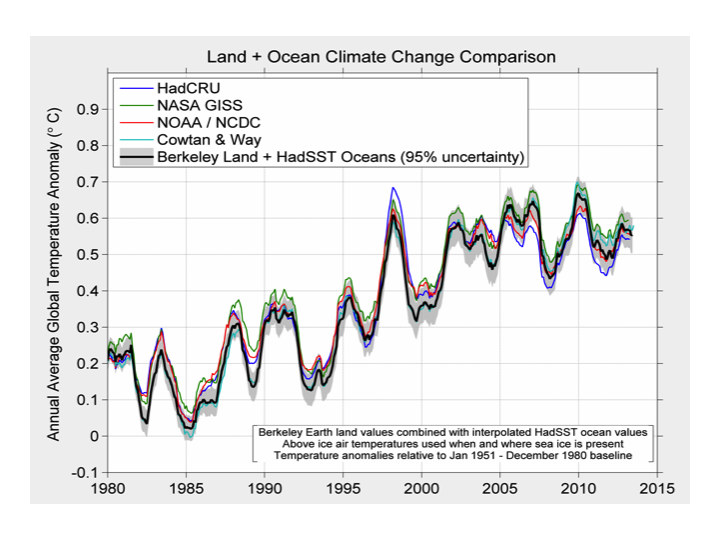 From the main text of the WMO report:
Global average temperatures are also estimated using reanalysis systems, which use a weather forecasting system to combine many sources of data to provide a more complete picture of global temperatures. According to data from the reanalysis produced by the European Centre for Medium-Range Weather Forecasts, the January to October combined land and ocean global average temperature would place 2014 as third or fourth highest for this dataset, which runs from 1958. Based on these lines of evidence it is most likely that 2014 is currently one of the four warmest years on record, but there is a possibility that the final rank will lie outside this range.
The reanalysis systems have been underutilized for estimated temperature trends, warmest years, etc. Because of changes to observing systems, the reanalyses have generally not been used for trend analyses. However, particularly for examining recent trends (e.g. the pause), I would say that the observing systems have arguably been sufficiently homogeneous since 1989 for this purpose. The great advantage of using the reanalyses is that ‘infilling’ for regions without observations is accomplished through data assimilation using a numeral weather prediction system (for details, see previous CE post reanalyses.org). This ‘infilling’ is done in a dynamically consistent way, which IMO is much better than the various statistical infilling or kriging strategies.
With regards to ‘warmest year’, Gavin Schmidt tweeted an interesting graph that illustrates record warmth estimates, although it is not clear what constitutes the distributions. In any event, it is seen that 2014 has a similar distribution to 1998, 2005, 2010. With this visualization, it is seen that 1998 clearly stood out as ‘warmest year’ at the time.

Implications for the pause
Well, ranking 1998, 2005, 2010 and 2014 as the ‘warmest years’ seems very consistent with a plateau in surface temperatures since 1998. Even if 2014 maintains its status among the top 4, how does this impact the ‘pause’ narrative?
RealClimate, Tamino, and probably others are busy trying to convince that the pause doesn’t exist. The preferred data set for such analyses is Cowtan and Way; I am not a fan of this dataset owing to concerns about how they treat the Arctic [link]. Statistical games can be played, and you can infer that there is a pause (or not).
The real issue is the growing divergence between climate model projections and the surface temperature observations, illustrated in this diagram by Ed Hawkins:
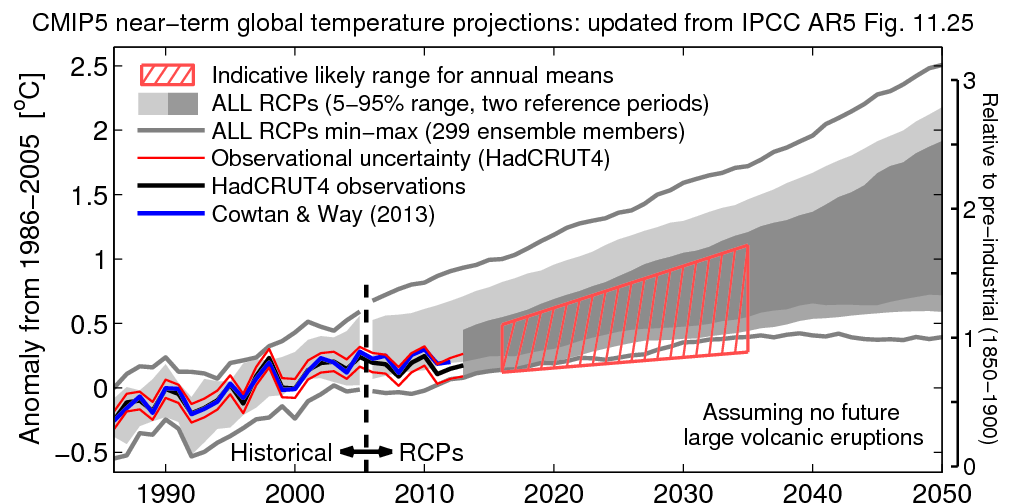
You can see that using the Cowtan and Way data set doesn’t help much with regards to the discrepancy: Cowtan and Way is within the error bars of HadCRUT4.
Updating this diagram to include 2014 is going to increase the discrepancy between the models and observations, because the climate models show an inexorable warming.
JC summary
Focusing on the ‘warmest year’ is a pointless exercise, unless the warm anomaly is as large as 1998. Focusing on the ‘pause’ is mainly significant in context of the comparison between climate model projections and surface temperatures.
Attempts to spin 2014 as a possible ‘warmest year’ is exactly that: spin designed to influence the Lima deliberations. While the WMO report was not unreasonable, their press release was a clear attempt to influence the Lima deliberations in the direction of being ‘alarmed.’
I’ll be waiting until HadCRUT and Berkeley Earth have provided their final 2014 temperature analyses (which will probably be sometime late winter). Particularly with regards to the recent temperature record and the ‘pause’, I think more scrutiny should be given to the various reanalyses, which in principle is probably the best way to provide a truly global analysis.
Letter from scientists prompts Suez Canal conspiracy theories
Mada Masr | October 8, 2014
A letter published in an international scientific journal about the ecological risks of expanding the Suez Canal has raised cries of conspiracy theories in local media.
The letter to the editor was signed by 18 scientists from around the world, including lead author Bella Galil of Israel’s National Institute of Oceanography. It was published in Biological Invasions, a peer-reviewed scientific journal which is ranked among the top 25 percent of scholarly publications in the fields of plant and animal sciences.
In keeping with the theme of the journal, the letter raises concerns that Egypt’s plans to widen the Suez Canal will speed the invasion of non-native species into the Mediterranean Sea.
It points out that half of the 700 multicellular non-native species found in the Mediterranean Sea were introduced via the Suez Canal, which it describes as “one of the most potent mechanisms and corridors for invasions by marine species known in the world.” Thus, the authors say, plans to expand the canal come as “ominous news.”
The migration of non-native sea creatures, many of whom have few natural predators in the Mediterranean, has led to “profound environmental, economic and human-health issues,” the authors say.
Among the examples cited are the annual swarms of jellyfish that harm tourism, fisheries and coastal installations such as desalination and power plants, the spread of poisonous pufferfish throughout the Levant and to Italy and Tunisia, and the invasion of several species of fish and prawns and oysters that have displaced local species that have traditionally been harvested by local fisherman.
The letter concludes with a reminder about international conventions that require signatories, including Egypt, to “prevent the introduction of, control or eradicate those alien species which threaten ecosystems, habitats or species,” and a call for a regionally-supervised environmental impact assessment to mitigate a new wave of invasive species that could migrate through a wider and deeper canal.
Ordinarily, a fairly technical letter-to-the-editor of a scientific journal would draw little notice outside of academia. In this case, however, it hit headlines because the lead signatory is a scientist from Israel’s National Institute of Oceanography, and because it involves the Suez Canal expansion, which is widely regarded as a patriotic national project that will underpin Egypt’s future economic success.
The story was picked up by Haaretz newspaper on October 6, and in turn by Egyptian publications. Although the letter was published September 28 in a journal based in the Netherlands, privately owned Youm7 ran a story on it under the headline: “A Zionist attempt to divert attention from October 6 commemoration. Israel starts war of rumors on new Suez Canal project. Tel Aviv publishes fabricated research claiming that widening the canal will pose environmental threat.”
Penguins, Polar Bears and Sea Ice
Jim Steele
View:
Part 1 Climate Sensitivity and Drought: Landscape Changes vs CO2
Part 2 Droughts and Heatwaves: Ocean Oscillations vs CO2
Part 3 Recovering Whales, Ocean Acidification, and Climate Horror Stories
Amid soaring fuel bills 25,000 UK pensioners to die this winter from cold weather
Press TV – November 12, 2014
A report says that a pensioner will die from cold weather every seven minutes in Britain this winter, amid soaring fuel bills.
The Age UK charity released the report on Tuesday, saying that, this winter, 25,000 elderly people in England and Wales will die as a result of the cold weather and due to high fuel costs and poorly insulated homes.
The charity also revealed that one in three pensioners, or more than 5 million elderly people, are worried that they will not be able to afford to warm their houses.
Caroline Abrahams, the charity’s director, said a growing number of people in Britain are facing difficulties in heating their homes properly.
“No older person should worry that they could die from the cold in their own home,” said Abrahams, adding, “Fuel poverty is a national scandal which has claimed the lives of too many people – both old and young – for far too long and left many more suffering from preventable illness.”
Abrahams called for a long-term solution to the problem, such as bringing Britain’s housing up to a high energy efficiency standard.
The government responded to the charity’s report by insisting that officials are already doing enough to protect elderly Britons struggling to heat their homes.
The UK has seen rising energy costs in recent years. A separate report published earlier this year revealed that the prices of domestic energy in the UK rose by 45 percent between 2008 and 2014.
Sagan’s baloney detection rules
By Judith Curry | Climate Etc. | November 9, 2014
On this 80th anniversary of Carl Sagan’s birthday.
Brain Pickings has a good post The Baloney Detection Kit: Carl Sagan’s Rules for Bullshit-Busting and Critical Thinking. Subtitle: Necessary cognitive fortification against propaganda, pseudoscience, and general falsehood. Excerpts:
In The Demon-Haunted World: Science as a Candle in the Dark, Sagan shares his secret to upholding the rites of reason, even in the face of society’s most shameless untruths and outrageous propaganda.
In a chapter titled “The Fine Art of Baloney Detection,” Sagan reflects on the many types of deception to which we’re susceptible — from psychics to religious zealotry to paid product endorsements by scientists, which he held in especially low regard, noting that they “betray contempt for the intelligence of their customers” and “introduce an insidious corruption of popular attitudes about scientific objectivity.”
Through their training, scientists are equipped with what Sagan calls a “baloney detection kit” — a set of cognitive tools and techniques that fortify the mind against penetration by falsehoods. Sagan shares nine of these tools:
- Wherever possible there must be independent confirmation of the “facts.”
- Encourage substantive debate on the evidence by knowledgeable proponents of all points of view.
- Arguments from authority carry little weight — “authorities” have made mistakes in the past. They will do so again in the future. Perhaps a better way to say it is that in science there are no authorities; at most, there are experts.
- Spin more than one hypothesis. If there’s something to be explained, think of all the different ways in which it could be explained. Then think of tests by which you might systematically disprove each of the alternatives. What survives, the hypothesis that resists disproof in this Darwinian selection among “multiple working hypotheses,” has a much better chance of being the right answer than if you had simply run with the first idea that caught your fancy.
- Try not to get overly attached to a hypothesis just because it’s yours. Ask yourself why you like the idea. Compare it fairly with the alternatives. See if you can find reasons for rejecting it. If you don’t, others will.
- Quantify. If whatever it is you’re explaining has some measure, some numerical quantity attached to it, you’ll be much better able to discriminate among competing hypotheses.
- If there’s a chain of argument, every link in the chain must work (including the premise) — not just most of them.
- Occam’s Razor. This convenient rule-of-thumb urges us when faced with two hypotheses that explain the data equally well to choose the simpler.
- Always ask whether the hypothesis can be, at least in principle, falsified. Propositions that are untestable, unfalsifiable are not worth much. Inveterate skeptics must be given the chance to follow your reasoning, to duplicate your experiments and see if they get the same result.
Just as important as learning these helpful tools, however, is unlearning and avoiding the most common pitfalls of common sense. In addition to teaching us what to do when evaluating a claim to knowledge, any good baloney detection kit must also teach us what not to do. He admonishes against the twenty most common and perilous ones — many rooted in our chronic discomfort with ambiguity — with examples of each in action.
Examples include ad hominem, argument from authority, argument from adverse consequences, appeal to ignorance, special pleading, begging the question, etc.
JC reflections
These ‘rules’ are useful commonsense reminders for evaluating any sort of claim. Too often serious baloney detection is ignored by scientists in the interests of careerism and advocacy. Carl Sagan’s birth 80 years ago is a fitting occasion to remind ourselves of these principles.
Featured Video

No Vote, No Representation, No State: Democracy, Israeli Style
or go to
Aletho News Archives – Video-Images
From the Archives
Sanctions, War and the Policy of Dual Containment
By SASAN FAYAZMANESH | March 17, 2008
It is now nearly three decades since the Unites States adopted the policy of dual containment of Iran and Iraq. While much has been written about the containment of Iraq, there has been very little in-depth analysis of this policy when it comes to Iran. In a book that is going to be released on March 31, 2008, entitled The United States and Iran: Sanctions, Wars and the Policy of Dual Containment (Routledge), I attempt to address this shortcoming by investigating when and why the US policy of containment of Iran came about, how it evolved, and where it stands today.[1] To the extent that Israel has been involved in US policy making, the study will also include the role that Israel has played in the containment of Iran. Also, since the fate of Iran has been inextricably linked to that of Iraq, occasionally the investigation will overlap with the containment of Iraq.
The policy of dual containment of Iran and Iraq originated during the Carter Administration, but it was not until the Clinton Administration that the expression “dual containment” became popular. … continue
Blog Roll
 Aletho News
- No Vote, No Representation, No State: Democracy, Israeli Style
- Zionist Bought Senate Blocks Information About American Citizens Killed By Israel
- While Gaza dominates the UN, these are the people keeping it alive
- New Report: “Scholasticide and Genocide in Gaza: Assessment, Testimonies and Legal Analysis”
- ‘THAAD Delusion’: Iran war exposes US missile shield limits – The Atlantic
- Moscow issues warning to NATO over Russian exclave
- Yes, the Iran war has destroyed Trump’s presidency
- The fallacy of US delusions about Iran’s economic collapse
- Hezbollah denies Syria cell link, warns of Israeli plan to sow discord
- The legacy of US sanctions, war, and occupation in Iraq
- If Americans Knew
- Mamdani releases plan to combat antisemitism and hate crimes in New York City
- Iran’s Revolutionary Guards Publish Letter to the American People
- DMFI launches $1 million ad campaign supporting Virginia’s Elaine Luria
- US Senate blocks resolution seeking report on Americans killed by Israel
- Israeli Attacks Kill Ten Palestinians in Gaza
- Massacre at Minab: The School That Became a Grave
- Israeli media: The IDF Shows It Doesn’t Turn a Blind Eye; It Actively Emboldens Settler Havoc
- As settlers ravage West Bank, Israeli forces kill 10 in Gaza – Daily Update
- New Report: “Scholasticide and Genocide in Gaza: Assessment, Testimonies and Legal Analysis”
- Ex-Biden officials are desperate for a Gaza scapegoat
- No Tricks Zone
- Green Energy Debacle: German Expert Professor Fritz Vahrenholt Warns Of Severe Economic And Social Consequences
- Two More Paleo Reconstructions Affirm Meters-Higher Sea Levels Across Ireland, Brazil 7000-6000 Years Ago
- New Study: Earth And Venus Surface Warmth Largely Explained By Convection And Lapse Rate, Not CO2 Or Radiation
- 2025 Nature Paper Claiming Worsening Global Drought Gets RETRACTED …Heavily Flawed
- New Study: ‘Global Drought Shows No Detectable Recent Acceleration Under Climate Warming’
- Economic Masterminds: German Socialists Suggest Taxing Productivity Gains Stemming From Using AI
- The South China Sea Has Not Been Cooperating With The Climate Change Narrative
- Energy Crisis: Germany Enters Heating Season With Historically Low Gas Reserve Fill Levels
- New Study: The Antarctic Ice Sheet Gained Mass From 2020-2024 Due To Staggering Snow And Ice Accumulation
- Study: Ocean Heating Rates From Thousands Of Years Ago ‘Dwarf’ Modern Ocean Heating Rates

