Unminced Words By Climate Scientist Hans von Storch
“Scientists Too Quick To Claim Last Word”
No Trick Zone | November 18, 2013
The Resonator, the research podcast of the German Helmholtz Research Group conducted a long interview (1 hr 40 min!) with climate scientist Hans von Storch director of the GKSS Research Center. In the interview von Storch was asked about his views on a wide variety of climate science related issues.
Overall the interview saw a Hans von Storch who spoke frankly and openly. Some of the remarks he made raised my eye brows. In general von Storch, best described as a non-alarmist warmist, views the climate debate as being dominated by the more extreme positions from both sides, with voices in the middle getting drowned out. He levels a fair amount of criticism at the climate science community, but does so without naming any persons in particular.
Due to the sheer length of the interview, I will only look at the points that I found interesting and relevant as skeptic.
Scientists too quick to accept dramatic scenarios
At the 15-minute mark von Storch describes a science that is so politicized with both sides are trying to make it black and white, and a debate that has been overly shrill. Some scientists, he says, have tended to accept dramatic scenarios and consequences even when there’s little evidence behind them. He also talks of a group of scientists who fancy themselves as the ultimate authority and who have the last word. All the exaggerations and projections of doom, gloom and disaster have led to an overall discrediting of the field.
“Science and Nature are pretty bad journals”
At the 29-minute mark von Storch says he sees himself as someone who needs a lot of time before he is convinced of anything. I was surprised to hear him call both Science and Nature “pretty bad journals” when it comes to the quality of their articles. Hans von Storch cites an article published by Science claiming that the climate was going to tip in the year 2047, calling the report “a real doozy“. He says that science journals must remain sufficiently critical and not let themselves get caught up with the zeitgeist. Von Storch admits that he has not always been popular among the community.
Overall von Storch doesn’t blame the media much for the hysteria, implying that the hysteria stems more from scientists communicating poorly. The media are only interpreting what the scientists are spewing. Projections of snowless winters, for example, were hardly helpful in lending credibility to climate science.
Scientists dramatizing for attention and prestige
At the 37-minute mark von Storch believes some scientists succumbed to drama in order to get attention and prestige, and says that the such are only damaging the credibility of climate science.
Models too CO2-centric
At the 40-minute mark von Storch discusses possible reasons why the warming has stalled and thinks other explanations need to be examined, such as solar activity and aerosols. He finds climate models too CO2-centric in general. Here he appeals for more patience to let the science unfold.
At the 45 minute mark he fires harsh criticism at scientists who promote a society governed by an elite technocracy, calling the idea “stupidity”. He calls the proposals made by a group of scientists in favor of appointing future councils to represent the interests of future generations “peculiar”.
At the 59-minute mark, on whether storms are becoming more frequent and severe, von Storch says he doesn’t think this is the case and that the disasters are more about the over-development of coastal areas.
Hockey stick was “something dumb” – an attempt to steer politics
On the hockey stick chart, at the 63 minute mark, von Storch has some blunt words on how it was possible to for it to become the icon that it became. He recalls having examined the chart himself and found it deficient.
“I believe it was something dumb by scientists who wanted to steer politics.”
He thinks the climate science community were too quick to call it the last word. Hans von Storch sees critique of the hockey stick and confirmed and that’s why it no longer appears in the IPCC reports. Scientists, von Storch reminds us, should not be so quick to claim absolute truth.
Also, von Storch believes that the oceans could be warming up, but that there is very little data out there to confirm it.
Mummy, The Ocean’s Eaten My Heat!!
By Paul Homewood | Not A Lot Of People Know That | September 24, 2013
I’ve been meaning to post on this for a while. We often hear the claim that all of the missing heat has been gobbled up by the oceans.
Now, let’s leave aside some of the obvious problems with this theory, such as:
- How all of this heat has selectively and mysteriously managed to avoid land areas.
- How warm water has managed to sink instead of rise.
- How the water at, or near, the surface seems to have escaped this warming.
And get straight to the nub of the matter.
Water has a much higher heat capacity than air. According to NOAA,
The oceans store more heat in the uppermost 3 meters (10 feet) than the entire atmosphere (above it).
So let’s run some very simple calculations.
In the last decade, most models were predicting something of the order of 0.2C global warming. If, instead of warming the atmospheric , this extra heat has gone into the sea, its effects will be much diluted, with the result that increases in sea temperatures will be much, much less than 0.2C.
(Remember, it takes much more energy to warm a bucket of water by 1C than a bucket of air.)
The suggestion is that, as there has been no noticeable warming in the upper 100 meters, this “hidden heat” is as far as 2000 meters down.
So, ocean temperature should have increased by:
2000 Meters Divided By 3 Meters = 666.6
0.2C Divided By 666.6 = 0.0003C
The idea that we can:
- measure sea temperatures throughout all the oceans of the world
- measure it throughout the whole depth down to 2000 meters and more.
- take into account seasonal changes
- take into account shifting ocean cycles and currents.
and still be able to measure the overall temperature to better than three ten thousandths of a degree is patent nonsense.
So step forward Professor Ted Shepherd, a leading atmospheric scientist and recently installed as Grantham Chair in Climate Science at Reading University.
He had this to say to the Guardian.
“The heat is still coming in, but it appears to have gone into the deep ocean and, frustratingly, we do not have the instruments to measure there,”
Or to put it another way, we have no idea whether it is or not, but in the meantime we’ll still cling to our theory.
20 tips for interpreting scientific claims
By Judith Curry | Climate Etc. | November 20, 2013
This list will help non-scientists to interrogate advisers and to grasp the limitations of evidence – William J. Sutherland, David Spiegelhalter and Mark A. Burgman.
Nature has published a very interesting comment, titled Twenty tips for interpreting scientific evidence. Excerpts:
Perhaps we could teach science to politicians? It is an attractive idea, but which busy politician has sufficient time? The research relevant to the topic of the day is interpreted for them by advisers or external advocates.
In this context, we suggest that the immediate priority is to improve policy-makers’ understanding of the imperfect nature of science. The essential skills are to be able to intelligently interrogate experts and advisers, and to understand the quality, limitations and biases of evidence.
To this end, we suggest 20 concepts that should be part of the education of civil servants, politicians, policy advisers and journalists — and anyone else who may have to interact with science or scientists. Politicians with a healthy scepticism of scientific advocates might simply prefer to arm themselves with this critical set of knowledge.
Differences and chance cause variation. The real world varies unpredictably. Science is mostly about discovering what causes the patterns we see. Why is it hotter this decade than last? There are many explanations for such trends, so the main challenge of research is teasing apart the importance of the process of interest from the innumerable other sources of variation.
No measurement is exact. Practically all measurements have some error. If the measurement process were repeated, one might record a different result. In some cases, the measurement error might be large compared with real differences. Results should be presented with a precision that is appropriate for the associated error, to avoid implying an unjustified degree of accuracy.
Bias is rife. Experimental design or measuring devices may produce atypical results in a given direction. Confirmation bias arises when scientists find evidence for a favoured theory and then become insufficiently critical of their own results, or cease searching for contrary evidence.
Bigger is usually better for sample size. The average taken from a large number of observations will usually be more informative than the average taken from a smaller number of observations. That is, as we accumulate evidence, our knowledge improves. This is especially important when studies are clouded by substantial amounts of natural variation and measurement error.
Correlation does not imply causation. It is tempting to assume that one pattern causes another. However, the correlation might be coincidental, or it might be a result of both patterns being caused by a third factor — a ‘confounding’ or ‘lurking’ variable.
Regression to the mean can mislead. Extreme patterns in data are likely to be, at least in part, anomalies attributable to chance or error.
Extrapolating beyond the data is risky. Patterns found within a given range do not necessarily apply outside that range.
Scientists are human. Scientists have a vested interest in promoting their work, often for status and further research funding, although sometimes for direct financial gain. This can lead to selective reporting of results and occasionally, exaggeration. Peer review is not infallible: journal editors might favour positive findings and newsworthiness. Multiple, independent sources of evidence and replication are much more convincing.
Feelings influence risk perception. Broadly, risk can be thought of as the likelihood of an event occurring in some time frame, multiplied by the consequences should the event occur. People’s risk perception is influenced disproportionately by many things, including the rarity of the event, how much control they believe they have, the adverseness of the outcomes, and whether the risk is voluntarily or not.
Data can be dredged or cherry picked. Evidence can be arranged to support one point of view. The question to ask is: ‘What am I not being told?’
JC comments: I really like the idea behind this article:
What we offer is a simple list of ideas that could help decision-makers to parse how evidence can contribute to a decision, and potentially to avoid undue influence by those with vested interests.
I suspect this article will not be appreciated by scientists who are playing power politics with their expertise, or by advocates promoting scientism with cherry-picked evidence.
I picked 10 of the 20 tips that I thought were of greatest relevance to the climate change debate.
Related article
- The 97% consensus myth – busted by a real survey (wattsupwiththat.com)
US makes first step toward banning trans fats
RT | November 7, 2013
The Food and Drug Administration announced on Thursday that it would require the food industry to phase out the use of artificial trans fats in its products.
The FDA said it has made a preliminary determination that the primary source of trans fat – partially hydrogenated oils – is no longer “generally recognized as safe,” and that it plans to ban their use in the market. Some trans fat is naturally generated in meat and dairy products, and the ban will only apply to trans fat added to foods.
According to FDA Commissioner Margaret Hamburg, the decision could potentially prevent 20,000 heart attacks a year and 7,000 deaths.
Over the last decade, American consumption of trans fat has declined significantly. In 2006, the average citizen was consuming 4.6 grams of trans fat a day, while the number decreased to roughly one gram a day in 2012. Still, Hamburg said they “remain an area of significant public health concern,” according to NBC News.
Many companies began eliminating the use of trans fat when the FDA required them to list the ingredient on nutritional labels in 2006, but it can still be found in common products like frozen pizza, microwave popcorn, margarine, coffee creamer, and various desserts.
“The artery is still half clogged,” Dr. Thomas Frieden, the director of the Centers for Disease Control and Prevention, said to the New York Times. “This is about preventing people from being exposed to a harmful chemical that most of the time they didn’t even know was there.”
“It’s quite important,” he added, referring to the FDA’s new proposal. “It’s going to save a huge amount in health care costs and will mean fewer heart attacks.”
Numerous studies have shown that there is virtually no health benefit to consuming trans fat. It lowers the level of “good” cholesterol and raises levels of “bad” cholesterol, clogging the arteries and increasing the risk of heart attacks.
The FDA did not lay out a timetable for the ban. It will open its proposal to public comment for 60 days while it formulates a schedule that gives food manufacturers enough time to cooperate with the new rule.
“We want to do it in a way that doesn’t unduly disrupt markets,” Michael Taylor, the FDA’s deputy commissioner for foods, said to the Associated Press. At the same time, he said the food “industry has demonstrated that it is by and large feasible to do.”
Public health groups have welcomed the FDA’s proposal, which the agency has been collecting data for since 2009.
Should the FDA move forward with its plan, the United States will join other nations such as Denmark, Iceland, and Switzerland, in banning the ingredient.
Still, there are numerous other ingredients that have been outlawed in various countries while still being sold in the U.S. An, article by BuzzFeed over the summer noted that brominated vegetable oil, which has been linked to birth defects and organ damage, continues to be used in sports drinks and the popular soda Mountain Dew. It’s been banned in more than 100 countries.
Meanwhile, synthetic hormones rGBH and rBST, linked to cancer and infertility, continue to be given to cows and show up in dairy products that aren’t labeled otherwise. They’ve been banned in Japan, Canada, New Zealand, Australia, and the European Union.
Earlier this month, the FDA banned three out of the four brands of arsenic-laced animal feed that was being given to chickens, turkeys, and pigs. The decision came four years after the Center for Food Safety called on the FDA to remove the feed, but one brand remains on the market.
Related article
Satellite sea level data has been “adjusted” upward by 34% over past 9 years alone
THE HOCKEY SCHTICK |October 30, 2013
There are many documented examples of sea level data from satellite altimeters being “adjusted” upward many years after publication, often repeatedly on the same data, and in defiance of the laws of probability, always in an upward direction. Seven documented examples can be found in the links in this post. A recent comment in a sea level article on the Yale Environment 360 site documents another example of sea level data being adjusted upward by 34% [by 1 mm/yr, equivalent to an additional 4 inches per century] over the 9 years since it was collected and published on the University of Colorado website.
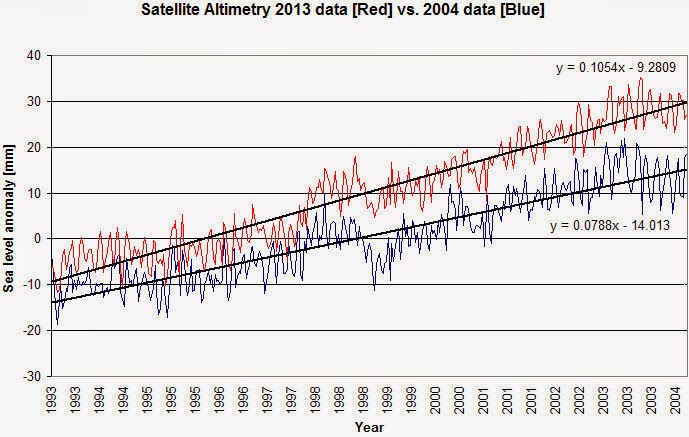 |
| Data published on U of Colorado website in 2004 shown in blue. Same data after 9 years of adjustments published on same website today shown in red. The slope of the same 1992-2004 data has somehow increased by 34% over the past 9 years. |
H/T: Based upon the comment by Steve Case in this article:
Here’s an interesting presentation by Dr. R. Steve Nerem, who is well quoted in the article:
“Why has an acceleration of sea level rise not been observed during the altimeter era?” R. Steven Nerem (University of Colorado)
One has to wonder what all the excitement is about if for the last twenty years there has been no acceleration of the rate. Couple that with the fact that it’s rather easy to determine that there’s been a good deal of inflating the rate of sea level rise by those same CU Sea Level Research Group scientists.
Simply put the URL of their home page (http://sealevel.colorado.edu/) into the Internet WayBack Machine (https://archive.org/) and see for yourself.
This archived time line:
(https://web.archive.org/web/20040719102733/http://sealevel.colorado.edu/2004_rel1.2/sl_ib_ns_cu2004_rel1.2_global.txt) differs from the current one: (http://sealevel.colorado.edu/files/2013_rel7/sl_ns_global.txt) in a rather interesting fashion. Changes have been made to the data resulting in an increase in the rate of reported sea level rise by nearly a millimeter per year.
Also see my comments on the same article:
Sea levels have been rising naturally for the past 20,000 years and at much, much faster rates in the past (up to 40 times faster than today). http://www.globalwarmingart.com/wiki/File:Post-Glacial_Sea_Level_png
Sea levels are currently rising 4 to 8 inches per century, and there is no acceleration, which means there is no evidence of a human influence on sea levels: http://hockeyschtick.blogspot.com/2013/09/new-paper-finds-sea-levels-rising-at.html
References finding no acceleration:
JM Gregory et al Journal of Climate 2012, M Beenstock et al 2013, NOAA 2005-2012 Sea Level Budget, Dean & Houston 2011 & 2013, Scafetta 2013, Holgate 2007, Boretti 2012, Morner 2004, Jevrejeva et al., 2006 & 2008, Wöppelmann et al., 2009
“no long-term acceleration of sea level has been identified using 20th-century data alone.”
“It is likely that GMSL (Global Mean Sea Level) rose between 1920 and 1950 at a rate comparable to that observed between 1993 and 2010”
… the authors find that sea level rise is a localized rather than global phenomenon, with 61 percent of tide gauge records demonstrating no change in sea levels, 4 percent showing a decrease, and a minority of 35 percent showing a rise. This implies relative sea level change is primarily related to subsidence or post-glacial rebound (land height changes) rather than melting ice or steric sea level changes (thermal expansion from warming). http://hockeyschtick.blogspot.com/2013/09/new-paper-finds-sea-levels-rising-at.html
Long Green
By Willis Eschenbach | Watts Up With That? | October 27, 2013
The US has some of the world’s most boring looking money—it’s all green. So we have terms like “greenbacks” for dollars, and “long green”, meaning lots of money.
I offer this as context for what I found when I got to wondering what had happened to the United Nations “Green Climate Fund”. You may recall that the Green Climate Fund was set up by the UN as the only result of the most recent Rio de Janeiro conference on climate idiocy. When the Fund is going full throttle, it is supposed to disburse no less than $200 billion ($200,000,000,000) dollars each and every year to the developing countries.
It turns out that, unlike those of us skeptics who are falsely accused of receiving big bucks from big oil, the “Green Climate Fund” has already raked in millions of dollars to spend on fighting the evil forces of carbon. They have a catchy slogan, viz: “The urgency and seriousness of climate change call for ambition in financing adaptation and mitigation”. Ambition in financing? What’s not to like?
Now, I’ve worked for development organizations before. The rule of thumb is that no more than 15% of the funds should go for administration, the rest needs to go to the eventual intended recipients of the largesse.

So … how many of the millions of dollars that have been “donated” by taxpayers in a variety of countries has gone to the actual poor, to aid them in their battle against the dread CO2?
Let’s start how much money we’re talking about.
Here’s a list of the countries who are both rich and improvident enough to squander their taxpayers’ money on the Green Climate Fund. It’s the usual suspects, my condolences to their citizens who are paying for this:
Australia, $513,000
Denmark, $608,000
Finland, $648,000
France, $326,000
Japan, $500,000
Germany, $1,053,000
South Korea, $2,099,000
Netherlands, $286,000
Sweden, $752,000
UK, $770,000
TOTAL, $7,555,000
The Koreans put in two megabucks … but then, they also negotiated a deal where the Green Climate Fund is headquartered in Seoul. So no tears for them, they’ll make out like bandits. Landing a UN drone hive is like landing a money machine, the local landlords will be overjoyed.
Now, of course, $7.5 million, that’s a long ways from their goal of dispersing $200 billion per year. In fact, it’s about this far from their goal:
 I see this as very good news—perhaps the countries of the world have figured out that they have better things to do with their money.
Anyhow, I started all of this out with a simple question. How much of the $7.5 million went to help the people it’s supposed to help?
Here’s the not-so-simple answer. When you do this kind of thing, first you have to hand out the plum jobs. Among those are the Members of the Board. Of course, then you have to pay for their travel, and a place for them to meet, for their meetings. And it turns out that three Board Meetings cost just under a million dollars. Expensive meetings. Very expensive meetings.
Oh, can’t forget the Board Committees, Panels, and Working groups. They cost just under four hundred thousand. Total, a million three …
The next round of plum jobs are the people who make up the “Interim Secretariat”. From the name, I take it that these folks are just placeholders until we get more parasites for the real Secretariat … in any case, there’s two million in the budget to hire fifteen people. My mathematics makes that $133,000 per person per year.
So one thing is clear. The UN Personnel came to do good for the poor … and they’re doing very well indeed. A hundred and thirty grand per person? You can see why the South Koreans will be the big winners in the deal.
It gets worse. They actually hire themselves to do the work, at incredible rates. For example, from the UN FCCC they are hiring one full-time and one part-time person, plus some administrative support … for a cool half million dollars. One and a half people. Half a megabuck.
And from the UN GEF, same deal, one full-time and one 60% time person, cost, another half million.
Now, you and I might be satisfied by that. But the UN folks are realists. They know that even if all those fifteen UN drones could somehow work together, they still couldn’t organize a booze-up in a frat house. For that, they always hire consultants. You know, people who can actually do the stuff the UN employees can only talk about.
So the Green Climate Fund has three-quarters of a million bucks in the budget for consultants, to make sure something gets done.
Oh, and did I mention $200,000 per year for the Executive Director?
Now, you gotta know that you can’t have fifteen pluted bloatocrats, plus 3.1 loan-drones from other UN agencies, and three-quarters of a million dollars worth of consultants, without renting some executive-type hive to house the worker bees. Plus phones and faxes and the like, that’s a million two …
Of course, you can’t do business by email, phone, and Skype. Gotta have a travel budget … three hundred grand.
Add all that up, and the “Interim Secretariat” costs $5.3 million …
Lastly, a Trust Fund needs an Interim Trustee. The Green Climate Fund hires that service from the World Bank for just under three-quarters of a million dollars per year … one trustee … IT costs … I can hardly believe it myself, but by a strange coincidence, what it costs them to run the Green Climate Fund adds up to … well … about seven and a half million dollars.
And that means that of the $7.5 million dollars donated by taxpayers all over the world, the people in the developing countries will get …
None.
Like I said, while I bemoan the waste of resources, I see all this as good news. Any country that takes a serious look at what’s happened to the first seven plus million that was donated to the Green Climate Fund will certainly have second thoughts about giving them money.
And that’s a good thing, because if they are this profligate with the first seven and a half million … can you imagine these same pack of over-fed fools in charge the dispensing of two hundred billion dollars to the developing world? I shudder to think of the waste, corruption, bribery, blackmail, and tribalism that would be involved in that kind of an industrial-scale goat-rope. The only people who’d be happy if that happened would be corrupt developing world leaders … and of course, Swiss bankers …
DATA: I do give the GCF high marks for one thing: transparency. All relevant documents are here.
Related articles
- Green Climate Fund ‘Can Power Poor’ (ivoter.net)
- Green Climate Fund ‘can power poor’ (eco-business.com)
- Green Climate Fund ‘can power poor’ (climatenewsnetwork.net)
- United Nations “Green Climate Fund” oddly having trouble attracting donors (seeker401.wordpress.com)
What if we named hurricanes after climate change deniers? Revisited
As scientific evidence shows that climate change is creating increasingly frequent and devastating storms, and with climate scientists declaring these extreme weather events as the new normal, we propose a new naming system. A system that names extreme storms caused by climate change, after the policy makers who deny climate change and obstruct climate policy.
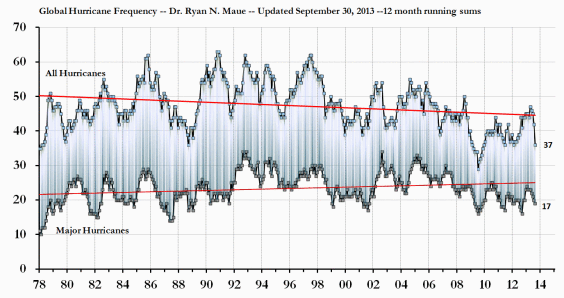
Closing in on the November 30th ending of the 2013 hurricane season:

Atlantic Hurricane Season Quietest in Decades

~
~
http://www.youtube.com/watch?v=Ku_IseK3xTc#t=66
Related article
Caribbean Water
By Rud Istvan | Climate Etc… | October 19, 2013
The Associated Press ran an alarming news piece on 9/6/13: Climate Change Threatens Caribbean’s Water Supply
It was picked up and echoed around the world, from Time Magazine’s Space and Science section in the US to CBC Canada to ABC Australia to ZeeNews India. The headline was everywhere, repeated at the Huffington Post as ‘Caribbean water supplies severely threatened by climate change.” The AP story reported on contemporary expert warnings at an August 2013 UN conference in St. Lucia. The lead AP paragraph is quite clear:
“Experts are sounding a new alarm about the effects of climate change for parts of the Caribbean—the depletion of already strained drinking water throughout much of the region.”
Experts like Avril Alexander, Caribbean coordinator of Global Water Partnership:
“When you look at the projected impact of climate change, a lot of the impact is going to be felt through water.”
Experts like Lystra Fletcher-Paul, Caribbean land/water officer for the UN FAO:
“Inaction is not an option. The water resources will not be available.”
Yet another anthropogenic global warming alarm, and just in time for IPCC AR5, whose newly released WG1 chapters 7 and 11 say there is high confidence that dry regions will get drier, wet regions will get wetter, and storms will get stormier. “But there is only low confidence in the magnitude.” These Caribbean experts are much more certain—Caribbean water resources will not be available.
Little in this MSM AP news is what it seems. Paragraph 2 starts out saying rising sea levels could contaminate Caribbean fresh water supplies. What a curious assertion. Less dense fresh water floats on top of salt water no matter the sea level. Excessive groundwater draw-down can cause saltwater intrusion from below. That is already a problem in urbanized Broward County, Florida despite proximity to the Everglades. And on the Tuvalu atolls in the Pacific, where government owned tourist hotels have strained its very limited groundwater capacity. Tuvalu is another urban development problem, not AGW. It was caused by Tuvalu’s government itself, eager to develop ecotourism (diving) after their new Funafuti runway was built with World Bank financing.

Saltwater intrusion doesn’t apply much to Caribbean island groundwater. The islands are mountainous. Pico Duarte in the DR is 3098m. Pic la Selle in Haiti is 2680m. Jamaica’s Blue Mountain is 2256m. Cuba’s Pico Turquina is 1974m. Antigua’s ‘Boggy Peak’ is 402m. St. Croix’ ‘Mount Eagle’ is 355m. Barbados is only hilly, with a maximum elevation of ‘just’ 343m. Barbados:

Rising sea levels will not contaminate Caribbean fresh water supplies.
The AP reported that Jason Johnson, head of the Caribbean Water and Wastewater Association, said the real issue is groundwater replenishment.
“Many Caribbean nations rely exclusively on underground water for their needs, a vulnerable source that would be hit hard by climate change effects. That’s the greatest concern. Those weather patterns may change, and there may not necessarily be the means for those water supplies to be replenished at the pace that they have historically been replenished.”
The AP noted some of the islands experienced an unusual dry spell in 2012. That’s weather. But Cedric Van Meerbeck, climatologist with the Caribbean Institute for Meteorology & Hydrology, made the inevitable AGW connection:
“There are a number of indications that the total amount of rainfall in much of the Caribbean would be decreasing by the end of the century.”
Since 2012 was dry, and AR5 WG1 Chapter 7 executive summary says dry will get dryer, perhaps IPCC pronouncements are the indications. But regionally down-scaled GCMs cannot make such predictions on multi-decadal time scales. [1]
Intense rains fully ameliorated the unusual 2012 dry spell early in the usual 2013 Caribbean tropical storm season. AR5 WG1 7.6.2 also says wet will get wetter and storms stormier. That worries Barnard Ettinoffe, President of the Caribbean Water and Sewerage Association:
“Heavy rains mean there’s not enough time for water to soak into the ground as it quickly runs off.”
Climate change causes dry to get drier and wet to get wetter according to AR5 WG1 11.3.2.3.1. It threatens Caribbean island water supply both ways!
What is actually going on was clued in the lead AP paragraph above—depletion of already strained water supplies throughout much of the region.
Much of the region is not correct. The AP story cites a 2012 study from British investment risk firm Maplecroft [2] saying Barbados is most at risk, but Cuba and the Dominican Republic also have high water security risk. On the large island of Hispaniola, the Dominican Republic has 2069m3 of renewable water per capita according the World Bank.[3] Cuba has 3381m3. The UK (another island for comparison sake) has 2311m3 but is not a water risk. The only way Cuba and the Dominican Republic could have a high water security risk rating (when the UK doesn’t) is through some illogic unrelated to water.
Barbados (although verdant, as the above picture proves) does have the least per capita renewable water in the Caribbean, only 284m3. That is because Barbados water consumption has doubled over the past 50 years [4] as its population has grown from ≈232K to ≈280K while its per capita GDP tripled from ≈$4k to ≈$12k. Water has become a major problem, and Barbados doesn’t have the oil wealth to import food (virtual water) or desalinate seawater like Saudi Arabia (86m3). Barbados’ water problem is anthropogenic, but not AGW. It is about unsustainable population growth and economic development on a smallish dryish island–just like on Tuvalu.
Another Caribbean country with current water problems is Antigua/Barbuda, at 590m3. Neither indigenous Caribbean tribes nor Spanish conquistadors settled those islands because of insufficient fresh water. The British did later. The country’s population has almost doubled from ≈54k in 1960 to ≈90k today. That always eventually causes finite resource problems. And now has in naturally dry Antigua/Barbuda.
Climate change does not threaten Caribbean water supplies. Population growth and economic development already do on some of the smaller islands. And they are using climate change to ‘extort’ financial aid (e.g. for desalination) from the usual rich ‘guilty’ AGW culprits.
The UN Framework Convention on Climate Change organized this regional conference (at St. Lucia’s luxurious Bay Gardens Hotel/Resort) for Caribbean environment ministers and politicians. The UN organizer’s locally televised purpose was to give “these less developed country ministers and politicians the information and tools to know what to ask for in the negotiations leading up to the new world agreements of 2015”. That starts at COP19 in Warsaw in November 2013.
It is no coincidence the conference was held on St. Lucia. Its minister presently heads the Alliance of Small Island States (AOSIS). AOSIS says its 44 member states comprise 30% of developing countries, 20% of UN member states, and 5% of world population. The AOSIS agenda for COP19 is clear from its PR after being disappointed at June 2013 Bonn meetings:
At the closing of the latest round of U.N. climate talks, the Alliance of Small Island States (AOSIS), a group of 44 low-lying and coastal countries that are highly vulnerable to the impacts of climate change, released the following statement:
“After losing two weeks to needless procedural wrangling, it is worth recalling the scale of the challenge we face and the precious little time remaining to meet it… Therefore an international mechanism to address the permanent injury our islands are experiencing [emphasis added] must be established this year at the Warsaw conference.”
Tuvalu is the AOSIS member most aggressively agitating for UN ‘climate change aid’, having experienced saltwater intrusion caused by government tourist hotel development. Hence the AP story’s odd second paragraph, which is unrelated to the Caribbean but right in the AOSIS (Tuvalu) lobbying sweet spot.

Hey mon, its Babylon politricks. (H/T to Bob Marley and Jamaica, a Caribbean island of 2.7 million people enjoying 2473m3 renewable water per capita and fantastic reggae music.)
[1] Pielke Sr., Regional Climate Downscaling: What’s the Point, EOS 93: 52-53 (2012)
[2] Maplecroft Global Risk Analytics, info@maplecroft.com
[3] Available at data.worldbank.org/indicator/ER.H2O.INTR.PC
[4] Barbados Free Press editorial on water rationing 2/28/10
Featured Video

No Vote, No Representation, No State: Democracy, Israeli Style
or go to
Aletho News Archives – Video-Images
From the Archives
Sanctions, War and the Policy of Dual Containment
By SASAN FAYAZMANESH | March 17, 2008
It is now nearly three decades since the Unites States adopted the policy of dual containment of Iran and Iraq. While much has been written about the containment of Iraq, there has been very little in-depth analysis of this policy when it comes to Iran. In a book that is going to be released on March 31, 2008, entitled The United States and Iran: Sanctions, Wars and the Policy of Dual Containment (Routledge), I attempt to address this shortcoming by investigating when and why the US policy of containment of Iran came about, how it evolved, and where it stands today.[1] To the extent that Israel has been involved in US policy making, the study will also include the role that Israel has played in the containment of Iran. Also, since the fate of Iran has been inextricably linked to that of Iraq, occasionally the investigation will overlap with the containment of Iraq.
The policy of dual containment of Iran and Iraq originated during the Carter Administration, but it was not until the Clinton Administration that the expression “dual containment” became popular. … continue
Blog Roll
 Aletho News
- No Vote, No Representation, No State: Democracy, Israeli Style
- Zionist Bought Senate Blocks Information About American Citizens Killed By Israel
- While Gaza dominates the UN, these are the people keeping it alive
- New Report: “Scholasticide and Genocide in Gaza: Assessment, Testimonies and Legal Analysis”
- ‘THAAD Delusion’: Iran war exposes US missile shield limits – The Atlantic
- Moscow issues warning to NATO over Russian exclave
- Yes, the Iran war has destroyed Trump’s presidency
- The fallacy of US delusions about Iran’s economic collapse
- Hezbollah denies Syria cell link, warns of Israeli plan to sow discord
- The legacy of US sanctions, war, and occupation in Iraq
- If Americans Knew
- Mamdani releases plan to combat antisemitism and hate crimes in New York City
- Iran’s Revolutionary Guards Publish Letter to the American People
- DMFI launches $1 million ad campaign supporting Virginia’s Elaine Luria
- US Senate blocks resolution seeking report on Americans killed by Israel
- Israeli Attacks Kill Ten Palestinians in Gaza
- Massacre at Minab: The School That Became a Grave
- Israeli media: The IDF Shows It Doesn’t Turn a Blind Eye; It Actively Emboldens Settler Havoc
- As settlers ravage West Bank, Israeli forces kill 10 in Gaza – Daily Update
- New Report: “Scholasticide and Genocide in Gaza: Assessment, Testimonies and Legal Analysis”
- Ex-Biden officials are desperate for a Gaza scapegoat
- No Tricks Zone
- Green Energy Debacle: German Expert Professor Fritz Vahrenholt Warns Of Severe Economic And Social Consequences
- Two More Paleo Reconstructions Affirm Meters-Higher Sea Levels Across Ireland, Brazil 7000-6000 Years Ago
- New Study: Earth And Venus Surface Warmth Largely Explained By Convection And Lapse Rate, Not CO2 Or Radiation
- 2025 Nature Paper Claiming Worsening Global Drought Gets RETRACTED …Heavily Flawed
- New Study: ‘Global Drought Shows No Detectable Recent Acceleration Under Climate Warming’
- Economic Masterminds: German Socialists Suggest Taxing Productivity Gains Stemming From Using AI
- The South China Sea Has Not Been Cooperating With The Climate Change Narrative
- Energy Crisis: Germany Enters Heating Season With Historically Low Gas Reserve Fill Levels
- New Study: The Antarctic Ice Sheet Gained Mass From 2020-2024 Due To Staggering Snow And Ice Accumulation
- Study: Ocean Heating Rates From Thousands Of Years Ago ‘Dwarf’ Modern Ocean Heating Rates

