Thom Hartmann’s ‘Last Hours’ video negated by IPCC AR5
By Anthony Watts | Watts Up With That? | October 13, 2013
From The End is Near department comes this video documentary from lefty talk radio guy Thom Hartmann that claims we are on the verge of a “mass extinction” due to climate change. Only one problem; the IPCC says “no” to his scenario. Ooops.
From the YouTube description, bold mine:
“Last Hours” is the first in a series of short films that explore the perils of climate change and the solutions to avert climate disaster. Each subsequent film will highlight fact-based challenges facing the human race, and offer solutions to ameliorate these crises. The initial short film series will culminate in a feature film to be presented prior to COP21, the 2015 UN Conference on Climate Change in Paris.
An asset for the climate change movement, “Last Hours” will be disseminated globally to awaken modern culture worldwide about the various dangers associated with climate change.
“Last Hours” describes a science-based climate scenario where a tipping point to runaway climate change is triggered by massive releases of frozen methane. Methane, a powerful greenhouse gas, has already started to percolate into the open seas and atmosphere from methane hydrate deposits beneath melting arctic ice, from the warming northern-hemisphere tundra, and from worldwide continental-shelf undersea methane clathrate pools.
Burning fossil fuels release carbon that, principally through greenhouse effect, heat the atmosphere and the seas. This is happening most rapidly at the polar extremes, and this heating has already begun the process of releasing methane. If we do not begin to significantly curtail the use of carbon-based fossil fuels, this freed methane threatens to radically accelerate the speed of global warming, potentially producing a disaster beyond the ability of the human species to adapt.
This first video is designed to awaken people to the fact that the earth has experienced five major extinctions in the deep geologic past — times when more than half of all life on earth vanished — and that we are now entering a sixth extinction. Industrial civilization with its production of greenhouse gases has the ability to trigger a mass extinction; in the extreme, it could threaten not just human civilization, but the very existence of human life on this planet.
The world community and global citizens urgently need to chart a path forward that greatly reduces green house gas emissions. To take action and follow the pathway to solutions to the climate crisis, you can explore this website and you can also sign-up for future updates. Thank you.
It’s the old “methane emergency” meme again.
But here’s the problem.
Apparently Thom never got the memo from the IPCC AR5. Note the third and fourth items in Table 12.4 from the IPCC:

Definitions for this table can be found in the section “TFE.5: Irreversibility and Abrupt Change” in the draft report. They say:
“Abrupt climate change is defined in AR5 as a large-scale change in the climate system that takes place over a few decades or less, persists (or is anticipated to persist) for at least a few decades, and causes substantial disruptions in human and natural systems.”
But alas, IPCC says Clathrate methane release is very unlikely, and they have high confidence in that assessment. Permafrost doesn’t seem to be much of a problem either, as it doesn’t seem to have the potential for abrupt climate change.
Looks like Thom Hartmann will have to rework his video.
Related articles
Understanding The IPCC AR5 Climate Assessment
By Dr. Richard Lindzen | Watts Up With That? | October 8, 2013
Each IPCC report seems to be required to conclude that the case for an international agreement to curb carbon dioxide has grown stronger. That is to say the IPCC report (and especially the press release accompanying the summary) is a political document, and as George Orwell noted, political language “is designed to make lies sound truthful and murder respectable, and to give an appearance of solidity to pure wind.”
With respect to climate, we have had 17 years without warming; all models show greater tropical warming than has been observed since 1978; and arctic sea ice is suddenly showing surprising growth. And yet, as the discrepancies between models and observations increase, the IPCC insists that its confidence in the model predictions is greater than ever.
Referring to the 17 year ‘pause,’ the IPCC allows for two possibilities: that the sensitivity of the climate to increasing greenhouse gases is less than models project and that the heat added by increasing CO2 is ‘hiding’ in the deep ocean. Both possibilities contradict alarming claims.
With low sensitivity, economic analyses suggest that warming under 2C would likely be beneficial to the earth. Heat ‘hiding’ in the deep ocean would mean that current IPCC models fail to describe heat exchange between surface waters and the deep ocean. Such exchanges are essential features of natural climate variability, and all IPCC claims of attribution of warming to mans activities depend on the assumption that the models accurately portray this natural variability.
In attempting to convince the public to accept the need to for the environmental movement’s agenda, continual reference is made to consensus. This is dishonest not because of the absence of a consensus, but because the consensus concerning such things as the existence of irregular (and small compared to normal regional variability) net warming since about 1850, the existence of climate change (which has occurred over the earths entire existence), the fact that added greenhouse gases should have some impact (though small unless the climate system acts so as to greatly amplify this effect)over the past 60 years with little impact before then, and the fact that greenhouse gases have increased over the past 200 years or so, and that their greenhouse impact is already about 80% of what one expects from a doubling of CO2 are all perfectly consistent with there being no serious problem. Even the text of the IPCC Scientific Assessment agrees that catastrophic consequences are highly unlikely, and that connections of warming to extreme weather have not been found. The IPCC iconic statement that there is a high degree of certainty that most of the warming of the past 50 years is due to man’s emissions is, whether true or not, completely consistent with there being no problem. To say that most of a small change is due to man is hardly an argument for the likelihood of large changes.
Carbon restriction policies, to have any effect on climate, would require that the most extreme projections of dangerous climate actually be correct, and would require massive reductions in the use of energy to be universally adopted. There is little question that such reductions would have negative impacts on income, development, the environment, and food availability and cost – especially for the poor. This would clearly be immoral.
By contrast, the reasonable and moral policy would be to foster economic growth, poverty reduction and well being in order that societies be better able to deal with climate change regardless of its origin. Mitigation policies appear to have the opposite effect without significantly reducing the hypothetical risk of any changes in climate. While reducing vulnerability to climate change is a worthy goal, blind support for mitigation measures – regardless of the invalidity of the claims – constitutes what might be called bankrupt morality.
It is not sufficient for actions to artificially fulfill people’s need for transcendent aspirations in order for the actions to be considered moral. Needless to add, support of global warming alarm hardly constitutes intelligent respect for science.
~
Richard S. Lindzen, Massachusetts Institute of Technology, October 5th, 2013
Biomass Industry Fans Flames of Wildfire Hysteria
By Josh Schlossberg | The Biomass Monitor | September 2013
California’s Rim fire, expected to be fully “contained” by October after igniting in Yosemite National Park on August 17, will ultimately benefit the forests it has passed through. While media accounts sensationalize such large wildfires as “catastrophic” and “disastrous,” science demonstrates that, to the contrary, fire is a vital component of western forest ecosystems.
Journalists mischaracterize the ecological function of wildfire as “devastation” or refer to forests that have experienced fire as a “barren wasteland,” exploiting emotions to sell newspapers. Yet media is only an accomplice to one of the masterminds ultimately responsible for fanning the flames of wildfire hysteria: the biomass energy industry.
Ignoring sound science and common sense, the biomass industry insists that cutting more backcountry forests, including native forests, will somehow prevent wildfires and protect people.
In September, the U.S. Department of Agriculture (USDA) announced the siphoning of even more taxpayer dollars to log and burn forests for energy under the guise of “reduc[ing] the risks of catastrophic wildfires.” In this most recent taxpayer handout to the biomass industry, $1.1 million in grants will be diverted to encourage more biomass incineration in California, Idaho, Minnesota, New Hampshire, and Alaska.
The biomass boosters’ well-worn talking points are laid out perfectly by Julia Levin, director of the Bioenergy Association of California, in a recent op-ed in the San Francisco Chronicle. Without citing a single scientific study, Levin boldly claims that hacking apart forests to burn for energy would “prevent more Rim Fires,” asserting that keeping chainsaws out a forest is the same thing as letting it go “up in smoke.”
George Wuerthner, ecologist and editor of Wildfire: A Century of Failed Forest Policy, explains that instead of stopping fires, logging “typically has little effect on the spread of wildfires.” Contrary to industry and media spin, large fires such as the Rim fire are a product of “high winds, high temperatures, low humidity and severe drought.” These bigger fires are “unstoppable and go out only when the weather changes — not because of a lack of fuels” in a logged forest.
Wuerthner contends that logging or “thinning” can actually “increase wildfires’ spread and severity by increasing the fine fuels on the ground (slash) and by opening the forest to greater wind and solar penetration, drying fuels faster than in unlogged forests.”
Biomass proponent Levin warns in her op-ed that wildfires have “enormous impacts on public health from the smoke, soot and other emissions.” Yet Levin sees no disconnect in building biomass incinerators that would spew deadly particulate matter into low-income communities twenty-four hours a day, seven days a week, at higher levels than most coal plants.
Wildfire can “threaten lives, homes and businesses,” Levin states truthfully, particularly as more forests in the fire plain are opened to development. Yet the industry mouthpiece doesn’t once mention the only action that can actually protect structures from wildfire: maintaining “defensible space” 100-200 feet around a building. Instead, she offers more backcountry logging as the solution.
Levin claims to fret about the impact on climate change from an occasional wildfire, while pushing hard for more biomass incinerators that would pump out more carbon dioxide per unit of energy than some of the dirtiest coal plants in the country.
Recent science demonstrates that big blazes have been typical in western forests for hundreds of years. “If you go back even to the turn of the century, you will find that tens of millions of acres burned annually,” according to Wuerthner. “One researcher in California recently estimated that prior to 1850, an average of 5 million to 6 million acres burned annually in California alone.”
Yet biomass opportunists such as Levin cling to the outdated belief that “wildfires are increasing dramatically in frequency and severity as the result of climate change and overgrown forests.”
It would be unfair to suggest that Levin completely ignores forest ecology in her op-ed. She doesn’t. She just makes up her own version of it to suit industry’s desire to get out the cut, swearing that more intensive logging won’t harm forests, but magically “increase forest ecosystem health.”
That’s just dead wrong, according to ecologist Chad Hanson, director of the John Muir Project of Earth Island Institute in California. Hanson explains that burned forests “support levels of native biodiversity and total wildlife abundance” equal to or greater than any forest type, including old growth. Burned forests are also the rarest kind of forest, and therefore among the most ecologically important.
Black-backed woodpeckers drill their burrows in standing dead snags, according to Hanson, eventually providing homes for other cavity-nesting species of birds and mammals. Native flowering shrubs thriving in the wake of wildfire attract insects, which feeds species of birds and bats. Shrubs and downed logs provide habitat for small mammals, which become food for raptors like the California spotted owl and northern goshawk. Deer live off the tender new tree growth, bears gorge themselves on the resulting berries and grubs, and Pacific fisher hunt the rodents, while the decaying organic material rejuvenates soils for swiftly regenerating seedlings.
Levin and the biomass industry’s “cure” for our “sick” western forests includes a recent bill passed by the California legislature requiring the Public Utilities Commission to generate up to 50 megawatts of biomass power, which Levin says would be extracted from 300,000 acres of forests over a ten year period.
The director of the Bioenergy Association of California specifically advocates for the construction of the 2.2 megawatt Cabin Creek Biomass Energy Facility in Placer County, California. This proposed facility is currently under legal challenge from Center for Biological Diversity, the environmental organization alleging that the Environmental Impact Report “does not comply with the California Environmental Quality Act.”
Related article
- Ecologist: Thinning won’t stop fires (mtexpress.com)
The Ecological Importance of California’s Rim Fire
By Chad Hanson | John Muir Project

Photo: Doug Bevington
Since the Rim fire began in the central Sierra Nevada on August 17, there has been a steady stream of fearful, hyperbolic, and misinformed reporting in much of the media. The fire, which is currently 188,000 acres in size and covers portions of the Stanislaus National Forest and the northwestern corner of Yosemite National Park, has been consistently described as “catastrophic”, “destructive”, and “devastating.” One story featured a quote from a local man who said he expected “nothing to be left”. However, if we can, for a moment, set aside the fear, the panic, and the decades of misunderstanding about wildland fires in our forests, it turns out that the facts differ dramatically from the popular misconceptions. The Rim fire is a good thing for the health of the forest ecosystem. It is not devastation, or loss. It is ecological restoration.
What relatively few people in the general public understand at present is that large, intense fires have always been a natural part of fire regimes in Sierra Nevada forests. Patches of high-intensity fire, wherein most or all trees are killed, creates “snag forest habitat,” which is the rarest, and one of the most ecologically important, forest habitat types in the entire Sierra Nevada. Contrary to common myths, even when forest fires burn hottest, only a tiny proportion of the aboveground biomass is actually consumed (typically less than 3 percent). Habitat is not lost. Far from it. Instead, mature forest is transformed into “snag forest”, which is abundant in standing fire-killed trees, or “snags,” patches of native fire-following shrubs, downed logs, colorful flowers, and dense pockets of natural conifer regeneration.
This forest rejuvenation begins in the first spring after the fire. Native wood-boring beetles rapidly colonize burn areas, detecting the fires from dozens of miles away through infrared receptors that these species have evolved over millennia, in a long relationship with fire. The beetles bore under the bark of standing snags and lay their eggs, and the larvae feed and develop there. Woodpecker species, such as the rare and imperiled black-backed woodpecker (currently proposed for listing under the Endangered Species Act), depend upon snag forest habitat and wood-boring beetles for survival.
One black-backed woodpecker eats about 13,500 beetle larvae every year — and that generally requires at least 100 to 200 standing dead trees per acre. Black-backed woodpeckers, which are naturally camouflaged against the charred bark of a fire-killed tree, are a keystone species, and they excavate a new nest cavity every year, even when they stay in the same territory. This creates homes for numerous secondary cavity-nesting species, like the mountain bluebird (and, occasionally, squirrels and even martens), that cannot excavate their own nest cavities. The native flowering shrubs that germinate after fire attract many species of flying insects, which provide food for flycatchers and bats; and the shrubs, new conifer growth, and downed logs provide excellent habitat for small mammals. This, in turn, attracts raptors, like the California spotted owl and northern goshawk, which nest and roost mainly in the low/moderate-intensity fire areas, or in adjacent unburned forest, but actively forage in the snag forest habitat patches created by high-intensity fire — a sort of “bedroom and kitchen” effect. Deer thrive on the new growth, black bears forage happily on the rich source of berries, grubs, and small mammals in snag forest habitat, and even rare carnivores like the Pacific fisher actively hunt for small mammals in this post-fire habitat.
In fact, every scientific study that has been conducted in large, intense fires in the Sierra Nevada has found that the big patches of snag forest habitat support levels of native biodiversity and total wildlife abundance that are equal to or (in most cases) higher than old-growth forest. This has been found in the Donner fire of 1960, the Manter and Storrie fires of 2000, the McNally fire of 2002, and the Moonlight fire of 2007, to name a few. Wildlife abundance in snag forest increases up to about 25 or 30 years after fire, and then declines as snag forest is replaced by a new stand of forest (increasing again, several decades later, after the new stand becomes old forest). The woodpeckers, like the black-backed woodpecker, thrive for 7 to 10 years after fire generally, and then must move on to find a new fire, as their beetle larvae prey begins to dwindle. Flycatchers and other birds increase after 10 years post-fire, and continue to increase for another two decades. Thus, snag forest habitat is ephemeral, and native biodiversity in the Sierra Nevada depends upon a constantly replenished supply of new fires.
It would surprise most people to learn that snag forest habitat is far rarer in the Sierra Nevada than old-growth forest. There are about 1.2 million acres of old-growth forest in the Sierra, but less than 400,000 acres of snag forest habitat, even after including the Rim fire to date. This is due to fire suppression, which has, over decades, substantially reduced the average annual amount of high-intensity fire relative to historic levels, according to multiple studies. Because of this, and the combined impact of extensive post-fire commercial logging on national forest lands and private lands, we have far less snag forest habitat now than we had in the early twentieth century, and before. This has put numerous wildlife species at risk. These are species that have evolved to depend upon the many habitat features in snag forest — habitat that cannot be created by any other means. Further, high-intensity fire is not increasing currently, according to most studies (and contrary to widespread assumptions), and our forests are getting wetter, not drier (according to every study that has empirically investigated this question), so we cannot afford to be cavalier and assume that there will be more fire in the future, despite fire suppression efforts. We will need to purposefully allow more fires to burn, especially in the more remote forests.
The black-backed woodpecker, for example, has been reduced to a mere several hundred pairs in the Sierra Nevada due to fire suppression, post-fire logging, and commercial thinning of forests, creating a significant risk of future extinction unless forest management policies change, and unless forest plans on our national forests include protections (which they currently do not). This species is a “management indicator species”, or bellwether, for the entire group of species associated with snag forest habitat. As the black-backed woodpecker goes, so too do many other species, including some that we probably don’t yet know are in trouble. The Rim fire has created valuable snag forest habitat in the area in which it was needed most in the Sierra Nevada: the western slope of the central portion of the range. Even the Forest Service’s own scientists have acknowledged that the levels of high-intensity fire in this area are unnaturally low, and need to be increased. In fact, the last moderately significant fires in this area occurred about a decade ago, and there was a substantial risk that a 200-mile gap in black-backed woodpeckers populations was about to develop, which is not a good sign from a conservation biology standpoint. The Rim fire has helped this situation, but we still have far too little snag forest habitat in the Sierra Nevada, and no protections from the ecological devastation of post-fire logging.
Recent scientific studies have caused scientists to substantially revise previous assumptions about historic fire regimes and forest structure. We now know that Sierra Nevada forests, including ponderosa pine and mixed-conifer forests, were not homogenously “open and parklike” with only low-intensity fire. Instead, many lines of evidence, and many published studies, show that these areas were often very dense, and were dominated by mixed-intensity fire, with high-intensity fire proportions ranging generally from 15 percent to more than 50 percent, depending upon the fire and area. Numerous historic sources, and reconstructions, document that large high-intensity fire patches did in fact occur prior to fire suppression and logging. Often these patches were hundreds of acres in size, and occasionally they were thousands — even tens of thousands — of acres. So, there is no ecological reason to fear or lament fires like the Rim fire, especially in an era of ongoing fire deficit.
Most fires, of course, are much smaller, and less intense than the Rim fire, including the other fires occurring this year. Over the past quarter-century fires in the Sierra Nevada have been dominated on average by low/moderate-intensity effects, including in the areas that have not burned in several decades. But, after decades of fear-inducing, taxpayer-subsidized, anti-fire propaganda from the US Forest Service, it is relatively easier for many to accept smaller, less intense fires, and more challenging to appreciate big fires like the Rim fire. However, if we are to manage forests for ecological integrity, and maintain the full range of native wildlife species on the landscape, it is a challenge that we must embrace.
Encouragingly, the previous assumption about a tension between the restoration of more fire in our forests and home protection has proven to be false. Every study that has investigated this issue has found that the only way to effectively protect homes is to reduce combustible brush in “defensible space” within 100 to 200 feet of individual homes. Current forest management policy on national forest lands, unfortunately, remains heavily focused not only on suppressing fires in remote wildlands far from homes, but also on intensive mechanical “thinning” projects — which typically involve the commercial removal of upwards of 80 percent of the trees, including mature trees and often old-growth trees —that are mostly a long distance from homes. This not only diverts scarce resources away from home protection, but also gives homeowners a false sense of security because a federal agency has implied, incorrectly, that they are now protected from fire — a context that puts homes further at risk.
The new scientific data is telling us that we need not fear fire in our forests. Fire is doing important and beneficial ecological work, and we need more of it, including the occasional large, intense fires. Nor do we need to balance home protection with the restoration of fire’s role in our forests. The two are not in conflict. We do, however, need to muster the courage to transcend our fears and outdated assumptions about fire. Our forest ecosystems will be better for it.
Chad Hanson, the director of the John Muir Project (JMP) of Earth Island Institute, has a Ph.D. in ecology from the University of California at Davis, and focuses his research on forest and fire ecology in the Sierra Nevada. He can be reached at cthanson1@gmail.com, or visit JMP’s website at www.johnmuirproject.org for more information, and for citations to specific studies pertaining to the points made in this article.
Source: Earth Justice Network
CAGW memeplex
By Andy West | Climate Etc. | November 1, 2013
The hypothesis for a single, simple, scientific explanation underlying the entire complex social phenomenon of CAGW.
Whatever is happening in the great outdoors regarding actual climate, inside the minds of men overwhelming evidence indicates that Catastrophic Anthropogenic Global Warming is a self-sustaining narrative that is living off our mental capacity, either in symbiosis or as an outright cultural parasite; a narrative that is very distanced from physical real-world events. The social phenomenon of CAGW possesses all the characteristics of a grand memetic alliance, like numerous similar structures before it stretching back beyond the reach of historic records, and no doubt many more cultural creatures that have yet to birth.
Having painted a picture CAGW from a memetic perspective in fiction last December [link], I realized that many people instinctively sense the memetic characteristics of CAGW, and typically express this in blogs or articles as relatively casual comments that cite memes or religion. Yet these folks appear to have no real knowledge of how truly meaningful and fundamental their observations are. Hence I have written a comprehensive essay which attempts to fill in this knowledge gap, and indeed proposes that the entire complex social phenomenon of CAGW is dominated by memetic action, i.e. CAGW is a memeplex.
Note: a ‘meme’ is a minimal cultural entity that is subject to selective pressures during replication between human minds, its main medium. A meme can be thought of as the cultural equivalent to a gene in biology; examples are a speech, a piece of writing (‘narratives’), a tune or a fashion. A memeplex is a co-adapted group of memes that replicate together and reinforce each other’s survival; cultural or political doctrines and systems, for instance a religion, are major alliances of self-replicating and co-evolving memes. Memetics101: memeplexes do not only find shelter in the mind of a new host, but they will change the perceptions and life of their new host.
Because the memetic explanation for CAGW rests upon social and evolutionary fundamentals (e.g. the differential selection of self-replicating narratives, narrative alliances, the penetration of memes into the psyche causing secondary phenomena like motivated reasoning, noble cause corruption and confirmation bias etc.) it is not dependent upon politics or philosophies of any stripe, which tend to strongly color most ‘explanations’ and typically rob them of objectivity. Critically, a memetic explanation also does not depend on anything happening in the climate (for better or for worse). CO2 worry acted as a catalyst only; sufficient real-world uncertainties at the outset (and indeed still) provided the degree of freedom that let a particular ‘ability’ of memeplexes take hold. That ability is to manipulate perceptions (e.g. of real-world uncertainty itself), values, and even morals, which means among other things that once birthed the CAGW memeplex rapidly insulated itself from actual climate events.
Homo Sapiens have likely co-evolved with memeplexes essentially forever (Blackmore), therefore they are a fundamental part of us, and indeed no characteristic of CAGW appears to be in the slightest bit new, quite the contrary. Underlining this ancient origin, one class of memeplexes folks are familiar with is: ‘all religions’. Yet these fuzzy structures are by no means limited to religion; science has triggered memetic themes before and extreme politics frequently does so, and there have even been historic memeplexes centered on climate. This does not mean CAGW is precisely like a religion, but being similarly powered by self-replicating narratives creates the comparable characteristics that many have commented upon.
Using a great deal of circumstantial evidence from the climate blogosphere and support from various knowledge domains: neuroscience, (economic) game theory, law, corporate behavior, philosophy, biological evolution and of course memetics etc., the essay maps the primary characteristics of CAGW onto the expected behavior for a major memeplex, finding conformance. Along the way, contemporary and historic memeplexes (mainly religious) are explored as comparisons. The essay is long, book-sized, because the subject matter is large. I guess an essay describing all of climate science would be very long, so one exploring the entire memetic characteristics of CAGW plus I hope enough context for readers to make sense of that, is similarly so.
The context is extremely broad, ranging from why pyramid building evolved in Egypt to a passionate cry against kings, priests, and tyranny in a radical women’s journal of the early nineteenth century. From the impact of memeplexes on the modern judicial system courtesy of Duke Law, to the ancient purpose of story-telling and contemporary attempts to subvert this, along with a plot analysis of the film Avatar. From the long and curious tale of an incarnation of ‘the past is always better’ meme currently rampant on the internet, to the evolutionary selection of fuzzy populations in biology and the frankenplex multi-element cultural creature that is CAGW. From the conflict related death-rates in primitive tribes versus modern states, to analysis of corporate social responsibilities after the Enron and banking sector crises. From memetic chain letters that stretch back to the hieroglyphs (Letters from Heaven), to the analysis of social cross-coalitions via game theory within the perspective of economics. From the concept of ‘the Social Mind’ courtesy of neuro-scientist Michael Gazzaniga, to pressure upon religions by aggressive atheism as promoted by Richard Dawkins. From modification of theistic memes in the Old to the New Testament, to notions of Gaia and telegraph wires and wing-nuts. Plus memetic sex, witchcraft, cults, Cathars, concepts of salvation, Communism, hi-jacking altruism, Lynsenkoism, lichen, psychologizers, National Socialism, de-darwinisation, that ugly term ‘denier’, and much more.
The reason for this huge breadth and depth is that memeplexes are deeply integrated into both our psyche and our societies; this level of vision and historical context is necessary to uncover the entities, to identify their actions with as much distancing from what remains of ‘ourselves’ as can be achieved.
In counter-weight to this very broad context, the essay is richly laced throughout with quotes from many of the main players and commenters in the climate blogosphere (plus from newspapers and other publications too), much of which will be pretty familiar to followers of the climate debate. These quotes cover luke-warmers, skeptics and Consensus folks, plus politicians, philosophers, psychologists and others as regards their views on CAGW, yet all are chosen and brought together for their focus on the memetic aspects of the phenomenon. There are also plenty of deeper topics specific to the sociological aspects of CAGW that most denizens of the climate blogosphere will recognize and can get their teeth into, some contentious. For instance, a look at Richard Dawkins’ immersion within a rampant memeplex (while this would seem to be both controversial and ironic, when one realizes that we’re all immersed to some extent in several memeplexes, irony tends to morph to introspection). A brief view of a different Stephan Lewandowski paper (i.e. NOT either of the ‘conspiracy ideation’ ones) in which he highlights the very type of inbuilt cultural bias that has then led him blindly to produce those very challenged and troubled works! An exposé of memetically induced cultural bias in a recent paper on ‘Professionals’ Discursive Construction of Climate Change’, that in my opinion undermines the objectivity of the work and robs the conclusions of any real meaning. A very interesting take on Mike Hulme’s stance as revealed by the memetic perspective. A glimpse of the ‘shall-we shan’t-we dance’ tentative cross-coalition between the Christian and CAGW memeplexes. The constant references to grandchildren within CAGW advocacy texts. Both the laudable and the lurking memetic content in philosopher Pascal Bruckner’s essay ‘Against Environmental Panic’. Numerous views of sociological comment by atmospheric scientist Judith Curry or at her blog Climate Etc from a memetic perspective. Plus a delve into one of pointman’s very interesting climate related essays, strong language and classic climate quotes explained via memetics, and more…
While CAGW skeptics might at first blush celebrate the possibility of a single, non-climate related, non-partisan, science-based theory that explains the whole complex range of CAGW’s social characteristics, acceptance of this theory also requires acceptance of a couple of pretty uncomfortable truths, and the ditching of at least one touchstone used by many (but by no means all) climate change skeptics. These issues are all expounded in the essay, but I summarize here:
- Acceptance of the memeplex explanation requires us to rethink what ‘self’ means, and how our opinions, perceptions, and even morals are formed and maintained, with an implication that our ‘self’ is much more about the societal groups we’re immersed in than about what’s intrinsically inside our heads. The fact that we don’t really ‘own’ ourselves, is challenging.
- Acceptance of the memeplex explanation requires a rejection of the ‘scam’ or ‘hoax’ theory as a root cause of the CAGW phenomenon, and as a primary motivator for the vast majority of CAGW ‘adherents’. (Note this does not rule out the fact that scams / hoaxes and other negative social phenomena may be attached to the memeplex as secondary structures – this is in fact common for major memeplexes). The essay spends quite some length saying why this is so.
- Whatever downsides are observed to stem from the social phenomenon of CAGW, memeplexes in general often contribute major net advantages to their host societies, sometimes very major. The balance between positive and negative aspects of a major memeplex are not easy to determine except long in retrospect and with access to the ‘big picture’ (all attributes and all impacts across all of society). Hence we cannot yet know the balance of this equation for CAGW. The positive aspects are not typically intuitive.
- As already mentioned, the memetic explanation is virtually independent of actual climate events. Hence dangerous climate scenarios are not ruled out. It simply means that no scenarios are ruled out, from the very dangerous to the utterly benign, and it is very much in the memeplex’s interests to keep the situation that way. Memeplexes wallow in uncertainty and confusion.
Many commenters in the climate blogosphere have written to the effect that: ‘it isn’t and never was about the science’. I happen to agree, very little of the CAGW phenomenon is about the science. The memetic perspective reveals why this is; not in terms of political or financial motivations but in the objective terms of the underlying social mechanisms, which are independent of (and enable) all such motivations.
Despite the essay’s length, I hope you will take the journey to acquiring a memetic perspective. Here [ memeplex summary ] is a very distilled summary of each section of the essay below this text, with a list of references, in which a few regular contributors might find their names. Please note that the work is not a ‘paper’, containing no proofs or supporting mathematics, excepting a couple of references to Game Theory and the Price Equation. And merely for convenience, I have written as though the memeplex hypothesis is true, i.e. that CAGW is a memeplex and that this characteristic dominates the social effects. It is just extremely cumbersome throughout hundreds of references to make them all conditional – so I haven’t. Yet by no means does that mean the hypothesis is true, or at least wholly true in the sense that the memetic effects are dominant. Readers must form their own opinions regarding that, no doubt which opinions will be colored by the memeplexes they’re already immersed in J. I think most folks will find it an interesting and enjoyable ride though. The complete essay is here [link]: (Note: this Post text doubles as the essay Foreword, so you can skip that).
P.S. while I intend to issue further Revs of the essay with some extensions plus feedback / corrections applied, in practice this may only happen on a very long timescale, or possibly not at all as my time is extremely pressured. Please keep an eye on www.wearenarrative.wordpress.com for any up-Revs or additional information. Note: the novella Truth from the WUWT post above is now available (free) at Smashwords here: https://www.smashwords.com/books/view/273983 or within the anthology ‘Engines of Life’ also at Smashwords here: https://www.smashwords.com/books/view/334834, or at Amazon here.
Why the WHO report on congenital anomalies in Iraq is a disgrace
By Christopher Busby | RT | September 28, 2013
The recently published World Health Organization report on its study of congenital birth anomalies in Iraq is nothing short of a disgrace.
There have been an increasing number of reports about childhood cancers, adult cancers and birth defects in Iraq. Public pressure and media attention to this catastrophic situation prompted a joint study by the World Health Organization (WHO) and the Iraqi Health Ministry to determine the prevalence of birth defects in the country. The study began in May-June 2012 and was completed in early October 2012. But it was not made public until recently. And I have to say that those who designed and carried out the study were well aware that the method they chose could not possibly give correct answers to the question of congenital anomaly rates, since they had consulted with me before they started, and I had pointed out why their method was unsafe, even sending them a report suggesting a method that would work.
In May 2011, I was asked to travel to Geneva by the Union of Arab Jurists to make my first presentation at the UN Human Rights Council, reporting our preliminary findings of extraordinarily high rates of cancer, infant mortality and sex ratio perturbations in the population of Fallujah, which we published in the International Journal of Environment and Public Health in 2010. I met with the director of the Human Rights Council, and also with the director of the International Red Cross, and made the case for intervention.
There was massive anecdotal evidence of these genetic damage effects of the US uranium weapons since the mid-1990s and in Fallujah after the 2004 war, but no one had carried out any study. We collected some money from individuals (about £4,000) and marched in. What we found made headlines in The Daily Telegraph, Le Monde and all over the world. In that study, we examined infant mortality rather than congenital birth defects, for reasons we gave in the paper and I will review here.
Later we also published two other follow-up studies based on hospital data, one analyzing 52 elements in the hair of the parents of children with congenital anomalies, the other giving the congenital anomaly rates and types. Both were based on prospective collection of data by the pediatricians from Fallujah General Hospital, and so we could be sure of the types of anomaly and the numbers.
I have to say that the fear generated by these discoveries made it extremely difficult to get the results published. The Lancet threw the papers out without sending them for review. The International Journal of Environment and Public Health was attacked after the first one, by various individuals they refused to name – and they wouldn’t publish the second one, which was published by Conflict and Health. The third one was also rejected by The Lancet and various other frightened journals and eventually was published by the Journal of the Islamic Medical Association, and then only after I asked them what Allah would think of their pusillanimous behavior. So much for scientific truth.
I pointed out to the WHO representative who contacted me in January 2011, Syed Jaffar Hussein, asking if I would join the WHO project, that the kind of questionnaire study that WHO were proposing would fail for two reasons. The first and most critical is that parents will not have sufficient knowledge to diagnose a congenital anomaly in their baby. For example, in the absence of hospital involvement at a high technical level (e.g. Fallujah Hospital) the baby will just die of what seems to the parents to be pneumonia, or failure to thrive, or the child will die for no apparent reason. In terms of congenital heart defects, or kidney defects, or many neurological defects there is no observable sign. And the type of monstrous defect, the Cyclops eye, the lack of arms, all the pictures on the Internet, these are a minor fraction of all the congenital defects that are fatal at birth. Generally the mother is not allowed to see such a baby and she is told it has died. It is the heart defects that make up the majority, and these are only diagnosable in a hospital pediatric unit.
The second problem I know about, since I have designed and carried out several questionnaire epidemiology studies since the pilot one in Carlingford, Ireland in 2000, is that people can’t remember back even five years, let alone 15 years. And in a situation like Iraq, where having a child with a congenital defect means that you yourself are contaminated and damaged, the likelihood is that you will shortly be dead from cancer and a whole range of illnesses generated by the causes that killed your baby. So the questionnaire study loses cases as you go back in time. The WHO results clearly show this, since the rates they report are actually lower than expected, suggesting that living in Iraq is good for birth outcomes. They seem surprised by this.
So a hospital-based prospective study is the only way. And since this is such a political issue, I said I would only be involved if I could have a hands-on role so that the numbers could be checked, and that was the end of our communication.
The result is very shoddy procedure which would not make it into peer-review. The WHO says that its work and the report was peer-reviewed by senior epidemiologists at the London School of Hygiene and Tropical Medicine, but if this is true these reviewers should be sent packing. The WHO report fails to refer to any of the studies, like our follow-up papers on uranium in Conflict and Health and the IMANA congenital anomaly rates one. There, for example, we looked at the uranium content along long strands of hair in mothers of birth-defect children and showed that the concentrations increased back to the time of the US attacks.

It is fairly easy to show that the WHO results are ridiculous. There was a previous similar study under Saddam’s regime for the period 1994-1999 which is of interest. This study also was not cited in the WHO report but was discussed in our paper which they must have read. The Iraqi child and maternal mortality survey covered 46,956 births in Iraq from 1994-1999. Results were obtained by questionnaires filled out by the mothers and results were given for all children aged 0-4 who died in 1994-1999. Effects found in this period, if due to environmental agents, would, of course, follow exposures in and following the first Gulf War. Using data presented in the tables in this publication it is easy to show that the results indicated a marked increase in deaths in the first year of life with an infant mortality (0-1) rate of 93 per 1,000 live births. Fifty-six percent of deaths in all the children aged 0-5 occurred in the first month after birth, but since the results were from self-reporting, it was difficult to draw conclusions as to the underlying causes of death except in the case of oncology/hematology. For example, the largest reported proportion of deaths in the neonates were listed as “cough/difficulty breathing” which might result from many different underlying causes. The low rates from congenital malformation reported are hardly credible. However, using data published in the report it appeared that the cancer and leukemia death rates in the entire all-Iraq 0-4 group were about three or four times the levels found in Western populations for this age group. These rates were three times higher in the south where depleted uranium was employed in the major tank battles near the Kuwait border (53 per 100,000 per year) than in the north (18 per 100,000 per year) where there was less fighting and where depleted uranium was not employed to such an extent. Furthermore, cancer and leukemia rates were highest in the 0-1 year group, which is unusual; the main peak in childhood cancer is generally found at age 4.
Despite all that can be said about the methodology, it is extremely hard to reconcile the WHO study’s finding of an overall congenital anomaly rate of 23.6 with the rate of 147 we found in Fallujah General Hospital, reported by us in. In Table 2, I copy the full results which were submitted in this congenital anomaly paper. It is clear from this that the majority of conditions could not be recognized by mothers of children who died at or shortly after birth. Of 291 babies with congenital abnormalities in our Fallujah hospital study, 113 were cardiovascular, 40 digestive, 9 genitourinary and 44 chromosomal defects, few of which could be recognized as congenital anomalies by mothers, and would need specialized diagnoses in a top hospital to classify.
It is shown in Table 2 that the rate for congenital heart effects alone is twice the rate reported in the WHO study. Of particular concern is the outcome of the “Expert Peer Group” meeting on 27-28 July, 2013, which apparently endorsed this epidemiologically unsafe approach and its results.
I have written and given presentations on scientific dishonesty. The truth can be established by science, but not if it is dishonest and political. And it seems that this report, and the events and decisions that preceded it, and particularly the London School of Hygiene and Tropical Medicine peer review meeting, are a classical example of scientific dishonesty. The use of the London School of Hygiene and Tropical Medicine reminds me of the use of the Royal Society to produce a disgraceful report on depleted uranium in 2001. Since the outcome is intended to exonerate the US and UK military from what are effectively war crimes, and since the result will be employed to defend the continued use of uranium weapons, all concerned in this chicanery should be put before a criminal court and tried for what they have done. Their actions are responsible for human suffering and death and cannot be forgiven. This is a human rights issue. I returned to the issue of Fallujah when I was invited a second time to make a presentation at the UN Human Rights Council in September 2011. I said then it was time to make a legal stand and I presented the human rights petition I had developed with the International Committee for Nuclear Justice. This issue will be taken forward by the Low Level Radiation Campaign in the next six months, so watch this space.
Finally, we should not forget that the WHO signed an agreement in 1959 with the International Atomic Energy Agency to keep their noses out of any research that has a connection with radiation or radioactivity. This agreement is still in force and is a matter of deep concern.
Christopher Busby is an expert on the health effects of ionizing radiation and Scientific Secretary of the European Committee on Radiation Risk.
National Geographic rising sea level prophecy – cause for concern or absurd fairytale?
By Prof. Don J. Easterbrook | Watts Up With That? | September 25, 2013
The September issue of National Geographic shows sea level midway up the Statue of Liberty, 214 feet above present sea level (Fig. 1) and contains dire images of impending catastrophic sea level rise. Anthony’s excellent responses (http://wattsupwiththat.com/?s=national+geographic) and
(http://wattsupwiththat.com/2010/11/28/freaking-out-about-nyc-sea-level-rise-is-easy-to-do-when-you-dont-pay-attention-to-history/) have demonstrated the utter absurdity of the National Geographic portrayal.

Figure 1. Cover of October issue of National Geographic.
As Anthony points out, at the rate of sea level rise shown by tide gauge records since 1856 at The Battery 1.7 miles away, for sea level to reach that high up the Statue of Liberty would take 23,538 years!
But what about the other assertions in the National Geographic article, such as (1) many graphic images of that the future holds, (2) smaller, but still unreasonable sea level rise, (3) doomed cities (Miami and London gone), (4) flooded coastal areas (most of southern Florida submerged), (5) more frequent storm surge disasters due to sea level rise, and (6) various other catastrophic scenarios? Are any these cause for concern or are they also just unfounded, fear-mongering scenarios aimed at getting attention? Let’s look at some the contentions in the National Geographic scenarios.
1. “By releasing carbon dioxide and other heat-trapping gases into the atmosphere, we have warmed the Earth by more than a full degree Fahrenheit over the past century and raised sea level by about eight inches. Even if we stopped burning all fossil fuels tomorrow, the existing greenhouse gases would continue to warm the Earth for centuries. We have irreversibly committed future generations to a hotter world and rising seas.”
2. “…the big concern for the future is the giant ice sheets in Greenland and Antarctica.” “If the Thwaites Glacier breaks free from its rocky berth, that would liberate enough ice to raise sea level by three meters—nearly ten feet.”
3. “by the time we get to the end of the 21st century, we could see sea-level rise of as much as six feet globally instead of two to three feet. Last year an expert panel convened by the National Oceanic and Atmospheric Administration adopted 6.6 feet (two meters) as its highest of four scenarios for 2100. The U.S. Army Corps of Engineers recommends that planners consider a high scenario of five feet.” “we’re already locked in to at least several feet of sea-level rise, and perhaps several dozens of feet”
4. “Inexorably rising oceans will gradually inundate low-lying areas” “By the next century, if not sooner, large numbers of people will have to abandon coastal areas in Florida and other parts of the world.” “With seas four feet higher than they are today—a distinct possibility by 2100—about two-thirds of southeastern Florida is inundated. The Florida Keys have almost vanished. Miami is an island.”
5. “A profoundly altered planet is what our fossil-fuel-driven civilization is creating, a planet where Sandy-scale flooding will become more common and more destructive for the world’s coastal cities.” “…higher seas will extend the ruinous reach of storm surges. The threat will never go away; it will only worsen. By the end of the century a hundred-year storm surge like Sandy’s might occur every decade or less.”
6. “…carbon dioxide in the atmosphere will reach around a thousand parts per million by the end of the century,” “According to the U.S. Geological Survey, sea level on an iceless Earth would be as much as 216 feet higher than it is today. It might take thousands of years and more than a thousand parts per million to create such a world—but if we burn all the fossil fuels, we will get there.”
7. “by 2070, 150 million people in the world’s large port cities will be at risk from coastal flooding, along with $35 trillion worth of property.”
These 7 statements are not as obviously ridiculous as the depiction of a 216 foot sea level rise at the Statue of Liberty, but all carry ominous consequences if true. Are any of these contentions realistic? Let’s consider real-time scientific data for each of them.
1. Has carbon dioxide warmed the Earth by more 1º F over the past century?
Carbon dioxide is a trace gas that makes up only 0.039% of the atmosphere, accounts for only 3.6% of the greenhouse effect, and has increased by only 0.009% since 1950. By itself, it is incapable of warming the climate by more than a fraction of a degree. With no physical evidence that CO2 causes significant atmospheric warming, the IPCC rely solely on computer models, but because the effect of CO2 is so small, they introduce an increase in water vapor (which is responsible for 95% of greenhouse warming), claiming that as CO2 goes up so does water vapor. For models to be valid, a real-world atmospheric water vapor must go up, but just the opposite is true—water vapor has gone down since 1947 (Fig. 2). Thus, climate models have been an utter failure (Fig. 3)


Figure 2. Declining atmospheric water Figure 3. Failure of climate models to match reality. vapor since 1947. Dark line is average temperature predictions of 44 models; red and blue lines are actual temperatures.
The National Geographic claims that CO2 has caused 1º F of warming this century. But CO2 didn’t begin to rise sharply until after 1945 so cannot have been a factor before then. Temperature data shows that 0.7° C of warming occurred from 1900 to 1945, before CO2 could have been the cause and while CO2 emissions soared from 1945 to 1977, global temperatures declined (just the opposite of what should have occurred if CO2 causes warming), and only 0.5°C warming from 1978 to present coincided with rising CO2 (and that is very likely coincidental).

Figure. 4. Temperature changes during the past century.
Much additional data showing the CO2 is of little significance in global warming is summarized in the Nongovernmental International Panel on Climate Change 2013 report “Climate Change Reconsidered II: Physical Science.” This 1200 page report convincingly and systematically challenges IPCC claims that carbon dioxide is causing “dangerous” global warming and that IPCC computer models can be relied on for future climate forecasts.
Conclusions: National Geographic’s statement that CO2 caused 1º F of global warming this century is contrary to scientific evidence and is thus false.
2. “…the big concern for the future is the giant ice sheets in Greenland and Antarctica.” “If the Thwaites Glacier breaks free from its rocky berth, that would liberate enough ice to raise sea level by three meters—nearly ten feet.”
That this is not going to happen is shown by (1) there is no evidence that this has ever happened in the past and several factors insure that it won’t happen any time soon, (2) Antarctic glaciers are frozen to their base and move by internal flowage of ice, not by basal sliding, (3) these ice sheets lie in basins, and (4) the Greenland ice sheet is behaving just as it has in the geologic past and there is nothing unusual happening to it now.
Conclusion: The likelihood of ice sheets in Greenland and Antarctic sliding into the sea is essentially zero.
3. “by the time we get to the end of the 21st century, we could see sea-level rise of as much as six feet globally instead of two to three feet. Last year an expert panel convened by the National Oceanic and Atmospheric Administration (NOAA) adopted 6.6 feet (two meters) as its highest of four scenarios for 2100. The U.S. Army Corps of Engineers recommends that planners consider a high scenario of five feet.” “we’re already locked in to at least several feet of sea-level rise, and perhaps several dozens of feet.”
How realistic are these predictions of sea level rise of six feet to several dozens of feet? To answer that, all we have to do is look at the sea level rise for the past century and compare it with the National Geographic projection. Sea level has risen 7 inches in the past century at a relatively constant rate of 1.7 mm/yr from 1900 to 2000 (Fig. 5) and has actually shown signs of decline in the past few years (Fig. 6).


Figure 5. Sea level rise of 1.7 mm/yr from 1900 to 2000. Figure 6. Sea level rise since 1993.

Figure 7. Sea level rise over the past century (lower left), sea level rise projected at this rate (black line, lower part of graph), and IPCC predicted sea level rise (red).
The difference between the sea level rise projected from actual rise over the past century and the catastrophic scenario of the National Geographic is 15 times the rate of sea level rise over the past century! Two questions immediately arise: (1) what is going to cause such accelerated sea level rise and (2) where is all the water going to come from? The accelerated rise is based on postulated accelerated warming but there has been no warming in the past 15 years (in fact, the climate has cooled during that time (Figure 8). So no climatic warming means no accelerated sea level rise as postulated by the National Geographic .

Figure 8. Cooling of -0.23°C per century over the past decade. (modified from Monckton, 2013)
In order to get the accelerated sea level rise postulated by National Geographic, much of the Greenland and Antarctic ice sheets would have to melt. However the Antarctic ice cap is growing, not melting, and the Greenland ice cap was about the same size as at present during the Holocene Climatic Optimum. Morner (2011) has pointed out that, even during warming 20 times more intense than recent warming, melting of the massive Pleistocene ice sheets that covered vast areas resulted in sea level rise no greater than one meter per century. Thus, now that these great ice sheets are gone, there is no source of water for sea level rise even approaching one meter, so any prediction of sea level greater than that cannot be considered credible. The National Geographic scenario of the rate of sea level rise of six feet would require a rate of sea level rise of 20 mm/yr. in contrast to the rate of 1.7 mm over the past century.
Conclusion: These data demonstrate that the scenario painted by the National Geographic of very large rise of sea level by 2100 is contrary to all physical scientific data and therefore its credibility must be totally rejected.
4. “Inexorably rising oceans will gradually inundate low-lying areas” “By the next century, if not sooner, large numbers of people will have to abandon coastal areas in Florida and other parts of the world.” “With seas four feet higher than they are today—a distinct possibility by 2100—about two-thirds of southeastern Florida is inundated. The Florida Keys have almost vanished. Miami is an island.”
How credible is submergence of two thirds of Florida by 2100, leaving Miami as an island? Figure 9 shows that sea level rose 7 inches at a constant rate (2.24 mm/yr) during the past century at Key West (which is representative of southern Florida sea level rise). Projection of that rate to 2100 (Fig. 9) would result in a sea level rise of 6 inches by then. Contrast this with the National Geographic projected sea level rise of 21 mm/yr. What could possibly cause such a huge, sudden change in the rate of sea level rise? The answer is that it is not even close to being credible because (1) with no global warming in the past 17 years there is no reason for such a change, (2) there is no source of water–the East Antarctica ice sheet is not melting and Greenland has been warmer for thousands of years in the past without melting its ice sheet, (3) Antarctic sea ice is increasing, setting records, and (4) even during the rapid, intense melting of huge ice sheet at the end of the last Ice Age, sea level didn’t rise this fast. Continuation of sea level at the constant rate of the past century would result only in a sea level rise of about 3-4 inches per generation.

Figure 9. Sea level rise at Key West, Florida from tidal gauge records (Blue curve); sea level rise projected to 2100 at the rate over the past century; sea level rise postulated by National Geographic (red line).
Conclusion: The National Geographic projection that two thirds of Florida will be submerge by 2100 is contrary to data and lacks any possible mechanism to increase sea levels more than a few inches. The National Geographic scenario is therefore totally without any credibility.
5. Are the National Geographic statements “…higher seas will extend the ruinous reach of storm surges.” and “By the end of the century a hundred-year storm surge like Sandy’s might occur every decade or less.” credible?
There is no scientific evidence that storm frequency or intensity has increased over the past century. Figure 10 shows no increase in hurricane power dissipation index since 1900 and the US has experienced the longest period with no hurricanes making landfall (the Sandy storm was not strong enough to be considered a hurricane).

Figure 10. Hurricane index for the US since 1900.
Conclusion: The National Geographic conclusion that higher sea levels “higher seas will extend the ruinous reach of storm surges” is not credible because (1) sea level rise is too small to significantly affect storm surges, and (2) the hurricane strength index is now lower than it was earlier in the century.
6. “by 2070, 150 million people in the world’s large port cities will be at risk from coastal flooding, along with $35 trillion worth of property.”
As shown in the data presented above, none of the National Geographic sea level projections are even remotely believable and sea level projections based on tide gauge records for the past century indicate that sea level will most likely rise 4-6 inches by 2070.
Conclusion: The National Geographic contention that 150 million people and $35 trillion worth of property is nothing more than a fairytale, totally contrary to data that indicates that sea level will rise only a few inches by 2070.
7. “…carbon dioxide in the atmosphere will reach around a thousand parts per million by the end of the century,” “According to the U.S. Geological Survey, sea level on an iceless Earth would be as much as 216 feet higher than it is today. It might take thousands of years and more than a thousand parts per million to create such a world—but if we burn all the fossil fuels, we will get there.”
The National Geographic issue contains many elaborately constructed images under the header of “If all the ice melted,” depicting submergence of extensive coastal areas all over the world and contending that “if we burn all the fossil fuels, we will get there.” What’s wrong with this? For openers, it would require melting of the entire Antarctic ice sheet, the Greenland ice sheet, and all of the world’s ice caps and alpine glaciers. Is this possible? Considering the data presented above, it is, of course ridiculous with no trace of credibility. In addition, the Antarctic ice sheet has not melted in 15 million years, including during many interglacial periods when global temperatures were significantly higher than at present for thousands of years.
Summary of conclusions: From the evidence presented above, the obvious conclusion is that the National Geographic article is an absurd fairytale, completely unsupported by any real scientific data and directly contrary to a mountain of contrary evidence.
Related article
- Has National Geographic Sullied Its Reputation? (dddusmma.wordpress.com)
The coming crisis of climate science?
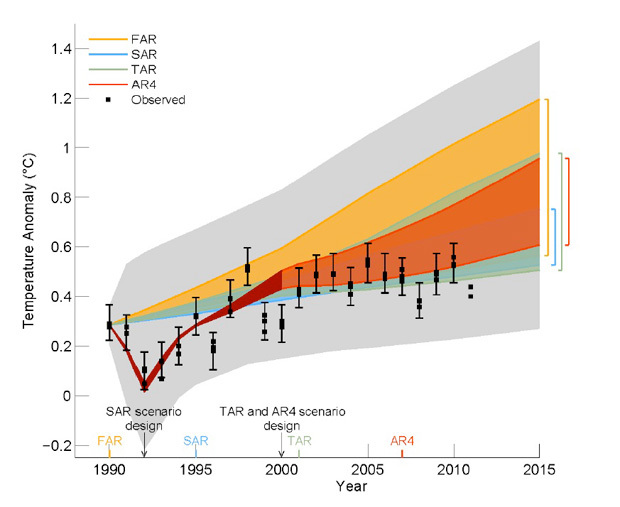
Figure 1.4 from Chapter 1 of a draft of the Fifth Assessment Report from the Intergovernmental Panel on Climate Change. Initials represent the First Assessment Report (FAR) in 1990, the Second (SAR) in 1995. Shaded banks show range of predictions from each of the four climate models used for all four reports since 1990. The last report, AR4, was issued in 2007. The black squares, shown with uncertainty bars, measure the observed average surface temperatures over the same interval. The range of model runs is indicated by the vertical bars. The light grey area above and below is not part of the model prediction ranges.
By Reiner Grundmann | September 19, 2013
With the fifth assessment report soon to be released by the IPCC the pre-publication buzz is well underway. A while ago unauthorised drafts circulated in the blogosphere and now the official leaks have found their way into news editing rooms. A central question picked up by most commentators is the ‘pause in global warming’, the ‘stagnation’, or the ‘hiatus’.
An anomaly presents itself for climate science in that model projections about future temperature increases do not concur with actual temperature observations. As expected, comments align with the agendas of the commentators, depending if one wants to defend the official modelling output or criticise it. These agendas are closely linked to policy options and the question if a lower observed temperature trend provides justification for political action on greenhouse gas emissions.
On this blog Hans von Storch expressed optimism as regards the ability of climate science to deal with this anomaly: ‘Eventually, we need to evaluate the different suggestions, but that will need time. No doubt that the scientific community will achieve this.’ Others are quick to pronounce climate science bunk. David Rose wrote in the Daily Mail ‘A leaked copy of the world’s most authoritative climate study reveals scientific forecasts of imminent doom were drastically wrong.’ Hayley Dixon in The Telegraph put it less blatant but still succinct in her opening sentence: ‘A leaked draft of a report by the UN Intergovernmental Panel on Climate Change is understood to concede that the computer predictions for global warming and the effects of carbon emissions have been proved to be inaccurate.’
Of course, both papers are on the political right and often skeptical about efforts to curb greenhouse gas emissions. It seems as if this topic is inconvenient for the left leaning papers who support action on climate mitigation. The Guardian so far is silent on the issue and prefers to write about new record lows of Arctic Ice coverage. When it looked last at this issue, Fiona Harvey bolstered the heat uptake by the oceans as explanation for the pause in global warming, thus doing away with a potential anomaly. At the same time she claims that climate scientists point out ‘that the trend is still upwards, and that the current temperature rises are well within the expected range.’ A quick glance at the graph above shows this is an illusion (the grey upper and lower bands are not part of the model prediction range).
Both the Mail and Telegraph quote Myles Allen (Oxford University) who tries to put the IPCC and its work into perspective. Says Allen: ‘we need to look very carefully about what the IPCC does in future… It is a complete fantasy to think that you can compile an infallible or approximately infallible report, that is just not how science works. It is not a bible, it is a scientific review, an assessment of the literature. Frankly both sides are seriously confused on how science works – the critics of the IPCC and the environmentalists who credit the IPCC as if it is the gospel.’
The Mail quotes Judy Curry (Georgia Institute of Technology) saying it makes ‘no sense that the IPCC was claiming that its confidence in its forecasts and conclusions has increased. For example, in the new report, the IPCC says it is ‘extremely likely’ – 95 per cent certain – that human influence caused more than half the temperature rises from 1951 to 2010, up from ‘very confident’ – 90 per cent certain – in 2007. Prof Curry said: ‘This is incomprehensible to me’ – adding that the IPCC projections are ‘overconfident’, especially given the report’s admitted areas of doubt.’
Both Allen and Curry call for a radical reform of the IPCC with Curry being more specific: ‘The consensus-seeking process used by the IPCC creates and amplifies biases in the science. It should be abandoned in favour of a more traditional review that presents arguments for and against – which would better support scientific progress, and be more useful for policy makers.’
Meanwhile in the Financial Post, Ross McKitrick wrote: ‘As the gap between models and reality has grown wider, so has the number of mainstream scientists gingerly raising the possibility that climate models may soon need a bit of a re-think. A recent study by some well-known German climate modellers put the probability that models can currently be reconciled with observations at less than 2%, and they said that if we see another five years without a large warming, the probability will drop to zero.’ (this seems to be a reference to the paper by Hans von Storch and Eduardo Zorita recently presented here on Klimazwiebel).
McKitrick goes on: ‘Judging by the drafts circulated this year, [the IPCC] is in full denial mode. Its own figure reveals a discrepancy between models and observations, yet its discussion says something entirely different. On page 9 of Chapter 1 it explains where the numbers come from, it talks about the various challenges faced by models, and then it sums up the graph as follows: “In summary, the globally-averaged surface temperatures are well within the uncertainty range of all previous IPCC projections, and generally are in the middle of the scenario ranges.” Later, in Chapter 9, it states with “very high confidence” that models can correctly simulate global surface temperature trends.’
McKitrick then makes a link between a ‘failed science’ and a ‘costly policy’: ‘since we are on the verge of seeing the emergence of data that could rock the foundations of mainstream climatology, this is obviously no time for entering into costly and permanent climate policy commitments based on failed model forecasts. The real message of the science is: Hold on a bit longer, information is coming soon that could radically change our understanding of this issue.’
This is where the crux of the matter lies. While it is indeed highly problematic to tie costly policies to flawed model forecasts the prospects of climatology are perhaps worth considering.
I chose as title for this blog post ‘The coming Crisis of Climate Science?’ The question mark is intentional and important. It could well be that in the coming year global surface temperatures pick up as expected. Existing models would be vindicated, end of story. The question is: how many more years should climatologists wait for this ‘renormalization’? It appears that mood is shifting towards alternative models and explanations. The timing of the fifth assessment report falls into this critical juncture where a lot of momentum has built up in favour of the current modelling practices which now prove so elusive. While the IPCC tries to make last minute rhetorical adjustments in order to accommodate anomalies, some of its participants, looking beyond, already indicate that this institution may have run its course. But even if the IPCC was reformed or dissolved, we still would have these questions in front of us:
How convincing is the climate science? How important should it be for climate policies? Do we need to implement climate policies, and if so, what should they be?
I can envisage an irony of history where climatology enters a period of crisis and looses its central place in public discourse about climate change, thus opening up discursive spaces for pragmatic options to deal with the problem.
Update: Global mean surface temperatures continued their sideways trajectory for the entire year of 2013 and October 2013 Arctic ice volume increased 50% from October 2012. – (Aletho News)
Related article
Featured Video

No Vote, No Representation, No State: Democracy, Israeli Style
or go to
Aletho News Archives – Video-Images
From the Archives
Sanctions, War and the Policy of Dual Containment
By SASAN FAYAZMANESH | March 17, 2008
It is now nearly three decades since the Unites States adopted the policy of dual containment of Iran and Iraq. While much has been written about the containment of Iraq, there has been very little in-depth analysis of this policy when it comes to Iran. In a book that is going to be released on March 31, 2008, entitled The United States and Iran: Sanctions, Wars and the Policy of Dual Containment (Routledge), I attempt to address this shortcoming by investigating when and why the US policy of containment of Iran came about, how it evolved, and where it stands today.[1] To the extent that Israel has been involved in US policy making, the study will also include the role that Israel has played in the containment of Iran. Also, since the fate of Iran has been inextricably linked to that of Iraq, occasionally the investigation will overlap with the containment of Iraq.
The policy of dual containment of Iran and Iraq originated during the Carter Administration, but it was not until the Clinton Administration that the expression “dual containment” became popular. … continue
Blog Roll
 Aletho News
- No Vote, No Representation, No State: Democracy, Israeli Style
- Zionist Bought Senate Blocks Information About American Citizens Killed By Israel
- While Gaza dominates the UN, these are the people keeping it alive
- New Report: “Scholasticide and Genocide in Gaza: Assessment, Testimonies and Legal Analysis”
- ‘THAAD Delusion’: Iran war exposes US missile shield limits – The Atlantic
- Moscow issues warning to NATO over Russian exclave
- Yes, the Iran war has destroyed Trump’s presidency
- The fallacy of US delusions about Iran’s economic collapse
- Hezbollah denies Syria cell link, warns of Israeli plan to sow discord
- The legacy of US sanctions, war, and occupation in Iraq
- If Americans Knew
- An error has occurred; the feed is probably down. Try again later.
- No Tricks Zone
- Green Energy Debacle: German Expert Professor Fritz Vahrenholt Warns Of Severe Economic And Social Consequences
- Two More Paleo Reconstructions Affirm Meters-Higher Sea Levels Across Ireland, Brazil 7000-6000 Years Ago
- New Study: Earth And Venus Surface Warmth Largely Explained By Convection And Lapse Rate, Not CO2 Or Radiation
- 2025 Nature Paper Claiming Worsening Global Drought Gets RETRACTED …Heavily Flawed
- New Study: ‘Global Drought Shows No Detectable Recent Acceleration Under Climate Warming’
- Economic Masterminds: German Socialists Suggest Taxing Productivity Gains Stemming From Using AI
- The South China Sea Has Not Been Cooperating With The Climate Change Narrative
- Energy Crisis: Germany Enters Heating Season With Historically Low Gas Reserve Fill Levels
- New Study: The Antarctic Ice Sheet Gained Mass From 2020-2024 Due To Staggering Snow And Ice Accumulation
- Study: Ocean Heating Rates From Thousands Of Years Ago ‘Dwarf’ Modern Ocean Heating Rates


