A question to the USGS and NPR
Watts Up With That | March 3, 2010
Which of these states is closest to 20,000 square kilometers in area?

WUWT reader “DC” points us to this Gore-esque pronouncement from a USGS scientist about “Antarctic ice loss”.
Jane Ferrigno of the U.S. Geological Survey in a National Public Radio interview
http://www.npr.org/templates/story/story.php?storyId=124178690 (Audio clip available)
Ms. FERRIGNO: The fact that the ice shelves are changing on the peninsula is a significant signal that global change, climate warming, is affecting the ice cover of Antarctica. It’s affecting first the area that’s towards the north, that’s slightly warmer, but the effect of the warming has traveled from the northern part of the peninsula to the southern part of the peninsula, where it’s colder.
…
“RAZ: Give us a sense of how much ice [on the Antarctic peninsula] has been lost over the past, say, 10 years.
Ms. FERRIGNO: I think I’ll go back 20 years, and in the last 20 years, I would say at least 20,000 square kilometers of ice has been lost, and that’s comparable to an area somewhere between the state of Texas and the state of Alaska.
RAZ: So about the size of the state of Texas in terms of ice has been lost in the past 20 years. ”
It gets better.
Ms. FERRIGNO: Well, this is a fairly small amount of ice when you consider the whole Antarctic continent consists of about 13 million square kilometers of ice.
RAZ: I mean, it sounds so dramatic, the size of Texas, right?
(Soundbite of laughter)
Ms. FERRIGNO: It is. It is very dramatic, and it is larger than the size of Texas, but when you consider the entire Antarctic ice sheet, it’s still a fairly minimal amount. But the thing that we’re really interested in seeing is that this is a sort of a red flag because if the warming continues, if the retreat continues, if the amount of ice on the continent starts to flow into the water, then there will be substantial impact to the sea level.
RAZ: That’s Jane Ferrigno. She is a scientist with the U.S. Geological Survey.
Jane Ferrigno, thanks for coming in.
Ms. FERRIGNO: Thank you.
Ms. Ferrigno might do well to have a look at this map of the USA and Antarctica compared at Texas A&M University’s Polar Science program to get a sense of scale.

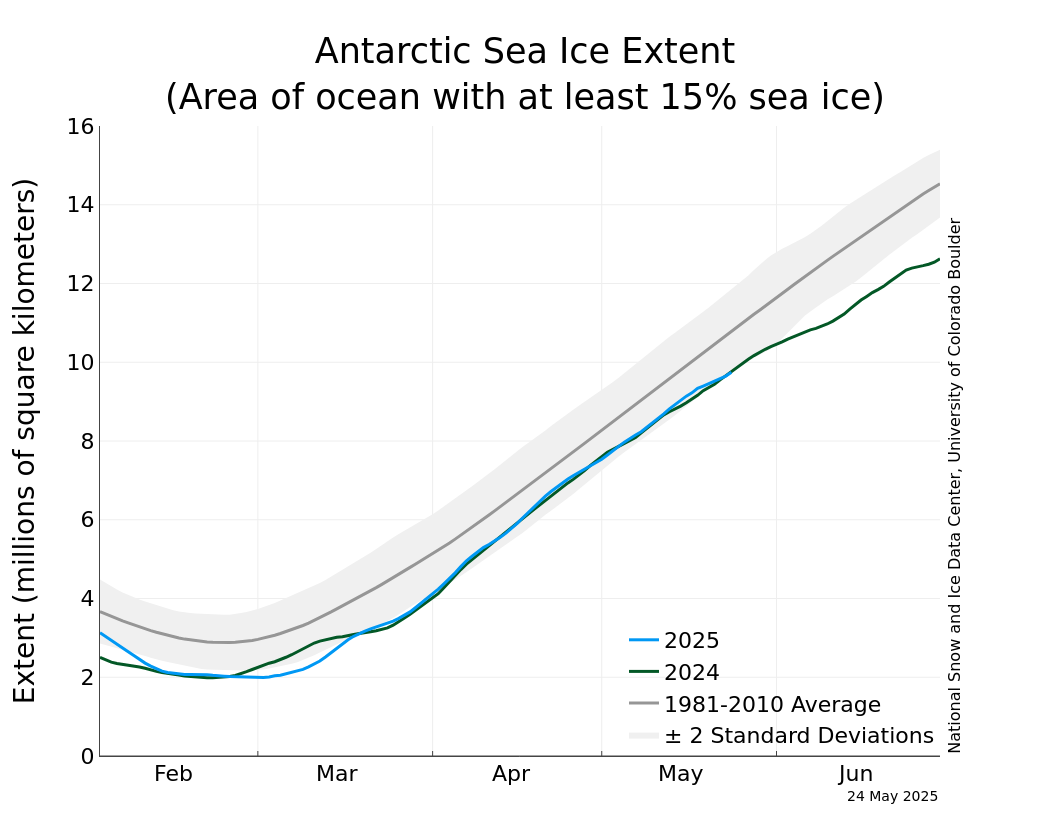
Here’s the story on all the Southern hemisphere sea ice, which includes all Antarctic sea ice, from Cryosphere today:
click for a larger image

Maybe Ms. Ferrigno will be embarrassed enough by her geographic ineptitude and will heed Gavin Schmidt’s advice and stop trying to “persuade the public“.
###
Just The Facts :
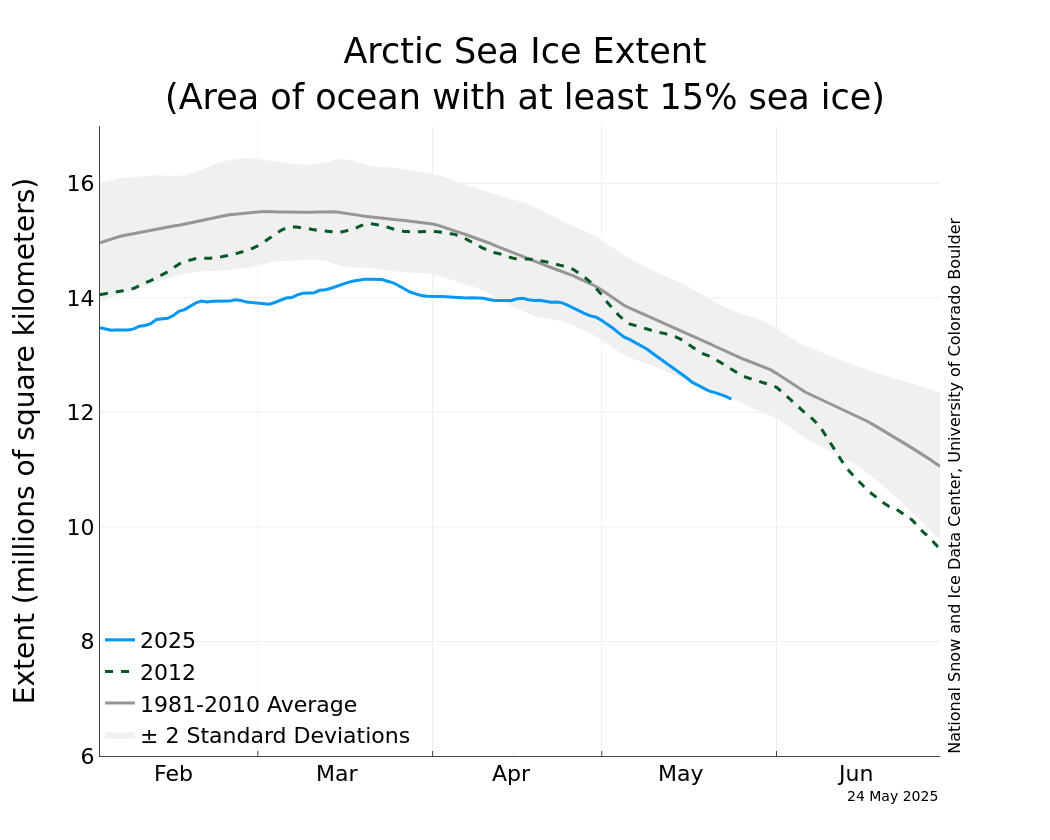
Also of note. Arctic Sea Ice Extent is on an upswing;
http://www.ijis.iarc.uaf.edu/en/home/seaice_extent.htm
and just a hair away from the arbitrary normal range used by NCIDC:
http://nsidc.org/data/seaice_index/images/daily_images/N_stddev_timeseries.png
Global Sea Ice Area appears to be making a run on average;
http://arctic.atmos.uiuc.edu/cryosphere/IMAGES/global.daily.ice.area.withtrend.jpg
and Antarctic Sea Ice Extent is above average:
http://nsidc.org/data/seaice_index/images/daily_images/S_stddev_timeseries.png
A new paper comparing NCDC rural and urban US surface temperature data
Watts Up With That | February 26, 2010
There’s a new paper out by Dr. Edward Long that does some interesting comparisons to NCDC’s raw data (prior to adjustments) that compares rural and urban station data, both raw and adjusted in the CONUS.
The paper is titled Contiguous U.S. Temperature Trends Using NCDC Raw and Adjusted Data for One-Per-State Rural and Urban Station Sets. In it, Dr. Edward Long states:
“The problem would seem to be the methodologies engendered in treatment for a mix of urban and rural locations; that the ‘adjustment’ protocol appears to accent to a warming effect rather than eliminate it. This, if correct, leaves serious doubt for whether the rate of increase in temperature found from the adjusted data is due to natural warming trends or warming because of another reason, such as erroneous consideration of the effects of urban warming.”
Here is the comparison of raw rural and urban data:

And here is the comparison of adjusted rural and urban data:

Note that even adjusted urban data has as much as a 0.2 offset from adjusted rural data.
Dr. Long suggests that NCDC’s adjustments eradicated the difference between rural and urban environments, thus hiding urban heating. The consequence:
“…is a five-fold increase in the rural temperature rate of increase and a slight decrease in the rate of increase of the urban temperature.”
The analysis concludes that NCDC “…has taken liberty to alter the actual rural measured values”.
Thus the adjusted rural values are a systematic increase from the raw values, more and more back into time and a decrease for the more current years. At the same time the urban temperatures were little, or not, adjusted from their raw values. The results is an implication of warming that has not occurred in nature, but indeed has occurred in urban surroundings as people gathered more into cities and cities grew in size and became more industrial in nature. So, in recognizing this aspect, one has to say there has been warming due to man, but it is an urban warming. The temperatures due to nature itself, at least within the Contiguous U. S., have increased at a non-significant rate and do not appear to have any correspondence to the presence or lack of presence of carbon dioxide.
The paper’s summary reads:
Both raw and adjusted data from the NCDC has been examined for a selected Contiguous U. S. set of rural and urban stations, 48 each or one per State. The raw data provides 0.13 and 0.79 oC/century temperature increase for the rural and urban environments. The adjusted data provides 0.64 and 0.77 oC/century respectively. The rates for the raw data appear to correspond to the historical change of rural and urban U. S. populations and indicate warming is due to urban warming. Comparison of the adjusted data for the rural set to that of the raw data shows a systematic treatment that causes the rural adjusted set’s temperature rate of increase to be 5-fold more than that of the raw data. The adjusted urban data set’s and raw urban data set’s rates of temperature increase are the same. This suggests the consequence of the NCDC’s protocol for adjusting the data is to cause historical data to take on the time-line characteristics of urban data. The consequence intended or not, is to report a false rate of temperature increase for the Contiguous U. S.
The full paper may be found here: Contiguous U.S. Temperature Trends Using NCDC Raw and Adjusted Data for One-Per-State Rural and Urban Station Sets (PDF) and is freely available for viewing and distribution.
Dr. Long also recently wrote a column for The American Thinker titled: A Pending American Temperaturegate
As he points out in that column, Joe D’Aleo and I raised similar concerns in: Surface Temperature Records: Policy Driven Deception? (PDF)
Al Gore Is Lying Low — for Good Reason
By Rex McBride | February 24, 2010
 Maybe Al Gore’s been advised by legal counsel to lie low. He may be the leader of the anthropogenic global warming (AGW) movement, but he’s not defending it in public, not even when it’s falling apart and his new fortune is based upon it.
RICO was written in broad terms. To state a claim, a plaintiff must allege four elements: (1) conduct (2) of an enterprise (3) through a pattern (4) of racketeering activity… Each element of a RICO claim requires additional analysis: an “enterprise” is marked by association and control; a “pattern” requires a showing of “continuity” — continuous and related behavior that amounts to, or poses a threat of, continued criminal violations; and “racketeering activity” involves the violation of designated federal laws …
The Melting Case for Cap-and-Trade
What a Difference a Year Makes
By ROBERT BRYCE | February 23, 2010
What a difference 12 months makes. Almost exactly one year ago, the popular, newly minted president, Barack Obama, was telling Congress that he wanted “legislation that places a market-based cap on carbon pollution and drives the production of more renewable energy in America.”
The Democrats, fully confident of their new president and their grip on both house of Congress, were certain that they could pass yet another big energy bill that would finally push hydrocarbons off their pedestal and replace them with wind turbines, solar panels and every other type of alternative energy.
But a lot has happened since Obama delivered his first State of the Union address. The global economy has continued to show lackluster growth. And perhaps most important: unemployment rates in the US remain stubbornly high and are expected to stay high for at least the next two years. On Sunday, the New York Times reported that “roughly 2.7 million jobless people will lose their unemployment check before the end of April unless Congress approves the Obama administration’s proposal to extend the payments.” The same story, written by Peter S. Goodman, also contained this astonishing fact: Some 6.3 million Americans have “been unemployed for six months or longer, the largest number since the government began keeping track in 1948. That is more than double the toll in the next-worst period, in the early 1980s.”
Real estate foreclosures in the US are soaring, with up to 3.5 million homeowners facing the threat of foreclosure this year. And of course, there’s the changing balance of power in Congress. The Democrats’ brief stint with a super majority has ended in the Senate, where a Republican, Scott Brown, now sits in the chair held by the late Ted Kennedy.
Meanwhile, the reputation of the IPCC, due to sloppy work by its researchers, has been tarnished, perhaps irretrievably so. Over the past two months, much of Europe and the US has been hit with record-cold temperatures and record amounts of snow. (Supporters of the theory of global warming insist that the record snows are “consistent” with their theory.) And there has been “climategate.” Last year, someone hacked into the computers at the Climate Research Unit at the University of East Anglia and released a spate of embarrassing emails that were exchanged among various climate scientists. The emails set off a firestorm of criticism of the scientists and their research methods.
Over the weekend, the global warming alarmists took yet another hit when the BBC published an interview with Phil Jones, the embattled scientist who heads the Climate Research Unit. The BBC’s environmental reporter, Roger Harrabin, asked Jones if he agreed that “from 1995 to the present there has been no statistically-significant global warming.”
Jones responded by saying “Yes, but only just. I also calculated the trend for the period 1995 to 2009. This trend (0.12C per decade) is positive, but not significant at the 95% significance level. The positive trend is quite close to the significance level.”
While that statement is enormously important, another Harrabin question was just as significant. Harrabin asked Jones to comment on the claim that “the debate over climate change is over.” Jones responded, “I don’t believe the vast majority of climate scientists think this. This is not my view. There is still much that needs to be undertaken to reduce uncertainties, not just for the future, but for the instrumental (and especially the palaeoclimatic) past as well.”
Remember that over the past few years, the pro-global warming theorists have repeatedly trumpeted the claims from the IPCC and others that the scientific proof of global warming was overwhelming and therefore, there was no reason for any further discussion. Given that the science was settled, politicians had to act immediately to curb carbon dioxide emissions, in order to avert catastrophic climate change. The fervor around the science, and the belief that the issue was settled became so common that anyone who doubted the supposed consensus view was branded as a “denier.” The fervor against the “deniers” was so strong that in 2006, one journalist, David Roberts of Grist, even advocated “war crimes trials for these bastards – some sort of climate Nuremberg.” (Shortly after his piece was published, Roberts retracted his statement.) The denunciations of the “deniers” continued after Al Gore and the IPCC won the Nobel Peace Prize in 2007 and they continue to this day.
Last month, Rolling Stone magazine published a list of “the 17 polluters and deniers who are derailing efforts to curb global warming.” The article, called, “The Climate Killers” lambasted a range of people — Warren Buffett, Exxon Mobil CEO Rex Tillerson, Oklahoma US Senator James Inhofe, and columnist George Will, among them.
But less than six weeks after Rolling Stone published its list of “climate killers” Jones, one of the world’s most prominent climate scientists, told the BBC that a) there’s been no statistically significant warming of the earth over the past 15 years, and b) that the science of global warming is not, in fact, settled and that, in his words, “there is still much that needs to be undertaken to reduce uncertainties.”
It’s not clear what effect Jones’ interview has had on US businesses, but it’s interesting to note that just two days after the BBC published its Q&A with Jones, two multinational oil companies – BP and ConocoPhillips –announced that they were dropping out of the US Climate Action Partnership. Last week, industrial giant Caterpillar also announced that it was quitting USCAP.
About a year ago, USCAP, a coalition of major corporations and environmental groups, looked to be the odds-on favorite to set the agenda for global warming legislation in Congress. Led largely by Jim Rogers, the loquacious CEO of Duke Energy, USCAP was viewed as a new business model for big industries trying to grapple with the potential consequences of carbon legislation. On February 13, 2009, Rogers, speaking at the CERAWeek conference in Houston, declared “The signposts are clear: we’ll have legislation” on carbon emissions. Four months later, the US House of Representatives narrowly passed the American Clean Energy and Security Act, a 1,428-page monstrosity filled with loopholes and giveaways for favored industries. When printed out on standard paper, the 2009 bill (also known as Waxman-Markey or the cap-and-trade bill) creates a stack nearly 7 inches tall.
But since last June, and particularly since December, when leaders from 192 countries met in Copenhagen for what the Associated Press called “the largest and most important UN climate change conference in history,” the urgency for any type of substantive action on carbon emissions has vanished. Indeed, after two weeks of wrangling in Copenhagen, the result was laughably predictable: no legally binding agreement on any reductions in carbon emissions, only a promise to set targets and an agreement to meet again a year later in Mexico City to discuss all of the same issues one more time.
In announcing their decision to drop out of USCAP, BP and ConocoPhillips made it clear that they were concerned about how pending US climate legislation would affect their refining businesses. Conoco’s CEO, James J. Mulva, said that the pending legislation “left domestic refineries unfairly penalized versus international competition.” Caterpillar said it was dropping out so that it could focus on carbon capture and storage projects.
Whatever their reasons, the exit of those three companies from USCAP reflects the waning enthusiasm for any type of federal carbon legislation. Senate leaders say they will attempt to pass a different energy bill from that passed by the House last year, one that will tax refineries and put emission limits on heavy industry.
That might happen. But that kind of tax scheme is going to meet huge resistance from industry. And the departure of BP and ConocoPhillips from USCAP appears to indicate that the refining industry – which has been hammered by the recession and slack motor fuel demand – has decided to actively fight such legislation.
In summary, given the ragged state of the economy, persistently high unemployment – indeed, the highest number of unemployed people in modern US history – along with huge numbers of foreclosures, the suddenly much-weaker scientific case for cutting carbon dioxide emissions, and the changing balance of power in Washington, don’t count on any significant carbon emissions legislation out of Congress anytime soon. Democrats and Republicans alike are sensing political peril in any effort that will impose higher energy prices on taxpayers during tough economic times.
Seeds of discontent: the ‘miracle’ crop that has failed to deliver
A new ‘ethical’ biofuel is damaging the impoverished people it was supposed to help
By Cahal Milmo and Andrew Wasley | The Independent | 15 February 2010
A “miracle” plant, once thought to be the answer to producing renewable biofuels on a vast scale, is driving thousands of farmers in the developing world into food poverty, a damning report concludes today.
Five years ago jatropha was hailed by investors and scientists as a breakthrough in the battle to find a biofuel alternative to fossil fuels that would not further impoverish developing countries by diverting resources away from food production.
Jatropha was said to be resistant to drought and pests and able could grow on land that was unsuitable for food production. But researchers have found that it has increased poverty in countries including India and Tanzania.
Millions of the plants have been grown in anticipation of rich returns, only for growers to be hit by poor yields, conflict over land and a lack of infrastructure to process the oil-rich seeds.
Oil giant BP, which planned to spend almost £32m on a joint venture to set up jatropha plantations, has now pulled out and the charity ActionAid today warns that jatropha needs to be cultivated on prime food-growing land to produce significant yields.
According to one estimate, up to one million hectares of jatropha – an area equivalent to Devon and Cornwall combined – are being cultivated around the globe, despite little evidence that it can produce enough oil to make the crop commercially sustainable.
Meredith Alexander, head of trade at Actionaid and co-author of its “Meals per Gallon” report, said: “Jatropha is a real gold-rush crop, and the same amount of common sense that applies in a gold rush has been applied to the jatropha rush.
“Jatropha was the subject of an explosion of fabulous propaganda. But this was an untried crop at commercial levels and the many thousands of marginal farmers who have gone into production have been experimented on with disastrous results. They are simply not getting the income they were promised and now cannot afford food for their families,” she said.
A native of central America, Jatropha curcus was brought to Europe in the 16th century and subsequently spread across Africa and Asia. Until recently, its few uses included a malaria treatment and an indigestion remedy.
But despite jatropha’s much-lauded ability to grow where food crops cannot flourish, campaigners say there is evidence that commercially viable yields can only be obtained in fertile soil.
In India, forecasted annual yields of three to five tonnes of seeds per hectare have been scaled back to 1.8 to two tonnes. The Overseas Development Institute, a leading international development think-tank, has stated that “as the mainstay of people’s livelihoods, jatropha looks distinctly marginal”.
ActionAid said its researchers found repeated cases of farmers being left with jatropha crops they could not sell and land previously used to grow food crops being taken over by sub-contractors who then employed locals on wages that could not compete with rises in the price of foodstuffs partially caused by biofuel production.
Raju Sona, a farmer in north-east India who gave up land that usually produces vegetables to grow jatropha, said: “No one will buy jatropha. People said if you have a plantation then surely you have a good market. But we didn’t see such a market. I threw the seeds away.”
A number of British companies are continuing to market jatropha as a “highly ethical and green” investment. One fund offers investors three packages for prices ranging from £7,500 to £15,600 in a brochure entitled “Money really does grow on trees”. That company says it has funded the planting of 32 million jatropha shrubs worldwide through a London-based provider called Carbon Credited Farming (CCF) Plc.
Jeff Reeves, head of global operations for CCF, which estimates it will have 300 million jatropha shrubs planted on 120,000 acres worldwide by the end of 2010, admitted that there had been problems establishing the crop.
He told The Ecologist magazine: “In many cases it is government policy and people that are to blame, rather than jatropha itself. Well-managed, jatropha … can work. But there have been countries where poor management has meant this is not the case.”
D1 Oils, a London-based biofuels company which has invested heavily in jatropha, insisted it was too early to write off the crop as a long-term biofuel source. But its former co-investor, BP, disagreed. A spokesman said: “As other [renewable fuel] technologies came up, we looked again at whether jatropha was going to be the best biofuel source that could be scaled up. There were problems with it. We have decided to look elsewhere.”
* Some of this research appeared in the Ecologist
CRU’s Jones: Climate data ‘not well organised’ and Medieval Warm Period debate ‘not settled’
By Roger Harrabin, Environment analyst, BBC News | February 12, 2010

Phil Jones, the professor behind the “Climategate” affair, has admitted some of his decades-old weather data was not well enough organised.
He said this contributed to his refusal to share raw data with critics – a decision he says he regretted.
But Professor Jones said he had not cheated the data, or unfairly influenced the scientific process.
He said he stood by the view that recent climate warming was most likely predominantly man-made.
But he agreed that two periods in recent times had experienced similar warming. And he agreed that the debate had not been settled over whether the Medieval Warm Period was warmer than the current period.
These statements are likely to be welcomed by people sceptical of man-made climate change who have felt insulted to be labelled by government ministers as flat-earthers and deniers.
‘Bunker mentality’
Professor Jones agreed that scientists on both sides of the debate could suffer sometimes from a “bunker mentality”.
He said “sceptics” who doubted his climate record should compile their own dataset from material publicly available in the US.
“The major datasets mostly agree,” he said. “If some of our critics spent less time criticising us and prepared a dataset of their own, that would be much more constructive.”
His colleagues said that keeping a paper trail was not one of Professor Jones’ strong points. Professor Jones told BBC News: “There is some truth in that.
“We do have a trail of where the (weather) stations have come from but it’s probably not as good as it should be,” he admitted.
Congenital Climate Abnormalities
By Willis Eschenbach | Watts Up With That? | February 13, 2010
Science is what we use to explain anomalies, to elucidate mysteries, to shed light on unexplained occurrences. For example, there is no great need for a scientific explanation of the sun rising in the morning. If one day the sun were to rise in the afternoon, however, that is an anomaly which would definitely require a scientific explanation. But there is no need to explain the normal everyday occurrences. We don’t need a new understanding if there is nothing new to understand.
Hundreds of thousands of hours of work, and billions of dollars, have been expended trying to explain the recent variations in the climate, particularly the global temperature. But in the rush to find an explanation, a very important question has been left unasked:
Just exactly what unusual, unexpected temperature anomaly are we trying to explain?
The claim is made over and over that humans are having an effect on the climate. But where is the evidence that there is anything that even needs explanation? Where is the abnormal phenomenon? What is it that we are trying to make sense of, what is the unusual occurrence that requires a novel scientific explanation?
There are not a lot of long-term temperature records that can help us in this regard. The longest one is the Central England Temperature record (CET). Although there are problems with the CET (see Sources below), including recent changes in the stations used to calculate it that have slightly inflated the modern temperatures, it is a good starting point for an investigation of whether there is anything happening that is abnormal. Here is that record:

Figure 1. The Central England Temperature Record. Blue line is the monthly temperature in Celsius. Red line is the average temperature. Jagged black line is the 25-year trailing trend, in degrees per century.
Now, where in that record is there anything which is even slightly abnormal? Where is the anomaly that the entire huge edifice of the AGW hypothesis is designed to elucidate? The longest sustained rise is from about 1680 to 1740. That time period also has the steepest rise. The modern period, on the other hand, is barely above the long-term trend despite urban warming. There is nothing unusual about the modern period in any way.
OK, so there’s nothing to explain in the CET. How about another long record?
One of the world’s best single station long-term records is that of the Armagh Observatory in Ireland. It has been maintained with only a couple minor location changes for over 200 years. Figure 2 shows the Armagh record.

Figure 2. Temperature record for Armagh University. Various colored lines as in Figure 1.
We find the same thing in this record as in the CET. The fastest rise was a long, long time ago. The modern rise is once again insignificant. Where in all of this is anything that requires billions of dollars to explain?
Finally, what about the global record? Here, you don’t have to take my word for it. A much chastened Phil Jones (the disgraced former Director of the CRU of email fame), in an interview with the BBC on Friday, February 12, 2010, answered a BBC question as follows:
Do you agree that according to the global temperature record used by the IPCC, the rates of global warming from 1860-1880, 1910-1940 and 1975-1998 were identical?
An initial point to make is that in the responses to these questions I’ve assumed that when you talk about the global temperature record, you mean the record that combines the estimates from land regions with those from the marine regions of the world. CRU produces the land component, with the Met Office Hadley Centre producing the marine component.
Temperature data for the period 1860-1880 are more uncertain, because of sparser coverage, than for later periods in the 20th Century. The 1860-1880 period is also only 21 years in length. As for the two periods 1910-40 and 1975-1998 the warming rates are not statistically significantly different (see numbers below).
I have also included the trend over the period 1975 to 2009, which has a very similar trend to the period 1975-1998.
So, in answer to the question, the warming rates for all 4 periods are similar and not statistically significantly different from each other.
So in fact, according to Phil Jones (who strongly believes in the AGW hypothesis) there is nothing unusual about the recent warming either. It is not statistically different from two earlier modern periods of warming. Since these warming periods were before the modern rise in CO2, greenhouse gases cannot have been responsible for those rises.
So my question remains unanswered … where is the anomaly? Where is the unusual occurrence that we are spending billions of dollars trying to explain?
The answer is, there is no unusual warming. There is no anomaly. There is nothing strange or out of the ordinary about the recent warming. It is in no way distinguishable from earlier periods of warming, periods that we know were not due to rising CO2. There is nothing in the record that is in any way different from the centuries-long natural fluctuations in the global climate.
In other words, we have spent billions of dollars and wasted years of work chasing a chimera, a will-of-the-wisp. This is why none of the CO2 explanations have held water … simply because there is nothing unusual to explain.
SOURCES:
CET:
http://hadobs.metoffice.com/hadcet/data/download.html
ARMAGH:
ADJUSTMENTS TO THE CET:
http://www.anenglishmanscastle.com/archives/004482.html
Jones also makes the interesting argument in the interview that the reason he believes that recent warming is anthropogenic (human-caused) is because climate models can’t replicate it … in other words, he has absolutely no evidence at all, he just has the undeniable fact that our current crop of climate models can’t model the climate. Seems to me like that’s a problem with the models rather than a problem with the climate, but hey, what do I know, I was born yesterday …
No, the Australian drought was not man-made
Another IPCC scare falls apart
By Andrew Bolt | Herald Sun | February 08, 2010
Melbourne University alarmist David Karoly once claimed a rise in the Murray Darling Basin’s temperatures was “likely due to the increase in greenhouse gases in the atmosphere from human acitivity” and:
Prime Minister Kevin Rudd grabbed the scare and exploited it:
BRENDAN Nelson was yesterday accused of being “blissfully immune” to the effects of climate change after he said the crisis in the Murray-Darling Basin was not linked to global warming…
In parliament yesterday, Kevin Rudd attacked Dr Nelson, accusing him of ignoring scientific facts.
“You need to get with the science on this,” the Prime Minister said. “Look at the technical report put together by the CSIRO and the Bureau of Meteorology.”
But the latest evidence indicates that Rudd and Karoly were wrong. In fact, there’s no evidence in the Murray Darling drought of man-made warming, says a new study in Geophysical Research Letters:
Previous studies of the recent drought in the Murray-Darling Basin (MDB) have noted that low rainfall totals have been accompanied by anomalously high air temperatures. Subsequent studies have interpreted an identified trend in the residual time-series of non-rainfall related temperature variability as a signal of anthropogenic change, further speculating that increased air temperature has exacerbated the drought through increasing evapotranspiration rates. In this study, we explore an alternative explanation of the recent increases in air temperature. This study demonstrates that significant misunderstanding of known processes of land surface – atmosphere interactions has led to the incorrect attribution of the causes of the anomalous temperatures, as well as significant misunderstanding of their impact on evaporation within the Murray-Darling Basin…
However, to accept the correlation [between temperature and rainfall] as the sole basis for the attribution of cause to human emissions is to implicitly assume that the correlation represents an entirely correct model of the sole driver of maximum air temperature. This is clearly not the case.
What’s causing the evaporation and temperatures is not (man-made) warming. It’s kind of the other way around: more sunshine, through lack of cloud cover, and lack of rain and therefore evaporation is causing higher temperatures.
Former IPCC Chairman says UN panel is losing credibility
Jonathan Leake, Environment Editor | The Sunday Times | February 7, 2010
A LEADING British government scientist has warned the United Nations’ climate panel to tackle its blunders or lose all credibility.
Robert Watson, chief scientist at Defra, the environment ministry, who chaired the Intergovernmental Panel on Climate Change (IPCC) from 1997 to 2002, was speaking after more potential inaccuracies emerged in the IPCC’s 2007 benchmark report on global warming.
The most important is a claim that global warming could cut rain-fed north African crop production by up to 50% by 2020, a remarkably short time for such a dramatic change. The claim has been quoted in speeches by Rajendra Pachauri, the IPCC chairman, and by Ban Ki-moon, the UN secretary-general.
This weekend Professor Chris Field, the new lead author of the IPCC’s climate impacts team, told The Sunday Times that he could find nothing in the report to support the claim. The revelation follows the IPCC’s retraction of a claim that the Himalayan glaciers might all melt by 2035.
The African claims could be even more embarrassing for the IPCC because they appear not only in its report on climate change impacts but, unlike the glaciers claim, are also repeated in its Synthesis Report.
This report is the IPCC’s most politically sensitive publication, distilling its most important science into a form accessible to politicians and policy makers. Its lead authors include Pachauri himself.
In it he wrote: “By 2020, in some countries, yields from rain-fed agriculture could be reduced by up to 50%. Agricultural production, including access to food, in many African countries is projected to be severely compromised.” The same claims have since been cited in speeches to world leaders by Pachauri and Ban.
Speaking at the 2008 global climate talks in Poznan, Poland, Pachauri said: “In some countries of Africa, yields from rain-fed agriculture could be reduced by 50% by 2020.” In a speech last July, Ban said: “Yields from rain-fed agriculture could fall by half in some African countries over the next 10 years.”
Speaking this weekend, Field said: “I was not an author on the Synthesis Report but on reading it I cannot find support for the statement about African crop yield declines.”
Watson said such claims should be based on hard evidence. “Any such projection should be based on peer-reviewed literature from computer modelling of how agricultural yields would respond to climate change. I can see no such data supporting the IPCC report,” he said.
The claims in the Synthesis Report go back to the IPCC’s report on the global impacts of climate change. It warns that all Africa faces a long-term threat from farmland turning to desert and then says of north Africa, “additional risks that could be exacerbated by climate change include greater erosion, deficiencies in yields from rain-fed agriculture of up to 50% during the 2000-20 period, and reductions in crop growth period (Agoumi, 2003)”.
“Agoumi” refers to a 2003 policy paper written for the International Institute for Sustainable Development, a Canadian think tank. The paper was not peer-reviewed.
Its author was Professor Ali Agoumi, a Moroccan climate expert who looked at the potential impacts of climate change on Tunisia, Morocco and Algeria. His report refers to the risk of “deficient yields from rain-based agriculture of up to 50% during the 2000–20 period”.
These claims refer to other reports prepared by civil servants in each of the three countries as submissions to the UN. These do not appear to have been peer-reviewed either.
The IPCC is also facing criticism over its reports on how sea level rise might affect Holland. Dutch ministers have demanded that it correct a claim that more than half of the Netherlands lies below sea level when, in reality, it is about a quarter.
The errors seem likely to bring about change at the IPCC. Field said: “The IPCC needs to investigate a more sophisticated approach for dealing with emerging errors.”
Climategate scientist ‘hid flaws in data’, say sceptics
Professor in leaked email scandal tried to hide fact that numbers he used were wrong
By Michael McCarthy, Environment Editor | The Independent | 2 February 2010
The “climategate” controversy intensified last night when the senior British scientist at its centre, Professor Phil Jones, faced fresh accusations that he attempted to withhold data that could cast doubt on evidence for rising world temperatures.
The charges follow an analysis of the emails hacked from the University of East Anglia’s Climatic Research Unit, of which Professor Jones is the director.
The emails, published online on the eve of the recent Copenhagen climate summit, led to allegations that Professor Jones and other researchers had behaved inappropriately in withholding or deleting scientific information to prevent its disclosure under the Freedom of Information Act (FOI). Last week the charge became more serious when the Information Commissioner’s Office said that in withholding information, UEA had broken the law.
The university has set up an independent inquiry into the affair headed by Sir Muir Russell, a former vice-chancellor of the University of Glasgow, and Professor Jones has taken leave from his director’s post until the inquiry is completed. But the new allegations go beyond refusing FOI requests and concern data that Professor Jones and other scientists have used to support a record of recent world temperatures that shows an upward trend.
Climate sceptics have suggested that some of the higher readings may be due not to a warmer atmosphere, but to the so-called “urban heat island effect”, where cities become reservoirs of heat and are warmer than the surrounding countryside, especially during the night hours.
Professor Jones and a colleague, Professor Wei-Chyung Wang of the State University of New York at Albany suggested in an influential 1990 paper in the journal Nature that the urban heat island effect was minimal – and cited as supporting evidence a long series of temperature measurements from Chinese weather stations, half in the countryside and half in cities, supplied by Professor Wei-Chyung. The Nature paper was used as evidence in the most recent report of the UN’s Intergovernmental Panel on Climate Change.
However, it has been reported that when climate sceptics asked for the precise locations of the 84 stations, Professor Jones at first declined to release the details. And when eventually he did release them, it was found that for the ones supposed to be in the countryside, there was no location given.
Climate sceptics have demanded the two professors now withdraw their heat island paper. Professor Wei-Chyung was investigated by his university, but exonerated, but the emails indicate there was also concern among Professor Jones’ s colleagues at UEA, including from Dr Tom Wigley, his predecessor as head of the CRU, about the Chinese weather station data and Professor Jones’s contuing reliance on it.
No-one was available for comment at the University of East Anglia last night.
UN climate change panel based claims on student dissertation and magazine article
By Richard Gray | The Telegraph | 30 Jan 2010
The United Nations’ expert panel on climate change based claims about ice disappearing from the world’s mountain tops on a student’s dissertation and an article in a mountaineering magazine.
The revelation will cause fresh embarrassment for the The Intergovernmental Panel on Climate Change (IPCC), which had to issue a humiliating apology earlier this month over inaccurate statements about global warming.
The IPCC’s remit is to provide an authoritative assessment of scientific evidence on climate change.
In its most recent report, it stated that observed reductions in mountain ice in the Andes, Alps and Africa was being caused by global warming, citing two papers as the source of the information.
However, it can be revealed that one of the sources quoted was a feature article published in a popular magazine for climbers which was based on anecdotal evidence from mountaineers about the changes they were witnessing on the mountainsides around them.
The other was a dissertation written by a geography student, studying for the equivalent of a master’s degree, at the University of Berne in Switzerland that quoted interviews with mountain guides in the Alps.
The revelations, uncovered by The Sunday Telegraph, have raised fresh questions about the quality of the information contained in the report, which was published in 2007.
It comes after officials for the panel were forced earlier this month to retract inaccurate claims in the IPCC’s report about the melting of Himalayan glaciers.
Sceptics have seized upon the mistakes to cast doubt over the validity of the IPCC and have called for the panel to be disbanded.
This week scientists from around the world leapt to the defence of the IPCC, insisting that despite the errors, which they describe as minor, the majority of the science presented in the IPCC report is sound and its conclusions are unaffected.
But some researchers have expressed exasperation at the IPCC’s use of unsubstantiated claims and sources outside of the scientific literature.
Professor Richard Tol, one of the report’s authors who is based at the Economic and Social Research Institute in Dublin, Ireland, said: “These are essentially a collection of anecdotes.
“Why did they do this? It is quite astounding. Although there have probably been no policy decisions made on the basis of this, it is illustrative of how sloppy Working Group Two (the panel of experts within the IPCC responsible for drawing up this section of the report) has been.
“There is no way current climbers and mountain guides can give anecdotal evidence back to the 1900s, so what they claim is complete nonsense.”
The IPCC report, which is published every six years, is used by government’s worldwide to inform policy decisions that affect billions of people.
The claims about disappearing mountain ice were contained within a table entitled “Selected observed effects due to changes in the cryosphere produced by warming”.
It states that reductions in mountain ice have been observed from the loss of ice climbs in the Andes, Alps and in Africa between 1900 and 2000.
The report also states that the section is intended to “assess studies that have been published since the TAR (Third Assessment Report) of observed changes and their effects”.
But neither the dissertation or the magazine article cited as sources for this information were ever subject to the rigorous scientific review process that research published in scientific journals must undergo.
The magazine article, which was written by Mark Bowen, a climber and author of two books on climate change, appeared in Climbing magazine in 2002. It quoted anecdotal evidence from climbers of retreating glaciers and the loss of ice from climbs since the 1970s.
Mr Bowen said: “I am surprised that they have cited an article from a climbing magazine, but there is no reason why anecdotal evidence from climbers should be disregarded as they are spending a great deal of time in places that other people rarely go and so notice the changes.”
The dissertation paper, written by professional mountain guide and climate change campaigner Dario-Andri Schworer while he was studying for a geography degree, quotes observations from interviews with around 80 mountain guides in the Bernina region of the Swiss Alps.
Experts claim that loss of ice climbs are a poor indicator of a reduction in mountain ice as climbers can knock ice down and damage ice falls with their axes and crampons.
The IPCC has faced growing criticism over the sources it used in its last report after it emerged the panel had used unsubstantiated figures on glacial melting in the Himalayas that were contained within a World Wildlife Fund (WWF) report.
It can be revealed that the IPCC report made use of 16 non-peer reviewed WWF reports.
One claim, which stated that coral reefs near mangrove forests contained up to 25 times more fish numbers than those without mangroves nearby, quoted a feature article on the WWF website.
In fact the data contained within the WWF article originated from a paper published in 2004 in the respected journal Nature.
In another example a WWF paper on forest fires was used to illustrate the impact of reduced rainfall in the Amazon rainforest, but the data was from another Nature paper published in 1999.
When The Sunday Telegraph contacted the lead scientists behind the two papers in Nature, they expressed surprise that their research was not cited directly but said the IPCC had accurately represented their work.
The chair of the IPCC Rajendra Pachauri has faced mounting pressure and calls for his resignation amid the growing controversy over the error on glacier melting and use of unreliable sources of information.
A survey of 400 authors and contributors to the IPCC report showed, however, that the majority still support Mr Pachauri and the panel’s vice chairs. They also insisted the overall findings of the report are robust despite the minor errors.
But many expressed concern at the use of non-peer reviewed information in the reports and called for a tightening of the guidelines on how information can be used.
The Met Office, which has seven researchers who contributed to the report including Professor Martin Parry who was co-chair of the working group responsible for the part of the report that contained the glacier errors, said: “The IPCC should continue to ensure that its review process is as robust and transparent as possible, that it draws only from the peer-reviewed literature, and that uncertainties in the science and projections are clearly expressed.”
Roger Sedjo, a senior research fellow at the US research organisation Resources for the Future who also contributed to the IPCC’s latest report, added: “The IPCC is, unfortunately, a highly political organisation with most of the secretariat bordering on climate advocacy.
“It needs to develop a more balanced and indeed scientifically sceptical behaviour pattern. The organisation tends to select the most negative studies ignoring more positive alternatives.”
The IPCC failed to respond to questions about the inclusion of unreliable sources in its report but it has insisted over the past week that despite minor errors, the findings of the report are still robust and consistent with the underlying science.
Featured Video

Revive Iran’s MOU Deal or Face a Forever War
or go to
Aletho News Archives – Video-Images
From the Archives
China names world’s ‘hacking empire’
RT | March 15, 2022
Calling the US a “hacking empire” of the world, the Chinese Foreign Ministry urged Washington to stop “malicious” cyber activities following reports that American hackers subverted a network in China to launch attacks on Russia and Belarus.
“China is gravely concerned about cyberattacks against other countries that originate from the US and use China as a springboard,” Foreign Ministry spokesperson Zhao Lijian told reporters at a press briefing on Monday.
Zhao was commenting on recent Chinese media reports that hackers, mainly from the US but also from NATO allies Germany and the Netherlands, recently hijacked a Chinese computer network for cyberattacks, 87% of which targeted Russia.
“Against the background of the Ukraine situation, such a move may produce the negative effect of misleading the international community and spreading disinformation,” Zhao said, pointing out that “a former US senior official called publicly for launching cyberattacks on Russia not long ago.”
This appeared to be a reference to Hillary Clinton, former US secretary of state and presidential candidate, who made the calls in an MSNBC interview at the end of February. … continue
Blog Roll
 Aletho News
- U.S. Midterms – a Referendum on Israel and Zionist Power
- Twice as many Canadian Jews serve in Israeli military as Canada’s armed forces: Report
- Thousands of Syrian troops set to join Saudi war on Yemen
- Jared Kushner’s Diplomacy for Hire
- Russia backs Tehran’s conditions in talks with US, Iran’s envoy says
- Irish ‘fake news’ expert exposed as fake
- China expresses strong opposition to Dutch report alleging Chinese cyberattacks
- Coup d’état in Poland
- The Endgame: When the CIA Proxy War Runs Out of Ukrainians!
- Over 16,000 hectares of farms, forests burnt in Israeli offensive on southern Lebanon, says minister
- If Americans Knew
- An error has occurred; the feed is probably down. Try again later.
- No Tricks Zone
- Zonal Asymmetry of Temperature Change in the Antarctic Circumpolar Current
- New Study: The Net Fossil Fuel Contribution To Rising Atmospheric CO2 Has Been Zero For 500 Years
- Germany’s Green Energy Transition Becoming Increasingly Expensive…Another 6 Trillion Euros!
- Sudden Stratospheric Warming, Powerful El Niño Combination May Lead To Extreme Europe Cold, Energy Crisis!
- Two New Studies Find Thwaites Glacier Melt Cannot Be Driven By Human Activity Or A Warming Ocean
- E-Cars Reduce CO2 Emissions By Only 41% Compared To Internal Combustion Engine Vehicles
- Predictions Made By Renowned Climate Professor Over Past Decades Have Been Proven To Be Poor
- New Study Suggests Large Regions Of The Pacific Ocean Have Been Cooling For The Last 80 Years
- Germany’s Green Energy Debacle: High Energy Costs Force Kahla Porzellan to Close After 182 Years!
- New Study: 50 Years Of The Most Aggressive ‘Net Zero’ Policies Can Only Affect The Global Climate By 0.03°C