ClimateGate: A closer look at some of the ‘tricks’ by the email authors
David Rose | Mail Online | December 13, 2009
The claim was both simple and terrifying: that temperatures on planet Earth are now ‘likely the highest in at least the past 1,300 years’. As its authors from the United Nations Intergovernmental Panel on Climate Change (IPCC) must have expected, it made headlines around the world.
Yet some of the scientists who helped to draft it, The Mail on Sunday can reveal, harboured uncomfortable doubts. In the words of one, David Rind from the US space agency Nasa, it ‘looks like there were years around 1000AD that could have been just as warm’.
Keith Briffa from the University of East Anglia’s Climatic Research Unit (CRU), which plays a key role in forming IPCC assessments, urged caution, warning that when it came to historical climate records, there was no new data, only the ‘same old evidence’ that had been around for years.
‘Let us not try to over-egg the pudding,’ he wrote in an email to an IPCC colleague in September 2006. ‘True, there have been many different techniques used to aggregate and scale data – but the efficacy of these is still far from established.’
But when the ‘warmest for 1,300 years’ claim was published in 2007 in the IPCC’s fourth report, the doubters kept silent.
It is only now that their concerns have started to emerge from the thousands of pages of ‘Warmergate’ emails leaked last month from the CRU’s computers, along with references to performing a ‘trick’ to ‘hide’ temperature decline and instructions to resist all efforts by the CRU’s critics to use the Freedom of Information Act to check the unit’s data and conclusions.
Last week, as an official inquiry by the former civil servant Sir Muir Russell began, I tried to assess Warmergate’s wider significance.
The CRU’s supporters insisted it was limited. ‘In the long term, it will make very little difference to the scientific consensus, and to the way politicians respond to it,’ Professor Trevor Davies, the university’s Pro-Vice Chancellor and a former CRU director, told me. ‘I am certain that the science is rock solid.’
He admitted that his CRU colleagues had sometimes used ‘injudicious phrases’, but that was because they kept on being ‘diverted’ from their work by those who wished to scrutinise it. ‘It’s understandable that sometimes people get frustrated,’ he said.
The only lesson the affair had for him was that ‘we have got to get better in terms of explanation. Some scientists still find it quite it difficult to communicate with the public.’
Others, however, were less optimistic. Roger Pielke, Professor of Environmental Studies at the University of Colorado, could in no sense be described as a climate change sceptic, let alone a ‘denier’.
‘Human-caused climate change is real, and I’m a strong advocate for action,’ he said. ‘But I’m also a strong advocate for integrity in science.’
Pielke’s verdict on the scandal is damning.
‘These emails open up the possibility that big scientific questions we’ve regarded as settled may need another look. They reveal that some of these scientists saw themselves not as neutral investigators but as warriors engaged in battle with the so-called sceptics.
‘They have lost a lot of credibility and as far as their being leading spokespeople on this issue of huge public importance, there is no going back.’
Climate science is complicated, and often the only way to make sense of raw data is through sophisticated statistical computer programs. The consequence is that most lay individuals – politicians and members of the public alike – have little choice but to take the assurances of scientists such as Davies on trust.
He and other ‘global warmists’ often insist that when it comes to the IPCC’s main conclusions – that the Earth is in a period of potentially catastrophic warming and that the main culprit is man-made greenhouse gas emission – no serious scientist dissents from the conventional view.
Hence, perhaps, Gordon Brown’s recent comment that those who disagree are ‘behind-the-times, antiscience, flat-Earth climate sceptics’.
In fact, there is a large body of highly-respected academic experts who fiercely contest this thesis: people such as Richard Lindzen, Professor of Meteorology at the Massachusetts Institute of Technology and a disillusioned former IPCC member, and Dr Tom Segalstad, head of geology at Oslo University, who has stated that ‘most leading geologists throughout the world know that the IPCC’s view of Earth processes are implausible if not impossible’.
These dissenters focus their criticisms on the IPCC’s analysis of the way the atmosphere works and the models it uses to predict the future.
However, Warmergate strikes at something more fundamental – the science that justifies the basic assumption that the present warming really is unprecedented, at least in the past few thousand years.
Take the now-notorious email that the CRU’s currently suspended director, Dr Phil Jones, sent to his IPCC colleagues on November 16, 1999, when he wrote he had ‘just completed Mike’s Nature trick’ and had so managed to ‘hide the decline’.
The CRU’s supporters have protested bitterly about the attention paid to this message. In the course of an extraordinary BBC interview in which he called an American critic an ‘****hole’ live on air, Jones’s colleague Professor Andrew Watson insisted that the fuss was completely unjustified, because all Jones had been talking about was ‘tweaking a diagram’.
Davies told me that the email had been ‘taken out of context’ adding: ‘One definition of the word “trick” is “the best way of doing something”. What Phil did was standard practice and the facts are out there in the peer-reviewed literature.’
However, the full context of that ‘trick’ email, as shown by a new and until now unreported analysis by the Canadian climate statistician Steve McIntyre, is extremely troubling. Derived from close examination of some of the thousands of other leaked emails, he says it suggests the ‘trick’ undermines not only the CRU but the IPCC.
There is a widespread misconception that the ‘decline’ Jones was referring to is the fall in global temperatures from their peak in 1998, which probably was the hottest year for a long time. In fact, its subject was more technical – and much more significant.
It is true that, in Watson’s phrase, in the autumn of 1999 Jones and his colleagues were trying to ‘tweak’ a diagram. But it wasn’t just any old diagram.
It was the chart displayed on the first page of the ‘Summary for Policymakers’ of the 2001 IPCC report – the famous ‘hockey stick’ graph that has been endlessly reproduced in everything from newspapers to primary-school textbooks ever since, showing centuries of level or declining temperatures until a dizzying, almost vertical rise in the late 20th Century.
There could be no simpler or more dramatic representation of global warming, and if the origin of worldwide concern over climate change could be traced to a single image, it would be the hockey stick. Drawing a diagram such as this is far from straightforward.
Gabriel Fahrenheit did not invent the mercury thermometer until 1724, so scientists who want to reconstruct earlier climate history have to use ‘proxy data’ – measurements derived from records such as ice cores, tree-rings and growing season dates.
However, different proxies give very different results.
For example, some suggest that the ‘medieval warm period’, the 350-year era that started around 1000, when red wine grapes flourished in southern England and the Vikings tilled now-frozen farms in Greenland, was considerably warmer than even 1998.
Of course, this is inconvenient to climate change believers because there were no cars or factories pumping out greenhouse gases in 1000AD – yet the Earth still warmed.
Some tree-ring data eliminates the medieval warmth altogether, while others reflect it. In September 1999, Jones’s IPCC colleague Michael Mann of Penn State University in America – who is now also the subject of an official investigation –was working with Jones on the hockey stick. As they debated which data to use, they discussed a long tree-ring analysis carried out by Keith Briffa.
Briffa knew exactly why they wanted it, writing in an email on September 22: ‘I know there is pressure to present a nice tidy story as regards “apparent unprecedented warming in a thousand years or more”.’ But his conscience was troubled. ‘In reality the situation is not quite so simple – I believe that the recent warmth was probably matched about 1,000 years ago.’
Another British scientist – Chris Folland of the Met Office’s Hadley Centre – wrote the same day that using Briffa’s data might be awkward, because it suggested the past was too warm. This, he lamented, ‘dilutes the message rather significantly’.
Over the next few days, Briffa, Jones, Folland and Mann emailed each other furiously. Mann was fearful that if Briffa’s trees made the IPCC diagram, ‘the sceptics [would] have a field day casting doubt on our ability to understand the factors that influence these estimates and, thus, can undermine faith [in them] – I don’t think that doubt is scientifically justified, and I’d hate to be the one to have to give it fodder!’
Finally, Briffa changed the way he computed his data and submitted a revised version. This brought his work into line for earlier centuries, and ‘cooled’ them significantly. But alas, it created another, potentially even more serious, problem.
According to his tree rings, the period since 1960 had not seen a steep rise in temperature, as actual temperature readings showed – but a large and steady decline, so calling into question the accuracy of the earlier data derived from tree rings.
This is the context in which, seven weeks later, Jones presented his ‘trick’ – as simple as it was deceptive.
All he had to do was cut off Briffa’s inconvenient data at the point where the decline started, in 1961, and replace it with actual temperature readings, which showed an increase. On the hockey stick graph, his line is abruptly terminated – but the end of the line is obscured by the other lines.


Any scientist ought to know that you just can’t mix and match proxy and actual data,’ said Philip Stott, emeritus professor of biogeography at London’s School of Oriental and African Studies. ‘They’re apples and oranges. Yet that’s exactly what he did.’
Since Warmergate-broke, some of the CRU’s supporters have claimed that Jones and his colleagues made a ‘full disclosure’ of what they did to Briffa’s data in order to produce the hockey stick.
But as McIntyre points out, ‘contrary to claims by various climate scientists, the IPCC Third Assessment Report did not disclose the deletion of the post-1960 values’. On the final diagram, the cut off was simply concealed by the other lines.
By 2007, when the IPCC produced its fourth report, McIntyre had become aware of the manipulation of the Briffa data and Briffa himself, as shown at the start of this article, continued to have serious qualms. McIntyre by now was an IPCC ‘reviewer’ and he urged the IPCC not to delete the post-1961 data in its 2007 graph. ‘They refused,’ he said, ‘stating this would be “inappropriate”.’
Yet even this, Pielke told me, may not ultimately be the biggest consequence of Warmergate.
Some of the most controversial leaked emails concern attempts by Jones and his colleagues to avoid disclosure of the CRU’s temperature database – its vast library of readings from more than 1,000 weather stations around the world, the ultimate resource that records how temperatures have changed.
In one email from 2005, Jones warned Mann not to leave such data lying around on searchable websites, because ‘you never know who is trawling them’.
Critics such as McIntyre had been ‘after the CRU station data for years. If they ever hear there is a Freedom of Information Act now in the UK, I think I’ll delete the file rather than send to anyone’.
Yesterday Davies said that, contrary to some reports, none of this data has in fact been deleted. But in the wake of the scandal, its reliability too is up for grabs.
The problem is that, just like tree rings or ice cores, readings from thermometers or electronic ‘thermistors’ are open to interpretation.
The sites of weather stations that were once open countryside become built up areas, so trapping heat, and the type of equipment used changes over time. The result is what climate scientists call ‘inhomogeneities’ – anomalies between readings that need to be ‘adjusted’.
But can we trust the way such ‘adjustments’ are made?
Last week, an article posted on a popular climate sceptic website analysed the data from the past 130 years in Darwin, Australia.
This suggested that average temperatures had risen there by about two degrees Celsius. However, the raw data had been ‘adjusted’ in a series of abrupt upward steps by exactly the same amount: without the adjustment, the Darwin temperature record would have stayed level.
In 2007, McIntyre examined records across America. He found that between 1999 and 2007, the US equivalent of the Met Office had changed the way it adjusted old data.
The result was to make the Thirties seem cooler, and the years since 1990 much warmer. Previously, the warmest year since records began in America had been 1934.
Now, in line with CRU and IPCC orthodoxy, it was 1998.
At the CRU, said Davies, some stations’ readings were adjusted by unit and in such cases, raw and adjusted data could be compared. But in about 90 per cent of cases, the adjustment was carried out in the countries that collected the data, and the CRU would not know exactly how this had been done.
Davies said: ‘All I can say is that the process is careful and considered. To get the details, the best way would be to go the various national meteorological services.’
The consequences of that, Stott said, may be explosive. ‘If you take Darwin, the gap between the two just looks too big. If that applies elsewhere, it’s going to get really interesting. It’s no longer going to be good enough for the Met Office and CRU to put the data out there.
‘To know we can trust it, we’ve got to know what adjustments have been made, and why.’
Last week, at the Copenhagen climate summit, the Met Office said that the Nineties have been the warmest decade in history. Depending on how the data has been adjusted, Stott said, that statement may not be true.
Pielke agreed. ‘After Climategate, the surface temperature record is being called into question.’ To experts such as McIntyre and Pielke, perhaps the most baffling thing has been the near-unanimity over global warming in the world’s mainstream media – a unanimity much greater than that found among scientists.
In part, this is the result of strongarm tactics.
For example, last year the BBC environment reporter Roger Harrabin made substantial changes to an article on the corporation website that asked why global warming seemed to have stalled since 1998 – caving in to direct pressure from a climate change activist, Jo Abbess.
‘Personally, I think it is highly irresponsible to play into the hands of the sceptics who continually promote the idea that “global warming finished in 1998” when that is so patently not true,’ she told him in an email.
After a brief exchange, he complied and sent a final note: ‘Have a look in ten minutes and tell me you are happier. We have changed headline and more.’
Afterwards, Abbess boasted on her website: ‘Climate Changers, Remember to challenge any piece of media that seems like it’s been subject to spin or scepticism. Here’s my go for today. The BBC actually changed an article I requested a correction for.’
Last week, Michael Schlesinger, Professor of Atmospheric Studies at the University of Illinois, sent a still cruder threat to Andrew Revkin of the New York Times, accusing him of ‘gutter reportage’, and warning: ‘The vibe that I am getting from here, there and everywhere is that your reportage is very worrisome to most climate scientists … I sense that you are about to experience the “Big Cutoff” from those of us who believe we can no longer trust you, me included.’
But in the wake of Warmergate, such threats – and the readiness to bow to them – may become rarer.
‘A year ago, if a reporter called me, all I got was questions about why I’m trying to deny climate change and am threatening the future of the planet,’ said Professor Ross McKitrick of Guelph University near Toronto, a long-time collaborator with McIntyre.
‘Now, I’m getting questions about how they did the hockey stick and the problems with the data. Maybe the emails have started to open people’s eyes.’
Russian secret service agents admitted yesterday that the hacked ‘Warmergate’ emails were uploaded on a Siberian internet server, but strenuously denied a clandestine state-sponsored operation to wreck the Copenhagen summit.
The FSB – formerly the KGB – confirmed that thousands of messages to and from scientists at the University of East Anglia’s Climatic Research Unit were distributed to the world from the city of Tomsk, as revealed by The Mail on Sunday last week.
Now, it has emerged that IT experts specialising in hacking techniques were brought in by the Russian authorities following this newspaper’s exposure of the Tomsk link. They have gathered evidence about how and where the operation was carried out, although they are not prepared to say at this stage who they think was responsible.
A Russian intelligence source claimed the FSB had new information which could cast light on who was behind the elaborate operation.
‘We are not prepared to release details, but we might if the false claims about the FSB’s involvement do not stop,’ he said. ‘The emails were uploaded to the Tomsk server but we are sure this was done from outside Russia.’
The Kremlin’s top climate change official, Alexander Bedritsky, denied the Russian government was involved in breaking into the CRU’s computer system.
‘You can post information on a computer from any other country. It is nonsense to blame Russia,’ he said.
Climate change: Minority report
Climategate does not just demonstrate the corruption of science and peer-review; it also demonstrates the incompetence of specialists who do not understand planetary ecology
By Peter Taylor
Al-Jazeera
December 8, 2009
Some climatologists believe current rises in temperatures and melting icebergs are part of of the Earth’s natural cycles, and not induced by man-made devices [EPA]
Concern over global warming has spawned such a highly charged and polarised political movement, that real science has become sidelined in favour of sound-bites and simple messages. The real science is not as ‘settled’ as some politicians would have us believe.
There is a significant minority of climate scientists who look at the data and conclude that we are dealing with natural cycles that are peaking just as they have done on a regular basis over centuries.
These scientists are heavily outnumbered by the proliferation of computer specialists who have created their own virtual planet – people trained in maths and physics who may never have handled an ice-core, tree-ring apparatus, sediments or stalagmites and all of the proxy indicators of past temperature cycles.
In my view, the UN secretariat has marginalised their careful assessment and warnings about natural cycles in favour of alarming future projections generated by the computer model.
These real climate scientists know that the last major warm period was a 1,000 years ago when the Vikings grew crops in Greenland – their graves are still solid in the permafrost.
In between then and now, Europe and China experienced a Little Ice Age – with widespread famine.
Reading the fine print
There is so much spin that you have to read the small print of the UN reports where they admit to not understanding natural cycles and what drives them.
Behind the scenes they acknowledge cycles are at work and contribute to the warming and that it is only from the model that they derive the dominance of carbon dioxide.
But the model does not easily simulate the poorly understood cycles. Satellites do a better job and having spent three years studying the data I conclude global warming is real but at least 80 per cent natural cycle and 20 per cent human emissions.
My conclusions are supported by recent climate shifts that run counter to model predictions. From the data on cycles I could predict that after 2007, when Arctic summer ice reached a record low, it would start to recover.
In 2008, it came back by 10 per cent. The majority expected it to continue its decline to ice-free status by 2015. In 2009, it grew by another 10 per cent.
Little Ice Age
The models beloved of the majority also predicted that the high-level winds, known as the jet-stream, would shift north as the globe warmed.
The jet-stream directs wet weather from the Atlantic and in 2007 they shifted south, bringing widespread flooding to Western Europe.
I have seen a minority report in Nasa’s archives which shows that the jet-stream shifts south as the magnetic field of the sun falls and this was characteristic of the Little Ice Age.
In 2007, the sun’s magnetic field fell to an all time low and this repeated through 2008 and 2009, as did the floods.
Many solar scientists point to a link between this magnetic field and climate on Earth and when the field is low, the Earth cools.
During the low in the 17th century the Thames in London froze every winter for 50 years and summers were a washout.
Chinese and Russian scientists have better knowledge of these cycles, because the cold periods induce widespread famine – and some of them see all the signs of a new Little Ice Age.
Perhaps that’s why their governments’ sovereign funds are buying huge tracts of productive land in the tropics – for food.
You may ask – if this is real science, how can the UN’s Intergovernmental Panel on Climate Change ignore it and claim the warming is caused by carbon dioxide.
Global spin?
In fact, the scientists only agreed the warming is “very likely not due to known natural causes acting alone” – and that is spun by the policy-makers and the world’s media.
The not-known natural causes are subject to high-level research programmes because real scientists know they exist and are powerful. And no real climate scientist ever said natural causes are acting alone.
Up until the recent ‘climate-gate’ scandal, I accepted that the objective data could be trusted.
But it now appears scientists upon whom the UN relies were busy manipulating the data to produce a warmer globe and to eradicate what they call ‘blips’ (i.e. cycles) that they cannot explain.
To compound matters, they then sought to undermine the Freedom of Information Act and delete their records in advance of requests for the data.
The issue of causation is crucial. The poorest people are already at risk whether the globe warms or cools.
We need action on the real and immediate threats facing human support systems from unavoidable natural climate change – but less than one per cent of resources devoted to climate are spent on adaptation, the rest goes on what will be ineffective attempts to ‘stop climate chaos’.
Peter Taylor is an ecologist and author of ‘Chill: a reassessment of global warming theory’.
The Carbonphobia Virus

Since the beginning of time, people have been plagued with viruses. They seem to come and go.
May 28, 2009
The carbonphobia virus is spread through a combination of circumstances.
Symptoms
Those prone to infection will have one or more of the following symptoms:
•They are poorly educated in and generally ignorant about general science and find math difficult or even confusing.
•They have no knowledge of the science of climate or climate change.
•They tune in to NPR, PBS, CBS, NBC, ABC, or CNN.
•They believe without question what they read in Time, Newsweek, US News & World Report, The New York Times, The Washington Post, etc., etc..
•They have watched Al Gore’s An Inconvenient Truth and find it convincing.
•They attend a school or college with liberal teachers/professors who sing the praises of the UN’s Intergovernmental Panel on Climate Change (IPCC).
•They tend to believe they are liberals or find liberal views enticing.
The more symptoms a particular individual possesses, the more likely that individual will become infected with the virus.
Unfortunately, many victims of the carbonphobia virus do not realize they are infected. They continue to lead their daily lives in complete ignorance of their infection. They are perfectly content to believe they have been properly informed by others who are also infected. Victims may not realize they are manifesting an infection by the virus.
Manifestations
Revealing manifestations of the carbonphobia virus include:
•A belief that burning fossil fuels will destroy earth by making it too hot to sustain life.
•A belief that human activity can change climate.
•A belief that if humans just stop burning fossil fuels, all will be restored to “normal.”
•A belief that we must “do something” to avert a climate “crisis.”
•A belief that we can manufacture a system of government mandates to force people to use less carbon fuel by creating a system of carbon credits tied to an illusive carbon footprint scheme.
•A belief that carbon dioxide is an evil pollutant and we must regulate its production.
The more manifestations of this virus one exhibits, the worse the infection and the more difficult the treatment.
If you find you have any of the symptoms or manifestations of the carbonphobia virus and you are interested in a cure, then read on.
Treating the Carbonphobia Virus
Fortunately, there is a treatment for the carbonphobia virus, but it requires massive doses of common sense, elementary knowledge of climate and climate change history, and a willingness to value truth.
Education
It may be necessary for infected individuals to purge massive amounts of misinformation about climate science that have been instilled in them by false prophets, undeducated teachers, and misinformed media. The best place to start is with some fundamental facts about the greenhouse effect and climate change.
Facts About The Greenhouse Effect and Climate Change
•The greenhouse effect is not a significant climate change force. It is a process for retaining heat from the sun.
•The greenhouse effect does not create heat, it merely retains heat produced by the sun.
•Carbon dioxide is a minor contributor to greenhouse heat retention. Water vapor (and clouds of water vapor) are responsible for up to 95% of greenhouse heat retention; all other greenhouse gases account for the remainder (carbon dioxide is the most potent of the remainder of greenhouse gases after water vapor).
•Carbon dioxide is always being created and absorbed by natural processes. The decay of plant and animal life produces, among other things, carbon dioxide. Animals and insects produce carbon dioxide as a byproduct of digestion and respiration. Plants absorb carbon dioxide, giving off oxygen as a byproduct of photosynthesis.
•The properties of carbon dioxide limit its greenhouse heat retention to less than 3.0°C (5.4°F), regardless of the amount put into the atmosphere.
•The first 20 ppm of carbon dioxide added to the atmosphere (from zero base) provides more greenhouse heat retention than the next 380 ppm combined.
•Carbon dioxide’s impact on heat retention declines logarithmically as more is added to the atmosphere.
•At current levels of about 380 ppm of atmospheric carbon dioxide, more than 2.7°C of carbon dioxide’s heat retention capability has already been achieved. Adding more carbon dioxide to the atmosphere will have little impact on greenhouse heat retention.
•Climate is always changing. The natural state of climate is change.
•Historically (in the paleoclimate record), carbon dioxide exhibits a short term (100s of years) response to climate change; it does not produce climate change! Over time frames of tens or hundreds of millions of years, there is no relationship between atmospheric carbon dioxide and climate.
•Humans have never experienced Earth’s “typical” climate (the climate that has prevailed during more than 90% of the existence of living organisms). Earth’s typical climate is between 15°F and 25°F warmer than anything humans have ever experienced.
•Earth has experienced four ice eras over the past 540 million years. Ice eras last tens of millions of years and contain embedded colder climate regimes called ice epochs that last hundreds of thousands of years (up to a few million years). Ice eras and ice epochs feature climate much colder than Earth’s typical climate when there is no surface ice at sea level anywhere on the planet and sea levels are much higher than anything experienced by humans.
•During Earth’s coldest ice era (the “snowball Earth” era that peaked about 450 million years ago), when almost the entire planet was covered in ice, atmospheric carbon dioxide was 5600 ppm, about 15 times higher than today!
•Ice ages are relatively brief periods lasting tens of thousands of years. Warmer climate periods between ice age cycles are known as interglacials. We are experiencing an interglacial that began about 18,000 years ago. Interglacials typically last about 20,000 years.
•Within ice age and interglacial cycles, there are shorter term climate episodes known as warm and cold periods lasting hundreds of years. Recent (within the past 5000 years) known regimes of this nature include The Minoan Warm Period, The Roman Warm Period, The Medieval Warm Period, and, most recently, The Little Ice Age that peaked in the 17th century. If recent history is representative, warm periods are more common than cold periods. Remember, these are all within the interglacial of an ice age cycle.
•During the 20th century, global temperatures cooled, warmed, cooled again, and then warmed again. The end of the 1990s featured a particularly warm period of several years that coincided with a particularly active solar sunspot cycle. A high correlation between solar cycles and climate exists in the climate and solar record.
•The unusually active solar cycle experienced over the past decade is passing and many solar scientists believe an unusually minimal period of solar activity will be experienced during the next 20 years. This could lead to dramatic cooling, based on the paleoclimate and solar cycle record.
•If humans were confronted with an imminent cold period (e.g., the recent Little Ice Age), there is nothing that could be done to prevent it.
•Carbon-based fossil fuels are produced from decayed ancient plant and animal life. That ancient life obtained its carbon from atmospheric carbon dioxide through photosynthesis and digestion. Consequently, the use of fossil fuels is nothing more than an exercise in long term recycling of carbon dioxide back to the atmosphere from which it originated. It is a natural life cycle process.
If you have been infected with the carbonphobia virus and you study the above facts, you will find that a cure is likely to emerge. By absorbing this knowledge, you will shed your infection and become a cured individual, capable of resisting future attempts at reinfection.
However, be warned that cured individuals must be wary of the tremendous pressure that the infected population may bring upon them to shed their knowledge and become reinfected. Particular pressure will come from politicians, a particularly susceptible group due to their general abysmal comprehension of things scientific. Infected politicians will cause extreme pain to all others through the folly of imposing regulatory burdens [upon non-pollutant CO2 emissions for example] and insisting on such energy inefficient non-solutions such as costly ethanol-based fuels.
The danger of reinfection is always present, particularly among those who continue to subject themselves to some of the symptoms noted above.
Action without knowledge is pure folly. Avoid becoming infected with the carbonphobia virus by seeking truth.
Hockey stick observed in NOAA ice core data
December 9, 2009
At the Foresight Institute, J. Storrs Hall had some interesting graphs made from NOAA ice core data (Alley, R.B. 2000. The Younger Dryas cold interval as viewed from central Greenland. Quaternary Science Reviews 19:213-226.) It sure seems to mirror other hockey sticks this past century. Dr. Mann will be thrilled to see this I’m sure.
J. Storrs Hall writes:
One thing that Climategate does is give us an opportunity to step back from the details of the AGW argument and say, maybe this is heat-of-the-moment stuff, and in the long run will look as silly as the Durants’ allergy to Eisenhower. And perhaps, if we can put climate arguments in perspective, it will allow us to put the much smaller nano arguments (pun intended) into perspective too.
So let’s look at some ice.
I’m looking at the temperature record as read from this central Greenland ice core. It gives us about as close as we can come to a direct, experimental measurement of temperature at that one spot for the past 50,000 years. As far as I know, the data are not adjusted according to any fancy computer climate model or anything else like that.
So what does it tell us about, say, the past 500 years? (the youngest datum is age=0.0951409 (thousand years before present) — perhaps younger snow doesn’t work so well?):

Well, whaddaya know — a hockey stick. In fact, the “blade” continues up in the 20th century at least another half a degree. But how long is the handle? How unprecedented is the current warming trend?
Some Historical Perspective

Yes, Virginia, there was a Medieval Warm Period, in central Greenland at any rate. But we knew that — that’s when the Vikings were naming it Greenland, after all. And the following Little Ice Age is what killed them off, and caused widespread crop failures (and the consequent burning of witches) across Europe. But was the MWP itself unusual?

Well, no — over the period of recorded history, the average temperature was about equal to the height of the MWP. Rises not only as high, but as rapid, as the current hockey stick blade have been the rule, not the exception.

In fact for the entire Holocene — the period over which, by some odd coincidence, humanity developed agriculture and civilization — the temperature has been higher than now, and the trend over the past 4000 years is a marked decline. From this perspective, it’s the LIA that was unusual, and the current warming trend simply represents a return to the mean. If it lasts.

From the perspective of the Holocene as a whole, our current hockeystick is beginning to look pretty dinky. By far the possibility I would worry about, if I were the worrying sort, would be the return to an ice age — since interglacials, over the past half million years or so, have tended to last only 10,000 years or so. And Ice ages are not conducive to agriculture.

… and ice ages have a better claim on being the natural state of Earth’s climate than interglacials. This next graph, for the longest period, we have to go to an Antarctic core (Vostok):

In other words, we’re pretty lucky to be here during this rare, warm period in climate history. But the broader lesson is, climate doesn’t stand still. It doesn’t even stay on the relatively constrained range of the last 10,000 years for more than about 10,000 years at a time.
Does this mean that CO2 isn’t a greenhouse gas? No.
Does it mean that it isn’t warming? No.
Does it mean that we shouldn’t develop clean, efficient technology that gets its energy elsewhere than burning fossil fuels? Of course not. We should do all those things for many reasons — but there’s plenty of time to do them the right way, by developing nanotech. (There’s plenty of money, too, but it’s all going to climate science at the moment.  ) And that will be a very good thing to have done if we do fall back into an ice age, believe me.
For climate science it means that the Hockey Team climatologists’ insistence that human-emitted CO2 is the only thing that could account for the recent warming trend is probably poppycock.
Himalayan Glaciers Not Disappearing
By Doug L. Hoffman – The Resilient Earth – 11/13/2009
A new report by a senior Indian glaciologist states that Himalayan glaciers remain frozen and quite intact.
The report by Vijay Kumar Raina, formerly of the Geological Survey of India, seeks to correct widely spread reports that India’s 10,000 or so Himalayan glaciers are shrinking rapidly in response to climate change. It’s not true, Raina says. The rumors may have originated in the Asia chapter of the U.N. Intergovernmental Panel on Climate Change’s (IPCC’s) 2007 Working Group II report, which claims that Himalayan glaciers “are receding faster than in any other part of the world and, if the present rate continues, the likelihood of them disappearing by the year 2035 and perhaps sooner is very high if the Earth keeps warming at the current rate.” Evidently, the bogus reporting was based on measurements from only a handful of glaciers.
Raina’s report draws on published studies and unpublished findings from half a dozen Indian groups who have analyzed remote-sensing satellite data or conducted on-site surveys at remote locations often higher than 5000 meters. While the report surveyed a number of glaciers, two particularly iconic ones stand out. The first is the 30-kilometer-long Gangotri glacier, source of the Ganges River. Between 1934 and 2003, the glacier retreated an average of 70 feet (22 meters) a year and shed a total of 5% of its length. But in 2004 and 2005, the retreat slowed to about 12 meters a year, and since September 2007 Gangotri has been “practically at a standstill,” according to Raina’s report.

Gangotri glacier, source of the Ganges River, retreated a few dozen meters from 2004 to 2008. – Photos provided by V. K. Raina.
The second glacier, the Siachin glacier in Kashmir, is even more stable. Claims reported in the popular press that Siachin has shrunk as much as 50% are simply wrong, says Raina, whose report notes that the glacier has “not shown any remarkable retreat in the last 50 years.” These conclusions were based in part on field measurements by ecologist Kireet Kumar of the G. B. Pant Institute of Himalayan Environment and Development in Almora. Much like the hysteria about Greenland’s ice cap, it seems reports of the glaciers’ demise are a bit premature.
According to a report in the journal Science, “several Western experts who have conducted studies in the region agree with Raina’s nuanced analysis—even if it clashes with IPCC’s take on the Himalayas.” The “extremely provocative” findings “are consistent with what I have learned independently,” says Jeffrey S. Kargel, a glaciologist at the University of Arizona, Tucson. Many glaciers in the Karakoram Mountains, on the border of India and Pakistan, have “stabilized or undergone an aggressive advance,” he says, citing new evidence gathered by a team led by Michael Bishop, a mountain geomorphologist at the University of Nebraska.
Having recently returned from an expedition to K2, one of the highest peaks in the world, Canadian glaciologist Kenneth Hewitt says he observed five advancing glaciers and only a single one in retreat. Such evidence “challenges the view that the upper Indus glaciers are ‘disappearing’ quickly and will be gone in 30 years,” said Hewitt. “There is no evidence to support this view and, indeed, rates of retreat have been less in the past 30 years than the previous 60 years.”
Other researchers and noted experts have raised their voices in support of Raina’s conclusions. According to Himalayan glacier specialist John “Jack” Shroder, the only possible conclusion is that IPCC’s Himalaya assessment got it “horribly wrong.” The University of Nebraska researcher adds, “They were too quick to jump to conclusions on too little data.”
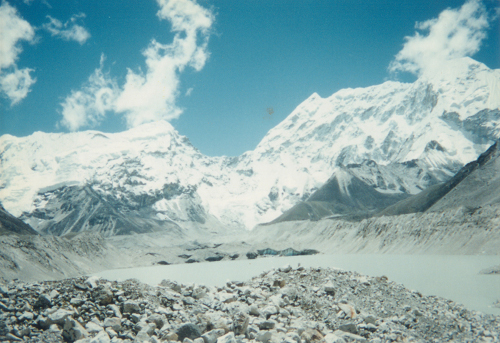
Looks like the Himalayas stay frozen. Photo UNEP.
The IPCC also erred in its forecast of the impact of glacier melting on water supply, claims Donald Alford, a Montana-based hydrologist who recently completed a water study for the World Bank. One of the dire predictions that the IPCC report made was for water shortages in the region. “Our data indicate the Ganges results primarily from monsoon rainfall, and until the monsoon fails completely, there will be a Ganges river, very similar to the present river.” Glacier melt contributes only 3% to 4% of the Ganges’s annual flow, says Kireet Kumar. Another piece of climate catastrophist propaganda debunked.
Even when faced with data showing the errors in their work, the IPCC seems incapable of admitting they were wrong. Typically, Murari Lal, chair of the Climate, Energy and Sustainable Development Analysis Centre in New Delhi and coordinating lead author of the 2007 IPCC report’s Asia chapter, rejects the notion that IPCC was off the mark on Himalayan glaciers. Even more petulantly, IPCC chairman Rajendra Pachauri accused the Indian environment ministry of “arrogance” for its report claiming there is no evidence that climate change has shrunk the Himalayan glaciers. Unfortunately for the climate change alarmists the truth is out, the glaciers of the Himalayas remain safely frozen and won’t be disappearing anytime soon.
Climategate: Gore falsifies the record
Andrew Bolt – December 09, 2009 at 06:54pm
Al Gore has studied the Climategate emails with his typically rigorous eye and dismissed them as mere piffle:
Q: How damaging to your argument was the disclosure of e-mails from the Climate Research Unit at East Anglia University?
A: To paraphrase Shakespeare, it’s sound and fury signifying nothing. I haven’t read all the e-mails, but the most recent one is more than 10 years old. These private exchanges between these scientists do not in any way cause any question about the scientific consensus.
And in case you think that was a mere slip of the tongue:
Q: There is a sense in these e-mails, though, that data was hidden and hoarded, which is the opposite of the case you make [in your book] about having an open and fair debate.
A: I think it’s been taken wildly out of context. The discussion you’re referring to was about two papers that two of these scientists felt shouldn’t be accepted as part of the IPCC report. Both of them, in fact, were included, referenced, and discussed. So an e-mail exchange more than 10 years ago including somebody’s opinion that a particular study isn’t any good is one thing, but the fact that the study ended up being included and discussed anyway is a more powerful comment on what the result of the scientific process really is.
In fact, thrice denied:
These people are examining what they can or should do to deal with the P.R. dimensions of this, but where the scientific consensus is concerned, it’s completely unchanged. What we’re seeing is a set of changes worldwide that just make this discussion over 10-year-old e-mails kind of silly.
In fact, as Watts Up With That shows, one Climategate email was from just two months ago. The most recent was sent on November 12 – just a month ago. The emails which have Tom Wigley seeming (to me) to choke on the deceit are all from this year. Phil Jones’ infamous email urging other Climategate scientists to delete emails is from last year.
How closely did Gore read these emails? Did he actually read any at all? Was he lying or just terribly mistaken? What else has he got wrong?
Why are the oligarchic elites trying so hard to push their climate change policies through right now?
December 9, 2009 by Notsilvia Night
Why are the political and financial elites and their obedient servants in the their faith – sorry scientific community – pushing so madly for a final decision on a global Carbon Tax legislation at this very moment?
Why don´t they just wait until the scandal of “climate gate” has blown over?
Because those elites know they are wrong on the issue of human caused climate change.
They know that their lies are being revealed to the public piece by piece, faster and faster.
Most of all, they know that the planet is at the moment once again in a cooling phase as occurs every thirty or forty odd years.
Looking at the current lack of solar activity, this cooling phase might even be a more severe one than the one that ended 40 years ago, possibly as severe as during what is called the Maunder Minimum, a cooling phase lasting several decades during the 17. and 18. century.
In a couple of years their claims would no longer be tenable at all. The cooling trend would be obvious to even the most ideologically blinded environmentalist on earth.
The scheme of taxing global population, creating new revenue streams for the world´s financial markets establishing a central control over the world economy and preventing the rise of developing countries out of poverty, would lose out.
The political leaders of all less powerful countries are being bullied at the moment into signing a treaty which gives away their country’s national sovereignty to the leadership of the powerful ones, namely Britain and United States – and more to the point to the shadow leadership behind them, the world´s financial elites of Goldman Sachs and Co.
So why are so many decent people on the left fighting hand and foot for the profits in carbon trading of Goldman Sachs and Al Gore´s Generation Investment Management (GIM) company?
It´s a psychological problem; most people, especially on the left, want to be on the side of the good and caring people.
For over 40 years now we have been told that being environmentally minded means being a good person. It means we care about nature, wild animal life, about future generations of human beings.
Being environmentally minded means we are opposed to polluting the air and the water;
we are opposed to deforestation (especially in the rain-forest regions);
we are opposed to dumping our own poisonous waste unto the developing world;
we are opposed to rampant consumerism, in which driven by the advertisement industry we keep on buying and buying. Buying things we actually don´t need, things which do not make us either happier or more comfortable, just more indebted.
All those nice middle class people who want to feel good about themselves, they all support these ideas as part of the program for the left. And yes, there are plenty of real environmental issues we should be concerned about. But while marginalizing these real issues for the environment, the financial and right-wing ideological elites have – with the help of the media they control – succeeded to infiltrate their own agenda into the “green” movement with the bogus Anthropogenic Global Warming ideology.
The propaganda has been very successful indeed. People who want with all their heart to be “good” and decent are now supporting the agenda of the most selfish and anti-humanist forces on the planet.
The propaganda has created a belief-system which is hard to break. In Europe this belief-system is even more entrenched, since it has been developed for a over a few more years, hence it may be harder to break among Europeans than in the United States.
But after the “climate-gate” revelations chances aren’t so bad any more. A global storm is brewing against the liars (which include most of the mainline media) and their masters. No matter how bad it looks when we listen to the sound-bites of the top-level political hacks, down on the bottom, in the population, minds are changing en masse.
In just a little while, those who honestly strive to be the “good” guys (and girls) will realize that being good and caring about future generations means not caring for the Goldman Sachs carbon credits scheme.
The truth will indeed set us free from global tyranny:
Watch also:
Lord Monckton on Climategate at the 2nd International Climate Conference
on Vimeo.
Experts voice doubt about efficacy of Tamiflu
Press TV – December 9, 2009 13:43:15 GMT
While Tamiflu has been used to ward off swine flu and its complications in the current pandemic, an expert panel has voiced doubts about its efficacy.
The use of the antiviral drug, also known as oseltamivir, has increased by a huge number since the onset of the A/H1N1 flu in April, as the drug is considered as the most effective treatment against the flu.
According to a study published in the British Medical Journal, there is no clear evidence regarding the efficacy of Tamiflu in preventing swine flu complications such as pneumonia in healthy individuals.
A review of published studies revealed that Tamiflu reduces flu symptoms in less than a day; it, however, has no dramatic influence on reducing the complications of the flu.
“We now conclude there is insufficient evidence to describe the effects of Tamiflu on complications of influenza or the drug’s toxicity,” said lead researcher Tom Jefferson.
“Governments around the world have spent billions of pounds on a drug that the scientific community now finds itself unable to judge,” said BMJ’s editor-in-chief Fiona Godlee.
Roche, the manufacturer of the drug, stressed that there are sufficient studies reporting the benefits of Tamiflu in protecting individuals against the fatal swine flu.
“We fully stand behind the robustness of the data and the integrity of that data, particularly the efficacy and safety of Tamiflu, the conduct of our clinical studies and the publication process,” said David Reddy, Roche’s pandemic taskforce leader.
Guru Of Science Czar Holdren Called For Doubling CO2 Emissions

Paul Joseph Watson
December 8, 2009
The guru of President Barack Obama’s science advisor, John P. Holdren, who in his 1977 book Ecoscience called for draconian population control measures including sterilizing the water supply and introducing forced abortions, wrote that large amounts of carbon dioxide should be pumped into the atmosphere in order to aid plant growth and solve the food crisis.
Lamenting on page 140 of his 1954 book The Challenge of Man’s Future, Harrison Brown – a geochemist who supervised the production of plutonium for the Manhattan Project, wrote that “the earth’s atmosphere contains only a minute concentration – about 0.03 percent” – Brown observed, “It has been demonstrated that a tripling of carbon-dioxide concentration in the air will approximately double the growth rates of tomatoes, alfalfa, and sugar beets.”
Brown was a guru to White House science czar John Holdren, who co-edited a 1986 book in his honor.
“There are between 18 and 20 tons of carbon dioxide over every acre of the earth’s surface,” Brown noted on page 142. “In order to double the amount in the atmosphere, at least 500 billion tons of coal would have to be burned – an amount six times greater than that which has been consumed during all of human history.”
The fact that Holdren was a disciple of Brown again goes to show how dramatically Holdren’s convictions about climate change have flip-flopped in order to accommodate whatever scientific fad holds sway at the time.
In the 70’s, Holdren was busy talking up the drastic threat of global cooling, warning that it would produce giant tidal waves and environmental devastation.
In a 1971 essay entitled “Overpopulation and the Potential for Ecocide,” Holdren and his co-author Paul Ehrlich wrote that global cooling would ensue as a result of , “a reduced transparency of the atmosphere to incoming light as a result of urban air pollutions (smoke, aerosols), agriculture air pollution (dust), and volcanic oil.”
Holdren and Ehrlich predicted, “a mere 1 percent increase in low cloud cover would decrease the surface temperature by .8C” and that “a decrease of 4C would probably be sufficient to cause another ice age.”
They continued: “Even more dramatic results are possible, however; for instance, a sudden outward slumping in the Antarctic ice cap, induced by added weight, could generate a tidal wave of proportions unprecedented in recorded history.”
Of course, Holdren and his ilk were spectacularly wrong with their doomsday predictions about global cooling, but almost entirely the same crowd are now telling us that global warming is a gargantuan threat and that only a carbon tax paid directly to the World Bank can stop it.
Deja Vu all over again: climate worries of today also happened in the 20’s and 30’s
We could all learn a little bit from our weather history. We could all step back a bit and look at what previously happened in our climate changes before we make a rush to judgement to try to “fix” a problem that is very likely just another natural variance on the upswing, soon to be followed by a downturn.
There are quite a number of articles on “climate change” in the past, for further reading, try looking at some of these article links submitted by readers of this forum from the New York Times newspaper archives. Just click on the date. Thanks to Tim Blair for compiling the list below from our reader submitted links as well as his own research.
• 1923:
Glaciers have disappeared and land once covered with field ice is bare.
• 1924:
Glaciers are moving from their age-old beds, pouring greater quantities of ice into the sea than recorded history has known. Broad areas of land are sinking to new levels. A number of islands have disappeared.
• 1930:
The Alpine glaciers are in full retreat. Out of 102 glaciers observed by Professor P.L. Mercanton of the University of Lausanne and his associates more than twothirds have been found to be shrinking.
• 1935:
The great glaciers of the West, last remnants of the Ice Age on continental United States, have been retreating from their strongholds in the mountains at double time since last year.
• 1947:
A mysterious warming of the climate is slowly manifesting itself in the Arctic, engendering a “serious international problem,” Dr. Hans Ahlmann, noted Swedish geophysicist, said today.
There are also many reports of the climate turning colder:
• 1895:
The question is again being discussed whether recent and long-continued observations do not point to the advent of a second glacial period, when the countries now basking in the fostering warmth of a tropical sun will ultimately give way to the perennial frost and snow of the polar regions.
• 1961:
Winters Since ‘40 Found Colder In Studies by Weather Bureau; Data Indicate, a Reversal of a Warming Trend That Began in 1881
• 1961:
After a week of discussions on the causes of climate change, an assembly of specialists from several continents seems to have reached unanimous agreement on only one point: it is getting colder.
• 1975:
Scientists Ponder Why World’s Climate Is Changing; a Major Cooling Widely Considered to Be Inevitable
• 1978:
An international team of specialists has concluded from eight indexes of climate that there is no end in sight to the cooling trend of the last 30 years, at least in the Northern Hemisphere.
Thus nature, and the NYT, balances itself. The paper really should return to the Grandfather Index of climate judgment:
• 1934:
America is believed by Weather Bureau scientists to be on the verge of a change of climate, with a return to increasing rains and deeper snows and the colder Winters of grandfather’s day.
• 1936:
The recent severely cold weather, following, in the main, many mild Winters, has caused people throughout the country to ask: “Does this portend a return to the reputed cold Winters of ‘granddad’s day’ years ago?”
Yep; all over the US, that’s exactly what people were asking. But listen to folks from the actual Granddad’s Day era and they’ll tell you the real cold was earlier still:
• 1890:
Is our climate changing? … The older inhabitants tell us that the Winters are not as cold now as when they were young …
Also, there are fewer mastodons. Last word to the ominously-named, but perfectly sensible, Mr Scarr:
• 1924:
Some People Always Think the Climate Is Changing, But Mr. Scarr Says There Is Nothing in His Records to Justify the Notion
There Is No ‘Consensus’ On Global Warming
By Prof Richard S. Lindzen – Wall Street Journal – 2006-06-26
 According to Al Gore’s new film “An Inconvenient Truth,” we’re in for “a planetary emergency”: melting ice sheets, huge increases in sea levels, more and stronger hurricanes and invasions of tropical disease, among other cataclysms — unless we change the way we live now.
Bill Clinton has become the latest evangelist for Mr. Gore’s gospel, proclaiming that current weather events show that he and Mr. Gore were right about global warming, and we are all suffering the consequences of President Bush’s obtuseness on the matter. And why not? Mr. Gore assures us that “the debate in the scientific community is over.”
That statement, which Mr. Gore made in an interview with George Stephanopoulos on ABC, ought to have been followed by an asterisk. What exactly is this debate that Mr. Gore is referring to? Is there really a scientific community that is debating all these issues and then somehow agreeing in unison? Far from such a thing being over, it has never been clear to me what this “debate” actually is in the first place.
The media rarely help, of course. When Newsweek featured global warming in a 1988 issue, it was claimed that all scientists agreed. Periodically thereafter it was revealed that although there had been lingering doubts beforehand, now all scientists did indeed agree. Even Mr. Gore qualified his statement on ABC only a few minutes after he made it, clarifying things in an important way. When Mr. Stephanopoulos confronted Mr. Gore with the fact that the best estimates of rising sea levels are far less dire than he suggests in his movie, Mr. Gore defended his claims by noting that scientists “don’t have any models that give them a high level of confidence” one way or the other and went on to claim — in his defense — that scientists “don’t know… They just don’t know.”
So, presumably, those scientists do not belong to the “consensus.” Yet their research is forced, whether the evidence supports it or not, into Mr. Gore’s preferred global-warming template — namely, shrill alarmism. To believe it requires that one ignore the truly inconvenient facts. To take the issue of rising sea levels, these include: that the Arctic was as warm or warmer in 1940; that icebergs have been known since time immemorial; that the evidence so far suggests that the Greenland ice sheet is actually growing on average. A likely result of all this is increased pressure pushing ice off the coastal perimeter of that country, which is depicted so ominously in Mr. Gore’s movie. In the absence of factual context, these images are perhaps dire or alarming.
They are less so otherwise. Alpine glaciers have been retreating since the early 19th century, and were advancing for several centuries before that. Since about 1970, many of the glaciers have stopped retreating and some are now advancing again. And, frankly, we don’t know why.
The other elements of the global-warming scare scenario are predicated on similar oversights. Malaria, claimed as a byproduct of warming, was once common in Michigan and Siberia and remains common in Siberia — mosquitoes don’t require tropical warmth. Hurricanes, too, vary on multidecadal time scales; sea-surface temperature is likely to be an important factor. This temperature, itself, varies on multidecadal time scales. However, questions concerning the origin of the relevant sea-surface temperatures and the nature of trends in hurricane intensity are being hotly argued within the profession.
Even among those arguing, there is general agreement that we can’t attribute any particular hurricane to global warming. To be sure, there is one exception, Greg Holland of the National Center for Atmospheric Research in Boulder, Colo., who argues that it must be global warming because he can’t think of anything else. While arguments like these, based on lassitude, are becoming rather common in climate assessments, such claims, given the primitive state of weather and climate science, are hardly compelling.
A general characteristic of Mr. Gore’s approach is to assiduously ignore the fact that the earth and its climate are dynamic; they are always changing even without any external forcing. To treat all change as something to fear is bad enough; to do so in order to exploit that fear is much worse. Regardless, these items are clearly not issues over which debate is ended — at least not in terms of the actual science.
A clearer claim as to what debate has ended is provided by the environmental journalist Gregg Easterbrook. He concludes that the scientific community now agrees that significant warming is occurring, and that there is clear evidence of human influences on the climate system. This is still a most peculiar claim. At some level, it has never been widely contested. Most of the climate community has agreed since 1988 that global mean temperatures have increased on the order of one degree Fahrenheit over the past century, having risen significantly from about 1919 to 1940, decreased between 1940 and the early ’70s, increased again until the ’90s, and remaining essentially flat since 1998.
There is also little disagreement that levels of carbon dioxide in the atmosphere have risen from about 280 ppmv (parts per million by volume) in the 19th century to about 387 ppmv today. Finally, there has been no question whatsoever that carbon dioxide is an infrared absorber (i.e., a greenhouse gas — albeit a minor one), and its increase should theoretically contribute to warming. Indeed, if all else were kept equal, the increase in carbon dioxide should have led to somewhat more warming than has been observed, assuming that the small observed increase was in fact due to increasing carbon dioxide rather than a natural fluctuation in the climate system. Although no cause for alarm rests on this issue, there has been an intense effort to claim that the theoretically expected contribution from additional carbon dioxide has actually been detected.
Given that we do not understand the natural internal variability of climate change, this task is currently impossible. Nevertheless there has been a persistent effort to suggest otherwise, and with surprising impact. Thus, although the conflicted state of the affair was accurately presented in the 1996 text of the Intergovernmental Panel on Climate Change (IPCC), the infamous “summary for policy makers” reported ambiguously that “The balance of evidence suggests a discernible human influence on global climate.” This sufficed as the smoking gun for Kyoto.
The next IPCC report again described the problems surrounding what has become known as the attribution issue: that is, to explain what mechanisms are responsible for observed changes in climate. Some deployed the lassitude argument — e.g., we can’t think of an alternative — to support human attribution. But the “summary for policy makers” claimed in a manner largely unrelated to the actual text of the report that “In the light of new evidence and taking into account the remaining uncertainties, most of the observed warming over the last 50 years is likely to have been due to the increase in greenhouse gas concentrations.”
In a similar vein, the National Academy of Sciences issued a brief (15-page) report responding to questions from the White House. It again enumerated the difficulties with attribution, but again the report was preceded by a front end that ambiguously claimed that “The changes observed over the last several decades are likely mostly due to human activities, but we cannot rule out that some significant part of these changes is also a reflection of natural variability.” This was sufficient for CNN’s Michelle Mitchell to presciently declare that the report represented a “unanimous decision that global warming is real, is getting worse and is due to man. There is no wiggle room.” Well, no.
More recently, a study in the journal Science by the social scientist Nancy Oreskes claimed that a search of the ISI Web of Knowledge Database for the years 1993 to 2003 under the key words “global climate change” produced 928 articles, all of whose abstracts supported what she referred to as the consensus view. A British social scientist, Benny Peiser, checked her procedure and found that only 913 of the 928 articles had abstracts at all, and that only 13 of the remaining 913 explicitly endorsed the so-called consensus view. Several actually opposed it.
Even more recently, the Climate Change Science Program, the Bush administration’s coordinating agency for global-warming research, declared it had found “clear evidence of human influences on the climate system.” This, for Mr. Easterbrook, meant: “Case closed.” What exactly was this evidence? The models imply that greenhouse warming should impact atmospheric temperatures more than surface temperatures, and yet satellite data showed no warming in the atmosphere since 1979. The report showed that selective corrections to the atmospheric data could lead to some warming, thus reducing the conflict between observations and models descriptions of what greenhouse warming should look like. That, to me, means the case is still very much open.
So what, then, is one to make of this alleged debate? I would suggest at least three points.
First, nonscientists generally do not want to bother with understanding the science. Claims of consensus relieve policy types, environmental advocates and politicians of any need to do so. Such claims also serve to intimidate the public and even scientists — especially those outside the area of climate dynamics.
Secondly, given that the question of human attribution largely cannot be resolved, its use in promoting visions of disaster constitutes nothing so much as a bait-and-switch scam. That is an inauspicious beginning to what Mr. Gore claims is not a political issue but a “moral” crusade.
Lastly, there is a clear attempt to establish truth not by scientific methods but by perpetual repetition. An earlier attempt at this was accompanied by tragedy. Perhaps Marx was right. This time around we may have farce — if we’re lucky.
Richard S. Lindzen is the Alfred P. Sloan Professor of Atmospheric Science at MIT.
Featured Video

Revive Iran’s MOU Deal or Face a Forever War
or go to
Aletho News Archives – Video-Images
From the Archives
China names world’s ‘hacking empire’
RT | March 15, 2022
Calling the US a “hacking empire” of the world, the Chinese Foreign Ministry urged Washington to stop “malicious” cyber activities following reports that American hackers subverted a network in China to launch attacks on Russia and Belarus.
“China is gravely concerned about cyberattacks against other countries that originate from the US and use China as a springboard,” Foreign Ministry spokesperson Zhao Lijian told reporters at a press briefing on Monday.
Zhao was commenting on recent Chinese media reports that hackers, mainly from the US but also from NATO allies Germany and the Netherlands, recently hijacked a Chinese computer network for cyberattacks, 87% of which targeted Russia.
“Against the background of the Ukraine situation, such a move may produce the negative effect of misleading the international community and spreading disinformation,” Zhao said, pointing out that “a former US senior official called publicly for launching cyberattacks on Russia not long ago.”
This appeared to be a reference to Hillary Clinton, former US secretary of state and presidential candidate, who made the calls in an MSNBC interview at the end of February. … continue
Blog Roll
 Aletho News
- Nuclear deterrence: The US-Israeli military aggression against Iran made the unthinkable legitimate
- U.S. Midterms – a Referendum on Israel and Zionist Power
- Twice as many Canadian Jews serve in Israeli military as Canada’s armed forces: Report
- Thousands of Syrian troops set to join Saudi war on Yemen
- Jared Kushner’s Diplomacy for Hire
- Russia backs Tehran’s conditions in talks with US, Iran’s envoy says
- Irish ‘fake news’ expert exposed as fake
- China expresses strong opposition to Dutch report alleging Chinese cyberattacks
- Coup d’état in Poland
- The Endgame: When the CIA Proxy War Runs Out of Ukrainians!
- If Americans Knew
- An error has occurred; the feed is probably down. Try again later.
- No Tricks Zone
- Zonal Asymmetry of Temperature Change in the Antarctic Circumpolar Current
- New Study: The Net Fossil Fuel Contribution To Rising Atmospheric CO2 Has Been Zero For 500 Years
- Germany’s Green Energy Transition Becoming Increasingly Expensive…Another 6 Trillion Euros!
- Sudden Stratospheric Warming, Powerful El Niño Combination May Lead To Extreme Europe Cold, Energy Crisis!
- Two New Studies Find Thwaites Glacier Melt Cannot Be Driven By Human Activity Or A Warming Ocean
- E-Cars Reduce CO2 Emissions By Only 41% Compared To Internal Combustion Engine Vehicles
- Predictions Made By Renowned Climate Professor Over Past Decades Have Been Proven To Be Poor
- New Study Suggests Large Regions Of The Pacific Ocean Have Been Cooling For The Last 80 Years
- Germany’s Green Energy Debacle: High Energy Costs Force Kahla Porzellan to Close After 182 Years!
- New Study: 50 Years Of The Most Aggressive ‘Net Zero’ Policies Can Only Affect The Global Climate By 0.03°C

