Olympia Food Co-op fights back against Israel-backed anti-boycott lawsuit
By Ali Abunimah – The Electronic Intifada – 11/02/2011
The Olympia Food Co-op (OFC) is fighting back against an Israel-backed lawsuit aimed at forcing it to end its boycott of Israeli goods.
Lawyers from the Center for Constitutional Rights (CCR) and Davis Wright Tremaine LLP, acting on behalf of the OFC, today filed a motion to dismiss the suit on the grounds that it violates a Washington state law to prevent use of the courts to silence free speech and public participation.
In September, The Electronic Intifada first revealed the plan by StandWithUs, a pro-Israel group, in consultation with the Israeli Consul-General in San Francisco, for five individuals to bring the lawsuit against the OFC.
The grocery cooperative located in Olympia, Washington, made international headlines in July 2010 when it decided to ban Israeli goods from its shelves in solidarity with the Palestinian civil society call for boycott, divestment and sanctions (BDS) on Israel.
An attempt to silence Co-op’s “principled stand”
A press release from CCR stated:
“We hope the court will strike down this effort to silence the Co-op’s principled stand on Israel’s human rights violations,” said Maria LaHood, Senior Staff Attorney with the Center for Constitutional Rights. “Allegations that the Co-op Board acted beyond its power are a thinly-veiled attempt to stop concerned citizens from using a nonviolent and historical tool for social change.”
Bruce E.H. Johnson of Davis Wright Tremaine LLP, the author of the law that protects against abusive lawsuits, said:
“Our nation was born in the middle of a boycott of British goods, and boycotts have played an important role over the centuries in our system of freedom of expression, whether the subject is segregation on the Montgomery municipal bus system, lettuce picked by non-union labor, or apartheid in South Africa.”
Yet, the StandWithUs and Israeli-government-backed lawsuit against the Olympia Food Co-op is part of a nationwide strategy by pro-Israel groups to use lawfare to try to fight BDS and silence criticism of Israel.
The Electronic Intifada cited in legal motion
The OFC’s motion to strike the lawsuit against it cites The Electronic Intifada’s original report as part of the evidence that the individual plaintiffs in the case were effectively only a front for the real party behind the effort: StandWithUs.
The same Electronic Intifada report also uncovered plans by StandWithUs to file a federal civil rights complaint against Evergreen State College, the alma mater of Rachel Corrie, in an attempt to suppress campus Palestine solidarity activism.
Similar complaints have been filed against the University of California-Santa Cruz, and Columbia University, as part of a strategy masterminded by pro-Israel activist and former US government official Kenneth Marcus.
The Center for Constitutional Rights has set up a case page with the motion, all other key documents and background which will be updated as the matter progresses through the courts.
Political prisoner: Hamas deal a “great step forward”
By Ameer Makhoul – The Electronic Intifada – November 2, 2011
Gilboa Prison – The prisoner exchange deal was a major achievement for Hamas and a great step forward for the Palestinian people, particularly the prisoners’ movement.
Hamas earned respect and credibility for its management of a very complex issue. In particular, the entire operation was played out on Palestinian land and largely handled in Palestine for five years under complicated and dangerous circumstances.
The deal brought joy to the lives of prisoners, their families and all Palestinians living in Palestine and abroad. It was a joy combined with honor, dignity and the promising spirit of victory.
Veteran prisoners who were not included in the deal have endured, along with their families, untold pain and suffering. The released prisoners and all the Palestinian people sympathize with them and understand these feelings.
It is important to highlight, however, that the continued suffering of the remaining prisoners is not caused by the prisoner exchange deal, but rather in spite of it. It is caused by a lack of a Palestinian vision for liberation that is tangible and ripe for the moment.
No deal without its limitations
The idea that postponing the prisoner swap could have improved the terms of the deal is simply not true. On the contrary, postponing could have jeopardized the agreement entirely. Such deals are done when the timing is right. They cannot be rushed, postponed, or determined beforehand.
The prisoner swap deal, or any deal of that sort, is not without its limits. One should not expect from a deal to liberate all 6,000 prisoners languishing in Israeli jails. We should evaluate Hamas’ success or failure based on the following question: did the movement exhaust all its capabilities before signing off on the deal? The answer is a definite yes.
The deal, as it was achieved, is the outcome of certain power dynamics, and approving it was a legitimate and appropriate action. In the history of all struggles and liberation movements, even among the victorious, there are losses and victims. That does not make the victory any less significant.
Hamas leader Ismail Haniyeh emphasized an important point in his liberation speech in Gaza.
“The borders of historic Palestine — Gaza, the West Bank, and the 1948 areas — are the borders of the prisoner exchange deal.
“With resistance we liberated Gaza. We liberated the land and the people,” he said.
Indeed, as Haniyeh claimed, resistance achieved what no other track, such as negotiations, was able to achieve or even come close to achieving.
Failure of West Bank “leadership”
In addition to liberating the prisoners and their families from the burden and suffering of imprisonment, the exchange represents another important development. The swap exposed a Palestinian leadership in the West Bank that does not hold much promise, as it has no real vision or project for liberating the rest of the political prisoners.
It is no secret that this leadership is under the illusion that progress is possible without resistance, that it will come about as a gesture of good faith on the part of Israel. The history of the struggle with Israel, however, has taught us that the Zionist state will not hesitate to commit any crime against the Palestinians, unless it is unable to do so or pay the price. The prisoners will not be liberated by laws, courts, mercy, or futile negotiations.
The prisoner exchange deal has created a new margin of freedom for Palestinians and an atmosphere of national reconciliation. It has also rehabilitated a supporting Arab role that had been suppressed by peace agreements from Camp David to Oslo to the so-called Arab Peace Initiative.
It has restored the value of resistance and the prospects of liberation, reaffirming that what was taken by force can only be restored by force; what was taken by occupation can only be restored by liberation; and what was taken by dispossession can only be restored by return.
Inclusion of 1948 prisoners
Hamas’ insistence on including in the prisoner swap deal for Palestinians living in the 1948 lands is a strategic accomplishment. It is not the first deal, historically speaking, to include prisoners from that part of historic Palestine. It is, however, the first deal since the Oslo accords to do so, setting a precedent for the future.
The deal also revealed the multi-strategic role that the new Egypt can play in liberating prisoners and restoring Palestinian rights, if the political will is there.
Hamas was able to take advantage of Israeli public opinion, which pressured the Israeli government for the return of the imprisoned Israeli soldier, Gilad Shalit. It withstood Israel’s repressive escalation against it, against the prisoners movement and against Gaza.
After the deal, the people expect any action by the Palestinian leadership on the prisoners issue to be connected to the question of their release. The goal is to liberate the prisoners and not merely to improve the conditions of their imprisonment.
It is no longer acceptable to postpone the issue of prisoners or give priority to other issues, as is the case with the Palestinian Authority’s pointless negotiations, conditioned as they are on freezing settlement expansion. The framework around the issue of political prisoners, namely that there will be no final peace agreement without the release of all prisoners, is practically a deferment strategy. But Palestinians do not want this issue deferred as this is an opportunity hastened by the prisoner swap deal.
Israel is taking precautions to prevent the capture of its soldiers and to create a deterrent policy that includes liquidating Palestinian leaders, tightening their grip on prisoners and using intelligence and technological assets. These methods, however, have been tried, and the Palestinian people have remained undeterred.
Nevertheless, one should not underestimate Israeli plans, and there is a need to fashion a Palestinian strategy to minimize the price paid in struggle while maximizing the benefits. This requires Palestinian preparedness. There is also pressing need for a supportive Arab contingent and for investment in Turkey’s role. Since both Egypt and Turkey desire regional power status, they can help foster, along with popular Palestinian, Arab and international solidarity movements, a safety zone that could deter Israel, liberate political prisoners and restore Palestinian rights.
Ameer Makhoul is a Palestinian civil society leader and political prisoner at Gilboa Prison.
This article is co-published by Beirut-based al-Akhbar and translated from Arabic.
Palestinian youth join boats set to challenge Israel’s siege of Gaza
Press Release | November 2, 2011
- Irish and Canadian boats in international waters on their way to challenge illegal siege policy
- Palestinian activists call for end to international complicity in Israel’s crimes
- Support actions taking place throughout the West Bank and inside Israel
 Ramallah – Two civilian boats, the Canadian Tahrir (Liberation), and the Irish Saoirse (Freedom), carrying 27 people from nine countries (including journalists and crew), are currently in international waters making their way to the beleaguered Gaza Strip to challenge Israel’s ongoing criminal blockade of the territory. A Palestinian youth activist from Haifa has joined this renewed international mission to challenge Israel’s unrelenting stranglehold on Gaza via the sea. The message they carry is one of unity, defiance, and hope, in spite of Israel’s policies that have physically separated Palestinians from each other. The “Freedom Waves to Gaza” organizers chose not to publicize the effort in advance given Israel’s efforts to block and sabotage Freedom Flotilla II last July. The boats, which set sail from Fethiye, Turkey, are expected to arrive in Gaza on Friday afternoon, sailing from international waters straight into Gaza’s territorial waters without entering Israel’s waters. The boats carry symbolic cargo – $30,000 in medicines, along with a diverse group of passengers, all committed to nonviolent defense of the flotilla and Palestinian human rights.
“Israel has caged Palestinians in Gaza and the West Bank, prohibiting physical contact between us. We want to break the siege Israel has imposed on our people,” said Majd Kayyal, a Palestinian philosophy student from Haifa on board the Tahrir. Kayyal added, “The fact that we’re in international waters is already a victory for the movement. Israel’s siege of Gaza is untenable and it’s a moral responsibility to put an end to this injustice.”
Meanwhile, a statement signed by Palestinian youth urged the international community and the U.N. in particular “to take urgent action to protect this mission as well as to end its compliance with Israel’s criminal blockade of Gaza.” They condemned the U.N. Secretary General’s previous declarations calling for aid to Gaza to go through “legitimate crossings and established channels,” despite the U.N.’s own admission that Israel’s failure to own up to its responsibilities has created an unprecedented crisis of human dignity.
Throughout the week Palestinian activists in the West Bank and inside Israel are organizing solidarity actions with the Freedom Waves mission, including a presence outside the UN compound (Tokyo Street, Ramallah) and rallies across West Bank towns.
This is the 11th attempt to break the siege of Gaza via the sea, with five missions arriving safely in Gaza between August and December 2008 and the remaining violently intercepted by Israel. On May 2010, Israel attacked passengers of the Freedom Flotilla in international waters, killing nine civilians and injuring over 50. Israel’s actions were widely condemned and led to protests around the world. Efforts to bring a second flotilla to Gaza were foiled by the government of Greece last July following pressure by Israel and Western governments, as well as by acts of Israeli sabotage.
Israel has intensified in the past days its aerial bombardments on Gaza, underlining the need for international initiatives of deterrence similar to this one.
For more information contact:
+970-592-346-895
FreedomWaves4PAL@gmail.com
For up to the minute information on the Freedom Waves flotilla: http://witnessgaza.com/
Twitter: @PalWaves #FreedomWaves
UN report: Israel must end its illegal blockade on Gaza
Palestine Information Center – 01/11/2011
GAZA — A UN report has affirmed that Israel’s blockade on the impoverished Gaza Strip is illegal and demanded an immediate end to it.
This came in the 43rd report that was submitted to the UN general assembly during its 66th session by the special committee that is commissioned to probe and report about Israel’s violations against the Palestinians in the occupied territories.
The report mentioned at length the blockade imposed by Israel on Gaza and its impacts on education, health, housing, employment and human development.
It condemned Israel’s actions against Gaza as mass punishment against civilians, and a violation of the international humanitarian law, adding that Israel also violated its obligations under international law of human rights.
The committee demanded Israel to end its illegal blockade on Gaza and ensure regular and adequate entry of food, medicines and other vital need to it in compliance with resolution 1860 that was issued by the UN security council in 2009.
The committee also called on Israel to end its restrictions on fishing activities in Gaza territorial waters and allow Palestinian fishermen to go 20 nautical miles out to sea according to the Oslo accords it signed in 1994.
The committee recommended in its report that the UN security council and its general assembly should consider imposing sanctions against the Israeli government for its persistent refusal to cooperate with UN bodies and respect their resolutions.
Keeping Democrats on the Hook
By ALAN NASSER | CounterPunch | November 1, 2011
“I think it’s dangerous, this class warfare”
– Mitt Romney on OWS, Oct. 4, 2011
Occupy Wall Street (OWS) represents a nationwide movement-in-the-making that is independent of the two-Party duopoly. Both the movement’s staying power and its effectiveness depend crucially on this independence. The established powers are fully aware of the dangers implicit in a truly popular democratic, i.e. independent of the two Parties, movement. It is therefore on our agenda to beware of colonization by the powers that be. No one worries about Republican infiltration. It is the Democrats who have the most to lose by OWS. We can be certain that the Party’s operatives will attempt to incorporate the movement into an agenda that does not challenge the legitimacy of the Democratic Party by, for example, underscoring Obama’s whole-hog subservience to Wall Street, and the Party leadership’s acquiescence to the president’s across-the-board betrayal of his once enthusiastic acolytes.
MoveOn has already moved in. An effective Fifth Column can waste no time. The organization responded immediately to OWS’s much publicized presence and broad appeal -polls show most Americans sympathetic to OWS- by forming local groups across the country and never identifying with the already existing OWS, which is at this point no more than the unorganized aggregation of its local assemblages. So far OWS has no clear agenda, no pointed set of demands, nor a clear notion of the sanctions an effective movement would impose if whatever demands are ignored. These are the circumstances we expect a savvy mole to exploit.
MoveOn is a force to be reckoned with. It has developed a sizeable following and an effective communications network. Its principal bad guys are the Republicans; nowhere in its message do we find a statement of preconditions for electoral support of Democratic candidates. The premises implicit in MoveOn’s stance are three: the exclusive objective of big politics is to win elections, no one but a Republican or a Democrat stands a chance of winning a presidential election, and the Republican will always be worse than the Democrat. From these (defective) premises the conclusion does indeed follow that supporting Democrats goes without saying. In fact, it follows that we need not know anything more about a Democratic platform than that the Republican will be worse. MoveOn has bought a subscription to Democratic politics with an obligatory renewal clause.
The organization is in effect an arm of the Democratic Party. It creates a political space in which activists who might otherwise be building a Left political alternative to the Democrats can be seduced to remain in the Party. Accomplishing this goal has never been more urgent to the Democrats than it is now. Disaffection with Obama and the Party is rampant in liberal circles. But MoveOn’s meetings will never conclude that the Democrats’ performance demonstrates that working within the Party will not move us away from Uncle Sam’s multiple wars or toward national health care and a reversal of the tendency toward widening inequality.
Is it possible that deindustrialized, financialized American capitalism is incapable of delivering on the New Deal and Great Society promises that define postwar liberalism, much less on the demands of genuine Left egalitarianism? Could it be that the liberal-conservative, Republican-Democrat alternatives are now politically obsolete? Surely the historical moment has arrived when these questions are up for serious consideration. OWS could in principle address these issues by virtue of its independence of the Parties. MoveOn will not touch them.
The Democratic Party will brook no independent political tendencies. It will marshall its forces on whatever scale necessary to discredit and defeat perceived Left challenges. The Howard Dean campaign of 2003-2004 is a paradigm illustration of the lengths to which the Party will go squelch independent tendencies out of step with the Party consensus.
Dean’s initial issues were health care and fiscal responsibility, but disenchanted Democrats siezed upon his opposition to the Iraq war as their principal rallying point around his campaign. Dean quickly appropriated the momentum of growing anti-war sentiment and took it online with great success. “We fell into this by accident,” Dean averred later. “I wish I could tell you we were smart enough to figure this out. But the community taught us. They seized the initiative through Meetup. They built our organization for us before we had an organization.”
An independent grass roots movement-in-the-making had appropriated Dean’s campaign. Its impressive gains were acknowledged by the Washington Post, which reported in 2003 that “His rivals grudgingly concede that Dean … has clearly tapped into something. He is attracting the largest crowds of the nine Democratic contenders… His supporters arguably are the most intense for this early in the process, tens of thousands of them self-organizing in about 300 cities once a month.” By September 2003 Dean was the leading fundraiser among the Democratic aspirants. The organizer of an earlier Republican online effort, the e.GOP Project, admitted that Dean’s base was “ahead in the game. . . . Left of center organizations are showing more energy, innovation and more strength in numbers.”
The effectiveness of Dean’s grass roots base is all the more impressive given his support for NAFTA, Medicare cuts, and his identification with the politics of the reactionary Democratic Leadership Council (DLC), whose operatives set out to defeat the disloyal upstart early in his campaign. Especially threatening to mainstream Democrats were the findings of polls showing most Americans in synch with Dean’s opposition to the war and therefore out of step with the Party leadership, which was solidly in the Clinton, New Democrat camp. Along with fundraisers for the Democratic National Committee, the DLC began running a series of ads attacking front-runner Dean for his position on NAFTA and Medicare, and for his NRA support. There was of course no mention of Clinton’s championing of NAFTA, nor of his pre-Lewinsky plans with Newt Gingrich to initiate the privatization of Social Security.
The major media were happy to jump onto the Democratic establishment’s attacks. They had started going after him the minute he made a campaign issue of breaking up the corporate media monoplies. Their coup de grace was the invention of “the scream”, Dean’s shout of exuberance intended to cheer up his supporters at a post-caucus rally after the Iowa primaries.
For a time after the Iowa caucus the airways were running the scream non-stop, encouraging the perception of Dean as a crazed nutcase. In context Dean’s shout was all of a piece with the crowd’s yelling and hollering. The television crews recorded the event by plugging into an audio source picking up Dean’s microphone, not the sound of the room. The cameras zeroed in on a tight shot of the candidate; the rest of the room was unseen. The media never provided the wide-angle visual-auditory shot until after the desired impression had been foisted upon viewers. As CBS news online put it after the damage had been done, “In a nutshell, you are not seeing that Dean’s speech fit the tone of the room.” Here we see the unsurprising dovetailing of the politics of both the media and the Party.
Equally unsurprising was Dean’s joining forces after his defeat with the very scoundrels who had worked so hard to bring him down. Mission accomplished: Dean was effectively reabsorbed into Democratic business as usual. The Party remained unchallenged from the Left.
OWS is comparable to the independent grass roots movement-in-the-making that put Dean’s campaign on the political map. But it has identified with no mainstream political figure. There is no individual personality to function as a whipping boy to discredit the entire movement. OWS itself will surely be the target of a sustained Party attempt either to discredit it altogether by character assassination or to keep it within the Democrats’ ambit by, for example, incorporating it into MoveOn. The movement will face the choice whether to remain independent of Democratic control or to become either an appendage of MoveOn or a marginalized grouping in the wake of MoveOn’s growing organizational effectiveness. Considerable political acumen is called for. How shall OWS retain its integrity while incorporating into its political program, such as it is, a determination to resist the sirens of MoveOn or any other arm of the Democrats? This is not a rhetorical question; I’m really asking.
I’ve belatedly made myself part of OWS. No one in the movement knows exactly where it is going. How could it be otherwise, given the number of disillusioned, angry and frustrated citizens motivated by a broad range of scandals – foreclosure, bankruptcy, a health care catastrophe, loss of the bulk of retirement savings, unbearable student debt and job loss? OWS does perceive all this as directly related to the economic crisis, the record inequality currently afflicting the citizenry, and the administration’s exclusive concern with protecting the cynical and lawless financial plutocracy. The gaping disconnect between Obama’s promises and his real-world performance has produced a profound sense of betrayal. No wonder that many are impelled to express in concert some form of resistance.
I stumbled onto MoveOn’s organization here in Tacoma when I misread an announcement and ended up not at an OWS meeting but at MoveOn’s initial gathering. The people were seated, much like an audience, in front of a table where the two MoveOn representatives were signing people up. One of the reps was on the staff of Washington Democratic Representative Adam Smith (sic).
The MoveOn representatives were in charge. They announced that the group would be divided into seven smaller discussion groups. The two reps instructed the groups that they had twenty minutes to come up with a brief list of concerns. After this, a representative from each group would state his/her group’s main issues. These would be written out by one of the MoveOn reps and displayed for all to see. From these combined lists the group would select the issues to adopt as its own. It’s worth mentioning that while there were no students present, five of the seven groups listed the student debt burden as among their priorities.
When it came to our group’s list, one of us, a plumber, stated our three concerns: should we adopt an overarching slogan, like Ban Derivatives Trading or Reinstate Glass-Steagall (everyone in my group, composed of retirees, wage earners and small businessmen, knew what Glass-Steagal was), to write down or forgive entirely student debt, and whether our group should maintain its independence of the two Parties. The third concern was not displayed by the rep.
Another member of our group asked why the independence concern was not acknowledged, and by the way, why should we not join the OWS people who were at this moment occupying a park on Tacoma’s main drag. Is there any reason why we should not be united? The rep replied that OWS and “our” group were “two different organizations.” But why, another asked, should that make any difference to an issue on which the two organizations are in accord. “Well,” replied the rep, “there are many different unions aren’t there? It’s the same thing.” “Sure,” I chimed in, “but a company union is not really a union.” End of discussion, the reps decided.
At the time of that meeting, the majority of Democrats on the congressional Joint Select Committee on Deficit Reduction, the “supercommittee” whose principal agenda is to recommend the largest cuts in social spending they think they can get away with, had not yet announced its plan. Their announcement at the end of October turns out to be well to the right of the recommendations of the first incarnation of the deficit reduction committee, the National Commission On Fiscal Responsibility and Reform. Obama appointed as co-chairs of that bipartisan team the fiscal conservatives and privatizers Erskine Bowles, at the time a director of Morgan Stanley, and retired Republican Wyoming senator Alan Simpson. Most of the remaining committee were ideological clones of the co-chairs; the Commission was a stacked deck. The day before his appointment Bowles said to The New York Times “There isn’t a single sitting member of Congress – not one – that doesn’t know exactly where we’re headed.” The same day, Simpson remarked to the Washington Post “How did we get to a point in America where you get to a certain age in life, regardless of net worth or income, and you’re ‘entitled’? The word itself is killing us.” (Feb. 17, 2010)
The Bowles-Simpson proposed cuts in social spending were as expected: $383 billion from Medicare and Medicaid. But the current Joint Select Committee Democratic majority beats that by $92billon; they’d slash a total of $475 billion. And they recommend about $850 billion less in revenue increases than Bowles-Simpson. The current Democratic plan features greater Medicare beneficiary cuts ($200 billion)than B-S and is eight times the level of Medicare beneficiary cuts recommended in Obama’s September 19 budget plan. The Center on Budget and Policy Priorities notes that “Since half of Medicare beneficiaries have incomes below about $21,000, it would be extremely difficult to secure $200 billion in savings from increased Medicare beneficiary charges without requiring significantly larger out-of-pocket payments by beneficiaries with incomes as low as $12,000 or $15,000.”
It is not enough to point out with due indignation that, in the words of an October 31 statement from the AFL-CIO, “Republicans and Democrats on the federal deficit “Super Committee” have called for big cuts to Social Security, Medicare and Medicaid. AFL-CIO President Richard Trumka says the AFL-CIO stands firm against cuts to these essential middle-class programs.” Of course both Republicans and Democrats want a reduction in the social wage, but the significance of the present Democratic stand is its more draconian recommendations relative to the predetermined reactionary position of B-S. Nor are we persuaded by our MoveOn liberals’ rejoinder that the Republicans dismiss the Democrats’ plan and demand even greater cuts. So what? Whatever the Democrats put forward, however poisonous it may be, the Republicans will always, on principle, demand something worse. Piling invective on the Republicans is not unworthy, but in this context it’s a distraction.
Keeping the Democrats on the hook should be implicit in whatever pointed demands OWS might come up with. That won’t happen if MoveOn has its way.
Alan Nasser is Professor Emeritus of Political Economy at The Evergreen State College in Olympia, Washington. He can be reached atnassera@evergreen.edu
Turkish protesters condemn NATO radar
Press TV – October 31, 2011
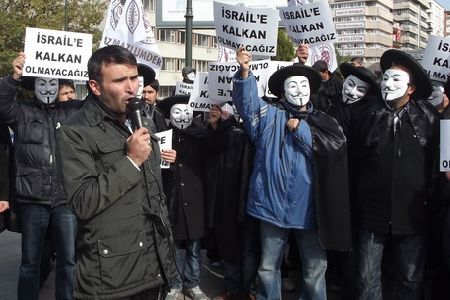
Turkish protesters have gathered outside the US Embassy in the capital, Ankara, to voice opposition to government plans to host a NATO base in the country, Press TV reported.
Turkish activists said on Sunday that the establishment of a NATO radar base in the eastern province of Malatya would turn Turkey into an “intelligence base for the imperialist wars waged by the US.”
They also held banners which read, “Turkey will not become a shield for Israel.”
The protest was organized by the Organization of Human Rights and Solidarity for oppressed People, known as Mazlumder in Turkish. Activists from several other NGOs also took part in the gathering.
Ankara announced in September that it had agreed on the deployment of the X-Band radar, which is an early warning radar, on its territory as part of NATO’s missile defense system.
According to the US Defense Department, the radar system will become operational in Turkey by the end of 2011.
The decision has sparked several protest rallies in Turkey.
Protesters say that the system threatens the region’s security and economy and that Ankara agreed with the plan under pressure from the US.
Opposition parties in Turkey have also called on the government to reject the planned deployment which they say is aimed at protecting Israel.
Iranian officials have repeatedly said that the presence of foreign forces in the region only threatens regional security and stability.
Communique No. 1 of “The Global March to Jerusalem”

The International Committee of the Global March towards Al-Quds issued the following Communique:
Since the Zionist occupation of 78% of Palestine in 1948, and the subsequent occupation of Jerusalem and the rest of Palestine in 1967, we have witnessed growing efforts to Judaize Jerusalem and colonize Palestine. These crimes against humanity are done under the political protection and full support of successive American administrations and enforced by its veto at the United Nations.
The goal of the Zionists is to force Palestinian residents out of Jerusalem and the rest of Palestine through acts of state terrorism, economic pressures, legal restrictions, and outright expulsions. The Holy city of Jerusalem is falsely called “the eternal capital of Israel” by Netanyahu and other Zionist leaders who clearly state that Jerusalem is non-negotiable. Such statements and related actions by the Zionists are absolutely inconsistent with all of the relevant United Nations resolutions on Jerusalem and contrary to the principles of international law.
The dominant position within the Israeli political, military and religious leadership is that Israel has a right to occupy all of historic Palestine. The “ultimate solution” as envisaged by the Zionists is to complete the ethnic cleansing of all Palestinians from historic Palestine and in the meantime apply a system of apartheid.
And yet Jerusalem is our common universal heritage including being revered by followers of all monotheistic religions. This remarkable and historic city of great antiquity is also venerated across the world for enhancing the heritage of all of humanity.
The city of Jerusalem has always been a beacon of emancipation and hope to the downtrodden. It has symbolized the unity and equality of all of God’s creation and the message of love, mercy and compassion. Millions of people who love Jerusalem are concerned for the safety and sanctity of the Al Aqsa Mosque, the Dome of the Rock Mosque, the Church of the Holy Sepulchre and other sacred properties under the Zionist plan to change and dismantle the structure of the society of Jerusalem, obliterating its Arab identity and changing the character of the city.
Jerusalem and all of Palestine need to be liberated, redeemed and restored as a land of freedom and coexistence by people of the world from all religious and cultural backgrounds.
As part of this movement and at the invitation of Palestinians, we decided to organize a Global March to Jerusalem (GMJ) aimed at raising awareness of the mortal threat to Jerusalem and all of Palestine by the hands of Zionists and helping us move closer to the day of freedom.
On 30 March 2012, from all continents we will converge and gather along the Palestinian borders with Jordan, Egypt, Syria and Lebanon, with the participation of delegations joining us from every country in the world in a peaceful march towards Palestine.
Therefore, we ask all people of good conscience to join us.
– The International Committee of the Global March towards Jerusalem
Italian pensioners protest in Rome
Press TV – October 28, 2011
Italian pensioners have taken to the streets of Rome to protest against their government’s harsh austerity measures, Press TV reports.
Thousands of pensioners gathered in a central square in Rome to voice their opposition to the government’s recent changes to the country’s pension plan.
The protests are a response to the recent decision by Prime Minister Silvio Berlusconi and his coalition partners, the Northern League, to increase Italy’s retirement age to 67 by 2025.
Italian workers are accusing the government of implementing reform measures too late and following instructions dictated by other European nations.
Italian opposition parties believe Rome should tax properties and residents with assets, rather than increasing the country’s retirement age and cutting public expenditure.
Rome has been pressured to implement economic reforms and budget cuts to reassure investors worried about the country’s huge debt ratio that is second only to Greece.
There is growing fear among EU leaders that Italy could be sucked into a crisis that has already claimed Greece, Ireland and Portugal.
Rome is facing a nearly two-trillion-euro debt that is 120 percent of its Gross Domestic Product.
Ashraf Abu Rahmah in the midst of circus military court
By Maria Stephanya | International Solidarity Movement | October 28, 2011
West Bank – The proof is all there: photos, videos, witnesses. All of them showed that Ashraf Abu Rahmah, one of the main activists of popular non violent struggle in the village of Bil’in, Palestine, walked peacefully on the road which goes from Bil’in’s recent liberated land to the center of the village, when an Israeli jeep passed besides him. Then it stopped. The soldiers stepped down, took the flag Ashraf carried and arrested him, forcing him to enter in the back of the vehicle under arrest, on October 23rd.
Rani Burnet, who saw everything in his wheelchair – part of his body was paralyzed because of live ammunition shot by an Israeli soldier, 11 years ago – complained.
In spite of lack of evidence to support charges brought against Abu Rahmah, in spite of the witnesses and the video which prove otherwise, Captain Tzvi Frenkel, a military judge at the Ofer Military Court, ordered the indefinite extension of his arrest, until the end of legal procedures against him.
In July 7th, 2008, Ashraf was blindfolded and bound in Ni’lin when the soldiers shot his foot. The video, seen by millions of people around the world, caused international protests. In April 17th, 2009, his brother Bassem was shot dead while trying to alert the soldiers for not harming livestock which was passing on the road beyond the wall. A high-velocity tear gas projectile, aimed at him from a distance of 40 meter hit him in the chest, killing him. In January 1st, 2011, their sister Jawaher also passed away because of the effects of the massive amount of toxic tear gas she had inhaled during a peaceful demonstration of December 31, 2011.
Maria Stephanya is an activist with International Solidarity Movement (name has been changed).
Edinburgh University students vote to ban G4S
By Adri Nieuwhof – The Electronic Intifada – 10/27/2011
The student council of the Edinburgh University Students Association (EUSA) adopted yesterday a motion to ban Danish-British security firm G4S from campus. EUSA wants to bring an end to the university’s relations with G4S because of the company’s involvement in the delivery of security services to illegal Israeli settlements in the occupied West Bank and Israeli prisons.
Indeed, G4S has stated in its own promotional material that it supplied security services to the Ofer prison compound, Keztiot prison and Megido prison. These prisons incarcerate 4,900 Palestinian “security prisoners,” according to G4S. All Palestinian political prisoners, including child detainees, are administratively classified as “security prisoners” as if being Palestinian constitutes a threat. At the end of September, Palestinian political prisoners went on hunger strike to improve the deplorable conditions under which they are detained in Israeli prisons. By providing services to Israeli prisons, G4S contributes to the facilitation of Israel’s violations of rights of Palestinian political prisoners.
The Students for Justice in Palestine group began a campaign to ban G4S following the adoption of the ‘Boycott Israeli Goods in Edinburgh University shops and supply chains’ motion at EUSA’s general meeting in March. The motion received around 270 votes in favor and 20 votes against. The decision was not binding because the quorum of more than 300 students to attend the meeting was not met. However, the huge level of support for the motion sent a clear signal to the student council of EUSA, the body that decides upon policies.
Almost seven months later, EUSA’s student council overwhelmingly supported a motion to block a contract with G4S, and to lobby the university to follow suit. The press release on the adoption of the “ban G4S” motion clarifies that the campaign to remove G4S from Edinburgh University campus is part of a wider campaign for boycott, divestmet and sanctions (BDS) by the Students for Justice in Palestine group on campus. The statement adds:
G4S currently provide security services to Edinburgh University library, which prompted Students for Justice in Palestine (SJP) to begin a campaign to force the University to tear up its contract with the security firm. It was then recently discovered that EUSA were also in the process of hiring the firm for money collecting services. This led to a motion quickly going before Student Council and it was clearly passed, meaning the Union’s trustee board must now look for an alternative.
The Danish-British security firm have been under huge scrutiny following the disclosure earlier this year of their role in Israel’s occupation by ‘Who Profits?’ a project by the Israeli Coalition of Women for Peace. The group revealed that the company supplies equipment and services to Israel for use at checkpoints, police stations, and settlements in the occupied West Bank and at Israeli prisons. Over the past month Palestinian prisoners have embarked on an open-ended hunger strike to protest the conditions in G4S supplied prisons.
In March earlier this year, due to pressure from the BDS campaign, G4S announced that it would exit from some of its contracts in the West Bank. However it will still deliver security services to illegal settlements in the West Bank and prisons in Israel.
Meanwhile, Addameer Prisoner Support and Human Rights Association has published an update with lots of information about the situation of the Palestinian political prisoners. They write:
CURRENT ARREST AND DETENTION STATISTICS*
5,374 Palestinian political prisoners in Israeli detention, including:
272 administrative detainees, including 3 women and 18 PLC members
36 women
176 children, including 31 under the age of 16
22 members of the Palestinian Legislative Council
141 prisoners who have been imprisoned for more than 20 years
170 Palestinians from the 1948 Territories
627 prisoners from the Gaza Strip, including 2 detained under the Unlawful Combatants Law
187 prisoners from East Jerusalem
750 approximate number of Palestinians arrested by Israel during the third quarter of 2011 (1 July – 30 September 2011). This marks an 11 percent decrease over the second quarter of 2011, and an 11 percent increase over the same period in 2010.*Detention statistics are based on reports from the Israeli Prison Service and Addameer’s monitoring. Because the IPS did not publish the latest statistics before the publication of this newsletter, the detention statistics included are current as of 31 August 2011, except for the number of women and PLC member, which are current as of 15 October 2011 and based on Addameer’s own documentation. Arrest statistics are based on figures from the Palestinian Monitoring Group and are current as of 30 September 2011.
Ahmad Saadat, Palestinian lawmaker and Secretary General of the Popular Front for the Liberation of Palestine, entered his 32nd consecutive month in isolation in October, writes Addameer:
On 6 and 9 October, lawyers from Addameer and other organizations were finally able to visit Saadat in Nafha Prison. They reported that he had already lost 5 kg and was showing signs of extreme fatigue and low levels of concentration, with the visits having to be cut short as a result. During both visits, Saadat fainted and reported that he had been coughing up yellow liquid. On 9 October, Addameer sent a request to the IPS for the immediate hospitalization of Saadat and all other hunger-striking prisoners in bad health. On 16 October, the IPS complied with this request, but at the time of publication, Saadat had just been transferred back to Nafha Prison from Ramleh Prison hospital and had his isolation renewed by an Israeli military court.
Featured Video

Piers Corbyn on religion of climate change
or go to
Aletho News Archives – Video-Images
New Documentary
“Inside Gaza” wins best documentary at Montreal’s Cinemania film festival
Palestine Information Center – November 16, 2026
MONTREAL – The documentary “Inside Gaza,” which chronicles the experiences of Palestinian journalists working with Agence France-Presse (AFP) while covering the Israeli war on the Gaza Strip, won the Best Documentary Award at the 32nd Cinemania International Francophone Film Festival held in Montreal, Canada.
Directed by Helene Lam Trong, the 72-minute film follows the daily lives of four AFP journalists who bear witness to the difficulties of reporting in a war-torn territory largely closed off to international media.
The film is compiled from material produced by the team on the ground, as well as from interviews conducted after they left.
The film also won the People’s Choice Award at the festival on Saturday. … continue
Blog Roll
 Aletho News
- Austria seeks to strip former foreign minister of citizenship over Russia ties
- “Inside Gaza” wins best documentary at Montreal’s Cinemania film festival
- Activists block German munitions plant over arms exports to ‘Israel’
- The Nasser Hospital attack and Israel’s relentless lies
- Could it be satan? No, Huckabee, just the Americans you work for
- AIPAC and more: Network of pro-Israel influence in US Congress
- Putin aide reveals Moscow’s stance on Europe at peace talks
- Imran Khan warns Pakistani judges he may die in prison
- IOF used Amazon facial recognition to track millions of Palestinians
- More EU Citizens Face Sanctions For Criticizing The Ukraine Proxy War
- If Americans Knew
- An error has occurred; the feed is probably down. Try again later.
- No Tricks Zone
- Argentina’s Perito Moreno Glacier Joins Antarctica and Arctic In Defying Doomsday Melt Claims
- New Study: Barents Sea Temperatures Were Warmer And Sea Ice Less Extensive In The 1700s Than Today
- German Authorities Start Initiative To Evaluate Public Register For Climate “Disinformation” Spreaders!
- Zonal Asymmetry of Temperature Change in the Antarctic Circumpolar Current
- New Study: The Net Fossil Fuel Contribution To Rising Atmospheric CO2 Has Been Zero For 500 Years
- Germany’s Green Energy Transition Becoming Increasingly Expensive…Another 6 Trillion Euros!
- Sudden Stratospheric Warming, Powerful El Niño Combination May Lead To Extreme Europe Cold, Energy Crisis!
- Two New Studies Find Thwaites Glacier Melt Cannot Be Driven By Human Activity Or A Warming Ocean
- E-Cars Reduce CO2 Emissions By Only 41% Compared To Internal Combustion Engine Vehicles
- Predictions Made By Renowned Climate Professor Over Past Decades Have Been Proven To Be Poor

