Residents and local administration officials in the northern Syrian town of Al-Hasakah rallied on Wednesday to protest against the illegal presence of 150 US troops in the Kurdish-controlled town of Rumeilan, Syrian SANA news agency reported.
“We are categorically against the impermissible and flagrant violation of our country’s sovereignty. We will not allow American boots on our soil. We are also against any plans for a division or federalization of Syria,” Al-Hasakah Governor Mohammad Zaal said during the meeting.
A similar rally had earlier been held in the neighboring town of Al-Qamishli.
The Syrian Foreign Ministry called the reported deployment of 150 US troops to Rumeilan airport in the northeast of the country “an unacceptable and illegal intervention” which came without authorization from the Syrian government.
On April 28, US President Barack Obama announced that Washington would “deploy up to 250 additional US personnel in Syria including Special Forces.” They are reportedly expected to train the Syrian Democratic Forces.
The White House asserts that the deployment of the Special Forces is intended to repel Daesh terrorists.
On Wednesday, about 150 US soldiers arrived in the Kurdish-controlled town of Rumeilan in northeastern Syria, according to a Kurdish security source. According to the source, part of the contingent immediately headed to the north of Raqqa province.
Meanwhile, a 28-year-old US Army officer has sued President Barack Obama over the legality of the war against the Islamic State (Daesh), questioning Mr. Obama’s disputed claim that he needs no new legal authority from Congress to order the military to wage the ever deepening mission, The New York Times wrote on Wednesday.
Captain Nathan Michael Smith, an intelligence officer stationed in Kuwait, voiced strong support for fighting Daesh but, citing his “conscience” and his vow to uphold the Constitution, he said he believed that the mission lacked proper authorization from Congress.
The legal challenge comes after the death of the third American serviceman in the fight against Daesh and as President Obama has decided to significantly expand the number of Special Forces members.
President Obama has argued that he already has the authority he needs to wage a conflict against the Islamic State under the authorization to fight the perpetrators of the terrorist attacks of September 11, 2001, enacted by Congress shortly after the attacks.
May 5, 2016
Posted by aletho |
Illegal Occupation, Militarism, Progressive Hypocrite, Solidarity and Activism | Obama, Syria, United States |
Leave a comment
Prologue: In 2004 I wrote Brazil and Lula: Year Zero (Edifurb: Blumenau, Sao Paolo 2005), in which I presented my analysis of the Lula-Workers Party (PT) regime in Brazil undergoing a Grand Transformation with the first stage represented by the PT’s incorporation into a government apparatus led by of bankers and exporters (the agro-mineral elite).
Two years earlier, my colleague, Henry Veltmeyer, and I had published Cardoso’s Brazil: A Land for Sale (Rowman and Littlefield, Lanham MD 2003) where we described how President Cardoso had sold off the major public resources, banks, petroleum and iron resources to foreign capital for rock bottom prices. The 2002 election of President Lula DaSilva of the Workers’ Party did not reverse Cardoso’s sell-out. Indeed, Lula accepted his predecessor’s neo-liberal policies – embellished them – and set about forging an alliance between the Workers’ Party and the economic elites, replacing Cardoso’s Party! For the next few years, we were attacked by the Left academic and pundit world for having dared to advance such a critique on their ‘worker president’! The consequences of what we had described as the PT’s pact with the Right are clear to everyone today: Brazil is enmeshed in swindles, scandals and coups.
Introduction
“The nature of the multitude is to arrive rapidly and depart swiftly”.
For more than a decade, left-wing parties, accompanied by working class trade unions and landless rural social movements, dominated Brazil, the largest country in Latin America. Their political leaders were repeatedly elected; their trade union and rural social officials secured concessions from the state; the political process followed legal procedures adjudicating its agenda with the opposition business, banking and professional parties.
We were told the days of coups and revolutions were passed. Electoral processes, honest vote counts and mutual recognition of political legitimacy precluded any violent, dismissal and ouster of the established Left political leadership.
The Rise and Fall of the Political Left
The dominance of the Left is now only a memory! Its parties are in full retreat. Its leaders are scorned, insulted and prosecuted by their former political allies. The business allies of the past are now at their throats. Those politicians, who secured government positions in return for loyalty and votes, have fled clamoring for ‘impeachment’ and claiming deceit… while seeking new sources of patronage and plunder.
The great left political leaders, who had once bragged of 53 million voters, who were hailed in the international press for their command of a huge mass base while accommodating the interest of modern trade and business, are now condemned by the capitalist media as the cause of the current economic calamity.
The popular heroes of yesterday, who shared wealth and status with their rivals in the business elite, are now ostracized and facing show-trials for corruption.
The Trade Union and Rural Workers’ Leaders
Veteran trade union and rural leaders came to the Presidential Palace to celebrate the electoral successes of the ‘worker president’.
Once blushing with flattery, these mass leaders are now dismayed that the fiesta has ended and the music has stopped, while the workers and peasants are ordered to pay for the broken dishes and start the cleanup…
The mass popular organizations are now without allies in Congress; their voices are shut out of the bourgeois media; the domestic economy has been abandoned by the market; and the masses are in the streets clamoring for retribution against the politicians betrayal. Now trade union and peasant leaders appeal for resistance and a return to class struggle; but their followers are in retreat!
Toward an Understanding of a Historical Defeat
The rise and fall of the Left is a historical reversal, which requires a systematic analysis of a disastrous strategy. The left’s defeat cannot simply be dismissed as a betrayal by treacherous allies, corrupt party officials or plots concocted by billionaires and the US Embassy, leading up to a coup via a clearly phony impeachment process. The real question to ask is: Why did the Left allow such treachery and betrayal, culminating in a legislative ‘coup d’état’, to develop unopposed leading to reversal and rout of the Left? How could a huge multi-million-person voting machine, a vast and experienced trade union apparatus and a militant rural social movement fall defeated without even a struggle?
The Strategy of the Left
The Left parties deliberately adopted a short-term strategy of accommodation with the right, in part to avoid long-term, large-scale strategic confrontations with the defeated economic elite. For their part, the parties of the Right and their US advisors patiently chose to accept the Left’s compromises and offers of cooperation, in order to prepare for a strategic offensive when the Left’s mass of support had declined.
The Left parties embraced poorly thought-out ’short-cuts’ to governance. They occupied government posts while cutting cozy deals with all the major power brokers of the Right.
The Left signed ‘austerity’ agreements with the IMF to restrain budgets and accept debt obligations. Members of notorious rightwing and opportunistic political parties were brought into the cabinet, assigned strategic congressional leadership positions and placed on senior presidential advisory panels in exchange for their votes to approve loans, credits and regional development projects.
The Left negotiated deals with business elites, offering them generous subsidies and high profits, while restraining workers’ demands for structural changes. They viewed this accommodation as an exchange for economic growth, wage increases and trade union recognition as a legitimate power sharer.
The Left dismissed the grassroots demands for social transformation and they opposed any popular campaign to prosecute the financial elites for money laundering and white-collar crimes. Instead, they favored incremental increases in wages, poverty funds, pensions and consumer credit.
The Left ignored the reality that such arrangements with the business elites were only a temporary truce rather than a permanent, strategic alliance.
The trade unions followed the lead of the Left political leadership. They directed their mass organizations to accept negotiations based on periodic wage increases, more funds for trade union education and subsidies for new union building complexes. The trade union leaders discouraged strikes, repressed demands for public ownership and prevented any investigation into mining, banking and agro-business corruption, tax evasions and bribery. Even the well-documented wave of assassinations of landless worker activists and the naked land grabs of ‘protected’ Indian territories went unpunished.
The business elite realized they faced a potential radical mass movement, which was under the control of an elected ‘Left’ government. They were ‘delighted’ that this Left government was so willing to accommodate capitalist demands. They cautiously decided that short-term rewards and well-placed bribes would help prepare the ground for their restoration to power and reversal of the left’s concessions.
The Left rural social movements retained their radical socialist rhetoric and mass membership, but their leadership followed the Left parties in government.
In exchange for subsidies to set-up and expand community-based rural organizations and training schools for farmworkers, the social movements mobilized their mass activists to ‘turn-out the vote’ for the Left parties’ President and Congress people.
The rural movement leaders justified their accommodation with the Left- business alliance describing the Left regime as a ‘field of contention’, where they could press for radical changes. After more than a dozen years of successful mass struggle, the radical rural movement chose to ally with the Left party apparatus! Only when the ‘Left President’ was impeached did the rural workers’ leader call for the return to class struggle!
The Left’s Short Term Gains and Long Term Losses
The political leaders on the left, as well as trade union and rural movement leaders, all believed they had a winning strategy. They claimed their mostly superficial ‘gains’ were ‘evidence’ of their success. These included:
(1) Their governance for over four administrations where they increased or maintained the left’s voting majority.
(2) ‘Pragmatic’ political alliances with parties across the spectrum – won through various forms of bribery – as a formula for winning Congressional approval for major development contracts.
(3) Their funding of opposition allies, which attracted ‘respectability’ and enriched both Left politicians and their electoral campaigns.
(4) The decrease in social tension achieved by recruiting business opponents and gaining support among sectors of the capitalist class.
The Left political leaders’ strategy of accommodation depended on the economic success of the mineral-oil-agriculture export elites. This ignored the business sector’s fundamental policy of cutting social and productive investments whenever markets, profits and economic opportunities declined.
When the Left regime’s public subsidies for the export industry declined following the collapse of the global commodity market, the entire capitalist elite coalesced into a virulent Rightwing opposition.
When the previous political accommodation with capital, held together by corruption and questionable subsidies became the target, the Right launched their strategic offensive.
The fact that business, banking, media and agro-mineral elites were able to join forces so quickly and launch their attack on the Left shows how they had flourished for a decade during the commodity boom.
The entire façade of a ‘broad progressive coalition’ disappeared: The trade union and rural movement structures, linked to the Left political leaders, were incapable of mobilizing their mass base and countering the insurgent Right. For over ten years, the Left regime had cut all its political deals in Congress, in the corridors of elite power, while ignoring ‘class struggle’.
This was a ‘Left’ regime, wholly dependent on market conditions and business allies. It was unable to defend any strategic ground when the Right regained its power base.
The Left regime had retained an intact and fully functioning right administrative and judicial apparatus, composed of courts and judges, the prosecutors and investigators all aligned with the Right opposition. They were ready to undermine the regime’s congressional majority by opening ‘corruption’ investigations targeting the Left. Meanwhile, the business elite managed to intensify the consequences of the economic recession and insist that ‘recovery’ meant austerity against the poor.
The Right purchased its street crowds and mobilized its party allies, including the center, the fascists, the neo-militarists, the agro-business elite and the imperial and local financial press. From Sao Paulo to New York to London they were poised to forcibly oust the elected Left President from power and jail its leaders.
Conclusion
The Left believed in the myth of democratic capitalism. They had faith that their negotiations with the business elites would increase social welfare. They operated on a platform of gradual accommodation of class interests leading to multi-class alliances and strategic conciliation between business and labor.
The historical lesson has proven otherwise – again. Business and the capitalist elite make clear, tactical short-term agreements in order to prepare a strategic counter-offensive. Their patient long-term strategy was to mobilize their class allies and overturn the electoral process – at the ripe moment.
The Left parties depended on achieving a series of ’strategic understandings with the capitalist class’ where both would benefit at a time of peak global demand for Brazil’s commodities, instead of expanding their popular mandate by transforming the economy and domestic market.
The Left behaved as if favorable world market conditions would last forever. They lost their chance to use their 53 million-voter strength and radically change the organization and ownership of Brazil’s strategic economic sectors!
In this way, the Left imitated the Right, choosing to share its power bases through accommodation with their business-partners. These were amateurs at the bourgeois power game, who found themselves entrapped in corruption and crisis! How shocking!
It was so much easier for the Left politicians to get campaign funding through the usual practice of business payola than to campaign from door to door, factory to factory, village to village, fighting repression, elite media boycotts and armed vigilantes.
In the end, their ‘power base’ dissolved and their capitalist ‘partners’ and political ‘allies’ abandoned them: the Left President was impeached.
Victorious capital and empire neatly ended this charade of ‘market democracy’. The retreating Left parties begged for a reprieve via parliamentary vote and ended with a decisive defeat… bleating their last whimper as the door slammed shut…
Capitalists have never and will never recognize weak popular opposition. The capitalist political elite will always choose power and wealth over social democracy. The Left, in retreat, isolated and expelled from the corridors of power, now face retribution from the most corrupt and treacherous of their ‘former allies’.
They usher in a lost generation.
May 4, 2016
Posted by aletho |
Economics, Solidarity and Activism, Timeless or most popular | Brazil, Latin America |
Leave a comment
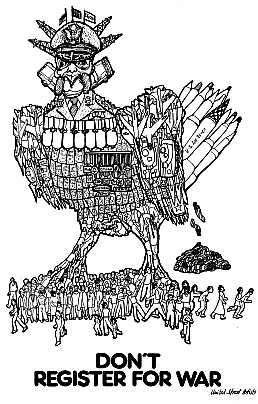 We won — and now, thirty years later, the government has finally admitted it.
It’s not often that government officials admit to failure in the face of popular resistance. When they do, it’s an occasion for celebration.
Draft registration was reinstated in 1980, supposedly to prepare for possible deployment of US troops in Afghanistan on the side of the Islamic fundamentalist warlords and “mujahideen” who were then fighting against the USSR. The US government put me in prison for refusing to agree to fight on the side of the people who would later become the Taliban and Al Qaeda! It’s no wonder that people of my generation, or later generations, have no faith in the ability of the US government to decide for us in which wars, or on which (if any) side, we should fight.
Today in U.S. News & World Report, Steven Nelson has the most significant piece of reporting about draft registration and the Selective Service System in decades, asking questions that journalists, politicians, and the public should have been asking years ago.
It’s been obvious — to anyone who wanted to look — that resistance forced the government to abandon the attempt to enforce draft registration in failure in the 1980s, after show trials of a handful of the “most vocal” nonregistrants. But this is the first time that responsible Selective Service officials and former officials have confirmed this on the record.
The article is worth reading in full, but I’ve posted some key excerpts below, followed by my analysis and comments:
Gender-Neutral Draft Registration Would Create Millions of Female Felons
by Steven Nelson, U.S. News & World Report, May 3, 2016
A key congressional committee voted last week to require young women to register for potentially compulsory military service, but the gender-equalizing reform threatens to make felons out of women who refused to participate.
Though prosecutions currently appear unlikely, men jailed for not registering with the Selective Service System and some former authorities who participated in the cases are concerned about criminalizing a large swath of the population.
“It will inevitably lead to massive resistance, whether visible in the streets or women just blowing it off the way men have,” says Edward Hasbrouck, prosecuted for not registering in the 1980s. “Congress is smoking crack if they think women can be forced to register.”
Hasbrouck served more than four months in prison after catching the eye of an ambitious federal prosecutor, Robert Mueller, who went on to be FBI director. He originally received a suspended sentence, but recalls an unamused judge sending him to prison in late 1984 [actually 1983] for doing peace activism to satisfy court-ordered community service….
The government was “faced with far more people who had initially refused to register in the start-up period than they had ever imagined — it was beyond their worst nightmare. They were self-deluded in the way people today who think they can just wave their wand and women will sign up for the draft are self-deluded,” Hasbrouck says….
In all, 20 men were prosecuted in the 1980s for not registering, a diverse and geographically scattered group including ideological advocates of individual rights and members of the historical peace churches.
The last indictment came in 1986 when Terry Kuelper of Arkansas was slapped with the felony charge. He agreed to register before trial and the charge was dismissed. Court proceedings ended when Gillam Kerley of Wisconsin was released from a three-year prison sentence after four months, with the case ending in 1988….
Former Selective Service associate director Edward Frankle … developed a process for … enforcement of the registration law…. “We did what we had to to keep at least some level of credibility in the system,” he says. “You couldn’t just totally ignore it — how could you do that and still with a straight face say, ‘Yeah that’s the requirement’?”
In the late ’80s the Justice Department discontinued prosecutions. Dick Flahavan, a spokesman for the Selective Service who was with the agency at the time, recalls the Justice Department “decided that since there was no draft … there are limited resources and the FBI’s time would be better spent chasing white collar crime than some Mennonite kid through Pennsylvania.”
“We said, ‘Fine, we understand,’ and that’s why it ended in ’88,” he says. “The agency did agree to what the Justice Department proposed, a suspension of prosecutions [during peace time]. Since they did the prosecutions we didn’t have much leverage anyways.”…
Flahavan says the Selective Service had hoped for a much stronger approach from federal prosecutors, but was rebuffed.
“What we would have preferred was every year in all 95 judicial districts there be a prosecution to keep the heat on and the publicity going,” he says. “But they couldn’t sustain that.”
If someone registered just before trial, the prosecution would be dropped, Flahavan notes, making the pursuit of resisters “really a losing proposition for the feds” and often “a big waste of time.”
Wilfred Ebel, acting director of the Selective Service System in 1987, when further waves of prosecutions were being considered, says he can’t recall the precise discussions that led to abandonment of new cases. Former Attorneys General Ed Meese, who left the department in 1988, and successor Dick Thornburgh did not respond to requests for comment, nor did Mueller….
Though hard numbers are elusive, Hasbrouck says with confidence “compliance with the address update requirement is and has been since 1980 essentially zero.”
A central insight of both Gandhian and anarchist political theory is that governments have power only to the extent that people are willing to carry out or comply with their orders. But few of the people pontificating lately about whether extending draft registration to women is “desirable” (from one or another perspective) have stopped to ask whether it is possible. So far as I know, no historian or scholar has made a study of draft registration since 1980. (If I’ve missed something, please send me a link or citation, or post it in the comments.) There’s been no GAO audit of the accuracy of the Selective Service database of registrants and their current addresses since 1982.
Despite the refusal of the Justice Department to prosecute nonregistrants, the Selective Service System continues to refer names of possible nonregistrants identified by automated data-matching to the Justice Department “for possible prosecution”. According to the latest Selective Service System Annual Report to Congress for Fiscal Year 2015 (page 16), “If a man fails to register or fails to provide evidence that he is exempt from the registration requirement after receiving Selective Service reminder and/or compliance mailing, his name is referred to the Department of Justice (DOJ) for possible investigation and prosecution for his failure to register… During FY 2015, 146,997 names and addresses of suspected violators were provided to the DOJ.” None of these nonregistrants were investigated or prosecuted, nor have any of the other millions of suspected draft registration resisters whose names have been referred by the SSS to the DOJ in the last thirty years.
If resistance rendered draft registration of men unenforceable, why would anyone think that young women will be more willing to sign up to kill or be killed on command than young men have been?
Resistance to any attempt to extend draft registration to women is inevitable, but people tend to (wrongly) discount the practical or political significance of silent resistance, despite its effectiveness. That’s a major reason why the ongoing resistance to draft registration by young men has been so little noticed or understood.
The political anthropologist James C. Scott analyzed this phenomenon in Domination and the Arts of Resistance (Yale University Press, 1990, Chapter 7):
Much of the active political life of subordinate groups has been ignored because it takes place at a level we rarely recognize as political. To emphasize the enormity of what has been, by and large, disregarded, I want to distinguish between the open, declared forms of resistance, which attract most attention, and the disguised, low-profile undeclared resistance….
For many of the least privileged minorities and marginalized poor, open political action will hardly capture the bulk of political action…. The luxury of relatively safe, open political opposition is rare… So long as we confine our conception of the political to activity that is openly declared we are driven to conclude that subordinate groups essentially lack a political life…. To do so is to miss the immense terrain that lies between quiescence and [open] revolt and that, for better or worse, is the political environment of subject classes….
Each of the forms of disguised resistance… is the silent partner of a loud form of public resistance.
And Scott said this in Two Cheers for Anarchism (Princeton University Press, 2012, Chapter 1):
Desertion is quite different from an open mutiny that directly challenges military commanders. It makes no public claims, it issues no manifestos, it is exit rather than voice. And yet, once the extent of desertion becomes known, it constrains the ambitions of commanders, who know they may not be able to count on their conscripts…. Quiet, anonymous,… lawbreaking and disobedience may well be the historically preferred mode of political action for… subaltern classes, for whom open defiance is too dangerous.
It’s past time for Congress to get real, end draft registration, and abolish the Selective Service System.
To make this happen, Congress and the public need to hear from young women who don’t plan to register for the draft. Otherwise they won’t think about the prospect of resistance by women to draft registration, or take it seriously. I’ll be happy to publish or link to “I Won’t Go” or “We Won’t Go” statements, anonymously or with names as the authors wish. If there are other things I can do to help young women prepare to resist draft registration, or to support their resistance, or to support the ongoing resistance by young men, please let me know.
edward@hasbrouck.org
May 4, 2016
Posted by aletho |
Civil Liberties, Militarism, Solidarity and Activism, Timeless or most popular | Human rights, United States |
Leave a comment
Hebron, Occupied Palestine – On the morning of the 24th of March around 8:30 am two Palestinian youths, Ramzi Aziz al-Qasrawi, 21, and Abed al-Fattah Yusri al-Sharif, also 21, were shot to death by Israeli forces after an alleged stabbing attempt in the Palestinian neighbourhood of Tel Rumeida. The world became aware of the extra-judicial killing of al-Sharif by the Israeli-French army medic Elor Azaria through the footage shot by Imad Abu Shamsiya, resident of Tel Rumeida, co-founder of Hebron Human Rights Defenders and contributor to Israeli human rights group B’Tselem.
Over the last month Imad has become something of a celebrity. He has appeared on Palestinian news, made appearances in international media and has even been interviewed by mainstream British newspaper The Independent. All of which has come at the same time as the settlers in Tel Rumeida and in wider Hebron have issued death threats and upped their campaign of persecution against him and his family.

Imad and his 3 sons, Awne (left), Soli (middle), Muhammed (right), who are all taking part in resistance against the occupation.
Last week ISM activists had the privilege of sitting down with Imad and talking about the impact of these events on his life, his family’s history in Hebron, his history of arrests by the Israeli Occupying Forces and his hopes and fears for his life both now and in the future.
Imad’s family have lived in Hebron for generations: “I was born here, my father was born here, my grandfather and my great-grandfather, all born here.” He can trace his family’s presence in Hebron back at least 218 years as the family had a house near to the Ibrahimi Mosque registered in their name from that time, in addition to the family home that they occupy to this day in Tel Rumeida.
Seven years ago in 2009, however, the family’s house in Tel Rumeida was standing empty. Imad knew that it would only be a matter of time before the settlers, by now established in Tel Rumeida and on Shuhada Street, would attempt to sieze the home. It was then that Imad decided to move from his home in H1 (Palestinian-controlled Hebron) to Tel Rumeida in H2. This extraordinary decision was supported by his entire extended family as well as his wife Faiza and his five children (then aged between 4 and 11). Imad himself felt confident in this choice: “At first we thought there was not a lot of difference, just that here there is a checkpoint when there was not one where we had lived before.”
But despite his initial downplaying of the situation, the decision had a huge impact on his family. From the get-go his children would go out to play in the street and they would be attacked by settlers or harassed by the army. However, this only served to strengthen Imad and his family’s desire to stay in Tel Rumeida. Even his youngest son – Salah, now 11 – knows that they are there to stop the settlers from stealing their home and their land.
Sadly this notion of resistance that runs through the whole family has, perhaps unsurprisingly, had some serious ramifications for all of them. No more so than for Imad’s oldest son – Aune, 17. Aune was shot in the foot with a ‘dum-dum’ bullet – live ammunition that splinters on entry – and Imad was further shocked when, at the checkpoint near his home, the local area commander of the Israeli Occupying Force told him that he would kill Aune if he saw him again. They decided it was best to send Aune away to live with relatives and so, a child of seventeen, he cannot live with his mother and father and never sees his four siblings. Moreover the other four children have all, at one time or other, been victims of abuse and attacks at the hands of the settlers. Although perhaps the worst that the family have lived through is the current situation and the death threats that Imad has experienced since his role in the video of the extra-judicial killing was made public. Imad, however, has been through extremely challenging times before and is undaunted by the situation he faces.

Imad in his house, which is regularly targeted by settlers and army
In the late eighties during the first Intifada a young Imad – sixteen years of age – would, like many young male Palestinians at that time, go to the demonstrations in protest of the Israeli occupation. The Israeli forces then, as now, would shut these demonstrations down with extreme measures. On one such occasion – on Friday 20th of January 1988 – Imad found himself hospitalised having been shot in the hand with live ammunition: “I was in hospital in Jerusalem for fifty days recovering and at that time the Israelis came and arrested me.” In prison Imad was questioned for eighteen days, accused of being a ringleader and organiser. Finally brought before the court he was sentenced to six months in prison for his role as a demonstrator: “then, thirteen days after I was released that first time, they arrested me again and sentenced me to another six months in prison.” He wasn’t to know it then but this was the first year of a total of four years and two months that he would spend in prison.
On the 16th of February 1991 Imad was arrested once again and this time he was kept in solitary confinement for 111 days: “Imagine it. You are alone, without water to wash with, you don’t see the sun, you are cold, it’s winter, you are in a t-shirt and shorts.” During this time he was tortured: beaten, subjected to stress positions and consistently interrogated. He was accused of throwing stones and molotov cocktails as well as being a leader within the Intifada. He denied all accusations and after 111 days, when they had nothing to charge him with, he was taken before the court and sentenced to another six months detention regardless.

Example of common stress-position (torture position) utilised in Israeli interrogation
Once again in 1992 he was arrested and again he was kept in solitary confinement, this time for a period of 75 days. Refusing to confess to the false accusations of violence that were leveled at him, Imad was sentenced to six more months of detention without charge.
In 1995 Imad, specifically due to his position as a citizen of the already divided town of Hebron, was part of a large group of Palestinians who objected to the terms of the Oslo Agreement. As such he was part of a mass-arrest and sent to the infamous Naqab Prison in the Negev Desert where he was detained for a further six months. Imad would be arrested twice more – in 1997 and 1999. On both occasions he was arrested in the middle of the night, taken from his family home, not questioned or interrogated, but sentenced to a further six months detention.
Taking this history of persecution and Imad’s lifelong resistance into account, it is perhaps less surprising to picture Imad and Faiza agreeing with their children to move to the front line of resistance when they moved to Tel Rumeida in 2009. Then two years ago he formed Hebron Human Rights Defenders with Badee Dwalik, and Imad’s journey towards infamy began. Having been trained in the use of video cameras by B’Tselem, Imad and Badee recruited others from Tel Rumeida and wider Hebron and trained them to use video cameras donated by anti-Zionist activists in the US. Imad even trained his wife and children to use the cameras: the whole family knows that if things get bad with soldiers and/or settlers then the first recourse is to pick up a camera and to document. Now Badee and Imad plan to teach the local children in Tel Rumeida how to use the cameras: they intend to resist the occupation by exposing it’s most inhumane and abusive elements.

Badia from Human Rights Defenders at a school in Tel Rumeida, teaching the kids how to film.
All of which leads us neatly back to the events of the 24th March this year (and you can read about the events of that day from Imad’s perspective here.) One would have thought that living with his wife and four of his children in occupied Hebron, with the constant threat of attack by settlers as well as harassment by soldiers out for revenge for him having made the video, Imad would feel some negativity about his life now, or at least have mixed feelings about having found fame in this way. Nothing could be further from the truth: “if I could go back in time and had the opportunity to maybe not shoot the film I wouldn’t take it. I would always want the world to see what Palestinians have always known goes on”. Still, one could forgive if he felt that perhaps it would be best if his family left Tel Rumeida: “we will never leave here. They can harass us and attack us but we will not let them have our family’s home and our land. This is something my wife and children agree with 100%. We will not leave.” And would he leave Hebron? “Never.”
The occupation could have ground Imad Abu Shamsiya down. They have tried everything that they can to ruin his spirit – from torture and arrest to death threats and harassment – but Imad is a man, supported by his extraordinary family, who personifies the strength and the generosity of spirit demonstrated by the Palestinian people in the face of such indignity and suffering. He certainly touched and moved the ISM activists that had the pleasure of sitting down and chatting with him.
Lastly it is ISM’s pleasure to convey a message from Imad to the international community, to the political class and to all Palestinians:
“As Palestinians we always said that extra-judicial killings happened. Now people have seen my video I hope that the world will know that they do. Now people know what we live with and I hope we can work together to end the occupation so that we, the Palestinian people, can be free.” – Imad Abu Shamsiya
May 3, 2016
Posted by aletho |
Ethnic Cleansing, Racism, Zionism, Solidarity and Activism | Hebron, Human rights, Israel, Palestine, Zionism |
Leave a comment
ODESSA — Eight foreign reporters were prohibited from entering the southern Ukrainian city of Odessa to cover the events commemorating the second anniversary of the massacre in the city, a lawyer representing one of the people accused of involvement in the deadly events said Monday.
“About eight journalists were not allowed to enter [the city],” Kirill Shevchuk told RIA Novosti.
He added that the reporters, including those from Poland, France, the Netherlands and Germany, were turned back at passport control in Odessa’s airport.
On May 2, 2014, pro-Kiev radicals blocked anti-government protesters in Odessa’s House of Trade Unions and set the building on fire by hurling Molotov cocktails inside. According to the official data, 48 people died and more than 250 were injured in the fire. No perpetrators have been brought to justice.
The mourning rally was scheduled for 2 p.m. local time (11:00 GMT), but because of an alleged bomb threat local authorities blocked the access to the tragedy site for people who wanted to commemorate the victims of the massacre.
May 2, 2016
Posted by aletho |
Full Spectrum Dominance, Solidarity and Activism | Human rights, Ukraine |
Leave a comment
Even as May Day protests were expected in cities across the world on Sunday, as economic crises and a rise in unemployment have fuelled anti-government sentiment, Brazil saw some radically different scenes.
Hundreds of thousands of people marched in Brazil’s main cities on International Workers’ Day in a show of support for the embattled President Dilma Rousseff.
Protests were seen in 16 of the country’s 27 states, called by Central Union of Workers (CUT) and numerous other labor and left-wing organizations.
The support for the embattled leftist leader Rousseff in Brazil was in sharp contrast to France which was on high alert after protests against planned labour changes this week sparked a frenzy, with cars set on fire and dozens of police officers being injured in Paris in clashes with protesters.
On Sunday, the Brazilian city of Sao Paulo saw the largest march with around 100,000 people, according to organizers, in three separate marches.
Rousseff appeared at the CUT march in Sao Paulo, alongside the mayor of Sao Paulo, Fernando Haddad, and the president of the Workers’ Party, Rui Falcao.
During a speech to the crowd, Rousseff announced a new policy measure, according to Brazilian daily O Globo, saying that her flagship social welfare program Bolsa Familia would be increased by 9 per cent.
Bolsa Familia is an ambitious cash-transfer scheme that has helped elevate millions of Brazilians out of poverty. Funds are channelled through the mothers of poor and working-class families.
The scheme was launched nationwide by President Lula’s administration in 2003 and its exemplary success has cemented support for Rousseff’s Workers Party among the poorest in Brazil.
On Sunday, Rousseff also announced that 25,000 new houses would be built within the Mi Casa, Mi Vida (My Home, My Life) program, the renewal of the contracts of foreign doctors in the Más Médicos (More Doctors) program, an increase in paternity leave for public officials and an adjustment to the rental tax to benefit workers.
In other cities such as Rio de Janeiro, Curitiba, Fortaleza, Manaus, Joao Pessoa, Recife and Salvador, Rousseff supporters marched, saying they would not allow her impeachment.
The Brazilian Senate is currently considering whether to open an impeachment trial against Rousseff, over alleged fiscal irregularities in 2014 and 2015.
May 2, 2016
Posted by aletho |
Economics, Solidarity and Activism | Brazil, Dilma Rousseff, Human rights, Latin America |
Leave a comment
The United Auto Workers (UAW) union at the University of California has been fighting to uphold a resolution passed to support the BDS movement against Israel. Its struggle has inspired other university unions to pass their own resolutions.
The UAW Local 2865, which includes some 14,000 students and teaching assistants working for the University of California, passed a resolution to support the Boycott Divestment and Sanctions movement in 2014, becoming the first major labor union to do so, with 65 percent voting in favor of divestment and 52 percent supporting an academic boycott among the student-workers union of the University of California.
“The University of California divest from companies involved in the occupation of Palestine; that UAW International to divest from these same entities; the US government to end military aid to Israel. Fifty-two percent of voting members pledged not to ‘take part in any research, conferences, events, exchange programs, or other activities that are sponsored by Israeli universities complicit in the occupation of Palestine and the settler-colonial policies of the state of Israel’ until such time as these universities take steps to end complicity with dispossession, occupation, and apartheid.” UAW Local 2865 Resolution
An anti-BDS arm of the union called Informed Grads appealed the result, with the help of Gibson, Dunn & Crutche, a law firm that has defended Walmart, Amazon and Chevron, Salon reports. The firm has represented Lockheed Martin, Boeing and other corporations that gain from Israel’s defense spending.
While the International Executive Board defended the integrity of the vote, saying it represented the will of the members, it claimed it could interfere with the flow of commerce and pointed to the possibility of discrimination, despite the number of Jewish and Israeli members that supported the resolution and later wrote a letter attesting to the fact.
Following the decision, lawyer Scott Edelman expressed pleasure at the UAW’s “forceful rejection of BDS, which sets a powerful precedent for other labor unions and national organizations.”
UAW Local 2865 appealed the decision, saying the “IEB improperly ignored the UAW constitutional mandate to solidify the labor movement and build solidarities with other unions, such as the Palestinian labor unions representing hundreds of thousands of workers who issued the call for BDS in 2005.”
The appeal has gone to the UAW Public Review Board who will make a final ruling in the next few months.
The nullification of the resolution has led to increased support for both UAW Local 2865 and the BDS movement among university staff.
UAW chapters at the University of Washington, Univeristy of Massachusetts Amherst and NYU wrote letters of support for the resolution, and went on to pass their own resolutions in April with Massachusetts securing 95 percent of the vote and NYU’s chapter taking 67 percent.
Both groups cited the nullification as a motivating factor for their own votes.
Jennifer Mogannam, a PhD candidate at UC San Diego and member of the union, told Shadowproof the attacks are “part and parcel of the larger Zionist movement’s suppression and attacking of those fighting for Palestinian self-determination and against Israeli settler colonialism.”
A recent BDS victory that saw security firm G4S announce it would end its contracts in Israel has caused Florida country club members to partake in their own boycott. The country club members are threatening to end G4S’s contract with their country clubs in a show of support for Israel.
READ MORE: Israel connects BDS with terrorism while cracking down on German banks
April 25, 2016
Posted by aletho |
Ethnic Cleansing, Racism, Zionism, Illegal Occupation, Solidarity and Activism, War Crimes | Human rights, NYU, Palestine, United States, Univeristy of Massachusetts Amherst, University of California, University of Washington, Zionism |
Leave a comment
A graduate student union at New York University on Friday voted in favor of joining the Boycott, Divestment, and Sanctions movement against Israeli violations of Palestinian human rights.
Two-thirds of the Graduate Student Organizing Committee cast a vote in support of the resolution, which calls on both NYU and its United Automobile Workers union affiliate to divest from all Israeli state institutions — including universities — and corporations “complicit in” Israeli violations.
The resolution proposes that NYU join the movement “until Israel complies with international law and ends the military occupation, dismantles the wall, recognizes the rights of Palestinian citizens to full equality, and respects the right of return of Palestinian refugees and exiles.”
Over 600 union members voted in the referendum, a reportedly larger-than-average turnout for union votes. The 2,000-strong union represents graduate teaching and research assistants at the university.
Some 57 percent of voters made a voluntary individual pledge to participate in the academic boycott against Israel.
The BDS movement has gained momentum over the past year, aiming to exert political and economic pressure over Israel’s occupation of Palestinian territory in a bid to repeat the success of the campaign which ended apartheid in South Africa.
Major actors to join the movement this year include British security giant G4S and French telecom company Orange.
The NYU union’s support of BDS comes after US President Barack Obama in February signed into law an anti-BDS trade agreement reiterating that US Congress “opposes politically motivated actions that penalize or otherwise limit commercial relations specifically with Israel,” referring directly to BDS activities.
The Israeli leadership has widely condemned the BDS movement as antisemitic or carried out from “hatred of Israel,” while proponents of the movement argue divestment measures are necessary in pressuring Israel to end its decades-long military occupation.
Moves inside the US — Israel’s longstanding ally and number one provider of military aid — to criminalize BDS have meanwhile been slammed by human rights defenders as a violation of free speech.
April 24, 2016
Posted by aletho |
Civil Liberties, Ethnic Cleansing, Racism, Zionism, Progressive Hypocrite, Solidarity and Activism, Subjugation - Torture, War Crimes | Human rights, Israel, New York University, NYU, Obama, Palestine, United States, Zionism |
Leave a comment
Latin America far surpasses any region in sending humanitarian aid and rescue experts to Ecuador for earthquake relief, with Venezuela sending almost a third of all rescue specialists and Palestine sending 19—19 more than the United States.
Palestine is the only country outside of Europe and Latin America that sent rescue experts to Ecuador, though Russia sent 30 tons of humanitarian aid, and China sent a satellite and a 911 system, mobile hospitals and US$100,000 to the Ecuadorean Red Cross.
Latin America sent a total of 702 rescuers, with even impoverished and violence-ridden Honduras sending a rescuer. Cuba sent the most after Ecuador’s neighboring countries and Mexico, followed by left-wing Bolivia.
Europe also sent almost 200 rescuers, some collectively with most of the rest from France and Spain.
Though U.S. President Barack Obama told Ecuador’s Rafael Correa that he would do whatever possible to help, the most up-to-date list from Tuesday night does not include rescuers from the United States. USAID, however, said it will coordinate with the United Nations disaster team and send US$100,000 for “critical supplies.”
Correa said Tuesday that South America should have its own Secretary of Natural Disasters, since no one country could possibly have enough resources to mobilize in such large-scale emergencies. Ecuador is one of the smallest countries on the continent, with a population barely above 16 million. It could only send 18 trained rescuers to affected areas, compared to Venezuela’s 212. Brazil, South America’s largest country, sent no rescue workers, and Argentina, the second largest, sent five.
April 21, 2016
Posted by aletho |
Solidarity and Activism | Ecuador, Latin America, Palestine, United States |
Leave a comment
Urge Congress to support H.R. 4523
- End draft registration — Don’t extend it to women.
- Abolish the Selective Service System.
- End contingency planning for a draft of health care workers.
- Restore Federal student aid for people who didn’t register for the draft.
This year, Congress is having its most serious debate about draft registration in decades — but so far, the debate has ignored the peace movement and the history of the draft, draft registration, and draft resistance.
If we don’t speak up, we will miss our best chance to put an end to preparations to reinstate the draft, and to put an end to the fantasy of military planners that the draft is always available as a fallback if the military runs short of troops. Even when the “poverty draft” and the outsourcing of war to civilian contractors obviates the need for a draft, draft registration indoctrinates young people that they have a “duty” to fight.
All male U.S. residents, regardless of citizenship or immigration status, are required to register with the Selective Service System when they turn 18, and notify Selective Service every time they change their address until their 26th birthday. Draft registration is one of the ways that all young men (and possibly soon young women as well) have to interact with the military and think about their relationship to military “service”.
The Selective Service System maintains contingency plans for a general “cannon fodder” draft of young men (based on the current list of registrants) and/or a separate Health Care Personnel Delivery System for men and women up to age 44 (based on professional licensing lists in 57 medical and related occupations). These plans could be activated at any time that Congress decides to reinstate either or both forms of a draft.
Few young men comply fully with the draft registration law. Knowing and willful refusal to comply is a crime, but nobody has been prosecuted since 1986. To convict anyone of draft resistance, the government would have to prove that they knew they were required to register. This would be difficult unless someone has told the government, or said publicly, that they are deliberately refusing to register. In practice, there is no penalty for late registration, as long as you register before your 26th birthday, and no enforcement of the address change notice requirement. Most draft notices sent to the addresses in Selective Service records would wind up in the dead letter office. Passive resistance has rendered the registration list all but useless for a draft.
Most men who register for the draft do so only if it is required for some other government program. Men who haven’t registered for the draft are ineligible for Federal student aid and some other Federal programs. In some states (although not in California), men of draft age are required to register in order to obtain a driver’s license, or are automatically registered (sometimes without even realizing it) when they get a driver’s license. Male immigrants of draft age must register before they can be naturalized as U.S. citizens.
Will women be required to register for the draft?
In 1981, the Supreme Court upheld requiring only men and not women to register for the draft. The court based its decision on “deference” to the military policy which, at that time, excluded women from combat assignments. Now that this policy has changed, it’s likely that continued registration of men but not women will be found unconstitutional. Lawsuits against male-only draft registration are already working their way through the courts; the next hearing in one of these cases will be scheduled soon in Federal court in Los Angeles.
Most members of Congress would prefer to avoid the issue of the draft. But if Congress does nothing, court rulings are likely to invalidate the current male-only draft registration law. Congress will soon have to decide whether to expand draft registration to women as well as men, or to end draft registration entirely. Now that Congress has been forced to address the issue, we have a rare opportunity to be heard — if we speak up.
This is our best chance in 20 years to put an end to plans and preparations for one or another type of draft, and to restore the eligibility of men who didn’t register for the draft for student aid, government jobs and training, naturalized citizenship, and other government programs from which they are currently excluded.
Different bills have been introduced in Congress that would extend draft registration to women, end draft registration entirely and abolish the Selective Service System, or attempt to restore the previous exclusion of women from military combat assignments and preserve male-only draft registration. By far the best of these proposals is H.R. 4523, a bipartisan bill that would end draft registration, abolish the Selective Service System, and restore the eligibility of nonregistrants for Federal student aid and all other Federal programs.
None of the leading Presidential candidates — Clinton, Sanders, or Trump — has taken a position yet on any of these bills. Any of these bills could be taken up for debate and vote at any time, possibly with little further warning. The time to contact your Representative and Senators, and the Presidential candidates, is now.
- Don’t register for the draft. Oppose both the draft and draft registration, for women or for men.
- Support resistance by young women to the expansion of draft registration to women.
- Support H.R. 4523 to end draft registration, abolish the Selective Service System, and restore eligibility for Federal student aid and other programs for men who didn’t register for the draft.
- Oppose continued contingency planning for a draft of health care workers.
- Support continued resistance to draft registration as long as it remains the law.
- Oppose any attempt to reinstate the draft or compulsory national service.
[Download this page as a one-page, two-sided printable PDF leaflet.]
www.Resisters.info
www.MedicalDraft.info
April 21, 2016
Posted by aletho |
Civil Liberties, Militarism, Solidarity and Activism | Human rights, United States |
Leave a comment
U.S. military recruiters are teaching in public school classrooms, making presentations at school career days, coordinating with JROTC units in high schools and middle schools, volunteering as sports coaches and tutors and lunch buddies in high, middle, and elementary schools, showing up in humvees with $9,000 stereos, bringing fifth-graders to military bases for hands-on science instruction, and generally pursuing what they call “total market penetration” and “school ownership.”
But counter-recruiters all over the United States are making their own presentations in schools, distributing their own information, picketing recruiting stations, and working through courts and legislatures to reduce military access to students and to prevent military testing or the sharing of test results with the military without students’ permission. This struggle for hearts and minds has had major successes and could spread if more follow the counter-recruiters’ example.
A new book by Scott Harding and Seth Kershner called Counter-Recruitment and the Campaign to Demilitarize Public Schools surveys the current counter-recruitment movement, its history, and its possible future. Included is a fairly wide range of tactics. Many involve one-on-one communication with potential recruits.
“Do you like fireworks?” a veteran of the latest war on Iraq may ask a student in a high school cafeteria. “Yes!” Well, replies Hart Viges, “you won’t when you get back from war.”
“I talked to this one kid,” recalls veteran of the war on Vietnam John Henry, “and I said, ‘Has anybody in your family been in the military?’ And he said, ‘My grandfather.’
“And we talked about him, about how he was short and he was a tunnel rat in Vietnam, and I said, ‘Oh, what does he tell you about war?’
“‘That he still has nightmares.’
“And I said, ‘And you are going in what branch of the service?’
“‘Army.’
“‘And you’re going to pick what skill?’
“‘Oh, I’m just going to go infantry.’
“You know … your grandfather is telling you he’s still got nightmares and that was 40 years ago. He’s had nightmares for 40 years. Do you want to have nightmares for 40 years?”
Minds are changed. Young lives are saved — those of the kids who do not sign up, or who back out before it’s too late, and perhaps also the lives they would have contributed to ending had they entered the “service.”
This sort of counter-recruitment work can have a quick payoff. Says Barbara Harris, who also organized the protests at NBC that supported this petition and got a pro-war program off the air, “The feedback I receive from [parents] is just incredibly heartwarming because [when] I speak to a parent and I see how I’ve helped them in some way, I feel so rewarded.”
Other counter-recruitment work can take a bit longer and be a bit less personal but impact a larger number of lives. Some 10% to 15% of recruits get to the military via the ASVAB tests, which are administered in certain school districts, sometimes required, sometimes without informing students or parents that they are for the military, sometimes with the full results going to the military without any permission from students or parents. The number of states and school districts using and abusing the ASVAB is on the decline because of the work of counter-recruiters in passing legislation and changing policy.
U.S. culture is so heavily militarized, though, that in the absence of recruiters or counter-recruiters well-meaning teachers and guidance counselors will thoughtlessly promote the military to students. Some schools automatically enroll all students in JROTC. Some guidance counselors encourage students to substitute JROTC for gym class. Even Kindergarten teachers will invite in uniformed members of the military or promote the military unprompted in their school assignments. History teachers will show footage of Pearl Harbor on Pearl Harbor Day and talk in glorifying terms of the military without any need for direct contact from recruitment offices. I’m reminded of what Starbucks said when asked why it had a coffee shop at the torture / death camp in Guantanamo. Starbucks said that choosing not to would amount to making a political statement. Choosing to do so was just standard behavior.
Part of what keeps the military presence in the schools is the billion dollar budget of the military recruiters and other unfair powers of incumbency. For example, if a JROTC program is threatened, the instructors can order the students (or the children formerly known as students) to show up and testify at a school board meeting in favor of maintaining the program.
Much of what keeps recruitment working in our schools, however, is a different sort of power — the power to lie and get away with it unchallenged. As Harding and Kershner document, recruiters routinely deceive students about the amount of time they’re committing to be in the military, the possibility of changing their minds, the potential for free college as a reward, the availability of vocational training in the military, and the risks involved in joining the military.
Our society has become very serious about warning young people about safety in sex, driving, drinking, drugs, sports, and other activities. When it comes to joining the military, however, a survey of students found that none of them were told anything about the risks to themselves — first and foremost suicide. They are also, as Harding and Kershner point out, told much about heroism, nothing about drudgery. I would add that they are not told about alternative forms of heroism outside of the military. I would further add that they are told nothing about the primarily non-U.S. victims of wars that are largely one-sided slaughters of civilians, nor about the moral injury and PTSD that can follow. And of course, they are told nothing about alternative career paths.
That is, they are told none of these things by recruiters. They are told some of them by counter-recruiters. Harding and Kershner mention AmeriCorps and City Year as alternatives to the military that counter-recruiters sometimes let students know about. An early start on an alternative career path is found by some students who sign on as counter-recruiters working to help guide their peers away from the military. Studies find that youth who engage in school activism suffer less alienation, set more ambitious goals, and improve academically.
Military recruitment climbs when the economy declines, and drops off when news of current wars increases. Those recruited tend to have lower family income, less-educated parents, and larger family size. It seems entirely possible to me that a legislative victory for counter-recruitment greater than any reform of ASVAB testing or access to school cafeterias would be for the United States to join those nations that make college free. Ironically, the most prominent politician promoting that idea, Senator Bernie Sanders, refuses to say he would pay for any of his plans by cutting the military, meaning that he must struggle uphill against passionate shouts of “Don’t raise my taxes!” (even when 99% of people would not see their wallets shrink at all under his plans).
Free college would absolutely crush military recruitment. To what extent does this fact explain political opposition to free college? I don’t know. But I can picture among the possible responses of the military a greater push to make citizenship a reward for immigrants who join the military, higher and higher signing bonuses, greater use of mercenaries both foreign and domestic, greater reliance on drones and other robots, and ever more arming of foreign proxy forces, but also quite likely a greater reluctance to launch and escalate and continue wars.
And that’s the prize we’re after, right? A family blown up in the Middle East is just as dead, injured, traumatized, and homeless whether the perpetrators are near or far, in the air or at a computer terminal, born in the United States or on a Pacific island, right? Most counter-recruiters I know would agree with that 100%. But they believe, and with good reason, that the work of counter-recruitment scales back the war-making.
However, other concerns enter in as well, including the desire to protect particular students, and the desire to halt the racial or class disparity of recruitment that sometimes focuses disproportionately on poor or predominately racial minority schools. Legislatures that have been reluctant to restrict recruitment have done so when it was addressed as an issue of racial or class fairness.
Many counter-recruiters, Harding and Kershner report, “were careful to suggest the military serves a legitimate purpose in society and is an honorable vocation.” In part, I think such talk is a strategy — whether or not it’s a wise one — that believes direct opposition to war will close doors and empower adversaries, whereas talking about “student privacy” will allow people who oppose war to reach students with their information. But, of course, claiming that the military is a good thing while discouraging local kids from joining it rather stinks of NIMBYism: Get your cannon fodder, just Not In My Back Yard.
Some, though by no means all, and I suspect it’s a small minority of counter-recruiters actually make a case against other types of peace activism. They describe what they do as “actually doing something,” in contrast to marching at rallies or sitting in at Congressional offices, etc. I will grant them that my experience is atypical. I do media interviews. I mostly go to rallies that have invited me to speak. I get paid to do online antiwar organizing. I plan conferences. I write articles and op-eds and books. I have a sense of “doing something” that perhaps most people who attend an event or ask questions from an audience or sign an online petition just don’t. I suspect a great many people find talking students away from the edge much more satisfying than getting arrested in front of a drone base, although plenty of wonderful people do both.
But there is, in my opinion, a pretty misguided analysis in the view of certain counter-recruiters who hold that getting tests out of schools is real, concrete, and meaningful, while filling the National Mall with antiwar banners is useless. In 2013 a proposal to bomb Syria looked very likely, but Congress members started worrying about being the guy who voted for another Iraq. (How’s that working out for Hillary Clinton?) It was not primarily counter-recruiters who made the Iraq vote a badge of shame and political doom. Nor was it outreach to students that upheld the Iran nuclear agreement last year.
The division between types of peace activism is somewhat silly. People have been brought into counter-recruitment work at massive rallies, and students reached by counter-recruiters have later organized big protests. Recruitment includes hard to measure things like Super Bowl fly-overs and video games. So can counter-recruitment. Both counter-recruitment and other types of peace activism ebb and flow with wars, news reports, and partisanship. I’d like to see the two merged into massive rallies at recruiting stations. Harding and Kershner cite one example of a counter-recruiter suggesting that one such rally created new opposition to his work, but I would be surprised if it didn’t also hurt recruitment. The authors cite other examples of well-publicized protests at recruitment offices having had a lasting effect of reducing recruitment there.
The fact is that no form of opposition to militarism is what it used to be. Harding and Kershner cite stunning examples of the mainstream nature of counter-recruitment in the 1970s, when it had the support of the National Organization for Women and the Congressional Black Caucus, and when prominent academics publicly urged guidance counselors to counter-recruit.
The strongest antiwar movement, I believe, would combine the strengths of counter-recruitment with those of lobbying, protesting, resisting, educating, divesting, publicizing, etc. It would be careful to build resistance to recruitment while educating the public about the one-sided nature of U.S. wars, countering the notion that a large percentage of the damage is done to the aggressor. When Harding and Kershner use the phrase in their book “In the absence of a hot war” to describe the current day, what should the people being killed by U.S. weaponry in Afghanistan, Iraq, Syria, Pakistan, Yemen, Somalia, Palestine, etc., make of it?
We need a strategy that employs the skills of every kind of activist and targets the military machine at every possible weak point, but the strategy has to be to stop the killing, no matter who does it, and no matter if every person doing it survives.
Are you looking for a way to help? I recommend the examples in Counter-Recruitment and the Campaign to Demilitarize Public Schools. Go forth and do likewise.
April 21, 2016
Posted by aletho |
Book Review, Militarism, Solidarity and Activism, Timeless or most popular | United States |
Leave a comment
 On Tuesday, Tax Day, activists delivered a petition with more than 5,000 signatures to IRS offices across the United States demanding the tax-exempt status of the Jewish National Fund (JNF) be revoked due to its role in displacing Palestinians and supporting illegal Israeli settlements.
The petition was delivered to offices in Oakland, San Francisco, Chicago, and Minneapolis. A delegation in Washington, DC attempted to make a delivery to the IRS Building but was turned away.
Founded in 1901, the JNF is a quasi-governmental Israeli agency that has played a major role in the dispossession of the Palestinians people, planting forests to help cover the reality of the more than 400 Palestinian towns and villages destroyed when Israel was created in 1948. Today the JNF continues to play an important role in the dispossession of Palestinians in both Israel and the occupied territories.
“We wanted to use the occasion of Tax Day to highlight how U.S. taxpayers are contributing to Israel’s ethnic cleansing of Palestinians through the JNF being a tax-exempt organization. It is completely unacceptable that an organization engaging in war crimes is considered to be a charity in the United States,” said Ramah Kudaimi of the US Campaign to End the Israeli Occupation.
“I am an American Jew and as such am very familiar with the little blue JNF boxes found in many Jewish households. Our families and synagogues encouraged putting change in these boxes, which, when filled would be donated to the JNF to ’Plant a Tree’ in Israel and ‘make the desert bloom,’” wrote Sylvia Schwarz in a piece published by The Hill. “Hidden from us amid the rhetoric of making the desert bloom was the reality of ethnic cleansing.”
The petition was launched on March 30, Palestinian Land Day, which commemorates the day in 1976 when Israeli troops killed six Palestinian citizens of Israel who were peacefully protesting the appropriation of their land. On that same day the National Lawyer’s Guild (NLG) submitted a regulatory challenge and accompanying legal complaint to the IRS requesting an investigation into the charitable status of the JNF on grounds of discrimination and contravention of U.S. policy.
 These actions targeting the IRS are part of a larger international Stop the JNF Campaign that seeks to end the JNF’s role in Israel’s continuing displacement of Palestinians and is connected to the growing boycott, divestment, and sanctions (BDS) movement in support of the Palestinian struggle for freedom, justice, and equality.
“For nearly 70 years Palestinians have been resisting Israel’s continued theft of our land,” said Nick Sous of the US Palestinian Community Network. “So many Palestinians have been directly impacted by Israel’s stealing their land with the support of the JNF and it is shameful that the IRS actually awards people who donate to support these illegal actions by allowing them to get a tax write-off.”
Contact Ramah Kudaimi, membership@endtheoccupation.org, 703-312-6360.
April 20, 2016
Posted by aletho |
Ethnic Cleansing, Racism, Zionism, Solidarity and Activism | Human rights, Israel, Palestine, United States, Zionism |
Leave a comment

 A Review of Conspiracy Theories and Other Dangerous Ideas by Cass Sunstein (based on an earlier paper co-authored with Adrian Vermeule); In Defense of Troublemakers: The Power of Dissent in Life and Business by Charlan Nemeth; and Conspiracy Theories and the People Who Believe Them, edited by Joseph E. Uscinski

