5 injured, 2 critically as Israeli forces fire on Kafr Qaddum march
Ma’an – June 12, 2015
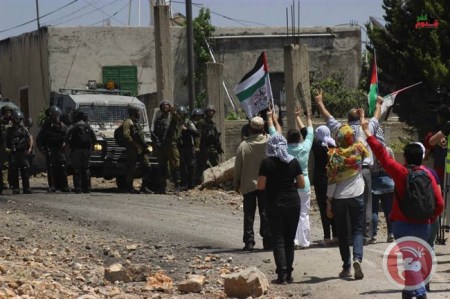
QALQILIYA – Five Palestinians were injured, two critically, when Israelis forces opened live fire on the Kafr Qaddum weekly march Friday.
A coordinator for the village’s popular resistance committee, Murad Shtewi, said that Muhammad Majid, 20, had been shot in the stomach and chest with live rounds and is in critical condition.
Ibrahim Mousa, 35, is also in critical condition after he was shot in the abdomen while in his house.
Shtewi also said that Muhammad Nidal, 20, and Mouiz Khader had been shot in the leg, and Ayman Farouq, 38, in the hand.
Dozens others suffered from excessive tear gas inhalation.
Israeli forces had closed down the village’s entrance since the early morning after they declared it a closed military zone. As a result, those injured had to be evacuated from the village in private cars using dirt roads.
An Israeli army spokeswoman contacted by Ma’an said she would look into it.
Israeli forces routinely suppress weekly marches by violent means.
In Kafr Qaddum, they also regularly declare the village a closed military zone in order to prevent the weekly march from taking place.
The march is carried out to protest the Israeli separation wall and Israeli settlement activity, both illegal under international law.
The internationally recognized Palestinian territories of which the West Bank and East Jerusalem form a part have been occupied by the Israeli military since 1967.
Norwegian pension fund divests from Israeli occupation
MEMO | June 12, 2015
Norway’s largest pension fund has excluded two companies “on the grounds of their exploitation of natural resources in occupied territory on the West Bank.”
KLP, which manages a US$70 billion investment portfolio, formally excluded Heidelberg Cement and Cemex on June 1, following a period of investigation and engagement. The combined worth of KLP’s shareholdings in both Heidelberg Cement and Cemex was approximately $5 million.
Heidelberg Cement and Cemex, leading global suppliers of building materials, operate quarries in the West Bank through their respective Israeli subsidiaries. According to KLP, “the companies pay licence fees and royalties to the state of Israel” while “the products deriving from the quarries are sold primarily for use in Israel’s domestic construction market.”
Based on “a review of applicable international law”, which the company explained in a separate document, KLP concluded that “the companies’ operations are associated with violations of fundamental ethical norms.”
Citing a previous similar case in Western Sahara, KLP noted that the quarries in question were opened after 1967, when Israel’s occupation began. “The opening of a quarry in occupied territory”, KLP said, “is in all probability incompatible with Article 55 of the Hague Regulations.”
The fund, which manages the retirement assets of Norwegian public sector workers, also excluded a further eight companies on the grounds of their income from coal-based operations, corruption, environmental damage, and the production of tobacco.
Criminalizing Criticism: A Zionist Project
By Lawrence Davidson – To The Point Analyses – June 10, 2015
Part I – Some Historical Background
From the 1920s on into the 1990s, the Zionists controlled the storyline in the West on the Israel-Palestine conflict. This meant that their version of history was the only version as far as most of the people in the West were concerned. Consequentially, they had an uncontested media field to label the Palestinians and their supporters as “terrorists” – the charge of anti-Semitism was not yet widely used. Also, as a consequence of their monopoly, the Zionists did not bother to engage in public debate.
Then, over the last twenty years the Zionists slowly lost their monopoly. In part this was due to the fact that in 1993 the PLO recognized Israel’s right to exist and renounced terrorism, and in the following years many of the Arab states made or offered peace. However, the Israelis did not respond in kind. In particular they failed to respond in a fair and just way to U.S.-sponsored peace efforts. Why so?
The answer to why the Israelis did not, in good faith, take up multiple historic opportunities to make peace with the Palestinians lies in the very nature of the Zionist movement. From its beginning, and certainly from the establishment of the State of Israel, Zionism has been driven by dreams of colonial expansion and religious exclusiveness. Each of these goals is seen as part of Zionism’s God-given mission, and they still prevail. Professor David Schulman of Hebrew University, writing in the New York Review of Books (23 April 2015), describes the consequences of this situation, “the Israeli electorate is still dominated by hyper-nationalist, in some cases proto-fascist, figures. It is no way inclined to make peace. It has given a clear mandate for policies … that will further deepen Israel’s colonial venture.” As a consequence, Israel’s credibility with an increasing number of people in the West has eroded.
This erosion led to a relatively short period of time in the early 2000s when the Zionists attempted to counter the situation by engaging with their critics in public debate. However, the majority of time they lost. Israel’s barbarous behavior on the ground, combined with the fact that their historical version of events was shown to be full of holes, condemned them to an increasingly weak defensive position. This proved to be intolerable to the Zionists, so they withdrew from the debating field. And, as they did, they began to level charges of anti-Semitism against their critics, even those who are Jewish. These accusations of the worst sort of racism have been with us ever since – which is really ironic because much of what Israel is being criticized for is its own racist, apartheid nature.
This was an important change in tactics for Israel because it opened the way to misusing Western laws to Israel’s advantage. Just as the charge of terrorism has often been misused in a broad and sweeping manner (for instance, leveled against non-violent supporters of Palestinian charitable organizations), so the charge of anti-Semitism can potentially be used in an almost unlimited fashion by over-aggressive, pro-Zionist Western prosecutors against any critic of Israeli behavior.
Part II – The Boycott Movement
In the West, much of the organized criticism of Israel now comes from campaigns aimed at promoting Boycott, Divestment, and Sanctions (BDS) of the Zionist state. So robust has the BDS movement grown that Gilad Erdan, Israel’s newly appointed Minister of Public Security, Strategic Affairs, and Public Diplomacy, has described it as one of the most “urgent issues” facing Israel. Israel’s president, Reuven Rivlin, has described the developing academic boycott, just one part of BDS, as a “strategic threat of the first order.”
Israel’s prime minister, Benjamin Netanyahu, has taken it upon himself to set the tone of Israel’s counter-attack on BDS. He has declared that there is an “international campaign to blacken Israel’s name” and he alleges that it is not motivated by Israel’s policies toward the Palestinians but rather seeks to “delegitimize Israel … and deny our very right to live here.” In other words, he is claiming that present criticism of Israel is really an attack on its existence, and not on its behavior. For Netanyahu this has to be a form of anti-Semitism. As Hanan Ashrawi, a member of the PLO executive committee, describes Netanyahu’s argument, “If you criticize me you are anti-Semitic … . If you accept any kind of punitive measure or sanctions against Israel, you want to destroy Israel.” That is how the prime minister avoids confronting the facts.
As bad as this is, it gets even worse. Declaring the goal of BDS to be the elimination of Israel allows the Zionists to use their influence with Western legislators to make cooperation with the boycott subject to penalties. In the United States, AIPAC, the most powerful of the Zionist lobbies, is working on legislation similar to that used against Iran and also the Arab boycott of Israel in the 1970s. This legislation would penalize businesses, both at home and abroad, that favorably respond to calls for boycott. If this works we can expect the Zionists to go further and try to subvert the U.S. Constitution’s free speech provisions and then go after individuals as well as businesses. In this regard, efforts are also under way in Canada and France.
Part III – Money Magic
Finally, there is the assumption that money can destroy Israel’s critics. This is a special belief of Sheldon Adelson, the billionaire casino magnate and enthusiastic backer of Netanyahu. Adelson has taken aim at activity critical of Israel on U.S. college campuses. In the first week of June 2015, he and his supporters convened a “Campus Maccabees Summit,” the purpose of which was “to develop the conceptual framework for the anti-BDS action plan [on college campuses], assign roles and responsibilities to pro-Israel organizations, and create the appropriate command-and-control system to implement it.” Fifty activist Zionist organizations attended the conference, as did twenty donors, each of whom pledged one million dollars to the cause over the next two years.
Part IV – Conclusion
Prime Minister Netanyahu personifies the problem with Zionist thinking. He is wholly self-centered and seemingly incapable of recognizing, much less taking responsibility for, Israel’s racist behavior. Thus, with the Zionists having spent the last 100 years planning and then actually doing what was needed to deny as many non-Jews as possible the “very right to live in” Palestine, Netanyahu now accuses others of doing the same thing to him and his kin – and labels it a criminal act.
The truth is that most Western critics, including supporters of BDS, are not trying to kick the Jews out of Israel. They are trying to bring maximum pressure on the Israeli government to stop kicking non-Jews out, to stop territorial expansion in violation of international law, and to start acting like the democratic state it so questionably claims to be.
Speaking strictly for myself, I don’t believe any of these goals are possible unless Zionism is in fact kicked out of what is now Israel. That is, the ideology that drives Israeli racism and colonial expansion must be done away with, in the same way that apartheid was brought down in South Africa. That did not result in South Africa being destroyed or all white South Africans being deported. But it did result in a democracy being imported. The same scenario is necessary for Israel.
No doubt many Israelis and their supporters would equate this goal of extirpating Zionism with promoting another Holocaust. This is not so, but they are scared enough to label the effort of bringing a real democracy to Israel as anti-Semitic, and to try to get it declared illegal in the West.
Finally, besides the public outcry over anti-Semitism, the Zionists are working behind closed doors – the closed doors of American state and federal legislatures and university board rooms – where they do not have to face serious debate. This might prove the most dangerous of their maneuvers. For behind closed doors the Zionist monopoly resurfaces and truth is all the easier to suppress.
Russia’s law on undesirable foreign NGOs and the ethics of international activism
By Aleksandar JOKIC | Oriental Review | June 5, 2015
The decision by Russian President Vladimir Putin to sign a bill that allows “authorities to prosecute foreign non-governmental organizations (NGOs) or firms designated as ‘undesirable’ on national security grounds” is bound to receive a hostile reception in the West. Already Amnesty International declared that the new law will “snatch away the space for dissenting views and independent civil society activism,” while Human Rights Watch more hysterically stated that the law aims at “squeezing the very life out of Russian civil society,” and the State Department harshly characterized it in a characteristically over the top fashion “as a further example of the Russian government’s growing crackdown on independent voices and intentional steps to isolate the Russian people from the world.”
Dramatic statements aside, we may want to ask, quite separately from the case with this Russian law, what could be considered as proper boundaries for engagement by international activists. In other words, the increasing power of NGOs in the post-Cold War period, manifest in their ever mounting number in operation and handling of ever more substantial quantities of money, raises questions about the roles and responsibilities of these new global, non-state actors. In particular, there is the question of developing an ethics of international activism that would facilitate moral assessments of the endeavors by agents operating in countries other than their own.
Elsewhere I have argued in favor of developing an ethics of international activism, which involved a process of formulating a series of constraints on what would constitute morally permissible agency in the context that includes delivering services abroad, directly or indirectly. In elaborating these ethical constraints I relied on the concept of “force multiplier.” The content of this idea and its official applications have explanatory importance in considering the correlation between post-Cold War phenomenal growth in the number of international NGOs and the emergence of the U.S. as the sole, unchallenged super-power ushering in the new “unipolar” world.
The fully developed proposal for an “ethics of international activism” consists of four constraints on morally permissible international activism: (C1) The Professionalism Constraint; (C2); The Integrity Constraint; (C3) The Respect for Sovereignty Constraint; and (C4) The Humility Constraint. As soon as these constraints are understood and correctly analyzed, an overarching principle emerges helping us realize that local activism must enjoy normative primacy (in all three normative spheres: moral, legal, and political) over international activism. At the same time, this gives us an idea of how to conceive of what could constitute legitimate international activism, that is one that respects the primacy of local activism.
Before introducing in a bit greater detail the elements of this ethics of international activism let us define “international activists” as altruists attracted by causes that originate in foreign lands. By calling them “altruists” I do not intend to prejudge the actions of international activists as necessarily morally good; I simply mean to indicate that they are ostensibly acting out of concern for the welfare of others, in this case those others are foreigners. We can make further progress in delineating more exactly who the “international activists” are by making more precise this notion of “causes that originate in foreign lands.” Most frequently those causes are expressed in terms of global protection, and respect for human rights. Thus, Amnesty International defines itself as a “global movement” of people “campaigning for a world where human rights are enjoyed by all,” while Human Rights Watch claims that it “works as part of a vibrant movement to uphold human dignity and advance the cause of human rights for all.”
We can achieve additional clarity by realizing that governments can also show interest in those same causes expressed in terms of human rights, but we would not count government administrators, operating in their official capacities, among “international activists”. Thus, The Bureau of Democracy, Human Rights and Labor of the U.S. government, states that “protecting human rights around the world [is] central to U.S. foreign policy,” yet we would not consider State Department officials “international activists”. This is why organizations that want to count as groupings of international activists are quick to assert their independence. Consequently, international activists are not meant to be government officials, ideologues, corporate lobbyists, or missionaries on behalf of any religion; in fact, international activists are supposed to operate independently of any government, ideology, corporation, and religion. In the first instance, this then poses strong constraints on how to construe an ethics of international activism starting with The Professionalism Constraints:
(C1) It is considered morally impermissible for international activists to act on behalf of any government, ideology, corporation, or religion.
It stands to reason that if a person is genuinely motivated by the welfare of others from a country other than her own, then she must not be acting on behalf of her (or any other) government, should not promote any ideology (be it political, economic or otherwise), nor proselytize in favor of a religion. Thus, for example, international activists must not propagate in favor of a regime change in a country where such policy is pursued by, say, the U.S. government; they must not engage in promoting the economic ideology of free market and privatization in, say, a country with the socialist economic system (or any other); or attempt to convert, say, local Muslim population to Christianity.
In order to introduce the second constraint the notion of force multiplier must be introduced; it is a military term, defined as follows in The Oxford Essential Dictionary of the U.S. Military:
A capability that, when added to and employed by a combat force, significantly increases the combat potential of that force and thus enhances the probability of successful mission accomplishment.
It is not difficult to document that this military term is widely used by U.S. officials, including a Democratic U.S. President, right wing think tankers, various academics, and even international activists themselves, suggesting that the Western NGOs do and should serve as force multipliers for U.S. armed forces in the variety of theaters of operations where the latter are continuously active. This, however, stands in direct opposition to the definitional component of “international activism” as agency that stems from concern for the welfare of others in foreign countries. The integrity of their actions is threatened if international activists operate in concert with U.S. armed forces or for the sake of U.S. government while ostensibly engaged to address basic needs of less fortunate humans in other countries. Consequently, an explicit moral constraint—The Integrity Constraint—defining the way international activists can satisfy the requirements of minimal integrity of their actions is necessary:
(C2) It is considered morally impermissible for international activists to serve as force multipliers for U.S. (or any other) armed forces or U.S. (or any other) government.
It is perhaps clear that The Integrity Constraint is already implied by The Professionalism Constraint. However, given the aggressive push by the U.S. officials to employ international activists as force multipliers, the impact of the phenomenon of revolving doors between government service and positions within human rights organizations, and the apparent happy acquiescence by many international activists to their newly given (post-Cold War) role, it is important to make The Integrity Constraint explicit.
Once human rights become indistinguishable from official political ideology, once human rights culture is usurped by the dominant powers, and once the argument for human rights is turned into an apologia for the imperial project by the sole super power while this transformation is not protested but supported by international activists in the Western countries, this gives us a clear sense of international activists serving as force multipliers or being “belligerent altruists”. However, the tension captured by this term must be resolved, and this brings us to the next constraint on the morally permissible character of international activism. In order to accomplish this we must remove the belligerent character of the post-Cold War practice by human rights organizations. We must counsel a return to the human rights discourse that respects sovereignty of nation states and permits at most “soft” intervention while opposing all attempts at decriminalizing aggression (through “humanitarian intervention,” R2P, “war on terrorism,” or similar constructs) and making sure that activists are not aiding and abetting aggression under any circumstances. This could be called Respect for Sovereignty Constraint:
(C3) It is considered morally impermissible for international activists to disrespect sovereignty, aid and abet aggression, and engage in anything beyond “soft” intervention.
To advance further with our goal of developing an ethics of international activism that would facilitate moral assessments of their endeavors we may engage in moral phenomenology of international activism. Moral phenomenology is the study of the experiential aspects of moral life. By investigating “what it is like” to undergo mental states that instantiate phenomenal properties when, say, judging that one “must engage” we might be able to formulate further moral constraints that can guide our moral evaluation of what international activists do. The idea is that the construction of constraints on moral permissibility of acting qua international activist can be aided via compelling phenomenological descriptions of specific experiential episodes.
By paying attention to moral phenomenology of activism a picture emerges according to which, for the activist, given the axiological nature of the cause for which she is fighting, all that is required to set her on the right path is that she be sincere and firm in her decision. Are there no obstacles to getting the purpose right, to honing in on what is unquestionably the right goal to make personal sacrifices for? What could be the source of such infallible knowledge or the experience that appears as if one is in the possession of it? These are appropriate questions! For, the activist possesses not only a firm conviction that the cause is right, but also a persuasion that no consideration could possibly put it in question. The position is tantamount to a person who has all the answers in advance, with no need to engage in the search for evidence. It is a position that readily presents answers, while the procedure that supplied them remains forever hidden, unexplored, and insignificant. Does this, therefore, mean that it isn’t, strictly speaking, important what will really be achieved (as in the saying “Don’t look a gift horse in the mouth”), but that whatever is accomplished is good enough—in the sense of being sufficient and not open to moral assessment other than automatic praise? Put differently, since the activist’s motivation procures the act’s rightness and its goodness, does this mean that there is no possible question to be raised here? Or, that no argumentation of any kind is required or possible in this case? The last remark indicates an ideological character of the situation—we are trading in a context wherein reasons do not function in their customary fashion, or not at all. This appears to make activism akin to ideology.
This discovered link between international activism and disposition to uncritical adoption of ideology indicates that the principal danger international activists face is their vulnerability to co-option by big powers through usurpation of the main (ideological) tenets that define sumum bonum on behalf of which they activate. In light of The Professionalism Constraint international activists are morally required to prevent such co-option and usurpation, but the ideological nature of activism substantially reduces the resistance capacity by activists in this respect. Hence, it should not be surprising that they end up converted into force multipliers with such ease. However, there is a defense available to them that could enhance their integrity and consists in the practice of humility. If activists avoid the attitude of epistemic arrogance with respect to the normative value of the cause they act to support, if they refuse to take their own comfort and conviction regarding the value of their cause as a sure mark of its unquestionable validity, they may have a way of protecting the moral purity of their engagement. This takes us to the final constraint in this exercise, to The Humility Constraint:
(C4) It is considered morally impermissible for international activists to take the strength of their conviction as a sufficient condition for the validity of their endeavor.
In light of the moral constraints, C1-C4, the overwhelmingly negative assessment of contemporary Western international activism is painfully obvious. If so, the question emerges, what must morally speaking be done about it? This question would have to be answered both from the perspective of the activists and those who find themselves on the receiving end of these would-be-good-but-bad-Samaritans.
From the perspective of the Western activists we should advise the following. Just as the old American saying goes that “all politics is local” so all activism should be local. In fact, the overarching duty for any activist-minded Westerner may be to go local, and thus deprive the imperialist project of an important body of force multipliers. On the other hand, if activities and projects by international activists hailing from the West cannot be deemed morally permissible, this should have legal consequences in the rest of the world: all countries outside the Empire, particularly countries targeted by international activists as potential theaters of their operations, ought to criminalize activities by international activists and “human rights organizations” on their territory when not in solidarity or in support of local movements. Paradoxically, the justification for this criminalization is grounded precisely in the real concern for the human rights of the inhabitants from those countries.
A clarification is in order at this point. When I state that all activism should be local this is not meant to preclude legitimate international activism. What I mean is to insist on the primacy of local activism in the sense that all international activism must recognize this primacy, and hence reduce itself to a supporting role. In short, the legitimate international activism engages in solidarity and support of pre-existing local movements. Recognizing this primacy of the local aspect of activism can be seen as the main condition of legitimacy for any international activism.

Gene Sharp was the mastermind of the disastrous regime change techniques which led to drastic fall in living standards and factual failures of states in Tunisia, Yemen, Egypt, Libya, Syria and Ukraine
The conceptual apparatus and normative framework developed here can assist in diagnosing in a precise way what is wrong (morally speaking) with the Western “strategic non-violent action” and the projection of the so called “soft power”. In short, this design that uses non-violence as a form of warfare adopted by foreign policy makers in the U.S. who orchestrated various “color revolutions,” “Arab spring,” etc. must be deemed morally impermissible as it violates all four constraints developed and defended here and because it feigns respect for the primacy of local activism: while it is the local people that participate in a non-violent movement directed against their government, the movement itself is envisaged, funded, and its “local” leaders are trained by foreign organizations.
Returning now to the Russian law on the undesirable foreign NGOs, rather than quickly dismissing it as an assault on dissent, civil society or anything else we could avoid drama and hysteria by using the conceptual apparatus offered here in order to assess whether the response to international activism is excessive or legitimate, which at the same time gives us a very precise sense of what is rightly “undesirable”. To the extent that foreign NGOs violate the provision of the primacy of the local activism and the four moral constraints, issuing restrictions in the form of legal means may be entirely justified and defensible. In fact, this is a practice that would in all probability be justified the world over, in particular in what I like to call the “once developing world” (before they become victims of imposed neoliberal economic models) where the Western human rights organizations have been operating in total impunity.
Aleksandar Jokic is Professor of Philosophy at Portland State University. This article is based on his essay “Go Local: Morality and International Activism” Ethics & Global Politics Vol. 6, No. 1, 2013; pp. 39-62.
Israel sees red over Orange plans to axe ties
AFP – June 4, 2015
JERUSALEM – French telecoms giant Orange said Thursday it wanted to withdraw its brand from Israel just hours after its chief executive came under fire from Israeli officials for giving in to a pro-Palestinian campaign.
Orange, which is partly controlled by the French government, insisted its decision to end its brand-licensing agreement with Partner, Israel’s second largest mobile operator, was not politically motivated.
But Israel lashed out at the decision, which appeared to be related to Partner’s operations in the occupied West Bank.
Citing its own “brand development strategy”, Orange said it did not wish to maintain a brand presence in countries “in which is it not an operator”, while distancing itself from the politics.
“In this context, and while strictly adhering to existing agreements, the Group ultimately wishes to end this brand licence agreement,” it said.
“The Orange Group… does not engage in any kind of political debate under any circumstance,” it said.
The storm erupted on Wednesday when Orange chief executive Stephane Richard told reporters in Cairo that the company was planning to withdraw from Israel.
His remarks touched a raw nerve in Israel which is growing increasingly concerned about global boycott efforts and the impact on its image abroad.
It drew a furious response from Israeli officials as well as from Partner, which is not a subsidiary but operates under the Orange brand name.
“The black side of Orange” said the top-selling Yediot Aharonot, while Israel HaYom, a staunch backer of rightwing Prime Minister Benjamin Netanyahu, ran a headline reading: “Orange is no longer a partner.”
Deputy foreign minister Tzipi Hotovely wrote to the Orange boss urging him “to clarify the matter” and warning him not to become party to “the industry of lies which unfairly targets Israel”.
And Isaac Benbenisti, who becomes chairman of Partner on July 1, said he was “very, very angry”, accusing Richard of caving in to “very significant pressure” from pro-Palestinian activists and joining a global campaign to isolate Israel.
End of the affair
Richard’s remarks dominated the headlines in all of Israel’s main media outlets on Thursday where he was immediately cast as a supporter of the boycott movement.
Although the Orange boss did not directly refer to the question of settlements, his remarks in Cairo came after the publication on May 6 of a report accusing the telecoms giant of indirectly supporting settlement activity through its relationship with Partner.
Compiled by five mainly French NGOs and two trade unions, the report accuses Partner of building on confiscated Palestinian land, and urges Orange to cut business ties and publicly declare its desire to avoid contributing to the economic viability of the settlements.
The international community regards all Israeli construction on Palestinian land seized during the 1967 Six-Day War as illegal.
Challenged in Cairo, Richard said: “Our intention is to withdraw from Israel. It will take time” but “for sure we will do it”.
“I am ready to do this tomorrow morning … but without exposing Orange to huge risks.”
Orange says it holds no shares or voting rights in Partner Communications, nor does it have any influence over the firm’s strategy, and that it does not have any other business activity in Israel.
Orange and Partner are linked by a licensing agreement which allows the Israeli firm to use its brand and logo in exchange for a fee. The contract was signed in 1998, two years before the telecoms giant was acquired by France Telecom.
The contract, initially open-ended, was recently amended by Orange and now expires in 2025.
Orange is present in 20 countries and the brand licensing agreement with Partner is the only one with a firm that is not a subsidiary.
Victory for BDS movement
The crisis comes after days of introspection in Israel over its place in the world, with the government railing against what it has denounced as a campaign of delegitimization.
Israel has been struggling to tackle a growing Palestinian-led boycott campaign which has had a number of high-profile successes.
Known as the BDS movement — boycott, divestment and sanctions — it aims to exert political and economic pressure over Israel’s occupation of the Palestinian territories in a bid to repeat the success of the campaign which ended apartheid in South Africa.
This week, Britain’s National Union of Students voted to affiliate itself with the BDS movement, in a move which drew a sharp rebuke from Netanyahu.
Last week, Israel narrowly avoided expulsion from FIFA after the Palestinians withdrew a resolution calling on it to ban its Israeli counterpart over restrictions on Palestinian footballers and the presence of five teams inside Jewish settlements.
The boycott movement was even debated in parliament on Wednesday.
“It’s not politically correct to be anti-Semitic today but it’s super ‘in’ to be anti-Israel,” Justice Minister Ayelet Shaked told MPs.
~
Ma’an staff contributed to this report.
Israel in Desperation
By Robert Fantina | Aletho News | June 4, 2015
Representatives of the Palestine Football Association removed their request for a vote at FIFA (The Fédération Internationale de Football Association; English: International Federation of Association Football) to expel Israel, at the very last minute. Whether it was known that they had insufficient votes, or Israel made some concessions, it can only be seen as a mistake for Palestine, and a small but short-lived victory for Israel.
Let’s look at this situation more closely.
If Palestine knew that it didn’t have the vote of 75% of the FIFA membership, a vote would still have required each nation to take a stand, either for or against justice, individual dignity and human rights. Countries that voted not to expel would have then been under pressure to change their vote the next time this issue arises before FIFA, which it definitely will. Palestine surrendered an excellent opportunity.
The other possible option is that Israel agreed to make some concessions. Surely no one representing Palestine would believe in Israel’s ‘good intentions’. Israel’s murderous, genocidal onslaught against the Palestinians in the Gaza Strip last summer drew to a close when a cease-fire agreement was reached between the two nations. Palestine agreed to stop its rocket-fire (more on those ‘rockets’ later) and Israel agreed to do the same, as well as allow trade between Gaza and the West Bank, and to ease the blockade of the Strip, including allowing the import of building materials. This easing of the blockade also included allowing fishermen to work unimpeded for a nine-mile limit.
Since then, there has been very little rocket-fire from Gaza, and that only in response to ongoing Israeli violations of the cease-fire. Trade is still forbidden between Gaza and the West Bank. Insufficient building materials have been allowed in to Gaza, and fisherman are routinely shot within sight of the shoreline.
And what about those Palestinian ‘rockets’? Dr. Norman Finkelstein, a noted scholar, son of Holocaust survivors and an outspoken critic of Israel, refers to them as ‘enhanced fireworks’. Another journalist noted that those ‘rockets’ could be made with an eighth-grade chemistry set. This is what Palestine must use to oppose Israel, which has the most advanced and deadly weaponry available in the world, all provided by the United States.
So if Israel made ‘concessions’ that caused Palestine to agree to withdraw its request for a vote, nothing will change.
So Israeli football (soccer) teams can continue to play in all world games, abusing Palestinians, preventing them from training and competing, and harassing them when they do. Business as usual for apartheid Israel.
However, the picture isn’t as rosy for Israel as it might seem. Regardless of what happens to the current corrupt FIFA leadership, the battle at FIFA is just one of many fronts. The war for Palestinian independence and freedom is not a ground, sea or air war, and it won’t be won quickly. The publicity surrounding the Palestinian request for a vote to expel Israel shed a very unflattering light on that nation, adding to its growing international reputation as a rogue nation, where racism is institutionalized and justice does not exist. With the newly-formed government of recently re-elected Prime Murderer Benjamin Netanyahu including some of the most overtly racist and genocidal cabinet members the world has ever seen, every new accusation gains greater scrutiny.
Pending in the International Criminal Court (ICC) are the findings on whether or not Israel committed war crimes in the summer of 2014. Palestine may, it is imagined, withdraw that petition as well, but doing so is unlikely. Any decision condemning Israel will have little legal impact, since Israel is not a member of the ICC. However, the court of public opinion is often stronger than anything a judge can decree, and the penalties far harsher than a court edict. The Israeli brand, already damaged beyond redemption, will suffer further once that decision is rendered.
The United Nations, nothing if not weak and generally ineffectual, is also considering a recommendation by its own personnel to add the Israeli army to a list of violators of children’s rights. UNICEF, the United Nations Children’s Fund, several Palestinian human rights organizations and at least one Israeli human rights organization all support the inclusion of the IDF (Israeli Defense Forces) on this infamous list. Yet Israel has exerted great pressure on the U.N., so it is possible that Ban Ki-Moon, the U.N. Secretary General, may dismiss the work and words of his own advisors. Yet even if he bows to this pressure, significant damage has been done to the Israeli brand.
In the U.S., a situation currently making the news involves the termination of the employment of Professor Steven Salaita from the University of Illinois, Urbana-Champaign. Mr. Salaita’s offer of tenured employment was withdrawn, following his ‘Tweeted’ criticism of Israel’s genocide against the Palestinians in 2014. Emails sent to the university chancellor indicate that large donors with strong pro-Israel beliefs pressured her into withdrawing the application. Within two weeks, over 1,200 academics around the world vowed to boycott the university, and that number has increased greatly since then. Numerous events scheduled to take place there have been cancelled, because the speakers who had previously agreed to participate, have withdrawn in protest. The American Association of University Professors, which has strongly condemned Mr. Salaita’s dismissal, is expected to censure the university within weeks.
One wonders how long Israel can continue to pressure and brow-beat international organizations into doing its bidding. How much time, effort and expense will it continue to expend to enable its continued crimes against humanity? Although the North American news media does little to publicize Israel’s many war crimes and violations of international law, the corporate-owned and controlled media is no longer the world’s only source of news. Social media gives everyone with a camera and an internet connection the ability to spread news around the world. And that ability, coupled with organized movements such as BDS (Boycott, Divest, Sanction), global student human-rights organizations working for Palestinian freedom and justice, and frantic (and futile) Israeli efforts to delegitimize Palestinian rights, all strengthen international knowledge of Israeli crimes.
It may not be in 2015 that Palestine is finally freed from its decades-long bondage to Israel. It will not come about because a soccer organization did or didn’t make a stand against injustice, or because of the findings of an international court of law. It will happen due to the efforts of people around the world who recognize the suffering of the Palestinian people, and who will no longer tolerate their governments’ complicity in that suffering. The defeat of apartheid in South Africa did not happen overnight, but it happened. The same will be true for Palestine.
The Podemos Phenomenon: Spain’s Best Hope for Democracy
By William Hawes | Global Research | June 4, 2015
The captivating rise of Spain’s new left-leaning party Podemos has captured the world’s attention by emphasizing participative democracy. The formerly fractured Spanish left, in the past marred by petty infighting in Spain, coalesced from grassroots protests over austerity measures and gained steam in 2011. Working with the Anti-Capitalist Left activist base, Podemos began in 2014 by starting local public meetings, called citizen circles, to organize; using the web to organize, poll, and debate issues; and heavily promoting anti-austerity measures and poverty reduction. Young adults especially have been swept up in the Podemos’ rise, as unemployment for youths stands at anywhere from 30-50% by region.
Last month, anti-poverty activist Ada Colau gained the most seats to become Barcelona’s mayor with backing from Podemos. Podemos-backed Manuela Carmena came in a strong second in Madrid’s mayoral election as well. A coalition with Spain’s Socialist Party (PSOE) may secure both ladies’ spots. Now all eyes turn to the general election slated for December. At center stage as leader of Podemos is Pablo Iglesias, former college professor and TV host.
The ideology of Podemos was incubated during the May 2011 protests in Madrid centered on the skyrocketing unemployment and austerity measures employed by the Zapatero-led government. Spain’s protests erupted nationwide and were centered in the Puerta del Sol square in Madrid, led by social networks and citizen assemblies. Protesters were dubbed Indignados (“the outraged”, or “the angry ones”), for their rejection of Spain’s increasingly corrupt two-party system and the “austericide” measures strangling the economy and vitality of the nation. Spreading throughout the country, it is estimated that about 6.5-8 million participated. Protests have continued under the Rajoy regime. (1)
After the protests, Podemos formed from a coterie of radical professors from Madrid’s Complutense University. The most notable are Iglesias, political theorist and the face of the movement; Jesús Montero, former communist and political organizer, and Iñigo Errejón, university lecturer and campaign strategist. Beginning to channel citizens’ hopes, despair, and anger over poor economic conditions, Iglesias’ TV programs, La Tuerka and also Fort Apache, became hits and launched him into the national spotlight.
Debating conservatives on national broadcasts pushed Iglesias into the stratosphere in Spain, with bona-fide rock-star status, which he backs up: Iglesias accepts only quarter of his salary as a member of the European parliament. He flies coach on all his trips. He routinely rips Rajoy and his cadre of corrupt officials. He lives in a graffitied neighborhood in Madrid, has credentials as a respected academic, and visits with famous theorist Chantal Mouffe.
Iglesias and Podemos certainly have their critics and detractors, however. Prime Minister Mariano Rajoy has blasted the party recently, calling them “incompetent populists”. Some have questioned Iglesias’ decision to run Fort Apache, as it was produced by an Iranian state-run TV company. Others frown upon members’ past consulting work with the Venezuelan government. And co-founding member Juan Carlos Monedero has recently quit the party, commenting that Podemos needs to “go back to its origins”. (2)
Despite the backlash, there is no doubt that Podemos represents the best hope for the future in Spain. Monedero still claims they are “the most decent force in Spanish politics”. Iglesias has shown citizens who the ruling People’s Party (PP) and the rival Socialists’ Workers Party (PSOE) really are: la casta (the caste), the establishment, corrupt leaders and officials who do nothing as nearly 6 million people are out of work and 2 million households have no net income. (3) The party is also aware of their limitations in an integrated EU economy: this is why they have called on the help of friends like Greece’s Syriza to fight the EU technocracy, ECB, and IMF. No doubt, Podemos would be wise to send feelers to Italy’s PM Matteo Renzi and Ireland’s Sinn Fein party to ally the periphery, mainly southern Europe, against the unjust policies of Brussels.
Iglesias has shown moderation and fairness in nearly every aspect of Podemos’ agenda. He supports Spain’s membership in the EU, but only under fair laws and loan agreements. He wants benefits and social programs expanded, but he is not calling for nationalization of entire industries. Podemos supports sharing more power with the autonomous regions of the Basque Country, Catalonia, and Galicia, and even states that the party would allow a Catalonian referendum, which the PP and PSOE oppose. (4)
Podemos is more than a vehicle to bring to life the hopes and dreams of Spaniards alone. As political theorists, leaders of Podemos cannot be accused of intellectual laziness. By employing a narrative of anti-elite rhetoric within a framework of social justice, they have created a message appealing to citizens of the whole nation. By linking digital democracy, through social media, with participative elements, such as meetings to combat poverty, lobby for public health initiatives, the arts, and more, Podemos has provided a contemporary deliberative democratic blueprint for the world.
The party has helped lay ground for democracy with revolutionary potential, but not within a traditional, left/right framework. Though favoring a moderate social democracy, Iglesias and the leadership deny that they are partisans. Iglesias explained the left/right divide succinctly at a rally in Barcelona: “Power doesn’t fear the left, only the people”. (5) At its core, Podemos is attempting to challenge the power structure, and deliver democracy to the masses, even if it means deviating from its anti-capitalist, leftist origins.
By moving towards the center, and consolidating power mostly between Iglesias and Errejón, Podemos risked alienating its activist base. These are undoubtedly the reasons for Monedero’s resignation from the party. Charisma and charm will only take you so far, and pandering towards the middle will only work up to a point. Besides, the populist, new center-right party Ciudadanos is also mining the center for votes with this strategy.
Podemos should continue to act as a movement led by activists, and evade the traps of capitulation and compromise that mainstream parties fall into. Breaking the two-party stranglehold of the PP and PSOE has been impressive. By concentrating on poverty reduction, debt restructuring, ending austerity, and listening to its citizen circles, Podemos and Iglesias can win wider support, unity, and solidarity. If focus can be kept on their grassroots campaigns, Spain will begin to see what a true, albeit messy, participative democracy looks like.
William Hawes is a writer specializing in politics and environmental issues. You can reach him at wilhawes@gmail.com.
Notes:
2) http://elpais.com/elpais/2015/04/30/inenglish/1430403454_148415.html
3) http://www.newsweek.com/2014/10/31/podemosradical-party-turning-spanish-politics-head-279018.html
5) http://elpais.com/elpais/2015/02/02/inenglish/1422900233_612344.html
Syria : Interview with Muhammad Raad, Deputy of Hezbollah
Extracts of the interview of Muhammad Raad on Al-Mayadeen Channel, May 22, 2015
Journalist: My question is: In your view at Hezbollah, when will this war (Syrian Crisis) end? Could it last for years more?
Mohammad Raad: When the US Administration and the West that orbits around it, and the regional guards and agents who are supporting the armed terrorists, when they take the decision to stop financing (the terrorists) & close the border crossings & prevent sneaking into Syria, the war will end in Syria, and the opportunity for national dialogue will open, (this very dialogue) which was supposed to take place since the beginning of the crisis.
Journalist: Do you mean by ‘the regional agents’: Saudi, Qatar, Turkey and Israel?
Mohammad Raad: I mean all those who support the armed terrorists.
Journalist: There is a view that says that Saudi Arabia, whom you always accuse, is still supporting (the terrorists) while other countries have stepped back like Qatar. And that Turkey is still giving a great amount of support to (the terrorists).
Mohammad Raad: Let us talk in general in order to avoid miscalculations and leave the assumptions to those who are concerned. In general, whoever supports, finances & facilitates the terrorists’ sneaking into Syria in order to destroy and sabotage Syria should cease to do so.
Journalist: That means the war might last for years.
Mohammad Raad: Yes, the military option can take some time.
Journalist: Today, after what was achieved in Qalamoun and the great victory you presented in this difficult region where the fighting was fierce, as we understand, today we see that Palmyra might have fallen, yesterday Al Mastouma and other areas fell. It looks like the fighting is a win here then a defeat there, a defeat then a victory, etc. It seems that no one can use military means to resolve the situation in a decisive way.
Mohammad Raad: Sami, now the media and the propaganda machine works on propagating false and hasty news about partial matters that have nothing to do with the strategic movement or even with the battlefield, the very issues which will define the results and the outcome of the war. We have an evaluation of the situation: in Syria, the military situation on the ground is in the favor of the regime and what we witness is a tightening of the (Syrian Arab Army’s) grip on the areas under the regime’s control.
Journalist: How can you explain this to us? The image circulated now in the other media is that the State doesn’t have control over many areas, and there’s a new offensive by the armed terrorists under Fatah Army and other groups. And the armed opposition, or the rebels or the Takfiris or terrorists, whatever you may call them, are achieving big gains on the ground. In your strategic evaluation, how do you see that your side, along with your ally the Syrian President Bashar Al-Assad, has actually started to achieve strategic gains on the ground?
Mohammad Raad: Before I answer your question, we should remember all the (previous) experiences of false propaganda talking about these terrorists & enlarging their achievements, their numbers, and their situation. Isn’t it about time for the public opinion to realize that this inflated image of the (terrorists) situation is untrue? Take what happened in Qalamoun: how many were the terrorists in Qalamoun? How long did they withstand their positions?
Journalist: Some would also say that they are in the Damascus countryside, in Jobar and in areas adjacent to Damascus, also in Aleppo…
Mohammad Raad: Sometimes there are areas and positions the regime ignores because they are not important, and he (knows he) can contain them whenever he wants. But he goes towards the strategic areas the control of which defines the preservation of the State’s structure. Isn’t it strange, in the opinion of all international observers, that after 4 years and a half, the State’s institutions are still functioning in Syria?
Journalist: Excellent, this is a very good point as the Army has been fighting for more than 4 years; the Syrian diplomacy is still functioning and maybe more actively than before. Now, I saw by myself that there is a head of a Syrian diplomatic mission in Egypt, Dr. Riadh Sneih, at an ambassador level, and he is an ambassador in fact, he was abroad; and the State institutions are still paying salaries, to the Army and even to students, scholarships and others… All this is important.
Mohammad Raad: Can you imagine a state suffering a devastating war like what is happening in Syria, and still you’ll find a traffic police officer issuing traffic violation tickets?
Journalist: It is said for that, Hajj Mohammad Raad, that if it wasn’t for the direct financial support from a country like Iran, maybe the State wouldn’t function until now, in addition to the military support, of course.
Mohammad Raad: This is not a shortfall in Syria’s ability to withstand. Why are alliances forged between countries and forces at the first place? Isn’t it to benefit from them during crises and during difficult times?
It is much emphasized now, and there is an abuse of this feeling that Iran is controlling Syria, while in Syria there is an Army that is still fighting after 4 years so far. This is part of the misinformation image being circulated.
First of all, do not believe that anybody would fight on behalf of anybody else for free. Maybe there will be mutual strategic or tactical interests imposing on two parties to fight on the same field for the same goal, but each party defends its goal within this mutual interest. Iran is supporting Syria also not only as a gratitude for the Syrian stance towards the Saddam imposed 8-years war against Iran, which was financed by all those who are now contributing in the war against Syria. Iran is standing by Syria because Iran is in an alliance with Syria within the same strategic choice, but if it wasn’t for the fact that the Syrian structure is capable of preserving its choice in the stance against (Israel), all the support Syria is receiving wouldn’t be enough to save the situation.
Enough of simplifying the issues; now it is said that we (Hezbollah) are helping the Syrian Army. Of course, we are carrying out an assistant role to the Syrian Army in the areas where we have an interest to be present in, either in defending the Resistance (Hezbollah) or to preserve the Syrian positive position in supporting the Resistance. But why is it that the heroism and bravery of the Syrian Arab Army are neglected, the army that is holding the keys of the battlefield struggle and manages the struggle until now?!
Journalist: Do you fight in the north (of Syria) Hajj Mohammad Raad? like in Aleppo, are there fighters (of Hezbollah)?
Mohammad Raad: I’m not In favour of talking about details, but I can tell you: We fight where we have to fight.
Journalist: And this is what Sayyed Nasrallah said. He recently said that after the last Qalamoun battle, Hezbollah lost 13 martyrs. Can we know the total number of Hezbollah’s martyrs since the beginning of the Syrian war? Approximately? Some say they reached a thousand (martyrs), is this correct?
Mohammad Raad: I do not believe the figure reached this much, but it is nearing five hundred. Five hundred approximately.
Journalist: Nearing five hundred. Less or a bit more? If it is nearing, it means less… Did President Bashar Al-Assad’s administration manage to survive collapsing? Now the talks saying that ‘There is no solution with the Syrian president involved’ are renewed. And even some of the fighters factions, 13 of them, gathered in Turkey recently and raised this slogan again that by force, he will fall. While for the past 4 years and now in the 5th year, he is still here? Will President Assad’s administration survive?
Mohammad Raad: Our belief is that the solution in Syria depends on the presence and the partnership of President Assad in this solution.
Journalist: Him in person?
Mohammad Raad: Him in person.
Journalist: OK. Can you tell us, Haj Mohammad Raad, why president Assad’s allies like Iran & Hezbollah at the utmost, maybe Russia to the same degree as you or less, I don’t know, why do they hold on to President Bashar Al-Assad in person? As some might argue that if President Al-Assad leaves, maybe the situation in Syria would become better. Is he (President Assad) in person the base to any solution for you?
Mohammad Raad: No, we are holding on him because the matter is not about the person, it is about the position and choice this person is committed to. You might say that there might be other persons like him, but this very person who defended Syria due to his commitment to this choice (resistance), why replace him?!
Journalist: It is said that his presence on top of the current Syrian State has maintained this State due to his personal features, his nerves of steel. I hear about this even among your ranks, that due to his calm, while most of his allies have collapsed, the veteran ones and even in Lebanon, he remained… This proves that he should remain in the partnership position to find a solution. But he’s also blamed by his foes inside Syria and abroad to be responsible for where we have reached. I want to know if Hezbollah and Iran (as Russia will not state its position) are insisting on the person of President Assad in any coming solution, whatever happens. There won’t be any solution found without President Assad?
Mohammad Raad: First of all, as long as the Syrian people are holding on to President Bashar Al-Assad, we cannot overlook this Syrian public opinion.
Journalist: Half of the people… More than half of the people are with President Assad?
Mohammad Raad: Of course
Journalist: How do you know? How do we know? Who is measuring the Syrian public opinion for us to know who is with him and who is not?
Mohammad Raad: First: who said there is anybody in the world who would accept his country to be destroyed? The hesitating portion at the beginning of the crisis of the Syrian people now joined those supporting President Assad to stay in power, because they found out that the alternative is the destruction of Syria and the end of its position and role, and making Syria a satellite in the orbit of the West and subjugating it to the Israeli conditions.
Journalist: So in your opinion President Assad is staying until the last day in his term?
Mohammad Raad: And maybe beyond…
[…]
Translation : Arabi Souri
Nablus activists to deploy on hilltops to prevent settlement expansion
Ma’an – June 3, 2015
NABLUS – Palestinian activists in the Nablus area of the northern West Bank are preparing to launch what they describe as the largest campaign against settlement expansion in the area.
Palestinian official Ghassan Daghlas, who monitors settlement related activities in the northern West Bank, told Ma’an Wednesday that the activists plan to install movable houses on hilltops in 35 villages and towns across Nablus district under threat of confiscation by Israeli authorities.
The move comes amid an ongoing takeover of private Palestinian land in the hills surrounding Nablus, where several Jewish-only settlements have been established throughout the area over the years.
After small groups of Israeli settlers claim the land and gradually grow outwards with the protection of the Israeli military, private Palestinian land is confiscated through legal processes, according to Israeli human rights group B’Tselem.
There are currently 12 illegal settlements and 27 settlement outposts in the Nablus area housing around 23,000 of the “most extremist settlers in the Palestinian Territory,” according to Daghlas.
The settlements and outposts surrounding Nablus have gained such reputation largely due to high rates of violent acts by settlement residents against local Palestinians, including uprooting and burning olive trees, vandalism against private property, in addition to violent physical attacks.
Last week, residents from the illegal Yitzhar settlement expanded onto local Palestinian land near the village of Huwwara.
Israeli security forces estimated that the majority of incidents during a 2014 wave of anti-Palestinian hate crimes were carried out by Yitzhar residents, Israeli media reported at the time.
The hilltop campaign, added Daghlas, is a preemptive move to protect Palestinian land from the ongoing settlement expansion especially as the newly-formed rightist Israeli government begins to fulfill promises made to the settler bloc in the run up to the March elections.
The activity was organized by the Nablus district Committee Against Settlements in cooperation with the Fatah movement’s recruitment commission headed by Mahmoud al-Aloul.
Never mind Israel, it’s time to show the red card to the PA
MEMO | May 30, 2015
For many observers, the fact that Sepp Blatter was re-elected as president of FIFA came as no surprise. As expected, he was determined to stay in office despite the arrests and corruption charges this week. That Israel, unlike the European countries, supported Blatter’s candidacy is also not surprising; it is a state whose own political leaders have been tainted by corruption charges over the years.
The most shocking news from the FIFA congress in Zurich was actually the decision by Palestinian Football Association chief Jibril Rajoub to withdraw the resolution for a vote to suspend Israel from world football’s governing body. Although the Palestinian Authority (PA) is notorious for its wanton squandering of international goodwill, this latest example is arguably the worst of all. It was a golden opportunity to take the international boycott of apartheid Israel to a new level. Rajoub’s claim that he was pressured by African and Asian countries is a lame and shameless excuse. His past history as head of the PA’s preventive security agency and thus a willing collaborator with Israel on security issues demonstrates clearly where his loyalties lie on such matters.
While much of what goes on at FIFA is often shrouded in secrecy, the universal support for the Palestinian case among the member federations was well known. If anyone doubts the level of international support that was there for the taking, just consider how petrified Israeli officials became in the days leading up to the Zurich meeting.
Israeli President Reuven Rivlin described the imminent suspension from FIFA and popular calls for a cultural boycott as a “strategic threat” to his country. Prime Minister Benjamin Netanyahu issued the now customary volley of threats to the PA, to Jibril Rajoub (he claims) and FIFA itself. To his credit, the Israeli leader did, at least, stand up to protect his country’s interests, which is more than can be said for the Palestinian leadership. Yet again, the PA proved that it desperately lacks the political will to do the same.
If nothing else, Rajoub’s farcical performance in Zurich confirms that the Ramallah authority cannot be trusted. It has now made it standard practice to betray the collective will and expectations of the Palestinian people. In 2008, for example, the PA obstructed the passage of a UN resolution proposed by the State of Qatar calling for an end to the blockade of the Gaza Strip. The following year, it abandoned a resolution for the Human Rights Council to forward Judge Richard Goldstone’s report on war crimes in Gaza to the UN Security Council. The PA has thus acquired a unique record of putting Israel’s interests before that of the Palestinians.
In a bizarre and theatrical manner, Rajoub took to the stage in Zurich carrying a red card – which he obviously had no intention of using – to announce that he was withdrawing the resolution because he was aware of the harm it would bring to Israel. His words amounted to an apology to the Israelis, as if their suspension from FIFA or a sporting boycott of the apartheid state was a crime.
Gideon Levy, the Israeli columnist for Haaretz newspaper, would have made a better representative for the Palestinians than Rajoub. “A soccer ban doesn’t kill anyone,” he wrote. “A boycott spills no blood. It is a legitimate weapon to establish justice and apply international law.”
That said, there are others, including Rajoub, who claim that politics should be kept out of sports. Of course, they would say that wouldn’t they, especially when it suits their interests to do so. But didn’t the US lead an international boycott of the 1980 summer Olympics in Moscow after the former Soviet Union invaded Afghanistan? Didn’t the Thatcher government in Britain as well as France and Australia support the boycott, leaving the decision about whether or not to compete to individual athletes? Similarly today, it is up to every individual citizen of the world to take a stand on Israeli apartheid. To advocate anything else would be sheer hypocrisy.
Whatever disappointment and outrage Palestinians and the thousands of people who had been campaigning vigorously for the ban may feel after Zurich, all is not lost. This latest encounter with apartheid Israel has placed the nuclear option of a sporting and cultural boycott of the rogue state well within the reach of the masses. They do not have to wait for the approval of FIFA or even the Palestinian Authority to set it in motion.
In retrospect, the failure of the PA to seek the suspension of Israel from FIFA has nothing to do with Israel’s “international effort” as Netanyahu claimed triumphantly. It was all about the spinelessness of the Palestinian Authority and its utter dependency on Israeli and Western largesse. Forget about showing Israel the red card; it is high time for the PA to be sent for an early bath for its repeated failures to represent the people of Palestine and defend their national interests.
Activists Confront “Jerusalem Hug” March

IMEMC News & Agencies | May 28, 2015
Activists confronted participants in the so-called “Jerusalem Hug” march, in which Palestinian and Israelis participated in Jerusalem, on Thursday.
Palestinians from Jerusalem gathered near Damascus Gate, where the march took place, and started telling Palestinian participants in the event that it had “normalization” goals.
There were minor scuffles and exchanges of swearing between the two sides.
Head of Fateh’s Jerusalem youth council Ahmad al-Ghoul told Ma’an News Agency that Palestinian participants in the march — from the West Bank cities of Bethlehem, Ramallah, Nablus, and Tulkarem — were deceived into joining it by luring them with permits to enter Jerusalem.
Al-Ghoul said that the organization claimed that the march was a “humanitarian project for people in the West Bank” and provided them with permits and the necessary transportation without showing them the “normalization” goals of the visit.
He added that such organizations equate the “victim and the executioner” and show the world a picture of Palestinians and Israelis living in peace and love, spending millions of shekels in the process.
Israeli police detained Mahdi Abu Sbeih and Shadi al-Labban, who were trying to stop the march.
Featured Video

Trita Parsi: Israel Set a Trap for Total War in the Region
or go to
Aletho News Archives – Video-Images
Book Review
Why the War on Conspiracy Theories Is Bad Public Policy
By Kevin Barrett • Unz Review • February 1, 2019
 A Review of Conspiracy Theories and Other Dangerous Ideas by Cass Sunstein (based on an earlier paper co-authored with Adrian Vermeule); In Defense of Troublemakers: The Power of Dissent in Life and Business by Charlan Nemeth; and Conspiracy Theories and the People Who Believe Them, edited by Joseph E. Uscinski
On January 25 2018 YouTube unleashed the latest salvo in the war on conspiracy theories, saying “we’ll begin reducing recommendations of borderline content and content that could misinform users in harmful ways—such as videos promoting a phony miracle cure for a serious illness, claiming the earth is flat, or making blatantly false claims about historic events like 9/11.”
At first glance that sounds reasonable. Nobody wants YouTube or anyone else to recommend bad information. And almost everyone agrees that phony miracle cures, flat earthism, and blatantly false claims about 9/11 and other historical events are undesirable.
But if we stop and seriously consider those words, we notice a couple of problems. First, the word “recommend” is not just misleading but mendacious. YouTube obviously doesn’t really recommend anything. When it says it does, it is lying. … continue
Blog Roll
 Aletho News
- Easy fix for Europe’s chaos? Stop fueling war against Russia
- Putin’s key remarks on peace talks and Europe’s ‘schizophrenia’
- Trita Parsi: Israel Set a Trap for Total War in the Region
- Trump’s Iran war is on an Israeli leash
- Saudi oil boss issues global supply warning
- Riyadh Says Its Oil System Is Intact. The Numbers Say Otherwise.
- Trump and Netanyahu Want to “Finish the Job” on Iran
- US ‘one-sided dictation’ not Iran’s beliefs makes rational talks impossible: Baghaei
- Iran’s Next Strike May Not Explode. It Could Shut You Down /Col Doug Macgregor
- Iran: US political targets legitimate if assassinations return
- If Americans Knew
- DAILY UPDATE: Latest essential news on Palestine, Israel, & region
- The Israel Lobby’s Changing Fortunes
- AIPAC has become such a political liability that it’s shifting to a more “nimble” approach to buying politicians
- At least 160 Israeli settler attacks in 2 weeks
- Will Gaza’s Ancient Christian Community Disappear Forever?
- Israel’s vision of regional security rests on keeping Arab states weak
- Heidi Levine recounts how Palestinian youths helped save her in settler attack
- DAILY UPDATE: Latest essential news on Palestine, Israel, & region
- Trump’s Intensifying Sabotage of the ICC, for Israel’s Sake
- Israeli military detain US and UK volunteers in West Bank including Democratic NY politician Brad Lander
- No Tricks Zone
- E-Cars Reduce CO2 Emissions By Only 41% Compared To Internal Combustion Engine Vehicles
- Predictions Made By Renowned Climate Professor Over Past Decades Have Been Proven To Be Poor
- New Study Suggests Large Regions Of The Pacific Ocean Have Been Cooling For The Last 80 Years
- Germany’s Green Energy Debacle: High Energy Costs Force Kahla Porzellan to Close After 182 Years!
- New Study: 50 Years Of The Most Aggressive ‘Net Zero’ Policies Can Only Affect The Global Climate By 0.03°C
- US September “Heat” Was No Record…Many Records Set Decades Ago
- Latest European Green Energy Debacle; Portugal’s Largest Flagship Solar Park Insolvent!
- Green Energy Debacle: German Expert Professor Fritz Vahrenholt Warns Of Severe Economic And Social Consequences
- Two More Paleo Reconstructions Affirm Meters-Higher Sea Levels Across Ireland, Brazil 7000-6000 Years Ago
- New Study: Earth And Venus Surface Warmth Largely Explained By Convection And Lapse Rate, Not CO2 Or Radiation

