China, India, Russia largest shareholders in China-led bank
The BRICS Post | June 29, 2015
Fifty countries on Monday signed the articles of agreement for the new China-led Asian Infrastructure Investment Bank, the first major global financial instrument independent from the Bretton Woods system.
Seven remaining countries out of the 57 that have applied to be founding members, Denmark, Kuwait, Malaysia, Philippines, Holland, South Africa and Thailand, are awaiting domestic approval.
“This will be a significant event. The constitution will lay a solid foundation for the establishment and operation of the AIIB,” said Chinese Finance Minister Lou Jiwei.
The AIIB will have an authorized capital of $100 billion, divided into shares that have a value of $100,000.
BRICS members China, India and Russia are the three largest shareholders, with a voting share of 26.06 per cent, 7.5 per cent and 5.92 per cent, respectively.
Following the signing of the bank’s charter, the agreement on the $100 billion AIIB will now have to be ratified by the parliaments of the founding members.
Asian countries will contribute up to 75 per cent of the total capital and be allocated a share of the quota based on their economic size.
Chinese Vice Finance Minister Shi Yaobin said China’s initial stake and voting share are “natural results” of current rules, and may be diluted as more members join.
Australia was first to sign the agreement in the Great Hall of the People in Beijing on Monday, state media reports said.
The Bank will base its headquarters in Beijing.
The Chinese Finance Ministry said the new lender will start operations by the end of 2015 under two preconditions: At least 10 prospective members ratify the agreement, and the initial subscribed capital is no less than 50 per cent of the authorized capital.
The AIIB will extend China’s financial reach and compete not only with the World Bank, but also with the Asian Development Bank, which is heavily dominated by Japan.
China and other emerging economies, including BRICS, have long protested against their limited voice at other multilateral development banks, including the World Bank, International Monetary Fund and Asian Development Bank (ADB).
China is grouped in the ‘Category II’ voting bloc at the World Bank while at the Asian Development Bank, China with a 5.5 per cent share is far outdone by America’s 15.7 per cent and Japan’s 15.6 per cent share.
The ADB has estimated that in the next decade Asian countries will need $8 trillion in infrastructure investments to maintain the current economic growth rate.
China scholar Asit Biswas at the Lee Kuan Yew School of Public Policy, Singapore, says Washington’s criticism of the China-led Bank is “childish”.
“Some critics argue that the AIIB will reduce the environmental, social and procurement standards in a race to the bottom. This is a childish criticism, especially because China has invited other governments to help with funding and governance,” he writes.
The US and Japan have not applied for the membership in the AIIB.
However, despite US pressures on its allies not to join the bank, Britain, France, Germany, Italy among others have signed on as founding members of the China-led Bank.
Meanwhile, New Zealand and Australia have already announced that they will invest $87.27 million and $718 million respectively as paid-in capital to the AIIB.
The new lender will finance infrastructure projects like the construction of roads, railways, and airports in the Asia-Pacific Region.
Iran, 49 states sign Asia bank charter
Press TV June 29, 2015
Iran on Monday joined 49 countries in signing up to the Asian Infrastructure Investment Bank (AIIB), bringing Asia’s largest financial lender a step closer to existence.
Finance and Economy Minister Ali Tayebnia put Iran’s signature to the bank’s articles of association at a ceremony in Beijing’s Great Hall of the People, which capped six months of intense negotiations.
In April, China accepted Iran as a founding member of the Asian Infrastructure Investment Bank being seen as a rival to the US-led World Bank, the International Monetary Fund (IMF) and the Asian Development Bank.
With the signing which amounted to the creation of AIIB’s legal framework, China’s Finance Minister Lou Jiwei said he was confident the bank could start functioning before the end of the year.
Seven more founding members would ink the articles after approval by their respective governments.
The bank will have a capital of $100 billion in the form of shares, each worth $100,000, distributed among the members. Beijing will be by far the largest shareholder at about 30%, followed by India at 8.4% and Russia at 6.5%.
China will also have 26% of the votes which are not enough to give it a veto on decision-making, while smaller members will have larger voice.
Singapore’s Senior Minister for Finance and Transport Josephine Teo said the bank will provide new opportunities for its members’ businesses and promote sustainable growth in Asia.
Seventy-five percent of AIIB’s shares are distributed within the Asian region while the rest is assigned among countries beyond it.
Germany, France and Brazil are among the non-Asian members of the bank despite US efforts to dissuade allies from joining it. Another US ally joining AIIB is Australia but Japan has stayed away from it.
Countries beyond the region can expand their share but the portion cannot be bigger than 30%. Public procurement of the AIIB will be open to all countries around the world.
But the president of the bank will have to be chosen from the Asian region for a maximum of two consecutive five-year terms.
The bank will be headquartered in Beijing and its lean structure will be overseen by an unpaid, non-resident board of directors which, architects say, would save it money and friction in decision-making.
Earlier this month, former Federal Reserve chairman Ben Bernanke rebuked US lawmakers for allowing China to found the new bank, which threatens to upend Washington’s domination over the world economic order.
He said lawmakers were to blame because they refused to agree 2010 reforms that would have given greater clout to China and other emerging powers in the International Monetary Fund.
Jewish group suggests ‘outing’ of American anti-Israel professors, calls for Israel studies programs

Press TV | June 29, 2015
A Jewish institute has proposed “outing” of anti-Israel professors from universities in the United States in order to reduce anti-Israel activity on American college campuses.
The Jewish People Policy Institute said in its 2014-2015 annual assessment that there are over 300 anti-Israel groups at American universities and they are responsible for resolutions passed by the Boycott, Divestment and Sanctions (BDS) movement.
According to the report published on Sunday, severe anti-Israel activity “is limited to around 20 campuses, mainly in California and in some elite eastern schools.”
“We recommend exposing ‘activist’ faculty members who use their academic lecterns to advance an anti-Israel agenda,” said the report.
It suggested enlisting Jewish donors in efforts “to prevent the misuse of academic freedom in promoting a politicized anti-Israel platform.”
Other suggestions are promoting “additional departments for Israeli studies programs on campuses” and increasing “cooperative endeavors with Israeli universities.”
The group gave the report to Israeli Prime Minister Benjamin Netanyahu.
The BDS campaign seeks to increase economic and political pressure on Israel until it ends the occupation and colonization of Palestinian lands and respects the right of return of Palestinian refugees.
The boycott campaign began in 2005 by 171 Palestinian organizations, calling for “various forms of boycott against Israel until it meets its obligations under international law.”
In 2013, two US academic groups — the American Studies Association and the Association for Asian American Studies — supported the boycott.
The refusal of the University of Illinois to hire Professor Steven Salaita last year for his tweets about Israel’s crimes against the Palestinians in the Gaza Strip sparked controversy.
Salaita decided to leave his job at Virginia Tech University after he was offered a professor’s job at the University of Illinois in 2013.
He wrote a number of messages in 2014 to condemn Israel’s war in the Gaza Strip.
In one message, Salaita said, “Only #Israel can murder around 300 children in the span of a few weeks and insist that it is the victim.”
He was told that he would not get the job after writing the messages.
UK activists to block arms factory on Gaza anniversary

MEMO | June 29, 2015
Activists in Britain are planning to block an Israel-linked arms factory to mark one year since Israel’s devastating assault on the Gaza Strip.
In what organisers are billing as “the biggest, most beautiful action” ever seen at a UK arms factory, buses of activists from around the country will descend on Shenstone in the West Midlands on July 6 for “a day of creative action in solidarity with Palestine.”
Last August, during Israel’s attack on Gaza, activists occupied the roof of the UAV Engines Ltd factory in Shenstone, which is owned by the Israeli arms company Elbit Systems. The drone engine factory was shut for two days as a result, which activists claim cost the company more than £180,000.
Elbit-produced drones are used by the Israeli military, and were used to conduct attacks during ‘Operation Protective Edge’.
A year on, and activists plan to ‘Block the factory’ on July 6, “transforming the space around the arms factory… into a fun, creative and child-friendly environment.” The focus is on “an inclusive and family friendly affair”, activists say.
The planned action is “part of the wider Boycott, Divestment and Sanctions campaign (BDS) and the Stop Arming Israel Campaign”, with the latter urging “the UK to end its extensive collaboration with the Israeli weapons industry and to institute a two-way arms embargo.”
Organisers note how “anger and disbelief over last year’s massacre led to widaespread and creative forms of resistance”, including “mass demonstrations, occupations of government buildings and complicit businesses, and growing public pressure on governments and arms companies to stop arming Israel.” The intention is for July 6 to be a continuation of such efforts.
Israel Hijacks Humanitarian Ship to Gaza in International Waters
By Stephen Lendman | June 29, 2015
Gaza has been lawlessly blockaded for nine years – entirely for political, not security reasons. Israel wants its 1.8 million people slowly suffocated.
Flotilla III is the latest humanitarian mission bringing vital aid – symbolic of how much more is needed and a call for world leaders to intervene responsibly for suffering Gazans, victimized by Israeli viciousness.
The latest news from Ship to Gaza Sweden reads as follows:
“Marianne and the #FreedomFlotilla right now
Boarded by Israeli navy in international waters
Distance to Gaza: 97 nautical miles
Last known position: 31.716667 latitude, 32.550000 longitude
Position received at: 29 June 00:57 (CET)
Speed: Unknown”
Hours earlier, Ship to Gaza’s site reported Marianne’s interdiction in international waters, then taken to Israel’s Ashdod seaport. Activists and international politicians on board include:
Dror Feiler, Sweden: musician and composer
Bassel Ghattas, Israel: Palestinian MK
Dr. Moncef Marzuki, Tunisia: former Tunisian president
Ana Miranda, Spain: European Parliament member
Nadya Kevorkova, Russia: RT International correspondent
Kajsa Ekis Ekman, Sweden: journalist and author
Robert Lovelace, Canada: Queen’s University professor
Ammar Al-Hamdan, Norway: Al Jazeera Arabic correspondent
Mohammed El Bakkail, Morocco: Al Jazeera Arabic correspondent
Ohad Herno, Israel: Israeli TV Channel 2 journalist
Ruwani Perera, New Zealand: MaoriTV journalist
Jacob Bryant, New Zealand: Maori TV journalist
Crew members include: Joel Opperdoes (Sweden) Gustave Bergstrom (Sweden), Herman Reksten (Norway), Kevin Neish (Canada), Jonas Karlin (Sweden), Charlie Andreasson (Sweden)
Three other Flotilla III vessels heading for Gaza changed course and returned to their ports of origin – Rachel, Vittorio and Juliano II.
In total, 47 participants from 17 countries are involved. Their mission is “break(ing) the illegal and inhumane blockade of Gaza,” as well as opening the territory to the world. A statement issued said:
“We once again call on the government of Israel to finally lift the blockade on Gaza. Our destination remains the conscience of humanity.”
The Marianne of Gothenburg carried medical equipment and solar panels. Flotilla spokesman Petros Stergiou reported contact with the vessel lost around 2AM local time Monday as three Israeli naval ships approached it.
“What we learned is that the Israeli navy attacked the Marianne about 100 nautical miles from the shore of Gaza,” he said.
Activists on board “said they could see three military boats approaching them that had identified themselves as being military.”
“Once again, the Israeli government and its military acted like state pirates and attacked our boat in international waters,” Stergiou explained. IDF spokesman Peter Lerner called the seizure “uneventful.”
Netanyahu commented as expected, saying “(t)his flotilla is nothing but a demonstration of hypocrisy and lies that is only assisting the Hamas terrorist organization and ignores all of the horrors in our region.”
He congratulated Israeli naval commandos for their high-seas piracy. He lied saying he acted according to international law and support from a “UN Secretary-General committee.”
Defense Secretary Moshe Ya’alon issued a similar statement irresponsibly claiming the mission has “no humanitarian intentions…which instead of caring for Gaza residents, tries to smuggle in weapons (to be) use(d) against Israel and its civilians.”
Fact: Hamas is no “terrorist organization.” It’s Palestine’s democratically elected government.
Fact: Israel and America bear full responsibility for regional “horrors.”
Fact: Palestinians are longstanding victims – along with Iraqis, Libyans, Syrians, Yemenis and others living under monarchal or military dictatorships.
Fact: No flotilla or other humanitarian missions carried weapons for anyone. The whole world knows it. So does Israel.
Its blockade breaches international law. It’s an act of war against 1.8 million largely defenseless Gazans – denied their fundamental human rights.
Poverty and unemployment are extreme. Most Gazans need international aid to survive. The Strip’s most arable land is off limits. Israeli buffer zone diktats prohibit cultivation. Fishing in 85% of Gazan waters is banned.
A nutritional crisis continues along with inaccessibility to clean water for 90% of Gazans. An acute shortage of medicines, medical supplies, building materials and other essentials exists.
Ship to Gaza activists say the international community fails to help a trapped population desperately in need. “As human beings, we cannot stand by silently while witnessing what the blockade is to doing to” people deserving much better. (T)herefore we will act,” they said.
We’ll continue “send(ing) more ships with many more people (in) solidarity with the people of Gaza.”
“New groups are being formed all over the world…(O)ur coalition is growing…Our (mission) is a natural, brotherly action; our objective is humanitarian; our basis lies in international law; and our method is non-violent.”
Israel’s blockade severely restricts movement of people and goods into and from Gaza. It constitutes lawless collective punishment – strictly prohibited under international law.
It deprives Gazans of their livelihoods, security, accessibility to proper nutrition, clean water, medicines, medical care, education, and ability to move freely.
Israeli aggression denies many of their right to life and well-being. Israeli media reported IDF commandos seizing the vessel overnight without incident or injuries to activists on board.
We’ll know more when they’re able to speak for themselves, explain exactly what happened and how they were mistreated.
Israel’s interdiction was high-seas piracy – a lawless bandit act. An IDF statement lied claiming it acted “(i)n accordance with international law.” It blatantly violated it.
Pre-recorded SOS messages called for international help before seizure by Israeli commandos occurred.
Based on how other interdicted activists were treated, Marianne participants can expect short-term detention under harsh conditions, abusive interrogations, confiscation of their possessions, and perhaps denial of food, water and outside contacts, followed by deportations.
Gazans remain trapped and isolated under brutalizing siege. The Al Haq human rights organization reported continued Israeli use of “excessive force” across the West Bank and Gaza – using live fire and other forms of brutality against defenseless civilians, “disregarding Palestinians’ right to life.”
Al Haq director Shawan Jabarin said Palestinian officials delivered documents to the International Criminal Court charging Israel with the crime of apartheid and 22 other criminal offenses, including seven war crimes – pertaining to Operation Protective Edge, illegal settlements, denial of due process and judicial fairness, as well as mistreatment of Palestinian prisoners, mostly held for political reasons.
Throughout nearly half a century of brutalizing military occupation (lawless under international law), punctuated by intermittent acts of aggression, no Israeli government or military official ever was held accountable. Expect justice again denied this time.
Stephen Lendman lives in Chicago. He can be reached at lendmanstephen@sbcglobal.net.
His new book as editor and contributor is titled “Flashpoint in Ukraine: US Drive for Hegemony Risks WW III.”
Freedom Flotilla III en route to Gaza; military plane spotted overhead

From left to right: Algerian MP Nasser Hamdaduche; Former US Army colonel and retired State Department official Ann Wright; Moroccan MP Abouzaid El Mokrie El Idrissi; and journalist Abdul Latif from Echorouk TV on one of boats of the Freedom Flotilla III, sailing in international waters towards Gaza
By Celine Hagbard | IMEMC News | June 28, 2015
On June 26th 2015, four boats of the 2015 the Freedom Flotilla III set sail toward Gaza to try to break Israel’s nine-year-long economic siege on Gaza. The ships are planning to sail from international waters directly into Palestinian waters, with no Israeli involvement. But just hours after setting sail, the captain of one of the ships took note of a military reconnaissance plane that appeared to be tracking the ships.
The captain of the lead ship, ‘The Marianne’, noticed military vessels and reconnaissance planes near Marianne on Saturday afternoon. The crew could not identify nationality for neither the vessels or the planes. The vessel and plane disappeared around 5pm, and the crew has not seen any sign of them since then.
According to a statement by the group, the Flotilla is due to reach Gaza in just a few days. Participants on board include about 50 human rights activists, journalists, artists, and political figures representing 17 countries. This is the third Freedom Flotilla, in addition to nine single boats that have undertaken to sail to Gaza, beginning in 2008 when several voyages reached Gaza City harbor and returned to Europe after their mission of bringing supplies and solidarity to the people of Gaza.
Israeli forces attacked every subsequent attempt to break the siege on Gaza by sea, seizing the humanitarian goods, medical supplies and water treatment equipment on the ships and arresting the participants. In an attack which garnered international attention, Israeli paratroopers dropped onto a Freedom Flotilla ship called the ‘Mavi Marmara’ and began shooting the passengers, killing nine.
In the current Freedom Flotilla, a converted fishing trawler, dubbed the ‘Marianne of Gothenburg’ left Sweden in May to join the flotilla and has made numerous stops along its journey around Europe. Marianne is carrying solar panels that will help alleviate the serious problem of electricity in Gaza, as well .as medical equipment. Three other sailing vessels (Rachel, Vittorio and Juliano II) are accompanying Marianne in its mission to break the blockade of Gaza, in solidarity with the 1.8 million Palestinians in Gaza. With different strategies and different itineraries, the group says they will continue to sail until the blockade is lifted and Gaza’s port is open.
Dr. Basel Ghattas, a member of the Israeli Knesset, is on board one of the ships, as well as Dr. Moncef Marzouki, former President of Tunisia, the first president after the 2011 popular uprising. Members of parliament from Spain, Jordan, Greece and Algeria are also on board, together with members of European Parliament. Ten of the current participants and crew have been on previous missions. Media outlets on board the flotilla are Al Jazeera, Euronews, Maori TV (New Zealand), Al-Quds TV, Channel 2 TV (Israel) and Russia Today TV, as well as several independent print journalists.
Over 100 European Parliamentarians have signed a letter to the EU’s High Representative, Federica Mogherini, in support of the Freedom Flotilla and calling for an end to the blockade of Gaza.
Iran gives Venezuela $500 million credit line
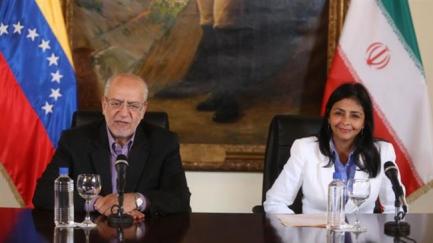
Iran’s Minister of Industry Mohammad Reza Nematzadeh and Minister for Foreign Affairs of Venezuela Delcy Rodriguez talk to reporters in Caracas
Press TV – June 27, 2015
Iran has agreed to a $500 million credit line for Venezuela to finance joint investments there, President Nicolas Maduro has announced.
He made the announcement after meeting Iranian Minister of Industry, Mine and Trade Mohammad Reza Nematzadeh in Caracas where the two sides signed six agreements to expand financial, economic, industrial and technological cooperation.
Among the agreements, there are plans for joint production of commodity goods, including detergents and other hygiene materials in Venezuela and Iran’s sales of medical drugs and surgical equipment to the country.
Maduro said the two countries had also agreed to a “comprehensive plan” to develop a joint program in nanotechnology in which Iran is among the top seven countries.
He said the deals would ensure a higher level of cooperation and deepen the bonds between the two nations.
Moreover, Iran agreed to transfer its expertise to Venezuela in combating an “economic war” on the Latin American country, Maduro said, apparently referring to Iran’s experience in facing years of US-led sanctions.
“We are facing an economic war of monumental proportions; a brutal war (but) we are here attending to our people,” Maduro said as he invoked the vision of the late President Hugo Chavez for “the government’s union with the people and struggle against imperialism”.
The Venezuelan head of state also hailed relations with Iran as “an example of alliance between two brother nations”.
“Today we have mutual trust in our relations and we work together with results. Working with Iran has gone well and our cooperation has been a great success since Hugo Chavez began a strategic alliance and brotherhood with Iran,” Maduro said.
Relations between Iran and Venezuela — both critics of US policies — have expanded in recent years. Iran is involved in a series of joint ventures worth several billion dollars in energy, agriculture, housing, and infrastructure sectors in Venezuela.
Iran’s main industrial projects in Venezuela include a car assembly plant, a tractor manufacturing complex and a cement factory.
The Islamic Republic has also built more than 3,000 residential housing units for less privileged citizens in Venezuela, with 7,000 more to be completed.
Both countries are hugely rich in resources. Venezuela possesses the world’s biggest oil deposit while Iran owns the fourth largest oil and first largest gas reserves of the world.
Maduro has announced his intention to visit Tehran to attend a summit of Gas Exporting Countries Forum planned for Nov. 23.
Gaza flotilla ship ‘sabotaged’ days before expected arrival
Ma’an – June 25, 2015
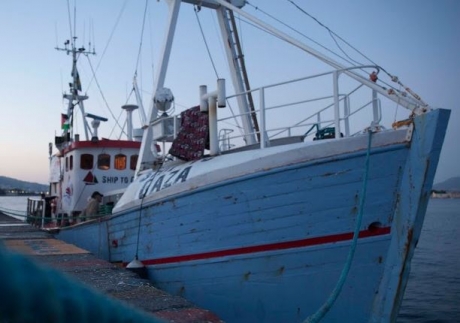
BETHLEHEM – One of the ships taking part in a flotilla headed towards the Gaza Strip was sabotaged south of Crete, an activist aboard one of the ships said Thursday.
Israeli-born Swedish activist Dror Feiler told Nazareth-based al-Shams radio that the ship had been sabotaged by professionals, and would have sunk if sailed at sea.
“Somebody went underneath the ship at night and sabotaged its propellers, just like they sabotaged the same ship in 2011,” Fieler said referring to similar damage that was inflicted upon a ship participating in a previous flotilla.
Feiler, who relinquished his Israeli citizenship after moving to Sweden, boarded the trawler Marianne of Gothenburg in Sweden with 18 other activists six weeks ago. The crew had refrained from stopping at European ports prior to avoid being held by authorities, but their trip was cut short after realizing that they might have drowned had they continued.
Despite the sabotage, the remainder of the flotilla convoy will move as planned with the ships expected arrive in Gaza in succession within three days, Feiler said.
The flotilla is the third of it’s kind to attempt to access the Gaza Strip by sea since 2010, aiming break the nearly nine-year Israeli blockade causing what is termed by rights organizations as a humanitarian crisis for the strip’s 1.8 million residents.
In May 2010, Israeli forces staged a raid on a six-ship flotilla which ended in bloodshed, claiming the lives of 10 Turkish rights activists and sparked a crisis with Ankara.
The participation in this year’s flotilla of Palestinian Knesset member Bassel Ghattas sparked an outcry among right wing members of the Knesset, Israel’s parliament, who called for Ghattas to be stripped of immunity from prosecution for joining.
Similar response was given to Palestinian MK Hanin Zoabi who took part in the 2010 flotilla, when Israeli minister Miri Regev accused Zoabi for “joining terrorists.”
Israeli leaders say that joining efforts to break the Israeli military blockade of Gaza is directly working against the security of Israel.
“It is the gravest thing possible that an Israeli MP would join the flotilla whose aim is to help the Hamas terror organisation,” said Israeli Immigration Minister Zeev Elkin from the ruling right-wing Likud party earlier this week.
Ghattas will be joined by the former Tunisian president, European lawmakers, and activists in what the Freedom Flotilla Coalition described as “a peaceful, nonviolent action to break the illegal and inhumane blockade of the Gaza Strip.”
JVP and Alison Weir – A Dissident View
By Ned Rosenberg* | June 21, 2015
Jewish Voice for Peace (JVP) has disassociated from a number of activists working for the liberation of Palestinians, including Gilad Atzmon, Greta Berlin (founder of Free Gaza) and now Alison Weir, who seeks to disseminate unbiased information about Israel/Palestine (IP) through her website If Americans Knew.org and presentations. JVP’s recent public statement concerning Weir specifically, credited to Anonymous, is a confused document. I examine some parts of this statement. Gilad Atzmon has commented insightfully on this public statement already and I will simply try to add to his work.
Alison’s mistake was her appearance on ‘Clay Douglas’s white supremacist radio show’ five years ago. JVP’s statement throws down the anti-racist gauntlet “… Clay Douglas is concerned primarily with the survival of the White race and sees malign Jewish influence everywhere. His racist, anti-Jewish, and anti-gay rhetoric can be found across the front pages of his multiple websites.” Yet, transcribing this pronouncement suggests a very different racism: “JVP is concerned primarily with the survival of the Jewish race and sees malign gentile influence everywhere. JVP’s racist, anti-gentile rhetoric can be found across its website, including ideological statements condemning “Americans,” and assaults on other activists who step outside its boundaries.” Alison is further cited for failing to defend Jews when Douglas launched into The Protocols of the Elders of Zion. As Gilad notes, Alison has no duty to defend Jews, especially given her devotion to Americans, as such. In JVP’s estimate, Alison’s error is all the more grievous since “Americans” are now the bad guys regarding IP, an important distinction in rejecting Alison’s work.
Unsurprisingly, divorce from these activists is not the end of the line. The organization continues to assault them with behind-the-scenes character assassinations and interventions to forestall their speaking engagements. Alison Weir reports several such instances of JVP interference and Atzmon documents the outspoken attempt of the Denver JVP to stop his appearance there. These efforts are disturbing to some JVP members who did not envision interfering with the free speech of other activists dedicated to Palestine at the behest of JVP’s Jewish board. JVP is now in the dirty business of judging, condemning and punishing Palestinian allies for not treating Jews or “Jewishness” with political correctness. This is probably the fate of all self-identified “Jewish” groups
As Gilad notes, JVP finds something suspicious in Alison Weir’s statement of intent for her website. This harmless statement
[Alison Weir] founded an organization to be directed by Americans without personal or family ties to the region who would research and actively disseminate accurate information to the American public.
is identified as racist because of its exclusions, a very cheap shot, in my opinion. And what then would we think of this hypothetical version:
Anonymous founded an organization to be directed by Jews with personal and family ties to the region who would research and actively disseminate accurate information to the American public.
Alison errs by insisting on diverse American researchers instead of Jews. Maybe this is just a labor dispute.
JVP’s statement proposes a progressive program which does not begin or end with IP but rather seeks continuation and long life by engaging other cases of injustices credited to, and sustained by US policies and practices across the globe. It is not happenstance that this expanded political program focused on global injustices has the virtue of placing the injustice of IP in the company of other troubling injustices credited to the craven, acquisitive very bad “American” people. The American people, after all, benefit from these abiding injustices, as in Saudi Arabia now or throughout South America routinely over the last century. JVP would like us to believe that Americans must also benefit from US support for the criminal Zionist regime in Israel, as though this support issues from the same base motives as the other instances. Were this true, then the American people are proper enablers of the oppression of Palestinians. In this schema, the American dog properly wags the American dog.
Unfortunately, the model doesn’t explain much about IP. Israel is not sustained by the American people for the sake of the benefits accruing to them because there are no such benefits. It’s an interesting game, if one has time, to try to find such a benefit. Scholars have given up in disgust while others venture that America seeks some unspecified strategic position from its support of Israel, but every such framing is really unconvincing. On net, Israel is just a very expensive adjunct to American power. American taxpayers fork over truly astonishing sums to the Zionists, directly and indirectly, and derive no benefit from so doing.
JVP’s broad attribution of cause to the bad Americans begs the question. We know why the US supports and sustains this particular injustice. The US does so because it is subjected to an army of well-heeled Zionist fellow travelers who work to influence the Congress, mostly through campaign contributions and other incentives, to provide such support. Certainly, it is very expensive to impact US legislators, media and institutions, but then again, consider the largesse of US taxpayers. The army consists of American Jews, American Jewish civil organizations, most American Jewish temples and synagogues, Zionist organizations, Christian Evangelicals and some defense contractors who have a bottomless interest in conflict. The model which attributes injustice in IP to “Americans”, their perfidy and exploitation, is disingenuous and indefensible. The proximal immediate cause for American support of Israel is the Jewish Lobby plain and simple. The pro Israel tail wags this American dog.
The effort to offload responsibility for the crimes of Zionism onto the “American people” is not just inadequate, but repugnant as well. Zionism is a creature of the Jewish people, not the American people. The Jewish people, its organizations and “helpers” are important accessories to the Zionist program and share responsibility for its dubious successes, especially its success in the obliteration of another people. Agents of the Jewish people are responsible for US support and this is well known and well documented. JVP’s theory, however, might be construed to provide fellow American Jews relief from the onus of the “Jewish power” accusation, the mere suggestion of which is considered anti-semitic no doubt. This nifty “two step” won’t do: The American people, their legislators, their institutions have been thoroughly compromised by the Lobby and JVP will not get away with doubletalk about this.
By taking sides in the struggle in IP “as Jews”, American Jews created a political identity out of their alleged ethnicity. It is therefore fair to suggest that Jewish power and its allies continue to tie the US to Israel, continue to tie, in JVP terms attributed to Clay, US white supremacist racism — specifically Jewish supremacist racism — to Israeli supremacist racism and its unacceptable consequences. The disingenuous attempt to sidestep the relationship of Jews worldwide to Zionism in our time, to subsume this powerful dynamic under the umbrella of American interests, to undertake such a huge displacement of moral/ethical culpability, places JVP squarely in the pack of other Jewish organizations who fret about “what’s good for the Jews” first and foremost and which end up defending the Zionist “no choice” sanctimony.
As Atzmon demonstrates, JVP does not escape racism by proclamation. It does not free itself from racist taint simply by saying it is opposed to all racism, not when it continues to act according to its own racist conceits, e.g. Alison Weir somehow owes it to the Jews to defend them against Clay Douglas or when it condemns white Americans for caring about white Americans, while focusing itself so obviously on what is good for the Jews. As currently constituted, JVP is not fit to join, much less lead, any progressive coalition because it will not face Jewish responsibility for IP forthrightly.
*The Author of this article is an American JVP activist. Ned Rosenberg isn’t his real name. Being a dissident voice within JVP is proven to be a dangerous adventure.
Cycles of Oppression, Cycles of Liberation: The Nasa People of Colombia Are Dispossessed Once Again

By Natalia Fajardo | Toward Freedom | June 8, 2015
An intense struggle for dignity and the right to land is being waged right now in the green mountains of south western Colombia, and chances are, you haven´t heard of it. While the scant mainstream media coverage of the country focuses on soccer or peace talks between government and armed guerrilla groups, it ignores that same government’s attacks against communities defending their territory.
On May 28th, one thousand riot police officers entered a sugar cane plantation called La Emperatriz in the municipality of Caloto, in the state of Cauca, to evict nearly 300 members of the Nasa indigenous people. The indigenous community members had peacefully replaced the sugar monocrop for beans and corn, as part of the process they call the Liberation of Mother Earth. This follows other recent evictions in the nearby town of Corinto, which left many civilians wounded, and clashes since February that resulted in the killing of Nasa youth Guillermo Pavi.
These confrontations occur in the midst of the community’s historic effort to defend their right to a dignified life by recovering land stolen from them – land which has been falsely promised to be returned.
Why Liberation? Why These Lands?
The Nasa people inhabited a large portion of southwestern Colombia long before the Spanish invasion. However, over decades of deceit and violence, the most fertile areas were taken over by wealthy landowners and the Nasa were displaced to higher elevations. Seferino Zapata, an elder from Caloto, explains, “We were taken to the mountain, but we fought. I took part in the struggles in the 80s, when we had to pay to work the land for food. We recovered this very land where I now sit.”
But these land takeovers have cost lives. According to Arcadio Mestizo, a leader of the indigenous reserve Huellas Caloto, on a night in 1991 the police and paramilitaries carried out the massacre known as El Nilo, killing 20 adults and children. While the slaughter occurred about 4 kilometers from the plantation, it was planned the night before at La Emperatriz.
The largehacienda of La Emperatriz, once used to raise livestock and grow rice, now hosts the exclusive cultivation of sugarcane by the transnational company Incauca, owned by the millionaire emporium Ardila Lule and currently under investigation for price fixing. Cane production has significant environmental impacts, such as biodiversity loss and toxic residues. La Emperatriz is just a sample of the economic reality of a region which has been transformed into a ‘green desert’ where sugarcane grown to produce biofuels replaced subsistence crops that fed thousands.
Following a ruling in 2000 by the Inter-American Commission on Human Rights, the Colombian state accepted its responsibility in the 1991 El Nilo massacre and agreed to transfer 15,600 hectares of land, including La Emperatriz, to the Huellas Caloto indigenous community. Trusting the agreement, the Nasa people suspended land takeovers. But time went by and the land promised by the government did not come through.
The Huellas Caloto indigenous leader Arcadio Mestizo explained, “In 2005, we re-started this struggle, now calling it Liberation of Mother Earth, and we began with La Emperatriz.”
Although in 2010 the government completed the transfer of the number of hectares of land promised, they are not the lands agreed upon, and much of it is not suitable for agriculture. So the Nasa vowed to “liberate” La Emperatriz hacienda.
The latest wave of liberation began in March, with the Nasa occupation of land, cultivation of maize, beans and cassava, and the construction of basic structures.
However, community leader Emer Pinzón said that in the morning this past May 28, the owner of La Emperatriz ordered their removal: “Riot police came in with their full war machinery ” and encountered 300 Nasa members armed with courage, shovels and stones to defend their efforts and dreams.
“The police brought, tanks, tractors and tear gas, and in four hours destroyed over two months of work,” Pinzón added. In addition to the constant threats by paramilitary groups, Pinzón reported that, during the eviction, riot police warned through megaphones, “this one will be worse than El Nilo.”
Mestizo added, “There is the 1991 precedent, and now we see us going in circles, but today the oppression happens in broad daylight, and fully institutionalized. [A massacre] can certainly happen again.”
This violence against civilians comes amid peace negotiations between the government and the FARC guerrillas.
Constanza Cuetia, a member of the Nasa community´s communications team, reflected, “The war is very much present in our communities. Targeted assassinations and recruitment of civilians continued during the ceasefire. In addition, the peace talks do not get to the heart of the conflict. The government’s delegate to the talks said that the [neoliberal] economic model will not be challenged in the negotiations.” Indeed, the government has justified the violent evictions defending the right to private property of a few, while ignoring the right of many for a dignified life.
However, resistance is strong. “These lands, as taught by our grandparents, belonged to our ancestors,” Pinzón said. “We will take it back for our youth, at any cost.”
Liberation as a Cure
The spokespeople of this community make it clear that the main reason for the liberations is not unfulfilled land agreements; this is only one ingredient in the recipe of reasons for why the Nasa struggle. “We do this to reclaim our land, but also to defend our social rights,” Mestizo explained.
Abel Coicué, a community leader, added, “we liberate these lands, both of the mountains and the lowlands, because they are ancestral and we have a right to them.”
‘’Everything done on the land sickens the earth further, and this disease is treated [by] liberating Mother Earth,” Paulina, a Nasa leader from nearby Corinto, noted. “It is about sowing spaces of freedom and life that allow us to live in balance and harmony.”
This strategy of liberation becomes even more urgent in light of the many “diseases” these territories face. “We have a major threat coming: mining, for which we must prepare,” Mestizo said. “Mining creeps in more quietly than sugarcane, and sometimes the community does not see it, but we have learned that mining companies, such as [South African] Anglogold Ashanti, have requested mining permits over our land, regardless if it is on a protected area or an indigenous reserve.’’
The Nasa people invite us to understand that their struggle is everyone’s struggle, and to take our part in it. ‘’This is not an issue for indigenous people in Cauca, Colombia, but it is a fundamental issue for all of humanity, whose main battlefield is here,” Mestizo explained. “We must understand and own this struggle, putting pressure on the capitalist who dispossess and abuses, and on the government that supports it.”
Click here to view a slideshow of this community and its struggle
Not Over Yet: Some Tough Votes Ahead on Fast Track
By Kevin Zeese and Margaret Flowers | Flush the TPP | June 13, 2015
While we all cheered the failure (TAA) to pass Trade Adjustment Assistance in the hope that its defeat would stop Fast Track, the House quickly voted to pass Fast Track Trade Promotion Authority (TPA) with 219 votes (218 is a majority but there were some abstentions). This situation means that the House and Senate have not passed identical versions of Fast Track (because the Senate version includes TAA) so Fast Track cannot go to the President’s desk yet to be signed into law. There are several possible scenarios ahead that leave the outcome of the fight against Fast Track uncertain.
While much of the media described today’s votes as a complete victory for those who oppose Fast Track and the Obama trade agenda, the fact is that we have some difficult challenges ahead. We won an important battle, and it was a tremendous victory especially when it is considered that President Obama did all he could including a special trip to the Congress for a private meeting with the Democratic leadership and the entire Democratic Caucus.
But, it is not over. Speaker Boehner called for reconsideration of TAA and a re-vote is supposed to happen within two legislative days so there may be another vote as early as Monday afternoon. We need to hold the line on TAA to prevent any form of TAA from passing the House and prepare for a vote in the Senate if a new form of TAA passes or if the TPA bill passed in the House goes back to the Senate without TAA.
Possibilities in the House
Since we won by a large majority on TAA in the House with a vote tally of 302 to 126 (76 vote difference), it is unlikely (but not impossible) that the current form of TAA would pass in a re-vote. No doubt this weekend President Obama is working overtime to convince Democrats to change their vote and Majority Leader Boehner is looking for Republicans to go against their views and vote for TAA. One Member told us after today’s vote that it is now a game of numbers. Politico does the numbers:
House Republican leaders say they have 100 votes for TAA, and Democrats would need to provide 118 if another vote happens. On Friday, Democrats provided 40 votes for TAA, while 86 Republicans supported it. In other words, Democrats would need to essentially triple their vote total to pass the measure.
If increased Democratic support cannot be achieved, passage would very likely require a mixture of Republicans voting for TAA in order to pass Fast Track and Democrats changing their position because they do not want to embarrass the president. Today, many of the “no” votes came after TAA failed to get a majority and everybody knew it would fail so they voted “no” or switched their vote to “no”. How firm are the votes of those who joined in after it had already failed? If the current TAA is not amended and it passes in the re-vote, there would be no need for any further action in the Senate and Fast Track would become law.
If the re-vote fails, a second possibility is for TAA to be re-written and voted on as a new bill in order to gain majority support. There were three problems with the current form of TAA: (1) Funding TAA by Medicare cuts; (2) Too small a budget; and (3) Failure to cover all workers, especially public workers.
The Medicare cuts were most significant in that almost no Democrat wants to be on record voting against Medicare. Prior to the vote, leadership of both parties came up with an alternative source of revenue (tax enforcement revenue). If this were written into a new TAA, the Medicare problem could be solved. It is not clear how real these tax enforcement dollars are so House leadership could also expand the budget for TAA and solve the budget problem as well. These two changes alone might be enough to gain a lot of Democratic votes. These changes would probably not lose a lot of Republican votes; in fact, Republican leadership still might be able to convince a group of Republicans to vote for TAA in order to get Fast Track passed.
The third problem is a significant one especially since under the Trade In Services Agreement (TISA) public workers will be threatened. For example, TISA could result in privatizing the US Postal Service which is the nation’s second-largest civilian employer after Wal-Mart with about 536,000 career workers. Adding public workers to TAA would require additional funding since more workers would be covered and this might be unpopular with Republicans.
If TAA is amended and passed in the House, the Senate would have to vote again – the House bill could either go to the Senate and be voted on as an original bill; or it could go to a conference committee where differences would be ironed out and then both chambers (House and Senate) would have to hold a re-vote.
We want our allies in the House to vote “no” on TAA no matter what kind of amendments are made to the bill. Now that TPA has passed, stopping TAA is critical for stopping Fast Track. The House TPA (Fast Track) without TAA would be much more difficult to pass in the Senate. Our goal in the House is for TAA bill to be defeated.
The Senate
When TPA came before the Senate, it was bundled together as one bill with TAA. It took a 62-38 vote to end debate on the bill and allow it to move forward. Other than Senators Collins (R-ME), Lee (R-UT), Paul (R-KY), Sessions (R-AL), Shelby (R-AL) and Enzi (R-WY) (who did not vote), all Republicans voted for the bill. In order to stop TPA in the Senate on a re-vote, three additional votes would be needed to prevent the new bill from reaching 60 votes and passing.
One possible scenario is that the House fails to pass TAA and sends a TPA bill to the Senate without TAA. This would be the most likely scenario that would lead to failure in the Senate. There were many Senators who insisted on TAA being included, indeed, some wanted a larger TAA. In addition, Senator Maria Cantwell (D-WA) was promised that the Export – Import Bank would be renewed in order to get her vote, that promise was not fulfilled so she is a possible “no” vote if this returns to the Senate.
The other possibility is that the House passes TAA in its present form or a new version. This would make it very difficult to stop TPA in the Senate. Other than Cantwell, it is hard to see who would change their vote. Senator Lindsay Graham (R-SC) had insisted that currency manipulation be included in the TPA. It wasn’t but he voted for the TPA anyway. Perhaps now that he is running for president, he might vote against TPA.
Our Task
The immediate task is to pressure Members of the House of Representatives to oppose any form of TAA.
Once again the Congress needs to be flooded with phone calls from across the political spectrum. The populist rebellion that has been taking place, especially during the last week, needs to continue so that Members of Congress know that they are risking their future election if TPA becomes law and rigged corporate trade agreements are given an easy path to becoming law.
It is also important to remind Members while they are home this weekend that you want them to vote “no” on TAA. Here is a link to a list of those Members who voted “no.” Thank your Member if she or he voted “no” and tell her or him to stay strong and not to compromise. Perhaps there will be an opportunity to reach her or him at a public event this weekend.
The Rigged Trade Rebellion was outside the Capitol all week. Once the vote was announced on Wednesday it became a 24 hour a day encampment until the vote on Friday.
The Popular Resistance Rapid Response Team will return to Capitol Hill on Monday to continue the Rigged Trade Rebellion. If you are able to make it to DC, we encourage you to come. This is a critical time to make the opposition to Fast Track highly visible. We have been staying at the corner of Independence Ave and New Jersey Ave SE so that we can speak to Members as they walk back and forth between their offices and the Capitol for votes.
One staffer mentioned to us that Members sometimes decide how they will vote just minutes beforehand. It could be that seeing your sign or speaking with you just prior to a vote could make a difference in what they do.
We still have the possibility of stopping Fast Track. Let’s put it over the edge in the next few weeks. You can follow the work to stop Fast Track at www.FlushtheTPP.org. And contact gro.ecnatsiseRralupoP@eiznekcaM if you have questions or are planning to come to DC.
Podemos supported anti-establishment mayors take control of Madrid & Barcelona
RT | June 14, 2015
Left wing party coalition leaders have been sworn in as mayors of Madrid and Barcelona, assuming control of the Spain’s two largest cities. This is yet another case of parts of Spain showing their opposition to the country’s conservative rule.
In the Spanish capital, a 71-year-old former judge, Manuela Carmena has put an end to the 24 years of conservative mayorship. She defeated her rival, 63-year-old Esperanza Aguirre from the People’s Party, in what proved to be a very close race.
The new mayor managed to claim 20 seats in the city chamber during the May 24 vote against Aguirre’s 21. However, Carmena managed to forge an alliance with the main opposition Socialist Party to secure victory. She was officially elected mayor by 29 of the 57 council representatives on Saturday morning.
Carmena, a former communist and rights activist, promised to improve the living conditions for the poor, who have been struggling since the 2008 financial crisis. She also echoed the calls of the massive Indignados (Outraged) protest movement that was formed in 2011 to fight corruption, government spending cuts and evictions.
“We are at the service of the citizens of Madrid. We want to govern by listening. We want them to call us by our first names,” Carmena said after being voted in.
Among her chief promises to the electorate are the development of public transport and increased support for poor families. She has promised to slash her salary by more than half to €45,000 ($51,000).
In Barcelona, 41-year old Ada Colau, an active protest leader, has become the city’s first female mayor. She rose to publicity after helping to organize the Platform for People Affected by Mortgages (PAH) movement, in Barcelona in 2009, to defend citizens against evictions caused by the collapse of the Spanish property market.
“Thank you for making possible something that had seemed impossible,” said Colau, representing the Barcelona en Comu party, after being elected mayor.
Her administration will now draft a list of 30 measures aimed at creating jobs and fighting corruption. Along with her colleague in Madrid, Colau announced that she will slash her salary from €140,000, down to €35,000.
Both Carmena and Colau secured victory during the May 24 local elections with the support of Pomedos, a new pro-worker and anti-establishment party that emerged last year.
Parties born out of the Indignado protest movement now rule five major Spanish cities: Madrid, Valencia, Zaragoza, Cadiz, and Barcelona.
The latest success of anti-establishment candidates in the two largest Spanish cities shows a major shift in the country’s politics, and erosion of the bipartisan system. The Popular Party and the main opposition Socialist Party together won just over half of the vote on May 24. The rest of the seats at the local elections went to candidates representing smaller populist parties who are demanding change.
Featured Video

Trita Parsi: Israel Set a Trap for Total War in the Region
or go to
Aletho News Archives – Video-Images
Book Review
Why the War on Conspiracy Theories Is Bad Public Policy
By Kevin Barrett • Unz Review • February 1, 2019
 A Review of Conspiracy Theories and Other Dangerous Ideas by Cass Sunstein (based on an earlier paper co-authored with Adrian Vermeule); In Defense of Troublemakers: The Power of Dissent in Life and Business by Charlan Nemeth; and Conspiracy Theories and the People Who Believe Them, edited by Joseph E. Uscinski
On January 25 2018 YouTube unleashed the latest salvo in the war on conspiracy theories, saying “we’ll begin reducing recommendations of borderline content and content that could misinform users in harmful ways—such as videos promoting a phony miracle cure for a serious illness, claiming the earth is flat, or making blatantly false claims about historic events like 9/11.”
At first glance that sounds reasonable. Nobody wants YouTube or anyone else to recommend bad information. And almost everyone agrees that phony miracle cures, flat earthism, and blatantly false claims about 9/11 and other historical events are undesirable.
But if we stop and seriously consider those words, we notice a couple of problems. First, the word “recommend” is not just misleading but mendacious. YouTube obviously doesn’t really recommend anything. When it says it does, it is lying. … continue
Blog Roll
 Aletho News
- Easy fix for Europe’s chaos? Stop fueling war against Russia
- Putin’s key remarks on peace talks and Europe’s ‘schizophrenia’
- Trita Parsi: Israel Set a Trap for Total War in the Region
- Trump’s Iran war is on an Israeli leash
- Saudi oil boss issues global supply warning
- Riyadh Says Its Oil System Is Intact. The Numbers Say Otherwise.
- Trump and Netanyahu Want to “Finish the Job” on Iran
- US ‘one-sided dictation’ not Iran’s beliefs makes rational talks impossible: Baghaei
- Iran’s Next Strike May Not Explode. It Could Shut You Down /Col Doug Macgregor
- Iran: US political targets legitimate if assassinations return
- If Americans Knew
- DAILY UPDATE: Latest essential news on Palestine, Israel, & region
- The Israel Lobby’s Changing Fortunes
- AIPAC has become such a political liability that it’s shifting to a more “nimble” approach to buying politicians
- At least 160 Israeli settler attacks in 2 weeks
- Will Gaza’s Ancient Christian Community Disappear Forever?
- Israel’s vision of regional security rests on keeping Arab states weak
- Heidi Levine recounts how Palestinian youths helped save her in settler attack
- DAILY UPDATE: Latest essential news on Palestine, Israel, & region
- Trump’s Intensifying Sabotage of the ICC, for Israel’s Sake
- Israeli military detain US and UK volunteers in West Bank including Democratic NY politician Brad Lander
- No Tricks Zone
- E-Cars Reduce CO2 Emissions By Only 41% Compared To Internal Combustion Engine Vehicles
- Predictions Made By Renowned Climate Professor Over Past Decades Have Been Proven To Be Poor
- New Study Suggests Large Regions Of The Pacific Ocean Have Been Cooling For The Last 80 Years
- Germany’s Green Energy Debacle: High Energy Costs Force Kahla Porzellan to Close After 182 Years!
- New Study: 50 Years Of The Most Aggressive ‘Net Zero’ Policies Can Only Affect The Global Climate By 0.03°C
- US September “Heat” Was No Record…Many Records Set Decades Ago
- Latest European Green Energy Debacle; Portugal’s Largest Flagship Solar Park Insolvent!
- Green Energy Debacle: German Expert Professor Fritz Vahrenholt Warns Of Severe Economic And Social Consequences
- Two More Paleo Reconstructions Affirm Meters-Higher Sea Levels Across Ireland, Brazil 7000-6000 Years Ago
- New Study: Earth And Venus Surface Warmth Largely Explained By Convection And Lapse Rate, Not CO2 Or Radiation

