The Phony Torture Debate: Why Trump is Wrong about Waterboarding — It’s Probably Not What You Think
By Sam Husseini | November 25, 2015
Republican presidential candidate Donald Trump — to the outrage of liberals everywhere — says he wants more waterboarding. Reports the Washington Post: “‘Would I approve waterboarding? You bet your ass I would — in a heartbeat,’ Trump said to loud cheers during a rally at a convention center [in Columbus, Ohio] Monday night that attracted thousands. ‘And I would approve more than that. Don’t kid yourself, folks. It works, okay? It works. Only a stupid person would say it doesn’t work.’
“Trump said such techniques are needed to confront terrorists who ‘chop off our young people’s heads’ and ‘build these iron cages, and they’ll put 20 people in them and they drop them in the ocean for 15 minutes and pull them up 15 minutes later.’
“‘It works,’ Trump said over and over again. ‘Believe me, it works. And you know what? If it doesn’t work, they deserve it anyway, for what they’re doing. It works.'”
There’s no shortage of people denouncing or pretending to correct Trump’s remarks. Virtually all miss the point. The fact is torture produces bad but useful intelligence. That is, it gives you “intel” that some bigwig with a conniving agenda wants to push. Like that Iraq had WMDs and we needed to invade.
As I wrote in my piece of last year: ““Both Sides” Are Wrong: Torture Did Work — to Produce Lies for War (See Footnote 857 of Report)“:
Nothing solidifies the establishment more than a seemingly raging debate between two wings of it in which they are both wrong. Not only wrong, but in their wrongness, helping to cover their joint iniquities, all the while engaging in simultaneous embrace and fingerpointing to convey the illusion of seriousness and choice.
>The truth is that torture did work, but not the way its defenders claim. It “worked” to produce justifications for policies the establishment wanted, like the Iraq war. This is actually tacitly acknowledged in the [Senate Intelligence Committee report on torture, partly declassified last year] — or one should say, it’s buried in it. Footnote 857 of the report is about Ibn Shaykh al-Libi, who was captured in Afghanistan shortly after the U.S. invasion and was interrogated by the FBI. He told them all he knew, but then the CIA rendered him to the brutal Mubarak regime in Egypt, in effect outsourcing their torture. From the footnote:
“Ibn Shaykh al-Libi reported while in [censored: ‘Egyptian’] custody that Iraq was supporting al-Qa’ida and providing assistance with chemical and biological weapons. Some of this information was cited by Secretary Powell in his speech at the United Nations, and was used as a justification for the 2003 invasion of Iraq. Ibn Shaykh al-Libi recanted the claim after he was rendered to CIA custody on February [censored], 2003, claiming that he had been tortured by the [censored, likely ‘Egyptians’], and only told them what he assessed they wanted to hear. For more more details, see Volume III.” Of course, Volume III — like most of the Senate report — has not been made public….
So, contrary to the claim that torture helped save lives, torture helped build the case of lies for war that took thousands of U.S. lives and hundreds of thousands of Iraqi lives, helping to plunge the region into astounding violence, bringing al-Qaeda into Iraq, leading to the rise of ISIS and further bloody wars.
But rather than face how torture actually works — and indeed how the establishment acknowledges it works — it’s more fun for so-called conservatives like Trump to talk about how we shouldn’t care that a bunch of presumably bad guys getting tortured and for liberals to pontificate about how we’re better than that and we need to live up to our values. Or for some to say that “torture doesn’t work” without examining what “works” means in a manipulative political context. Everyone can then pretend to feel good about themselves: Trump cares about your safety; Liberals uphold our great values that show how superior we are to the savages, and how superior they are to Trump.
It’s all phony. I’m not even sure if Trump knows it’s phony. I do know that many reporters and presumed opponents of torture are aware of this, but have chosen to stay mum about it. Again, as I wrote in my piece last year:
Exploiting false information has been well understood within the government. Here’s a 2002 memo from the military’s Joint Personnel Recovery Agency to the Pentagon’s top lawyer — it debunks the “ticking time bomb” scenario and acknowledged how false information derived from torture can be useful:
“The requirement to obtain information from an uncooperative source as quickly as possible — in time to prevent, for example, an impending terrorist attack that could result in loss of life — has been forwarded as a compelling argument for the use of torture. … The error inherent in this line of thinking is the assumption that, through torture, the interrogator can extract reliable and accurate intelligence. History and a consideration of human behavior would appear to refute this assumption.” The document concludes: “The application of extreme physical and/or psychological duress (torture) has some serious operational deficits, most notably, the potential to result in unreliable information. This is not to say that the manipulation of the subject’s environment in an effort to dislocate their expectations and induce emotional responses is not effective. On the contrary, systematic manipulation of the subject’s environment is likely to result in a subject that can be exploited for intelligence information and other national strategic concerns.” [PDF]
So torture can result in the subject being “exploited” for various propaganda and strategic concerns. This memo should be well known but isn’t, largely because the two reporters for the Washington Post, Peter Finn and Joby Warrick, who wrote about in 2009 it managed to avoid the most crucial part of it in their story, as Jeff Kaye, a psychologist active in the anti-torture movement, has noted. One reporter who has highlighted critical issues along these lines is Marcy Wheeler — noting as the recent report was being released: “The Debate about Torture We’re Not Having: Exploitation.”
An additional irony is that Trump is putting himself out there as the guy opposed to the Iraq war.
Colin Powell’s former chief of staff Col. Lawrence B. Wilkerson has acknowledge the torture-evidence link, and I questioned Powell about this. Noted Wilkerson: “What I have learned is that as the administration authorized harsh interrogation in April and May of 2002 — well before the Justice Department had rendered any legal opinion — its principal priority for intelligence was not aimed at pre-empting another terrorist attack on the U.S. but discovering a smoking gun linking Iraq and al-Qaeda.”
Trump can pose as standing up to political correctness. The actual political correctness is how torture is used by war makers to get the tortured “evidence” they want to have a pretext for war and other hideous policies. The actual political correctness is to pretend that “torture doesn’t work” when it works for evil ends all too well. It’s way past time to get off the liberal-conservative phony debate not-so-merry-go-round.
Cooking the Books for Israel: How The NY Times Plays a Numbers Game
By Barbara Erickson | TimesWarp | November 23, 2015
 Jodi Rudoren today in The New York Times puts up a numbers barrier to hide the reality of Palestinian casualties in the latest spate of violence in Israel and the occupied Palestinian territories. The aim, as usual, is to maintain the claim of Israeli victimhood and to obscure the criminal brutality of the occupation.
In a story about four who died yesterday in alleged attacks in the region, Rudoren writes that more than 90 Palestinians have been killed since Oct. 1, “about half while attacking or trying to attack Israelis and the rest during demonstrations where they clashed with Israeli soldiers.”
We are to believe from this statement that only violent activists have died at the hands of Israeli forces, but in fact, several Palestinians have been killed in circumstances that were anything but “clashes”—at checkpoints, for instance, when trigger happy troops shot and killed unarmed victims. One of the dead was a 73-year-old grandmother on her way to lunch with her sister.
To omit these cases is to ignore the findings of human rights groups that have charged Israel with committing extrajudicial executions in recent weeks, and Rudoren’s statement, in the face of their evidence, is an effort to distort the facts.
The misrepresentations do not end there, however. Rudoren goes on to say, “At the same time, 17 Israeli Jews have been killed and dozens wounded in 70 stabbings, 10 shootings and 10 vehicular attacks.”
Note what is missing here: the number of Palestinians that have been wounded and the attacks against them in Israel, the West Bank and Gaza. Her aim is to minimize the huge discrepancy in casualty counts by omitting the number of Palestinians wounded by Israeli forces and settlers.
Ninety compared to 70 sounds like something approaching parity, but Rudoren has deliberately omitted the logical comparison—the number of injuries. This, according to United Nations data, was 133 Israelis and 9,171 Palestinians injured as of Nov. 16.
We should ask Rudoren and Times editors why this information is missing here, in a context that cries out for full disclosure.
Beyond the full casualty count, the Times could also inform readers of other statistics that illuminate the reality of Palestinian-Israeli relations:
- A weekly average of 150 Israeli military search and arrest operations in the West Bank last year.
- 211 reported incidents of settler violence against Palestinians this year as of Nov. 16. (Actual incidents are daily occurrences throughout the West Bank.)
- 50 Israeli military incursions into Gaza from Jan. 1 to Nov. 16, 2015.
- 481 demolitions of Palestinian-owned structures as of Nov. 16 this year. (This includes homes, animal shelters, cisterns, wells and public buildings such as schools.)
- 601 Palestinians displaced due to demolitions in 2015.
- 6,700 Palestinian political prisoners currently held by Israel.
- 320 Palestinian child prisoners currently in Israeli prisons.
The information for the numbers above comes from the UN Office of Coordination for Humanitarian Affairs and from Addameer, a Palestinian prisoners’ rights organization. The Times, however, ignores their reports and prefers to rely on official Israeli entities. Thus, the numbers Rudoren cites for attacks and casualties are taken from the Israeli Ministry of Foreign Affairs, which has an obvious interest in political spin.
Israel has the first and last word in the Times. The United Nations, Palestinian monitoring groups and human rights organizations are silenced while Israeli official claims are taken as fact. The word “alleged,” for instance, never appears in Rudoren’s piece today. The UN report, however, uses the term frequently, distinguishing between the claims of security forces and verified information.
In short, Times reporting on Palestine and Israel is a disgrace. Numbers are deliberately manipulated, relevant facts are censored, and the result is dishonest journalism, in spite of the newspaper’s lofty claims of providing “the complete, unvarnished truth” and “impartial” reporting. The numbers simply prove them wrong.
Follow @TimesWarp on Twitter.
Mass Demonstration Demands Closure of US’ Notorious ‘School of Assassins’
Sputnik – 24.11.2015
 Georgia’s infamous ‘School of Assassins’ was besieged by hundreds of activists from across the country, calling for the closure of the military training center and a halt to the militarization of Latin America by the US.
The 25th anniversary protest march was held over the weekend in the town of Lumpkin in northern Georgia, and at the gates of Fort Benning army base, where the former US Army School of the Americas (SOA), hidden now under the name of the Western Hemisphere Institute for Security Cooperation (WHINSEC), is located, along with the nearby Stewart Immigrant Detention Center, the country’s largest for-profit immigration prison.
Dozens of nonprofit organizations and some 1,400 activists joined the rally, which aimed to protest against the notorious “School of Assassins,” as SOA is referred to, for its production of “death squads” that commit mass murders, torture and other human rights’ violations and military crimes across the globe, activists claim. Watchdogs maintain several Latin Americans dictators and many more security officials, who have perpetrated such crimes, graduated from SOA.
“Despite a shocking human rights abuse record, the School of the Americas continues to operate with US taxpayer money. Closing the SOA would send a strong human rights message to Latin America and the world,” SOA Watch founder and organizer of the event, Father Roy Bourgeois, said in a statement.
Hundreds held vigil in front of Fort Benning, while others marched to protest to the immigrant prison, where some 1,800 migrants await repatriation. Eleven people were arrested after crossing onto the grounds of the prison, according to the Ledger-Enquirer.
The event was attended, among others, by members of Veterans for Peace.
“From Ferguson to Ayotzinapa, we must continue to denounce the militarization of police across the Americas and call for an end of state-sponsored terrorism and violence against our communities. Our clamor for justice must be heard!” the pacifist NGO’s online statement reads.
Newly released documents, obtained by the Partnership for Civil Justice Fund, suggest the FBI has been monitoring the activities of SOA Watch and infiltrating the NGO, using confidential informants and counterterrorism units.
Night raids continue in al-Khalil (Hebron)
International Solidarity Movement | November 22, 2015
Hebron, occupied Palestine – On Tuesday, 17th November, several groups of soldiers raided houses in the Wadi al-Hurriya neighborhood of al-Khalil (Hebron), an H1 district legally outside of Israeli control. From 7.30pm, Israeli forces were present in the area, divided into groups of 7-12 soldiers and entering every house and business on designated streets. At some of the residences they entered by force, violently smashing through doors. They checked every I.D card of the residents and also, according to soldiers who confronted the ISM volunteers, searched for weapons. Later in the night they informed the volunteers that they were looking for weapons and collecting data in order to prevent potential stabbings: “yes, some people are scared. But some people have reason to be scared.”
Each group of soldiers patrolled different streets and dark alleys, checking each house and entering with backpacks, mapping equipment, bullet-proof vests, and cocked machine guns. On entering houses, 2-3 soldiers remained outside to “secure” the entrance, periodically pointing guns at passers-by and preventing vehicle and pedestrian passage through the streets.
The raids lasted until at least 12.30am, after which one unit was witnessed occupying the second floor of a Palestinian house – the other half of which was inhabited by a Palestinian family – and could be heard setting up sleeping equipment. According to the soldiers questioned on site: “no, we are not inside a Palestinian house, they are not living in this house.” The residence is located within 500 meters of an army base and checkpoint bordering the H2 restricted area of al-Khalil.
It was reported later from residents who were in contact with ISM that furniture and property was damaged on the night. This is typical of night raids on Palestinian houses, and in other incidences money and other property has also been stolen. While these raids have been used extensively in the al-Khalil district in recent weeks as part of a tactic of intimidation, it is unclear as to whether the policy of raiding the H1 district and squatting family homes will continue.
Colombia: 300 Campesino Leaders Killed in 2015

Campesino leaders say the government is criminalizing their movements and does not protect their rights. | Photo: @marchapatriota
teleSUR – November 21, 2015
At least 300 campesino leaders have been killed in Colombia in 2015, according to Andres Gil, human rights leader and spokesperson of the Marcha Patriotica.
Many of these deaths have come as campesino leaders are attempting to defend their land and their natural resources. Another 7,000 campesino leaders have been jailed.
Land distribution in Colombia is extremely unequal. Less than 1 percent of the population owns roughly half of the land, and 70 percent of the population owns only 5 percent of the land. Campesinos who fight for their land are often risking their lives.
At least three campesinos leaders where killed just in the last two weeks, including the young Afro-descendent leader Jhon Jairo Ramirez Olaya in the Valle region; the environmental and campesino leader Daniel Abril, in the Orinoquia region; and the representative of Afro-descendent victims from Cordoba, Luis Francisco Hernandez Gonzales.
Another young campesino leader allegedly killed by the armed forces last Friday, according to Marcha Patriota.
According to Verdad Abierta — an investigative project on the armed conflict of Colombia’s Semana magazine — Abril accused various state officials of corruption, and was fighting against multiple oil corporations with extensive land interests.
Feliciano Valencia, another indigenous leader from the region of Cauca who was controversially sentenced to 18 years in jail, was also victim of a homicide attempt on Tuesday, as four men opened fire on his home, according to local social organizations.
Still in Cauca, in the end October, the armed forces were recently involved in the murder of indigenous leader Alfredo Bolaño, the 58th victim from security forces in the region, one of the most affected by violence because of its highly fertile lands.
On Friday, the Colombian army killed one campesino and wounded five others after it raided a rural area in what military officials said was an effort to “manually eradicate” illegal coca crops.
According to the local community, the armed forces opened fire on a peaceful march last Thursday in Argelia, Cauca.
The country’s ombudsman Fabian Laverde told teleSUR that this issue was rooted in several causes.
“First, the national government refuses to recognize the existence of paramilitarism. Second, the complaints from the social movements made about situations of threats or concrete actions against residents of these territories have been completely ignored,” he said.
YouTube Terminates PINAC Account for “Violent” Police Videos, the Latest Shutdown on Independent Media
By Andrew Meyer | PINAC | November 20, 2015
On October 27, YouTube terminated the main channel of Photography is Not a Crime, claiming the channel posts too many videos that are “violent or graphic content that appears to be posted in a shocking, sensational, or disrespectful manner.”
Because of that, PINAC lost hundreds of videos it had posted on the channel.
The videos found on the PINAC YouTube channel are typically also aired by national and local television news stations now that police violence has become national news.
However, PINAC’s account was suspended in August for airing footage of the Virginia reporters getting shot to death, which many news stations chose not to run.
“We did so because we wanted to give readers the choice to view the full video if they wanted rather than make the decision for them,” said PINAC Founder and Publisher Carlos Miller. “While many news stations chose not to run that video, Washington Post media analyst Erik Wemple was quoted in an interview that not running the video in its entirety is ‘coddling’ the readership – which was our viewpoint all along.”
Wemple stated the following in that interview:
“If you really want to understand enormity and the horror of what happened, I’m afraid airing the video is one way to get that across,” he says.
“I don’t see the point in not telling the full story,” Wemple adds.
News outlets are not showing the images and posting the videos because, as the The New York Times put it, “we didn’t want to force people to see it,” he says.
“I think that’s coddling the audience a little much,” Wemple says.
YouTube then suspended the account again in September after PINAC aired a video of Delaware police shooting and killing a man in a wheelchair.
And the last straw was in October over a video of a Canadian cop repeatedly running over a dog before stepping out of his patrol car and shooting it to death.
That was when we received the following email.

YouTube continues to host thousands of channels that could also be described as “violent” content providers, including channels specializing in professional fighting highlights, clips of people fighting in the street and other channels with nearly identical content to PINAC.
Mark Dice, who has posted videos exposing the Bilderberg Group and other topics blacklisted from corporate “mainstream” media also had his channel deleted in March of 2014. When Dice made a video drawing attention to this blatant censorship on his secondary channel, that channel was then also deleted without explanation, despite zero negative history against it.
YouTube has a long history of shutting down alternative media channels, including those of Russia Today, Federal Jack, Stefan Molyneaux, and Alex Jones. And YouTube is not alone in their censorship of alternative media.
Luke Rudkowski, who runs the emerging news outlet WeAreChange, had his Facebook account suspended, while an Infowars reporter was repeatedly banned from Twitter.
PINAC Executive Director Grant Stern made the following statement:
It’s upsetting that YouTube would destroy a year’s worth of news journalism, including numerous worldwide exclusive videos. Our numerous YouTube Live interviews with key sources from the Baltimore Uprising were due to be arranged into a feature length movie, but now it appears all of that hard work was for naught.
The summary deletion of our YouTube account harms the public interest in knowing how our government officials behave when caught on camera, and breaks countless hundreds of news stories around the country who linked to our videos.
We have appealed each suspension only to be quickly denied. We appealed the last decision but don’t expect YouTube to restore our channel judging by their denials on previous appeals.
However, others have had the suspensions of their accounts typically overturned, but it often requires a fight from the audience. To help restore PINAC’s YouTube channel, post on your Facebook, Twitter, and YouTube itself using # YouTubeCensorship and #PhotographyIsNotACrime.
But we’re not holding our breath, so we are now using this channel as our main YouTube channel.
Israeli forces close several main roads in Nablus
Ma’an – November 20, 2015
 NABLUS – Israeli forces closed several main roads in the Nablus district on Friday until further notice for alleged security purposes, Palestinian security sources said.
Palestinian security sources told Ma’an that they were informed by Israeli authorities of the decision to shut the main entrances of the villages of Burin, Awarta, Osarin, Aqraba.
The entrances were closed at 10 a.m. and will be closed indefinitely due to the “deterioration of the security situation,” the sources added.
Locals told Ma’an that Israeli forces had also placed large dirt mounds across another road leading into Burin as well as a main road inside of Awarta.
An Israeli army spokesperson did not have immediate information on the closures.
Nablus is one of several areas in the occupied West Bank to come under increased measures from Israeli authorities since the beginning of last month including home demolition, road closures, and high levels of arrests.
Earlier this month, a Palestinian was shot dead after carrying out a vehicular attack that left three Israelis injured at the Tappuah Junction, south of the villages.
Sweeping restrictions are typically implemented following attacks on Israeli military and settlers in the occupied West Bank.
Such restrictions on access apply only to Palestinian residents, while facilitating the movement of Israeli settlers living illegally in the area.
Cops Claim LSD Killed this Dad, but Autopsy & Video Confirms they Hogtied Him to Death
By Justin Gardner | The Free Thought Project | November 19, 2015
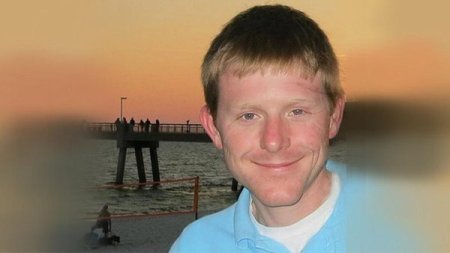
Memphis, TN – An independent autopsy has found that 30-year-old Troy Goode died from being hog-tied face-down for an extended period of time. The Southaven, Mississippi police department tried to blame Goode’s death on LSD, but there is no scientific basis for this claim.
As we reported in July, Goode and his wife attended a concert in Southaven where they took LSD. Goode began acting funny in a parking lot, and someone thought it was necessary to call the police.
The cops’ answer was to hog-tie Goode and place him face-down, which is known to be a potentially deadly position.
Bystander footage shows Goode being hog-tied, thrashing around, and then being placed into an ambulance. Several onlookers state their disbelief that cops would place someone in this dangerous position, with one even saying it’s good they are getting video “in case he dies.” Goode was pronounced dead an hour after arriving at the hospital.
A friend of the family contacted the Free Thought Project and said that Goode was asthmatic and he was denied his inhaler. We were also told that cops threatened to arrest friends and family if they visited Goode at the hospital.
The family has never accepted the official story and believes that excessive force and the manner of restraint killed Goode.
Not wanting to wait six to eight months for a state autopsy to be performed, Goode’s family had an independent one performed. Attorney Tim Edwards released the results at a news conference in Memphis.
He was suffocating. His heart increased into what is called tachycardia. There is no scientific basis to attribute his death to LSD.
This was lethal force, putting someone in a prolonged hog-tied position. This was not a situation where a 300-pound man attacked a police officer in the dark. This was a science nerd.
The toxicology report … rules out any drug-related causes. That takes that off the table. LSD does not cause heart failure.
Edwards is seeking a civil rights investigation by the U.S. Department of Justice, and the family will file a lawsuit in January.
DeSoto County District Attorney John Champion declined to comment on the results of the independent autopsy. The DA and the police department will likely cling to the false excuse that LSD killed Troy Goode.
Southhaven Mayor Darren Musselwhite issued a statement defending the officers and said Goode posed a danger to himself and others. He also claims that Goode threatened officers and resisted arrest, and continued violent behavior in the ambulance. Musselwhite stated that Goode never said he couldn’t breathe, but the video and bystander reactions indicate that Goods was showing signs of distress.
The autopsy found no evidence of pre-existing disease that would have caused the death, and there is no known case of a person dying from LSD overdose. Troy Goode was having a bad trip, but it was the cops’ use of a dangerous restraint tactic that killed this husband and father.
Israeli officer gets community service for brutal assault on US teen
Ma’an – November 19, 2015
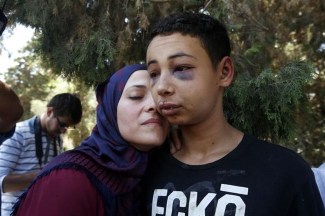 BETHLEHEM – An Israeli border policeman responsible for brutally assaulting a Palestinian-American teenager last year has escaped a jail sentence,Israeli media reported Wednesday,instead receiving six weeks of community service.
Tarek Abu Khdeir, 15, was severely beaten by masked Israeli police officers last summer in the Shufat neighborhood of East Jerusalem amid clashesfollowing news that his cousin, Muhammad Abu Khdeir, was kidnapped and burned alive by Jewish extremists.
Video footage capturing the beating emerged later that evening and went viral as word spread that Tarek was an American citizen.
Muhammad, 16, had been kidnapped and burned alive by suspected Jewish extremists two days prior.
The Israeli policeman who repeatedly beat and kicked Tarek in his head, face, shoulders, and upper body was given the six-week verdict Tuesday despite the prosecution’s request for a seven-month sentence in prison, Israeli daily Haaretz reported.
Israeli Judge Dana Cohen-Lekac considered “mitigating circumstances such as the policeman’s lack of a criminal record, positive character references and the fact that the policeman lost his job after the incident,” when making the decision.
Israeli police said at the time of Tarek’s detention that he was wearing a mask and carrying a slingshot. Tarek denied he was involved in the demonstration.
The teen required medical treatment following the severe force used by the policeman, and was later sentenced to nine days under house arrest.
Prisoners’ rights group Addameer at the time called on international rights organizations and the US consulate to attend Tarek’s court hearing following his detention.
“State-sanctioned violence against children is unlawful and unacceptable,” Addameer said, urging the bodies to “investigate the intensified aggression against Palestinian children.”
The policeman — whose name remains under a gag order — was initially indicted on Sept. 2014 in an investigation the family and rights groups said was only carried out due to Tarek’s US citizenship.
Most Police Training is Simply Learning to Kill – It’s Leading to a Deadly ‘Epidemic’
By Justin Gardner | The Free Thought Project | November 18, 2015
South Carolina — The Free Thought Project has been covering the murder of 19-year-old Zachary Hammond by Officer Mark Tiller since the incident occurred on July 26th. Three weeks ago the heartbreaking dashcam video was finally released, which shows a maniacal Tiller ruthlessly take the life of this teenager over a suspected bag of weed.
According to the Post and Courier, “the Hammond case was far from unusual” in South Carolina.
A campus cop at Spartanburg Methodist College shot to death an unarmed college student driving a car—including twice in the head—after responding to a report of a vehicle break-in. Of course, the cop claims that 20-year-old Delvin Simmons was trying to run him over, but there is no bodycam or dashcam video to refute that claim.
The Post and Courier found that South Carolina is set to break its current record of police shootings, and that 1 in 4 shootings involved officers who fired at moving vehicles. Criminal justice experts say this practice is “ineffective and risky to officers and bystanders.”
The paper’s investigation, titled Shots Fired: Mining lessons from tragedy, looked into the use of deadly force by the state’s police officers and how they learn from these encounters.
What they found was that the State Law Enforcement Division (SLED) and the Criminal Justice Academy do literally nothing to learn from past mistakes. For instance, there was no evaluation of the case of Walter Scott to glean lessons in avoiding the use of deadly force, even though Officer Michael Slager was charged with murder.
“They don’t want to admit mistakes,” said Philip M. Stinson, a former police officer who is a criminologist at Bowling Green State University in Ohio. “In some agencies there is an erroneous perception that if they were to discuss and learn from mistakes, any advancement would be viewed as an admission of guilt that could result in civil liability.”
Decades-old tactics of escalation and use of deadly force are firmly entrenched in police training,
“A survey that Wexler’s group recently completed showed the continuing emphasis placed on force over persuasion. Among the 281 police agencies that responded, the average number of basic training hours devoted to firearms was 58, compared to eight hours spent on de-escalation techniques and 10 hours on communication skills.”
The paper contrasts this to typical European approaches of law enforcement that emphasize keeping their distance, buying time and de-escalating the situation.
However, learning de-escalation tactics is an “elective” course for cops training at the academies. Instructor John McMahan sums up the extent of South Carolina’s current police training programs:
“Our main job is basic handgun fundamentals. Really all we are trying to do is to get them to where they can draw from a holster, site a line and pull the trigger.”
This was certainly on display when Mark Tiller so callously took the life of Zach Hammond.
Stinson, the criminologist and former cop, is taking aim at the unwillingness of police departments to learn from past incidents in order to reduce the violence being carried out upon he citizenry.
“It’s not second-guessing to say, ‘What can we do in the future to prevent these shootings from happening?’ That’s not second-guessing. That’s taking advantage of good policy and practice,” said Stinson.
As Chuck Wexler, director of the Police Executive Research Forum, points out, police shootings say a lot about “the training officers receive and the policies their departments adhere to.”
“So much attention is placed on the oversight issue, which is important, but you really have to look upstream at the policies and training that are in place,” said Wexler.
Instead of desperate attempts to blame victims, bystanders taking video, or journalists helping to expose police brutality, it’s time for law enforcement to take the blinders off and study their past actions.
After the Post and Courier exposed South Carolina law enforcement’s penchant for deadly force and shooting into moving vehicles, SLED chief Mark Keel is announcing they will change their ways.
He wants the Criminal Justice Academy “to start reviewing these cases and start looking for lessons learned, good and bad.” Keel says he is looking at policies and training practices in other states and may take specific actions next year.
They should not limit their research to other states in the U.S., as the ready use of brutality and deadly force is standard operating procedure across the country.
Time will tell if these announcements bring meaningful change, or if they are mere lip service to the increased scrutiny.
Mass Arrests After #BlackLivesMatter Protesters Shut Down Minneapolis Road
Sputnik – 17.11.2015
On Monday evening, 51 people were arrested in Minneapolis after shutting down a busy highway for over two hours in protest of an unarmed black man who was killed by police on Sunday.
Among those arrested were at least two reporters, one of whom was doing a live broadcast for the local Fox Affiliate as he was handcuffed.
Jamar Clark, 24, was shot in the face by a still-unnamed police officer and died on Monday after being taken off of life support.
“A man shot in an officer-involved shooting incident early on November 15, 2015, has died,” Minnesota Bureau of Criminal Apprehension said in a statement. “Jamar O’Neal Clark, 24, of Minneapolis, died Monday evening. Clark’s body has been taken to the Hennepin County Medical Examiner’s Office for autopsy.”
Witnesses have maintained that he was handcuffed when the single bullet was fired, though the police have stated their initial investigation has determined he was not.
Police had arrived at the scene of an assault after Midnight on Sunday morning, officers claimed that Clark was interfering with paramedics who were treating the victim, when a “scuffle” ensued.
The outrage in the community lead to protesters marching to the police department and forcing their way inside. Many protesters have been occupying the lobby of the station, refusing to leave until the officer’s name is released as well as surveillance footage.
On Monday evening, Clark was taken off of life support and died shortly after.
Later in the evening, another group of hundreds of protesters marched onto I-94 and shut down traffic in both directions. The interstate was backed up for miles as demonstrators linked arms and refused to move.
Eventually, 43 adult protesters and 8 juveniles were arrested and charged with misdemeanors. All have since been released.
The Minneapolis Police Department has placed the two officers involved in Clark’s death on paid leave and has requested a federal investigation into the incident.
Their police department remains occupied, and a list of demands has been released by the Black Lives Matter protesters:
1. Footage from the incident
2. An independent organization to investigate
3. Media to cover witness testimony, not just police point of view
4. Community oversight with “full disciplinary power”
5. Officers to live in the communities they serve
Corbyn’s rejection of ‘shoot-to-kill’ causes Labour rupture
RT | November 17, 2015
Labour Party leader Jeremy Corbyn has been criticized by members of his own shadow cabinet after publically opposing a “shoot-to-kill” counter-terrorism policy on British streets.
Days after the Paris terror attacks the UK government ordered special forces to “shoot to kill” if Islamic State terrorists were to threaten a large number of people.
During a parliamentary meeting on Monday, a clear division among Labour Party factions emerged when MPs questioned Corbyn’s views on the policy and his stance on the legality of the extrajudicial execution of Mohammed Emwazi (also known as ‘Jihadi John’).
Ann Coffey and John Mann were among MPs to challenge their leader. A spokesperson for Corbyn said only a small minority of MPs had expressed themselves “volubly” during the meeting.
Corbyn was asked if he considered the strike that killed Emwazi to be legal. According to the Telegraph, he refused to answer, angering several Labour MPs.
‘I can’t speak for Corbyn’
Shadow Foreign Secretary Hilary Benn admitted he is struggling to defend Corbyn’s stance on the shoot-to-kill policy.
In an interview with the BBC, Benn said he “can’t speak” for the leader of his party.
“I can’t speak for Jeremy in relation to the particular circumstances he may have been thinking about,” he said.
He added it is “reasonable” to kill a terrorist where there is an “immediate threat to life.”
“All I can say is what is the position of the party. The long-standing position in the UK – there are procedures, it has got to be reasonable, it has got to be proportionate. But you have got to protect human life.”
Benn’s comments contrasted with Corbyn’s remarks when he was asked if he would be pleased to order the military or police to follow such a policy.
‘Shoot-to-kill policy is dangerous’
On Monday, Corbyn called the policy dangerous. “I’m not happy with the shoot-to-kill policy in general – I think that is quite dangerous and I think [the policy] can often be counterproductive,” he told the BBC.
“I think you have to have security that prevents people firing off weapons where they can, there are various degrees of doing things as we know.
“But the idea you end up with a war on the streets is not a good thing. Surely you have to work to try and prevent these things happening, that’s got to be the priority,” he added.
However, Corbyn’s aide insisted he is not opposed to the policy in all cases, adding he is “committed to what the existing law is – that any armed action by the police has to be proportionate to the threat.”
‘We are as ruthless as they are’
Commenting on the policy, Metropolitan Police (MPS) Commissioner Sir Bernard Hogan-Howe said officers working in terror situations would need to know they are supported when they are forced to pull the trigger.
“We work within the law and we make sure the people on the other side – the terrorists – know that we’re as determined as they are, we’re as ruthless as they are,” he told LBC radio.
“We work within the law, but the officers have some difficult decisions. They deserve all our support.”
Featured Video
BRITAIN’S WARNING: PREPARE FOR WAR
or go to
Aletho News Archives – Video-Images
From the Archive
How Ukraine Tortured and Slaughtered Donbass
By Kit Klarenberg | Al Mayadeen | July 11, 2024
Almost immediately after the proxy war erupted, ISIS-tier footage of the torture and murder of Russians in Ukrainian custody emerged.
On July 6th, the New York Times published an astonishing investigation: In Ukraine, Killings of Surrendering Russians Divide an American-Led Unit. The article documents in grim detail how Chosen Company, an international volunteer battalion for Kiev, routinely executes Russian prisoners of war. It is the very first mainstream admission that this practice – a brazen breach of the Geneva Conventions, and a grave war crime – is widespread among Ukraine’s fighters, both foreign and homegrown. … continue
Blog Roll
 Aletho News
- Israel Demolishes Home Of Lebanese Journalist Whose Viral Film Exposed Pager Attack
- Record Oil, Empty Tanks: The UAE’s Miracle Recovery
- Burnham tackles Britain’s poverty with aggression in Yemen
- Peace in Ukraine: the easy way – or the hard way
- Trump & the Rrrrussians
- US taxpayer money laundered back through Ukraine – Musk
- Before COVID, an NIH lab chief proposed making a SARS-like bat virus more infectious
- Gates, Bourla on Trial in Netherlands Accused of ‘Great Reset’ Scheme at Vaccine Injury Hearing
- BRITAIN’S WARNING: PREPARE FOR WAR
- “Historic Russia”: The Land Putin Will Not Give Back
- If Americans Knew
- DAILY UPDATE: Latest essential news on Palestine, Israel, & region
- Damning report shows the media must confront its failures on Gaza
- BBC senior broadcaster speaks out on Gaza coverage
- Netanyahu vows vast West Bank invasion in response to 20-minute skirmish that left 2 Israeli soldiers and 2 Palestinian fighters dead
- Tied up and tortured: Israel using US-made electroshock weapons on Palestinian detainees
- The outsourced risk: how newsrooms rely on Gaza’s freelancers without protecting them
- Gaza bakeries forced to shut as Israel blocks flour shipments
- Gaza’s breast cancer patients face a deadly wait for treatment amid Israel’s genocide
- DAILY UPDATE: Latest essential news on Palestine, Israel, & region
- The Israel Lobby’s Changing Fortunes
- No Tricks Zone
- Two New Studies Find Thwaites Glacier Melt Cannot Be Driven By Human Activity Or A Warming Ocean
- E-Cars Reduce CO2 Emissions By Only 41% Compared To Internal Combustion Engine Vehicles
- Predictions Made By Renowned Climate Professor Over Past Decades Have Been Proven To Be Poor
- New Study Suggests Large Regions Of The Pacific Ocean Have Been Cooling For The Last 80 Years
- Germany’s Green Energy Debacle: High Energy Costs Force Kahla Porzellan to Close After 182 Years!
- New Study: 50 Years Of The Most Aggressive ‘Net Zero’ Policies Can Only Affect The Global Climate By 0.03°C
- US September “Heat” Was No Record…Many Records Set Decades Ago
- Latest European Green Energy Debacle; Portugal’s Largest Flagship Solar Park Insolvent!
- Green Energy Debacle: German Expert Professor Fritz Vahrenholt Warns Of Severe Economic And Social Consequences
- Two More Paleo Reconstructions Affirm Meters-Higher Sea Levels Across Ireland, Brazil 7000-6000 Years Ago

