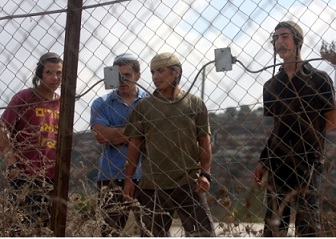
Yesterday, 11th October at 7 pm, a group of settlers of the illegal settlement of Tel Rumeida surrounded the entrance of the Azzeh family property and built a wire fence to block the exit. Young settlers fixed the fence in place using plastic cable ties.
Hashem Azzeh and his family were about to leave the house when they found the gate blocking their way and the settlers confronted them saying they couldn’t go out that way any more. A group of Israeli soldiers were present but did not stop the action.
Baruch Marzel. (Photo credit: Wikipedia)
Two international activists arrived on the scene and were surrounded by settlers and physically and verbally attacked by them, one of them had water thrown over his camera and another was kicked. An international journalist also present was hospitalized after a settler threw bleach into her eyes. After more international activists arrived, they managed to remove the fence. Despite multiple appeals to the Israeli soldiers to prevent the settler violence by both the Azzeh family and the international activists, they took no action. Jewish Defense League leader Baruch Marzel, was left free to verbally attack Hashem Azzeh.
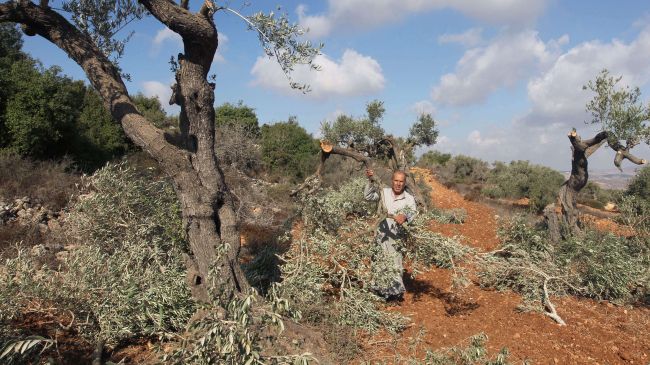
The Azzeh family has long been a target of settler intimidation and harassment. Last Thursday during the night settlers trespassed on the Azzeh family property and stole about 400 Kilos of olives from 40 olive trees. Hashem Azzeh had been prevented from starting his olive harvest pending a permit from the Israeli Civil Administration. Four days after his olive trees had been raided, he was suddenly informed by the administration that he should start his harvest immediately, but unfortunately he doesn’t have any olive trees left.
Since the Hamas election victory in January 2006 — and particularly after the Hamas-Fatah clashes and split between Gaza and the West Bank in the summer of 2007 — Gaza has undergone a disturbing human experiment, whose toll is unprecedented in the history of the impoverished Strip.
The plotters involve the usual suspects, each with a clear set of objectives behind the isolation and targeting of Gaza. The US and Israel have worked tirelessly to divide Palestinians and derail any chances of a unified government, let alone a cohesive national project. This helped Israel achieve two objectives: Blaming Palestinians for a lack of leadership (as in ‘we don’t have a peace partner’) for the collapse of the so-called peace process and creating distractions as it continued with the construction of its Apartheid Wall and colonies throughout the Occupied Territories.
The Palestinian National Authority (PNA) has assumed the role of the local collaborator and has done its outmost to undermine Hamas at every turn. The US has ensured that no unity agreement is signed between Hamas and the PNA’s ruling Fatah party and if any such agreement is ever reached, it will never be honored. Israel moved into Gaza from time to time to test the resolve of Palestinian resistance, to ‘teach Gaza a lesson’ and to ensure that Hamas’ reign comes at a heavy price. PNA President Mahmoud Abbas’s Fatah was spoiled with much ‘aid’ and perks. Its officials are well paid, even when the rest of the Palestinians are not paid at all. According to VisualizingImpact.org, Palestinian politicians are the second highest paid in the world after Kenya, as a multiple of gross domestic product per capita.
Abbas, his officials and PNA security bosses have no reason to abandon such a sweet arrangement, especially if the other option will be to let go of their riches and embrace a national liberation project, the cost of which could be too high for pampered men to bear.
Isolated, lacking political savvy and out of options, Hamas made some costly mistakes, especially following the Arab upheaval that promised change, but threw the entire region into a high-stakes political gamble. Hamas became even more isolated, especially after the July military coup against Egypt’s first elected president. Mohammad Mursi, despite immense pressure, was much kinder to Palestinians in Gaza than his predecessor Hosni Mubarak, who was an important player in the Gaza experiment. His regime worked diligently to ensure that the siege on Gaza was complete and that an Islamic movement at his country’s doorsteps had no chance of proving politically viable.
The Mubarak regime played its role according to the script and greatly benefited too. For his tenacious efforts to contain ‘radical Islamists’ in Gaza, Mubarak was spared the sham democracy crusade launched by former US president George W. Bush. The US was and remains completely oblivious to numerous human rights violations carried out by Egypt’s security apparatus, the curtailing of freedoms and the brazen denial of basic rights of Egyptian citizens. US Congress seemed much more forgiving of Egypt’s abuses, compared to rights abuses carried out by other regimes — thanks in part to Egypt’s six-year-long crackdown on Gaza. Out of the four crossings that connect Gaza to the world, Israel is sealing three, while Egypt is choking the fourth and in the last two months, it has destroyed all tunnels that Gazans had dug to smuggle food and other urgent supplies. It is believed that some of these tunnels are also a source of arms that Palestinians in Gaza use in their war with Israel. As Gaza dies slowly, the waiting game continues. All parties — Israel, US, Egypt and the PNA and their regional allies are coordinating their efforts to ensure Hamas’ demise and PNA’s return to power.
In an article titled ‘Gaza: Crushed between Israel and Egypt’, Jonathan Cook wrote of a ‘cynical game’ that is on in full swing. The game expects the Egyptian military to destroy all tunnels and to close the Rafah border crossing for Israel to turn a blind eye to “Egypt pouring troops, as well as tanks and helicopters, into Sinai in violation of the 1979 peace treaty,” so that Gaza can become dependent on Israel’s ‘good favor’ once more. All of this is to “bolster the image of Abbas” and to present the PNA as a sane option as opposed to Hamas’ caustic policies.
Meanwhile, in the name of “national security”, Egypt seems to be planning something sinister as well. Apart from cutting Gaza off, its navy is attacking and imprisoning Gaza fisherman and its generals are constantly accusing Gaza of playing a role in the security unrest in Sinai. One of Egypt’s most prominent military leaders, General Ahmad Wasfi, warned “Gaza jihadists” in Kuwait’s Al Rai newspaper, saying he would “cut off the head of anyone who tries to threaten Egypt’s security”. This comes shortly after Egypt’s Foreign Minister, Nabeel Fahmy, threatened war on the Gaza Strip. More recently, Israeli daily Jerusalem Post cited a senior Egyptian source commenting to West Bank-based Ma’an news agency that “the Egyptian army has planned military attacks on specific targets in the Gaza Strip in the event that the security situation in the northern Sinai peninsula deteriorates”. According to the source, “Egyptian reconnaissance planes had photographed the potential targets”.
It is payback time as far as the plotters are concerned. Israel’s failed, albeit very violent wars on Gaza, fell short of eradicating Hamas or rooting out the Strip’s resistance groups. The US’s carrot-and-stick policies also failed as did most of US policies in the Middle East since the invasion of Iraq, if not even before. As for Abbas, his credibility is at an all-time low and the only reason he remains in charge is because Israel sees some benefits in his continued presence. But since the overthrow of the Muslim Brotherhood-dominated government in Egypt, efforts have been renewed with earnest — this time involving all parties.
For months, there has been growing talk of a new “popular” movement in Gaza to topple Hamas. The movement is modeled after Egypt’s protests of June 29, which emboldened the military coup by Egypt’s strongman General Abdul Fatah Al Sissi. Hamas claims that several cells affiliated to Egyptian intelligence have been apprehended in Gaza. Protests are also planned for next month. “Hamas’ political rival, Fatah … is reported to be behind the new protest movement,” wrote Cook.
True, Hamas is now politically at its weakest, thereby creating an opportunity for its many enemies to make their move. But this is not just about Hamas. The ultimate aim is to remold Gaza, the heart of Palestinian resistance, and to turn the strip into an extension of its western-styled Ramallah under Abbas with its handsomely paid officials. If this goal is achieved, it will come at a very high price that will be exacted not just from Gaza, but from all Palestinians.
– Ramzy Baroud is a media consultant, an internationally-syndicated columnist and the editor of PalestineChronicle.com. His latest book is My Father Was A Freedom Fighter: Gaza’s Untold Story. (Pluto Press).
A Bahraini court jailed nine activists for life Monday after alleging that they made bombs for “terrorist” purposes, a judicial source said.
Four of the defendants were in court for the verdict and the remaining five, tried in absentia, were handed an 10 additional years in jail for failing to hand themselves in. Life imprisonment in Bahrain is a 25-year-sentence.
Human rights groups have slammed the Bahraini dictatorship’s persecution of activists and political opponents since a pro-democracy movement swept the tiny Gulf kingdom two and a half years ago.
The courts, whose judges are appointed by the Bahraini king, have jailed hundreds of peace activists and human rights leaders on terrorism-related charges in recent months.
Monday’s ruling brings to 104 the number of activists jailed since September 29 over terrorism-related charges in the western and Saudi-backed Gulf kingdom.
The four men told the court that they were tortured, mistreated and held in solitary confinement – a routine procedure in country to force confessions, according to the Bahrain Center for Human Rights (BCHR).
The defendants were found guilty of “joining a group with the intention of disturbing public order and using terrorism to endanger Bahrain’s security,” the charge sheet said.
They were also convicted of making bombs and training others how to produce them, and “owning and using explosives for a terrorist purpose and carrying out bombings to terrorize citizens.”
BCHR says at least 89 people have been killed by Bahraini police and a Saudi-led Gulf force since the a popular, anti-government uprising erupted in February 2011.
Bahrain is the home base of the US Fifth Fleet and Washington is a long-standing ally of the Al-Khalifa ruling family.
The US State Department every year releases its Country Reports on Human Rights Practices, arrogating to itself the right to judge how the rest of the world measures up to US standards of respect for human rights.
One of the key measurements the US uses to determine whether the rest of the world is up to its stated standards of human rights protection is whether the country engages in “extrajudicial executions,” i.e. the state killing people without a legal trial. Needless to say, countries which engage in or promote extrajudicial killing are considered among the worst of the human rights abusers.
At a Washington Post sponsored panel yesterday on cybersecurity attended by former NSA/CIA chief Michael Hayden and by current Chairman of the House Intelligence Committee Mike Rogers (R-MI), Hayden quipped that while NSA leaker Edward Snowden is on the consideration list for a European Human Rights Award, he had “also thought of nominating Mr. Snowden, but it was for a different list.”
Considering the input that Hayden had over the US administration’s “kill list,” the implication was fairly clear. One might imagine what among some at least was (hopefully) nervous laughter.
Is it funny to joke about killing someone when everyone knows you have had the power to make it happen? At least Hayden made the comment while he was no longer serving in a position where he could call out the drones.
What is worse, however, was the reaction of the neoconservative warmonger and enemy of civil liberties, Chairman Mike Rogers. To Hayden’s confession that he had thought of putting Snowden on “a different list,” Rogers did not miss a beat.
“I can help you with that,” Rogers said.
It is incredible to imagine that an individual in such a powerful position as is Mike Rogers — not just a Member of Congress but the Chairman of the Committee that coordinates with the CIA, NSA, and the rest of the Intelligence Community on matters covert and operational — would even if perhaps in a lighthearted moment make such a deeply disturbing comment.
Killing is so casual to people like Rogers.
It is the kind of thing that — were the US not the authors — would be written up in a report on human rights abuses and threats to the rule of law.
NABLUS — Jewish extremist settlers attacked olive groves in Deir Sharaf village west of Nablus northern West Bank on Friday night.
The settlers attacked Palestinian lands near Shavei Shomron settlement where they cut down trees and bulldozed Palestinian lands in the area, a PIC correspondent reported.
The lands’ owners were stunned Saturday morning at the site and bulk of the damages caused by the settlers’ violent attack against their agricultural lands.
Settler attacks usually witness a sharp escalation during the olive harvest season, and include the uprooting of Palestinian trees, in addition to attacks on residents, and international supporters, while picking their crops.
Meanwhile, Israeli settlers burned Palestinian land planted with grapes near Kharsia settlement in al-Khalil southern West Bank.
Local sources told Quds Press that the Israeli settlers burned down a four-dunum piece of land planted with grapes owned by the Palestinian citizen Mousa Jaber.
The Palestinian farmers called on human rights institutions to intervene to put an end to the Israeli violations and attacks against them and their farms.
Bahrain general prosecutor says senior opposition and ex-MP, Khalil Marzooq, has been referred to court on charges of “inciting terrorist crimes.”
Abdulrahman al-Sayyed said in a statement on Saturday that Marzooq, a leading figure in the kingdom’s main opposition group, al-Wefaq, would also face charges of “promoting acts that amount to terrorist crimes.”
Marzooq was arrested on September 17. He served as deputy speaker in Bahrain’s 40-member parliament before a walkout was staged in 2011 by 18 members of al-Wefaq in protest against the violent crackdown on anti-regime demonstrators.
The statement added that Marzooq was also accused of using his position in al-Wefaq to call for “crimes” that are regarded as “terror acts under the law.”
The prosecutor also confronted Marzooq for his public speeches in which he supported an opposition group known as the Coalition Youth of February 14 Revolution.
On September 18, al-Wefaq, Bahrain’s main opposition group, boycotted national reconciliation talks in protest against the detention of Marzooq.
Last Sunday, a court in the kingdom sentenced 50 Shias to up to 15 years in jail for forming the Coalition Youth of February 14 Revolution.
The Bahraini uprising began in mid-February 2011. Protesters initially called for political reform and a constitutional monarchy, a demand that later changed to an outright call for the ouster of the ruling Al Khalifa family following its brutal crackdown on popular protests.
Scores have been killed, many of them under torture while in custody, and thousands more detained since the popular uprising in the Persian Gulf kingdom.
On the Saturday Sept. 28th, disgraced Gen. Odlanier Mena shot himself in the head in a stairwell outside his home in Santiago, Chile. Convicted in 2007 and sentenced to six years for ordering the murder of Oscar Codoceo, Manuel Donoso, and Julio Valenzuela in 1973, a media firestorm over the conditions of his military prison, replete with nutritionist and tennis court, had forced conservative Pres. Piñera to approve his transfer to general population. Rather than face prison life, Gen. Mena made a choice he never offered the thousands whose torture he oversaw as head of the CNI (Chile’s secret police), years of suffering or a painless death. He chose the latter.
Such a sensational story rightly found traction in media outlets across the Hemisphere, but most, like the New York Times, failed to mention Mena’s training at the School of the Americas (SOA), a U.S. Army training facility for Latin American soldiers, as well the broader involvement of the Nixon Administration in fomenting the 1973 coup. That Gen. Mena was able to commit suicide on weekend leave to his comfortable home while technically a prisoner of the state is indication enough of Chile’s agonizing struggle for justice; that mainstream media outlets across the Hemisphere failed to link Mena to the policies of Kissinger and Nixon– policies that continue to the present even as the SOA has been rebranded WHINSEC (Western Hemisphere Institute for Security Cooperation)– lays plain that Chilean generals are not the only ones who walk among us, blood on their hands, with impunity.
The New York Times, of course, is not the only publication to focus on the drama of Mena’s death without probing the accomplices who trained, funded, and protected him along the way. The Times, like others, stuck to descriptions of his death, limited the scope of his crimes, and devoted one of eight paragraphs to a sympathy plea from Mena’s lawyer while offering no voice to the family members of his countless thousands of victims. In order to understand this carnal mess, we must expand the timeline beyond that offered by the Times, which in their article begins in 1973, when Gen. Mena had recently transferred from the “Caravan of Death” unit of the Chilean Army to commander of the Rancagua Regiment in Arica Province. Without forgetting his eventual conviction for the murders of the civilians he ordered that year, it’s necessary to turn back the clock three years to 1970, when Mena attended a 9 month Command and General Staff Officer Course at Ft. Benning, GA, home of the School of the Americas. In doing so, the precise type of officers produced at the SOA will come into focus, and allow us a contemporary, domestic point of reference for both the 9/11/73 coup that bore Gen. Pinochet’s dictatorship and the implementation of “Operations Other Than War (OOTW)” that Mena became familiar with at Ft. Benning.
The SOA/WHINSEC has a long and gruesome history. Originally opened in the Panama Canal Zone in 1946, it relocated to Georgia in 1984 after the Panamanians finally achieved sovereignty over their Canal. Notorious graduates include Guatemalan Pres. Gen. Rios Montt (convicted this year, and subsequently released, of genocide), Argentine Pres. Gen. Roberto Viola (convicted in 1985 of murder, kidnapping, and torture) and Honduran Police Chief Juan Carlos “the Tiger” Bonilla (whose police force has murdered and repressed Hondurans so successfully since the 2009 coup that the U.S. State Department has rerouted military aide to his subordinates, an Orwellian maneuver necessitated by Congress’s disapproval of human rights abuses in Honduras). That is to say that the impact of SOA grads across the Hemisphere continues not only in the historical memories of Latin Americans and the nightmares of disgraced generals, but in the mundane standard operating procedures of lethal military bureaucracies from the Rio Grande to Tierra del Fuego.
Chile alone has sent more than 5,200 soldiers to be trained at the SOA in counterinsurgency, sniper fire, and interrogation techniques. Gen. Mena, high enough in rank in 1970 to forgo those courses, instead enrolled in Command and General Staff Officer Course (O-3), reserved for majors and above. According to the 1996 U.S. Army Course Catalog from the SOA, the stated purpose of the course was to train Latin American officers to “be able to command battalions, brigades and equivalent-sized units in peace or war…” and “efficiently manage manpower, equipment, money and time.” Certainly, his U.S. Army instructors would have been pleased with how efficiently Mena ran the Center for National Intelligence from 1977-80, renamed, like the SOA, after its previous moniker, DINA, had become too toxic.
During a time when the Chilean state faced no credible external threats, of all the course objectives listed in the SOA catalog, it must have been the Operations Other Than War (OOTW) training that Gen. Mena drew upon most frequently. The seemingly vague description, “To develop awareness of U.S. OOTW doctrine and of specific Latin American problems in a (sic) OOTW environment,” tells all when we trace the trajectories of SOA stars like Mena to the craters where they are currently crashing and burning all across Latin America. Among the “specific Latin American problems” Mena developed an awareness of during his time at the SOA most surely was the ascendance of the political left, a process now more than a half century old that manifested itself in Chile by the election of the Popular Unity coalition’s Salvador Allende Gossens to the presidency on Sept. 4th, 1970, six months after Mena’s enrollment at Ft. Benning. We can only imagine what must have been discussed by Mena and his Chilean colleagues in the portion of their course devoted to the objective of “Officer Preparation”, designed to familiarize them “with basic organization and doctrinal concepts”, but the outcome was tattooed in red across Chile during the 17-year Pinochet dictatorship.
Beyond the glaring omission of Mena’s training at the SOA, the New York Times and other mainstream outlets also ignored the larger story of U.S. direct involvement in the ’73 coup and complicity in all that followed. That story has been told by truth seeking independent journalists many times (for a great account of the mainstream media’s whitewashing of Latin American state violence, see Keane Bhatt’s article from July 29). Suffice it to say that Nixon’s Secretary of State Henry Kissinger has for many years been unable to travel freely abroad for fear that foreign courts will hold him accountable for his crimes against humanity. While the Times tries to relegate Mena’s suicide to the realms of history and pulp, we must remember that crimes like Mena’s are ongoing, and that the SOA/WHINSEC continues to export anti-democratic human rights abusers around the Hemisphere. Who says we don’t produce anything here anymore?
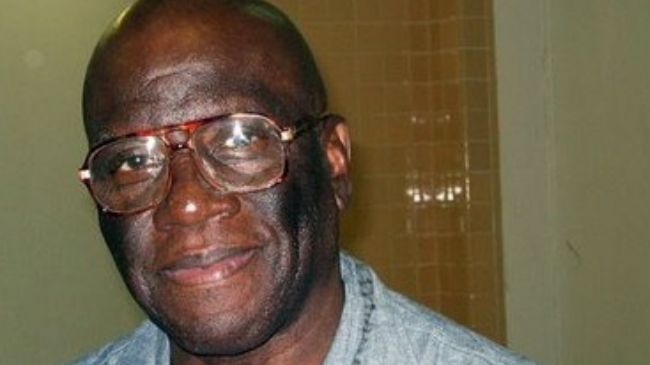
An American prisoner, who was released a few days ago after spending 41 years in solitary confinement, has died of liver cancer.
The 71-year-old Herman Wallace was freed on Tuesday after a US federal judge overturned his conviction for the murder of a prison guard, saying his 1974 trial had been “unconstitutional.”
His attorneys said he died at a supporter’s home in New Orleans.
“One of the final things that Herman said to us was, “I am free. I am free”,” they said.
Wallace, who was a former Black Panther and member of the “Angola 3,” and two other inmates were held in solitary confinement for years.
Wallace and Albert Woodfox, who was also convicted, have denied the killing, saying they were set up because they founded a chapter of the Black Panthers at Angola.
The inmates charged with killing the guard became known as the “Angola 3.” The third prisoner eventually became a prosecution witness.
Louisiana, where he was imprisoned, had refused to free Wallace on medical grounds over his terminal cancer.
Campaigner for Amnesty International Tessa Murphy criticized prison officials.
“The Louisiana prison authorities put this man through hell,” Murphy said. “There were longstanding concerns about the safety of his conviction and it’s some small consolation that Herman died a free man.”
What image of Palestinians would viewers, who have a smattering, or if any, knowledge of the Palestinian struggle, gain after seeing Dror Moreh’s documentary, The Gatekeepers?
The word ‘terrorist’ and versions thereof – ‘terrorism’ ‘terror’ – occur over 40 times, and all, bar once, in reference to Palestinians implicitly justifying the raison d’etre for Shin Bet (Israel Security Agency).
The MO of the vicious Shin Bet or Shabak is covert counter-terrorism – based on the premise that the people of Palestine have no right to defend themselves or fight for their rightful independence enshrined in international law against the brutal illegal occupier and coloniser- the rogue State of Israel.
Meanwhile, Israel, the world’s fourth largest high-tech nuclear military force bleats its right to defend itself against Palestinian rocks and piddly homemade rockets.
The Gatekeepers presents interviews with six former Shin Bet commanders with relevant archival footage. Luke Buckmaster states, “These are men who, after consuming their toast and coffee, went to work to oversee every form of state-sanctioned violence. Manhunts. Executions. Torture. Missions that led to the death of countless innocent people… It seems highly improbable — despite unusually candid-feeling interviews — that the former top brass from the Shin Bet didn’t come to the project without an agenda in mind.” (Crikey 21-8-13)
The documentary has been hailed for presenting the human face of Shin Bet.
Dror Moreh: What shocked me was how humane they were. You have a certain image of somebody like Shalom before you meet him; he has a reputation that precedes him. And suddenly, you find yourself seated in front of Shalom and you do not see this monster, or this heartless bureaucrat, or this mastermind of espionage. You see a human being, with the same doubts and tormented thoughts that you or I have. You see a person with a conscience.
You can bet that a documentary proselytising the humanity of Gestapo heads, Heinrich Himmler, Rudolph Diels and Heinrich Muller would ignite fires of Sheol to spurt from the tongues of the Zionist Lobby.
The documentary opens with footage of a sterile ‘super clean operation’ (like the Wikileaks release of the US gunship ‘collateral murder’ video in Iraq) of the targeted killing, by remote, of so-called Palestinian ‘terrorists’ [freedom fighters], accompanied by the self-congratulatory comments of Yuval Diskin, who adds that in reflective moments he thinks it is ‘ unnatural’ to have the power to take lives in an instant. Really? Such moral musings from a man who has spent 30 years in military, Shin Bet and Mossad intelligence including Israel’s 1982 bloody war on Lebanon. Apparently ‘in no time Shin Bet controlled Lebanon’.
The sensitively airbrushed Yuval waxes lyrical about his ‘exotic encounter with olive trees’ (millions of which, along with livelihoods have been destroyed by Israel) and about his interaction with the peasants as he wandered through landscapes, refugee camps (refused right of return), visiting homes, chatting in cafes (one wonders how many of his bucolic buddies Shin Bet kidnapped and tortured) and then awakes from his fond reverie to remind himself and us of the ‘Palestinian problem’.
Right on cue the next footage, presents a newsreel on the killing of two soldiers in Al Khalil (Hebron). Mystifyingly, there is no footage of any of the hundreds of Palestinian civilians murdered there, in their own city, such as young Mohammed Ziad Awad al-Salayma who, in December 2012, was shot moments after buying a cake for his 17th birthday.
The indigenous people of Al Khalil are held hostage by a handful of settler thugs protected by the Israeli military. The once vibrant commerce of Shuhada St has been shut down and netting covers the narrow passages of the Old City to curtail the urine, faeces and rubbish that vulgar settlers throw down on passing Palestinians.
Avraham Shalom, a feared and uncompromising bully, has an acting skill range from a frisky thrill for his job security “ luckily for us terrorism increased’, to quasi-senility in remembering his ordering the execution of the two surviving handcuffed hijackers of Bus 300. Their heads were smashed with a rock. Shalom (ironic name) admits President Shamir had given him carte blanche on life-and-death decisions- literally – and that he coordinated his actions with Shamir, Rabin and Peres who rolled over and played ignorant under public pressure. Shalom later admits that Israel has become ‘cruel’ and is ‘similar to the Germans in WWII”. He should know.
Yakov Peri another of Moreh’s charming goons, comments on the First Intifada, “A nation rose up and tried to launch a revolution,” Why? Wait for it – “to kick us out”… Ah, there it is- the Israeli mantra of victimhood. Not one of these men of ‘conscience’ get that Palestinians are fighting for self-determination, for freedom from savage and systematic oppression, for their lives and shrinking country.
Peri goes on to laud Shin Bet’s ‘well-oiled’, ‘well-organized, effective’ and ‘systematic’ ‘intelligence factories’. He explains how Shin Bet learned about their territorial units ‘village by village, trail by trail’, through field trips and masses of ‘interviews’ ie interrogations about the village, the clans, number of people and its institutions. This format resembles the well-oiled, well-organized, effective and systematic Plan Dalet that mapped, for the Jewish terrorist militias, the ethnic cleansing of 531Palestinian villages in 1947-48; “These operations can be carried out in the following manner; either by destroying villages (by setting fire to them, by blowing them up or by planting mines in their rubble)… In case of resistance, the armed forces must be wiped out and the population expelled outside the borders of the state.” Ilan Pappe, The Ethnic Cleansing of Palestine p.82
Shin Bet then set up a tight web of informers and agents and one wonders what terrible coercions would make a Palestinian betray his community, friends and family. The atmosphere of terror, the sinister recruitment practices and informant systems in Stalin’s Russia and Hitler’s Germany comes to mind.
The section Our Own Flesh and Blood deals with the rise of settler power. Peri drops a hasbara (Lie) clanger stating that “the illegal settlements were built despite of or in opposition to government decisions”. Shortly after the settler protests in 1975, Rabin allowed the establishment of Ma’ale Adumin and settlers have been given financial incentives and tax concession by successive Israeli governments.
Since 1967 over 541,000 settlers have colonised the West Bank and there are 100 outposts, forerunners to new settlements. Israel threatens to annex the settlements on stolen Palestinian land and since the onset of the present peace farce in July, the Netanyahu government announced plans for 800 illegal housing units. Extremist settler parties have unprecedented power in the present Knesset.
The rise of settler power only disturbs Israel when its own may suffer as with the assassination of Rabin and the deranged plot to blow up the Dome on the Rock. Moreh never refers to these fanatics as terrorists even though, after the massacre at Al Khalil’s Ibrahimi Mosque by Baruch Goldstein, the settler groups, Kach and Kahane Chai were designated terrorist organisations.
Moreh makes much of death of Rabin and its impact on the peace process but Tanya Reinhart told it straight; “Deception and lies have been a cornerstone in Israeli policy, brought to a new level of perfection since Oslo. While the world believed that Prime Minister Rabin promised to eventually end the occupation and dismantle the settlements, the number of Israeli settlers actually doubled during his rule.”
If you are not convinced The Gatekeepers is a propaganda exercise, listen to Carmi Gillon’s testimony on Shin Bet’s justification for the use of torture in interrogations which became more difficult during the Second Intifada because “ Anyone willing to sacrifice his life whether its for the virgins in paradise or not has nothing to lose.” The belittlement of the sacrifice of suicide bombers for paradisaical virgins confirms Israel’s denial of the Palestinian political impetus for freedom and denial of the desperation of Palestinian life under the might of Israel’s control.
In 2001, Human Rights Watch asked the Danish government to reject Gillon’s appointment as ambassador to Denmark and Amnesty International, citing the UN Convention against Torture demanded he be detained.
Years after the end of the Second Intifada, “the need to use moderate physical pressure in interrogations” continues to this day. Moderate? Impunity to inflict sleep deprivation, sitting handcuffed in a painful, degrading, exhausting position, covering heads, shaking, beatings, humiliation, threats against family, medical neglect, electrocution on adults and minors is secured by Israel’s High Court and the Office of the Prime Minister.
In February 2013, Charlotte Silver’s opinion piece in Al Jazeera, How Israel legitimises torturing Palestinians, to death, exposes how Arafat Jaradet was tortured to death during the 7 days between his arrest and death on February 23.
“The ordeal that Arafat suffered before he died at the hands of Israel’s Shin Bet is common to many Palestinians that pass through Israel’s prisons. According to the prisoners’ rights organisation Addameer, since 1967, a total of 72 Palestinians have been killed as a result of torture and 53 due to medical neglect. Less than a month before Jaradat was killed, Ashraf Abu Dhra died while in Israeli custody in a case that Addameer argues was a direct result of medical neglect… And in the first week of February, two weeks before Arafat was killed, the High Court of Justice threw out Adalah’s petition that demanded the GSS videotape and audio record all of its interrogations in order to comply with requirements of the United Nations Convention Against Torture (CAT) to which Israel is a signatory.”
The section, Collateral Damage vividly depicts Shin Bet’s new strategy; state-sanctioned targeted killings which are outlawed under international law. In 2007, Avi Dichter, was forced to cancel a visit to the UK because of a potential arrest warrant on suspicion of war crimes for the bombing of Hamas‘ Saleh Shehade’s home killing 15 family members including 3 children. Sharon called it ‘one of our greatest successes.’
Ami Aylon points out Israel also achieved greater security because cooperation was secured at monthly meetings between Shin Bet and the PLO security in spite of the dwindling Israeli desire to reach agreement on a Palestinian state. This is backed up by footage that features Fatah gangster, Mohammed Dahlan whose death squads took over Israel’s policing of Gaza and the West Bank. Concocting competition and conflict between Fatah and Hamas is a brilliant divide and rule strategy that deflects the Palestinian focus from self-determination.
In interviews, Moreh insists these Shin Bet sadists in sheep’s clothing agreed to be interviewed because of their concern for the diminishing window for a two-state solution that is propelling Israel toward a catastrophe. Ayalon is a vocal supporter the two state solution but without the right of return; a right of all peoples. A Jew anywhere in the world has the right to ‘return’ to Israel but Palestinians are denied their legal right to return to their own country and lands even though international law guarantees, “no territorial acquisition resulting from the threat or use of force shall be recognized as legal”.
Moreh’s urgent pragmatic push for a two state solution must include the corrupt Abbas, and Moreh, in an interview on Huffpost, condemns Netanyahu calling Abbas irrelevant and a terrorist. Of course Abbas, Erekat et al are the dream team because they’ve agreed to a Palestinian state on 18% of the remaining area within the 1967 borders, illegal land swaps that will contain the settlements in a vastly expanded Israeli state, no right of return, and demilitarisation. That is to say the status quo. Israel couldn’t get a better two-state deal.
Perhaps a future Palestinian leader of integrity and /or a one state outcome is the catastrophe Moreh is frantic to evade.
Moreh is honest in declaring, “I feel they came because they are really concerned about the future of the state of Israel.” (clearly there is no evidence they have any concern for Palestinians past, present or future) and Israel’s self-interest is definitely the prime agenda. Israel’s reputation is rancid internationally and it is desperately trying to sweeten it with honeytraps like The Gatekeepers that seemingly appear to criticise Israel, throw in a few moral and philosophical after-thoughts, then stamp the terrorist label onto suffering Palestinians.
Dr. Vacy Vlazna is Coordinator of Justice for Palestine Matters. She was Human Rights Advisor to the GAM team in the second round of the Acheh peace talks, Helsinki, February 2005 then withdrew on principle. Vacy was coordinator of the East Timor Justice Lobby as well as serving in East Timor with UNAMET and UNTAET from 1999-2001.
Egypt is preparing a plan for a possible military intervention in the Gaza Strip, security sources told Ma’an news agency on Wednesday.
Officials told Ma’an that Egyptian planes had entered Gazan airspace and examined a number of locations near the border in Rafah and Khan Younis to be targeted if military attacks against Egyptian troops intensify in Sinai.
Egyptian aircraft could also target vehicles traveling across the border with smuggled goods, the sources added, highlighting that “all options are open.”
Egyptian military sources claim that ongoing attacks in Sinai are carried out by organizations based both in Sinai Peninsula and in the Gaza Strip.
“The Egyptian army does not believe the population of Gaza is involved in the violence in Sinai, but certain factions strongly support Sinai groups. The tunnels play a major role in the communication between both sides,” a senior Egyptian official told Ma’an.
“In addition, Hamas, although its involvement is limited, is responsible for maintaining control of the smuggling tunnels as well as the factions operating in the coastal enclave,” he added.
Hundreds of people have been killed and more than 2,000 arrested across Egypt in the crackdown on the Muslim Brotherhood following the army’ ouster of President Mohammed Mursi in July.
The Egyptian military has stepped up a campaign against militant groups operating out of the Sinai Peninsula since, as attacks against the army have intensified.
The Egyptian military has accused Hamas, the current rulers of the Gaza Strip, of being connected to the violence and of having ties to Mursi.
Late on Wednesday at night a number of extremist Israeli settlers closed the western entrance of Ya’bod village, near the northern West Bank city of Jenin, and harassed several residents. Soldiers invaded the village and broke into a store.
Local sources said the settlers were dancing in the streets, chanting anti-Arab slogans, and were cursing at the residents, and conducting provocative acts.
The settlers used generators to light the streets, and to power loud speakers, while Israeli soldiers were deployed in the area without attempting to stop them, the Safa News Agency has reported.
Later on, the army invaded the village, not to remove the settlers, but to break into a local store that belongs to resident Salah Abu Dyak.
The soldiers violently searched the store and withdrew from the village.
On Thursday morning, several Israeli military jeeps installed a roadblock at the eastern entrance of Ya’bod, and nearby villages, and blocked all Palestinian traffic.
Soldiers stopped and searched dozens of cars, and questioned the passengers before forcing them back, forcing dozens of residents to take unpaved rough roads to reach their places of work, universities and schools.
Dozens of soldiers further invaded Sielet Ath-Thaher town, south of Jenin, broke into the home of resident Nasser Ibrahim Malloul, and handed his son Bilal, 27, a military warrant ordering him to the Salem military base for interrogation.
Huwwara, Occupied Palestine – In the early hours of 1st October settlers from the settlement of Bracha set fire to two cars parked outside the house of Edrees Shehadeh in Huwwara. This attack forms part of a sustained campaign of intimidation against the village, which includes the 2002 murder of Adnan Shehadeh-Howwara, the 21 year old son of Edrees Shehadeh. Adnan was shot to death by a settler as he was standing on the roof of his family’s house.
The family was woken at 2 a.m. by the noise of settlers setting fire to their car, parked among olive trees next to their house. The perpetrators ran away up the hill upon discovery and the residents managed to put out the fire. The other car, a white Fiat, was completely destroyed.
A plastic bottle containing gas and a box of Israeli branded matches was found on the ground next to the car that was saved. This car was parked next to the children’s room, and the smoke from the fire could have harmed them if it had not been put out so quickly. In recent years 12 cars belonging to the family have been set alight.
Other recent settler attacks to this village include stone-throwing at a house situated even closer to the settlement. Additionally more than 30 olive trees growing on the hill were damaged with axes, killing many of them and resulting in loss of livelihood for the owners.
The label for Humira, once the best-selling drug in the world, lists its risks in plain print. One of them, in the label’s own words, is new “autoimmune” disease.
A drug prescribed for a condition labelled autoimmune carries a warning that it can cause a condition labelled autoimmune. That contradiction sits in every box, on a folded paper almost nobody reads.
My new book starts there.
No Autoimmunity: The Body Doesn’t Attack Itself
For seventy years, “your body is attacking itself, and we don’t know why” has ended the conversation for people diagnosed with multiple sclerosis, lupus, rheumatoid arthritis, Hashimoto’s, Type 1 diabetes, Crohn’s and psoriasis. More than eighty conditions now carry the autoimmune label. The diagnosis comes with a prescription for life. It almost never comes with a question about cause.
This book asks the question and answers it from the framework’s own records: its drug labels, its journals, its regulatory filings, and its own experiments. … continue
This site is provided as a research and reference tool. Although we make every reasonable effort to ensure that the information and data provided at this site are useful, accurate, and current, we cannot guarantee that the information and data provided here will be error-free. By using this site, you assume all responsibility for and risk arising from your use of and reliance upon the contents of this site.
This site and the information available through it do not, and are not intended to constitute legal advice. Should you require legal advice, you should consult your own attorney.
Nothing within this site or linked to by this site constitutes investment advice or medical advice.
Materials accessible from or added to this site by third parties, such as comments posted, are strictly the responsibility of the third party who added such materials or made them accessible and we neither endorse nor undertake to control, monitor, edit or assume responsibility for any such third-party material.
The posting of stories, commentaries, reports, documents and links (embedded or otherwise) on this site does not in any way, shape or form, implied or otherwise, necessarily express or suggest endorsement or support of any of such posted material or parts therein.
The word “alleged” is deemed to occur before the word “fraud.” Since the rule of law still applies. To peasants, at least.
Fair Use
This site contains copyrighted material the use of which has not always been specifically authorized by the copyright owner. We are making such material available in our efforts to advance understanding of environmental, political, human rights, economic, democracy, scientific, and social justice issues, etc. We believe this constitutes a ‘fair use’ of any such copyrighted material as provided for in section 107 of the US Copyright Law. In accordance with Title 17 U.S.C. Section 107, the material on this site is distributed without profit to those who have expressed a prior interest in receiving the included information for research and educational purposes. For more info go to: http://www.law.cornell.edu/uscode/17/107.shtml. If you wish to use copyrighted material from this site for purposes of your own that go beyond ‘fair use’, you must obtain permission from the copyright owner.
DMCA Contact
This is information for anyone that wishes to challenge our “fair use” of copyrighted material.
If you are a legal copyright holder or a designated agent for such and you believe that content residing on or accessible through our website infringes a copyright and falls outside the boundaries of “Fair Use”, please send a notice of infringement by contacting atheonews@gmail.com.
We will respond and take necessary action immediately.
If notice is given of an alleged copyright violation we will act expeditiously to remove or disable access to the material(s) in question.
All 3rd party material posted on this website is copyright the respective owners / authors. Aletho News makes no claim of copyright on such material.




 The label for Humira, once the best-selling drug in the world, lists its risks in plain print. One of them, in the label’s own words, is new “autoimmune” disease.
 Aletho News
