Paraguay: Organisations Denounce Human Rights Abuses Before IACHR
By Kari Paul | The Argentina Independent | March 25, 2013

Thousands protest the impeachment of Fernando Lugo
The Inter-American Commission on Human Rights (IACHR), an autonomous organ of the Organisation of American States (OAS), held a hearing on the “general situation of human rights in Paraguay” in Washington, US, on Friday and various Paraguayan organisations brought grievances to address.
Among the most important issues presented were the Curuguaty Massacre of last June and the so-called ‘parliamentary coup’ against Fernando Lugo last year. The organisations demanded that the commission urge Paraguayan state investigation into the allegations of torture in the Curuguaty incident.
They also asked for clarification regarding the procedure for the seizure of lands belonging to the Cuyabia indigenous community. The same request was made on the continuous felling of the Ayoreo Totobiegosode Natural and Cultural Heritage Site.
The organisations alerted the Commission to the recent murders of three farming leaders. They also asked them to help get the threats against human rights advocates in the country under control.
The Commission received the complaints of the Human Rights Coordination of Paraguay, the Latin American and Caribbean Committee for the Defence of Women’s Rights, the Peace and Justice Coordination of Paraguay, and Rural and Indigenous Women Workers of Paraguay, among others.
Story courtesy of Agencia Púlsar, the AMARC-ALC news agency. (photo courtesy of anticapitalistes.net)
Activists join Guantanamo hunger strike in week of fast
RT – March 25, 2013
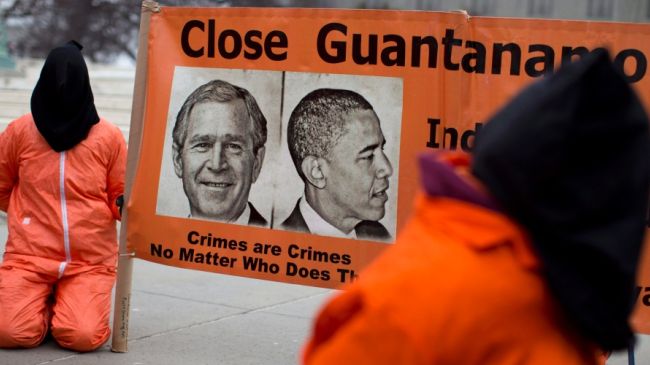
In a gesture of solidarity with Guantanamo Bay prisoners, who are continuing their month-long hunger strike, activists across the world have launched a week-long fast. The campaign will also include protest rallies and vigils.
The action, organized by the Guantanamo prisoners support group Witness Against Torture (WAT), began on Sunday and is to last through March 30. Some activists plan to continue fasting every Friday until the prison is closed, the group says.
The fast will be accompanied by public gatherings to protest against the existence of Guantanamo prison and the condition of people held there.
“We will gather for action in New York City, Chicago, Los Angeles, and other cities domestically and internationally next week to denounce the barbaric practice of torture and indefinite detention and to demand justice for the men at Guantanamo,” WAT says.
The activists also released a list of 166 names of Gitmo detainees, calling on supporters to flood the prison with letters of solidarity and remind the management “that the world has not forgotten the hunger strikers.”
Human rights advocate Andy Worthington believes demonstrations like the recent one are crucial for changing the situation in Guantanamo, stating inactivity “would be a victory” for those whose aim is to keep the prison open.
“Those of us working to close Guantanamo are up against powerful forces of indifference or hostility to our cause, despite the obvious justice of our position. People should not – must not – be put off by this indifference or hostility,” Andy Worthington told RT.
WAT organized similar fasts of solidarity annually since 2010. The group itself was formed back in 2005 and has since been trying to make the US government close the notorious prison through vigils, marches, nonviolent direct action and other measures.
Lawyers of the detainees say more than a hundred of Guantanamo prisoners have been on a hunger strike since early February, with some putting their health at considerable risk. The protest was reportedly caused by mistreatment on the part of the guards, including searches, confiscation of personal items and desecration of Korans.
Guantanamo Bay management has been downplaying the scale of the protest, saying that it considers only a handful of detainees to be genuine hunger strikers.
Related article
- Human rights watchdogs turn blind eye on Gitmo hunger strikers (alethonews.wordpress.com)
Related video
Israelis spray ‘Skunk’ at Palestinian homes
Middle East Monitor
… Israeli forces have sprayed Palestinian homes in the village of Nabi Saleh with Skunk as a punishment for organizing weekly protests against the Apartheid Wall built on occupied land. …
Journalists detained in Hebron, leading to two arrests and threats to restrict Palestinian movement
International Solidarity Movement | March 24, 2013
Hebron, Occupied Palestine – In the afternoon of the 24th March, two Palestinian Al Jazeera journalists arrived into Hebron to interview a Palestinian family living near the illegal Israeli settlement in the area of Tel Rumeida. When they arrived, settlers called the Israeli military and police, who arrived and confiscated the journalists’ ID cards, despite having seen their press credentials. The Al Jazeera reporters had their ID cards returned after around an hour, but two Hebron Palestinians who attempted to intervene on their behalf with police were arrested and removed in a police car. Their status is currently unknown and no reason was given for their arrest.
After the journalists were apprehended, police and settlers arrived into the area with rolls of barbed wire, informing another Palestinian resident that his primary access to the main road would be closed. Hashem Azzeh and his family live underneath the Tel Rumeida settlement, with their access to the main road running directly next to the settlement. This path has been repeatedly closed by the Israeli authorities since 2000, and was only opened most recently in late 2012 after extensive legal battles in the Israeli courts.
The police and settlers claimed today that the path would be closed because unapproved people had been walking along it. According to the Israeli authorities, only Hashem, his family and guests walking with them have permission to use the path. Hashem states that he has no knowledge of strangers using this route to access his house.
Without the path, Hashem and his family have to travel a much longer, rock-strewn and hazardous route to leave their home. Hashem said today, “I think they will close my access now, they will say it is for security reasons.” He thinks that the settlers used the arrival of the journalists and the subsequent confusion as a pretext to close his path and restrict his family’s movement, in further attempts to drive them from their home – they already face regular hassle from Israeli authorities and attacks from the settlers, including on Hashem’s young children.
Related articles
- 9 Year old Palestinian boy attacked by settlers (alethonews.wordpress.com)
- Stranded in Shuhada: Hebron’s Qurtuba school (alethonews.wordpress.com)
Obama Doesn’t Seek Israeli Apology for American Youth’s Killing
By Dave Lindorff – This Can’t Be Happening! – 03/23/2013
The American media are full of glowing reports and praise for President Obama for “brokering” a detente between Israel and Turkey, two former allies who have been at loggerheads since May 31, 2010 when heavily armed Israeli forces boarded the Mavi Marmara, a Turkish-flagged vessel seeking to break Israel’s illegal blockade of Gaza with non-military supplies, and killed nine unarmed peace flotilla activists.
In the deal arranged by the American president, Israel’s hot-head prime minister, Benjamin Netanyahu, who had ordered the raid, apologized “to the Turkish people” for “any mistakes that might have led to the loss of life or injury.”
It was a lame excuse for murder, but it appears that Turkey’s government was ready to bury the hatchet and, as a client state of the US, was also under some pressure from this country too.
It is interesting and indicative of the continuing power of the pro-Israel lobby in the US, that President Obama did not, as part of this brokered deal, bother to demand that Netanyahu include an apology, weak or otherwise, to the American people for the killing of an American national. For one of the nine people slaughtered by Israel in that raid, a 19-year-old young man named Furkan Dogan, was an American citizen — a son of Turkish parents, but born and raised to adulthood in the U.S.
Dogan’s death has never been protested or even investigated or questioned by the US government — an astonishing abrogation of this government’s oft-repeated promise to protect American lives. Indeed, in his first debate in the series of three presidential campaign debates with Republican Mitt Romney last fall, President Obama said, in his first answer to a question from the moderator, that his number on responsibility was to protect Americans.

Furkan Dogan in Turkey before he was killed on a peace voyage to Gaza by Israeli Forces
Not young Furkan Dogan, though.
As we reported in ThisCantBeHappening!, the unarmed Dogan, who was filming the IDF boarding of the Mavi Marmara, was beaten and kicked viciously on the deck by two IDF thugs, who then fired at him with their shotguns at point blank range.
As we also reported, the Turkish Council of Forensic Medicine conducted an official autopsy which concluded that Dogan had been killed by two shots to the face fired at close range — this as he lay already gravely wounded on the deck of the ship, having been already shot in the back, leg and foot.
This report, which was conveyed directly to the US Embassy in Ankara in July, 2010, was sat on, covered up and ignored, and went unreported. Turkey later relayed the autopsy report directly to the White House, and finally, when that elicited no response, Turkish Prime Minister Recep Tayyip Erdogan mentioned it specifically himself during a state visit to Obama. The Turkish leader later expressed his surprise to reporters following his meeting with the president that the US had not protested the killing of one of its citizens. As he told reporters, ‘I asked President Obama whether the reason he showed no interest in one of his nationals being killed was because [the victim] was [ethnically] Turkish. He didn’t reply.’”
What a freaking outrage!
The idea that this president cannot demand even a mild apology from an Israeli prime minister for the brutal slaughter of an unarmed US citizen, even as he is brokering such an apology for the killing of nine Turkish citizens, is beyond appalling.
Equally, or perhaps even more appalling, is the complete failure of the US corporate media to mention this failure, even as they note that one of the nine killed was a “Turkish-American.”
Actually, he was more than that. He was an American, pure and simple. An American born in America, and you don’t get more American than that.
I guess if you think you have the right to kill US citizens without a trial, as Obama does, you probably figure you don’t have to demand apologies from foreign leaders who order their deaths, too.
The victims are just US citizens after all. No big deal.
Related articles
- U.S./Israel Axis of Evil
- UN Fact-Finding Mission Says Israelis “Executed” US Citizen Furkan Dogan
- Why I Dislike Israel
- A Pattern of Abuse Against American Citizens
- Protecting Americans? President Obama’s Shameful Silence in the Face of Israel’s Murder of a Young American
- US Fails to Condemn Israel Raid on Gaza Flotilla Despite UN Findings
- Flotilla Check: Facts and Israeli Lies
- Israeli Raid Coverage
Mass arrest of schoolchildren
CPTnet | March 24, 2013
Twenty-seven Palestinian children, age seven to 15, were arrested while on their way to school in the West Bank city of Hebron. Three were detained for two days; twenty-four others were held for almost twelve hours.
The principal of the Hebron Public School reported that he was standing at the gate to his school at 7:30 a.m. when about 22 soldiers arrived and immediately began taking children from the street without speaking with the principal, teachers or the children. The street was full of children on their way to five area schools. Several adults arrived and tried to prevent the soldiers from taking the students but soldiers pulled the children away.
Israeli soldiers arrested 29 students, age seven to 15. They made them walk to checkpoint 29 and violently forced them into the jeeps. Some of the children reported injuries. The soldiers drove them to the police station near the Ibrahimi Mosque, brought 27 children inside and released two on a nearby road. They questioned the students without parents, a lawyer or teachers present and without permission from parents or other adults. Eight of the children were in grades one through four.
Obaida Babyeh, age 15, a student at the Ibrahimi School, was one of the two released near the station. He said, “We were passing to go to our school and they arrested us. The soldiers pushed us into the jeep, then they took us away from the school checkpoint. They hit me on my knee. Then the commander came and talked with them in Hebrew. The commander slapped me and my friend on the face and let us go.”
Teachers from the school came to the police station but were not allowed in. Soldiers told the teachers that they were checking the children against photographs and would release children whose photos they did not have.
At 2:00 p.m. soldiers released the eight youngest children and transported the remaining 19 to the Jabarah and Junaid military stations where they continued to question them. Some were questioned at both locations. The students were fingerprinted, photographed and questioned multiple times without the presence or consent of family, lawyers or teachers. Throughout the incident the children were held together with adult detainees.
Ahmad Abed Al Ra’aoof Sudky Burqan, age 14 and a student at Hebron public elementary school, said, “I was in a small store with my friend on our way to school. When we came out of the market to go to our school the soldiers grabbed us from behind. They took us to checkpoint 29, and then pushed us into the jeep. They took us to the first police station [Ja’abra], then to another one [Junied]. They questioned us, and took our finger prints. I was there from 7:30 a.m. until 7:00 p.m.”
At 7:00 p.m. soldiers released twelve of the students and transported seven to Ofer military prison. Soldiers released four of them from the prison late on the night of 20 March. Three of the children remain in Ofer. Israel is currently detaining 195 Palestinian children, 93 of them in Ofer prison.
For several weeks prior to the incident, members of Christian Peacemaker Teams and other internationals monitoring checkpoints near the schools observed soldiers asking children about photos on a camera before allowing them to pass through to their schools. Students attending school near the Old City must pass through military checkpoints each day as they walk to and from school.
On 20 March, Israeli officials committed at least four clear violations of rights guaranteed to these children under international law:
Parents or legal guardians should be informed of the arrest of children within the shortest possible time thereafter, in a language understood by the child and the parents or legal guardians. (The International Covenant on Civil and Political Rights (ICCPR), article 9 (1) and (2); Beijing Rules, Rule 10.1)
All children should be free from compulsory self-incrimination, which includes the right to silence. ‘Compulsory’ should be interpreted broadly and not limited to physical force. The age of the child and the length of the interrogation, the child’s lack of understanding and the fear of unknown consequences may all lead a child to give a confession that is not true. (Convention on the Rights of the Child (CRC) article 40(2)(b) (iv); CRC General Comment No. 10, paragraphs 56-58; Convention against Torture, article 15; ICCPR, article 14(3)(g) and (4); Geneva IV, article 31)
There must be independent scrutiny of the methods of interrogation of children. This should include the presence of a lawyer and relative or legal guardian and audio-visual recording of all interrogations involving children (CRC, art 40(2)(b0(ii) and (iv); CRC General Comment no. 10, para 58; ICCPT, art. 14(3)(b); HRC General Comment no. 20, para 11; HRC Concluding Observations, Israel (29 July 2010), ICCPR/C/ISR/CO/3, para 22; Convention against Torture, art. 2; UN Committee against Torture, General Comment No. 2, para 14, and Concluding Observations, Israel (14 May 2009), CAT/C/ISR/CO/4, paras 15, 16, 27 and 28)
Children should not be held with an adult population while in custody. Under the Convention on the Rights of the Child, parties should establish separate facilities for children deprived of their liberty, including distinct, child-centered staff, personnel, policies and practices.
According to UNICEF (Children in Israeli Military Detention; Observations and Recommendations, February 2012), approximately 700 Palestinian children aged 12 to 17 are arrested, interrogated and detained by the Israeli army, police and security agents each year. In the past ten years approximately 7,000 children have been detained, interrogated, prosecuted and/or imprisoned within the Israeli military justice system. This is an average of two children each day.
Related article
- Stranded in Shuhada: Hebron’s Qurtuba school (alethonews.wordpress.com)
We want to live in dignity
Alhaqhr | March 23, 2013
Since 1967, the Israeli authorities have demolished approximately 25,000 Palestinian homes in the West Bank, including East Jerusalem, and the Gaza Strip. This includes demolitions to allow for the expansion of Israeli settlements and settlement farms, the construction of the Annexation Wall and settler-only roads, closed military zones, military training areas, nature reserves, and punitive demolitions that amount to collective punishment, which is considered a war crime under international law. Widespread destruction of property not justified by absolute military necessity also amounts to a war crime and entails the breach of a number of human rights provisions, including the right to adequate housing and family.
According to Al-Haq documentation, Israel demolished 368 Palestinian-owned structures in the West Bank in 2012, including 44 in East Jerusalem. Demolitions in the first month of 2013 increased by almost 30 per cent compared to the same period last year (from 34 in January 2012 to 44 in January 2013).
Countless Palestinian homes are demolished by the Israeli military under the spurious justification of lack of building permit. Given that such demolitions are neither carried out in the name of strict military necessity or for the benefit of the occupied population, they constitute a clear violation of international humanitarian law. In this regard, the United Nations Committee on the Elimination of all forms of Racial Discrimination last year harshly criticised Israel’s “discriminatory planning policy” which rarely, if ever, grants construction permits to Palestinian communities.
There is no such restriction placed upon Israeli settlement construction across the West Bank, including East Jerusalem. At least 6,676 new settlement housing units in the West Bank were approved for construction in 2012 by the Israeli authorities, who have already granted approval to hundreds more units this year.
This short video produced by Al-Haq’s Monitoring and Documentation Department gives voice to Muhammad Usamah Taha, whose workshop and house were demolished by the Israeli authorities without prior warning, destroying his only source of livelihood and many of his possessions. Unfortunately, Muhammad’s experience is one shared by thousands of Palestinian families across the Occupied Palestinian Territory.
Related articles
- Peace Fraud: Obama Fails to Demand Halt to Illegal Settlements (alethonews.wordpress.com)
- Briefing: Beyond the E-1 Israeli settlement (alethonews.wordpress.com)
Second NYPD officer testifies on stop-and-frisk quotas, racial targeting
RT | March 22, 2013
Following a leaked recording seeming to prove the existence of an NYPD arrest quota system, a second police officer has come forward to explain to a federal judge why he decided to record his superiors as they directed him to increase “stop-and-frisks.”
Officer Pedro Serrano, an 8-year veteran of the New York Police Department, held back tears as he explained to the judge why he came forward: “It’s very simple. I have children. I try to be a decent person.”
Serrano joins another whistleblower from the Bronx, Officer Adhyl Polanco, who testified earlier this week regarding his own recordings as part of a federal class action suit against the City of New York seeking to address racial disparities in the department’s street stops.
Meanwhile, a 2003 settlement from a similar lawsuit set in place a requirement for the NYPD to track the stops. The resulting records showed that some 87 per cent of the 5 million individuals detained by police were black or Latino.
Officer Serrano presented a recording from June 2010 in which a female lieutenant told officers she was “looking for five” – that is, requesting a specific quota for criminal summonses from officers in the precinct. Serrano recorded another instance only a month later, in which another lieutenant made a similar reference to a “five-five-five,” indicating a quota in place for arrests, patrols and summonses at public housing projects.
Serrano testified that his performance evaluation subsequently dropped in every category, evidently for failing to meet the quotas. During a meeting with his supervisor, Serrano was told that his performance score was based more on his “numbers” and his “low activity.” At the time, his precinct’s captain is said to have informed him that the NYPD’s Operations Order No. 52 allowed her to implement “performance goals,” likely a veiled reference to quotas.
Much of Serrano’s testimony supports accusations that officers who refused or failed to meet quotas were subjected to discriminatory treatment. Serrano points to the fact that he was transferred to an undesirable post, denied a day off following a car accident near his home, and the vandalization of his personal locker – which included the placement of “rat stickers.”
In its denial of the quota system and a racial profiling policy, the NYPD claims that the appearances of both stem from departmental reliance on the CompStat program, that being the heavy policing of high-crime neighborhoods – which are often predominantly minority communities.
Still, Serrano’s testimony did reveal direct evidence of racial targeting at least in his precinct. In one specific recording, a lieutenant urged officers to concentrate on a region in the south Bronx: “St. Mary’s Park: go crazy in there. Go crazy in there. I don’t care if everybody writes everything in there. That’s not a problem.”
Officer Serrano also provided recordings of an appeals meeting with Deputy Inspector Christopher McCormick, regarding his low numbers for writeups – which he was told would only have been “appropriate for Central Park.”
The same meeting became heated after McCormick indicated Serrano’s numbers demonstrated a lack of initiative, an issue he demanded be rectified by detaining “the right people at the right time.” “And who are the right people?” asks Serrano, to which McCormick replies “I don’t have any trouble telling you this: male blacks 14 to 20, 21.”
Serrano’s testimony was presented as part of Floyd v. City of New York, in which four plaintiffs claim they were racially profiled by the NYPD. Four police officers presented evidence for the prosecution.
Featured Video

Death Spikes & Rising Cancer In Our Youth Explained
or go to
Aletho News Archives – Video-Images
From the Archives
Politicians lie
By Mazin Qumsiyeh | Popular Resistance | August 18, 2013
There is no way to say this truth nicely: Politicians lie. That includes Japanese, American, Egyptian, Israeli, and Palestinian politicians! Is there something more common sense than that? Yet, so many citizens around the world believe their own politicians or wistfully acknowledge lies but think it is part of the job needed to run things. They believe even when politicians contradict themselves blatantly. This phenomenon is rather remarkable. It is a dissonance and disconnect from reality that many seem oblivious to. It is very dangerous because it can lead to accepting rationales for going to war. These can be deadly wars that lead to millions of lives lost as happened in what was called World War 1 and WW2. Even when incredible and declassified evidence abound, politicians continue to lie and old mythologies refuse to die. Here are just a few of the countless lies told to us over the past few decades… continue
Blog Roll
 Aletho News
- RSF military group defects, joins Sudanese army: State media
- Ireland goalkeeper refuses to play ‘Israel’ as squad weighs boycott
- China pushes back against US on Cuba, Iran
- Ukrainian Soldiers, Potential Mercenaries: Have Gun, Will Travel!
- Burnham’s UN debut… A masterclass in British disinformation
- Iran flights continue despite US aviation sanctions
- Global Tipping Points Lead the World Into a State of Entropy
- The day-after at the White House: USA and Xi Jinping
- The Geopolitical Balance in the Red Sea: The UAE Being Displaced by New Players
- Iraqi resistance group vows to stage airport sit-ins over Iran aerial blockade
- If Americans Knew
- Deconstructing Netanyahu’s pants-on-fire UN rant – Daily Update
- Trump betrayed voters with his campaign lies and prioritized a foreign country once he took office
- Netanyahu calls Israel’s war in Gaza ‘opposite of genocide’ in UN speech to near-empty hall
- Settler Kidnappings: Torture, Sexual Abuse and Terrorisation of Palestinian Abductees as Israel Deepens Annexation of West Bank
- Gaza winter nears as 162,000 tents become unusable, raising fears of humanitarian crisis
- Netanyahu says, “It’s the opposite of genocide”; UN says Gaza economy is world’s ‘most severe crisis on record’ – Daily Update
- Israel’s US-Backed Assault on Gaza Has Created the ‘World’s Most Severe Economic Crisis on Record’: UN
- ‘Protecting U.S. Citizens’… From Israel
- ‘This is where I live now, the back of a truck’: a day in the life of a grandmother in Gaza
- In UN Speech, Iran’s President Displays Pictures of Children Killed by US, Brings Attention to Israel’s Nuclear Arsenal
- No Tricks Zone
- New Study: Earth And Venus Surface Warmth Largely Explained By Convection And Lapse Rate, Not CO2 Or Radiation
- 2025 Nature Paper Claiming Worsening Global Drought Gets RETRACTED …Heavily Flawed
- New Study: ‘Global Drought Shows No Detectable Recent Acceleration Under Climate Warming’
- Economic Masterminds: German Socialists Suggest Taxing Productivity Gains Stemming From Using AI
- The South China Sea Has Not Been Cooperating With The Climate Change Narrative
- Energy Crisis: Germany Enters Heating Season With Historically Low Gas Reserve Fill Levels
- New Study: The Antarctic Ice Sheet Gained Mass From 2020-2024 Due To Staggering Snow And Ice Accumulation
- Study: Ocean Heating Rates From Thousands Of Years Ago ‘Dwarf’ Modern Ocean Heating Rates
- Climate Extremists Target, Attack Large-Scale Power Grid Infrastructure In Germany!
- New Study: Antarctic Ice Melt Has Contributed Less Than 1 Centimeter To Sea Level Rise In The Last 30 Years

