The broken truce
International Solidarity Movement | January 21, 2013
Beit Lahiya, Gaza Strip, Occupied Palestine – A ceasefire was announced on 21st November, ending eight days of horrific bloodshed in Gaza. Has the delicate truce held over the past two months? It depends who you ask. Israelis or Gazans, each going about their daily lives on opposite sides of a border fence.
There has not been a single report of a rocket fired out of Gaza since 21st November. In contrast, four Palestinians have lost their lives and over 80 have been injured by Israeli forces since then. Yet these violations have received little or no coverage in the mainstream media. Palestinian civilians, whose only crime is to live in the border areas, are terrorized on a daily basis by the Israeli army. This is what everyday life under the ceasefire has meant for them.
Beit Lahiya, in the far north of the Gaza Strip is one such place. A week ago it saw the brutal murder of 20 year-old Mustafa Abu Jarad. Today, it was the site of another Israeli violation. Abdullah Marouf, 18, was in the west of Beit Lahiya, near the coast, when he was shot in the right leg by Israeli forces, fracturing both his tibia and fibula.
 Abdullah Marouf in hospital. (Photo by Desde Palestina)
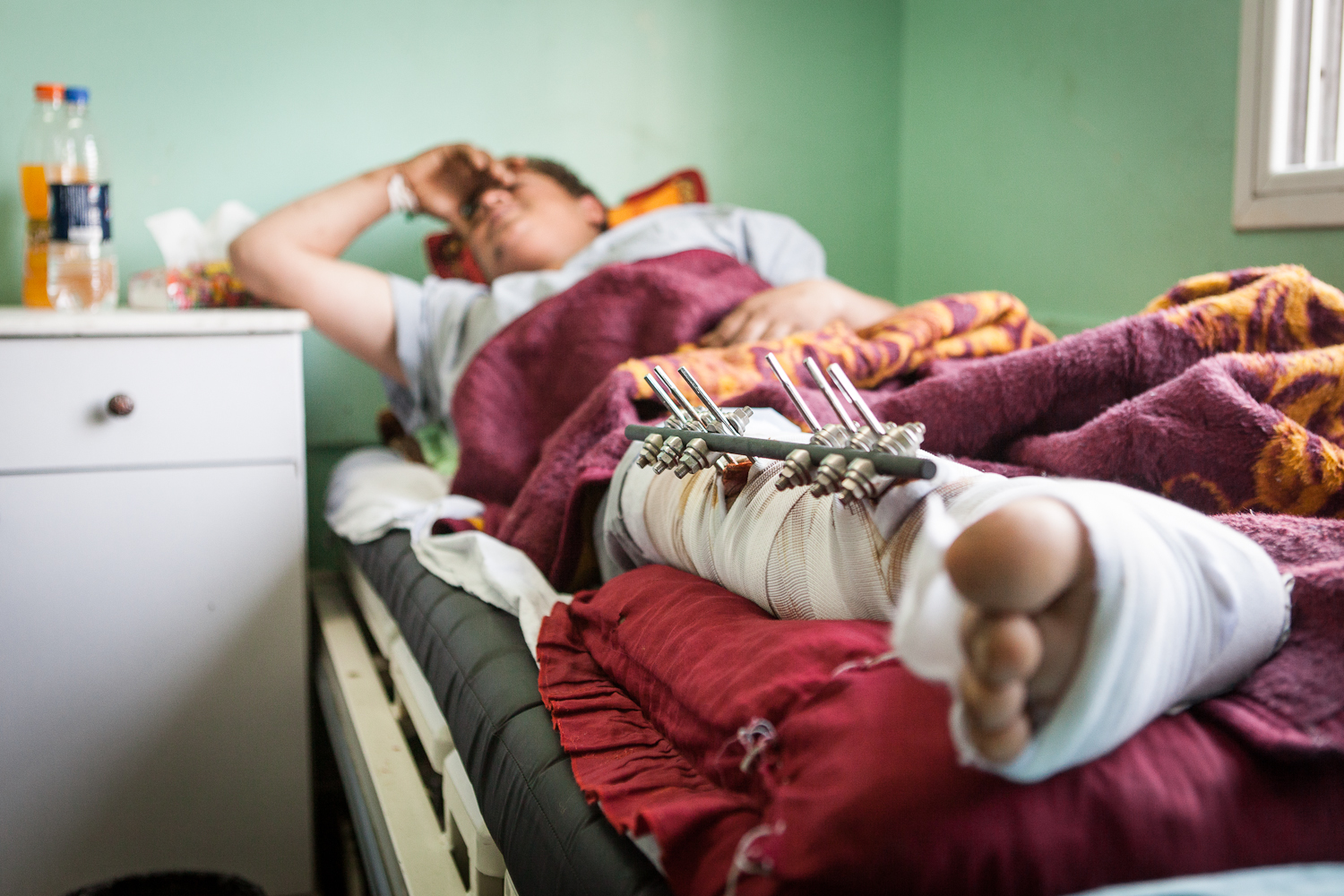
At about 9.00 on the morning of 21st January, Abdullah was in an area approximately 250 metres from the border fence, catching birds with his two brothers. A group of five or six Palestinians they were unaquainted with were also in the vicinity, closer to the fence than they were. Abdullah had been under the impression that he would be safe, however he noticed an Israeli soldier in a watchtower on the border and others on the ground. The soldiers began firing live ammunition towards them and Abdullah was shot.
Two local farmers brought him to Kamal Adwan hospital where surgeons performed percutaneous pinning of his lower leg which had sustained damage from an entry wound and a significantly larger exit wound. He requires subsequent surgery in a couple of months to fit internal wires. His recovery is estimated to take at least 12 months.
Abdullah, who is engaged to be married, had been working with his two brothers selling scrap metal. Now they will have to support a family of nine without his help. It is unsurprising that he expressed a lack of faith in the ceasefire agreement.
One can only expect that the Palestinian resistance has also lost faith and is fast losing patience. If a response is provoked it will appear to be in a vacuum – despite this being far from the case – due to the shameful silence maintained by the international community throughout the ongoing Israeli atrocities. It is for people of conscience to protest this injustice and prevent a further escalation of Israel’s attacks on Gaza.
New U.S. Counterterrorism Playbook to Exclude Pakistan from Drone “Kill” Rules
By Noel Brinkerhoff | AllGov | January 23, 2013
The Central Intelligence Agency’s (CIA) drone campaign in Pakistan will not be bound by new counterterrorism rules that the Obama administration is finalizing.
The rules, referred to as the “playbook” by officials, are supposed to establish parameters for killing overseas threats. Once completed, the playbook will detail how names are added to assassination lists, which legal principles justify the killing of U.S. citizens, and what offices must sign off before drone strikes are carried out.
But the CIA will be exempted from the rules for at least a year. Agency leaders objected to being bound by the playbook, citing the pressing need to continue bombing Taliban and al-Qaeda targets in Pakistan before the U.S. withdraws from neighboring Afghanistan, where the drones are based.
Greg Miller of The Washington Post wrote that the drafting of “the playbook was nearly derailed late last year by disagreements among the State Department, the CIA and the Pentagon on the criteria for lethal strikes and other issues. Granting the CIA a temporary exemption for its Pakistan operations was described as a compromise that allowed officials to move forward with other parts of the playbook.”
Critics of the government assassination program view the playbook as indicative of the institutionalization of the U.S. killing policy. It is “a step in exactly the wrong direction,” Hina Shamsi, director of the American Civil Liberty Union’s National Security Project, told the Post. She called it “a further bureaucratization of the CIA’s paramilitary killing program.”
Teenager dies following shooting in Bethlehem
International Solidarity Movement | January 23, 2013
Bethlehem, Occupied Palestine – On Friday January 18th at approximately 3.20 pm, fifteen year old Saleh Elamareen was shot in the head by an Israeli soldier in Aida refugee camp, Bethlehem. Today Wednesday 23 January he was pronounced dead.
Salah Elamareen was outside the Lajee Refugee Centre when he was shot through the left forehead. The Centre lies some distance from the wall itself. At the time of the shooting eyewitnesses have said that protests were not happening, and that the people of Aida were simply watching the soldiers from afar. This is supported by video documentation of the incident, which shows a group of youth carrying Elamareen after he was shot.
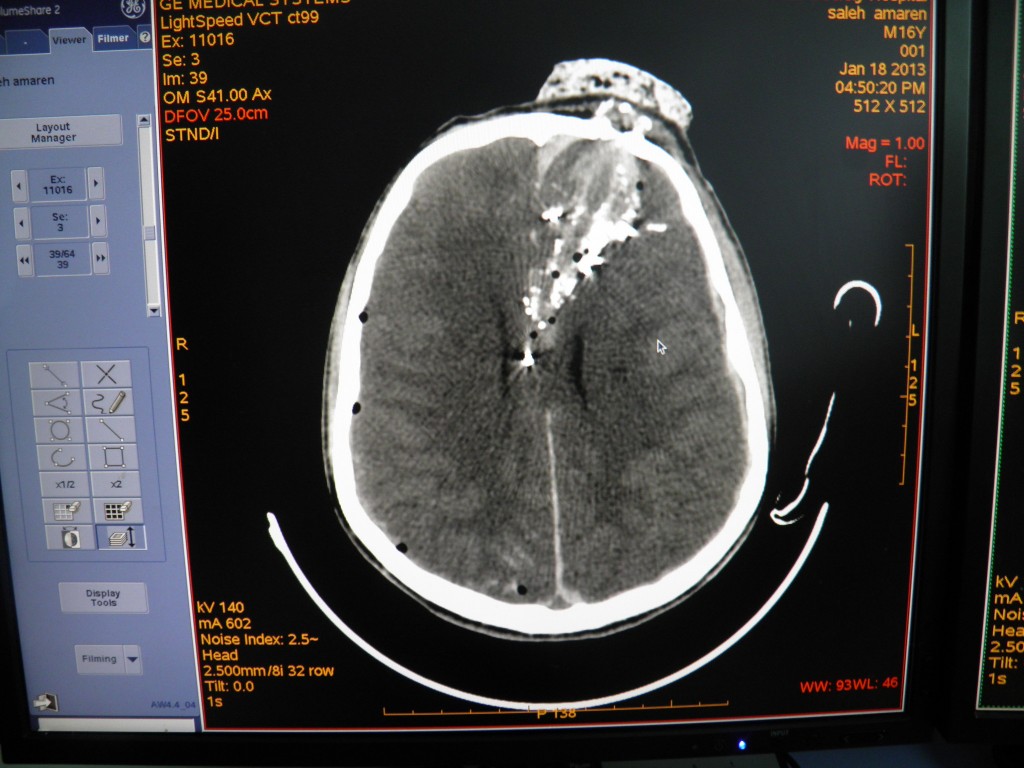
Two of the doctors who treated Elamareen did not rule out previous rumours that he was shot with a dumdum bullet, due to the fragmentation of the bullet within his head. Another doctor has claimed it was definitely a dumdum bullet in his opinion.
Dumdum bullets expand after impact and are designed to cause maximum damage and pain. Due to the brutality of these bullets they are illegal under international law. Article 8 at the Review Conference of the Rome Statute in Kampala made the use of expanding bullets in non-international armed conflict a war crime. The Hague Convention also prohibits there use in international warfare. If the doctors are correct and a dumdum bullet was in-fact used, this would be another serious violation of international laws and standards by Israel.
The head of the department under which he was treated at the government hospital said he was hit with the bullet in the left frontal section of the head, around the eye, causing large intracranial hemorrhaging. A number of doctors who looked at the patient concluded that the bullet exploded in the brain. The CT scan shows the shrapnel inside his skull. The entry wound shows significant impact to the skull, and there is no exit wound.
Israeli occupation forces kill woman near Hebron
Ma’an – 23/01/2013
HEBRON – Israeli forces shot and killed one person and injured another in the Hebron district on Wednesday, medics said.
Witnesses told Ma’an that Israeli soldiers traveling in a civilian car opened fire at a group of people at the entrance to al-Arrub refugee camp south of Bethlehem.
Lubna Munir Hanash, 22, was shot in the head and died from her injuries, medics said.
Suad Yusuf Jaara was shot in the hand and transported to Ahli hospital in Hebron.
Witnesses told Ma’an that after the shooting Israeli soldiers prevented an ambulance from arriving at the scene for around 10 minutes.
Locals said there were no clashes in the area at the time.
An Israeli army spokeswoman said that “soldiers were attacked by Palestinians who hurled multiple firebombs at them while they were traveling near al-Arrub. Soldiers returned fire and the circumstances of the incident are currently being reviewed.”
Israeli soldiers searched the area and found several firebombs ready for use, she said, adding that no soldiers were injured in the incident.
Related articles
- Israeli soldiers vandalise Hebron home and arrest a student (alethonews.wordpress.com)
- Family denies Hebron teen killed by Israel was carrying toy gun (alethonews.wordpress.com)
- Local activist detained in Hebron (alethonews.wordpress.com)
- Hebron families struggle for existence (palestinemonitor.org)
- Second group of journalists beaten in Hebron (alethonews.wordpress.com)
Israeli soldiers violently break into two houses in Nablus, Kidnapping one person
International Solidarity Movement | January 15, 2013
Occupied Palestine – Last night more than forty Israeli soldiers invaded the city of Nablus and raided two homes looking for two young men. One of them was arrested Emad’s Motherduring the raid and the other one avoided arrest as he was working at the time of the raid.
At 2.30 am, dozens of Israeli soldiers with several dogs broke into Mead Nijad’s house breaking the door with a hammer and violently interrupting the family’s sleep. As the soldiers entered the house, they ordered everyone to have their hands up; they asked for Emad, blindfolded, handcuffed and arrested him. Immediately after, they took the ID’s of all family members and locked them outside the house on a cold winters night. In the meantime, the soldiers ransacked the whole house causing widespread destruction. They also took with them the young boy’s working tools. As Emad’s mother explains, “if they come with dogs, why do they have to destroy everything? If there is something in the house, the dogs would find it”. Furthermore, no reasons for why they arrested Emad were given; the commander just said “your son has caused problems to the Israelis, if you want to know where your son is, come to Huwwara”. The family still does not know the fate of their son.
In the case of Moaz Darduk (19), dozens of only Hebrew speaking soldiers arrived in his house at 3 am while he was at work and woke his parents up. As they asked for him and his father told the soldiers he was not at home but working, they locked his mother in a room and took his father to his other son’s house just in the next building. The commander, who was the only one speaking Arabic, kept saying to his father “do you know who I am? I am Haroun and I came here to kill your son”. When the commander went back to Moaz’s house he told to his parents “I want you to remember who I am, I am Haroun and I am here to kill your son. If you do not bring your son to Huwwara tomorrow morning at 9.30, we will kill him and return him to you in a coffin”.
Night raids and home searching are common tools used by the Israeli Occupation Forces to arrest Palestinian youth for no reason and as a collective punishment to scare Palestinian families.
Related articles
- Israeli forces arrest cancer patient in Nablus, locals say (altahrir.wordpress.com)
- Soldiers Kidnap Nine Palestinians In The West Bank (imemc.org)
Israeli army kills Palestinian teenager
Al-Akhbar | January 15, 2013
A Palestinian teenager was shot and killed after Israeli soldiers stormed a high school in the West Bank, according to activists.
The victim, 17-year-old Samir Awad was from Budrus, a village close to the Israeli apartheid wall, Ma’an news agency reported.
According to the village council head Mohammad Morar, a clash erupted between Israeli forces and teenagers attending the Budrus high school.
Witnesses told Ma’an that Israeli troops stormed into the school, causing students to throw rocks at them. Israeli soldiers then fired five bullets at the students.
Awad was shot four times in the head, chest and legs. He was taken to Ramallah for medical treatment, but succumbed to his wounds there.
The spokesman’s office of the Israeli Armed Forces claimed that Awad had tried to breach the Budrus security fence, ignoring warning shots fired in the air, The Jerusalem Post reported.
Late on Monday, 21-year-old Palestinian Mustafa Abu Jarad died in Gaza after being shot in the head by Israeli forces. A military spokesman later denied that the incident was related to the Israeli army.
Honduras: Two More Campesinos Murdered in Aguán
Weekly News Update on the Americas | January 13, 2013
Two campesinos were shot dead on Jan. 11 in the Lower Aguán Valley in the northern Honduran department of Colón as they were walking out of an estate which they and other campesinos had been occupying for two months. A long-standing conflict between campesino groups and large landowners in the area has resulted in the deaths of some 80 campesinos since the groups began occupying estates in December 2009 to dramatize their demands for land [see Update #1154]. According to Wilfredo Paz Zúniga, spokesperson for the Permanent Human Rights Monitoring Center for the Aguán, the victims were José Luis Reyes and Antonio Manuel Pérez. He said unidentified people shot them at close range from a moving automobile.
The Unified Campesino Movement of the Aguán (MUCA), one of the main campesino groups in the region, identified the campesinos as Luis Antonio Ramos Reyes, originally from the Tepusteca de Olanchito Yoro community, and Manuel Antonio Pérez, originally from Remolino on the Aguán river’s left bank. MUCA said the two men were members of another group, the Campesino Movement for the Recovery of the Aguán (MOCRA), whose 600 families began occupying estates on July 20, 2012. According to Paz, the campesinos had been occupying land claimed by the National Autonomous University of Honduras (UNAH); MUCA said the land was owned by UNAH’s Atlantic Coast Regional University Center (CURLA), which had abandoned it. (AFP 1/12/13 via Terra.com; Anncol (Colombia) 1/13/13 via Rebelión (Spain))
Related article
- Honduras: Another Campesino Murdered in Aguán (alethonews.wordpress.com)
West Bank: Aid agencies tread gingerly in Area C
IRIN | January 11, 2013
As night descends in the Jordan Valley in the occupied Palestinian territory (oPt), a family in the village of Ras Al-Ahmar lights a small paraffin lamp in the tent they call home.
There is no electricity here and the nearby Palestinian villages are enveloped in darkness. The only visible cluster of light is from a nearby Israeli settlement.
Humanitarian agencies are well aware of the needs in this part of the West Bank but they face a challenge: play by the rules established by Israel or face the risk of having projects demolished.
Despite being outside the state of Israel, 90 percent of the Jordan Valley is under full Israeli civil and military control as part of Area C, a zone that covers 60 percent of the West Bank.
Palestinian communities here, among the poorest and most vulnerable in oPt, desperately need access to water, electricity, sanitation and other basic infrastructure.
But despite the needs, development organizations that try to improve living conditions in Area C say they find their ability to make any lasting impact hampered by Israeli restrictions and bureaucracy.
Like Palestinians, organizations that want to build basic service infrastructure such as houses, schools or water systems are required to submit an application for a permit to the Israeli authorities.
Often, these permits are not granted. According to the UN Office for the Coordination of Humanitarian Affairs (OCHA), between January 2000 and September 2007, over 94 percent of applications submitted by Palestinians to the Israeli authorities for building permits in Area C were denied.
“The permit regime is very confusing. There is no clarity about the status of an application, whether paperwork has been received, if it is complete,” Willow Heske, media lead for Oxfam in oPt, told IRIN. “Agencies have sometimes waited for two years only to get a rejection that comes without any explanation.”
“A few years ago we put in plans to build a water reservoir in Al-Jiftlik, to provide half of Al-Jiftlik with running water,” said Heske.
“The reservoir was considered a `building’ and we didn’t get the permit. So we moved to a plan B which still involved setting up a reservoir and piping system but above rather than below ground. This too was not accepted. So as a last resort we had to go back to distributing water tanks. And of course people were frustrated and disappointed.”
Challenging the Occupation
Some NGOs, among them Palestinian organizations like Ma’an Development Centre (MDC), believe that adhering to the permit regime helps legitimize the occupation, and choose to ignore the rules altogether.
“If you’re playing within the rules of the occupation then you are legitimizing it. We don’t seek permits from the Israelis. If we put in a permit request we would likely get denied,” MDC project manager Chris Keeler told IRIN. “And also because of a moral stance. We don’t think that a Palestinian NGO should be seeking permission from Israel to be building on Palestinian lands.”
For international organizations, it’s not only the possibility of having a permit denied that affects their work, but also the multiple ways in which the Israeli state bureaucracy hinders their work by issuing “stop work” orders to existing projects, refusing to issue work visas, or refusing to renew existing work permits for foreign staff.
Even MDC finds that it must sometimes work within existing framework restrictions.
“There are houses all over the Jordan Valley that need renovations,” said Keeler. “If we do a project in some of the communities in the north, it would likely get destroyed. So we work a lot in Al-Jiftlik and Al-Fasayil. We need permits in those places too, but because they are more established communities, there is less risk that they will get destroyed. A lot of donors want reassurance that structures we build will not be torn down.”
IRIN was unable to get a response from the Israeli government despite repeated attempts, but in the past the Israeli government spokesperson has said Israeli policy is shaped by security concerns.
EU Move
In May 2012, the European Union (EU) Council of Foreign Affairs called on Israel to meet its obligations to communities in Area C, “including by accelerated approval of Palestinian master plans, halting forced transfer of population and demolition of Palestinian housing and infrastructure… and addressing humanitarian needs.”
The Council stated that the “social and economic developments in Area C are of critical importance for the viability of a future Palestinian state.”
The Israeli Ministry of Foreign Affairs criticized the recommendations, saying they were “based on a partial, biased and one-sided depiction of realities on the ground” and that they “do not contribute to advancing the peace process”.
The Ministry said 119 projects were authorized in Area C in 2011 and that they ensured that “planned projects” were “coordinated and in conformity… with the law”.
Oxfam’s Heske believes the recent EU recommendations are bold and courageous, even though it is still not clear how they will play out on the ground. “These conclusions mean that there is now a full political commitment to work on development in Area C,” she said. “How it will play out, we don’t know, if it happens with or without permits. But we don’t want to see just one token water network here and there.”
Since 2011, the Palestinian Authority’s ministry for local government and local Palestinian councils have submitted 32 master plans for development in Area C to the Israeli Civil Administration (ICA). Each master plan includes infrastructure development, health care, primary education, water provision, electricity and the development of agricultural land, and requires approval by the ICA through a lengthy process of negotiation.
However, according to Azzam Hjouj, acting general director for urban and regional planning in the Palestinian ministry of local government, even if master plans are approved by the ICA, it is expected that the Israeli authorities may issue demolition and “stop work” orders for some plans, particularly in areas like Al-Jiftlik in the Jordan Valley, and that political pressure will be required to ensure implementation.
Bedouin Villages
As for the more isolated Bedouin villages in the valley, the new master plans will not cover their areas.
“It’s difficult to make a master plan for these herding communities, because they are dispersed over large areas. They move around a lot and we don’t want to urbanize these areas, it’s their way of life,” Hjouj said. “And even if we made master plans, it would just give the ICA an excuse to congregate the herding communities into one area and take the remaining land.”
The Israeli Coordination of Government Activity in the Territories (COGAT – a unit in the Israeli Ministry of Defense that engages in coordinating civilian issues between the government of Israel, the Israel Defense Forces, international organizations, diplomats, and the Palestinian Authority) said that many of the construction projects in Area C are “illegal and poorly planned”.
A report compiled by COGAT relating to projects in Area C states that “illegal construction projects that ignore master plans undermine the possibility for future expansions and create problems for electrical, sewage and water systems.”
More Advocacy?
As with the wider crisis, there are no easy solutions for humanitarian agencies seeking to provide aid in Area C, and finding the line between purely humanitarian work, and political engagement is tough.
For economist Shir Hever, author of The Political Economy of Israel’s Occupation, Western governments and NGOs need to be more active in opposing the occupation of West Bank areas.
“Instead, donors put 99 percent of their work in doing what is allowed and 1 percent in protesting conditions,” he said.
Related articles
- Israeli occupation authorities halt entry of West Bankers to 1948 occupied Palestine (alethonews.wordpress.com)
- More evictions for Israeli army training in the Jordan Valley (alethonews.wordpress.com)
- Israeli forces evict West Bank Palestinian outpost despite court ruling (rt.com)
The hardest thing: Palestinian parents speak of their children killed by Israeli bombings
By Eva Bartlett | In Gaza | January 12, 2013


During the Nov 2012 Israeli attacks on Gaza, 182 Palestinians were killed, according to the World Health Organization’s Dec 2012 report, among whom 47 were children, including 16 under 5 years old. Another 1399 Palestinians were injured, most of them with multiple injuries.
It is only four years after Israel’s last major assault on Gaza, which killed over 1450 including those who died of their injuries, and injured over 5000. Then there are the random Israeli attacks throughout the years, leaving injured suffering even years later.
And there were the under-reported attacks in the week preceding the Nov 14 attacks: the Nov 8 killing of 13 year old Ahmed Abu Daqqa as he played football, the Nov 10 killing of Mohammed Harara (16) and Ahmed Harara (17) as they played football, the subsequent killings of Ahmed Al- Dirdissawi (18) and Matar Abu al-‘Ata (19) when they rushed to the scene of the Harara killings (source: PCHR).
Every December and January, I remember the victims of the 2008-2009 massacre, particularly some of the harder incidents of burning to death from white phosphorous bombing, or point blank shootings of loved ones. All ages suffered, although we tend to pick up on the children. Somehow their murders, their maimings, their imprisonment strikes us more.
Two cases from the November 2012 attacks struck me and stay with me: the killing of 4 year old Reham as she stood a few metres from the door of her Nusseirat camp home, outside of which an Israeli bomb exploded…and the murder of Nader, 14, killed by a precision drone missile as he walked to get food for his siblings… just two hours before the ceasefire.
Below are follow-up photos, the families and loved ones of Reham and Nader. Allah yerhamhum (Allah, God, bless them).

Mourning area for Reham Nabaheen, killed by an Israeli bombing outside her Nusseirat camp home.

Abu Reham looks to where the Israeli bomb struck, the shrapnel of which blasted into his home and struck his daughter in the temple, killing her.


Um Reham sits with other women, mourning her daughter.

Fatoum, Reham’s neighbour and close friend, stopped speaking after her friend’s killing. Also four years old, she is in shock from knowing her friend is dead. Abu Reham: “I love her like I loved my daughter.”

Roa’a, Reham’s infant cousin. Reham used to play with her and bring her treats.
In the days following Reham’s murder, we visit the family in the simple Nusseirat home. Beside a mourning room set up to receive family and friends, a portrait of the girl I’d only until then seen dead in the morgue.
The home is barebones simple, the old Palestinian style of home and courtyard reconstructed with refugee camp means: cheap cement, toxic asbestos roof, chipped paint, thin walls and doors, sparse decor…no frills. A single olive tree grows in one side of the courtyard.
Um Reham sits amongst female relatives and although her daughter was killed only a few days earlier, is strong and tells me of the day. We’d seen her at al-Aqsa hospital in Deir al Balah on Nov 21, after the shelling. Further back from where the explosion hit, Um Reham was still wounded in her face by flying shrapnel. Her other two sons suffered only minor injuries.
“We’d gone to my sister’s home in Bureij, at the beginning of the attacks. There was so much bombing in Nusseirat, we were afraid to stay here, our kids were terrified. On the last day, we heard there would soon be a cease-fire and wanted to come home. I wanted to do laundry, to change my kids clothing. My sister told me to leave Reham with her, but I said no, I couldn’t leave my daughter behind.
After we’d returned to Nusseirat, we realized the bombing was still very heavy here. We were going to return to Bureij…“
Abu Reham, who we’d seen at the hospital morgue leaning over his daughter’s lifeless body, sobbing and kissing her, stoically continues explaining what happened that day.
Although Nusseirat was still being hammered, at the moment of the Israeli shelling which killed his daughter, it was relatively calm, he says.
“There was no visible danger, our neighbour across street was sitting on a chair by his doorway just minutes before the bombing. He left to go see something at a neighbour’s home…if he had not left, he would have been killed.“
He points out the two narrow courtyard doors to the street where a pocket in the asphalt speaks to the earlier bombing.
“It was around 4pm, one of the doors was closed, we were getting the kids ready to go back to Bureij. I’d brought out some cookies, and Reham went to get them out of the bag. She was reaching into the bag when the bomb struck. She was near the door, the shrapnel went right into her head. She died soon after, there was blood all over.
The sound of drones was insane then, it could’ve been a drone strike.”
“Tank,” his brother says, “it was a tank shell.”
The brother holds a girl.
“This is my daughter, Roa’a, she’s a year and a half old. Reham used to play with her every afternoon, she’d bring Roa’a chips and snacks… Reham used to always take care of her.”
A neighbour daughter comes over with his daughter, Fatoum (Fatema), 4 years old as Reham was. She is chubby cheeked and lovely, but unsmiling and won’t say a word.
“She came to play with Reham every day. A four year old shouldn’t have to know what death is, that her friend has been killed. She said to me, ‘my friend is dead, my friend died.’“
Abu Reham, whose daughter is just days dead, is worried about Fatoum who fell ill after learning Reham was dead.
“I love her like a daughter. Every child who loved my daughter, I love them like my own child (breaks down crying). I went to the cemetery, saw children from the area there, they had brought flowers and were tending Reham’s grave. They told me ‘we will visit her, even if your family moves, we’ll continue to visit her.’“

Nader Abu Mghaseeb, 14, killed by precision Israeli drone bombing as he went to get food for his siblings.

Abu Nader tells how his son was killed by an Israeli bombing

When Nader’s siblings awoke the morning after his murder, they asked for him, only to learn he’d been killed.

Abu Nader points to the hole in the road where the Israeli bomb which killed his son struck.

Shrapnel markings from the Israeli bombing which killed his son.

Light of the small shop to which Nader was headed when murdered by the Israeli bombing.

When killed, Nader was en route to the store to buy food for his siblings.

Pieces of the Israeli precision drone bomb which targeted Nader.

Pieces of the Israeli precision drone bomb which targeted Nader.

Pieces of the Israeli precision drone bomb which targeted Nader.

Pieces of the Israeli precision drone bomb which targeted Nader.

Nader’s watch and the memory chip from his cell phone, which he had with him when targeted by the Israeli bomb.
On the eastern outskirts of Deir al Balah, central Gaza, we go to the home of the 14 year old whose mutilated body set me sobbing when I saw it in al-Aqsa hospital on Nov 21. The family has a number of olive trees, from which they exist. Their simple home, just over a kilometre from the border and surrounded by trees on a small plot of land, is a little oasis in the over-crowded Strip. But for Abu Nader, it is now hell.
“I look at his jeans, I remember him. I look at the house, I remember him. I look there, look there, wherever I look, I’m reminded of Nader.
I hate this house, this area. I hate life now. I started to hate life when my son was killed.
You don’t stay in a place if your dear one is no longer there.”
We’re sitting in the small, nylon-walled tent behind his home, drinking bitter coffee and listening as Abu Nader tells us how his son was killed. Nader’s six younger siblings, for whom he’d been going to get food when killed, sit beside their father. When we walked into the tent, Abu Nader ran to one corner to grab a small vial of cologne, which he rolled onto the backs of our hands. Nader’s favourite.
“I had lit a fire and we were sitting like this. Sitting like this exactly. Nader asked if I had money, said he wanted to go to the shop to get food for dinner. I didn’t want him to go, but he said the ceasefire would start in a couple of hours, he’d be okay.
There was nothing to eat in the house. These kids need to eat, we’d had nothing in the house for 5 days.
Nader told me to warm the bread over the fire. He said he’d get some yogurt, some canned meat, anything so that all the kids could eat. One of his younger brothers went with Nader, but halfway there Nader told his brother to go back home. His brother kept saying he wanted to go with Nader, but Nader insisted he go back home, told him to wait for him at home.
His brother came back here and said to me, ‘Dad, Nader told me to come back here. He wouldn’t let me go with him to the store’. While he was telling me this, we heard a loud explosion.
My wife said that the explosion was very close to here. She told me to call Nader’s cellphone to see where he was. I called Nader but he cellphone was off. I kept trying to call him, and I ran to the street to try to find Nader.
I kept running until I reached the mosque. From the mosque I saw the light of the store.
And it was night, dark, about fifteen minutes after the evening prayer.
I was looking at the store and waiting for my son to come out of it, and didn’t see that my son was on the ground near me. There was blood all over the street. I thought it was water.
They fired a missile right at him.
When I saw him, I knelt down and grabbed him. There was no one around. I tried to pick him up but couldn’t. He was dead weight, heavy, I couldn’t pick him up on my own. And his legs were shredded, falling apart.
I started screaming, for anyone to hear and help me pick up my son and take him to the hospital.
No one heard me.
I left Nader and screamed to the houses around me, then came back to Nader, but no one heard me.
I sat next to him for a minute, panicking, didn’t know what to do.
I ran to another house to yell for help, but no one heard me.
I came back and wrapped my arms around him, put my head on his head. And I woke up in the hospital.
They killed him in a horrible way. They shot the missile right at him.
In the morning, one of Nader’s brothers came to me and said, ‘Nader’s bed is empty. Where is Nader?’
I told him, the Israeli army killed him.
We are all traumatized.
I’m not angry because Allah chose to take Nader. Allah gives and Allah takes. The hardest thing is that I saw how Nader died. In pieces. How can I live seeing my son cut into pieces? He was a child. He went to get food for his siblings.”
Abu Nader, a wiry frame and the weathered face of a farmer, repeatedly breaks into sobs as he re-tells the story of Nader’s killing.
He takes out a bag of the shrapnel bits he collected from the bomb which killed Nader, a collection of circular, square and jagged pieces, some with serial numbers inscribed, some with the wiring and chips of a precisely-fired missile. He also shows us Nader’s wristwatch, something I’d honed in on at the hospital, looking away from Nader’s shredded legs and noting the watch, a bright plastic stopwatch the kind most teens love.
We walk through the darkness of the unlit village, the only lights being the mosque near which Nader was killed and the shop to which he’d been headed. Abu Nader shows us the hole in the road where the missile hit, points out shrapnel marks… The same tormented pointing out of details that Abu Reham performed.
He points out the mosque, which Nader prayed at devoutly. Nader’s mother later reiterates, “he was such a good boy, didn’t talk back to his parents, was excellent in school.”
At the small shop Nader never made it to that day, the shop owner shakes his head in regret, echoes the words of Nader’s parents about the boy’s character. Abu Nader pulls hummus, processed meat and yogurt from the fridge, waving it at us… this is why Nader was killed, because he’d wanted to bring these things to his family.
Two children, of 47 in the Nov 2012 Israeli attacks alone, killed in brutal ways their parents can never forget, on the afternoon of the impending cease-fire. Zionist aggressors know no bounds.
Related articles
- PCHR Weekly Report: 7 wounded, including 3 children, by Israeli troops this week (occupiedpalestine.wordpress.com)
- Gaza: Palestinian farmer ‘killed by Israeli gunfire’ (altahrir.wordpress.com)
- 49th Violation of Truce Agreement: Israeli military invades and leveled land in north Gaza (occupiedpalestine.wordpress.com)
Featured Video
Iran is (probably) collecting tolls, and why Asia stopped buying oil from the US
or go to
Aletho News Archives – Video-Images
From the Archives
The Great Recycling Scam
By Dr. Vernon Coleman – 21st Century Wire – September 2, 2022
Recycling was introduced, worldwide, as a tool to teach citizens to become compliant.
Forcing citizens to sort their rubbish into up to nine separate bags or boxes every week had absolutely nothing to do with ‘saving the planet’ and everything to do with teaching citizens (through a mixture of fines and shame) to behave ‘responsibly’ i.e. to do as they were told without looking too closely at the rationale of what they were being told to do.
The recycling never had anything to do with protecting the planet, of course. Most of the rubbish sorted, washed and collected in the UK was taken abroad, by lorry or ship or train, and burnt or dumped. It was, quite simply, impractical and not cost effective to recycle the material that had been collected. And, of course, collecting the sorted rubbish involved massive costs in terms of cash and pollution.
Today, the recycling business has reached an apogee of lunacy. Councils introduce ever more complex rules and fees. They refuse to take away much of the waste that is collected. And those wanting to take their rubbish to a ‘recycling’ centre will probably have to make an appointment and answer a host of questions.
It is no surprise that fly-tipping has become a major problem. The biggest causes of plastic in the sea are dumped fishing gear and plastic waste (much of it officially designated as recycled) which has been dumped by ships.
The good news, however, is that in Britain, recycling rates are falling. More and more people have become aware that the whole recycling movement was just another piece of manipulative trickery.
Blog Roll
 Aletho News
- Weaponized Journalism: 2021 Sayer Ji Interview with NPR
- Beyond Netanyahu: what Israel’s election means for Palestinians
- Lithuania plans universal conscription
- Lies, Damn Lies, and Ukraine News
- Financial Times rejects Nordic demands to correct Putin call story – media
- The Case for Less Unity in Europe
- Ukraine expands minority rights under EU pressure – but Russians remain excluded
- Albania takes anti-riot crackdown cue from France
- The interest of the House of Rothschild in Ukraine
- Pentagon fires top military planner
- If Americans Knew
- An error has occurred; the feed is probably down. Try again later.
- No Tricks Zone
- Germany’s Green Energy Transition Becoming Increasingly Expensive…Another 6 Trillion Euros!
- Sudden Stratospheric Warming, Powerful El Niño Combination May Lead To Extreme Europe Cold, Energy Crisis!
- Two New Studies Find Thwaites Glacier Melt Cannot Be Driven By Human Activity Or A Warming Ocean
- E-Cars Reduce CO2 Emissions By Only 41% Compared To Internal Combustion Engine Vehicles
- Predictions Made By Renowned Climate Professor Over Past Decades Have Been Proven To Be Poor
- New Study Suggests Large Regions Of The Pacific Ocean Have Been Cooling For The Last 80 Years
- Germany’s Green Energy Debacle: High Energy Costs Force Kahla Porzellan to Close After 182 Years!
- New Study: 50 Years Of The Most Aggressive ‘Net Zero’ Policies Can Only Affect The Global Climate By 0.03°C
- US September “Heat” Was No Record…Many Records Set Decades Ago
- Latest European Green Energy Debacle; Portugal’s Largest Flagship Solar Park Insolvent!

