Nabi Saleh Protest Organizer Shot in Face at Weekly Protest
By Circarre Parrhesia | IMEMC | November 11, 2011
In the village of an-Nabi Salah, in the district of Ramallah, an organizer of the weekly non-violent protest, Abu Hussam Tamimi, was shot in the face by the Israeli military, at a distance of approximately 20 meters, according the the Popular Struggle Coordination Committee, on Friday.
Tamimi was shot in the face with a rubber coated steel bullet, contravening international law regarding the use of so-called crowd dispersal tactics, that state that projectiles should be fired towards the legs.
Local activists stated via Twitter that Tamimi lost a great deal of blood while waiting to be evacuated to hospital by the Red Crescent ambulance services.
The Popular Committee further stated that Tamimi has suffered a fracture.
Also, in an-Nabi Saleh an 11 year old boy, name not known, was shot in the torso with a rubber coated steel bullet, possibly fracturing the boy’s ribs.
In total more than ten injuries wee reported in Nabi Saleh, as was the use of live ammunition. None of those injuries reported were due to the use of live munitions.
Furthermore, local journalist and volunteer for the Israeli human rights organization, B’Tselem, Bilal Tamimi, was arrested whilst filming this week’s protest.
Likud MK Danon: Destroy Gaza neighborhoods for every rocket fired
By Alex Kane | Mondoweiss | November 10, 2011
Ami Kaufman of +972 Magazine highlights this disgusting message from Danny Danon, a Likud Party member of the Israeli Knesset:
I am currently in Ashkelon to witness the security problem facing the city specifically in neighborhoods with new Olim and have come to two main conclusions. Firstly, we must do everything we can to ensure the safety of all residents with an emphasis on areas with new immigrants who greatly lack protection, and more importantly, to deal with Hamas leaders in Gaza, and for every missile that falls in our southern towns, we retaliate by deleting a neighborhood in Gaza
It is disturbing to hear such a blunt call for collective punishment and the wholesale destruction of civilian life in Gaza from a politician with power in Israel. Unfortunately, it is no surprise–a similar mentality was behind Israel’s conduct during Operation Cast Lead.
Danon’s call echoes what former combatants in the Israeli army told the UK-based Channel 4 early this year:
24-year-old tank commander Ohad remembers being told the night before the operation that the entry into Gaza was to be “disproportionate”. Once into Gaza, he says his orders were unambiguous:
“The order was very clear that if a car came within 200 metres of me I could simply shoot at it. Shoot a shell at it.”
Some of the most disputed claims about the operation centre around firing at family homes and mosques.
Ohad also says: “We needed to cleanse the neighbourhoods, the buildings, the area. It sounds really terrible to say “cleanse”, but those were the orders….I don’t want to make a mistake with the words.”
Danon is only vocalizing what has long been the Israeli establishment’s mentality towards the people of Gaza.
Alex Kane is a freelance journalist and blogger based in New York. Follow him on Twitter @alexbkane.
ISRAELIS PREVENT IRISH ACTIVISTS FROM BOARDING FLIGHT HOME
Free Gaza Movement | 10 November 2011
The seven Irish human rights activists due home in Ireland this afternoon at 2:25 pm were at the last minute prevented from boarding their flight out of Ben Gurion airport by Israeli armed guards. They had been taken last night to a holding cell and were ready to board their 7:40 am flight to London this morning when at the last minute they were prevented from doing so by Israeli security forces and returned to Givon prison. All seven are now being detained indefinitely, with no further news available from Israeli authorities or the Irish Department of Foreign Affairs about when they will be released.
An Irish Ship to Gaza shore team coordinator spoke briefly on the phone with Fintan Lane before communication was abruptly cut off. Lane said: “This is a deliberate and calculated attempt by the Israelis to break our spirit. It won’t succeed.”
Lane also reported that the seven had been subject to “continuous harassment and repeated, humiliating body searches” and were shackled and “denied sleep”.
Gay Lawlor, Zoe Lawlor’s brother, spoke briefly with Zoe, who described what was happening as “sheer malice” on the part of the Israelis.
The families of the detainees are phoning member of the Irish Ship to Gaza shore team this morning in great distress.
Laurence Davis, Irish Ship to Gaza spokesperson, commented: “We are outraged by this latest attempt by the Israeli authorities to break the morale of the human rights activists, their families and their supporters, all of whom had been looking forward to the homecoming this afternoon in Dublin. This is yet another example of the cruelty and arrogance that the Palestinians face every day.”
Irish Ship to Gaza spokesperson Claudia Saba added: “It is particularly distressing for the families to learn that their loved ones won’t be coming home as they had expected, and distressing that they have no update as to what exactly is happening or when they will be finally freed.”
For more information, contact:
Laurence Davis 086 360 5053 (Outside of Ireland, add +353 and drop the 0)
Claudia Saba 086 393 8821
Kidnapped Canadians face two months of captivity, Harper fails to object
Canadian Boat To Gaza – Press Release – November 10, 2011
On Tuesday, Freedom Waves to Gaza activists detained in Israel – including Canadians David Heap and Ehab Lotayef – came before a judge and were told they could be held in prison for 2 months without charges or trial.
To avoid this, the judge told them, they must sign a statement that they entered Israel ‘voluntarily’ and ‘illegally’ despite being violently kidnapped from international waters and taken to Israel against their will while trying to reach Gaza.
While a handful of Freedom Waves to Gaza participants have been deported – including Canadian Karen DeVito – 18 activists and journalists have now been in Israeli prison for 5 days with no end in sight. DeVito is available for interviews.
The Israeli military forcibly commandeered the boats Tahrir and MV Saoirse that journalists and activists were travelling on as part of the Freedom Waves initiative and brought them to Ashdod port in Israel.
American journalist Jihan Hafiz was on the Canadian boat Tahrir, and was among those detained by Israel despite her press credentials. Israeli authorities ordered her and others not to talk about “anything negative or political” during their brief phone calls to home from Israeli detention.
This censorship explains why some details are only just coming out now. She reported Tuesday about her experience during the Israeli takeover of the Irish and Canadian boats:
“There were three warships […] four Zodiacs, four water cannon boats, as well as four regular gunboats. All of the commandos on all of these boats were heavily armed. It looked like they were taking on an army of a foreign country.”
She added: “Two water cannons started to pour lots of water into the Irish boat, which flooded it, blew their sockets, and cut off all the electricity. And so, at that point, the Irish delegates I spoke to said they told the Israeli army, ‘We’re taking on water. We’re sinking. We’re going to go down at sea if you continue with the water.’”
Hafiz went on to describe the violent takeover during which guns were pointed at the heads of the boats’ passengers, how they were roughed up, mistreated, strip-searched, and filmed naked. She also tells of how the journalists’ equipment was confiscated, in a bid to silence any reporting that might contradict the sanitized Israeli account of what happened during the hijacking of the Tahrir and the MV Saoirse.
“Our friends have been assaulted, tasered, beaten, kidnapped, robbed, and imprisoned. Now Israel is threatening to illegally detain them for two months. What is it going to take for the Canadian government to actually do something about another country kidnapping Canadian citizens and refusing to let them go?” demands Wendy Goldsmith, an organizer with the Canadian Boat to Gaza.
“We are disappointed, but not surprised, by the inaction of Baird and Harper,” said Canadian Boat to Gaza organizer Dylan Penner. “In its failure to speak out against Israel’s blockade of Gaza, the Canadian Government is condoning Israel’s disregard for the human rights of the citizens of Gaza and giving it impunity for its refusal to comply with its international obligations. It is this silence that compels citizens of good conscience, like David and Ehab, to act where our Government has so consistently failed to do so.”
Organizers of the Canadian Boat to Gaza are demanding Foreign Affairs Minister John Baird step down for failing to do his job to stand up for the interests of Canadians.
For updates, stay tuned to:
Twitter (@CanadaBoatGaza and #freedomwaves),
Facebook.com/CanadaBoatGaza, http://www.tahrir.ca , http://www.ustogaza.org ,
http://www.freegazaoz.org , and http://www.irishshiptogaza.org .
For more information:
English inquiries:
Wendy Goldsmith, Canadian Boat to Gaza, 519-619-6766
Dylan Penner, Canadian Boat to Gaza, 613-859-6996
French inquiries:
Denis Kosseim, Canadian Boat to Gaza, 514-923-5594
How Ireland helps Israel’s war industry
By Maidhc Ó Cathail | The Passionate Attachment | November 10, 2011
Mainly due to our long experience of colonisation, many Irish have been staunch supporters of the dispossessed and oppressed Palestinians. In 2009, Ambassador Riyad Mansour, Permanent Observer of Palestine to the United Nations, singled out Ireland as one of the few Western nations to vote for the UN resolution supporting the Goldstone Report detailing Israeli war crimes in Gaza. In June this year, the Irish Ship to Gaza (ISG) campaign claimed that their vessel, the Saoirse (Freedom), was sabotaged by Israel while berthed in the Turkish port of Gocek. And only last Friday, Israeli commandos boarded the Saoirse in international waters off Gaza and detained an Irish Member of the European Parliament on board.
Sadly, some of Ireland’s most prominent institutions appear to be less principled. David Cronin, the author of Europe’s Alliance with Israel: Aiding the Occupation, has written an important piece in Politico.ie detailing the complicity of one of Ireland’s EU Commissioners, many Irish universities, and Ireland’s “newspaper of record” with Israel’s war industry:
Ensconced in Brussels, the only controversy Máire Geoghegan-Quinn has been embroiled in over the past few years related to her bloated income. While she has displayed remarkable chutzpah in seeking to draw down both a European commissioner’s salary and Oireachtas and ministerial pensions, her personal greed is of little consequence compared to her abetting of Israel’s crimes against humanity.
Israel is the most active non-European participant in the EU’s multi-annual scientific research programme, which Geoghegan-Quinn administers. According to the European Commission’s own data, Israel is currently involved in 800 EU-financed research activities with a total value of €4.3 billion. What the Commission is less eager to spell out is that the beneficiaries of this largesse include weapons manufacturers and technology firms that supply Israel with the tools of repression and occupation.
The Irish Times regularly publishes columns on the EU’s research activities by Conor O’Carroll from the Irish Universities Association. Because the seven universities O’Carroll represents receive funding from the EU’s science programme, he has a direct interest in presenting that programme in a positive light. Although the Irish Times is nominally committed to informed debate, its editors have told me on several occasions that they would not have space on their pages for an article explaining how Irish academics cooperate with Israel’s war industry.
Trinity College Dublin, for example, is taking part in a €14.5 million EU-financed project called Total Airport Security System (TASS), under which new surveillance equipment will be installed in Heathrow Airport ahead of next year’s Olympic Games in London. Among the other participants in the TASS consortium are Elbit, a company that has helped install surveillance equipment in the apartheid wall that Israel is building in the West Bank. Elbit was also one of two makers of the pilotless drones (or unmanned aerial vehicles, UAVs) with which Israel attacked Gaza in 2008 and 2009.
When ruling that the West Bank wall was illegal, the International Court of Justice stated in 2004 that public authorities throughout the world had an obligation not to render any aid or assistance to its construction. Norway – a country outside the EU – has taken that verdict sufficiently seriously to order that its state-owned pension scheme divest from Elbit. Yet Geoghegan-Quinn and her officials continue to subsidise that same company.
The University of Limerick is involved in a €70 million project called Maaximus for developing “more affordable” aircraft than those currently in use. Other participants in this project include Israel Aerospace Industries, another firm that has worked on the West Bank wall and provided warplanes used to kill civilians in Gaza.
University College Cork, meanwhile, is trying to give credence to the Israeli myth that it is saving the world from terrorist attacks. UCC is the official coordinator of an EU-funded project called CommonSense, which is focused on developing sensors for detecting bombs containing radioactive materials. This project also involves the Police Service of Northern Ireland and the Israeli Institute for Technology in Haifa. Better known as the Technion, that institute has been responsible for such innovations as a remote-controlled bulldozer, explicitly intended for use in demolishing Palestinian homes.
Irish Government criticized as Israel illegally detains 14 Irish citizens
By Ruaidhrí Ó Conghaile | Dord Fian | November 9, 2011
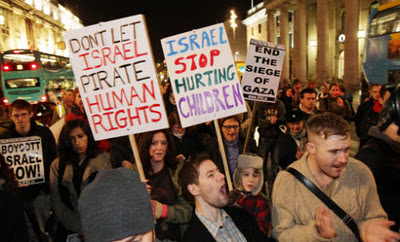
The Irish Government are tonight coming under heavy criticism for their inexplicable lack of action in relation to the 14 Irish citizens currently being detained by Israeli authorities. They are being held at the Givon Detention Centre near the port of Ashdod.
The 14 man crew of the Irish vessel the MV Saoirse were taken into Israeli custody on Friday last when their ship was illegally boarded in international waters by Israeli forces.
The ship was en route to Gaza as part of the ‘Freedom Waves’ flotilla, alongside Canadian ship the ‘Tahrir’. This was a humanitarian mission carrying medical aid and supplies, and aimed to break the Israeli blockade of Gaza.
A number of Irish political figures, including a current Member of the European Parliament, are among those being detained.
The decision by the Israeli authorities to board the vessel in international waters contravenes international law, and amounts to piracy. The subsequent decision to detain the crew of MV Saoirse therefore, can only by described as state sponsored kidnap.
In a three minute phone call from Givon prison in Israel, MEP Paul Murphy described the treatment of the detainees by the Israeli authorities:
“Our boat was almost sunk by the manner in which it was approached and boarded by the Israeli navy. People were shackled and deprived of all personal belongings.
“In Givon prison the authorities tried to disorientate us through sleep deprivation and the removal of our watches and the prison clock recording the wrong time. We have been given no time frame as to how long we will be kept here before the deportation trial.”
Co-ordinator Dr. Fintan Lane who is also among those detained, described the Israeli raid as “dangerous to human life.”
“I was hosed down the stairs of the boat” Dr Lane said. “Windows were smashed and the bridge of the boat nearly caught fire. The boats were corralled to such an extent that the two boats, the Saoirse and the Tahrir, collided with each other and were damaged, with most of the damage happening to the MV Saoirse. The boats nearly sank.”
The Irish activists have so far refused to sign deportation papers which state that they came to Israel voluntarily and entered the country illegally. This is clearly quite absurd, since Israeli naval ships violently seized the MV Saoirse and the Tahrir, and forcibly transported the vessels and all crew on board to Ashdod.
Back home, the Irish Government have remained coy on the matter, and attempts by opposition TD’s to have the issue openly debated in the Dáil have so far failed.
Tonight Deputy Richard Boyd-Barrett described the lack of action by the government as “nothing short of disgraceful”.
Mr Boyd-Barrett said: “We are calling on the Minister for Foreign Affairs Eamon Gilmore and the Government to speak out and condemn what Israel has done; and to demand the immediate release of Irish citizens and to demand an explanation from the Israeli authorities as to why they kidnapped, illegally on international waters, 14 Irish citizens.”
This sentiment is echoed amongst the Irish general public, where there is a growing feeling that Israeli defiance of international law has become habitual, and worryingly appears to be without any consequence whatsoever.
In May of last year, the world was stunned when Israeli commandos murdered 9 Turkish humanitarian activists and wounded many more during the raid on the first ‘Gaza Freedom Flotilla’. This incident also occurred in international waters and involved a number of Irish citizens.
The following June Ireland ordered the expulsion of an Israeli diplomat from the country’s embassy in Dublin. This move was in protest of Israel’s forgery of Irish passports, eight of which were used in the assassination of a Hamas official in Dubai.
This latest incident, the latest of eleven international attempts to break the blockade of Gaza via the sea, is sure to further damage relations between Ireland and the Israeli regime, if only for the time being in the continued disintegration of the Irish public’s regard for Israel.
Some reports are suggesting that up to half of the 14 Irish detainees may be released on Thursday November 10th. There is however no word as of yet to suggest when the remainder of those who have been detained may be released.
Father of 5 run over and killed by settler
By Thom Andrews | 9 November 2011 | International Solidarity Movement, West Bank
This afternoon, 45 year old Abdullah Mutaled Al-Mashni, father of 5, was run over and killed by an illegal settler.
Whilst returning from collecting his olives, Abdullah was last seen riding his donkey back towards his village of Deir Istia – 7km northwest of Salfit.
Soon after the killing, Israeli Occupation Forces arrived to shield the scene from photographers and journalists gathered to report on the crime.
It is believed the settler was a resident in the nearby illegal colony of Revava – established on occupied Palestinian land in 1991.
This attack comes just as a relatively peaceful olive harvest draws to an end. Tomorrow there will be a funeral for the martyr in Deir Istia.
Remembrance in Beit Hanoun
9 November 2011 | by Nathan Stuckey | International Solidarity Movement, Gaza

It is Tuesday, the third day of Eid, the Eid of the Sacrifice. We, the Beit Hanoun Local Initiative and the International Solidarity Movement, have gathered near the bombed remains of the Beit Hanoun Agricultural College like we do every Tuesday in preparation for our march into the no go zone. This Tuesday is different though, we are not gathered on the road that leads into the no go zone, but behind the bombed buildings of the College. Like much of Palestine, history is densely packed, every place has a story, today, we would learn the story of this small area. Today marks the five year anniversary of the Beit Hanoun massacre. Before us, lie the graves of its victims.
On November 8, 2006 at six in the morning the Israeli army began shelling Beit Hanoun. The shells landed on the houses of the A’athamnah and the Kafarnah families. Not just one shell, the shelling continued for fifteen minutes. Round after round fell on their houses. Nineteen people were killed, nine children, four women and six men. The youngest was only a baby of a couple of months, the oldest a 73 year old woman. Forty more people were injured. They were all civilians, not even the Israeli army bothers to claim that they were armed; they were sleeping in their beds.
The graves are just off the road, just behind the Agricultural College. They are large; each of them contains several bodies, large gray slabs of concrete with names and prayers inscribed on them. Abu Issa, from the Beit Hanoun Local Initiative speaks; he prays for the dead and asks us to remember the past. This massacre is barely the past though; it is almost the present, even if forgotten in so much of the world. His words end, as they must, on the present, “we did not ask for the occupation, we have always lived here, it came to us, but we cannot accept it, we must continue the struggle until the occupation ends.” We hang a wreath next to the first grave.
We walk slowly down the row of graves; Abu Issa reads us the names of the dead. We reach the grave of Maisa, age six. I cannot help but look away, for I have my own Maisa, who was also six in 2006. She isn’t my daughter, she is my English student. He name is Maisa Samouni. Twenty nine members of her extended family were murdered in much the same way by the Israeli army, herded into a house by soldiers, and then the house was shelled by the IDF. I wonder what this Miaisa would look like today, would she be as smart and kind and beautiful as my Maisa? As we reach the end of the graves we come to the graves that have been destroyed, destroyed by Israeli bulldozers in subsequent invasions of Gaza.
We turn away from the graves and look toward the border. At the concrete towers which line it, full of snipers and computer controlled guns which kill at will. Abu Issa begins to tell us about the area that we see in front of us. It was here that the men of Beit Hanoun were imprisoned during the first week of November 2006. Israeli forces had invaded Beit Hanoun; all males between the ages of 14 and 60 were rounded up and brought here. For six days the slept in the open, in the cold, while the Israeli army took them for questioning. Fifty three people were killed and over 200 injured during the invasion. The day after Israeli forces withdrew; they fired the shells which would kill nineteen more, including Maisa.

After the memorial service we piled into the van and went to the east of Beit Hanoun to visit the Al Jareema family. The Al Jareema’s are Bedouin family that lives right next to the no go zone. They have not always lived there, they used to live in 1948, but they were expelled by the Zionists during the Nakba, them and 750,000 other Palestinians. They settled in Gaza. They lived right next to the border, their houses used to be 50 meters from the border. Then, the Israeli’s decided to impose the buffer zone on Gaza, the family received a notice that they must move. There was no appeal. Israeli bulldozers came and destroyed their houses. They destroyed the pens for the animals. They destroyed the groves of trees that used to thrive in the no go zone.
Now, the family lives in a collection of tents and shacks about 500 meters from the border. As you look toward the border you see a particularly large gray tower, it is from this tower that the Israeli army shoots at them. They have nowhere to go, so they stay living here, surviving as best they can on the land that Israel has not seized. We bring them sweets to celebrate Eid, they serve us tea and freshly made bread. They ask us to stay for lunch, but we must go, there is a wedding going on in Beit Hanoun. Life continues. I pray that the children of the new couple grow up in a more just world, in a free Palestine. This is what we struggle for.
Settlers torch cars in Beit Ummar
Ma’an – 09/11/2011
HEBRON — Israeli settlers torched three cars Wednesday at dawn in the village of Beit Ummar in the northern West Bank, locals said.
Popular committee spokesman Muhammad Ayyad Awad said settlers from Kfar Etzion settlement torched the cars of Habes Husein Baragheeth, Suheil Muhammad Hussein Baragheeth and his brother Yousef.
He added that the Jewish extremists sprayed racist graffiti in the area.
Israeli police spokesman Micky Rosenfeld told AFP the words “price tag” were sprayed on the wall, and said “police launched an investigation and were looking for suspects.”
Hardline Jewish settlers have adopted what they call a “price tag” policy under which they have attacked Palestinians and their property in response to Israeli government measures against settlements.
Overnight, Israeli forces detained at least three Palestinians in the West Bank.
Palestinian security sources said a large Israeli force accompanied by a helicopter raided Qabatiya village in Jenin for over four hours, searching homes and neighborhoods.
Security officials added that Israeli forces detained Anas Atta Camil, 27, and Ahmad Hisham Camil, 26, who is a university student and was released from an Israeli prison two months ago.
An Israeli military spokeswoman said two “wanted Palestinian suspects” were arrested south of Jenin and another man was detained in Hebron. They were taken for questioning by security forces, she added.
Meanwhile in Salfit on Wednesday, Israeli forces stopped farmers from reaching their lands to pick their olives near Revava settlement west of Deir Istiya, the local mayor said.
Nathmi Salman, the mayor of Deir Istiya, told Ma’an that Israeli soldiers prevented Khaled Abdul Latif and Mufeed Abdullah from working on their land claiming they did not have permission.
Salman added that residents were complaining that their lands had been soaked with sewage from the settlement and that they couldn’t harvest their olives.
He called on international bodies to intervene to stop the sewage and demanded that Israeli authorities reined in the settlers. He warned of a humanitarian and environmental disaster if the settlers weren’t stopped.
Israel Carries Out Two Airstrikes Targeting Gaza
By Saed Bannoura | IMEMC & Agencies | November 09, 2011
 The Israeli Air Force carried out, at dawn on Wednesday, two airstrikes targeting Khan Younis, in the southern part of the Gaza Strip; damage was reported, no injuries.
Local sources reported that the Air force fired a missile at a greenhouse, northwest of Khan Younis, followed by another missile into the same area a few minutes after the initial attack. The two attacks came only hours after Israeli tanks fired several shells into Al Waha area, in the northern part of the Gaza Strip leading to damages.
On Tuesday at night, the army fired artillery shells into As-Sudaniyya area, northwest of the Gaza strip.
Eyewitnesses reported that a number of residents suffered minor injuries, as initial reports revealed that Gaza hospitals did not receive any casualties following the attack.
Why is an Israeli soldier worth more than a Palestinian child?
By Dana Halawa | The Electronic Intifada | 8 November 2011
I have read countless articles and watched numerous videos about Gilad Shalit being reunited with his family five years after his abduction. One typical report noted he was “just 19 years old in 2006 when he was cruelly and illegally abducted by Hamas.” I have been hearing of him for the past five years. I know Gilad Shalit’s name better than I know the names of my classmates.
What I have already forgotten, however, is the names of the 477 Palestinians that were freed. What I will never know are the stories of the thousands of Palestinians who are spending their entire lives behind bars away from their family and friends. The thousands of children, women and men still captivated unjustly in Israeli jails. The children that grew up in cages. The parents that watched their children seized out of their hands and taken away without their consent, forced to watch from afar awaiting news on their child’s whereabouts, praying that their child wouldn’t be tortured — too much. Those are the things, the stories the world has never learned and will never learn. Those are the nameless, faceless heroes that were freed in this exchange, while thousands more continue to languish in Israeli jails.
Ashraf Baluji, Imad Abu Rayyan, Imad al-Masri and Yusuf al-Khalis were only 18 and 19 years old when they were arrested back in 1991. They were part of the first 477 prisoners of war to be released in exchange for Gilad Shalit after spending over 20 years in Israeli jails. Crazily, 1991 was the year I was born. Every breath I have ever taken, every moment I have known of life, they were locked up and tortured.
In every article I’ve read referring to Shalit by his name and the 1,027 Palestinians being released in exchange as a number or as “militants,” the journalist has forgotten to mention that Shalit was an armed and trained soldier that was “kidnapped” from a military occupation vehicle, that the majority of Palestinian prisoners never engaged in military or criminal acts against Israel, and were only accused of resistance to the Israeli military occupation. They have conveniently left out the numerous Palestinian children abducted from their homes and taken far away, usually denied even visits from their parents or lawyers.
In 2009, Time magazine published a story about Walid Abu Obeida, a Palestinian farm boy who was only 13 years old when he was stopped on his way home by two Israeli soldiers aiming their rifles at him. They punched, beat, and arrested him while his parents wondered where he was and why their son wasn’t home yet (“Does Israel mistreat Palestinian child prisoners?,” 30 June 2009).
Alas, Abu Obeida’s treatment was far from an isolated incident. As of the latest figures recorded by Defence for Children International-Palestine Section, as of October 2011, 164 Palestinian children between the ages of 12 and 17 years old are behind bars, including 35 aged between 12 and 15 years old (Child detainees, accessed 7 November 2011).
Many are being held without trial or conviction, while others are — often falsely — convicted of throwing rocks at Israeli tanks occupying their land and demolishing their homes.
Key facts forgotten
Israel has arrested more than 650,000 Palestinians, a number equal to about 20 percent of the population, since the occupation of the West Bank began in 1967. We tend to forget that Israel is occupying Palestine when we speak of the two. Palestinians are killed and arrested every day under the pretext of “protecting Israeli security.” Palestinians are kidnapped from their homes and stand trial in Israeli courts, where even Palestinian witnesses have no right to testify, while others are jailed, without trial or charge, under “administrative detention”.
Looking through the list of released prisoners, I found the name of Akram Mansour, who was arrested at the age of 18. He has spent over three torturous decades languishing in Israeli jails for resisting the Israeli occupation of Lebanon. At 51, he finally gets to taste a bit of freedom — although without his mother, father or sister who died while he was in Israeli custody — before the brain tumor he developed in Israeli jails takes life itself from him. In an online Arabic-language interview with Mansour, he says he currently suffers from paralyzed fingers, missing teeth and blackouts because of the torture he was subjected to, which varied from hammering his fingers to a nail in his forehead to having urine spilled over him and, after filing a complaint, being forced to strip naked in the cold as buckets of freezing water were spilled over him (“The suffering of the liberated prisoner Akram Mansour,” 24 October 2011 [Arabic]).
Robbed of childhood
Twelve-year-old Palestinian boys are robbed of their innocence and childhood behind bars. Sixteen-year-old Palestinian children are tried as adults by Israel, even though the legal age under international and even Israeli law (for Israelis) is 18. Mothers and sisters are arrested and convicted of terrorism for standing up to the occupation. Children are forced to grow up without parents. Men are convicted and sentenced to as many as 36 life sentences for resisting their genocide. In total, 1,027 will be freed while 5,000 remain captive.
Gilad Shalit will be remembered as a hero that endured five years of kidnapping, during which he had regular medical checkups and was placed in as good a condition as Gaza could provide under the Israeli blockade. This is more than I can say for the Palestinian prisoners, who have often been deprived of basic services, including medical attention when needed.
Today, Shalit is a free man with no conditions on his freedom. However, the 477 Palestinians freed in the first part of this exchange were either allowed home, provided they report to Israel monthly and not travel between Palestinians cities; or exiled to Gaza where they may not see their families in the West Bank (who are not allowed into Gaza); or even exiled outside the entire country and banned from ever returning home. Through preventing released prisoners from returning home, Israel violates the most basic of human rights. Article 12 of the International Convention on Civil and Political Rights states: “No one shall be arbitrarily deprived of the right to enter his own country.”
A life is a life, and a human being is a human being. So, many now ask why Gilad Shalit’s life is worth 1,027 Palestinian lives. To ask that is to not understand Israel. An Israeli life’s value cannot be estimated, whereas a Palestinian life is of very little to no value. I think I speak for most Palestinians when I say, I’m glad Gilad Shalit is home, safe and with his family, that Palestinians more than anyone understand what it’s like to lose a father, mother, brother, sister, daughter and son. More than anyone, Palestinians understand the joy he and his family must feel now that his back.
Personally, I believe a fair exchange would have been to release all Palestinian prisoners for all Israeli prisoners, namely just Gilad Shalit, rather than making one life worth 1,027 lives. However, knowing that Israel would never agree to that, I congratulate Hamas and the Palestinian people on their victory. And I pray for the remaining 5,000 Palestinians in Israeli custody, and many more currently being arrested to fill the cells being emptied of 1,027 prisoners.
Dana Halawa is a twenty-year-old American-Palestinian medical student at the Jordan University of Science and Technology in Jordan.
Islamic Jihad: Israel ‘broke’ truce
Ma’an – 07/11/2011
BETHLEHEM — Islamic Jihad said it would retaliate after Israeli forces killed a member of its armed wing in Gaza late Saturday, hours before the Muslim festival Eid al-Adha began.
“Israel has again broken the truce” agreed by Gaza factions after Israeli strikes killed 12 people in two days last week, spokesman Daoud Shihab said in Sunday’s statement.
Shihab warned of Israeli escalation during the Eid holiday, which began on Sunday.
Islamic Jihad will take “revenge” for Israel’s firing on the southern Gaza Strip on Saturday, which killed a 26-year-old member of the group’s Al-Quds Brigades, and injured two others, Shihab said.
All Palestinians reject the killing of their people and the attempt to ruin the festivities of Eid, he added.
~
Israeli forces shell east Gaza City, 3 injured
Ma’an – 07/11/2011
GAZA CITY — Israeli forces shelled the eastern Shujaiyeh district of Gaza City on Monday, with medics reporting three people were injured.
Witnesses told Ma’an that up to 10 shells were fired from the direction of Israeli crossing Nahal Oz to the east of the city throughout the morning.
Medics said three people were transferred to Shifa hospital in Gaza City.
An Israeli army statement said soldiers fired towards “a terrorist squad planting two explosive devices adjacent to the security fence… confirming a hit.”
An Egyptian-brokered truce between Gaza factions and Israeli forces was declared “broken” by Islamic Jihad on Sunday after a 26-year-old member of its armed wing was killed by Israeli forces late Saturday.
The Oct. 30 truce came after Israeli strikes killed 12 people in the Gaza Strip in two days, and Gaza militants fired a volley of rockets and mortars into southern Israel, killing one Israeli in Ashkelon, in the worst flareup on the border in several months.
Featured Video

AIDS Inc. by Gary Null (2007)
or go to
Aletho News Archives – Video-Images
From the Archives
Clash of Civilization, Iran Part II
By Jamal Kanj – Intifada-Palestine.com – January 14, 2011
Israel’s survival kit is: perpetuate conflict, insecurity to rationalize collective hate and finally playing victim.
Devoid of conflict, Israel implodes internally; without hate, Zionism loses its justification; and playing eternal victim to continue blackmailing the West. Absence of this holy trinity, Israel ceases to exist.
From its inception, the house of Zion has mastered exploiting adversarial powers to advance Israel’s cause. For instance, their influence over the Democratic Party in the US began with President Truman’s bid for 2nd term election in 1948.
Responding to strong opposition from Secretary of State General George Marshall and Department experts urging against recognition of Israel, President Truman replied: “I’m sorry gentlemen but I have to answer to hundreds of thousands [Jewish voters] who are anxious for the success of Zionism. I do not have hundreds of thousands of [voting] Arabs among my constituents”
Zionists influence over liberal American politics was matched with the doctrinal school of Conservative theoreticians aligning the Republican Party’s platform with Israel’s objectives. The Neoconservative Zionists, coined Zioncons, invented the “Clash of Civilization” concept to fight Israel’s wars. … continue
Blog Roll
 Aletho News
- Merck Virologists Admitted to Falsely Certifying Vaccine Efficacy
- Mandatory Folic Acid for every man, woman & child
- Pro-Palestine protesters arrested outside UK’s ruling Labour Conference in Liverpool
- Mauritius denies landing permit to flight from Israel, forcing cancellation: Tour operator
- Israeli finance minister calls for genocidal war on West Bank, annexation of south Lebanon
- 12 Things Your Psychiatrist Was Trained Not to Tell You
- From Unipolar Universalism to Multipolar Civilizational Distinctiveness
- RSF military group defects, joins Sudanese army: State media
- Ireland goalkeeper refuses to play ‘Israel’ as squad weighs boycott
- China pushes back against US on Cuba, Iran
- If Americans Knew
- Israel forces Gazans to live in constant peril – Daily Update
- Deconstructing Netanyahu’s pants-on-fire UN rant – Daily Update
- Trump betrayed voters with his campaign lies and prioritized a foreign country once he took office
- Netanyahu calls Israel’s war in Gaza ‘opposite of genocide’ in UN speech to near-empty hall
- Settler Kidnappings: Torture, Sexual Abuse and Terrorisation of Palestinian Abductees as Israel Deepens Annexation of West Bank
- Gaza winter nears as 162,000 tents become unusable, raising fears of humanitarian crisis
- Netanyahu says, “It’s the opposite of genocide”; UN says Gaza economy is world’s ‘most severe crisis on record’ – Daily Update
- Israel’s US-Backed Assault on Gaza Has Created the ‘World’s Most Severe Economic Crisis on Record’: UN
- ‘Protecting U.S. Citizens’… From Israel
- ‘This is where I live now, the back of a truck’: a day in the life of a grandmother in Gaza
- No Tricks Zone
- New Study: Earth And Venus Surface Warmth Largely Explained By Convection And Lapse Rate, Not CO2 Or Radiation
- 2025 Nature Paper Claiming Worsening Global Drought Gets RETRACTED …Heavily Flawed
- New Study: ‘Global Drought Shows No Detectable Recent Acceleration Under Climate Warming’
- Economic Masterminds: German Socialists Suggest Taxing Productivity Gains Stemming From Using AI
- The South China Sea Has Not Been Cooperating With The Climate Change Narrative
- Energy Crisis: Germany Enters Heating Season With Historically Low Gas Reserve Fill Levels
- New Study: The Antarctic Ice Sheet Gained Mass From 2020-2024 Due To Staggering Snow And Ice Accumulation
- Study: Ocean Heating Rates From Thousands Of Years Ago ‘Dwarf’ Modern Ocean Heating Rates
- Climate Extremists Target, Attack Large-Scale Power Grid Infrastructure In Germany!
- New Study: Antarctic Ice Melt Has Contributed Less Than 1 Centimeter To Sea Level Rise In The Last 30 Years

