Nasr Ibrahim Alean was murdered by Israel Thursday
By Nathan Stuckey | November 7, 2011 | International Solidarity Movement, Gaza
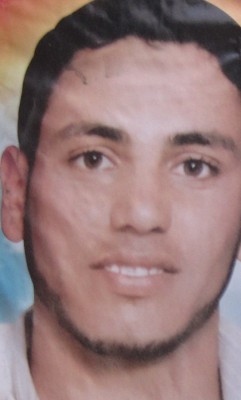 Nasr Ibrahim Alean was a 23 year old farmer from Beit Lahia. He was murdered on November 3, 2011. He was picking strawberries in his field when he was shot in the leg by the Israeli army. He called his friend Muhammad Abu Helmeyyah, 22 years old, to help him. Muhammed tried to take him to safety, but they were both killed by a missile from an Apache helicopter. Nasr was not the first farmer in Gaza murdered by the IDF, and he will probably not be the last.
When Nasr was killed he was working in a field 500 meters from the border. Outside of the Israeli imposed “buffer zone” which is in reality a 300 meter zone of death that surrounds Gaza. This isn’t uncommon; the high risk area around the border extends as far as one or two kilometers according to the UN. Nasr knew that he risked his life when he went to work, but he had no choice. He needed money to get married, and working on the land was the only work that he could find. Gaza is under siege, and unemployment is rife. Not only are many imports banned, but most exports are banned as well.
We sat in the mourning tent talking with Nasr’s family, hearing their stories, seeing their pictures of Nasser. A cousin showed us a video of them picking up the body. There was a giant hole in his head. They tell us that Israel did not allow the Red Cross to pick up the body immediately; it sat for several hours, until finally the ambulances came. Too late, Nasr was already dead. Muhammad was already dead. They told us worse stories, of bodies that no one was allowed to pick up, bodies that the IDF left to rot, everyone forbidden to claim them.
Nasr’s brother was getting married in two days. One of his aunts heard the story as she had her eyebrows done in preparation for the wedding. She says of him, “He wasn’t in the resistance, he was just trying to work,” and continues “They don’t even want us to work. If it wasn’t for the United Nations, I don’t know what we would do.” His uncle tells us about how he used to work in Israel. He worked as a driver. One day a woman got in with her young child. She abused him in front of the child. He asks, “How can people who abuse you in front of their children teach their children about peace?” He doesn’t seem to have much hope. They talk of going to human rights organizations to complain about Nasr’s murder, but they do not really believe that they will help. Nasr hadn’t given up though, he went to pick strawberries on Thursday because he wanted to live, because he wanted to get married and have children and a house of his own.
Violent and dangerous Israeli piracy
Update on the Freedom Waves to Gaza Boats November 6, 2011
The take over of the Tahrir and the Saoirse was violent and dangerous. Despite very clear protests from the occupants of the two boats that they did not want to be taken to Israel, they were forcibly removed from the boats in a violent manner. The whole take over took about 3 hours. Many of those on the Canadian boat were beaten.
It began with Israeli forces hosing down the boats with high pressure hoses and pointing guns at the passengers through the windows. Fintan Lane, on the Saoirse, was hosed down the stairs of the boat. Windows where smashed and the bridge of that boat nearly caught fire. The boats were corralled to such an extent that the two boats, the Saoirse and the Tahrir collided with each and were damaged, with most of the damage happening to the MV Saoirse. The boats nearly sunk, the method used in the take over was very dangerous.
The Israeli forces initially wanted to leave the boats at sea but the abductees demanded that they not be left to float unmanned at sea, for they would have been lost and possibly sunk. David Heap, a Canadian delegate, was tasered and beaten. All belongings of the passengers were taken off them and crew and they still do not know if and what they will get back. 6 prisoners were released-both of the Greek Captains, 2 of the journalists and 2 delegates. The passengers remain in Givon detention center and many, including Kit Kittredge of the U.S., have not been able to make phone calls.
Those remaining are being asked to sign deportation papers which state that they came into Israel illegally and that they will not attempt another effort to break the Gaza blockade. If they sign they will not be allowed into Palestine, through Israel, for 10 years. Obviously their goal was to go to Gaza not Israel, and a signature could validate Israel’s right to blockade Gaza, so they refuse to sign. This will mean longer detention. Their continued detention is designed to force them to agree to abandon their legal rights and has nothing to do with the security of Israeli civilians – just like the blockade of Gaza’s civilians is clearly punitive and has nothing to do with the security of Israeli civilians
Our State Department has not been an advocate for its citizens. They would rather join Israel in stating that we are terrorists. Obama on Thursday said the passengers on these boats are defying Israeli and American law. He must have been confused. It’s the other way around. State Department spokeswoman Victoria Nuland said the U.S. was renewing its call to Americans “not to involve themselves in this activity,” and warned of possible consequences.
WE NEED ALL OF YOU TO GET ON THE PHONE TODAY AND CALL:
U.S. Emergency Consular Services 202-647-4000
and the U.S. Embassy in Tel Aviv 011-972-3-519-7575
Tell them you want them to insist Israel free the prisoners immediately and end its siege of Gaza.
Just a few phone calls can make a difference.
I write to you from cell 9 of the Apartheid State of Israel
Canadian Boat to Gaza
 Dear sisters and brothers, friends and loved ones,
I write to you from cell 9, block 59 Givon Prison near Ramla in Occupied Palestine. Although I was tasered during the assault on the Tahrir, and bruised during forcible removal dockside (I am limping slightly as a result) I am basically ok. We, Ehab, Michael, Karen from Tahrir, as well as Karen, Kit (US) and Jihan who we saw briefly this morning. We are most concerned about our Tahrir shipmate, Palestinian Majd Kayyal from Haifa, last seen by us at Ashdod being photographed and put in a police car.*
Although Michael and I (among others) were transported in handcuffs and leg shackles, let me stress that we are neither criminals nor illegal immigrants but rather political prisoners of the apartheid state of Israel. Four from the Tahrir are imprisoned with 12 Irish comrades from the Saoirse, who have more experience with such issues. The four of us, Ehab and I (Cdn), Michael (Aus) and Hassan (UK) have joined with the Irish in their political prisoners’ committee in order to press our collective demands:
- association in the block – i.e. open cells
- adequate writing and reading material
- free communication with outside world – i.e. regular phone calls
- information about shipmate women held at same prison
We add one Tahrir-specific demand: that Israeli state recognize the professional status of Democracy Now journalist Jihan Hafiz in accordance with her credentials from the US government. All political incarceration is unjust but let me stress that in duration and conditions, our situation pales in comparison to the plight of thousands of Palestinian political prisoners and to the open air prison of Gaza.
If you have energy to devote to solidarity actions in the coming days, please concentrate on them. We must get Tahrir back and hope Freedom Waves continue.
Free Majd Kayyal! Free all political prisoners! Free Gaza! Free Palestine!
Anishnabe-debuewin, restons humaine, stay human, in love and struggle,
David
* Majd Kayyal was released, but it appears David the other political prisoners weren’t told where he was taken.
Rafah border crossing closed for 6 days
5 November 2011 | International Solidarity Movement, Gaza
Only hours after activists from popular committees and youth movements throughout the West Bank formally presented the Egyptian ambassador, His Excellency Yasser Othman, with an appeal and a petition to open the Rafah crossing unconditionally and permanently, the Palestinians of Gaza learned that the crossing will in fact be closed for six consecutive days during the Eid holiday.
A petition was originally issued by Gaza-based civil society sectors including academics, students, workers, and youth. It was immediately supported publicly by Egyptian revolutionaries and grass-roots organizations as well as renowned International human rights defenders such as Desmond Tutu and Richard Falk.
Despite assurances by the Egyptian ambassador that conditions at Gaza’s only lifeline to the outside world will improve in the coming days, it seems that the people of Gaza will continue to suffer from frequent and arbitrary closures on weekends and holidays. This closure comes while the Taba crossing to the Israeli city of Eilat as well as other Egyptian border crossings, airport terminals and seaports are closed for only one day for Eid al Adha and continue their activities throughout the year without interruption.
While Palestinians and their allies continue to struggle against the criminal Israeli-imposed siege, the frequent closures of the Rafah crossing by the Egyptian authorities compounded with the quota system that only allows a limited number of people to cross every day results in long delays and significant hardship. At times, students miss their school terms and workers lose their jobs while waiting for their turn to cross. Family members who hold foreign passports are still prevented from visiting their loved ones in Gaza. This severely hinders the freedom of movement of the Palestinians of Gaza, a basic human right under international law.
CALL TO ACTION
1. Organize a delegation to deliver the petition to your Egyptian embassy, consulate or representative office.
2. Contact your Egyptian embassy. In the US, fax, phone or email the DC Embass Fax: (202) 244-4319; Phone: (202) 966-6342; Consulate@egyptembassy.net
3. Sign and circulate the petition.
4. “Like”, “Share” and Post your activities on the campaign Facebook page
5. Sign this petition to unconditionally open the Rafah crossing
For more information and to send an email about your activities contact: rafahcrossingcampaign@gmail.com
Fatalities All Too Common: British Prime Minister Ignores Problem of Rampant Police Brutality
By Linn Washington, Jr. – This Can’t Be Happening – 11/04/2011
London — For a dozen years they had marched peacefully to the street containing the residence of Britain’s prime minister, asking the current occupant of #10 Downing Street to investigate the scourge ripping at the soul of this nation.
That scourge is the thousands of suspicious deaths occurring while in the custody of British police, in British prisons and in British mental health facilities.
Eight persons died in police custody just during the first nine months of 2011, according to official British government statistics. That’s more than double the custody deaths last year.
One of those deaths involved a 49-year-old reggae music singer who police claimed had committed suicide by plunging a butcher knife into his heart while making tea in his kitchen, allegedly for officers who were in his house conducting a drug investigation.
That knife contained no fingerprints of the dead singer.
This year, on their thirteenth march to Downing Street the demonstrators endured, for the first time — the very thing they were protesting against: abuse by police.
This year police responded to this annual march by the United Families and Friends Campaign (UFFC) by roughing up some demonstrators, and by denying them their desire to simply pin their demands to the gate blocking entrance to Downing Street as they’ve done without incident in past years.
“That the families of those who have died in custody can be treated in this way is an outrage,” wrote Lee Jasper, a respected social justice activist who served as the head steward for the latest march, on his blog.
UFFC personnel at the protest march passed out a broadsheet containing the names of 3,180 individuals compiled by UFFC as having died suspiciously since 1969 while in the custody of police, prisons, psychiatric units and immigration detention centers throughout Britain.
“Too many have died in questionable circumstances,” stated a message on that broadsheet. “Too many killed unlawfully…and pitifully too few held to account for the deaths of those we name here.”
Jasper criticized London’s conservative Mayor Boris Johnson and the capital city’s new Police Commissioner Hogan Howe for the aggressive policing. Jasper served as the policy Director for Policing and Equalities for the mayor Johnson replaced in 2008.
Jasper, blasting police for attacking peaceful protesters, including children and the elderly, characterized police-black community relations as being at a “historic low,” and he warned that the police fracas during that protest march will make an “already bad situation much worse.”
The fatal police shooting of Mark Duggan in August 2011 ignited days of rioting that rocked London and other British cities.
In 1985, in the same North London area as the Duggan shooting, the death of Cynthia Jarrett during a police raid at her residence sparked the ‘Broadwater Farm Riot.’
That Broadwater Farm earlier upheaval followed a riot days before in the South London community of Brixton, which arose from the fatal shooting of a woman by police. Fatalities from police acctions also triggered the 1981 and 1995 riots in Brixton.
The urban riots that erupted across the United States during the mid-1960s were all rooted in instances of police abuse, according to the 1968 report that followed an investigation conducted by the presidentially appointed Kerner Commission. America’s worst riot – 1992 in Los Angeles – followed the acquittal of four officers charged with the videotaped beating of black motorist Rodney King.
Mark Duggan’s brother, Shaun Hall and Cynthia Jarrett’s son, Patrick, participated in the UFFC march to Downing Street.
Both Hall and Jarrett criticized police abuse in England and the failure to thoroughly address this misconduct by authorities ranging from the Independent Police Complaints Commission to the offices of two successive Prime Ministers.
“The police have no accountability for their actions,” Patrick Jarrett said at the march, describing how those errant officers involved in his mother’s death faced neither discipline nor prosecution, despite an official review that faulted their actions.
A few days after the UFFC march, police officials in London announced that six officers involved in smashing a taxi cab with baseball bats while arresting the cab’s driver would keep their jobs despite overly aggressive behavior which government oversight authorities had contended was unreasonable.
The bat-wielding officers received minor reprimands despite authorities having found no evidence supporting the officers’ explanation for their assault.
Police abuse ranging from verbal insults to fatal incidents is not exclusive to Britain, of course.
Recently, for example, a British tourist visiting Dubai died inside a police station following a severe beating after an arrest for swearing in public.
In America, vicious police assaults in cities across the country, from New York City to Oakland on anti-corporate-greed-Occupy-demonstrators have again thrust the issue of brutality by American police into the news.
An Iraqi War veteran hit in the head by a police projectile–most likely a tear gas cannister fired at close range during a police assault on an Occupy encampment in Oakland, CA–remains hospitalized and is unable to speak.
Downing Street protest marchers included Marcia Rigg and Stephanie Lightfoot Bennett.
Rigg’s brother died suspiciously in August 2008 while in police custody, and Bennett’s twin brother died under similar suspicious in-custody circumstances in 1992.
“They treated my brother like less than a dog,” Marcia Rigg often says about the death of her brother Sean, an aspiring musician who died on the ground inside an outdoor holding area of a London police station after being taken into custody following a mental-related emergency.
Rigg’s referencing dog-like treatment isn’t hyperbole, because British police have been convicted of cruelty to police dogs, too. (No surprise in dog-loving Britain.)
In 2010 a British policemen received a six-month suspended sentence for the death of two police dogs he left inside a vehicle on a sweltering day. In 1998 two British policemen received convictions for cruelty to police dogs, one receiving a four-month jail term, later reduced to three months.
The first and still only conviction of British police for an on-duty killing of a human being occurred in 1969, when two policemen received guilty verdicts for killing a black man.
Police abuse, particularly fatal abuse, is a problem across Britain, however the extent of the problem remains clouded by contradictory figures.
In London, for example, the government watchdog Independent Police Complaints Commission issues figures stating that 16 persons died in police custody between 2006 and 2009, citing data supplied to it by London’s Metropolitan Police.
Yet, London’s Metropolitan Police itself issues figures stating that 59 have persons died in their custody during that same time.
Inquest, a non-governmental agency that monitors police abuse, states that 35 black minority ethnic persons died in the custody of police in London between the years 2006-2009.
However, the Metropolitan Police state their custody death figure for non-whites during that period is 28.
Britain’s Association of Chief Police Officers issued a statement decrying every death in custody as “a tragedy,” but he says he sees encouraging signs in a decreasing number of such deaths in recent years, a claim rejected by others.
“We need to see changes in legislation. We want to see those doing this misconduct held to account,” said Matilda MacAttram, Director of Black Mental Health UK during a public meeting on black deaths in custody that was convened by BMH-UK at the prestigious London School of Economics two days before that UFFC protest march.
A report last December from the Independent Police Complaints Commission challenged the widespread belief that blacks comprise the majority of in custody deaths. According to that report, whites comprised 75 percent of the custody deaths during the years 1998-2009, with blacks for seven percent.
Family members of many white victims of in custody deaths participated in the UFFC march.
“My son was treated in the most appalling way,” said Patricia Cocker, whose son Paul died inside a police station in 2005.
Cocker, echoing the interracial unity among participants in the custody deaths protest march, said, “They may break our hearts but they won’t break our spirits.”
Israel opens dams flooding Palestinian homes in Abasan
Palestine Information Center – 04/11/2011

GAZA — Israeli occupation authorities opened water dams at Sanati to the east of Khan Younis in the southern Gaza Strip causing the flooding of Palestinian homes in the town of Abasan al-Kabira.
The mayor of Abasan, Mustafa al-Shawwaf, told Safa news agency 8 homes in the town were flooded to a height of 70 to 90 cm, and that residents of those homes are being evacuated.
Many streets in Khan Younis, in the southern Gaza Strip, were also flooded as a result of torrential rain that fell all night in the area.
Medical sources that nine homes were badly flooded in the Amal neighbourhood and that residents of those homes were rescued.
PIC correspondent said that a medical centre near the Red Crescent headquarters in the city was also flooded.
No casualties were reported until the preparation of this report, while the civil defence department said that its teams are helping in pumping the water out of the affected homes.
Israeli navy intercepts Gaza-bound aid flotilla
Press TV – November 4, 2011
Israeli naval vessels have intercepted a Gaza-bound international aid flotilla seeking to break the crippling blockade of the Palestinian territory.
According to a Press TV correspondent on-board one of the ships, the two vessels were shadowed by Israeli warplanes and naval vessels in international waters on Friday as they approached the besieged Gaza Strip.
Eight Israeli warships made radio contact with the ships, calling on them to change course towards Egypt or to turn around.
~
URGENT REPORT FROM IRISH BOAT: WARSHIPS APPROACHING / BOAT IS 48 NAUTICAL MILES FROM GAZA
(time of call: 10:58 am Irish time)
By US To Gaza
EMERGENCY ACTION IN NYC: 5pm to 6:30pm tomorrow, Friday, November 4th
WESPAC, Code Pink – NYC and other Palestine Solidarity groups are organizing an emergency support vigil for the passengers on the Saoirse and the Tahrir. This vigil will take place from 5pm to 6:30pm Friday, November 4th across the street from the Israeli Consulate in mid-town Manhattan located at 800 2nd Avenue between 42nd Street and 43rd Street. Denise Rickles, with Code Pink NYC, will be the point person for this support rally. She can be reached at deniserr@msn.com.
Please bring appropriate signs with you such as:
END THE SIEGE OF GAZA NOW!
OCCUPY WALL STREET NOT GAZA
END U.S. FUNDING OF ISRAELI ATTACKS
Chicago area prepares emergency response if Israeli forces target the Tahrir and the Saoirse on their way to Gaza
“In the event that Israel attacks our ships, there will be an Emergency Response protest at the Israeli Consulate in Chicago at 5:00 PM on the following work day (Monday-Friday). Please bring Palestinian flags and appropriate posters. “
E-mail gazafreedomwave@gmail.com to tell us about any actions you plan in your local area.
Israel drops missile on North Gaza neighborhood, no one cares
Radhika Sainath | International Solidarity Movement, Gaza | November 1, 2011
 The Israeli Air Force fired a missile into a Beit Hanoun residential neighborhood in north Gaza early Sunday morning. The missile landed in a grove surrounded by homes, creating a crater the size of a tennis court and destroying over forty orange and olive trees. Chunks of shrapnel and oranges lay scattered about the grove.
Local children and area residents interviewed appeared to be in shock. Ayman Ismail Hamad explained that “[a]t 3 a.m. we heard a huge boom. It was so scary for the children and women here and they started to shout and cry – such a scary thing for them. When we looked out to see what happened we found everything there totally destroyed … and the windows from the houses in this area – totally nothing. The [Israeli] F-16 didn’t leave anything behind.”
The owner of the farmland, Sufyan Musa Muhammad, reported losing approximately 40 orange and olive trees, not including the uprooted trees at the periphery of the crater, valued at approximately $200 a tree. “It’s not just the price,” he added, gazing sadly at the upturned alien landscape. “It’s that there’s no more fruit.” According to Muhammad, no journalists had approached him regarding the Israeli missile attack, which went unreported.
Thirteen-year-old Amer Ayman Hamad, whose house is about 50 meters away from the impacted area said, “There was boom … I didn’t scream, I just woke up … it was during the night we didn’t hear any plane except for the sound of the drones … after that I went to the bathroom.”
Israel has not claimed responsibility for the attack which terrorized local residents. No one was injured. Palestinians in the area believe that Israel used an F-16 to bomb the residential neighborhood due to the size of the crater and the thickness of the shrapnel.
When asked if he believed Israel should compensate him for his loss Muhammad replied, ”I don’t want money from the Israelis. Whatever they do to us we are steadfast and strong and we won’t leave our land.”
Florida SWAT shoots homeless man in the face
RT | November 3, 2011
Dennis Gaydos, a homeless man from Palm Springs, was making his home outside of a church in the sunny Florida community without incident until a police intervention changed his life.
Gaydos says he was keeping to himself in his temporary home on the church grounds when the Palm Springs Police department SWAT team, dressed in full military garb, shot him multiple times with rubber bullets.
The close-range blast slashed off a portion of his right ear lobe and rendered his left eye a pulpy mess.
In the four years since the event, Gaydos has filed a federal lawsuit against Palm Beach County, Sheriff Ric Bradshaw and the Village of Palm Springs Police Department. The lawsuit, which was filed in late July, is in response to the SWAT team to removing him from his encampment and severely butchering him.
Other damages include “physical suffering, permanent disfigurement including the loss of use of a bodily function, injury and mental anguish.”
“What happened to Mr. Gaydos was outrageous,” says Kevin Anderson to Jose Lambiet of GossipExtra.com. Anderson, Gaydos’ police liability lawyer, adds that “the behavior of the police officers and deputies at the scene was simply unexplainable.”
The lawsuit states, with a deployed helicopter over head, “the plaintiff was overtaken by multiple deputies and police officers. The Plaintiff was not threatening harm to the officers or other individuals upon the defendants’ arrival.”
Authorities claim Gaydos refused to come out and, on the contrary, officers allegedly took action when they spotted Gaydos wielding a cell phone in one hand and a “knife” in the other.
Gaydos admits to having a cell phone in his hands at the night of the incident, but said he had just finished calling a food assistance agency.
It is believed that the food agency’s operator reported to law enforcement that Gaydos was living in underbrush by the church’s parking lot.
Gaydos claims the incident which left him blind and deaf should have never occurred since he had permission from the pastor to reside there.
Gaydos’ attorney added the artificial light in the area was more than sufficient to prevent an “accidental” shooting.
Palm Beach County records indicate the night of the incident, Gaydos didn’t have any criminal charges filed against him and was never arrested.
According to official records no knife was recovered from the scene either.
New Israeli airstrikes after third ‘ceasefire’ agreement, two killed
Palestine Information Center – 31/10/2011
KHAN YOUNIS — Two more Palestinians were killed at midnight Sunday in a fresh Israeli violation of the Egyptian brokered calm that supposedly went into effect for the third time at 10 pm Sunday.
Medical sources told the PIC reporter that the medical crews could not retrieve the bodies of the two men until dawn Monday, noting that they were killed in a raid on the Fakhari area east of Khan Younis, south of the Gaza Strip.
The Ansar brigades, the armed wing of the Ahrar movement, said that the two were of its fighters.
The casualties bring the number of Palestinian martyrs since Saturday to 12 mostly from Islamic Jihad operatives.
Meanwhile, Palestinian resistance factions retaliated to the Israeli violations of the ceasefire and fired homemade rockets at areas adjacent to the Gaza Strip with no casualties reported.
An Arab member in the Israeli Knesset, Dr. Jamal Zahalka, said that Israel was trying to restore its “deterrence” but ruled out a big military operation on Gaza for the time being.
He said in a statement to Quds Press on Sunday that Israel had no justification for the attacks on Gaza but rather had its own goals such as maintaining the siege on the coastal enclave and to strike at Palestinian factions to sway them from the path of resistance.
Israel violates Egypt-brokered truce, escalates aerial attacks on Gaza
Palestine Information Center – 30/10/2011

GAZA — Israel has escalated its military aggression against the Gaza Strip and intensified its air raids at dawn Sunday immediately after a truce brokered by Egypt was declared between the two sides.
A spokesman for medical services in Gaza told the Palestinian information center (PIC) reporter there that Israel waged from one o’clock to three thirty in the morning more than 10 air strikes on different targets in Gaza especially in Khan Younis and Rafah areas.
The air raids caused extreme horror and panic among civilians especially children and also caused material damage in the bombed areas, the spokesman added.
Egypt was reported to have managed to broker a truce, supposed to start at 3:00 am, between the Palestinian resistance factions in Gaza and the Israeli occupation state, but the latter waged a series of air raids after this time violating the cease-fire.
A Palestinian informed source told the PIC that efforts made by the Egyptian intelligence service were able to convince the resistance factions in Gaza especially the Islamic Jihad Movement to accept a reciprocal cease-fire with the Israeli occupation starting today at three o’clock in the morning.
Featured Video

AIDS Inc. by Gary Null (2007)
or go to
Aletho News Archives – Video-Images
From the Archives
Clash of Civilization, Iran Part II
By Jamal Kanj – Intifada-Palestine.com – January 14, 2011
Israel’s survival kit is: perpetuate conflict, insecurity to rationalize collective hate and finally playing victim.
Devoid of conflict, Israel implodes internally; without hate, Zionism loses its justification; and playing eternal victim to continue blackmailing the West. Absence of this holy trinity, Israel ceases to exist.
From its inception, the house of Zion has mastered exploiting adversarial powers to advance Israel’s cause. For instance, their influence over the Democratic Party in the US began with President Truman’s bid for 2nd term election in 1948.
Responding to strong opposition from Secretary of State General George Marshall and Department experts urging against recognition of Israel, President Truman replied: “I’m sorry gentlemen but I have to answer to hundreds of thousands [Jewish voters] who are anxious for the success of Zionism. I do not have hundreds of thousands of [voting] Arabs among my constituents”
Zionists influence over liberal American politics was matched with the doctrinal school of Conservative theoreticians aligning the Republican Party’s platform with Israel’s objectives. The Neoconservative Zionists, coined Zioncons, invented the “Clash of Civilization” concept to fight Israel’s wars. … continue
Blog Roll
 Aletho News
- Merck Virologists Admitted to Falsely Certifying Vaccine Efficacy
- Mandatory Folic Acid for every man, woman & child
- Pro-Palestine protesters arrested outside UK’s ruling Labour Conference in Liverpool
- Mauritius denies landing permit to flight from Israel, forcing cancellation: Tour operator
- Israeli finance minister calls for genocidal war on West Bank, annexation of south Lebanon
- 12 Things Your Psychiatrist Was Trained Not to Tell You
- From Unipolar Universalism to Multipolar Civilizational Distinctiveness
- RSF military group defects, joins Sudanese army: State media
- Ireland goalkeeper refuses to play ‘Israel’ as squad weighs boycott
- China pushes back against US on Cuba, Iran
- If Americans Knew
- Israel forces Gazans to live in constant peril – Daily Update
- Deconstructing Netanyahu’s pants-on-fire UN rant – Daily Update
- Trump betrayed voters with his campaign lies and prioritized a foreign country once he took office
- Netanyahu calls Israel’s war in Gaza ‘opposite of genocide’ in UN speech to near-empty hall
- Settler Kidnappings: Torture, Sexual Abuse and Terrorisation of Palestinian Abductees as Israel Deepens Annexation of West Bank
- Gaza winter nears as 162,000 tents become unusable, raising fears of humanitarian crisis
- Netanyahu says, “It’s the opposite of genocide”; UN says Gaza economy is world’s ‘most severe crisis on record’ – Daily Update
- Israel’s US-Backed Assault on Gaza Has Created the ‘World’s Most Severe Economic Crisis on Record’: UN
- ‘Protecting U.S. Citizens’… From Israel
- ‘This is where I live now, the back of a truck’: a day in the life of a grandmother in Gaza
- No Tricks Zone
- New Study: Earth And Venus Surface Warmth Largely Explained By Convection And Lapse Rate, Not CO2 Or Radiation
- 2025 Nature Paper Claiming Worsening Global Drought Gets RETRACTED …Heavily Flawed
- New Study: ‘Global Drought Shows No Detectable Recent Acceleration Under Climate Warming’
- Economic Masterminds: German Socialists Suggest Taxing Productivity Gains Stemming From Using AI
- The South China Sea Has Not Been Cooperating With The Climate Change Narrative
- Energy Crisis: Germany Enters Heating Season With Historically Low Gas Reserve Fill Levels
- New Study: The Antarctic Ice Sheet Gained Mass From 2020-2024 Due To Staggering Snow And Ice Accumulation
- Study: Ocean Heating Rates From Thousands Of Years Ago ‘Dwarf’ Modern Ocean Heating Rates
- Climate Extremists Target, Attack Large-Scale Power Grid Infrastructure In Germany!
- New Study: Antarctic Ice Melt Has Contributed Less Than 1 Centimeter To Sea Level Rise In The Last 30 Years

