Night of Israeli violence: Al Aqsa Mosque barricade, house demolition, gang beating, arrests
22 August 2011 | International Solidarity Movement, West Bank
Just after midnight on Monday, August 22 the Israeli Occupation Forces (IOF) took the opportunity to trap 1500 Palestinian youth inside al-Aqsa mosque in Jerusalem, blow up a house in Hebron (injuring 30 people in the ensuing riots), and arrested a member of the Freedom Theatre in Jenin.
In Jerusalem, thousands of Palestinians gathered to protest the Israeli escalation of violence in the Gaza Strip. Starting from the Bab Al `Amoud (Damscus Gate) area and marching toward Salah El Deen Street, the protesters suddenly found themselves under attack by IOF soldiers after the latter claimed that a soldier had been stabbed. IOF soldiers and border police closed off the Bab Al Amoud area and Salah El Deen Street and kidnapped several Palestinian youth who were taken to the Al Maskobiyya interrogation center, west of Jerusalem. They also attacked Palestinian medics and ambulances in the area.
The protesters continued their march into the Old City, prompting hundreds of policemen to break into several homes and cause damage in the area. The protesters ended up inside al-Aqsa mosque, where policemen trapped them inside, closed off the mosque, placed ladders on walls surrounding the mosque, and provoked protesters and those who were simply there to pray and worship during the last ten holy days of Ramadan.
In another incident in Jenin, IOF soldiers surrounded the Freedom Theater at 2 am, closed off the area, and arrested Mohammed Naghnaghiye, the security guard and technician of the theater. On the way out, they fired live ammunition to disperse the crowd of Palestinians who had gathered.
This is the third attack on the Freedom Theater by the IOF this month.
55 Palestinians injured as Israeli army invades Hebron
By Saed Bannoura | IMEMC & Agencies | August 22, 2011
Palestinian medical sources in Hebron, in the southern part of the West Bank, reported that 55 residents were injured following clashes that took place between local residents and Israeli soldiers who invaded the city.
The sources stated that some of the wounded residents were hit by rubber-coated metal bullets fired by the soldiers; others were treated for the effects of teargas inhalation, while the rest were violently attacked and beaten by the soldiers.
Also, soldiers broke into the home of detainee Mahmoud Al Qawasmi of the Hamas movement, in Wadi Abu Kteila area, north west of Hebron, and detonated some of its walls. Al Qawasmi has been imprisoned by Israel for the past seven years.
The soldiers detained dozens of residents and interrogated them in the streets, and broke into several homes that belong to members of Al Qawasmi family, Karama, and Al Joulani.
Sporadic clashes took place in Bab Al Zawiya area, in the center of Hebron, as local residents hurled stones and bottles at the invading military forces. The soldiers fired gas bombs and rubber-coated metal bullets.
Other clashes took place at the Tareq Bin Ziad junction, south of the city, while the army placed more forces in the area and chased the residents; no arrests were reported.
Soldiers also invaded several nearby villages and town, and conducted military searches of homes.
On Sunday at dawn, troops invaded Hebron, broke into and searched dozens of homes, and kidnapped dozens of Hamas members and supporters, including elected legislator Mohammad Abu Jheisha, and a number of Hamas political leaders.
Air raids exact heavy toll on Gaza health and sanitation infrastructure
Ma’an – 21/08/2011
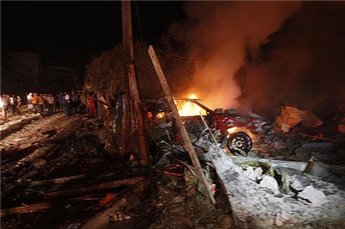
GAZA CITY — A physiotherapy clinic, sewerage pump, civil society organizations and government buildings have been damaged in Israeli raids on the Gaza Strip since Thursday, witnesses and officials said.
Israeli warplanes have bombarded the coastal enclave for three days in what the military says is a response to a deadly attack in southern Israel on Thursday.
Fourteen Palestinians were killed and more than 40 wounded in a series of airstrikes across the Gaza Strip.
A specialist physiotherapy clinic in Gaza City funded by the Organization of Arab Petroleum Exporting Countries was amongst the buildings seriously damaged in the assault, witnesses said.
The clinic was the first of its kind in Gaza and run by the Arab Fund for Economic and Social Development.
An electricity generator and four water pumps for the sewerage system in An-Nuseirat refugee camp were destroyed on Friday, causing power cuts in central Gaza.
The offices of the Organization of Islamic Cooperation sustained damages in air raids at dawn on Friday. The Gaza City office was opened to provide humanitarian assistance to Gaza residents in the wake of Israel’s Operation Cast Lead offensive in December 2008.
The same building was also bombed in July 2010. Officials said the damage would affect the organization ability to provide humanitarian services.
Israeli forces also shelled a library located in a residential area and among government buildings, the Gaza government said.
The Hamas-run Ministry of Justice, civil servants’ bureau and government media office were severely damaged, the ministry said.
In a statement, the justice ministry said Israeli forces deliberately targeted civil institutions in what it described as a war crime.
Israel arrests over 50 Hamas supporters in Al-Khalil
Palestine Information Center – 21/08/2011
 AL-KHALIL — Israeli occupation forces arrested Sunday morning more than 50 Hamas supporters in one of the largest raids on the West Bank city of Al-Khalil since 2003.
IOF troops accompanied by more than a hundred military vehicles in addition to undercover forces began raiding the city midnight Sunday and deployed throughout its neighborhoods, local and security sources said.
A number of arrests have also been made in towns outside of the city, as the operation, one of the largest since 2003, continues.
Violent clashes broke out in several areas and civilians have been left injured.
Among those taken into custody was Palestinian MP Mohammed Mutlaq Abu Juheisha.
Also on Sunday morning, Israeli forces arrested Palestinian reporter Oseid Abdul-Majid Amarina, 26, after a violent raid on his home in Dheisha refugee camp east of Bethlehem.
Bethlehem Mayor says soldiers ransacked home
Ma’an – 21/08/2011
BETHLEHEM — Israeli forces assaulted and detained a Palestinian man during a raid on the home of the Mufti of Bethlehem overnight Saturday, the sheikh said.
Sheikh Abdul-Majid Ata Amarna said troops raided his home in Duheisha refugee camp shortly before dawn prayers searching for his son Usayd, a journalist for Hamas-affiliated Al-Aqsa TV.
“When the soldiers raided my home, I asked them to wait before entering the different rooms so women could put on their head scarves and change their sleeping clothes, but instead of waiting they started firing inside the house injuring my brother-in-law, 27-year-old Bakr Badarin” the cleric told Ma’an.
He said Badarin was hit by a live bullet to his thigh, but soldiers refused to allow Palestinian Red Crescent medics to treat him and detained the injured man and the sheikh’s son Usayd Amarna.
The family learned later that Badarin was taken to Hadassah Hospital in Jerusalem for treatment.
Gaza health ministry condemns attack on doctor
Ma’an – 20/08/2011
GAZA CITY — The health ministry in the Gaza Strip on Saturday condemned Israel’s killing of a Palestinian doctor overnight.
Dr Munther Qriqe, 32, a member of Shifa hospital’s intensive care unit, was killed along with two others from the same family when an Israeli drone fired a missile at his car, medics said.
Qriqe was on his way home with his brother Mutaz and his young nephew Islam, the health ministry said, charging that the attack reflected Israel’s “brutal escalation against medical staff.”
“The Israeli aggression against the Palestinian people in Gaza has increased dramatically,” the ministry said in a statement early Saturday.
“Israel has crossed a red line,” said ministry spokesman Dr Ashraf Alqudra.
The health ministry called for more protection for medical staff.
13 year old boy old dead and 18 injured in Gaza
19 August 2011 | International Solidarity Movement, Gaza
Israel’s price tag campaign is not waged only by the settlers in the West Bank; it is also waged against the people of Gaza. It isn’t exactly clear what the Gaza Strip is paying the price for. In contrast to Israeli propaganda, people are killed in Gaza all the time. This has been a bloody week. An 18 year old mentally disabled man was shot to death on Tuesday, another young man was shot in the leg on Tuesday. Perhaps the price must be paid simply for existing.
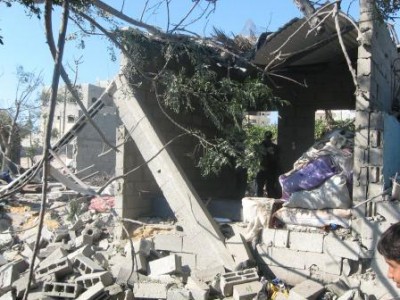 Overnight Israeli warplanes pounded Gaza. Nine people have been murdered in Gaza since yesterday. 13-year-old Mahmoud Abu Samra was one of the killed, he and 18 others were injured in one bombing attack in Gaza. The Abu Samra family lives near the former intelligence services headquarters in Gaza City. Their house was destroyed by an Israeli bomb last night at 12:30 A.M. Their house was completely destroyed, one of their neighbors houses was also destroyed, one more, heavily damaged. Thirteen people from three families live in these houses. All of these families are refugees, expelled from their homes in 1948, and now, in a repeat of history, once again their houses are destroyed. When we arrived family members were picking through the rubble, trying to salvage what could be salvaged.
The Abu Samra house was completely destroyed. All that is left standing is a bathroom with the door torn off, a sink, and a broken mirror in it. Mahmoud is dead, the latest causality in the Israeli assault on Gaza. Neighbors and relatives pick through the remains. A shattered computer monitor sits on a pile of rubble. Israel bans the import of concrete into Gaza, so the house will probably live on in another house after the rubble is recycled. Mahmoud is dead, he was buried today.
Next to the Abu Samra house is the Al Helal Sporting club. It is one of the few places for young men to hang out in the neighborhood. When the bomb hit it was packed with young men trying to escape the heat, entertaining themselves playing football and watching TV. Many of the injured were young people from the neighborhood at the club.
We spoke to Seham Awad, a forty five year old mother of two. She and her nephew were picking through the rubble. Thankfully, her son is away at university studying, her daughter is married and no longer lives with her. Her ex-husband is in an Israeli prison, seven years into a twelve year sentence. She is unemployed and lives on charity and help from her neighbors. She is a resourceful woman though, her backyard, maybe 25 square meters, has been turned into a garden. It is overhung by a shattered trellis for passion fruit vines. She grows vegetables on the rest of her land, in old tires that have been turned into planters, on every square meter of land vegetables grow. Her house is small, only two rooms, now both destroyed.
Her house was also destroyed during Cast Lead, she received no help rebuilding, only some mattresses and household supplies. She lives without windows; only sheets cover the holes in the walls that would be windows. Perhaps, this was lucky last night, there was no shattered glass to cut her. After the attack, she slept in the garden, on mattresses placed in the back corner. She is undefeated, after her house was destroyed in Cast Lead she rebuilt as best she could, concrete blocks, an asbestos and tin roof, and no windows. She expected that her house would be destroyed again, she was right. As she said, “I expect little from life, I planted this tree, now it is big, it provides shade, that is enough.” When asked what she would do now, where she would go, she said, “I will stay here, I will rebuild again as best I can, where else can I go?”
Her neighbors, the Abbas family was not so lucky. Their father, Abu Akmed was injured in the bombing. This family too is picking through the rubble, praying for their father. Their home, heavily damaged was all that they had. In the back a horse still lives in a small shed. Abu Ahmed, like most men in Gaza, had no job–they’re just simple refugees trying to rebuild their lives. Nine people crammed into a small concrete block house, now, mostly destroyed. Out their front door you can see the old security headquarters in Gaza, heavily bombed during Cast Lead and now abandoned.
Behind the Abbas family lives Hajjer Abu Duwani. She is a fifty five year old mother of twelve. She is a small woman; she looks older than her years. She doesn’t really have a house, just two tin sheds that she lives in. A chicken coop takes up one end of her land; on the rest of it she tries to grow vegetables. She has no job; she depends on the help of her children to live. Shrapnel from the bombing hit her. She has an ugly hand sized bruise on her leg, another bruise on her arm, and her head was cut with shrapnel. She is happy, at least she is alive, Mahmoud, her thirteen year old neighbor is dead, the houses of her other neighbors destroyed.
Egypt’s Secret Minister
By THOMAS C. MOUNTAIN | CounterPunch | August 17, 2011
Just exactly what influence Omar “The Secret Minister” Suleiman retains over the military junta that rules Egypt is a question of utmost importance for those who live on the banks of the Nile River. With a resume including 20 years as head of Egyptian Intelligence he is not someone anyone of those who helped bring about the downfall of Mubarak can afford to ignore.
He was the CIA’s go to man when it came to doing the Agencies dirty work in the Middle East as well as being the liaison with Israel and was reported to be in contact with Mossad on an almost daily basis.
Suleiman is infamous for enforcing the blockade of Gaza, saying he wanted the Palestinians there to “be hungry but not starving” in punishment for supporting Hamas. Hungry as in a 40% level of malnutrition related disability rates amongst Gaza’s children.
Mubarak as Egypt’s Godfather was as lacking in charisma as any leader in the Arab world and ruled by brute force alone. Omar Suleiman was his consigliere and enforcer combined, and was reputed to having a hands on approach to how his torturers carried out their interrogations.
While Mubarak and Sons lived a very publicly ostentatious lifestyle and were well known for their corrupt and decadent ways, Suleiman “The Secret Minister” always preferred to remain behind the scenes, at least until those last desperate days of the Mubarak regime and his “appointment” to the new position of Vice President of Egypt. It was he who announced to the world that a military coup had been carried out and that Mubarak was officially “retired”.
Of course, every member of the Egyptian military junta that overthrew Mubarak had arrived on the Supreme Military Council with his appointment stamped “Approved by Suleiman”. While they may hate “The Secret Minister” one could expect that the junta leaders know that if they want to avoid ending their careers standing in a cage in an Egyptian court “they had better hang together or they will all hang separately”.
Suleiman put them where they are and who better to keep matters from really disintegrating? And who better to keep them informed about what the CIA will and will not approve of.
Today the whereabouts of Suleiman the Secret remains just that, a secret. The last time he was allegedly heard from was via a letter to Al-Ahram newspaper in which he disavowed any desire to be elected President of Egypt. No, all he wanted to do was “live a quiet life with his family”.
Trial by military courts, torture and disappearances, all the hallmarks of Suleiman the Secret are still a part of today’s Egypt and those who partied in the streets after the Coup against Mubarak had better be warned. Behind the scene and still pulling the strings, Suleiman the Secret remains a danger whose continued influence will be ignored at the peril of those who rejoiced at Mubarak’s downfall.
Thomas C. Mountain is the only independent western journalist in the Horn of Africa, living and reporting from Eritrea since 2006.
Israeli police jeep kills Palestinian
Press TV – August 17, 2011
A Palestinian pedestrian has been killed after an Israeli border police vehicle hit him in East al-Quds (Jerusalem) suburb near an Israeli settlement neighborhood. The 38-year-old victim Amin Talab Dabash was hit by an Israeli police jeep in Har Homa in East al-Quds, AFP reported on Wednesday.
A spokesman for the Israeli border police, however, claimed that the victim died in a traffic accident.
“Last night in the area of Har Homa, there was an accident when one of our jeeps hit a pedestrian. As a result of the accident, he died,” the Israeli spokesman said.
“He was crossing the road in a dark area, an area without lighting and the jeep hit him,” he added.
The Dabash family accuses Israel’s border police of having intentionally killed him.
At least 1,000 Palestinians attended Dabash’s funeral chanting slogans against the Israeli regime.
Settlers torch farmland near Nablus
By Saed Bannoura | IMEMC & Agencies | August 16, 2011
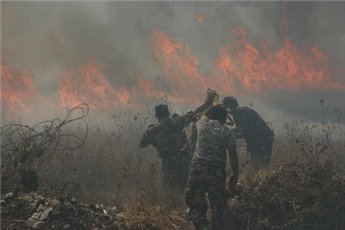
Ma’an Images
A group of armed extremist Israeli settlers torched dozens of dunams of farmland near the Homesh former settlement, north of Nablus city, in the northern part of the West Bank on Tuesday evening.
Ghassan Douglas, a Palestinian official in charge of settlements file in the northern part of the West Bank, stated that the settlers set ablaze all trees planted around the evacuated settlement and that the fire consumed hundreds of almond trees and evergreens.
He added that the trees belong to the local Palestinian residents, and that the attack was carried out just as the residents were preparing to break their fast as the Muslims are marking the holy month of Ramadan.
On Sunday evening, July 31, a group of fundamentalist Israeli settlers set ablaze, 150 Dunams of farmlands that belong to residents of Ein Jaloud village, near the northern West Bank city of Nablus.
On Friday July 15, settlers torched Palestinian olive orchards in Jabal Suleiman area, close to Burin village, south of Nablus.
The attack was carried out by a group of twenty heavily armed settlers who set ablaze at least 80 Dunams of farmlands, including dozens of olive trees.
Israeli soldiers arrived at the scene but failed to stop the settlers, but instead, obstructed the work of local firefighters.
The repeated attacks by the settlers are part of what they dub as “Price Tag” and include attacking and torching mosques in the West Bank, in addition to attacking farmers and their lands. The settlers hold the Palestinians responsible for the few random settlement outposts that were evacuated by the Israeli army in the West Bank.
Gaza: Soldiers shoot 75 year old woman along with ten goats
16 August 2011 | International Solidarity Movement
Selma Al Sawarka, or Um Ahmad, is an active woman, a mother of seven, and a grandmother of 35, who has never quit working. August 10, 2011 dawned like most days do for her; she went out to graze her family’s goats. She took her neighbor with her, 15 year old Keefa Al Bahabsa.
They went to the same land they usually go to. At 9:30 that morning they saw an Israeli tank and an Israeli jeep near the border. Not an uncommon sight. The tank and jeep left. About 30 minutes later, the jeep returned, three soldiers got out, and opened fire on Um Ahmed and Keefa. Um Ahmed was shot in the leg, Keefa fled to get help. The soldiers also shot ten of the family’s goats.
Um Ahmed is used to being shot at by the Israelis as her land is only 600 meters from the border. Usually, she says, the soldiers shoot around her, or into the air, trying to drive her from her land; she doesn’t know why today was different, why they shot directly at her, why they shot her in the leg. Her scarf also has bullet holes in it; only through the grace of God is she still here.
It took half an hour for Keefa to return with help, they loaded Um Ahmed onto a donkey cart, and went to the main road to meet a taxi to take her to the hospital. When I met Um Ahmed she was laying on a mat on the floor, recovering from being shot. A pale blue scarf covered her head. Bracelets adorned her wrists. Her daughter sat next to her. The room was simple, some mats on the floor, two chairs for the guests, a dresser, and small stand with a TV.
On the wall was a picture of her son Mustapha. He was killed by the Israeli’s on Dec, 15, 2004. Sometimes, the soldiers, or even the settlers themselves, would close the road near Netzarim settlement, the only way to go anywhere was to leave the road, and walk on the beach by the sea. Mustapha was shot and killed as he walked on the beach. The house we are in used to be Mustapha’s house. Beside the TV is another picture, another of her sons, this one has been in prison for the last ten years. He has eleven years left on his sentence. Um Ahmed, like all Gazan mothers, is not allowed to visit her son in prison, for four years this has been a blanket Israeli policy. Instead, she looks at this picture, she thinks about him in prison, while her leg heals.
Gaza teenager shot dead
Ma’an – 16/08/2011
GAZA CITY — Israeli forces shot dead a Palestinian teenager near the central Gaza Strip city of Deir Al-Balah late Tuesday, medical officials reported.
Medics said the Palestinian, who was not identified, suffered “more than 10” gunshots to the head and upper body after soldiers east of the Al-Masdar area opened fire.
Gaza health ministry official Adham Abu Salmiya told Ma’an that an ambulance crew transferred the teenager’s body to the Al-Aqsa Martyrs Hospital in central Gaza.
An Israeli military spokeswoman told Ma’an that “IDF forces opened fire at a suspect approaching the security fence. The forces identified a hit,” the official said.
The teenager had approached the border east of the refugee camp of Maghazi in central Gaza, Agence France-Presse quoted Palestinian witnesses as saying.
Earlier, Abu Salmiya said Israeli airstrikes killed one man and injured seven others in the central and southern Gaza Strip, in what the army called retaliation for a rocket attack hours before.
Featured Video

AIDS Inc. by Gary Null (2007)
or go to
Aletho News Archives – Video-Images
From the Archives
Clash of Civilization, Iran Part II
By Jamal Kanj – Intifada-Palestine.com – January 14, 2011
Israel’s survival kit is: perpetuate conflict, insecurity to rationalize collective hate and finally playing victim.
Devoid of conflict, Israel implodes internally; without hate, Zionism loses its justification; and playing eternal victim to continue blackmailing the West. Absence of this holy trinity, Israel ceases to exist.
From its inception, the house of Zion has mastered exploiting adversarial powers to advance Israel’s cause. For instance, their influence over the Democratic Party in the US began with President Truman’s bid for 2nd term election in 1948.
Responding to strong opposition from Secretary of State General George Marshall and Department experts urging against recognition of Israel, President Truman replied: “I’m sorry gentlemen but I have to answer to hundreds of thousands [Jewish voters] who are anxious for the success of Zionism. I do not have hundreds of thousands of [voting] Arabs among my constituents”
Zionists influence over liberal American politics was matched with the doctrinal school of Conservative theoreticians aligning the Republican Party’s platform with Israel’s objectives. The Neoconservative Zionists, coined Zioncons, invented the “Clash of Civilization” concept to fight Israel’s wars. … continue
Blog Roll
 Aletho News
- Merck Virologists Admitted to Falsely Certifying Vaccine Efficacy
- Mandatory Folic Acid for every man, woman & child
- Pro-Palestine protesters arrested outside UK’s ruling Labour Conference in Liverpool
- Mauritius denies landing permit to flight from Israel, forcing cancellation: Tour operator
- Israeli finance minister calls for genocidal war on West Bank, annexation of south Lebanon
- 12 Things Your Psychiatrist Was Trained Not to Tell You
- From Unipolar Universalism to Multipolar Civilizational Distinctiveness
- RSF military group defects, joins Sudanese army: State media
- Ireland goalkeeper refuses to play ‘Israel’ as squad weighs boycott
- China pushes back against US on Cuba, Iran
- If Americans Knew
- Israel forces Gazans to live in constant peril – Daily Update
- Deconstructing Netanyahu’s pants-on-fire UN rant – Daily Update
- Trump betrayed voters with his campaign lies and prioritized a foreign country once he took office
- Netanyahu calls Israel’s war in Gaza ‘opposite of genocide’ in UN speech to near-empty hall
- Settler Kidnappings: Torture, Sexual Abuse and Terrorisation of Palestinian Abductees as Israel Deepens Annexation of West Bank
- Gaza winter nears as 162,000 tents become unusable, raising fears of humanitarian crisis
- Netanyahu says, “It’s the opposite of genocide”; UN says Gaza economy is world’s ‘most severe crisis on record’ – Daily Update
- Israel’s US-Backed Assault on Gaza Has Created the ‘World’s Most Severe Economic Crisis on Record’: UN
- ‘Protecting U.S. Citizens’… From Israel
- ‘This is where I live now, the back of a truck’: a day in the life of a grandmother in Gaza
- No Tricks Zone
- New Study: Earth And Venus Surface Warmth Largely Explained By Convection And Lapse Rate, Not CO2 Or Radiation
- 2025 Nature Paper Claiming Worsening Global Drought Gets RETRACTED …Heavily Flawed
- New Study: ‘Global Drought Shows No Detectable Recent Acceleration Under Climate Warming’
- Economic Masterminds: German Socialists Suggest Taxing Productivity Gains Stemming From Using AI
- The South China Sea Has Not Been Cooperating With The Climate Change Narrative
- Energy Crisis: Germany Enters Heating Season With Historically Low Gas Reserve Fill Levels
- New Study: The Antarctic Ice Sheet Gained Mass From 2020-2024 Due To Staggering Snow And Ice Accumulation
- Study: Ocean Heating Rates From Thousands Of Years Ago ‘Dwarf’ Modern Ocean Heating Rates
- Climate Extremists Target, Attack Large-Scale Power Grid Infrastructure In Germany!
- New Study: Antarctic Ice Melt Has Contributed Less Than 1 Centimeter To Sea Level Rise In The Last 30 Years

