From Brixton to Tottenham
By MICHAEL DICKINSON | Counterpunch | August 16, 2011
Following the recent disturbances in England in inner city areas of high unemployment and poverty it is expected that the final count of those arrested for riot and looting could reach as high as 4000. Reasons suggested by the press for the scale of the unrest include recreational violence, criminal opportunism, social irresponsibility, gang culture, greed, and cuts in public services, including the closure of youth clubs. But the prime factor that caused the mayhem to spread must come down to local tensions with the police, and their fatal shooting of Mark Duggan, a black man travelling in a minicab.
Similarly, in the early 1980’s young black men in Brixton were victimised by the widespread use of the “sus” law, which enabled police officers to stop and search members of the public even if they had no hard evidence that a crime had been committed. And the shooting of a black woman, Cherry Groce, in her own home by police investigating a robbery in September 1985 was the trigger for a simmering resentment to explode.
I was living in a squat in Brixton at the time. We were just getting ready for supper when news came on the television about the shooting. Apparently, in a search of her flat for her son who was wanted on a suspected firearms offence, Mrs. Groce had been shot dead in bed by a policeman. (We learned later that she wasn’t killed but had been paralyzed from the waist down from the shot.) The news said a group of protesters had gathered at the local police station chanting anti-police slogans and demanding disciplinary action against the officers involved. I said we should get down there and join them. While my squatmates hummed and hawed I decided not to waste any time and set off for Brixton Police Station. As I approached the center I met people coming from it warning me to go back as the protest outside the police station had turned into a battle which was spreading through the streets, but I decided to continue. I saw people coming out of smashed shop windows with goods, people running, throwing stones at lines of charging police, a few cars and buildings burning, lighting the night with orange flames. Police cars and vans rushed around wailing.
Not everyone was out on a riot. Many like myself had just come to see what was going on. (I had my right arm set in a plastercast anyway from an earlier accident.) Halfway up Railton Road, the notorious ‘Front Line’ a barricade of bins and boxes was being erected by rioters. I found a large pile of old discarded newspapers and added them to the defence in solidarity, then went to visit two young women friends, Helena and Rachel, who lived in a flat nearby. We had a chat and a drink and I persuaded them to come out and see what was going on. There was a good view of Railton Road across a tarmacked park from the end of their street. A crowd of mainly black residents had congregated there and were watching the scene. The barricades across the road were now burning and molotov cocktails were being hurled at the charging shield and baton wielding army of crash-helmeted police force. The mood of the onlookers was excited and friendly and they laughed and cheered when I shouted across the tarmac at the police, telling them to get out of Brixton and leave us alone. A few voices joined me.
Helena suggested we go back into the flat and listen to the police radio she had hacked into and learn what was happening. Apparently Brixton was out of control and people were being arrested all over the place.
When we went back out a bit later the barricades were smouldering and the riot police were having a breather, seated with their shields in front of them on the benches on the other side of the park. The onlookers were still crowded together watching. When one of them saw me they said “Ah, here’s Rambo again! (In reference to the small black cyclist’s helmet I was wearing.) Give them some more jaw, Rambo!”
So I made my voice reach the resting cops across the square.
“Do your mothers know you’re out? Isn’t it time you were home in bed? Get out of Brixton! You’re not wanted here!”
Suddenly the gang of police stood up and started drumming their batons against their shields. At the same time one of the crowd shouted a warning.
“There’s a police van coming up the street! Run for it everyone!”
The onlookers began to scarper in every direction, and at that moment the line of bobbies began to charge towards us. I began to run but suddenly stopped and began to walk instead. Why should I flee? I hadn’t done anything wrong.
One of the charging policemen reached me and grabbed my arm.
“Let’s hear you shouting now, Rambo!” he said, and another cop grabbed my helmet and chucked it away. I was bundled into the back of the police van which had now arrived and was driven back into the heart of Brixton, stopping and picking up other young men, black and white, along the way, who had been arrested. The van was soon full and we were driven to a police station where we were made to line up outside while they dealt with detainees ahead of us. An officer handed out leaflets.
“Read and inwardly digest,” he said. I took one and shoved it into my mouth, biting and chewing. It didn’t taste very nice so I didn’t pursue the joke. Inside mug shots were being taken of all those arrested. One guy’s nose was pouring with blood as his picture was taken. Then it was time for fingerprints. I refused to have mine done. When asked why not, I said it was my right, and a senior officer confirmed this, but he said it might make matters difficult for me later. Then I was put into a small cell with about ten other guys and we were there for the rest of the night, most of us seated on the floor. At one point two policemen came and removed one black guy and made him take his trousers and underpants down outside the cell before putting him back in again.
In the morning my cellmates began to be released one by one, collecting summons for their court appearances on various charges connected with the riots of the previous night. Finally there was just me in the cell, and when, by lunchtime, I demanded to know why I was being kept, I was told that if I gave my fingerprints I would be released. What else could I do? I gave them and got my summons to appear in court a couple of days later.
Before that, the next morning at about seven the front door of our squat was battered down by police officers saying they were looking for goods looted in the riots. We were confined to our rooms while they searched. I objected when they started going through my letters and private documents, saying that none of them had been stolen, but there was nothing I could do. After combing the flat they took away one of my squatmates, Frank, to question at the station because he had a suspiciously large amount of rolling tobacco, but he hadn’t stolen it and no charges were brought.,
Meanwhile I got Helena and Rachel to come along to my court hearing, and a neighbour of theirs who had been in the crowd that night to act as witnesses to the fact that I had done nothing wrong. A lawyer was provided. After I talked to him he said that considering my list of previous arrests there was a possibility I might be facing time in prison. I was a little worried at first, but when the judge heard the circumstances presented as police evidence against me he quashed the charge.
I was charged with ‘Incitement to Racial Hatred’. The story that the arresting officer told in the dock was extraordinary. He said that the accused (me) had been in the company of a gang of black youths. When I had appeared on the scene where the police were resting I had pointed to them and announced: “There they are! Kill the devils!” And my little gang had proceeded to throw bricks and stones at them.
“Just a minute,” said the judge. “This man is white. Him telling black people to kill white people cannot be classed as ‘Incitement to Racial Hatred’. It only works if you are inciting hatred of another race, not your own. This is a waste of time. Case dismissed.”
And so to my relief I was free. Free? Well, at least not in prison.
In 1987 Inspector Douglas Lovelock, the officer who shot Cherry Groce was acquitted of all charges, including malicious wounding, and was reinstated. Mrs Groce received compensation but remained paralyzed for the rest of her life. She died in May 2011.
Meanwhile, the identity of the policeman who shot Mark Duggan remains unclear.
Michael Dickinson can be contacted at his website – http://yabanji.tripod.com/
British police kill indiscriminately
Press TV – August 16, 2011
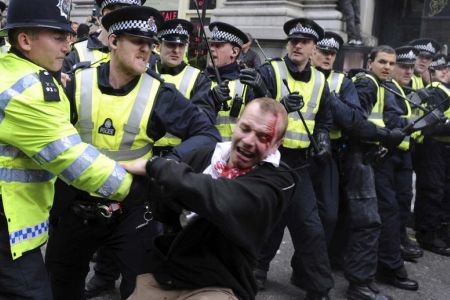
British police have played a significant role in triggering civil disobedience in the UK through their unprofessional and brutal way of dealing with innocent civilians.
Mark Duggan, recently killed in a police shooting in the London suburb of Tottenham and whose death sparked a wave of street protests across Britain, Ian Tomlinson, an English newspaper vendor who was killed during G20 summit protests in London, Jean Charles de Menezes, who was shot seven times in the head after the London bombings of July 7, 2005, and David Emmanuel , a British reggae singer who was killed during a police raid on his home, all are the names included in a long list of people killed at the hands of British police forces.
Independent Police Complaints Commission (IPCC), a police watchdog that deals with complaints against police has been established to investigate police’s crimes.
The IPCC’s job is to make sure that complaints against the police in England and Wales are dealt with effectively, it claims.
The body claims to be setting standards for the way the police handle complaints against themselves and, when something has gone wrong, it helps the police learn lessons and improve the way it works.
But they neither have learnt lessons nor have they tried to improve their performance, the example of which are:
1- Mark Duggan, whose family said it has no trust in the IPCC. The police shooting victim’s friends and family said that they don’t feel the police watchdog is sufficiently independent. The police watchdog has admitted it may have wrongly led journalists to believe that Mark Duggan fired at officers before he was killed. The Independent Police Complaints Commission has confirmed that it may have “inadvertently” given reporters misleading information in the early stages of the investigation. It was initially reported that Duggan, 29, shot at police. But ballistic tests later found that a bullet which lodged itself in one officer’s radio was police issue. An inquest into Duggan’s death heard the father-of-four died from a single gunshot wound to the chest.
2- Ian Tomlinson was an English newspaper vendor who collapsed and died in the City of London after he was confronted with the police while on his way home from work during the 2009 G20 summit protests. A first postmortem examination indicated he had suffered a heart attack and had died of natural causes. A video footage later showed that a baton wielding police had struck him on the leg from behind and the pushed him on the ground. The video showed no provocation on Tomlinson’s part. He also was not a protester, and at the time he was struck was walking along with his hands in his pockets. The victim walked away after the incident, but collapsed and died moments later.
3- Jean Charles de Menezes was killed in the aftermath of the London bombings of July 7, 2005. He was a Brazilian man shot in the head seven times at Stockwell tube station on the London Underground by the Metropolitan Police. Police misidentified the victim as one of the fugitives involved in the previous day’s failed bombing attempts. The IPCC launched two probes into the incident, none of which brought disciplinary charges against police officers involved.
4- David Victor Emmanuel, known as Smiley Culture, was killed on March 15, 2011 during a police raid on his home. The 48-year-old was a British reggae singer and deejay known for his fast chat style. Police claimed that the victim died of a self-inflicted wound, while officers were searching his house in Warlingham, Surrey. But a post-mortem examination revealed that he had died from a single stab wound to his heart. His death triggered peaceful protests, but it was little reported.
The IPCC was faced with a crisis in February 2008 after more than one hundred lawyers who had specialized in handling police complaint resigned from its advisory body.
They lashed out at IPCC for its indifference towards complaints, favoritism towards police and rejecting complaints, which were strongly documented. Meanwhile, there have happened more than 400 deaths at the hands of police officers in the past ten years alone but no policeman has ever been convicted of murder or manslaughter for just one single death so far.
Unexplained Gaza communications “blackout” highlights Israeli control of networks
By Benjamin Doherty – The Electronic Intifada – 08/14/2011
On Tuesday, Gaza disappeared from the world’s telecommunication networks for between 12 and 18 hours. This was an anxious time for both Gaza’s residents and those trying to contact friends, colleagues and loved ones from the outside.
The Gaza Strip, home to 1.6 million Palestinians, the vast majority of them refugees, depends on telecommunications to maintain a tenuous link to the outside world, from which it has been physically isolated due to five years of Israeli siege and blockade. The sudden cutoff also sparked fears of an imminent Israeli attack.
Though there was relief when communications were re-established, there has been no satisfactory explanation of the blackout, who was responsible for it, and whether or not it could happen again.
What happened to Gaza’s networks last week?
Ma’an News Agency was the first to report the problem, and a few Twitter users in Gaza remained online because they had BlackBerry service or were able to connect to the Orange network via its towers on the Israeli side of the boundary with Gaza.
The blackout has not been fully explained, and statements from Israeli and Palestinian officials are not consistent. The initial reports of Israeli bulldozers do not mention if the bulldozers were actually digging in the ground. One incident should not have disconnected the entire Gaza Strip, because there are multiple lines at different locations that connect Gaza’s networks to the West Bank. […]
[An Israeli occupation forces] spokesperson denied involvement in the disconnection, but they were very specific about what they were denying. […]
Occupied Lineman
To repair broken equipment in Israel, the Palestinian companies that maintain them must either receive permission from the Israeli authorities or find an Israeli contractor to perform the work. During Israel’s three-week long assault on Gaza in 2008-09, millions of dollars of damage was done to Gaza’s telecommunications infrastructure, but even then, the network did not completely fail as it did last week.
Under the terms of the Oslo Accords, Israel agreed to allow Palestinians’ to develop an independent telecommunications infrastructure, but the communications infrastructure in West Bank and Gaza Strip remains completely dependent on Israel. In fact, Palestinians (along with Israelis) are prohibited from connecting to international networks through any other country. Despite this, Paltel announced its intention to develop an alternate connection through networks in Jordan earlier this year.
In a useful and well-documented paper, Helga Tawil-Souri gives a detailed introduction to the history of Palestinian telecommunications under Israeli occupation and what she terms the “Hi-tech enclosure of Gaza,” the electronic counterpart of Israel’s ongoing physical siege of the territory.
Moreover, Palestinian writer and entrepreneur Sam Bahour, who was part of the core team that established Paltel, has emphasized the importance of telecommunications to economic development and how Israel’s occupation has enriched Israeli companies and hindered Palestinian development in general. … Full article
US suspends aid to Gaza
Al-Manar | August 13, 2011
The United States has suspended operations of the aid organizations it funds in the Gaza Strip because the resistance group had demanded confidential information about their work, a US official told Reuters on Friday.
“USAID-funded partner organizations operating in Gaza are forced by Hamas’s actions to suspend their assistance work. (They) were put on hold effective August 12,” said the official, who is based in the region.
He added that “through a series of measures (Hamas) has imposed over the past months, it has created an environment which jeopardizes the ability of nongovernmental organizations to provide assistance to Gaza’s most vulnerable residents.”
The official, who declined to be named, said Hamas had demanded access to files and records of NGOs, which would reveal financial and administrative information, details of staff members and information on beneficiaries.
He said that Hamas had shut down the International Medical Corps (IMC) an NGO and USAID partner organization, after its officials objected to “unwarranted audits”.
“We are disappointed that Hamas has once again chosen to put its political agenda ahead of the welfare of the Palestinian people,” the official said, calling on the group “to cease its interference … so that we can resume our humanitarian and development activities in Gaza.”
Hamas administration official Taher al-Nono said an understanding had been reached which would allow independent auditing teams to inspect the files of NGOs, but he added that Hamas had the right to monitor their work in the territory.
The IMC will be allowed to reopen its offices on Saturday or Sunday, he added.
Responding to the USAID decision to suspend its partner organizations’ work, Nono said “Such a decision sounds odd a day after the understanding was reached … we reject any foreign intervention in Palestinian affairs.”
~
Ma’an | August 13, 2011
GAZA CITY — The Palestinian movement Hamas and the US Agency for International Development have reached a compromise to maintain the flow of aid, a senior Hamas official said Saturday.
“We’ve reached a compromise with USAID through the United Nations” to allow the continuation of aid, which was suspended by Washington on Friday, the official of the movement controlling the Palestinian enclave said.
A day earlier, a US official announced that USAID was halting humanitarian assistance to the Gaza Strip over alleged meddling by the Hamas-led government, which the US considers a terrorist group. […]
… a [Hamas] spokesman in Gaza insisted Friday that the government should be able to verify the accounts of NGOs financed by the US Agency for International Development in the Palestinian territories.
“The minister of interior of the government of Hamas intends to exercise its legal rights in the surveillance of all institutions operating in Gaza,” spokesman Taher al-Nunu said.
He complained that “USAID refuses to recognise the government in Gaza,” adding that anyone who “wishes to work in Palestinian territory must obey its laws.”
A similar row was underway in Cairo where a notorious Egyptian intelligence apparatus is probing foreign funding of civil society groups sparking tensions between Washington and Egypt’s ruling generals, judicial sources said.
Israel uses “primitive, racist” policies against Palestinian prisoners
By Mel Frykberg – IPS – August 11, 2011
RAMALLAH – “I’m sick with worry about my daughter,” Yehiya al-Shalabi says. “I’m afraid of what they are doing to her. She has done nothing to deserve this. If they have anything against her why don’t they bring her to trial?”
Hana al-Shalabi, Yehiya’s 27-year-old daughter, has been languishing in Israeli administrative detention for more than two years. She is the longest serving Palestinian female political prisoner in administrative detention.
According to her lawyer, the young woman from Jenin in the northern West Bank does not know why Israeli soldiers arrested her several years ago. She also does not know how long they will keep her in jail or what they will charge her with.
Shalabi, like nearly 200 other Palestinian prisoners, is being held in Hasharon prison. A senior Israeli military officer has just renewed the administrative detention order against her for the fourth time.
Israel’s “administrative detention” policy states that Palestinian political prisoners can be held for six months without trial or charges being brought against them. The detention order can be renewed every six months.
According to the official narrative, the policy of administrative detention is used by the Israeli military when they have “classified and secret” information against Palestinian prisoners. Both the prisoner and their lawyer are forbidden from seeing the classified information, and therefore are unable to challenge accusations or to question those who made the accusations.
The administrative detention policy is used when Israeli authorities have “secret witnesses” such as Palestinian informants, or has obtained intelligence in a clandestine manner which would not stand up in an Israeli civilian court but are par for the course in Israeli military courts.
No fair trial
“It’s a primitive and racist way to hold a trial and no civilized country in the world uses such methods. Needless to say Israel’s legal system could never do this to an Israeli Jew. Even the Israeli settlers who carry out acts of terror against Palestinians in the West Bank are not treated in this manner,” Qadura Fares, the president of the Palestinian Society Prisoners’ Club in Ramallah, said.
“Administrative detainees are not given a fair trial. Basically the Israeli military prosecutor and the military judge are in agreement. It is very rare for a judge to disagree with the military prosecutor,” Fares says.
In the 1970s Ali Jamal, also from Jenin, spent seven years in administrative detention. He holds the record for the longest administrative detention to date.
“At that time the Israeli military courts relied on confessions from Palestinian prisoners for convictions,” Fares explained. “But Jamal wouldn’t confess so the laws were changed to allow the ‘secret witnesses and secret files’ to be used by the IDF [Israeli military] to convict political prisoners.”
The soldiers came for Hana al-Shalabi in the middle of the night over two years ago. “They ransacked the house and assaulted me when I tried to stop them from taking my daughter away,” Yehiya al-Shalabi said. “My daughter had finished her studies and was engaged to get married. She was very diligent and stayed home most of the time except for when she helped tend our agricultural crops. She had no social life outside and wasn’t political in any way.”
However, Israeli special forces assassinated Hana’s 24-year-old brother several years ago after they accused him of being a member of Islamic Jihad, Yehiya said. “They had shot and wounded him. He phoned us, as he lay badly injured on the ground. But before he could finish the call the death squad moved in and shot him at close range, several times in the head and in the eye.”
The conditions in administrative detention are harsh, just as they are for all Palestinian prisoners.
Confessions through coercion
“Confessions are coerced through physical and verbal humiliation, torture, emotional blackmail such as bringing in elderly or sick relatives who are held as hostages until the prisoner confesses,” Fares said.
Imani Nafa, aged 47, spent ten years in an Israeli jail as a young woman, from 1987 to 1997 during the first Palestinian intifada. Nafa had everything going for her. She had finished university and was working as a nurse. But, she became politically involved and had planned to carry out a shooting and bombing attack against Israeli soldiers.
Nafa was caught and kept in a filthy, cramped cell with no window. Fluorescent lights were kept on permanently, causing sensory deprivation and the inability to distinguish between day and night.
“I was beaten and held in stress positions while handcuffed for several days, unable to move. I was deprived of sleep and when the interrogation finished I was forced to drink from the drain in my cell and eat mouldy food,” Nafa said. “I was told that if I worked with them to spy on other prisoners I would be freed, but if I refused to do so I would be imprisoned for a very long time and harshly treated.”
Black Britain Revolts: What If It Had Been New York?
Glen Ford | Black Agenda Radio | August 9, 2011
It is impossible to observe the outbreak of Black rebellions on the streets of Great Britain without a comparison with the United States. In many respects, the confrontations with police that began in the Tottenham district and quickly spread to neighborhoods around London and to the cities of Liverpool, Nottingham, Bristol and Birmingham, England’s second largest city, followed patterns that would be familiar to any Black American.
Just as with virtually every U.S. urban rebellion over the past 75 years, the London police set off the violence when they shot to death a young Black man. African Americans would also immediately recognize the institutionalized racism that pervades the British criminal justice system. Black Brits are six times more likely than whites to be stopped and searched on the street by police, and are incarcerated at about seven times the rate of British whites, although studies show that whites are just as likely to commit crimes as Blacks. Racial reformers in the United Kingdom point to many of the same social imbalances as highlighted by their counterparts in the United States. For example, “for every African Caribbean male on [college] campus, there are two in jail.” People of African descent in Britain are heavily ghettoized and clustered in relative poverty.
Black Brits and Black Americans are, indeed, in many ways, in much the same boat. But the difference is in the scale of racial repression in the two countries. When it comes to state violence against people of African descent, Britain isn’t even in the same league with the United States. At the time of this writing, besides the initial Black victim, possibly one person had died in days of disturbances in London and other cities. In contrast, the 1992 Los Angeles rebellion left 54 dead, thousands injured and 7,000 people arrested. There can be no doubt that, had London’s current disturbances occurred on a similar scale in New York City, with outbreaks across the various boroughs, the police would have unleashed a bloodbath. And if the disturbances were to spread to Chicago and other cities, a post-911 United States would likely declare a kind of marshal law.
British police struggle to cope with young people linked by instant-message technology who move from neighborhood to neighborhood in “flying squads” of mopeds and bicycles to find the best looting opportunities. But authorities were reluctant to impose curfews, and rejected the use of rubber bullets or water cannon. British Home Secretary Theresa May explained: “The way we police in Britain is not through use of water cannon. The way we police in Britain is through consent of communities.”
You will never hear a cabinet-level officer of the United States government speak of respecting the “consent of communities” while imposing order – certainly not the consent of African American communities. In Philadelphia, at the same time that parts of London were burning, the Black mayor slammed a curfew on the city in reaction to a couple of incidents of “flash mobs” that caused little more than public anxiety, and promised harsh measures if people did not go home and stay home. In the U.S. of A., that means deadly force.
So, yes, the workings of racism in Britain bear many similarities to the United States. But the Brits don’t come close to matching the Americans in the sheer scale of racist violence and repression.
Hamas: No improvement at Rafah crossing
Ma’an – August 10, 2011
GAZA CITY — Gaza Interior Ministry deputy Kamel Abu Madi said Wednesday there had been no improvements at the Rafah border crossing with Egypt.
“The working procedures at the Rafah crossing are as usual and no improvement has occurred,” Abu Madi said.
He added that Egyptian authorities were still preventing Palestinians who had fled Libya from entering the Gaza Strip.
The official said there were serious discussions with Egyptian authorities over ongoing issues which he hoped would be resolved soon.
Egypt permanently opened the Rafah crossing for Palestinians in May 2011 in a significant change of policy from the previous Mubarak regime.
The Rafah border with Egypt is Gaza’s only crossing that bypasses Israel, although it is still lacks the infrastructure required to transport large quantities of goods into the Gaza Strip.
Egyptian and Gazan authorities have struggled to cope with huge demand and coordinating procedures, leading to travel delays.
Population of Gaza fears Israeli invasion in midst of communication blackout
By Saed Bannoura | IMEMC News | August 10, 2011
Late Tuesday night, residents throughout Gaza lost internet, cell phone and landline phone service, creating a communication blackout similar to one which occurred just before a massive Israeli invasion in 2008. The blackout sparked fear among Gaza residents that an Israeli invasion might be underway.
Just before the communication blackout began, residents of northern Gaza witnessed Israeli armored bulldozers mobilizing along the northern border between Israel and the Gaza Strip.
The main Palestinian cellphone company, Jawwal, told reporters with Ma’an News Agency that they were aware of problems with service, but did not know what was causing it.
During the 2008-9 invasion of Gaza, Israeli forces bombed the main power plants, plunging Gaza into a sea of darkness. Due to the ongoing Israeli siege, the electricity infrastructure of the Gaza Strip has been unable to fully recover, and fuel shortages have prevented the power plants from operating at full capacity. Since the 2008 invasion, Gazans have been on rolling electricity blackouts most of the time – in most parts of Gaza, people receive just six hours of electricity a day.
The Israeli military did not issue any statement or comment on the communication cut-off.
According to local sources, telephone landlines run by Paltel, the Palestinian Telecommunications Agency, were cut off, along with cell phone service by all of the major cell companies.
The source of the blackout is still unknown.
Gaza fishermen refuse return of confiscated ships stripped of motors, equipment
By Maureen Clare Murphy – The Electronic Intifada – 08/07/2011
After extensive correspondence between Palestinian human rights groups and the Israeli authorities, Israel agreed to return several fishing vessels confiscated off the coast of Gaza.
On 2 August, Israel brought the stolen ships to the Karem Abu Salem crossing with Gaza to return the ships to their owners. However, the boats had been stripped of their motors and fishing equipment; in some cases the missing equipment was worth thousands of dollars.
Israel also attempted to charge the boat owners for transportation fees to the Karem Abu Salem crossing — therefore the Palestinian fishermen refused the Israeli receipts for their vessels and returned to Gaza without their ships.
The Palestinian rights groups Adalah and Al Mezan released a statement on 4 August explaining that the returned boats had been confiscated from eight fishermen over the course of 18 months.
The Electronic Intifada has continuously covered Israel’s repeated attacks on Gaza fishermen and the fishing industry. Israel has arrested fishermen, shot them dead and more recently attacked a small ship carrying human rights observers monitoring Israel’s harassment of fishermen.
In addition to physically attacking Gaza fishermen, Israel has prevented them from rightfully accessing deep sea waters — decimating the fishing industry, robbing Palestinians in Gaza of self-sufficiency and depriving Palestinians in Gaza from an affordable source of protein.
Israel’s attacks on the Gaza fishing industry takes place in the wider context of its systematic decimation of Gaza’s economy, through denying exports from the besieged territory, and through the bombardment of agricultural areas.
Israeli army detains Freedom Theater actor
Ma’an – 06/08/2011
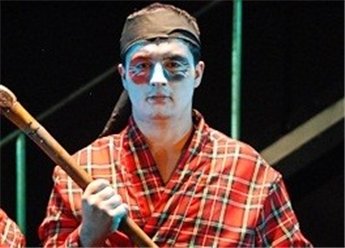
Acting student Rami Awni Hwayel [MaanImages/Freedom Theater HO]
JENIN — Israeli forces on Saturday detained an acting student of the iconic Freedom Theater at a checkpoint near Jenin, theater staff said.
Rami Awni Hwayel, 20, was detained, handcuffed and blindfolded at Shave Shomeron checkpoint in the northern West Bank. He was returning from rehearsals in Ramallah, the theater said in a statement.
An Israeli military spokeswoman said a Palestinian was arrested at the Shave Shomeron checkpoint but had no further details.
Hwayel is the third member of the theater to be detained by the Israeli army in recent weeks.
On July 27, Israeli soldiers detained Adnan Naghnaghiye and Bilal Saadi during a dawn raid on the West Bank city.
Director Udi Aloni said Hwayel’s detention was “devastating.”
“Rami is playing the main role in ‘Waiting for Godot’ and doing an amazing job, he’s so dedicated to the work. He just left rehearsals today for the weekend to see his family for Ramadan. It’s terrible, we want our Pozzo back.”
The theater urged its friends and supporters to act “in order to stop this outrageous harassment by the Israeli army against a cultural establishment.”
In April, unknown assailants shot dead the theater’s general-director, Juliano Mer-Khamis, 52, an Israeli national, in an unsolved case which has frustrated local security services despite initial claims of success.
Mer-Khamis’ late mother founded the theater in the 1980s.
Featured Video
AIDS Inc. by Gary Null (2007)
or go to
Aletho News Archives – Video-Images
From the Archives
Clash of Civilization, Iran Part II
By Jamal Kanj – Intifada-Palestine.com – January 14, 2011
Israel’s survival kit is: perpetuate conflict, insecurity to rationalize collective hate and finally playing victim.
Devoid of conflict, Israel implodes internally; without hate, Zionism loses its justification; and playing eternal victim to continue blackmailing the West. Absence of this holy trinity, Israel ceases to exist.
From its inception, the house of Zion has mastered exploiting adversarial powers to advance Israel’s cause. For instance, their influence over the Democratic Party in the US began with President Truman’s bid for 2nd term election in 1948.
Responding to strong opposition from Secretary of State General George Marshall and Department experts urging against recognition of Israel, President Truman replied: “I’m sorry gentlemen but I have to answer to hundreds of thousands [Jewish voters] who are anxious for the success of Zionism. I do not have hundreds of thousands of [voting] Arabs among my constituents”
Zionists influence over liberal American politics was matched with the doctrinal school of Conservative theoreticians aligning the Republican Party’s platform with Israel’s objectives. The Neoconservative Zionists, coined Zioncons, invented the “Clash of Civilization” concept to fight Israel’s wars. … continue
Blog Roll
 Aletho News
- Merck Virologists Admitted to Falsely Certifying Vaccine Efficacy
- Mandatory Folic Acid for every man, woman & child
- Pro-Palestine protesters arrested outside UK’s ruling Labour Conference in Liverpool
- Mauritius denies landing permit to flight from Israel, forcing cancellation: Tour operator
- Israeli finance minister calls for genocidal war on West Bank, annexation of south Lebanon
- 12 Things Your Psychiatrist Was Trained Not to Tell You
- From Unipolar Universalism to Multipolar Civilizational Distinctiveness
- RSF military group defects, joins Sudanese army: State media
- Ireland goalkeeper refuses to play ‘Israel’ as squad weighs boycott
- China pushes back against US on Cuba, Iran
- If Americans Knew
- Israel forces Gazans to live in constant peril – Daily Update
- Deconstructing Netanyahu’s pants-on-fire UN rant – Daily Update
- Trump betrayed voters with his campaign lies and prioritized a foreign country once he took office
- Netanyahu calls Israel’s war in Gaza ‘opposite of genocide’ in UN speech to near-empty hall
- Settler Kidnappings: Torture, Sexual Abuse and Terrorisation of Palestinian Abductees as Israel Deepens Annexation of West Bank
- Gaza winter nears as 162,000 tents become unusable, raising fears of humanitarian crisis
- Netanyahu says, “It’s the opposite of genocide”; UN says Gaza economy is world’s ‘most severe crisis on record’ – Daily Update
- Israel’s US-Backed Assault on Gaza Has Created the ‘World’s Most Severe Economic Crisis on Record’: UN
- ‘Protecting U.S. Citizens’… From Israel
- ‘This is where I live now, the back of a truck’: a day in the life of a grandmother in Gaza
- No Tricks Zone
- New Study: Earth And Venus Surface Warmth Largely Explained By Convection And Lapse Rate, Not CO2 Or Radiation
- 2025 Nature Paper Claiming Worsening Global Drought Gets RETRACTED …Heavily Flawed
- New Study: ‘Global Drought Shows No Detectable Recent Acceleration Under Climate Warming’
- Economic Masterminds: German Socialists Suggest Taxing Productivity Gains Stemming From Using AI
- The South China Sea Has Not Been Cooperating With The Climate Change Narrative
- Energy Crisis: Germany Enters Heating Season With Historically Low Gas Reserve Fill Levels
- New Study: The Antarctic Ice Sheet Gained Mass From 2020-2024 Due To Staggering Snow And Ice Accumulation
- Study: Ocean Heating Rates From Thousands Of Years Ago ‘Dwarf’ Modern Ocean Heating Rates
- Climate Extremists Target, Attack Large-Scale Power Grid Infrastructure In Germany!
- New Study: Antarctic Ice Melt Has Contributed Less Than 1 Centimeter To Sea Level Rise In The Last 30 Years

