Ex-Gitmo captive recounts lethal torture
Press TV – July 26, 2011
 German Guantanamo detainee Murat Kurnaz has publicly spoken about being subjected to electroshock torture, lethal beatings and humiliation during his years of unlawful detention.
In an exclusive interview with Russia Today news network on Monday, the former detainee said he was held at the Guantanamo Bay detention camp for five years before being released without charges.
Kurnaz went on to say that Americans have not apologized for his years of torment at the notorious detainment facility, and he doesn’t think they would ever do so.
He further explained that he was arrested in Pakistan in 2001, and turned to the Americans after he had visited a school run by Tablighi Jamaat — a religious movement hated by the al-Qaeda and the Taliban for its non-political stature — in the Asian country.
Kurnaz had earlier become familiar with Pakistan-based Tablighi Jamaat movement through its assistance to homeless people and youth, who had problems with drugs.
He added that when he got booked, Pakistani forces didn’t tell him anything about what was going on.
“They didn’t tell me that they were looking for terrorists or whatever. They said we’re just going to check your passport. I didn’t know at that time they get a bounty of $3,000 for each person. Not under my name, but for anyone turned over to the Americans as terrorist they get $3,000, and $3,000 in Pakistan is a lot of money,” Kurnaz said.
He noted that after being transferred to Kandahar in Afghanistan, he witnessed all kinds of things that one can imagine as torture.
“I saw many killed under torture. I was one of those who survived those kinds of torture. They used electroshocks on me because I would not sign papers.”
“I was forced to agree I was a member of the Taliban and the al-Qaeda and I said I’m not. Really I didn’t know at that time what al-Qaeda was, I didn’t know [anything] about al-Qaeda. So when they asked me about al-Qaeda and Taliban, I said I’m not a member of them. And they brought me papers, forced me to sign. I refused,” the former Gitmo prisoner said.
“That’s why they tried to make me sign by electroshocks. And another time they forced me by water boarding. Another time they hanged me on chains. I was hanging on the ceiling. They were pulling me on the ceiling with the chain, and until my feet were over the floor. After a few days I started to pass out, because in that situation I couldn’t eat or drink and it was freezing cold. It was wintertime and I had no clothes on,” he added.
Kurnaz said Guantanamo detainees were chained hand to foot in a fatal position on the floor with no chair, food, or water for 24 hours or more.
He also said that the youngest Gitmo prisoner was nine years old, and the second underage detainee in Guantanamo was 12.
Upon taking office, US President Barack Obama signed an executive order to stop military commissions in order to close down the facility by 2010. However, this has not happened yet.
Israeli restrictions ensure slow pace of Gaza reconstruction
IRIN | July 21, 2011
The housing crisis in the Gaza Strip is not going to be resolved any time soon: Only a small number of the 40,000 units needed to meet natural population growth and the destruction of homes in Israeli military operations are being built, according to the UN Office for the Coordination of Humanitarian Affairs (OCHA).
Israel restricts the import of building materials deemed to be of potential military benefit to Gaza’s Hamas government. A limited number of international, mainly-UN-backed, building projects are being allowed to go ahead, but the Israeli checking process is causing delays.
Israel’s spokesperson for the Coordinator of Government Activities in the (Palestinian) Territories (COGAT), Guy Inbar, told IRIN that COGAT reviews all international projects due to security concerns. “COGAT wants to have supervision that the projects are not being implemented near Hamas facilities, and to ensure that construction material goes only to the [Israeli-approved international] projects and not to Hamas.”
The UN Relief and Works Agency (UNRWA) has only brought in a tiny fraction of the construction material needed – 3,291 trucks since June 2010 (under 4 percent of the agency’s overall US$660 million construction plan to rebuild homes and schools in the Gaza Strip over three years).
It had also planned to build 100 schools, a teacher training centre, 10,000 “shelters” and two healthcare centres. “The so-called `easing’ of the blockade has made almost no difference in the lives of real people,” said UNRWA spokesperson Chris Gunness in Jerusalem.
In June 2010, after several international activists died trying to end the blockade, Israel announced a package of measures to ease its blockade of the territory to provide relief to Gaza’s population, while protecting Israeli citizens from harm. However, basic construction material like cement, gravel and asphalt remained on specific lists of prohibited “dual-use” items.
And as if to emphasize its determination to maintain the blockade, on 19 July Israeli commandos intercepted and boarded an international protest boat trying to reach Gaza.
Approved Projects
Some 73 reconstruction projects worth about 28 percent of the cost of UNRWA’s entire work plan for Gaza, have been approved by COGAT. Currently, UNRWA is entering about 240 trucks per week of aggregate and 90 trucks of other building materials. At this rate it will take a year to enter the supplies for the 73 approved projects, said Gunness.
Approved water and sanitation projects are also being delayed due to the lack of construction material.
As a result of the restrictions, there has been a significant increase in the amount of construction material entering Gaza via underground tunnels along the Gaza-Egypt border over the past year. An estimated 98,000 tons of construction material was entering Gaza monthly, according to a March report by OCHA. A similar amount was also now entering via the Kerem Shalom crossing, OCHA reported in June.
The International Committee of the Red Cross has called the blockade “a collective punishment in clear violation of international humanitarian law”.
According to Israel, Gaza is no long occupied territory since it withdrew its forces in 2005, and the Hamas government in power is now responsible for the welfare of Gaza’s population.
Tortured Kenyans allowed to sue UK government
Press TV – July 22, 2011
Four Kenyans have been allowed to sue the British government over the atrocities committed by the UK army against the anti-colonial Mau Mau uprising in the 1950s.
The British Foreign and Commonwealth Office (FCO) had insisted that the British government would not answer for the abuses committed by the former British colony and that legal responsibility referred to the present Kenyan government.
The recent decision means that the UK government will face charges of torture, murder and sexual assault among other alleged crimes.
Around 17,000 documents were found in the British Foreign Office’s archives, seen by the ministers in 1950s and 60s, which revealed the details of the UK army’s harsh measures.
Four elderly Kenyans Ndiku Mutwiwa Mutua, Paulo Muoka Nzili, Wambugu Wa Nyingi and Jane Muthoni Mara stressed that the documents from a paper trail showed that the UK ministers had approved abuse in their detention camps.
Earlier this year, Mutua and Nzili told the British High Court that they had been castrated, Nyingi had been hit unconscious, and Mara had fallen the victim of sexual abuse.
High Court Justice McCombe said that the claimants have arguable cases, which were fit for trial.
“I emphasize that I have not found that there was systematic torture in the Kenyan camps nor that, if there was, the UK government is liable to detainees, such as the claimants, for what happened,” he said.
The Kenyans’ lawyer said the ruling that the UK government could be held responsible for the anti-human rights actions in the colonies was a “historic judgment,” adding in the past 50 years his clients suffered the worst torture at the hands of the British Colonial regime.
“Castration, abuse, severe beatings, were just some of what they had to endure as the British tried to prevent the advance of the Kenyan Independence movement…Our government has seemed hell-bent on preventing that happening,” the lawyer said.
Recalling his clients’ sufferings, the attorney called for “some sort of justice, an apology, some sort of money that would give them peace in their final years.”
Human rights lawyer Paul Muite said what British soldiers did in Kenya, a British colony at the time, was “shameless and immoral.”
“These were terrible atrocities committed by British soldiers, not by the government of Kenya,” he said, adding that, “These people were fighting for justice, liberty and their land.”
Human rights workers continue to face Israeli aggression in Gazan waters
20 July 2011 | Civil Peace Service Gaza
The Israeli navy attacked Civil Peace Service Gaza volunteers along with international press and Palestinian fishermen today. One of the Israeli ships targeted the boats with high pressure water cannons.
Meanwhile, a small naval boat approached the Oliva and hit it from behind, stopping the boat and causing serious damage to the engine. The crew aboard the Oliva was evacuated to other boats and all the boats at sea were forced to turn back.
Joe Catron, an American human rights worker aboard the Oliva, stated, “Israel has been regularly attacking Palestinian fishermen within the purported 3 nautical mile fishing limit. The livelihood of many Gazans relies on fishing and Israel has been using live ammunition and water cannons to prevent fishermen from doing their work. We will continue to go out with the Palestinians and document human rights violations, despite the powerful threats we and Gazan fishermen face.”
This is the fourth attack on Oliva in less than two weeks. To watch and read recent reports in the news media about CPS Gaza, visit Al Jazeera and The Guardian.
Journalists and TV Crews are invited to join the CPSGaza boat.
Civil Peace Service Gaza is an international, third party, non-violent initiative to monitor potential human rights violations in Gazan territorial waters.
US abuses Afghans in secret jails: UN
Press TV – July 20, 2011
 A new report by the UN shows the United States continues to abuse prisoners in secret CIA jails in other countries including Afghanistan.
A UN inquiry says inmates are routinely forced to take off their clothes in secret CIA detention facilities in Afghanistan.
The report also says many prisoners are denied access to lawyers and deprived of the right to visit their relatives.
The developments come as a well-known Afghan prisoner named Shir Khan has said Washington still runs secret jails in Afghanistan despite US President Barack Obama’s claim to the contrary.
Shir Khan says inmates are blindfolded, hanged from the ceiling and dogs are unleashed on them during interrogation.
Several reports have confirmed that American prison guards have mistreated Afghan detainees held at the notorious US-run Bagram prison camp and airbase in Afghanistan.
The International Committee of the Red Cross said in May 2010 that it had been informed of the names of several detainees held in the secret prison in Afghanistan.
A number of former inmates of the main US military base at Bagram say they were abused and isolated during detention there.
Human rights groups say Bagram has remained a US torture center since the toppling of the Taliban regime in Afghanistan nine years ago.
US officials claim that all inmates in the facility are treated humanely.
The Humanity and Courage of the Prisoners… And the Moral Responsibility to Support Their Demands
By Li Onesto | Revolution | July 18, 2011
Prisoners at the Security Housing Unit (SHU) at Pelican Bay State Prison have been on a hunger strike since July 1—demanding an end to what amounts to torture and brutally inhumane conditions. The weekend of July 2-3, the California Department of Corrections and Rehabilitation (CDCR) reported that 6,600 prisoners, in 13 different prisons, refused food in solidarity with the strike. And there has been growing support on the outside from people who are demanding that the CDCR meet the prisoners’ demands.
The 13th day of the strike, alarming, urgent reports started coming out that the medical condition of some of the prisoners was at a severe crisis. Mediators in contact with prisoners reported that some of the strikers had lost 25-35 pounds. According to a July 13 press release from Prisoner Hunger Strike Solidarity, a source with access to the medical condition of the prisoners, who asked to remain anonymous, said the health of the hunger strikers was quickly and severely deteriorating—that some were in renal failure and had been unable to make urine for three days; and some had blood sugars measuring in the 30 range, which can be fatal if not treated. Legal representatives who visited prisoners in the Pelican Bay SHU on Tuesday, July 12, reported that many prisoners were experiencing irregular heartbeats and palpitations, dizziness, shortness of breath and other respiratory problems; some were suffering from diagnosed cardiac arrhythmia. There were reports that prisoners at Calipatria State Prison and Corcoran, on a hunger strike in solidarity with the prisoners at Pelican Bay, were also in a dangerous medical condition.
Now consider this: By the time you read this, it will be at least one week since these reports started coming out. And the CDCR is still refusing to even consider any of the demands of the prisoners.
What are these demands? To be treated like human beings. The prisoners want an end to long-term solitary confinement where they are kept in windowless cells with no human contact for 23 hours a day. They want an end to collective punishment, and the practice of “debriefing,” which amounts to forced interrogation on gang affiliation. They are asking for decent food, rehabilitation and education programs, one phone call per week, one photo per year, two packages a year, more visiting time, permission to have wall calendars, and warm clothing. (See “Prisoners at Pelican Bay SHU Announce Hunger Strike,” Revolution #237, June 26, 2011, for the prisoners’ demands.)
Now think about this: Hundreds of prisoners, right now, are willing to die for these basic and just demands. They are doing everything they can, in the most isolated, inhumane conditions, to refuse to be treated like animals. And because of this, a light is being shined on the torture and inhumanity going on behind these prison walls. We can’t say “We didn’t know.”
So the question is: What are people on the outside going to do? People have the moral responsibility to act in a way commensurate with the justness of the prisoners’ demands and the urgency of the situation.
The CDCR does not treat these prisoners like human beings. It argues that these prisoners are the “worst of the worst” and deserve what they are getting. But as human beings, we need to be clear: NOBODY—no matter what they have done—deserves to be tortured. NOBODY deserves to be put in such extreme conditions of isolation where prison guards try to extinguish everything that makes you human, that keeps you physically and mentally alive, that connects you with the world and other people, that gives you a reason to live, to love, to learn and think. And this is not just being done in the SHU at Pelican Bay. There are tens of thousands of people in prisons throughout the U.S. caged up in maximum security units, subjected to this kind of torture.
Many of the prisoners have made it clear they are willing to die if their demands are not met. And what people on the outside do will be a big factor in what happens now, for good… or bad. In this kind of urgent, life and death situation, there can be no excuse for standing to the side. There is no justification for not joining the fight for these demands, for not taking a stand here in the interest of humanity.
Ask yourself this: What would it mean if people on the outside don’t stand up and do everything they can to make sure these prisoners don’t die, to really fight for these prisoners to be treated like human beings? What would this say about our humanity? But also, what will it mean if hundreds and thousands of people do stand up together, wage a determined struggle for the just demands of these prisoners, and in this way, assert our own humanity?
As a statement from prisoners in Corcoran Prison put it: “It is important for all to know Pelican Bay is not alone in this struggle and the broader the participation and support for this hunger strike and other such efforts, the greater the potential that our sacrifice now will mean a more humane world for us in the future.”
NOBODY Deserves To Be Treated Like This
Close your eyes and imagine you’re in a cell that’s 8 x 10 feet—with no windows, no air, just concrete walls all around you. This tomb includes a slab of cement to sleep on, a toilet and sink. That’s it. You’re deprived of human contact. Your food is shoved through a slot in the door. You can’t take a photo of yourself to send to your family. Maybe once a day, but maybe not, you are let out of this cell for one hour, into a space a little bigger, with a little bit more air. You are denied medical care. And if the guards decide you’re not cooperating—for something as minor as not returning a food tray or banging on the door—a team of them, in full riot gear, with batons, handcuffs, will “extract” you from your cell, hogtie you and beat you with no mercy. You have been in this cell, subjected to this torture, for five years, or 10 years, or maybe 30 years, deprived of human contact, never feeling the sun, never seeing the sky or a blade of grass, never hearing a note of music.
This is life—or more accurately, a slow death—for 70,000 men and women who have been put in maximum security units in prisons all over the USA. This kind of solitary confinement stands in violation of international human rights standards, including the UN Convention Against Torture and Other Cruel, Inhuman or Degrading Treatment or Punishment. This kind of sensory deprivation and lack of human contact is known to create severe psychological disorders, to literally drive people crazy. Putting an END to all this is what the hunger strikers at Pelican Bay State Prison are willing to die for.
Think about how prisoners in these conditions are on a hunger strike. Many of them have no way of even knowing what is happening outside of their cell. They have no way to communicate with each other and no way—or very limited ways—to talk with friends, family and supporters on the outside. Meanwhile prison officials have tried all kinds of ways to sabotage the strike—including lying to prisoners, telling them the strike is over, and trying to create divisions among the prisoners. And still, a hard core of the prisoners on hunger strike have remained strong and even more determined.
On Friday, July 14, Prisoner Hunger Strike Solidarity issued a press release reporting that the strikers at Pelican Bay had unanimously rejected a CDCR proposal to end the strike. According to PHSS, CDCR responded to the prisoners’ five demands by distributing a vaguely worded document stating it would “effect a comprehensive assessment of its existing policy and procedure” about the security housing units—and this document gave no indication if any changes would be made at all. After this settlement document was distributed to all hunger strikers at Pelican Bay, some prisoners who had gone off the strike resumed refusing food.
This System Is the “Worst of the Worst”
This system wants people to believe these prisoners deserve what they are getting and that everyone else is safer because of this. Prison officials say this hunger strike just goes to show that these prisoners should be in the SHU. Terry Thornton, spokesperson for the CDCR, said, “That so many inmates in other prisons throughout the state are involved really demonstrates how these gangs can influence other inmates, which is one of the reasons we have security housing units in the first place.” (New York Times, July 7, 2011)
But even the mainstream press has reported on how this hunger strike has united prisoners across different nationalities and others divisions which prison officials have always used to set prisoners against each other. The New York Times reported, “The hunger strike has transcended the gang and geographic affiliations that traditionally divide prisoners, with prisoners of many backgrounds participating.”
The SHU at Pelican Bay is a prison within a prison. These supermax prisons were built, prison officials say, for the “worst of the worst.” In fact, a huge percentage of prisoners are in the Pelican Bay SHU simply because prison officials have decided to “validate” them as affiliated with a gang. A prisoner can end up in the SHU because he has a certain tattoo or hangs out with someone who guards say is a gang member. A prisoner in the SHU can target another prisoner as a gang member—whether it is true or not—in order to get out of the SHU. A prisoner can end up in the SHU because they are rebellious, because they dare to think. A letter from a hunger striker at Pelican Bay to the Prisoners Revolutionary Literature Fund (PRLF) said:
“Just being a rebellious or progressive prisoner gets one targeted and labeled a ‘gang member’ and sent to Shu. The Shu is made out as a big stick to intimidate the prison population into passivity, (think deportation threats to migrants or the whip shown to the slave). It doesn’t mean it’s going to be used but the thought of it existing is enough to control a large portion of the prison population so it becomes a tool not used for rehabilitation but for social control… It is these conditions where even reading material such as philosophy or history is censored. Pelican Bay Shu is designed to control, nothing more. We’ve seen even Revolution newspaper being censored and banned from this prison at one time. Take a minute to think of living in a certain zip code or apartment building where city officials notify you that Revolution newspaper is banned and is not allowed in your neighborhood. How would you feel about these city officials? How would you feel about the system that upholds the actions of these city officials?”
In many ways this hunger strike is objectively exposing the complete illegitimacy of this system and the hypocrisy of the USA which goes around the world posing as the “leader of the free world” and the protector of democracy and human rights.
Step back and look at the bigger context of the courageous prisoners on a hunger strike and the conditions they are protesting:
How the system uses police murder and brutality, extreme repression, its laws and courts and prisons to maintain the oppressive economic and social relations in society, to maintain control over a section of the people it fears will rebel against their oppression.
This is a system that fears the potential of the millions of people for whom it has no future.
This is what has been behind the so-called “war on drugs” that, over several decades now, has criminalized generations of youth and led to mass incarceration—to a prison population in the USA of over 2.3 million, mostly Black and Latino men.
***
The demands of the prisoners are completely just. And an incredibly powerful statement is being sent out from behind the bars at Pelican Bay, joined by many in other prisons throughout the country. These prisoners are demanding to be treated like human beings, asserting their humanity and challenging everyone to respond with their own humanity. There is an urgent need for people from all walks of life to speak up with courage and determination to wage a fight to force the CDCR to meet the prisoners’ just demands.
100 hours in Israeli detention for trying to visit Bethlehem
By Laura Durkay | Mondoweiss | July 18, 2011
“What is your father’s name?”
“James.”
“What is his father’s name?”
“Andrew.”
“Where are you going?”
“Bethlehem.”
“Where are you staying there?”
“At the Lajee Center in Aida Refugee Camp.”
That is as far as my conversation at Israeli passport control goes. I am at Ben Gurion Airport in Tel Aviv, one of dozens of activists who have flown in from across Europe and the US for the Welcome to Palestine mission, a week of cultural and solidarity activities organized by Palestinian civil resistance groups across the West Bank.
As part of our mission, our Palestinian hosts have asked us to honestly declare our goal of traveling to the West Bank to visit Palestinians. Israel controls all access points into the West Bank. While traveling to the Occupied Territories is not strictly illegal under Israeli law, internationals and Palestinians living abroad are commonly interrogated, searched, harassed, and often denied entry if they state their intention to visit or work with Palestinians.
The political policing at Israeli-controlled borders is just one facet of an elaborate system that keeps Palestinians in the Occupied Territories isolated and under siege. The Welcome to Palestine mission is intended to be a mass challenge to these policies, so of course the Israeli government is doing everything it can to stop it.
In the days before July 8, when hundreds of nonviolent activists were scheduled to arrive at Ben Gurion Airport, the Israeli government’s hysteria about the action reached a fever pitch. On July 5, Israeli Public Security Minister Yitzhak Aharonovitch said of the activists: “These hooligans who try to break our laws will not be allowed into the country and will be returned immediately to their home countries”—conveniently ignoring the fact that none of the activities of the Welcome to Palestine campaign are illegal under Israeli law. In the days before our arrival, Israeli government officials issued numerous threats against us in the media and airport security was beefed up despite our clear statements that we were not planning to stage any demonstrations inside the airport and were committed to nonviolence in all our actions.
In a last-ditch effort to stop Welcome to Palestine activists from reaching Ben Gurion Airport, the Israeli government sent a blacklist to major European airlines containing 374 names of passengers to be barred from boarding their planes in Europe. Most airlines seemed to comply with this list, sending last-minute letters or phone calls to some activists telling them in advance that they would not be allowed to fly. Many more, including the majority of the French delegation, the largest component of the campaign, arrived at the airport and were simply refused permission to board their flights. If the siege of Gaza extends to the shores of Greece, it seems the blockade of the West Bank covers all of Europe.
In London the night before departing, our group of about 15 Brits, Irish and Americans discussed what we would do if we were kept off our flight out of Luton Airport. Those of us who had been speaking and writing openly about the Welcome to Palestine mission were quite sure we would be on the blacklist.
At the airport the next morning, one American is in fact kept off the plane by security at the very last minute. But as the plane takes off, I and the other participants realized that we have cleared the first hurdle and are on our way to Palestine.
From the moment we land at Ben Gurion Airport around 4pm on Friday, it’s clear the security presence is intense. Plainclothes security officers line the hallway leading from the gate to passport control, watching us as we disembark. Mick Napier of the Scottish Palestine Solidarity Campaign, our delegation leader, gives us hushed updates about other groups that have been stopped in Europe or here at the airport. As we approach passport control, he turns back to us and said simply, “Now it’s our turn.” And it is.
At passport control, anyone who lists their destination as “Bethlehem,” “Palestine,” or “the West Bank” is quickly pulled aside, their passports disappearing into the hands of Israeli immigration officials. After most of my group has been waylaid by security, we are herded into a basement immigration holding area, where a number of French, Belgian and German activists are already being detained. There are about forty of us packed into the small waiting room. The immigration officials are not interrogating us. We think they are mostly just trying to figure out what to do with us.
We are held in the downstairs waiting area for about three hours. During this time I am taking non-stop press calls from Israeli and international media. I am shocked that the Israeli officials let me keep my phone (and even let me charge it) but determined to let as many people know what is happening as possible. I also contact the US consulate in Tel Aviv—not that I expect them to do anything to help us, but on principle I think they should know that Americans are being detained.
Around 7pm, a large number of plainclothes and uniformed immigration officers, police, and Border Patrol soldiers suddenly enter the room. I attempt to sneak a picture of the Border Patrol soldiers with my phone, only to have it roughly grabbed out of my hands by a burly immigration officer in a suit. I knew I wasn’t going to be able to hang onto it indefinitely, but the loss of my only connection to the outside world still makes me nervous, especially since something is clearly about to go down. We notice several officers filming us, including one who climbs onto a desk to get a better angle.
Suddenly, a couple of the officers grab a French man who looks to be of Arab descent and try to pull him out of the room by himself. He protests that he wanted to stay with the group, and his comrades tried to nonviolently resist him being removed from the room. This is all the excuse the police and soldiers needed to move in and start punching, hitting and shoving anyone they can reach.
It’s clear the whole event is a deliberate provocation staged for the camera—perhaps to demonstrate what “hooligans” we are. At the same time, it’s hard to imagine us passively allowing someone to be removed from the group against their will—particularly someone of Arab origin who is quite right to believe they are more likely to be mistreated.
The upshot of the scuffle is that we are not removed from the room one by one, but in pairs or small groups. (We still have no idea where we are being relocated to and no one will tell us.) I pair up with a British woman named Fiona and we link arms so we can’t be separated. I am still trying to regain possession of my phone, which I can see the immigration officers playing with behind the desk. “I’ll turn it off, I’ll delete the pictures, I just want my phone back,” I tell one of the men in suits. No go. We are forcibly shoved out of the room, with one of the immigration officers pinching Fiona hard on the arm to make her comply. When Fiona says something along the lines of “That’s not necessary, we’re going,” the only response is “You fucking bitch.”
We are taken up to a women’s bathroom inside the airport where our bags and persons are searched. (Thankfully we are not strip-searched.) From there we’re taken outside to an isolated corner of the airport where what looked like a normal tour bus with dark windows awaits us. “Get in the limo, you’re going to the Hotel of Immigration,” one of the officers says sarcastically. We are pretty sure the Hotel of Immigration is prison.
Once we enter the bus we realized it has been converted to a paddy wagon on the inside, with metal grates on the windows and hard metal seats. Men and women are separated and put in different sections of the bus. While none of the women are handcuffed or shackled, several of the men were. It is night by this point but still quite hot, and the bus is stifling and crawling with roaches. We sit there for three hours, with no ventilation, no food or water, no toilet access and no information on what will happen next. We finally get a few bottles of water by banging on the metal walls to demand them. Everyone is nervous. If this is how we are being arrested, are there worse things to come?
Around 11pm we finally started driving. No one has told us where we are going, but those in the front of the bus are able to look out the tiny window and identify street signs for Ramla, a Palestinian town conquered in 1948 that is about 30km from Tel Aviv. I know there is an immigration detention center there, which is normally filled with migrant workers who have lost their visas and African refugees who have attempted to cross Israel’s border through the Sinai. Sure enough, Givon Detention Center, with its massive gate and barbed-wire-topped walls, is exactly where we end up.
We’re brought into a large open room to wait while we are processed for detention extremely slowly. Around 1am, after nine hours of detention, we’re finally given some food, which the guards film us eating so they can demonstrate how humanely they’re treating us. We’re allowed to keep our carry-on luggage with us, although our IDs, money, credit cards, and any media and electronics are confiscated. Those of us (like me) who had been stupid enough to check a bag have not been reunited with it, and therefore have no toiletries and no change of clothes. I’m finally processed and put in a cell with five other women around 2:30am—only to be woken up for a headcount at 6:30 the next morning.
It doesn’t matter how “humane” the conditions are—waking up in prison sucks. There’s a lot of anxiety on the first day, since no one knew how long we’ll be here and how the guards might treat us. At one point, a rumor goes around that they’re trying to photograph and fingerprint us all and we must all resist because we are not criminals. I imagine being in a room full of guards, alone, outnumbered, having to physically resist being fingerprinted, and get quite scared. That threat turns out not to materialize—either the rumor wasn’t accurate or they gave up that project after they realized we were all going to resist. But it’s a shaky first day or so.
My first cell contains one Austrian, one German-Palestinian woman whose father was from Gaza, and three Belgians. We’re all between 23 and 31, and four of us are Muslim. Needless to say, these ladies do not exactly fit the stereotype of the meek, submissive Muslim woman.
Some of the women in my cell had been part of a small group of mostly young Arabs who were separated from the large group at the airport and put in a smaller arrest van with a large number of soldiers and police, who filmed them and made sexually suggestive comments. One French Algerian woman was very roughly arrested, beaten, kicked, and put in handcuffs and leg irons before being thrown in the arrest van.
Someone has markers and we distract ourselves by graffiting all over the walls and lockers in our cell. When the guards finally open the doors and allowed us out into the closed-off hall of our cellblock a few hours later, we see that almost every cell had graffiti written on the walls and doors. Many cells have used soap or toothpaste to write “Free Palestine” on the inside of the doors. The prison toothpaste takes the paint off the doors, which is funny until you think about the fact you’ve been brushing your teeth with that.
Consular officials begin arriving that morning. The two people from the American consulate are friendly and do call our families, but they don’t seem to have much power or information about what will happen to us. They initially tell us we will be deported that night—it turns out they’re off by three days.
On Saturday, when the consular officials are present, our cell doors are kept open most of the day. We’re still confined to a closed hallway, but at least we can move about and talk to each other. The next day, Sunday, we’re locked up 21 out of 24 hours. We demand phone calls, only to be told “later.” We start to joke that in Hebrew, later means never. When we point out that it says on the “prisoners’ rights” document on the wall that we are to be allowed phone calls within 24 hours, we are told: “You’re special—those rights don’t apply to you.”
On the second night, I switch to the cell across the way without asking permission. It turns out the guards aren’t keeping track of us that carefully and no one notices. I want to be with Donna, the other American, since there are only two of us.
One of the prisoners in my second cell is Pippa Bartolotti, the only Brit who made it through passport control, perhaps because she is very posh and does not look like a “typical activist,” whatever that is. She is a Brit with an Italian name because her grandfather was sent out of fascist Italy as a teenager—other family members did not survive. On Friday, she made it out of the airport only to get a frantic text from one of us while we were being attacked by security in the basement. Her no-nonsense approach to getting back into the airport was effective (you can, and really must, watch the video here) but did result in her getting thrown to the ground and roughly handcuffed with someone’s knee on her back. The marks from the handcuffs are still visible and the bruises are just beginning to appear.
There is also an older French woman in our cell who has diarrhea. Her requests to see a doctor are being ignored. We take care of her—thankfully Donna is a nurse—but it’s not until the day we’re released that she’s finally able to see a doctor to her satisfaction. It’s pure luck that she doesn’t become seriously ill.
A sort of primitive communism develops in which everyone instinctively shares food, clothing, toiletries, and the most precious resource, information. Enough people speak either French or English that those become the common languages. When French and Belgian activists come back from their consular visits reporting that our story is huge in the European media and there are protests in support of us in Paris and Brussels, it’s like a ray of light.
We find ways to entertain ourselves, sharing stories and singing songs. The light switches for our cells are outside in the hall, so once the doors are locked at 8pm, there is no way to turn the lights off. The girls across the hall from us work out an ingenious solution that involves a spoon attached to a mop head and some feeling around for the light switch with the guidance of your cellmates across the hall.
Some of us begin to be allowed to see lawyers, although who is permitted to go seems totally random. We have two wonderful Palestinian lawyers, Anan and Samer, from Addameer, a prisoners’ rights organization, who are representing us pro bono. They are allowed to see us between 2pm and 5pm—not nearly enough time to talk to the approximately 120 of us who are here. I am the last person of the day to see them on Sunday, and they spend half our meeting arguing with the guards, who are trying to kick them out before they can give us any information. The guards seem determined to humiliate them, but they somehow maintain their dignity. I guess they’ve had a lot of practice.
The main thing they are able to tell us is that we are in a sort of legal black hole. The Israeli government is arguing that we have not formally entered Israel and are still “in transit,” as we would be as if we were being detained at the airport. Our lawyers are countering that this is absurd since we have now spent several days in a prison 30km from the airport. They warn us in no uncertain terms not to sign anything the Israelis give us. They tell us that it can take up to four days to get a deportation hearing, at which point the judge can decide, arbitrarily, to hold us for another four days—meaning we could be here for up to a week. This seems to me to be a pale shadow of the system of administrative detention that Palestinians face—except what’s days for us can be months or years for them.
At 1pm on Monday—almost three full days into our detention—I am finally allowed to make my phone call. I go with Pippa, whose phone was confiscated and still has not been returned. While Pippa is arguing with the guards, demanding to use their phone (request denied), I’m able to send some surreptitious text messages. I call my parents and tell them to call an activist friend in New York. “Tell her to call the media, tell everyone what’s happening, do something to get us out,” I say. At that point I’m promptly told, “Your time is up now.”
On Monday afternoon some people start to be deported. We hear that two of the British men have left. We later learn that there were numerous empty seats on the flight they were on. I think it’s just pure disorganization that some of the women were not put on that flight.
On Tuesday afternoon, eight of our English-speaking crew are finally driven to the airport. We are taken to a completely empty security screening area, made to sit down and surrounded by about twenty immigration officers and police. Suddenly we are told: “You can go to Bethlehem now.” No one is sure exactly what is going on, but being surrounded and outnumbered two to one by threatening security officers makes it really hard to believe this is a sincere offer. We are at the airport—surely they have already secured seats for us on the EasyJet flight that’s about to depart. We notice they are filming us again. Maybe the point of this is to film us refusing their offer—which we do on principle since dozens of our comrades have already been deported—so they can say “Look, we offered them the chance to go to Bethlehem and they didn’t really want it, so that proves they were just here to make trouble.”
At this point I feel they’re just screwing with us and get quite angry. I stand up and start questioning the head immigration officer, the thug who orchestrated the attack on us in the basement holding area on Friday night. “If you say you’re letting us in now, why didn’t you let us in four days ago?” He says something about there being dangerous people in our midst. “Who?” I demand. “You know.” “No, I don’t know. Tell me who.” I try to get him to say something about “terrorist” Arabs or Muslims among us, which I’m sure is what he means, but he, at least, is too smart for that.
Finally we are put on the plane, separated from all the other passengers. We get our passports back from a flight attendant. Most people’s are stamped ENTRY DENIED, but mine is stamped with nothing. It’s as if I never entered the country, even though I’ve been in prison for the past four days. It is 8pm on Tuesday when the plane finally takes off. We have been detained for 100 hours.
Throughout the whole process, we never saw a single piece of paper stating why we were being detained. If we have deportation orders, we did not see or sign them. We have no information about whether we are banned from re-entering Palestine, although I don’t think any of us expect a problem-free entry in the future.
We are well aware, as we fly off from a country we supposedly never entered, that things could have been much worse. We all know that the way we were treated is nothing—nothing—compared to what happens to Palestinians. As internationals, we have the luxury of only encountering the repressive system on its mildest setting. Our prison experience was full of barked orders, petty meanness, and lies upon lies upon lies, but we learned by the end that the guards were very much unwilling to use violence against us. Not because they were particularly nice, but because they knew the story would get out. As westerners our lives are still perceived as having some value. Less so for the poor migrants who filled the rest of the prison, and not at all for Palestinians.
Like the response to the Flotilla, like the violence against the Nakba and Naksa Day protests and the brutality that unarmed protesters in Palestine face every day, the Israeli government’s response to the Welcome to Palestine mission shows that they know only one way to react to nonviolent protest—with brute repression and total stupidity. If they had simply let us in, there would have been no story. Instead they created a multi-day media embarrassment for themselves and ensured that all of us came out of prison more determined to fight.
By detaining dozens of Europeans and Americans for simply declaring their intent to visit Palestinian cities, the Israeli government has only internationalized the struggle. We will return to our countries and build the boycott, divestment and sanctions (BDS) movement. We will continue to speak out against Israeli apartheid and for Palestinian human rights. And we will return to Palestine. We know we are always welcome.
Laura Durkay is a member of Siegebusters Working Group and the International Socialist Organization in New York City. You can follow her on Twitter at @lauradurkay.
B’Tselem: Rights Of Palestinian Minors Being Abused
By Kevin Murphy | IMEMC | July 18, 2011
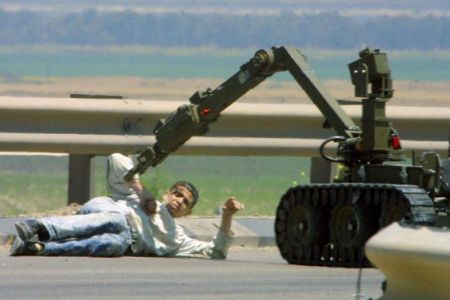
An Israeli robotic arm with a rifle attached to it injures a Palestinian kid in the occupied Palestinian lands. (File photo)
Israeli human rights group B’Tselem released a report Monday on the findings of a investigation into the arrest, detention and interrogation of 50 Palestinian minors detained by Israeli military forces for throwing stones. The investigation shows a pattern of consistent abuse of the rights of minors both under Israeli and international law.
B’Tselem’s report into the arrest and detention of Palestinian minors on suspicion of throwing stones by Israeli forces has exposed a system of legal abuses conducted by the Israeli justice system such as beatings, forced confessions and the denial of legal representation and parental presence during interrogation.
The report was based on the testimony of 50 Palestinian minors on their experiences at the hands of the Israeli military justice system.
Thirty of the minors interviewed reported that they were taken during the middle of the night by Israeli military forces.
During the interrogation 47 stated they were not allowed adequate sleep, 23 stated they were not allowed access to the bathroom or to food or water and 19 said they were treated violently.
More broadly the report documents that at least 835 Palestinian miners were charged between 2005 and 2010 for throwing stones of which only one was acquitted.
Imprisonment was the punishment imposed in 93% of cases between 2005 and 2010. 60% of 12-14 year-olds were imprisoned despite this being illegal under Israeli law. Sentences increased with the age of the offender.
Many Palestinian minors enter into plea bargains with Israeli authorities so as to cut down on the time of their detention which is enforced throughout court proceedings.
The human rights organization stated their belief that the Military Youth Court, established in 2009 to hear the cases of Palestinian minors in the West Bank, has not alleviated the situation of accused Palestinian minors despite declarations by the court that it would rule in the spirit of Israeli youth law.
Palestinian youth are tried under adult military law which does not conform with Israeli or international standards for criminal proceedings against minors.
The treatment of Palestinian minors has twice been discussed in recent months in the British Parliament after British MP’s and Lords reported widespread human rights abuses against charged Palestinian minors similar to those reported in B’Tselem’s report following a fact finding mission to the West Bank.
Jewish settlers stab Palestinian farmers
Ma’an – 18/07/2011
JERUSALEM — A group of Israeli settlers attacked three Palestinian shepherds near Jerusalem on Monday, police said.
The shepherds were tending to their sheep on a hillside near Mikhmas east of Jerusalem when they came under a “brutal” attack by the ultra-Orthodox settlers who beat and stabbed them, Palestinian police said in a statement.
They were evacuated to hospital where medics said two victims sustained serious wounds, police said. The statement did not elaborate on their identities or say at which hospital they received treatment.
The alleged attack follows a string of violent events in the occupied Palestinian territories.
A report by the Palestinian Authority found that settler violence increased “dramatically” in June 2011, documenting 139 attacks in the West Bank and the destruction of over 3,600 olive trees and vineyards.
On Friday, Israeli settlers from the illegal settlement of Yizhar set fire to Palestinian land near the village of Burin, south of Nablus, a member of its agricultural committee, Belal Eid, told Ma’an.
Two days earlier, a Palestinian teenager sustained bruises after Israeli settlers pelted his car with stones near the site of the former Israeli settlement of Homesh, which was evacuated in 2005.
Anonymous Soldiers as Medical Experts? Only when the NYT covers Israel killing a Palestinian
By Alex Kane | Extra! | April 2011
This article was originally published in the April 2011 issue of Fairness and Accuracy in Reporting’s Extra! magazine. It was only recently put online.
U.S. media coverage of the death of Jawaher Abu Rahmah reflected how the corporate press routinely covers high-profile civilian deaths caused by Israel. The Israeli government, it seems, can count on U.S. media to print its anonymous claims—no matter how baseless.
Two days after Abu Rahmah, a Palestinian woman from the West Bank village of Bil’in, died from tear-gas inhalation during a December 31 demonstration against the separation wall, the Israel Defense Forces (IDF) went into spin mode. Anonymous “senior officers” in the Israeli army pushed a number of theories about her death—Abu Rahmah wasn’t at the demonstration, she had cancer, it may have been an “honor killing” and more—that the Israeli press dutifully reported. Israeli journalist Noam Sheizaf (+972 Magazine, 1/4/11), who was actually present at the Bil’in demonstration, described these claims as “half-truths and lies.”
U.S. corporate media also used anonymous Israeli military sources to cast doubt on the 36-year-old Abu Rahmah’s killing. In the New York Times (1/5/11), reporter Isabel Kershner characterized the story as a “debate” with “clashing narratives.” Though she noted that the IDF claims were all anonymous while the Palestinian claims were “backed by medical documents,” Kershner went on to give roughly equal time to both arguments.
Among the IDF’s anonymous claims were that they “had never heard of tear gas killing anyone in the open” and that Abu Rahmah may have had “some pre-existing ailment that, alone or compounded by the tear gas, caused her death.” Why anonymous military officials should be treated as experts on medical questions was never explained.
The Washington Post (1/6/11) similarly stated that anonymous military officials “suggested that an existing medical condition might have contributed to 36-year-old Jawaher Abu Rahmah’s death.” The Los Angeles Times’ only brief mention of the case (1/3/11) explained, “Since tear gas is typically nonlethal, it remained unclear whether soldiers used excessive amounts or whether the woman had health problems that contributed to her reaction.”
But the IDF claims were contradicted by extensive eyewitness reports from other protesters, Israeli journalists from +972 Magazine and the family of Abu Rahmah. In a January 4 statement put together by the Popular Struggle Coordina-tion Committee, Abu Rahmah’s mother said her daughter “was not sick with cancer, nor did she have any other illness, and she was not asthmatic,” while the director of the health center that treated Abu Rahmah stated that she “died from lung failure that was caused by tear gas inhalation, leading to a heart attack.”
Furthermore, the claim printed in the New York Times that the IDF “had never heard of tear gas killing anyone in the open”—boosted by Kershner’s own claim that the gas “can be lethal in closed environments but is considered nonlethal in the open air”—was belied by a Ha’aretz report (1/7/11) that noted that a 2004 study conducted by the IDF found that “a high concentration of the gas in a given location could cause serious or even lethal harm.” In fact, a toddler living in the East Jerusalem neighborhood of Silwan had died from tear gas just a few months prior to Abu Rahmah’s death (Ma’an News Agency, 9/24/10).
Kershner wrote that the IDF “routinely fires CS tear gas against the protesters to keep them away from the barrier and to disperse stone-throwing youths.” She didn’t mention that the wall has been ruled to be illegal under international law, according to an advisory opinion by the International Court of Justice (7/9/04); as Human Rights Watch has noted (3/5/10), “85 percent of the barrier’s route lies inside the West Bank, separating Palestinian residents from their lands, restricting their movement, and in some places effectively confiscating occupied territory.”
Moreover, Kershner’s wording seemed to imply that the Israeli army was simply responding to stones being hurled. But as Sheizaf’s eyewitness report stated, “the tear gas was fired by the IDF well before the march got even close to the fence.” Sheizaf wrote that at these demonstrations, “when stone-throwing does occur, it usually begins after the army disperses the march…. As for the soldiers, they are standing on the hill, heavily protected, and the stones normally pose no real danger for them.”
The coverage of Abu Rahmah’s death recalls how corporate media treated the killings of nine civilians by Israeli commandos aboard a Gaza-bound aid flotilla. As Peter Hart wrote in Extra! (7/10), “much of the U.S. media coverage has been remarkably unskeptical of Israel’s account of events and their context.” It appears that half a year later, little has changed.
Alex Kane is a freelance journalist and blogger based in New York City (alexbkane.wordpress.com). He can be followed on Twitter @alexbkane.
Featured Video

AIDS Inc. by Gary Null (2007)
or go to
Aletho News Archives – Video-Images
From the Archives
Fanatical Followers of the Covid Regime: A Jim Jones-Style Cult?
By Professor Roger Watson and Dr. Niall McCrae | The Daily Sceptic | November 15, 2021
As scholars at leading British universities over recent decades, we witnessed the replacement of critical thinking and debate by narrative: facts are discrimination and scientific method is imperialism; truth, instead, is derived from ‘progressive’ values. This educational trend may be a major contributory factor to the ease in which society has been inculcated to the Covid ‘new normal’ of masking, testing, and repeated doses of vaccines for a disease of similar risk to severe influenza.
One doesn’t need much critical reasoning to observe the flawed logic of some vaccination enthusiasts, such as people who respond to experiencing any side effects, however debilitating, by saying “at least I know it’s working”, or, after contracting the disease despite their promised inoculation (over 90% effective, according to initial drug company claims), “I’d have been worse off without the jab.” … continue
Blog Roll
 Aletho News
- Merck Virologists Admitted to Falsely Certifying Vaccine Efficacy
- Mandatory Folic Acid for every man, woman & child
- Pro-Palestine protesters arrested outside UK’s ruling Labour Conference in Liverpool
- Mauritius denies landing permit to flight from Israel, forcing cancellation: Tour operator
- Israeli finance minister calls for genocidal war on West Bank, annexation of south Lebanon
- 12 Things Your Psychiatrist Was Trained Not to Tell You
- From Unipolar Universalism to Multipolar Civilizational Distinctiveness
- RSF military group defects, joins Sudanese army: State media
- Ireland goalkeeper refuses to play ‘Israel’ as squad weighs boycott
- China pushes back against US on Cuba, Iran
- If Americans Knew
- Israel forces Gazans to live in constant peril – Daily Update
- Deconstructing Netanyahu’s pants-on-fire UN rant – Daily Update
- Trump betrayed voters with his campaign lies and prioritized a foreign country once he took office
- Netanyahu calls Israel’s war in Gaza ‘opposite of genocide’ in UN speech to near-empty hall
- Settler Kidnappings: Torture, Sexual Abuse and Terrorisation of Palestinian Abductees as Israel Deepens Annexation of West Bank
- Gaza winter nears as 162,000 tents become unusable, raising fears of humanitarian crisis
- Netanyahu says, “It’s the opposite of genocide”; UN says Gaza economy is world’s ‘most severe crisis on record’ – Daily Update
- Israel’s US-Backed Assault on Gaza Has Created the ‘World’s Most Severe Economic Crisis on Record’: UN
- ‘Protecting U.S. Citizens’… From Israel
- ‘This is where I live now, the back of a truck’: a day in the life of a grandmother in Gaza
- No Tricks Zone
- New Study: Earth And Venus Surface Warmth Largely Explained By Convection And Lapse Rate, Not CO2 Or Radiation
- 2025 Nature Paper Claiming Worsening Global Drought Gets RETRACTED …Heavily Flawed
- New Study: ‘Global Drought Shows No Detectable Recent Acceleration Under Climate Warming’
- Economic Masterminds: German Socialists Suggest Taxing Productivity Gains Stemming From Using AI
- The South China Sea Has Not Been Cooperating With The Climate Change Narrative
- Energy Crisis: Germany Enters Heating Season With Historically Low Gas Reserve Fill Levels
- New Study: The Antarctic Ice Sheet Gained Mass From 2020-2024 Due To Staggering Snow And Ice Accumulation
- Study: Ocean Heating Rates From Thousands Of Years Ago ‘Dwarf’ Modern Ocean Heating Rates
- Climate Extremists Target, Attack Large-Scale Power Grid Infrastructure In Germany!
- New Study: Antarctic Ice Melt Has Contributed Less Than 1 Centimeter To Sea Level Rise In The Last 30 Years

