Ashton ‘concerned’ by anti-wall leader’s conviction
Ma’an – 25/08/2010
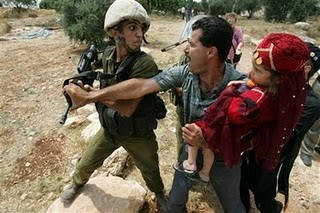
Abdallah Abu Rahmah
BETHLEHEM — EU foreign affairs and security chief Catherine Ashton said Tuesday she was concerned by the conviction of a Palestinian anti-wall campaign leader by an Israeli military court on charges of incitement and organizing demonstrations.
“The EU considers Abdallah Abu Rahmah to be a Human Rights Defender committed to non violent protest against the route of the Israeli separation barrier through his West Bank village of Bil’in,” Ashton said in a statement.
Ashton said she was further deeply concerned that “at the possible imprisonment of Mr Abu Rahmah is intended to prevent him and other Palestinians from exercising their legitimate right to protest against the existence of the separation barriers in a non violent manner.”
The High Representative added that the EU considers the route of Israel’s wall where it is built on Palestinian land to be illegal, and that it maintained a presence at all of Abu Rahmah’s court hearings.
Abu Rahmah was detained on 10 December 2009 during a night raid. According to his supporters, Abu Rahmah’s conviction was based only on testimonies of minors who were arrested in the middle of the night and denied legal counsel despite significant ills in their questioning.
###
International Solidarity Movement
Abdallah’s outrageous conviction today will be followed by a sentence in the coming weeks. The amount of pressure we will be able to generate in this time could influence Abdallah’s sentence, but will also make clear to Israeli authorities that the repression of the popular struggle does have a political price.
Please use the below template letters prepared by the Popular Struggle Coordination Committee to ask your Minister of Foreign Affairs to send an official inquiry to the Israeli government about Abdallah. Demand that your country apply pressure on Israeli officials to release Abdallah Abu Rahmah and stop targeting popular struggle.
US fires on civilian Bagram protest
By Tom Mellen | Morning Star | 24 August 2010
US troops fired on thousands of Afghan civilians as they protested outside the massive US military base at Bagram on Monday.
A provincial police official said that at least one civilian was killed in the incident, but Nato asserted that no civilians had been killed or injured.
The Western military alliance claimed that soldiers had only fired “warning shots” to disperse residents after they surrounded a military patrol and attacked vehicles outside the sprawling facility with rocks and iron bars.
But Parwan province deputy police chief General Faqir Ahmad was adamant that one civilian had been killed – although he said he could not be sure who fired the fatal bullet.
Gen Ahmad said that the Nato shooting had served to enrage the crowd, which he put at about 2,000 people.
He said that some responded by using rocks and sticks to attack police and the head of the district government, Kabir Ahmad, who had tried to calm the situation.
He reported that Mr Ahmad and a police officer had sustained serious but not life-threatening injuries.
Gen Ahmad went on to say that the rally had been triggered by the arrest of a religious teacher suspected of taking part in a rocket attack on occupation forces.
Also on Monday, officials and residents of Baghlan province in the north of the country accused Nato troops of killing eight civilians during a pre-dawn raid.
Mohammed Ismail, the governor of the Talah wa Barfak District, said that foreign troops broke into a district house at 2am and killed eight civilians, injured 12 and took nine prisoners.
The province’s governor Munchi Abdul Majid confirmed the attack but could not provide details.
Nato spokesman Major Michael Johnson said that he was unaware of any such attack.
Meanwhile the Taliban has reportedly attacked and torched a Nato convoy carrying fuel and materiel to US troops in the south.
Taliban spokesman Qari Yousuf Ahmadi claimed responsibility for the attack on the lorries destined for Helmand and alleged that the assault prompted US forces to evacuate their military base in Sangin.
Nato denied the Taliban’s claims and boasted that US-led troops had killed 40 militants in offensives this week in eastern Afghanistan.
Monday’s clash between locals and occupation forces outside the Bagram base is the second such incident in 10 days.
On August 15 hundreds of residents participated in a militant demonstration in protest at the construction of military facilities on land owned by villagers.
Protesters threw “baseball-size rocks” at troops as they escorted a mercenary to the base, according to Nato.
Amnesty slams Canada for rights abuse
Press TV – August 24, 2010
Amnesty International’s new secretary general has sharply criticized the Canadian government for its “serious” human rights violations.
Salil Shetty told the CIVICUS World Assembly on Citizen Participation on Monday that Amnesty International is increasingly concerned “about the serious worsening” of Canada’s human rights approach.
“There is a real shrinking of democratic spaces in this country… Many organizations have lost their funding for raising inconvenient questions,” AFP quoted Shetty as saying. He also pressed Ottawa to seek the repatriation of a Canadian detainee, Omar Khadr, held at the US naval base in Guantanamo Bay, Cuba.
Shetty said that the prisoner’s detention was “unlawful” and that his trial, held this month before a US military tribunal, was “unjust.”
Khadr was only 15 years old when he was captured by US troops in Afghanistan eight years ago. He is accused of throwing a grenade that killed an American soldier during a gun battle in 2002.
Khadr, who has spent one-third of his life in Guantanamo, says he was tortured while being interrogated and forced to provide false confessions.
In a sworn statement, the traumatized Canadian said he was beaten, subjected to long periods in solitary confinement, doused in freezing water, spat on, chained in painful positions, terrorized by barking dogs and subjected to sleep deprivation and threats of rape.
Settlers raid house, burn crops
Ma’an – 24/08/2010
TULKAREM — Settlers raided a house and torched five dunums of farmland in the northern West Bank Monday evening, witnesses said.
Locals said two buses of Israeli citizens living in Hebron in the southern West Bank arrived at the illegal Mevo Dotan settlement in Tulkarem in the northern West Bank, where they harassed locals and caused damage.
Settlers raided the house of Muhammad Al-Haloul and remained for three hours banning the family from leaving, family members said. They destroyed the house and burnt the family’s wheat crops, locals said.
Settlers set 20 dunums of farmland on fire south of Nablus on Sunday, Palestinian Authority official Ghassan Doughlas said.
Dozens of residents of the illegal Ihya outpost torched the area of Sahel Khalet Abu Shreka, near Jalud village, he said.
Doughlas accused settlers in the area of repeatedly provoking locals by expanding settlements, constructing outposts, and burning land.
The same day, medics said Israeli troops entered the village and fired tear gas grenades toward residents.
An Israeli army spokesman said the military was not familiar with such an incident.
Gaza’s industries suffer under siege
Mel Frykberg | IPS | 23 August 2010
 |
A bombed out biscuit factory in Gaza. (Mel Frykberg/IPS) |
GAZA CITY, occupied Gaza Strip – Just off Omar al-Mukhtar Street, Gaza City’s main thoroughfare, in a narrow, sandy alleyway is a little second-hand clothing shop. In the dimly lit store, with only intermittent electricity for some hours a day at best, sits a single battered and aging sewing machine.
This is where Khaled Nassan, a father of four children, tries in vain to eke out a living repairing and selling second-hand clothing. Nassan charges the equivalent of 25 cents on average to repair an item. Gazans can’t afford to pay the dollar it used to cost. Nassan is lucky if he takes home $20 a day.
“There is almost no business. I’m surviving on about $500 a month, and I have several children at university. My family is dependent on aid from the [UN agency for Palestine refugees (UNRWA)]. Without them we would not survive,” Nassan tells IPS.
Prior to Israel’s systematic strangulation of the coastal territory (which began during the outbreak of the second Palestinian Intifada or uprising in 2000 but peaked with its hermetic sealing in 2007 when Hamas took over) Nassan had a clothing factory which employed 250 Gazans who in turn supported nearly 3,000 dependents.
“I used to travel to Israel regularly for business to meet my Israeli business partners and visit stores where my clothing was sold. I would also purchase material there to bring back to Gaza but now I can’t import any material,” says Nassan.
“Previously my profits ranged around $20,000 monthly. I used to give my kids five dollars daily pocket money; now they are lucky if they get 50 cents. They have to walk long distances to and from university. We can’t even afford cheap shared taxis and I’m concerned about being able to fund their future education.”
Nassan is a harsh critic of the ruling Hamas regime. Eighty percent of Gaza’s population is now dependent on foreign aid, much of it from UNRWA. Despite Israel’s recent decision to ease the blockade it is still forbidding Gazan factories and companies from exporting their goods, and preventing the import of vital raw materials and spare parts and machinery.
Gaza’s economy was heavily dependent on the furniture, clothing, textile and food production sectors selling their goods outside Gaza.
Israeli authorities originally argued that the blockade on almost everything but bare humanitarian aid was for security reasons. However, following a lawsuit by the Israeli rights group Gisha the Israeli government was forced to acknowledge that the siege was a political move.
“A country has the right to decide that it chooses not to engage in economic relations or to give economic assistance to the other party to the conflict, or that it wishes to operate using ‘economic warfare,'” the government said.
Nassan is one of hundreds of formerly prosperous Gazan businessmen whose businesses and livelihoods have been decimated by the blockade and Israel’s devastating military assault on the strip during Israel’s invasion of Gaza at the end of 2008 beginning of 2009.
IPS visited the remains of a former three-story biscuit and potato chips factory belonging to Wael al-Wardah in northern Gaza a few hundred meters from the Israeli border.
The factory used to employ 150 individuals who supported approximately a thousand dependents. Its annual turnover was $10-12 million.
Craters, walls pockmarked with bullet holes, twisted and blackened machinery and equipment and sagging ceilings are all that remain after the Israelis employed F-16s, tank fire and bulldozers against the factory.
Al-Wardah, 43, father of seven from Gaza City, inherited the biscuits and potato chips factory from his father. His factory and the factories belonging to his four brothers who used to produce ice cream, sweets, potato chips and biscuits suffered 80 percent destruction and more than $10 million worth of damage during the Israeli bombardment. Twenty-two trucks and vehicles were also destroyed.
During the last three days of Israel’s 2008-09 winter assault, the Israeli Air Force embarked on an intensive bombing campaign aimed at the coastal territory’s economic infrastructure.
Israel had employed its “Dahiyeh doctrine,” which advocates disproportionate force in asymmetrical warfare against the civilian infrastructure of its enemies. Al-Wardah is adamant that no fighters were in the vicinity of the factories, because the Israelis were nearby.
Despite the bloody past, al-Wardah and his brothers are keen to start afresh. But they have been unable to import construction material to rebuild their factories. Al-Wardah is also unable to bring into Gaza machinery he bought in Europe.
“I have more than a million dollars of raw materials and specialist machinery sitting in Israel’s Ashdod port. It costs me $400 monthly to store the goods, but I still can’t bring them into Gaza,” he told IPS.
“Because I’m unable to continue my previous business I’m trying to start a pickled vegetable business, so I’ve brought in some equipment through the smuggling tunnels with Egypt. But this is very expensive and the tunnels get regularly bombed too.”
Karl Schembri from Oxfam in Gaza says easing the blockade doesn’t suffice.
“Gazans continue to suffer. The siege has to be completely lifted. There has to be free movement for people, and if the economy is to recover the import of raw material has to be allowed. Concrete and steel are needed to rebuild after the immense destruction,” Schembri told IPS.
Hebron: Israeli Military and Policemen Shut Three Palestinian Shops
By Christian Peacemaker Teams | August 22, 2010
Every Saturday for the last several months, Youth Against the Settlements has led a nonviolent action – “Open Shuhada Street” – at the entrance to the Old City of Hebron. On Tuesday, 10 August 2010 the Israeli military and police forcibly welded shut three stores that stand directly behind the area of the weekly Saturday action and across from the gate of an Israeli military base.

Israeli soldiers in Hebron (photo from palsolidarity)
A local friend alerted Christian Peacemaker Teams (CPT) at 2:45 p.m. that the shopkeeper had received a warning that the military would close his shops, and he had half an hour to remove all his merchandise. After arriving at the site, CPTers alerted other internationals, partner organizations and media to come. A crowd of about 75 people assembled in front of the stores. As they waited, Palestinians removed and hid two of the shop doors.
A little after 4:00 p.m., 30 soldiers and three policemen arrived and pushed their way into the shops where internationals and Palestinians were waiting. The soldiers pulled the civilians out of the shops, scattered much of the merchandise, and dragged a Palestinian behind the gate. Red Crescent of the International Red Cross came shortly thereafter and examined the Palestinian man who had been injured while being dragged. They determined he had a brain concussion and advised the police that he needed hospitalization. The police replied they would take the Palestinian man to the jail, question him and then decide if he needed hospitalization.
Declaring the area from the military base to the stores a “closed military zone,” the soldiers formed two lines and progressively forced the crowd away from the stores being closed. Other soldiers retrieved the two hidden doors and welded shut the three shops. An Israeli policeman pushed the shopkeeper’s large cart of merchandise into one of the stores before the doors were welded shut. One of the CPTers urged the policeman to bring the cart out of the shop or allow her to retrieve it for the shopkeeper, but the policeman refused. One British man and four Palestinians were arrested.
The British man was released the next morning at 2:30 a.m. on the condition that he immediately leave the West Bank and not return for 15 days. The four Palestinians are now in Ofer Prison. The brother of the man with the brain concussion reported to CPTers that his brother was never hospitalized.
A case of decency deficit: Israel’s sickness goes beyond one soldier and her Facebook pictures
By Lawrence Davidson | 22 August 2010
It is true that in any given population there will always be a range of decency. Some might use the term morality instead of decency, but morality is loaded with too many disputed meanings. The term decency, hopefully, has a broader recognizable footprint. At the lowest end of any range of decency are those who are so egocentric or perverted that they not only act in ways that are harmful to others, but they do so as a form of enjoyment.
In extreme cases, such people usually end up in prison, or even asylums for the criminally insane. They have committed serial murders or some other form of horrible physical abuse. They have robbed their elderly neighbours for the fun of it or set fire to the local hospital or what have you.
Yet, it is a strange quirk of our way of doing things that such degenerates can actually find a place in society where there is an accepted scope for their particular attitudes and actions. That place would have to bring them into contact with people outside the community and toward whom their society is hostile, a place where the “rules of engagement”, as the phrase goes, is much more flexible and fuzzy than back home. That place is the military in times of war. This is not to say that every soldier is suffering from a severe case of “decency deficit”. However, if one has been in the military, particularly in a combat environment, one will most likely recognize the type. While everyone else is scared and counting the days until they can get out of an essentially inhuman environment, these people are enjoying themselves.
There has been a recent case of moderate decency deficiency involving a 20-year-old female Israeli soldier by the name of Eden Abargil. Ms Abargil had her picture taken as she “guarded” Palestinian prisoners who were bound and blindfolded. She stands there with her rifle and smiles at the camera. She is not the only one who comes away from serving in Israel’s occupation army with such photographic trophies. What makes her special is that she posted this and other pictures on Facebook, under the title “The army, the best time of my life”.
According to the Israeli human rights group Breaking the Silence, these sort of trophy pictures are such a “widespread phenomenon” that taking them constitutes “a norm”. Why so? Because it is the “necessary result of a long term military control of a civilian population”. No doubt this is true, though if you are sufficiently decency deficient your exposure does not have to be “long term” at all.
Ms Abargil gave an interview on Israeli Army Radio on 17 August. She proclaimed herself “mystified” by those who were upset at the postings. She asked the audience: “What is wrong with that [putting the pictures on Facebook]?” After all, she continued, “there was no violence in the pictures” and “they reflect the military experience”. Abargil seems to have decency deficit problems. If nothing else she cannot see that there is in fact violence in her photos. The Palestinian men whom she is so gleefully guarding have obviously suffered violence simply by being bound and blindfolded for resisting illegal occupation. In fact, these scenes scream violence to anyone who can see them within a context of an occupation which itself is violent on a daily basis – anyone who is aware of the Geneva conventions, UN resolutions, the Ten Commandments, the Golden Rule, plain human decency. Yet, that is the rub. Eden Abargil cannot see it. Why not?
Well, her problem might be a personal one. That is, she may be one of those small number of people found worldwide who are incapable of recognizing the difference between right and wrong. If so we can compare her to another young lady whose psyche might qualify for this condition. This woman was also in the military, but she is a 28 year old American. Her name is Lynndie England. She was one of 11 soldiers court marshalled in 2005 for the abuse of prisoners at Abu Ghraib. Here too it was trophy pictures that exposed the smiling England romping among horribly abused captives. Ms England said that she was just following orders.
In the case of Eden Abargil there is yet another possibility. How can you tell if you have a behaviour problem or are simply misunderstood by outsiders, when you live in a community were decency deficiency is normal? After all, if Breaking the Silence, and other Israeli human rights organizations (whose memberships are quite small but collectively an important humane voice) are right, the taking of trophy pictures is “a widespread phenomenon, not an aberration caused by a single soldier”. In this regard it should be noted that the Israeli army appears upset with Abargil, whose action it has labeled “crude”, not because she had “the best time of my life” posing for such pictures, but because she was indiscrete enough to display them to the world via the web.
To clarify the above question, consider the environment in which Eden Abargil was born and raised. It is an environment in which most Israelis are taught from childhood that the world is against them. When informed that her Facebook postings might “injure Israel’s image in the international arena”, Abargil responded: “We shall always be attacked. Whatever we do, we shall always be attacked.” Many Israelis are convinced that the Palestinians are barbarians, “beasts walking on two legs”, who want to “push the Jews into the sea”.
The answer to this alleged threat is to convince the Palestinians that they are “a defeated people”. Yet they never seem to get this message and so Israel’s destructive power never gives its citizens the security they crave. On the other hand, many Israelis believe that to compromise with the enemy is to encourage them to keep trying to “push the Jews into the sea”. So they just continue on an illogical path of trying to humiliate the Palestinians into total surrender.
The majority of Israelis have this problematic worldview reinforced throughout their lives by their parents, their schoolmates and teachers, their friends and co-workers, and their compatriots in the military. They even get it from their rabbis. Under the circumstances it is very difficult to avoid the taint of racism. So, is Eden Abargil’s decency deficiency a personal problem, or is she simply an acculturated, “normal” member of a society that is collectively deficient of decency?
If it is the former, the answer might be therapy, parole of one year to live in an Arab-Israeli town, or just keeping Ms Abargil indefinitely away from guns and cameras. If it is the latter, the first step to a cure is the isolation of the entire Israeli society on the model used against apartheid South Africa.
Personally, I agree with Breaking the Silence. The problem goes beyond Eden Abargil. In fact she is only the latest public symptom of an indecent state and ideology (Zionism). For a long time both have done nothing but harm to the Jewish people and religion. It is for their sake, as well as for the long-suffering Palestinians, that the treatment of isolation must be attempted.
Lawrence Davidson is professor of history at West Chester University. He is the author of numerous books, including Islamic Fundamentalism and America’s Palestine: Popular and Official Perceptions from Balfour to Israeli Statehood.
Father Charged With ‘Resisting Arrest’ Despite Video Evidence Disproving Charge
IMEMC | August 19, 2010
A man whose arrest was filmed and spread on Youtube, showing his child begging soldiers to leave his father, has been sentenced by an Israeli court to three months and a fine.
The video shows Fadil al-Jabari’s four-year old son tugging on his father’s shirt and begging the soldiers not to take his daddy away. The footage is emotional and difficult to watch, as the child cries and repeatedly calls to his ‘papa’. The soldiers push the boy away and leave him on the side of the road alone as they take his father away in a military jeep.
Al-Jabari was charged with resisting arrest and striking an officer. Both of these charges are easily disproven by the video of the incident, but the video evidence was not allowed to be shown in court.
Apparently, the man was in a ‘restricted area’, trying to get clean water from a well that used to be Palestinian, but was seized by the Israeli military. Israeli authorities severely restrict access to water for the Palestinian population in the West Bank, cutting off water completely for 15 – 20 days at a time, even while Israeli settlements are able to water their lawns and swim in swimming pools.
According to local news agency Ma’an News, which interviewed Fadil al-Jabari’s mother, her 4-year old grandson has been severely traumatized by the incident, and repeatedly calls for his father. He has never had a history of behavioral problems, she said, but now, after watching the soldiers take his dad away, he has become agitated, and begun hitting his younger sister.
Palestinians say such abductions by Israeli troops are common, even leaving small children on the road without an adult, as the Israeli soldiers assume that some Palestinian will come along and help the child after the soldiers take their parent away. Israeli troops make no provisions whatsoever for the children of those whom they abduct.
LATE VICTORIAN HOLOCAUSTS BY MIKE DAVIS

BOOK REVIEW
Critics of globalization point out with some justice that poor people around the world suffer far more than the citizens of industrialized nations during downturns in the global economy. Peasants in developing countries can find their lives hanging in the balance during a rise in food prices or a decline in the global market value of the goods they produce. Never was this more true than during the hey-day of the European imperialism in the last three decades of the nineteenth century. Aggressive trade practices and the ruthless use of military force effectively subdued nations in Asia, Africa, and South America and brought these countries into a global trade system. By the 1870s, and certainly by the turn of the century, many European countries, above all Great Britain, had created the world’s first global market economy. Financial markets in London, Paris, Amsterdam, and elsewhere were linked by telegraph to places where raw materials were produced for European consumption, while established trade routes were patrolled by European navies (particularly the Royal Navy). The economic power of the extensive British Empire was unparalleled and the inner workings of the global system dominated by London determined the fate of innumerable people around the world.
It is with the workings of the British economic system and their impact on indigenous populations in India, China, and elsewhere that Mike Davis’ book Late Victorian Holocausts is concerned. Davis’ point of departure is a simple question. Why is it that widespread hunger in Western Europe disappeared in the nineteenth century while famine and disease raged throughout multiple places in what today we would call the “Third World”? Davis provides a simple answer: European imperialism (especially British imperialism) created a global economic system through which the food and wealth of conquered nations (i.e. colonies) was siphoned off for the benefit of wealthy and powerful Europeans, while those in the colonies were left to starve and die. The result was mass death (what Davis calls “holocausts”) on an unprecedented scale in India, China, Brazil and other places, that was most intense during the El Niño drought years of 1876-77 and 1888-1902.
This imperial global economic system was certainly not a “free” market in any sense of the word. It was in fact bolstered by a long series of tariffs and unfavorable trade relationships that were forced by Europeans upon the peoples they conquered. Colonies were in turn subjected to economic pressure dictated by and manipulated from financial centers in Western Europe. It was these economic forces, as well as brutal gunboat diplomacy, that Davis argues created the Third World as we know it today.
THE “FREE MARKET” AS A MECHANISM OF MASS MURDER
Davis’ primary focus in fleshing out his story is the crown jewel of Britain’s colonial empire: India. Drought was the precipitating cause of the hardship faced by the Indian people. However, Davis demonstrates with statistics and anecdotes that it was the unregulated “free market” system imposed on India by Britain that led to the deaths of tens of millions in the mid-1870s and late 1880s.
How did death and human suffering on such a massive scale happen? Following the English conquest of India in the early nineteenth century, economic relationships in the sub-continent underwent revolutionary changes. Thousands of miles of railroad track were laid. Telegraph wire was strung between outlying areas and the capitol city of Bombay (Mumbai today). Central grain collection depots were created and Indian grain was exported in massive quantities to the British Isles. Also, Indian subsistence farmers were gradually forced out in favor of large land enclosures. Within these new enclosures cash crops like cotton were planted, which supplied the textile mills of Lancashire, but which could not feed the Indian peasants who farmed the land. Finally, the tax burden upon the Indian peasantry was increased exorbitantly to pay for these “improvements”. British authorities needed the revenue to finance war in neighboring Afghanistan.
The innovations imposed by the British on India re-directed the trajectory of Indian commerce and especially food production toward Great Britain and away from the local village markets where the food was needed. Rail lines and the adjacent grain depots enabled British authorities to stockpile grain and keep it under guard away from the people who needed it most, while telegraph lines dictated the price of grain on world commodities markets to local producers. When grain prices rose across the board in global trading, peasants could not afford to buy food.
In the face of these crippling economic forces, British colonial authorities did nothing, primarily because they would not “tamper” with the operation of the liberal “free” market that Britain had created. The Viceroy of India during the famine years of the 1870s was Lord Lytton, a mentally unbalanced English noble. Davis recounts that in the midst of widespread famine and the deaths of millions all around him, Lytton maintained a strict laissez-faire attitude toward famine relief. As Lytton wrote at the time, “there is to be no interference of any kind on the part of the Government with the object of reducing the price of food,” a policy proposal Lytton termed “humanitarian hysterics” and “cheap sentiment”. (p. 31)
Lytton and his fellow administrators preferred instead to blame the “laziness” of famine victims themselves for causing their own dire fate. Citing Lord Temple, “Nor will; many be inclined to grieve much for the fate which they brought upon themselves, and which terminated lives of idleness and too often of crime”. (p. 41) The task of saving life, therefore, was “beyond our power to undertake,” claimed Temple and Lytton, and it was “a mistake to spend so much money to save a lot of black fellows”. (p. 37)
British officials were thus completely unwilling to intervene in the operation of the “free” market despite seeing death on a massive scale all around them. Overall at least 7.1 million people, and perhaps as many as 10.3 million people, died during the famine years of 1876-1878. (p. 111) Furthermore, despite death on this scale and falling production caused by drought, British officials in India still managed to export 6.4 million cwt. of wheat to Great Britain. (p. 31)
LIFE AND DEATH FOLLOWS THE MARKET CYCLE
The years following 1879 were a time when the world market continued to expand. Monsoonal rains settled back into a normal pattern and grain production around the world rose considerably. These were also years when Britain and other colonial powers expanded their reach into the interior of the subjugated countries they held. In India, even more land is brought under cultivation. These lands are then connected to the market by expanded telegraph and rail lines. Then in 1888-89 and 1891-92, the bottom again fell out of the system as El Niño drought gripped the temperate regions of Asia once more.
The resulting death from famine and disease, caused by the very same factors operating in India and elsewhere in the 1870s, was unfathomably huge. By 1902 in India alone between 12.2 and 29.3 million people perished. In China, where the British, Americans, and other European powers controlled practically all trade using military force, between 19.5 and 30 million people died. In Brazil another 2 million perished over the same time span. (p. 7).
THE “FREE” MARKET AND THE MAKING OF THE THIRD WORLD
Mike Davis demonstrates beyond a doubt that the economic structure of exploitative globalization is not a new phenomenon in the world. The lives of millions of people who formerly had survived in localized economies based on subsistence farming were wiped out “in the process of being forcibly incorporated” into the modern world system. (p. 9) Davis reminds us that markets are never free and they never operate according to “iron laws” of economics. Rather, markets are created and often the power underpinning their operation is fiscal manipulation and simple brute force.
Great Britain’s global imperial economy was a case in point. It was never a “free” market. England imposed unfavorable trade terms and high tariff walls on India, China and on all of the other countries in its empire. Local economies forced open by the British were sucked dry of their vital raw materials and in return peasants were forced to buy expensive British manufactured goods. This practice was put into place throughout the colonial world by France, Portugal, Spain, Germany and other colonial powers. If anything, the economies of European colonies were more captive markets than free markets.
The latter point is perhaps the most important conclusion of Late Victorian Holocausts; specifically, that what we call the Third World today was a product of European and, to a lesser extent, American economic exploitation. The incorporation of formerly powerful countries like China and India into the global economy by Great Britain and others effectively destroyed indigenous production. Contrary to conventional wisdom, until around 1850, India and China had actually held their own against Europeans when it came to industrial production. The localized production of wealth and industry, however, was halted and then reversed by the imposition of the global economic system. It is for this reason, Davis concludes, that India’s per capita income did not increase between 1757 and 1947; and in fact declined by more than 50% between 1850 and 1900. (p. 311).
Settlers beat 10-year-old Palestinian girl
Ma’an – 18/08/2010
HEBRON — Israeli settlers assaulted a 10-year-old Palestinian girl on Sunday evening and an Israeli military jeep struck an 8-year-old boy in Hebron, witnesses said.
Inas Mazen Qaaqour was beaten by residents of the illegal Tel Rumeida settlement and treated at the Hebron Government Hospital where medics said she was bruised all over her body. Sameh Natshe Jacob was taken to the same hospital, and medics described his condition as stable.
An Israeli military spokesman did not respond to several requests for comment.
The presence of settlements in the center of Hebron means that Palestinians and Israelis live closer in the city than anywhere else in the West Bank, sometimes on the same street.
The Israeli military controls 20 percent of the city including the Old City and the market area and imposes severe restrictions on Palestinians’ movement.
The Israeli rights group B’Tselem says settlers routinely abuse Palestinians in the city, sometimes using extreme violence. Filmed incidents include settlers shooting, stoning, and beating Palestinians with clubs. The organization has reiterated Palestinian complaints that Israeli soldiers often witness these attacks but rarely intervene, and perpetrators are seldom prosecuted.
Facebook scandal escalates as group posts new photos
Ma’an – 17/08/2010
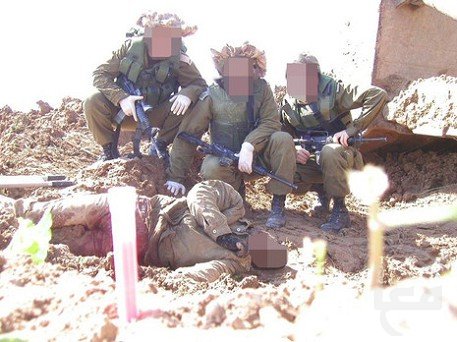
BETHLEHEM — An Israeli human rights group has released pictures of Israeli soldiers and border guards alongside blindfolded and handcuffed Palestinian detainees — some of them dead.
Breaking the Silence set up a group on Facebook entitled “the norm denied by Avi Benayahu,” an Israeli military spokesman who described the recent release of photographs by an ex-soldier next to detainees as exceptional.
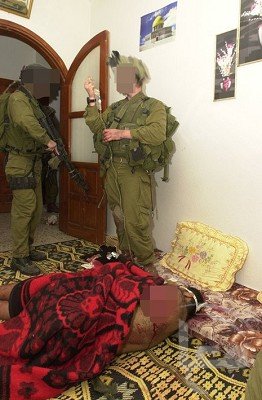 “The new campaign came into being in the wake of the publication of Eden Abergil’s photos, in order to show the prevalence of this phenomenon among IDF ranks,” Breaking the Silence said in a statement to the Israeli news site Ynet.
“The photographs that had been published are merely the tip of the iceberg. Many people possess thousands of photos, but only a small part is being published … we turned Eden into a scapegoat, while the norm is what needs to be targeted.”
The original photos prompted a harsh reaction from the Palestinian Authority. “This shows the mentality of the occupier, to be proud of humiliating Palestinians. There is nothing in the world that can justify [this] humiliation that is part of the Israeli occupation practices on [a] daily basis,” the PA’s Government Media Center said in a statement.
“Occupation is unjust, immoral and, as these pictures show, corrupting. It should end and Palestinian rights and dignity be respected. We call upon all human rights defenders to make all efforts to end the Israeli occupation and close this dark era for humanity,” the statement added.
Abergil posted the photos in her Facebook album “Army…best time of my life:)” in early August. The series of images, since removed from her page, displayed Abergil posing with blindfolded and handcuffed detainees who were apparently seized during a recent army raid in the occupied West Bank.
Billions of dollars promised for Haiti fail to materialize
By Isabel Macdonald – The Star – August 16, 2010
Nearly seven months after a devastating earthquake killed upwards of 250,000 people in Haiti, UN special envoy to Haiti Bill Clinton told Associated Press on Aug. 6 that international donors have yet to make good on their promises of billions of dollars to help the country rebuild.
Haiti’s rebuilding could cost $14 billion, according to a recent Inter-American Development Bank study. Yet only “five countries — Brazil, Norway, Australia, Colombia and Estonia — have so far provided $506 million, less than 10 per cent of the $5.3 billion pledged for Haiti at a March donors’ conference,” according to an Aug. 6 AP article.
Today, dozens of leading academics, authors and activists from around the world proposed a bold solution to this desperate financial shortfall.
Why not reimburse Haiti for the illegitimate “independence debt” it paid France?
In an open letter to French president Nicolas Sarkozy published today in the French national daily newspaper Liberation, 90 leading academics, authors, journalists and human rights activists from around the world urged the French government to pay Haiti back for the 90 million gold francs Haitians were forced to pay as a price for their independence.
There are “powerful arguments in favour of the restitution of the French debt,” as Harvard medical professor Paul Farmer (who was recently appointed deputy UN special envoy to Haiti) pointed out in his testimony at the 2003 hearings in France on the independence debt.
This historic payment was patently illegitimate, and, on several different scores, it was also illegal, according to a 2009 paper produced by the Institute for Justice & Democracy in Haiti.
Prior to independence, St. Dominique — the country that is now Haiti — was France’s most profitable colony, thanks in no small part to its particularly brutal system of slavery. In 1791, the slaves revolted, and in 1804, after defeating Napoleon’s armies, founded the world’s first black republic.
Following Haiti’s independence, former French slave owners submitted detailed tabulations of their losses to the French government, with line items for each of “their” slaves that had been “lost” with Haitian independence. In 1825, French King Charles X demanded that Haiti pay an “independence debt” to compensate former colonists for the slaves who won their freedom in the Haitian revolution. With warships stationed along the Haitian coast backing up the French demand, France insisted that Haiti pay its former colonizer 150 million gold francs — 10 times the fledgling black nation’s total annual revenues.
Under threat of a French military invasion that aimed at the re-enslavement of the population, the Haitian government had little choice but to agree to pay. Haiti’s government was also forced to finance the debt through loans from a single French bank, which capitalized on its monopoly by gouging Haiti with exorbitant interest rates and fees.
The original sum of the indemnity was subsequently reduced, but Haiti still disbursed 90 million gold francs to France. This second price the French exacted for the independence Haitians had won in battle was, even in 1825, not lawful. When the original indemnity was imposed by the French king, the slave trade was technically illegal; such a transaction exchanging cash for human lives valued as slave labour represented a gross violation of both French and international laws.
And Haiti was still paying off this “independence debt” in 1947 — 140 years after the abolition of the slave trade and 85 years after the emancipation proclamation.
A lawsuit launched by the Haitian government to recuperate these extorted funds was aborted prematurely in 2004, with the French-backed overthrow of the government that had the temerity to point out that France “extorted this money from Haiti by force and . . . should give it back to us so that we can build primary schools, primary health care, water systems and roads.”
The French government was similarly quick to suppress a Yes Men-style prank announcement last Bastille Day pledging that France would repay Haiti. On July 15 — one day after the hoax — a spokesperson for the French ministry told Agence France Presse that the French government was pursuing possible legal action.
Featured Video

The American Retreat from Vietnam
or go to
Aletho News Archives – Video-Images
From the Archives
Secret document reveals plans for civil war in Lebanon, Israeli false flags, and invasion
By Randi Nord | Geopolitics Alert | April 5, 2019
Beirut – During his visit with US Secretary of State, Mike Pompeo, Lebanese President Michael Aoun reportedly received a US-Israeli document detailing plans for creating a civil war in Lebanon with covert false flag operations and possible Israeli invasion.
Although the source of the document is Israeli and created in partnership with Washington, no one knows who presented it to Aoun. The Lebanese TV station, Al-Jadeed, initially reported the document on Lebanese TV and a video on its website. Geopolitics Alert translated the report for this article. … continue
Blog Roll
 Aletho News
- ‘Distance yourselves from Israel’: IRGC urges US population to question govt policies
- America’s Greenland deal has a radioactive backstory
- The RAF Fairford ‘terror plot’: Unpacking escalation in the UK echo-chamber
- EU Council Advances Chat Control 2.0 Scanning Proposal
- Ex-Greek MEP files complaint against Israeli spyware firm over alleged Pegasus surveillance
- Troubling ideas throughout the Torah, Talmud, Mishneh Torah and Tanya
- ‘Grave, alarming’: Iran mission on Trump’s UNGA ‘annihilation’ threats
- Najaf airport to reopen to Iranian flights within 24 hours: Ambassador
- From ‘How Will This End For Iran’ to ‘When America Walks Away’: A tale of two Economist covers
- Tehran blasts ‘baseless’ speculation linking Iran to alleged bomb plot at UK air base
- If Americans Knew
- US arms sales to Israel worth $21.6 billion in 20 months
- Three Palestinians Killed in Israeli Attacks on Gaza
- Revealed: German “Anti-Semitism Expert” Driving Crackdown on Palestine Solidarity is Former Israeli Spy
- Egypt’s Warning to Israel Before Oct 7
- Israel’s siege signals another cruel winter for 1.8 million Gazans – Daily Update
- Netanyahu Asked UAE Leader to Deny Report on Oct. 7 Warning in Secret Visit, Sources Say
- CNN Chief Int’l Correspondent Clarissa Ward on Journalists in Gaza
- Democratic Party Consultants Surround Troy Jackson with Pro-Israel Donors
- Christian Leader Responds To Netanyahu’s Claims Regarding Palestinian Christians
- In Gaza, ‘Whoever Survives the Bombing Won’t Survive the Rubble’
- No Tricks Zone
- New Study: Earth And Venus Surface Warmth Largely Explained By Convection And Lapse Rate, Not CO2 Or Radiation
- 2025 Nature Paper Claiming Worsening Global Drought Gets RETRACTED …Heavily Flawed
- New Study: ‘Global Drought Shows No Detectable Recent Acceleration Under Climate Warming’
- Economic Masterminds: German Socialists Suggest Taxing Productivity Gains Stemming From Using AI
- The South China Sea Has Not Been Cooperating With The Climate Change Narrative
- Energy Crisis: Germany Enters Heating Season With Historically Low Gas Reserve Fill Levels
- New Study: The Antarctic Ice Sheet Gained Mass From 2020-2024 Due To Staggering Snow And Ice Accumulation
- Study: Ocean Heating Rates From Thousands Of Years Ago ‘Dwarf’ Modern Ocean Heating Rates
- Climate Extremists Target, Attack Large-Scale Power Grid Infrastructure In Germany!
- New Study: Antarctic Ice Melt Has Contributed Less Than 1 Centimeter To Sea Level Rise In The Last 30 Years

