Rights group: Teen tortured, held by Israeli forces
Ma’an – 13/08/2010
BETHLEHEM — Palestinian rights group Addameer said it received a sworn affidavit from a 17-year-old boy who said he was detained by Israeli forces at a West Bank checkpoint and tortured.
The boy, identified as Emad Al-Ashhab, remains in Israeli custody under his third Administrative Detention order following his incarceration on 21 February from the Container checkpoint on the Wadi Nar road between Bethlehem and Ramallah.
“Israeli soldiers covered his face with a woolen bag and beat him with a stick all over his body while both his hands and feet remained shackled. The soldiers also burnt his hand with cigarettes while they tightened the shackles around his wrists,” a statement from Addameer attorney Anan Odeh reported.
The sworn testimony from the teenager was made public by the rights organization on Friday, and said the boy was interrogated for five days at Israel’s Ofer Military Base near Ramallah.
Emad told the lawyer that he was questioned about his political affiliations by Israeli Security Agency officers, and said he was not guilty of any of the accusations thrown at him.
“Under the Israeli military orders that govern the occupied Palestinian territory, membership in an organization – be it a political party or a charitable organization – that is declared illegal by the Israeli military commander is considered an offense. However, Emad has never been charged with any offense, and no evidence supporting the interrogators’ allegation has been disclosed to Emad or his lawyer,” the rights group explained.
Addameer issued an urgent appeal on behalf of the young man, describing it as a case through which the organization challenge the Israeli system of Administrative Detentions, a procedure legalized under Israeli military order 1591, that allows the Israeli military to hold detainees indefinitely on secret evidence without charging them or allowing them to stand trial. Orders are handed down for periods of up to six months and are infinitely renewable.
A soldier’s word
Nighttime raids, pointed guns, arrests often accompanied by beatings, kicks, curses and painful and extended handcuffing. The ordinary behavior of Israeli children in uniform.
By Amira Hass | Haaretz | August 11, 2010
Children in the West Bank throw stones at army vehicles and Israeli cars, mainly those belonging to settlers. That is the undeniable truth. Throwing stones is the classic way of telling the occupier, who is armed from head to toe, that he has forced himself on the occupied. Sometimes it’s part of a sweeping resistance movement, sometimes it’s a ceremonial remnant of such a movement, not devoid of braggadocio and adolescent boredom, while also a reminder to adults not to adapt.
The armed occupier bellows that this is violence, an offense just a step away from firearms. The violence of the occupier is the norm that no one questions, so much so that it becomes invisible. Only the response to that norm is presented and perceived as criminal, and the occupying nation wallows pleasurably in its eternal victimhood to justify its violent actions.
The army, especially the military justice system, has abundant means to deter young people from taking part in those ceremonies to ward off adjustment. Nighttime raids, pointed guns, arrests often accompanied by beatings, kicks, curses and painful and extended handcuffing. The ordinary behavior of Israeli children in uniform, completely normative. From the frightening conditions of such arrests, Palestinian children are taken straight to interrogation. This, too, involves intimidation, threats and sometimes a blow, sometimes temptation: Admit that you threw stones and we’ll let you go. Because detention until the end of legal proceedings might be longer than the sentence itself, sometimes it’s preferable to admit to something you did not do.
Eight 16-year-old students at the El-Arub agricultural school refused to be part of the statistic of confessions under pressure in the so-called military justice system. Three soldiers who arrested them in October 2008 testified to the police that their detainees had thrown stones on Route 60, and the soldiers caught them on the road after chasing them. The indictments were tailored to the soldiers’ account of events.
But the truth was that the teens were pulled out of their classrooms by soldiers who drove into the school compound. The police did not bother to question the principal and his teachers, the prosecution did not append corroborating evidence to the “stone-throwing incident” (such as documentation of the incident by the police or an army war room ). And still, the military judge extended the remand of the eight teens until the end of the proceedings. A soldier’s word against the word of a Palestinian boy.
The appeals judge was somewhat discomfitted by the vague testimony the soldiers gave the police and ordered the boys released on very high bail. The military prosecution tried, as usual, to get the defense attorney (from the Ad-Damir human rights group ), to sign a plea bargain (you confess, we’ll ask for a suspended sentence and a fine ), to save everyone’s time, especially the court’s. The boys were adamant in their refusal. The three soldiers, therefore, had to testify in court after they were warned to tell the truth, and they were very unconvincing.
On July 12, after almost two years of “wasting the court’s time,” the prosecution asked that the indictments be dropped. According to the IDF Spokesman’s Office, “there was no determination by a court of law that the soldiers lied in their testimony,” which is true, and that “in agreeing to drop the indictment there is no implication regarding the credibility of the soldiers’ testimony.” Sure.
Indeed, the soldiers acted the way many had acted before them. What they did is not devoid of the adolescent braggadocio that their society accepts affectionately and leniently. In particular, they are obeying unwritten orders to deter potential activists against the occupation. Blows, twisting the truth and intimidation are all part of the system they did not invent.
Khadr’s ‘torture’ confessions admissible
Press TV – August 10, 2010
Confessions made by Omar Khadr, who was captured by US troops when 15, can be used as evidence in trial despite claims they were obtained through torture.
Khadr, who was charged with war crimes based on the allegation that he threw a grenade that killed an American soldier in Afghanistan in 2002, has been held in US custody with out a trial since then.
The Canadian-born captive is set to be tried before a military tribunal on Tuesday.
He reportedly confessed to the crime while in a US prison at Bagram airbase in Afghanistan, 8 years ago, but later pleaded not guilty. His lawyer has argued that his confessions should be ruled as inadmissible because he was forced to confess due to torture and threats of death and rape.
A military judge at Guantanamo Bay, where Khadr is currently held, denied that request on Monday.
“He suffered 142 separate interrogations at Bagram,” Alfred Lambremont Webre, a war crimes lawyer, told Press TV.
“Bagram interrogators threatened him to be raped, he was not allowed to use the bathroom, and he was forced to urinate on himself. They were shoving bright lights up against his face and his eyes would tear and tear and tear.”
“This is torture; it is prohibited by international conventions,” Webre said.
Khadr has reportedly been beaten, subjected to long periods in solitary confinement, doused in freezing water, spat on, chained in painful positions, terrorized by barking dogs and subjected to sleep deprivation in the three months he was imprisoned in Bagram.
“He is protected by the conventions on the rights of the child. And he is protected as a prisoner of war by the Third Geneva Convention and he is protected by the Convention against torture and other cruel or inhumane treatments,” Webre said.
The now 23-year-old is the youngest, among the 176 captives held without charge, in the US notorious detention center.
‘Major George’ Accused of Running Israel’s Abu Ghraib
By Jonathan Cook – Jerusalem | August 8, 2010

A police officer known as ‘Major George’ who is accused of torturing Arab prisoners in his previous role as chief interrogator in a secret military jail has been appointed to oversee relations with Jerusalem’s Palestinian population, it has emerged.
The decision has been greeted with stunned disbelief from human rights groups, who say unresolved allegations against Major George that he brutally abused Arab prisoners for many years should disqualify him from such a sensitive post.
Relations between the Israeli police and the 250,000 Palestinian residents of East Jerusalem have been on a knife edge for many months, as extremist Jewish groups — backed by the municipality — have increased their settlement drive in traditional Palestinian neighbourhoods such as Sheikh Jarrah and Silwan.
The Association of Civil Rights in Israel (Acri), Israel’s largest legal rights group, revealed last week that it had made a formal complaint in February about Major George, whose real name is Doron Zahavi.
Acri said he had threatened to demolish the home of a Palestinian community activist in Silwan for leading protests against a settler takeover of Palestinian homes in the area. During what police described as a “getting to know each other session”, pressure was also put on Jawad Siyam to become an informant.
Zahavi, however, first earnt notoriety in Unit 504, a special wing of military intelligence, that oversaw the interrogation of foreign Arab nationals held in the secret prison, known as Facility 1391. Israel claims to have closed the jail following its exposure in 2003.
A Lebanese militia leader, Mustafa Dirani, who was held in Facility 1391 for many years, alleged in an Israeli court in 2004 that Zahavi repeatedly tortured him, including by sodomising him with a baton.
The civil suit for $1.5 million damages was never settled because Israel released Dirani in a prisoner swap before the court had issued a ruling. The judge has denied Zahavi’s subsequent requests to close the case.
Although Zahavi has denied the main charges, he has admitted interrogating prisoners while they were naked and that he ordered one of his officers to undress in Dirani’s cell and threaten to sexually assault him.
Several of Unit 504’s interrogators later corroborated Dirani’s claims, revealing that they routinely used the torture techniques he had described.
The case has attracted comparisons with Abu Ghraib, the prison in Iraq where US soldiers sexually abused Iraqi inmates.
Dalia Kerstein, director of Hamoked, an Israeli human rights group that helped to expose Facility 1391, called Zahavi’s appointment “appalling”.
She said the security services had a history of appointing officials who acted violently towards Palestinians to sensitive posts. The authorities’ logic, she said, appeared to be that “these people know how to deal with the Arabs because they can speak the language of violence”.
Zahavi’s new role as adviser on Arab affairs to Jerusalem’s police chief, Aharon Franco, is one of the key roles in the Jersualem force. Zahavi is supposed to act as the main channel between Palestinian residents and the police.
According to the job description, the adviser “must be an accepted and welcome figure in the Arab community, with excellent interpersonal skills.”
Melanie Takefman, a spokeswoman for Acri, said it was hard to see how Zahavi could fill such a post. “The problem in Jerusalem is that the police relate almost exclusively to the Palestinians as suspects and do not enforce the law equitably.”
Zahavi’s job in Facillity 1391 was to extract information from important Arab prisoners.
Dirani — a senior figure in Amal, a now-defunct Lebanese militia, who was seized by Israeli commandos in 1994 — was assumed to know the location of a missing airman, Ron Arad, whose plane went down over Lebanon eight years earlier.
Dirani claimed he was left naked for his first month in detention and was sexually abused repeatedly by his interrogators.
When Dirani appeared in court in 2004, he entered walking with great difficulty and aided by a cane. He told the judge of his experience of torture: “I prayed that I’d die.”
An unnamed interrogator who worked under Zahavi told the Israeli media: “I remember one instance that I still feel until today, which makes me shudder, in which a baton was used — not for hitting. Even in the field, George did what he wanted, in front of my eyes and the eyes of everyone else.”
After Zahavi was dismissed from military intelligence, he joined the immigration police and later moved into police intelligence. He is reported to have taken up his new post in the past two months.
The recent meeting with Siyam suggests that he is likely to bring an uncompromising approach to his role as a liaison with Jerusalem’s Palestinians.
Siyam said Zahavi spent most of their meeting shouting at him, and warning that a demolition order would be drawn up for Siyam’s house if he continued his political activities. Zahavi also threatened to get him fired from his job.
Although Israel claims to have closed Facility 1391, there are suspicions it and possibly other secret prisons are still in operation. In May last year the United Nations Committee Against Torture called for the location of 1391 to be identified and the prison inspected.
Zahavi is only the latest example of a security official accused of violent crimes against Palestinians later being placed in a sensitive post.
Gavriel Dahan: A lieutenant in the border police, Dahan was found guilty of carrying out a “manifestly illegal” order to shoot dead Israeli-Palestinian citizens arriving at an improvised checkpoint in 1956. In total, 47 civilians were killed at Kafr Qassem. Dahan was later appointed adviser on Arab affairs in the mixed city of Ramle.
Ehud Yatom: In the infamous Bus 300 affair in 1984, Yatom admitted using a rock to smash the skulls of two bound Palestinian teenagers who had hijacked a bus full of Israelis. Yatom was later pardoned. In 2001 prime minister Ariel Sharon appointed him his counter-terrorism adviser, though the supreme court ruled him unfit for the post. He was elected to the parliament in 2003.
Benzi Sau: A state commission of inquiry harshly criticised Sau, northern commander of the border police, for his role in the fatal shootings of 13 unarmed Palestinian citizens in 2000. The panel recommended he be denied promotion for four years. In that time he was promoted twice, eventually becoming head of the national border police.
Official: Israel lowers water supply to Nablus villages
Ma’an – 08/08/2010
NABLUS: A Nablus village’s local council has accused Israeli authorities of cutting several villages’ water supplies by 50 percent, as the global heatwave continues.
Rujeib council head Ahmad Dweikat said the water pumped to his village had been lowered from 5,000 cubic meters to 2,500 cubic meters without prior notice three weeks ago. The nearby villages of Azmut, Salim, and Deir Al-Hatab have undergone the same reduction, he said.
The four villages have a combined population of 16,000 and several homes on hilltops have not had a supply of water for three weeks. As a result, residents are purchasing water from delivery tanks that cost up to 300 shekels ($95) for 10 cubic meters.
A spokesman for Israel’s Civil Administration said the same amount of water was being pumped to the Rujeib
Residents filed a complaint three weeks ago and again on Wednesday that the water supply was not reaching them, he said.
A representative from Israel’s Mekorot water company was sent out and determined the water was being illegally diverted, he added.
Army vandalism in Hebron: soldiers destroy family’s well
3 August 2010 | ISM Media
Yesterday morning (2 August 2010) a group of Israeli soldiers, reportedly drunk, used two bulldozers to destroy a well that belonged to a family living in Wad Lerus, Hebron.
Several ISM activists went out to talk to members of the Al Jaabel family in Wad Lerus, close to the Kyriat Arba settlement in Hebron, yesterday afternoon.

The family members we talked to were very upset since Hebron already has limited water supply, and they depend on this private well in front of their house as a water source, as do some of their neighbours. They had also invested a lot of resources, both on building the well and filling it with water.
They explained that a group of approximately 50 soldiers and border police arrived at the family home at 11:00 in the morning on Monday. The soldiers were reported to be drunk, drinking cans of beer while carrying out the destruction work. ISM activists observed empty beer cans scattered around the destroyed well.
The family said that soldiers and border police brought two bulldozers, and that these were used to destroy the walls at the side of the well, causing huge rocks to fall down into it. When the family tried to stop the soldiers, they were met with violence and aggression, including towards the women. The soldiers also destroyed the gate to the house, which was now standing at the side, off the hinge. The attack lasted for about 30 minutes, and severe damage was done to the well during this time. Several water pipes were also cut off.
At the time ISM visited the family, they were about to empty the well since they fear that children might fall into it. There used to be an edge preventing this possibility, which was bulldozed down by the soldiers. The family told us that they had just bought and refilled the well with 80 cubic meters of water, to the cost of 2000 shekels, and now they had to see it all going to waste. The incident was the first time they had experienced a military attack of this nature, and even though they fear it will happen again, they have no other choice but to try and rebuild the well.
Defence for Children International submits evidence of Israeli forces using 14-year-old as human shield to UN, asks for investigation
DCI-Pal | August 3, 2010
On 3 August 2010, DCI-Palestine submitted a case involving the use of a child as a human shield to the UN Special Rapporteur on Torture for further investigation.
DCI-Palestine has received credible evidence that on 16 April 2010, a 14-year-old boy was used as a human shield by units of the Israeli army whilst conducting operations in the village of Beit Ummar, near Hebron, in the Occupied Palestinian Territory. It is alleged that two soldiers forced the boy to walk in front of them in an attempt to shield the soldiers from stones being thrown during clashes with local Palestinian youths. The boy was subsequently tied, blindfolded and beaten, before being released several hours later, without charge. Part of the incident was photographed and reported in Ma’an News.

The practice of using human shields involves forcing civilians to directly assist in military operations or using them to shield an area or troops from attack. Both of these circumstances expose civilians to physical, and sometimes, mortal danger. Civilians are usually threatened and/or physically coerced into performing these tasks, most of the time at gunpoint. The practice is illegal under both international and Israeli domestic law.
Since April 2004, DCI-Palestine has documented 15 cases involving Palestinian children being used as human shields by the Israeli army. Fourteen of the 15 cases, occurred after the Israeli High Court of Justice ruled the practice to be illegal in October 2005, suggesting that the army is not effectively implementing the Court’s decision.
| # | Name | Date of incident | Age at incident | Nature of incident |
| 1 | M.B. | 15 Apr 04 | 13 | Tied to the bonnet of a military jeep for four hours during clashes. |
| October 2005 Israeli High Court rules that the use of civilians as human shields is illegal |
||||
| 2 | A.E. | 26 Feb 07 | 15 | Forced at gunpoint to walk in front of soldiers during clashes. |
| 3 | J.D. | 28 Feb 07 | 11 | Forced at gunpoint to walk in front of soldiers and enter an abandoned house in search of combatants. |
| 4 | I.M. | 11 Apr 07 | 14 | Forced to sit for 15 minutes on the bonnet of a jeep during clashes. |
| 5 | O.G. | 11 Apr 07 | 15 | Forced to sit for 10 minutes on the bonnet of a jeep during clashes. |
| 6 | R.N. | 11 Jul 07 | 14 | Wounded whilst being forced to evacuate a house. |
| 7 | A.S. | 04 Jan 09 | 14 | Detained for 10 days and forced to search houses during war in Gaza. |
| 8 | A.A. | 05 Jan 09 | 15 | Detained close to military operations for four days during war in Gaza. |
| 9 | A.A. | 05 Jan 09 | 16 | Detained close to military operations for four days during war in Gaza. |
| 10 | N.A. | 05 Jan 09 | 17 | Detained close to military operations for four days during war in Gaza. |
| 11 | K.A. | 05 Jan 09 | 15 | Detained close to military operations for four days during war in Gaza. |
| 12 | H.A. | 05 Jan 09 | 12 | Detained close to military operations for four days during war in Gaza. |
| 13 | Majed R. | 15 Jan 09 | 9 | Forced at gunpoint to search bags thought to contain explosives during war in Gaza. |
| 14 | D.A. | 18 Feb 10 | 16 | Forced at gunpoint to search for a weapon. |
| 15 | S.A. | 16 Apr 10 | 14 | Forced at gunpoint to walk in front of soldiers during clashes. |
On 7 April 2009, DCI-Israel wrote to the Israeli Ministers of Justice and Defence requesting information regarding what measures the authorities had taken to investigate five specified incidents involving the use of children as human shields. Some seven months later, DCI received a response from the authorities, dated 3 November 2009, requesting further information regarding just one of the incidences referred to, the case of nine-year-old Majed R. who was used as a human shield during the war in Gaza. Two soldiers were subsequently charged in the case with deviating from authority to the extent of endangering life or health and unbecoming behaviour, in circumstances where the child was forced at gunpoint to search bags thought to potentially contain explosives. A decision has yet to be handed down in the case. As far as DCI is aware, no other investigations leading to charges have been conducted in the 14 other documented cases, and the authorities have not requested any further information.
DCI reiterates its position that full and impartial investigations meeting international standards must be carried out in all cases involving the use of children as human shields, and that the army be given adequate training and supervision to ensure compliance with the 2005 ruling of the Israeli High Court of Justice.
The 14-year-old boy the subject of the present complaint continues to experience behavioural problems, lack of concentration and memory loss since reportedly being used as a human shield in April 2010.
KASHMIR – The Dispute That Continues to Rock South Asia
By Shahid R. Siddiqi | Axis of Logic | July 18, 2010
A cartoon published in an American newspaper in 2002 showed former president George Bush sitting behind his desk in the Oval Office, utterly confused by a news report he was reading about India and Pakistan going to war over Kashmir. “But why are the two countries fighting over a sweater,” he asked Dick Cheney who stood by with his usual sly smile on his face.
Besides reflecting the intellectual capacity of the American president of the time, the cartoon was a realistic portrayal of the understanding that American leaders have generally shown of this longstanding dispute between Pakistan and India.
The unresolved Kashmir conflict has rocked South Asia for six decades. It has created an environment of distrust and acrimony, forced the people to sink into poverty with the bulk of the resources consumed by the war machines and claimed lives of hundreds of thousands of innocent civilians as well as soldiers who died in the three wars fought between India and Pakistan. India, whose forcible occupation of Kashmir in 1947 created the conflict, refuses to settle it. The other stake holders, the Kashmiri people and Pakistan, insist on a fair solution. The international community including the US and the United Nations played little or no role in diffusing it either. Consequently, the conflict has developed into one of the most intractable problems of international politics that remains a continuing threat to peace of the region.
Indian Brutalities & The International Reaction
India has not hesitated to use brutal force to maintain its hold on Indian occupied Kashmir and suppress revolt. The US, UN and other international organizations failed to take note of grave human rights violations. They failed to provide any specific, actionable proposals for a permanent solution. All they extended were diplomatic courtesies, suggested vague formulas and generalities that are open to multiple interpretations.
Although the US considers South Asia to be a sensitive and strategically important region from its geopolitical, security and economic standpoint and has expressed the desire to see peace prevail, it has so far paid only lip service to finding a permanent solution. It would not chastise India for human rights violations, which would have attracted its immediate attention if these were taking place in a country that it had chosen to punish, for fear of displeasing or alienating India which it has aggressively been courting in recent years.
This situation was compounded by the Indian dreams of regional hegemony that led it to dismember Pakistan in 1971 and go on to become a nuclear power, which forced Pakistan to develop its own nuclear deterrent for safeguarding its security.
Consequently, India has consistently and blatantly refused to honor the will of the people, negotiate Kashmir’s future status or stop the use of brutal force.
The Conflict Leads To The First Kashmir War
In the wake of the August 1947 partition of British India that brought into existence two sovereign states of the Indian Union and Pakistan, the British left after having midwifed the Kashmir dispute that has since bedeviled peace between the two countries. Essentially, the agreed principle that governed partition was that Muslim majority states to the east and west of British India would form Pakistan, while rest of the subcontinent was to form Indian Union.
Decisions by several Muslim rulers for accession of their states to Pakistan that had Hindu majorities (Hyderabad, Junagadh and Manavadar being cases in point) were rejected on the grounds that a Muslim ruler did not have the right to overrule the will of the Hindu majority population. But the decision of the Hindu Raja of the princely state of Kashmir, which was predominantly a Muslim majority state and should have acceded to Pakistan, was immediately accepted by the British viceroy and the Indian government, despite a popular Kashmiri revolt against his decision. Although an agreement of non-intervention in Kashmir had been signed between India and Pakistan, the new Indian government sent troops into Kashmir at the request of the Hindu ruler to enforce the instrument of accession and forcibly occupy the territory, in disregard of the agreed principle of accession applied elsewhere.
This led to the first Kashmir war in 1947 between India and Pakistan. In 1948 India sought cease fire, taking the issue to the UN Security Council, which passed resolution 47 on 21 April 1948 that imposed an immediate cease-fire along the line of actual control of territory by both parties and called on them to withdraw their troops. It also ruled that “the final disposition of the State of Jammu and Kashmir will be made in accordance with the will of the people expressed through the democratic method of a free and impartial plebiscite conducted under the auspices of the United Nations.” The cease fire was enacted in December 1948, with both governments agreeing to hold the plebiscite in areas under their control. Ever since, India has been rejecting all resolutions of the Security Council and the proposals of the UN arbitrators for demilitarization of the region – all of which were accepted by Pakistan.
The Security Council Steps In
Although the resolutions of the Security Council were regarded as the ‘documents of reference’ for a durable and internationally acceptable solution, no steps were ever taken for their implementation. This was because in technical terms these were not mandatory – not having been based under Chapter VII of the Charter. This allowed India to get away, dashing the false expectations of the Kashmiris as to the possible role of the United Nations as facilitator of a solution to the Kashmir problem.
This injustice to the Kashmiri people was intrinsically linked to the veto privilege of the permanent members of the Security Council and the lack of unanimity between them for enforcement measures according to Articles 41 and 42 of the Charter. Their plight is similar to that of the Palestinians, in whose case also resolutions 242 (1967) and 338 (1973) that call upon Israel to withdraw from occupied Arab territories are not based on Chapter VII and have hence enabled the occupying country, Israel, to ignore them.
That the United Nations Organization follows double standards was clearly visible when it adopted compulsory resolutions in other conflict situations, such as in case of the occupation of Kuwait by Iraq in 1990-1991, where the US – a permanent member was able to force the hand of other permanent members to do its bidding.
The cease fire line between the Indian and Pakistani sides of Kashmir has since become the Line of Control and continues to be monitored by UN observers.
India Annexes The Disputed Occupied Kashmir
Thereafter, ignoring the Security Council resolutions, disregarding the internationally accepted ‘disputed’ status of the state and defying the will of the people, India went on to annex Occupied Kashmir into the Indian Union through an amendment to its Constitution, claiming it to be an integral part of India. On its part Pakistan continues to regard the part of Kashmir under its control as disputed territory and allows it self rule. It continues to plead for a final settlement taking the position that the people of Kashmir on both sides must get the right to choose their future through self determination.
|

People of Kashmir Demand The Right Of Self Determination
The people of Kashmir had begun to wage a struggle against the Hindu Raja’s rule as far back as in 1931 and refused to accept Indian occupation from the day it was imposed in 1947. Their struggle has since intensified and they have called for accession of a united Kashmir to Pakistan. Rejecting their demand, successive Indian governments have tried to suppress the struggle by use of force.
Writing in Kashmir Watch of July 11, 2010, a Kashmiri academic, Dr. Manzoor Alam, urged world bodies like the Arab League, OIC, Asia watch, human rights organizations and the European Union to make a paradigm shift in their policies and move from ‘mere condemnation’ to throwing their political weight and resources behind the Kashmiris in their freedom struggle.
“ … we are talking about freedom from India which is our basic and fundamental right and this right was promised to us by Jawaharlal Nehru on June 26, 1952. We make an earnest and urgent appeal to the conscience of the world to act promptly to save Kashmir and her people. It is time for the United Nations to wake up to its responsibilities. It has to assume its duty in saving millions of Kashmiri lives. Enough is enough.”
Grave Human Rights Violations
Indian troops in combination with paramilitary forces and state police have let loose a consistent and massive reign of terror on unarmed civilians. Men, women and children, young and old, are being indiscriminately killed, injured and maimed and women are being raped with impunity.
A recent report on Human Rights violations states that that between 1989 to June 30, 2010 the number of Kashmiris killed at the hands of Indian security forces stands at 93,274. Additionally, there have been 6,969 custodial killings, over 107,351 children have been orphaned, 22,728 women widowed and 9,920 women gang raped. In June 2010 alone, 33 people were killed including four children, 572 people were tortured and injured and 8 women were molested, 117,345 people were arrested and 105,861 houses or structures in the use of the communities were razed or destroyed.
Human rights groups blame the culture of impunity among security forces in Kashmir on a controversial 1990 national law granting soldiers the right to detain or eliminate all suspected terrorists and destroy their property without fear of prosecution. Critics call this provision a license to kill as it does not clearly define “terrorists”.
The murky cycle of violence is picking up speed. The killing of innocent civilians draws protests in all nooks and corners of the state by enraged people which in turn provoke the security forces to indulge in more killing. More recently, the state has remained on a knife’s edge since June 11, when angry protests began against the killing by Indian security forces of three 11th grade teenagers without provocation. This continues to happen also because the state or the federal government does not believe in explaining their actions or carrying out investigations and punishing those who use excessive force. Instead, the Indian government proudly calls all of these achievements ‘successful counter insurgency’ operations.
To punish the Muslim population of Jammu and Kashmir for the uprising, the state machinery is economically strangulating it through the ruthless action of road blockades that have resulted in acute shortages of foodstuff, medicines and other critical items of daily use in the valley. Protestors were fired upon earlier this month, resulting in the loss of hundreds of innocent lives, including some prominent leaders.
Under a well thought out plan, India has brought about a demographic change in Jammu after Hindu rule was imposed in October 1947. Muslims constituted 62% of the population there according to a 1941 census which now stands in the 30s. The Indian government is now focusing on the Kashmir valley where land allotments to Hindus from outside the state are being made to encourage population transfer in order to reduce the Muslim majority.
India Cold Shoulders Pakistan’s Out Of The Box Solutions
Pakistan’s willingness, as stated by Pakistan’s former President Pervez Musharraf, to get away from old paradigms and launch fresh proposals for a just and durable solution, did not draw any bold steps or a concrete response from India. Although he went so far as to say that for the sake of a settlement, options that are “unacceptable to either side” should be set aside and he went on to float the idea in December 2005 of a “United States of Kashmir” that would include all regions, India did not show any interest in engaging in a meaningful dialogue. India has continued hedging the core issue and has instead been raising peripheral issues one after the other as an evasive tactic. It has been demanding confidence building measures before any dialogue could seriously get underway but even these CBMs initiated by Pakistan did not prove enough. The track II diplomacy has also not been able to achieve much. This causes frustrations, not only for Pakistan but also among the Kashmiris, causing a very volatile climate, further raising the political temperature.
In Search Of The Solution
After six decades of bloodshed and armed confrontation, Indian leaders should realize the impossibility of sweeping the issue under the carpet or keeping the Kashmiris subjugated through force, an option which has acquired an entirely new dimension due to India and Pakistan having become nuclear powers. It is now time that India should move, and move with sincerity, towards resolving the dispute with the following in mind:
- A solution must be pursued not only on the basis of bilateral approach involving India and Pakistan but also on the tripartite level that would take into account the wishes of the people of Kashmir.
- Kashmir must be treated as an issue of basic human rights, which forms part of the jus cogens of general international law. Kashmir is also an issue of religious rights and identity where the majority Muslim community has been adversely affected by the partition along the “Line of Control”.
- Kashmir is not only a regional issue in terms of territorial claims by three states, including China, but it is, at the same time, a matter concerning the international community since it has implications for global peace and security. The nuclear potential of the three powers actually controlling parts of the disputed territory can simply not be ignored.
- The struggle of the people of Kashmir must not be confused with the so-called “global war on terror”, which happens to be a superpower agenda that is alien to this conflict. Instead of falling in this trap and making this issue further intractable, India needs to understand the dictum: “one man’s terrorist is another man’s freedom fighter.”
- In the interest of finding a durable solution, India will have to move away from the police and military approach, or as India likes to put it as “a battle against terrorists”. Instead of dealing with symptoms, it must address the root cause of the conflict – the question of self-determination.
- Police brutalities, rape and other human rights violations will have to come to an end and have to be prosecuted with full determination and without bias. At the same time, deliberate attacks on civilians will have to be terminated once and for all.
- The legacy of the Security Council resolutions 38 and 47 (1948) as well as the resolutions adopted by the UNCIP in 1948 and 1949 cannot be discarded, in spite of the time that has elapsed since their adoption, as these have neither become obsolete, nor invalid nor have they been recalled by the Council at any stage. On the other hand, ten years after the initial resolutions, Security Council resolution 122 (1957) reaffirmed the same democratic principle as basis of a just solution. India’s Prime Minister Jawaharlal Nehru is on record fully endorsing this principle when on November 2, 1947 he said:
“We have declared that the fate of Kashmir is ultimately to be decided by the people. That pledge we have given […] not only to the people of Kashmir but the world. We will not, and cannot back out of it. We are prepared when peace and law and order have been established to have a referendum held under international auspices like the United Nations.”
It is time for the present Indian leadership to listen to its founding fathers, if it does not wish to listen to the rest of the world.
Revered Rabbi Preaches “Slaughter” of Gentile Babies
By JONATHAN COOK | August 2, 2010
Nazareth: A rabbi from one of the most violent settlements in the West Bank was questioned on suspicion of incitement last week as Israeli police stepped up their investigation into a book in which he sanctions the killing of non-Jews, including children and babies.
Rabbi Yitzhak Shapira is one of the leading ideologues of the most extreme wing of the religious settler movement. He is known to be a champion of the “price-tag” policy of reprisal attacks on Palestinians, including punishing them for attempts by officials to enforce Israeli law against the settlements.
So far the policy has chiefly involved violent harassment of Palestinians, with settlers inflicting beatings, attacking homes, throwing stones, burning fields, killing livestock and poisoning wells.
It is feared, however, that Shapira’s book The King’s Torah, published last year, is intended to offer ideological justifications for widening the scope of such attacks to include killing Palestinians, even children.
Although Shapira was released a few hours after his questioning last Monday, dozens of rabbis, as well as several members of parliament, rallied to his side, condemning the arrest.
Shlomo Aviner, one of the settlement movement’s leaders, defended the book’s arguments as a “legitimate stance” and one that should be taught in Jewish seminaries.
But in a sign of mounting official unease at Shapira’s influence on the settlement movement, the Israeli military authorities also threatened last week to enforce a decade-old demolition order on Yitzhar’s seminary, which was built without a permit.
Dror Etkes, a Tel Aviv-based expert on the settlements, said the order was unlikely to be carried out but was a way to pressure Yitzhar’s 500 inhabitants to rein in their more violent attacks.
He said the authorities had begun taking a harder line against Yitzhar only since Shapira and several of his students were suspected of torching a mosque in the neighboring village of Yasuf last December.
“Shapira is trying to redefine the conflict with the Palestinians, turning it from a national conflict into a religious one. That frightens Israel. It doesn’t want to look as though it is fighting the whole Islamic world,” Etkes said.
He added that the rabbi and his supporters were closely associated with Kach, a movement founded by the late Rabbi Meir Kahane that demands the expulsion of all Palestinians from a “Greater Israel”. Despite Kach being banned, officials have largely turned a blind eye as its ideology has flourished in the settlements.
“It may be illegal to call oneself Kach but the authorities are more than tolerant of settlers who hold such views and carry out violent attacks. In fact, what Kahane was doing in the 1980s seems like child’s play compared with today’s settlers.”
In the 230-page book, Shapira and his co-author, Rabbi Yosef Elitzur, also from Yitzhar, argue that Jewish law permits the killing of non-Jews in a wide variety of circumstances. The terms “gentiles” and “non-Jews” in the book are widely understood as references to Palestinians.
They write that Jews have the right to kill gentiles in any situation in which “a non-Jew’s presence endangers Jewish lives” even if the gentile is “not at all guilty for the situation that has been created”.
The book sanctions the killing of non-Jewish children and babies: “There is justification for killing babies if it is clear that they will grow up to harm us, and in such a situation they may be harmed deliberately, and not only during combat with adults.”
The rabbis suggest that harming the children of non-Jewish leaders is justified if it is likely to bring pressure to bear on them to change policy.
The authors also advocate committing “cruel deeds to create the proper balance of terror” and treating all members of an “enemy nation” as targets for retaliation, even if they are not directly participating in hostile activities.
The rabbis appear to be offering justifications in Jewish law for collective punishment and other war crimes of the kind committed by the Israeli army in its attack on Gaza in the winter of 2008.
Pamphlets similarly calling on soldiers to “show no mercy” were distributed by the army’s rabbinate as troops prepared for the Gaza operation, in which 1,400 Palestinians, the majority of them civilians, were killed. Religious settlers have come to dominate many combat units.
An investigation last year by Yesh Din, an Israeli human rights group, found Shapira’s seminary had received government funds worth at least $300,000 in recent years. American and British groups have also contributed tens of thousands of dollars in tax-deductible donations.
According to the Jerusalem Post, the Yitzhar settlers have responded to the demolition order against their seminary by threatening to publish documents showing that the housing and transport ministries were closely involved in the project too.
The settlers have repeatedly rampaged through nearby Palestinian villages, most notoriously in September 2008, when they were filmed shooting at homes in Assira al-Kabaliya, smashing properties and daubing Stars of David on homes. Ehud Olmert, the prime minister of the time, termed the settlers’ actions a “pogrom”.
The same year a religious student from Yitzhar was arrested for firing home-made rockets at Palestinian villages close by.
In April, Yitzhar’s settlers marched through the village of Huwara and pelted a Palestinian family’s home with stones in “reprisal” for the arrest of 11 of their number.
A settler from Yitzhar was questioned last month over the fatal shooting of a 16-year-old Palestinian, Aysar Zaban, in May, reportedly after stones were thrown at the settler’s car. The teenager was shot in the back.
Last week, the settlers attacked Burin, shooting at villagers and burning fields.
In most of these cases, the settlers who were arrested were released a short time later either by the police or the courts. In January, a Jerusalem judge freed Rabbi Shapira for lack of evidence in the arson attack on the mosque.
Yitzhak Ginsburg, an authority on Jewish law and a mentor to Shapira, was questioned by police last Thursday over his endorsement of the book. In the past Ginsburg has praised Baruch Goldstein, a settler who opened fire in Hebron’s Ibrahimi mosque in 1994, killing 29 Palestinian worshippers.
In 2003 Ginsburg was accused of incitement for publishing a book that called for the expulsion of Palestinians from Israel and the occupied territories, but the charges were dropped after he issued a “clarification statement”.
A group calling itself “Students of Yitzhak Ginsburg” recently distributed a leaflet urging Israeli soldiers to “spare your lives and the lives of your friends and show no concern for a population that surrounds us and harms us”.
Kach was founded in 1971 by the late Meir Kahane, an American rabbi who immigrated to Israel. He won a seat in the Israeli parliament in 1984 on a platform of expelling all Palestinians from Israel and the occupied territories. As an MP, he drafted legislation to revoke the Israeli citizenship of non-Jews and ban sexual relations between Jews and gentiles.
The political party was banned from running for the Israeli parliament in 1988 and the movement was outlawed six years later. Although the group is considered a terrorist organization in the United States and most of Europe, its ideology has been allowed to thrive in the settlements.
Today, dozens of rabbis espouse an interpretation of Jewish religious law identical to or worse than Kahane’s.
Michael Ben Ari, a former Kach leader, was elected as an MP last year for the far-right National Union party, which holds four seats in the 120-member parliament.
Avigdor Lieberman, who leads the parliament’s third largest party and is foreign minister, briefly joined the party before it was banned. His own party’s anti-Arab “No loyalty, no citizenship” program includes echoes of Kahane’s ideology.
Jonathan Cook’s website is www.jkcook.net.
Israeli airstrike injures 42 in Gaza refugee camp
Ma’an – 02/08/2010
Gaza – Israeli warplanes targeted the home of a senior Hamas military leader in the central Gaza Strip early Monday leaving 42 civilians injured, medics said.
Al-Qassam Brigades leader Alla Ad-Danaf’s home in Deir Al-Balah was destroyed along with five others by a missile from an Israeli F16 fighter jet, military medical services coordinator Adham Abu Salmiyya told Ma’an. At least 42 civilians were injured as a result, he added, with wounds ranging from slight to moderate.
The Israeli army has denied involvement, with an Israeli military spokeswoman saying there was no army or air force activity overnight.
On Saturday morning, an Al-Qassam leader was killed in an Israeli airstrike, which the Israeli army said came in response to projectile fire.
The latest blast follows a weekend of airstrikes across the Gaza Strip, with residents saying the raids were reminiscent of Israel’s Operation Cast Lead between December 2008 and January 2009.
Kashmir – 31 Killed in Recent Weeks
Al-Jazeera | August 1, 2010

At least eight people have been killed in three separate incidents in Indian-administered Kashmir, bringing the death toll from recent weeks of violence to 31.
Four people were shot by security forces who opened fire on thousands of protesters, while four others died in a blast at a police station that had been set on fire by residents, police said.
A 17-year-old girl was among those shot by police on Sunday, after government forces tried to prevent demonstrators from marching in the towns of Pampore and Khrew.
Residents were angry at the two deaths in Khrew, a town near Srinagar where hundreds had been protesting against Indian rule, and attacked the local police station, setting it on fire, a police officer said.
There were no casualties among the police officers, who fled the area as the residents approached the police station.
Al Jazeera’s India correspondent, Prerna Suri, said that at least 35 protesters were injured in the explosion, which comes after three days of clashes in the Muslim-majority Kashmir valley.
Conflicting reports
“Many of the protesters were defying state imposed curfews and are demanding security personnel to be off their streets,” our correspondent said.
Police said they had to open fire after tear gas and baton charges failed to disperse the protesters.
Residents said they were holding peaceful protests against Indian rule when security troops fired on them.
The shooting brought even more people out on to the streets, and witnesses said that they retaliated against the police with rocks and sticks.
They also set fire to at least three government buildings and two vehicles.
Our correspondent said that Ban Ki-moon, the UN secretary-general, issued a rare statement appealing for public calm.
She also said that Manmohan Singh, India’s prime minister, held an emergency meeting with his cabinet colleagues on the issue of security in Kashmir.
India has blamed separatists for instigating the latest unrest but locals say the protests are spontaneous.
Judicial probe
Decades of on-off political dialogue about the status of the disputed territory have yielded few rewards and no end to the deadlock. This has bred frustration among the residents.
The violence on Friday and Saturday was focused on the northern district of Baramulla, a traditional hotbed of Muslim separatism in the valley. It spread to south Kashmir on Sunday.
Police and witnesses said police and protesters clashed at over two dozens places across the valley.
Last week, the Kashmir state government ordered a judicial probe into the recent spate of police shootings.
The inquiry will be led by two retired judges and has been tasked with submitting a report within three months.
Israel declares village closed to foreigners
Ma’an – 31/07/2010
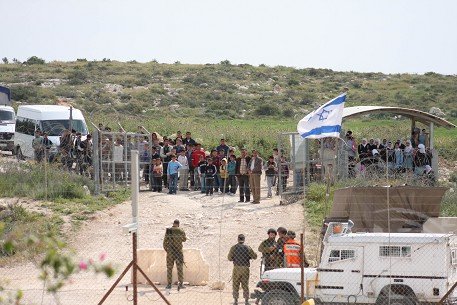
Nablus – Israeli forces turned away Palestinian medical teams at a checkpoint erected at Iraq Burin on Saturday morning, telling international medical volunteers that the area was a “closed military zone.”
Head of the Palestinian Medical Relief Society in Nablus Ghassan Hamdan said the volunteers tried to enter the Nablus-area village where the society had prepared to offer a free treatment day at a local clinic.
Hamdan said the team was told by Israeli soldiers at the village entrance that they must turn back because the village was a closed zone. He said that medics and society officials had made several attempts to explain the humanitarian nature of the mission, but soldiers responded saying their orders were to restrict all entry into the area.
An Israeli military spokeswoman confirmed that the area was declared a “closed military zone for all non-Palestinians,” but said that an exception was made for the doctors at 11a.m., hours after the group arrived at the checkpoint.
Officials from the society confirmed that the Palestinian and international medical workers were permitted into the area, and condemned the delay, saying it would cause a serious reduction in available medical services for villagers.
The society regularly organizes volunteer programs for doctors, nurses and medics from around the world who donate their time and perform free checkups and treatment to Palestinians without regular access to medical services.
The declaration follows one week after the detention of two young men at a checkpoint installed in the same location the previous Saturday.
Iraq Burin, cut off from Nablus by several checkpoints and roadblocks preventing access to the nearby settlement of Yizhar and Bracha, has held regular protests against continued land confiscations by the settlements and settler-only roads. The two detained were accused of having participated in protests in previous weeks.
According to a report by the Israeli human rights group B’Tselem, a new Israeli military order passed in January 2010 made gatherings of more than ten people illegal, by reenacting a 1967 law. The group said the law violated the right of assembly for Palestinians, guaranteed by the fourth Geneva Convention.
Featured Video

The American Retreat from Vietnam
or go to
Aletho News Archives – Video-Images
From the Archives
Secret document reveals plans for civil war in Lebanon, Israeli false flags, and invasion
By Randi Nord | Geopolitics Alert | April 5, 2019
Beirut – During his visit with US Secretary of State, Mike Pompeo, Lebanese President Michael Aoun reportedly received a US-Israeli document detailing plans for creating a civil war in Lebanon with covert false flag operations and possible Israeli invasion.
Although the source of the document is Israeli and created in partnership with Washington, no one knows who presented it to Aoun. The Lebanese TV station, Al-Jadeed, initially reported the document on Lebanese TV and a video on its website. Geopolitics Alert translated the report for this article. … continue
Blog Roll
 Aletho News
- ‘Distance yourselves from Israel’: IRGC urges US population to question govt policies
- America’s Greenland deal has a radioactive backstory
- The RAF Fairford ‘terror plot’: Unpacking escalation in the UK echo-chamber
- EU Council Advances Chat Control 2.0 Scanning Proposal
- Ex-Greek MEP files complaint against Israeli spyware firm over alleged Pegasus surveillance
- Troubling ideas throughout the Torah, Talmud, Mishneh Torah and Tanya
- ‘Grave, alarming’: Iran mission on Trump’s UNGA ‘annihilation’ threats
- Najaf airport to reopen to Iranian flights within 24 hours: Ambassador
- From ‘How Will This End For Iran’ to ‘When America Walks Away’: A tale of two Economist covers
- Tehran blasts ‘baseless’ speculation linking Iran to alleged bomb plot at UK air base
- If Americans Knew
- Israel Has Kidnapped Another American Teenager
- US arms sales to Israel worth $21.6 billion in 20 months
- Three Palestinians Killed in Israeli Attacks on Gaza
- Revealed: German “Anti-Semitism Expert” Driving Crackdown on Palestine Solidarity is Former Israeli Spy
- Egypt’s Warning to Israel Before Oct 7
- Israel’s siege signals another cruel winter for 1.8 million Gazans – Daily Update
- Netanyahu Asked UAE Leader to Deny Report on Oct. 7 Warning in Secret Visit, Sources Say
- CNN Chief Int’l Correspondent Clarissa Ward on Journalists in Gaza
- Democratic Party Consultants Surround Troy Jackson with Pro-Israel Donors
- Christian Leader Responds To Netanyahu’s Claims Regarding Palestinian Christians
- No Tricks Zone
- New Study: Earth And Venus Surface Warmth Largely Explained By Convection And Lapse Rate, Not CO2 Or Radiation
- 2025 Nature Paper Claiming Worsening Global Drought Gets RETRACTED …Heavily Flawed
- New Study: ‘Global Drought Shows No Detectable Recent Acceleration Under Climate Warming’
- Economic Masterminds: German Socialists Suggest Taxing Productivity Gains Stemming From Using AI
- The South China Sea Has Not Been Cooperating With The Climate Change Narrative
- Energy Crisis: Germany Enters Heating Season With Historically Low Gas Reserve Fill Levels
- New Study: The Antarctic Ice Sheet Gained Mass From 2020-2024 Due To Staggering Snow And Ice Accumulation
- Study: Ocean Heating Rates From Thousands Of Years Ago ‘Dwarf’ Modern Ocean Heating Rates
- Climate Extremists Target, Attack Large-Scale Power Grid Infrastructure In Germany!
- New Study: Antarctic Ice Melt Has Contributed Less Than 1 Centimeter To Sea Level Rise In The Last 30 Years

