Judge Rules CIA Can Suppress Information About Torture Tapes and Memos
Ruling Allows CIA to Conceal Evidence of Its Own Illegal Conduct, Says ACLU
ACLU | July 15, 2010
NEW YORK: A federal judge today ruled that the government can withhold information from the public about intelligence sources and methods, even if those sources and methods were illegal. The ruling came in response to Freedom of Information Act (FOIA) litigation filed by the American Civil Liberties Union for Justice Department memos that authorized torture, and for records relating to the contents of destroyed videotapes depicting the brutal interrogation of detainees at CIA black sites.
The government continues to withhold key information, such as the names of detainees who were subjected to the abusive interrogation methods as well as information about the application of the interrogation techniques. Judge Alvin K. Hellerstein of the U.S. District Court for the Southern District of New York today ruled that the government can continue to suppress evidence of its illegal program.
The following can be attributed to Jameel Jaffer, Deputy Legal Director of the ACLU:
“We are very dismayed by today’s ruling, which invests the CIA with sweeping authority to conceal evidence of its own illegal conduct. There is no question that the CIA has authority under the law to withhold information relating to ‘intelligence sources and methods.’ But while this authority is broad, it is not unlimited, and it certainly should not be converted into a license to suppress evidence of criminal activity. Unfortunately, that is precisely what today’s ruling threatens to do. The CIA should not be permitted to unilaterally determine whether evidence of its own criminal conduct can be hidden from the public.”
CONTACT: ACLU
Rachel Myers (212) 549-2689 or 2666; media@aclu.org
UK Sought Rendition of British Nationals to Guantánamo; Tony Blair Directly Involved
Andy Worthington – 15.7.10
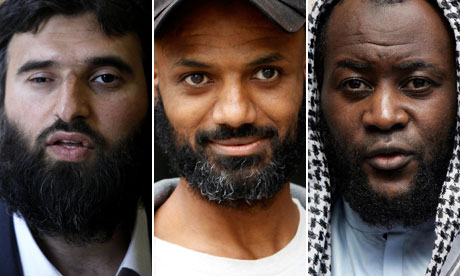 With what the Guardian described yesterday as the “almost unprecedented” release of “security service reports of interviews with detainees in Guantánamo Bay and other overseas detention centres,” the coalition government failed in its attempt to persuade the High Court to bring a temporary halt to a civil claim for damages filed by six former Guantánamo prisoners, unleashing, instead, a torrent of previously classified and deeply disturbing documents.
These reveal, shockingly, how the Labour government was happy for British nationals and residents seized in Afghanistan and Pakistan to be rendered to Guantánamo by the Bush administration, and how, in one case — that of Martin Mubanga, seized in Zambia — Tony Blair’s office intervened to prevent attempts by the Foreign and Commonwealth Office to have him returned to the UK, leading to his imprisonment in Guantánamo for two years and nine months.
In paving the way for its announced inquiry into British complicity in torture, the coalition government attempted, without success, to persuade the High Court that, as the Guardian put it, “proceedings should be delayed while attempts at mediation are made” before the inquiry begins. Critics had already expressed their fears that the calls for “mediation” were a smokescreen for compensation deals that would attempt to buy the former prisoners’ silence, so that the inquiry could proceed in secret without too many embarrassments.
Instead, however, the government’s intervention has precipitously kick-started the inquiry in a very public manner, after Tim Otty QC, counsel for five of the men, said that proceedings “should be allowed to continue because the documents that the government is beginning to disclose shed new light upon the role that the UK authorities played in the men’s mistreatment,” and the judge, Mr. Justice Silber, agreed.
One of the most shocking documents disclosed in the High Court proceedings was issued by the FCO on January 10, 2002, the day before Guantánamo opened. Entitled, “Afghanistan UK Detainees,” it described the government’s “preferred options” in dealing with British prisoners. “Transfer of United Kingdom nationals held to a United States base in Guantánamo is the best way to meet our counter-terrorism objectives, to ensure they are securely held,” the document explained, adding that the “only alternative” was to either hold these men in British custody in Afghanistan, or to return them to the UK.
In another shocking revelation, it was revealed that, in the case of Martin Mubanga, released documents “raise a number of troubling questions as to the role of the former Prime Minister’s office in frustrating the release of one of the claimants,” as Tim Otty described it, adding, “In the period of March and April 2002, the Prime Minister’s office apparently countermanded a desire on the part of the Foreign and Commonwealth Office to intervene on behalf on Mr. Mubanga.”
Mubanga, a joint British-Zambian national, had traveled from Pakistan to Zambia, where his sister lived, in February 2002, but had then been seized by the Zambian security services, and according to the documents released in court, the Prime Minister’s Office had intervened to ensure that he was not brought back to the UK. As a result, the FCO was put in a difficult position: if officials sought consular access, thereby acknowledging British responsibility for him, he would have been released to the UK authorities, directly contradicting the Prime Minister’s orders, which, as Reprieve noted yesterday, involved the Prime Minister “order[ing] the FCO to violate its international law obligations under the Vienna Convention, which requires the UK to provide consular assistance to British nationals around the world.”
At the time, an FCO document complained about “the schizophrenic way in which policy on this whole case was handled in London,” which had led to the British High Commission in Lusaka being placed “in an impossible position,” and in an email dated August 22, 2002, an FCO official, recognizing that “we broke our policy” because of direct interference from Tony Blair’s office, stated, “we are going to be open to charges of concealed extradition.”
According to Mubanga, after the British finished with him — apparently having tried and failed to recruit him as a spy — the US agent who had been dealing with him told him, “I’m sorry to have to tell you this, as I think you’re a decent guy, but in ten or 15 minutes we’re going to the airport and they’re taking you to Guantánamo Bay.”
In court, Tim Otty highlighted Tony Blair’s complicity in torture by pointing out that, by the spring of 2002, it was abundantly clear that there was a considerable risk that terror suspects in US control would be subjected to rendition and torture. “Despite that,” he told the court, “someone at Number 10 saw fit to counter what the Foreign Office wished to do.”
As the Guardian also explained yesterday, this was “not the only time the Prime Minister’s Office intervened to thwart attempts by Foreign Office officials to obtain a degree of protection for British citizens.” Minutes prepared for the Home Office Terrorism and Protection Unit after a meeting in April 2002 state that the US authorities “had been informed that the British government might begin making public requests for legal access to British men held at Guantánamo.” According to the minutes, “FCO had wanted to do this (and wanted to be seen to be doing it) but had been overruled by No. 10.”
The released documents also highlight the leading role played by Jack Straw, then the foreign secretary, in shaping the policies that led to the interrogations of British prisoners in US custody in Afghanistan, prior to their transfer to Guantánamo. As the Guardian explained, in mid-January 2002, Straw sent a telegram to several British diplomatic missions around the world in which he “signaled his agreement” with the Guantánamo policy, “but made clear that he did not wish to see the British nationals moved from Afghanistan before they could be interrogated.” In the telegram, he wrote:
A specialist team is currently in Afghanistan seeking to interview any detainees with a UK connection to obtain information on their terrorist activities and connections. We therefore hope that all those detainees they wish to interview will remain in Afghanistan and will not be among the first groups to be transferred to Guantánamo. A week’s delay should suffice. UK nationals should be transferred as soon as possible thereafter.
One of these “detainees” was Shaker Aamer, the last British resident still held in Guantánamo, and as a court heard in December last year, leading to the launch of a Metropolitan Police investigation, Mr. Aamer has claimed that British agents were present in the room, in the US prison at Kandahar airbase in Afghanistan, when he was subjected to abusive treatment by Americans.
Other interrogations revealed in the documents include those involving Omar Deghayes, seized from a house in Lahore in May 2002, who was treated disdainfully by the British agents who visited him, and an unidentified prisoner held in Kabul, under the heading, “Warriors 14/1,” about whom the agents involved noted only, “Interview conditions: cold beaten up.”
Extraordinarily, these documents are only the tip of a very murky iceberg, and it is unclear at present how many more will be publicly revealed. As has been previously reported, the government has identified up to 500,000 documents that may be relevant to the former prisoners’ claim for damages, and, according to the Guardian, “says it has deployed 60 lawyers to scrutinize them, a process that it suggests could take until the end of the decade.” In this first batch, “just 900 papers have been disclosed, and these have included batches of press cuttings and copies of government reports that were published several years ago,” but as they also include these damning insights into the activities of Tony Blair, Jack Straw and the agents who interrogated British prisoners in appalling conditions, it is surely inconceivable that the government will now be able to conduct a secret inquiry into British complicity in torture, and must, instead, order a full and open inquiry.
This could take place under the Inquiries Act of 2005, like the Baha Mousa inquiry (into the murder, in British custody, of a hotel clerk in Iraq), which, as Reprieve noted when David Cameron announced the torture inquiry two weeks ago, was held under the Act and has been “a model of an inquiry functioning efficiently, including the hearing of secret evidence,” and has also allowed for document classification review proceedings that “are sophisticated and rightly allow the judge to balance the need for national security against the need for transparency.”
The time for silence, and the time for secrecy are over. To clear the air, and to draw a line under this most lamentable period in our recent history, we need an inquiry presided over by someone who is able to “balance the need for national security against the need for transparency.” For too long now — and with baleful results — the need for national security has been allowed to override everything else, inflicting grave damage on our claims to be a civilized country, and leading to devastating effects for those caught up in a “War on Terror” with few checks and balances.
“They want us to be loyal to the occupation”
Muhammad Totah interviewed
Max Blumenthal, The Electronic Intifada, 15 July 2010
On 9 July, as Israeli Border Police officers brutalized demonstrators at the weekly protest in the Sheikh Jarrah neighborhood of occupied East Jerusalem, forcing them away from a street where several homes had been seized by radical right-wing Jewish settlers, I visited the Jerusalem International Committee of the Red Cross (ICRC) headquarters just a few hundred meters away.
Though the din of protest chants and police megaphones could not be heard from the ICRC center, the three Palestinian legislators who had staged a sit-in there for more than a week to protest their forced expulsion from Jerusalem insisted that their plight was the same as the families forced from their homes down the street.
“All the Israeli steps in East Jerusalem are designed to evacuate Jerusalem of its Palestinian heritage,” remarked Muhammad Totah, an elected Palestinian Legislative Council member who has been ordered to permanently leave Jerusalem by the Israeli government. “Whether it’s through home demolition, taking homes or deporting us, the goal is the same.”
According to Israel’s Ministry of the Interior, the three legislators are guilty of a vaguely defined “breach of trust,” ostensibly for their membership in a foreign government. The charge leveled against them recalls nothing more than the campaign platform of the far-right Israeli Foreign Minister Avigdor Lieberman, which demanded the mass expulsion of “disloyal” Palestinian citizens of Israel.
For this reason, the Israel-based legal advocacy group Adalah described the Israeli government’s actions as “characteristic of dark and totalitarian regimes” (“Motion for Injunction filed to Israeli Supreme Court to Stop Imminent Deportation Process of Palestinian Legislative Council Members from Jerusalem,” 15 June 2010).
The lawmakers’ problems began in 2006 when they ran for the Palestinian Legislative Council in the West Bank as members of the Change and Reform list, an offshoot of Hamas. Though the Israeli government allowed the men to campaign for office and vote for the Chairman of the Palestinian Legislative Council, as soon as they were elected, Israel warned them to resign from office or face the cancellation of their status as residents of Jerusalem.
When they failed to heed the Israeli government’s demand, in June 2006, the men were arrested and sentenced to two to four years in prison. Two days after they were released, the Israeli police confiscated their identification cards and ordered them to leave Jerusalem for another part of the West Bank.
As a result of the expulsion orders, the first of their kind since 1967, the three lawmakers are virtual hostages in the city their families have lived in for generations — if they leave the Red Cross center they will be immediately arrested. Their colleague, Muhammad Abu Tir, is already in an Israeli jail cell. Despite having been separated from their families for years, they remain steadfast in their rejection of the government’s orders, fearing that their expulsion will open the door for mass deportations of Palestinians from East Jerusalem.
Israel occupied East Jerusalem in 1967, along with the rest of the West Bank, the Gaza Strip, the Syrian Golan Heights and the Sinai peninsula, which was returned to Egypt in a peace deal a decade later. No country recognizes Israel’s annexation of East Jerusalem, and the UN Security Council has declared repeatedly that Israel’s occupation of all the territories it seized in 1967 is governed by the 1949 Fourth Geneva Convention Relative to the Protection of Civilian Persons in Time of War, a treaty Israel was compelled to sign which specifically forbids an occupying power from expelling civilians from the territory it occupies. Thus the legislators’ expulsion has been issued in explicit violation of binding international law.
Totah told me that the Israeli interior ministry has a list of 315 members of Palestinian civil society in East Jerusalem — academics, lawmakers, activists — whom it plans to expel in the near future on charges of disloyalty to the Jewish state. “They are trying to legalize the Nakba,” Totah remarked, using the Arabic word Palestinians use to describe their mass expulsion from their homeland in 1948.
I talked with the 42-year-old Totah for a half hour in the leafy courtyard of the ICRC headquarters. He was visibly tired, having spent the past two days in meetings with British parliamentarians, the head of Jerusalem’s Greek Orthodox Church and left-wing Israeli groups ranging from Anarchists Against The Wall to Gush Shalom. While a wiry young boy rushed around the yard, serving us a seemingly endless stream of Turkish coffee shots, Totah described to me his experience as a prisoner in his hometown.
Max Blumenthal: The Israeli government says you are guilty of a “breach of trust.” Does this mean they are accusing you of disloyalty to the state?
Muhammad Totah: The main reason they are expelling us is that we are accused of disloyalty. And every one on the list [of 315 Palestinian civil society members Israel seeks to expel] is accused of disloyalty. They want us to be loyal to the occupation. This is insane! So they are seeking any excuse to get rid of us. They want us to leave at any price. Basically, they want to finish the project that they began in 1948 because it has taken too long.
MB: Why did you decide to conduct a sit-in inside the Red Cross headquarters?
MT: We are determined to prevent the occupation from coming and taking us away. Beyond that, we are using our time here to make sure the international community hears our case. The occupation is against all international laws and we believe if the door of deportation is open in Jerusalem, it means that hundreds or even thousands will be deported. Right now, we are in danger of being arrested at any time. In fact, our colleague Abu Tir was arrested last month. So they could come at any time for us.
MB: Do you believe the Israelis would go as far as raiding a Red Cross center in Jerusalem to carry out your expulsion?
MT: The occupation will do anything. They are killing people constantly, demolishing buildings and doing what they have done for years. Ten thousand Palestinians are currently in prison. So yes, we would not be surprised by such an action.
MB: Has the international community responded to your protest?
MT: We sent a letter to [US] President [Barack] Obama and asked him to interfere and to put pressure on the Israeli side to cancel this illegal decision. So far, we have not heard a response. We have sat with [Palestinian Authority] President [Mahmoud] Abbas two times and he said that he had sent my letters to all the human rights organization and USAID [the US Agency for International Development] and sent letters to the occupation authorities and he said they’re making communications all the time time. But until now nothing on the ground. We have put out a call for international human rights organizations as well. And we have sent letters to all the leaders of Islamic and Arab states.
Our letters stress that our protest is not about our case in particular, but that it is about all the Palestinians living in Jerusalem. We believe that this decision is designed to begin a process that will empty Jerusalem of Palestinian people. The UN and international community admits that East Jerusalem is occupied by Israel, so clearly this is an illegal decision under the Fourth Geneva Convention.
MB: How much of Israel’s decision is motivated by your affiliation with Hamas and how does the tension between Hamas and Fatah effect the Palestinian Authority’s involvement in the case?
MT: This is an international case. It has nothing to do with Fatah and Hamas. There is a list of over 300 people who will be deported after us — the heart of Palestinian civil society in East Jerusalem — and for this reason all the parties in Jerusalem are united against this decision. They feel that we are the first and they will be the second. We know that the occupation doesn’t discriminate between political parties.
MB: How has your predicament affected your family?
MT: My son who is six years old does not want to leave the house anymore. He said, “I will not leave the house until my father comes back!” As soon as I was released from prison I was sent to so many meetings right away and couldn’t see my family, who I had hardly seen for four years. Now he’s having his own protest at home. “I will not leave home!” he says. This is a very big problem for me because I don’t want to break his heart. One of my children who is even younger wakes up every night screaming and crying with terrible nightmares. “Why are you crying?” my wife says. He says, “The soldiers are coming to throw me in jail!” My wife is suffering because of course we have been split for a very long time. The occupation wants to scare my family and if any information gets to my wife or children about what is happening to me they become extremely upset. This is not just my problem, though. All my colleagues are suffering this same way.
MB: How much of a burden has been placed on you by the Palestinian community in Jerusalem to resist your expulsion?
MT: The fact is that if we accept the deportation it means we accept deportation for thousand of Palestinians in Jerusalem. Even as hard as it is to be here without our families for so long we think that is the only means we have to declare that [our expulsion] is illegal and is against all international laws. We have nowhere else to go. This is our original country and our original city. My father was born here; my grandfather was born here so we have been here hundreds of years. All we are demanding is to stay in our homes and we are sure that we will get it because it’s our right and the deportation is against all international laws.
MB: If deporting you is the first step in a plan for mass deportations, what do you think Israel’s end game is?
MT: We think that there is a plan from the Israeli side to make East Jerusalem Jewish and they have many practices to do so. One of them that is the most dangerous is our deportation. If they demolish your house, you can always build another building. But deporting people — how can you talk about a city without people? What they want is to legalize the Nakba.
Max Blumenthal is an award-winning journalist and bestselling author working in Israel-Palestine. His articles and video documentaries have appeared in The New York Times, The Los Angeles Times, The Daily Beast, The Nation, The Huffington Post, Salon.com, Al-Jazeera English and many other publications. He is a writing fellow for the Nation Institute. His book, Republican Gomorrah: Inside The Movement That Shattered The Party, is a New York Times and Los Angeles Times bestseller.
Israeli Soldiers Kidnap Nine, Including Two Women In Nablus
By Saed Bannoura – IMEMC & Agencies – July 15, 2010
Israeli soldiers conducted an arrest campaign targeting leaders and members of the leftist Popular Front for the Liberation of Palestine (PFLP), and kidnapped nine residents, including two women, in Beit Forik Village, near the northern West Bank city of Nablus.
Myassar Etyani, a Palestinian woman active in detainee affairs, stated that the soldiers invaded the village around 2 a.m. and broke into several homes.
The soldiers broke into the home of Abu Ghlamay and kidnapped Ayman Abu Ghalamy who was released from an Israeli detention camp a month ago after spending 4.5 years in Israeli prisons. Soldiers also confiscated the I.D. card of his father.
The soldiers also kidnapped Laith Mofeed Abu Ghalamy in addition to former female detainees Linan Yousef Abu Ghalamy and her sister Taghreed.
Etyani added that the army also kidnapped Sajed Abdul-Latif Mleitat, his brother Mos’ab, Hani Abu Al Saoud, and Hamada Hanani. Soldiers confiscated laptops and mobile phones.
Etyani said that Linan was released from an Israeli detention facility on October of 2009 as part of an agreement that was meant to reach a prisoner-swap deal that would ensure the release of prisoner-of-war, Gilad Shalit.
Linan is the widow of Amjad Mleitat who was assassinated by Israel in 2004. He was a senior member of the Abu Ali Mustafa Brigade, the armed wing of the PFLP.
Linan and Taghreed are the sisters of Ahed Abu Ghalamy who is serving life-term in Israeli prisons, while Ayman and Laith are his nephews.
OCHA And WHO Announce Israel’s Barriers Are Blocking Access To Hospitals
Palestine Monitor | 10 July 2010
On the sixth anniversary of the International Court of Justice (ICJ) demand that the Separation Barrier be re-routed and dismantled where it breaches Palestinian territory, The United Nation’s Office for the Coordination of Humanitarian Affairs (OCHA) and the World Health Organisation (WHO) have issued a new report condemning its impact on health and agriculture. New studies have shown movement restrictions are preventing access to East Jerusalem’s six specialist hospitals for staff and patients. The report also highlighted the difficulties for those living and working in the ‘seam zone’, the areas isolated by the Wall.
Current projections indicate the finished Wall, currently 61% completed, will leave almost 10% of the West Bank on the Israeli side. 85% of the barrier is to be built on Palestinian land, with approximately 7,800 people currently trapped in this ‘seam zone’. That figure is set to treble.
While the report noted that some Israeli measures have reduced movement restrictions in the West Bank, with “the removal of dozens of obstacles” around Qalqilya and Nablus, they are tightening in East Jerusalem. This has been most problematic in terms of access to the six hospitals located there, which provide specialist services not available elsewhere in the West Bank and Gaza, including dialysis and oncology, open-heart surgery, neurosurgery and eye surgery.
At present patients are required to pass through three checkpoints on foot, a policy WHO representatives described as “undignified and often unsafe” when applied to severely ill patients. A further problem has been the lack of access for hospital staff, who until 2008 had been given special dispensation to pass East Jerusalem checkpoints. That ‘privilege’ was then suspended before protests led to it being restored for doctors, but not nurses or support staff, who now face lengthy delays and periodic refusals in attempting to access their workplace. WHO officials say Israeli authorities have given “no clear reason” for this damaging policy which severely impacts on the maintenance of hospital services, and that they are continuing to press for full, unrestricted access.
The problem is more severe for patients. In 2009, almost 50% of patient referrals for specialised care were to East Jerusalem hospitals, which treat around 19,000 patients a year. Since 1993, Palestinians without Jerusalem ID cards are forced to apply for permits in order to receive treatment, a time consuming, unreliable process that leads to costly delays in dealing with urgent health problems. Emergencies are not treated as such. In 2009, the Palestinian Red Crescent Society reported 440 “denials and delays” of ambulances in the Occupied Territories, “two thirds of which occurred at Barrier checkpoints accessing Jerusalem”. The permit applications department from Augusta Victoria Hospital estimates 20% of patients are refused.
Al-Quds University in Abu Dis is the main training centre for medical students, but the 90% of students from the West Bank require permits to attend their courses. In the last month Al Quds medical school announced 11 students were forced to end their training as they were not given permission.
The report’s other main concern was the increasing difficulty for West Bank farmers in the ‘seam zone’ in accessing their land. Farmers must apply for an Israeli permit proving ‘connection to the land’ and satisfy security criteria. This, coupled with a gate system that only allows workers through at certain times of the day and never at night, has led to a steep decline in production and the abandonment of large tracts of land. UN studies show farmers are wary of submitting personal documents to Israeli security services “for fear they will be used against them” and others refuse to apply out of principle. As a consequence, only 207 of 1,000 farmers in Habla, Qalqilya were issued permits last year, 73 of 1,400 in in Zeita, Tulkarm and 70 of 1,750 in Anin, Jenin.
The presence of barrier gates in the seam zone represents a serious health concern. If an injury, common in rural areas, takes place outside the designated opening hours, the victim cannot receive treatment until the next opening.
Along with the report, OCHA and WHO have issued a short list of demands to the Israeli authorities; 24 hour access through gates around the seam zone to facilitate medical treatment, as well as unhindered access for medical personnel, students and patients to East Jerusalem hospitals. OCHA representatives have as yet received no response.
Read a full OCHA report on their website
Israel closes case of Silwan shooting
Ma’an – 10/07/2010
Jerusalem: Israel’s attorney general has closed the case of a shooting by an Israeli soldier who was visiting the City of David illegal settlement in the Wadi Helwa neighborhood in Silwan, East Jerusalem.
The soldier was carrying an M16 rifle and opened fire at member of the Wadi Helwa committee Ahmad Qara’een, 40, who was shot in the foot and Ameer Froukh, 13, while he was riding his bike in the neighborhood.
The case was closed due to lack of evidence, the attorney general said.
Ahmad Qara’een said that the outcome was inexplicable as he had submitted witnesses, photos, and medical reports to Israeli officials.
“Meanwhile, they accused me of attempting to snatch a soldier’s rifle, and interrogated my two children Wadee and Ali, who are 11 and 10. That same soldier harshly beat my two sons, and Ameer Froukh was shot in the foot while riding his bike,” Qara’een said.
Ramadan Al-Bana of the Wadi Helwa Information Center said “Israeli soldiers always punish the victim and always look at us Palestinians as criminals. This is what we have come to expect from Israeli soldiers, who turn us into suspects and portray themselves as victims.”
Tensions boiled over Saturday when a group of Israeli settlers accosted members of the At-Taweel family, relatives said, claiming that their home was owned by the King David project and ordering them to leave.
Residents of the neighborhood arrived at the scene but the settlers left before any major disturbances.
Israeli occupation forces damage more land in Gaza, Zionist settler runs over elderly Palestinian
Palestine Information Center – 11/07/2010

KHAN YOUNIS: Israeli occupation forces (IOF) escorted two military bulldozers 300 metes into eastern Khan Younis, in southern Gaza Strip, on Sunday amidst indiscriminate shooting.
Local sources told the PIC reporter that three army tanks were firing intermittently as the bulldozers damaged Palestinian lands.
IOF troops on Saturday night opened machinegun fire at Palestinian homes and lands east of Rafah, also south of Gaza.
Eyewitnesses said that IOF warplanes were seen flying over the targeted area, no casualties were reported.
Meanwhile, in the West Bank an elderly Palestinian farmer was seriously injured when a Zionist settler ran him over near Khader village, Bethlehem district. Witnesses said that Mahmoud Subaih was on his way to farm his field when the settler hit him then sped away.
Zionist settlers drive recklessly on West Bank bypass roads which Palestinians have come to dub “death roads” as many civilians are killed or seriously injured in such incidents as a result of high speed and indifference to Palestinian lives.
Ma’an reports:
One PRCS paramedic said Israeli Magen David Adom ambulance staff contacted them after they arrived at the scene, as they were unable to transfer the injured to an Israeli hospital because he had a West Bank ID card.
Six years in jail, no charge: war on terror’s forgotten victim speaks
The Independent – 08/07/2010

Babar Ahmad was left with 73 injuries after his first arrest in 2003. He is presently being held in a small cell
Babar Ahmad, 35, is the longest-serving prisoner held without charge or trial in the UK. In his first media interview since his arrest on a US extradition warrant in 2004, Mr Ahmad tells Robert Verkaik that he is the forgotten victim of the ‘war on terror’. In March 2009, he was awarded £60,000 in compensation after an admission by the UK’s anti-terrorist police that they subjected him to ‘grave abuse, tantamount to torture’ during his first arrest in December 2003. Corresponding via email from a secure isolation unit at Long Lartin prison, he calls on the Government to charge him or release him. Today, the European Court of Human Rights rules on his case.
Can you describe your life in the UK before your arrest?
I was born in the UK and have spent all my life living in south London in the Balham/Tooting area. At the time of my first arrest in December 2003, I was employed full-time as an ICT Support Analystat Imperial College London. My job entailed supporting the software needs of undergraduate academic teaching and postgraduate research. I have always been a devout Muslim and others would describe me as adhering to mainstream Islamic teachings. I have never been charged with or convicted of any criminal offence.
Describe the conditions of your detention.
I have been held in a number of prisons throughout the high-security estate since my arrest in 2004. I have been designated a category A prisoner. Initially, I was held on normal wings in prisons, alongside prisoners of all different categories. I was then moved to a small unit in HMP Long Lartin and held with other men fighting extradition or deportation. Over the last year and a half, the conditions of my detention have deteriorated. I spend all day, every day on a small unit with seven other prisoners. We are isolated from all other prisoners and all our time is spent in the claustrophobic atmosphere of a small unit. If I am extradited to the US, my conditions will deteriorate further. I face the possibility of life without parole in solitary confinement under the harshest of prison regimes in a Supermax prison, far from home, family and friends.
What is the case against you?
The central US allegations against me revolve around a family of websites that provided news in nearly 20 languages on Chechen resistance fighters who were defending their land against the Russian Army’s invasion of Chechnya in the 1990s. According to the US, this was terrorism [The Home Office says Mr Ahmad is accused of providing material support to terrorists]. But according to UK this was, and still is, legal as Chechen resistance fighters have never been proscribed as a terrorist organisation, unlike al-Qa’ida. In fact, the leader of the Chechen resistance has been living in the UK for several years, having been granted asylum.
The US claims jurisdiction because it is alleged that one of the several dozen computer servers on which the websites were hosted was located in the US for approximately 18 months from early 2000. The US accepts that the websites were also hosted on computer servers around the world and that “at all times material to the indictment” I was living in the UK. Other peripheral allegations against me are that a US naval battleship plan document was allegedly seized from me in December 2003. The media raised uproar about this document when I was arrested on the extradition warrant. However, in a letter to Sadiq Khan MP, the former Attorney-General Lord Goldsmith wrote that it could not even be proven that it was in my possession. Another document seized from my parents’ house was a tourist brochure (belonging to my father) of the Empire State Building in New York, which prompted the media to report “al-Qa’ida planned to attack Empire State Building”. That brochure is dated 1973, which is when my father visited New York. What is more incredible is that UK police returned this brochure to my father after I was arrested on the extradition warrant, yet it still forms part of the evidence against me.
How were you tortured in the UK?
On 2 December 2003, I was arrested in a pre-dawn raid by anti-terrorist police officers at my home in Tooting. During my arrest and subsequent journey to the police station, the officers subjected me to a “serious, prolonged and gratuitous attack” and “grave abuse tantamount to torture”, which left me with at least 73 physical injuries including bleeding in my ears and urine. I was held in custody for six days during which my home and office were searched, computers seized and analysed and I was questioned. On 8 December 2003 I was released without charge, after the CPS determined that there was no evidence to charge me with any criminal offence whatsoever. I believe that part of this decision was based on the fact that any future criminal trial would air embarrassing details of the abuse inflicted on me at my arrest.
Following my release I filed a formal complaint against the police and I gave several interviews describing my treatment. My case began to prove highly embarrassing to the Blair government.
When were you re-arrested?
After two months recovering from my injuries, I returned to work in February 2004 and tried to rebuild my life following my ordeal. On 5 August 2004, on my way home from work, I was re-arrested pursuant to an extradition warrant from the US under the controversial, no-evidence-required US-UK Extradition Treaty and taken to a high-security prison where I have remained ever since. To this day I have not even been questioned about the allegations against me.
Why is the US Government so determined to see you face trial there?
The question to ask is why has the Blair/Brown Government been so determined to extradite me? In my case there is documentary evidence to suggest that it is not the US that is really interested in me, but the Blair/Brown Government that has been determined to send me there at any cost. One only has to read the ferocious, lengthy representations that the Foreign Office has made to the European Court of Human Rights urging, almost begging, the Court to extradite me to the US. Their Herculean efforts eclipse those made by the US government itself.
What message do you have for the Coalition Government in respect of your extradition?
I have now been in prison fighting extradition for six years, which is the equivalent of a 12-year sentence. Whilst in prison I have outlived the the Blair/Brown Labour Government. To their credit, both the Liberal Democrats and the Conservatives have steadfastly opposed this controversial UK-US Extradition Treaty and they have pledged, in their published Coalition Agreement, to modify it.
Obama’s Gitmo
Torturing the rule of law
By Chase Madar | The American Conservative | August 1, 2010 Issue
President Obama may lack the nerve to stare down Liz Cheney or Bibi Netanyahu, but no one can deny that our commander in chief has the guts to take on a child soldier. Come August, a military commission in Guantánamo will try Omar Khadr, a Canadian national captured outside Kabul in 2002, when he was just 15 years old. This will be only the third Gitmo trial and the Obama administration’s first, and there won’t be anything kinder and gentler about it.
But give our government credit for breaking new ground: no nation has tried a child soldier for war crimes since World War II, and the decision to prosecute Khadr has drawn protests from UNICEF, headed by a former U.S. national security adviser, as well as every major human-rights group. The audacity doesn’t stop there: charges against Khadr include “murder in violation of the rules of war,” a newly minted war crime novel to the history of armed conflict. Battlefield deaths do not usually result in murder trials for prisoners of war. But according to the Department of Defense, Omar Khadr is no POW. He’s a non-uniformed, “unprivileged belligerent.” In the euphemistic lingo of Gitmo, Khadr is not even a prisoner, just a “detainee” who has been awaiting trial for the past eight years.
This kind of court action would have made great copy under Cheney and Bush, noisome proof of their barbarity. Now everyone except the Right’s usual panic-merchants is sick of Guantánamo and wishes it had closed, as Obama promised, by the end of 2009. But that deadline has passed, and Gitmo will surely be open next year too. Several reporters told me they had to beg their editors to be sent down to cover the Khadr story.
Anyone expecting to witness eye-popping tableaux of Rumsfeldian cruelty at Gitmo will be disappointed. It’s a military base like many others, except instead of the nearby base town with obligatory pawn shop, strip club, and Korean restaurant, you find an impermeable barrier sealing base dwellers and visitors inside. Overall, it’s not a bad deployment: soldiers can at least get a beer off duty, the snorkeling’s good, and the roads are free of IEDs. Given the paucity of lurid local color, scribblers who take the military flight—a leased Delta aircraft from Andrews Air Force Base—have been reduced to soliloquizing about Guantanamo’s McDonald’s and the banality of evil amid the French fries.
Gitmo’s population continues to trickle away, to a point. Over 600 prisoners have been let go, and of the 50 habeas petitions for release filed since the Boumediene decision in 2008, 36 have been granted. Were these really “the worst of the worst”? Hardly. Still, the Obama administration has announced that it will continue to hold some 45 detainees indefinitely without charges, one of George W. Bush’s most radical policies, now zealously defended by a smoother, smarter team of Democratic lawyers. This is exactly the kind of lawlessness that Harold Koh, a human-rights icon, used to condemn from his bully pulpit as dean of Yale Law. Now, as legal adviser to the Department of State, he’s tasked with justifying indefinite detention.
Of the roughly 180 remaining prisoners, Omar Khadr is the youngest. The 23-year-old is now in the midst of pretrial suppression hearings to determine whether his confession of throwing a grenade that killed a Special Forces medic is admissible as evidence. Few would deny that Khadr was tortured—one interrogator testified that he first laid eyes on the youth hooded and chained to the walls of his cell, standing with his shackled arms extended at head level. The only questions are how much torture, exactly what kind, for how long, and whether it contaminates the confession that Khadr later retracted. The first round of hearings afforded a clear vantage into the legal black hole that Guantanamo very much remains.
The Obama administration has striven to paper over the abyss with a layer of legality. There are new, improved rules for the military commissions, signed by the secretary of defense the night before the hearings began. Alas, they continue to fall short in core areas of juridical fairness. There is no right to a speedy trial, no pretrial investigation to weed out weak cases, and the defense’s requests for witnesses must go through the prosecution. There is no credit for pretrial detention—now nearly a decade for many prisoners—and no right of equal access to witnesses and evidence. Freshly invented war crimes like “material support for terrorism,” retroactively applied, violate the fundamental juridical principle of nulla poena sine lege, no crime without a prospective law.
The greatest flaw is structural: the interference of the “Convening Authority”—the politically appointed head of the commissions—into the prosecutions has been documented again and again. Brig. Gen. Thomas Hartmann, former legal adviser to the Convening Authority, was so blatant in his attempts to secure convictions that he was banned from any involvement in three separate trials for his “undue command influence.” One former chief prosecutor at Guantanamo has said that Hartmann pushed hard for the Khadr case because he thought it would be “sexy, the kind of case the public’s going to get energized about.” Such micromanaging did not endear Hartmann to his colleagues: former deputy prison camps commander at Guantánamo Brig. Gen. Gregory Zanetti testified in 2008 that Hartmann’s conduct was “abusive, bullying and unprofessional … pretty much across the board.”
One might expect that a legal system thus rigged would greatly appeal to its prosecutors. Until now, one would be wrong. Half a dozen prosecutors have quit the commissions in disgust, most with blistering criticisms on their way out. Col. Morris Davis, former chief prosecutor of the commissions until October 2007, said that constant political pressure made full, fair, and open trials impossible: “What we are doing at Guantánamo is neither military nor justice.”
No less scathing is Lt. Col. Darrel Vandeveld, formerly lead prosecutor in another commissions case against a child soldier—a case that collapsed midway through, with the government dropping all charges. “It would be foolish to expect anything to come out of Guantánamo except decades of failure. There will be no justice there, and Obama has proved to be an almost unmitigated disaster,” he told me. After resigning from the commissions as a matter of ethical principle, Vandeveld was punished with a mandatory psychiatric evaluation and gratuitous hearings into his fitness for remaining in the Army, even though he had only four months remaining in his term of service. Vandeveld, who has deployed to Iraq, Afghanistan, and Bosnia, doubts very much that any more prosecutors will resign after his highly visible reprimand.
The new head of the prosecution team, Capt. John Murphy, told me proudly that morale has never been higher on his team. Half of the four lawyers looked young enough to have started law school long after 2001, and it is hard to imagine young attorneys quitting the commissions without established careers to fall back on.
This may spell the end to a golden chapter in JAG history: throughout the sordid drama of Guantanamo, the few glimmers of governmental integrity have come from the JAG corps’ dissent. They even earned that ultimate ethical accolade, the disapproval of John Yoo, who scolded the military lawyers for adhering to the rule of law in defiance of the “unitary executive authority” as embodied by torture buffs such as himself.
For its part, Team Obama’s main innovation has been to ban troublesome journalists from the base, a move Bush never dared. On May 6, toward the end of this round of hearings, the Joint Task Force abruptly barred four of the most knowledgeable reporters from returning to Gitmo, accusing them of violating an order that the identity of Omar Khadr’s primary interrogator be kept secret. It doesn’t matter that “Interrogator Number One,” convicted in a 2005 court martial for prisoner abuse at Bagram prison, had already been interviewed by one of these journalists two years ago and that his identity is available in the public record.
One of the banned journalists, Carol Rosenberg of McClatchy, was hounded last summer by a risible and quickly dismissed sexual harassment complaint made by Navy press officer Jeffrey Gordon. Rosenberg is the acknowledged dean of Gitmo journalists. Getting rid of her would be a singularly effective way for the Department of Defense to gain some control over Gitmo’s public image.
And that image remains pretty terrible, even if Camp X-Ray, the open-air cages that held orange jumpsuited detainees for four months in 2002, is now growing weeds. Camp Delta, the detention complex, is rather prosaic. Camp 5, for the least compliant prisoners, is a direct modular copy of a block from the federal prison in Terre Haute, Indiana; Camps 4 and 6, for the most compliant, of Lawanee Prison in Adrian, Michigan. Some detainees are able to take courses in Arabic, English, and art. And so what?
A prison doesn’t have to be an unremitting nightmare to threaten the rule of law. As the ACLU’s Ben Wizner puts it, “At this point, Guantánamo isn’t a place anymore, it’s a principle.” A normal-looking prison that just happens to hold people indefinitely without charge is a more insidious threat to the integrity of the legal system than Camp X-Ray ever was. For this reason, the ACLU does not see transporting the system to Thomson Correctional Facility in Illinois as any kind of progress.
Guantanamo, wherever it is located, runs the grave risk of normalization, a process already well underway. Over a few nights during the Khadr hearings, I read in my air-conditioned tent a law-review article by Prof. Adrian Vermeule, an up-and-comer at Harvard Law School. He proposes that legal black holes—the term was coined by a British law lord expressly for Guantánamo—are not only tolerable but necessary. Any attempt to fill them in with law would be “hopelessly utopian,” “quixotic” even. “Our Schmittian Administrative Law,” published last year in the Harvard Law Review, draws heavily on the work of Nazi jurist Carl Schmitt, lifelong opponent of the rule of law and liberal democracy. A chronic figure of fascination among lefty academics for the cold eye he cast on liberalism’s sacred myths, Schmitt’s ideas had always been held at a prophylactic distance.
No longer. Schmitt’s ready-made conceptual lexicon for political emergencies, non-state combatants, and the need for strident executive authority has proven irresistible to ambitious intellectuals in the revolving door between the federal government and the finer law schools. These tweedy immoralists urge us to relax our square-john commitment to the rule of law and embrace strong executive action. Surely the moralizing banalities of rule-of-law theorists are inadequate for the unique challenges of the post-9/11 global order, they tell us.
But after the events of the past decade, one would be on safer ground drawing the opposite conclusion about the rule of law’s value. Our government responded to 9/11 with extraordinary measures contemptuous of ordinary legality, and nearly every one of them has been catastrophic. From the conquest of Iraq to waterboarding to warrantless wiretapping to the military commissions of Guantánamo, these policies have been exorbitantly costly in blood, treasure, and national prestige. Nor is setting up a shambolic court to try a child soldier who was tortured in custody likely to solve anything. Has any part of our frenzied rejection of legal restraints improved national security?
Vermeule is correct to note that these black holes are likely to dilate rather than contract as an imperialist foreign policy strains our legal system, not only with the panic and fervor of war but with juridical conundrums of extraterritoriality, non-state belligerents, and geographically far-fetched definitions of self-defense. Already a new Guantánamo for indefinite detainees has opened up in Bagram, which will be much less accessible to media, nonprofit observers, and defense counsel.
Meanwhile, the rule of law will continue to suffer rough treatment at the hands of our best and brightest. The concept has been debunked by many postmodern academics as so much high-minded bourgeois blather and, more dangerously, derided by the neoconservative Right as a folktale for chuckleheads. But people in countries where violent lawlessness is rife see the rule of law as something more than rhetorical window dressing. From Colombia to Egypt to Italy to Guantánamo’s neighboring Cuba, citizens who risk their lives against the depredations of organized crime or authoritarian states routinely invoke the rule of law to give meaning to their acts of resistance. Yes, the rule of law may be an ideal—but it is not only an ideal.
Repairing legal black holes in America may start by shutting down Guantánamo, wherever the detention complex ultimately winds up, and radically rethinking our post-9/11 security policies. Indefinite detention in some nondescript prison with a few art classes doesn’t make for splashy headlines, but it marks the beginning of the end of the rule of law.
Chase Madar is a lawyer in New York.
Physicians For Human Rights – Israel: End Gaza Siege
By Circarre Parrhesia – IMEMC News – July 07, 2010
Physicians For Human Rights – Israel has released a report, on Wednesday, detailing the progressive degradation of the medical situation in the Gaza Strip as a result of the ongoing siege upon the coastal enclave. The report comes as a response to the Israeli cabinet decision of June 20, 2010, to ease the blockade.
PHR – Israel’s report calls for a complete end to the siege on Gaza and the end of practices by the Israeli government that restrict full access to proper healthcare for the inhabitants of Gaza.
The report considers three major areas in which the residents of the Gaza Strip suffer from inadequate healthcare due to Israel’s ongoing siege.
(1) Preventing the development of the healthcare system in the Gaza Strip while restricting patients’ exit for medical treatment including:
the restriction of medical equipment from passing into Gaza; restriction of training for the medical professionals of Gaza and; prevention of patients access to medical treatment outside of Gaza, despite inadequate facilities, whilst simultaneously preventing medical delegations from entering the Strip.
(2) Shin Bet uses unacceptable methods towards patients in need of medical treatment including:
summoning patients for interrogation before allowing them to exit Gaza for treatment, including scheduling interrogation after the patient’s date for treatment causing them to miss much needed medical care, and summoning patients who have applied for exit visas due to medical conditions only to arrest them, or place them in detention.
(3) Israel’s policy towards patients’ access to medical treatment involves extraneous considerations including:
tending to refuse exit visas to those who are not in a life threatening situations, a criteria that violates both international and Israeli human rights law; prevention of access to highest quality medical care due to prevention of development in Gaza, and refusal of travel; prevention of travel to patients who require follow up medical care; denying patients’ requests to travel, including critical cases, through fear that the patient will use the permit to unite with their families in the West Bank and; confiscation of patients personal belongings when returning to Gaza following medical care.
The report concludes that the actions of the Israeli government towards the Gaza Strip has a profound impact of the lives of the civilian population requiring medical care, leaving thousands suffering, and it should be noted that hundreds of Gazans have died since the beginning of the siege, in June 2007, due to inadequate or incomplete medical care.
The full report can be found at the following link:
http://www.reliefweb.int/rw/rwb.nsf/db900sid/FERB-874JAL/
Recalling the ‘successful’ counterinsurgency
July 6, 2010 – Kuala Lumpur
Do we not care about the massacres of our lifetime?
December 1948 was just six months into a 12-year campaign to crush communists, who were trying to drive British occupiers out of the Malay Peninsula.
From 1874 to mid 1950s, the British struggled to suppress resistance to occupation. The brutality of some British forces in the Malay Peninsula drove many ethnic Chinese to communism. People who supported communists were literally fenced in. People who opposed communism were co-opted and their communities offered food, medicine and protection. The guerrillas were starved out in the jungle with the gorillas.
Survivors recall
“Did the soldiers bring you outside all at once or in groups?”
“I cannot remember, I fainted. The spirits pushed me. They shot us.”
He was not well in his 70s. He went to the spot where he fainted and fell from British bullets that killed 24 of his fellow workers 55 years before. The rubber trees these deceased tapped were felled long ago. Only stumps remain of the “rumah kongsi” that was once their communal home. His wife had throat cancer. She could eat only un-spiced fish and vegetables. She remembered the brutalities. She was 16 then, a fiance to the man. Another survivor, in her 80s, could recall seeing her husband, the estate supervisor, led out and shot in cold blood with the others.
“The British said that the man who had a receipt for fruit was supplying communists with food. ” “They shot him.” “I wanted to stay and die with them.”
“So cruel those British, so cruel.”
The British soldiers came in trucks and accused the villagers of helping communists. The men and women of the village were separated. The women were loaded onto trucks to be taken away. The younger woman asked where the men were. The soldiers said the men would have to be shot. She remembered watching as the men were led out in groups of four and five, told to turn around by the waiting troops and shot in the back. After two days, she returned to look for her fiance. The bodies had been mutilated, heads hacked off and genitals smashed.
This was 8 months after the massacre of 250 Palestinians on 9th April, 1948 in the village of Deir Yassin in the district of Jerusalem in British-occupied Palestine. The soldiers who made Batang Kali into a killing field in December 1948 were not illegal illegitimate immigrant thugs of the Haganah, Vladimir Jabutinsky’s Irgon, Abraham Stern’s the Stern gang, Palmach and Golani supported and funded by Anglo-American Zionists in the premeditated and systematic ethnic cleansing of Palestinians. They were British Scots Guards struggling to hold on to imperialism, colonialism and may be even Zionism in the face of widespread resentment and resistance. This killing field in the Malay Peninsular as brutal as the Sharpeville massacre of 69 young demonstrators in apartheid South Africa in March 1960 was not unlike so many killing fields made by Americans up north in late 1960s. It was worse with the massacre of 150 unarmed Vietnamese at My Lai on 16th March 1968. It was so much worse with the massacre of at least 1000 unarmed Palestinian refugees in September 1982 at Sabra and Shatila camps in Lebanon ordered by Ariel Sharon as Israeli defense minister conspiring with Elie Hobeike’s Lebanese Forces militia, and another Israeli proxy, Major Saad Haddad’s South Lebanon Army after the American-backed invasion of West Beirut.
Justice was never seen to have been done about these massacres and many more. The killers are still at it in Palestine, Afghanistan, Iraq and Sudan.
Are we not weaklings held to account for indifference or inaction?
These, our deceased, had the right of resistance; they might be labeled communists or terrorists, but they were our people, dead or alive; anytime anywhere they were braver than those people who shot them in the back.
Britain’s Abu Ghraib
The allegations of torture by British soldiers in Iraq bear chilling comparison with America’s worst excesses
Phil Shiner and Tessa Gregory | The Guardian | 3 July 2010
The inquiry into the death of Baha Mousa is due to report by the end of the year. It will detail how Mousa died in Iraq in September 2003, allegedly brutalised by British soldiers in a “free for all”; and how it was that he and nine other men in the same incident were allegedly hooded, forced into painful stress positions, and deprived of sleep, food and water.
The Guardian article this week, which reported that many more civilians died in army custody than previously thought, should shock the conscience of the nation. The evidence of Lieutenant Colonel Mercer to the inquiry reveals that as early as May 2003 – four months before Mousa’s death – there were “a number of deaths in custody” with “various units”. It appears there were, by then, at least nine deaths. The Ministry of Defence refuses to answer questions from us or the Guardian as to where, how or why these Iraqis died, and refuses to confirm or deny whether any of these deaths were ever investigated and if so with what outcome.
Although we are acting for one family referred to in the article, we have no idea about the other cases. And the story could be a lot worse: an ex-Royal Military Police (RMP) major told BBC radio last October that there were “hundreds” of similar cases.
Further, there are thousands of torture allegations being made by more than 100 Iraqi clients in new cases. We applaud the efforts of those who have succeeded in obtaining an inquiry into alleged British complicity in torture by various overseas regimes. But the public and the government also need to face up to our history of actual torture. The evidence from the Mousa inquiry and the allegations in these other cases may allow a chilling comparison to be made with the worst excesses of the US at Guantánamo Bay or Abu Ghraib, with the Stasi in the cold war, or the British in post-colonial wars.
Apart from the techniques banned by the Heath government in 1972 (hooding, stressing, food and water deprivation, sleep deprivation, the use of noise), which returned as standard operating procedure in Iraq, the array of allegations is staggering: mock executions; the use of tiny refrigerated spaces; electric shocks; forced nudity; threats of rape to female relatives; prolonged solitary confinement; loud, hardcore pornography played incessantly; disorientation by various means; simulated drowning; dog attacks; masturbation and other sexual acts; urinating on detainees; giving urine not water to drink; as well as systematic abuse through rifle-butting, kicks, punches, forced exertion and prolonged shouting at detainees.
The MoD insists our brave soldiers behaved impeccably save for a few rotten apples and that there is no evidence of coercive interrogation techniques. Now the Iraq historic allegation team, comprising of RMP investigators and others, will investigate whether anyone should be prosecuted by a military court martial.
However, these other deaths in custody are not being investigated; the thousands of allegations of the use of coercive interrogation make it difficult to see how much more evidence of systemic issues is needed; and the RMP is a discredited and failed organisation that is incapable of dealing with these cases, and in any event its soldiers are the subject of some of the allegations.
The damage caused to the French in Algeria by its use of torture is well known. The same damage may have been caused to the British battle for Iraqi hearts and minds. To perpetuate that damage by this alleged cover-up would be immeasurably stupid: as we now know from Bloody Sunday, when the state is involved in wrongdoing the nation requires not a Widgery but a Saville.
Featured Video
The American Retreat from Vietnam
or go to
Aletho News Archives – Video-Images
From the Archives
Secret document reveals plans for civil war in Lebanon, Israeli false flags, and invasion
By Randi Nord | Geopolitics Alert | April 5, 2019
Beirut – During his visit with US Secretary of State, Mike Pompeo, Lebanese President Michael Aoun reportedly received a US-Israeli document detailing plans for creating a civil war in Lebanon with covert false flag operations and possible Israeli invasion.
Although the source of the document is Israeli and created in partnership with Washington, no one knows who presented it to Aoun. The Lebanese TV station, Al-Jadeed, initially reported the document on Lebanese TV and a video on its website. Geopolitics Alert translated the report for this article. … continue
Blog Roll
 Aletho News
- Department of War Awards $20.7 Billion Contract to Raytheon for Air-to-Air Missiles
- ‘Distance yourselves from Israel’: IRGC urges US population to question govt policies
- America’s Greenland deal has a radioactive backstory
- The RAF Fairford ‘terror plot’: Unpacking escalation in the UK echo-chamber
- EU Council Advances Chat Control 2.0 Scanning Proposal
- Ex-Greek MEP files complaint against Israeli spyware firm over alleged Pegasus surveillance
- Troubling ideas throughout the Torah, Talmud, Mishneh Torah and Tanya
- ‘Grave, alarming’: Iran mission on Trump’s UNGA ‘annihilation’ threats
- Najaf airport to reopen to Iranian flights within 24 hours: Ambassador
- From ‘How Will This End For Iran’ to ‘When America Walks Away’: A tale of two Economist covers
- If Americans Knew
- New Report: “Scholasticide and Genocide in Gaza: Assessment, Testimonies and Legal Analysis”
- Ex-Biden officials are desperate for a Gaza scapegoat
- Israeli “settlers” Invade Al-Aqsa; Pour Boiling Water on 75-Year-Old
- Israel Has Kidnapped Another American Teenager
- US arms sales to Israel worth $21.6 billion in 20 months
- Three Palestinians Killed in Israeli Attacks on Gaza
- Revealed: German “Anti-Semitism Expert” Driving Crackdown on Palestine Solidarity is Former Israeli Spy
- Egypt’s Warning to Israel Before Oct 7
- Israel’s siege signals another cruel winter for 1.8 million Gazans – Daily Update
- Netanyahu Asked UAE Leader to Deny Report on Oct. 7 Warning in Secret Visit, Sources Say
- No Tricks Zone
- New Study: Earth And Venus Surface Warmth Largely Explained By Convection And Lapse Rate, Not CO2 Or Radiation
- 2025 Nature Paper Claiming Worsening Global Drought Gets RETRACTED …Heavily Flawed
- New Study: ‘Global Drought Shows No Detectable Recent Acceleration Under Climate Warming’
- Economic Masterminds: German Socialists Suggest Taxing Productivity Gains Stemming From Using AI
- The South China Sea Has Not Been Cooperating With The Climate Change Narrative
- Energy Crisis: Germany Enters Heating Season With Historically Low Gas Reserve Fill Levels
- New Study: The Antarctic Ice Sheet Gained Mass From 2020-2024 Due To Staggering Snow And Ice Accumulation
- Study: Ocean Heating Rates From Thousands Of Years Ago ‘Dwarf’ Modern Ocean Heating Rates
- Climate Extremists Target, Attack Large-Scale Power Grid Infrastructure In Germany!
- New Study: Antarctic Ice Melt Has Contributed Less Than 1 Centimeter To Sea Level Rise In The Last 30 Years


