The Hilo Massacre
Hawaii’s Bloody Monday – August 1, 1938
By William J. Puette, first published in 1988 on the 50-year memorial of the Hilo Massacre.
INTRODUCTION
In 1987 we are celebrating the 200th anniversary of the writing of the U.S. Constitution. The outpouring of commentary is as great as one might have expected. Paeans to democracy and freedom of speech are almost countless. Few stop to notice that the Constitution as originally written in 1787 contained no specific provisions for democracy or free speech. The extent to which those qualities existed in the America of 1787 was to be found at the local level of government. Americans firmly believed that they enjoyed those rights, among others. The rhetoric of Revolution was more than mere rhetoric to the common people of America.
Not everyone agreed with those popular assumptions. The common law heritage with which we began our constitutional system was based upon a notion of the master-servant relationship which did not grant to the employee the right of speech or collective action. As that eighteenth century notion evolved under our Constitution, it was little changed. Several basic legal assumptions made by the judicial system served to repress and restrict working men and women when they attempted to protect their rights and working conditions or to improve their standard of living. The first of these over-riding assumptions was the importance of the “continuity of production”, and that workers, “unless controlled, will act irresponsibly.”1 Even the writing of the Bill of Rights, with its explicit prohibition of the passage of any law restricting the right of free speech or assembly did not prevent the passage of laws restricting those very rights.2
Neither the courts nor Congress paid much attention to those basic rights when it came to labor relations. Workers had to struggle to gain those rights. In the face of legal representation, such as the Cordwainers case of 1809 which prohibited even discussion of organization, much less organizing to change working conditions, workers continued to organize and demand equality at the work place.
Not until 1935 did federal law explicitly recognize the right of workers to form organizations of their own choosing and to take collective action to secure their rights and economic justice.3 The National Labor Relations Act finally accepted what workers had insisted upon even as the Constitution was being written-collective bargaining as a inherent right and not something granted to property and employers exclusively.
But the passage of the Wagner Act was only the initial step in securing labor’s rights. Employers regarded the law as insignificant and one that would be shortly discarded by the Supreme Court, as the Court had done to other New Deal legislation. The legal counsel of Hawaii Sugar Planters’ Association advised the Trustees that the law was patently unconstitutional and need not be matter of concern. This was in line with the attitudes expressed on the mainland. Many battles, some even more deadly and tragic than the one described here would have to be fought before labor’s right to organize would be clearly recognized and the use of force – generally police forces and militia – would be restrained.
At the local level, labor law generally consisted of anti-picketing statutes, criminal syndicalism legislation, and ordinances restricting public assembly. Hawai’i’s territorial laws were the equal of any of the states in their repressive nature. The Great Strike of 1920 frightened the political and economic power of Hawai’i. The vigorous effort of the Japanese workers to redress their grievances and the skill they demonstrated in creating a labor organization throughout the sugar industry called forth a massive reaction by the planters and their political machine. Perhaps even more frightening to them was the effort to achieve a racial unity in the joint efforts of the Filipino and Japanese workers.
To protect against such efforts in the future, severe and even more repressive laws were enacted. Trespass and criminal syndicalism laws viewed almost any speech or action regarding labor as evidence of criminal intent, and anti-picketing laws were freely applied to include a ban on union meetings. This tight net of law, it was thought, would at last be sufficient to restrain labor organization. The 1924 Filipino strike proved them wrong. Despite police repression, the Filipino workers conducted a strike which rotated through the Islands and lasted for over six months. Despite a police ban on meetings, defined as two or more workers, the sugar workers carried their strike to the limits of the physical and human resources. That strike brought the Hanapēpē Massacre – the killing of sixteen workers and four policemen. The official interpretation of that event was that it was the result of worker misbehavior. Over sixty workers were jailed and/or deported. Nothing was said about the arming of hunters or positioning them around the strike camp. That was not deemed provocative or ill-advised.
When the wave of labor organization began in 1933 as a response to the desperate conditions confronting the American worker, many Hawaiian workers, both plantation and maritime, were in California and on the West Coast, watching and participating in those struggles. The Vibora Luviminda was organized by Antonio Fagel, based on his experiences in the California farm labor struggles in Watsonwille. By 1935, the longshoremen were turning once again to the International Longshoremen’s Association, as they had early in the 20th century when they organized locals in Hilo and Honolulu.
It was this long, militant tradition of fighting for the rights of working men and women, despite the obstacles of political and judicial repression that led the Inland Boatman’s Union and their allied workers to strike in 1938. It was the firm belief that as American citizens, the workers of Hilo had a right to express their solidarity with and support of their brothers and sisters in Honolulu. This story is about that conviction.
As with many of labor’s struggles, we know them primarily from the news media and the skimpy treatment given labor in our history books. Few outside labor know the details of the long struggle and too many within the ranks of labor are unaware of the long and proud heritage which is theirs. A quantum change has taken place in the writing of labor history in the last quarter century. Young scholars are no longer content to accept the stories handed down. Labor historians are vigorously pursuing the record – painfully and carefully tracking down the events and the participants.
The story told here exists entirely because the writer refused to accept that the records had disappeared or been destroyed. Repeated trips to the State Archives and the Attorney General’s office in search of the original report of the Territorial Attorney General led, after several months, to the discovery in the Archives of the complete record – depositions, photographs, lists of participants, even samples of the bullets used by the police. From this trove of data, Puette has put together a complete picture this one event. When the ILWU and organized labor next pay tribute to the participants of the Hilo Massacre next August. 1, they will have the complete story to make their observance more meaningful. And that is the most important part of this piece of history. Workers today and tomorrow have as much need for the freedom to organize and to take collective action as did the workers of Hawai’i in 1938. The wisdom of Frederick Douglass applies here: “Where there is no Struggle, there is no Progress.” What the men and women of Hilo confronted the police and Big Five with was no less than the history of struggle that has brought meaning to the notion of freedom of expression and human rights.
Edward Beechart
University of Hawai’i
Notes:
1 James B. Atleson. Values and Assumptions in American Labor Law, (Amherst, Univ. of Mass. Press, 1983) 67 – 69.
2 The Alien and Sedition Acts of 1798 forbade any criticism of elected or appointed Federal officials. Similar restrictions on free speech were enacted in the Southern States in defense of slavery, in Lincoln’s suppression of free speech in Ohio in 1864, during World War I with the Sedition Act of 1917, to name only a few examples.
3 For a convenient summary of these laws, see ILWU vs Ackerman, 1948, Memorandum on Labor History.
Part One: Organizing
Clearly the year 1938 marked a turning point in the social history of Hawai’i. Still a long way from statehood in 1959, the Territory had been growing and maturing as an economic power whose fortunes and future were very much a matter of concern to the Federal government. President Roosevelt had begun to enact his progressive, New Deal legislation so that by 1935 Congress had passed the Wagner Act legalizing workers’ rights to join and be represented by labor unions.
Nearly a hundred years earlier, Hawaii’s elite business leaders (most of them descendants of the early missionary families) had begun to consolidate their power over the island’s economy and social structure. Starting with the sugar plantations and branching out by means of an impressive network of inter-locking directorates, they had by the twenties centralized virtually all economic power into the hands of five great ‘factor’ companies, the Big Five: Alexander & Baldwin, C. Brewer, Castle & Cooke, American Factors, and Theo. Davies. Everything of significance from banks to shipping lines and sugar plantations to newspapers was tightly controlled by the Big Five. Fully one third of the population of the islands was living on the plantations with seventy percent of the people directly dependent on plantation economy.
The regional director of the newly organized NLRB charged with enforcing the Wagner Act, reported that laborers in Hawaii were “more like slaves than free people. . . They have no chance to change their jobs or get away from their present environment. They speak and mumble in undertones.” He described Hawaii as a “picture of Fascism” in which workers suspected of union sympathies were quickly identified and blacklisted.1
Hawai’i’s laborers faced almost insurmountable odds against unification and organization. Besides the autocratic control exercised by the Big Five, the labor force had been divided into racial blocs following the patterns of immigration established by the sugar planters over the years. After the number of native Hawaiians began to decline, Chinese were brought in; then successive waves of Portuguese, Japanese and Filipino workers. Each new group was used to depress the wages of the former in the employers’ insatiable quest for new sources of cheap and servile labor.
The cultural gulf between these groups of workers was so enormous that unified action was, for many years, effectively subverted. There were Hawaiian strikes and organized Japanese and Filipino strikes, but they had all been beaten in the end, for the employers were organized and acted in unity, while the workers could not. Not until the longshoremen in Hilo and Kaua’i began organizing in 1935 did a truly inter-racial union movement emerge. No one ethnic group alone could muster the power to challenge the combined weight of the Big Five and the political machinery it controlled.
The last great racial strike was put down on Maui on 1937. The newly organized Filipino union, Vibora Luviminda, valiantly attempted to win recognition from the Puunene sugar plantation. Like its predecessor in 1924 this strike was fiercely resisted by the plantation owners, and once again without the support of the other workers, their cause was doomed.
Organizing Hilo
One of the most commonly held misconceptions about the emergence of the modern labor movement in Hawaii is that it was brought in by mainland organizers who, in the manner of the religious missionaries a century before, revealed a gospel of real unionism to poor, misguided local workers. This interpretation grossly ignores the key significance of a score of local Hawaiian, Japanese, and Filipino leaders whose union consciousness can be traced back to organizing efforts in the mid-Nineteenth century. In fact, if there is a father of the modern labor movement in Hawai’i, the honor should most likely go to Hawai’i’s own Harry Lehua Kamoku.
A Chinese-Hawaiian who was born and raised in Hilo, Harry Kamoku was the primary organizer and leader of the first real union in Hawai’i to be legally recognized as a bargaining representative. His story goes well beyond the events of the Hilo Massacre, and hopefully it will someday be told in full. But t he basic outline of his accomplishments must be noted.
Born October 3rd, 1905 in Hilo, he was raised near Hilo’s waterfront in Waiakea town. In all likelihood he attended Waiakea Kai School through seventh grade and went to sea at age sixteen. Like many early labor leaders, Harry was educated in that ocean-going college of experience, his classroom the fo’c’sle; his professors, brother seamen who for twelve years taught the tough young Hawaiian the meaning of the word brotherhood and the solidarity of the sea. It is believed, in fact, that the ubiquitous pidgin word “blala” or “brah” first became popular in local Hawaiian idiom from its use around the docks.
Harry to see first-hand the organizing that had been conducted on the West Coast. He’d seen the struggles and the great benefits won by seamen and dockworkers there. With his cousins, ‘Chicken,’ Israel and Henry, he walked the picket lines in the 1934 West Coast Maritime strike. That crucial dispute had gained his West Coast brothers a thirty-hour week, higher wages, union recognition, and coastwide contracts. There he met Harry Bridges of the International Longshoremen’s Association (ILA), who began to show him the possibilities of organizing workers in Hawai’i as well. He came home in 1935 determined to organize his fellow Hilo Longshoremen, and take on the “Big Five” at last.2
Unlike many great labor leaders, he was not a flowery public speaker. He was always sensitive to the feelings of the group. He most often described himself as a union “agent” rather than a president or director. And he took care not to grab the limelight from his union brothers. In fact, as an organizer, he seemed to have the uncanny ability to make each longshoreman he recruited feel as if the leadership were shared primarily with him. Practically everyone remembers him as a soft-spoken man, and above all “a gentleman,” not the wild, cursing and carousing longshoreman of popular legend.
The Hilo Longshoremen’s Association was formed on November 22nd 1935 when Harry Kamoku and about 30 young longshoremen of almost every ethnic and racial origin common to the territory agreed to join forces and organize all the waterfront workers regardless of race or national origin. Harry was just thirty, but commanded respect because of his experience and his unwavering sense of purpose. What he told them was that the union would give them the power to make the docks safer and give them the dignity they deserved as working men. He emphasized the Maritime Federation slogan that “An injury to one is an injury to all.” And he worked hand-in-hand with the seamen who, though they were affiliated with the rival AFL, were involved in the same struggle for recognition. In 1936, a few short months after they first organized their local, they walked out and stayed out for several months, in support of the striking seamen. For Harry and the other longshoremen in Hawai’i, solidarity was no mere word or slogan to shout at the union hall; time and again they proved their commitment to union solidarity by suffering whatever strike was required to help their fellow unionists. On the docks, as Harry said, they were all the same. Regardless of the color of their skin, everyone had the same red blood in their veins, so they were all “brothers under the skin.” 3
At first they used to meet in secret at “the Block,” as they called it. Up at the corner of Kuhio and Kalanianaole, it was a combination pool hall and grocery store run by their old friend James Kealoha, who would years later with their political support be the state’s first Lieutenant Governor. Starting with the younger men who had less to lose and more to gain, Harry moved quickly. His “seaman’s education” combined with a local style gained him respect and credibility. By May of 1936, the Hilo Longshoremen were 100% organized even their “Big Five” employer, C. Brewer, had to concede as much to the National Labor Relations Board. 4 As the longshoremen grew stronger, the organizing branched out. They had even organized an active Women’s Auxiliary among the wives of the longshoremen. Based on similar West Coast auxiliaries, the Hilo women were strong supporters of their husbands’ efforts and would not hesitate to be at their sides in the troubled times that law ahead.
Nor were longshoremen content to relax after having done for themselves what had surely seemed impossible. Their example had stimulated similar efforts by other groups of workers whom they then helped to organize as well. Just as they preached the importance of solidarity and togetherness among the other Hilo workers, they realized their own need for the resources of affiliation with a strong mainland union. They had first reached out to the American Federation of Labor, but were disheartened by t hat organization’s response which inquired as to the ‘American-ness’ more militant Congress of Industrial Organizations, and the International Longshoremen’s Association (ILA) which was then deeply involved in an internal struggle between its East and West coast locals. It was, after all, natural that they would be so drawn to the CIO, for the Hilo longshoremen were also committed to the belief that their best hope for a better life was expressed in the CIO motto: Organize the unorganized.
By the summer of 1937, with the help of the longshoremen, Hilo had the following unions: Hilo Laundry Workers’ Association, Hilo Longshoremen’s Association, Hilo Canec Association, Hilo Clerks’ Association, Hilo Railroad Association, and the Honuapo Longshoremen’s Association. 5 They had moved from “the Block” to more permanent quarters in a new office in Waiakea town, 6 and, with no outside assistance, were standing proudly on their own and fully involved in the day-to-day business of modern collective bargaining.
By October the dust had settled on the ILA organization. Harry Bridges was the leader of the new CIO affiliated International Longshoremen’s and Warehousemen’s Union (ILWU). And in Hawaii the three locals ready and waiting to be chartered were Kaua’i, local 1-35; Hilo, local 1-36; and Honolulu, local 1-37.
Honolulu: Organizing I-I
The Inter-Island Steam Navigation Co., Ltd. had been controlled since 1925 by Matson Navigation and Castle & Cooke, Ltd. the days before commercial airline transport between the islands, its ships carried virtually all passenger and light freight traffic. It operated four steamers: The SS Humuula, SS Hawaii, the SS Waialeale, and the SS Hualalai; and was the main artery of commerce between all the main islands in the Hawaiian chain.
In 1937 it was the primary object of union organizing campaigns on Oahu by several unions including both CIO and rival AFL affiliates. Spurred on by the dramatic gains made by West Coast workers as the result of the 1934 Maritime Strike as well as by the achievements of their brother Hilo longshoremen, the Honolulu workers were now eager to win similar rights on Oahu that would bring the whole Territory into the same fold.
By January 20th, the newly organized Inland Boatmen’s Union (IBU), a CIO affiliate, had announced that the crews of the Waialeale and Hualalai were nearly 100% organized. Out of a possible 215 unlicensed personnel, they had signed up 195, the great majority of them, Hawaiians. 7 They would be joined by about 45 stevedores signed up by the Honolulu local of the ILWU.
Also in January of 1937, three established AFL craft unions organized a Metal Trades Council to combine their efforts oat organizing the workers at Inter-Island drydocks and Honolulu Iron Works. These AFL members consisted of Boilermakers, Machinists and Carpenters. And, though they were mostly haole8 to begin with, by 1937 they had been integrated to the extent that they represented numbers of Hawaiians, Portuguese and Orientals as well. By November 22nd the NLRB had certified the Metal Trades Council as the legitimate bargaining representative for 174 employees of the Inter-Island’s drydocks and machine shops.9
The situation was now ripe for a unified coalition approach to their common problem. The ILWU president was Jack Kawano; while Albert Kaiwi, Basil Mayo and Folinga Faufata lead the IBU; and coordinating the over-all CIO strategy was Hawaii’s newly appointed regional director Edward Berman. On the AFL side, the Metal Trades Council president was A.H. Stubbs.
But just before this coalition could be worked out, a new AFL local was chartered by the International that put all other plans on hold. The Honolulu Waterfront Workers’ Association (HWWA), chartered June, 1937 started an organizing drive that was clearly designed to challenge the established CIO representation. Its president, Charles B. Wilson, seemed to be distributed both by the local AFL and CIO unionists as a possible tool of the employer’s efforts to avoid dealing with anyone. 10 The classic employer tactic, ‘Divide and Rule’ was all too familiar to them. Whether that was his intention or Inter-Island’s or both, is hard to say, but undeniably that is the very effect Wilson’s drive had.
Through the opening months of 1938 a regular free-for-all ensued as organizers from the HWWA, the Sailor’s Union of the Pacific (SUP) and the Marine Firemen, Oilers, Batertenders and Wipers Association (MFOWWA) wrestled each other for the ILWU and IBU Inter-Island workers. Finally, disgusted with the company delays and the resulting jurisdictional raids of the AFL’s HWWA, the IBU struck Inter-Island the week of February 4th to force an end to the squabbles and demonstrate its true strength and support. Of the 215 crewmen on three ships, 180 walked off, and the matter was at last settled. In the end, Wilson was only able to pick up a handful of drydock workers, not otherwise represented by the Metal Trades Council.
With recognition issues out the way, the stage was finally set for the real negotiations to begin.
Notes:
1 Elwyn J. Eagen, Regional Director of the NLRB’s Seattle office. “Report on the Hawaiian Islands (1937)” requested by NLRB Member Edwin S. Smith. Recorded in Hearings before the Special House Committee to Investigate the National Labor Relations Board, vol. 22 (May 3, 1940) Exhibit 1283, pages 4602 and 4611.
2 See Sanford Zalburg’s A Spark Is Struck (Honolulu: University Press of Hawaii, 1979), pp. 7-8. and Edward Beechert’s Working in Hawaii (Honolulu: University of Hawaii Press, 1985), p. 255.
3 Joe Kahe’e, longshoreman and charter member of the HLA, in an interview with Chris Conybeare for KHET Rice & Roses program initially broadcast September 2nd, 1986, 7:30 p.m.
4 Letter of A.H. Armitage, Manager Hilo Office, May 5, 1937 as reprinted in The Voice of Labor, May 15, 1937, p. 4.
5 Richard Alan Liebes, Labor Organization in Hawaii: A Study of the Efforts of Labor to Obtain Security Through Organization. Unpublished M.A. thesis, University of Hawaii, June 1937, p. 102.
6 That building, at 1383 Kamehameha Avenue, with the rest of Waiakea was unfortunately completely destroyed along with all the Local’s early records and charters in the tidal wave of April 1, 1946. Today the spot is the site of the 3rd hold of Country Club Hawaii’s golf course.
7 Hawaii Education Association, Social Affairs Committee, “IV: The Inter-Island Strike, May 26 to September 27, 1938” Annual Report of the Social Economic Plans Committee. (Honolulu, 1939), hereafter referred to as the Reinecke Report, p. 105.
8 A Hawaiian word meaning literally ‘foreigner’; in modern usage it refers only to Caucasians.
9 Reinecke Report, p. 105.
10 Ibid.
Part Two: The Inter-Island Strike
As the bargaining began with a most reluctant employer, the three unions, the IBU, the ILWU and the MTC were in complete agreement on the two major issues: 1) parity or equity of wages and conditions with the West Coast workers; and 2) the closed or union shop or some kind preferential hiring arrangement.
But Hawai’i employers were committed to fight the issue of wage parity or mainland wage standards in every industry as a matter of principle. No matter how well their businesses were doing or how enormous the profits, the adamantly resisted the very notion that local workers should be compared to their mainland counterparts. That lower standard or pay in the standard of pay in the islands was jealously guarded as their competitive edge that would insure profitability through whatever economic times might lie ahead.
Inter-Island was having a particularly difficult time with this issue. The public was aware that the company’s years of monopoly control of the light freight traffic had resulted in exorbitantly high rates. In the years previous to the strike, net profits and stock dividends generally exceeded 10%, while most local people felt that service was not particularly good and compared poorly to cheaper mainland lines.1
The question of wage parity, though, was somewhat different for the different I-I workers. At first glance, the seamen seemed to be making slightly more than some of the West Coast workers, but their working conditions were more severe, and resulted in an actual loss of take home-pay. On the West Coast, the seamen had a regular work week of 5 and a half days; the I-I men worked nine-hour days six or seven days a week with irregular and inconvenient hours at less than the overtime rates of their West Coast brothers. And on the Coast there were special premium rates for difficult or dangerous cargoes as well as meal and rent allowances, all of which left the I-I men lagging behind the mainland standard.2 For the Metal Trades workers the issue was more dramatic. The I-I drydock workers made 20% to 25% less than men doing the same work at Pearl Harbor.3
The second major issue, that of the preferential hiring hall was, like the wage issue, one that hinged on the ideas of recognition and dignity. Just as the unions were insistent that their work be given the same value and remuneration as mainland workers received, they also sought control over the greatest weapon the employers had used to fight the union. Since the early days of the movement, unionists had seen the employers’ fire then blacklist their best organizers and representatives. Longshoremen in particular suffered from the shape-up hiring system whereby for each new shipment ready for unloading, all the workers, the veterans along with young new applicants, had to muster in a humiliating line-up like so much meat at an auction before the employer, hoping to be picked out. Sometimes they stood for hours, only to be turned away in the end; often they wasted the whole day for only an hour or two of paid work. More often than not men would try to improve their bid for work by tendering little bribes to the time keeper: Japanese sake during prohibition days, a chicken, or even a straight cut of their wages was likely to be required. Or, if a man were a good athlete, he stood a better chance of getting work since the company fielded its own sports teams. These were the arbitrary and capricious ways men got jobs on the waterfront. And, if someone had been identified as a union member, all the bribes he could put together wouldn’t help. Any labor union that hoped to survive would have to stop the shape-up and prevent the I-I and the Big Five from being able to continue to use the blacklist against them.
In 1934 the West Coast dockworkers had won a closed shop hiring hall that put an end to that kind of management harassment, and the Hawaiian workers were determined to get the same protection from Inter-Island.
I-I went all out to sway public opinion against the union on this issue. They ran full page advertisements in the local papers on May 12th and 13th which were, later in the strike, followed by a front page editorial in the Advertiser on July 29th, each denouncing the “closed shop.”4
In March and April of 1938 the unions tried negotiating individually but the Inter-Island’s position was unequivocal. Between April 19th and the 26th, the I-I negotiators rejected each union’s proposals. Strike votes were taken, and it started to become clear that I-I was ready to take them on. From April to May, though the company was in sound economic condition, it actually laid off nearly 150 drydock workers, writing the union that:
The company sincerely hopes and will endeavor to avoid any reduction in personnel or rates but certainly cannot at this time entertain proposals which will add to the company’s expenses without considering corresponding curtailment.5
In the face of this kind of harassment, the most incredible alliance was forged.
The IBU and the ILWU were CIO unions that only recently had been locked in an organizing battle for survival with the AFL affiliated HWWA. The three unions of the Metal Trades Council also belonged to the AFL, which the CIO unionists generally regarded as their bitter rival. But now they could see the times required unity in dealing with Inter-Island. The past had shown them all too many examples of strikes broken by the employers’ ability to play one group off another. Though their unions were not divisible along racial lines, they knew the same “divide and rule” strategy would be used against them and doom their efforts as well.
On April 26th, the same day the I-I rejected the last of the union proposals, the Star-Bulletin reported:
A union spokesman said the ILWU and IBU . . . have agreed to present a ‘united front’ with the trades council, an AFL affiliate. No union, the spokesman said, will sign an agreement until each of the other two unions has reached an understanding with the company.
(page 2)
Of the 500 strikers that would go out together, about half were in the Metal Trades and half in the CIO affiliates. For their own survival, they both agreed to join in a “united front,” whereby each would enjoy an equal voice in all their mutual deliberations throughout the dispute.
They spent another full month trying to negotiate a settlement, neither the unions nor the Inter-Island willing to give on these two issues. On May 26th at 4 p.m. members of the Honolulu based ILWU and IBU walked out, followed two days later by the MTC boilermakers, carpenters, machinists and electricians. They set up pickets in front of the company piers and drydocks as well as its offices.
For the first three weeks, the strikers were in good spirits and hopeful for a quick settlement. But I-I was not in this alone either. As only a strand in the Big Five web of corporate control, Inter-Island soon demonstrated to the unions that they were matched up against the massive resources of Hawaii’s power elite.
With the assistance of Federal Mediator William Strentch, the parties did get back together, and the union submitted some counter-proposals on the hiring hall issue, but the company was adamant and rejected each new proposal as it had already rejected the entire concept.
After the third week, the company began to recruit non-union replacement workers, now determined to break the strike entirely. The mood of the strikers darkened and several sporadic episodes of violence occurred when the company announced the proposed sailing of the SS Hawaii manned by “scabs” and deserters, the worst involving the beating of two taxi drivers who, it was believed, were driving strikebreakers to the piers.
The press, ever eager to vilify the unions, seized the opportunity to unleash a torrent of bad publicity which had, at least, the one good effect of tightening the unions’ discipline so as to stop any further incidents.6
But things were going from bad to worse for the strikers. Since the company had pulled together enough scabs to get a boat or two into service, the unions had decided to fall back somewhat and draw their line at the return of the two larger ships, the SS Waialeale and the SS Hualalai. The smaller ones, the SS Hawaii and the SS Humuula, came back on line with limited passenger and mail service and little union resistance.
By July, though, it was apparent that both of the unions’ major issues were now lost. The unions may well have been ready to give up the strike altogether and return to work, but the I-I officials were then no longer content with merely winning the strike. They were committed to break the unions entirely. The chief bargaining issue of this last phase of the strike became whether or not striking union men would have the right to go back to work at all. As bad as things were going, the union men were renewed by that intransigence and again prepared to take their stand against the two big ships. For its part, Inter-Island on July 6th was ready to put the SS Waialeale in drydock preparatory to setting her back in regular service.
The Dynamite Plot
The day after the SS Waialeale went to the drydocks, the Honolulu police got a call of a plot to blow her up. A careful search did not reveal anything, but, a few days later, Charles B. Wilson, the disgruntled president of HWWA, informed Merton B. Carson, the acting manager of Inter-Island, of enough details to convince him there was a real possibility of danger. Carson called the police who immediately went to Wilson’s home where they found 26 sticks of dynamite and four caps.7
It was Charles Wilson who had earlier been suspected by the IBU and ILWU of trying to organize a company union. Now he was mysteriously involved in a failed plot to dynamite the ship his CIO rivals and AFL brothers were striking. The end result, of course, served only to discredit the strikers, who had, since the taxi drivers incident, strenuously sought to control the growing anger and frustration of their members so as not to incite public opinion against their cause.
In a signed article in the union’s newspaper, The Voice of Labor, entitled “WE ACCUSE!,” (echoing Zola) the co-conspirators Wilson had named unanimously disavowed his entire scheme:
It doesn’t make any sense that a “labor leader” who is furnishing “scabs” to the company and who has been aided and abetted by the company in organizing his union . . . would take into his confidence men he KNOWS distrust him, on matters of such a desperate nature.8
Conspiracy charges were brought against all of the men Wilson named, but Judge Harry Steiner dismissed the charges when the prosecution was unable to establish that any of them had been working with Wilson at all.9
In the end it appeared to be just another example of the framing of labor leaders on false charges. Reminiscent of the 1924 charges leveled against Pablo Manlapit, leader of the Filipino plantation strikes,10 the “dynamite plot,” though later discredited, gave the press in the last weeks of the strike, ample occasion to lambaste the union and the cause of the strikers.
Notes:
1 The Reinecke Report, submitted as The Annual Report of the Social-Economic Plans Committee of the Hawaii Educational Association (Honolulu, 1939), p. 102.
2 Edward Beechert, Working in Hawaii: A Labor History (Honolulu: University of Hawaii Press, 1985), p. 264; also in Reinecke Report, p. 115.
3 Colin MacKay as quoted in the Voice of Labor (May 12, 1938). 4 Star-Bulletin, May 12, 1938, p. 7; Advertiser May 13, 1938, page 7; Reinecke Report, pp. 109-110.
5 From a March 22nd letter I-I sent to the Metal Trades Council as quoted in The Voice of Labor (May 12, 1938), p. 4.
6 Reinecke Report, p. 130.
7 Ibid., p. 134.
8 Colin J. MacKay, Henry W. Keb and Edward Jennings of the Metal Trades Council, The Voice of Labor (July 21,1938), p. 4.
9 Reinecke Report, p. 135.
10 Eagen Report, p. 4608.
Part Three: Provocation
To fully understand the events that occurred on the morning of August 1st, 1938 on the Hilo wharves we must look back to what happened on the docks ten days earlier on Friday, July 22nd. After two months of little or no cargo service to Hilo or the other neighbor island ports, a great deal of pressure had built up on the company to bring her two main carriers, the Waialeale and the Huala-lai, back on line and restore full cargo services to the neighbor island merchants, whose businesses had, of course, been hard hit. The strike was clearly winding down. By mid-July the Honolulu unions had given up most of their major demands, but with the aid of its Big Five support, Inter-Island maintained its tough stance in the hope of breaking the unions completely. So on July 19th Inter-Island announced restoration of the Waialeale’s cargo service to Kauai, Maui and Hilo.
What they didn’t foresee was the sympathetic reaction of the Kauai and Hilo unionists. It must be emphasized that this was not a question of self-interest on the longshoremen’s part. Inter-Island’s cargo was traditionally loaded by its own crews, so the current strike was not one in which either the Kauai or the Hilo workers had a personal stake. The issue for them, quite simply, was the basic union principle that ‘An Injury to One is an Injury to All.” The Hilo Longshoremen had long before been recognized by C. Brewer, so the outcome of the Honolulu unions’ action against Inter-Island would not profit them at all. But they looked upon the Honolulu workers as their union brothers and sisters and were, therefore, committed to help in whatever way they could.
Of the three Hilo piers in operation on the morning of July 22nd, two were being worked by Brewer longshoremen when the Waialeale was scheduled to come in. On pier 3 four gangs with nearly 50 men were working the Matson freighter Makua, while a similar number was working the Maliko on pier 1. They arranged with the Brewer agent, Mr. Armitage, to take a few hours off to peacefully demonstrate in support of the I-I strikers.
Coincidently, Hilo’s chief law enforcement officer, Sheriff Henry K. Martin, was aboard the Waialeale on his return from Honolulu. He and a few other members of the Hilo Police Department had been there competing in a law enforcement officers’ pistol tournament. 1
The acting Harbor Master, Captain Hasselgren, had heard of the union’s plans to demonstrate, and decided to close the wharves under his emergency authority to head-off any difficulties. As the Attorney-General’s report would later note, he did this under Section 11, item 4 of the Rules of the Board of Harbor Commissioners, which provides that “no person shall enter upon a wharf so closed without permission of the harbor master.”2 At his request, therefore, Deputy Chief Pakele and Lieutenant Charles Warren with about eight men roped off the area going to pier 2 and prepared to deal with what they expected would be no more than a relatively small union demonstration. But by 9:10 when the ship came in, a large crowd of bystanders and members of the public had already gained access to the wharf and were gathering by the pier. As the longshoremen turned out for their demonstration, unarmed and mixed with a considerable group of people from the general public, including women and children, the unionists certainly assumed they should have the same right of access to the pier as the rest.
The whole crowd moved toward the ship, as the longshoremen proceeded to shout at the Waialeale crew in an effort to persuade them to quit “scabbing.” No attempt was made to prevent any work from being done, but, as the newspapers noted, they did “boo and jeer” at the crew.
At this point, Lieutenant Charles Warren decided that the demonstration had gone too far. He went to his car and took out a tear gas bomb and, without authorization from the Sheriff or Deputy Sheriff who were both present, lobbed it into the middle of the crowd. 3
His bomb exploded in the face of an 11-year-old child, Onson Kim, who had to be rushed to the hospital. At that, someone yelled “bomb!” and the crowd began to stampede for safety, trampling three other small children. Ironically, the tear gas actually dispersed only the non-union by-standers and spectators. The longshoremen, for the most part, remained and were more adamant than before.
For the next hour or more, Harry Kamoku, as leader of the longshoremen, met with Thomas Strathairn, local manager of Inter-Island, to work out an agreement. Considering how close he thought the Honolulu strikers were to capitulation, Strathairn must, no doubt, have been amazed at the determination of the Hilo men, and decided it was little use running the risk of this kind of a demonstration as long as the strike was still on. Whatever I-I’s strength might have been in Honolulu, Hilo was a different matter. According to James Mattoon of the Clerks’ union, with whom Harry talked just after that meeting, he and Strathairn had come to a “gentlemen’s agreement,” whereby Strathairn had agreed that the Waialeale would not unload the balance of its Hilo cargo nor would the company return cargo service to Hilo, if the union would agree not to demonstrate against its mail and passenger service. After unloading only its mail, passengers, and some automobiles, the Waialeale left for Honolulu that night with 500 tons of cargo still on board.
Considerable debate would result over the exact nature of that Kamoku-Strathairn “gentlemen’s agreement” over the next ten days. Strathairn would later state that he only told Kamoku there would be no more service to Hilo until he could be guaranteed adequate protection for the ship’s crew and passengers.
There is no doubt that the union leadership all believed Strathairn had, in fact, promised to restrict cargo service to Hilo for the duration of the strike. According to the Associated Press announcement on the 22nd:
The Inter-Island Steam Navigation Co. announced today that its ships will avoid Hilo until there is assurance there will be no display of violence. The company made the announcement, following receipt of news of the Waialeale demonstration and cancelled the previously announced plan to return the Waialeale and Humuula to regular service. The Waialeale was to being [sic] regular service with her departure Monday at 5 p.m. for Hilo.4
It should be noted that in the subsequent investigation by Territorial Attorney General Hodgson, no violence was found to be attributable to any of the union demonstrators. The only violent actions taken, on both the 22nd and later on August 1st, were official police actions, notwithstanding the press insinuations to the contrary.5
In regard to the controversy between what would later be the different union and management interpretations of that Kamoku-Strathairn agreement on July 22nd, Hodgson concluded:
A bargain arrived at under such circumstances would of course have no binding effect. … It seems very unlikely that a local agent with limited authority would, especially under such circumstances, give the assurance mentioned by the labor union people. . . . However, irrespective of what Mr. Strathairn’s representations were, I believe that the labor union leaders conveyed their interpretation or mis-interpretation to the union memberships . . 6
It is curious, though, that he was able to come to such conclusions, when the transcript of his interrogation of Kamoku does not contain a single question relating to Kamoku’s meeting with Stra-thairn. Hodgson’s report has generally been praised and esteemed over the years as a most thorough and objective presentation of the incident. But it is only recently that the actual statements and other evidence Hodgson collected has been available for examination and analysis. This problem with the questioning of Kamoku is one of a number of flaws that, taken collectively, begin to cast doubt on the purity of Hodgson’s inquiry. In this instance, for example, it seems just as reasonable to conclude there was a problem of communication between Strathairn’s terminology and Kamoku’s style, which was—after all—developed through his relationship with Brewer representatives, more accustomed to discussions with a union; or that Strathairn was simply too inexperienced to negotiate and did, in fact, mistakenly exceed his authority, then sought to retract or vitiate his former concessions. But, whatever the cause, it seems grossly unfair to conclude that Kamoku would just make up his version of that agreement, which is what Hodgson’s remarks imply.
For a few days, though, immediately after the Waialeale returned to Honolulu, there was no dispute. Life went back to normal with Inter-Island preferring not to aggravate the tensions in Hilo. But then yet another party was to enter the contest and escalate the conflict once again. The Hilo Chamber of Commerce, as representative of the merchants, was no longer content to wait out the strike in Honolulu while their stocks and inventories dwindled to nothing. Their board met on July 26th and decided to call a special “public” meeting the following day in order to persuade Sheriff Martin and Strathairn of Inter-Island to agree to bring the Waialeale back.
On July 27th, even as the Chamber was holding its so-called “public meeting,”7] more trouble attended the Waialeale on Kaua’i. As she pulled into Nawiliwili, another crowd of about a 150 longshoremen turned out to jeer and boo the scab crew, even going so far as to cut the ship’s lines to the pier.8
The day after the meeting was held in Hilo the headline of the Tribune Herald, whose General Manager, Kenneth Byerly, was himself a member of the chamber, proclaimed the chamber’s position: “RESUMPTION OF I-I SERVICE IS SOUGHT.” The one hour meeting at the chamber’s offices was called, as Hodgson correctly points out, “to give expressions to sentiment favorable to the resumption of Inter-Island sailings” and to put Sheriff Martin directly on the spot. Strathairn maintained that no service would be restored without guarantees of protection. The Sheriff, as might be expected, assured the merchants that he would protect the Waialeale if it were to come back. In answer to their concerns, the Sheriff read from a letter he had just sent to Stanley Kennedy, I-I President and General Manager in Honolulu:
I gave my guarantee and assurance to Mr. Strathairn that full protection will be afforded, and wish to give you that same assurance in order that normal commercial traffic can be resumed as soon as possible. Preparations are going ahead to enlist an adequate armed police, including reserves, in order to guarantee the forgoing protection.9
So it seems this meeting was held after decisions had already been made. Sheriff Martin had already been reached, and Inter-Island had apparently already made some kind of commitment to recommence its service. The Sheriff explained:
The police underestimated the waterfront situation in Hilo last Friday. Since the steamer had left Honolulu peacefully on the preceding day, the Hilo police did not anticipate any trouble here. We have no alibi to offer at this time for the unfortunate incident at the waterfront, but I can assure you that the next time a steamer comes here we will be fully prepared. We will have all passengers and freight unloaded under the protection of police guns.10
Also at the meeting was the longshoremen’s leader Harry Kamoku. When he was asked to state his views, in the lion’s den, Kamoku boldly reminded the chamber that despite their intention of holding a “public” meeting, what was convened was little more than a regular meeting of the chamber itself, and that they were receiving only one side of the issue. He described the plight of the I-I workers and admonished them, “We are fighting for our living while you businessmen are thinking only of your profits.” He ended by warning them of the consequences of their position:
Our Union policy is ‘No Violence.’ We instruct our men not to go in for violence. The strike is now coming to a close and we don’t want this body here to interfere in our fight. We want you to keep a hands-off policy. If not, we don’t know what might happen.11
Though this admonition caused quite a stir, the chamber seemed to perceive it only as a threat that the union would resort to violence after all. They were convinced it was now properly a matter for the police, so they continued their pressure on the Sheriff.
The following day the paper announced the return of the Waialeale to Hilo, which was purportedly a decision made by General Manager Kennedy in view of the Sheriff’s promised protection. Running next to that front page story was a companion announcement of Sheriff Martin’s call for volunteers to act as special deputies when the ship comes in. “Those who register as volunteer special deputies will have their names on file at the police station and whenever they are needed they will be summoned by the sounding of the siren.”12
On July 30th and 31st, Inter-Island ran its usual notice in the Hilo Tribune Herald to shippers and passengers that the SS Waialeale would be sailing for Honolulu via Lahaina on Monday. And on the 31st, Sheriff Martin posted an additional notice in the paper forbidding parking on the streets by the wharves, and advising friends and relatives of passengers to await their passengers at the Airport.13 The notice, it should be remarked, did not close the wharf or forbid general access to the piers.
This raises a very important question that, to some extent, challenges the traditional interpretation of the incident. It has generally been accepted as a given that the union demonstrators were actually breaking the law by defying the Sheriff’s orders to remain off the wharf. In the HEA report on the Inter-Island Strike, Reinecke noted:
Although normally the public has the right of access to Territorial piers, under section 11, Item 4 of the Rules of the Board of Harbor Commissioners . . . the demonstrators were deliberately committing a misdemeanor.14
Hodgson as well reports that the unionists knew they were not supposed to cross the Sheriff’s line; knew there would be violence, but proceeded with the demonstration anyway:
On Friday and Saturday, July 29 and 30, the Hilo newspapers carried stories of the plans which the police were perfecting. It was stated that the plans involved the closing of Kalanianaole and Silva Streets at designated points. It was also stated that a picket fence would be erected at the place where Kuhio Road joins Kalanianaole Street, that a cordon of police officers would be stationed in the vicinity of the wharves, that those who had business on the wharves should secure passes from the police department . . . 15
Actually there were only two official police notices that appeared in the Hilo Tribune Herald on the 29th and 31st of July (see Appendix A). The first was a call for volunteer “Special Deputies” to register at the police department. The second was a notice that parking in the area would be prohibited and that passengers should be picked up at the Airport. There is no mention in these notices of the closure of the harbor or of the need to secure special passes from the police department. Even the news stories, which could hardly have been expected to serve as legal notification, contain no reference to Hasselgren’s order or to the police passes Hodgson describes.
Interviews with several of the demonstrators, furthermore, indicated that they had received the opinions that their planned demonstration was legal, since the Sheriff did not have authority on territorial wharves, nor was the Harbor Master within his rights to restrict access of the wharves to some but not to others.16
Sheriff Martin, it would seem, had his own misgivings about his authority on the wharves and described in his statements to Hodgson how he sought advice from Gordon Scruton,17 Executive Secretary of the Hilo Chamber of Commerce, who advised the Sheriff to assure himself by consulting the County Attorney, W. Beers. Mr. Beers told the Sheriff to get a letter from acting Harbor Master Hasselgren making his request for police assistance a matter of record. Hasselgren quickly complied, though, as Hodgson notes,
At no time prior to delivery of this and at no time prior to the firing at the wharf on August 1 did Captain Hasselgren inform the Board of Harbor Commissioners of what transpired at the Chamber of Commerce meeting. . . . No request was made to the Territorial High Sheriff for assistance.18
While this short paragraph in Hodgson’s report implies that Hasselgren may have exceeded his proper authority, and perhaps dragged Sheriff Martin along with him, Hodgson does not explore the issue, or comment on how this might have affected the propriety of the union’s demonstration. His interviews did, however, reveal another feature of this question which was totally omitted from his report.
Though Hasselgren had not communicated with the Board of Harbor Commissioners, Louis S. Cain, Chairman of that Board, had been following the story through the press reports in the Honolulu papers. Ironically, Cain finally wired Hasselgren just as the police began shooting into the crowd. In a wire dated August 1st, 10:00 a.m., Cain gave Hasselgren the following instructions:
ADVERTISER STORY TODAY RE POLICING OF PIER NOTED STOP HARBOR BOARD IS NEUTRAL IN STRIKE STOP SO LONG AS PIER IS USED BY PUBLIC WITHOUT INTERFERING WITH PASSENGERS AND FREIGHT AND NO DISTURBANCE OR NUISANCE COMMITTED NO ACTION TO BE TAKEN BY HARBOR BOARD STOP IN CASE OF RIOT COMMA INTERFERENCE WITH USE OF DOCK COMMA OR PASSENGERS AND FREIGHT COMMA THEN ASSISTANCE OF SHERIFF IS TO BE REQUESTED IF YOU ARE UNABLE TO PRESERVE ORDER.19
It is not known exactly when he received this wire, whether it was later that day or there at Pier 2 as the shooting was already underway. Surely Hasselgren must have been alarmed and worried to find his supervisors so dramatically indisposed to the strategy he had adopted. In his report to Cain the following day, he had to justify his resort to the police by the following description of the demonstration:
The S.S. Waialeale arrived on August 1, 1938, at nine o’clock A. M., and a mob of approximately 600 men swarmed through the police lines to within fifty feet of the shed on Pier 2, where they finally stopped. The police tried to talk to them and to get them to move on but they insisted that they were going to rush the shed and board the vessel, which they finally attempted to do. The police opened fire on them injuring a number and restored order, and cleared the property of persons intending to create a disturbance. I in no way indicated to the police how they should maintain law and order or what steps they should take. You can see from this explanation of the situation that I have been carrying out the letter and spirit of your wire as well as the rules and regulations of the Board of Harbor Commissioners of the Territory of Hawai’i and at the same time have not taken sides in the labor dispute.20
That this is a deliberately distorted account of what actually happened August 1st shall be seen in the next chapter. If on the other hand this were generally what happened that day, it is likely that Sheriff Martin could have corroborated Hasselgren’s depiction. Instead, in the last few lines of Hodgson’s first interview of Sheriff Martin, the Sheriff expressed an entirely different assessment:
Q. Did the Harbor Master inform you that he had a wire from the Harbor Board that they were neutral and the crowd had a right to go on the pier so long as they would not destroy any property?
A. After this thing had happened. If that was given to me prior to that, we would have walked home.21
But why didn’t the Attorney General cite any of this in his report? The omission of any reference to these findings casts serious aspersions on the reliability of Hodgson’s report and suggests a deliberate intention to cover-up any Territorial culpability for the shootings.
Police Preparations
Notwithstanding the doubts Sheriff Martin was having about the jurisdiction of his authority, on the 28th of July he directed Deputy Sheriff Pakele (whose name in Hawaiian means ‘escape’) to work out a detailed strategy for the armed protection he had promised the Chamber. In an attempt to account for whatever the unions might be planning, Pakele’s strategy called for a series of progressively more violent lines of defense that would begin at the highway entrance to the waterfront and end at the Waialeale where she would be tied up at pier 2. To avoid the problem they experienced on its last visit, when longshoremen simply walked over from the neighboring piers that were being worked, they arranged for the other two piers to be closed down also.
That same day, July 28th, patrolmen were taken to the National Guard firing range where they were shown the difference between the buckshot and bird shot cartridges they would be given. And they also demonstrated the difference between firing straight on at a target as opposed to shots ricocheted off the ground in front of a target as was recommended in riot situations.22
Pakele then delegated command of the different divisions. Deputy Chief Nahale would be in charge of the “club detail” of officers who would be responsible for the basic crowd control problems of an ordinary nature. Fire Department Chief Johnson Kahili would bring a firetruck and firehoses to shoot at the demonstrators as needed. And Lieutenant Charles Warren was assigned command of the tear gas and gun details.
Tear-Gas Warren
The choice of Lieutenant Warren for this crucial assignment is perplexing. Born in Honolulu as Charles Joseph Warren, Jr., he was a rather dark-skinned young Hawaiian whose father had been a servant to King Kalakaua, a member of the provisional troops that overthrew the monarchy, and a police captain before him. Charles, Jr. had served in the army during World War I and held rank in the Hilo unit of the National Guard. He had been off and on the police force at Hilo for about eight years since he joined in 1925.
From all the indications, he had the complete trust and confidence of the Sheriff, which is somewhat surprising considering his previous record. Just a week and a half earlier it had been Warren who had taken it upon himself, without the authorization of his superiors who were present, to blindly throw a tear gas bomb into a crowd composed as much of curious by-standers as of the longshoremen he was targeting. Flaunting “Tear-Gas Warren,” as some were beginning to call him, before these same demonstrators with so much authority and command must certainly have been regarded by the unionists as a form of provocation. But Warren already had a reputation for impetuous and uncontrollable outbursts. Local attorney Martin Pence, who was at the time also a second judge of South Hilo district court, told Hodgson of a string of episodes in which Warren had been found guilty of police brutality:
He stated that Warren had arrested a boy and given him a brutal beating. The boy was later represented by Judge Metzger when Judge Metzger was practicing law and that boy had received a judgement in the sum of about $400.00 for the injuries he received.
Mr. Pence further stated that a client of his had been arrested by Warren and when the two of them arrived at the police station, Warren grabbed the man, twisted his arm and threw him against the wall, so that his face hit the wall, breaking his glasses and making a cut over one of his eyes. Later Warren paid for the glasses.
He further stated that at some boxing contest held in Hilo, a riot occurred while Warren was present and that Warren did nothing to stop the riot with the exception of setting up [sic] a tear gas bomb. Warren left the hall and after walking some distance to the street clubbed a person on the street . . .”23
Attorney General Hodgson scrupulously avoided drawing any official conclusions as to the guilt or responsibility of anyone involved in that day’s events, and yet, beneath this veneer of objectivity, there are numerous instances revealing his personal support of the Sheriff. But Warren is another matter. Even Hodgson leaves us wondering how differently the day might have ended without Warren’s prominent role.
Notes:
1 Hilo Tribune Herald (July 22,1938), p. 6.
2 J. V. Hodgson, “Report of the Attorney General in regard to the August 1 labor union demonstration at Hilo” (September 9,1938), p. 20.
3 “Statement of Charles J. Warren” (August 6th, 1938), pp. 6-8. Attorney General Pau Case Files #4791, Hawai’i State Archives.
4 Hilo Tribune Herald (July 22,1938), p. 1.
5 The press treatment referred to here is described and discussed in Part Five, pp. 52-54.
6 Hodgson Report, p. 25
7 As Harry Kamoku was to point out, the meeting was little more than a regular Chamber meeting, attended almost exclusively by those affected members of the Chamber of Commerce.
8 Reinecke Report (HEA), p. 138; and Star-Bulletin (July 27th, 1938).
9 Hilo Tribune Herald (July 28,1938), p. 1.
10 Ibid., pp. 1 and 7.
11 Ibid., p. 7.
12 Hilo Tribune Herald (July 29,1938), p. 1.
13 Hilo Tribune Herald (July 31,1938), p. 8.
14 Reinecke Report, p. 139n.
15 Hodgson Report, p. 36.
16 Joe Rocha recalls a meeting with Harry Kamoku and Territorial Deputy High Sheriff Walker who assured them that the County police did not have authority unless called in by the governor. See also Part Four, p. 30 for the advice given to the unionists by Judge Martin Pence.
17 A Canadian by birth, Scruton had come to Hawaii 15 years earlier to work as a reporter for the Advertiser. Most of the surviving unionists felt he was behind the Chamber’s anti-union position. Later he would return to Honolulu as the personnel director for E. E. Black, then the head of the General Contractor’s Association.
18 Hodgson Report, pp. 30-31.
19 Attorney General Pau Case Files, Hawai’i State Archives.
20 Letter from August Hasselgren to Louis S. Cain, Chairman, Board of Harbor Commissioners (August 2, 1938). Attorney General Pau Case Files, Hawai’i State Archives.
21 “Testimony of Henry K. Martin, Sheriff, County of Hawaii, taken by Mr. J. V. Hodgson, Attorney General, on Tuesday August 2, 1938, at 4:40 p.m. in room 212, Federal Building, Hilo, Hawaii,” page 93. Attorney General Pau Case Files, Hawai’i State Archives.
22 Hodgson Report, p. 31.
23 “Memorandum Re: Conversation with Martin Pence on August 3rd, 1938,” pp. 96-97. Attorney General Pau Case Files, Hawai’i State Archives.
PART FOUR: THE HILO MASSACRE
In view of the elaborate police plans they heard were being drawn up and the daily stories in the Tribune Herald of the impending return to service of the S.S. Waialeale, the Hilo union members called for a joint meeting on Sunday July 31st at the Hilo Boathouse near Coconut Island to consider their plans. Present were about 250 members of the ILWU, Local 1-36—Long-shoremen and Warehousemen; ILWU, Local 1-36—Clerks; ILWU, Local 1-36—Ladies Auxiliary; United Laundry Workers, Local 832; The Quarryworkers International Union of North America, Branch 284; United Automobile Workers of America, Local 586; and a Teamsters local of the Hilo Transport Workers Association.
Harry Kamoku presided over the meeting at which there was considerable discussion over what they should do in response to the return of the Waialeale the next day. They were all told of Stra-thairn’s “gentlemen’s agreement” with Kamoku from the 22nd. Feeling was strong that some kind of a demonstration would be necessary.
David Furtado, a key organizer of the ILWU Clerk’s unit, had picked up details of the police plans from a fellow National Guardsman and from his sister, a secretary in Doc Hill’s office. He told them all how the police were planning to use tear gas, fire hoses, clubs and possibly riot guns if they attempted to get down by the pier.
Earlier that weekend Harry and several others had tried to talk to Gordon Scruton of the Chamber of Commerce. After calling the Sheriff for advice, Scruton would only tell them that his official statements would be published in paid advertisements in the paper; they should believe only what they read in those notices.1
Though this formal rebuff was duly recorded by Attorney General Hodgson, unaccountably, he later criticizes the unionists because “the labor union leaders made no such effort. No attempt was made to sit down and frankly discuss a situation which was rapidly becoming dangerous.”2
Also that weekend they paid a call on Judge Martin Pence for his opinion on their right to demonstrate on the wharf. Judge Pence, one of the island’s handful of Democrats who had dared to cross swords with the Big Five by representing union clients, was willing to advise them manuahi (free-of-charge). As Hodgson records, he told them that the Harbor Master did have the right to close the Harbor, but he also told them they had as much right to be on the piers as anyone else so long as they conducted themselves in a peaceful manner.3
 As they heard all these reports at their meeting on the 31st, consensus was quickly reached to proceed with a mass, joint demonstration. There was some concern about the women participating, in view of the possibility of a confrontation with armed police. But the women themselves insisted upon their right to attend. Almost two months earlier Theresa Hamauku of the Laundry Workers had written to the I-I strikers: “It takes lots of GUTS to face the whole world, and we know what it means to fight.”4 She and her fellow workers had been through a rough organizing strike the year before, and neither they nor the Ladies Auxiliary were willing to back down on their pledges of support to the Inter-Island workers.
At this meeting they also decided that careful precautions must be taken to be sure that their demonstration would remain peaceful, regardless of whatever provocation they might encounter from the police. They were afraid that the police and the newspapers would seize upon the smallest excuse possible to lay the blame on them for any violence. They would meet any police force with “passive resistance.”5
Here it must be noted how advanced sociologically their plans were. Of course Thoreau had conceived of the idea of civil disobedience nearly a hundred years before, and Gandhi had first developed the principle of satyagraha, non-violent civil disobedience as an organizational strategy during his civil rights campaign in South Africa around 1910. But conventional wisdom has normally credited Martin Luther King, Jr. with bringing Gandhi’s tactic of passive resistance into modern use in America in the late 50’s civil rights movement. And yet, here in the Territory of Hawaii, clearly, the Hilo unionists were using “passive resistance” per se in 1938.
To work out the details of the demonstration and assure there would be compliance with the consensus reached that Sunday, each of the seven unions, including the ladies auxiliary, delegated two representatives to sit on a special planning committee.
And, finally, as the group adjourned, they agreed to form up the next morning in front of Kealoha’s store, the Block, at the corner of Kalanianaole and Silva streets. Those who were scheduled to work that day should seek time-off from their employers; everyone was to wear their regular work clothes.
The committee then met and developed the following specific rules which would be explained to everyone the next morning:
* No violence of any kind;
* No weapons or tools that might be mistaken for weapons;
* No intoxicating liquor. Kealoha to close his bar and anyone smelling of alcohol shall be sent home;
* No use of profane or obscene language permitted—only jeering at the Waialeale crew allowed;
* Any police force was to be met with “passive resistance”— do not struggle with the police, but just sit or lie down wherever you may be;
* Do not molest or harass the Waialeale passengers getting off the boat or leaving the area with their baggage;
* Do not interfere with the loading or unloading of any of the cargo or mail;
* March peacefully down to Pier 2, eight abreast, men in front and women in back;
* If police throw tear-gas or use their “billies” (clubs) on the crowd, remain calm and lie down in place until it’s safe to get up;
* Once you get down by the Waialeale sit down throughout the demonstration, so that you won’t be accused of “rushing” the police. To get closer, the back row can move up in front of the front row to gradually edge the crowd forward, non-threateningly.
* The demonstration would continue until noon at which time they would all be free to return to their regular work or continue to demonstrate as it pleased them.
Regardless of these expressed goals and guidelines of the demonstration, which did not intend to prevent the unloading of the ship’s passengers or cargo, Attorney General Hodgson’s investigation continued to focus upon the exact location of the unions’ ultimate destination, believing that,
if the object of the demonstration was to gain access to the area on the apron of the wharf between the warehouse and the S.S. Waialeale, the attaining of such object would necessarily result in the ship being unable to load or unload cargo which, in turn, would set at naught the Sheriff’s promise of full protection upon the arrival of the ship.6
In his interrogations, therefore, much time was spent trying to establish a clear and premeditated union plan to attain that apron. But the many statements he elicited only pointed to the conclusion that there was no precise target in the committee’s plan. Almost all of the union witnesses attested only to the idea that they were to get as close to the Waialeale as would permit their booing and jeering to be heard by the crew.
Nevertheless, Hodgson elected to quote in his official report the opinion of longshoreman Kenneth Moniz who was one of the only witnesses to describe the apron as their goal. Moniz, it must be noted, was not a member of the planning committee nor was he in any respect an organizer of the day’s events. For Hodgson to make so much of Moniz’ statement despite the weight of the vast majority of the other union witnesses on this question suggests the Attorney General was not being entirely unbiased in his analysis.
In any case, the effect of Hodgson’s conclusions regarding the final goal of the demonstrators would lend support to Hasselgren’s “rushing the shed” depiction, and, therefore, justify the Sheriff’s resort to the use of deadly force.
The Night Before
Sunday night the police began to assemble at the wharf to be sure that the union men would not get there before they did. Officers from all over the island together with about a dozen deputized citizens were called in and assigned duty to one of the various sections, which besides the club, tear gas and gun details also included a detective squad which would work the boat and passengers; a team of unarmed “specials,” who were friendly with many of the unionists and, therefore, assigned to talk them out of whatever they were planning; and a photographic detail to obtain pictures that might possibly be used for future evidence.
In all, Hodgson tabulated the total police detail to deal with the demonstration at 68 officers and special volunteer deputies. However, it is possible by cross referencing testimonies to actually identify by name as many as 74 men (see Appendix C). Under the over-all command of Deputy Chief Peter Pakele, they set up two police lines to stop the progress of the marchers. The first was marked off by a yellow line drawn on the road together with a partial picket fence at the top of Kuhio road where it joins the highway, directly across from Kealoha’s store, “the block” (see Appendix B). The second line, “the dead line” as Warren called it,7] was drawn in yellow about 350 feet further down Kuhio. Still quite some ways from the pier, this line was understood by Warren to represent the point beyond which his forces were to be unleashed to drive the unions back.
At his command was a small arsenal of 52 riot guns with bayonets (originally purchased in 1924 on the occasion of the Filipino plantation strike led by Manlapit), 4 Thompson sub-machine guns, tear gas grenades, and an adequate supply of ammunition including both buckshot and birdshot cartridges for the riot guns.

And finally, the Hilo Fire Department was assigned to dispatch a pumping truck and enough firemen as might be needed to repulse the marchers with hoses.
Outside of the official police force that was assembling, the Inter-Island Navigation Company had also prepared a squad of its own ‘specials.’ Under the command of Port Captain Herbert T. Martin (not related to Sheriff Martin), aboard the Waialeale was a team of eight or more thugs that I-I used like a SWAT team to deal with labor disturbances. Inter-Island was concerned about a repeat of the Nawiliwili incident in which the hawsers from the ship were cut by the unionists. Martin revealed to Hodgson that,
I flew to Kauai to break that mess, to straighten that mess out . . . Yes, I flew to Kauai and got that mess straightened out there, and they had no more trouble over there after that.8
Indeed his job was to “break” the strike and the union. His Honolulu squadmembers were not carried as crew on the ship’s logs. Their job was apparently to stop any attempt of the unions to cut the Waialeale’s lines and to marshal the rest of the crew as necessary to make sure the cargo was properly unloaded at Hilo. They were armed with 50 hickory trundle sticks, a dozen flare or “Very Guns,” several of the ship’s hoses deployed for use to repel boarders, and—though it was never proven and adamantly denied by Martin— various Hilo witnesses, including police, observed them with police badges and hand guns. Nevertheless, as Hodgson notes: “The police conducted no investigation, either at the time or afterwards to determine whether there were armed men on the ship.”9
August 1st: The Demonstration Begins
The Waialeale was expected around 9:00 a.m. But some of the longshoremen started to gather at “the block” as early as 6:30 that day. Harry Kamoku was watching from early in the morning and finally spotted her off Pepeekeo. The word went out, and by 8:30 a.m. the majority of the unionists began to arrive, walking down from each different direction.
One of the most difficult questions, which even Hodgson was unable to solve precisely, was the exact number of demonstrators that actually were there. Witnesses estimated the crowd anywhere from 80 to 800, with the newspapers reports running around 500 to 600. One difficulty in getting a reliable figure arises out of the fact that a considerable number of those present were just curious by-standers not related to the union.
Hodgson was inclined to settle on an estimate between 250 and 300. No one seems to have used the many photographs taken that day to actually count heads. Careful study of enlargements of two such photos, one taken of the demonstrators as they reassembled after the tear gassing and hosing, and the other taken of the crowd shortly before the firing revealed a considerably smaller number. In both cases the crowd seemed to be undiluted by onlookers. Separating out the figures established as police, in the first photo there were 169 visible, and in the second about 158 could be seen, with a few more believed to have been outside the camera range. This latter day photographic analysis is certainly subject to some error, but is likely an indication that even the formerly conservative estimate of 250 was somewhat exaggerated. There is, after all, a natural tendency to exaggerate an opposing force, and it must have been difficult at many points to tell the difference between demonstrators and other members of the general public just there to watch the event as it unfolded. It may well be, therefore, that either the demonstration had thinned by that later stage, or that Hodgson’s estimate of the size of the crowd, based entirely on the various statements he collected, was itself exaggerated.
It seems most plausible to estimate that the demonstration that day may well have started with about 200 or more union members but was thinned considerably after the first tear gassing and was carried out in the main by about 175 members of Hilo’s local unions, including about thirty women.10 Of this number it is possible to identify by name through the various records just over a hundred of them (see Appendix D). When the number of shot and wounded later is matched up against this reassessment, it means that a significant percentage of the crowd was, in fact, to fall before police fire.
As the crowd began to collect in front of Kealoha’s store between 8:30 and 9:00, the Waialeale could be seen coming in to her berth. At 9:00 a.m. she tied up and started to unload, so a small delegation of the unionists went over to the police line to talk to Sheriff Martin. Two photographs, later identified as “Camera Craft pictures #5 and #6,” show this conference (see page below). The unions were represented by Harry Kamoku, James Mattoon, Leo Camara, Bernard and Anna Kamahele, Lydia Papalima Lui, and a few others. The Sheriff was backed up by Wallace Naope, one of the “special” deputies, and Deputy Sheriff Pakele. As Sheriff Martin tells it, this is what was said:
They told me they wanted to have a demonstration and they wanted to go down to the boat and see who was on that boat. I told them I am sorry the men in charge of the dock has asked me to keep everybody out, not only you people but others and not to allow anyone except those who had actual business as I said.
So they said, “How about us going down in here”? They knew all about this country. They said the wharf line was about here where the railroad. . . I said, “That is impossible. You will be interfering with the passengers. . . . You will be interfering with the freight and passengers coming out. This is a big street. You can march up and down and stage all you want as long as you don’t interfere with the people traveling.”11
They also asked the Sheriff to bring Strathairn out to discuss their agreement from July 22nd, but the Sheriff told them he couldn’t do that. Harry and the others then went back to the crowd to let them know what they had been told. James Mattoon was appointed to speak to them. He got up on a little hill across from the store and made a speech that the police regarded as inflammatory. According to the statement he made to the Attorney General, this is what he said:
I told them that at the previous arrival of the Waialeale the agreement Strathairn made with us was a gentlemen’s agreement, and that he did not live up to his word, and had gone right ahead and did what he pleased, and that the sheriff was there on a request of the big shots from Honolulu, and that is why the sheriff was there, and I said “Now it is up to the union members”. I said “Now it is up to you”.
Q. What did the crowd say? What did the unionists say when you said “Now it is up to you”?
A. They clapped and before I knew it they were marching on.12
Without any specific order, the crowd formed up and began to march down singing as they went, “The more we get together, together, together; The more we get together, the better we’ll be!” While in the back the women were singing, “Hail, hail the gang’s all here.”
With Harry Kamoku, his cousin Isaac “Chicken” Kamoku, David “Red” Kupukaa, and Raymond Namau in the front line, they brushed past the Sheriff and his Deputy whose feeble shouts of “Stop, stop” were barely heard even by his own men.
Down Kuhio Road they went, quickly approaching Warren’s “dead line.” About 40 feet away from that line on either side, Sergeants Walter Victor and Vernon Stevens with officers Callahan, Kuroyama and Otani were ready with tear gas grenades. As the first of them reached that second line, each of the officers threw two or three grenades into the crowd until about a dozen had been set off.
The crowd broke with a few running off to the right toward the Pacific Guano and Fertilizer buildings, but with most running to the left into the pu hala trees and then on to the park further down the road. As Anna Kamahele recalled:
We were moving down singing, “Hail, hail, the gang’s all here” and the first thing you know the first group was about to turn at the Inter-Island wharf, and we were by the small little house, the railroad house, and we saw smoke coming out, and everybody stopped right there, and somebody yelled “Tear gas”. It came like fireworks, and I did not know where it was coming from and I ran to the puahala [sic] trees and some laid flat on the ground.13
Some of the braver ones, especially those who had experience in the local unit of the National Guard, had come with their leather work gloves and so were able to pick up the grenades and threw them back at the police or off to the side. One of the officers who tried to throw a grenade back again burned his hand before he realized how hot the grenades become after exploding. In a few minutes, as the air settled the demonstrators walked down to the little park with the coconut trees bringing the balance of the crowd closer to pier 2 than the police had ever calculated.
In the meantime the police were getting the fire truck ready to pump sea water through the hoses to push them all back up to Kalanianaole. But when they tried to operate the hoses, some of the firemen had been blinded by the gas, so they could run the hoses at only about 85 pounds of pressure, less than half of normal. The firechief’s heart didn’t seem to be in it anyway. His statement to the Attorney General later would reveal incidentally that Harry and Chicken Kamoku were his nephews, and that he had not even brought enough men to man the four hoses they brought if they were used at full pressure. He had left half of his men back at the station to protect the rest of Hilo.14 In any event, the hoses (not running at full pressure) were totally ineffective, so after a few feeble attempts to spray the demonstrators which succeeded only in clearing the tear gas out of the air and cooling off the gravel area in front of the pier, that part of the plan was given up.
For about five minutes the crowd was in confusion and disarray, yet, it should be noted, the police made no attempt to arrest anyone then or at any time during the whole course of the incident. Whether the police were still unconvinced as to their legal authority to make such arrests or whether they were reluctant on account of the close inter-relationships of so many of the union members with police and fire officials present, is only possible to conjecture. But Sheriff Martin had apparently taken the position that he would try to defuse the situation with Hawaiian-style “Ho’omali-mali.” 15 Unfortunately, this did not seem to be the position Strathairn had adopted, and the Sheriff was unable to bring the two parties together as had happened on the 22nd.
Before long the crowd had recovered sufficiently to reassemble on the gravel area between the park and the pier (see Appendix B). They stood there while Harry Kamoku and the others went forward to request again a chance to speak with Strathairn. At this point Sheriff Martin actually tried to pull a trick on the union leaders to assert a clearer and more absolute authority over them. He asked Kamoku, Mattoon and the others to raise their right hands while he started to deputize them, but they all dropped their hands and walked away. With that failed ploy, the sheriff returned to the pier shed. Five or ten minutes passed and the unionists began to sit down in place to wait it out. They played card games like ‘donkey’ and sang songs hoping that the Sheriff would be able to leverage Strathairn out for a parley. Special officer Moody Keliihoomalu, who knew most of the unionists, recalled:
A. They asked us to go ahead and get the committee, and we [he and the Sheriff] said all right. In fact I suggested that we have the committee from the ship agree about it, so we came in to see Mr. Strathairn the manager and told him the boys demand to see the delegates on the ship, by the name of Thompson. He did not say anything. The attorney was standing there.
Q. Who is the attorney?
A. Wendell Carlsmith. We asked and he said no.
Q. Who said that?
A. Carlsmith.
Q. What did you do then?
A. I pleaded. … I talked to him for quite a while before he agreed. He said “I will try”. He went out to see Captain Martin of Honolulu, the harbormaster, the marshall.
Q. So that Carlsmith went to talk to the Inter-Island port captain Martin?
A. Yes.
Q. He said that nobody from the ship can come off.16
Passengers were loaded into automobiles and driven off to the airport, yet no word came from Strathairn. At last the union formed up again and prepared to move forward, but Deputy Sheriff Pakele warned them that his men were prepared to use force if necessary to stop them from going any farther. At this, the demonstrators seemed to disperse, but were actually breaking up into three groups. Most of them collected around the fire truck over by the sea wall directly in front of the Waialeale; a second group remained on the pavement on Kuhio Road; and a third smaller group spread out into a thin line on the loose gravel area in front of the pier 2 and pier 3 shed.
The police likewise fanned out to match the rough semi-circle that the crowd had now formed. It is interesting to note that in organized demonstrations such as these, the police and the press often seek to characterize the crowd as a “mob” or “riot” while at the same time complaining of the “military precision” of its actions. It’s hard to understand how it can be both, but this is exactly what was to occur in the police and press reports of the Hilo unionists. The Sheriff was obviously caught off guard by the division of the crowd into different sections. Particularly since their first impression was that the whole assembly was now dispersing as they had hoped.
Sitting down and remaining, by all accounts, quiet and peaceful, the demonstrators remained true to their plans. They were not being violent or abusive. Their language was neither obscene, profane or threatening bodily harm. To get closer to the ship, those in the back walked up and sat in front of those sitting in the front, gradually edging the demonstration close enough to be heard. They occasionally booed at the Waialeale’s “scab” crew, or at police Lieutenant Charles Warren or Sheriff Martin for their roles in upholding the interests of the company’s owners instead of his own people, but most of the witnesses agreed there were no especially provocative or threatening words or deeds from the demonstrators.
As this was happening, the eight-man gang from Honolulu under Captain H. T. Martin’s command came out and took up positions on the apron of the wharf directly behind a white picket fence set up to separate the demonstrators from the ship’s hawsers. Feeling confident and obviously unthreatened by the demonstrators, they leaned over the fence and glared at the crowd of unionists. Sheriff Martin saw them and was told by Chief of Detectives Richardson that the crewmen of the Waialeale had been overheard talking about the arms they were carrying to deal with the situation. When the Sheriff went over there to talk to Port Captain Martin, he was warned, “If you can’t handle them, I will!” This threat was to weigh heavily on the Sheriffs mind, and yet he never checked that rumor out, nor did he regard their presence as legally improper, as Hodgson’s interrogation revealed:
Q. Will you repeat what he [Port Captain Martin] said?
A. He came out there and he was practically yelling at me. He said “That mob is getting too close and if you can’t handle them, I will take things over and act”.
Q. What did you say to him?
A. I told him to go back in the shed.
Q. Why didn’t you arrest him?
A. For the same reason. I saw no reason for arresting him at that time.
Q. You saw no reason for arresting those men at any time before the firing?
A. No, I did not, Sir.
Q. When you say you saw no reason for arresting any of those men before the firing, what do you mean by that?
A. I presumed they were special officers who came with the ship. That is the impression I received, and many others had that idea. As a matter of fact I saw two with badges just sticking out of their pockets.17
From everything the Sheriff has said, it is clear that his decision to authorize the firing on the crowd was based on his understanding that the ship’s crew was, indeed, heavily armed and on the verge of independent action. Two days after the incident, the Sheriff went on the local radio station and explained his actions to the people of Hilo:
When the Waialeale came to port she had aboard 84 men, heavily armed. : In addition, there were arms intended to repel shore mob attacks. These men were powerful fellows and were prepared to fight. They would have remained on the ship and at start of any of 500 oncomers attempting to go aboard, they would have been hit on the head and dropped into the bay.
I knew that any such clash would result in the death of a large number of local boys.18
The Sheriff seemed to have believed he had something of a Hob-son’s choice before him, so he decided that if anyone were going to shoot into the crowd it would be his men with bird shot instead of the full scale weaponry he imagined to be aboard the ship. He ordered his men to change their ammunition from the larger buckshot to the less harmful birdshot, and set out to disperse the crowd once and for all. Unfortunately, not many of the officers assigned to the gun squad ever heard that order; they were spread out in a semi-circle trying to move the demonstrators back.
Theresa Hamauku, nineteen years old at the time and one of the leaders of the Laundry Workers Union, recalled the way the policemen tried to frighten them:
The only time they talked to the police officers was when he said he had orders to shoot, and there was a fellow who belongs to Keaukaha and he said, “If you shot me and I died who is going to take care of my wife” and the police officer turned around and said, “I will give her to the Filipinos” and he said if you die or get hurt would you like me to give your wife to the Filipinos?” and he said “No”. That was officer Kahale.
Q. Was he laughing when he said that?
A. Yes.10
In fact, these threats had little effect. Theresa herself, after two officers physically dragged her to the back of the crowd, just picked herself up and marched right back to the front where she was, to the applause of her brother unionists.
There are many that have laid the blame for the carnage on Lieutenant Charles Warren. The support for this is the evidence that Lieutenant Warren was the first to come bounding out of the pier shed to where Kai Uratani and Red Kupukaa were sitting in the third section of the crowd, stretched out in front of pier 2 and 3. Smarting from the jeering and taunts directed at him through the morning, Warren told the men, “OK, You’ve been calling for Charlie Warren to come out. Well, here I am. And now I’m giving you three minutes to get out.” With that he stepped up to Kai Uratani, slapped him on the side of his face with the side of his bayonet blade.
Uratani lying on the ground began to get up and Warren then lunged his bayonet into the side of Uratani’s back. He described to Hodgson:
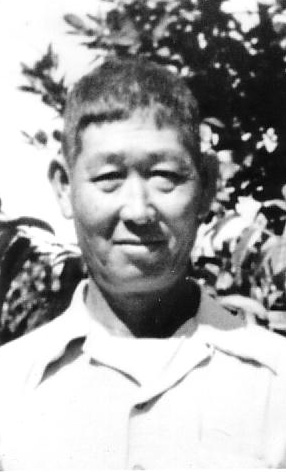
Kai Uratani
Q. Now, as I understand it, you were in a leaning posture, reclining on the ground on your elbow, and Warren came up, and after he pricked you and slapped you with the bayonet on the face, you started to get up. Had you got on to your feet when he stabbed you with the bayonet?
A. No, I was sitting down.
Q. What direction was your back to officer Warren?
A. My back was turned to him.
Q. Your back was turned to officer Warren?
A. Yes.
Q. Did you see him move the gun and stab you with the bayonet?
A. I did not see.
Q. You felt something under your arm?
A. Yes, but before I felt something under my arm I felt a poke.
Q. You felt a poke?
A. Yes. I did not know I was stabbed. After I felt something running I looked at my hand and I see blood.
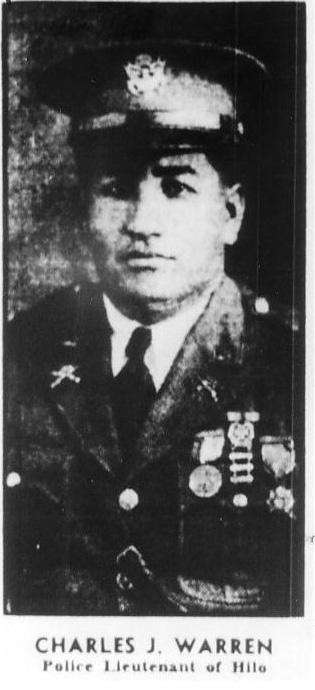
Honolulu Star-Bulletin photo (September 23, 1938, p. 7)
Q. You saw blood. And at that time you had your back toward officer Warren, and you were looking toward the crowd of people?
A. Yes.
Q. After Warren did that to you did he do anything else?
A. He went for Tony Moniz.
Q. What did he do to Tony Moniz?
A. Tony Moniz was here on this side and I saw him just giving a poke with the bayonet at Tony Moniz’ trousers.
Q. You saw him give a poke with the bayonet at Tony Moniz’ trousers?
A. Yes.
Q. Did you see the bayonet go into Tony Moniz?
A. I saw the bayonet go into Tony Moniz’trousers.
Q. What did Tony Moniz do?
A. He just slipped off.20
Longshoreman Red Kupuka’a, one of the few unionists in the demonstration who had a record of minor arrests with the police, shouted out “Hey, You can’t do that!” and Warren stepped over to him, swung the butt end of his rifle up into Kupukaa’s jaw and laid him out. Two officers picked him up and moved him back a few feet, then stepped back as Warren took his first shot into the crowd, followed almost immediately by the volleys of the rest of the gun squad until the shooting subsided entirely after about five minutes. It was just about 10:20 a.m.
In the affray at least 16 rounds of ammunition were fired: seven birdshot—as Martin had ordered—and nine buckshot. When it was over, fifty people, including two women and two children, had been shot; at least one man bayoneted and another’s jaw nearly broken for speaking up for his fallen brother.
The savagery of the final police attack that day is not easy to explain especially in view of Sheriff Martin’s earlier conciliatory efforts. Perhaps the growing police frustration as they tried to cope with the unions’ determined but non-violent demonstration, when it was at last released, created a frenzy. Longshoremen Robert Napeahi’s testimony to Hodgson tells of just such a melee:
Q. Do you know who fired in your direction?
A. No. At that time a woman fell, shot; it was near where I was standing. She called and told me she was shot. I heard the second shooting, rapid fire, and I took cover over her. I covered her. She is my sister-in-law.
Q. You got in front of her so she would not get shot again?
A. Yes.
Q. And you got shot in the side?
A. Yes. After that I lift her and I asked her how she feels and I carried her past the fire engine and Harry Kamoku and my brother gave a hand. While I was moving away, naturally when you pick up a wounded woman you can’t move fast, Kahale was there, poking a club and he said “Move, keep moving”; oh, I would not say it was Kahale that did the poking. There was a couple more cops there, but there was somebody behind me poking me with a club, saying “Move, keep moving” and some of them said “Let them have it”.
Q. So that you got in front of your sister-in-law, and the policeman, so that she would not get shot again?
A. Yes. She fell down and called me and told me she got shot. Shooting again came twice, so far as I know, and instead of standing there I just lie myself right on top of her so that she would not get shot again.
Q. Was that when you got shot?
A. Yes, that’s when I got shot.
Q. Where were you shot?
A. In the skull here.
Q. Now your sister-in-law, what is her name?
A. Helen Napeahi
Q. Where was she shot?
A. In the back. In the afternoon I saw her and asked her where she was shot and she said practically all in the back.21
Two days after the shooting Harry Kamoku tried to tell the story over the phone to Edward Herman in Honolulu between half choked sobs:
They shot us down like a herd of sheep. We didn’t have a chance. The firing kept up for about five minutes. They just kept on pumping buckshot and bullets into our bodies. They shot men in the back as they ran. They shot men who were trying to help wounded comrades and women. They ripped their bodies with bayonets. It was just plain slaughter, Brother Berman. 22
Some have said this was all due to Lieutenant Charles Warren, who was personally to blame for losing his temper and starting the shooting on his own authority in the same way he caused the tear gassing of the crowd on the 22nd, ten days earlier. Sheriff Martin, then, under this interpretation, is believed to have nobly taken the blame for the rash behavior of his Lieutenant, by insisting that he did give the order to open fire, though he never authorized bayonets or the use of the buckshot.
There are, however, some major problems with such a reading of the Sheriff’s role. A considerable amount of testimony of union as well as by-stander and police witnesses supports the allegation —denied by Martin—that several minutes before Warren’s attack, the by-standers and some of the personal relatives of police officers among the unionists were, in fact, warned to move away or clear the area since the shooting was about to start. Anne Kaluhikaua, for instance, was called aside by her uncle, Officer Kekela, and removed to the rear of the crowd only moments before the shooting.23
Other witnesses also testify that ‘special’ officer Seiji Matsu and Deputy Sheriff Pakele went around to the near-by sampans in the harbor and other on-lookers by pier 1, warning them to seek cover or clear the area as the police were about to use force to disperse the crowd. If the shooting had not been premeditated, but simply the result of Warren’s outburst; and, if Sheriff Martin were just accepting blame, then how is it Pakele, Kekela and Matsu were in positions to know of the impending danger? And why should Martin so vehemently deny what so many other unbiased witnesses can establish as evidence, that the shooting was by plan and not by accident?
Sheriff Martin’s testimony is, in fact, riddled with the strangest inconsistencies and denials that seriously impugn his credibility. He insisted that he gave a full and complete order and warning to the unionists as they began to cross the first yellow line, but even other police witnesses present were unable to support that. He denied that ‘special’ officer Seiji Matsu was assigned to take photographs of the crowd, but the testimony of other ‘specials’ contradict his denial, and other photographs show Matsu doing just that. And, most unbelievably, at several points, when being questioned by the Attorney General about the guns and ammunition, the Sheriff claims, “As a matter of fact I don’t know much about arms and firearms. I have never carried a gun myself.”24 And yet, just three weeks before, the Hilo Tribune Herald had run his picture holding a pistol with the caption “The Shooting Sheriff,” as he returned from a pistol shooting competition in Honolulu.
Most distressing of all, is that Attorney General Hodgson did not seem in the least troubled with the Sheriff’s testimony. Rather, he proclaimed in the prefatory remarks of his report that he believed “neither the labor union members as a class nor the police or fire department members as classes attempted deception.”25
Notes
1 Hodgson Report, pp. 36-37.
2 Ibid., pp. 45-46.
3 “Memorandum Re: Conversation with Martin Pence on August 3rd, 1938,” p. 96. Attorney General Pau Case Files, Hawai’i State Archives.
4 Theresa Hamauku’s letter to the Joint ILWU-IBU Strike Committee (June 6,1938) as published in the Voice of Labor (June 9,1938), p. 3.
5 Hodgson Report, p. 39.
6 Ibid., p. 44.
7 “Statement of Charles J. Warren” (August 6, 1938), p. 23. Attorney General Pau Case Files, Hawai’i State Archives.
8 “Statement of Captain Herbert T. Martin” (August 15, 1938), p. 93. Attorney General Pau Case Files, Hawai’i State Archives.
9 Hodgson Report, p. 53.
10 The women were from the union representing the workers at White Star Laundry and from the Ladies’ Auxiliary not from Kress Store, as has often been reported.
11 “Testimony of Henry K. Martin, Sheriff, County of Hawaii” (August 2, 1938) p. 72. Attorney General Pau Case Files, Hawai’i State Archives.
12 “Statement of James K. Mattoon” (August 12, 1938), pp. 25-26. Attorney General Pau Case Files, Hawai’i State Archives.
13 “Statement of Mrs. Anna Kamahele” (August 16th, 1938), p. 6. Attorney General Pau Case Files, Hawai’i State Archives.
14 “Testimony of Johnson Kahili, Fire Chief, Taken by Edward N. Sylva, Deputy Attorney General, on Saturday, August 13, 1938,” pp. 468-469. Attorney General Pau Case Files, Hawai’i State Archives.
15 This word, which means “to smoothe, flatter or mollify” was, in fact used by several of the witnesses to describe the Sheriff’s interim tactic for dealing with the unions that day.
16 “Statement of Moody M. Keliihoomalu” (August 11, 1938), pp. 6-7. Attorney General Pau Case Files, Hawai’i State Archives.
17 “Statement of Sheriff Henry K. Martin (Continued)” (August 10, 1938), p. 3. Attorney General Pau Case Files, Hawai’i State Archives.
18 Sheriff Henry K. Martin’s radio address, aired August 3rd, 1938 on KHBC at Hilo. Honolulu Star-Bulletin (August 4,1938), p. 12.
19 “Statement of Miss Theresa Hamauku” (August 6, 1938), p. 14. Attorney General Pau Case Files, Hawai’i State Archives.
20 “Statement of Kaichi Uratani” (August 13, 1938), pp. 19-20. Attorney General Pau Case Files, Hawai’i State Archives.
21 “Statement of Robert Napeahi” (August 15, 1938), pp. 18-21. Attorney General Pau Case Files, Hawai’i State Archives.
22 The Voice of Labor (August 4, 1938), p. 1.
23 “Statement of Mrs. Anna Kamahele” (August 16, 1938), p. 20; corroborated by Anne Kaluhikaua’s statement— Attorney General Pau Case Files, Hawai’i State Archives.
24 “Statement of Sheriff Henry K. Martin” (August 8, 1938), p. 20 and p. 28. Attorney General Pau Case Files, Hawai’i State Archives.
25 Hodgson Report, p. 5.
PART FIVE: AFTERMATH
For all the official pronouncements that the unionists were violating the law by their demonstration, at no time, either before or after the shooting, did the police even attempt to arrest anyone. The next day, Louis S. Cain, chairman of the Board of Harbor Commissioners, after his untimely attempt to telegram Hasselgren prior to the shooting, publicly affirmed that it was the board’s policy to remain neutral in the dispute and thereby delayed further police intervention.
In the confusion and uncertainty of the moment, the remaining, uninjured unionists left the docks Monday afternoon and the Waialeale was unloaded without incident. But that night a rally was held at Mo’oheau Park which was attended by a huge crowd. Media estimates of those present range from as many as 3000 to as few as 500 persons. 1 Harry Kamoku addressed the crowd and described what happened, “The only reason we know for them shooting at us like criminals is that we are members of our chosen unions. The order to shoot came while we were sitting down.”2
He was joined by Theresa Hamauku of the Laundry Workers, Mrs. Kaneao of the Ladies Auxiliary, and Joe Rocha of the Clerks Union who held up a shoe with a bullet hole through it and the blood-spattered remains of Bert Nakano’s pants. Not knowing whether Bert or the others had even survived the shooting yet, Rocha appealed to the crowd to help their fallen comrades. Describing the hail of buckshot the police unleashed on them, Rocha told them: “The police say pellets were used and we show you the bullets extracted by physicians. I ask, is this justice?”3 Reminiscent of the violence unleashed in the West Coast Strike four years earlier, the Hilo shooting closely paralleled the San Francisco police attack of July 5th that had left two strikers slain and a hundred others wounded. As that day had been called Bloody Thursday, they were already calling August 1st Hilo’s Bloody Monday.
The local radio station that started to cover the speeches suddenly stopped broadcasting. But this only seemed to stimulate public curiosity, for the crowd swelled as the hours passed and more people from Hilo turned out to hear the rest of the story.4 Judge Metzger, who had come to hear the speeches, took Joe Rocha by the hand and pressed twenty-five dollars into his palm “for the victims.”5 So ashamed was the Judge of the actions of the Chamber of Commerce, that he resigned his membership, though he had been a founding member.
Reactions started to occur almost immediately. Scores of local union members in Honolulu wrote one-penny postcards to Attorney General Hodgson in protest. And in Washington, the Secretary of the Interior’s Division of Territories and Island Possessions was flooded with complaints including letters from Lee Pressman, General Counsel of the CIO, and Gardner Jackson of Labor’s Non-Partisan League.
On Tuesday night Honolulu unionists purchased radio time from KGMB to descry Sheriff Martin’s actions and call for an official investigation of the massacre.
Sheriff Martin, for his part, prepared a public statement which he delivered on Hilo’s KHBC on Wednesday night, which was rebroadcast in Honolulu by KGMB. Published in toto by the Star-Bulletin on Thursday, the Sheriff’s speech defended his order to shoot into the crowd on the basis that,
Once the 500 men had gone beyond us there would have been loss of life and property beyond our imagination. … It was to protect them in spite of themselves hence my action in resorting to the use of shotguns and bird-shot.6
The Press
It is difficult so many years after the fact to accurately gauge the reaction of the general public to the sheriff’s actions that day or to the cause of the union men and women that prompted their demonstration. Reading the local papers’ coverage of the shooting cannot be relied on since it is clear that the General Manager of the Hilo Tribune Herald, Kenneth Byerly, was not only a member of the Chamber of Commerce himself, but, as can be seen from his own coverage of the events of the last week of July, was a vocal advocate of the Chamber’s call for the return of I-I service and the attendant police intervention.
But it was not just the local Hilo paper that reflected that management/chamber bias. As Eagen’s report to the National Labor Relations Board reminds us, “The newspapers are all owned and controlled by the interests who control the Big Five.”7
As noted earlier, the so-called “Dynamite Plot,” that improperly implicated the Honolulu strike leaders, was given considerable play in the papers from July 19th through the 30th, beginning with the police photo of the confiscated cache that was splashed across the front page with pictures of all the union men suspected of complicity. Nearly every day a follow up story kept that alleged plot before the public eye, though comparatively little was written when the actual strike leaders were later exonerated.
As to the demonstration itself and the police attack on the unionists, the Tribune Herald as well as its parent publication in Honolulu, the Star-Bulletin, along with the Advertiser, were characteristically single-minded in their common application of the word “Riot” to describe the massacre. Suggesting almost that the unionists were themselves firing guns, the headline in Hilo’s extra that afternoon read “36 INJURED DURING RIOT: UNION GROUP TURNED BACK AFTER FIRING”, and in the Star-Bulletin “36 WOUNDED IN HILO RIOT: Injuries of Five Men Are Critical.”
That a group of unarmed men and women sitting down on the dock was called a “riot” apparently caused some consternation locally, for on Friday the editorial of the Tribune Herald tried to defend its use of that term based on definitions in the Territorial laws, specifically Sec. 6172:
Sec. 6172. MENACING DEMONSTRATIONS. Menacing language, or gestures, or show of weapons or other signs or demonstrations tending to excite terror in others, are sufficient violence to characterize an unlawful assembly or riot (P.C. 1869, c. 38, s. 3; R.L. 1925, s. 4344.)
To the editors of the Tribune Herald, picket signs and the “boos and jeers” in and of themselves were enough to “excite terror” under this law. So justified, the papers continued to refer to the massacre exclusively in terms of it having been a riot. Each paper published the Sheriff’s defense without so much as a summary of the union perspective until Hodgson’s report was made public. And that report, it was emphasized, drew no conclusions as to the guilt or wrongdoing of any of the parties.
The Hodgson Report
Joseph V. Hodgson (1899-1973) was appointed Attorney General of the Territory by Governor Poindexter just a few weeks before the Hilo Massacre. A native of Boyne, Michigan, he would later join the U.S. Army’s judge advocate general’s department and, after the war, serve on the U.N. War Crimes Commission in London. As noted earlier, his report on the Hilo Massacre has been taken over the years to be the most reasonable and objective account of the incident possible. It was not released until after a Hilo Grand Jury had already decided to refuse to bring any indictments against the police. And when the report was submitted to Territorial Governor Poindexter and the Department of the Interior in Washington D.C., it had the desired effect of mollifying the earlier public outrage that had been incited.
A careful analysis of Hodgson’s report, however, reveals an insidious bias that is only subtly apparent. While he was not so obvious as to condemn the unionists, as certainly the press and the Chamber of Commerce had, Hodgson over-looked the most glaring examples of deception from police and Inter-Island witnesses; worse, he apparently suppressed or ignored evidence that might have shown that the demonstration was legally constituted, or that the police involvement was improperly authorized; and, finally, he appears to have totally fabricated some details with respect to the official public notices published in the local paper.
The net effect of each of these alterations and amendments is to leave the reader of his report with the impression that the police, with the possible exception of Lieutenant Warren, were guiltless as were the other officials involved. But, on examination of the actual statements and photographs Hodgson accumulated, a less wholesome portrait of the authorities emerges.
Three levels of questions arise as to the legitimacy of the police actions against the unionists that day that Hodgson did not bother to consider. To begin with, Acting Harbor Master Hasselgren may not have been acting properly within his powers to close the Harbor in the first place. Though Cain’s neutrality notice came only after police forces had already been committed, it certainly suggests that, prior to Cain’s notice, Hasselgren was anything but neutral. He had not himself sought advice from the Territorial Board, while he regularly accepted direction from Scruton and the Chamber of Commerce. Secondly, even without that letter from the Board, there is real question as to the authority of a county police sheriff to enforce closure of the Territory’s Harbor in lieu of a Territorial High Sheriff, as the unionists had been told. And, finally, all the other questions aside, the Harbor may not in fact have been legally closed. No notice officially closing the Harbor was actually published, nor was any attempt made to prevent a considerable crowd of by-standers and on-lookers from walking freely throughout the wharf all through that day.
If the demonstrators were, in fact, well within their rights to conduct a peaceful demonstration that day, then any police action to prohibit their access with the use of deadly force should have itself been deemed illegal. That Hodgson failed to pursue this line of investigation, and that he seems rather to have either ignored or over-looked such findings when he clearly encountered them in the testimony casts serious doubts on the objectivity and accuracy of his conclusions.
The net effect of such investigatory lapses as noted above, is that Hodgson’s report, which has always purported to be generous to the union demonstrators, may actually have been primarily used to placate the parties, at the expense of the justice they desired.
The Grand Jury
Even while Hodgson was preparing his investigation for Governor Poindexter, the Hilo Grand Jury was called to consider possible criminal indictments against the police or anyone else who might be responsible for criminal assault. Though Hodgson offered to make his evidence and testimony available to the Grand Jury, he withheld his conclusions and analysis until after the Grand Jury returned their verdict. Hodgson’s express desire not to influence the Grand Jury is curious. His investigation was by all accounts the most thorough and had the least biased access to most of the available resources. The Grand Jury, on the other hand, relied almost exclusively on the police’s own investigation. As the presiding Judge Delbert Metzger remarked on hearing their findings for no indictments:
This report reads more to me like the report of a policy committee of some civic organization than the report of the grand jury. “We find a state of emergency existed”; that does not seem to mean anything as a matter of legal significance. “That evidence is not sufficient to warrant an indictment against any person or group of persons”; it is a matter of public knowledge, the fact that men were greviously [sic] injured by shooting, by bayonet stabbing, by broken jaw bones or something of the sort; it seems rather strange to me that there was not any law violated by either one side or the other in an affray of that kind.8
As the Judge was no doubt aware, his comment was closer to the mark than anyone not familiar with the make-up of that Grand Jury might be able to guess. It seems that the Big Five, especially C. Brewer, and the Hilo Chamber of Commerce, the same civic organization that had ordered the Sheriff to commit his forces in the first place, were unusually well represented on that jury:
1. Dodge S. Baker Radio Salesman
2. Ezekiel Baptiste Clerk for Moses Co. whose owner is a member of Chamber
3. Percy Bayly Sperry Flour Co. Sales Rep. owned by member of Chamber
4. William Brown Clerk for Davies & Co.
5. David Butchart Cashier Honomu Sugar Plantation
6. John L. Dykes Asst. Secty. First Trust Company of Hilo
7. O. E. English Hawaii National Park
8. Ed. B. Hallor Cashier Waiakea Mill Sugar Plantation
9. E. R. Hartley Bookkeeper Waiakea Mill Sugar Plantation
10. Xavier L. Helbush
(Foreman) Postman, Glenwood Post Office Mountain View
11. E. N. Holmes, Jr. Treas. Holmes Dept. Dry Goods Store, member of Chamber
12. Frank Huff Agency Real Estate Broker member of Chamber of Commerce
13. Louis Kapela Economic Trading Co. member of Chamber of Commerce
14. Antone Kimi Manager Progressive Club (liquor establishment)
15. Ralph Lau Manager Hilo Dry Goods member of Chamber of Commerce
16. Tomoichi Machida Machida Drug Store member of Chamber of Commerce
17. Costa P. Roumanis Asst. Manager Hilo Hotel (caters to big business)
18. Michael de F. Spinola Notary Public, Hilo Chamber of Commerce
19. Yoshio Tanimoto Tanimoto Variety Store member Chamber of Commerce
20. Stanley Williams Asst Manager C. Brewer one of the Big Five, and employer of the Longshoremen 9
James Mattoon of the Clerk’s unit, when called as a witness before this jury, challenged their objectivity to their faces and named each man’s affiliation. Far from impugning their motives, however, Mattoon’s candor about this “blue-ribbon” jury only incited Jurist Ed. Hallor to seek Mattoon’s impeachment.10 The County’s attorney, Beers, who was himself conducting the proceedings, just ignored the remarks, confident of the ultimate outcome that would vindicate the police as well as his own legal advice, on which the police actions were based.
Not only Judge Metzger was scandalized by the jury’s total vindication of the authorities. In Washington, Director Ernest Gruening’s summarized his findings to the Secretary of the Interior. After his review of the record, he decried the verdict as a “whitewash.”11
Kai Uratani’s Suit
Unfortunately, Judge Metzger’s candid remarks as published in the newspapers were later to further inhibit the plight of the wounded unionists for a just settlement. Months later, on October 14th 1938, the longshoremen attempted to seek the court’s justice, this time by filing a civil suit against Lt. Warren, Sheriff Martin and the other officers, on behalf of Kai Uratani, the first to have fallen that day. Judge Metzger would have normally presided in that case.
The Sheriff’s attorney fought the suit by moving to disqualify Judge Metzger on the basis of his publicized remarks about the Grand Jury verdict, and by moving against the union’s San Francisco attorney, George Anderson, who filed the suit for them. Hawaii’s Supreme Court rules required a mainland attorney to associate with a local firm in order to practice law. Their friend Martin Pence was unable to take the case since he had just been elected County Attorney. Unable to find another local lawyer willing to take the case, the suit almost had to be dropped without trial.
After a considerable amount of hopeless casting about, the union finally obtained the services of Honolulu attorney, O. P. Soares. Seeking $25,149.50 in general and punitive damages,12 the union was hoping to make this a test case, and follow it up with similar actions on behalf of Bert Nakano and the others most severely wounded. But Judge Metzger was disqualified and Judge J. Frank McLaughlin heard the case instead. A thirty-one year old Harvard-educated man, born and raised in Massachusetts, Judge McLaughlin was at the time a new resident of the territory in his first judicial appointment looking to a promising judicial career.13
On November 16th of 1939, over a year after the suit had been filed, the case was heard in Hilo’s court of the Fourth Circuit. Little evidence remains of the deliberations or of the make-up of the jury that tried this suit. The record does show that Judge McLaughlin transmitted very specific instructions to the jury: Sees. 6170 and 6184 of the Revised Laws of Hawaii, 1935 which liberally defined “unlawful assembly” and legally released law officers from liability for any action taken in dealing with unlawful assemblies.14 There were no instructions relative to the authority of county police on the territorial wharf, nor any instructions relative to the constitutional rights of “freedom of assembly.” The suit was lost, and, as if that weren’t enough, Kai was charged $355.80 for Martin and Warren’s defense costs.
Paying for the legal expenses as best they could with their limited resources, the Hilo unionists were unable to afford an appeal. And, though there was no justice for them in the courts, public sentiment had begun to swing toward them throughout Hilo. Organizing on that island continued to prosper and, even though Sheriff Martin was reelected in the following year, it was the union that had been adjudged innocent in the eyes of more and more of the community.
Notes:
1 Honolulu Star-Bulletin (8-3-38), p. 6; Honolulu Advertiser (8-3-38), p. 1.
2 Honolulu Star-Bulletin (8-3-38), p. 6.
3 Ibid.
4 Interview with Joseph Rocha in Hilo May 29,1987.
5 Ibid.
6 Honolulu Star-Bulletin (August 4, 1938), p. 12.
7 Eagen Report, p. 4603.
8 Transcript of the “Report of the Grand Jury, September 20, 1938” In the Circuit Court of the Fourth Judicial Circuit, Territory of Hawaii. From a copy attached to a letter of Judge Metzger to Ernest Gruening, Assistant Secretary of the Interior, dated October 26, 1938. National Archives, Washington D.C.
9] I.L.W.U. local 142, library files. Honolulu Hawaii.
10 Interview with James Mattoon February 13,1987.
11 “Memorandum for the Secretary” by Ernest Gruening, Director of the Division of Territories and Island Possessions, Office of the Secretary of the Interior (October 29, 1938). Hawaii File 9 4 55, National Archives, Washington D.C.
12 K. Uratani vs. C. J. Warren and Henry K. Martin Law 2291, In the Circuit Court of the Fourth Circuit, Territory of Hawaii (10-14-39).
13 Interview with Judge Martin Pence, November 10th 1987.
14 K. Uratani vs. C. J. Warren and Henry K. Martin, In the Circuit Court of the Fourth Circuit, Territory of Hawaii. Law No. 2291, Docket 7.
CONCLUSIONS & OPINIONS
On the “Massacre”
Since none of the unionists actually died as a result of injuries, there are those who would question the use of the word “massacre” to describe the bloody police attack that August 1st. In the dictionary we find two definitions of the term. The first is “the indiscriminate, merciless killing of a number of human beings,” and the second “To defeat overwhelmingly.”1
The term also conjures up the ruthless attacks committed against the unarmed communities of American Indians in the name of “manifest destiny.” In nearly every sense of the term, it is the appropriate description of Hilo’s Bloody Monday. The police detachment was undeniably overwhelming. There was nearly one policeman to every three demonstrators. And the police were armed with an arsenal more than adequate to deal with a much larger and more menacing assembly. That the Sheriff elected to fall upon an admittedly peaceful demonstration that had made no effort to prevent the unloading of cargo, and unleash repeated volleys of shotgun fire at close range upon unarmed men, women and children alike most certainly qualifies the action as a massacre.
Anna Kamahele, who took two separate hits of buckshot had, like most of the wounded, to make her own way to a hospital. No ambulances were available, so the wounded, when the police finally pulled back, had to be taken in private cars or buses to Hilo Memorial or one of the various Japanese clinics downtown. Anna, for instance, was taken to two different Japanese Hospitals before she was finally treated at Dr. Kasamoto’s Hospital on Piopio Street. To this day she carries one of the pellets which lodged one eighth of an inch from her lung, where it was too dangerous to remove.
Bert Nakano, similarly, was hit by several rounds of buckshot. One of the pellets, which was ricocheted off the ground, flattened like a disk and sliced through his groin leaving a wound that was for some time thought to be a bayonet wound. He recalls the shooting:
Well, I know I went down; then I thought I’d get up and move away. I could hear the bullets whizzing over my head, see. I tried to go up; then I found out. I noticed my hand, my left hand was paralyzed. Then my left leg was all paralyzed. . . . Then I knew that I was going to pass out, and I just passed out. I don’t know what happened after that until I opened my eyes at the hospital.2
They piled his body into the “five,” as they called the five cent bus to Hilo. He would be in the hospital for 17 months while the doctors worked to save his leg. Brother longshoremen donated blood, and it was touch and go for him for many months. When he was finally out of the hospital, it would be another 19 months of recuperation before he could return to work, three years after the massacre.
Hodgson was particularly concerned to establish the direction in which the gun squad officers fired their shot. Did they fire into the ground in front of the crowd, as directed by the Sheriff and as practiced at the National Guard firing range earlier that week, or did some of them fire point blank directly into the crowd? He hoped to show that the police had tried to be humane by shooting down at the ground in front of the demonstrators or over their heads instead of dead on. He cited Paul Tallett as one of the unionists who testified that the police aim was deflected. But the actual transcript of his examination of Tallett reveals some not-so-subtle direction:
Q. How did he [Warren] shoot, down toward the ground, above your heads, or how?
A. Right straight out, sir.
Q. Straight for the crowd?
A. The crowd was seated, sir. It would go over their heads.
Q. The first shot was over their heads?
A. Yes. He was standing up, sir. It would go over their heads.
Q. The only time you actually saw Warren shooting he shoot [sic] over the heads of the group?
A. That is the first time.
Q. And nobody got hurt as a result of that discharge, so far as you know?
A. So far as I know, because my eyes were always forward.3
In disregarding Tallett’s first response “Right straight out” and using the quote “over their heads,” Hodgson has created the impression in his report that Warren was shooting his riotgun into the air over their heads instead of the straight-from-the-hip shooting that Tallett was really trying to describe.
Similar problems arise over the testimony about the other shots that Hodgson maintains were primarily shot at the ground in front of the demonstrators instead of head on. Doctors, for instance, removed a considerable number of buckshot pellets that were whole and had obviously not been ricocheted off the ground. Furthermore, in view of the way Bert Nakano was most severely wounded by one of the shots that had been flattened after impact with the ground before it sliced through the arteries in his leg, Hodgson’s premise that ricocheting the shot was more humane may not have been valid.
The problem with all these fine distinctions about the direction of the shot or the number of birdshot versus buckshot rounds fired is that they divert our attention from the basic issue. The violence of August 1st, 1938 was, after all, inexcusable and unnecessary. It should, indeed, be remembered as the “massacre” it has been called so that we are not tempted to reduce its significance or forget the lesson it should teach us about the civil right of all Americans to demonstrate peacefully. When we attempt to arrest conflict by silencing dissent, the first and most regrettable casualties are our national principles.
It is rightly said that we are doomed to repeat history that we are foolish enough to forget. Let us, then, be sure to remember Hilo’s Bloody Monday not just out of respect for the courage of Hawaii’s early union brothers and sisters and the many injuries they endured to build their unions, but with the resolve necessary to protect another generation from the need to suffer this struggle ever again.
Notes:
1 New World Dictionary of the American Language, Second College Edition, 1978.
2 Bert Nakano interviewed by Chris Conybeare on the television program Rice & Roses aired in Hawaii by KHET on September 2nd, 1986 at 7:30pm.
3 “Statement of Paul Tallett” (August 4, 1938) pp. 47-49. Attorney General Pau Case Files, Hawai’i State Archives.
 click to ernlarge |
Hilo Unionists display their signs in front of “the Block” on Silva Street on the morning of August 1st, 1938, Hawai’i State Archives |
 click to ernlarge |
Unionists gathering on Silva Street on the morning of August 1st, 1938. Grand Jury Exhibit 4, Hawai’i State Archives |
 click to ernlarge |
Referred to in Hodgson’s transcripts as “Hilo Camera Craft Photo, No. 5” Sheriff Martin standing with his back to th cameran the center in the white shrt and hat, confers with Harry Kamoku on the Sheriff’s right faciing forward and James Mattoon, in the wide brim hat, on the Sheriff’s left. nna Kamahele is on the extreme left in back of Mrs. Lydia Papalimu Lui. Grand Jury Exhibit 5, Hawai’i State Archives |
 click to ernlarge |
The first three ranks of demonstrators marching beyond the first police line. Sheriff Martin is in the second line wearing the felt hat with stiff brim. Grand Jury Exhibit 10, Hawai’i State Archives |
 click to ernlarge |
Referred to in the Hodgson transcripts as “Pung Picture #2” showing the front line of the demonstrators as they sat down around the fire truck in front of pier 2. Sgt Wm. Roy standing on the left. Longshoreman Raymond Namau still suffering from the tear gas is caughing into his handkerchief. The women in the white cuffed dresses were from While Star Laundry. Grand Jury Exhibit 29, Hawai’i State Archives |
 click to ernlarge |
Referred to in Hodgson’s transcripts as “Williams picture D” this picture shows an unidentified man standing with the police holding an authorized machine gun, and another non-uniformed man holding a club under his jacket. |
 click to ernlarge |
“Williams Picture J” showing the discussion between Sheiff Martin and the Inter-Island hired men which was being photographed by Special Offocer Seiji Matsu as the Unionists sat and watched. Grand Jury Exhibit 30, Hawai’i State Archives |
 click to ernlarge |
The crowd of demonstrators while the firing was going on being driven into the harbor. Note the I-I men still in position by the picket fence.Grand Jury Exhibit 33, Hawai’i State Archives |
 click to ernlarge |
With the Waialeale in the background, Demonstrators scramble to find their own transportation to local hospitals. Hawai’i State Archives. |
 click to ernlarge |
An unidentified White Star Laundry worker overcome by the attack is attended by longshoremen. Hawai’i State Archives. |
 click on cover to order hardcopy Copyright © William J. Puette, 1988 The Center for Labor Education & Research |
Archival footage of “Hilo Massacre” with commentary by Joe “Blur” Kealalio from our 1996 Rice & Roses video documentary 1946: The Great Hawai’i Sugar Strike. |
|
NOTES RE: ONLINE VERSION
|
TABLE OF CONTENTS
|
|
PART ONE: OrganizingPART TWO: The Inter-Island Strike
PART THREE: Provocation PART FOUR: The Hilo Massacre PART FIVE: Aftermath APPENDIX A: Official Notices |
Israel convicts grassroots activist to two years’ imprisonment
Amy Darwish, The Electronic Intifada, 1 July 2010
 |
| Adeeb Abu Rahme during a protest against the wall in Bilin. (Hamde Abu Rahme) |
On 30 June grassroots activist Adeeb Abu Rahmah was sentenced by Israel to two years imprisonment at a military court hearing at the Ofer Military Complex in the occupied West Bank. Abu Rahmah already spent 11 months behind bars and his arrest and detention is part of Israel’s repressive efforts to criminalize the grassroots popular resistance to the Israeli occupation.
Adeeb Abu Rahmah is known for his vibrant presence at the occupied West Bank village of Bilin’s weekly demonstrations against Israel’s wall and for his commitment to popular nonviolent resistance. A founding member of the Bilin Popular Committee Against the Wall and Settlements, Abu Rahmah was arrested at a nonviolent demonstration on 10 July 2009 and later indicted by the military prosecution on grounds of “incitement,” “activity against public order,” and “being present in a closed military zone.”
Abu Rahmah has repeatedly affirmed his commitment to nonviolent resistance. He has also denied all charges, aside from acknowledging his participation in the weekly demonstrations. Although his release was initially ordered on 16 July 2009, the prosecution later appealed the decision and Abu Rahmah was remanded into custody for the duration of his legal proceedings.
Many contend that Israel’s investigation of Abu Rahmeh was flawed from the very beginning, and the Israeli military court system is notorious for its lack of respect for international standards of fair trial and detention. A 5 March 2010 Human Rights Watch report particularly highlighted many due process concerns where investigations regarding Palestinian anti-wall demonstrators are concerned, citing charges based on “questionable evidence and allegedly coerced confessions.”
According to Iyad Burnat, Head of the Bilin Popular Committee, the Israeli military in Abu Rahmah’s case “relied on the forced confessions of four Bilin youth — one 14, one 15 and two 16 years of age — to convict Adeeb for having told them to throw stones.”
Burnat added: “This problem is not confined to Bilin and has also emerged in other villages.”
Attorney Gaby Lasky, who is representing Abu Rahmah, noted that the testimony from the minors in question was provided under considerable duress. “They were arrested at 3:30am, they were handcuffed and blindfolded,” she said. “They were then interrogated at 2pm the next day, without having eaten or having had a chance to use the washroom.”
Israeli military authorities claim that they questioned the youths to determine who threw the stones, and the youths identified Abu Rahmah as having done so.
“Yet, several times, the demonstrators had thrown leaflets and other innocuous objects at the soldiers. We are arguing that the police investigation was so lacking that they didn’t even ask the youth what Adeeb had specifically said,” Lasky explained.
Lasky also noted that the youth were questioned by an interrogator who was not a specialist in questioning children, and the interrogation was carried out without the presence of a lawyer or the children’s parents. Human Rights Watch states that such practices directly contravene provisions under Israeli Military Orders that allow detainees to contact lawyers and grant child detainees the right to have a parent present during their interrogations.
The credibility of the investigation was also challenged when Lasky learned that a special army unit was filming the demonstrations and that the footage was being submitted as evidence against Abu Rahmah. When Lasky subsequently attempted to get ahold of the footage, however, she was told that all the cassettes had been erased.
“Under different circumstances, this might have been enough to acquit him,” Lasky said. “There have been many problems with the investigation and we had hoped that the court would take this into consideration.”
Ultimately, Abu Rahmah’s trial may portend broader implications where the popular resistance is concerned. “Adeeb’s indictment and conviction raise much bigger questions,” Lasky explained. “The trial is really against the demonstrations as a whole.” Indeed, Abu Rahmah’s indictment may signal an escalation in the use of legal strategies as a means of quelling the popular resistance.
For the past five years, the people of Bilin have waged an ongoing struggle against the construction of Israel’s wall, which has annexed large portions of their agricultural lands and threatens the economy of the village. Since the first bulldozers began to uproot olive trees in February 2005, the villagers have staged weekly demonstrations every Friday. Joining villages such as Budrus, Jayyus, Nilin and al-Masara, their creative tactics have captured the imaginations of many people around the world and inspired other Palestinian communities across the West Bank to take up the struggle.
Villagers in Bilin have also launched a precedent-setting legal challenge alongside its popular campaign. On 22 June 2009, court proceedings unfolded in the Quebec Superior Court, where the village filed their lawsuit against Green Mount and Green Park International, two Quebec-based companies involved in the construction of condos and the expansion of settlements at the village’s expense. Citing the Fourth Article of the Geneva Convention and the Canadian Law on Crimes Against Humanity and War Crimes, the complaint accuses both companies of complicity in war crimes.
Coinciding with the legal challenge, three members of the Bilin Popular Committee Against the Wall and Settlements also visited 11 Canadian cities for a nation-wide speaking tour.
While the case was later rejected by the Quebec Superior Court in the fall of 2009, the village later appealed the decision at the Quebec Court of Appeals. During hearings that unfolded earlier this month, judges fielded arguments from the village’s legal team regarding the “justiceability” of the village’s claim. Lawyers for the village maintain that the Fourth Geneva Convention is not incorporated into Israeli law, thereby precluding the possibility that the case can be heard in the Israeli high court. At present, the Canadian court has taken the case under advisement and a decision is anticipated in the months to come.
While Bilin’s three-pronged strategy of direct action, court cases and international solidarity have kept it in the headlines, the Israeli military continues to repress it. Indeed, Abu Rahmah’s conviction represents the most recent development in a broader campaign to quell the popular struggle.
In a recent report, prisoner rights group Addameer and the Stop the Wall campaign have noted that violence has been systematically used by Israeli forces to suppress the popular resistance. It is estimated that more than 1,566 Palestinians have been injured and 16 have been killed between 2005 and 2009. In Bilin alone, approximately 1,300 protestors have been wounded during weekly demonstrations over the past five years. Israel’s directed policy of misusing dispersement tactics also claimed the life of Bilin’s Bassem Abu Rahmah, who was killed on 17 April 2009, when he was shot in the chest with a tear gas canister.
The Israeli military has also instituted a policy of targeted arrests and detention. According to Sahar Francis, director of Addameer, “this policy is very much part of a broader campaign of repression against any form of activism.” The use of detentions and arrests has also escalated considerably in recent years. “Within the past one or two years, it has increased considerably as momentum in the campaign against the wall builds.”
Since 2002, Addameer and Stop the Wall have documented the arrests of 176 Palestinian grassroots activists in five villages, namely Bilin, Nilin, al-Masara, Jayyus and Budrus. According to Bilin’s internal village statistics, 85 residents have been arrested since June 2009, many during the Israeli military’s frequent night raids into the village The recent wave of political arrests has targeted key community activists; five of those arrested are active with the Bilin Popular Committee Against the Wall and Settlements, and all were charged with “incitement.”
Defined as “any act of attempting, whether verbally or otherwise, to influence public opinion in the Area in a way that may disturb the public peace or public order” under Article 7(a) of Military Order 101, the use of incitement as a blanket charge is controversial.
Attorney Lasky explained that “Until recently, people had not been charged with this particular offense for a very long time and it is now being interpreted very broadly.” In a recent press release, Amnesty International also cautioned that “the broad scope of Israeli military orders mean that Abu Rahmah could be imprisoned solely for legitimately exercising his right to freedom of expression in opposing Israeli policies in the West Bank.”
From Sahar Francis’ perspective, the use of vague language and nebulous parameters is no coincidence. “The first thing we should remember is that all forms of activism are deemed illegal,” she explained. “Participating in demonstrations, holding forums — all these things are considered to be incitement. You find very vague language and definitions so broad that any action can fit inside. This was written into the Military Orders in 1967 to permit them to adapt to evolving forms of resistance.”
Abu Rahmah’s case could also have far-reaching implications for other anti-wall activists currently awaiting trial. As Amnesty International explained, he could be “the first activist against the fence/wall to be brought to a full evidential trial in a case of this kind.” Abu Rahmah’s conviction could potentially set troubling new precedents for further criminalizing the popular resistance.
Abu Rahmah’s sentence has also come as a tremendous shock and disappointment to his family, and his ongoing imprisonment continues to weigh heavily upon them. Left without a financial provider, the family of ten has struggled to make ends meet for the past 11 months.
“I am a medical student at Abu Dis University, while my sister is also studying management at al-Quds Open University,” daughter Rajaa Abu Rahmah explained. “We also have to cover the costs of books and tuition, in addition to meeting basic needs. It has been really hard to get by.”
In addition to financial pressures, Abu Rahmah’s absence has also exacted a heavy emotional toll on the family. “This is the first time my father has been away from us, even for a short period of time,” stated Rajaa. “We feel angry all the time, for no reason. It has been a sad, lonely time for us all.”
Despite the challenges faced during his absence, the Abu Rahmah family remains steadfast. “We are not alone,” Rajaa said. “Many villages also have prisoners and people who have suffered injuries. It has been difficult, but we have to come out of this stronger.”
As the Abu Rahmah family has been resilient, so too has the popular struggle. The weekly demonstrations have continued unabated and resistance remains ongoing, even in the face of intense repression and legal persecution.
“Certain people may be more cautious in their participation,” Francis explained. “Still, the resistance is continuing and even expanding to new villages, such as Nabi Saleh. They are not succeeding in breaking the will of the people.”
Iyad Burnat said that the latest round of repression leaves the movement even more determined to sustain the popular struggle. “Israel will not break us on their anvil — they will only make us stronger with their repression and hammer blows.”
Burnat added, “After five years of struggle in the village, one murder and many disabling injuries we still strive with the words of Terence McSwiney — the Irish nationalist who fought the British occupation of Ireland and died on hunger strike in protest — in mind: ‘it is not those who can inflict the most, but those that can endure the most who will prevail.'”
Amy Darwish is a writer and community organizer active in the Tadamon! network in Montreal.
Ambition and orthodoxy (Kagan’s hero is also Dershowitz’s)
By Philip Weiss on June 29, 2010
Elena Kagan, the nominee to the Supreme Court, was dean of Harvard Law School in 2006 when she introduced Aharon Barak, chief judge of Israel’s High Court of Justice, during an award ceremony as “my judicial hero.” She explained (per the New York Times):
He is the judge or justice in my lifetime whom, I think, best represents and has best advanced the values of democracy and human rights, of the rule of law and of justice.
Turns out that Kagan (who testified today that “Israel means a lot to me”) is not alone. In The Case for Israel (2003), Harvard Law Professor Alan Dershowitz writes:
This book is respectfully dedicated to my dear friend of nearly forty years, Professor Aharon Barak, the president of Israel’s Supreme Court, whose judicial decisions make a better case for Israel and for the rule of law than any book could possibly do.
Who is Barak? In Beyond Chutzpah, Norman Finkelstein says that Aharon Barak was “a leading proponent” of guidelines allowing torture– making Israel the “only country in the world where torture was legally sanctioned,” according to the Israeli human rights group B’Tselem. He also gave a green light to administrative detentions, even as the judge conceded, “there is probably no State in the Western world that permits an administrative detention of someone who does not himself pose any danger to State security.”
And he approved the barrier wall that crosses through occupied territory, of which Finkelstein says:
If all branches of Israeli government and society bear responsibility for this impending catastrophe [the end of the two-state solution], the share of the HCJ and especially its liberal chief justice, Aharon Barak, is relatively larger. Due to its moral authority the HCJ was in a unique position to sensitize the Israeli public. Beyond helping fend off external criticism of Israel’s annexationist policies, the HCJ chose to mute the collective Israeli conscience.
Of course Finkelstein was denied tenure at DePaul not long after he published that book.
Martha Minow replaced Kagan as dean of Harvard Law School. In 2006, she co-authored an Op-Ed for the Boston Globe with an Israeli army lawyer; the piece is titled, “The Israeli model for detainee rights,” and touts Israeli measures developed “during a long and difficult experience with terrorism.”
P.S. Andrew Sullivan has recently asked whether there are any vocal anti-Zionists on any Op-Ed pages in the U.S. Good question; the answer is No. You can’t be.
Today I was reading Geoffrey Wawro’s book Quicksand when I came across this passage that resonates with the above examples.
“There was no Iraqi who was not in the [Baathist] party,” an ex-factory manager in Baghdad told an American reporter in April 2003. He meant Iraqis who were “highly educated and technical.” Among that cohort, “if you weren’t a Baathist, you wouldn’t be able to rise in the hierarchy.”
West Bank poverty ‘worse than Gaza’
June 30, 2010
Al Jazeera’s Bernard Smith reports on how the poor pay a heavy price in the West Bank:
Children living in the poorest parts of the West Bank face significantly worse conditions than their counterparts in Gaza, a study conducted by an international youth charity has found.
The report by Save the Children UK, due to be released on Wednesday, says that families forced from their homes in the West Bank are suffering the effects of grinding poverty, often lacking food, medicine and humanitarian assistance.
The European Commission funded study found that in “Area C”- the 60 per cent of the West Bank under direct Israeli control – the poorest sections of society are suffering disproportionately because basic infrastructure is not being repaired due to Israel’s refusal to approve the work.
Homes, schools, drainage systems and roads are in urgent need of repair, but instead of work being allowed, families are being forced to live in tents and do not have access to clean water.
Restrictions on the use of land for agriculture have left thousands of Palestinian children without enough food and many are becoming ill as a result, the study found.
Conditions in Area C have reached “crisis point”, the charity said, with 79 per cent of the communities surveyed lacking sufficient food – a greater proportion than in blockaded Gaza, where the figure is 61 per cent.
The lack of proper nutrition is having a major impact on the health of children growing up in the area, with 44 per cent of those surveyed for the study suffering from diarrhoea, the world’s biggest killer of children under the age of five.
Many children living in such communities are showing signs of stunted growth, with the figure running at more than double Gaza’s rate, and more than one in ten children surveyed for the study were found to be underweight.
The report says that for many Palestinians, international humanitarian assistance is far harder to access in the West Bank than in Gaza, with almost half the households surveyed in Area C reporting that they had no access to foreign aid assistance.
Save the Children warned that with the blockade of Gaza dominating headlines in recent months, the international community risked forgetting the fate of the poorest communities in the West Bank.
“The international community has rightly focused its attention on the suffering of families in Gaza but the plight of children in Area C must not be overlooked,” Salam Kanaan, Save the Children’s director in the occupied Palestinian Territories, said.
“Palestinians in the West Bank are widely thought to enjoy a higher standard of living but tragically many families, particularly in Bedouin and herder communities, actually suffer significantly higher levels of malnutrition and poverty.”
The organisation called for Israel to immediately cease home demolitions and land confiscations in the West Bank and said the Palestinian authority should take “urgent action” to develop services and improve food security in Area C.
“Palestinian children cannot wait for the stalled peace talks between the Palestinian Authority, Israel, and the United States to find solutions to this crisis,” Kanaan said.
NY police ‘beat up’ Iranian professor
Press TV – June 30, 2010

Professor Kaveh Afrasiabi
A US-based Iranian university professor and senior political analyst, Kaveh Afrasiabi, says he has been brutally beaten up by police officers in New York.
Speaking to IRNA on Tuesday, professor Afrasiabi explained about the unusual manner in which he was arrested, saying that he was handcuffed and sent to jail under the pretext that he had not paid his traffic ticket.
“While handcuffed I was pushed to the front. Then my head hit a metal rod and I was seriously wounded. I was then sent to the hospital in an ambulance due to severe injuries,” said Afrasiabi who could hardly speak.
After he was discharged from the hospital, the police took him to court where the judge ordered his release.
Afrasiabi said his arrest came over a traffic ticket which he had to pay 25 years ago.
Afrasiabi has taught political science at Tehran University, Boston University, and Bentley College. He has also been a visiting scholar at Harvard University, UC Berkeley and Binghamton University.
The Iranian professor, who is a former consultant to the UN program of Dialogue Among Civilizations, has appeared on numerous television talk shows, including Press TV, CNN, MSNBC and Al-Jazeera. He has also worked as a consultant to CBS’s 60 Minutes program.
He has also authored the book After Khomeini: New Directions in Iran’s Foreign Policy and is a co-author of Reading in Iran Foreign Policy After September 11.
Obama’s Moral Bankruptcy Regarding Torture
By Andy Worthington – 29.6.10

Saturday was the International Day in Support of Victims of Torture, established twelve years ago to mark the day, in 1987, when the UN Convention Against Torture and Other Cruel, Inhuman or Degrading Punishment or Treatment came into force, but you wouldn’t have found out about it through the mainstream US media.
No editorials or news broadcasts reminded Americans that “No exceptional circumstances whatsoever, whether a state of war or a threat of war, internal political instability or any other public emergency, may be invoked as a justification of torture,” and that anyone responsible for authorizing torture must be prosecuted, and no one called for the prosecution of George W. Bush, Dick Cheney and Donald Rumsfeld or their supportive colleagues and co-conspirators, including, for example, John Yoo, Jay S. Bybee and Stephen Bradbury, the authors of the Office of Legal Counsel’s “torture memos,” or other key figures in Cheney’s “War Council” that drove the policies: David Addington, Cheney’s former Chief of Staff, Alberto Gonzales, the former Attorney general, and William J. Haynes II, the Pentagon’s former Chief Counsel.
Instead, two mainstream newspaper articles revealed the extent to which President Obama has, over the last 17 months, conspired with senior officials and with Congress to maintain the bitter fruits of the Bush administration’s torture program — and its closely related themes of arbitrary detention and hyperbole about the perceived threat of terrorism.
In the first of these two bleak stories, “US to repatriate Guantánamo detainee to Yemen after judge orders him to be released,” anonymous administration officials told the Washington Post that the President had generously decided to release a Yemeni prisoner in Guantánamo, Mohammed Hassan Odaini, whose release was ordered last month by a judge in the District Court in Washington D.C.
As I explained in an article following the judge’s May 26 ruling, it had been publicly known since November 2007 that the government had conceded in June 2005 that Odaini, a student, had been seized by mistake after staying the night with friends in a university guest house in Faisalabad, Pakistan on the night that the house was raided by Pakistani and US operatives, and that he had been officially approved for release on June 26, 2006 (ironically, on the International Day in Support of Victims of Torture).
Nevertheless, the Justice Department refused to abandon the case against him, and took its feeble allegations all the way to the District Court, where they were savagely dismissed by Judge Henry H. Kennedy Jr. When the judge’s unclassified opinion was subsequently released, an even grimmer truth emerged: that shortly after Odaini’s arrival at Guantánamo in June 2002, an interrogator recommended his repatriation (after he had been exploited for information about his fellow prisoners), and that, in April 2004, “an employee of the Criminal Investigative Task Force (‘CITF’) of the Department of Defense reviewed five interrogations of Odaini and wrote that ‘[t]here is no information that indicates [he] has clear ties to mid or high level Taliban or that he is a member of al-Qaeda.’”
Odaini was not subjected to specific torture techniques, but there are many people — myself included — who are happy to point out to the Obama administration that subjecting an innocent man to eight years of essentially arbitrary detention in an experimental prison camp devoted to the coercive interrogations of prisoners who were deliberately excluded from the protections of the Geneva Conventions is itself a form of torture, especially as, unlike the worst convicted criminals on the US mainland, no Guantánamo prisoner has ever been allowed a family visit, and many have never even spoken to their families by phone.
Moreover, the fact that the administration proceeded with his habeas case, despite knowing that he was innocent, and then refused to release him as soon as the judge delivered his ruling, confirms that, when it comes to lawlessness and cruelty, the Obama administration is closer in spirit to the Bush administration than it cares to admit.
On Saturday, via its anonymous spokesmen, the administration confirmed how far it has fallen from all notions of decency. The officials explained that the moratorium on any releases to Yemen that was issued by President Obama in January, in response to cynical hysteria whipped up in the wake of the failed plane bomb plot involving a Nigerian who had reportedly trained in Yemen, “remains in place,” but, as one of the officials stated:
The general suspension is still intact, but this is a court-ordered release. People were comfortable with this … because of the guy’s background, his family and where he comes from in Yemen.
In other words, a mouthpiece of the administration told a major US newspaper that Odaini, a patently innocent man whose release was ordered by a US judge, and whose ongoing detention was cynically sought by the Obama administration, was only being released because government officials were happy about his family background (his father, it transpires, is a retired security officer).
I shouldn’t really need to explain to the government that it’s unconstitutional to detain an innocent man, even if his father happened to be Osama bin Laden rather than a security officer, nor to point out how it would appear if this vetting procedure were to be applied to the criminal justice system in general, but in Obama’s world it is apparently necessary to point out these basic facts.
The second story that arrived in time to cast a mocking light on the International Day in Support of Victims of Torture — “Closing Guantánamo Fades as a Priority” — was published in the New York Times. Since President Obama failed to close Guantánamo by his self-imposed deadline of January 22 this year, the administration has failed to set a new deadline — and for a depressing reason, as Sen. Carl Levin explained to the Times.
“There is a lot of inertia” against closing the prison, “and the administration is not putting a lot of energy behind their position that I can see,” Sen. Levin said, adding that “the odds are that it will still be open” by the next presidential inauguration in 2013.
Sen. Levin had no doubt that this failure had come about because of a lack of political will on the part of the administration, which contrasts sharply with the rhetoric of Barack Obama in August 2007, when he was still a Senator. On that occasion, he spoke compellingly about how, “In the dark halls of Abu Ghraib and the detention cells of Guantánamo, we have compromised our most precious values. What could have been a call to a generation has become an excuse for unchecked presidential power.” However, since coming to power, as Sen. Levin explained, the administration has been “unwilling to make a serious effort to exert its influence.”
With a sharp eye for how principled rhetoric has not been followed up with any attempt whatsoever to persuade Congress of the importance of closing Guantánamo, Sen. Levin contrasted the administration’s “muted response to legislative hurdles to closing Guantánamo with ‘very vocal’ threats to veto financing for a fighter jet engine it opposes,” and added that last year the administration “stood aside as lawmakers restricted the transfer of detainees into the United States except for prosecution,” and also responded with silence just a month ago, when the House and Senate Armed Services Committees voted to block money for renovating a prison in Illinois to take the remaining prisoners in Guantánamo who have not been cleared for release.
“They are not really putting their shoulder to the wheel on this issue,” Sen. Levin concluded, adding, “It’s pretty dormant in terms of their public positions.”
“Dormant” is a good word, but something like “extinct” may be more appropriate, if, as Sen. Levin asserts, Guantánamo will still be open in January 2013. If that occurs, Guantánamo will have been open for 11 years, which doesn’t even bear thinking about. This is especially true because, as it stands now, nearly eight and half years after Guantánamo opened, the Obama administration’s refusal to take leadership on the issue, to drop its unacceptable moratorium on releasing Yemenis cleared by its own Task Force (and in some cases, like Mohammed Hassan Odaini, by the courts), and to abandon an unprincipled policy of continuing to hold men indefinitely without charge or trial demonstrates that senior officials, including the President, genuinely have no interest in bringing to an end a regime founded on torture and arbitrary detention. In most respects, their actions — or their inactivity — represent a ringing endorsement of their predecessors’ vile policies.
The “enhanced interrogation techniques” of the Bush years may have come to an end, but anyone doubting the baleful effects of long-term detention without charge or trial should recall what Christophe Girod of the International Committee of the Red Cross told the New York Times over six year and a half years ago: “The open-endedness of the situation and its impact on the mental health of the population has become a major problem.”
That was in October 2003, and I dread to think what the mental state of some of those prisoners must be by now. The very thought that, two and half years from now, some of these men might still be held because the Obama administration doesn’t care enough to do anything about it cannot be excused for reasons of political expediency. Instead, it confirms that, in failing to bring to an end key elements of the Bush administration’s program of torture and arbitrary detention, the Obama administration has lost its principles.
Andy Worthington is the author of The Guantánamo Files: The Stories of the 774 Detainees in America’s Illegal Prison).
HRW Report Says Britain, France, Germany Use Foreign Torture Intel
Al-Manar TV – 29/06/2010
Britain, France and Germany use foreign intelligence obtained through torture in the fight against terrorism, a new report from Human Rights Watch said Tuesday.
The use by three heavyweight European powers of information from secret services in countries that routinely rely on torture was damaging the reputation of the entire European Union, said the rights group.
“Berlin, Paris and London should be working to eradicate torture, not relying on foreign torture intelligence,” said Judith Sunderland, Western Europe researcher for HRW. “Taking information from torturers is illegal and just plain wrong.”
The report, “No Questions Asked: Intelligence Cooperation with Countries that Torture,” found: “The actual practices of these leading EU states contradict the EU’s anti-torture guidelines, which make eradicating torture and ill-treatment a priority in its relations with other countries.”
Intelligence services in the three countries lack detailed instructions on how to assess and respond to information from countries that torture, said the rights group.
Torture-tainted information has been used in criminal proceedings in France and Germany, despite domestic and international rules banning the use of such evidence in proceedings, said HRW.
“France, Germany, and the UK can engage in necessary intelligence cooperation without undermining the global torture ban,” said the rights group.
“To do so, they must make genuine inquiries of countries that provide information to determine whether torture was used to obtain it.”
Israel Releases Abducted Lebanese Shepherd, Leaves Scars All Over His Body
Islamic Resistance of Lebanon | June 28, 2010

It seems that the Lebanese citizens remain to be subject to the “Israeli” enemy’s atrocities while the UN Interim Forces set a blind eye to all violations, and it seems that its only mission is to keep record of these “Israeli” violations.
In this context, a Lebanese shepherd was abducted on Sunday the 27th of June 2010 by “Israeli” forces, and then released 24 hours later, with scars of torture and violence covering his body.
Intiqad correspondent to South Lebanon Fatima Shoeib visited the Lebanese abducted citizen and shepherd Imad Hassan Atwi- 37 years old- in Tyr Governmental Hospital, where he received treatment for his injuries.

Released Shepherd Imad Hassan Atwi told Al Intiqad that he was grazing his sheep a hundred meters away from the Blue Line when suddenly soldiers captured him and started hitting him brutally, “I am nothing but a shepherd who has been present in this area for the past 20 years. This time I fell in the hands of “Israeli” forces and was unable to run away as “Israeli” soldiers surrounded me and hit me brutally on my head, chest and back until I passed away,” he said.
Atwi added “They threw me to the ground, sat on my chest, and hit me on my head until I passed away. They transferred me then on a stretcher off which I fell multiple times until I was put in the vehicle. I was then transported to Roweisat Al Alam point, from there again transported to the intelligence center where 9 detectives conducted investigations with me. Their accusation was that I aimed at abducting Zionist soldiers… At that point, I mocked them questioning if I was able to abduct any soldiers with a stick I use to graze the cattle…”

“When I denied the charges, they started questioning me about fellow brothers from my village Sheba’a. They even showed my photos taken by reconnaissance planes and asked me to determine the owners of the houses in the village, but again I said I knew nothing. That was when they threatened me that I will stay imprisoned for 20 years, but my answer was that I will be with my children tomorrow.” Atwi added.
Atwi, who was hospitalized for serious injuries, was handed over at the Naqura border crossing.
He was received by the United Nations Interim Force in Lebanon (UNIFIL) at the Naqoura border crossing and later handed over to the specialized Lebanese forces. He was transferred to the Tyre governmental hospital for having had incurred some bruises. Enquiry into incident is still underway.
UK: Spies told to reveal instructions which ‘turned blind eye to torture’
By Abul Taher | Daily Mail | 27th June 2010
MI5 and MI6 have been ordered by a High Court judge to release secret guidelines which human rights groups claim instructed spies to turn a blind eye to the torture of British terror suspects abroad.
The guidelines will be released to six British former Guantanamo Bay detainees who are suing the Government for allegedly being complicit in their torture by the Americans.
The guidelines were issued to agents in 2002 and 2004.
‘We believe they will reveal a policy of complicity to torture, which explains all these cases over the years of MI5 agents knowing a Briton is being tortured but doing nothing about it,’ said Katherine O’Shea of Reprieve, a charity which has given legal help to former Guantanamo Bay detainees.
The release is likely to damage David Miliband, the front-runner to become Labour leader. As Foreign Secretary, he told Parliament that the Government was never complicit in the torture of Britons abroad.
In February, the High Court overruled Mr Miliband’s attempt to stop former Guantanamo detainee Binyam Mohamed, 31, seeing a CIA document which showed MI5 knew he was being tortured.
Mr Miliband argued the release would jeopardise intelligence-sharing accords between Britain and America which would damage the national interest. Mr Mohamed is a claimant in the latest case with Bisher Al Rawi, 49, Jamil El Banna, 58, Richard Belmar, 30, Omar Deghayes, 40, and Martin Mubanga, 37.
All six claim that during their detention they were questioned by British agents who not only knew they were being tortured, they also supplied further questions for interrogators.
The Foreign Office said last night that it was considering Mr Justice Silber’s ruling. A spokesman said: ‘We will look at whether their disclosure raises any national security issues that may need to be protected.’
Even if publication is blocked, advocates can still read the documents and give the six an outline of what they contain.
Israeli Occupation Authority still banning entry of 3,500 commodities into Gaza
Palestine Information Center – 28/06/2010
GAZA: MP Jamal Al-Khudari, the head of the popular committee against the siege, has said that the Israeli occupation authority (IOA) was still barring the entry of 3500 commodities into the Gaza Strip.
He said in a report published on Sunday that the IOA allowed only 10% of goods that were previously banned from entering Gaza, describing the IOA talk about easing the siege as mere propaganda and means to deceive the world and is contrary to what is happening on the ground.
The lawmaker noted that in the first week the IOA opened two commercial crossings out of four, which were all completely closed, then it opened one crossing for a couple of days while the fourth was only partially opened.
There is no real end to the siege without opening all commercial crossings on permanent basis, allowing influx of all types of goods, opening a safe passage between Gaza and the West Bank, and finally allowing a sea route between Gaza and the outside world under European supervision, Khudari elaborated.
He championed continued pressure on the IOA to achieve those goals, asking the UN Secretary General and UNRWA to continue pressuring the IOA until the siege is totally lifted.
Meanwhile, a delegation of Lebanese doctors arrived in the Gaza Strip on Sunday in a show of solidarity with the besieged people of Gaza.
The crossings and borders authority said in a statement that the 8 Lebanese doctors would remain in Gaza till next Thursday and might operate on a number of patients.
Israeli flotilla investigation panel member castrated Palestinian in blood vengeance
By Richard Silverstein | June 17, 2010
Amos Horev, the retired IDF general, former Technion president, and chief booster of the Israeli defense industry, has a rather sordid past that many might find akin to being a terrorist, Israel-style.
He is one of three panel members of the Gaza flotilla investigation and this incident, described by the inimitable Tom Segev in a 2002 Haaretz article, should shed light on the type of justice he might mete out in this inquiry:
`We castrated you, Mohammed!’
In the mid-1940s, a popular song [by Haim Hefer] among the members of the Palmach was entitled “We castrated you, we castrated you, Mohammed!” [Serasnucha ya Muhammad–the Hebrew lyrics censor the word for “castration” and substitute the meaningless Saragosa in order to permit Israeli youth groups to sing and dance to the song without having to explain the true meaning to such tender ears] That song is remembered even today. During the 60 years that have passed since that time, various theories have surfaced about the song’s origin. However, it was commonly assumed that members of the Palmach had tracked down and then castrated an Arab who had raped a Jewish woman. This was not an isolated case. In his biography of Yitzhak Sadeh, Zvika Dror writes that the commander of the Palmach even sent some of his men to a special course that was given at the Mendele clinic of the Kupat Holim Clalit health maintenance organization. “We would go there at 8:30 P.M. when the clinic was empty,” Dror quotes his source. “A physician and a nurse taught us anatomy and afterward we practiced a castration procedure.”
Now it is official: A book by Gamliel Cohen, “Undercover: The Untold Story of the Palmach’s Undercover Arab Unit,” published by the Ministry of Defense and the Galili Center for Defense Studies, reveals, with amazing precision, who the mythological “Mohammed” was, whom he raped, who authorized the rapist’s castration, who performed the castration and how precisely the “surgical operation” was carried out. Cohen eventually joined the Mossad. He describes how the Palmach’s undercover agents performed their liquidations; the same procedure is being used today in the territories.
The rapist…is identified in Cohen’s book as Araf Ahmed Shatawi, a broad-shouldered, muscular man who lived in the village of Bissan, where the town of Beit She’an is presently located. Shatawi was suspected of having attempted to rape a young woman from Kibbutz Messilot. According to Cohen, the suspicions were based on intelligence data. Shatawi was alleged to have spotted the woman as she descended from a bus and to have dragged her into the bushes. She struggled and managed to thwart the rape attempt. Since the atmosphere in the kibbutz was already highly charged and since this was not the first attempted rape, the supreme command of the Haganah decided that it would provide an effective response to the incident. At first it was proposed that Shatawi be assassinated; however, because of the fear that an assassination might set off a chain of blood vendettas, it was decided, as Cohen puts it, “to deal with him in accordance with the biblical principle that calls for the chopping off of a thief’s hand and which, in this case, would call for attacking the organ he used to perform the crime, namely, for castrating him.”
The plan was submitted to Shaul Avigur for approval. He was somewhat hesitant, in view of the cruel nature of the proposed action; however, Yehoshua Palmon, who later became the prime minister’s adviser on Arab affairs, persuaded him, and Avigur gave the plan the green light. According to Cohen, who quotes documents preserved in the IDF archives, the two individuals who carried out the castration procedure were Yohai Bin-Nun, who later became a major general and the commander-in-chief of the Israel Navy, and Amos Horev, who also later became a major general, the chief scientist of the defense establishment and the president of the Technion – Israel Institute of Technology. There was a third man, named Yaakuba Cohen; however, according to the Ministry of Defense version of the incident, he did not actually participate in the castration but instead stood guard over the rapist’s family, while Bin-Nun and Horev dragged him from his home into an open field, where they castrated him. Before they set off for this mission, they were briefed by the chief physician of the communities of Tel Yosef and Ein Harod. Cohen does not name him. The book then goes on to provide a detailed surgical description of the castration, which sounds almost like a “do-it-yourself” manual. In the final analysis, according to the Ministry of Defense version, the “operation, it was pointed out, proved highly valuable because it had an immense impact on the entire Beit She’an Valley and horrified the Arab population.”
No doubt, Amos Horev feels like the Israeli bus driver who decorated his bus with a banner that read:
Flotilla 13 [the navy unit that attacked the Mavi Marmara], be ashamed. Why did you kill so few?
Yes, there are those who will say this incident happened nearly 70 years ago and times have changed and that people change. I’m not even going to argue with this proposition though I disagree with it. The fact is that Horev should not have been appointed because his past taints his participation in the present inquiry. Surely, not even a reasonable supporter of the Gaza attack can argue that Horev has the type of past that would instill confidence that he can judge the facts dispassionately.
As an aside, if Israel embraces the type of Biblical justice meted out by the Palmach to the alleged Palestinian rapist, then should we expect, in the unlikely event the Israeli commission finds Flotilla 13 guilty of criminal acts against the Mavi Marmara passengers, that Horev will advocate cutting off the trigger fingers of the shooters? Or perhaps Turkey should take that mission on itself in the event the commission absolves the team of any culpability?
And the next time any supporter of Israel’s draconian policies rants about Arab terror, let them consider for a moment the rather sordid past of some of Israel’s current elite. If those who engaged in acts of terror like Horev can play major roles in their nation’s subsequent history, there is no reason why those Israel currently labels dangerous, murderous terrorists cannot do the same in Palestine.
Kashmir killings provoke protests
Al-Jazeera | June 26, 2010
Fresh protests have rocked Indian-administered Kashmir as thousands took to the streets defying a curfew to demonstrate against the killing of two young men by security forces.
Demonstrators chanted “we want freedom” and “blood for blood” on Saturday in the town of Sopore in response to the killings a day earlier.
Police have said the two men, both in their 20s, were killed on Friday when troops opened fire on protesters after a police car was attacked with stones in Sopore, 50km north of Srinager, Kashmir’s summer capital.
Following the deaths, police imposed a curfew after thousands poured into the streets and torched a security vehicle and attacked a police station.
Renewed clashes erupted on Saturday when police fired teargas and used batons in an attempt to disperse demonstrators.
Resignation demanded
Mirwaiz Umar Farooq, a leading separatist figure and head of the region’s main mosque, has demanded the resignation of the state’s chief minister over the killings.
Omar Abdullah, the chief minister, “should resign because he has failed to protect the lives of Kashmiris”, Farooq said.
“Abdullah’s government is allowing India to oppress Kashmir,” he said.
Friday’s killings are the latest crisis to hit the government of Abdullah, who became chief minister of the volatile state 18 months ago.
Indian security forces have also been accused of killing three other civilians in the last two weeks.
In a statement released on Saturday, Abdullah said that “all forces deployed in the state have to exercise utmost restraint while dealing with civilians”.
Farooq has called for the withdrawal of Indian army and paramilitary forces from civilian areas, arguing that “their presence fuels resentment”.
India and Pakistan each rule a part of Kashmir but lay claim to the entire Himalayan territory.
Featured Video
The American Retreat from Vietnam
or go to
Aletho News Archives – Video-Images
From the Archives
Secret document reveals plans for civil war in Lebanon, Israeli false flags, and invasion
By Randi Nord | Geopolitics Alert | April 5, 2019
Beirut – During his visit with US Secretary of State, Mike Pompeo, Lebanese President Michael Aoun reportedly received a US-Israeli document detailing plans for creating a civil war in Lebanon with covert false flag operations and possible Israeli invasion.
Although the source of the document is Israeli and created in partnership with Washington, no one knows who presented it to Aoun. The Lebanese TV station, Al-Jadeed, initially reported the document on Lebanese TV and a video on its website. Geopolitics Alert translated the report for this article. … continue
Blog Roll
 Aletho News
- Department of War Awards $20.7 Billion Contract to Raytheon for Air-to-Air Missiles
- ‘Distance yourselves from Israel’: IRGC urges US population to question govt policies
- America’s Greenland deal has a radioactive backstory
- The RAF Fairford ‘terror plot’: Unpacking escalation in the UK echo-chamber
- EU Council Advances Chat Control 2.0 Scanning Proposal
- Ex-Greek MEP files complaint against Israeli spyware firm over alleged Pegasus surveillance
- Troubling ideas throughout the Torah, Talmud, Mishneh Torah and Tanya
- ‘Grave, alarming’: Iran mission on Trump’s UNGA ‘annihilation’ threats
- Najaf airport to reopen to Iranian flights within 24 hours: Ambassador
- From ‘How Will This End For Iran’ to ‘When America Walks Away’: A tale of two Economist covers
- If Americans Knew
- New Report: “Scholasticide and Genocide in Gaza: Assessment, Testimonies and Legal Analysis”
- Ex-Biden officials are desperate for a Gaza scapegoat
- Israeli “settlers” Invade Al-Aqsa; Pour Boiling Water on 75-Year-Old
- Israel Has Kidnapped Another American Teenager
- US arms sales to Israel worth $21.6 billion in 20 months
- Three Palestinians Killed in Israeli Attacks on Gaza
- Revealed: German “Anti-Semitism Expert” Driving Crackdown on Palestine Solidarity is Former Israeli Spy
- Egypt’s Warning to Israel Before Oct 7
- Israel’s siege signals another cruel winter for 1.8 million Gazans – Daily Update
- Netanyahu Asked UAE Leader to Deny Report on Oct. 7 Warning in Secret Visit, Sources Say
- No Tricks Zone
- New Study: Earth And Venus Surface Warmth Largely Explained By Convection And Lapse Rate, Not CO2 Or Radiation
- 2025 Nature Paper Claiming Worsening Global Drought Gets RETRACTED …Heavily Flawed
- New Study: ‘Global Drought Shows No Detectable Recent Acceleration Under Climate Warming’
- Economic Masterminds: German Socialists Suggest Taxing Productivity Gains Stemming From Using AI
- The South China Sea Has Not Been Cooperating With The Climate Change Narrative
- Energy Crisis: Germany Enters Heating Season With Historically Low Gas Reserve Fill Levels
- New Study: The Antarctic Ice Sheet Gained Mass From 2020-2024 Due To Staggering Snow And Ice Accumulation
- Study: Ocean Heating Rates From Thousands Of Years Ago ‘Dwarf’ Modern Ocean Heating Rates
- Climate Extremists Target, Attack Large-Scale Power Grid Infrastructure In Germany!
- New Study: Antarctic Ice Melt Has Contributed Less Than 1 Centimeter To Sea Level Rise In The Last 30 Years

