Long-separated family reunites in Gaza through tunnel
Rami Almeghari writing from occupied Gaza Strip, Live from Palestine, 25 May 2010
 |
| Naima Akkawi and Mahmoud Jouda’s children Rimas and Riwan. |
Naima Akkawi, a 40-year-old Moroccan native, is finally back home in Gaza with her husband Mahmoud Jouda and her two young children, Riwan (5) and Rimas (3) after an enforced absence of 10 years.
During that long and agonizing separation, Mahmoud and Naima did all they could to get back together through official channels but it was all to no avail. Finally, Naima, who had been living mostly in Morocco with Riwan and Rimas, decided to take the risk of going through a tunnel in order to be reunited with her loved ones.
“Since 2000, I have not been able to visit the Gaza Strip,” Naima explained, “a period in which I have endured every possible bad feeling being away from my dear husband.” Until 2007, she says during an interview at her newly established cosmetics shop in the Maghazi refugee camp in central Gaza, when Israel tightened its siege on Gaza, the couple were able to meet in Morocco or in Cairo.
Naima has been with her family in Gaza for almost six months, but it took a year of thought and hesitation to take the risky decision to go underground into one of the many tunnels that have become Gaza’s main lifeline to Egypt and the world beyond.
Since June 2007, Israel enforced a total closure of all of Gaza’s border crossings and Egypt sealed off the only gate into its territory, opening it only rarely for any of Gaza’s 1.5 million residents. The blockade has led to the excavation of numerous tunnels along the Gaza-Egypt border line. Gazans use such tunnels to bring in essential goods and commodities such as foods, cement, electronics and thousands of other items.
Recalling conversations with her husband, Naima said “He used to try to convince me to come across the border through a tunnel. I used to have a mix of feelings — I was worried about the risk but also so anxious to reunite with Mahmoud. Eventually I opted to take the risk.”
Back in the Moroccan city of Meknes where Naima lived before she moved to Gaza, she and many other neighbors and friends worried about family members who had married into families in Gaza.
“Actually, the Moroccan people are extremely sympathetic to the Palestinian people,” Naima said. “Many times I used to hear people talking about going to Palestine to show solidarity or take any action for the sake of those suffering under Israeli attacks and blockade.”
“The day I decided to travel from Morocco on way to Cairo, I felt excited and worried,” Naima recalled. Once in Cairo, she and her daughters stayed at her father-in-law’s house for about three weeks.
 |
| Naima Akkawi in her newly-opened cosmetics shop. |
“One day I received a call from Mahmoud, asking me to prepare for travel to Gaza,” she said. “That day a man came over and took us to the border area at the Egyptian side.”
In the Egyptian border town of Rafah, Naima stayed in a house with an elderly couple. “After we had breakfast that morning, the elderly couple assured me and showed me the path to the underground tunnel that we were supposed to take en route to Mahmoud, who was waiting for us at the Gaza side of the border. I held my children with my arms and entered a small door that was down a few steps. The moment was so incredible to me but I had to endure it as I was heading for my husband who I have not seen for the past three years and I was heading for the normal family life that I have been deprived of for the past 10 years.”
It took only a three-minute walk to reach the Gaza end of the tunnel. “During the walk I hit my head as the tunnel is very narrow and low,” Naima remembered. “At the end of the tunnel, someone placed my daughters in something that was like a swing, which went up a 26-meter shaft to the surface. Right after them, I went up and there I saw Mahmoud.”
Mahmoud Jouda told EI that it was not difficult to bring his family through the underground tunnel — but it was a last resort.
“I have done all my best for the past three years to bring my wife and my little daughters to Gaza, but all efforts were useless as the border crossings have been closed for all this time. I had no choice but to bring them through a tunnel.”
According to Mahmoud, “All you need is to coordinate well with a tunnel owner, so you can bring your family in. I encourage all those wanting to reunite with their families to take this step right away as our situation seems to be endless.”
In the first few months of her stay in the Maghazi refugee camp, Naima used to get worried by the frequent sound of nearby bombardment. “Every time there’s an explosion, Naima gets worried and asks me what’s happening,” said Mahmoud.
At the front door of her store, Riwan and Rimas played as their mother received customers. Life goes on despite the closure of the border and the crippling Israeli blockade.
“Gazans teach others like myself how to be patient, tolerant and resilient,” Naima said. “The suffering they have been enduring is quite rare in countries like mine. I just hope that Moroccans and other Arabs extend a hand of real support to the Palestinian people, who are definitely brothers and sisters for all us Arabs.”
All photos by Rami Almeghari.
Rami Almeghari is a journalist and university lecturer based in the Gaza Strip.
In the Zionist Entity: The Authorities and the Public would prefer to outlaw Human Rights Organizations
By Adib Kawar – May 25th, 2010
“Promised Land”– news and opinion from Israel – Ma’ariv (p. 12) by Arik Bender, wrote an article dated April 29th 2010 entitled Knesset moves to outlaw human rights organizations in Israel, “Something very troubling is happening to “the only democracy in the Middle East”.
“More than 20 MKs, including members of opposition party Kadima, proposed a new bill which will make it possible to outlaw important human rights groups in Israel. Among the organizations mentioned in the proposed bill are Doctors for Human rights, The Coalition of Woman for Peace, The Public Committee against Torture in Israel, and Adalah: the Legal Center for Arab Minority Rights. All these organizations receive funds from the New Israeli Fund.
The article proceeded by saying:
“According to a report in Maariv, the new bill will outlaw any organization “which is involved in activity intended to lead to the prosecution or arrest of IDF officers and government officials for war crimes.” The word “involved” gives it a very broad definition.
Note the phrase with which the article was started with: “Something very troubling is happening to “the only democracy in the Middle East”. Isn’t this more than true? More than probably it is, when we see that more than 20 MKs of the “Israeli Knesset”, which is the “Israeli” parliament, “proposed a new bill which will make it possible to outlaw important human rights groups in Israel”, and more than half of those who are considered “Israeli” support limiting and curbing activities of Human Rights organizations!
So what is left of democracy if the activities of human rights organizations are limited, curbed and illegitimated, especially in what is claimed to be the only democracy in an entire region and a central part of the world?
We mean the rights of the occupied people being trampled on by a certain group of people, including the occupier taking the liberty of restraining freedom of expression in addition to limiting the human rights of other people by denying them free movement. The occupiers, citizens of the Zionist state, illegally occupy and steal land other kinds of property, and have been doing so continually. Not only is property their concern, but they take the lives of the occupied people, be they young or old, by any sort of assassination or targeting. Let us not forget how they demolish and then take possession of the property of Palestinian Arabs and throw their residents in the street to be replaced by Zionist racist invaders.
We mean in an entity where the death penalty by its courts is banned against its citizens, but where its executive body and its elected juridical body, including its supreme court of justice, the highest judicial body, permits its executive body to overturn law to permit assassination of those it chooses by its armed forces or intelligence, whether internal or external. This means that the death penalty is not permitted by law against the entity’s first class citizens belonging to a certain religious faith, which the state claims to assume this religious character, but it certainly may be imposed on other categories of citizens and occupied non-citizens who belong to other religious faiths and ethnicities.
We mean this entity which permits itself to threaten its neighbors in Arab and non-Arab states and resistance forces and punishes them just because they dare to arm themselves. An occupied people is entitled to arm themselves by prescriptions of international law so as to enable themselves to defend their sovereignty with effective arms and weapons. They do this because it is their right. They must simply “break the existing balance of power with an illegal entity” that uprooted an entire population from its ancestral homeland, an entity that owns formidable conventional and unconventional arsenals of arms and weapons. These arsenals have allowed this rogue entity to wage an unending series of wars and terror operations against the indigenous population of the land it occupied with the aim of replacing them, as well as threatening its Arab neighbors and far away non-Arab and non-neighboring countries with demolition and destruction, just because they want to develop their lands and strengthen their citizens.
We mean this entity that issues an order it calls No 132 by the strength of which it is legal to put infants on trial and imprison them.
A public opinion poll published in the “Israeli” daily Haaretz showed that the majority of Jews in occupied Palestine desired to curb the activities of human rights organizations, and wants to punish those who uncover unethical and illegal military activities and also to strike the press that publishes information about that. The results of this poll simply demonstrate how undemocratic the Zionist entity is and what little interest and respect for human rights its first class citizens have. This extends as well into the public and governmental bodies, at all branches, executive, judicial and legislative.
We mean in this entity where prisoners of war who number about 8,000 in the prisons and detention camps of Zionist occupation who suffer from catastrophic health conditions and health care that is almost unavailable, and in most cases the detention is harmful for their health if not deadly, which the occupation authorities subject them to in order to achieve certain special aims. Reports said that in addition to that Zionist doctors who practice various types of torture against the prisoners of war, these doctors use them for experiments for “Israeli” pharmaceutical companies. Also proved reports said that the Zionist entity and those belonging to it steal organs of Palestinian Arab martyrs and these organs become valuable merchandise.
This poll showed that a majority of the Jewish inhabitants of occupied Palestine are Zionist by all means of the word, and not simply people who belong to the Jewish faith and respect human rights and human dignity irrespective of their religious faith or ethnicity.
The published poll results exposed the racism of the vast majority of Jewish faith inhabitants though many of their presence in occupied Palestine is illegal in every international statute regarding occupation.
The poll said that the vast majority of “Israelis” want to severely curtail, or in a less drastic, but still scandalous way, they at least support limiting activities of Human Rights organizations, and believe it is just to punish not the perpetrator of human rights abuses but rather anyone who uncovers unethical and illegal military actions. They believe it is crucial to bar the press from publishing anything about that.
The poll revealed that almost six “Israelis” out of ten, a massive 58% of those canvassed, declared that human rights organization should not be allowed to uncover unethical “Israeli” practices nor should they be permitted to practice their activities freely, while half of them, 51%, said that there is excessive freedom of expression in “Israel”.
56% said that that “Israelis” who support punishing the “Jewish state” or boycotting it should themselves be punished.
73% support severely punishing journalists who publish reports that uncover information about unethical and illegal activities committed by the “Israeli” army and/or the (Shabak).
64% see that the “Israeli” press should not be allowed to publish reports that security bodies consider to cause danger to public security.
42% said “Israelis” should not be allowed to publish reports of Palestinian sources, which puts the army in a negative position, even if what was written had proven to be correct.
We ask ourselves and we ask you, is it not time to outlaw an entity that has such little tolerance for human rights and democracy before this tendency brings more suffering and disaster to the region?
Original Arabic on http://gulagnik.wordpress.com
Related articles
- Can Zionism Fool All of the People All of the Time? (alethonews.wordpress.com)
- Death of a Proud, Self-Avowed Terrorist: Former Israeli PM Yitzhak Shamir Goes to the Great Hague in the Sky (alethonews.wordpress.com)
- The Failure of Peace without Partners (alethonews.wordpress.com)
FAQ’s about Tristan Anderson
International Solidarity Movement | May 24, 2010
Written by Gabby, his partner
Can he talk?
Yes, Tristan started talking in early December (shortly after he ripped out his tracheotomy tube).
What does he say? Does he know who he is?
Tristan knows who he is and he remembers his pre-injury life. He’s maintained a lot of specialized knowledge, he tells stories, he recognizes people in pictures, he sings his favorite songs, etc. His long term memory for life before the injury is generally excellent.
What does his voice sound like? Is there heavy slurring? Does he have trouble formulating language?
Tristan speaks clearly but softly. We have very good communication from him, but it can be difficult to hear what he’s saying if there’s competing noise. While other cognitive functions have been impacted, Tristan’s language abilities are more or less intact. He’s maintained adult grammar and vocabulary and has not needed therapy to re-learn language.
How did Tristan communicate during the months before he was talking?
Before he was talking, Tristan communicated primarily with gestures and pantomime, and also by writing and spelling words out on a communication board. (Although it’s very difficult to read his handwriting, and it used to be much worse.)
In earlier days (and for a long time) Tristan had very limited and sometimes inconsistent communication, primarily with yes/no hand signals. Besides hand signals, communication was also achieved by presenting objects or writing choices on a board and asking Tristan to point to the correct or desired one. In the bad old days, Tristan could really only handle two options at a time.
I hear he was in a coma.
Tristan was never in a coma, but he lingered in a “minimally responsive” state for his first six to seven months post-injury. During this time, life was almost completely dominated by medical complications and Tristan could only maintain wakefulness for a few minutes at a time. It was a horrible period with a lot of uncertainty about whether or not life would ever get better, but he pulled through it and it has.
What changed?
In August Tristan had two surgeries, a Cranioplasty (a reconstructive surgery on his skull) followed by a VP Shunt (to regulate the flow of Cerebrospinal Fluid in his body). Tristan started noticeably “waking up” more following the shunt surgery, then experienced a very serious infection and went septic. He was put on high doses of intravenous anti-biotics for an extremely long time. Weeks later he emerged from the fevers and started making the slow climb out of the abyss.
Has his personality changed? How has Tristan been most affected cognitively by the injury?
Tristan has maintained a lot of his values and knowledge base as an activist and as the person we knew, but he has been profoundly affected by the injury to his brain. Among other things, he suffers from difficulties with impulse control and short term memory retrieval that impacts everything he does all the time.
I’m afraid in answering this question that I’ll give an overly optimistic or an overly pessimistic view to the people who are reading it. At various times talking to friends, I feel that I have done both. The fact is, it’s complicated.
Brain injury can make a person a bit of an enigma.
For instance, Tristan can legitimately play adult trivia games at a higher level than I can, but he can’t play Connect Four or other simple children’s board games because he gets too caught up in putting all the pieces in and he can’t wait his turn.
Tristan oscillates constantly between being knowledgeable and insightful to being unreasonable and child-like. There is never a time that I am unaware of his injury.
What parts of his body and brain were injured on March 13, 2009?
Tristan was shot in the forehead above his right eye and was primarily injured in the right frontal lobe of his brain. He also suffered injury due to hemorrhaging and swelling during his first week in the ICU which very nearly took his life and did more damage. These secondary injuries caused significant harm to the right temporal lobe and to other areas of his brain.
Tristan was also blinded in the right eye and the orbit (the bone surrounding this eye) was smashed to pieces. He is classified as having had a “severe” traumatic brain injury.
How has he been affected physically?
Tristan is hemiplegic. He is not completely paralyzed but has almost no movement at all in his left arm and left leg. This is particularly difficult for him because he was left handed.
Tristan is also still recovering from the extensive damage done to his body by the months of being mostly bed-ridden and immobilized.
Will he walk again?
Tristan is in a wheelchair. Recently we’ve been seeing some movement come back in his left hip, and his physical therapist feels optimistic that given proper therapy, he will be able to regain some ability to walk. However, she has warned that this may take years of work.
What is daily life like for you guys at the Rehabilitation Center?
On a good busy day, the mornings are a flurry of activity as Tristan moves between physical, speech and occupational therapy appointments. We squeeze in two meals and hopefully have time leftover for exercises and practice on a Standing Frame (a supported structure in the physical therapy room that lets Tristan’s body get used to standing again.) Sometimes we also use a recumbent style stationary exercise bike that Tristan can peddle actively using his right leg and passively with his left.
In the early afternoon Tristan goes back to bed and rests for about two hours. He typically gets up about 4:00 or 4:30 and goes on a long walk with his father, then comes back and eats dinner. He eats a lot of variations on rice and beans and vegetables and a lot of different kinds of soups.
After dinner we figure out what to do with the rest of the evening. Sometimes Tristan works with a computer. Other times we play card games, board games, stuff like that. We try to get him used to operating his wheel chair for himself. Sometimes we work him pretty hard, other times we just hang out. We read to each other a lot, including some of Tristan’s old writings.
We try to keep him company here and do something in between “work” and “play” in the free time we have. Mike, Nancy, and I have no lives at all. We’re here at the hospital pretty much all the time.
Does he ever get out of the hospital?
Not very often, but sometimes. We try to get out on the weekends.
How is he handling this emotionally?
For better or worse, Tristan has never heavily grieved over his injury. He is very aware of ways that the injury has affected him physically, but less aware or accepting of the cognitive repercussions.
In the last several months we’ve seen him slowly start to get more in touch with his feelings, and I believe this will continue to develop with time.
Are you still seeing improvement in his abilities?
Yes.
Is he still in critical condition?
No, at this point, Tristan is in the post-acute stage of his injury. He’s living in a hospital because he gets rehabilitation there.
Is he pretty much independent now or does he need a lot of help?
He needs a lot of help.
What’s happening with the court cases?
There are two court cases, a criminal case and a civil case.
As of now, the Israeli Police who investigated Tristan’s shooting have closed the case without bringing criminal charges against anyone involved. The investigation has been widely criticized as a sham, and we are appealing this decision.
(There was a misleading article published by Ha’aretz entitled “State to Re-investigate Wounding of U.S. Activist”, which was spread all over the internet and gave the false impression that the Israeli state was re-opening Tristan’s case. In fact all that happened is that our lawyers submitted an appeal and the other side is legally obliged to accept our paperwork, so they did. That’s it.)
Besides the criminal case, there is also a civil case which Tristan’s family is bringing against the Israeli military to help cover the lifetime of medical expenses, lost wages, and continuing care that Tristan will need. We have been warned that the civil case is likely to take years before coming to fruition. (Rachel Corries’ civil case, filed in 2005, first made it in to court here about a month and a half ago, which is appalling.)
What is the basis of your appeal to re-open the criminal case?
The investigation into Tristan’s shooting is a perfect illustration of why the police and the army can not be trusted to investigate themselves.
The investigators, for instance, never even bothered to go to the scene where the shooting took place. No physical evidence was ever collected.
Additionally, eye witnesses uniformly testified that the shots were fired from a nearby hill. Even though the military has confirmed that indeed there were Border Police armed with high velocity tear gas positioned on that hill, the entire investigation into Tristan’s shooting relates instead to the irrelevant conduct of an irrelevant squad of Border Police positioned on the other side of town.
To date, the Border Police on the hill where the shots were fired have never been questioned.
Is there anything we can do to help demand justice for Tristan?
We are demanding that the criminal case against the Border Police involved in Tristan’s shooting be re-opened immediately and a meaningful investigation begun.
Friends are urged to contact Barbara Lee, Tristan’s representative in Congress (202-225-2661) or to picket their local Israeli Consulate,
(http://www.israelemb.org/israeli-consulate-in-usa.htm) demanding that Israel take full responsibility for Tristan’s shooting.
We also recognize that during the time that we’ve been here in the hospital with Tristan, two other activists have died at demonstrations against the Wall. Their names were Basem Abu Rahme and Yousef ‘Akil’ Tsadik Srour. Basem was killed while screaming to soldiers that this was a non-violent demonstration and telling them to stop shooting at a woman protester who’d been injured. Akil died coming to the aid of a sixteen year old boy who’d been shot in the spine.
To date, Israel has killed 23 people to build their Wall, and seriously wounded many more, including Ehab Fadel Barghouthi (age 14), shot in the head at a demonstration several weeks ago.
Putting finishing touches on this document, I learn that Ahmad Sliman Salem Dib, age 19, was shot to death just days ago on the 28th of April, at a demonstration against land seizure in Gaza.
Demanding Justice for Tristan is also demanding justice for them, and recognizing the role of the United States government in war and occupation around the world.
18 – Will Tristan make a full recovery? Do the doctors have any kind of long term projection?
There is no long term projection. As long as he’s still doing better, no one can tell how far he’ll go. But the fact is, you can’t just shoot somebody in the head and then take it back. Dead brain tissue stays dead, but the human mind can learn to compensate.
The most common metaphor I’ve heard to describe brain injury rehabilitation is this: You’re traveling down the road and the highway is blocked. The question is: can you find a way to get to where you’re going using the back roads? People who are successful at brain injury rehabilitation form new pathways and find them.
When do you think he will be ready to come home?
This is also the question that Tristan asks all the time. We expect to fly back in to California some time in the summer of 2010.
Tristan will move in with his parents and live with them in their small rural town. He will continue his rehabilitation on an out-patient basis from there. We plan to also set up a satellite home for him in the Bay Area and move back and forth.
My hope is that friends and family will accept Tristan for his abilities and disabilities, and find ways to welcome him back home.
For anyone inspired, there will be a lot of work to do.
We are accepting monetary donations through this website. Also, we’re starting a Welcome Tristan listserve for logistical coordination of accessibility projects and bright ideas. To subscribe send a blank email to friendsoftristan+subscribe@googlegroups.com
Jewish Colonists Torch Palestinian Farmlands in Jordan Valley
By Saed Bannoura – IMEMC & Agencies – May 23, 2010
A group of fundamentalist settlers torched several farms in Wad Al Maleh in the northern plains of the Jordan Valley in the occupied West Bank on Saturday. The torched lands were planted with wheat and barley.
Eyewitnesses reported that Palestinian firefighters arrived at the scene and prevented a bigger disaster.
The Popular Campaign in the Northern Plains reported that Israeli soldiers are aiding the settlers in their attacks instead of stopping them, and that the army obstructs firefighters and civil defense teams from reaching their destination.
The army did not evacuate the settlers and did not conduct any arrests. Yet, the soldiers [obstructed] several residents who rushed to the torched lands in order to extinguish the fire.
The attack came only two weeks after soldiers forced residents out of the Ein Al Hilwa area as the settlers are planning to install an illegal outpost there.
Soldiers fire at ambulance evacuating injured demonstrator
International Solidarity Movement | 22 May 2010
The West Bank village of An Nabi Saleh held their weekly demonstration on Friday, attempting to reach the village land that has been annexed by the illegal settlement of Halamish. Demonstrators marched down from the village mosque till they were blocked by a line of Israeli soldiers and jeeps. Participants chanted, danced and sang for approximately half an hour before the military decided to violently disperse the group by throwing tear gas and sound grenades directly at the participants.
Soldiers continued to fire gas and rubber-coated steel bullets at the villagers for several hours, injuring several people, including a local teenage boy who was hit directly in the face by a canister. It opened up a hole in his face and shattered his cheek bone. As the ambulance tried to drive him away to hospital, soldiers fired volleys of tear gas at it, forcing it to turn around and take a much longer route round.
Towards the end of the demonstration, two internationals were arrested. The two, Swedish and Canadian citizens, were not taken to military base, but were held for four hours in a small shack. They were blindfolded and had their hands tied behind their backs for the whole four hours, before being released without charge. A similar ordeal was endured by three Israeli activists arrested earlier in the day in Bili’in.
The hilltop village of An Nabi Saleh has a population of approximately 500 residents and is located 30 kilometers northeast of Ramallah along highway 465. Today and every Friday since January 2010, around 100 un-armed demonstrators leave the village center in an attempt to reach a spring which borders land confiscated by Israeli settlers. The District Coordination Office has confirmed the spring is on Palestinian land, but nearly a kilometer before reaching the spring, the demonstration is routinely met with dozens of soldiers armed with M16 assault rifles, tear gas, rubber-coated steel bullets and percussion grenades.
Israel planning re-entry, mass detention camps in Gaza?
By Helena Cobban | Just World News | May 20, 2010
Amir Buhbut reported in the Israeli daily Ma’ariv on Tuesday that,
the IDF and Military Police forces are training for the possibility that the IDF would stage an offensive on the entire Gaza Strip, including Gaza City and other Palestinian cities, and would be compelled to govern them for an extended period.
The translation comes from INN.
Buhbut quoted an un-named military source as saying that an officer has already been chosen to be the military governor of Gaza under this scenario.
And this:
The contingency plan also calls for setting up detention facilities that will be able to hold thousands of Palestinian detainees who are suspected of terrorist activity. “In order to hold them for a lengthy period of time, and under acceptable conditions, the preparations must be made in a clear and careful way,” the military source added.The Military Police intend to make use of an advanced biometric system that the IDF and Defense Ministry operated prior to Hamas’s rise to power in the Gaza Strip, in order to enable the entry of Palestinians to work in Israel, and to examine those who returned through the border terminals.“The biometric documentation process began a long time ago, but it will soon be renewed in order to ease matter for the Palestinian population that reaches Israel along with monitoring the population registry, and if we are called upon to classify the detainees or the population that is not involved in terror, we will do so successfully,” explained a military official who is involved in the training series, in preparation for the possibility of a deterioration in the Gaza Strip.
The mass detention operation, the “monitoring” of the population registry, and the “classifying” of the detainees or the population in general are all highly coercive steps, reminiscent of some of the most abusive moments in world colonial history like the “Pipeline” system that the British deployed against Kenyan nationalists (including Pres. Obama’s own grandfather) back in the 1950s.
Or, reminiscent of the steps the U.S. military took in Iraq in general, or in Fallujah or Tel Afar in particular.
Of course, Israel has its own long record of running mass detention operations. Today it holds some 11,000 Palestinian political prisoners, many of them for long periods and without charge or trial. Those thus detained include more than tree dozen members of the Palestinian parliament elected (in an election held with U.S. and Israeli approval) in January 2006.
The many different detention operations Israel ran in Lebanon during its 22-year occupation of the country, 1978-2000, were also notable. The prison it ran along with its proxy forces in Khiam was particularly notorious for the tortures enacted therein. In addition, in the aftermath of Israel’s large-scale 1982 aggression in Lebanon, it established three major detention camps, including the notorious Ansar I camp, in which it held thousands of Palestinian and Lebanese detainees.
(None of those detention/torture operations in Lebanon helped Israel to consolidate its rule in Lebanon. Instead, they further fueled the will of the Lebanese to resist the occupation, which coalesced in particular into the establishment of Hizbullah, which had not even existed prior to 1982. Now, 28 years later, Hizbullah holds a respected position in Lebanon’s parliament and government. Next week marks the tenth anniversary of the last Israeli ground forces slinking out of Lebanon in some disarray, back in May 2000.)
I do have a question, regarding this latest report from Buhbut, as to both why the military/sources “leaked” this information to him, and why the report was “allowed” to pass through Israel’s all-pervasive military censorship system.
Was it leaked, in fact, as a way of trying to scare Gaza’s population and the elected Hamas government in Gaza into making some concessions in, for example, the on-again-off-again negotiations over a prisoner release? If so, I doubt if it will have much effect.
But it does seem that some people in the Israeli military are still so frustrated and angry over the fact that the assault they waged against Gaza 18 months ago that they’re trying to figure out how to plan and launch another version of that assault that will actually succeed in dismantling Hamas’s structures in the Strip completely.
Ain’t gonna happen. (See Lebanon, above.)
Israel Obstructs Entry Of Medicine, Medical Equipment To Gaza
By Saed Bannoura – IMEMC & Agencies – May 20, 2010
Despite Israeli guarantees to the International Community, the Israeli Authorities are still obstructing the entry of medicine and medical equipment to the besieged Gaza Strip. The last time medicine was allowed into Gaza was mid October 2009.
Raed Fattouh, who heads a committee in charge of the entry of good into the Gaza Strip, stated that since mid October 2009 until this day, Israel has been obstructing the entry of all medical equipment and medications transferred from the West Bank to Gaza.
Some of the urgently needed equipment are CT scan machines, incubators and their equipment, heart machines, dialysis machines and other urgently needed equipment.
Fattouh held Israel responsible for the lives of the patients in the Gaza Strip as the siege has already led to the death of hundreds of patients, including children and infants.
Israel claims that the equipment and the medicines are undergoing “security check” as they “can be used in a counterproductive way.”
Fattouh said that the Palestinian Authority asked the World Health Organization and other international groups to intervene and pressure Israel into allowing the needed medical equipment.
Official: Israeli forces destroy pipelines in Hebron village
Ma’an – 19/05/2010
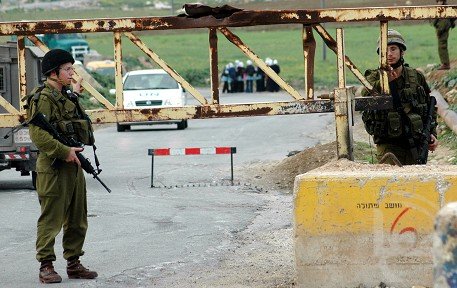
Hebron – Israeli army bulldozers reportedly destroyed several water pipes as they attempted to block the main road from the Adh-Dhahiriya village to Hebron on Wednesday, effectively cutting off the village’s water supply, an official said.
A representative from the Palestinian Authority Water Authority, Nabil Abu Aqel, said the bulldozers were in the process installing a road block near the adjacent Otni’el settlement, destroying a number of essential water pipelines in the process.
However, a spokesman for Israel’s Civil Administration said a pipe had burst in the area and that it was currently being repaired.
Two weeks prior, Israeli forces piled earth at the northern entrance of Adh-Dhahiriya, closing off the main road to Hebron in what town residents said at the time was an attempt to restrict access to roads near settlements.
In the process of digging, forces destroyed pipes to the town, again cutting off its water supply, Adh-Dhahiriya Mayor Sami Estanyur said at the time.
The Hebron-Dhahiriya road bypasses the Otni’el settlement was established on 150 dunums of private Palestinian land in 1983, and Eshtanyur said the road overlays the water network of the town.
At the time, Israel’s army said it was not familiar with the incident.
“What kind of democracy is America, where people do not ask these questions?”
By Kathy Kelly and Josh Brollier | Pulse Media | May 18, 2010
Islamabad–On May 12th, the day after a U.S. drone strike killed 24 people in Pakistan’s North Waziristan, two men from the area agreed to tell us their perspective as eyewitnesses of previous drone strikes.
One is a journalist, Safdar Dawar, General Secretary of the Tribal Union of Journalists. Journalists are operating under very difficult circumstances in the area, pressured by both militant groups and the Pakistani government. Six of his colleagues have been killed while reporting in North and South Waziristan. The other man, who asked us not to disclose his name, is from Miranshah city, the epicenter of North Waziristan. He works with the locally based Waziristan Relief Agency, a group of people committed to helping the victims of drone attacks and military actions. “If people need blood or medicine or have to go to Peshawar or some other hospital,” said the social worker, “I’m known for helping them. I also try to arrange funds and contributions.”
Both men emphasized that Pakistan’s government has only a trivial presence in the area. Survivors of drone attacks receive no compensation, and neither the military nor the government investigate consequences of the drone attacks.
Mr. Dawar, the journalist, added that when he phoned the local political representative regarding the May 12th drone attack, the man couldn’t tell him anything. “If you get any new information,” said the political representative, “please let me know.”
In U.S. newspapers, reports on drone attacks often amount to about a dozen words, naming the place and an estimated number of militants killed. The journalist and social worker from North Waziristan asked us why people in the U.S. don’t ask to know more.
It’s hard to slow down and look at horrifying realities. Jane Mayer, writing for The New Yorker, (“The Predator War,” October 26, 2009), quoted a former C.I.A. official’s description of a drone attack:
People who have seen an air strike live on a monitor described it as both awe-inspiring and horrifying. ‘You could see these little figures scurrying, and the explosion going off, and when the smoke cleared there was just rubble and charred stuff,’ a former C.I.A. officer who was based in Afghanistan after September 11th says of one attack.
“Human beings running for cover are such a common sight,” Jane Mayer continues, “that they have inspired a slang term: ‘squirters.’”
Just rubble and charred stuff…
The social worker recalled arriving at a home that was hit, in Miranshah, at about 9:00 p.m., close to one year ago. The house was beside a matchbox factory, near the degree college. The drone strike had killed three people. Their bodies, carbonized, were fully burned. They could only be identified by their legs and hands. One body was still on fire when he reached there. Then he learned that the charred and mutilated corpses were relatives of his who lived in his village, two men and a boy aged seven or eight. They couldn’t pick up the charred parts in one piece. Finding scraps of plastic they transported the body parts away from the site. Three to four others joined in to help cover the bodies in plastic and carry them to the morgue.
But these volunteers and nearby onlookers were attacked by another drone strike, 15 minutes after the initial one. 6 more people died. One of them was the brother of the man killed in the initial strike.
The social worker says that people are now afraid to help when a drone strike occurs because they fear a similar fate from a second attack. People will wait several hours after an attack just to be sure. Meanwhile, some lives will be lost that possibly could have been saved.
The social worker also told us that pressure from the explosion, when a drone-fired missile or bomb hits, can send bystanders flying through the air. Some are injured when their bodies hit walls or stone, causing fractures and brain injuries.
The social worker described four more cases in which he had been involved with immediate relief work, following a drone attack. He didn’t supply us with exact dates, and we weren’t able to find news articles on the internet which exactly matched his accounts. Riaz Khan, an AP reporter covering a drone strike on May 15th, noted differences in details reported by witnesses and official sources. “Such discrepancies are common and are rarely reconciled,” according to Khan (May 15th , Officials: US missiles kill 5 in NW Pakistan‘).
Exasperated by the neglect and indifference people in Waziristan face, especially those who say they have nowhere to hide, the journalist and social worker began firing questions at us.
“If the US had good intelligence and they hit their targets with the first strike,” Safdar asks, “why would the second one be necessary? If you already hit the supposed militant target, then why fire again?”
“Who has given the license to kill and in what court? Who has declared that they can hit anyone they like?”
“How many ‘high level targets’ could there possibly be?”
“What kind of democracy is America,” Safdar asks, “where people do not ask these questions?”
Reliance on robotic warfare has escalated, from the Bush to the Obama administrations, with very little significant public debate. More than ever before, it is true that the U.S. doesn’t want our bodies to be part of warfare; there’s also not much interest in our consent. All that is required is our money.
But, you get what you pay for in the U.S.A. The social worker and the journalist assured us that all of the survivors feel hatred toward the United States. “It is a real problem,” said Safdar, “this rising hatred.”
Kathy Kelly (kathy@vcnv.org) and Josh Brollier (Joshua@vcnv.org) are co-coordinators of Voices for Creative Nonviolence www.vcnv.org
Israel charged with 14 cases of sexual assault and threats to children
Defence for Children International | May 18, 2010
On 18 May 2010, DCI-Palestine submitted 14 cases to the UN Special Rapporteur on Torture for investigation. The submission relates to the sexual assault, or threat of sexual assault, of Palestinian children at the hands of Israeli soldiers, interogators and police between January 2009 and April 2010. The ages of the children range from 13 to 16 years.
DCI-Palestine is becoming increasingly alarmed at reports contained in sworn affidavits received from children that they are being subjected to sexual assault, or threat of sexual assault, in order to obtain confessions.
DCI-Palestine has reviewed 100 sworn affidavits collected from children in 2009, and in four percent of cases, children report being sexually assaulted, whilst in 12 percent of cases, the children report being threatened with sexual assault. The sexual assault and threats of sexual assault documented by DCI-Palestine include grabbing boys by the testicles until they confess and threatening boys as young as 13 years with rape unless they confess to throwing stones at Israeli settler vehicles in the occupied West Bank. DCI-Palestine suspects that these figures may understate the extent of the problem.
In one of the cases documented by DCI-Palestine, a 15 year-old boy recalls his experience after being arrested by Israeli soldiers from his family home at 2am, in September 2009:
‘While sitting on the ground near the truck, a person speaking Arabic approached me and grabbed my hands and ordered me to stand up and accompany him. He grabbed me so violently and pulled me. He forced me to walk with him for about 20 metres and I could see from under the blindfold that we stopped behind a military jeep. He slapped me hard twice and grabbed my testicles so hard and started pressing them. Then, he asked me whether I threw stones and Molotov cocktails and I said I did not. He started shouting and saying ‘liar, your mother’s a c**t.’ He started beating me all over my body and once again he grabbed my testicles and started pressing hard. “I won’t let go of your testicles unless you confess,” he said to me. I felt so much pain and kept shouting. I had no other choice but to confess to throwing stones.’
Each year around 700 Palestinian children are arrested, interrogated and prosecuted in the Israeli military courts. The most common charge is for throwing stones. The children are interrogated in the absence of a lawyer and family members and in 2009, over 80 percent of these children provided confessions after a coercive interrogation, of which 32 percent were written in Hebrew, a language few Palestinian children understand. Following their conviction in the military courts, the majority of these children are incarcerated inside Israel in contravention of Article 76 of the Fourth Geneva Convention.
DCI-Palestine is requesting that the Special Rapporteur investigates these and other reports relating to the apparent widespread and systematic ill-treatment of Palestinian children by Israeli authorities in the Occupied Palestinian Territory and to publish the findings.
For further information please see DCI-Palestine’s latest report on Palestinian child prisoners.
Remarkable Urgency
By Eva Bartlett | In Gaza | May 18, 2010

*wheat crops bulldozed in a roughly 15 metre wide track clawed into the land by Israeli military bulldozers and tanks.
A dry winter with very late rains –at the end of January, the last possible time for planting, the farmers said –followed by a dry spring evolved into the beginnings of a dry summer.
Called yesterday to accompany farmers in the Faraheen and Khoza’a regions, each east of Khan Younis, we were suddenly busy again. So it goes with the farmers who’ve been forced to give up high-maintenance agriculture and try for the lowest-maintenance crops possible: wheat, rye, lentils. No more trees, they’ve all been bulldozed too many times. Not so many potatoes, nor much parsley–they require more water than the sparse rains provided or the destroyed water cisterns, wells and piping allowed for.
Whereas before the heightened Israeli army aggressions against these visibly unarmed farmers they would live on their land, at the very least daily visit and work on it, they are now resigned to rushed attempts at sowing and harvesting some of Gaza’s richest soils, under the thud and whiz of Israeli army bullets.
We were to join Leila Abu Dagga’s sister to harvest 5 dunams of lentils. But when we arrived were told, “it’s gone, the Israelis bulldozed it all”. [The land in question is near where the young, deaf farmer was shot by an Israeli soldier last year. Over 500 metres from the border, I remember it well (and remember the shock of the Israeli soldiers having shot around us to reach this unarmed farmer just trying to earn 20 shekels a day. The horror: shit, is he dead? The disbelief: but they saw us farming for over 2 hours… why shoot now? The disgust: this kid is just trying to add to his large family’s small income)]

*a roughly 15 metre wide track clawed into the land by Israeli military bulldozers and tanks.

So we moved to Abu Tabbash land, roughly 12 dunams of wheat which we had accompanied the elderly farmer on four months ago. Then, the Israeli army jeeps had lorded atop earth mounds just across the Green Line border fence as Abu Khader walked the length of his accessible land, back and forth, hand-spraying wheat seeds.

*Faraheen farmland [photo: Rada Daniell]
As we arrive, shortly after 7 am, he tells us “we started at 5 am. The jeeps were there, but no shooting yet”. He is neither surprised nor grateful, just matter of fact. Matter of fact is the Israeli soldiers can appear at any moment and shoot at any moment, any whim. There is no pattern, no predictability, and the only seeming reason, quite obviously, is pure harrassment with the intent of driving Palestinians off their land and destroying the agricultural sector.
So farmers like Abu Khader risk working on their land, abadoning the tens, hundreds for some families, of dunams lost to within and near the Israeli-imposed “buffer zone”. But they do so at frantic paces, determined to work even the smallest section of their land.
“It’s quite remarkable,” says Adie, one of us accompanying the farmers. “It’s unbelievable that the Israeli army would fire on a scene like this. It’s one of the most tranquil things you could be doing, this hand-harvesting.”

Abu Khader has the bearing, humility, and cracked heels of someone who has toiled the land all his life. His dignity shines, as does his sense of urgency to harvest the crop, and he wastes no time with small-talk or breaks.
Working with three other family members, he hand-plucks the wheat from its earth, noting “it’s so meagre this year. It should be up to here,” gesturing near head level.
They rip, pile and bundle wheat and the dry hay-grass which will serve as animal feed. The bundles are stuffed into large sacs or piled on too-small donkey carts and hauled off.


Day one they’ve harvested from 5 am to 10 am and call it a day. Day two –”there was shooting this morning,” we are told, and an hour and a half another round of shots at visibly unarmed farmers –they work roughly the same, with same intensity, saying “tomorrow we’ll finish, just need an hour and a half”.
We leave, some of the plucked wheat still in small piles to be collected the next morning.
We learn hours later that after farmers and accompaniers left the land, Israeli bulldozers crushed in and lit afire by incendiary devices the land in and along the “buffer zone” including Abu Khader Abu Tabbash’s remaining wheat.
Featured Video

The American Retreat from Vietnam
or go to
Aletho News Archives – Video-Images
From the Archives
Secret document reveals plans for civil war in Lebanon, Israeli false flags, and invasion
By Randi Nord | Geopolitics Alert | April 5, 2019
Beirut – During his visit with US Secretary of State, Mike Pompeo, Lebanese President Michael Aoun reportedly received a US-Israeli document detailing plans for creating a civil war in Lebanon with covert false flag operations and possible Israeli invasion.
Although the source of the document is Israeli and created in partnership with Washington, no one knows who presented it to Aoun. The Lebanese TV station, Al-Jadeed, initially reported the document on Lebanese TV and a video on its website. Geopolitics Alert translated the report for this article. … continue
Blog Roll
 Aletho News
- There’s a drought in academia: A drought in honest research on the subject of drought and other weather extremes
- Department of War Awards $20.7 Billion Contract to Raytheon for Air-to-Air Missiles
- ‘Distance yourselves from Israel’: IRGC urges US population to question govt policies
- America’s Greenland deal has a radioactive backstory
- The RAF Fairford ‘terror plot’: Unpacking escalation in the UK echo-chamber
- EU Council Advances Chat Control 2.0 Scanning Proposal
- Ex-Greek MEP files complaint against Israeli spyware firm over alleged Pegasus surveillance
- Troubling ideas throughout the Torah, Talmud, Mishneh Torah and Tanya
- ‘Grave, alarming’: Iran mission on Trump’s UNGA ‘annihilation’ threats
- Najaf airport to reopen to Iranian flights within 24 hours: Ambassador
- If Americans Knew
- New Report: “Scholasticide and Genocide in Gaza: Assessment, Testimonies and Legal Analysis”
- Ex-Biden officials are desperate for a Gaza scapegoat
- Israeli “settlers” Invade Al-Aqsa; Pour Boiling Water on 75-Year-Old
- Israel Has Kidnapped Another American Teenager
- US arms sales to Israel worth $21.6 billion in 20 months
- Three Palestinians Killed in Israeli Attacks on Gaza
- Revealed: German “Anti-Semitism Expert” Driving Crackdown on Palestine Solidarity is Former Israeli Spy
- Egypt’s Warning to Israel Before Oct 7
- Israel’s siege signals another cruel winter for 1.8 million Gazans – Daily Update
- Netanyahu Asked UAE Leader to Deny Report on Oct. 7 Warning in Secret Visit, Sources Say
- No Tricks Zone
- New Study: Earth And Venus Surface Warmth Largely Explained By Convection And Lapse Rate, Not CO2 Or Radiation
- 2025 Nature Paper Claiming Worsening Global Drought Gets RETRACTED …Heavily Flawed
- New Study: ‘Global Drought Shows No Detectable Recent Acceleration Under Climate Warming’
- Economic Masterminds: German Socialists Suggest Taxing Productivity Gains Stemming From Using AI
- The South China Sea Has Not Been Cooperating With The Climate Change Narrative
- Energy Crisis: Germany Enters Heating Season With Historically Low Gas Reserve Fill Levels
- New Study: The Antarctic Ice Sheet Gained Mass From 2020-2024 Due To Staggering Snow And Ice Accumulation
- Study: Ocean Heating Rates From Thousands Of Years Ago ‘Dwarf’ Modern Ocean Heating Rates
- Climate Extremists Target, Attack Large-Scale Power Grid Infrastructure In Germany!
- New Study: Antarctic Ice Melt Has Contributed Less Than 1 Centimeter To Sea Level Rise In The Last 30 Years

