US activist loses eye after being shot in face with tear gas canister
International Solidarity Movement | 31 May 2010
US citizen Emily Henochowicz was shot directly in the face with a tear gas canister as she non-violently demonstrated against the Flotilla massacre

31 May 2010: An American solidarity activist was shot in the face with a tear gas canister during a demonstration in Qalandiya, today. Emily Henochowicz is currently in Hadassah Hospital in Jerusalem undergoing surgery to remove her left eye, following the demonstration that was held in protest to Israel’s murder of at least 10 civilians aboard the Gaza Freedom Flotilla in international waters this morning.
21-year old Emily Henochowicz was hit in the face with a tear gas projectile fired directly at her by an Israeli soldier during the demonstration at Qalandiya checkpoint today. Israeli occupation forces fired volleys of tear gas at unarmed Palestinian and international protesters, causing mass panic amongst the demonstrators and those queuing at the largest checkpoint separating the West Bank and Israel.
“They clearly saw us,” said Sören Johanssen, a Swedish ISM volunteer standing with Henochowicz. “They clearly saw that we were internationals and it really looked as though they were trying to hit us. They fired many canisters at us in rapid succession. One landed on either side of Emily, then the third one hit her in the face.”
Henochowicz is an art student at the prestigious Cooper Union, located in East Village, Manhattan.
The demonstration was one of many that took place across the West Bank today in outrage over the Israeli military’s attack on the Gaza freedom flotilla and blatant violation of international law. Demonstrations also took place in inside Israel, Gaza and Jerusalem, with clashes occurring in East Jerusalem and Palestinian shopkeepers in the occupied Old City closing their businesses for the day in protest.

Henochowicz lost her left eye after being shot directly in the face with a tear gas canister
Tear gas canisters are commonly used against demonstrators in the occupied West Bank. In May 2009, the Israeli State Attorney’s Office ordered Israeli Police to review its guidelines for dispersing demonstrators, following the death of a demonstrator, Bassem Abu Rahmah from Bil’in village, caused by a high velocity tear-gas projectile. Tear-gas canisters are meant to be used as a means of crowd dispersal, to be shot indirectly at demonstrators and from a distance. However, Israeli forces frequently shoot canisters directly at protesters and are not bound by a particular distance from which they can shoot.
###
Israeli version doesn’t begin to pass laugh test
Moshe Yaroni on the Israeli response:
… every once in a while, things take a turn, and that turn is punctuated by a singular, stunning event. The murderous raid on the Gaza Freedom Flotilla this day was one such event.
I waited to start writing this until there was some official statement from Israel. I did that because I want to start off with Israel’s explanation for this horror. Here’s what the IDF spokesperson said, in part:
During the intercept of the ships, the demonstrators onboard attacked the IDF Naval personnel with live fire and light weaponry including knives and clubs. Additionally one of the weapons used was grabbed from an IDF soldier. The demonstrators had clearly prepared their weapons in advance for this specific purpose.
As a result of this life-threatening and violent activity, naval forces employed riot dispersal means, including live fire. Reports from IDF forces on the scene are that it seems as if part of the participants onboard the ships were planning to lynch the forces.
I am sure, as is always the case, there will be those who believe this version of events. But frankly, I can’t see how anyone can do so unless they are so desperate to justify Israel’s action here that they’ll believe anything. Let’s examine the IDF’s version of events.
We begin with the point that these were civilian ships and Israel boarded them with commandoes—soldiers who are disposed toward combat situations and are not meant to police unarmed civilians. They’re fighters, that’s their purpose. But the IDF claims that an assortment of international activists deliberately provoked a violent confrontation (using potentially deadly weapons, but which still leave them ridiculously overmatched) against heavily armed and trained soldiers in order to “lynch them.”
Does that seem remotely credible? It only seems so if you believe the activists on board these ships were willing to risk and actually sacrifice their lives in order to create a scandal for Israel. Of course, Israeli hasbara (propaganda) is well-practiced in casting all Arabs and Muslims as suicidal lunatics, aided by the suicide bombers who represent an infinitesimal percentage of those populations. But this collection of international activists, including many Jews, Americans and Europeans, apparently are also willing to give their lives, and rather cheaply, according to this story.
No, the IDF version of these events doesn’t begin to pass the laugh test… Full article
NATO to hold emergency session at Turkey’s request
Ma’an/Agencies – 31/05/2010
NATO will hold emergency talks on Tuesday at Turkey’s request after an Israeli commando unit stormed an aid convoy en route to Gaza, killing at least 10 passengers, spokesman James Appathurai said.
“Planning is underway for a meeting… at the request of the Turkish authorities tomorrow afternoon,” Appathurai told the Agence France-Presse. The talks will gather ambassadors from the 28 NATO member countries at its Brussels HQ.
Turkish Prime Minister Recep Tayyip Erdogan told reporters in Santiago, Chile that his government was demanding the NATO council gather to address the deaths and accused Israel of committing “inhuman state terror” with its deadly raid on a fleet of aid ships bound for Gaza, the Turkish daily Hurriyye reported.
“It should be known that we will not stay silent and unresponsive in the face of this inhuman state terror,” Erdogan said in live televised remarks ahead of his departure from Chile to Turkey, cutting short a Latin American tour, the daily wrote.
“International law has been trampled underfoot,” he added.
Israel is not a member state of NATO. Meanwhile Israeli Prime Minister Benjamin Netanyahu cut a Canada trip short, and canceled a Washington meeting, saying he regretted the deaths caused in the incident but asserted that Israel had a right to defend itself, the Israeli daily Haaretz reported.
He further said that Israel’s blockade of the Gaza Strip would continue, despite renewed international calls to immediately lift the siege following reports of the deaths.
Facing armed attack in international waters
By Paul Woodward on May 31, 2010

When a civilian passenger ship comes under military attack in international waters, should we be surprised — or even critical — when some of the passengers mount a defense?
According to CNN, which has made itself into a mouthpiece for the Israeli Defense Forces, the flotilla massacre was a “skirmish”, which the dictionary defines as a “minor battle in war, as one between small forces.”
CNN/the IDF would have the world believe that Israel’s elite commandos unexpectedly met an armed force on the decks of the Mavi Marmara. Some of the Israeli soldiers were so afraid they jumped into the sea to save themselves from Arabic-speaking assailants, Israeli officials claimed.
Turkish officials have denied claims leveled by Israeli authorities that weapons were onboard one of the six aid ships attacked by Israel on Monday.
Officials from the Customs Undersecretariat said every passenger was searched before getting on the ship with the help of X-ray machines and metal detectors. Senior officials from the undersecretariat said Israel’s allegations were tantamount to “complete nonsense.”
Israel and its lackeys in the US media might try to characterize what happened in the Mediterranean today as an “incident,” or “skirmish,” or an “ambush.”
But if the IDF met “unexpected resistance,” what exactly did they expect? A reception committee with tea and breakfast? Didn’t they see the resistance the Viva Palestina convoy put up last year when challenged by Egyptian security forces?
The live video feed coming from the Mavi Marmara during its voyage from Turkey would have provided invaluable intelligence for the IDF and I have little doubt that they watched it carefully. A number of observations the Israelis must have made may have significantly influenced their calculations and miscalculations.
One of the striking demographic features of the group of passengers was the average age — having watched many hours of the feed, I’d put the average age at about 35-40 with a significant number of “retirees” — this was not a bunch of young hotheads.
Also, the group was overwhelmingly Middle Eastern and Turkish and male. The risk that Israeli violence would result in the death of another Rachel Corrie was relatively low.
Put together these two factors — the expectation that the age of the passengers might make them somewhat less volatile and the fact that they largely came from countries that Israel has less concern about offending — and you get the perfect cocktail for Israeli hubris.
As for the fact that elite Israeli soldiers can in one instant be portrayed as invincible and yet the next as hapless victims — that is a paradox that can be resolved only in the minds of Israelis.
In the eyes of much of the world, this was a massacre, the dead will be seen as martyrs, and the moral bankruptcy of the Jewish state revealed in sharper clarity than ever before.
World in shock at Israel’s deadly Gaza ship raid
Israel’s foes and allies close ranks in condemning deadly raid against aid ship heading for Gaza.
Middle East Online | May 31, 2010
ANKARA – Shock and outrage swept the globe Monday after Israeli commandos stormed a flotilla of aid ships bound for Gaza, as Tel Aviv’s foes and allies closed ranks in condemning the deadly raid.
Police struggled to hold back an angry crowd of hundreds outside the Israeli consulate in Turkey’s biggest city Istanbul, while furious protesters shouted “Damn Israel” outside the residence of the Israeli ambassador in Ankara.
Turkey’s foreign ministry warned that the raid on the flotilla, which included Turkish vessels, may lead to “irreparable consequences” in bilateral ties.
“We strongly condemn these inhumane practices of Israel,” a written statement said.
“This deplorable incident, which took place in open seas and constitutes a fragrant breach of international law, may lead to irreparable consequences in our bilateral relations,” it said.
In Europe, condemnation was equally swift.
France said that “nothing can justify” the violence of Israel’s Gaza ship raid, and Franch President Nicolas Sarkozy on Monday accused Israel of a “disproportionate use of force” in its deadly raid.
German Foreign Minister Guido Westerwelle said he was “deeply concerned” about the deaths.
The European Union demanded Israel mount a “full inquiry” into the killing of at least 10 people in a raid on a flotilla of aid ships bound for Gaza.
EU foreign affairs chief Catherine Ashton warned that Israel’s “continued policy of closure is unacceptable and politically counterproductive,” demanding “an immediate, sustained and unconditional opening” of crossings to Gaza.
Greece withdrew from joint military exercises with Israel in protest at the raid, as it summoned Israel’s ambassador to demand an “immediate” report on the safety of about 30 Greeks on board the flotilla.
A Greek non-governmental organisation said Monday that Israeli forces in helicopters and inflatable boats fired on a Greek vessel in the aid convoy attacked while heading for Gaza.
“There was an attack with live bullets against the Greek boat Sfendoni and the Turkish boat Mavi Marmara, with helicopters and inflatable boats,” the Greek organisation said in a statement.
The NGO added that two Greeks were on the Mavi Marmara and 12 others with a Tunisian on Sfentoni, while 22 Greeks and eight Swedish nationals were on the Eleftheri Mesogeio.
Belgium’s foreign minister on Monday “invited” Israel’s ambassador to “explain” the decision to storm the Gaza-bound aid flotilla, his spokesman said.
Steven Vanackere “invited the Israeli ambassador to explain to him this afternoon how events unfolded,” and also to provide news of five Belgian nationals who were on board the flotilla, spokesman Bart Ouvry said.
Italy on Monday “deplored” the loss of civilian life in Israel’s raid on aid ships bound for Gaza.
“I absolutely deplore… the killing of civilians” in the assault on Monday, Italian Foreign Minister Franco Frattini told reporters, describing the Israeli pre-dawn military action as “really serious.”
“An investigation must discover the truth about what happened,” he said. “We demand a serious and detailed investigation, and I think the EU must be involved so that it is directly informed of the findings.”
The bloody ending to the high-profile mission to deliver supplies to Gaza came on the eve of a meeting in Washington between President Barack Obama and Israeli Prime Minister Benjamin Netanyahu.
The democratically elected Hamas movement in the Gaza Strip Monday urged Arabs and Muslims to “rise up” in front of Israeli embassies across the globe in protest against Israel’s deadly raid.
“We call on all Arabs and Muslims to rise up in front of Zionist embassies across the whole world,” said Hamas spokesman Sami Abu Zuhri.
Ismail Haniya, the movement’s prime minister in Gaza, slammed the “ugly attack” in a statement in which he called for “the United Nations to protect the activists” on board the boats.
“We call on the Palestinian Authority to halt negotiations, direct or indirect, with Israel because of this crime,” said Haniya.
Palestinian Authority president Mahmud Abbas slammed the navy raid as “a massacre” and announced a three-day mourning period.
“We will have to take some difficult decisions this evening,” an official from his office told Palestinian television, without giving further details.
The Palestinian Authority also called for an emergency meeting of the UN Security Council “to discuss the piracy, the crime and the Israeli massacre,” said top negotiator Saeb Erakat.
Israel’s Arab community called a general strike in response to an Israeli naval operation and called for protests across the country.
In response, hundreds from across the political spectrum flooded onto the streets of the northern Arab Israeli city of Nazareth to protest against the bloody attack.
Kuwait’s parliament speaker condemned the raid on the flotilla, which was carrying 16 Kuwaitis including an MP, as a “heinous Israeli crime,” as the cabinet prepared for an emergency meeting.
Arab League chief Amr Mussa slammed the raid as a “crime” against a humanitarian mission, saying the 22-country body was consulting to decide on its next step.
UN Secretary General Ban Ki-moon said Monday he was “shocked” by the deadly Israeli raid and demanded Tel Aviv conduct a full investigation.
“I am shocked by reports of killings and injuries on boats carrying supplies for Gaza,” the UN chief said at a press conference. “I condemn this violence,” Ban added.
Swedish author Henning Mankell was onboard one of the ships in the Gaza aid flotilla which Israeli commandos attacked early Monday, the Swedish branch of Ship to Gaza said.
The 62-year-old, whose books about world-weary detective Kurt Wallander have sold more than 25 million copies worldwide and have been adapted to film and television, said he was partaking in the flotilla to show his solidarity towards the Palestinian people.
“I think that when one talks about solidarity, one must always know that actions are what proves destiny,” he told Swedish public radio last Thursday.
“It is with actions that we prove we are ready to support something we believe is important,” he said.
Swedish-Israeli artist Dror Feiler, the chairman of the Swedish “Jews for Israeli-Palestinian peace,” as well as nine other Swedes, including a member of parliament, were also participating in the flotilla.
It remained unclear whether any of them had been wounded in the attack.
The Netherlands expressed shock over the Israeli army’s deadly raid on aid ships and said it would ask Israel for “clarifications” about the incident which has triggered worldwide condemnation.
“I am going to ask today for clarifications from the Israeli ambassador to The Hague,” said Dutch Foreign Minister Maxime Verhagen in a statement.
“I am very shocked over the deaths which are deplorable. The Netherlands wants an inquiry to determine exactly how this could have happened,” Verhagen said.
“What happened today, while the Israelis and Palestinians were just starting to relaunch talks, will not bring them closer to peace,” the Dutch minister added. “I hope that it will not lead to another deadlock in the talks.”
Foreign ministry spokesman Bart Rijs said he did not know if any Dutch citizens were on board the ships carrying aid to the besieged Palestinian territory.
UN aid group: Israel deliberately hampering West Bank, Gaza relief efforts
By Chaim Levinson | Haaretz | May 30, 2010
A United Nations humanitarian relief agency is accusing Israel of deliberately disrupting the international community’s aid efforts for the Palestinians in the West Bank and Gaza Strip.
According to a special report released by the UN’s Office for the Coordination of Humanitarian Affairs (OCHA ), Israel is not permitting construction of buildings for needy Palestinians and is encumbering on the freedom of movement of aid groups and their staffs.
The report, which was issued on Thursday under the headline “Impeding Assistance: Challenges to Meeting the Humanitarian Needs of Palestinians,” said that human rights NGOs last year committed a total of $660 million in aid to the territories.
A large portion of the report is devoted to the humanitarian situation in Gaza, where it claims that UNRWA, the UN aid agency for Palestinian refugees, has been unable to build 100 news schools it says are needed to accommodate the fast-growing population.
In May 2009, the UN submitted a request for Israeli approval of a wide-ranging, $80 million plan to provide housing, medical assistance and educational services to Gazans. After nine months of negotiations, the Israeli government permitted a scaled-down version of the original plan, including the construction of 151 residential units in a project in Khan Yunis.
On Friday, a report appeared in the Israel Hayom newspaper which quoted Prime Minister Benjamin Netanyahu as saying: “In Gaza, let them build [homes] with wood. Concrete is used to build bunkers.”
The OCHA report claims Israel is interfering with the movement of local Palestinian aid workers. According to the report, 20 percent of requests for West Bank workers to secure passage to Gaza were rejected, while 46 percent of requests for Gaza-based employees to gain entry into the West Bank were turned down. The OCHA report said Israeli constraints have complicated efforts to train workers in Gaza.
Meanwhile, in the West Bank, aid groups have encountered other problems. In 2010, the UN formulated a series of urgent plans aimed at addressing shortages in water, educational services and housing for needy Palestinians living in Area C, the West Bank territories under exclusive Israeli military and civilian administration. According to the report, the international body prepared 15 initiatives that were intended to provide water to 52,000 Palestinians in 17 different locales in Area C, as well as 25 projects for the reconstruction of schools to service 6,000 children. Three months have passed since the UN presented these plans to the Israeli government, which has yet to offer its response.
Another issue cited by OCHA is movement in the West Bank. While the report acknowledged that the lifting of roadblocks and removal of checkpoints have significantly improved NGOs’ ability to work, it stated that difficulties remain. In August 2009, aid agencies were unable to deliver 170 water tankers intended to service 58 families and some 5,000 sheep in the southern Hebron Hills due to mounds of earth that impeded their progress. This forced half the residents of one village to relocate in order to find sources of water, the report stated.
Over 100 Palestinian minors reported abuse in IDF, police custody in 2009
69 minors complained of being beaten, four minors reported being sexually assaulted, and 12 said they were threatened with sexual assault.
By Amira Hass | Haaretz | May 28, 2010
 Photo by: Tal Cohen
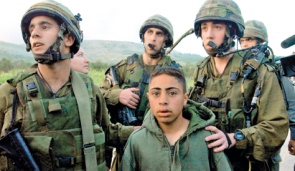
Most Palestinian children arrested by the Israel Defense Forces and police are intimidated, abused and maltreated in custody, according to the sworn testimonies of minors who were arrested last year. This happens both before and during interrogation, and several minors have been sexually assaulted.
The Palestinian branch of the non-governmental organization Defense for Children International has asked the United Nations to probe complaints of sexual assaults.
The organization has collected 100 detailed depositions from minors aged 12 to 17 who were arrested last year, immediately after their release. Most of the findings were not a surprise to DCI activists, apart from verbal or physical attacks of a sexual nature committed by soldiers.
Sixty-nine minors complained of being beaten by soldiers (slaps, kicks, sometimes blows with a rifle stock or club ). Nearly all – 97 percent, including children aged 12 to 15 – were held for hours with their hands cuffed, and 92 percent were blindfolded for long periods of time. Twenty-six percent said they were forced to remain in painful positions.
For example, one child said he was bound, blindfolded and placed on the floor of a jeep or vehicle on its way to the prison facility. About half the children said the soldiers who arrested them cursed and threatened them before the interrogation, to make them confess the charges. Or the children were urged to confess with false promises of immediate release.
The children were frequently told that the soldier who beat them was also the interrogator to whom they must confess. Most of them said they were held for many hours before receiving anything to drink or eat.
The DCI says the numerous sworn testimonies attest to a fixed, repeated pattern. It says these practices violate international law and the children’s rights.
In addition, causing pain and intimidation to extract a confession from a minor or make him incriminate others is defined as torture.
The relatively surprising findings in the depositions were the complaints of sexual abuse – verbal or physical. Minors usually have difficulty talking about this aspect of their arrest, and the issue came up only during the longer conversations DCI lawyers had with the children.
Four minors reported being sexually assaulted, and 12 said they were threatened with sexual assault. The threat was accompanied by physical violence. Last week, the DCI’s Palestinian branch sent the UN official who monitors torture 14 complaints by Palestinian prisoners aged 13 to 16 of sexual assault during detentions from January 2009 to April 2010.
The depositions sent to the UN report direct attacks, including squeezing boys’ testicles, pushing a blunt object (a club or rifle stock ) between the chair and a child’s buttocks, and repeated threats of “I’ll screw you if you don’t confess you threw stones.”
A 15-year-old arrested in September told the DCI that a soldier slapped him twice, squeezed his testicles and asked if he had thrown stones or a Molotov cocktail. The boy said he hadn’t thrown either, and the soldier shouted at him that he was a liar, beat him all over his body, grabbed his testicles again and squeezed. “I won’t let your balls go until you confess,” he said.
The boy felt such pain that he confessed to throwing stones, he reported.
The DCI recommends that the IDF and police interrogate minors only in the presence of a lawyer of their choice and a relative, and record the interrogation on video. These accepted procedures for interrogating children would reduce the risk of extorted confessions.
Palestinian prisoners, including minors, are allowed to see their lawyers only shortly before trial, sometimes only in the courtroom itself. This prevents them from talking in detail about their treatment in custody. Minors, 60 percent of whom are charged with stone-throwing, may expect a much shorter prison sentence than their detention time until the end of the trial.
Consequently, many minors confess, even when they deny the charges, and their lawyers sign plea deals with the prosecution to shorten their incarceration.
Asked about a failure to complain to the authorities about the sexual assault of minors, DCI legal adviser Khaled Kuzmar said many parents are not prepared to do so. “Very few people have confidence in the system that abuses them,” he said.
Some fear that the system or certain individuals would take revenge on them if they complain, he said.
However, the DCI is considering filing complaints along with Israeli human rights groups, if the parents agree.
The Israeli authorities arrest around 700 Palestinian minors aged 12 to 18 annually. Some 300 Palestinian minors are held in various Israeli prison facilities every month – either before or after they have been tried. Last month, 335 Palestinian minors, 32 of them aged 12 to 15, were imprisoned, mostly on suspicion of throwing stones.
The IDF Spokesman’s Office dismissed “claims of deliberate deviation from procedures for arresting and interrogating minors. Minors’ arrests are carried out in keeping with international law; the arrest of suspects under 16 years old in the West Bank requires a military lawyer’s approval …. Minors are brought before a judge within a relatively short period.”
The spokesman said complaints about violence should be raised during the trial, or in an orderly complaint to the Justice Ministry’s police investigation department or the Military Police.
Military sources told Haaretz that minors’ interrogation sessions are recorded, except for interrogations by the Shin Bet security service, which are exempt by law. As for a lawyer’s presence during a minor’s interrogation, the law does not require that even in Israel proper.
Israel’s Disinformation Campaign Against the Gaza Freedom Flotilla
Witness Gaza | May 28, 2010
Israeli disinformation cannot hide the siege of Gaza.
For over four years, Israel has subjected the civilian population of Gaza to an increasingly severe blockade, resulting in a man-made humanitarian catastrophe of epic proportions. Earlier this month, John Ging, the Director of Operations of the UN Relief and Works Agency for Palestine Refugees (UNRWA) in Gaza, called upon the international community to break the siege on the Gaza Strip by sending ships loaded with humanitarian aid. This weekend, 9 civilian boats carrying 700 human rights workers from 40 countries and 10,000 tons of humanitarian aid will attempt to do just that: break through the Israel’s illegal military blockade on the Gaza Strip in non-violent direct action. In response, the Israeli government has threatened to send out ‘half’ of its Naval forces to violently stop our flotilla, and they have engaged in a deceitful campaign of misinformation regarding our mission.
Israel claims that there is no ongoing humanitarian crisis in Gaza. Every international aid organization working in Gaza has documented this crisis in stark detail. Just released earlier this week, Amnesty International’s Annual Human Rights Report stated that Israeli’s siege on Gaza has “deepened the ongoing humanitarian crisis. Mass unemployment, extreme poverty, food insecurity and food price rises caused by shortages left four out of five Gazans dependent on humanitarian aid. The scope of the blockade and statements made by Israeli officials about its purpose showed that it was being imposed as a form of collective punishment of Gazans, a flagrant violation of international law.”[1]
Israel claims that its blockade is directed simply at the Hamas government in Gaza, and is limited to so-called ’security’ items. Yet When U.S. Senator John Kerry visited Gaza last year, he was shocked to discover that the Israeli blockade included staple food items such as lentils, macaroni and tomato paste.[2] Furthermore, Gisha, the Israeli Legal Center for Freedom of Movement, has documented numerous official Israeli government statements that the blockade is intended to put ‘pressure’ on Gaza’s population, and collective punishment of civilians is an illegal act under international law.[3]
Israel claims that if we wish to send aid to Gaza, all we need do is go through ‘official channels,’ give the aid to them and they will deliver it. This statement is both ridiculous and offensive. Their blockade, their ‘official channels,’ is what is directly causing the humanitarian crisis in the first place.
According to former U.S. President Jimmy Carter: “Palestinians in Gaza are being actually ’starved to death,’ receiving fewer calories per day than people in the poorest parts of Africa. This is an atrocity that is being perpetrated as punishment on the people in Gaza. It is a crime… an abomination that this is allowed to go on. Tragically, the international community at large ignores the cries for help, while the citizens of Gaza are treated more like animals than human beings.”[4]
Israel claims that we refused to deliver a letter and package from POW Gilad Shalit’s father. This is a blatant lie. We were first contacted by lawyers representing Shalit’s family Wednesday evening, just hours before we were set to depart from Greece. Irish Senator Mark Daly (Kerry), one of 35 parliamentarians joining our flotilla, agreed to carry any letter and to attempt to deliver it to Shalit or, if that request was denied, deliver it to officials in the Hamas government. As of this writing, the lawyers have not responded to Sen. Daly, electing instead to attempt to smear us in the Israeli press.[5] We have always called for the release of all political prisoners in this conflict, including the 11,000 Palestinian political prisoners languishing in Israeli jails, among them hundreds of child prisoners.[6]
Most despicably of all, Israel claims that we are violating international law by sailing unarmed ships carrying humanitarian aid to a people desperately in need. These claims only demonstrate how degenerate the political discourse in Israel has become.
Despite its high profile pullout of illegal settlements and military presence from Gaza in August—September 2005, Israel maintains “effective control” over the Gaza Strip and therefore remains an occupying force with certain obligations.[7] Among Israel’s most fundamental obligations as an occupying power is to provide for the welfare of the Palestinian civilian population. An occupying force has a duty to ensure the food and medical supplies of the population, as well as maintain hospitals and other medical services, “to the fullest extent of the means available to it” (G IV, arts. 55, 56). This includes protecting civilian hospitals, medical personnel, and the wounded and sick. In addition, a fundamental principle of International Humanitarian Law, as well as of the domestic laws of civilized nations, is that collective punishment against a civilian population is forbidden (G IV, art. 33).
Israel has grossly abused its authority as an occupying power, not only neglecting to provide for the welfare of the Palestinian civilian population, but instituting policies designed to collectively punish the Palestinians of Gaza. From fuel and electricity cuts that hinder the proper functioning of hospitals, to the deliberate obstruction of humanitarian aid delivery through Israeli-controlled borders, Israel’s policies towards the Gaza Strip have turned Gaza into a man-made humanitarian disaster. The dire situation that currently exists in Gaza is therefore a result of deliberate policies by Israel designed to punish the people of Gaza. In order to address the calamitous conditions imposed upon the people, one must work to change the policies causing the crisis. The United Nations has referred to Israel’s near hermetic closure of Gaza as “collective punishment,”[8] strictly prohibited under Article 33 of the Fourth Geneva Convention. All nations signatory to the Convention have an obligation to ensure respect for its provisions.[9]
Given the continuing and sustained failure of the international community to enforce its own laws and protect the people of Gaza, we strongly believe that we all, as citizens of the world, have a moral obligation to directly intervene in acts of nonviolent civil resistance to uphold international principles. Israeli threats and intimidation will not deter us. We will sail to Gaza again and again and again, until this siege is forever ended and the Palestinian people have free access to the world.
NOTES:
- Amnesty International, Annual Human Rights Report (26 May 2010); http://thereport.amnesty.org
- “The pasta, paper and hearing aids that could threaten Israeli security,” The Independent (2 March 2009)
- “Restrictions on the transfer of goods to Gaza: Obstruction and obfuscation,” Gisha (January 2010)
- “Carter calls Gaza blockade ‘a crime and atrocity,” Haaretz (17 April 2008), http://www.haaretz.com/news/carter-calls-gaza-blockade-a-crime-and-atrocity-1.244176
- “Gaza aid convoy refuses to deliver package to Gilad Shalit,” Haaretz (27 May 2010)
- “Comprehensive Report on Status of Palestinian Political Prisoners,” Sumoud (June 2004); Palestinian Children Political Prisoners, Addameer, http://www.addameer.org/detention/children.html
- Article 42 of the Hague Regulations stipulates, a “territory is considered occupied when it is actually placed under the authority of the hostile army,” and that the occupation extends “to the territory where such authority has been established and can be exercised.” Similarly, in the Hostage Case, the Nuremburg Tribunal held that, “the test for application of the legal regime of occupation is not whether the occupying power fails to exercise effective control over the territory, but whether it has the ability to exercise such power.” Palestinians living in the Gaza Strip, like those in the West Bank, continue to be subject to Israeli control. For example, Israel controls Gaza’s air space, territorial waters, and all border crossings. Palestinians in Gaza require Israel’s consent to travel to and from Gaza, to take their goods to Palestinian and foreign markets, to acquire food and medicine, and to access water and electricity. Without Israel’s permission, the Palestinian Authority (PA) cannot perform such basic functions of government as providing social, health, security and utility services, developing the Palestinian economy and allocating resources.
- John Holmes, Briefing to the U Security Council on the situation in the Middle East, including the Palestinian question, 27 January 2009.
- Convention (IV) relative to the Protection of Civilian Persons in Time of War. Geneva, 12 August 1949, Article I stating, “The High Contracting Parties undertake to respect and to ensure respect for the present Convention in all circumstances.” See also, Legal Consequences of the Construction of a Wall in the Occupied Palestinian Territory, Advisory Opinion, I. C. J. Reports 2004, p. 136 at 138; http://www.icj-cij.org/docket/files/131/1671.pdf.
Israel indicts tortured rights activist Ameer Makhoul
Jonathan Cook, The Electronic Intifada, 27 May 2010
A leading human rights activist from Israel’s Palestinian Arab minority was charged yesterday with the most serious security offenses on Israel’s statute book, including espionage.
Prosecutors indicted Ameer Makhoul, the head of Ittijah, an umbrella organization for Arab human rights groups in Israel, with spying on security facilities on behalf of Hizballah after an alleged meeting with one of its agents in Denmark in 2008.
Makhoul, who had been held incommunicado by Israel’s secret police, the Shin Bet, for much of the time since his arrest three weeks ago, appeared in court and pleaded not guilty. In his first public statement, he told the court: “The Shin Bet controls the Israeli justice system.”
As a gag order was lifted on the case, his lawyers said Makhoul had been tortured during his detention, including being told by interrogators that they would leave him “disabled.” The three lawyers said he had been forced to make a false confession, which they would argue was inadmissible.
Makhoul’s arrest had angered many in Israel’s Palestinian minority, nearly a fifth of the population, who suspect he is being persecuted for his leading role in promoting internationally the boycott movement against Israel and his prominent opposition to Israel’s attack on Gaza nearly 18 months ago.
He has been backed by human rights groups abroad, including Amnesty International, which declared him a prisoner of conscience and accused Israel of “pure harassment.”
Makhoul’s brother, Issam, a former MP for a joint Jewish-Arab party, told Israel Radio yesterday that Makhoul had been threatened by the Shin Bet back in January 2009, shortly after he organized protests against the Gaza attack. The Shin Bet had told him that they would frame him and “make him disappear,” Issam Makhoul said.
Ameer Makhoul’s wife, Janan, who saw her husband in court for the first time since he had been arrested, said he was in constant pain and had impaired vision. She added: “He is very exhausted and he told me about the torture he underwent in his interrogation. Thirty-six hours without sleep tied to a chair stuck to the floor.”
Makhoul, 52, is charged with assistance to the enemy in a time of war, conspiracy to assist an enemy, aggravated espionage and contact with a foreign agent. According to the indictment, he passed on “strategic intelligence” to Hizballah agents on at least 10 occasions via encrypted e-mails.
The militant Lebanese group is said to have used Makhoul, whose organization is based in the northern city of Haifa, to provide information on security installations in the north.
Makhoul is alleged to have provided details of the locations of two Shin Bet facilities, a Mossad office, a military base and a Rafael armaments factory, as well as trying unsuccessfully to gather information on the security arrangements of Benjamin Netanyahu, the prime minister, and Ehud Barak, the defense minister.
A senior Shin Bet officer told the liberal Haaretz newspaper: “Part of the information that Makhoul transferred could be delivered by anyone with a pair of eyes and Google Earth [a computer program providing satellite images]. But Makhoul, as an Israeli Arab, has freedom of movement and access across Israel.”
Prosecutors also accused him of passing on the names of six Israelis as potential spies and providing analysis of trends in Israeli politics and society.
Hizballah, prosecutors suggested, was especially keen to learn about its success in hitting Israeli security installations with rockets during its military confrontation with Israel in 2006.
In a related case, Omar Said, 50, a pharmacologist and political activist, was charged yesterday in a Nazareth court with contacting and transferring information to Hizballah after meeting an agent in the Sinai resort of Sharm al-Sheikh. He denied the allegations and said he too had been forced into making a confession.
Hassan Jaja, a Lebanese businessman living in Jordan, is alleged to have initiated contacts between Hizballah and Said and Makhoul.
The Adalah legal center, which represents Makhoul, said his indictment was based on a confession extracted during nearly two weeks in which he was denied a lawyer, kept in a small isolation cell, deprived of sleep and food, and shackled in a painful position to a small chair.
The combination of methods, known in Hebrew as the “Shabeh,” created high levels of mental stress and acute, continuous physical pain, said Abir Baker, a lawyer with Adalah. The interrogation method violates international law and was banned by Israel’s high court in 1999.
Hasan Jabareen, head of Adalah, said that, when Makhoul complained of serious pain, the interrogators tied him even tighter, threatening that he would be “left disabled.”
Issam Makhoul said the family was concerned that the court had denied his lawyers the right to see a medical report from a state physician who visited him twice during his interrogation.
Baker said recent amendments to Israel’s security laws had given the Shin Bet “dangerous powers” to deny suspects the right to see a lawyer for up to 21 days, with limited judicial oversight.
Such powers were being used almost exclusively against Palestinian citizens held in detention, she said, though the state had refused to provide figures on how frequently the law was being employed.
She said, during periods when suspects could not see a lawyer, interrogators were more likely to use illegal torture methods.
A report by the Abu Dhabi-based National newspaper in January 2009 supports Issam Makhoul’s claim that his brother was threatened in an earlier Shin Bet interrogation. Makhoul told the paper at the time that a Shin Bet officer “called me a rebel threatening the security of the state during time of war and said he would be happy to transfer me to Gaza.”
Makhoul’s case, said Mohammed Zeidan, head of the Human Rights Association in Nazareth, had left everyone in Israel’s human rights community “afraid.” “The Shin Bet wanted to take him out of the game and they have succeeded,” he said. “Ameer has been disappeared.”
Zeidan added that the case had strong echoes of what he called recent “unwarranted legal assaults” by the Shin Bet on two other Palestinian leaders in Israel.
Sheikh Raed Salah, of the popular Islamic Movement, was arrested in 2003 and spent two years in jail awaiting trial on charges of assisting a terror organization before he was released in a plea bargain in which he admitted only financial misdemeanors.
Since 2007 Azmi Bishara, the leader of the Balad party, has been in exile after he was accused of espionage while out of the country. Critics say the Shin Bet effectively silenced him without having to produce evidence.
“It has become clear over the past few years that this could happen to any of us,” he said.
On Wednesday, in a related development, the parliament passed the first reading of a “loyalty bill,” introduced by the far-right Yisrael Beiteinu party, that would strip anyone found guilty of espionage of their citizenship.
Jonathan Cook is a writer and journalist based in Nazareth, Israel. His latest books are Israel and the Clash of Civilisations: Iraq, Iran and the Plan to Remake the Middle East (Pluto Press) and Disappearing Palestine: Israel’s Experiments in Human Despair (Zed Books). His website is www.jkcook.net.
Israeli Army Raids Bil’in and Burns Olive Tree
By Saed Bannoura – IMEMC News – May 26, 2010
Early Tuesday morning Israeli soldiers raided the town of Bil’in in the central West Bank. Soldiers fired tear gas, sound bombs, and live ammunition at villagers, detained three journalists attempting to document the raid, and set fire to an ancient olive tree. Bil’in has been at the forefront of the non-violent resistance movement against the Israeli occupation.
Villagers voiced concern that the burning olive tree had been hit with white phosphorus because they were unable to put out the fire. The tree, responsible for much of the livelihood of the Palestinian farmer who owns the it, could not be saved.
Israeli forces have destroyed over 600,000 olive trees in the West Bank over the last ten years, depriving Palestinian farmers of their main source of income.
Leaders of the Popular Committee Against the Wall in Bil’in called the Israeli invasion and arson a “pernicious act of economic warfare,” saying the action by the military deeply angered the villagers. Many of them are dependent on the sale of the olive oil from the trees. A single tree can yield up to 800 shekels (about 210 dollars) worth of olive oil annually.
Bil’in witnesses said that such incursions by Israeli soliders onto their land are a daily occurrence in the village.
In recent months, Israeli troops have targeted non-violent organizers with the Popular Committee Against the Wall, including the town’s main leadership in the movement, Abdullah Abu Rahma and Eyad Bornat, both of whom were later released without being charged.
At Least 16 Wounded in Israeli Airstrikes In Gaza
By Saed Bannoura – IMEMC & Agencies – May 26, 2010
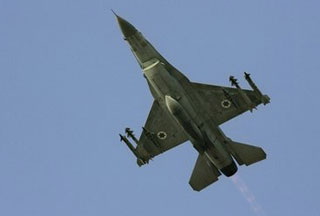 Palestinian medical sources in the Gaza Strip reported Wednesday morning that at least sixteen Gaza residents, mostly women and children, were wounded in a series of Israeli airstrikes over northern and southern Gaza.
The strikes targeted homes and several facilities, including the former headquarters of the Civil Defense at the Gaza International Airport in the southern Gazan city of Rafah.
At least four missiles were fired at the already destroyed Airport, local sources reported.
The Israeli Air Force also struck areas near the Egyptian border believed to contain underground tunnels.
Eyewitnesses reported that Israeli F-16 jets fired two missiles at a training base used by the Al Qassam Brigades, the armed wing of Hamas. The base is in Beit Hanoun, in the northern portion of the Gaza Strip.
The attacks damaged several homes and gave several residents, mainly children, panic attacks.
The Emergency Unit at the Military Medical Services in the Gaza Strip reported that fifteen residents suffered mild injuries in Beit Hanoun.
The Unit has condemned the shelling and says that it targeted civilian areas in direct violation of International Law.
Interview: ethnic cleansing inside the green line
Nora Barrows-Friedman, The Electronic Intifada, 25 May 2010
|
|
Israel denies Palestinians in “unrecognized villages” basic services like water and electricity. (Yotam Ronen/ActiveStills) |

Al-Masadiya, al-Garin, Khirbat al-Watan, Bir al-Hamam, Khashem Zana, Sawin, al-Shahabi, Wadi al-Naam and al-Mashash are all Palestinian Bedouin villages facing destruction by bulldozers and cement mixers as Israel’s transportation ministry plans to lengthen its Trans-Israel Highway southward into the Naqab (Negev) desert. This means that more than 3,000 Palestinian Bedouins could be displaced if an injunction filed by Israeli civil rights nongovernmental organizations (NGOs) doesn’t succeed in the high court.
Spokespeople for Bimkom (Planners for Planning Rights), the Association for Civil Rights in Israel and the Regional Council for Unrecognized Villages in the Negev, some of the groups filing the injunction, say that the Israeli government approved the highway construction without consideration for indigenous populations in the Naqab.
The Israeli daily Haaretz reports that the highway extension is part of the Israeli government’s plan for “development” of the Naqab, which also includes the construction of a massive Israeli military training facility at the Southern end.
More than 80,000 indigenous Bedouins live in the Naqab desert region, in dozens of so-called “unrecognized villages” — communities that the state has refused to acknowledge despite the fact that most of them have existed before the State of Israel was established. Moreover, Israeli politicians often refer to the areas as “empty” in order to create support for building new Jewish settlements, removing the indigenous populations in continuation of an ethnic cleansing project that is now more than 62 years old.
On a regular basis, Israeli bulldozers and squads of police invade Palestinian Bedouin villages, carrying out widespread home demolitions and leaving entire communities reduced to rubble. While such Israeli rights violations in the occupied West Bank including East Jerusalem have generated protest, it is less known that such policies are in place in Israel itself.
Rawia Abu Rabia, a social activist and human rights lawyer with the Association for Civil Rights in Israel, represents her community and advocates for their human and civil rights as the state continues to discriminate and uproot citizens across the country. Nora Barrows-Friedman interviewed Abu Rabia for KPFA’s Flashpoints Radio on 13 May.
Nora Barrows-Friedman: Rawia, can you talk about the current crisis facing the indigenous populations living inside the State of Israel? Explain what these so-called unrecognized villages are, and tell us about the level of institutionalized racism, discrimination and home demolitions right now.
Rawia Abu Rabia: First, we’re talking about the indigenous Bedouin community who are part of the Palestinian people. They are citizens of Israel, although they are not treated as equal citizens. Half of the Bedouin indigenous communities have existed before the establishment of the state, for many centuries, as agricultural workers. They were internally displaced by the State of Israel, starting from the Nakba in 1948, where they were transferred to a certain geographical area. They were restricted from moving from one place to another until 1966, as part of the military regime policy that Palestinian citizens of Israel were subjected to.
Then, the state decided to organize the Bedouins and established seven governmental townships that are among the poorest towns in Israel, forcibly moving the Bedouins into this tight geographical area known for its low agricultural fertility. The purpose was to have as many Bedouins as possible on minimum land. Their ancestral lands were given to new Jewish cities and other urban areas, while they were restricted from returning to their historical villages.
Then, the state started to make different laws in order to take over new areas of Bedouin land. In 1965, Israel’s implementation of the construction and building law, which designed the master plan for Israeli cities and villages, didn’t take into consideration any of the Bedouin villages. By doing that, the state used the law and the legal mechanisms to displace the Bedouins and make them illegal. That’s why today we have about 80,000 Bedouin Palestinian citizens of Israel who live in about 35 villages that the State of Israel refuses to recognize. What I mean by lack of recognition is that the villages don’t appear on official maps. They are denied basic services: running water, electricity, and garbage disposal. People aren’t allowed to build permanent houses, and those who do risk heavy fines and home demolitions.
In 2009, 254 houses were demolished in these villages. The State of Israel and state officials ignore their existence. They are invisible citizens in the eyes of the law. The other half of the Bedouins live in the seven townships that are among the poorest and underdeveloped towns of Israel. The rate of dropout from schools in these villages is almost 60 percent, the rate of unemployment is extremely high and the level of education is very poor … the Bedouins are not entitled to the same rights as the Jewish citizens.
The saddest thing is the institutionalized racism and discrimination that is written into the law. Especially laws related to the land issues — which are designed to criminalize the Bedouins and make them illegal.
NBF: What do the laws actually say; what is written in these laws?
RAR: First of all, the laws related to land issues are discriminatory. For example, since the establishment of the State of Israel in 1948 until today, hundreds of Jewish cities and agricultural settlements were established, while no Palestinian villages or cities were established except for the seven townships that I mentioned. Another example is the issue that this area in which the Bedouins are concentrated, is basically the only place that Bedouins can live. If a Bedouin wants to live in another place, he will face all sorts of discriminatory mechanisms, such as criteria to be accepted to live in certain towns in Israel.
I mentioned this construction and building law from 1965, the Master Plan, that didn’t include any of the Bedouin villages. So by the law, the Bedouin villages are illegal. Today, in many Palestinian villages in Israel, when people want to build homes or expand their villages, they don’t get permits from the planning authorities to do so. By doing that, they are deprived from the basic right of housing and the state doesn’t provide any alternative.
Even when the homes are demolished in the unrecognized villages, no compensation or alternative housing is provided by the state, even though, according to international law, such an alternative should be provided.
There are other laws, such as the citizenship law, [that are discriminatory]. If you are a Palestinian Israeli citizen and want to marry a Palestinian from the occupied territories or another Arab country, your spouse will not get [Israeli] citizenship. He is deprived; while if you are a Jewish Israeli, and you want to marry a foreigner from a country abroad, he can move into the process of citizenship. There is also the law of return, which is a law that says that anyone who has a mother who is Jewish can come to Israel and get Israeli citizenship, while Palestinians who were expelled in 1948 — refugees, as we all know — cannot return. They cannot get any rights, and their properties and land are declared as “absentee property” even when the people who own these lands are not absent — they’re still alive.
NBF: In April 2010, the Bedouin village of Twail abu Jarwal in the Naqab was demolished for the fortieth time in the last few years. Tell us about these kinds of actions by the Israeli government, and what happens to people during these home demolitions.
RAR: We’re talking about home demolitions — but the “homes” we’re talking about are very poor shacks and tents that are being destroyed. And these are young communities. About 70 percent of the Bedouin community is below 18 years old. These bulldozers come into these poor places, these shacks and tents, and demolish them. The purpose is meant to pressure the Bedouins into leaving their land, so the state can take control over their land.
There are other mechanisms used to take over land as well, such as the Jewish National Fund — which recently planted trees on the land of the al-Araqid tribe. These are other forms and mechanisms to take over more and more land, and to pressure people to leave their land. The Bedouins know this, and based on the bitter experience of the Palestinian people, they know that the only way that they can have a chance to keep their land is to physically stay on their land — sumoud (steadfastness). [Israel’s policies are] a very aggressive way to push people off their land without any consideration of international law, or of the declaration of the rights of indigenous people, et cetera. This actually pushes people to be hostile, and to lose any trust in the Israeli authorities; legal or otherwise. People become bitter when they see this discrimination alive, in front of them; when they see the bulldozers come and destroy their homes without any compensation or alternative, nothing.
NBF: Walk us through one of these Bedouin villages. Talk about the kinds of conditions that Bedouins are living in right now as they face home demolitions, and what kinds of services people are prevented from accessing as villagers in these communities.
RAR: Most of the unrecognized Bedouin villages lack health services and other services as well. If they want to access services in the nearest Jewish city or elsewhere, they first have to walk for miles to get to the main road. And then they have to find transportation, since there is no public transportation within these villages. The few services, the few clinics that we have in some of the villages, are results of petitions to the supreme court. None of the villages are connected to electricity at all. So when a bulldozer comes and destroys houses during the winter time — we’re talking about the desert, which is very cold at night — you can imagine that they will be left with no ways to find heating or other protection, other solutions.
NBF: We’ve been following the story of the Palestinian “unrecognized” village of Dhammash, outside of Lydd near the Ben Gurion Airport, 20 minutes from Tel Aviv. The people there are in and out of the high court, hoping to get another injunction to prevent the bulldozers from demolishing 13 homes there. Can you talk about what’s happening to communities like this, which are inside more urban areas around the state, Palestinians who are forced into displacement as the Jewish communities grow and expand?
RAR: I think that the issue of the Bedouins is not disconnected from the issues of other Palestinian communities living inside Israel. This is part of the daily situation we all face as Palestinian Israeli citizens who are treated as second-class citizens or worse. The land is the main resource that has been denied to the Palestinians.
For instance, in Jaffa, which a mixed city of Jews and Palestinians, we see how Jaffa is developing for the Jewish citizens while the Palestinian citizens are kicked out of their neighborhoods. This is the issue of the Naqab with the Bedouins, it’s the issue of the mixed towns of Jaffa or Lydd, and it’s also the issue in the Galilee, where there are many home demolition orders as well. This is the same cause. This is the feeling of the Palestinian citizens of Israel — we were displaced in 1948, and in 1967, and the process of internal displacement is still happening all the time. Especially now, with the right-wing government that is following these racist policies and pushing Palestinian Israeli citizens more and more out of their villages, and are being delegitimized as a people.
I think this is what links the whole cause. It’s the cause of being Palestinian, and being a Palestinian Israeli citizen who is being treated in an unequal way.
NBF: You met the Special Rapporteur for Indigenous People at the United Nations in New York recently, tell us what went on in the meeting and what the UN is doing to address the critical needs for the Palestinian and Bedouin communities inside Israel.
RAR: Yes, I had a meeting with the Special Rapporteur, Professor James Anaya, and I explained to him the situation of the Bedouins in the Naqab and the internal displacement, the home demolitions, and the decision of the Israeli government to triple the home demolition orders for Bedouin villages, and he’s very much concerned with the situation of the Palestinian Bedouins in the Naqab. He mentioned that he will follow up with the situation. I urged him to come and visit these villages and see for himself. I could sit there and describe this to him, but the best thing is if he could come and see the demolitions that are taking place, the actions that are taking place to push people away from their land and houses. I hope he accepts the invitation and comes and visit. But he said that in the meantime, he said he will follow up the issues that I have raised with the Israeli government.
NBF: Talk about your work as a lawyer for these communities. What is it like representing their concerns as the state pretty much goes ahead and continues to de-populate, displace and discriminate on a daily basis?
RAR: As a lawyer for human rights, working at the Association for Civil Rights, I face challenges all the time. On the one hand, I face discrimination as a Bedouin citizen of Israel — when I came back from the UN on El-Al airlines, I faced a huge humiliation because I’m an Arab. But on the other hand, the only effective tool that I can use to advocate for my people is the legal tool. It’s a challenge all the time, because you have to be optimistic. My biggest dilemma is, how can I advocate for equality within a discriminatory reality? This is a big challenge — because sometimes, the supreme court makes good decisions, but sometimes, because of some discriminatory laws, it could make a decision that is not the best for my people … And I believe in the international mechanisms as well, that we have to use these to put pressure on Israel to change its policies towards the Bedouins.
People, sometimes, are very frustrated with the situation, especially when they see that the legal system is not equal … people think that the legal system is supposed to provide answers, but not in all cases. That’s the situation. We have to promote equality in an unequal reality. We don’t have any other options — we have to continue in this way.
NBF: Israeli politicians regularly describe the state as a moral democracy for all of its citizens, but it’s clear that it’s a democracy only for a preferred ethnicity, or a preferred religion. What can you say about what democracy looks like in historic Palestine today, and what’s your response to how Israeli leaders represent their policies?
RAR: Like Member of Knesset Ahmad Tibi said, “Israel is a democratic state for the Jews, and a Jewish state for the Arabs.” This describes the situation … And others, like professor Oren Yiftachel, who said that it’s actually an ethnocracy, it’s not democracy. We could argue whether it is a democratic and Jewish state or not. Israel doesn’t have a constitution. It doesn’t have a separation between religion and the state. It has problematic issues related to violations of women’s rights because of a lack of separation between religious laws and the state. So, it’s a very problematic democracy. And we are also witnessing harassment of human rights activists and organizations that are the last refuge for a democracy. They are the only voices that talk about human rights violations that are taking place in the so-called democratic state.
NBF: You’re referring to your colleague, Ameer Makhoul of Ittijah – Union of Arab Community-Based Associations and others in the last few weeks who have been detained, prevented from leaving the country. And Makhoul’s story was under gag order in the Israeli media. What more can you say about this crackdown on Palestinian civil rights activists and organizations, who are trying to represent the interests of the indigenous populations there?
RAR: I think the gag orders are problematic and they’re happening more often. It’s very concerning, as Israel wants to see itself as a democracy. A democratic state is not supposed to let things happen in the dark. We’re very much concerned with these gag orders being issued easily. Actually, Adalah [the Legal Center for Arab Minority Rights in Israel] and the Association for Civil Rights are asking the courts to remove these gag orders. And people know about these cases already. It’s a globalized world; people are reading about what’s happening on the Internet, they hear about it anyway, so [the gag orders] are kind of absurd.
But I think this is also part of the steps that are being taken against Palestinian leaders in order to silence them as they advocate for their cause. We’re doing our work according to the legal system, and this is a way to silence these voices.
Nora Barrows-Friedman is the co-host and Senior Producer of Flashpoints, a daily investigative newsmagazine on Pacifica Radio. She is also a correspondent for Inter Press Service. She regularly reports from Palestine, where she also runs media workshops for youth in the Dheisheh refugee camp in the occupied West Bank.
Featured Video

The American Retreat from Vietnam
or go to
Aletho News Archives – Video-Images
From the Archives
Secret document reveals plans for civil war in Lebanon, Israeli false flags, and invasion
By Randi Nord | Geopolitics Alert | April 5, 2019
Beirut – During his visit with US Secretary of State, Mike Pompeo, Lebanese President Michael Aoun reportedly received a US-Israeli document detailing plans for creating a civil war in Lebanon with covert false flag operations and possible Israeli invasion.
Although the source of the document is Israeli and created in partnership with Washington, no one knows who presented it to Aoun. The Lebanese TV station, Al-Jadeed, initially reported the document on Lebanese TV and a video on its website. Geopolitics Alert translated the report for this article. … continue
Blog Roll
 Aletho News
- There’s a drought in academia: A drought in honest research on the subject of drought and other weather extremes
- Department of War Awards $20.7 Billion Contract to Raytheon for Air-to-Air Missiles
- ‘Distance yourselves from Israel’: IRGC urges US population to question govt policies
- America’s Greenland deal has a radioactive backstory
- The RAF Fairford ‘terror plot’: Unpacking escalation in the UK echo-chamber
- EU Council Advances Chat Control 2.0 Scanning Proposal
- Ex-Greek MEP files complaint against Israeli spyware firm over alleged Pegasus surveillance
- Troubling ideas throughout the Torah, Talmud, Mishneh Torah and Tanya
- ‘Grave, alarming’: Iran mission on Trump’s UNGA ‘annihilation’ threats
- Najaf airport to reopen to Iranian flights within 24 hours: Ambassador
- If Americans Knew
- New Report: “Scholasticide and Genocide in Gaza: Assessment, Testimonies and Legal Analysis”
- Ex-Biden officials are desperate for a Gaza scapegoat
- Israeli “settlers” Invade Al-Aqsa; Pour Boiling Water on 75-Year-Old
- Israel Has Kidnapped Another American Teenager
- US arms sales to Israel worth $21.6 billion in 20 months
- Three Palestinians Killed in Israeli Attacks on Gaza
- Revealed: German “Anti-Semitism Expert” Driving Crackdown on Palestine Solidarity is Former Israeli Spy
- Egypt’s Warning to Israel Before Oct 7
- Israel’s siege signals another cruel winter for 1.8 million Gazans – Daily Update
- Netanyahu Asked UAE Leader to Deny Report on Oct. 7 Warning in Secret Visit, Sources Say
- No Tricks Zone
- New Study: Earth And Venus Surface Warmth Largely Explained By Convection And Lapse Rate, Not CO2 Or Radiation
- 2025 Nature Paper Claiming Worsening Global Drought Gets RETRACTED …Heavily Flawed
- New Study: ‘Global Drought Shows No Detectable Recent Acceleration Under Climate Warming’
- Economic Masterminds: German Socialists Suggest Taxing Productivity Gains Stemming From Using AI
- The South China Sea Has Not Been Cooperating With The Climate Change Narrative
- Energy Crisis: Germany Enters Heating Season With Historically Low Gas Reserve Fill Levels
- New Study: The Antarctic Ice Sheet Gained Mass From 2020-2024 Due To Staggering Snow And Ice Accumulation
- Study: Ocean Heating Rates From Thousands Of Years Ago ‘Dwarf’ Modern Ocean Heating Rates
- Climate Extremists Target, Attack Large-Scale Power Grid Infrastructure In Germany!
- New Study: Antarctic Ice Melt Has Contributed Less Than 1 Centimeter To Sea Level Rise In The Last 30 Years

