Blinding the witnesses
By Naomi Klein on June 4, 2010
There is something way too literal about Israel shooting out the eye of a witness to its crimes.
This photograph of Emily Henochowicz’s bandaged face needs to be seen by the world.

Like many of us around the world, Henochowicz, a 21-year-old Cooper Union art student, joined protests on Monday against Israel’s outrageous attack on the humanitarian flotilla. But unfortunately, the protest Emily attended was in the Israeli-occupied West Bank, and like so many protests in the West Bank, it was violently attacked by the IDF. According to a report from the International Solidarity Movement, Emily was “hit in the face with a tear gas projectile fired directly at her by an Israeli soldier during the demonstration at Qalandiya checkpoint today.” Sören Johanssen, a Swedish activist standing beside Henochowicz, reported that, “They fired many canisters at us in rapid succession. One landed on either side of Emily, then the third one hit her in the face.”
This courageous young woman is now the wrenching embodiment of a policy that systematically targets witnesses and human rights advocates — from Stop the Wall’s Mohammad Othman, arrested on his way back from a European speaking tour, to the vicious smear campaign waged against Justice Richard Goldstone.
When Did Resistance Become a Dirty Word?
By Robin Yassin-Kassab | Pulse Media | June 6, 2010
What the Western political class and its media demand of the Arabs and Muslims is acceptance of the unacceptable status quo in Israel-Palestine. To resist the status quo is to be troublesome, destabilising and irrationally violent. Resistance arises from the inadequacies of a culture and religion given to antisemitism and hysteria. In order to develop, these backward folk must give resistance up.
For the Lebanese, this means that they must forget the brutal 22-year occupation of their country and the 1982 siege of Beirut as well as the 2006 assault on the country’s civilian infrastructure. They must forget the endless chain of massacres perpetrated by Zionists and their allies on Lebanese territory. They must smile when Israel violates their air space on a daily basis and threatens to send them “back to the stone age” on a weekly basis. They must disarm and label as terrorist Hizbullah, the principled defender of their country.
Syria must smile at the illegal occupation and annexation of the Golan Heights and the theft of its essential water supplies. It must repress the refugees from the Golan and the half million Palestinian refugees and their political organisations. It must not buy or build weaponry that might give it minimum protection from Zionist terrorism. It must grin stupidly when Israel chooses to bomb its territory.
The Palestinians must be modern and democratic. They must do this by fighting the winner of democratic elections and by supporting an unelected and corrupt bunch of collaborators.
As for Western sympathisers with the Palestinian cause, they must preface their criticisms of Israel with such statements as “Of course, Israel has a right to exist in security,” or “Of course we don’t support Hamas,” or, in the case of the passengers on the Rachel Corrie (whose courage and commitment I salute), “We will not resist.”
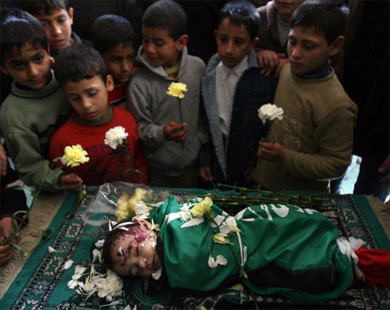
Learning Not to Resist
It’s time we stopped playing this game. To recognise Israel’s ‘right’ to exist in security is to deny Palestine’s right to exist in security. No state which occupies other states’ territories has a right to security. Did Hitler’s Germany have a right to security once it had invaded Czechoslovakia and Poland? And apartheid states don’t have a right to exist at all. There’s nothing anti-Semitic about this, just as there was nothing anti-white or anti-Afrikaaner in arguing that apartheid South Africa didn’t have a right to exist. A state established by massive ethnic cleansing and perpetuated by occupation and repeated massacres is not a normal state like any other. Israel will earn its right to exist when it allows the refugees to return home and when Jews, Muslims and Christians enjoy equal rights.
What are the arguments used to demonise (rather than critically engage with) Hamas?
Firstly, Hamas doesn’t recognise Israel. True, Hamas believes that Arafat made a major strategic blunder by officially recognising Israel before Israel allowed the Palestinians minimal rights. In this Hamas is only being logical. Hamas certainly knows that Israel exists, and even if Hamas drank enough whisky to forget Israel’s existence (which isn’t likely) Israel would still be there, with its Merkava tanks, its checkpoints and its nuclear bombs. Hamas has repeatedly said that it will stop fighting if Israel leaves the territories in 1967. It still won’t recognise Israel as a Jewish state on 78% of Palestine, because this would be to recognise the ‘justice’ of the theft of Palestine in order to build an ethno-state. In any case, Israel doesn’t recognise Palestine. Its failure to recognise Palestine has immediate and practical ramifications, like the occupation and the ethnic cleansing.
Secondly, Hamas doesn’t recognise the two-state solution. But again, neither does Israel, whatever its propagandists say. If Israel supported two states, it wouldn’t have spent the last decades, under Labour and Likud, building settlements on the West Bank and in Jerusalem. And Israel is the occupier.
Thirdly, Hamas has attacked civilians. This is surely the most hypocritical of reasons for isolating the movement. Since September 2000, Palestinians have killed 1072 Israelis. In the same period, Israelis have killed 6348 Palestinians (not including those who died as an indirect result of the occupation, for instance critically ill people who died in ambulances held up for hours at checkpoints). So Israel is far more guilty of killing civilians. And I would say that the violence of the occupied struggling to liberate themselves is more justifiable than the oppressive violence of the occupier. The people who cry over the fate of Sderot should consider not only the far, far worse fate of Gaza and the West Bank, but also the fact that the inhabitants of the bombed and starved refugee camps in Gaza come from the destroyed villages on which Sderot is built. If your home is stolen and neither the law nor the conscience of the thieves will give you restitution, you are entitled to fight the thieves. Hamas also holds one prisoner of war – not a civilian but a stormtrooper of the occupation. It is grotesque that the world knows the name of this captured terrorist but not the existence of at least 10,000 Palestinian prisoners in the Zionist gulag, many of them children.
Even if we could establish that the Palestinian side has been more violent than the Israeli side – which we can’t – Hamas, unlike Israel, has shown itself capable of sustaining ceasefires. And anyway, many of the Israeli victims have been killed by the al-Aqsa Martyrs Brigade, which is linked to Fatah.
A Good Arab – Not Resisting
Fourthly, Hamas aims to establish an Islamic state. True, in theory. But it knows that it was elected for its resistance agenda and its freedom from corruption, not for Islamic reasons. There are signs that Hamas has recently tried to impose some of its moral code on the people of Gaza – and I oppose this – but given the circumstances, it’s been a gentle Islamism. It is in fact a bulwark against the more offensive Salafi nihilist groups which are now appearing among Palestinians in their desperation. And of course Israel is not a state for its citizens, still less for the people under its control, but a Jewish state. The fact that some of its people define Jewishness ethnically rather than religiously does not change this fact.
My main quibble with Hamas is its constitution’s reference to the Protocols of the Elders of Zion, an antisemitic Russian text discredited by anti-Zionists such as Abdelwahhab el-Messiri. (I’m not as outraged as I am by European anti-Semitism – if anyone can be excused for generalising about Jews, it’s the victims of the self-proclaimed Jewish state). Hamas leaders frequently say they do not oppose Jews for being Jews, but Zionists for being Zionists. If this is the case, I wish they’d remove the Protocols reference. So Hamas is not perfect, but neither was the Communist Party, which dominated resistance to Nazi occupation in Europe. Had I been around, I would have supported the anti-Nazi resistance as I support Hamas – critically but unconditionally.
As for the brave passengers on the MV Rachel Corrie, I wish they had not said, “we will not resist.” I wish they had said, “We are unarmed and we have no desire to come to blows with Israeli soldiers. However, if we are hijacked by armed men in international waters or near the shore of Gaza – over which we do not recognise Israeli jurisdiction – we will resist as best we are able.” Unwittingly, the activists handed Israel ammunition for its propaganda – ‘when civilised, peaceful activists arrive we deal with them peacefully. When mad Islamist Turks attack us with sticks when we board their ship, we have no choice but to shoot them many times at close range in the back of the head.’
The passengers on the Mavi Marmara should be congratulated for resisting piracy and the illegal, barbaric siege. We should never be ashamed of resistance – in occupied Europe, in South Africa, in Iraq, in Vietnam, in Palestine, in Lebanon, or on the Mediterranean sea. Resistance is beautiful. Resistance proves the existence of the human spirit amid a vast sea of inhumanity.
Eyewitnesses, both activists and reporters, contradict Israeli account
By Steve Hynd | June 4, 2010
As Israel releases detained activists and journalists after the assault on the Gaza relief flotilla, they are beginning to tell their version of events. The story has so far been dominated by Israeli offical releases and “hasbara” so it’s important that the voices of these witnesses are heard by the international community. So far, though, these eyewitness accounts aren’t penetrating the U.S. media. If they did, more Americans would doubtless agree with the New York Times editorial calling for a “impartial international investigation” – not a self-serving one run by Israel.
Most importantly, every witness who has so far spoken out contradicts the Israeli account of some kind of self-defense, saying that the Israelis first attacked in boats and that they had already opened fire on the flotilla before commandos began descending from helicopters. They also agree that several people were shot from behind or above, that the Israeli attackers didn’t immediately allow treatment of convoy wounded and that weapons ripped from the hands of commandos were stripped of their ammunition and thrown overboard.
Perhaps the best eyewitness account to begin with is that of Paul McGeough, twice named Australia’s journalist of the year. He writes:
The Israeli attack was timed for dawn prayers – when a good number of the men aboard the Mavi Marmara were praying on the aft deck of the big Turkish passenger ferry, as it motored steadily through international waters in the eastern Mediterranean Sea.
…Suddenly sound bombs and tear gas were exploding on the main aft deck, where prayers were held five times a day. The life-jacketed passengers on the rails at first seemed oblivious as those behind them donned the few gas masks that were on board and others, wearing asbestos gloves, sought to grab the devices and hurl them back at the Israeli commandos before they exploded.
In failing to get their grappling irons to hold on the rails of the five-deck ferry, the commandos in their Zodiac-style assault craft continued to be an irritant, or perhaps a decoy because at this point the Israelis opted for a critical change of plan – if they could not come up from the water, they would have to drop from the sky.
On hearing the machines, activists on the upper decks rushed to the top level of the ship – grabbing the commandos even before they landed, disarming them; beating them until, according to some who were present, leaders demanded the Israelis not be harmed; but in one case, one of the Israelis was hurled from one deck of the ship to the next.
…There were conflicting accounts of the first commando landing – some activists said he was injured and was being carried inside the ship for treatment by the flotilla doctors. However, a Serbian cameraman, Srojan Stojiljkovic, said some of the activists had armed themselves with lengths of chain and metal posts that had served as cordons around the ship’s lifeboats.
“Some of the people caught the first commando before he touched the deck – a few started to hit him, but a lot of people moved in to shelter him with their bodies,” the cameraman said. “Another soldier with a bleeding nose was brought in … a few people threw punches, but not as many as I would have expected.”
Matthias Gardel, a leader of the Swedish Palestinian support group, confirmed the soldiers had been beaten, but insisted those involved were unarmed and in keeping with the ship’s non-violent charter, the soldiers’ weapons were thrown overboard.
McGeough also notes that at least two people were shot from behind while treating wounded, another was shot from above.
The Turkish actor Sinan Albayrak said he had witnessed one of the most senior of the Turkish activists ordering passengers to cease beating two of the Israeli soldiers. Later, he saw a Turkish photographer who had been shot in the back of the head; while he and others had been attempting to assist another injured activist, “Israeli troops had opened fire on them . . . we ran away from the injured man”.
The dead include a Turkish journalist, Chetin Genghis, whose head wounds suggested he had been shot from above – possibly from one of the helicopters. After witnessing his dying moments, his colleague Hisham Goruney said:”I want to forget – I still don’t believe that I saw it.”
Another of the dead was said to be an Indonesian cameraman, Sura Fachrizaz, shot in the chest. Also among the dead was a Malaysian doctor who, activists said, was shot while treating the wounded.
All of these elements are confirmed by other witness accounts. Canadian Farooq Burney, mentioned byJohn earlier, is head of an organisation that was bringing a consignment of laptops into Gaza to help educate children there.
Speaking from Istanbul, where he arrived after being released from Israeli detention, Burney said the Israeli military began firing objects at the ship before the boarding party landed.
“There were a lot of gunshot noises that could clearly be heard. Whether they were rubber bullets, whether they were live ammo, there was a lot of gunfire coming from the helicopter, coming from the boats (alongside the Mavi Marmara.)”
Burnley also recounted seeing his first casualty.
Canadian Farooq Burney (37) described how an elderly activist died after being shot in the chest. “We couldn’t see where he was hit so we opened up his lifejacket and we could clearly see that he was hit in the chest, he was losing a lot of blood,” Mr Burney said.
“It was on. . . the right, just close to his chest and there was blood coming out from there. He passed away,” he added.
Mr Burney also said activists who snatched pistols from the commandos removed the bullets and threw them into the sea, contradicting Israeli assertions that the weapons were used against the boarding party.
Gulf News reporter Abbas Al Lawati wrote for his own paper:
As I saw angry activists drag one of the Israeli soldiers down the stairs and punch him, I lost my journalistic objectivity and found myself urging the activist to stop hitting the soldier.
Seeing the anger in the activist’s eyes, I thought that he would kill him. I had images of the wars that Israel has waged over its captive soldiers, and the number of people that have died as a result of them. My thought was that if an Israeli soldier was to die on that ship, the entire flotilla would be bombed until it sank.
That was, of course, before I saw the bloodshed. The activists’ anger was suddenly put in context when I saw a number of people carrying a dying man down the stairs. His face was unrecognisable, covered in blood. He was apparently one of the first to go down, after an Israeli gun targeted the centre of his forehead from a helicopter, spilling his brains into the hands of another activist who was trying to look after him.
Lawati also describes meeting one of the Israeli commandos disarmed by the ship’s passengers.
I took a few steps down to film the other captive soldier, struggling to keep my balance with so much blood under my feet. He stood in a corner being attended by two medics onboard, in shock, crying.
It was surreal. I knew that that soldier could destroy the entire flotilla, and thought I would get some close up footage of him. I took my camera as close as possible to his face and asked his name twice. He was too traumatised to answer. I could see fear of death in his eyes. He was petrified. Then I heard women screaming. “They are coming!”
New Zealand activist Nicola Enchmarch spoke to the NZ Herald:
She said she saw an activist shot on the deck after the forces stormed the ship, part of a flotilla attempting to breach a blockade to deliver aid to Gaza.
“He was shot in the head – probably live ammunition because the back of his head, the injury was severe,” she told the BBC.
“He died there and we had to move because it was just getting crazy, there was a lot of gunfire coming from all directions.”
Her group moved down from the deck to shelter inside and escape the danger. On the way she saw a man shot in the back, who survived.
She said the activists were acting defensively while the Israeli forces were menacing and aggressive. They set off sound bombs and released what was possibly tear gas.
While Irishman Dr. Fintan Lane spoke of his experience on one of the flotilla’s smaller boats.
Dr Lane said he was assaulted: “When they boarded our boat, we resisted entirely peacefully. I sat on the floor and tried to reason with them, but the Israeli commandos physically attacked us,” he said.
“Fiachra [Ó Luain, from Boston USA] was dragged around the ground and I had a gun pointed in my face by a screaming commando. His mania was so intense that I genuinely feared for my life.”
Haneen Zuabi, a Palestinian member of the Israeli Knesset who has recieved death threats for her participation in the relief convoy, told reporters:
“Israel wanted many deaths to terrorise us and to send a message that no future aid convoys should try to break the siege of Gaza,” she told journalists this week.
Zuabi said that naval boats surrounded the Mavi Marmara and fired on it before soldiers abseiled aboard from a helicopter. She went below to the ship’s hold and said that, within minutes, two dead passengers were brought inside, followed by two more who had been seriously wounded.
soldiers refused her requests for medical assistance for the injured passengers, who died shortly after.
Zuabi – known in Israel as an articulate Hebrew speaker – said that soldiers specifically asked her to translatetheir instructions. At first, she refused. “I shouted back, ‘Why didn’t you ask for my help before you murdered these people?'”
Al Jazeera journalist Jamal ElShayyal taped his account for his own station. Juan Cole writes:
he asserted that the Israelis opened fire as they were boarding the vessel, and that one passenger took a bullet through the top of his head. Many passengers have now confirmed that they were fired on even before the commandos had boots on the deck. Presumably it is this suppressive fire that killed or wounded some passengers and which provoked an angry reaction and an attack on the commandos.
You can watch ElShayyal’s whole account here.
Robert Mackay excerpts some of his testimony for the NYT’s The Lede blog:
It was evident there was definitely fire from the air, because one of the people who was killed was clearly shot from above — he was shot, the bullet targeted him at the top of his head. There was also fire coming from the sea as well. Most of the fire initially from the sea was tear gas canisters, sound grenades, but then it became live fire. After I finished filing that last report and I was going down below deck one of the passengers who was on the side of the deck holding a water hose — trying to hose off, if you will, the advancing Israeli navy — was shot in his arm by soldiers in the boats below. […]
There is no doubt from what I saw that live ammunition was fired before any Israeli soldier was on deck. What I saw, the sequence of events that took place, there was a pool camera, so reporters took it in turns to file, so after I had done my first file, I turned around to see what was going on and there were several shots fired. In fact, one of the helicopters at the front of the ship, you could almost see the soldiers pointing their guns down through some sort of hole or compartment at the bottom side of the helicopter and firing almost indiscriminately without even looking where they were firing. And those bullets were definitely live bullets.
And apparently the violence didn’t stop after the Israelis had taken control. Irish-American peace campaigner Ken O’Keefe, a former US Marine, says he’s been beaten up twice while in Israeli custody. The second beating was so severe that he is still in an Israeli hospital and is now on hunger strike.
There’s a remarkable consistency among eyewitness accounts that Israel supporters will doubtless put down to complicity and others will ascribe to telling the truth. What’s certain is that these accounts are so very different from the official Israeli line that we have to question Israel’s credibility as an honest reporter of events as much as we question the eyewitnesses – perhaps even more so, since many of these witnesses are reporters with reputations for impartial accuracy rather than activists or soldiers following orders.
Robert Mackay writes:
The way these accounts diverge from that of Israel’s military would seem to make an independent investigation into the events crucial. That is particularly true since, as The Lede noted on Wednesday, Israel is apparently in possession of much more video evidence than it has yet released.
In a post making the case that Israel should not conduct that inquiry, Noam Sheizaf, an Israeli journalist and blogger, pointed out that journalists in the flotilla seem to have left Israeli custody without any of the video they shot during the raid that might bolster their accounts.
Israel has confiscated some of the most important material for the investigation, namely the films, audio and photos taken by the passengers [and] journalists on board and the Mavi Marmara’s security cameras. Since yesterday, Israel has been editing these films and using them for its own PR campaign. In other words, Israel has already confiscated most of the evidence, held it from the world and tampered with it. No court in the world would [trust] it to be the one examining it.
The Obama administration and pro-Israel members of Congress are busy saying that Israel is competent and can be trusted to investigate its own actions. Everything we’re hearing from those released says that simply isn’t the case.
Update: The Palestinian Monitor spoke to Italian activist Manolo Luppichini, who told them he was beaten in custody by his israeli captors because “I asked to call my family and my embassy”. Luppichini also says he spoke to Australian Jennie Campbell, one of the nurses present on the Mavi Marama. She told him that she had seen and counted 19 bodies, not the 9 being reported by the media.
Also, check out Gaza Flotilla Survivors, which is aggregating accounts by eyewitnesses.
Update 2: British journalist Hassan Ghani told BBC Radio Scotland:
“They began by throwing stun grenades on to the deck of the ship when people were in the middle of morning prayers.
“Then they began using rubber bullets, they tried to come aboard the ship from the side. People repelled the commandos with water cannons they had set up on the side of the ship.
“Then the Israelis used helicopters to drop people onto roof and there was scuffles on the roof.
“The Israeli solders had already opened fire on the ship, so people were grabbing anything they could to stop the attack in international waters.”
Eyewitness reports are very consistent and at odds with the Israeli official line.
UN rights chief says Gaza siege ‘illegal’
Press TV – June 5, 2010
The UN High Commissioner for Human Rights says the Israeli imposed blockade of the Gaza Strip is “illegal and must be lifted.”
The United Nations official, Navi Pillay said on Saturday that “International humanitarian law prohibits starvation of civilians as a method of warfare and … it is also prohibited to impose collective punishment on civilians.”
“I have consistently reported to member states that the blockade is illegal and must be lifted,” she added.
The comments came as Tel Aviv’s siege of the Gaza Strip is about to enter its third year. The Gaza siege has deprived the Palestinians of food, fuel and other necessities.
Pillay also repeated a call for a probe into Israel’s deadly attack on the multinational relief convoy, the Freedom Flotilla, which had set sail to challenge the siege.
The Monday attack in international waters 150 km (90 miles) off the coast of Gaza killed several activists and left scores more injured.
Also on Saturday, the Israeli military seized the Rachel Corrie, the aid ship which neared Gaza five days after the bloodshed.
Settler under house arrest after shooting teens
Ma’an – June 4, 2010
Bethlehem/Hebron – An Israeli settler reportedly turned himself in, telling police he fired shots into the air near Hebron’s Aroub refugee camp on Thursday; shots that hit two high school boys witnesses said.
The office of Prim Minister Salam Fayyad released witness testimonies on Friday morning, naming citizens who said they saw the unidentified settler shoot at a group of highschoolers returning home after completing an end-of year exam.
Moataz Moussa Omran Banat, 16, was seriously injured in the abdomen and thigh, and Ibrahim Mohammed, also 16, was shot in the chest.
An Israeli police spokesman told Ma’an that an Israeli man turned himself into police on Thursday evening, saying he gave an account of what happened at the police station and was questioned by officers.
The man, who remains unidentified, told police that he shot his weapon into the air. The spokesman said he was put under house arrest as the investigation continues.
Medics at the Al-Ahali Hospital told Ma’an that Moataz remains in the ICU but has been stabilized, and Ibrahim is set to have a second surgery on Friday, and has remained in stable condition since admission to the facility.
According to the prime minister’s office, witnesses said the settler shot randomly at school students. Shop worker Nidal Mawi, said a man driving a white Citreon car with yellow plates ” stopped in the middle of the street and one of the two settlers in the car stepped out and started shooting at the students.”
A second witness, identified as Jameel Jawabra, said that the “students were left bleeding in the street until a local resident took them to the hospital in his car.” The man who brought the two to hospital was identified as Ashraf Abu Shama’a, a resident of Aroub.
Abu Shama’a told both Palestinian and Israeli investigators that the “settler was only 10-15 meters away from the boys when he shot at them,” and said that the man walked some 50 meters into the camp after he exited the car, shot at the teens, got back into his vehicle and drove away.
What if it Were Your Child?
By Joharah Baker for MIFTAH | June 02, 2010

Almost every subject can be argued two ways, especially when the subject at hand is as controversial as the Palestinian-Israeli conflict. No matter how unjust the Israeli siege on the Gaza Strip is, there will always be those biased souls that justify it with the “Hamas terrorists” argument and the hackneyed Israeli pretext of state security. However, one subject, which cannot possibly have a flip side to it, is the torture of children. Only a deranged and perverted mind could justify that. Oh, and of course, Israel’s security establishment.
On May 18, Defense for Children International released a press statement in which it said it had filed a complaint with the UN Special Rapporteur on Torture in which it documented the cases of 14 Palestinian children who were either sexually assaulted or threatened with sexual assault by Israeli interrogators, soldiers or police last year. Throughout 2009, DCI’s Palestine chapter reviewed over 100 affidavits from Palestinian minors between the ages of 12 to 16 who gave sworn testimonies of their torture and sexual assault at the hands of Israeli soldiers or interrogators.
To read some of these affidavits is shocking. Israeli interrogators bind boys as young as 13 to chairs, sometimes handcuffed, and squeeze their testicles until the child admits to throwing stones. In other sworn affidavits, all of which were taken immediately after the boys were released, the minors recount how Israeli soldiers or interrogators slap them, kick them, call their mothers whores and threaten to rape them. “He started beating me all over my body and once again he grabbed my testicles and started pressing hard. ‘I won’t let go of your testicles unless you confess,’ he said to me. I felt so much pain and kept shouting. I had no other choice but to confess to throwing stones,” said one 15-year old boy in his testimony to DCI.
It is common knowledge that confessions under torture are inadmissible in court, even for adults. The violations of children’s rights in these cases are off the charts, obviously. For one, the arrest of a child is only to be used as a “last resort”. Israel arrests 700 children on average every year from the West Bank. Furthermore, the Fourth Geneva Convention stipulates that each and every person is entitled to a fair trial, something Palestinians in general, children included do not have. Most important though, is this:
Article 2(2) of the UN Convention Against Torture states:
“No exceptional circumstances whatsoever, whether a state of war or a threat of war, internal political instability or any other public emergency, may be invoked as a justification of torture.”
Under no law, except maybe the law of the jungle, is it justifiable to use torture, especially on a child. Israeli forces not only drag children out of their beds in the middle of the night and handcuff and blindfold them in front of their families, they are exposed to terrible conditions once inside the detention center. Children are deprived of sleep, are made to stay in one position for hours, are not allowed sufficient food or water and are intimidated constantly by their interrogators and prison wardens.
The testimonies of sexual abuse however, are the most disturbing. How can such vile acts be going on under the nose of the civilized world? This is Israel, a country that claims it is democratic, that it respects international law and human rights and is constantly extending its hand in peace. This is Israel, a country that prides itself on its judicial system, mocks the primitive systems of neighboring Arab countries and insists that all it does is in the name of its security.
This is when their argument falls through. In the overwhelming majority of cases where children are arrested, either from their homes or from the street, children are charged with throwing stones. Logically, even if a 12-year old had thrown stones at an Israeli army jeep, which is fully armored and bullet-proofed, how could this possibly constitute a threat to the soldiers’ lives? And even if that child had thrown stones at an occupation soldier (a right he is entitled to by the way), torturing him and abusing him sexually cannot be justified even by the staunchest of Israel supporters. These are blatant violations of human rights and international law for which Israel should be held accountable… Full article
The day the world became Gaza
By Ali Abunimah | Al-Jazeera | June 3, 2010

Since Israel’s invasion and massacre of over 1,400 people in Gaza 18 months ago, dubbed Operation Cast Lead, global civil society movements have stepped up their campaigns for justice and solidarity with Palestinians.
Governments, by contrast, carried on with business as usual, maintaining a complicit silence.
Israel’s lethal attack on the Freedom Flotilla to Gaza may change that, spurring governments to follow the lead of their people and take unprecedented action to check Israel’s growing lawlessness.
Lip service
One of the bitterest images from Operation Cast Lead was that of smiling European Union heads of government visiting Jerusalem and patting Ehud Olmert, the then Israeli prime minister, on the back as white phosphorus still seared the flesh of Palestinian children a few miles away.
Western countries sometimes expressed mild dismay at Israel’s “excessive” use of force, but still justified the Gaza massacre as “self-defence” – even though Israel could easily have stopped rocket fire from Gaza, if that was its goal, by returning to the negotiated June 2008 ceasefire it egregiously violated the following November.
When the UN-commissioned Goldstone Report documented the extensive evidence of Israeli war crimes and crimes against humanity, including the willful killings of unarmed civilians, few governments paid more than lip service to seeing justice done.
Even worse, after Cast Lead, EU countries and the US sent their navies to help Israel enforce a blockade on Gaza which amounts to collective punishment of the entire population and thus violates the Fourth Geneva Convention governing Israel’s ongoing occupation.
Not one country sent a hospital ship to help treat or evacuate the thousands of wounded, many with horrific injuries that overwhelmed Gaza’s hospitals.
Carrot and stick
The blockade has never been – as Israel and its apologists claim – to stop the smuggling of weapons into Gaza.
Its goal has always been political: to cause the civilian population as much suffering as possible – while still politically excusable – in order for the Palestinians in Gaza to reject and rise up against the Hamas leadership elected in January 2006.
The withholding of food, medicine, schoolbooks, building supplies, among thousands of other items, as well as the right to enter and leave Gaza for any purpose became a weapon to terrorise the civilian population.
At the same time, Western aid was showered on the occupied West Bank – whose ordinary people are still only barely better off than in Gaza – in a “carrot and stick” policy calculated to shift support away from Hamas and toward the Western-backed, unelected Palestinian Authority leadership affiliated with the rival Fatah faction, who have repeatedly demonstrated their unconditional willingness to collaborate with Israel no matter what it does to their people.
“The idea is to put the Palestinians on a diet, but not to make them die of hunger,” senior Israeli government advisor Dov Weisglass notoriously explained in 2006. By this standard the blockade – supported by several Arab governments and the Quartet (the US, EU, UN secretary-general, and Russia) has been a great success, as numerous studies document alarming increases in child malnutrition as the vast majority of Gaza’s population became dependent on UN food handouts. Hundreds have died for lack of access to proper medical care.
Filling the ‘moral void’
While inaction and complicity characterised the official response, global civil society stepped in to fill the moral and legal void.
In the year and a half since Cast Lead, the global, Palestinian-led campaign for boycott, divestment and sanctions on Israel (BDS) has been racking up impressive victories.
From the decisions by Norway’s pension funds and several European banks to divest from certain Israeli companies, to university divestment initiatives, the refusals by international artists to perform in Israel, or the flashmobs that have brought the consumer boycott to supermarkets around the world, Israel sees BDS as a growing “existential threat”.
At this point, the effect may be more psychological than economic but it is exactly the feeling of increasing isolation and pariah status that helped push South Africa’s apartheid rulers to recognise that their regime was untenable and to seek peaceful change with the very people they had so long demonised, dehumanised and oppressed.
Indeed, the BDS movement is only likely to gather pace: world-best-selling Swedish author Henning Mankell who was among the passengers on the Turkish ship Mavi Marmara kidnapped and taken to Israel, said on being freed: “I think we should use the experience of South Africa, where we know that the sanctions had a great impact.”
The Freedom Flotilla represented the very best, and most courageous of this civil society spirit and determination not to abandon fellow human beings to the cruelty, indifference and self-interest of governments.
The immediate response to Israel’s attack on the Flotilla may indicate that governments too are starting to come out of their slumber and shed the paralysing fear of criticising Israel that has assured its impunity for so long.
Growing gap
Indeed, the global reaction demonstrates the growing gap between the US and Israel on one side and the rest of the world on the other.
While Israeli officials scrambled to offer justifications from the ludicrous (elite commandos armed with paint ball guns) to the benign (the attack was an “inspection”), the US has once again stood behind its ally unconditionally.
As the Obama administration forced a watered-down presidential statement in the UN Security Council, Israeli apologists in the mainstream US media repeatedly attempted to excuse Israel’s actions as lawful and legitimate.
Senior administration officials, including Joe Biden, the vice president, openly began to echo their Israeli counterparts that Israel’s attack was not only legitimate but justified by its security needs.
Despite the predictable and shameless US reaction, international condemnation has been unusually robust.
In his speech to the Turkish parliament following the attack, Recep Tayyip Erdogan, the Turkish prime minister, denounced Israeli “state terrorism” and demanded that the international community exact a price.
Erdogan vowed that “Turkey will never turn its back on Gaza,” and that it would continue its campaign to lift the blockade and hold Israel accountable even if it had to do so alone.
There are hopeful signs it may not have to.
European and other countries summoned Israeli ambassadors and several recalled their envoys from Tel Aviv.
Franco Frattini, the Italian foreign minister and one of Israel’s staunchest apologists in Europe, said his country “absolutely deplored the slaying of civilians” and demanded that Israel “must give an explanation to the international community” of killings he deemed “absolutely unacceptable, whatever the flotilla’s aims”.
Small countries showed the greatest courage and clarity. Nicaragua suspended diplomatic ties completely, citing Israel’s “illegal attack”. Brian Cowen, Ireland’s prime minister, told parliament in Dublin that his government had “formally requested” of Israel that the vessel Rachel Corrie still heading toward Gaza, be allowed to proceed, and warned of the “most serious consequences” should Israel use violence against it.
The boat – named after the young American peace activist killed by Israeli occupation forces in Gaza in 2003 – is carrying Malaysian and Irish activists and politicians including Nobel Peace Prize winner Mairead Maguire.
Crossed a threshold
These are still small actions, but they indicate Israel may have crossed a threshold where it can no longer take appeasement and complicity for granted.
It is a cumulative process – each successive outrage has diminished the reserve of goodwill and forbearance Israel enjoyed.
Even if most governments are not quite ready to go from words to effective actions, growing public outrage will eventually push them to impose official sanctions.
Binyamin Netanyahu, the Israeli prime minister, may have hastened that day with his fulsome pride in, and praise for, the slaughter at sea even after the outpouring of international condemnation.
Despite its intensive efforts to hide and spin what happened aboard the Mavi Marmara in the early hours of May 31, the world saw Israel use exactly the sort of indiscriminate brutality documented in the Goldstone Report.
This time, however, it was not just “expendable” Palestinians or Lebanese who were Israel’s victims but people from 32 countries and every continent. It was the day the whole world became Gaza. And like the people of Gaza, the world is unlikely to take it lying down.
‘If you express solidarity with Palestinians, then you will have Palestinian experiences’
By Philip Weiss on June 3, 2010
Two thoughts on the meaning of the Israeli violence.
There is of course a big effort in the western press now to make the flotilla members into violent people, provocateurs, engaged by cool Israeli commandos. I must tell you my one actual experience of this dynamic.
In January, I attended a demonstration against the occupation in the West Bank village of al-Masara. I wrote about it here: “An English politician watches Israeli soldiers lose control at a peaceful demonstration and vows to bear witness.”
The headline sums it up. About 100 demonstrators, Israelis and Palestinians and internationals, marched toward an illegal settlement (Efrat) and the confiscatory wall. They were stopped by a line of Israeli soldiers, some of whom were young and obviously nervous, standing at a line of concertina wire. The demonstrators shouted at the Israeli soldiers. I saw fear on a couple of the young men’s faces. And before you knew it the Israeli soldiers were pushing people back forcefully, even dragging them, and then firing stun grenades at us.
I don’t know if you’ve ever seen a stun grenade go off, but it’s pretty terrifying, the first time, when a soldier hurls a black cylinder and it explodes; you think it’s live. And I have seen reports that these grenades were used on board the boat.
The soldiers ran the demonstrators a half mile back into the village amid mayhem. The lesson of the experience was the one that English politician took away– Catharine Arakelian, a candidate for Parliament, whom I met– that the Israelis had turned a nonviolent demonstration into an out-of-control situation.
So when people say that flotilla passengers tried to lynch the Israeli soldiers, or started the violence, I find that extremely doubtful.
I saw the way that Israel turns to violence as a tool, outside its own borders.
The second thought I have is also from that trip to the Middle East.
When I was in Egypt with the Gaza Freedom March last December, blocked by the Egyptians from entering Gaza, an older member of the group said to me, “When you express solidarity with Palestinians, you will find that you have Palestinian experiences, and you will experience their bitterness.”
He meant that if you walked a ways in the Palestinians’ shoes, you’d experience actual persecution. You’d find that governments and authorities dole out to you some of what the Palestinians experience–from actual violence to being silenced. And so you’d understand the Palestinian experience– and try to hurry back into your privileged life.
This seems to me the lesson of the Turkish boat, and also of Emily Henochowicz, the 21-year-old Cooper Union student who was blinded by Israeli soldiers in a protest of the flotilla raid, whose face is now having to be reconstructed. All these people have now had doled out to them some of the violence and abuse — and lies — that has been the Palestinian experience since 1948.
Of course it makes their courage all the more impressive.
But more important, it shows that the Palestinian experience under fearful Israeli rule is not the experience of animals or terrorists. It is a human experience. It could be you.
Israeli MP’s Terror on Aid Ship: ‘Plan Was to Kill Activists’
By Jonathan Cook – June 2, 2010
An Arab member of the Israeli parliament who was on board the international flotilla that was attacked on Monday as it tried to take humanitarian aid to Gaza accused Israel yesterday of intending to kill peace activists as a way to deter future convoys.
Haneen Zoubi said Israeli naval vessels had surrounded the flotilla’s flagship, the Mavi Marmara, and fired on it a few minutes before commandos abseiled from a helicopter directly above them.
Terrified passengers had been forced off the deck when water was sprayed at them. She said she was not aware of any provocation or resistance by the passengers, who were all unarmed.
She added that within minutes of the raid beginning, three bodies had been brought to the main room on the upper deck in which she and most other passengers were confined. Two had gunshot wounds to the head, in what she suggested had been executions.
Two other passengers slowly bled to death in the room after Israeli soldiers ignored messages in Hebrew she had held up at the window calling for medical help to save them. She said she saw seven other passengers seriously wounded.
“Israel had days to plan this military operation,” she told a press conference in Nazareth. “They wanted many deaths to terrorise us and to send a message that no future aid convoys should try to break the siege of Gaza.”
Released early yesterday by police, apparently because of her parliamentary immunity, she said she was speaking out while most of the hundreds of other peace activists were either being held by Israel for deportation or were under arrest.
Three other leaders of Israel’s large Palestinian Arab minority, including Sheikh Raed Salah, a spiritual leader, were arrested as their ships docked in the southern port of Ashdod. Lawyers said that under Israeli law they could be held and questioned for up to 30 days without being charged.
Contradicting Israeli claims, Ms Zoubi said a search by the soldiers after they took control of the Marmara discovered no arms or other weapons.
It was vital, she added, that the world demand an independent UN inquiry to find out what had happened on the ship rather than allow Israel to carry out a “whitewash” with its own military investigation.
Ms Zoubi spoke as Palestinians inside both Israel and the occupied territories observed a general strike called by their leaders. A statement from the High Follow-Up Committee, the main political body for Israel’s Palestinian citizens, described the raid on the flotilla as “state-sponsored terrorism”.
Demonstrations and marches in most of the main Palestinian towns and villages in Israel passed off quietly. Local analysts described the mood as angry but subdued, not least because of the openly hostile climate that has developed towards Palestinian citizens since crackdowns on their protests during the Israeli attack on Gaza 18 months ago.
However, police were reported to have been put on high alert, with thousands of extra officers drafted into the north, where most Palestinian citizens live.
On Monday, clashes between protesters and police broke out close to the al Aqsa mosque in Jerusalem’s Old City and in the northern town of Umm al Fahm after false rumours circulated that Sheikh Salah, the leader of Israel’s main Islamic Movement, had been killed in the Israeli naval operation.
Even before the attack on the flotilla, the country’s Palestinian minority, a fifth of the population, had been braced for a backlash from the government and Jewish public for its leaders’ participation in the flotilla. As the ships set sail, Ynet, Israel’s most popular news website, had asked whether Ms Zoubi was an “MP in the service of Hamas”.
But faced with the severe diplomatic fall-out from Israel’s killing of peace activists, Israel’s Palestinian leaders warned that they were likely to come under even fiercer criticism in coming days.
Yesterday right-wing parties launched their first attacks on Ms Zoubi, demanding the revocation of her immunity and her expulsion from the parliament. Danny Danon, a member of the prime minister Benjamin Netanyahu’s Likud party, called for her to be “tried for treason”.
In her statement on the attack, Ms Zoubi said that at 4am on Monday she had seen at least 14 Israeli boats surround their ship 130km out at sea, in international waters.
She said the passengers had been gripped with fear at the noise and confusion as the commandos abseiled on to the deck. “I did not believe we were going to survive more than five minutes,” she said.
Taleb al Sana, another Arab MP, supported Ms Zoubi’s contention that Israeli claims that the commandos shot only at the passengers’ legs were false. “I have visited the wounded in hospital and they all have shot wounds to the head and body,” he said.
Adalah, a legal centre for Israel’s Arab minority, said nine lawyers had been given limited access yesterday afternoon to the hundreds of activists detained in the southern city of Beersheva and were trying to take testimonies “in very difficult circumstances”.
Its lawyers and human rights groups were also trying to track down who had been injured and where they being treated.
“Our view is that Israel is intentionally trying to obstruct this work and is enforcing an information blackout,” said Gaby Rubin, a spokeswoman for Adalah.
– Jonathan Cook is a writer and journalist based in Nazareth, Israel. His latest books are “Israel and the Clash of Civilisations: Iraq, Iran and the Plan to Remake the Middle East” (Pluto Press) and “Disappearing Palestine: Israel’s Experiments in Human Despair” (Zed Books). His website is www.jkcook.net.
Concern grows over flotilla missing and prisoners
Free Gaza Movement & ISM London | June 1, 2010
International Solidarity Movement volunteers today expressed grave concern over the fate of wounded, imprisoned and missing flotilla activists.
The group said, with an information blackout from Israel preventing news of their plight reaching the media, speculation is mounting about the Internationals’ safety.
Theresa MacDermott (Scotland) Ewa Jasiewicz (Britain/Poland) and Caoimhe Butterly (Ireland) along with hundreds of other civilian passengers have not been heard from since before the Israeli attack on Monday morning.[1]
Israel has today refused Free Gaza lawyers permission to make contact with the human Rights defenders.
Sharyn Lock (England), founding member of The FreeGaza Movement and author of Gaza: Beneath the Bombs, said today:
“Through my experience volunteering with ambulances in Palestine, I know Israel regularly lets civilians die without allowing medical aid reach them.”[2]
She went on to say:
“It is deplorable that family and friends are being refused contact or information and we can only speculate as to their whereabouts and injuries.”
“We call on the EU member States to fulfil their obligation to protect the safety of human rights defenders.[3] We demand that Israel allows access to the injured and imprisoned immediately.” added Vittorio Arrigoni (Italy) who was himself injured by Israeli gunboats in 2008.
ISMers and former flotilla passengers Eva Bartlett (Canada) and Alberto Arce (Spain) are also waiting to hear from their missing colleagues.
“All of us are nonviolent activists who have personally come under fire from Israeli forces, and several of us have been wounded or detained. It is common for Israeli forces to open fire with live rounds on unarmed civilians, both Palestinian and Internationals.” said Eva, from Gaza.[4]
Human rights defenders in Gaza are attacked on a daily basis. Amongst them are Bianca Zammit (Malta), who was shot while accompanying farming families in Gaza on April 25th, 2010[5] and Adie Mormech (England),who was kidnapped and imprisoned after the FreeGaza boat The Spirit of Humanity was forcibly boarded by Israel on June 30, 2009.
All the ISMers mentioned in this release are available now for comment.
Contact
- Sharyn Lock (Free Gaza Movement, England) +44 7881651 259
- ISM London, +44 7913 067 189
- Vittorio Arrigoni (Italy, based in Gaza) +972 5977 50820
- Eva Bartlett (Canada, based in Gaza) +972 5987 10648
- Adie Mormech (England, based in Gaza) +972 5977 17696
- Bianca Zammit (Malta, based in Gaza) +972 5975 89688
- Alberto Arce (Spain) +0034 6556 50048
Notes
- Ewa Jaciezicz is a freelance journalist. She and Caoimhe Butterly have trained as First Responder Medics. Theresa MacDermott is a postal worker.
- Alongside flotilla passengers Caoimhe and Ewa, Eva Bartlett, Sharyn Lock, Alberto Arce, and Vittorio Arrigoni worked daily with Palestinian medics during Israel’s Operation Cast Lead, with Eva and Alberto filming the shooting by an Israeli sniper of medic Hassan as he tried to retrieve a body. The footage taken by Alberto and Mohammed Rujailah became their award-winning film “To Shoot an Elephant” Alongside flotilla passenger Theresa MacDermott in 2008, Vittorio Arrigoni, Eva Bartlett, and Sharyn Lock came under regular fire as they accompanied unarmed Gaza fishermen, who are often shot at not only within three miles of the Gaza shore, but actually on the beach.
- EU Guidelines on Human Rights Defenders:http://www.consilium.europa.eu/uedocs/cmsUpload/GuidelinesDefenders.pdfWith related resources here:
http://www.ishr.ch/index.php?option=com_content&task=view&id=189&Itemid=267
http://www2.ohchr.org/english/issues/defenders/docs/Frontlinehandbook.pdf
- Bianca Zammit received a gunshot to the thigh when Israeli soldiers fired on farming families, Gaza, 2010. Vittorio Arrigoni required ten stitches after Israeli gunboats attacked the fishing boats he was accompanying, Gaza sea 2008. Caoimhe Butterly recieved a gunshot to the thigh while rescuing Palestinian children, West Bank 2002. Sharyn Lock was shot in the stomach from an Israeli armoured personel carrier while walking backwards with her hands in the air, one of ten internationals injured, West Bank 2002.
- Bianca says:
Israeli soldiers fire live ammunition at unarmed civilians, farmers and activists without any inhibition. On the day they shot me soldiers were shooting aggressively at the demonstrators. It was clear they had a policy of at least “shooting to injure”. I was filming and documenting when the bullet struck my leg. For me this was a clear message that Israeli soldiers do not hesitate to shoot at internationals but also that they feel threatened by our work.
Released Detainees Deny Being Armed, Say Israel Used Bullets, Gas, Electroshock
Al-Manar TV – June 1, 2010
Knesset Member Hanin Zoabi, who was on board the Marmara ship when it was raided by Navy fighters, held a press conference in Nazareth on Tuesday, in which she accused Israel of committing crimes during its takeover of the Gaza-bound aid ship. She called for an international inquiry into the incident.
Zoabi added, “It was clear from the size of the force that boarded the ship that the purpose was not only to stop this sail, but to cause the largest possible number of fatalities in order to stop such initiatives in the future.”
She said the flotilla’s participants did not have any violent intentions: “Our goal was to break the siege. We had no plans for a confrontation. Israel carried out a provocative military operation. Israel is used to doing as it pleases with the Palestinians. The main problem is not the ship, but the siege.”
She also demanded the activists held in Beersheba be allowed visitation. “We also demand a UN inquiry commission probe the Israeli claims. This is an international issue, because the passengers were from different nations.”
Of the raid itself, she said, “I entered the captain’s room. He was asked to stop by the Israeli soldiers. He said, ‘We are a Turkish ship.’ We were 130 miles off. It was 11:30 pm. We saw four Israel vessels, they were at a distance because we were in international waters. At 4:15 am we saw the ships approaching. They were dinghies and choppers. At 4:30 am the forces landed quickly. I did not hear any warning from the ships, because noise was coming from the ships and the choppers. Within 10 minutes there were already three bodies. The entire operation took about an hour.”
She denied any resistance from the ship’s passengers. “There was not a single passenger who raised a club. We put on our life vests. From where I was standing, I didn’t see any clubs or anything of the sort. There were gunshots, I don’t know if they were live bullets or not. There were gunshots fired from the ships in our direction.”
“A clear message was being sent to us, for us to know that our lives were in danger. We convened that we were not interested in a confrontation. What we saw was five bodies. There were only civilians and there were no weapons. There was a sense that I many not come out of it alive. Israel spoke of a provocation, but there was no provocation.”
Zoabi was released to her home Tuesday morning after being questioned.
Shortly before the takeover, Zoabi said, “We are part of the Palestinian people. They are trying to break us. The ships took us by surprise and started to call out to us. For four years, no one spoke about Gaza. Only in this past week did the entire world get to the war crimes of Israel, a country that occupies and violates basic humanitarian rights.”
GREEK ACTIVIST: ISRAELIS USED BULLETS AND ELECTROSHOCK
Moreover, a Greek activist told of the moment Israeli troops stormed the ill-fated Gaza-bound aid flotilla, using rubber bullets, tear gas and electroshock weapons to subdue those aboard. “Israeli troops jumped onto the boat around 0530 on Monday,” Michalis Grigoropoulos said of the pre-dawn raid by Israeli forces.
Grigoropoulos was aboard the Eleftheri Mesogeio, smaller than the lead boat, the Mavi Marmara, which Israeli troops had attacked earlier. “They fired rubber coated bullets, tear gas and then used electroshock weapons on some activists,” he told Skai television shortly after Israel deported him and five compatriots to Athens.
“An hour beforehand, at 0430 local time, we heard gunfire on the Turkish boat Mavi Marmara, the Israelis jumped from helicopters onto the boat,” he said.
Israel is still holding hundreds of the 686 passengers they seized and took back to the Israeli port of Ashdod, where Grigoropoulos said he was kept incommunicado, denied access to a lawyer and made to sign papers he did not understand.
Grigoropoulos criticized “the wretched detention conditions at Ashdod (where) 500 people were packed in together” saying that “two Greek activists were beaten up” there by Israeli police. “They made me sign papers on my expulsion, without me knowing what was on the papers because I did not have the right to a translator, a lawyer or to communicate with my family,” he said.
The Eleftheri Mesogeio’s captain, Zaharias Stilianakis, who was among those returned to Athens, said that “after their assault on the boat, the commandos cut all means of communication.”
GERMAN WITNESSES: NO ONE ARMED ON GAZA FLOTILLA
Three visibly shaken Germans who experienced the deadly raid by the Israeli military denied on Tuesday that anyone on board was armed. “The Israeli government justifies the raid because they were attacked. This is absolutely not the case,” former Member of Parliament Norman Paech, 72, wrapped in a blue blanket, told reporters in Berlin. “This was not an act of self-defense.”
His comments were backed up by two others on board the convoy when it was raided at dawn on Monday in international waters, MPs Inge Hoeger, 59, and Annette Groth, 56. “We felt like we were in a war, like we were being kidnapped,” Hoeger said. “We wanted to bring aid to Gaza. Nobody had a weapon.”
Featured Video

The American Retreat from Vietnam
or go to
Aletho News Archives – Video-Images
From the Archives
Secret document reveals plans for civil war in Lebanon, Israeli false flags, and invasion
By Randi Nord | Geopolitics Alert | April 5, 2019
Beirut – During his visit with US Secretary of State, Mike Pompeo, Lebanese President Michael Aoun reportedly received a US-Israeli document detailing plans for creating a civil war in Lebanon with covert false flag operations and possible Israeli invasion.
Although the source of the document is Israeli and created in partnership with Washington, no one knows who presented it to Aoun. The Lebanese TV station, Al-Jadeed, initially reported the document on Lebanese TV and a video on its website. Geopolitics Alert translated the report for this article. … continue
Blog Roll
 Aletho News
- There Is A Drought in Academia: A Drought in Honest Research on the Subject of Drought and Other Weather Extremes
- Department of War Awards $20.7 Billion Contract to Raytheon for Air-to-Air Missiles
- ‘Distance yourselves from Israel’: IRGC urges US population to question govt policies
- America’s Greenland deal has a radioactive backstory
- The RAF Fairford ‘terror plot’: Unpacking escalation in the UK echo-chamber
- EU Council Advances Chat Control 2.0 Scanning Proposal
- Ex-Greek MEP files complaint against Israeli spyware firm over alleged Pegasus surveillance
- Troubling ideas throughout the Torah, Talmud, Mishneh Torah and Tanya
- ‘Grave, alarming’: Iran mission on Trump’s UNGA ‘annihilation’ threats
- Najaf airport to reopen to Iranian flights within 24 hours: Ambassador
- If Americans Knew
- New Report: “Scholasticide and Genocide in Gaza: Assessment, Testimonies and Legal Analysis”
- Ex-Biden officials are desperate for a Gaza scapegoat
- Israeli “settlers” Invade Al-Aqsa; Pour Boiling Water on 75-Year-Old
- Israel Has Kidnapped Another American Teenager
- US arms sales to Israel worth $21.6 billion in 20 months
- Three Palestinians Killed in Israeli Attacks on Gaza
- Revealed: German “Anti-Semitism Expert” Driving Crackdown on Palestine Solidarity is Former Israeli Spy
- Egypt’s Warning to Israel Before Oct 7
- Israel’s siege signals another cruel winter for 1.8 million Gazans – Daily Update
- Netanyahu Asked UAE Leader to Deny Report on Oct. 7 Warning in Secret Visit, Sources Say
- No Tricks Zone
- New Study: Earth And Venus Surface Warmth Largely Explained By Convection And Lapse Rate, Not CO2 Or Radiation
- 2025 Nature Paper Claiming Worsening Global Drought Gets RETRACTED …Heavily Flawed
- New Study: ‘Global Drought Shows No Detectable Recent Acceleration Under Climate Warming’
- Economic Masterminds: German Socialists Suggest Taxing Productivity Gains Stemming From Using AI
- The South China Sea Has Not Been Cooperating With The Climate Change Narrative
- Energy Crisis: Germany Enters Heating Season With Historically Low Gas Reserve Fill Levels
- New Study: The Antarctic Ice Sheet Gained Mass From 2020-2024 Due To Staggering Snow And Ice Accumulation
- Study: Ocean Heating Rates From Thousands Of Years Ago ‘Dwarf’ Modern Ocean Heating Rates
- Climate Extremists Target, Attack Large-Scale Power Grid Infrastructure In Germany!
- New Study: Antarctic Ice Melt Has Contributed Less Than 1 Centimeter To Sea Level Rise In The Last 30 Years

