Two Little Girls: Murder in the Jordan Valley
International Solidarity Movement | 5 May 2010

Emad Fakha, father
We stopped by the roadside at the spot where the two little girls had been killed. Their blood still stained the cushion on which they had been sitting, fragments of the military jeep which had rammed their father’s tractor still littered the ground. Janaa Fakha (8), her sister Maasa (5) and their brother Hussein (9) never saw what hit them as they waited for their father to take them from the family fields to their home in the small village of Al Ain al Baida in the northern Jordan Valley. Al Ain al Baida (the White Spring) is one of the few remaining Palestinian villages here. Its inhabitants scratch a living from what remains to them of their lands in this fertile and beautiful area.
That April day Emad Fakha had taken three of his four children to help in the fields after school, something they enjoyed, a treat. The children had climbed into the “basket” on the ground at the rear of the tractor, ready to be lifted up. Emad was preparing to start the motor when an Israeli military jeep swerved off the road, at speed, and rammed into the tractor from behind. While Hussein was thrown clear and suffered only a broken leg, the little girls didn’t stand a chance. With the body of one sister draped obscenely over its front bumper, the jeep reversed for five or six metres and then rammed once again into the tractor. What might have been a tragic accident is thus revealed for what it was – a cold-blooded murder.
Their jeep undriveable and so unable to escape, the soldiers threatened Emad with their rifles. More soldiers arrived but it was 25 minutes before the Israeli police reached the scene. The soldiers claimed that it was “an accident”, but Israeli citizen Eliazer Salam, from the settlement at Yama, who had witnessed the entire incident from his car, testified that the jeep driver had not applied his brakes at any stage and had, indeed, swerved off the road and accelerated into the tractor.
The jeep’s driver was arrested but there has been no news that he is to face any charges in a court of law. When I asked the family whether there would be an inquest (explaining that this was the usual procedure in Western, democratic countries) they didn’t understand the term. They have no recourse to the protection of the law, as we know it. Far from protecting the civilian population of the territories which they occupy, as required under international law, the Israeli military brutalises and preys upon a helpless people.
Recent similar incidents in the Nablus region – at Awarta and in Jenin – where Israeli military vehicles have been used to run down pedestrians and ram a civilian car, with fatal consequences, seem to point to an emerging pattern. The psychopathic tendencies of certain members of the Israel Defence (sic) Force have found an outlet.
Meanwhile, a single, small grave has been dug in the graveyard at Al Ain al Baida. It houses the remains of two small sisters, their severed limbs and bodies buried as one, together forever under the sun, clouds and rain of their beloved Palestine.
Update, the pattern continues:
Uniformed woman behind Netanya hit-and-run
Ma’an – 10/05/2010
Hebron – A Hebron man working in Israel was killed in a hit-and-run incident in Netanya, north of Tel Aviv, on Monday with police saying the woman driving the vehicle was in army uniform… Full article
Military jeep, car collide near Halhoul, 2 injured
Ma’an – 10/05/2010
Hebron – Two Palestinians were injured in a car accident involving an Israeli military jeep on Sunday afternoon, when the vehicles collided near the Halhul bridge north of Hebron, reports said… Full article
.
The sadistic logic behind Israel’s siege of Gaza
By Paul Woodward on May 3, 2010
The Israeli human rights group, Gisha, has taken the Israeli government to court in an effort to force Israel to reveal information on the import controls through which Gaza is being held under siege.
Rules that allow the importation of cinnamon but not coriander might seem arbitrary and it’s unlikely that further documentation from the Israelis will show otherwise. But there does appear to be a sadistic logic at work here. Nothing more effectively reinforces a sense of powerlessness in a population than for the minutiae of everyday life to be under the constant, arbitrary and callous control of an invisible and inaccessible power. This is the logic and practice of subjugation. It is an exercise in the crushing of human will.
Gisha’s director, Sari Bashi, says she is no security expert, “but preventing children from receiving toys, preventing manufacturers from getting raw materials – I don’t see how that’s responsive to Israeli security needs.”
And she says that some of the prohibitions appear to be absurdly arbitrary: “I certainly don’t understand why cinnamon is permitted, but coriander is forbidden. Is there something more dangerous about coriander? Is coriander more critical to Gaza’s economy than cinnamon? This is a policy that appears to make no sense.”
She argues that if there is a logic behind such decisions, the military should reveal what it is.Now, after several months’ waiting, the state has given its response to the court, in a written submission, seen by the BBC.
It throws a small pool of light on the process behind the blockade.
The overall rationale is set out, in bold type: “The limitation on the transfer of goods is a central pillar in the means at the disposal of the State of Israel in the armed conflict between it and Hamas.”
The Israeli authorities also confirm the existence of four documents related to how the blockade works: how they process requests for imports into Gaza, how they monitor the shortages within Gaza, their approved list of what is allowed in, and a document entitled “Food Consumption in the Gaza Strip – Red Lines” which sets out the minimum calorie intake needed by Gaza’s million and a half inhabitants, according to their age and sex.
This paper was however, the state insists, just a draft power-point presentation, used for “internal planning work”, which “never served as a basis for the policy of the authority”.
But while the first three documents promise a great deal of detail, that detail is not delivered.
In each case, the state argues that disclosure of what is allowed in and why would, in their words, “damage national security and harm foreign relations”.
Soldiers Level Mosque Near Rafah, Settlers Torch Mosque Near Nablus
By Saed Bannoura – IMEMC & Agencies – May 04, 2010
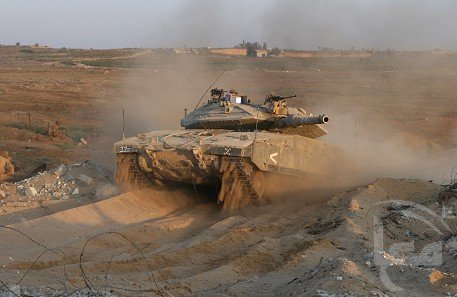 Israeli soldiers invaded an area in Rafah, in the southern part of the Gaza Strip, leveled the Al Dahniyya mosque and uprooted farmlands on Tuesday at dawn. Local sources reported that the mosque was leveled to the ground after several armored military vehicles and bulldozers invaded Rafah.
Also in Rafah, soldiers uprooted farmlands near the Yasser Arafat Airport east of Rafah. Several military bulldozers and armored vehicles bulldozed farmlands and opened fire at random in Al Dahniyya area. The vehicles, originally stationed at the Karem Abu Salem (Kerem Shalom) military post, advanced 800 meters into the area and placed sand hills.
Also on Tuesday at dawn, a group of fundamentalist settlers torched the main mosque of the Al Lubban Al Shariyya village, south of the northern West Bank city of Nablus. The settlers attacked the mosque approximately at 3 A.M., rounded up several copies of the Holy Koran in one place and set them ablaze. The fire caused excessive damage to the property of the mosque, including its ceiling, its fans and walls. Its 450 square meters of carpet and eight air conditioners were burnt also.
This is the third mosque to be torched by the settlers this year as the settlers torched a mosque in Yasuf village near Salfit and another mosque in Huwwara town, near Nablus.
Photo credit Maan Images/Wissam Nassar
###
Al-Manar TV

… According to the town’s mayor, Jamal Daragma, this is not the first time the village was targeted by settlers: “In the past they also smashed windows, uprooted olive trees, damaged houses and property. At least once a week settlers come in, riot and harm the village.”
The town is located next to three Israeli settlements: Shilo, Ma’ale Levona, and Eli. Contacted by AFP, the Israeli occupation army could not immediately confirm or deny the report.
On April 14, a mosque in Huwara near Nablus was desecrated by settlers who scrawled Hebrew graffiti and a Star of David over the walls. Two cars were also torched during the incident.
In December, settlers vandalized another mosque in the northern West Bank village of Yasuf, torching Muslim holy books and spraying hate messages in Hebrew. The incident triggered clashes between villagers and Israeli occupation troops. Israeli police arrested youths from the settlement of Yitzhar, but no one was charged.
Undercover Forces Kidnap Six Children in Raid on Village
By Saed Bannoura – IMEMC & Agencies – May 03, 2010
The Palestine Solidarity Project reported that undercover forces of the Israeli army kidnapped six children in Beit Ummar town, near the southern West Bank city of Hebron, and handed them to the army on Sunday evening.
The undercover forces, dressed as Palestinians, drove into the town in a White Ford Transit carrying a Palestinian license plate, and kidnapped six children, aged between 13 and 16. The forces then hurled several stun grenades and fired tear gas bombs into the narrow streets of the town and drove away.
One undercover soldier was hit in the head by a stone hurled by one of the protesters during clashes with the invading forces. Mohammad Awad, spokesperson for the Palestine Solidarity Project, stated that clashes took place near the Karmie Tzur illegal settlement, installed on Palestinian lands. Awad stated that it is believed that the kidnapped six youth were taken to the Karmie Tzur settlement.
Four of the six kidnapped children were identified as Hussein Shihda Sleiby, 16, Rashid Mohammad Awad, 15, Ali Said Sabarna, 16, and Odai Saady Ikhlayyil, 13.
On Sunday evening, a number of fundamentalist settlers of the Karmie Tzur settlement held a demonstration at Highway 60 and attacked several Palestinian villagers of Beit Ummar. The police arrived at the scene and used loud speakers to order the villagers back to their homes and fired tear gas and stun grenades at them instead of removing the settlers.
The army used excessive force against the villagers who were protesting the illegal settler-takeover of their land and the destruction of dozens of trees.
The Palestine Solidarity Project reported that Israeli soldiers were filmed in recent weeks while attacking and beating journalists. Also, a 10-year-old child was shot with a rubber coated bullet by soldiers from Karmie Tzur.
“Egypt Responsible For The Death Of Four, Gassed In Tunnel”
By Saed Bannoura – IMEMC & Agencies – April 29, 2010
 Dr. Sami Abu Zuhri, media spokesperson of the Hamas movement, held the Egyptian Authorities responsible for the death of four Palestinians who died in a tunnel after Egypt’s Border Police gassed it.
Abu Zuhri demanded Egypt to conduct an immediate probe into the issue, and to prosecute those in charge.
Speaking at a press conference in Gaza, Abu Zuhri said that Hamas is following the developments, and strongly denounced Egypt for using gas against the residents. Besides the four who were gassed to death, two residents are currently in serious conditions. He added that this is not the first time Egypt uses gas in the tunnels as 45 residents previously died after being gassed in different tunnels, and a total of 145 residents were killed in different accidents and incidents.
The Hamas spokesperson said that the Palestinians need the tunnels, and resorted to them due to the urgent necessity due to the ongoing siege on the Gaza Strip. He further stated that the solution is not killing the residents, and added that the solution is opening all border terminals.
Abu Zuhri demanded the Arab League to act immediately and end the siege.
Photo credit – Ma’an Images
Settler Sewage Ruins Palestinian Crops, Drinking Water
By Mel Frykberg | IPS | April 28, 2010

BEIT UMMAR, West Bank – Residents of this Palestinian village refuse to buy the idea that the flood of raw sewage from the adjacent Israeli settlement of Kfar Etzion, that destroyed vineyards and contaminated their drinking water, was an accident.
The Israeli Civil Administration, which administers the occupied West Bank, claims the spillage was the result of an accidental power malfunction which caused excess settlement sewage to overflow onto Palestinian land.
“This was no mistake,” says a British activist who has been documenting life in the village for several months. “The pipe was deliberately unscrewed by hand so that the sewage would spill over into Beit Ummar. That has nothing to do with an electricity cut,” he told IPS.
Villagers standing near a completely destroyed 70,000 sq m vineyard belonging to the Sabarneh family said they believe it was a deliberate act of sabotage and part of a concerted campaign by the settlers to harass their Palestinian neighbours and vandalise their property.
Beit Ummar has been the target of a number of Israeli military raids at night last month. Activists who have been organising non-violent protests against the expropriation of their land for the settlements have been arrested and the village blockaded.
In a similar incident last week the Palestinian village of Bruqin, in the northern West Bank, was flooded with sewage from the nearby Ariel settlement, causing contamination of underground water and springs and damaging crops.
These incidents are part of a larger problem of scarce water resources where a Palestinian population of 2.5 million survives on 17 percent of the West Bank’s main underground aquifer.
The remaining water is channelled towards the West Bank’s (including East Jerusalem) 500,000 Israeli settlers, and into Israel proper.
The water shortage is compounded by the lack of wastewater treatment plants and inefficient treatment of waste and sewage in the Palestinian territory which fouls its water sources.
Israeli rights group B’tselem released a study last year called ‘Foul Play: Neglect of wastewater treatment in the West Bank’.
According to the organisation, more than 90 percent of Palestinian wastewater is not treated while only 20 percent of Palestinian homes, primarily in towns and cities, are connected to sewerage systems.
Furthermore, only 81 of 121 illegal Israeli settlements are connected to wastewater treatment facilities. Over half of the settlements’ treatment plants are too small to treat waste effectively and are ill-equipped to handle the burgeoning settler population.
The result is continual technical breakdowns and sewage overflow. Most of the settlements are situated on ridges and hilltops so sewage flows down towards the Palestinian villages and towns in the valleys below, contaminating their drinking water supplies and destroying their crops.
The Israeli settlers are not affected by this as they are connected to Israel’s water supply.
The planning and building authorities in the settlements and Israeli industrial areas also ignore Jordanian building and planning laws which govern how wastewater is to be treated in the West Bank.
The B’tselem report further outlines the neglect of the territory’s water treatment plants by the Israeli Civil Administration during the decades of occupation and the current difficulties faced by Palestinian Authority (PA) water officials in trying to build new wastewater treatment plants or repair the old ones.
There is currently only one wastewater treatment plant operating in the West Bank in Ramallah. Three others have ceased to function and the PA has been unable to repair them or build new ones.
The West Bank is divided into Area A, which is under Palestinian control, Area B under joint Palestinian and Israeli control, and Area C which is under full Israeli control.
Area C comprises 60 percent of the West Bank. Areas A and B are mostly built up with little free land available.
However, in order to move around or build new wastewater treatment plants in Area C Palestinian officials from the PA Environment Authority require building permits from the Israeli Civil Administration.
B’tselem and PA officials complain of the delays these officials face in getting building approval if they get them at all.
“There is an enormous amount of red tape and bureaucracy that Palestinian officials have to overcome before they get the permits,” says Eyal Hareuveni, the author of the B’tselem report.
“The Israeli Civil Administration says that the Palestinians don’t provide the necessary detailed building plans as they have been instructed but I think the administration is being deliberately difficult,” Hareuveni told IPS.
Issa Moussa from the PA’s Environmental Authority denied that the PA provided insufficient details.
“We have the case of wanting to build a new wastewater treatment plant in Tulkarem in the northern West Bank. We provided absolutely everything requested but we were still waiting for a permit,” Moussa told IPS.xxxxx
Other difficulties facing the more efficient handling of wastewater are the restrictions placed on Palestinian movement in the West Bank by the Israeli military. This has led to increased costs for donors who support wastewater projects and who in turn have cut down on their expenditure.
A Joint Water Committee between Israel and the PA was established following the Oslo Peace Accord of 1993, to address water issues.
One of the disputes between the sides is the Israeli insistence that settlement sewage be connected to future Palestinian wastewater treatment plants.
The Palestinians reject this as this implies that the settlements are permanent and say their refusal to approve this condition is one of the reasons for approval being withheld on the construction of wastewater plants.
With no higher authority to settle the disagreement the situation will only worsen in the future.
“Neither side seems to be making the urgent issue of water and waste treatment a priority,” Hareuveni told IPS.
Israeli soldiers given minor reprimands over shooting of Palestinian civilians
By Catrina Stewart | The Independent | 28 April 2010
Israeli officers held responsible for the deaths of four Palestinians in the West Bank received only minor reprimands after an internal investigation concluded that the deaths could have been avoided.
Chief of Staff Gabi Ashkenazi, Israel’s military chief, admitted that the incidents last month “could have ended differently” and could have “avoided causing harm to civilians”.
The two fatal shooting incidents, just 24 hours apart, marked the most serious escalation of tensions in the occupied West Bank in months, and threatened to destroy the fragile calm that has persisted there in recent years.
In one case, Israeli soldiers fired on Palestinian protesters, killing two. In a second incident, a soldier killed two Palestinians who he claimed had tried to attack him. Mr Ashkenazi reprimanded two senior officers – a colonel and a lieutenant colonel – and removed a squad commander from his post, a military statement said. The soldiers who fired the lethal rounds appeared to escape censure.
Israeli human rights organisations denounced the military investigation, claiming that it failed to hold the soldiers accountable for their actions and upheld the army’s culture of impunity.
“It is extremely rare for the Israeli security forces to be held accountable in cases where they have killed or injured Palestinian civilians,” said Sarit Michaeli, a spokeswoman for B’Tselem, an Israeli NGO.
She said that the army should open criminal investigations into both cases rather than conduct “internal operational debriefs” that skirt the legal issues regarding the soldiers’ actions. “There are credible allegations, these must be investigated,” she said.
On 20 March, Israeli forces faced Palestinian protesters in the village of Iraq Burin as they tried to prevent clashes with extremist Jewish settlers from nearby Bracha. In the ensuing skirmish, Israeli soldiers killed two Palestinian teenagers, Mohammed Qadus and Osaid Qadus.
The military statement said Israeli forces had been authorised to use rubber bullets against the Palestinians, but, as reported by The Independent, medics who examined the body insisted that live ammunition had been used, and produced X-rays that appeared to show a conventional bullet lodged in the skull of Osaid Qadus.
The Israeli army said a Military Police investigation into the claims that live rounds were used was still ongoing. The army “could not verify the autopsy and could therefore not confirm that the rioters were in fact hit by live rounds,” the statement said.
In Awarta a day later, an Israeli soldier fired on two Palestinians who approached a checkpoint and started “acting suspiciously,” according to the statement. The first apparently tried to attack the soldier with a bottle, prompting the soldier to shoot him. The second then allegedly wielded a “sharp object” and was also shot dead.
The soldier fired seven bullets into Mohammed Qawariq and at least three into Saleh Qawariq, according to Palestinian doctors. “While the soldier, believing his life was at risk, acted subjectively, the Chief of the General Staff holds the officers responsible for training their soldiers to act in difficult operational situations,” the military said.
Relatives of the deceased denied that they tried to attack the soldier and said they were only metal workers looking for scrap.
Rights Groups Issue Open Letter on Upcoming NYC Trial of Syed Fahad Hashmi and Severe Special Administrative Measures
April 23, 2010
New York – The Center for Constitutional Rights, Amnesty International USA, and the Council on American Islamic Relations-NY released an open letter today expressing their serious concerns about the trial of Syed Fahad Hashmi, set to begin on April 28. The human rights organizations discuss Mr. Hashmi’s severe conditions of confinement over the last three years in which he has awaited trial, their impact on his mental health, and his ability to effectively participate in his own defense.
The material support charges against Mr. Hashmi are based on the allegation that he allowed an acquaintance, Junaid Babar, to use his cell phone and to stay with him at his apartment in London where he was pursuing a Master’s degree. According to Mr. Hashmi’s indictment, Babar had waterproof socks and rain ponchos in his luggage that he later delivered to al-Qaeda in South Waziristan. Mr. Hashmi denies all charges against him.
In their letter, the Center for Constitutional Rights, Amnesty International USA, and the Council on American Islamic Relations-NY urge the Attorney General to review and revise the Department of Justice regulations governing the imposition of severe Special Administrative Measures (SAMs) to ensure that all prisoners are held in humane conditions, are not subjected to discriminatory treatment, are given adequate information about why SAMs are being imposed, and are given a full opportunity to argue and present evidence against their imposition.
Two days ago, CCR publicly condemned the government’s attempt to frighten the jury in Mr. Hashmi’s case, calling the U.S. Attorney’s motion for the jurors to be anonymous and kept under extra security because of the attention and political activism these issues have drawn to the case “a clear attempt to influence the jury by creating a sense of fear for their safety and to paint Mr. Hashmi as already guilty.”
Open Letter from Amnesty International USA, the Center for Constitutional Rights, and the Council on American Islamic Relations-NY on the upcoming trial of Syed Fahad Hashmi and the severe Special Administrative Measures to which he is subjected :
On April 28, Syed Fahad Hashmi is scheduled to be tried in the Southern District of New York on charges of material support for terrorism. Mr. Hashmi has been held in pretrial detention at the Special Housing Unit at the Metropolitan Correctional Center in Manhattan, pursuant to Special Administrative Measures, or SAMs, for almost three years now. These measures have severely limited his ability to communicate with the outside world and effectively placed him in solitary confinement, although he has not been convicted of any crime.
Mr. Hashmi is 30 years old, was raised in Queens and attended Brooklyn College before moving to London to obtain a Master’s degree in political science. Since his extradition to the United States in May 2007, he has been imprisoned alone in a cell and not permitted to speak, worship or otherwise communicate with any other prisoners. He is not permitted any visitors or outside communications, except for his attorneys and limited visits from immediate family. He is not allowed any physical human contact, even from his closest family members. Mr. Hashmi is allowed one hour per day of physical exercise, which must be taken alone, in a small cage inside the prison. He is not permitted access to any natural air or sunlight. Moreover, Mr. Hashmi is subjected to a strip-search before his one hour per day of exercise. Due to the resulting humiliation he experiences, he has chosen to forego this hour outside of his cell altogether.
In addition, Mr. Hashmi is subjected to constant surveillance, not only when he is alone in his cell but also when he showers, uses the toilet, or meets with an attorney or family member. He may not communicate with any members of the media, and he is forbidden from listening to a television or radio news program or reading a timely newspaper.
Mr. Hashmi’s family, friends and attorneys are extremely concerned that his mental health is rapidly deteriorating under these extreme conditions. It is well-documented that solitary confinement can have severely detrimental effects on a prisoner’s mental health. It may also affect his ability to effectively participate in his trial and to present his defense.
Muslim community groups are increasingly expressing concern about these prison conditions, as they seem to be imposed disproportionately on Muslims suspected of connections with terrorism.
SAMs may be imposed on a particular inmate, according to the Department of Justice’s regulations, when such measures are “reasonably necessary to prevent disclosure of classified information,” or when “reasonably necessary to protect persons against the risk of death or serious bodily injury.” To be extended beyond the initial 120-day period, the Attorney General or federal law enforcement must demonstrate that such measures are reasonably necessary “because there is a substantial risk that an inmate’s communications or contacts with persons could result in death or serious bodily injury to persons, or substantial damage to property that would entail the risk of death or serious bodily injury to persons.”
The material support charges against Mr. Hashmi are based on the allegation that he allowed an acquaintance, Junaid Babar, to use his cell phone and to stay with him at his apartment in London where he was pursuing a Master’s degree. According to Mr. Hashmi’s indictment, Babar had waterproof socks and rain ponchos in his luggage that he later delivered to al-Qaeda in South Waziristan. Mr. Hashmi denies all charges against him. These charges will be the subject of his trial.
We are concerned that Mr. Hashmi has not been informed of the reasons for the imposition of SAMs. We are also concerned that Mr. Hashmi is being held under conditions that are not consistent with international standards for humane treatment. Due to their likely impact on his mental health, we are further concerned that these conditions will prejudice his ability to assist in his own defense.
The Department of Justice stated last year that 46 inmates around the country were being confined pursuant to SAMs. Although we recognize that the department has a legitimate interest in protecting classified information that may harm national security and in protecting the public against acts of terrorism, we are very concerned that inmates held pursuant to such measures are not being given an adequate opportunity to defend against the imposition of SAMs in their cases.
We urge the Attorney General to review and revise the agency’s regulations governing the imposition of SAMs to ensure that all prisoners regardless of their security status are held in humane conditions, are not subjected to discriminatory treatment, are given adequate information about why SAMs are being imposed, and are given a full opportunity to argue and present evidence against their imposition.
The Center for Constitutional Rights is dedicated to advancing and protecting the rights guaranteed by the United States Constitution and the Universal Declaration of Human Rights. Founded in 1966 by attorneys who represented civil rights movements in the South, CCR is a non-profit legal and educational organization committed to the creative use of law as a positive force for social change.
Contact: press@ccrjustice.org
Israel Kidnaps Lawyer Representing Jordanian Detainees
By Saed Bannoura – IMEMC & Agencies – April 26, 2010
Israeli soldiers kidnapped on Sunday Shereen Al Esawy, a lawyer representing Jordanian Detainees imprisoned in Israel. Al Esawy was kidnapped at a roadblock, near Jabal Al Mokabbir, in East Jerusalem.
The National Committee for Jordanian Prisoners and Missing Prisoners, stated that Shereen was moved to the Al Maskobiyya interrogation center, and added that the army also broke into her home and confiscated her laptop.
The Committee slammed the arrest and demanded international human rights groups to intervene and oblige Israel to release her as she is only performing her duty as a lawyer.
Several weeks ago, Israel barred Al Esawy from visiting the detainees she represents. Al Esawy was also prevented, several months ago, from entering Jordan for a conference about the detainees. The conference was held in Amman after Jordanian detainees in Israeli prisons held a hunger strike, but the Jordanian Authorities prevented her from crossing into the country.
The committee states on its website that there are currently 27 Jordanian detainees, including one woman, imprisoned by Israel. The woman, Ahlam Tamimi, was sentenced to 16 consecutive life-terms. Also detainee Abdullah Barghouthi was sentenced to 67 consecutive life-terms. The rest of the detainees were sentenced to different periods (between one year and several life-terms), the committee said.
Watching the invasion unfold
By Eva Bartlett | In Gaza | April 22, 2010

It was an early morning, farmers relieved to have harvested the 6 dunam (1 dunam is roughly 1000 square metres) field of lentils planted 5 months ago in Al Faraheen borderlands. The village, east of Khan Younis, includes land cut off to farmers by the Israeli-imposed “buffer zone”. That technically 300 metre no-go zone stretching south to north along Gaza’s border with Israel actually extends far beyond the few hundred metres, up to 2 km in some areas where Palestinian civilians have been shot, injured or killed, by Israeli soldiers while on their land.
Abu Qater Tabbash has 100 dunams of land he can no longer access, he says, because it lies in the buffer zone. The land he worked today, along with 5 women from his family, is rented land. Their crop will not pay off, but it will provide lentils for the family and hay for their animals.

“I knew they were going to do something today,” says Jaber Abu Rjila. “I saw the bulldozers line up at the border yesterday and knew today there’d be a party,” making light of his dangerous reality.

Rjila is an old hand at Israeli invasions, even prior to the one which destroyed his farm and livelihood. Being shot at and having his and neighbouring land churned to waste by Israeli bulldozers is so normal that he continues sorting garlic and harvesting lettuce, to give to his guests, as the tanks line up at the gate before entering and nearing within 200 metres of his home.


But when the bulldozers and tanks begin to thunder in through the Israeli-controlled gate nearest Rjila’s land, he, Leila and a few neighbours are the only ones who stay.
“All of Faraheen will be in Khan Younis after a while,” says Jaber, referring to the proximity of the town and the fact that Israeli invasions have repeatedly harassed the citizens of his town, destroyed their houses, shot up their walls and terrified their children.
One of Rjila’s young daughters has never gotten over the experience of being in a house surrounded by and being shot at by Israeli tanks and soldiers as military bulldozers destroyed their land. The girl, just 7 or 8 years old, is slight and shows signs of malnourishment, despite her parents best efforts and the comparative health of her siblings.
“She was traumatized,’ Leila says, explaining that of her siblings, the girl was the most terrified during the 2008 Israeli invasion, which including shelling and gunfire on her home.
The tanks enter the gate some 500 metres from the house we are at and seem to be bee-lining for the Rjila home. When they are roughly 100 metres away, we leave our vantage point, not wanting to bring further wrath on the home by the provocation of documenting Israel’s invasion.
Continuing to film from a different spot still near the home and the convoy of tanks, we hear their rumble as they tear up the earth.


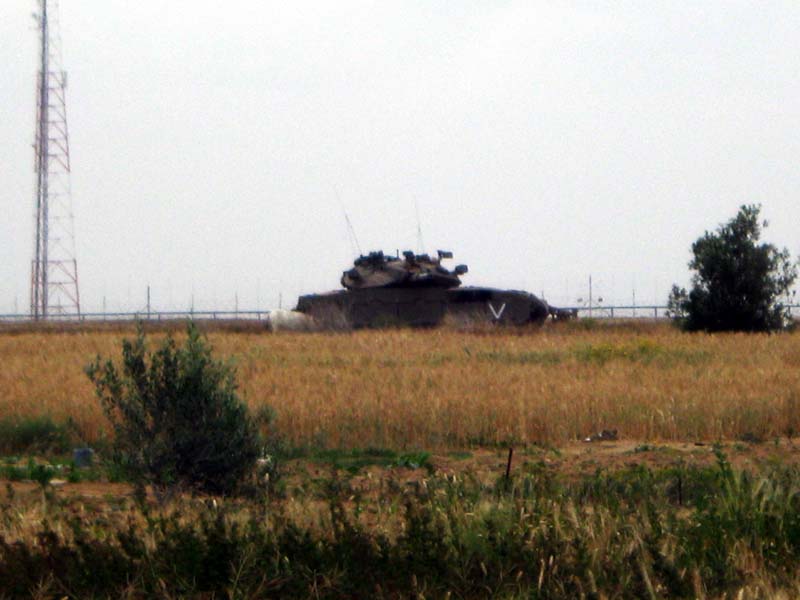


*the area, tranquil, before the invasion

*this land will have all been torn up in the invasion
Beit Ummar vineyard flooded with settlement sewage
Ma’an – 22/04/2010

Hebron – Israeli settlers opened a sewage pipe running toward the Hebron-area town of Beit Ummar on Wednesday night, flooding a Palestinian vineyard with wastewater, local officials said.
By opening the sewage pipe, residents of the Gush Etzion settlement bloc destroyed some 70,000 square meters of the vineyard belonging to the Sabarneh family, experts visiting the site said.
The land, in the Wad Shakhat area of northern Beit Ummar, was ruined by the flood of sewage, along with the crop after it was contaminated by the untreated wastewater, land experts who arrived at the scene along with the village mayor said.
An Israeli Civil Administration representative confirmed the incident, saying a pump from the Kfar Etzion settlement stopped working due to a power malfunction and sewage overflowed from the network. The official said the matter was a mistake, and as soon as the Beit Ummar governor notified officials of the issue the problem was rectified.
Military officials said compensation for the mistake would likely have to be sought in court.
Residents of Beit Ummar said the mayor informed Israel’s Civil Administration office of the incident, and that he asked Israeli police to investigate what was behind the disaster.
“As far as I know, the mayor of Kfar Etzion called and apologized,” the Civil Administration representative said.
Featured Video

Dan Dicks with James Corbett on Solutions Watch
or go to
Aletho News Archives – Video-Images
From the Archives
Secret document reveals plans for civil war in Lebanon, Israeli false flags, and invasion
By Randi Nord | Geopolitics Alert | April 5, 2019
Beirut – During his visit with US Secretary of State, Mike Pompeo, Lebanese President Michael Aoun reportedly received a US-Israeli document detailing plans for creating a civil war in Lebanon with covert false flag operations and possible Israeli invasion.
Although the source of the document is Israeli and created in partnership with Washington, no one knows who presented it to Aoun. The Lebanese TV station, Al-Jadeed, initially reported the document on Lebanese TV and a video on its website. Geopolitics Alert translated the report for this article. … continue
Blog Roll
 Aletho News
- There’s a drought in academia: A drought in honest research on the subject of drought and other weather extremes
- Department of War Awards $20.7 Billion Contract to Raytheon for Air-to-Air Missiles
- ‘Distance yourselves from Israel’: IRGC urges US population to question govt policies
- America’s Greenland deal has a radioactive backstory
- The RAF Fairford ‘terror plot’: Unpacking escalation in the UK echo-chamber
- EU Council Advances Chat Control 2.0 Scanning Proposal
- Ex-Greek MEP files complaint against Israeli spyware firm over alleged Pegasus surveillance
- Troubling ideas throughout the Torah, Talmud, Mishneh Torah and Tanya
- ‘Grave, alarming’: Iran mission on Trump’s UNGA ‘annihilation’ threats
- Najaf airport to reopen to Iranian flights within 24 hours: Ambassador
- If Americans Knew
- New Report: “Scholasticide and Genocide in Gaza: Assessment, Testimonies and Legal Analysis”
- Ex-Biden officials are desperate for a Gaza scapegoat
- Israeli “settlers” Invade Al-Aqsa; Pour Boiling Water on 75-Year-Old
- Israel Has Kidnapped Another American Teenager
- US arms sales to Israel worth $21.6 billion in 20 months
- Three Palestinians Killed in Israeli Attacks on Gaza
- Revealed: German “Anti-Semitism Expert” Driving Crackdown on Palestine Solidarity is Former Israeli Spy
- Egypt’s Warning to Israel Before Oct 7
- Israel’s siege signals another cruel winter for 1.8 million Gazans – Daily Update
- Netanyahu Asked UAE Leader to Deny Report on Oct. 7 Warning in Secret Visit, Sources Say
- No Tricks Zone
- New Study: Earth And Venus Surface Warmth Largely Explained By Convection And Lapse Rate, Not CO2 Or Radiation
- 2025 Nature Paper Claiming Worsening Global Drought Gets RETRACTED …Heavily Flawed
- New Study: ‘Global Drought Shows No Detectable Recent Acceleration Under Climate Warming’
- Economic Masterminds: German Socialists Suggest Taxing Productivity Gains Stemming From Using AI
- The South China Sea Has Not Been Cooperating With The Climate Change Narrative
- Energy Crisis: Germany Enters Heating Season With Historically Low Gas Reserve Fill Levels
- New Study: The Antarctic Ice Sheet Gained Mass From 2020-2024 Due To Staggering Snow And Ice Accumulation
- Study: Ocean Heating Rates From Thousands Of Years Ago ‘Dwarf’ Modern Ocean Heating Rates
- Climate Extremists Target, Attack Large-Scale Power Grid Infrastructure In Germany!
- New Study: Antarctic Ice Melt Has Contributed Less Than 1 Centimeter To Sea Level Rise In The Last 30 Years

