El Al sued for racial profiling
Jonathan Cook, The Electronic Intifada, 20 April 2010
Two Palestinian citizens of Israel have won $8,000 in damages from Israel’s national carrier, El Al, after a court found that their treatment by the company’s security staff at a New York airport had been “abusive and unnecessary.”
Brothers Abdel Wahab and Abdel Aziz Shalabi were assigned a female security guard who watched over them at the airport’s departure gate for nearly two hours, in full view of hundreds of fellow passengers, after they had passed the security and baggage checks.
Later, El Al’s head of security threatened to bar Abdel Wahab, 43, from the flight if he did not apologize to the guard for going to the toilet without first getting her approval. Abdel Aziz said he had been humiliated and “cried like I’ve never cried before in public.”
Although surveys of Palestinian Arab citizens, who comprise one-fifth of Israel’s population, show that most have suffered degrading treatment when flying with Israeli carriers, few bring cases to the Israeli courts.
The brothers are now planning to sue El Al and its New York staff in the United States over Israel’s racial profiling of passengers in a country where the practice is illegal.
“I’d rather go to New York by donkey than fly with El Al again,” said Abdel Aziz, 44. “We will keep fighting this case until Israel is embarrassed into stopping its policy of discriminating against its Arab citizens.”
The brothers, who live in northern Israel, were the only Arabs in a party of 17 Israeli insurance agents on a two-week business trip to Canada and New York in 2007.
They arrived four hours early at John F. Kennedy airport in New York for their return flight with Israir, an Israeli charter company, to allow time for the additional checks they expected from El Al’s security staff.
El Al has special agreements with most countries’ airports to carry out its own security checks for passengers flying with Israeli airlines.
The brothers said they were questioned, searched and had to wait two hours while their bags and carry-on luggage were subjected to lengthy inspections.
“The Jews with us went through in minutes,” said Abdel Aziz, in his home in the village of Iksal, near Nazareth. “The difference in treatment was very clear.”
After they had passed the checks, an El Al security guard, Keren Weinberg, was assigned to them until they boarded the plane. They were told to make sure she could see them at all times.
When Abdel Wahab visited a toilet without her permission, a noisy argument broke out between the two, with Weinberg accusing him of “roaming freely.” He said he told her to “either arrest me or go away.”
Ilan Or, the head of El Al security, was then called and issued him an ultimatum that he apologize or be prevented from catching the flight. Abdel Wahab told a magistrate’s court in Haifa this month that he broke down in tears and finally said he was sorry.
“I was in shock. One minute I was made to feel like a terrorist and then the next like a naughty child,” he said.
Judge Amir Toubi said the security staff had admitted that neither brother was deemed a security threat and that Israeli law did not allow checks to continue after passengers had passed the security area.
“With all due understanding of security needs, there is no justification for ignoring the dignity, freedom and basic rights of a citizen under the mantle of the sacred cow of security,” the judge ruled.
El Al told the court that it had been “asked by the state to conduct security checks abroad on behalf of [charter companies] Arkia and Israir airlines, and is acting under the security guidelines set by official bodies of the state.”
Abdel Wahab praised the court’s decision but said the damages were minor and would not act as a deterrent against El Al repeating such behavior in the future. He said the brothers would appeal to a higher court in Israel and were planning to initiate a legal action in New York, too.
“I will not rest until we get an apology from El Al and they acknowledge that what they did is wrong,” he said. He called on all Arab citizens to boycott El Al until it committed to stop its discriminatory policy.
A 2007 report on racial profiling by Israeli carriers, published by the Arab Association for Human Rights and the Centre Against Racism, concluded: “This phenomenon is so widespread that it is hard to find any Arab citizen who travels abroad by air and who has not experienced a discriminatory security check at least once.”
The two groups found that Arab and Muslim passengers typically faced long interrogations and extensive luggage searches, and were also regularly subjected to body and strip searches, had items including computers confiscated, were kept in holding areas and were escorted directly on to the plane.
The report noted that foreign countries that allowed Israel to carry out its own security checks at their airports failed to supervise them and preferred to “ignore their discriminatory nature and the human rights violations committed on their own soil.”
New York’s JFK airport was one of the airports that refused to answer questions from the groups about incidents of discriminatory treatment of Arabs and Muslims.
Israel has also come under harsh criticism for the standard racial profiling policies it uses against its own Arab citizens and foreign Arab nationals at Ben Gurion airport near Tel Aviv.
The practice of putting different color-coded stickers on Jewish and Arab passengers’ luggage ended three years ago. However, airport guards still write a number on uniform white stickers indicating the level of security threat. Critics say higher numbers are reserved for non-Jews.
Faced with a lawsuit from Israeli human rights groups, Menachem Mazuz, the attorney general at the time, instructed the airports authority in early 2008 to implement “visible equality” by ending discriminatory screening policies.
However, observers have noticed no change in practice. “This was a very cynical exercise. ‘Visible equality’ simply means making it look like there’s equality when the inequality persists,” said Mohammed Zeidan, director of the Association for Human Rights, based in Nazareth.
In December an airport official told the right-wing Jerusalem Post newspaper: “Profiling makes the biggest difference. A man with the name of Umar flying out of Tel Aviv, whether he is American or British, is going to get checked seven times.”
Two years ago Israel’s racial profiling policy made headlines when a member of an American dance troupe with a Muslim-sounding name was forced to dance at the airport to prove he was who he claimed.
The incident with the Shalabi brothers follows on the heels of a diplomatic crisis between Israel and South Africa over revelations that spies posing as El Al staff have been operating at Johannesburg airport, gathering information on non-Jewish passengers visiting Israel.
El Al has threatened to close the route after South African officials stopped providing the airport guards with diplomatic immunity.
South African TV reported last month that two of the Mossad assassins suspected of killing a Hamas commander in Dubai in January may have used Johannesburg airport to fly back to Israel.
Jonathan Cook is a writer and journalist based in Nazareth, Israel.
PA: Sick prisoner in solitary dies in Israeli custody
Ma’an – April 17, 2010

Holding a photo of her imprisoned son, a Gaza City woman protests for the right to family visits outside of the Red Cross building on 12 April 2010. Prisoners in 13 Israeli facilities began a boycott of family visits, protesting what they called unequal treatment for prisoners, as the visits were used to punish inmates and harass family members, detainees said. [MaanImages/Wissam Nasser]
Bethlehem – Palestinian Minster of Prisoners Affairs Issa Qaraqe identified a Palestinian prisoner in Israel, announced dead Friday afternoon, as 26 year old Raed Muhammad Ahmad Hammad.
The death comes on the Day of the Palestinian Prisoner, marked by dozens of rallies across the West Bank and Gaza, commemorating the lives of more than 10,000 Palestinians currently held in Israel, and the hundreds of thousands of others who have spent years of their lives incarcerated by Israeli military courts.
Former prisoner Abed An-Naser Farawneh said Hamad’s death came as a result of “intentional medical negligence,” and noted that Hammad was the 198th Palestinian to die in Israeli custody since the occupation of the West Bank and Gaza in 1967.
According to a report from the Palestinian Authority, Hammad was moved into solitary confinement in Israel’s Eshel Prison, despite medical reports indicating the young man was not well.
An announcement by Israel’s prison authority said only that a 31 year old Palestinian died in a southern Israeli facility, and noted investigations into the reasons behind his death had been initiated.
Hammad was a member of the Hamas party, and was serving a prison term following his conviction in an Israeli military court on charges of attempting an attack on Israeli civilians.
Palestinian Women and Children Behind Zionist Bars
By Reham Alhelsi | A Voice From Palestine | April 17, 2010

On a beautiful March day, I was on the way to school in Jerusalem when the bus I was in was stopped at Ras Il-Amoud. The soldiers got into the bus, told everyone to get out and told the bus driver to turn and go back from where it came. Some passengers started arguing with the soldiers, explaining they had jobs or classes to go to, but the soldiers didn’t want to know about that and started shouting and beating those present with their clubs, including me. We were school children and were not a threat to armed soldiers, nevertheless a number of us were arrested for daring to tell the soldiers to stop beating us. We were handcuffed and loaded into military jeeps. On the way, we were forced to bend our heads down the whole trip and the only thing I could see were the boots of the soldiers.
When the jeep finally stopped, we were ordered by the soldiers to step down and as I looked around me I realized we were in a military camp. The soldiers told us then to stand in a certain place, turn our backs to them and kneel on the ground. We were still handcuffed. Opposite me I could see the mountains of Jerusalem and I realized we were in the Abu-Dees military camp which occupied one of the hills. We weren’t allowed to sit but half kneel which was very painful. And as we half-knelt there, near each other but not able to talk to each other, the soldiers started throwing small stones at us. They were laughing and talking in Hebrew while throwing the stones. I didn’t understand what they were talking about, but I figured they were betting who would hit which one of us and where. I don’t remember how long this “game” lasted, but I remember how painful the kneeling was, how painful the stones were when they hit my head and how I wondered what would happen to us, what they would do to us here alone in this military camp with no Palestinian around. Every now and then I would take a quick peek at the hills in front of us and I would think about my parents and what they were doing. We tried comforting each other silently by touching our feet. We didn’t talk for we weren’t allowed to do that, but whenever someone near me touched my foot with theirs, it was like telling me: don’t worry, we’ll get through this, and I would return the gesture.
After seemingly long hours, maybe in the afternoon, we were loaded back into the jeeps, ordered to lower our heads again and a new journey started. When this second journey ended, we were in one of the detention centres. The soldiers separated us from each other and I was taken to a small room where one female soldier searched me thoroughly several times. Then another male soldier came and took me to another room and told me to keep standing the whole time and if I sit I will be punished and that they will be watching me. While waiting I could hear shouting and a boy crying a room nearby. They were interrogating him and I knew my turn would be next. That day, I was a school pupil on my way to school, I got beaten by armed Israeli soldiers, was used as a “target” in their games and ended up in a detention centre. I was a child, a little girl, and was surrounded and beaten by no less that 5 or 6 fully armed soldiers to be then detained for “attacking the soldiers”. It didn’t matter that I was a child, it didn’t matter that I was a girl, to the Israeli soldiers I am a Palestinian, thus beating me and detaining me for no reason is allowed.
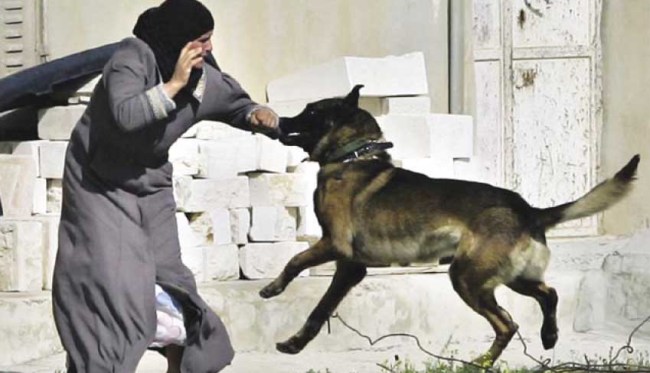
Photo – Multaqa.org

This is not an isolated case. Palestinian women and children are detained on almost a daily basis, and are physically and physiologically abused. They are beaten, humiliated and tortured during arrest, interrogation and detention. Their families are also harassed and sometimes other family members are arrested as well to extract a confession from the detainee. Palestinian children are interrogated by Israeli soldiers without the presence of a lawyer or a family member and later stand trial like adults. Families are often not allowed to see their children before or after trial.
Since 1967, Israel detained over 700,000 Palestinians including tens of thousands of children. Since the outbreak of Al-Aqsa Intifada in 09.2000, more than 8000 Palestinian children have been detained, of whom 337 are still in Israeli detention. According to “Defence for Children International/Palestine Section (DCI/PS)”, around 700 Palestinian children are detained yearly in Israeli jails. Of the over 8500 Palestinians currently detained in Israeli jails, at least 400 were children at the time of their arrest. Palestinian children are arrested from their homes, from schools, while playing in the streets or at checkpoints. They are blindfolded, shackled and taken into detention centers where they are separated from others. They are beaten, threatened and abused by the soldiers and interrogators, are not allowed to see a lawyer or a family member and are forced into singing papers in Hebrew which they don’t know. These children are prosecuted as adults in two military courts and by military officers who act both the prosecutor and the judge. Many of the children detained are subjected to administrative detention which means detention without charges or any trial. […]

One recent incident is that of Mohammad Al-Qunbar, a 14 year old from Jerusalem. On 15.03.2010 Mohammad was first hit by a police car, then beaten by the occupation police and detained despite his injury. The Israeli occupation police first claimed that Mohammad was hit by an “Arab” car, but pictures taken during the incident proved otherwise. Later, the boy testified he was threatened by investigators in the Maskubiyyeh with prison in case he revealed that he was hit by a police car. Mohammad said that an Israeli car came towards him and his friend, hit him the first time, turned and hit him a second time. Then those inside the car came out, arrested him and started beating him in the car while he was crying.
Children are also arrested during midnight raids. In recent years, mass arrests of Palestinian children have been reported. On 10.02.2010, and during a nightly military raid on Al-Jalazoun refugee camp in Ramallah, 19 children were detained from their homes. These were beaten and harassed and the families report that the IOF used excessive force during the arrests. The children were then taken to a detention centre and interrogated without the presence of a lawyer or any family member. According to the “Defence for Children International/Palestine Section (DCI/PS)” five of them were aged 14, seven were aged 15, four were aged 16 and three were aged 17. At least seven of them (aged 15 or less) were transferred to jails inside Israel which is, in addition to the illegality of detaining children, another violation of international law. During another similar midnight raid, this time in Silwan in Jerusalem, several Palestinian children aged 12 to 15 were detained. These were taken from their beds, handcuffed and transported to interrogation cells in the Maskubiyyeh and their parents were not allowed to accompany them. The children later testified that they were threatened and beaten during the interrogation. Similar midnight raids with mass arrests of children occurred in Tura Al-Gharbiyyeh on 19.01.2009, Azzun on 14.07.2009 and in Haris on 26.03.2009 where over 90 children were detained, beaten and threatened.
According to the Defence for Children International/Palestine Section (DCI/PS): [1]
90 Day: the period of time a Palestinian detainee, including a child, can be denied access to a lawyer and held in incommunicado detention (Military Order 378)
20 Years: the maximum sentence that can be imposed on a Palestinian, including a child, for throwing stones (Military Order 378)
188 Day: the length of time a Palestinian detainee, including a child, can be held in detention without charge (Military Order 378)
2 Years: the period of time a Palestinian detainee, including a child, can be held between indictment and trial.
Since 1967 more than 12,000 Palestinian women were detained by the Zionist entity. During the First Intifada 3000 women were detained and during Al-Aqsa Intifada more than 900 women were locked up behind Israeli bars. Currently, there are 35 Palestinian women detainees in the Israeli prisons Damon and HaSharon: among them 3 administrative detainees, 8 await trial, 23 sentenced of whom 5 are serving life sentences. Palestinian female detainees, like their brothers in detention, suffer from the brutality of the Israeli Prison Authority. They are punished for the slightest thing with isolation, are beaten, harassed, tied up for hours under hot sun or under rain, deprived of sleep, their rooms raided at night, continuously denied family visits and calls back home and letters are sent and brought only once every 3 months. Water is very dirty and food is inedible, thus the detainees are forced to buy their food and water from the prison canteen for very high prices. Some political prisoners are also locked up with Israeli criminals who abuse them. Their cells are over-crowded, damp, lack hygiene and are infested with insects.
The detainees are also denied appropriate and much needed medical treatment and most medications are expired; 13 detainees are in need of medical treatment. Amal Faiz Jum’a from Askar refugee camp suffers from womb cancer while Raja’ Al-Ghoul from Jenin refugee camp suffers from heart and blood pressure diseases and both don’t get the need treatment. Female detainees are only allowed to see a general doctor and no specialists, and some were forced to give birth while hand and leg cuffed such as Mirvat Taha and Manal Ghanim. Currently, there are at least 6 Palestinian mothers in detention. Others have their husbands or their brothers in Israeli detention as well, but are not allowed to visit them. Abir Odeh for example has 3 brothers in Israeli detention and Fatin Al-Shafi’ Al-Sa’di has a brother in jail.
Sources:
http://www.palestinebehindbars.org
http://www.waed.ps
http://www.dci-pal.org/
Footnotes
[1] http://www.dci-pal.org/english/camp/freedomnow/display.cfm?DocId=803&CategoryId=16
© http://avoicefrompalestine.wordpress.com

Necessity and Defiance
By Eva Bartlett | April 16, 2010

Mohammed Abu Jerrad, 12, works with his older brother and 4 others to gather their wheat. Although it is still somewhat early for harvesting, the family hopes to harvest their 5 dunams quickly, preferring the early harvest over the possibility that Israeli soldiers will demolish or light their crops afire, as they have routinely done in the past. [One such incident occured in Johr Ad Dik last May, when Israeli soldiers shot incendiary devices into ripe wheat and barley fields, setting nearly 3 km, 200 dunams, of crops and fruit trees afire.]

Abu Jerrad’s 5 dunams lie roughly just over 300 metres from the border, along which Israeli military tower and remote controlled machine gun towers loom. From these towers, Israeli soldiers regularly shoot on farmers, workers gathering rubble and scrap metal for construction uses, and civilians on the land.
This plot of wheat is on rented land.
“We grow it to feed our sheep and goats,” Abu Jerrad says of his 150 animals.
“This morning when we came here to work the Israelis began shooting, so we left,” he says.
“Yes, Mohammed was with us,” he answers of the 12 year old helping him.
“Sometimes they even shoot at the sheep,” he adds. “Are they afraid of the sheep?” he jokes.
The 6 farmers can do two trips of 3 loaded donkey carts per day, if all goes well. It will take many more days before their crops are harvested.
In a Strip under years of siege and an area where Israeli shooting, shelling and kidnapping is the norm, every incident of farming is an act of necessity and an act of defiance: Palestinian farmers will not be driven off their land.


*Sheep, most often seen scouring Gaza’s vacant lots and garbage dumps, find good grazing land for a change. Much of Gaza’s prime grazing land has been destroyed or is inaccessible due to the Israeli-imposed “buffer zone”.
Adding Torture to Injury
By Pam Bailey | IPS | April 14, 2010
|

GAZA – It was bad enough that Ahmad Asfour was severely maimed by an Israeli drone strike outside his house on Jan. 9, 2009. But, his search for advanced treatment landed the journalism student, now 19, in Israeli prison where he remains.
According to Mahmud Abo Rahma of the Al Mezan Centre for Human Rights, not many Palestinians are arrested as Ahmed was, but it is increasingly common for patients entering Israel to be denied treatment unless the patient or family agrees to collaborate.
Al Mezan has joined the Physicians for Human Rights and the ADALA Centre (which defends the rights of Palestinian Arabs in Israel) to charge Israel with blackmailing Palestinian patients in Gaza, exploiting their need for medical treatment to pressure them into collaborating with its intelligence agencies.
Ahmad and four teenaged cousins were hit by fragments from a missile fired by an Israeli drone, east of Khan Younis, in the southern region of the Gaza Strip, just 14 days after Israel launched its massive, 22-day assault on the densely populated strip of land wedged between Israel and Egypt. The fragments lodged in his left eye, broke his jaw, shattered his teeth, severely lacerated both hands and right thigh, destroyed his genitals, and damaged his pancreas and intestines.
His father, Samir, was in Egypt at the time with one of Ahmad’s brothers, who had been injured just eight days before. Due to the siege imposed by Israel since Hamas took control in 2007, medical care in Gaza is often inadequate. Gazans have been unable to repair the 15 (out of 27) hospitals and 43 (of 110) primary healthcare facilities damaged in last year’s Israeli invasion, because of the ban on importation of construction materials.
Treatment in Egypt is not advanced and, according to Abo Rahma, the risk of contracting Hepatitis C is significant. Getting permission to enter Israel is difficult for Palestinians during normal times, and it was impossible during and immediately after the invasion. Even a year later, the UN reports that almost a quarter of the 1,103 patients who had sought permits for treatment in Israel in December 2009 were denied or delayed. As a result, 27 patients died while awaiting referral last year.
Ahmad and his cousins were rushed to the local hospital by his oldest brother, and the medical director sent them immediately to Egypt. Ahmad spent the next eight months there, but little could be done. In fact, because of the damage to his pancreas and the lack of appropriate treatment, he soon developed diabetes.
Doctors caring for Ahmad recommended he travel to Germany. But there was a catch: Ahmad needed a visa, and for that he was required to go to Tel Aviv – an impossibility for Gazans.
Finally, one physician suggested a hospital in Jerusalem, St. Joseph’s. As part of the approval process, Samir took his wheelchair-bound son to the Erez Crossing into Israel on Nov. 23. After waiting four hours, they were turned away, and told to return two days later. When they arrived, they were subjected to a harrowing ordeal.
“Here I am with my injured son, terrified about his health, and we were forced to remove all of our clothes so we could be strip searched. Then they took my son away from me,” recounted Samir through an interpreter. “Ahmad needed insulin every two hours, but I couldn’t give it to him…The next thing I know he is in shackles! They took the medication I had brought for Ahmed and all the money I had collected from charities (about US$2,500) and he was gone.”
It was 20 days, says Samir, before he finally found out what had happened to his son, after he sought help from human rights organizations.
Lawyers from the Al Mezan Center for Human Rights discovered that other young men who had gone before Ahmad to Erez and been interrogated had apparently implicated him, claiming he had been in possession of a gun and an explosive for one of the Gaza-based militias. (Samir claims the “explosive” was actually his son’s insulin vials.)
Ahmad maintained his innocence during his four hours of interrogation at Erez, and as a result, he was transferred to an Israeli prison in Ashkelon. After five consecutive days of further interrogation, Ahmad could take no more and confessed. The charges: ” membership in a terrorist organization, observation of and passing information to the enemy, providing services for a terrorist organization and possession of firearms.”
“He was subjected to practices that we consider torture and ill treatment, mainly in the form of forced stress positions for long hours, such as sitting on a chair with hands cuffed behind,” the Al Mezan legal team said in a response to an inquiry. “Torture is unconscionable at any time, but it is particularly cruel when the victim is already medically vulnerable.”
Samir, who receives information on his son from the attorneys and the Red Cross, said he learned later that his son had been told that his father was in jail as well, and that therefore he must cooperate with the Shin Bet, Israel’s internal security agency. Meanwhile, Physicians for Human Rights learned that Ahmad was being denied all medical treatment except for his insulin, and has been advocating on his behalf. Samir says the latest news he received is that one of his son’s arms may need to be amputated.
Today, Ahmed is still in prison, although he has been transferred to Beersheba. Based on his “confession,” he was offered a plea bargain of 33 months incarceration or a shortened list of charges with sentencing to be determined. He rejected the “bargain” and at a Mar. 24 session, the court set a new hearing for June, to allow the prosecution to call its witnesses – the police who conducted the interrogation.
“Every Palestinian has the right to health, which is enshrined in Article 25 of the Universal Declaration of Human Rights,” Al Mezan stated in a March 2009 report. “This right must be provided without any conditions hinged to it, a principle that Israel repeatedly violates. The Shin Bet has on numerous occasions pressured Palestinians in need of external medical treatment to become informants in exchange for permission to leave Gaza.’’
According to Physicians for Human Rights, agents interrogate Gazans who want to enter Israel for medical care about their relatives, neighbors and friends; those who don’t cooperate often don’t get travel clearance. It has received reports from 32 patients in Gaza who say they were denied permission to leave for refusing to cooperate with Israeli questioners at the Erez Crossing by answering questions about the political affiliations of relatives, friends and acquaintances.
Samir has hired an Israeli attorney to plead his son’s case, but so far doesn’t have the money to pay her. He will sell his house, he says, if he has to.
“My son is not guilty!” exclaims Samir in frustration and pain. “If my son was a militant, would I have tried to take him through Erez? He is just a boy who needs treatment, who is being used as part of their game.”
Afghans ‘abused at secret prison’ at Bagram airbase
By Hilary Andersson | BBC News | April 15, 2010
Bagram – Afghan prisoners are being abused in a “secret jail” at Bagram airbase, according to nine witnesses whose stories the BBC has documented. The abuses are all said to have taken place since US President Barack Obama was elected, promising to end torture.
The US military has denied the existence of a secret detention site and promised to look into allegations.
Bagram was the site of a controversial jail holding hundreds of inmates, who have now been moved to another complex.
The old prison was notorious for allegations of prisoner torture and abuse. But witnesses told the BBC in interviews or written testimony that abuses continue in a hidden facility.
Sleep deprivation
“They call it the Black Hole,” said Sher Agha who spent six days in the facility last autumn.
“When they released us they told us we should not tell our stories to outsiders because that will harm us.”
Sher Agha and others we interviewed complained their cells were very cold.
“When I wanted to sleep and started shivering with cold I started reciting the holy Koran,” he said. But sleep, according to the prisoners interviewed, is deliberately prevented in this detention site.
“I could not sleep, nobody could sleep because there was a machine that was making noise,” said Mirwais, who said he was held in the secret jail for 24 days.
“There was a small camera in my cell, and if you were sleeping they’d come in and disturb you,” he added.
The prisoners, who were interviewed separately, all told very similar stories. Most of them said they had been beaten by American soldiers at the point of arrest before being taken to the prison.
Mirwais had half a row of teeth missing, which he said was from being struck with the butt of a gun by an American soldier.
No-one said they were visited by the International Committee of the Red Cross during their detention at the site, and they all said that their families did not know where they were.
In the small concrete cells, the prisoners said, a light was on all the time. They said they could not tell if it was night or day and described this as very disturbing.
Mirwais said he was made to dance to music by American soldiers every time he wanted to use the toilet.
The ex-prisoners said they were imprisoned at the secret jail before being taken to the main detention centre at the Bagram airbase, a new complex called The Detention Facility in Parwan. Bagram’s prisoners were moved to the Parwan complex from the old notorious Bagram prison site on the airbase earlier this year… Full article
Israeli Demolition Campaign in Three Towns Across the West Bank
Popular Struggle Coordination Committee | 14th April 2010
 House demolished by Israeli bulldozers in the village of Al-Khader, near Bethlehem. [MaanImages/Luay Sababa]
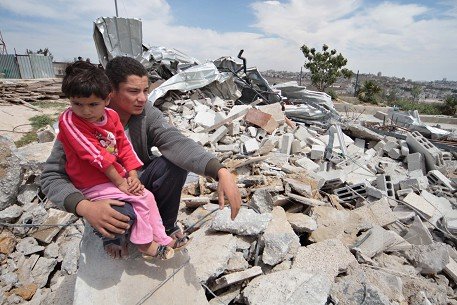
In an aggravation of Israeli policy of home demolitions, a house and two shops were razed in the Central West Bank village of Hares this morning. An additional house was reduced to rubble in the village of alKhadder, west of Bethlehem and a 1,000 square meters factory was demolished in the town Beit Sahour.
In what seems a coordinated move, Israeli forces carried out demolitions in two different areas of the West Bank today, rendering at least 16 people homeless. In recent months, international pressure has caused a significant decline in the demolition of Palestinian houses in the Israeli-controlled Area C of the West Bank. Israel uses its statutory authority in Area C, which spans over 60% of the West Bank, to dramatically limit Palestinian development. Palestinians fear that today’s concerted demolitions may be the opening salvo in a provocative change in Israeli policy.
Mahmoud Zwahare a popular committee member from the Bethlehem region said during the demolitions that “Israel keeps claiming it strives for peace and constantly complains about Palestinian incitement and violence. It is doing so while carrying out destructive and irreversible steps on the ground against ordinary civilians. The demolitions today have nothing to do with the security of Israelis and everything to do with provocation and injustice”.
A convoy of eight armored military jeeps and a D9 bulldozer entered the village of Hares in the early morning today and advanced towards the newly built house of Maher Sultan. The house, which Sultan had just finished constructing after five years, was to be home for himself, his wife and their five children. The two story house was quickly demolished by the bulldozer, which left nothing but rubble behind it.
The demolition order was posted on Sultan’s house a month ago, citing a Mohammed Mansour as the owner of the house, which complicated to procedures to stop the demolition. At the time of the demonstration, Sultan was actually at the DCO in Tulkarem to try an negotiate an injunction, unaware that his home is being razed.
After completing the demolition of Sultan’s house, the Israeli forces continued to demolish two stores in the outskirts of the village.
Almost simultaneously, a massive contingent of Israeli forces invaded the town of alKhadder, West of Bethlehem. The massive Israeli bulldozer demolished the house of Ali Mousa, which was home to nine people, including a one year old baby, as soldiers prevented anyone from nearing the house – including the family’s lawyer, who showed soldiers a 2006 court-issued injunction on the demolition.
After completing the demolition, an Israeli Civil Administration officer who was present at the scene informed people that more house demolitions will be carried in the near future.
Shortly after the alKhadder demolition, forces lead by the Israeli Civil Administration demolished a factory in the town of Beit Sahour. Roughly a year ago, Omar Ayyoub, the owner of the factory was served a halt-construction order by the civil administration, which he complied with and have been fighting ever since. When the bulldozers arrived today he pleaded with the officer in charge to stop the demolition, or at least present him with a valid demolition order. The officer refused and ordered Ayyoub removed from the scene.
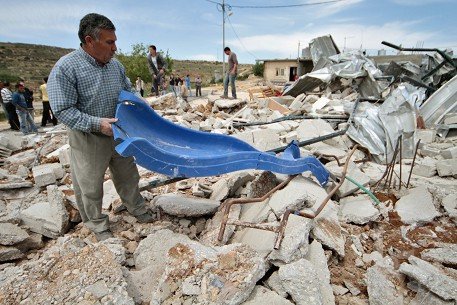 Home destroyed on 14 April 2010 under the pretext it was too close to Israel`s wall. [MaanImages/Haytham Othman]
Over 60 percent of the West Bank is currently classified as Area C, in which, under the Oslo accords, Israel has complete control, over both civil and security issues. According to the UN Office for the Coordination of Humanitarian Affairs (OCHA) some 70 percent of Area C, or approximately 44 percent of the West Bank, has been largely designated for the use of Israeli settlements or the Israeli military. The Israeli authorities generally allow Palestinian construction only within the boundaries of an Israeli-approved plan and these cover less than one percent of Area C, much of which is already built-up. As a result, Palestinians are left with no choice but to build “illegally” and risk demolition of their structures and displacement.
According to information released by the Israeli State Attorney’s Office in early December 2009, approximately 2,450 Palestinian-owned structures in Area C have been demolished due to lack of permit over the course of the past 12 years.
When the Army Uses “Enhanced Interrogation” on an American Soldier
Joshua Kors | The Nation | April 14, 2010
I had been covering veterans’ issues for several years and thought I’d developed a thick skin. But the pain on the other end of the telephone line was difficult to stomach. Sergeant Chuck Luther, now back from Iraq, was describing his journey to hell and back. The worst part, he said, wasn’t battling insurgents or even the mortar blast that tossed him to the ground and slammed his head against the concrete — it was the way he was treated by the U.S. Army when he went to the aid station and sought medical help.
In gruesome detail, Luther described what happened to him at Camp Taji’s aid station. He thought he would receive medical care. Instead he was confined to an isolation chamber and held there for over a month, under enforced sleep deprivation, until he agreed to sign papers saying that he was ill before coming to Iraq and thus not eligible for disability and medical benefits. “They wanted me to say I had a ‘personality disorder,'” Luther told me.
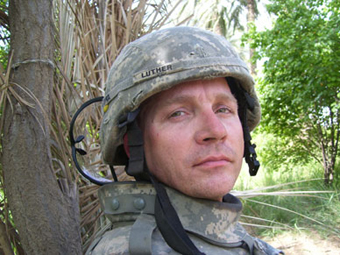
Luther’s call did not come out of the blue. For two years I had been investigating this personality disorder scandal: how military doctors were purposely misdiagnosing soldiers, wounded in combat, as having this pre-existing mental illness. As in the civilian world, where people can be locked out of the insurance system if they have a pre-existing condition, soldiers whose wounds can be attributed to a pre-existing illness can be denied disability benefits and long-term medical care.
My reporting began with the case of Specialist Jon Town, who was wounded in Iraq, won a Purple Heart and was then denied disability and medical benefits. Town’s doctor had concluded that his headaches and hearing loss were not caused by the 107-millimeter rocket that knocked him unconscious but by a pre-existing personality disorder.
The spotlight on Town prompted military doctors to step forward and talk about being pressured by their superiors to purposely misdiagnose wounded soldiers. One doctor spoke of a soldier who returned from Iraq with a massive chunk missing from his right leg. The doctor quit after he was pressured to diagnose that soldier as having personality disorder.
Since 2001 more than 22,600 soldiers have been discharged with personality disorder (PD), saving the military billions in disability and medical benefits.
My articles on the scandal sparked a Congressional hearing, a Law and Order episode, and before leaving office, President Bush signed a law requiring the Pentagon to investigate PD discharges. In the wake of those developments, I was flooded with calls from soldiers who had fractured bones and been pierced by grenade shrapnel, only to be told that their wounds came from a problem with their personality — a pre-existing illness that had somehow gone undetected with each military screening and only popped up now, after they returned wounded from combat.
Luther was one of thousands severely wounded in Iraq and Afghanistan now facing a lifetime without medical care. I had spoken to dozens of soldiers in his shoes. But his call haunted me. He sent me photos of the isolation chamber. It was the size of a walk-in closet and was crammed with cardboard boxes, a desk and a bedpan. Armed guards monitored him 24 hours a day. Luther told me how they stopped him from sleeping, keeping the lights on and blasting heavy metal music at him all through the night: Megadeth, Saliva, Disturbed. When he rebelled, Luther was pinned down and injected with sleeping medication.
“This was an aid station,” he said, “but it felt a lot more like enhanced interrogation than medical care.”
After a month, Luther was willing to sign anything — and did. Soon after he signed his name to a personality disorder discharge, he was whisked back to Fort Hood and informed about a PD discharge’s disastrous consequences. No disability pay, no long-term medical care, and because he didn’t serve out his contract, he’d have to pay back a portion of his signing bonus. “They told me I now owed the Army $1,500.”
I would spend the next two years investigating Luther’s case: reading the stacks of medical records written by Luther’s doctors, which document his confinement; talking with a fellow soldier who visited Luther during his month in the aid station; and interviewing his commander, who confirmed all the details.
Settlers vandalize mosque, burn cars, uproot olive trees in Huwwara
Ma’an – 14/04/2010

File Photo
Nablus – Israeli citizens living in an illegal West Bank settlement vandalized a mosque the village of Huwwara, after storming the Nablus village early Wednesday morning.
Settlers from the nearby Yitzhar settlement ascended upon the village at 2am and sprayed graffiti, including a Star of David and racist slogans across the the Bilal Ben Rab Mosque in the Qoza area of the village, said Ghassan Doughlas, Palestinian Authority official in charge of the settlement portfolio in the northern West Bank.
Two cars were further set on fire in the village, belonging to Ziad Abdullah Theeb and Sameer Ibrhaim Zahar respectively. The official added that settlers crashed into another vehicle belonging to Zaher’s brother.
According to Israeli media,more than 300 olive trees were uprooted and the racist graffiti was sprayed across the village.
In response to the incident, Itamar Ben-Gvir, a spokesman for the right-wing Jewish National Front party, said: “We are talking about a hostile village that has been the source of a large number of violent attacks against the residents of Yitzhar,” the Israeli daily Haaretz reported.
“The time has come for the Arabs to understand that Jews are not suckers and that Jewish blood will not be shed without consequence,” Ben-Gvir said, according to the daily.
A statement issued by the Israeli army confirmed the incident and said “the Commander of the IDF Judea and Samaria division [the West Bank], Brig. Gen. Nitzan Alon ordered an immediate investigation into the incident, condemned the acts and said that those responsible should be brought to justice.”
The Israeli army added that it “conveyed a message to the Palestinians through the Civil Administration,” reassuring them that it “takes the matter of harming holy sites very seriously.” The Civil Administration erased the graffiti following the incident, the statement said. In December 2009, Israeli settlers set fire to a mosque in the West Bank village of Yasuf.
Gaza: Clash with Israeli force kills 2 fighters
Ma’an – 13/04/2010
Gaza – Two fighters were killed and two others injured in clashes with Israeli forces near the Al-Bureij refugee camp following an Israeli military incursion into the Strip early Tuesday.
Medical sources at the Al-Aqsa Martyrs Hospital in Deir Al-Balah initially confirmed one dead and two injured, as eyewitnesses said Israeli artillery vehicles shelled the area while helicopters opened machine gun fire.
Until late in the morning, ambulances were unable to access the area to evacuate the injured, medics confirmed. By 2:30pm, however, medics reached the area and identified two slain fighters.
Islamic Jihad’s militant wing the Al-Quds Brigades said fighters with the units were involved in fierce clashes with an Israeli military force which attempted to cross the border. The group said its combatants hit their targets directly.
Israeli media said there were no soldiers injured in the attack, and said the incident was precipitated when Israeli forces saw a group of Palestinians planting an explosive device near the border, where Israel enforces a 150-300 meter no-go zone used for continued military control of the area.
An Israeli military spokeswoman confirmed the media report, noting a vehicle on a regular patrol in the border area identified the fighters, calling in armored vehicles and the Israeli airforce to assist in the attack.
They’ve Stolen Our Road!
By Peter Balaam | Palestine Monitor | 8 April 2010
We sat with Jamal and Susan and in their home in Shufa. Their seven children peeped in from time to time, daring each other to go and speak to the foreigners. Jamal explained how the road to their village has literally been stolen by some Israelis who live in a nearby illegal settlement.
We already knew about this, because our taxi-ride to Shufa had been interrupted by a huge earth mound and some concrete blocks in the road. We had to get out and walk the last mile up a steep hill.
This stretch of road is now solely for the use of the settlers, who use it to get to their settlement from the main road. The Israeli army will not allow Palestinians to use the road except on foot or on a donkey.

Photo: Peter Balaam
The road was built in 1950 by the Palestinians. In 1987, the Israelis built 40 houses on Palestinian land and started to share the road with the local villagers. The settlement expanded for some years, and then in 1995, the Israeli army suddenly built the earth mound and forbade the Palestinians to use the road. Now Jamal has to drive home from the school where he is the headteacher, park his car by the earth mound and walk the last mile uphill to his home. And he does this every day, in any weather, including temperatures in the 40s in summer.
“Why?” I asked Jamal. “Why can’t they share the road with you?” Jamal had no answer. For years they had shared the road with no problem. The Israeli answer is just “Security”, but they refuse to explain what they mean by this.
The only explanation that Jamal can think of is that the Israelis simply want to cause the Palestinians to suffer. Another explanation I have heard is that if someone wished to attack people in the settlement, the road would have provided an easy way of escape. But there has been no such attack in 23 years. Perhaps it’s just that the settlers feel nervous about sharing a road with people whose land they appropriated in order to build their settlement.

Photo: Peter Balaam
The stolen road has all sorts of other consequences. Jamal and Susan cannot drive to see their family in Lower Shufa, which is the other side of the earth mound. Farmers’ profits are reduced because each time they take their produce to market in Tulkarem, they need fuel for a 25 km journey instead of 6 km.
The villagers of Shufa have learnt to live with the settlers. In the past, they have been attacked by settlers during the olive harvest and settlers have destroyed hundreds of their olive trees. But they do not face the daily threat of settler violence that other Palestinians face. Life is merely uncomfortable. And nothing changes the fact that their road has been stolen. They live with this reality every day – just one more quiet, unchanging injustice.
The article was written by Peter Balaam. He works for Quaker Peace and Social Witness as an Ecumenical Accompanier serving on the World Council of Churches’ Ecumenical Accompaniment Programme in Palestine and Israel (EAPPI). The views contained in this article are personal and do not necessarily reflect those of QPSW or the WCC.
Israeli occupation forces surround school
Ma’an – 2/04/2010
 File Photo
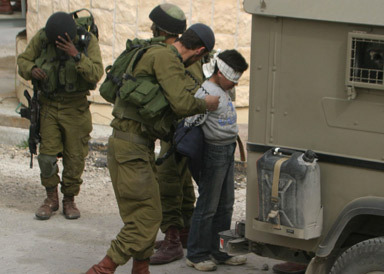
Qalqiliya – Israeli forces surrounded the Yasser Arafat School in the west end of Azzun, a town east of Qalqiliya on Monday. Troops demanded children evacuate the school so boys accused of rock throwing could be detained.
The school’s principal, Majid Odwan, said three military vehicles were stationed outside the gates of the building. Soldiers started by calling out the the children with loudspeakers demanding that they empty the school so several boys could be detained, he said.
Odwan shouted back that he refused the request and would keep children inside the school compound for the duration of their lessons, he said.
Responding to the principal’s remarks, soldiers declared that they would remain stationed outside the school until classes finished and take the children then. Soldiers remained outside the school for more than an hour, reports said.
An Israeli military spokeswoman confirmed the incident, but said a boy threw a “firebomb at an Israeli vehicle” and proceeded to “escape to a nearby school to hide out.”
Soldiers arrived to detain the child, she said, but did not in the end make an arrest.
Featured Video

Dan Dicks with James Corbett on Solutions Watch
or go to
Aletho News Archives – Video-Images
From the Archives
Secret document reveals plans for civil war in Lebanon, Israeli false flags, and invasion
By Randi Nord | Geopolitics Alert | April 5, 2019
Beirut – During his visit with US Secretary of State, Mike Pompeo, Lebanese President Michael Aoun reportedly received a US-Israeli document detailing plans for creating a civil war in Lebanon with covert false flag operations and possible Israeli invasion.
Although the source of the document is Israeli and created in partnership with Washington, no one knows who presented it to Aoun. The Lebanese TV station, Al-Jadeed, initially reported the document on Lebanese TV and a video on its website. Geopolitics Alert translated the report for this article. … continue
Blog Roll
 Aletho News
- How to MAKE THE CONSPIRATORS PAY for their crimes! Dan Dicks with James Corbett on Solutions Watch
- There’s a drought in academia: A drought in honest research on the subject of drought and other weather extremes
- Department of War Awards $20.7 Billion Contract to Raytheon for Air-to-Air Missiles
- ‘Distance yourselves from Israel’: IRGC urges US population to question govt policies
- America’s Greenland deal has a radioactive backstory
- The RAF Fairford ‘terror plot’: Unpacking escalation in the UK echo-chamber
- EU Council Advances Chat Control 2.0 Scanning Proposal
- Ex-Greek MEP files complaint against Israeli spyware firm over alleged Pegasus surveillance
- Troubling ideas throughout the Torah, Talmud, Mishneh Torah and Tanya
- ‘Grave, alarming’: Iran mission on Trump’s UNGA ‘annihilation’ threats
- If Americans Knew
- New Report: “Scholasticide and Genocide in Gaza: Assessment, Testimonies and Legal Analysis”
- Ex-Biden officials are desperate for a Gaza scapegoat
- Israeli “settlers” Invade Al-Aqsa; Pour Boiling Water on 75-Year-Old
- Israel Has Kidnapped Another American Teenager
- US arms sales to Israel worth $21.6 billion in 20 months
- Three Palestinians Killed in Israeli Attacks on Gaza
- Revealed: German “Anti-Semitism Expert” Driving Crackdown on Palestine Solidarity is Former Israeli Spy
- Egypt’s Warning to Israel Before Oct 7
- Israel’s siege signals another cruel winter for 1.8 million Gazans – Daily Update
- Netanyahu Asked UAE Leader to Deny Report on Oct. 7 Warning in Secret Visit, Sources Say
- No Tricks Zone
- New Study: Earth And Venus Surface Warmth Largely Explained By Convection And Lapse Rate, Not CO2 Or Radiation
- 2025 Nature Paper Claiming Worsening Global Drought Gets RETRACTED …Heavily Flawed
- New Study: ‘Global Drought Shows No Detectable Recent Acceleration Under Climate Warming’
- Economic Masterminds: German Socialists Suggest Taxing Productivity Gains Stemming From Using AI
- The South China Sea Has Not Been Cooperating With The Climate Change Narrative
- Energy Crisis: Germany Enters Heating Season With Historically Low Gas Reserve Fill Levels
- New Study: The Antarctic Ice Sheet Gained Mass From 2020-2024 Due To Staggering Snow And Ice Accumulation
- Study: Ocean Heating Rates From Thousands Of Years Ago ‘Dwarf’ Modern Ocean Heating Rates
- Climate Extremists Target, Attack Large-Scale Power Grid Infrastructure In Germany!
- New Study: Antarctic Ice Melt Has Contributed Less Than 1 Centimeter To Sea Level Rise In The Last 30 Years

