Affecting and Affected
Eva Bartlett | In Gaza | April 11, 2010
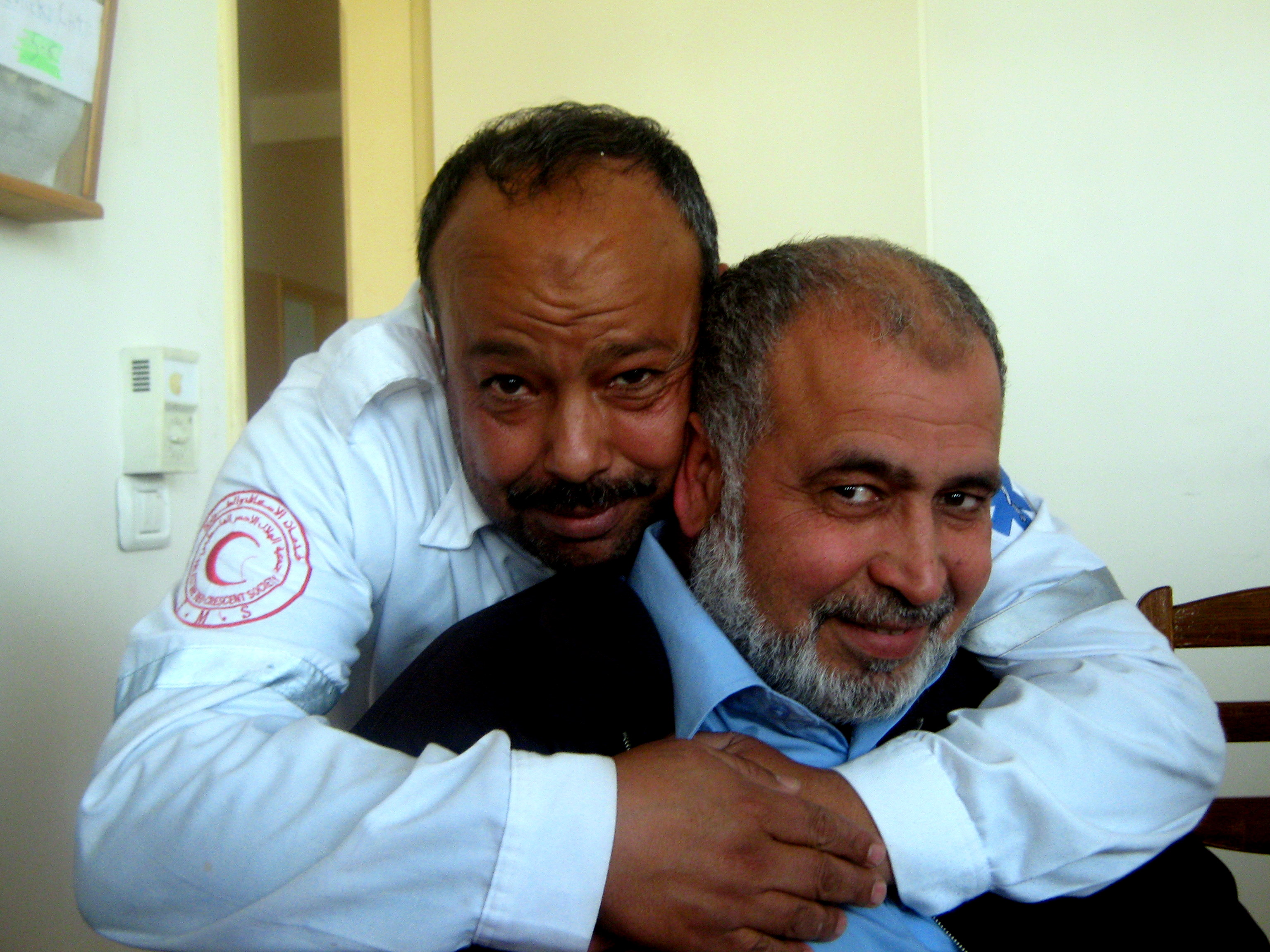
Abu Basel (right) is one of the long-termers, having served over 20 years as a medic in Gaza.
“Who will take care of people if not us? Someone has to do this work. Without medics, who will care for the injured? Everyone has something to contribute,” he replied to the question: why do you do such dangerous work.
Dangerous work. Being a medic hardly seems dangerous…anywhere else. But in a place like Palestine, medics have to contend with more than tending to the injured or bringing in the dead. They have to be aware of Israeli soldiers’ shooting, shelling from Apaches, F-16s, tanks, the sea…
Having spoken with Abu Basel many times during and after the Israeli massacre of Gaza last year, I thought I’d heard most of his horror stories.
He is a calm man, when not driving the ambulance, and relates all his stories in the same laid-back tone, whether joyful or atrocious.
Upon request, he begins to recall some of the many dangers he was exposed to during the last Israeli attacks, not to mention the nearly 2 decades before that.
He recalls being with medics and 4 ambulances, 2 metres from the Al Kurdi house in the Jabaliya region when an F-16 bombed it.
“How in the world are you alive?” I ask.
“It’s in God’s hands,” he replies.
He remembers a night in Beit Lahiya when they rushed to the site of a drone missile bombing.
“It was 1 am. We found the injured and brought the stretcher. A drone dropped another missile. Because it was night and there were not as many noises as during the day, I heard the sssss of the missile and we ran. The missile landed 1 metre from ambulance and 1.5 metres from the injured.
We ran back and grabbed the injured and drove. Two minutes later an F-16 bombed the house where we’d taken the injured from.”
He relates another incident in Sheyjayee where, similarly, a drone attacked his ambulance, dropping a missile metres from his ambulance.
“We’d gone to retrieve 5 injured but were only able to take four before the missile struck. A man nearby who had come to help us load the injured was killed by the missile. The ambulance windows shattered and my colleagues were injured.”
He then recalls 2 incidents when he says his ambulance had coordination via the International Committee of the Red Cross (ICRC) to reach an area the Israeli soldiers were occupying or preventing ambulances from accessing.
We went to Attatra with 3 Red Crescent ambulances and an ICRC jeep to bring out injured. When we reached the area, Israeli tanks started firing on us with machine gun fire. An ICRC employee started speaking with the Israelis via phone. ‘You’re firing on us,’ he said and the Israelis denied it. But the tanks kept firing and we had to leave quickly because of the danger.
Another time, in Esserah area, Beit Lahiya, we again went with coordination. We went there along the sea route and when near the area got on the microphone. ‘If there’s anyone injured or anyone needs to leave or has an ill person or needs help, we’re ICRC and RC, we’re here to help,’ we told them.
There was a guy sitting outside his destroyed house. He told us 13 people from his family were inside the house (children, elderly, women). We began helping them, loading them into our ambulances. When the Israeli soldiers saw us helping the people, they began firing on us from their tanks. We hurried, took the 13 people into our ambulance. Two tires were blown out on one ambulance, but there wasn’t time to transfer the people or wait for other ambulances. They’d been in there, the 14 of them, since their house was destroyed a week earlier. They’d been without food for the week, just had water.”

Iyad has been a medic for 16 years and equally has too many close calls to remember.
He shares some of his near-death escapes.
“I was working in the Red Crescent centre near Al Quds hospital, in the Tel el Howa area of Gaza City. After the Samounis were bombed, I went one afternoon to bring some of the martyrs. A drone and tanks fired missiles on the road we were driving on. Six missiles, the closest was just 8 metres away. We had gone without coordination, because there were many martyrs and the area where we headed was somewhat far from the Israelis, maybe 500 metres away. I saw them and they saw me. We managed to take a marytr and leave.”
Living in central Gaza, Iyad was among the medics completely cut off from his family during the massacre.
“For about a week I didn’t know anything on my family, the phone reception was so bad we couldn’t call each other. I live in Nussierat, and the road was severed by the Israelis, so I couldn’t get to them or communicate with them.”
“There are so many incidents,” Abu Basel says, “but I can’t remember them all, so many.”
He repeats what most medics have said.
“We weren’t afraid, despite the danger. But it was hard. We weren’t sleeping, not eating well –there was no time to eat or sleep. Most didn’t see our families during the war, just a minute or two here or there.”
While you’d think the most difficult time was the Israeli war on Gaza itself, because the medics were kept busy, most didn’t have time to think about the horrors of what they were seeing and experiencing.
“The hardest hardest was after the war,” says Abu Basel. “During the war, I knew there was death. I’d see a body, then a different body. I wouldn’t dwell on what I had seen, would just think about what I had to do next.
But after the war, I began to have terrible dreams, I’d remember everything. For 2 months I dreamed horrible dreams, warplanes, the bodies, everything I saw in the war I re-lived in my dreams.
That was much harder than the war.”
I remember Abu Basel telling me about finding Shahed Abu Halima, the infant girl killed by white phosphorous shelling, her corpse left for days as medics and family were unable to bring it out. Abu Basel was among the medics who uncovered the Abu Halima massacre, the charred remains of those family members killed in the shelling, and the gnawed body of Shahed, partially eaten by dogs.
“For the rest of my life I’ll remember that day. I’ll never get over it,” he said.
Do they feel scarred by their work and experiences?
“After 20 years of this, this kind of stress and work is normal. But still, after this last war, the worst so far, people were extremely nervous and agitated. Some developed diabetes. Many found that after the war they got angry easily and were not sociable, didn’t want to speak to people… but now most are better.
Many medics can’t have babies. I know one who after 7 years still hasn’t had children.
Many take medications to have kids. It’s because they are very stressed, they see a lot of terrible things and begin to have problems with psychology.”
After the massacre, a psychologist came to the Red Crescent to do workshops with the medics, says Abu Basel.
“For a month and a half, two days per week, we had sessions. He spoke with us, showed us exercises for relaxation, took us to the sea…
He gave us the will and spirit to work and live well.
The problem for us isn’t our psychology. We only need a break, to go somewhere else for a vacation and see something different. Go to Europe or somewhere, see a different life and try to forget what we saw.
For Iyad, there is no relaxation.
I sleep. Only. There’s nothing else to do. When I use the internet, there’s news. I watch TV or listen to the radio, and I hear news. I walk on the street, and all I hear is politics. There is no escape from this stress, no way to relax but to sleep.”


Ahmed Abu Foul’s daughter Hola is 6 months old now. Married just one week before the Israeli massacre of Gaza erupted, Ahmed’s honeymoon was 23 days of hell in his dual positions of medic with the Red Crescent and with the Civil Defense, along with the hell of being separated from family.
Although only 27, Ahmed’s stories are too many to recount.
He re-visits some of them, which I marveled over before:
-The time he went to retrieve a martyr near a cemetery in Beit Lahiya. Israeli machine gun fire erupts at him and Ahmed is trapped, lying on the road, breaking for it and zig-zagging his way back to the ambulance.
-When they went to the site of a bombing in Sheik Radwan, north of Gaza City.
“There had been a drone strike on a house, they said there were injured.
I was looking to see if anyone [was] injured. I was next to a 5 story house, in the alley, when an F-16 hit the house next to me. It fell in the other direction, but rubble fell on me.
I wasn’t badly injured, somehow, but my hair stood on end and I lost my hearing for 4 or 5 days,” Ahmed tells with a grin.
But his most troubling recent injury is that inflicted as he attempted to evacuate a martyr from a Jabaliya apartment.
“The Israelis had fired numerous missiles on Hamouda tower, a 5 story building in Jabaliya district. When we got there, we were told there was a martyr on 5th floor. I was the first to enter, everyone else was afraid. I found the body and Dr Issa Salah came up to help.
We were carrying the corpse down the stairs when the Israelis fired on us. The bomb blast decapitated Dr. Issa. His head hit me in the back of my head . I thought I’d been hit by shrapnel or something. Now I’ve got shrapnel in my head, but its bone shrapnel, from the dr. Issa. And shrapnel in leg from the bomb blast.
In a society where nearly everyone suffers from the continuous Israeli attacks, invasions, and wars, venting is not easy, and going to a psychologist is not the norm.
“After the war, I became extremely, extremely nervous. I was agitated and got angry easily. Sometimes if someone was making noise or annoying me I’d want to hit them,” he says, still smiling his open smile.
“I was never rested. When I’d wake, I’d still feel like I hadn’t slept.
Until today, I still have nightmares from the war.
I went to a doctor. Every 2 days I saw her. If I hadn’t gone I would have been completely destroyed long ago.
We talked about my feelings. I just talked and talked, no medicine, just talking. By the end she said I was fine.
Some people are afraid to go to a therapist. Others might say they are crazy. But I know I wasn’t crazy, I just needed to talk, needed to fix my psychological state.”
And like the others, Ahmed longs for a reprieve, even for a week.
“If I could just leave Gaza for one week, breathe a different air, all my psychological problems and stress would go. Even if I just went to Cairo.”
Israeli occupation forces round up 14 including foreigners, journalists
Palestine Information Center – 11/04/2010

AL-KHALIL — Israeli occupation forces (IOF) rounded up 14 civilians in Beit Ummar, north of Al-Khalil, on Saturday night including foreign activists and journalists.
Local sources told the PIC that the IOF troops severely beat up participants in a march that headed to farmers’ lands near the village after firing teargas bombs and stun grenades at them.
They added that the soldiers blocked the foreign activists, farmers and anti-settlement campaigners from reaching the lands threatened with confiscation near Beit Ayan settlement and arrested 14 one of them including two journalists and six foreigners.
A similar demonstration was organized by the Irak Burin villagers south of Nablus on Saturday with the participation of foreign activists to protest Israeli confiscation of their land east of the village.
Eyewitnesses said that the massive march headed to the mountain threatened with confiscation, noting that the participants hoisted the photos of two martyrs who were killed by IOF soldiers a few weeks ago during protest demonstrations.
The village of Irak Burin is the target of systematic attacks on the part of settlers in nearby settlements of Yitzhar and Brakha, which were built on village land. The settlers wish to expand their settlements at the expense of the village land.
Israel’s Pentagon Papers
By Bernard Avishai | TPM | April 9, 2010
Common sense tells you that the Israeli military, charged with keeping Israeli citizens as safe as possible, should have the right to keep operational plans secret; and that the government–acting within bounds set by the judiciary–should have the right to censor any stories about such plans and prosecute the people who leak them. But what if the military, acting as an occupation force, is itself violating bounds set by the judiciary, and its actions are arguably making citizens less safe? What if a whistle-blower leaks documents to a journalist, who then uses them to write a story questioning the legality or efficacy of the military’s actions? What if the story is itself passed by the censor, but the government opens an investigation into the journalist’s sources?
What, then, if the journalist, cooperating with the investigation, hands over documents in an agreement that stipulates that they could not be used to prosecute the source, if found? And what, nevertheless, if the government finds the whistle-blower and charges her under laws written, not to deal with the press, but to prevent espionage for a hostile foreign government? What if the government refuses to renounce the option of arresting the journalist for holding prohibited documents–so he remains in London, refusing to return to the country?
THIS, IN A nutshell, is the troubling case of a young woman, Anat Kam, who allegedly (well, apparently) leaked documents from the office of the Central Command to Haaretz journalist Uri Blau, showing that the IDF systematically issued operational guidelines to its soldiers quite different from regulations the courts have required. The latter decreed that the military may not simply engage in targeted assassination in the occupied territories; that, rather, soldiers must at least try to take Palestinian suspects alive, and not unreasonably endanger innocent bystanders during search operations. Blau’s original piece exposed how the IDF ignored these bounds. He explored cases where Palestinians who might have been arrested were killed, as were bystanders.
Haaretz–which, as if more proof were needed, is emerging as a great world newspaper–is defending its journalist with all of its force. I won’t attempt to compete with its morning edition, that gives any patient reader the full picture, including this editorial, arguing how military intelligence broke the deal it made with the paper, and this follow-up by Blau.
I will, however, make one point the paper does not make, about the efficacy of targeted assassinations themselves. Presumably, these are justified, and the regulations issued to facilitate them justified, because occupation forces preempt attacks on Israeli civilians by getting the bad guys before they get us. I have no doubt that, in some cases, this preemption has saved lives. But what if, on the whole, the opposite is true, that shooting preemptively and recklessly raises the likelihood of violence against Israelis.
ANYONE WHO GIVES this a moment’s thought must see this is at least possible. An old friend of mine, the University of Toronto sociologist Robert Brym, carefully studied all 138 suicide bombings between September 2000 and mid-July 2005. He concluded that, in the vast majority of cases, the suicide bombers themselves–whatever their “ideological” predispositions, or the groups that claimed responsibility–had lost a friend or close relative to Israeli fire. They acted, he wrote, “out of revenge.”
Which is precisely why the newspaper was as justified in exposing these secret documents as the Times and the Post were justified in publishing the Pentagon Papers. Haaretz’s Akiva Eldar connected the dots this morning when he wrote that he expects the real story of how the Al-Aqsa Intifada got started is buried somewhere in similar documents–the ones we have not yet seen–documents pointed to by Kam’s leaked ones, testifying to the IDF’s vendetta culture:
Right now, hundreds of clerks and officers are sitting in the Defense Ministry, the Foreign Ministry and the army lacking the courage to contact a journalist and divulge that the ministers or commanders in charge are endangering their children’s future.
Some are keeping to themselves the real story behind the big lie peddled by Ehud Barak, Shaul Mofaz and Moshe Ya’alon – the falsehood that “Yasser Arafat planned the intifada,” which gave rise to the disastrous “there is no partner” ideology. The real story, of course, is contained in documents stamped with the words “Top Secret.”
I expect we will soon hear stories about Kam’s youth, or ingenuousness, or flakiness, which all may be as true as Daniel Ellsberg’s depressions. None of this changes the importance to Israeli democracy of airing the question of whether targeted assassinations as practiced and sanctioned by the IDF command are either morally acceptable in a country of law or will make any of us sleep more safely, even if not more soundly.
Witnesses: Soldiers look on as settlers beat 2
Ma’an – 09/04/2010
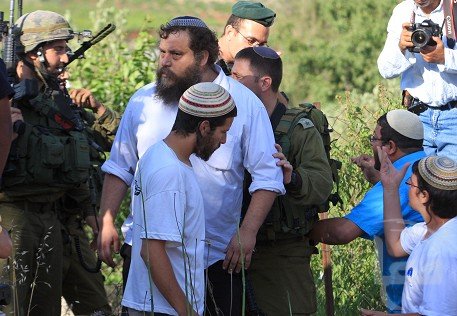 Hebron – Two 19-year-old men were transferred to a Hebron hospital for treatment Wednesday after being harshly beaten by Israeli settlers near the Ibrahimi Mosque, locals said.
Witnesses identified the two as Muhammad Abdul Raouf Al-Muhtaseb and Rushdi Al-Muhtaseb, both 19, and said soldiers looked on as settlers attacked the men and did nothing to interfere.
On 31 March a similar incident was reported, with A’teiyah Yousef Maswada, 31, transferred to hospital following an attack by some 10 settlers outside of the mosque.
Palestinian police reported the attack, and eyewitnesses including Christian Peacemaker Teams corroborated the account, with Israeli police unavailable for comment by phone.
Shopkeepers in the area said the man was en route to the Ibrahimi Mosque when he was assaulted, and was described as having a bloody face, CPT reported, noting that witnesses said the man did not go to the hospital. By the time Israeli police arrived on the scene, the CPT observer noted, shopkeepers said the settlers had fled.
Gandhi’s grandson in Al-Khalil supports Palestinian just struggle
Palestine Information Center – 05/04/2010

AL-KHALIL — Israeli occupation forces (IOF) have tried to obstruct the tour of Rajmohan Gandhi, the grandson of Indian independence leader Mahatma Gandhi, and his wife Usha in Al-Khalil city on Sunday.
Local sources said that the IOF soldiers tried to prevent the couple, who were accompanied by Palestinian MP Mustafa Al-Barghouthi, from reaching the settlement outposts erected in the vicinity of the Ibrahimi Mosque and detained a number of journalists who were covering the visit.
Gandhi, after touring the Old City and the Ibrahimi Mosque, told a press conference that the Palestinian people were entitled to freedom and independence.
He said that the electronic gates installed in front of the Ibrahimi Mosque were an insult to humanity, and a humiliation that the Israeli occupation should stop.
The Israeli repression in the city of Al-Khalil was obvious including the confiscation of civilian homes and attacking citizens, he said, expressing absolute support for the Palestinians’ popular struggle.
Gandhi said that the world community was fast asleep and was not moving to amend the situation, promising to convey what he saw to the world so that it would wake up and act.
Israel destroys Gaza dairy for second time
Rami Almeghari writing from the occupied Gaza Strip, Live from Palestine, 5 April 2010
 |
Palestinians inspect the remains of the destroyed Dalloul dairy plant in southern Gaza City. (Rami Almeghari) |
It was not a chemical plant, nor a nuclear facility, nor a manufacturer of weapons of mass destruction. But almost all the rubble of the entirely destroyed factory was covered in white, with white chunks everywhere. These were pieces of cheese, butter and yoghurt — some of the products made by the Dalloul dairy factory in southern Gaza City.
Israeli warplanes bombed the factory shortly after midnight last Thursday through Friday night, 1-2 April, leaving the building, all its equipment and the distribution van completely destroyed.
“At 12:30am we heard a very loud explosion nearby,” said owner Mutassim Dalloul as he inspected the wreckage on Friday morning. “I got downstairs to find my factory completely destroyed. Everything inside, including the machines, the power generator and all our products, [was destroyed].”
This was not the first Israeli attack on the factory.
“During the January 2009 war on Gaza, Israeli warplanes hit my factory, inflicting an estimated loss of half a million dollars. However, my brothers and I decided to rebuild it, so we now have a newly-destroyed dairy,” Dalloul said. He estimated the losses from the latest attack to be at least $100,000.
The Dalloul dairy is located in southern Gaza City, far away from the Gaza-Israel boundary. The factory distributed its products all over the city.
“At least 60 family members used to be supported from the work at this diary. I myself have a family of nine, including myself and my wife. My two brothers along with a number of other workers used to work at this factory, trying to get by under these harsh circumstances,” Dalloul patiently explained, despite his loss.
The attack on the Dalloul factory was part of about a dozen air raids carried out across the Gaza Strip in what Israel said was a response to rockets fired from Gaza into nearby Israeli towns (Palestinian resistance factions for their part say their rocket fire is a response to constant Israeli attacks on Gaza). Israeli leaders have publicly threatened harsh attacks on the territory after Palestinian resistance fighters killed two Israeli soldiers when an Israeli patrol made an incursion into the Gaza Strip last week.
International officials have warned in recent days against an escalation in violence, and the Palestinian prime minister in Gaza, Ismail Haniyeh, called for international intervention to prevent further deterioration. Al-Quds al-Arabi newspaper reported on 5 April that representatives of all Palestinian factions in Gaza, except for Fatah which declined to attend, had met to discuss a moratorium on rocket fire into Israel, while reserving the right to self-defense.
“I cannot imagine what my factory has to do with the ongoing situation,” Dalloul said. “Can you see a homemade rocket? Can you see a single bullet? Can you see a gun? Why did they attack my dairy?”
Since June 2007 — when Israel tightened its blockade of Gaza — the economy has sunk into a deep depression as unemployment has hit as high as 70 percent. Poverty among the 1.5 million residents has reached unprecedented levels with more than 80 percent of the population dependent on food aid provided by UNRWA, the UN agency for Palestine refugees. The dire situation is the result of Israel’s closure, according to numerous international assessments. Although Israel erratically opens border crossings for the import of food and other basic necessities to Gaza, only a fraction of the people’s requirements get in.
Dalloul’s was one of the few dairies meeting Gaza’s needs. In one corner of the factory, Haroun Dalloul, who worked at the factory, was picking up pieces of cheese. “I didn’t imagine I would get up this sad morning to throw the cheese into trash cans, instead of helping distribute it,” he said.
Mustafa al-Qayed, a local resident, expressed resentment at the attack: “The destroyed factory used to provide our neighborhood with milk and cheese daily.” He noted that the prices of the locally-made products were much lower than the Israeli products that were occasionally imported into Gaza.
According to economic assessments in Gaza, approximately 95 percent of Gaza’s local industrial facilities have been forced to shut down because of the closure of Gaza’s commercial crossings. The closing of the these facilities has rendered more than 70,000 Gaza laborers jobless. Dalloul’s dairy, along with several metal workshops Israel also destroyed in the latest attacks, were vital to Gaza’s economy.
During its December 2008-January 2009 attack on Gaza, Israel destroyed a number of other facilities central to Gaza’s food supply, including the al-Badr flour mill — the only functioning one in in the territory — and the Sawafiry chicken farm which supplied the vast majority of the territory’s eggs. The UN-commissioned Goldstone report found that these attacks, as well as others on Gaza’s water, food and agricultural infrastructure, appeared to be part of a deliberate pattern and constituted violations of the right to food, as well as possible war crimes and crimes against humanity.
However, manufacturers like Dalloul are determined to get their businesses back up and running.
“The same way we rebuilt our factory that was bombarded during the war, we are determined to rebuild this one,” Mutassim Dalloul said. “We are determined with a great deal of hope to resume our production, to say to our enemy that whatever you do will never make us succumb.”
Meanwhile, Dalloul greeted well-wishers arriving to the factory offering sympathy and support.
Rami Almeghari is a journalist and university lecturer based in the Gaza Strip.
Racism against Arabs in Israel escalates
Middle East Monitor | April 4, 2010
A report by the Centre for Equality and Coalition Against Racism has confirmed a 28% rise over the past year in incidents of racism against Palestinians in Israel who constitute 20% of its population.
The centre monitored 286 racist incidents against Palestinians by Israelis, pointing out that 21 draft racist laws were proposed since the election of the current parliament. The data also revealed that racism is now endemic in the Jewish religious establishment, pointing to high levels of incitement carried out by rabbis against Palestinian Arabs.
The report said that the police continue to deal with Arab citizens as enemies, and instead of protecting them, neglect them. As a result, “Arab citizens’ confidence in the body that is supposed to protect them is lost.”
Human rights activists and researchers in the field of anti-racism note that: “racism has become legitimate in the Israeli street and is part of the general atmosphere and the lives of its victims.” They stress, however, that it does not mean that Palestinians living in lands occupied in 1948 should give in to the status quo, but they should step up their opposition and organize their struggle against racism.
Arab MP in the Knesset, Dr. Afou Ighbaria, President of the parliamentary lobby against racism said: “the majority of the Israeli street is heading toward extremist forms of racism as a result of the campaigns of incitement led by the right-wing government through the legislation of the worst racist laws.”
He also affirmed that the parliamentarian lobby against racism which was recently established under his initiative will be the vehicle of opposition inside the Knesset, in collaboration with the anti-racism movement, which includes 19 Arab and Jewish institutions, as well as Islamic figures and human rights committees.
Meanwhile, Nidal Othman, a lawyer from the Centre for Equality, said: “the increasing incidence of racism in recent years has a direct relationship to rejection of internal peace in Israel and peace in the region generally.”
He added: “the continuation of the occupation policy in the West Bank and occupied Jerusalem, and blockade of the Gaza Strip, as well as the continued expansion of settlements, are in themselves racist practices that blatantly and criminally violate human rights and the rights of the Palestinian people.”
Othman pointed out that recent years have witnessed a steady decline of the judiciary system in Israel resulting in proposals for laws that circumvent the decisions of the Supreme Court of Justice, and official institutions refraining from implementing court decisions, in addition to massive attacks on the judicial system by the media and politicians.
Another official, Baker Awawdeh, Director of the Centre Against Racism in Israel added: “It is not surprising that the phenomenon of racism is increasing in the Israeli streets, as long as there are Jewish MPs in the parliament who continue to describe the Arabs as a demographic bomb and a cancer within the state, and as long as textbooks continue to be swamped with hatred and prejudice against Arab citizens in order to restrict and force them to leave their land.”
Awawdeh recalled that Foreign Affairs Minister, Avigdor Lieberman, has already urged the House to prosecute Arab MPs and execute them. He pointed out that the Israeli Judiciary system is dealing very softly with the racists who trample under their feet local and international laws that prohibit discrimination and incitement of racism.
Israeli occupation troops round up 1,400 Palestinians in 3 months
Palestine Information Center – 04/04/2010

GAZA — The higher national committee in support of prisoners on Sunday said that the Israeli occupation forces (IOF) had detained more than 1,400 Palestinians in the first quarter of 2010 including 90 from the Gaza Strip.
Riyadh Al-Ashkar, the head of the committee’s information office, said in a press release that the number of detainees from Jerusalem and the West Bank was on the rise, noting that 400 citizens were rounded up in Jerusalem alone.
Ashkar said that 18 fishermen were among the 90 detainees from Gaza Strip along with many other workers who were detained while collecting scrap near the northern crossing.
He said that there are seven women among the detainees, three of whom were released while four others are still detained including Muntaha Al-Tawil the wife of El-Bireh mayor who was held in administrative detention for three months.
He added that 225 of the detainees were children less than 18 years old, noting that the IOF soldiers were increasingly detaining children less than 12 years old and mentioned a number of cases where 9 year olds were detained.
Ashkar said that many prisoners were suffering as a result of deliberate medical neglect on the part of the Israeli prisons authority (IPA) and as a result of the escalating attacks on their wards and the humiliating strip searches that even expanded to include relatives visiting them.
He said that the IPA was threatening 15 prisoners with deportation and has turned 9 captives into open-ended detention after considering them “unlawful combatants”.
The committee appealed to the international organizations to pressure Israel into halting the rabid campaign against prisoners and to apply the fourth Geneva Convention in this issue.
Tibi: Barak responsible for Palestinian death at checkpoint
Ma’an/Agencies – 04/04/2010
Bethlehem – Palestinian Knesset Member Ahmad Tibi said Israel’s Defense Minister Ehud Barak bears responsibility for the death of a diabetic at a West Bank checkpoint, Israeli media reported.
“Ehud Barak is personally responsible for his cruel death. The orders at roadblocks require the humiliation and oppression of a civil population, and the person who issued the order is responsible for the death of a Palestinian-French civilian,” said Tibi according to the Israeli daily Yedioth Aharonoth.
Mohammad Damen Abed Al-Karim E’lieyat, 62, from the village of Dir Abu Da’eef in Jenin, was en route to the Jordan Valley but was barred from transit for several hours at the Al-Hamra checkpoint in Tubas. E’lieyat, diabetic with high blood pressure, died of a severe heart attack shortly after being allowed to cross.
E’lieyat made several attempts to cross but was turned back by Israeli authorities who said that he was unable to pass because he held French citizenship.
An Israeli military spokesman told Ma’an that a complaint was filed with the Jericho DCO following the death.
Settlers attack elderly woman in Sheikh Jarrah
Ma’an – 03/04/2010
Jerusalem – Israeli settlers assaulted an elderly Palestinian woman and her daughter in the Sheikh Jarrah neighborhood of East Jerusalem on Friday, amid protests against settler “provocations” in the area.
The elderly woman, 89-year-old Rifqa Al-Kurd, was taken to Al-Maqasid Hospital in Jerusalem where she received medical treatment before she was discharged. Her daughter was identified as 50-year-old Nadiya.
Ma’an’s correspondent reported that some 200 demonstrators, including international sympathizers, rallied in the district home to a number of settlers, protesting recent attacks on Palestinian residents of the neighborhood.
He pointed out that the elderly woman was attacked in front of Israeli police officers who opted not to stop them. Instead, they told the Al-Kurd family to file a legal case against the settler who was filmed attacking the woman and her daughter, he said.
Also Friday, local residents accused some Israeli police officers of attacking Palestinians who tried to defend themselves against the settlers.
Israeli settlers and soldiers attacked Palestinians in Silwan on Thursday night, onlookers said. A 15-year-old boy, Yezen Ammar Siam, was taken to an undisclosed location, witnesses in the flashpoint area said.
No Drawdown for US Special Forces in Iraq
By Jason Ditz | April 02, 2010
Despite much being made of the so-called August timetable that would spell an end to “combat” missions in Iraq and cut the US forces to about 50,000, SOCOM head Admiral Eric Olson today announced that this would not affect his troops, which are involved in some of the heaviest combat.
 “The special operations forces are not experiencing a drawdown in Iraq,” Olson insisted, adding that the 50,000 troops scheduled to stay behind would have a “continuing mission” to support their operations.
The admiral gave no indication that there was a separate drawdown timetable at all for the 4,500 SOCOM forces in Iraq, saying that his conversations with Gens. Petraeus and Odierno suggested that they were planning to sustain that level going forward.
There have been discussions for months that the August drawdown would be slowed or even stopped altogether amid rising violence in the nation, but the comments by Admiral Olson today suggest that the speculative drawdown strategy had never included his forces, and that the administration never had any intention of stopping combat operations in August.
Israeli Court Decides Not To File Charges Against Soldier Who Killed Nonviolent Protestor in Bil’in
By Saed Bannoura – IMEMC & Agencies – April 02, 2010
Despite a video clearly showing the death of Bassem Abu Rahma, who was shot in the chest by a gas bomb, an Israeli court decided Thursday that the killing that took place during a nonviolent protest against the Annexation Wall in Ni’lin near Ramallah, was not intentional.
The brother of Abu Rahma slammed the decision and said it comes to give the soldiers more chances to continue the killing of innocent, nonviolent protestors.
The soldier will not face any charges, and will be allowed to resume his military service as if nothing happened. Bassem Abu Rahma, 31, was killed in April of last year. Israeli and International peace activists were also at the scene.
The Israeli army claimed that Abu Rahma and other protestors were throwing stones at the soldiers, yet the video footage clearly shows him shouting at the soldiers asking them not to open fire. “rega, rega, catzin” the Hebrew words Abu Rahma told the soldiers… “officer… officer… wait.. listen..”.
The Israeli court disregarded the facts and decided to close all investigations in the issue, and decided that the gas bomb fired by the army was not intentionally aimed at Abu Rahma.
This decision disregarded the fact that the soldiers did not have to open fire at the protestors to start with as they were not under attack, and the nonviolent protestors were on the other side of a barbed-wire fence installed by the army.
Bil’in in the scene of weekly nonviolent protests against the illegal Israeli Annexation Wall and settlements. Israeli and International peace activists join the residents in their protests in Bil’in and in several other Palestinian villages in the West Bank.
Ashraf, the brother of Bassem, said that the court’s decision does not surprise him, and added that “Israel’s Justice System provides cover for the soldiers to continue their crimes”.
In July of 2008, Ashraf was detained by Israeli soldiers during a nonviolent protest in the nearby village of Ni’lin, and after he was cuffed and blindfolded a soldier, standing next to him, pointed his gun at his leg and shot him with a rubber-coated bullet.
The shooting of Ashraf was also caught on tape by a young Palestinian girl. Israeli soldiers kidnapped her father later on as a punishment just for exposing the crime.
Commenting on his brother’s death, Ashraf said that hundreds witnessed the attack, and heard Bassem call out to the soldier asking him to hold his fire, but the soldier shot him while he was only six meters (nearly 20 feet)away.
Ashraf stated that the family will file an appeal to the Israeli High Court of Justice, and should it also fail to achieve justice, the family would resort to the International Court.
The army insists that the soldiers did not commit any violation, and that the decision was made after examining all related details.
Featured Video

Dan Dicks with James Corbett on Solutions Watch
or go to
Aletho News Archives – Video-Images
From the Archives
Secret document reveals plans for civil war in Lebanon, Israeli false flags, and invasion
By Randi Nord | Geopolitics Alert | April 5, 2019
Beirut – During his visit with US Secretary of State, Mike Pompeo, Lebanese President Michael Aoun reportedly received a US-Israeli document detailing plans for creating a civil war in Lebanon with covert false flag operations and possible Israeli invasion.
Although the source of the document is Israeli and created in partnership with Washington, no one knows who presented it to Aoun. The Lebanese TV station, Al-Jadeed, initially reported the document on Lebanese TV and a video on its website. Geopolitics Alert translated the report for this article. … continue
Blog Roll
 Aletho News
- Sheikh al-Asadi warns of Iraqi government compliance with US demands
- How to MAKE THE CONSPIRATORS PAY for their crimes! Dan Dicks with James Corbett on Solutions Watch
- There’s a drought in academia: A drought in honest research on the subject of drought and other weather extremes
- Department of War Awards $20.7 Billion Contract to Raytheon for Air-to-Air Missiles
- ‘Distance yourselves from Israel’: IRGC urges US population to question govt policies
- America’s Greenland deal has a radioactive backstory
- The RAF Fairford ‘terror plot’: Unpacking escalation in the UK echo-chamber
- EU Council Advances Chat Control 2.0 Scanning Proposal
- Ex-Greek MEP files complaint against Israeli spyware firm over alleged Pegasus surveillance
- Troubling ideas throughout the Torah, Talmud, Mishneh Torah and Tanya
- If Americans Knew
- New Report: “Scholasticide and Genocide in Gaza: Assessment, Testimonies and Legal Analysis”
- Ex-Biden officials are desperate for a Gaza scapegoat
- Israeli “settlers” Invade Al-Aqsa; Pour Boiling Water on 75-Year-Old
- Israel Has Kidnapped Another American Teenager
- US arms sales to Israel worth $21.6 billion in 20 months
- Three Palestinians Killed in Israeli Attacks on Gaza
- Revealed: German “Anti-Semitism Expert” Driving Crackdown on Palestine Solidarity is Former Israeli Spy
- Egypt’s Warning to Israel Before Oct 7
- Israel’s siege signals another cruel winter for 1.8 million Gazans – Daily Update
- Netanyahu Asked UAE Leader to Deny Report on Oct. 7 Warning in Secret Visit, Sources Say
- No Tricks Zone
- New Study: Earth And Venus Surface Warmth Largely Explained By Convection And Lapse Rate, Not CO2 Or Radiation
- 2025 Nature Paper Claiming Worsening Global Drought Gets RETRACTED …Heavily Flawed
- New Study: ‘Global Drought Shows No Detectable Recent Acceleration Under Climate Warming’
- Economic Masterminds: German Socialists Suggest Taxing Productivity Gains Stemming From Using AI
- The South China Sea Has Not Been Cooperating With The Climate Change Narrative
- Energy Crisis: Germany Enters Heating Season With Historically Low Gas Reserve Fill Levels
- New Study: The Antarctic Ice Sheet Gained Mass From 2020-2024 Due To Staggering Snow And Ice Accumulation
- Study: Ocean Heating Rates From Thousands Of Years Ago ‘Dwarf’ Modern Ocean Heating Rates
- Climate Extremists Target, Attack Large-Scale Power Grid Infrastructure In Germany!
- New Study: Antarctic Ice Melt Has Contributed Less Than 1 Centimeter To Sea Level Rise In The Last 30 Years

