Israel army ‘routinely’ fires on Palestinian journalists
Ma’an – 01/04/2010
Bethlehem – Reporters Without Borders has deplored the frequency of alleged press freedom violations by the Israeli military, whose forces the Paris-based press freedom group says routinely fire on Palestinian journalists.
At least eight journalists were injured by shots fired by Israeli soldiers during March in the West Bank and Jerusalem.
“The incidents continue with complete impunity,” Reporters Without Borders said. “The IDF soldiers involved are rarely punished and, less still, disowned by the superiors, who endorse the use of violence against media personnel. It is time this stopped.”
In the most recent incident, Falestin TV journalist Harun Amayra was injured in the foot by a shot fired by an Israeli soldier while he was covering a peaceful demonstration marking Earth Day in Badras, a village to the west of Ramallah, on 30 March. Around 10 demonstrators were also injured by Israeli gunfire. Amayra was hospitalized in Ramallah.
A crew working for satellite TV station Al-Quds were blocked for several hours by Israeli troops at the Qalandiya checkpoint on 25 March while on their way to present a live broadcast from Jerusalem. After interrogating presenter Raed Fathi, the soldiers banned him from entering the city for a week.
Falestin TV reporter Harun Amayra and cameraman Najib Sharoneh were doing a report in the village of Badras on 19 March when Israeli soldiers accosted them, hit them and then detained them for nearly four hours.
The same day, Israeli soldiers banned journalists from entering the village of Ni’lin, near Ramallah, where the reporters had wanted to cover the weekly protest against Israel’s West Bank barrier.
An Israeli soldier fired a tear-gas grenade at photographer Nasser Al-Shouyoukhi of The Associated Press during clashes between Israeli troops and Palestinian youths on 17 March in Hebron. Rubber-coated bullets and tear-gas canisters were also fired at photographer Issam Al-Rimawi while he was covering events at the Qalandiya checkpoint.
Israeli soldiers fired rubber bullets at three Palestinian photographers – Mahmoud Alyan and Mahfouz Abou Turk (who both work for the daily Al-Quds) and Ahmed Al-Gharabli of Agence France-Presse – while they were covering clashes between soldiers and Palestinian youths outside the Al-Aqsa mosque in Jerusalem on 5 March.
IOF assaults on Land Day demos: 4 youths shot at close range
Eva Bartlett | In Gaza | March 31, 2010

Four non-violent demonstrators were shot at close range with live ammunition by Israeli soldiers during six simultaneous protests throughout the Gaza Strip commemorating “Land Day”.
Three of those injured come from Khoza’a, a village east of Khan Younis in Gaza’s south. The fourth, from Deir al Balah, was participating in a peaceful demonstration east of Meghazi, central Gaza.
The Khoza’a demonstration neared the border shortly after 12 noon. Israeli jeeps stopped along the Green Line border, their number increasing quickly. Israeli soldiers exited their jeeps and assumed sniper positions on a raised dirt mound and along the border fence.
Jemah Najjar, 22, was the first to fasten a Palestinian flag to the border fence in today’s demonstration. He was also the first injured in the Khoza’a region, roughly 10 minutes after he had placed the flag on the fence, he estimates.
Israeli soldiers repeatedly opened fire on the very visibly unarmed demonstrators, without any verbal warning, nor without warning shots in the air.
Pieces of the IOF bullet which struck Jemah Najjar are still lodged in his head. He will require an operation to remove them, if it is possible.


Walla’a Najjar, 18, was shot just above the kneecap by an IOF soldier at close range.
“I saw the soldier who shot me. He didn’t give any warning, just shot me right away.”
Walla’a Najjar is fortunate that the bullet did not hit an artery, although as it was he was bleeding heavily. Doctors say his leg has been fractured by the bullet. Palestinian medics confirm that in their experience Israeli soldiers routinely aim for the upper thigh area where an artery lies. If not treated quickly, victims can bleed to death from an artery injury.

Hani Najjar, 17, also has bullet shrapnel in his body. “The Israeli soldier was lying on a dirt mound across from us. He fired at me without warning.”
The bullet, fired from a distance of roughly less than 50 metres, hit below Hani Najjar’s knee. He will need an operation to remove the multiple pieces of shrapnel deeply embedded in his flesh. He had planned on attending the demonstration and continuing on to his nearby high school.
Fellow protestors carried the injured roughly half a kilometer to a place which ambulances could access. The border region is notoriously dangerous for all, including medics who under international law should have unheeded access to the injured. But through experience, medics in Gaza know they cannot reach victims in the border regions.

Mohammed Ot’ti, 21, from Deir al Balah, was in a demonstration further north along the border, east of Meghazi camp, central Gaza.
Ot’ti was the first to place a flag on the fence in his demonstration and was shot immediately after by an Israeli soldier, at close range.
“Last time they shouted at us and mostly fired in the air,” Ot’ti said, referring to last week’s demo in Waddi Salqqa. “This time, they didn’t say anything or give any warning. They just shot me.”
Like the others, Ot’ti says when he is healed, he’ll resume going to the demonstrations.


Mahmoud Az Zaq, co-coordinator of the Committee Against the Buffer Zone, said: “The Israelis should have fired warning shots, but instead they just shot directly at the youths”
Ma’an news reports that an Israeli military spokesman said an investigation showed “soldiers operated in accordance with accepted dispersal procedures,” in regards to the IOF violence against unarmed protestors.
To commemorate Land day, the Committee Against the Buffer Zone and the Local Initiative from Beit Hanoun organized 6 protests, in Rafah, Khoza’a, Meghazi, Karni, Beit Hanoun and Beit Lahiya.
Land Day remembers the murder of six Palestinians 34 years ago who were themselves protesting the Israeli annexation of Palestinian land.
Today’s protests are the latest in demonstrations growing in frequency and numbers, protesting the Israeli-imposed “buffer zone” and calling for the rights of Palestinians to work and live on their land, without threat of being shot or abducted by Israeli soldiers.
In May 2009, Israeli planes leafleted “buffer zone” areas re-iterating the Israeli imposition of a 300 metre off-limits area, within which anyone is subject to Israeli fire. In reality, Israeli soldiers shoot up to 2 km on farmers and civilians on their land, including children and women.
In Land Day commemorations yesterday and today, Palestinians throughout occupied Palestine tended olive and fruit trees, dressed in traditional Palestinian clothing, danced Dabke and showed the Palestinian spirit which until now has not been quashed by Israeli brutality.
CPT report corroborates family account of child arrest
Ma’an – 31/03/2010
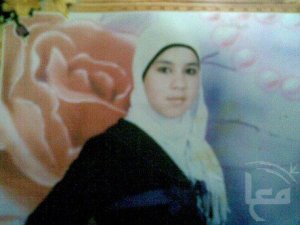 A photo of Suhad provided by her father [MaanImages]

Bethlehem – A report from Christian Peacemaker Teams in Hebron confirmed reports of the detention of a 13-year-old girl by Israeli forces last week.
At the time, an Israeli military spokesman said he had no knowledge of the incident, which was left uncorroborated until a CPT report was released on Thursday.
According to the report, “At about 5:45pm , CPTers followed four soldiers as they entered the girl’s home and ordered the entire family to the roof. Once on the roof, a fifth soldier from a permanent post on a neighboring Israeli settler home ordered the family’s three teenage daughters to one side of the roof.
“The soldier singled out the 13-year-old and accused her of throwing a stone. The girl’s mother protested saying that minutes before she had notified this soldier of settlers throwing stones at her as she hung her laundry and that he had seen settlers throwing stones. She was dumbfounded that the soldier’s response was to call another unit of soldiers to detain her daughter.
“Two more units of soldiers arrived at the house before escorting the girl out of her home. The girl’s aunt attempted to prevent the soldiers from taking the girl by linking arms with her and refusing to let go. After a five-minute stand off, soldiers stated that the aunt could accompany the girl and the group of eighteen soldiers escorted them both away to a military jeep. Israeli police arrived, arrested the girl and took her and her aunt to a police station for questioning and fingerprints.”
Ma’an had identified the child as Suhad Al-Ewaiwi, whose father contacted the Palestinian Prisoners Society shortly after his daughter was taken from their home. Lawyer with the society, Muhammad Shahin, said he called Israeli police, who told him settlers accused the girl of throwing stones at them.
Israeli Army Invades Khan Younis, Leaders Weigh Resumption Of Assassinations
By Saed Bannoura – IMEMC & Agencies – March 28, 2010
 Ma’an images

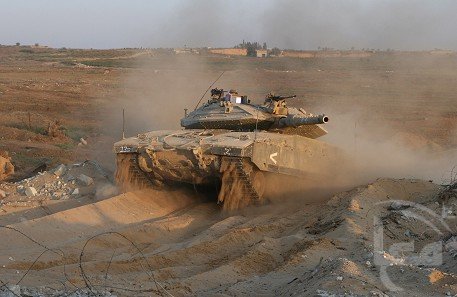
Several armored military vehicles carried out a limited invasion into Khan Youni, in the southern part of the Gaza Strip, on Sunday morning. The latest attack comes amidst talks of a likely resumption of assassinations in the coastal region. Israeli Finance Minister called for “reoccupying” Gaza and “eliminating Hamas”.
Eyewitnesses reported that several armored vehicles and military bulldozers advanced 500 meters into the area, and that military bulldozers started uprooting trees and farmlands while the army opened fire in different directions. Military bulldozers uprooted olive and almond trees in Um Al Mahed and Abu T’eima areas, in Khan Younis.
The invaded area is where Friday clashes took place; one resident was killed and thirteen others were wounded. Two Israeli soldiers were killed and three were wounded. The latest developments came as Israel’s military and political leaders are weighing the possibility of a massive attack against the Gaza Strip in addition to weighing the possibility of resuming Israel’s illegal assassinations policies.
Israeli paper, Maariv, reported Sunday that Israel’s military leadership believes that Palestinian resistance groups in Gaza benefited from the cease fire that followed “Operation Cast Lead” offensive against the Gaza Strip a year ago January. The paper added that this cease fire gave the resistance a chance to attack the Israeli army along the border with Gaza, such as the Friday attack that led to the death of three soldiers.
A number of military leaders said that the known policy of bombarding tunnels and “weapons storage facilities is not affective anymore and does not curb further attacks”.
Senior Israeli military leaders stated that the current situation requires the resumption of the assassination policy. They are calling for assassinations targeting certain political and military leaders of Palestinian factions in Gaza, especially prominent figures.
The Israeli army believes that after the Friday attack and the killing of the soldiers, several leaders in Gaza went underground fearing Israel’s retaliation.
The army estimates that those leaders would resume their activities in the future, therefore “the army must prepare plans to assassinate them”, and should also bombard certain areas believed to be used by the resistance. This includes tunnels, resistance training centers and areas believed to be weapons storage facilities, in addition to bombing the homes of political and military leaders of Hamas and other factions.
Israeli Finance Minister, Yuval Steinitz, called for “reoccupying Gaza” and to totally eliminate the authority of Hamas in the coastal region. He said that reoccupying Gaza and eliminating Hamas, the ruling “power” on Gaza, are among the main scenarios that Israel might elect should other options fade.
Steinitz slammed what he called “the U.S. pressure on Israel”, and claimed that Israel conducted acts of “good will” towards the Palestinians by “giving them the chance to improve their economy” and by “freezing settlement activities”.
Palestinian Political Prisoners
By Stephen Lendman | March 27, 2010
The numbers vary but range at any time from over 7,000 to 12,000 or more. In April 2008, the Adalah Legal Center for Arab Minority Rights in Israel cited 11,000, including 345 children and 98 women. Over 1,000 suffered from chronic or other diseases. Around 150 were seriously ill from heart disease, cancer, and other diseases, and 195 or more Palestinians died or were killed in prison since 1967.
As of January 2009, Adalah said about “22,500 individuals were imprisoned or detained in Israeli prisons; around 70% (or 15,750 are) Arabs.” Included are 9,735 Palestinians, nearly 80% classified as “security.” Of these, 570 were administrative detainees, uncharged by order of an administrative official, not a judge.
Another 20 were so-called “unlawful combatants” under Israel’s Unlawful Combatants Law (UCL), saying they’re not entitled to POW status under international law because they either took part in hostilities against Israel (directly or indirectly) or belong to a force carrying them out. No proof is needed, only “a reasonable basis for believing” the designation is accurate, and under UCL, detentions can be permanent, without trial or judicial fairness.
According to the Addameer Prisoners’ Support and Human Rights Association, since 1967, “over 650,000 have been detained by Israel,” about 20% of the total Occupied Territory (OPT) population and 40% of the male population. Most are held in Palestine, but many thousands in Israeli civil and military prisons, in violation of numerous Fourth Geneva provisions, including Article 49 stating:
“….forcible transfers, as well as deportations of protected persons (including prisoners) from occupied territory to the territory of the Occupying Power or to that of any other country, occupied or not, are prohibited, regardless of their motive.”
This applies to OPT prisoners, most of whom are political victims of militarized oppression, or in other words, guilty of being Palestinian. In addition, Fourth Geneva states protected persons shall be detained in the occupied territory and, if convicted, serve there sentences therein.
OPT arrests and detentions come under about 1,500 military regulations for the West Bank and over 1,400 for Gaza. The IDF commander issues orders, but new ones aren’t revealed until implemented because they’re issued any time for any reason, often arbitrarily and capriciously.
Israeli prisons and military detention facilities are mainly located within Israel’s 1948 borders. They include five interrogation centers, six detention/holding facilities, three military detention camps, and about 20 prisons where OPT Palestinians are held.
A secret Facility 1391 at an unknown location is notorious for using severe torture. Gilboa Prison, north of the West Bank, is also believed to administer extreme treatment.
“The location of prisons within Israel and the transfer of detainees to locations within the occupying power’s territory are illegal under international law and constitute a war crime.”
On June 7, 1967, Military proclamation No. 1 justified them “in the interests of security and public order,” weasel words meaning anything. Since then, over 2,900 orders were issued, gravely harming Palestinians’ welfare. “These orders serve as justification every time the Israeli authorities arrest a Palestinian….”
They can be held for extended periods, interrogations lasting up to six months, during which time torture, abuse and other degrading treatment is commonplace, against the great majority in custody.
After interrogation, Palestinians can be detained administratively without charge or tried in military courts where “military orders take precedence over Israeli and international law.”
Under Military Order 1530, months may elapse between being charged and trial. The entire process is structured to deny due process and judicial fairness, unlike for most Jews in civil courts.
Activists, protesters and human rights defenders are especially at risk. In July 2008, Israeli authorities, by military order, closed the Nafha Society for the Defense of Prisoners and Human Rights. It’s one of several organizations representing Palestinian detainees in Israeli courts and advocates for them in prisons and detention centers.
Currently, Israeli security forces, politicians and extremist groups are targeting human rights groups in response to their support for the Goldstone Commission report. Among those affected are:
— B’Tselem
— Adalah
— Breaking the Silence
— the Association for Civil Rights in Israel (ACRI)
— Yesh Din
— the Centre for the Defence of the Individual
— the Public Committee Against Torture in Israeli (PACTI)
— the Israel Religious Action Centre
— Physicians for Human Rights – Israel
— Rabbis for Human Rights, and
— the Palestinian Centre for Human Rights (PCHR) that condemned the practice in a February 8 press release stating:
PCHR “condemns the continued persecution of international human rights defenders in the West Bank….and the deportation of international activists from the country.”
On February 7, PCHR learned that Israeli security forces entered Ramallah and al-Bireh, storming an al-Bireh apartment building and arresting Spanish journalist Ariadna Jove Marti and Australian student Bridgette Chappell. They were taken to Ofer Prison pending their deportation, citing expired visas as pretext. The two women are International Solidarity Movement activists known, according to an IDF spokesman, “for being involved in illegal riots that obstruct Israeli security operations.”
Other activists were also arrested, Israel now issuing tourist visas only to 150 selected NGOs operating in the West Bank and East Jerusalem, including Oxfam, Save the Children, and Doctors Without Borders. However, they’ll be excluded from Area C under Israeli control, comprising 60% of the West Bank, thus hampering their work and imposing additional hardships on Palestinians.
PCHR condemned the action and recommends that international civil society and human rights organizations, bar associations, and international solidarity groups continue exposing suspected Israeli war criminals and pressuring their governments to prosecute them according to provisions of international law.
The extremist Netanyahu government won’t tolerate criticism or censure for its expansionist West Bank plans, including making all Jerusalem exclusively Jewish.
His cabinet introduced a Knesset bill prohibiting organizations from receiving funding from foreign political institutions unless registered with the Registrar of Political Parties.
They must then provide details about all “foreign political entity” donations, the source, amount, purpose, commitment made for its use, and more, as a way to harass and make the process more cumbersome.
The bill’s supposed purpose is to:
“increase the transparency and to correct lacunas (empty spaces or missing parts) in the law regarding the funding of political activity in Israel by foreign political entities (where such activity is defined as being) aimed at influencing public opinion in Israel or one of the branches of government in Israel regarding any element of Israel’s domestic or foreign policy.”
In fact, it’s to stifle free expression, dissent and activism, the way police states do it, how Israel always treats Palestinians, now increasingly toward outspoken Jews and international human rights organizations as well.
Conditions in Israeli Prisons
Israel willfully and systematically violates international humanitarian law, including Common Article 3 applying to the four Geneva Conventions, requiring:
“humane treatment for all persons in enemy hands, specifically prohibit(ing) murder, mutilation, torture, cruel, humiliating and degrading treatment (and) unfair trial(s).”
Fourth Geneva’s Article 4 calls “protected persons” those held by parties to a conflict or occupation “of which they are not nationals.” They must “be treated with humanity and, in case of trial, shall not be deprived of the rights of fair and regular trial prescribed by the present Convention.” They’re entitled to full Fourth Geneva rights. Prisoners of war under Third Geneva have the same rights and those under Common Article 3.
Israel willfully denies them. Under the 1971 Israeli Prison Ordinance, no provision defines prisoner rights. It only provides binding rules for the Interior Minister who can interpret them freely by administrative decree. For example, it’s legal to intern 20 inmates in a cell as small as five meters long, four meters wide and three meters high, including an open lavatory, and they can be confined there up to 23 hours daily.
An April 2009 PCHR press release said thousands of Palestinians “continue to suffer in Israeli jails” under horrific conditions, including:
— severe overcrowding;
— poor ventilation and sanitation;
— no change of clothes or adequate clothing;
— sleeping on wooden planks with thin mattresses, some infested with vermin; blankets are often torn, filthy and inadequate; hot water is rare and soap is rationed;
— at the Negev Ketziot military detention camp, threadbare tents are used, exposing detainees to extreme weather conditions; in summer, vermin, insects, scorpions, parasites, rats, and other reptiles are a major problem;
— Megiddo and Ofer also use tents; in addition, Ofer uses oil-soiled hangers;
— for some, isolation in tiny, poorly ventilated solitary confinement with no visitation rights or contact with counsel or other prisoners;
— no access to personal cleanliness and hygiene; toilet facilities are restricted, forcing prisoners to urinate in bottles in their cells;
— inadequate food in terms of quality, quantity, and dietary requirements;
— poor medical care, including lack of specialized personnel, mental health treatment, and denial of needed medicines and equipment; as a result, many suffer ill health; doctors are also pressured to deny proper treatment, some later admitting it;
— extreme psychological pressure to break detainees’ will;
— widespread use of torture, abuse, cruel and degrading treatment;
— women and children are treated the same as men;
— NGOs like Physicians for Human Rights – Israel and the ICRC are deterred from aiding detainees;
— denied or hindered access to family members and counsel;
— imposed conditions link visits:
“with the overall security situation, requiring that prisoners must not be security prisoners and that persons applying for visits must not have a security record, requiring that visitors be first-degree relatives and that brothers or sons applying for visits must be under the age of 18.”
Treatment of Gazans Arrested During and After Operation Cast Lead
On January 28, 2009, a complaint to Israel’s Military Judge Advocate General, Brigadier General Avichai Mandelblit, by seven Israeli human rights organizations, cited degrading and appalling conditions in which detainees, including minors, were held.
Before transfer to the Israel Prison Service, they were held for many hours or days in pits dug in the ground, handcuffed and blindfolded, under extreme weather conditions. No sanitation was provided and limited amounts of food. Some, in fact, were held in combat areas, in violation of international law prohibiting their exposure to danger.
After removal from pits, some were held overnight in a truck, handcuffed, with one blanket for two people in winter. Others were kept for extended periods in the rain with little food or water. Incidents of extreme violence and humiliation were also reported that continued after prison transfers.
Legal Department Director of the Public Committee Against Torture in Israel (PACTI), Bana Shoughry-Badarne, said:
“Israel’s indifference to its moral and legal obligations to detainees is particularly objectionable in view of the fact” that the IDF completely ignored “the basic rights of the detainees and captives” under international law, violations committed against every detainee held.
Since July 2007, Gazan families have been denied access to their relatives in Israeli prisons. Non-Israeli Palestinian lawyers can’t represent them in military courts. Travel restrictions impede all lawyers. Meetings with their clients aren’t confidential, and most prisoners have no access to an attorney.
In 2006, B’Tselem issued a report titled, “Barred from Contact: Violation of the Right to Visit Palestinians Held in Israeli Prisons,” citing obstacles families face to visit their relatives. They include difficulties obtaining required permits and “grueling journeys” of up to 24 hours, the result of long distances through numerous checkpoints plus delays.
This “arbitrary and disproportionate policy not only infringes the right to family visits, it also results in violation of other rights and principles of international humanitarian and human rights law, as well as domestic Israeli law.”
In January 2010, Adalah addressed the same issue stating:
On December 9, 2009, “Israel’s Supreme Court (HCJ) decided that the state has no obligation to allow family visits for Gazans detained in Israel.” Writer Grietje Baars, a UK lawyer, said the HCJ rejected petitions by detainees, their relatives and Palestinian and Israeli human rights organizations, claiming that “Israel’s rights as a sovereign state” lets it deny “foreigners” entry in violation of international law – a clear act of persecution.
Under Article 7(g) of the Rome Statute of the International Criminal Court (HCJ), crimes against humanity include:
“Persecution (meaning) the intentional and severe deprivation of fundamental rights contrary to international law by reason of the identity of the group or collectivity.”
In a previous decision, the HCJ held that:
“It is a firmly established precept that the human rights to which a person is entitled simply by being human remain even when he is detained or imprisoned, and the fact that he is incarcerated cannot serve to deprive him of any right.”
Denying them defies that ruling, and the fact that hundreds of Gazan detainees in Israel are held indefinitely without trial, are in virtual isolation, and can only send their families occasional messages through ICRC representatives.
Petitioners call banning visits “collective punishment” under Fourth Geneva’s Article 33 stating:
“No protected person may be punished for an offence he or she has not personally committed. Collective penalties….are prohibited.”
Doing so (along with torture and other forms of abuse) aims to break their spirit to get them to cooperate or confess to crimes they didn’t commit.
Baars concluded:
“Aside from the right to have their rights hououred and protected, and to live their lives in dignity and freedom, the Gazans and the Palestinians in general, have the right to an effective judicial remedy. Without domestic enforcement of international law, the onus is on the international community to fulfill these rights and uphold the rule of law, internationally, for the benefit of all.”
The international community’s failure to comply with international law lets Israel violate its provisions freely. Unless changed, Israel’s lawlessness will continue unchecked, a no longer to be tolerated grim prospect.
Stephen Lendman lives in Chicago and can be reached at lendmanstephen@sbcglobal.net. Also visit his blog site at sjlendman.blogspot.com
In West Bank Palestinian Childhood Is Cut Short – It’s the Law
March 27th, 2010 | by Carol Sanders
 Palestinian child arrested
In the West Bank, there is a two-tiered system of justice, including for minors. For settler children, justice is administered according to Israeli domestic law, with all the due process protections that affords. They cannot be charged as adults until they reach 18, in accordance with the U.N. Convention on the Rights of the Child, to which Israel is a signatory. For Palestinian children, military law applies, and that pretty much means due process, and the tenderness of their years, is irrelevant. Their childhood itself is cut short, both by the circumstances of the Occupation and the letter of military law. Until recently, they could be charged as adults as young as 12 years of age. A recent military order “reformed” that anomaly by setting their age of majority at 16 –still two years earlier than their settler counterparts, and two years younger than required by the Convention on the Rights of the Child. But the reality is that children as young as 12 continue to be arrested and imprisoned in adult military jails. In the majority of cases the soldiers who arrest them say that the children were throwing stones, which carries a maximum sentence of 20 years.
Defence of Children International-Palestine reports that arrests of children have been increasing . Presently approximately 350 West Bank children under 17 are being held in Israeli prisons. Defence of Children provides testimonies of the children, detailing the brutal circumstances of their detention and interrogation, and their confinement with adult prisoners. Urgent appeals on behalf of the children are issued by Defence of Children, including in the case of masse arrests (17 children taken in a night raid from Al Jalazun Refugee Camp near Ramallah), and the transfer of children to prisons within Israel, where family members cannot visit because of restrictions on movement of people under Israel’s military Occupation.
Related posts:
Hamas: We have the right to retaliate against Israel’s incursions and crimes
Palestine Information Center – 27/03/2010
GAZA — Senior Hamas official Ismail Radwan stated Friday that the Palestinian resistance has the right to respond to Israel’s incursions into the Gaza Strip, and its daily violations and crimes against the Palestinian people and their holy sites.
In a press statement to the Palestinian information center (PIC), Radwan stressed that the operation of Khan Younis confirmed that the resistance is still alive and the Gaza Strip is not easy to invade.
He warned that the Israeli occupation has to think a thousand times before making foolish steps against the Islamic holy shrines in Palestine, adding the Palestinian resistance is able to retaliate to Israel’s crimes in the manner it deems appropriate.
For his part, Hamas spokesman Sami Abu Zuhri said that the commando operation of Khan Younis proved his Movement’s adherence to the resistance option and its keenness on the protection of the Palestinian people.
In the same context, the Israeli occupation forces (IOF) admitted that two of their troops were killed and five others were wounded during an incursion into the eastern area of Khan Younis.
The IOF spokesman said on Friday that a deputy commander in the Golani brigade and another officer of low rank were killed and five other soldiers were injured, one of them in a serious condition, when a big explosive device was detonated near Kissufim crossing, east of Khan Younis.
The spokesman acknowledged that the soldiers were killed and wounded after they carried out an incursion east of Khan Younis.
For his part, commander of the IOF in the southern region Yoav Galant said few hours after the Khan Younis operation that one of the officers was killed when one of the Palestinians (resistance fighters) shot at a grenade in his flack jacket, while the other one was killed during the clashes.
Galant’s remarks authenticated the communiqué issued by Al-Qassam Brigades, the armed wing of Hamas, that its sniper unit was responsible for killing two Israeli officers on Friday evening.
Al-Qassam spokesman Abu Obeida told a news conference on Friday that the attack unit of the Brigades supported by the sniper unit attacked an Israeli military force that attempted to infiltrate into Khan Younis.
61 Killed as Pakistan Bombs Schools, Mosque
Many Civilians Reported Slain in Attack on Pacifist Seminary
By Jason Ditz | March 25, 2010
Pakistani warplanes attacked a number of sites in the Orakzai Agency today, including a mosque, a school, and a religious seminary, killing 61. Security officials initially labeled all 61 “suspected militants,” though locals later conceded that a great many of them were actually innocent civilians.
The bulk of the casualties came when planes bombed Tableeghi Markaz, a seminary belonging to the pacifist missionary group Tableeghi Jamaat (Society for Spreading Faith). Pakistani officials say they had reports that Taliban commanders may have been at or near the seminary at the time of the attack, though they have yet to confirm if anyone other than the scores of civilians inside were actually killed.
Some 48 people were killed in the Markaz, and dozens wounded. The number may yet rise further as the seminary was said to be packed at the time of the attack. The two other strikes hit a mosque and a school which officials also believed were “Taliban hideouts,” killing 13 others.
Pakistan has vowed an offensive against Orakzai for weeks after its invasion of neighboring South Waziristan failed to net any Taliban leaders and officials speculated they had all moved to Orakzai. So far they have not killed or captured any major leaders in Orakzai, either, though as today’s bombings demonstrate the offensive is certainly causing havoc for the residents of the region.
Israeli fire injures Palestinian worker in southern Gaza
Ma’an –25/03/2010

Gaza – A Palestinian worker was critically injured on Thursday morning as the Israeli forces at the closed Sufa crossing opened fire on a group of men collecting rubble for the re-manufacturing of construction materials, medics said.
Director of ambulance and emergency services in Gaza, Muawiya Hassanein, identified the injured man as Naji Abu Rayda, 32, noting he was shot in the back and transferred to the European Hospital.
An Israeli military spokesman said he was unfamiliar any such incident in the area of the Sufa crossing.
Israeli news sources reported a similar incident near the Rafah crossing, southwest of Sufa. The spokesman said he had no knowledge of an incident matching either description.
According to the Al Mezan Center for Human Rights, Rayda was injured in the right thigh when he and several other workers were approximately 500 meters from the border fence.
Earlier in the week, Al Mezan reported Israeli soldiers near the Erez crossing opened fired on men “collecting rubble to sell to brick factories, which recycles it into bricks.” The men were reportedly 100 meters away from the border.
“This is the only source of bricks for construction that is available in the Gaza Strip, which suffers from an acute shortage of construction materials due the Israeli siege,” the report said.
Two days earlier, Israeli forces reportedly arrested 20 Palestinian workers who were collecting the rubble from destroyed buildings in the northern Gaza Strip. The report said four of those detained were children. Eight were released the next day after interrogations, the report said.
Targeting Palestinian Mothers
21/03/2010 — Reham Alhelsi
Targeting the weakest and the most vulnerable is neither new nor surprising when it comes from an entity that stands on the ruins of Palestinian villages and is swimming in the blood of its Palestinian victims. It is the mentality of Zionists who in cold-blood aim to kill Palestinian children, who write on their helmets: Born to Kill and who wear T-Shirts with images of dead Palestinian babies and guns aimed at Palestinian babies. It is an entity that is proud of slogans showing images such as that of a pregnant Palestinian woman with a target sign on her belly and the inscription: 1 shot, 2 kills.

During the Nakba, the Zionist usurpers committed countless massacres. Often it was the women and the children who were first targeted and brutally murdered as a warning and to frighten others and force them to leave. Accounts of the Deir Yassin massacre (9-10.4.1948) mention that among the 254 Palestinians victims were 25 pregnant women who were bayoneted in the abdomen while still alive. Another 52 children were maimed in front of their mothers before having their heads cut off by the Zionist terrorists. After the village of Beit Darras had been surrounded by Zionist terror groups and further Zionist mobilization was on the way to occupy the village, the Zionist terror groups called on the Palestinian residents to leave the village safely from the south side. The villagers decided that it was safer for the women and children to leave, since it was the village the Zionists wanted. Upon leaving the village, all the women and children were massacred by the Zionist terrorists. During the Khisas massacre (18.12.1947) the 12 victims killed by the Zionist terrorists were all women and children. Other massacres such as Sa’sa’, Balad Il-Sheikh, Abu Shusha, Beit Daras, Tantoura, Dawaymeh and many others show the same pattern of killing unarmed pregnant women, mothers and their children. Targeting mothers and children continued after the Nakba. During the Kufr Qasem massacre (29.10.1956) whole families were massacred, and women were butchered with their children. In Qibya (14-15.10.1953), after the Zionist terrorist militia ordered the residents to remain in their homes, it blew up these homes, killing entire families. On 07.02.1951, Zionist terrorists killed 10 unarmed residents of Sharafat, including 3 women and 5 children. Similar patterns follow in the massacres of Azazmeh, Beit Jala, Qalqilia, Gaza and others more.
During the first Intifada several mothers were shot dead by the IOF. Also pregnant women were targeted and a number were killed mainly by the poisonous gas used by the IOF against unarmed Palestinians:
1. Wujdan Hafith Rajab Faris (35 years old) from Khan Younis, Gaza, suffocated by gas fired by Israeli soldiers on 10.1.1988, she was pregnant in 7th month.
2. Amira Ahmad Omar Abu Askar (35 years old) from Jabalia, Gaza. On suffocated by gas fired by Israeli soldiers on 11.1.1988, she was pregnant.
3. Nabila Ali Al-Yaziji (35 years old) from Ash-Sheikh Ridawn, Gaza, suffocated by gas fired by Israeli soldiers on 26.3.1988, she was pregnant.
4. Dawlat Daoud Al-Masri (18 years old) from Jabalia, Gaza, suffocated by gas fired by Israeli soldiers on 27.9.1988, she was pregnant in 6th month.
5. Aziza Salim Jabir (27 years old) from Hebron, was shot dead by a Zionist settler on 06.08.1990, she was pregnant.

Another Zionist method of murdering Palestinian mothers is the network of over 630 Israeli military checkpoints/roadblocks in the West Bank, aka the “traps of death”. Patients in need of urgent treatment and medics rushing to save lives are often delayed at Israeli military checkpoints, constituting another war crime added to the ever-growing list of war crimes committed by the Zionist entity. Alone between 2000 and 2005 137 Palestinian patients, including 37 women, died at checkpoints because Israeli soldiers either prevented ambulances from passing and reaching the patients or prevented them from transporting patients to hospitals beyond the checkpoints. In many incidents, Palestinian mothers, including the elderly, the sick and the pregnant, were stopped and humiliated at checkpoints. Pregnant women are delayed at checkpoints and often prevented from reaching hospitals, causing many to give birth at these checkpoints. The deliberate delays at checkpoints have resulted in several premature births, stillborns and even the death of some of the mothers as Israeli Soldiers ignore the cries of suffering women and demand they get a special permit. Because of these checkpoints, Palestinian mothers are forced to deliver on the road or inside cars at the checkpoint. Many have to travel up to 4 hours and longer to reach a medical centre. One example is baby Zaid who died only moments after his birth when the Israeli soldiers refused to let his mother Nahil Abu Raja (21 years old) from Qasra, south of Nablus, to pass the Huwwara checkpoint and go to Nablus hospital. The medics who reached the checkpoint one hour after Nahil gave birth could only declare the baby dead. Around 6 pregnant women were also beaten or shot at by Israeli soldiers at checkpoints. Many mothers are forced to give birth at home, despite fear of complications because they fear they will be stopped at checkpoints and won’t make it in time to the hospital. In Azzun Atma near Qalqilya pregnant women are even forced to take up residence outside the village until they deliver out of fear that they might not be able to get the necessary medical treatment. The village, encircled by the apartheid wall, is separated by a gate from the rest of the West Bank. This gate is not manned at night, making the village a prison to its residents. According to a B’Tselem report, alone during 2006 some 20 out of 30 pregnant women from Azzun Atma were forced to relocate outside of the village because of their pregnancy.
Since then beginning of Al-Aqsa intifada in 2000 and till 2006 at least 69 Palestinian women gave birth at Israeli checkpoints in front of Israeli soldiers. This led to 35 miscarriages and the death of five mothers:
1. Rana Adel Abdel-Rahim Al-Jayyousi (17 years old) from Qour, Tulkarim: went into labor on 09.03.2002 and because of the closure of roads she was forced to give birth at home. Her baby was stillborn and when her condition deteriorated her family tried transporting her to hospital in Qlaqilia. They were stopped at an Israeli checkpoint for half an hour and when the ambulance arrived, Rana was already dead.
2. Aisha Abdel-Kairm Nassar (28 years old) from Al-Janyeh, Ramallah: on 23.1.2001 was in a critical condition after giving birth, but was stopped at an Israeli military checkpoint and delayed for 45 minutes. She died before reaching the hospital.
3. Rihab Nofal (30 years old) from Husam, Bethlehem: she went into labor on 18.10.2001 but Israeli soldiers stopped her at a checkpoint and prevented her from reaching the nearest hospital. She died.
4. Umayyah Hamad-Allah Imran (25 years old) from Azzoun, Qalqilia: on 24.09.01 she suffered from heavy internal bleeding after she had given birth, but was stopped at an Israeli checkpoint and her transport to the hospital was delayed. She left to hospital at 3 pm and reached it at 8 pm although the hospital lies only 20 km away. When she finally got there, Umayyah was dead.
5. Laila Husam Baheiri (18 years old) from Qalqilia: went into labor on 31.07.2002 but was prevented by Israeli soldiers at a military checkpoint from reaching hospital which led to her death.
© http://avoicefrompalestine.wordpress.com/
Destroying educational institutions or using them for military purposes is a war crime
“The Education system in Iraq, prior to 1991, was one of the best in the region; with over 100% Gross Enrolment Rate for primary schooling and high levels of literacy, both of men and women. The Higher Education, especially the scientific and technological institutions, were of an international standard, staffed by high quality personnel”. (UNESCO Fact Sheet, March 28, 2003)[1].
Dirk Adriaensens, member of the BRussells Tribunal executive committee, 23 March 2010
As a result of ongoing U.S. occupation, today Iraq is more illiterate than it was five or twenty-five years ago, because the U.S. Administration and U.S. forces occupying Iraq began to root [out] and destroy every aspect of Iraq’s education [infrastructure].
The Iraqi educational system was the target of U.S. military action, because education is the backbone of any society. Without an efficient education system, no society can function, writes Ghali Hassan in May 2005.[2]
Facts have proven him right. This is also one of the conclusions of the book Cultural Cleansing in Iraq.[3]
Random facts
A recent UNESCO report “Education Under Attack 2010 – Iraq”, dated 10 February 2010, concludes that “Although overall security in Iraq had improved, the situation faced by schools, students, teachers and academics remained dangerous.”[4] The destruction of Iraq’s education is ongoing. Aswat Al Iraq reported on 4 January 2010 that “the 2010 federal budget offers the country’s education and higher education only 10 percent of the funding they need.”
Let’s present a few random facts that give an idea of the scale of the destruction of Iraq’s education sector under occupation.
The director[5] of the United Nations University International Leadership Institute published a report[6] on 27 April 2005 detailing that since the start of the war of 2003 some 84% of Iraq’s higher education institutions have been burnt, looted or destroyed[7].
Like most higher education institutions across Iraq, Baghdad University escaped almost unscathed from the bombing. In the subsequent looting and burning, 20 of the capital’s colleges were destroyed. No institution escaped: the faculty of education in Waziriyya was raided daily for two weeks; the veterinary college in Abu Ghraib lost all its equipment; two buildings in the faculty of fine arts stand smoke-blackened against the skyline. In every college, in every classroom, you could write “education” in the dust on the tables. [8]
Ongoing violence has destroyed school buildings and around a quarter of all Iraq’s primary schools need major rehabilitation. Since March 2003, more than 700 primary schools have been bombed, 200 have been burnt and over 3,000 looted.[9]
Between March 2003 and October 2008, 31,598 violent attacks against educational institutions were reported in Iraq, according to the Ministry of Education (MoE)[10]
Since 2007 bombings at Al Mustansiriya University in Baghdad have killed or maimed more than 335 students and staff members, according to a 19 Oct 2009 NYT article, and a 12-foot-high blast wall has been built around the campus.[11]
Education under Attack (2007) reported that 296 people serving as education staff were killed in 2005; and 180 teachers were killed between February and November 2006.[12]
These are just a few examples to highlight the level of cultural genocide in Iraq. The list is endless, the real number of casualties much higher. More information can be found in the book Cultural Cleansing in Iraq and in the BRussells Tribunal archives on Iraqi education under occupation, perhaps the most comprehensive database on the Internet about the assassination of Iraqi academics and the destruction of Iraq’s education.[13] Our campaign to protect Iraqi academics[14] is still ongoing, because the tragedy continues. The UNESCO report “Education Under Attack 2010 – Iraq” is very clear: “Attacks on education targets continued throughout 2007 and 2008 at a lower rate – but one that would cause serious concern in any other country.” Why didn’t it cause serious concern? Is it because it’s US design?
The petition we issued, containing also a call for action, is still valid today and can still be signed: http://www.petitiononline.com/Iraqacad/petition.html. An excerpt:
1. We appeal to organisations which work to enforce or defend international humanitarian law to put these crimes on the agenda.
2. We request that an independent international investigation be launched immediately to probe these extrajudicial killings. This investigation should also examine the issue of responsibility to clearly identify who is accountable for this state of affairs. We appeal to the special rapporteur on summary executions at UNHCHR in Geneva.
We urge that educators mobilise colleagues and concerned citizens to take up the cause of the salvation of Iraq’s intellectual wealth, by organising seminars, teach-ins and forums on the plight of Iraq’s academics.
Occupying schools
When writing “Killing the Intellectual Class” for the book Cultural Cleansing in Iraq, I added a short story about occupation of schools by the MNF-I.
“it certainly is our policy to not establish military headquarters or other operations in protected areas under the Geneva Convention,” said Lt. Col. Gary Keck, a spokesman for the Department of Defense in Washington, when a journalist asked why the US army occupied a girls’ and boys’ school of a town in northern Iraq.[15]
At a UN press briefings in Amman on 30 April 2003, the question was asked:” Do you know of any other schools that are still occupied & would you ask them of making a point to stay away from the schools, so they can be rehabilitated?”
Answer: S. Ingram: I am not aware of any other places that this situation holds. I remember the incident you referred to, there was a school in the north & some contacts were necessary to persuade the US troops there to leave the premises, which they subsequently did. I am not aware of any other places where schools are being occupied.[16]
“I’m not aware”. A pack of lies. Because occupying schools is exactly what the US Army did (and still does) on a regular basis. I heard and read numerous eyewitness accounts about Iraqi protests after US Forces occupied schools and educational institutions.
The origins of armed resistance in Fallujah f.i. can be traced almost precisely to April 28, 2003, when U.S. troops, who had arrived in the city five days earlier, massacred 17 apparently unarmed protesters. The April 28 protest had demanded an end to Fallujah’s occupation and, more specifically, that U.S. troops vacate the al Qaid primary school, where classes had been scheduled to resume on April 29.[17]
And it continued. On the 29th of February 2008, the Association of Muslim Scholars (AMSI) published a press release condemning the American occupation forces for the seizure of an Islamic Secondary School in Baghdad. [18]
On the 1st of May 2008, the Iraqi News Agency “Voices of Iraq”, reported that: “The U.S. military withdrew from a building of the education department in Sadr City in eastern Baghdad, which they used it as a barrack last month.”[19]
This was basically all the hard information I had found about the occupation of educational institutions by the occupation forces and I thought the evidence was a little thin to make a decent case, so I decided not to use it for the book.
But now I read in the UNESCO report 2010:
“MNF-I, the Iraqi Army and Iraqi police units occupied more than 70 school buildings for military purposes in the Diyala governorate alone.”[20]
This is only in one province. There’s no information at my disposal about the other regions, but we can almost certainly conclude that occupying schools by occupation forces was/is a general phenomenon throughout Iraq. Where else would you station a one million strong army and security forces?
On the 11th of April 2003, a number of Iraqi scientists and university professors sent an SOS e-mail complaining American occupation forces were threatening their lives.[21]
The appeal message said that looting and robberies were being taken place under the watchful eye of the occupation soldiers.
The occupation soldiers, the e-mail added, were transporting mobs to the scientific institutions, such as Mosul University and different educational institutions, to destroy scientific research centres and confiscate all papers and documents to nip in the bud any Iraqi scientific renaissance.[22]
John Agresto, in charge of the Ministry of Higher Education and Scientific Research in 2003-2004, initially believed that the looting of Iraq’s universities was a positive act in that it would allow such institutions to begin again with a clean slate, with the newest equipment as well as a brand new curriculum.[23]
The Hague IV Conventions[24] on Laws and Customs of War on Land, 1917, make explicit, in Article 56, that educational institutions are to be regarded as private property, and thus must not be pillaged or destroyed, that occupying forces in war are bound to protect such property and that proceedings should follow their intentional damage, seizure or destruction. Article 55 reinforces this duty relative to all public buildings and capital. Further, an occupying power is obliged, according to Articles 43 and 46, to protect life and take all steps in its power to re-establish and ensure “public order and safety”.
In addition, The Hague Convention for the Protection of Cultural Property in the Event of Armed Conflict[25] (ratified by the Republic of Iraq in 1967) creates a clear obligation to protect museums, libraries and archives, and other sites of cultural property. Paragraph 1 of Article 4 notes: “The High Contracting Parties undertake to respect cultural property situated within their own territory as well as within the territory of other High Contracting Parties by refraining from any use of the property and its immediate surroundings or of the appliances in use for its protection for purposes which are likely to expose it to destruction or damage in the event of armed conflict; and by refraining from any act of hostility, directed against such property.”
Using schools and universities for military purposes, destroying educational institutions and assisting in looting, criminal neglect when educational staff is being harassed and assassinated, dismantling the Iraqi education system and active involvement in training, funding and arming murderous militia’s….
War crime upon war crime upon war crime. When will there be justice for Iraq? When will there be a serious investigation into these crimes by official International Human Rights Bodies? And who will charge the successive Anglo-American Administrations for War Crimes and Crimes against Humanity?
[1] http://portal.unesco.org/es/ev.php-URL_ID=11216&URL_DO=DO_TOPIC&URL_SECTION=201.html
[2] http://www.globalresearch.ca/articles/HAS505B.html
[3] http://www.plutobooks.com/display.asp?K=9780745328126&CID=BRUSSELLS
[4] http://www.unhcr.org/refworld/docid/4b7aa9df5.html
[5] http://www.la.unu.edu/about_staff_reddy.asp
[6] http://www.unu.edu/news/ili/Iraq.doc
[7] http://www.brusselstribunal.org/Academicspetition.htm
[8] http://www.brusselstribunal.org/academicsArticles.htm#weed-out
[9] http://www.islamic-relief.com/ecamp/orphans-iraq/education-iraq.htm
[10] http://www.unhcr.org/refworld/docid/4b7aa9df5.html
[11] http://www.ohio.edu/outlook/2009-10/March/Iraq-professor-409.cfm
[12] http://www.unhcr.org/refworld/docid/4b7aa9df5.html
[13] http://www.brusselstribunal.org/AcademicsResources.htm
[14] http://www.brusselstribunal.org/Academics.htm
[15] http://www.csmonitor.com/2003/0404/p07s01-woiq.html
[16] http://www.un.org/apps/news/infocus/iraq/infocusnews.asp?NewsID=509&sID=9
[17] http://www.worldpress.org/Mideast/2183.cfm and http://www.guardian.co.uk/world/2004/mar/17/iraq.rorymccarthy
[18] http://heyetnet.org/en/content/view/2670/33/
[19] http://www.iraqupdates.com/p_articles.php?refid=DH-S-01-05-2008&article=30525
[20] http://www.unhcr.org/refworld/docid/4b7aa9df5.html
[21] http://www.islamonline.net/english/news/2003-04/12/article02.shtml
[22] Dirk Adriaensens in “Cultural Cleansing in Iraq” p 119, http://www.plutobooks.com/display.asp?K=9780745328126&
[23] Nabil al-Tikriti in “Cultural Cleansing in Iraq” p 98, http://www.plutobooks.com/display.asp?K=9780745328126&
[24] http://www.yale.edu/lawweb/avalon/lawofwar/hague04.htm
[25] http://portal.unesco.org/en/ev.php-URL_ID=13637&URL_DO=DO_TOPIC&URL_SECTION=201.html
Featured Video

Dan Dicks with James Corbett on Solutions Watch
or go to
Aletho News Archives – Video-Images
From the Archives
Secret document reveals plans for civil war in Lebanon, Israeli false flags, and invasion
By Randi Nord | Geopolitics Alert | April 5, 2019
Beirut – During his visit with US Secretary of State, Mike Pompeo, Lebanese President Michael Aoun reportedly received a US-Israeli document detailing plans for creating a civil war in Lebanon with covert false flag operations and possible Israeli invasion.
Although the source of the document is Israeli and created in partnership with Washington, no one knows who presented it to Aoun. The Lebanese TV station, Al-Jadeed, initially reported the document on Lebanese TV and a video on its website. Geopolitics Alert translated the report for this article. … continue
Blog Roll
 Aletho News
- Sheikh al-Asadi warns of Iraqi government compliance with US demands
- How to MAKE THE CONSPIRATORS PAY for their crimes! Dan Dicks with James Corbett on Solutions Watch
- There’s a drought in academia: A drought in honest research on the subject of drought and other weather extremes
- Department of War Awards $20.7 Billion Contract to Raytheon for Air-to-Air Missiles
- ‘Distance yourselves from Israel’: IRGC urges US population to question govt policies
- America’s Greenland deal has a radioactive backstory
- The RAF Fairford ‘terror plot’: Unpacking escalation in the UK echo-chamber
- EU Council Advances Chat Control 2.0 Scanning Proposal
- Ex-Greek MEP files complaint against Israeli spyware firm over alleged Pegasus surveillance
- Troubling ideas throughout the Torah, Talmud, Mishneh Torah and Tanya
- If Americans Knew
- New Report: “Scholasticide and Genocide in Gaza: Assessment, Testimonies and Legal Analysis”
- Ex-Biden officials are desperate for a Gaza scapegoat
- Israeli “settlers” Invade Al-Aqsa; Pour Boiling Water on 75-Year-Old
- Israel Has Kidnapped Another American Teenager
- US arms sales to Israel worth $21.6 billion in 20 months
- Three Palestinians Killed in Israeli Attacks on Gaza
- Revealed: German “Anti-Semitism Expert” Driving Crackdown on Palestine Solidarity is Former Israeli Spy
- Egypt’s Warning to Israel Before Oct 7
- Israel’s siege signals another cruel winter for 1.8 million Gazans – Daily Update
- Netanyahu Asked UAE Leader to Deny Report on Oct. 7 Warning in Secret Visit, Sources Say
- No Tricks Zone
- New Study: Earth And Venus Surface Warmth Largely Explained By Convection And Lapse Rate, Not CO2 Or Radiation
- 2025 Nature Paper Claiming Worsening Global Drought Gets RETRACTED …Heavily Flawed
- New Study: ‘Global Drought Shows No Detectable Recent Acceleration Under Climate Warming’
- Economic Masterminds: German Socialists Suggest Taxing Productivity Gains Stemming From Using AI
- The South China Sea Has Not Been Cooperating With The Climate Change Narrative
- Energy Crisis: Germany Enters Heating Season With Historically Low Gas Reserve Fill Levels
- New Study: The Antarctic Ice Sheet Gained Mass From 2020-2024 Due To Staggering Snow And Ice Accumulation
- Study: Ocean Heating Rates From Thousands Of Years Ago ‘Dwarf’ Modern Ocean Heating Rates
- Climate Extremists Target, Attack Large-Scale Power Grid Infrastructure In Germany!
- New Study: Antarctic Ice Melt Has Contributed Less Than 1 Centimeter To Sea Level Rise In The Last 30 Years

