‘US running international network of secret detentions’
Press TV – March 7, 2010
A United Nations report on the existence of secret detention facilities in countries around the world puts most of the blame on the US and its Central Intelligence Agency.
The report says that the CIA, under the pretext of fighting terrorism, runs scores of secret prisons in foreign countries where suspected terrorists are held, a Deutsche Welle article read on Saturday.
The UN report charges that the United States has created an “international network” to keep in detention anyone it deems as potential enemies.
According to Deutsche Welle, the secret prisons exist in more than 66 countries.
These countries include Algeria, Egypt, India, Russia, Sudan and Zimbabwe where suspects and dissidents are kept in secret facilities.
Poland and Romania are accused of hosting the CIA secret prisons on their soils.
The report further suggests that the US transfers its prisoners to countries like Ethiopia, Djibouti, Egypt, Jordan, Morocco, Pakistan, Syria and even Thailand for interrogation.
According to the UN report, in Israel Palestinian prisoners are kept in secret detention under the “illegal fighter” law.
The UN report says while the existence of the secret prisons around the world violates the human and international rights they introduce a “serious problem on a global scale.”
“If resorted to in a widespread or systematic manner, secret detention might reach the threshold of a crime against humanity,” suggests the report.
Four UN Special Rapporteurs Martin Scheinin, Manfred Nowak, Shaheen Sardar Ali, and Jeremy Sarkin, have contributed to the report.
The report was due to be examined in Geneva this month; however, the resistance shown by some countries postponed the process until June.
Twilight zone / Unanswered questions
By Gideon Levy | Haaretz | March 4, 2010
Musa Abu Hashhash could not hold back his tears. We have worked with this devoted field worker from B’Tselem, the Israeli Information Center for Human Rights in the Occupied Territories, for years. Never before had we seen him cry. But this week he broke down and wept after a visit to the widow of Fayez Faraj, his aged, broken-hearted mother, and his 10 distraught orphans, aged 2 to 18.
Fayez Faraj was the last person who might have been expected to attack Israel Defense Forces soldiers. He had a permit to enter and sleep over in Israel, which few Palestinians are given – and then only after a thorough security check. He had worked for 15 years for Kriza, a footwear company in Tel Aviv, crafting soles for the women’s shoes. Aged 41, he spoke Hebrew fluently, hung out in Tel Aviv, had Israeli friends, was well-off economically and lived in a relatively spacious stone home.
No one in Hebron believes that Faraj attacked the soldiers. One of his Tel Aviv employers, who asked to remain anonymous, also refuses to believe it. A., the Israeli, spoke to Faraj by phone three hours before he was killed, an ordinary business conversation.
“I don’t believe he went to stab a soldier,” A. told Haaretz this week. “I have worked with him for 15 years. I know he was a good guy. Someone who loved life. He wasn’t embittered. I can’t understand how he got into a situation where soldiers killed him. It’s a kind of fate, a screwed-up fate. It’s true that he was slightly depressed lately, because he was in a financial crisis, but the whole story is puzzling, very puzzling.”
A. is not the only one who’s puzzled. It’s strange that the soldiers fired no fewer than seven bullets into Fayez from short range, three into his leg, three into his stomach and one into his left hand, in three volleys; that they went on shooting him after he lay on the ground, blood streaming from his leg, in which a major artery was hit; and that they pulled him – still alive – out of a Palestinian ambulance, and transferred him into an army Jeep and then into an Israeli Magen David Adom ambulance. And above all, there is the question of whether Faraj attacked the soldiers with a knife, as the IDF claims, or whether we should believe the testimony of a young woman who watched the incident from the roof of her house and says the soldiers took the knife from their Jeep in order to incriminate Faraj.
These are all serious, unsettling questions. A Military Police investigation is under way.
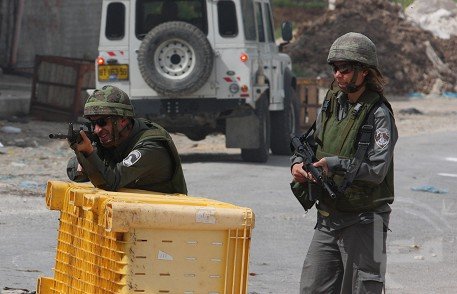
The Israeli media barely reported the killing of a Palestinian civilian by IDF soldiers in the heart of Hebron exactly three weeks ago today. A dead Palestinian is a non-story. This week we visited the meager home of his brother Samir, a policeman in the Palestinian Authority, a few dozen meters from the family workshop and from the site of the killing. There we heard about Fayez’s last day and about the circumstances of his death.
At about 12:30 P.M. that Friday, Fayez visited his brother and asked Samir to help out in the workshop. Samir said he was expecting guests and would come to work after they left. Fayez went on to their mother’s home, had lunch there and hurried to the workshop at the corner of the street below Samir’s house.
At about 4 P.M., Samir heard gunshots from the street and rushed down to see what had happened. He encountered a group of soldiers who threatened him with their rifles and ordered him to move off. He tried to approach from a different lane, but again soldiers stopped him. In the meantime, he heard that a wounded man was lying on the road, bleeding.
Samir phoned Tarek Watan, whose barbershop is opposite the scene of the incident, and learned that the wounded man was his brother Fayez. Watan told Samir that the soldiers were continuing to shoot Fayez every time he tried to lift his head. In the meantime, more IDF troops rushed to the scene in Jeeps and fired tear-gas and stun grenades to disperse the crowd that had gathered. Samir shouted to the soldiers that he wanted to see his brother, but to no avail.
A few minutes later, a Palestinian Red Crescent ambulance arrived and Samir saw Fayez being placed in it, still alive. As the ambulance started to pull away, soldiers ordered the driver to stop. The Palestinian paramedic Eid Abu Munshar stated in his testimony to two B’Tselem field workers who arrived on the scene, that the soldiers entered the ambulance and pulled the IV from Fayez’s arm. He said Fayez was suffering from a massive loss of blood and time was critical.
Aliya Hospital lies a few hundred meters from the scene of the incident, and the paramedic wanted to rush Fayez there. But an IDF officer who arrived at the scene ordered him taken out of the ambulance, the paramedic said. The dying Fayez, with seven bullets in his body, was transferred to an IDF jeep and then placed in an intensive care ambulance of Magen David Adom. According to Palestinian testimony, the ambulance waited there for half an hour. At 5:25 P.M., the Red Crescent received a call from the District Coordination and Liaison Office: Fayez had died in the ambulance; they should send a vehicle to pick up the body at the checkpoint at the northern entrance to Hebron.
What actually happened on the street corner between Tarek’s barbershop and Fayez’s footwear workshop? According to the testimonies compiled by Samir and B’Tselem field workers, the following sequence of events emerges: While Fayez was walking from his mother’s house to the workshop, he ran into a group of men celebrating the engagement ceremony of a neighborhood girl. He stopped to congratulate them just as a group of six soldiers walked by. (The IDF sometimes enters the neighborhood, even though it is in area H1, which is supposedly under Palestinian control.) About half an hour earlier, some people had thrown stones at these soldiers in a different neighborhood, and local residents testified that they seemed tense. The soldiers were coming up one of the lanes and people warned Fayez about them. But Fayez, who was considered a proud man who also spoke Hebrew and interacted with Israelis, replied, “So what if there are soldiers?”
One witness reported that shouts were suddenly heard from up the lane. He saw one of the soldiers slip and fall, apparently because of the steepness of the street. Immediately afterward he saw the soldier get up and shoot Fayez in the leg. Maybe Fayez attacked him, or maybe the soldier thought Fayez had attacked him. He heard Fayez curse the soldiers after being wounded and saw him get up. The soldiers then shot him again. People who had gathered on the street shouted to Fayez not to move, because the soldiers might shoot him again – and they indeed shot him a third time, according to the testimonies.
After Fayez was taken away, Samir asked an officer what had happened. The officer, known as “Captain Moshe,” said his brother had tried to stab one of the soldiers, and showed him a knife. Samir told the officer that this made no sense – if Fayez had wanted to stab an Israeli he could have done so in Tel Aviv. Moreover, he had not taken a knife from the house. The officer told Samir that Fayez was in serious condition and had been taken to Hadassah Medical Center in Jerusalem.
Shortly afterward, an officer who identified himself as “Captain Rafi,” possibly from the Military Police investigations unit, arrived, and asked Samir about his brother’s mental state. Samir told him that “Fayez’s intelligence is bigger than both of ours” and that he had never had mental problems. Together, they questioned the eyewitnesses at the site, all of whom said they had seen no knife in Fayez’s hand. A young woman of 19, Bian Julani, who was on the roof of her home when the incident occurred, told Samir – and, he says, also Captain Rafi – that she saw the soldiers shoot Fayez three times. She also claimed that she saw a soldier wearing gloves take a knife out of the army jeep.
In the meantime, the soldiers confiscated the camera of Abu Hashhash, who arrived on the scene, and returned it to him with all the photos deleted. “As a police officer,” says Samir, “I can tell you that in any event, six soldiers could have subdued Fayez without killing him. It was murder in cold blood.”
Soldiers tore down the posters hung in Fayez’s memory on walls at the scene of the incident. At the entrance to his home, located in another part of the city, a large parrot whistles – Fayez bought it in Tel Aviv. Ten children wander about the house, and their grandmother, Maisar, bursts into tears. “Will someone with 10 children go with a knife?” she asks, and the question echoes through the room. Ibtisam, the widow, is due to give birth any day now. She is carrying a boy. His name will be Fayez, of course.
No comment from the IDF Spokesman was received by press time.
Suppressing Evidence, David Miliband and UK Complicity in Torture
By Sarah Gillespie | March 5, 2010
Last Saturday I went to see Polly Nash and Andy Worthington’s harrowing documentary ‘Outside the Law, Tales from Guantánamo’ at London’s BFI.
The film knits together narratives so heart-wrenching I half wish I had not heard them. Yet the camaraderie between the detainees and occasional humorous anecdotes, such as Binyam Mohammed’s false confession that he tried to induce nuclear fission on April 1st, provide a glimpse into the wit, courage and normalcy of the men we are encouraged to perceive as monsters.
Nash and Worthington’s film also explores the legal and pragmatic implications of our transatlantic free-fall into ethical bankruptcy. It asks how we might navigate our way out of a situation that doesn’t legally exist. The answer is: with great difficulty. With lawyers like Clive Stafford-Smith working tirelessly to defend people who have not been accused of a crime and have no evidence against them to refute, the courtroom has become the domain in which we watch the dream of European multiculturalism imploding. Here we see UK Muslims struggle to exert Enlightenment-based Common Law against a so-called civilized, liberal government who would apparently prefer the Magna Carta had never been written. (1)
Two weeks ago the Foreign Secretary David Miliband lost his long legal battle to suppress a section (known as paragraph 168) from a court decree revealing that MI5 officers were involved in the torture of ex terror suspect and British resident, Binyam Mohamed. Up until now the testimonies of released British Residents Omar Deghayes, Mozzam Begg and Binyam Mohamed have not been fully absorbed by the British public. This is despite the fact Omar Deghayes entered Cuba with two eyes but came home with one. Many news consumers prefer to maintain that detainee accounts of asphyxiation, physical torment, sexual and religious abuse, were either deserved, fabricated or necessary. Others can not contemplate that a nation proudly branding itself on civil liberties, tolerance and ‘fair play’ could willfully throw us back into the medieval barbarism of the Norman Conquests. Yet, as Miliband’s credibility crumbles in the light of his failed cover-up, so the plausibility of Binyam Mohammed’s testimony gains ground. The tide is changing.
Recently Court of Appeal also stated that it withstood ‘unprecedented bullying’ from the Foreign and Home Secretary to withdraw 168 from its ruling. However, Miliband’s plee was overturned by independent judges and we now know the report stated that British treatment of Binyam Mohammed was “at the very least cruel, inhuman, and degrading”. David Miliband dismissed the testimony of this particular British resident, whose torments included having razzor blades applied to his penis, as ‘ludicrous lies.’
The independent judge apparently dissagrees with our delightful foreign secretary. He warns that the integrity our government is now under serious dispute and suggests that Miliband has an undisclosed agenda.
“Not only is there an obvious reason for distrusting any UK Government assurance, based on SyS (secret services) advice and information, because of previous “form”, but the Foreign Office and the SyS have an interest in the suppression of such information.”
Shaker Aamer, the Witness from Battersea.
Perhaps the most disturbing and crucial aspect of ‘Tales from Guantánamo’ is that it spotlights the continuing illegal incarceration of South Londoner, Shaker Aamer. All British residents have been discharged from Guantánamo. Yet despite being officially cleared for release in 2008, Aamer remains impounded in a 6 foot by 8 foot cell, tortured, humiliated and, according to reports, force fed through a pipe routed to his stomach via his nose. At 8 stone, he has lost over half his body weight. His wife, the mother of their 4 children continues to live in London where she has been treated for a succession of nervous break downs since her husband was seized.
There is no justification offered as to why this Aamer has been singled out. No evidence has transpired to counter his claim that he was in Afghanstan in 2002 to help construct schools as part of his religious duty of zakat. It is believed that Aamer’s conspicuous eloquence, linguistic talents and charisma identified him within the gates of Guantánamo, as a exceptional case. He orchestrated collective hunger strikes, translated fluently between Arabic and English and inspired his fellow inmates to demand their rights. He was treated by detainees as a holy man, a leader. He was punished accordingly.
Speculation surrounding Aamer’s continued detention pivots on the numerous ‘suicides’ he is alleged to have seen, the severity of the torture he has endured and his claims that it was, in part, executed on the behest of British agents. It is widely believed that should Binyam Mohammed’s case progress, Shaker Aamer would be a leading witness against British authorities, cementing evidence that could transfer the label of ‘criminal’ from the defendant to the accuser: namely Whitehall. Back in November last year the Independent’s law editor Robert Verkaik predicted Aamer’s release would be detrimental to the reputation of the UK government.
“The case is potentially more damaging to Britain than that of former Guantanamo detainee Binyam Mohamed because British agents are accused of being present during Mr Aamer’s alleged torture. In one allegation an MI5 agent is said to have been present when Mr Aamer’s US interrogators banged his head against a wall.”
As calls for a full judicial inquiry gather pace, we may well ask why on earth Miliband persists in attempting to thwart evidence in this degrading farce we call Justice. His CV so far for defending the interests of Britain abroad, is not great. Since he took the job he gave Britain’s blessing to Israel’s massacre in Operation Cast Lead (2), he maintained Britain abstain from voting against the Goldstone Report, he intervened in Polish domestic politics slandering a popular MEP as an ‘anti-Semite’ and he has stood limply in the wings giving lip service to the Mossad’s use of British passports in their assaination last month. Worryingly, it seems the concerns of British sovereignty do not feature high on Miliband’s list of priorities. If they did we could expect that, instead of pushing for a re-write of the law to enable war criminal Tzipi Livni tio visit the UK without charge, Miliband might consider adhering to the law that has protected our rights for the last 800 years – and allow Shaker Aamer to come home.
(1) Magna Carta Libertatum (the Great Charter of Freedoms) is and English legal charter, orriginally issued in 1215. Among other things it explicity supported what became the writ of habious corpus, allowing appeal against unlawful imprisonment.
(2) Less than a month before Israel launched its assault on Gaza Miliband visited the Israeli town of Sderot. He said “Israel should, above all, seek to protect its own citizens. It’s very important that counties like mine and others show solidarity with the people of Sderot…. Israeli people need to know that the British people know of Sderot, and we know of the tragedy they are facing, and we stand with them.”
To write to David Miliband requesting the safe return of Shaker Aamer click here.
To find out where you can see ‘Outside the Law, Tales from Guantánamo’ click here.
Police Abduction by Quota
By William Grigg on March 4, 2010
A few months ago, Zebulun and Elijah Colbourne were among five New York City teenagers arrested and held overnight in jail in order to fill an official quota. The citation claimed that the teenagers, who had been racing in the sidewalks, were engaged in “tumultuous and violent conduct that caused public alarm.” They were given a summons, handcuffed, and held in a cell before being released the next morning without further action.
“They just wanted to arrest us,” Zebulun told WABC News. “They locked us up for nothing.” Well, not exactly for nothing: The arresting officer was able to tally five summonses toward his monthly quota.
Adil Polanco, a five-year veteran of the NYPD’s 41st Precinct in the Bronx, confirmed to WABC that police are under relentless official pressure to make arrests and issue summonses in order to meet arbitrary quotas.
“We are stopping kids walking upstairs to their house, stopping kids going to the store, young adults … [i]n order to keep the quota,” discloses Officer Polanco. “Our primary job is not to help anybody, our primary job is not to assist anybody, our primary job is to get those numbers and come back with them.”
Like other decent people who become police officers out of a genuine desire to protect the rights and property of individuals — yes, such people do exist — Polanco is severely disillusioned by the reality of his profession.
“I’m not going to keep arresting innocent people, I’m not going to keep searching people for no reason, I’m not going to keep writing people [citations] for no reason, I’m tired of this,” declared a visibly disgusted Polanco.
Audio recordings played during the segment broadcast by WABC confirmed Polanco’s account.
One patrol supervisor told officers that unyielding and ever-increasing arrest and citation quotas would be part of their professional lives “until you decide to quit this job and become a Pizza Hut delivery man”; another supervising officer tells police that “you’re going to be doing a lot more, a lot more” by way of meeting arrest and citation quotas.
New York City Deputy Police Commissioner Paul Browne insists that quotas — however euphemistically described — are “productivity goals” for police officers. He thereby offered a validating illustration of a principle repeatedly noted in this space: The only things that government actually makes are criminals out of innocent people, and corpses out of living human beings.
An unjustified arrest is an act of kidnapping. What Officer Polanco describes and WABC documents is nothing less than the systematic abduction of innocent people under color of state “authority.”
Polanco is neither the first nor only officer to confirm the widely known but officially denied truth that police are subject to arbitrary arrest and citation quotas.
Five years ago Cincinnati police officer Vincent George filed a grievance with the police union against the department’s use of arrest and ticket quotas. Like other Cincinnati police officers who failed or refused to meet those quotas, George suffered immediate professional retaliation in the form of a demotion to overnight desk duty.
A Washington Post story from 2004 described how police in Falls Church, Virginia were required “to write an average of three tickets, or make three arrests, every 12-hour shift, and to accumulate a minimum total of 400 tickets and arrests for year…. Failure to meet the quotas results in an automatic 90-day probationary period with no pay raise and a possible demotion or dismissal if ticket or arrest numbers aren’t immediately raised to acceptable levels. ”
In Illinois, pressure from police officials killed a proposed measure banning the use of arrest and ticket quotas, even though the same officials loudly deny that such quotas are in use.
As the Greater Depression deepens, municipal revenue streams are being choked off and job opportunities are evaporating. Thus police are under ever-increasing pressure to carry out the predatory practice of “taxation by citation” — with the prospect of financial ruin if they fail to produce the required number of “criminals.”
Whatever else can be said about Officer Adil Polanco, his public condemnation of police abduction by quota is an act of authentic heroism.
Honduran newspaper discovers murder after 3 days
By Belen Fernandez |Pulse Media | February 27, 2010
A headline in this morning’s edition of the Honduran daily La Tribuna, fervent defender of last year’s coup d’état against President Mel Zelaya, announces the search for the “gang member” that killed the daughter of veteran union organizer and anti-coup resistance figure Pedro Brizuela. The murder of Claudia Larisa Brizuela Rodríguez, which took place on February 24 in the Céleo González neighborhood in the northern city of San Pedro Sula, had not prompted any prior coverage in the mainstream Honduran press despite the papers’ usual predilection for homicide photographs.
Honduran journalistic traditions had also been disrupted in July 2009 by the murder during a demonstration at the Tegucigalpa airport of anti-coup teenager Isis Obed Murillo, whose picture appeared in the daily La Prensa only after his blood had been removed via the Photoshop program. La Tribuna refrains from erasing the pool of blood surrounding Brizuela Rodríguez’ body on her living room floor, or from explaining how it is that members of the National Criminal Investigation Directorate (DNIC) are “hot on the trail” of the alleged gang member when the only identifying information provided by witnesses is that he is short.
During a conversation in San Pedro Sula last August, Pedro Brizuela dismissed his daughter’s concern regarding his potential martyrdom on behalf of the resistance and reasoned that he was already old, anyway. As it turns out, Brizuela Rodríguez’ concern was only slightly misplaced, and she was shot at age 36 upon answering the door at her home—a scene witnessed by her two sons, ages 2 and 8. La Tribuna concludes:
The femicide [of Brizuela Rodríguez] has caused consternation among civil and trade union organizations, due to her father’s decades-long involvement in these sorts of activities.”
El Heraldo had demonstrated similar consternation over popular activity in a July 31 article explaining that anti-coup Honduran teacher Roger Vallejo Soriano had “ended up with a head wound”—which promptly killed him—due to the fact that he had “abandoned his classroom in order to go out and protest in the streets.” Brizuela Rodríguez receives more lenient treatment at the hands of La Tribuna, and instead of being blamed for her own demise is cast as the victim of her father’s past, with any other blame for the crime absorbed by the term “femicide,” as gender-related targeting by gangs is less easy to pin on the current administration of Pepe Lobo.
Lobo, an impending beneficiary of the “greater engagement with the countries of the Western Hemisphere” promised by the U.S. State Department, will rendezvous in Guatemala with Hillary Clinton at the beginning of March. As for why Clinton’s Latin America tour includes both Guatemala and Costa Rica but not Honduras, this question was posed by an attendee at yesterday’s press briefing by Assistant Secretary for Western Hemisphere Affairs Arturo Valenzuela, who confirmed the geographical proximity between Central American nations:
QUESTION: And the flight time between Costa Rica and Guatemala and Honduras –
ANSWER: Yeah. Right. Right. Guatemala.
Valenzuela’s discourse does not become any less enigmatic as the briefing progresses, and he proclaims with the regard to the U.S. position on the recent Honduran crisis:
So we see the outcome in Honduras is a very successful case of standing for a very fundamental principle and that is that you cannot tolerate a coup d’état in a country. This sets a terrible precedent. And in that sense, we join the unanimity of the hemisphere in this regard. But at the same time, a solution had to be found to Honduras.”
As is clear from the lack of a U.S. response to the slew of politically-motivated murders that have occurred in the first month of Lobo’s presidential term, these are to be considered part of the Honduran solution and compatible with Clinton’s call for “principled pragmatism” in condemnation of human rights abuses.
HRW slams Obama’s rights records
Press TV – February 25, 2010
Obama has been criticized for his failure to deliver on his promise for the closure of the notorious Guantanamo prison.
Human Rights Watch has blasted US President Barack Obama’s change in “rhetoric” rather than “policies” as US transfers more Guantanamo Bay prisoners to Europe.
Executive Director of Human Rights Watch, Kenneth Roth, says that vows of change in the US administration have been limited to presidential rhetoric, US media said Wednesday.
When it came to promoting human rights, there has undoubtedly been a marked improvement in presidential rhetoric, Roth said. However, he added, the translation of those words into deeds remains incomplete.
Roth referred to Obama’s failure to deliver on his promise for the closure of the notorious Guantanamo prison one-year after assuming power and urged the president to “aggressively” pursue the rights agenda.
Human Rights Watch and other Non-Governmental Organizations (NGOs) have called upon the US government to prosecute detainees in regular federal courts, repatriate them, or resettle them in safe countries.
Roth, however, says that Obama’s refusal to end military commissions and detention without trial continues the spirit of Guantanamo even after its complete shutdown in future.
Roth’s assessment comes amid reports of the transfer of four Guantanamo inmates to Spain and Albania from the US military prison in Cuba.
The four “terror suspects” have been identified as Saleh Bin Hadi Asasi, from Tunisia, Sharif Fati Ali al Mishad, from Egypt and Abdul Rauf Omar Mohammad Abu al Qusin from Libya, reports quoted US Justice Department officials as saying on Wednesday. The identity of the fourth captive has not been disclosed.
Around 190 prisoners still remain in custody in the US Naval detention facilities despite Obama’s own deadline to close Guantanamo by February 2010.
Brown sorry for UK shipping kids to colonies
Press TV – February 24, 2010
In an unprecedented move British Prime Minister Gordon Brown apologized on Wednesday for the UK’s role in sending an estimated 150,000 children to former colonies, where they were abused.
Brown apologized for the treatment of children by the child migrants program — under which thousands of British children were sent to Commonwealth countries including Australia, Canada and New Zealand.
According to estimates released by the British government many as 150,000 children were separated from their parents and shipped off to the former colonies.
Brown also announced that GBP 6 million will be allocated to bring back the families that were torn apart by the scheme together. The practice was in place between the 1920s and the 1960s.
“To all those former child migrants and their families; to those here with us today and those across the world — to each and every one — I say today we are truly sorry. They were let down,” the British Premier said in a statement to the House of Commons.
“And we are sorry that it has taken so long for this important day to come and for the full and unconditional apology that is justly deserved. They were mostly sent without the consent of their mother or father.”
Brown said that the children “endured harsh conditions, neglect and abuse in the often cold and brutal institutions which received them. Those children were robbed of their childhood: those most precious years of life.”
The prime minister announced in November that he would like to apologize for the actions of previous governments, and held discussions with charities representing the former child migrants.
Forty of the survivors of the practice arrived in London earlier to listen to Brown’s formal statement.
One of the survivors, Rex Wade, was sent to Australia when he was 11 and put in a children’s home in Tasmania. He described it as a military camp, while those in other homes referred to it as slave labor.
“There was no love, there was no kindness. The punishments were incredible, the beatings we used to get for stupid things,” he told The BBC.
“I blamed myself for years that I must have done something really bad to be shipped away to another country. I don’t care what they say, even today, it wasn’t for the good of the child. I didn’t even know I had a mother.”
Prior to Brown’s recent statement, no formal apology had been given for Britain’s role in the tragedy.
Israeli Unaccountability and Denial: Suppressing the Practice of Torture
By Stephen Lendman | The Peoples Voice | February 24, 2010
The Public Committee Against Torture in Israel (PACTI – stoptorture.org) “believes that torture and ill-treatment of any kind and under all circumstances is incompatible with the moral values of democracy and the rule of law.” Yet it’s systematically practiced by the Israeli Police, General Security Service (GSS), Israeli Prison Service (IPS), and Israeli Defense Forces (IDF).
In December 2009, PACTI published its latest report titled, “Accountability Denied: The Absence of Investigation and Punishment of Torture in Israel,” explaining “the many layers of immunity that protect” the guilty, specifically the GSS, the focus of this report.
Immunity insures that GSS interrogation torture and abuse complaints never become criminal investigations, indictments, or legal hearings. Israel’s State Attorney and Attorney General assure it “under a systemic legal cloak” giving torturers “unrestricted protection.”
Since 2001, victims submitted over 600 torture complaints to authorities. None were investigated – “the first step” before indictments, prosecutions, and convictions. As a result, GSS interrogators have blanket immunity to operate freely “behind closed doors (making) torture an institutionalized method of interrogation in Israel, enjoying the full backing of the legal system.” As in America, torture is official Israeli policy.
Torture in Israeli Law – A Barrier of Loopholes
Israel’s Supreme Court ruling in Public Committee against Torture in Israel et al v. the Government of Israel et al (the HCJ Torture Petition) established the current legal basis, even though international law prohibits it unequivocally, at all times, under all conditions, with no allowed exceptions – a matter universally binding even on non-signatory states. Israel, however, signed and ratified the 1984 Convention against Torture. Yet no Israeli law explicitly bans it, except for several provisions relating to torture, including assault, abuse of defenseless persons, and the explicit prohibition of force or threats by a public employee toward interrogees.
However, Israeli court rulings ban torture, and the Supreme Court interpreted the Basic Law: Human Dignity and Liberty to mean torture is unacceptable and prohibited. Earlier, “psychological pressure (and) a moderate degree of physical pressure” were permissible, based on the Landau Commission’s recommendations that GSS interrogators may commit such acts on the basis of necessity.
The Commission condemned the practice but approved using it to obtain evidence for convictions in criminal proceedings, saying coercive interrogation tactics were necessary against “hostile (threats or acts of) terrorist activity and all expressions of Palestinian nationalism.”
This notion protects defendants in a criminal trial “for an act that was required in an immediate manner in order to save his life, liberty, person, or property or those of another from danger of grave injury accruing from a given situation at the time of the act when he had no course of action other than to commit this act.”
In its 1999 ruling, Supreme Court President Aharon Barak established a milestone in the struggle against torture by recognizing its prohibition in international law, calling it “absolute (with) no exceptions and no balances.”
Yet the High Court of Justice (HCJ) legitimized coercive interrogations in three 1996 cases – by plaintiffs Bilbeisi, Hamdan and Mubarak for interim injunctions against abusive GSS practices. Ones cited included violent shaking, painful shackling, hooding, playing deafeningly loud music, sleep deprivation, and lengthly detainments. After due consideration, the HCJ ruled painful shackling illegal, but not the other practices.
The Court’s 1999 ruling went further, but equivocated by adding loopholes to allow torture, so effectively its prohibition was empty. Although it reversed the Landau Commission’s recommendations, it ruled that pressure and a measure of discomfort are legitimate interrogation side-effects provided they’re not used to break a detainee’s spirit. It also sanctioned physical force in “ticking bomb” cases, in violation of international laws allowing no exceptions ever. Moreover, Israeli security forces routinely claim detainees are security threats enough to justify abusive interrogations.
In his ruling, Court President Barak justified physical force to save lives, saying interrogators may employ the “necessity defense” to justify them. In so doing, he authorized sweeping use of the most abusive practices, while at the same time prohibiting torture “absolute(ly with) no exceptions and no balances.”
The Court let “the Attorney General….guide himself concerning the circumstances (to assure) interrogators who are alleged to have acted in an individual case from a sense of ‘need’ are not to be prosecuted.” These guidelines thus “serve as a priori authorization” to practice torture freely. In other words, the Court wanted to “have its cake and eat it too: to declare an absolute prohibition of torture,” yet let it continue.
The Necessity Defense
Despite the Israeli High Court’s equivocal position, international law prohibits torture under all conditions with no exceptions. The notion of “no other alternative” is false, disingenuous, criminal, and illogical as experts say torture doesn’t work and isn’t used for information.
The US Army Field Manual 34-52 Chapter 1 says:
“Experience indicates that the use of force is not necessary to gain the cooperation of sources for interrogation. Therefore, the use of force is a poor technique, as it yields unreliable results, may damage subsequent collection efforts, and can induce the source to say whatever he thinks the interrogator wants to hear.”
US experts, including generals, CIA and FBI interrogators, diplomats, politicians and others concur. So do foreign officials and Israeli experts. Yet the practice persists, not for information but to abuse and punish maliciously. The “necessity” rationale is a red herring.
Yet shortly after the HCJ’s ruling, Israel’s Attorney General and State Attorney’s Office Criminal Department head published two key documents:
“GSS Interrogations and the Necessity Defense – A Framework for the Discretion of the Attorney-General (and) Circumstances in Which GSS Interrogators Who Acted out of a Sense of ‘Need’ Are Not to be Prosecuted.”
They establish guidelines authorizing abusive practices to gain “vital information to prevent tangible danger or grave injury to state security or to human life, liberty, and integrity, and when there is no other reasonable means in the circumstances of the matter to prevent this injury, the Attorney General will consider refraining from instigating criminal proceedings.”
In other words, anything goes, anytime, for any reason under the “necessity defense” even though torture is justified nor does it work.
Yet in 2006, a GSS interrogator told Haaretz writer Nir Hasson that “authorization to use force in interrogations is given at least by the head of the interrogation team, and sometimes comes directly from the head of the GSS.”
GSS, in fact, openly admits that a priori permission is granted for it – the result of legal loopholes permitting it in violation of international law.
Torture, Lies and No Investigation
The Officer in Charge of GSS Interrogee Complaints (OCGIC) is responsible for handling them together with his counterpart in the State Attorney’s Office. Yet Israel has no policy for responding and one in place undermines the process.
GSS’ “culture of lying” began with the April 1984 “Bus (or Kav) 300” affair referring to a bus highjacking by Palestinians and the allegation that GSS agents executed two of them taken captive. A secret commission was appointed to investigate. Those testifying lied. The commission determined that blows to the head killed the two detainees, but no one was held responsible.
GSS head Avraham Shalom claimed he acted “with authority and permission.” Prime Minister Yitzhak Shamir said nothing, but President Chaim Herzog pardoned four GSS official to quash further actions – the first time in Israeli history that the president pardoned someone before being tried and convicted, even though the investigation revealed lawless acts including torture.
This and other findings led to the Landau Commission’s formation and its revelations that GSS personnel lied to courts, denied using torture, and the coverup included top officials, mindful of their lawless acts. The Commission quoted an internal 1982 GSS memorandum instructing interrogators to lie, yet recommended no criminal action.
Public discussion, however, led to two amendments to the Police Ordinance – Amendment No. 12 in 1994 and No. 18 in 2004. The first one extended Police Investigation Department (PID) authority to include investigating GSS employee offenses during or in connection with interrogations.
The second one allowed investigations of all suspected GSS offenses in the performance of their duties, including those unrelated to interrogations. However, while police personnel investigations are submitted directly to the PID, the Attorney General must authorize whether GSS ones will be sent there. As a result, complaints about them have never been investigated, and justice has consistently been denied.
“In hindsight….the amendments created a hermetic barrier preventing criminal investigation(s), since the Attorney General has chosen not to forward even a single case (to) the PID (and) the Israel Police has not opened a single investigation in this field.”
In addition, since a GSS official is authorized to investigate complaints, in practice, a clear conflict of interest exists, and it’s evident in consistent whitewashings. From January 2001 – December 2008, PACTI submitted 598 interrogee complaints to the State Attorney’s Office. None were forwarded for criminal investigation. For example, in 2007:
— OCGIC opened 47 examinations;
— as of June 20, 2008, processing for 30 were completed; but
— “not a single complaint relating to a GSS investigator was forwarded for investigation and no steps (including disciplinary action) were taken against the interrogators.”
The years 2005, 2006 and earlier ones were no different. On October 20, 2009, PACTI submitted a freedom of information request to the Ministry of Justice for pertinent 2008 and 2009 information. As of yearend 2009, no reply was received. It appears torture and abuse aren’t serious enough to warrant investigation and disciplinary action. As a result, it continues unpunished and unabated.
Past Department of Special Tasks responses have been brief and obstructionist with “formulaic phrases” like:
— “The complaints in your letter are baseless.
— The interrogation was pursued in accordance with the procedures.
— After the interrogators have been questioned and the complainant’s claims have been examined one by one, the Attorney General has reached the conclusion that no defect occurred in the interrogators’ behavior. Accordingly, there is no cause to take any legal action against them.”
No clarifications were given, and at times, responses had no relevance to the complaints or why they were dismissed. PACTI concluded that thorough investigations weren’t undertaken, and whatever was done was “laundered,” making the conclusions reached worthless.
Worse still, lawyers may not represent complainants (no longer suspects) during interrogations or prepare them in advance. They occur without prior notification. The atmosphere is tense, and PACTI learned about complainants being shackled and having no rights, “whose words are to be regarded with great suspicion.” In other words, their complaints may do more harm than good. Submitting them may make them a future target, and GSS accounts are always accepted as factual, no matter how false and inaccurate.
The Illogic of Letting the Abuser Be the Investigator
How can “a body responsible for investigating torture and improper means of interrogation” be the one responsible for the abuse. “Such a body cannot operate as a substitute for a criminal investigation; the investigation must be transparent and open to public criticism.” Doing otherwise discredits the entire process and “defies common sense, Israeli law and international law….”
Also, letting torturers investigate their own crimes discourages complainants. Why bother under a fundamentally unfair system, one with further harmful implications for the abused.
The system is rigged to fail. Abuse gets rubber-stamp approval, and authorization goes right to the top, granting sweeping immunity for the most grievous offenses, justice always being denied. By order of the Attorney General and State Attorney’s Office (via Prime Ministerial authorization), “an impenetrable barrier (shields) criminal investigation(s)” and GSS prosecutions.
Grave consequences result. Abuses and a culture of lying persist as well as a “disrespect for the rule of law and for the values of human rights. It denies relief to victims seeking to repair the physical and psychological damage they have suffered, and it also imposes an obstacle, preventing (them) from securing their right to claim compensation through a civil proceeding.”
Being Palestinian under Israeli control carries great risks, best attested to by victims.
The Legal Obligation to Investigate Abuses and Penalize Those Responsible
Numerous international laws prohibit torture, including the Covenant on Civil and Political Rights, the Convention against Torture, Geneva Conventions and Common Article 3, the Nuremberg Principles, the Universal Declaration of Human Rights, the Rome Statute of the International Criminal Court, and others.
The prohibition is sweeping, applies universally, and no exceptions are allowed. Israel committed to observe it, yet systematically is in violation.
The Convention against Torture defines it as follows:
“any act by which severe pain or suffering, whether physical or mental, is intentionally inflicted on a person for such purposes as obtaining from him or a third person information or a confession, punishing him for an act he or a third person has committed or is suspected of having committed, or intimidating or coercing him or a third person, or for any reason based on discrimination of any kind, when such pain or suffering is inflicted by or at the instigation of or with the consent or acquiescence of a public official or other person acting in an official capacity. It does not include pain or suffering arising only from, inherent in or incidental to lawful actions.”
Actions not meeting the definition of torture come under the definition of “cruel, inhuman, or degrading treatment or punishment,” otherwise called abuse, but the line between the two is thin and often crossed.
The Obligation to Investigate
The Convention against Torture obligates member states to investigate and punish torturers. The same is true for the UN Committee against Torture (responsible for implementing the Convention), the UN Human Rights Committee (responsible for implementing the Covenant on Civil and Political Rights), and the main international tribunal rulings – all requiring independent, impartial, efficient, effective and reliable action to hold those responsible accountable.
The UN Special Rapporteur on Torture is also mandated to investigate torture globally, including complaints and legal issues as well as regular fact-finding missions to specific countries under conditions of free inquiry, unrestricted movement, and the ability to conduct confidential interviews with victims, witnesses, human rights defenders, and NGOs, after which reports are prepared for the Human Rights Council and made available to the public.
The European Court of Human Rights and Inter-American Committee of Human Rights stipulated that states must report their investigatory results to complainants and publish them. The Istanbul Protocol includes the most detailed publication requirements, stating:
“A written report, made within a reasonable time, shall include the scope of the inquiry, procedures and methods used to evaluate evidence as well as conclusions and recommendations based on findings of fact and on applicable law. On completion, this report shall be made public. It shall describe in detail specific events that were found to have occurred and the evidence upon which such findings were based, and list the names of witnesses who testified with the exception of those whose identities have been withheld for their own protection. The State shall, within a reasonable period of time, reply to the report of the investigation, and, as appropriate, indicate steps to be taken in response.”
In addition, prosecuting guilty parties must occur in compliance with Article 12 of the Convention. Also, integrating torture offenses comes under under the provisions of Article 4(1) and definition in Article 1. Minimum penalties aren’t established, but recommendations range from six to 20 years, depending on the severity of the offense. Under no circumstances should pardons be granted. Doing so violates the Convention’s Article 2(1) and encourages recurrences.
Israel is a signatory to the Convention against Torture and is obligated to observe its provisions. Yet as early as 1994, the UN Committee against Torture, in a departure from its usual practice, demanded that Israel submit a special report following the HCJ ruling explicitly permitting “physical pressure” against interrogees. After examining the report, the Committee concluded that GSS interrogation methods constitute torture in violation of fundamental international law, including so-called “ticking bomb” cases.
In its most recent May 2009 report, the Committee addressed Israeli violations with respect to conditions of detention and imprisonment, protracted isolation, illegal facilities, detaining minors, and using force during military operations. Concern was also raised about failure to include torture in Israeli law, and that:
“….the ‘necessity defense’ exception may still arise in cases of ‘ticking bombs,’ i.e., interrogation of terrorist suspects or persons otherwise holding information about potential terrorist attacks….The Committee is concerned that GSS interrogators who use physical pressure in ‘ticking bomb’ cases may not be criminally responsible if they resort to the necessity defense argument.”
The Committee against Torture’s unequivocal recommendation was for Israel to “completely remove necessity as a possible justification for the crime of torture.” The UN Special Rapporteur on Torture and Human Rights Committee expressed the same view, including that “all allegations of torture and ill-treatment are promptly and effectively investigated and perpetrators prosecuted and, if applicable (appropriate) penalties….imposed.”
Of great concern was that none of the 600 torture complaints against GSS interrogators from 2001 through 2008 led to a criminal investigation and prosecution. It called Israel’s behavior particularly grave and urgently in need of change. Everyone up the chain of command is responsible, including commanders, the Attorney General, and others materially involved.
Torture and inhumane treatment are crimes under international law. In armed conflict, they’re war crimes, and when civilian populations are attacked, they’re crimes against humanity. Defendants may be tried by their home countries, or in others under the universal jurisdiction principle, an obligation borne by all Geneva Convention parties. They may also be tried in the International Criminal Court in the Hague, a permanent tribunal to prosecute individuals for genocide, crimes against humanity, war crimes, and the crime of aggression.
Culpable persons include planners, order issuers, and assistants. Vicarious liability is also recognized and may be imposed on commanders and civilian leaders based on crimes committed by their subordinates on explicit or implicit orders given.
To prove guilt, it must be established that they either knew or should have known about crimes, yet they made no effort to stop them, or when committed, punish offenders.
Institutionalized torture can’t be maintained without higher up authorization and tacit or explicit approval of the practice. In the case of the Bush administration, culpability went right to the top, documented in revealed torture memorandums, memos, findings Executive Orders, and National and Homeland Security Presidential Directives.
In sum, states are obligated to investigate torture complaints and hold guilty parties accountable. “The State of Israel has failed to meet these requirements, to which it is obligated under international law.” The UN Committee against Torture noted this lawlessness for years. Israel did nothing to address it. To date, the practice continues unabated, authorized by the highest government officials and IDF commanders in violation of fundamental international law.
According to PACTI:
“There can be no doubt that all branches of (Israel’s) government – the executive, the legislature, and the judiciary – have provided GSS interrogators with multiple layers of protection. There can also be no doubt that (they) exploited these (protections) to emerge unscathed after committing unconscionable actions in moral and legal terms. (It’s) essential to end the era in which torturers enjoy immunity in Israel or elsewhere.” Nothing less is tolerable or acceptable.
Stephen Lendman is a Research Associate of the Centre for Research on Globalization. He lives in Chicago and can be reached at lendmanstephen@sbcglobal.net.
Knesset member calls for assassinating Haneyya
Palestine Information Center – 24/02/2010

OCCUPIED JERUSALEM — Member of the Israeli parliament (Knesset) Yariv Levin has called for liquidating Ismail Haneyya, the Palestinian premier in the Gaza Strip, similar to what happened to Qassam leader Mahmoud Al-Mabhouh.
The head of the parliamentary committee in the Knesset voiced his call when the Knesset was debating a proposal by an Arab member demanding a discussion into the involvement of the Mossad, Israel’s foreign intelligence, in the assassination of Mabhouh. The proposal was rejected.
Meanwhile, Al-Jazeera net website quoted the former Israeli army chief of staff Dan Halutz as hailing the assassination crime of Mabhouh.
He said in a lecture at Tel Aviv university that any person like Mabhouh should think a thousand times before embarking on any activity such as travel.
Halutz described the assassination of Mabhouh and that of Emad Mughniye, the Lebanese Hizbullah military commander, as deterrent acts, in a clear indication that Israel was the one that masterminded those murders.
Israeli assassinations: crime against humanity?
By Rachel Rudolph | Palestine Telegraph | February 21, 2010
Dominating the world news, even in the United States, is the Al-Mabhouh assassination. Israel has a long history of engaging in targeted killings and assassinations, so why has this one sparked media frenzy? Many outlets are focusing on the use of fake passports, while others are condemning the lack of action by those governments whose passports were used. Very few are actually focusing on the act of assassination itself and its consequences under international law. While targeted killings of specific individuals with government approval are permissible under international law under certain conditions, assassinations (an attack on an individual who believes there is no need to fear the attacker) are not. Was the murder of Al-Mabhouh an assassination? If so, is this another Israeli crime against humanity?
While I am sure Palestine Telegraph readers are well acquainted with the murder, a little background should be given to help understand the applicability of international law. Born in the Jabalya camp in the northern Gaza Strip on Feb. 14, 1960, Mahmoud Al-Mabhouh was murdered on Jan. 20 at a hotel in Dubai. There was no reason to suspect that this trip would be his last, as Al-Mabhouh had travelled to Dubai in the past and never encountered any problems. However, while he had no problems travelling to Dubai, Israel’s Mossad had attempted to take his life three times in the past: in 1991, 2004 and 2008. The last attempt followed the Israeli assassination of Imad Mughniyeh, a top military leader with the Lebanese Hizbullah organization. (He was blamed for the kidnapping of Western hostages in Beirut – including the Briton Terry Waite – and a 1983 bombing that killed 240 U.S. marines in the Lebanese capital.)
Al-Mabhouh was murdered by a team consisting of 11 agents. The team of agents changed hotels, arrived from different locations and changed their clothes to thwart identification. All of them had Austrian mobile numbers and conducted encrypted calls from Dubai to Austria. None, however, had prior contact with one another, as all communication went through the Austrian office. Austrian authorities said they intended to open an investigation. Dubai also detained two Palestinian Fatah security officials in connection with the murder.
The team of 11 also used fake passports. Mossad has a history of using foreign passports to carry out its activities. In 1987, Margaret Thatcher deported 13 Israeli diplomats after the assassination of a Palestinian cartoonist in London. In 1997, Israeli agents traveling with fake Canadian passports were arrested in Amman after attempting to assassinate Khaled Meshaal, the elected head of the Hamas politburo. In 1998, Labour’s MP Galloway stated that four members of the UN weapons inspection team in Iraq were Mossad agents working under false names and papers.
Israel’s response to Mossad’s involvement in the Al-Mabhouh murder was noncommittal. Israeli Foreign Minister Avigdor Liberman said there was no evidence of Israeli involvement, but in any case, Israel never responds, never confirms and never denies. This response or lack thereof was to be expected given Israel’s policy on Mossad actions.
Prior to Efraim Havely becoming the ninth director of Mossad, the prime minister’s approval for such operations was needed. Havely disagreed with this policy, arguing that the prime minister needs “deniability” and must be insulated from any failures as well. While the procedure for selecting targets has not been made public, the overall sense of how decisions are made has emerged. According to Steven R. David (2003), Israeli intelligence agencies rely on the testimony of collaborators to identify those who pose a threat to security. A report on the target’s activities is complied and the potential for him or her to engage in future attacks is assessed. A recommendation is then made to target the individual, which is approved or disapproved by the Israeli government. Once approval is given, no further permission is sought for the operation in terms of timing, location, etc.
History of Israeli Assassinations
The history of Israeli assassinations actually predates the declaration of statehood by Israel. Nachman Ben-Yehuda (1997) examines the political assassinations carried out prior to and after the establishment of the State of Israel. According to his findings, up until 1988, 90 percent of the political assassinations occurred between 1939 and 1948 and were conducted by Hagana, Etzel or Lehi. Most of them (73 percent) targeted Jews rather than Brits or Arabs, motivated by revenge or the target’s reputation as “squealers” or “traitors.” The charge of “traitor/squealer” was used 91.2% of the time. Moreover, Ben-Yehuda’s research finds that the assassinations were all deliberate and planned in advance.
The policy of sanctioning targeted murder did not stop with the establishment of the state of Israel. In the 1970s, there was a wave of killings of pro-Palestinian individuals in Paris, Nicosia, Beirut and Athens; and, in 1978, a member of the Popular Front for the Liberation of Palestine was killed. In 1988, during the first Intifada, the PLO’s Khalil al-Wazir was assassinated.
In the 1990s, there were three major waves of Israeli assassinations. Two of the prominent political targets were Fathi Shikaki and Yahya Ayyash. There was also the attempted assassination of Khaled Meshaal. Another wave began in 2000, following the second Intifada. Some of the high-ranking individuals targeted include Abu Ali Mustafa (PFLP), Raed al-Karmi (Tanzim Movement), Salah Shehada (a commander of the military wing of Hamas), Sheikh Ahmed Yassin (one of the founders of Hamas) and Abdel Aziz Rantisi (the leader of Hamas in Gaza in 2004). Then, in 2008, Mossad assassinated Imad Mughniyeh. There were many other figures targeted, but these were the most high-profile. All, including those not listed, were killed without any trial or due process. It should also be noted that in the past, Israel’s policy of systematically targeting individuals has been condemned by Arab countries, Europe, the United Nations and even the United States (David, 2003). In 2002, the European Union even threatened sanctions.
Following the political murder of Mahmoud Al-Mabhouh, however, there have been no calls for an investigation or threats of sanctions by the International community. It was not until it was revealed that foreign passports were used to carry out the attack that foreign governments –namely, the British, French and Irish governments — called on Israel’s ambassadors to explain the situation. The UK and France have also increased pressure on Israel to provide them with information on the assassination. Britain has also launched an investigation due to the violation of its security and affront to its integrity. The investigation is to be led by the Serious Organised Crime Agency, which will work closely with the Emirati authorities. British politicians have also called on Israel to launch an investigation into the matter.
Israeli press commentary suggests that there is no need to be concerned over the “unpleasantness with [the] governments,” since the “State of Israel will emerge from this affair unblemished and the Mossad will continue enjoying a reputation of fearless determination and nearly unstoppable capabilities.” Mossad’s strategy, according to Efraim Havely, is to think outside the box, including penetrating organizations it deems enemies and exploiting the differences between factions, movements and political parties. But is Israel’s systematic practice of political assassinations and willful disregard of the other states’ sovereignty consistent with international law?
Systematic Murder under International law
International law is complex in terms of the protection, rights and treatment of non-state actors, especially when they are the target of state violence. Official state actions are governed by the UN Charter. Article 2 of the charter specifically prohibits the aggressive use of force by states. The only exception to this prohibition is Article 51, which authorizes military action for self-defense. This right, however, can only be invoked when the threat of aggression is imminent and force is necessary as a last resort. If force is used, the state’s response must be proportionate.
It is hard to argue Israel’s applicability of Article 51 in the case of Al-Mabhouh’s murder. First, Israel’s actions were not taken against another state actor. Second, he posed no imminent danger. Al-Mabhouh lived in Syria and was traveling on a diplomatic mission for Hamas. Threat of imminent aggression was not present. Israel, however, argues that it is involved in an ongoing armed conflict with the Palestinians, especially with the political movement Hamas. Therefore, it says, there is a constant, imminent threat of aggression. However, this argument is a stretch for the Al-Mabhouh murder because he was not living inside the Palestinian Territories. This fact in itself reduces the imminent nature of any perceived threat he may have been. Third, Article 51 states that force is to be used only as a means of last resort. The Israeli agents could have subdued and arrested Al-Mabhouh or contacted the Emirati authorities to seek his arrest. The use of force was not proportionate.
In addition, Israel violated Article 2 of the UN Charter. Article 2 requires that states respect the sovereignty of other countries. The use of fake passports of another country and the carrying out of murder on another state’s territory, without its permission, is a clear violation of this article. Israel also violated the sovereignty of Austria, given that its territory was used as the command center for carrying out the attack. There is no plausible argument that Israel can give to justify this violation, particularly since Al-Mabhouh posed no imminent threat.
However, while Article 51 of the UN charter is not plausibly applicable to the Al-Mabhouh murder, the United States has set a precedent in its so-called war on Al-Qaeda. Due to the U.S. targeting of Al-Qaeda, the definition of a non-international conflict has been extended to include one between a state and non-state actor outside the state’s territory. Thus, Article 3 (as well as the Provisions of Additional Protocol II) of the Geneva Conventions are applicable when a state engages in violence against a non-state actor outside of its territory or the territories in which there is ongoing conflict.
Given this U.S. precedent, there are several other criteria that must be met. First, the individuals targeted must be of the armed forces of the non-state actor. And while there is no obligation to attempt to arrest members of the armed forces before they are targeted, combatants can only be killed when they cannot be prevented from perpetrating an attack that endangerw the lives of others. In all other circumstances, combatants should be arrested, prosecuted and punished for their crimes under law. Second, those who play a purely political role for a non-state group cannot be targeted. Third, targeting must meet the requirement of proportionality under customary international law. Fourth, permission must be sought from the government on whose territory an attack is believed to be imminent.
Israel did not seek the permission of the UAE to carry out an attack on its territory and there has been no evidence presented that Al-Mabhouh was planning to perpetrate an attack. Moreover, the Israeli agents were able to locate him at his hotel. Even if Israel attempted to make the weak argument that he was planning to perpetrate an attack, there is no plausible argument that he could not have been prevented from carrying it out. Al-Mabhouh could have been arrested, prosecuted and punished for whatever so-called crimes that Israel claims he violated. Nothing changes the fact that he deserved due process and Israel violated his rights granted under international law. Israel willfully murdered Al-Mabhouh. The question now is whether the murder was in fact an assassination.
Targeted Killing versus Assassination
Targeted killing is the intentional slaying of a specific individual or group of individuals undertaken with explicit government approval. It is permissible to target combatants under international law, especially when a state is in armed conflict. For a targeted killing to be permissible, the targets must be combatants or part of the military chain of command; they must pose an imminent threat to the security of the state; and, the means used must not be “treacherous.” A targeted killing must be an option of last resort and arrest not possible. Finally, when conducted in a foreign territory, permission must be obtained for it to be legal under international law. If it is not, then the act is in violation of Article 2 of the UN Charter. This is even the case when the individual targeted is a non-state actor. Therefore, even if Al-Mabhouh’s murder is considered a targeted killing and not an assassination, Israel violated Article 2 because permission was not granted by the UAE. Given the means used to carry out the murder, it is questionable whether it was in fact a targeted killing.
Assassination is defined as “murder by treacherous means”; therefore, the method used is important for determining the legality of the action. Treachery is an attack on an individual who believes there is no need to fear the attacker, especially in incidents when the attacker pretends to be a non-combatant civilian. There was no reason to believe that Al-Mabhouh feared the attackers, who knocked on his hotel room door. The woman who knocked was dressed as a hotel employee and the other agents were all dressed in civilian clothing. Thus, the means used were treacherous and it was an assassination, not a targeted killing. It is clear from the press photos released that Al-Mabhouh was treated in a cruel, humiliating and inhumane way. Article 3 of the Geneva Conventions prohibits cruel, humiliating and degrading treatment.
A Crime Against Humanity?
A crime against humanity is one that is part of a systematic or widespread pattern of attacks against a civilian population. In addition, if an assassination that targeted a particular person was part of a broader plan to destroy the individual’s entire group, it could be viewed as genocide. As has been demonstrated, there was a systematic use of murder and political assassination carried out before and after the establishment of the state of Israel. Since Israel’s declaration of independence, the Israeli government has engaged in a systematic and widespread pattern of attacks on Palestinian civilians. Moreover, it has engaged in a systematic pattern of assassinations that target particular persons in a group.
Therefore, Israel has engaged in crimes against humanity and genocide. Israel has continuously and systematically violated international law. The British, French, Irish, Austrian and Emirati governments, as well as the international community, have a duty to do more than call for an investigation into Israeli action. Condemnation and sanctions are necessary.
Rachael M. Rudolph, PhD
__________________________
Sources:
Ezzedine al-Qassam Brigades-Information Office
BBC News, “Dubai suspects on Interpol list,” 18 February 2010.
BBC News, “UK inquiry into ‘fake ID’ murder, 17 February 2010.
BBC News, “Arab press glee at ‘Mossad exposed,” 18 February 2010.
Havely, E. (2006). Man in the Shadows, St. Martin’s Press.
BBC News, “UK: ‘Undercover Mossad agents in UN team,” 3 November 1998.
David, S (2003). “Israel’s Policy of Targeted Killing,” Ethics and International Affairs.
Ben-Yehuda, N (1997). “Political Assassination Events as a Cross-Cultural Form of Alternative Justice,” International Journal of Comparative Sociology.
BBC News, “Long History of Israel’s covert killing,” 29 January 2010.
BBC World Service, “Dubai Hamas killing: ‘fraudulent’ passports fuel Mossad suspicion,” 17 February 2010.
BBC News, “UK ‘outrage’ at passport killing, 18 February 2010.
BBC News, “Israel press on Hamas killing,” 18 February 2010.
Cullen, P (2008). “The Role of Targeted Killing in the Campaign Against Terror,” JFQ: National Defense University.
Physics professor ‘slowly dying’ in Israeli prison
Ma’an – 20/02/2010
Tulkarem – The Ahrar Center for Prisoners Studies and Human Rights called attention to the urgent case of a 52-year-old Physics Professor in an Israeli prison suffering from a bevy of untreated medical problems, including kidney disease and high blood pressure, a report said.
Director of the center, Fuad Al-Khufesh, described the failure of Israeli prison officials to treat the man as “medical negligence,” and said Israel would be held accountable for his health and well being.
The prisoner, professor of physics at An-Najah National University in Nablus, Isam Rashed Al-Ashqa, is from the town of Seida in the Tulkarem governorate.
“Rashed is slowly dying … because of medical negligence and lack of medications,” Al-Khufesh said, noting the professor only receives light painkillers for treatment.
Rashed obtained his bachelor of sciences in Physics from the Jordanian University in Al-Yarmouk in 1980 and his master of science from the University of Jordan in 1982. He went on to teach at An-Najah between 1982-4, and then traveled to the US for his doctoral studies at Toledo University, Ohio.
When he returned from Ohio, Rashed founded the department of Physics at An-Najah.
Rashed has been under administrative detention since 19 March 2009. He has not stood before a judge and has not been charged. This is his third detention.
Settler sewage flowing into West Bank village
Ma’an –19/02/2010
Qalqiliya – Sewage from a treatment plant in the Israeli settlement of Sha’are Tiqwa has been flowing into a high school in the northern West Bank village of Azzun Atma since the early morning, local authorities said late on Wednesday.
The Azzun Atma Municipality said that some students simply stayed away from school because of the stench emanating from the wastewater that pooled in the schoolyard.
The municipality said it informed the Palestinian civil coordination office in order to pass a message to Israeli authorities. Officials from the International Committee of the Red Cross came to the village from nearby Qalqiliya and documented the sewage flow, the municipality added.