HRW slams Obama’s rights records
Press TV – February 25, 2010
Obama has been criticized for his failure to deliver on his promise for the closure of the notorious Guantanamo prison.
Human Rights Watch has blasted US President Barack Obama’s change in “rhetoric” rather than “policies” as US transfers more Guantanamo Bay prisoners to Europe.
Executive Director of Human Rights Watch, Kenneth Roth, says that vows of change in the US administration have been limited to presidential rhetoric, US media said Wednesday.
When it came to promoting human rights, there has undoubtedly been a marked improvement in presidential rhetoric, Roth said. However, he added, the translation of those words into deeds remains incomplete.
Roth referred to Obama’s failure to deliver on his promise for the closure of the notorious Guantanamo prison one-year after assuming power and urged the president to “aggressively” pursue the rights agenda.
Human Rights Watch and other Non-Governmental Organizations (NGOs) have called upon the US government to prosecute detainees in regular federal courts, repatriate them, or resettle them in safe countries.
Roth, however, says that Obama’s refusal to end military commissions and detention without trial continues the spirit of Guantanamo even after its complete shutdown in future.
Roth’s assessment comes amid reports of the transfer of four Guantanamo inmates to Spain and Albania from the US military prison in Cuba.
The four “terror suspects” have been identified as Saleh Bin Hadi Asasi, from Tunisia, Sharif Fati Ali al Mishad, from Egypt and Abdul Rauf Omar Mohammad Abu al Qusin from Libya, reports quoted US Justice Department officials as saying on Wednesday. The identity of the fourth captive has not been disclosed.
Around 190 prisoners still remain in custody in the US Naval detention facilities despite Obama’s own deadline to close Guantanamo by February 2010.
Brown sorry for UK shipping kids to colonies
Press TV – February 24, 2010
In an unprecedented move British Prime Minister Gordon Brown apologized on Wednesday for the UK’s role in sending an estimated 150,000 children to former colonies, where they were abused.
Brown apologized for the treatment of children by the child migrants program — under which thousands of British children were sent to Commonwealth countries including Australia, Canada and New Zealand.
According to estimates released by the British government many as 150,000 children were separated from their parents and shipped off to the former colonies.
Brown also announced that GBP 6 million will be allocated to bring back the families that were torn apart by the scheme together. The practice was in place between the 1920s and the 1960s.
“To all those former child migrants and their families; to those here with us today and those across the world — to each and every one — I say today we are truly sorry. They were let down,” the British Premier said in a statement to the House of Commons.
“And we are sorry that it has taken so long for this important day to come and for the full and unconditional apology that is justly deserved. They were mostly sent without the consent of their mother or father.”
Brown said that the children “endured harsh conditions, neglect and abuse in the often cold and brutal institutions which received them. Those children were robbed of their childhood: those most precious years of life.”
The prime minister announced in November that he would like to apologize for the actions of previous governments, and held discussions with charities representing the former child migrants.
Forty of the survivors of the practice arrived in London earlier to listen to Brown’s formal statement.
One of the survivors, Rex Wade, was sent to Australia when he was 11 and put in a children’s home in Tasmania. He described it as a military camp, while those in other homes referred to it as slave labor.
“There was no love, there was no kindness. The punishments were incredible, the beatings we used to get for stupid things,” he told The BBC.
“I blamed myself for years that I must have done something really bad to be shipped away to another country. I don’t care what they say, even today, it wasn’t for the good of the child. I didn’t even know I had a mother.”
Prior to Brown’s recent statement, no formal apology had been given for Britain’s role in the tragedy.
Israeli Unaccountability and Denial: Suppressing the Practice of Torture
By Stephen Lendman | The Peoples Voice | February 24, 2010
The Public Committee Against Torture in Israel (PACTI – stoptorture.org) “believes that torture and ill-treatment of any kind and under all circumstances is incompatible with the moral values of democracy and the rule of law.” Yet it’s systematically practiced by the Israeli Police, General Security Service (GSS), Israeli Prison Service (IPS), and Israeli Defense Forces (IDF).
In December 2009, PACTI published its latest report titled, “Accountability Denied: The Absence of Investigation and Punishment of Torture in Israel,” explaining “the many layers of immunity that protect” the guilty, specifically the GSS, the focus of this report.
Immunity insures that GSS interrogation torture and abuse complaints never become criminal investigations, indictments, or legal hearings. Israel’s State Attorney and Attorney General assure it “under a systemic legal cloak” giving torturers “unrestricted protection.”
Since 2001, victims submitted over 600 torture complaints to authorities. None were investigated – “the first step” before indictments, prosecutions, and convictions. As a result, GSS interrogators have blanket immunity to operate freely “behind closed doors (making) torture an institutionalized method of interrogation in Israel, enjoying the full backing of the legal system.” As in America, torture is official Israeli policy.
Torture in Israeli Law – A Barrier of Loopholes
Israel’s Supreme Court ruling in Public Committee against Torture in Israel et al v. the Government of Israel et al (the HCJ Torture Petition) established the current legal basis, even though international law prohibits it unequivocally, at all times, under all conditions, with no allowed exceptions – a matter universally binding even on non-signatory states. Israel, however, signed and ratified the 1984 Convention against Torture. Yet no Israeli law explicitly bans it, except for several provisions relating to torture, including assault, abuse of defenseless persons, and the explicit prohibition of force or threats by a public employee toward interrogees.
However, Israeli court rulings ban torture, and the Supreme Court interpreted the Basic Law: Human Dignity and Liberty to mean torture is unacceptable and prohibited. Earlier, “psychological pressure (and) a moderate degree of physical pressure” were permissible, based on the Landau Commission’s recommendations that GSS interrogators may commit such acts on the basis of necessity.
The Commission condemned the practice but approved using it to obtain evidence for convictions in criminal proceedings, saying coercive interrogation tactics were necessary against “hostile (threats or acts of) terrorist activity and all expressions of Palestinian nationalism.”
This notion protects defendants in a criminal trial “for an act that was required in an immediate manner in order to save his life, liberty, person, or property or those of another from danger of grave injury accruing from a given situation at the time of the act when he had no course of action other than to commit this act.”
In its 1999 ruling, Supreme Court President Aharon Barak established a milestone in the struggle against torture by recognizing its prohibition in international law, calling it “absolute (with) no exceptions and no balances.”
Yet the High Court of Justice (HCJ) legitimized coercive interrogations in three 1996 cases – by plaintiffs Bilbeisi, Hamdan and Mubarak for interim injunctions against abusive GSS practices. Ones cited included violent shaking, painful shackling, hooding, playing deafeningly loud music, sleep deprivation, and lengthly detainments. After due consideration, the HCJ ruled painful shackling illegal, but not the other practices.
The Court’s 1999 ruling went further, but equivocated by adding loopholes to allow torture, so effectively its prohibition was empty. Although it reversed the Landau Commission’s recommendations, it ruled that pressure and a measure of discomfort are legitimate interrogation side-effects provided they’re not used to break a detainee’s spirit. It also sanctioned physical force in “ticking bomb” cases, in violation of international laws allowing no exceptions ever. Moreover, Israeli security forces routinely claim detainees are security threats enough to justify abusive interrogations.
In his ruling, Court President Barak justified physical force to save lives, saying interrogators may employ the “necessity defense” to justify them. In so doing, he authorized sweeping use of the most abusive practices, while at the same time prohibiting torture “absolute(ly with) no exceptions and no balances.”
The Court let “the Attorney General….guide himself concerning the circumstances (to assure) interrogators who are alleged to have acted in an individual case from a sense of ‘need’ are not to be prosecuted.” These guidelines thus “serve as a priori authorization” to practice torture freely. In other words, the Court wanted to “have its cake and eat it too: to declare an absolute prohibition of torture,” yet let it continue.
The Necessity Defense
Despite the Israeli High Court’s equivocal position, international law prohibits torture under all conditions with no exceptions. The notion of “no other alternative” is false, disingenuous, criminal, and illogical as experts say torture doesn’t work and isn’t used for information.
The US Army Field Manual 34-52 Chapter 1 says:
“Experience indicates that the use of force is not necessary to gain the cooperation of sources for interrogation. Therefore, the use of force is a poor technique, as it yields unreliable results, may damage subsequent collection efforts, and can induce the source to say whatever he thinks the interrogator wants to hear.”
US experts, including generals, CIA and FBI interrogators, diplomats, politicians and others concur. So do foreign officials and Israeli experts. Yet the practice persists, not for information but to abuse and punish maliciously. The “necessity” rationale is a red herring.
Yet shortly after the HCJ’s ruling, Israel’s Attorney General and State Attorney’s Office Criminal Department head published two key documents:
“GSS Interrogations and the Necessity Defense – A Framework for the Discretion of the Attorney-General (and) Circumstances in Which GSS Interrogators Who Acted out of a Sense of ‘Need’ Are Not to be Prosecuted.”
They establish guidelines authorizing abusive practices to gain “vital information to prevent tangible danger or grave injury to state security or to human life, liberty, and integrity, and when there is no other reasonable means in the circumstances of the matter to prevent this injury, the Attorney General will consider refraining from instigating criminal proceedings.”
In other words, anything goes, anytime, for any reason under the “necessity defense” even though torture is justified nor does it work.
Yet in 2006, a GSS interrogator told Haaretz writer Nir Hasson that “authorization to use force in interrogations is given at least by the head of the interrogation team, and sometimes comes directly from the head of the GSS.”
GSS, in fact, openly admits that a priori permission is granted for it – the result of legal loopholes permitting it in violation of international law.
Torture, Lies and No Investigation
The Officer in Charge of GSS Interrogee Complaints (OCGIC) is responsible for handling them together with his counterpart in the State Attorney’s Office. Yet Israel has no policy for responding and one in place undermines the process.
GSS’ “culture of lying” began with the April 1984 “Bus (or Kav) 300” affair referring to a bus highjacking by Palestinians and the allegation that GSS agents executed two of them taken captive. A secret commission was appointed to investigate. Those testifying lied. The commission determined that blows to the head killed the two detainees, but no one was held responsible.
GSS head Avraham Shalom claimed he acted “with authority and permission.” Prime Minister Yitzhak Shamir said nothing, but President Chaim Herzog pardoned four GSS official to quash further actions – the first time in Israeli history that the president pardoned someone before being tried and convicted, even though the investigation revealed lawless acts including torture.
This and other findings led to the Landau Commission’s formation and its revelations that GSS personnel lied to courts, denied using torture, and the coverup included top officials, mindful of their lawless acts. The Commission quoted an internal 1982 GSS memorandum instructing interrogators to lie, yet recommended no criminal action.
Public discussion, however, led to two amendments to the Police Ordinance – Amendment No. 12 in 1994 and No. 18 in 2004. The first one extended Police Investigation Department (PID) authority to include investigating GSS employee offenses during or in connection with interrogations.
The second one allowed investigations of all suspected GSS offenses in the performance of their duties, including those unrelated to interrogations. However, while police personnel investigations are submitted directly to the PID, the Attorney General must authorize whether GSS ones will be sent there. As a result, complaints about them have never been investigated, and justice has consistently been denied.
“In hindsight….the amendments created a hermetic barrier preventing criminal investigation(s), since the Attorney General has chosen not to forward even a single case (to) the PID (and) the Israel Police has not opened a single investigation in this field.”
In addition, since a GSS official is authorized to investigate complaints, in practice, a clear conflict of interest exists, and it’s evident in consistent whitewashings. From January 2001 – December 2008, PACTI submitted 598 interrogee complaints to the State Attorney’s Office. None were forwarded for criminal investigation. For example, in 2007:
— OCGIC opened 47 examinations;
— as of June 20, 2008, processing for 30 were completed; but
— “not a single complaint relating to a GSS investigator was forwarded for investigation and no steps (including disciplinary action) were taken against the interrogators.”
The years 2005, 2006 and earlier ones were no different. On October 20, 2009, PACTI submitted a freedom of information request to the Ministry of Justice for pertinent 2008 and 2009 information. As of yearend 2009, no reply was received. It appears torture and abuse aren’t serious enough to warrant investigation and disciplinary action. As a result, it continues unpunished and unabated.
Past Department of Special Tasks responses have been brief and obstructionist with “formulaic phrases” like:
— “The complaints in your letter are baseless.
— The interrogation was pursued in accordance with the procedures.
— After the interrogators have been questioned and the complainant’s claims have been examined one by one, the Attorney General has reached the conclusion that no defect occurred in the interrogators’ behavior. Accordingly, there is no cause to take any legal action against them.”
No clarifications were given, and at times, responses had no relevance to the complaints or why they were dismissed. PACTI concluded that thorough investigations weren’t undertaken, and whatever was done was “laundered,” making the conclusions reached worthless.
Worse still, lawyers may not represent complainants (no longer suspects) during interrogations or prepare them in advance. They occur without prior notification. The atmosphere is tense, and PACTI learned about complainants being shackled and having no rights, “whose words are to be regarded with great suspicion.” In other words, their complaints may do more harm than good. Submitting them may make them a future target, and GSS accounts are always accepted as factual, no matter how false and inaccurate.
The Illogic of Letting the Abuser Be the Investigator
How can “a body responsible for investigating torture and improper means of interrogation” be the one responsible for the abuse. “Such a body cannot operate as a substitute for a criminal investigation; the investigation must be transparent and open to public criticism.” Doing otherwise discredits the entire process and “defies common sense, Israeli law and international law….”
Also, letting torturers investigate their own crimes discourages complainants. Why bother under a fundamentally unfair system, one with further harmful implications for the abused.
The system is rigged to fail. Abuse gets rubber-stamp approval, and authorization goes right to the top, granting sweeping immunity for the most grievous offenses, justice always being denied. By order of the Attorney General and State Attorney’s Office (via Prime Ministerial authorization), “an impenetrable barrier (shields) criminal investigation(s)” and GSS prosecutions.
Grave consequences result. Abuses and a culture of lying persist as well as a “disrespect for the rule of law and for the values of human rights. It denies relief to victims seeking to repair the physical and psychological damage they have suffered, and it also imposes an obstacle, preventing (them) from securing their right to claim compensation through a civil proceeding.”
Being Palestinian under Israeli control carries great risks, best attested to by victims.
The Legal Obligation to Investigate Abuses and Penalize Those Responsible
Numerous international laws prohibit torture, including the Covenant on Civil and Political Rights, the Convention against Torture, Geneva Conventions and Common Article 3, the Nuremberg Principles, the Universal Declaration of Human Rights, the Rome Statute of the International Criminal Court, and others.
The prohibition is sweeping, applies universally, and no exceptions are allowed. Israel committed to observe it, yet systematically is in violation.
The Convention against Torture defines it as follows:
“any act by which severe pain or suffering, whether physical or mental, is intentionally inflicted on a person for such purposes as obtaining from him or a third person information or a confession, punishing him for an act he or a third person has committed or is suspected of having committed, or intimidating or coercing him or a third person, or for any reason based on discrimination of any kind, when such pain or suffering is inflicted by or at the instigation of or with the consent or acquiescence of a public official or other person acting in an official capacity. It does not include pain or suffering arising only from, inherent in or incidental to lawful actions.”
Actions not meeting the definition of torture come under the definition of “cruel, inhuman, or degrading treatment or punishment,” otherwise called abuse, but the line between the two is thin and often crossed.
The Obligation to Investigate
The Convention against Torture obligates member states to investigate and punish torturers. The same is true for the UN Committee against Torture (responsible for implementing the Convention), the UN Human Rights Committee (responsible for implementing the Covenant on Civil and Political Rights), and the main international tribunal rulings – all requiring independent, impartial, efficient, effective and reliable action to hold those responsible accountable.
The UN Special Rapporteur on Torture is also mandated to investigate torture globally, including complaints and legal issues as well as regular fact-finding missions to specific countries under conditions of free inquiry, unrestricted movement, and the ability to conduct confidential interviews with victims, witnesses, human rights defenders, and NGOs, after which reports are prepared for the Human Rights Council and made available to the public.
The European Court of Human Rights and Inter-American Committee of Human Rights stipulated that states must report their investigatory results to complainants and publish them. The Istanbul Protocol includes the most detailed publication requirements, stating:
“A written report, made within a reasonable time, shall include the scope of the inquiry, procedures and methods used to evaluate evidence as well as conclusions and recommendations based on findings of fact and on applicable law. On completion, this report shall be made public. It shall describe in detail specific events that were found to have occurred and the evidence upon which such findings were based, and list the names of witnesses who testified with the exception of those whose identities have been withheld for their own protection. The State shall, within a reasonable period of time, reply to the report of the investigation, and, as appropriate, indicate steps to be taken in response.”
In addition, prosecuting guilty parties must occur in compliance with Article 12 of the Convention. Also, integrating torture offenses comes under under the provisions of Article 4(1) and definition in Article 1. Minimum penalties aren’t established, but recommendations range from six to 20 years, depending on the severity of the offense. Under no circumstances should pardons be granted. Doing so violates the Convention’s Article 2(1) and encourages recurrences.
Israel is a signatory to the Convention against Torture and is obligated to observe its provisions. Yet as early as 1994, the UN Committee against Torture, in a departure from its usual practice, demanded that Israel submit a special report following the HCJ ruling explicitly permitting “physical pressure” against interrogees. After examining the report, the Committee concluded that GSS interrogation methods constitute torture in violation of fundamental international law, including so-called “ticking bomb” cases.
In its most recent May 2009 report, the Committee addressed Israeli violations with respect to conditions of detention and imprisonment, protracted isolation, illegal facilities, detaining minors, and using force during military operations. Concern was also raised about failure to include torture in Israeli law, and that:
“….the ‘necessity defense’ exception may still arise in cases of ‘ticking bombs,’ i.e., interrogation of terrorist suspects or persons otherwise holding information about potential terrorist attacks….The Committee is concerned that GSS interrogators who use physical pressure in ‘ticking bomb’ cases may not be criminally responsible if they resort to the necessity defense argument.”
The Committee against Torture’s unequivocal recommendation was for Israel to “completely remove necessity as a possible justification for the crime of torture.” The UN Special Rapporteur on Torture and Human Rights Committee expressed the same view, including that “all allegations of torture and ill-treatment are promptly and effectively investigated and perpetrators prosecuted and, if applicable (appropriate) penalties….imposed.”
Of great concern was that none of the 600 torture complaints against GSS interrogators from 2001 through 2008 led to a criminal investigation and prosecution. It called Israel’s behavior particularly grave and urgently in need of change. Everyone up the chain of command is responsible, including commanders, the Attorney General, and others materially involved.
Torture and inhumane treatment are crimes under international law. In armed conflict, they’re war crimes, and when civilian populations are attacked, they’re crimes against humanity. Defendants may be tried by their home countries, or in others under the universal jurisdiction principle, an obligation borne by all Geneva Convention parties. They may also be tried in the International Criminal Court in the Hague, a permanent tribunal to prosecute individuals for genocide, crimes against humanity, war crimes, and the crime of aggression.
Culpable persons include planners, order issuers, and assistants. Vicarious liability is also recognized and may be imposed on commanders and civilian leaders based on crimes committed by their subordinates on explicit or implicit orders given.
To prove guilt, it must be established that they either knew or should have known about crimes, yet they made no effort to stop them, or when committed, punish offenders.
Institutionalized torture can’t be maintained without higher up authorization and tacit or explicit approval of the practice. In the case of the Bush administration, culpability went right to the top, documented in revealed torture memorandums, memos, findings Executive Orders, and National and Homeland Security Presidential Directives.
In sum, states are obligated to investigate torture complaints and hold guilty parties accountable. “The State of Israel has failed to meet these requirements, to which it is obligated under international law.” The UN Committee against Torture noted this lawlessness for years. Israel did nothing to address it. To date, the practice continues unabated, authorized by the highest government officials and IDF commanders in violation of fundamental international law.
According to PACTI:
“There can be no doubt that all branches of (Israel’s) government – the executive, the legislature, and the judiciary – have provided GSS interrogators with multiple layers of protection. There can also be no doubt that (they) exploited these (protections) to emerge unscathed after committing unconscionable actions in moral and legal terms. (It’s) essential to end the era in which torturers enjoy immunity in Israel or elsewhere.” Nothing less is tolerable or acceptable.
Stephen Lendman is a Research Associate of the Centre for Research on Globalization. He lives in Chicago and can be reached at lendmanstephen@sbcglobal.net.
Knesset member calls for assassinating Haneyya
Palestine Information Center – 24/02/2010

OCCUPIED JERUSALEM — Member of the Israeli parliament (Knesset) Yariv Levin has called for liquidating Ismail Haneyya, the Palestinian premier in the Gaza Strip, similar to what happened to Qassam leader Mahmoud Al-Mabhouh.
The head of the parliamentary committee in the Knesset voiced his call when the Knesset was debating a proposal by an Arab member demanding a discussion into the involvement of the Mossad, Israel’s foreign intelligence, in the assassination of Mabhouh. The proposal was rejected.
Meanwhile, Al-Jazeera net website quoted the former Israeli army chief of staff Dan Halutz as hailing the assassination crime of Mabhouh.
He said in a lecture at Tel Aviv university that any person like Mabhouh should think a thousand times before embarking on any activity such as travel.
Halutz described the assassination of Mabhouh and that of Emad Mughniye, the Lebanese Hizbullah military commander, as deterrent acts, in a clear indication that Israel was the one that masterminded those murders.
Israeli assassinations: crime against humanity?
By Rachel Rudolph | Palestine Telegraph | February 21, 2010
Dominating the world news, even in the United States, is the Al-Mabhouh assassination. Israel has a long history of engaging in targeted killings and assassinations, so why has this one sparked media frenzy? Many outlets are focusing on the use of fake passports, while others are condemning the lack of action by those governments whose passports were used. Very few are actually focusing on the act of assassination itself and its consequences under international law. While targeted killings of specific individuals with government approval are permissible under international law under certain conditions, assassinations (an attack on an individual who believes there is no need to fear the attacker) are not. Was the murder of Al-Mabhouh an assassination? If so, is this another Israeli crime against humanity?
While I am sure Palestine Telegraph readers are well acquainted with the murder, a little background should be given to help understand the applicability of international law. Born in the Jabalya camp in the northern Gaza Strip on Feb. 14, 1960, Mahmoud Al-Mabhouh was murdered on Jan. 20 at a hotel in Dubai. There was no reason to suspect that this trip would be his last, as Al-Mabhouh had travelled to Dubai in the past and never encountered any problems. However, while he had no problems travelling to Dubai, Israel’s Mossad had attempted to take his life three times in the past: in 1991, 2004 and 2008. The last attempt followed the Israeli assassination of Imad Mughniyeh, a top military leader with the Lebanese Hizbullah organization. (He was blamed for the kidnapping of Western hostages in Beirut – including the Briton Terry Waite – and a 1983 bombing that killed 240 U.S. marines in the Lebanese capital.)
Al-Mabhouh was murdered by a team consisting of 11 agents. The team of agents changed hotels, arrived from different locations and changed their clothes to thwart identification. All of them had Austrian mobile numbers and conducted encrypted calls from Dubai to Austria. None, however, had prior contact with one another, as all communication went through the Austrian office. Austrian authorities said they intended to open an investigation. Dubai also detained two Palestinian Fatah security officials in connection with the murder.
The team of 11 also used fake passports. Mossad has a history of using foreign passports to carry out its activities. In 1987, Margaret Thatcher deported 13 Israeli diplomats after the assassination of a Palestinian cartoonist in London. In 1997, Israeli agents traveling with fake Canadian passports were arrested in Amman after attempting to assassinate Khaled Meshaal, the elected head of the Hamas politburo. In 1998, Labour’s MP Galloway stated that four members of the UN weapons inspection team in Iraq were Mossad agents working under false names and papers.
Israel’s response to Mossad’s involvement in the Al-Mabhouh murder was noncommittal. Israeli Foreign Minister Avigdor Liberman said there was no evidence of Israeli involvement, but in any case, Israel never responds, never confirms and never denies. This response or lack thereof was to be expected given Israel’s policy on Mossad actions.
Prior to Efraim Havely becoming the ninth director of Mossad, the prime minister’s approval for such operations was needed. Havely disagreed with this policy, arguing that the prime minister needs “deniability” and must be insulated from any failures as well. While the procedure for selecting targets has not been made public, the overall sense of how decisions are made has emerged. According to Steven R. David (2003), Israeli intelligence agencies rely on the testimony of collaborators to identify those who pose a threat to security. A report on the target’s activities is complied and the potential for him or her to engage in future attacks is assessed. A recommendation is then made to target the individual, which is approved or disapproved by the Israeli government. Once approval is given, no further permission is sought for the operation in terms of timing, location, etc.
History of Israeli Assassinations
The history of Israeli assassinations actually predates the declaration of statehood by Israel. Nachman Ben-Yehuda (1997) examines the political assassinations carried out prior to and after the establishment of the State of Israel. According to his findings, up until 1988, 90 percent of the political assassinations occurred between 1939 and 1948 and were conducted by Hagana, Etzel or Lehi. Most of them (73 percent) targeted Jews rather than Brits or Arabs, motivated by revenge or the target’s reputation as “squealers” or “traitors.” The charge of “traitor/squealer” was used 91.2% of the time. Moreover, Ben-Yehuda’s research finds that the assassinations were all deliberate and planned in advance.
The policy of sanctioning targeted murder did not stop with the establishment of the state of Israel. In the 1970s, there was a wave of killings of pro-Palestinian individuals in Paris, Nicosia, Beirut and Athens; and, in 1978, a member of the Popular Front for the Liberation of Palestine was killed. In 1988, during the first Intifada, the PLO’s Khalil al-Wazir was assassinated.
In the 1990s, there were three major waves of Israeli assassinations. Two of the prominent political targets were Fathi Shikaki and Yahya Ayyash. There was also the attempted assassination of Khaled Meshaal. Another wave began in 2000, following the second Intifada. Some of the high-ranking individuals targeted include Abu Ali Mustafa (PFLP), Raed al-Karmi (Tanzim Movement), Salah Shehada (a commander of the military wing of Hamas), Sheikh Ahmed Yassin (one of the founders of Hamas) and Abdel Aziz Rantisi (the leader of Hamas in Gaza in 2004). Then, in 2008, Mossad assassinated Imad Mughniyeh. There were many other figures targeted, but these were the most high-profile. All, including those not listed, were killed without any trial or due process. It should also be noted that in the past, Israel’s policy of systematically targeting individuals has been condemned by Arab countries, Europe, the United Nations and even the United States (David, 2003). In 2002, the European Union even threatened sanctions.
Following the political murder of Mahmoud Al-Mabhouh, however, there have been no calls for an investigation or threats of sanctions by the International community. It was not until it was revealed that foreign passports were used to carry out the attack that foreign governments –namely, the British, French and Irish governments — called on Israel’s ambassadors to explain the situation. The UK and France have also increased pressure on Israel to provide them with information on the assassination. Britain has also launched an investigation due to the violation of its security and affront to its integrity. The investigation is to be led by the Serious Organised Crime Agency, which will work closely with the Emirati authorities. British politicians have also called on Israel to launch an investigation into the matter.
Israeli press commentary suggests that there is no need to be concerned over the “unpleasantness with [the] governments,” since the “State of Israel will emerge from this affair unblemished and the Mossad will continue enjoying a reputation of fearless determination and nearly unstoppable capabilities.” Mossad’s strategy, according to Efraim Havely, is to think outside the box, including penetrating organizations it deems enemies and exploiting the differences between factions, movements and political parties. But is Israel’s systematic practice of political assassinations and willful disregard of the other states’ sovereignty consistent with international law?
Systematic Murder under International law
International law is complex in terms of the protection, rights and treatment of non-state actors, especially when they are the target of state violence. Official state actions are governed by the UN Charter. Article 2 of the charter specifically prohibits the aggressive use of force by states. The only exception to this prohibition is Article 51, which authorizes military action for self-defense. This right, however, can only be invoked when the threat of aggression is imminent and force is necessary as a last resort. If force is used, the state’s response must be proportionate.
It is hard to argue Israel’s applicability of Article 51 in the case of Al-Mabhouh’s murder. First, Israel’s actions were not taken against another state actor. Second, he posed no imminent danger. Al-Mabhouh lived in Syria and was traveling on a diplomatic mission for Hamas. Threat of imminent aggression was not present. Israel, however, argues that it is involved in an ongoing armed conflict with the Palestinians, especially with the political movement Hamas. Therefore, it says, there is a constant, imminent threat of aggression. However, this argument is a stretch for the Al-Mabhouh murder because he was not living inside the Palestinian Territories. This fact in itself reduces the imminent nature of any perceived threat he may have been. Third, Article 51 states that force is to be used only as a means of last resort. The Israeli agents could have subdued and arrested Al-Mabhouh or contacted the Emirati authorities to seek his arrest. The use of force was not proportionate.
In addition, Israel violated Article 2 of the UN Charter. Article 2 requires that states respect the sovereignty of other countries. The use of fake passports of another country and the carrying out of murder on another state’s territory, without its permission, is a clear violation of this article. Israel also violated the sovereignty of Austria, given that its territory was used as the command center for carrying out the attack. There is no plausible argument that Israel can give to justify this violation, particularly since Al-Mabhouh posed no imminent threat.
However, while Article 51 of the UN charter is not plausibly applicable to the Al-Mabhouh murder, the United States has set a precedent in its so-called war on Al-Qaeda. Due to the U.S. targeting of Al-Qaeda, the definition of a non-international conflict has been extended to include one between a state and non-state actor outside the state’s territory. Thus, Article 3 (as well as the Provisions of Additional Protocol II) of the Geneva Conventions are applicable when a state engages in violence against a non-state actor outside of its territory or the territories in which there is ongoing conflict.
Given this U.S. precedent, there are several other criteria that must be met. First, the individuals targeted must be of the armed forces of the non-state actor. And while there is no obligation to attempt to arrest members of the armed forces before they are targeted, combatants can only be killed when they cannot be prevented from perpetrating an attack that endangerw the lives of others. In all other circumstances, combatants should be arrested, prosecuted and punished for their crimes under law. Second, those who play a purely political role for a non-state group cannot be targeted. Third, targeting must meet the requirement of proportionality under customary international law. Fourth, permission must be sought from the government on whose territory an attack is believed to be imminent.
Israel did not seek the permission of the UAE to carry out an attack on its territory and there has been no evidence presented that Al-Mabhouh was planning to perpetrate an attack. Moreover, the Israeli agents were able to locate him at his hotel. Even if Israel attempted to make the weak argument that he was planning to perpetrate an attack, there is no plausible argument that he could not have been prevented from carrying it out. Al-Mabhouh could have been arrested, prosecuted and punished for whatever so-called crimes that Israel claims he violated. Nothing changes the fact that he deserved due process and Israel violated his rights granted under international law. Israel willfully murdered Al-Mabhouh. The question now is whether the murder was in fact an assassination.
Targeted Killing versus Assassination
Targeted killing is the intentional slaying of a specific individual or group of individuals undertaken with explicit government approval. It is permissible to target combatants under international law, especially when a state is in armed conflict. For a targeted killing to be permissible, the targets must be combatants or part of the military chain of command; they must pose an imminent threat to the security of the state; and, the means used must not be “treacherous.” A targeted killing must be an option of last resort and arrest not possible. Finally, when conducted in a foreign territory, permission must be obtained for it to be legal under international law. If it is not, then the act is in violation of Article 2 of the UN Charter. This is even the case when the individual targeted is a non-state actor. Therefore, even if Al-Mabhouh’s murder is considered a targeted killing and not an assassination, Israel violated Article 2 because permission was not granted by the UAE. Given the means used to carry out the murder, it is questionable whether it was in fact a targeted killing.
Assassination is defined as “murder by treacherous means”; therefore, the method used is important for determining the legality of the action. Treachery is an attack on an individual who believes there is no need to fear the attacker, especially in incidents when the attacker pretends to be a non-combatant civilian. There was no reason to believe that Al-Mabhouh feared the attackers, who knocked on his hotel room door. The woman who knocked was dressed as a hotel employee and the other agents were all dressed in civilian clothing. Thus, the means used were treacherous and it was an assassination, not a targeted killing. It is clear from the press photos released that Al-Mabhouh was treated in a cruel, humiliating and inhumane way. Article 3 of the Geneva Conventions prohibits cruel, humiliating and degrading treatment.
A Crime Against Humanity?
A crime against humanity is one that is part of a systematic or widespread pattern of attacks against a civilian population. In addition, if an assassination that targeted a particular person was part of a broader plan to destroy the individual’s entire group, it could be viewed as genocide. As has been demonstrated, there was a systematic use of murder and political assassination carried out before and after the establishment of the state of Israel. Since Israel’s declaration of independence, the Israeli government has engaged in a systematic and widespread pattern of attacks on Palestinian civilians. Moreover, it has engaged in a systematic pattern of assassinations that target particular persons in a group.
Therefore, Israel has engaged in crimes against humanity and genocide. Israel has continuously and systematically violated international law. The British, French, Irish, Austrian and Emirati governments, as well as the international community, have a duty to do more than call for an investigation into Israeli action. Condemnation and sanctions are necessary.
Rachael M. Rudolph, PhD
__________________________
Sources:
Ezzedine al-Qassam Brigades-Information Office
BBC News, “Dubai suspects on Interpol list,” 18 February 2010.
BBC News, “UK inquiry into ‘fake ID’ murder, 17 February 2010.
BBC News, “Arab press glee at ‘Mossad exposed,” 18 February 2010.
Havely, E. (2006). Man in the Shadows, St. Martin’s Press.
BBC News, “UK: ‘Undercover Mossad agents in UN team,” 3 November 1998.
David, S (2003). “Israel’s Policy of Targeted Killing,” Ethics and International Affairs.
Ben-Yehuda, N (1997). “Political Assassination Events as a Cross-Cultural Form of Alternative Justice,” International Journal of Comparative Sociology.
BBC News, “Long History of Israel’s covert killing,” 29 January 2010.
BBC World Service, “Dubai Hamas killing: ‘fraudulent’ passports fuel Mossad suspicion,” 17 February 2010.
BBC News, “UK ‘outrage’ at passport killing, 18 February 2010.
BBC News, “Israel press on Hamas killing,” 18 February 2010.
Cullen, P (2008). “The Role of Targeted Killing in the Campaign Against Terror,” JFQ: National Defense University.
Physics professor ‘slowly dying’ in Israeli prison
Ma’an – 20/02/2010
Tulkarem – The Ahrar Center for Prisoners Studies and Human Rights called attention to the urgent case of a 52-year-old Physics Professor in an Israeli prison suffering from a bevy of untreated medical problems, including kidney disease and high blood pressure, a report said.
Director of the center, Fuad Al-Khufesh, described the failure of Israeli prison officials to treat the man as “medical negligence,” and said Israel would be held accountable for his health and well being.
The prisoner, professor of physics at An-Najah National University in Nablus, Isam Rashed Al-Ashqa, is from the town of Seida in the Tulkarem governorate.
“Rashed is slowly dying … because of medical negligence and lack of medications,” Al-Khufesh said, noting the professor only receives light painkillers for treatment.
Rashed obtained his bachelor of sciences in Physics from the Jordanian University in Al-Yarmouk in 1980 and his master of science from the University of Jordan in 1982. He went on to teach at An-Najah between 1982-4, and then traveled to the US for his doctoral studies at Toledo University, Ohio.
When he returned from Ohio, Rashed founded the department of Physics at An-Najah.
Rashed has been under administrative detention since 19 March 2009. He has not stood before a judge and has not been charged. This is his third detention.
Settler sewage flowing into West Bank village
Ma’an –19/02/2010
Qalqiliya – Sewage from a treatment plant in the Israeli settlement of Sha’are Tiqwa has been flowing into a high school in the northern West Bank village of Azzun Atma since the early morning, local authorities said late on Wednesday.
The Azzun Atma Municipality said that some students simply stayed away from school because of the stench emanating from the wastewater that pooled in the schoolyard.
The municipality said it informed the Palestinian civil coordination office in order to pass a message to Israeli authorities. Officials from the International Committee of the Red Cross came to the village from nearby Qalqiliya and documented the sewage flow, the municipality added.
Poland tightens military alliance with Israel
Ewa Jasiewicz, The Electronic Intifada, 17 February 2010
The Polish army’s announcement that it will buy seven Aerostar Unmanned Aerial Vehicles (UAVs) from Israel’s Aeronautics earlier this month was heralded as a step forward for Poland’s “stabilization” mission in Afghanistan. The UAV, or drone, has long been a key tool in the military arsenals of both the United States and Israel. The US leads the export market, followed by Israel, which as of last year was the planet’s third-biggest arms exporter, arming regimes around the world to the tune of $6.75 billion in 2009
The drone is more than simply a flying camera; it is killing machine in itself. American-made “Predator” and “Reaper” drones are currently used above Afghanistan and Pakistan and carry a payload of 200 kilograms — the weight of three adult men. In January 2010 alone, Predators killed 123 innocent civilians in Pakistan. During this period only two missiles hit their intended targets, in the extrajudicial killings of three al-Qaeda leaders.
Israel’s “Hermes 450” drone was used extensively during the invasion of Gaza last winter, dubbed “Operation Cast Lead” by the Israeli military. Like its American counterparts, the Hermes can also fire missiles, including the “Spike” missile which weighs up to 150 kilograms. Despite being defined as a “battlefield reconnaissance” weapon, drone-launched missiles were the biggest single cause of death during the 23-day invasion. According to Palestinian human rights organization Al Mezan, 519 persons — more than a third of the total casualties — were killed by UAVs. The next closest were 473 Palestinians killed by Israeli warplanes, including American-made F-16s.
The majority of Palestinians killed during the invasion were civilians. Palestinian medics reported a preponderance of civilian deaths by drones — families like the Berbakhs in Rafah who lost five members or the Abed Rabbo family’s six members who were killed by UAV-launched missiles. During the fighting it was common to find the mangled bodies of unarmed men cut down in the streets at night — victims of Israel’s UAV-enforced “aerial curfew.”
Poland’s military has embarked on a “Polonization of Israeli technology” drive, coupling Israeli weapons-manufacturing technology with Polish manpower and raw materials. Poland’s Bumar Group has a 10-year offset deal worth $400 million with Israel’s Rafael Advanced Defense Systems to produce Spike missiles for drones and helicopter gunships. Under the deal, Rafael must accept Polish components in its own weapons.
The Spike missiles are currently produced at the ZM Mesko factory in southern Poland. During the Second World War Mesko was occupied by German forces and both Jewish Polish and Polish slave-workers manufactured ammunition for the Third Reich. According to the Israeli Embassy’s Defense Attache here, the venture at Mesko represents the most successful example of the Polonization of Israeli technology. He told this writer, “Now, 60 years after the Holocaust, this company is providing Israeli technologies with Polish manpower for the benefit of the whole world.” The residents of Afghanistan, Palestine and West Papua wouldn’t agree.
The current round of UAVs being sold to Poland are unarmed but will be used to guide F-16 bombing missions in Afghanistan. Poland, with 2,600 troops occupying the country is one of the US’s top ten biggest recipients of Foreign Military funding. Following the completion of a $3.8 billion contract for delivery of 42 F-16s in 2003, the US Air Force has been training Polish pilots how to use the new planes. According to Colonel Timothy Burke, Chief of the Office of Defense Cooperation at the US Embassy in Warsaw, “The pilots should be qualified in the next few years. Once training has been completed, they will be using the F-16s for aerial missions” armed with laser-guided, GPS-enabled “smart-weapons.”
The first Polish S-70i Blackhawk helicopter is also ready to roll this year. It is the product of a trilateral geopolitical military alliance comprised of Israel’s Elbit Systems, the US’s United Technology Corporation and Poland’s PZL Mielec. This alliance is expected to deepen in the coming years.
Israel has also given regular strategic and technical advice to the Polish military command. According to the Polish Ministry of Defense, between 1995 and 2009 there were more than 200 activities including mutual trainings of military units, exchange of expertise, courses, seminars and symposiums organized by the Polish-Israeli Working Group. The working group is comprised of officials from the Ministries of Defense and Foreign Affairs of both countries.
Last autumn, Poland’s Chief of Staff Gen. Franciszek Gagor participated in a training session with Israeli defense specialists on lessons learned from “Cast Lead” and “how to deal with the headlines.” According to the Israeli government, “Information warfare is one of the most developed issues of the past two decades. We have built a structure in the Israeli Defense Forces which includes information warfare. Coping with media challenges is one of our biggest issues.”
The Polish Ministry of Defense’s Vision of the Armed Forces 2030 Plan has a similar structure including “Information Forces” to police enemy media. According to the plan, “The enemy shall use a broad range of mass media in order to support its actions. By diffusing images displaying inhumane aspects of military operations, suffering of the civilian population, including children and persons advanced in years, the enemy shall try to preserve perception of the intervention forces as occupying troops which do not respect human rights. Based on the ideology or religion, it will instill fear, feed hatred and strive for mobilization of the local and international public opinion against military forces and states fulfilling mandate of international organizations.”
By equating the broadcast of the horrific realities of war and particularly its effects on a civilian population with “propaganda” and de facto enemy activity, this policy risks censoring and criminalizing investigative journalism and respect for human rights and international law. We journalists and human rights activists could be the enemy. And if we step out of line, the “Information Forces” could whip us into shape as “The units shall be intended for offensive and defensive actions carried out in order to get information predominance over the enemy and to achieve expected military [political] results of the conducted operation.”
As modern warfare takes on an ever more aerial, alienated and indiscriminate approach to “the enemy,” governments are forcing us to keep our distance. Whether it is soldiers in bunkers guiding UAVs with joysticks or keeping the men, women and children being bombed by our militaries out of our sight through media gagging orders, it is ever more urgent that this distance be closed and those in charge of military policy be held accountable for their devastating results.
Ewa Jasiewicz is a co-Editor of Le Monde Diplomatique Polish Edition where a version of this article was originally published.
Children as young as 12 arrested in night raids in Silwan, East Jerusalem
B’Tselem | February 16, 2010
B’Tselem recently uncovered a number of cases in which minors aged 12-15 from Silwan, in East Jerusalem, were arrested in the middle of the night by police officers and Israel Security Agency agents accompanied by armed border policemen. In four cases documented by B’Tselem, the minors were taken from their beds and homes and brought, their hands cuffed, to interrogation at the police station in the Russian Compound, in West Jerusalem. The parents of the children were not allowed to accompany them. The minors were then interrogated on suspicion of stone throwing. Testimonies given to B’Tselem indicate that, during the questioning, the interrogators beat and threatened them. The detention of one of them, a 14-year-old, was extended for seven days. The rest were released. There are indications that several other minors were similarly arrested and interrogated.
The ongoing friction between residents of Silwan and the settlers in nearby Beit Yehonatan and security personnel guarding it, in which context Palestinian children in the neighborhood throw stones at the building, is apparently the reason for the arrests.
The authorities’ treatment of the minors completely contravenes the Youth Law, as amended in 2008 (Amendment No. 14). Under the Law, a minor who is suspected of committing a criminal offense may consult as a rule, with a parent or other relative prior to being questioned, and the parent or relative may be present during the questioning. The Law also prohibits, other than in exceptional cases, questioning a minor at night, and states that, if the objective can be achieved in a less harmful way, the minor should not be arrested. In the present case, some of the parents were willing to undertake to bring the minors in the morning for questioning, and there was no need for the night operation.
The actions by the authorities severely violated the human rights of the minors, all of whom are Israeli permanent residents. A military-style operation conducted in the middle of the night, with the aim of detaining for interrogation minors aged 12-15 suspected of stone throwing is illogical and unjustifiable on any grounds. It is hard to believe that the security forces would have acted similarly with Jewish minors.
B’Tselem has sent urgent letters to the Jerusalem police commander, Maj. Gen. Ilan Franco, and to the head of the Department of the Investigation of Police, Herzl Shviro, calling for an end to police, ISA, and Border Police operations to detain minors in Silwan. If any child from the neighborhood is suspected of having committed a criminal offense, he can be summoned for questioning in the presence of an adult on his behalf. Also, the questioning must be conducted by youth interrogators.
Israel bombs Gaza’s agricultural sector to the brink
Eva Bartlett, The Electronic Intifada, 15 February 2010
 |
One of many destroyed water wells in Gaza’s border regions. |
“If we didn’t get the wheat planted today, we would not have had crops this year,” says Abu Saleh Abu Taima, eyeing the two Israeli military jeeps parked along the border fence east of Khan Younis, southern Gaza Strip. Although his land is more than 300 meters away, technically outside of the Israeli-imposed “buffer zone,” Abu Taima has reason to be wary.
“They shot at us yesterday. I was here with my wife and nephews.”
Like many farmers along Gaza’s eastern and northern borders, Abu Taima has been delayed planting by the absence of water and the threat from Israeli soldiers along the border.
With most of Gaza’s border region wells, cisterns and water lines destroyed by Israeli forces during last winter’s attacks, farmers have been largely left with no option but to wait for heavier rains.
“Israeli soldiers started intensively bulldozing the land in 2003. But they finished the job in the last war on Gaza,” says Hamdan Abu Taima, owner of 30 dunams (1 dunam is approximate to 1,000 square meters) dangerously close to the buffer zone.
Nasser Abu Taima has 15 dunams of land nearby. Another 15 dunams lie inaccessibly close to the border, rendered off-limits by the Israeli military. “My well was destroyed in the last Israeli war on Gaza. Five years ago I had hothouses for tomatoes, a house here, many trees. It’s all gone. Now I just plant wheat if I can. It’s the simplest.”
Nasser points out the rubble of his home, harvests some ripe cactus fruit and shakes his head. “Such a shame. Such a waste. I knew every inch of this area. Now, I feel sick much of the time because I cannot access my land. And I’ve got 23 in my family to provide for.”
Israel imposed the “buffer zone” along Gaza’s side of the internationally-recognized “Green Line” boundary nearly ten years ago. Israeli bulldozers continue to raze decades-old olive and fruit trees, farmland and irrigation piping, and demolish homes, greenhouses, water wells and cisterns, farm machinery and animal shelters.
Extending from Gaza’s most northwestern to southeastern points, the unclearly-marked buffer zone annexes more land than the 300 meters flanking the border. Israeli authorities say anyone found within risks being shot at by Israeli soldiers. At least 13 Palestinian civilians have been killed and 39 injured in border regions in and outside of the buffer zone since the 18 January end of Israel’s attacks last year, among them children and women.
A sector destroyed
 |
Farmers in southeastern Gaza take shelter from bullets fired by Israeli soldiers at the border nearly one kilometer away. |
The United Nations agency OCHA reports that roughly one-third of Gaza’s agricultural land lies within the buffer zone, its width varying from half a kilometer to two kilometers.
Ahmed Sourani, of the Palestinian Agricultural Relief Committee (PARC), told the Guardian newspaper: “It is indirect confiscation by fear. My fear is that, if it remains, it will become de facto.”
According to PARC, the fertile farmland in and next to the buffer zone was not long ago Gaza’s food basket and half of Gaza’s food needs were produced within the territory.
In 2008, the agricultural sector employed approximately 70,000 farmers, says PARC, including 30,000 farm laborers earning approximately five dollars per day.
One of the most productive industries some years ago, farming now yields the least and has become one of the most dangerous sectors in Gaza, due to Israeli firing, shelling and aggression against people in the border regions.
Of the 175,000 dunams of cultivable land, PARC reports 60 to 75,000 dunams have been destroyed during Israeli invasions and operations. The level of destruction from the last Israeli war on Gaza alone is vast, with 35 to 60 percent of the agricultural industry destroyed, according to the UN and World Health Organization. Gaza’s sole agricultural college, in Beit Hanoun, was also destroyed.
Oxfam notes that the combination of the Israeli war on Gaza and the buffer zone renders around 46 percent of agricultural land useless or unreachable.
More than 35,000 cattle, sheep and goats were killed during the last Israeli attacks, as well as 1 million birds and chickens, according to a United Nations Environment Programme (UNEP) September 2009 report.
Even before Israel’s last assault, PARC reported on the grave shortage of agricultural needs due to the Israeli siege on Gaza: “saplings, pesticides and fertilizers, plastic sheets for greenhouses and hoses for irrigation are no longer available,” reads its 2008 report.
A March 2009 OCHA report lists nylon, seeds, olive and fruit tree seedlings, plastic piping and valves, fertilizers, animal feed, livestock and many other items as scarce, many of which are “urgently” needed.
The dearth of agricultural goods, combined with Israel’s policies of destruction and aggression in the buffer zone, has meant that farmers have changed practice completely, planting low-maintenance wheat and rye where vegetables and orchards once flourished, or not planting at all.
Water sources were particularly hard hit during Israel’s attack on Gaza last winter.
A UNDP survey following the attacks found that nearly 14,000 dunums of irrigation networks and pipelines have been destroyed, along with 250 wells and 327 water pumps completely damaged, and another 53 wells partially damaged by Israeli bombing and bulldozing. This is excluding the many destroyed cisterns and irrigation ponds.
Farmers now either hand deliver water via plastic jugs or wait for the heavy rains in order to salvage some of their crops. Many others have given up working their land.
 |
Ahmed al-Basiouni: “Now when I water my remaining trees, I do it by hand, tree by tree.” |
Farming under fire
Mohammed al-Ibrim, 20, of Benesuhela village near Khan Younis was injured by Israeli shooting in the border region.
“On 18 February 2009, I was working with other farm laborers on land about 500 meters from the border. We’d been working for a couple of hours without problems, and the Israelis had been watching us. Israeli soldiers began shooting from the border as we pushed our pickup truck which had broken down. I was shot in the ankle.”
His injury came just weeks after cousin Anwar al-Ibrim was martyred by an Israeli soldier’s bullet to the neck. Anwar al-Ibrim leaves behind a wife and two infants.
Meanwhile, in Gaza’s north, Ali Hamad, 52, has 18 dunams of land roughly 500 meters from the border east of Beit Hanoun.
“The Israelis bulldozed my citrus trees, water pump, well and irrigation piping in the last war. No one can come here to move the rubble of my well — everyone is afraid of the Israeli soldiers at the border. So now we are just waiting for the winter rains.
All but one well and pump have been destroyed in this region.
“I haven’t watered my few remaining trees since the war. I used to water them once a week, three to four hours per session. Now, they are dehydrated, the lemons and oranges are miniature.”
Mohammed Musleh, 70, lives east of Beit Hanoun, roughly 1.5 kilometers from the border, and owns the only working well and pump in his region.
“There used to be many birds in this area, because it was so fertile, until the Israelis started bulldozing all of the trees, including mine. When people replanted them, the Israelis began destroying the water sources instead.”
Ahmed al-Basiouni, 53, owned the first well established in the east Beit Hanoun area, built in 1961.
“My brothers and I have 60 dunams of land. Many people took water from our well. It was destroyed in 2003, and again in the last Israeli war. Now when I water my remaining trees, I do it by hand, tree by tree.”
In its September 2009 report, the UNEP warned that Gaza’s aquifer is in “serious danger of collapse,” noting that the problem has roots in the “rise in salt water intrusion from the sea caused by over-extraction of ground water.” According to the report, the salinity and nitrate levels of water are far above WHO-accepted levels. Between 90 and 95 percent of the water available to Palestinians in Gaza is contaminated and hence “unfit for human consumption,” according to WHO standards.
Water has been further contaminated by chemical agents used by the Israeli army during its war on Gaza. More contamination from destroyed asbestos roofing, the toxins produced by the bodies of thousands of animal carcasses, and waste sites which were inaccessible and damaged during and after the attacks on Gaza exacerbates the situation.
Further up the lane, Hassan al-Basiouni, 54, says he has lost a quarter of a million dollars to the Israeli land and well destruction.
“My brothers and I have 41 dunams. Our well was destroyed once before this last war. The materials to make a new well aren’t available in Gaza. The 180 people who earned a living off this land are out of work.”
According to Bassiouni, it costs $200 to raise just one fruit tree to fruit bearing maturity.
“We had 1,500 citrus trees, some destroyed in random Israeli shelling and the rest destroyed during the last Israeli war on Gaza. The few remaining trees are only one year old and produce nothing.”
“This water we’re using,” says Basiouni, referring to the contamination, “actually dehydrates the trees.”
 |
Sena and Amar Mhayssy deliver water by hand after Israel destroyed the water sources on their land. |
Weathering the storm
In eastern Gaza’s Shejaiye area, Sena, 74, and Amar Mhayssy, 78, are devastated. “Our land has been bulldozed four times. We have nine dunams of land in the buffer zone which we can’t access because the Israelis will shoot at us. We have 10 dunams of land over 500 meters from the border fence. Our olive trees, over 60 years old, were all bulldozed by the Israeli army.”
They persevere in the face of danger and futility.
“Now we’re growing okra and have replanted 40 olive trees. But they will take years before they produce many olives. We need to water the new trees every three days, but our water source was destroyed. So we bring containers to water them. There are 13 people in our family, with four in university. Aside from farming, we have no work.”
In al-Faraheen village, east of Khan Younis, Jaber Abu Rjila now can only work his land on a small scale.
“My chicken farm — over 500 meters from the border — as well as 500 fruit and olive trees and 100 dunams of wheat and peas of my and my neighbors’ land were destroyed in May 2008 by Israeli bulldozers. My cistern, the pump and motor and one of my tractors were destroyed. The side of our house facing the border is filled with bullet holes from the Israeli soldiers. Now, because of the danger we rent a home half a kilometer away. I’ve lost my income, how can I pay for rent?”
Since the first constraints of the siege on Gaza were imposed nearly four years ago, the destruction of Gaza’s agricultural sector and potential to provide produce and economy to a severely undernourished Strip has dramatically worsened.
With Palestinians in Gaza now largely dependent on the expensive Israeli produce that is inconsistently allowed into Gaza, the plight of the farmers reverberates throughout the population.
All images by Eva Bartlett.
Eva Bartlett is a Canadian human rights advocate and freelancer who arrived in Gaza in November 2008 on the third Free Gaza Movement boat. She has been volunteering with the International Solidarity Movement and documenting Israel’s ongoing attacks on Palestinians in Gaza. During Israel’s recent assault on Gaza, she and other ISM volunteers accompanied ambulances and documenting the Israeli attacks on the Gaza Strip.
Israeli soldiers kill Palestinian in cold blood in Al-Khalil
PIC | 13-02-2010
Al-KHALIL — Israeli occupation forces (IOF) killed a Palestinian citizen from Al-Khalil city, south of the West Bank, in cold blood Friday evening, alleging that he tried to stab one of their soldiers.
Medical sources told the Palestinian information center (PIC) that Fayez Faraj, 41, was shot dead without warning by Israeli soldiers during his presence in the Shalala street in the city, noting that there were no clashes in the area.
The sources added that the IOF troops kidnapped the citizen despite the fact that he was seriously bleeding and took him to an unknown destination before declaring his death.
In a related context, the Palestinian center for human rights said in its weekly report that Israeli violations of international and humanitarian law escalated in the West Bank and the Gaza Strip during the week extending from 4 to 10 February 2010.
The report pointed out that during the week, the IOF troops wounded seven Palestinian civilians including two cameramen and a child in the village of Burin, south of Nablus, and in Sha’fat refugee camp in occupied Jerusalem.
In the Gaza Strip, IOF troops launched a series of aerial, naval and land attacks on civilian targets in Gaza. They also detained four fishermen for several hours, confiscated two fishing boats and bombarded Gaza international airport.
During the reporting period, IOF troops carried out at least 22 military incursions into West Bank areas and kidnapped 32 Palestinian civilians, including seven children, one woman, and two international human rights activists. They also detained 60 others in Sha’fat refugee camp.
On 10 February 2010, following the identification of a Palestinian who allegedly stabbed an Israeli soldier near Za’tara checkpoint, south of Nablus, IOF troops stormed Al-Kheljan village, southwest of Jenin, raiding and ransacking a number of houses, including the home belonging to the family of this Palestinian, Mahmoud al-Khatib.
They ordered the family to vacate the house in order to demolish it and withdrew from the village at night after kidnapping six Palestinian civilians, including Al-Khatib’s four brothers.
The report also talked about settlement activities and Israeli settlers’ continued attacks on Palestinian civilians and property as well as the severe restrictions imposed on the movement of Palestinian civilians throughout the West Bank including east Jerusalem and the tight blockade on Gaza.
US forces kill ‘eight bystanders’ in Iraq
Press TV – February 13, 2010
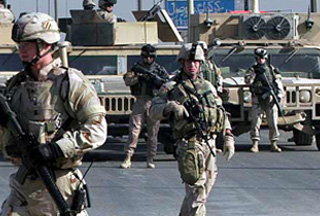 US forces have shot eight Iraqi people, most of them ‘innocent bystanders,’ in a raid in a village southeast of Baghdad, Iraqi provincial officials say.
Iraqi provincial council officials described the US raid as slaughter and demanded financial compensation for the relatives of the victims.
Maysan province governor Mohammed Shia al-Sudany told state-run television that eight people were killed, one wounded and 12 arrested in the village 75 km (46 miles) north of the provincial capital of Amara.
“What happened this morning was a massacre in every sense of the word. Eight people were killed. Most of them were innocent,” Reuters quoted Sudany as saying.
The US military, however, said the raid was against suspected members of what it called a terrorist Iran-backed group.
“The joint security team was fired upon by individuals dispersed in multiple residential buildings … members of the security team returned fire, killing individuals assessed to be enemy combatants,” the US military said in a statement on Friday.
“While the number of casualties has not yet been confirmed, initial reports indicate five individuals were killed,” the statement added.
This is while Iraqi officials have called on US troops to release all those arrested during the raid and to apologize for the attack.
Featured Video
Dan Dicks with James Corbett on Solutions Watch
or go to
Aletho News Archives – Video-Images
From the Archives
Secret document reveals plans for civil war in Lebanon, Israeli false flags, and invasion
By Randi Nord | Geopolitics Alert | April 5, 2019
Beirut – During his visit with US Secretary of State, Mike Pompeo, Lebanese President Michael Aoun reportedly received a US-Israeli document detailing plans for creating a civil war in Lebanon with covert false flag operations and possible Israeli invasion.
Although the source of the document is Israeli and created in partnership with Washington, no one knows who presented it to Aoun. The Lebanese TV station, Al-Jadeed, initially reported the document on Lebanese TV and a video on its website. Geopolitics Alert translated the report for this article. … continue
Blog Roll
 Aletho News
- Sheikh al-Asadi warns of Iraqi government compliance with US demands
- How to MAKE THE CONSPIRATORS PAY for their crimes! Dan Dicks with James Corbett on Solutions Watch
- There’s a drought in academia: A drought in honest research on the subject of drought and other weather extremes
- Department of War Awards $20.7 Billion Contract to Raytheon for Air-to-Air Missiles
- ‘Distance yourselves from Israel’: IRGC urges US population to question govt policies
- America’s Greenland deal has a radioactive backstory
- The RAF Fairford ‘terror plot’: Unpacking escalation in the UK echo-chamber
- EU Council Advances Chat Control 2.0 Scanning Proposal
- Ex-Greek MEP files complaint against Israeli spyware firm over alleged Pegasus surveillance
- Troubling ideas throughout the Torah, Talmud, Mishneh Torah and Tanya
- If Americans Knew
- New Report: “Scholasticide and Genocide in Gaza: Assessment, Testimonies and Legal Analysis”
- Ex-Biden officials are desperate for a Gaza scapegoat
- Israeli “settlers” Invade Al-Aqsa; Pour Boiling Water on 75-Year-Old
- Israel Has Kidnapped Another American Teenager
- US arms sales to Israel worth $21.6 billion in 20 months
- Three Palestinians Killed in Israeli Attacks on Gaza
- Revealed: German “Anti-Semitism Expert” Driving Crackdown on Palestine Solidarity is Former Israeli Spy
- Egypt’s Warning to Israel Before Oct 7
- Israel’s siege signals another cruel winter for 1.8 million Gazans – Daily Update
- Netanyahu Asked UAE Leader to Deny Report on Oct. 7 Warning in Secret Visit, Sources Say
- No Tricks Zone
- Two More Paleo Reconstructions Affirm Meters-Higher Sea Levels Across Ireland, Brazil 7000-6000 Years Ago
- New Study: Earth And Venus Surface Warmth Largely Explained By Convection And Lapse Rate, Not CO2 Or Radiation
- 2025 Nature Paper Claiming Worsening Global Drought Gets RETRACTED …Heavily Flawed
- New Study: ‘Global Drought Shows No Detectable Recent Acceleration Under Climate Warming’
- Economic Masterminds: German Socialists Suggest Taxing Productivity Gains Stemming From Using AI
- The South China Sea Has Not Been Cooperating With The Climate Change Narrative
- Energy Crisis: Germany Enters Heating Season With Historically Low Gas Reserve Fill Levels
- New Study: The Antarctic Ice Sheet Gained Mass From 2020-2024 Due To Staggering Snow And Ice Accumulation
- Study: Ocean Heating Rates From Thousands Of Years Ago ‘Dwarf’ Modern Ocean Heating Rates
- Climate Extremists Target, Attack Large-Scale Power Grid Infrastructure In Germany!

