Israeli occupation troops kidnap 150 Palestinians in two days
PIC | 12-02-2010

GAZA – The PA ministry of prisoners and ex-prisoners affairs in Gaza said on Thursday that the Israeli occupation authorities kidnapped 150 Palestinian citizens over the past two days, most of them from Jerusalem city.
According to Reyadh Al-Ashkar, the information officer in the ministry, the IOA rounded up nearly 100 Palestinian youths in the refugee camp of Shafat, north of the occupied city of Jerusalem during a military incursion described as the most violent in recent years.
Another 15 Palestinian civilians of one family, including children, were also kidnapped by the IOF troops after they swept into the northern borders of the Gaza Strip near the town of Beit Lahia. The whereabouts of the kidnapped Gazans is still unknown.
In the West Bank, the IOF troops kidnapped 38 Palestinian citizens, including at least 15 minors, over the past couple of days.
Meanwhile, the Israeli Salem military court extended the administrative detention of Palestinian female captive Sanabil Nabegh Brek, 19, for the 40th time successively. The Palestinian lady was kidnapped since September, 2008.
The court also extended the detention of Muntaha Al-Taweel, 45, wife of Al-Beireh mayor Jamal Al-Taweel, who was kidnapped from her house three days ago. Al-Taweel is a mother of five children, at least two of them need special care.
In this regard, the ministry appealed to international human rights and legal institutions to immediately intervene to protect the unarmed Palestinian civilians, and to pressure the IOA to halt the heinous practices against them.
The IOA is holding nearly 12,000 Palestinian citizens captives in its jails, many of them spent more than 20 years in jail so far. The issue of prisoners is considered one of the most crucial issues for the Palestinian people.
Binyam Mohamed torture evidence must be revealed, judges rule
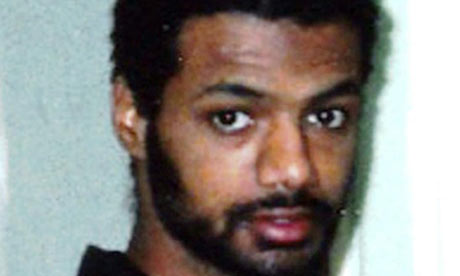
By Richard Norton-Taylor | The Guardian | February 10, 2010
Three of Britain’s most senior judges have ordered the government to reveal evidence of M15 complicity in the torture of British resident Binyman Mohamed- unanimously dismissing objections by David Miliband, the foreign secretary.
In a ruling that will cause deep anxiety among the security and intelligence agencies, they rejected Miliband’s claims, backed by the US government, that disclosure of a seven-paragraph summary of classified CIA information showing what British agents knew of Mohamed’s torture would threaten intelligence sharing between London and Washington, and therefore endanger Britain’s national security.
One of the key paragraphs states that there “could readily be contended to be at the very least cruel, inhuman and degrading treatment of Binyam Mohamed by the United States authorities”.
The judges – Sir Igor Judge, the lord chief justice; Lord Neuberger, the master of the rolls; and Sir Anthony May, president of the Queen’s Bench – shattered the convention that the courts should not question claims by the executive relating to national security.
In damning references to claims made by Miliband and his lawyers, and stressing the importance of the media in supporting the principle of open justice, they said the case raised issues of “fundamental importance”, of “democratic accountability and ultimately the rule of law itself”.
Publication of the material Miliband wanted to suppress was “compelling”, Judge said, since they concerned the involvement of wrongdoing by agents of the state in the “abhorrent practice of torture”. The material helped to “vindicate Mr Mohamed’s assertion that UK authorities had been involved in and facilitated the ill- treatment and torture to which he was subjected while under the control of USA authorities”.
The disputed paragraphs have now been published by the Foreign Office.
Miliband said in a statement: “The government accepts the decision of the court of appeal that in the light of disclosures in the US court, it should publish the seven paragraphs at issue in the case of Binyam Mohamed.
“At the heart of this case was the principle that if a country shares intelligence with another, that country must agree before its intelligence is released.
“This ‘control principle’ is essential to the intelligence relationship between Britain and the US.
“The government fought the case to preserve this principle, and today’s judgment upholds it.
“It agreed that the control principle is integral to intelligence sharing. The court has today ordered the publication of the seven paragraphs because in its view their substance had been put into the public domain by a decision of a US court in another case.
“Without that disclosure, it is clear that the court of appeal would have overturned the divisional court’s decision to publish the material.
“The government has made sustained and successful efforts to ensure Mr Mohamed’s legal counsel had full access to the material in question.
“We remain determined to uphold our very strong commitment against mistreatment of any kind.”
A Foreign Office spokesman said: “Under the terms of the embargo we were permitted by the court to notify a small number of US officials in advance of this judgment. We have done so.
“The foreign secretary spoke last night to Hillary Clinton. He stressed to her that the court had strongly supported the control principle and would have agreed with HMG [her majesty’s government] had it not been for the Kessler judgment in the US court last December, which had effectively disclosed the material in the seven paragraphs.
“The foreign secretary and the secretary of state reaffirmed the importance of the US-UK intelligence relationship.”
Shami Chakrabarti, the director of Liberty, said the ruling and revelations made a public inquiry “inescapable”.
“It has been clear for over a year that the Foreign Office has been more concerned with saving face than exposing torture.
“These embarrassing paragraphs reveal nothing of use to terrorists but they do show something of the UK government’s complicity with the most shameful part of the war on terror.
“The government has gone to extraordinary lengths to cover up kidnap and torture. A full public inquiry is now inescapable.”
Key to the appeal court’s ruling was a recent case in a US court where the judge noted that Mohamed’s “trauma lasted for two long years. During that time he was physically and psychologically tortured. His genitals were mutilated … All the while he was forced to inculpate himself and others in various plots to imperil Americans.”
The US court, which was hearing a case relating to another detainee at Guantanemo Bay, noted that Mohamed was told “that the British government knew of his situation and sanctioned his detention”.
An MI5 officer known only as Witness B is being investigated by the Metropolitan police over his alleged role in questioning Mohamed incommunicado in a Pakistan jail.
The whole basis of Miliband’s case had “fallen away” because of the US court case, said Neuberger, who added: “It is a case which is now logically incoherent and therefore irrational and is not based on any convincing evidence.”
In his ruling , May said: “In principle a real risk of serious damage to national security, of whatever degree, should not automatically trump a public interest in open justice which may concern a degree of facilitation by UK officials of interrogation using unlawful techniques which may amount to torture or cruel, inhuman or degrading treatment.”
In a stinging reference to claims by Jonathan Sumption QC, Miliband’s counsel, that high court judges in earlier rulings were “irresponsible” in saying that CIA intelligence relating to ill treatment and torture and Britain’s knowledge of it should be disclosed, the lord chief justice said: “No advantage is achieved by bandying deprecatory epithets.”
Mohamed was detained in 2002 in Pakistan, where he was questioned incommunicado by an MI5 officer. The US flew him to Morocco, Afghanistan, and Guantánamo Bay, where he says he was tortured with the knowledge of British agencies.
In the high court last year, Lord Justice Thomas and Mr Justice Lloyd Jones ruled that it was clear from the evidence “that the relationship of the United Kingdom government to the United States authorities in connection with Binyam Mohamed was far beyond that of a bystander or witness to the alleged wrongdoing”.
Tel Aviv’s hydra-headed monster
It’s outrageous that in all probability Israel will once again be allowed to get away with committing murder on foreign soil while the world remains silent
By Linda Heard | Gulf News | February 9, 2010

- Government-sponsored Israeli murderers are professional and have decades of experience. It’s highly unlikely that they would leave behind them a trail of hard evidence that would stand up in an international court of law.
- Image Credit: NINO JOSE HEREDIA/Gulf News
It’s surely ironic that the country that complains loudest about terrorism has assassination squads travelling the world in search of prey. The murder of Hamas commander Mahmoud Al Mabhouh in a Dubai hotel room last month is believed to have been carried out by members of the Mossad allegedly using Irish passports. And the fact that the Israeli government has declined to comment other than to falsely claim that Al Mabhouh was in the emirate to meet with Iranian officials speaks volumes.
Dubai’s Police Chief Lieutenant General Dahi Khalfan Tamim has warned that an international arrest warrant will be issued in the Israeli Prime Minister’s name if it is proved that the crime was perpetrated by an Israeli hit squad. That would certainly be a logical course of action but it’s easier said than done.
Government-sponsored Israeli murderers are professional and have decades of experience. It’s highly unlikely that they would leave behind them a trail of hard evidence that would stand up in an international court of law.
Moreover, even if Benjamin Netanyahu’s name were to appear on an international arrest warrant there would be very few countries, if any, willing to face Washington’s wrath by putting him behind bars.
Let’s be realistic. It’s just not going to happen! Britain, for instance, regularly tips off Israelis who are wanted for war crimes and is attempting to change its own laws to ensure Israelis are no longer vulnerable.
It’s outrageous that in all probability Israel will once again be allowed to get away with committing murder on foreign soil while the world stays silent. The reaction or rather non-reaction of the international community is unprincipled. It isn’t hard to imagine what an orchestrated outcry there would be if assassins backed by Arab governments were targeting prominent Israelis abroad. Every western television network would have rolling news and commentary centering on ‘Arab terrorists’, while US and European leaders would be issuing warnings and sending condolences.
There will be those who will say ‘good riddance’ upon hearing of the demise of a top Hamas lieutenant but I believe that anyone who takes that stance needs to check their moral compass. Whatever we feel about the victim should be neither here nor there.
Rogue state
Countries that equip assassins with foreign passports — usually acquired using devious means — to violate the sovereignty of a third nation should be censured in the United Nations and isolated. When a nation’s leaders behave like the Sopranos it deserves to be branded a rogue state.
Over the decades, the Mossad, the Shin Bet and the Israel Defence Forces (IDF) have carried out dozens of targeted assassinations. Several leaders of Hamas, Fatah, Al Aqsa Martyrs Brigade, the Popular Front for Liberation of Palestine (PFLP), the Palestine Liberation Organisation (PLO) and Hezbollah have been killed along with the Egyptian nuclear scientist Yahya Al Mashad, who was murdered in a Paris hotel room in June 1980. By some estimates, the Mossad is responsible for the deaths of hundreds of nuclear scientists and is believed to have been behind the killing of Canadian ballistics expert Gerald Bull shot outside his Brussels apartment in March 1990 while working for Iraq.
The Mossad may be a well-honed killing machine but there are times when it makes mistakes. In 1973, Mossad agents using fake Canadian passports murdered a Moroccan waiter in Norway, whom they mistook for a Black September leader, and were arrested.
In 1997, Canada withdrew its ambassador from Israel after Israeli assassins were caught with Canadian passports in Jordan after a failed attempt on the life of Hamas leader Khalid Mesha’al. Then, in 2004, there was a diplomatic contretemps between Israel and New Zealand when Israelis working for Israeli intelligence fraudulently tried to obtain New Zealand passports.
Al Mabhouh’s killing may be stamped with the Mossad’s trademark but, in the end, the case is likely to be filed away marked ‘unsolved’. The slayers who flew out of Dubai within hours of doing the deed will be given new identities, new passports and new assignments.
Israel’s propagandists will attempt to pin the blame on Arab intelligence agencies and the rest of us will simply yawn and turn the page… until the next time this government-licensed hydra-headed monster strikes. The question is who will be next?
Linda S. Heard is a specialist writer on Middle East affairs. She can be contacted at lheard@gulfnews.com
Unrest continues in Shu’fat; overnight raids, youth detained
 09/02/2010
Jerusalem – Ma’an – Confrontations erupted between school children and border guards at the Shu’fat military checkpoint on Tuesday, leading to the detention of a 15-year-old and the injury of a soldier, witnesses said.
The clash followed a series of overnight raids where border guards handed out dozens of notices for residents to turn themselves in for questioning at Israeli intelligence compounds in Jerusalem. The raids came directly on the heels of an arrest campaign targeting dozens of Palestinian residents of the camp.
The teen detained in the most recent clashes was identified as Ahmad Jamil Abu Hamda, who was on his way to school when the clashes erupted.
Locals said soldiers used tear gas to disburse the crowds.
The secretary of Fatah in the camp, Khader Ad-Dibs, said that raids continued until 5am, and that more than a hundred soldiers guarded the entrances of the camp.
Ad-Dibs noted that some of the men and women detained Monday had already been transfered to the military court where their sentences were extended, and others who were released said they had been severely beaten.
Ethnic Cleansing Escalation in Jerusalem
Aletho News | February 8, 2010
Israeli occupation forces manning a military checkpoint at the Shu’fat refugee camp in Jerusalem set off protests Saturday due to the humiliating conditions inflicted on Palestinians on a daily basis. The residents, whom were displaced from their homes across Jerusalem, have been denied access to the city by the apartheid wall as well as various military checkpoints.
There have also been recent protests against home demolitions in the area. Palestine Information Center reports:
In the city’s Sheikh Jarrah suburb, an armed Israeli settler wearing military uniform pointed his rifle at Palestinian lady Refqa Al-Kurd, 85, in a bid to frighten her and force her out of what is remained of her house after the settlers occupied most of it.
- Refqa Al-Kurd, aged 85, after assault
The incident prompted clashes between the Palestinian neighbors, who rushed for the help of the elderly woman, and the settlers.
Another Israeli settler in the same suburb dropped a big stone at Palestinian teenager Murad Ateyyah, 14, prompting angry Palestinian citizens to intervene and clash with the settlers before the Israeli occupation police arrived and broke up the clashes.
Palestinian Jerusalemites asserted that attacks by Israeli settlers against them increased rapidly with the aim to force them out of the city.

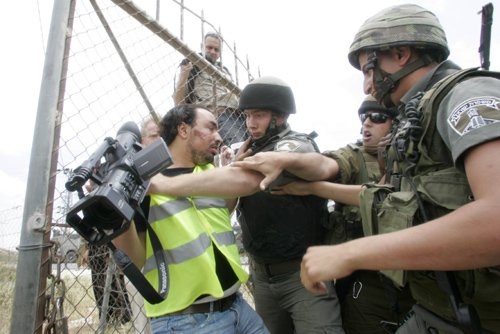
Tensions were raised further by army raids on private residences in the Anata camp early on Monday. Packs of soldiers ransacked homes at daybreak in surrounding villages abducting residents for torture interrogations. House to house searches without search warrants resulted in the seizure of one homemade rifle.
File photo
Ma’an reports that over 60 Palestinians were seized in the raids. Young Palestinians confronted the intruding forces by throwing stones. Journalists that attempted to record the clashes were fired upon with tear gas, rubber-coated bullets and stun grenades. Eyewitnesses also report the use of live ammunition. Several journalists were injured.
Occupation forces then attacked the local clinic and detained the doctors working there, preventing them from attending to the injured. The camp is now under military control, curfew has been imposed.
Israeli forces detain wife of mayor in Ramallah
 08/02/2010
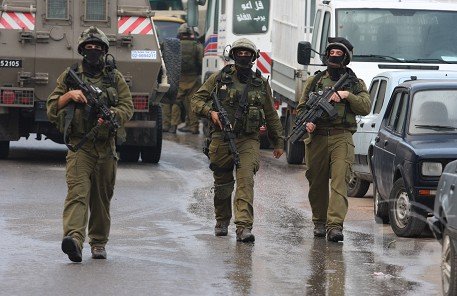
Jerusalem – Ma’an – Israeli forces detained Muntaha Tawil, wife of Al-Bireh Mayor Jamal Tawil, on Monday, after searching their home in Ramallah.
“Heavily armed soldiers and large numbers of military vehicles raided the mayor’s home on Monday early morning breaking the doors and damaging the house’ interior before they detained Muntaha Tawil, the mayor’s wife,” an Al-Birreh Municipal Council statement said.
Mayor Tawil said his wife’s detention would not hinder his ability to provide his constituents with the services they need, adding that Israel often attempts to exert pressure on mayors of Palestinian villages through detentions, forced home searches and summons orders.
Tawil is the mother of four and her husband has been detained several time by Israeli forces. Mayor Tawil previously served 13 years in an Israeli prison.
An Israeli military spokesman said that Muntaha Tawil was detained overnight by Israeli forces operating in Ramallah because of her involvement in activities “in the Hamas terrorist organization.”
###
Editor’s note:
Muntaha Tawil is one of the most active women working in the prisoners’ solidarity movement.
The Culture of Cocaine
By Forrest Hylton | February 5, 2010
Cocaine is a central commodity of the neoliberal age; so, too, its re-processed form (“crack”) for the desperately poor in de-industrialized cities of the North and South Atlantic. First announced by Richard Nixon in 1971, the “War on Drugs” predates the rise of cocaine and crack by nearly a decade, but, in the 1980s and ’90s, the “War on Drugs” was redoubled in response to the explosion of the cocaine business. It now ranks as the U.S.A.’s longest running military-police campaign. Thus, if we look at cocaine as a social hieroglyph – not as a thing but as a complex relation between networks and organizations of people, as well as between states and bureaucracies – we may glimpse some of the distinguishing features of the contemporary world.
There is a strong argument to be made for the impact of the cocaine business on architecture, urban design and construction, fashion, media entertainment, sports, and aesthetics, not to mention banking and credit institutions. The war on cocaine producers, sellers, and users has radically changed the shape of states in relation to those who are, at least nominally, rights-bearing citizens, as states have become more militarized, policed, punitive and carceral, and citizens more powerless and less protected by the rule of law. As the French sociologist Pierre Bourdieu observed in his late work, states do not disappear under neoliberalism: rather, their repressive right wings are strengthened while their progressive, redistributive rights-based wings are weakened or eliminated. This is most notable in cities, where urban space has been re-made in line with the requirements of policing and surveillance to protect capital investment and affluent consumers.
Though it does not advance these arguments, except tangentially, Tom Feiling’s well-researched The Candy Machine: How Cocaine took over the World (Penguin, 2009) makes a similar claim for the importance of its subject.Yet, could not the same be said of any essential commodity: oil, for instance, or cars or clothes? What makes cocaine different? The answer, of course, would depend on whom one asks, but what makes cocaine extraordinarily profitable for its import-export merchants is the fact that it is illegal. The fact that one country – Colombia – supplies 90 per cent of the cocaine consumed in the U.S. also makes the commodity different. Ninety per cent of Colombian cocaine enters the U.S.A. through Mexico (and Guatemala); smuggling having been made considerably easier by NAFTA, which de-regulated trucking and shipping.
Plan Colombia and Plan Mérida (Mexico) – based on counternarcotics and counterterrorism – are the two most important U.S. foreign policy initiatives in the Western Hemisphere, with Plan Colombia and its successors costing U.S. taxpayers $8 billion between 2000 and 2008, and Plan Mérida, approved in 2008, costing $500 million in 2009. So, cocaine is not only big business, it is also high politics: Plan Colombia has been held up as a model of counternarcotics and counterinsurgency success for Mexico, Afghanistan and Pakistan. One senior U.S. official told CBS News, “The more Afghanistan can look like Colombia, the better.”
Public debate in the U.S. concerning the suppression of cocaine production and consumption – and the U.S. has determined international drug policy since the U.N. Single Convention on Narcotic Drugs of 1961 – is moralistic, due to the weight of conservative strains of Protestantism, even among non-evangelicals, not to mention neoconservative Catholicism: decent, responsible people should not consume drugs, and should not be allowed to consume them, because, if they do, they will become unproductive degenerates.
If supply is reduced, the official argument goes, prices will rise for consumers in the U.S.A., and demand will drop correspondingly. Nevertheless, Plan Colombia and related anti-drug initiatives in the Andes and Mexico have not reduced the supply of cocaine to the U.S., where prices have tended toward secular decline since the early 1980s and domestic demand has fluctuated from generation to generation. The volume of illicit drugs that U.S. citizens consume has not changed significantly over time, but the type of drugs they consume has, with cocaine coming back into fashion, together with pharmaceuticals, among young, affluent people during the Bush II period.
In terms of costs and benefits, fighting cocaine production and consumption is a disaster even by the standards of the Pentagon: according to a 1994 RAND Corporation study, to reduce cocaine consumption by 1 per cent in the U.S., it would be twenty-three times cheaper ($34 million) to spend on treatment and education for consumers than on coca eradication for producers ($783 million).
But the failure to achieve stated objectives has yet to affect policy-making, which is driven mainly by ideology. Empirical data have little bearing on the policy-making process. The logic driving the War on Drugs has been chiefly ideological and political, not economic: domestic politics in the U.S. have determined policy abroad. One of the defining policies of Cold War liberalism, President Johnson’s War on Poverty – which had less than one-tenth of the lifespan of the War on Drugs – took for granted that federal and state governments should take responsibility for improving the plight of the poor in northern cities and represented a semi-coherent response to African-American riots and insurgencies. But what if poor black people in cities could be held responsible for their poverty? What if, as industrial jobs disappeared by the millions, they became addicted to selling or consuming illegal drugs, produced and/or distributed by U.S. government allies in Cold War counterinsurgent campaigns? Then African Americans could be locked up for nonviolent drug offenses and warehoused in prisons at an accelerated rate.
It is to Feiling’s credit to have discovered this larger truth, albeit in bits and pieces: “As long as the focus stayed on drug sales and drug abuse, inner-city residents could be blamed for the poverty they had been driven into … what the politicians had to do was convince the American public that the inner cities deserved to be abandoned.”
In the 1970s, President Richard Nixon and Governor Nelson Rockefeller in New York campaigned for office by whipping up hysteria about “crime” and “drugs,” and then criminalized African-American communities, militarized policing, and increased incarceration. After a brief respite under Carter, fighting crime and drugs in urban African-American neighborhoods became the rhetorical coin of the political realm under Ronald Reagan. The idea was to put African Americans back in their place without Jim Crow segregation, and to get elected or re-elected by doing it. Fear was to be one of the most enduring weapons in the U.S. politician’s arsenal. In his diary in 1969, Nixon’s top aide, H.R. Haldeman, provided a succinct summary of the overall strategy: “Nixon emphasized that the whole problem is really the blacks. The key is to devise a system that recognizes that, while not appearing to do so.”
In a letter to Dwight Eisenhower, Nixon wrote, “Ike, it’s just amazing how much you can get done through fear. All I talk about in New Hampshire is crime and drugs, and everyone wants to vote for me – and they don’t even have any black people up here.”
Nixon’s War on Drugs,” Feiling notes, was “politically expedient, since it turned attention away from … Vietnam, while preserving the military culture that had inspired the war in the first place.”
Nearly all of those imprisoned in New York State for drug offenses have been African-American or Latino males, most of them from eight neighborhoods in New York City. Whereas the U.S. had 200,000 prisoners in the 1970s, it currently has 1.8 million in jail and 5 million on probation or parole, making it the largest carceral state-society in world history. The U.S. accounts for 5 per cent of the world’s population and 25 per cent of its prison population; 500,000 people are serving time for nonviolent drug offenses.
Needless to say, the profile of the U.S. prison population does not reflect consumption patterns: whites consume an estimated 80 per cent of cocaine in the U.S.A., while African Americans consume 13 per cent; whites consume cocaine in disproportionate numbers, while blacks do not. Yet 38 per cent of those arrested and 59 per cent of those convicted for drug offenses have been African Americans. And stereotypes notwithstanding, whites account for 46 per cent of all crack use, while African Americans consume 36 per cent and Latinos 11 per cent. That is to say that although African Americans use crack out of proportion to their numbers, probably because it is the least expensive of illicit drugs, they consume considerably less of it than whites do.
Just as Jim Crow succeeded slavery at the end of the 19th century after Reconstruction was reversed, militarized policing and prisons replaced Jim Crow after the civil rights movement was rolled back. Black freedom struggles determined the limits of U.S. democracy from the early 19th century through the 1960s, and the criminalization and incarceration of young African-American males through the War on Drugs at the end of the 20th century represented another dramatic constriction of democratic politics in the U.S., first under President Nixon and accelerating under Presidents Reagan, Bush and Clinton. As Feiling and others have stressed, it was through sentencing laws on crack vs. powder cocaine which passed in 1986 under Ronald Reagan – in cooperation with Democratic house majority leader Tip O’Neill – and a revolution in police tactics and organization, that this was achieved.
Such is the domestic context, without which it is impossible to make sense of U.S. foreign policy in producer countries in the Andes (Colombia, Peru and Bolivia) and transport countries in Mexico, Central America and the Caribbean (leaving aside Brazil, whose government does not respond to U.S. pressures). After Ronald Reagan was elected, aerial fumigation was undertaken against marijuana growers in Mexico, Jamaica and Colombia in the early 1980s, even as the Pacific Northwest became the leading supplier of the U.S. marijuana market thanks to its competitive advantage in transport costs; the region was soon to find itself subject to similar, if less toxic campaigns. In 1982, President Reagan became the first to appoint a high-level official, then Vice President George H.W. Bush, to run the South Florida Drug Task Force – composed of agents from the DEA, Customs, FBI, ATF, IRS, Army, and Navy – to deal with cocaine trafficking in Miami, by which time the city’s homicide rate had made headlines thanks to the violence that Colombians had unleashed in their bid to take over and maintain distribution networks.
Before launching the invasion of Panama and the Gulf War, in 1989 President George H.W. Bush created the Office of National Drug Control Policy, led by “drug czar” William Bennett, militarized anti-narcotics policing in Colombia, Ecuador, Peru and Bolivia, and doubled the anti-drug budget to $12 billion. Mexico had already become the major transshipment point for Colombian cocaine, but its dominance only increased with the end of U.S. counterinsurgency wars in Central America, the passage of NAFTA, and the fall of the two so-called cartels in Colombia – Medellín and Cali – under President Clinton.
The Candy Machine’s greatest strength may be its presentation of perspectives from former gang members and drug users, drug traffickers and retired narcotics enforcement officials in the U.S. Thus Rusty, a former narcotics officer for the Department of Corrections in Arizona: “When I talk about legalizing drugs, people say, ‘you can’t mean heroin and crack, right?’ But after 30 years of the drug war, spending a trillion dollars … the bad guys still control the price, purity, and quantity of every drug. Knowing that they control the drug trade, which drug are you going to leave under their control? Regulation and legalization is not a vote for or against any drug. It’s not about solving our drug use problem. It’s solely about getting some control back.”
“They” refers to drug barons, many of them large landowners, as well as warlords, in Colombia, Mexico, Afghanistan and Pakistan, but the problem with Rusty’s analysis is that U.S. government allies in such countries – the intelligence services, the judicial systems, the military and police, business and political elites – are either complicit with or directly involved in supplying U.S. and European markets with cocaine and/or heroin, generally in order to finance counterinsurgency wars. As Cockburn and St. Clair’s Whiteout [to be reissued, updated, in 2010 by CounterPunch Books] describes, this pattern was set in the 1950s, with opium and heroin in places like Burma, Marseilles and Cuba, repeated in the 1960s and ’70s in Vietnam and Laos, and updated with Colombian cocaine in Central America and Central Asian heroin in the 1980s.
The career path of “Freeway Rick” Ross in the 1980s, is illustrative. Unlike everyone else selling cocaine or crack, Rick Ross was supplied with cocaine at cut-rate prices by Danilo Blandon, a Nicaraguan employee of the CIA in the U.S. government’s war against the revolutionary Sandinista government, as documented in Whiteout and the late Gary Webb’s Pulitzer-prize winning Dark Alliance: The CIA, the Contras, and the Crack Explosion (2003). From prison, Ross explained to Feiling, “Me and Danilo Blandon were really tight. I knew from earlier that he was backing some war, and I knew that he was from Nicaragua, but I had no idea about the Contras. I was illiterate at that time, you know. I never read a newspaper or listened to the news. They say that Danilo was protected, and you can assume from the Feds that I was protected too, but I never knew that. I was just in it for the money, trying to get out of the ghetto.”
Blandon sold cocaine to Ross at a price, of a quality, and in quantities that none of Ross’s competitors could match. As former DEA agent Celerino Castillo III, who served in El Salvador, told Feiling, “They gave all the coke to Danilo Blandon, who was a CIA asset. He in turn fronted all that stuff to Ricky Ross. Ross became the Walmart of crack, distributing to the Bloods and Crips and everybody else all over the country… Hangars 4 and 5 at Ilopango airport in El Salvador were used as a trampoline for drugs coming in from Colombia and Costa Rica. Oliver North and a Cuban exile named Felix Rodríguez [a former CIA agent who supervised the execution of Che Guevara in Bolivia] were running one of them, and the other one was owned by the CIA.
All evidence pointed to Vice President George H.W. Bush’s office as overseeing the operation, but, of course, nothing came of it besides the Kerry Committee Report of 1989, which charged the State Department with making payments to Nicaraguan Contras involved in the cocaine business.
In the neoliberal economy of the 1980s, anchored in financial services, insurance, real estate, and speculative asset bubbles, many African-American males and immigrant males of color saw the cocaine-crack business as the way to achieve material security. Cocaine gave a shot in the arm to street gangs, who handled lower levels of wholesale and retail distribution in the U.S. Rick Ross describes his trajectory: “I was a youngster. Uneducated, uninformed, unemployed. I was looking for opportunities. I wanted to be important in the world, somebody who was respected. Basically, I wanted the American dream, so I guess I was ripe for the picking. The opportunity came in the form of drugs and I latched onto it. I just kept saving my money and buying more drugs. My childhood friends would be walking, but I’d be driving a nice car, and they’d want to know how I got the car. ‘Oh, I’m selling cocaine now,’ I’d say. ‘Teach me how to sell cocaine,’ they’d say. So my friends started to get involved, and, before long, we’re making a lot of money, and I’m eating at McDonald’s whenever I want to. At our height, some days a million dollars would come through our hands in a single day. Next thing I know, the whole neighborhood is selling, people were already gang-banging, but now we were able to afford more expensive weapons, more expensive cars, and better houses and the police started noticing it more.”
The comment about eating at McDonald’s speaks volumes about the depths of poverty from which Rick Ross escaped, only to wind up living most of his life in a prison cell. Indeed, for most of those serving hard time for nonviolent drug offenses, the crack business offered much less distance from poverty than it had for Ross. Marc, from South Jamaica neighborhood in the borough of Queens, N.Y. – currently the epicenter of the foreclosure crisis in New York City’s black and brown neighborhoods – described his work as follows: “It was the hardest job I ever had. It’s pure capitalism, you know. Say, you’re selling drugs in the South Bronx, say at 138th and 3rd Avenue, and another crew of guys is selling the same drugs as you two blocks away. The block they’re on is making $2,000 per day, and the block you’re on is making about $2,000 per day. They decide, ‘You know what? You’re a punk. You’re a pussy.’ So they move you.” It’s dog eat dog, to quote the title of a remarkable 2008 film about the cocaine business in Cali, Colombia: a Hobbesian capitalist world of all against all and murder for hire.
This pattern – with gangs as cell forms of organized crime – was repeated among a host of new immigrant groups in the U.S., involved in cocaine distribution and/or smuggling and money-laundering: Colombians, Mexicans, Salvadorans and Guatemalans in L.A.; Colombians, Mexicans and Puerto Ricans in Chicago; Colombians, Jamaicans, Dominicans, Puerto Ricans, Mexicans, Albanians, and Russians in New York. These gangs, of course, are bi- and transnational, just like the cocaine commodity circuit, in which they are embedded: in L.A., there are roughly 2,000 gangs; in Medellín, Colombia, there were reportedly 6,300 gangs in 2003; Chicago is said to have 70,000 gang members.
Gangs involved in distribution aim to reproduce the corporate organization of capitalism, from which their members have been excluded. Hip-hop music testifies to this, particularly the Brooklyn variety pioneered by Biggie Smalls and Jay-Z. Lance, a cocaine wholesaler from South Jamaica, Queens, described his outfit as follows: “The structure of the business is like a Fortune 500. We’d have different titles, but it all basically remains the same as in corporate America. You have your CEO, your supervisor, your treasurer. You might be the captain; you have your lieutenants, your soldiers.” Most Fortune 500 companies have different titles for their executives, though; only the Sicilian mafia uses such terms for its employees. This would seem to be an indication of the extent to which poor African Americans – not to speak of Jamaicans, Dominicans, Mexicans, Colombians, Salvadorans, and so forth – have seized upon mafia organization and ideology to justify the pursuit of employment, upward mobility, material abundance, and, most importantly, “respect.” If so, it provides evidence of delusion, desperation, or some combination thereof, for, as anthropologist Phillipe Bourgeois’ In Search of Respect: Selling Crack in El Barrio (1995) shows, the cocaine-crack business is much like any other low-wage service industry offering no benefits. Feiling found that “street-level sellers earn roughly the federal minimum wage, which at the time of writing stood at $6.55 per hour.” Most top dealers have day jobs and take no more than 25 per cent of total revenues. Only one in six brings home more than $5,000 per month, as 60 per cent of revenues go to wholesalers and retailers on the lower rungs of the distribution chain.
Yet, in spite of the new mafia ideology encapsulated in Jay-Z’s (typically self-glorifying) verse, “even righteous minds go through this” (when contemplating whether to participate in the crack game), the cocaine business offers only marginally more room for upward mobility than the service industries to which African-American and Latino youth are confined in the licit economy – with the added risk, or near-certainty, of prison or violent death at an early age.
For direct producers of tropical agricultural commodities like coffee, neoliberal policies in the countryside – nowhere else applied with greater blood and zealotry than in Colombia – have accelerated a long-term secular price decline: there are no options other than coca for people in isolated rural frontier areas, where there is no state presence or source of employment. A coca grower from the department of Sucre (Monterrey municipality) does the arithmetic: “Getting a sack of potatoes to market will cost a farmer between 3,000 and 5,000 pesos, and it will sell for between 10,000 and 12,000 pesos, depending on demand. Meanwhile, coca is a lot easier to sow and process, and doesn’t need transporting because the traffickers come to the village to buy it. They pay 1,500,000 pesos for a kilo of coca paste.” Making coca paste is and will remain the only option for survival for millions of impoverished peasant families on the Colombian agricultural frontier; the same is true for Peru and Bolivia.
As the experience of the Bolivians Yungas with northern Argentina demonstrates, a legal market for coca dramatically reduces the amount of coca leaf produced for the cocaine business. Bolivian President Evo Morales, whose political base remains the coca growers’ trade union federation in the Chapare that produced him, would like nothing better than to tour the world touting the medicinal benefits of the coca leaf and coca tea, and it is easy to imagine a successful “coca diplomacy” with leaders and consumers in the EU, the U.S., Australia and Japan. But, first, the U.N. Single Convention of 1961 would have to be revised so that companies and firms other than Coca Cola could use the leaf for industrial purposes. Until U.S. domestic politics changes, it will stand.
Decriminalizing Marijuana and Cocaine
Perhaps in recognition of this fact, a number of Latin American countries have de-criminalized personal consumption of cocaine and marijuana. Colombia was the pioneer: in 1994, as head of the Constitutional Court, created in the Constitution of 1991, Judge Carlos Gaviria legalized the personal consumption of up to 20 grams of marijuana, and/or a gram of cocaine, because, he argued, drinkers were much more likely to commit violent crimes, and no one had suggested prohibition of alcohol consumption since the 1920s. Gaviria, who has since moved on to a political career in Colombia’s turbulent electoral Left, said, “Legislators can proscribe certain forms of behavior toward others, but not how a person is behaving toward him or herself, as long as this doesn’t interfere with the rights of others.” Ecuador, Argentina and Mexico have since followed suit, which represents the extent to which Latin American countries have sought and attained greater autonomy from U.S. imperial control, as many of the anti-drug laws in Latin America were drafted under U.S. diplomatic pressure. Latin American countries have now joined the Netherlands in treating drug consumption as a public health problem rather than a police problem.
In the U.S., however, as Feiling points out, “legalization” is a “third-rail issue” for politicians, meaning that most will not mention it for fear of destroying their political careers. As President Obama’s drug czar, Gil Kerlikowske, put it in July 2009, “Legalization is not in my vocabulary nor is it in the president’s.” To understand why, it is helpful to ask who wins and who loses from legalization. The losers, not necessarily in order of importance, would include U.S. Immigration and Customs Enforcement, the DEA, U.S. Border Patrol, the FBI, the ATF, the IRS, state and local police forces, the U.S. Coast Guard, the U.S. armed forces, to name only some of the agencies whose budgets depend on the drug war for funding, as well as their counterparts in U.S. client states throughout the Americas; arms manufacturers like Sikorsky Helicopters; large pharmaceutical companies like Pfizer; suppliers of chemicals for fumigation like Monsanto; the banking sector as well as off-shore tax havens; the Republican Party; along with warlords, gangs and gangsters. The clearest winners would be consumers, direct producers, and societies that would be less militarized, less carceral, less moralizing, and would have stronger public health and education systems. But, as Jack Cole, who spent 26 years in policing narcotics in New Jersey and is now the executive director of Law Enforcement against Drug Prohibition, stressed to Feiling, “When you train your police to go to war, they’ve got to have an enemy.” Cole considers the War on Drugs a “terrible metaphor” for “policing in a democratic society.” Terrible, alas, but substitute “neoliberal” for “democratic,” and it is nothing if not apt. Predictably, Obama and Kerlikowske have dropped the nomenclature, but the policies remain intact.
Forrest Hylton is the author of Evil Hour in Colombia (Verso, 2006), and with Sinclair Thomson, of Revolutionary Horizons: Past and Present in Bolivian Politics (Verso, 2007). He can be reached at forresthylton@yahoo.com.
Voices From Guantanamo: Omar Deghayes
By Jasmin Ramsey | Pulse Media | February 5, 2010
Omar Deghayes spent close to 6 years of his life in the US run Guantánamo Bay detention facility, the same prison that President Barack Hussein Obama said he would close down during his presidential election campaign. Once referred to as a “sad chapter in American history” by Obama, Guantánamo Bay remains in operation today, while its lesser known twin in Afghanistan has undergone ‘improvements‘ and expansion. A list of the hundreds of detainees in Bagram were only obtained by the American Civil Liberties Union (ACLU) after months of campaigning in January 2010. Bagram has been holding, interrogating, and sometimes killing suspects of the US led ‘war on terror’ since 2001.
In 2007 Deghayes was finally released without being charged, but will carry the physical and emotional scars that he suffered during his imprisonment for the rest of his life. He will have to face one of those scars every time he looks in the mirror. For some, Deghayes is just another brown male with a beard and a disturbing story to tell. Who listens?
Near the end of January Patrick Barkham of The Guardian conducted an in-depth interview with Deghayes. In it he notes:
It is not hot stabbing pain that Omar Deghayes remembers from the day a Guantánamo guard blinded him, but the cool sensation of fingers being stabbed deep into his eyeballs. He had joined other prisoners in protesting against a new humiliation – inmates being forced to take off their trousers and walk round in their pants – and a group of guards had entered his cell to punish him. He was held down and bound with chains.
“I didn’t realise what was going on until the guy had pushed his fingers inside my eyes and I could feel the coldness of his fingers. Then I realised he was trying to gouge out my eyes,” Deghayes says. He wanted to scream in agony, but was determined not to give his torturers the satisfaction. Then the officer standing over him instructed the eye-stabber to push harder. “When he pulled his hands out, I remember I couldn’t see anything – I’d lost sight completely in both eyes.” Deghayes was dumped in a cell, fluid streaming from his eyes.
The sight in his left eye returned over the following days, but he is still blind in his right eye. He also has a crooked nose (from being punched by the guards, he says) and a scar across his forefinger (slammed in a prison door), but otherwise this resident of Saltdean, near Brighton, appears relatively unscarred from the more than five years he spent locked in Guantánamo Bay. Two years after his release, he speaks softly and calmly; he has the unlined skin and thick hair of a man younger than his 40 years; he has just remarried and has, for the first time in his life, a firm feeling that his home is on the clifftops of East Sussex.
Deghayes must, however, live with the darkness of Guantánamo for the rest of his days. There are reminders everywhere, from the beautiful picture of Saltdean that was painted for him while he was incarcerated, to the fact that Guantánamo remains open 12 months after Barack Obama vowed to close it within a year.
There are still around 200 prisoners left in the detention camp, many of whom have been there for eight years. Of the 800 freed, only one has been found guilty of any crime and he was convicted by a dubious military commission, a verdict that is likely to be overturned. Deghayes, too, does not want to forget. He says there is so much still to be exposed about the conditions there, and about British collusion in the extraordinary rendition and torture of men such as him in the months following the American-led invasion of Afghanistan in 2001.
Although Deghayes is now free (or as free as he can ever be considering the ordeal he was forced to endure), many others continue to suffer within the walls of America’s infamous torture chambers, otherwise referred to as detention centres, while life goes on as usual for others. Canadian citizen Omar Khadr has matured from a boy into a man within the cell walls of Guantánamo (he was detained when he was 15) while Prime Minister Stephen Harper and his government continue to resist demands and even supreme court rulings recommending that Khadr be returned to Canada. Harper recently went so far as to declare that Canadians “don’t care” about Afghan detainee abuse on national television. Some will argue that this is not the case and if you care about the actions your government takes in your name, then write to and call your governmental representatives so that there’s no confusion.
Interestingly, in the clip above Deghayes reveals that even though he has every reason to, he has not allowed himself to be swallowed by bitterness and hatred. Instead, he has been telling his story and campaigning to prevent the same injustices from being imposed on others. Deghayes and others like him provide inspiring examples of how humanity can endure even in the most challeging of circumstances, in this case brought to us by a brown male with a beard. Now, who will listen?
NYT’s Israel Editor’s Sticky Situation
Ethan Bronner’s Conflict With Impartiality
By ALISON WEIR | February 5, 2010
Ethan Bronner is the New York Times Jerusalem bureau chief. As such, he is the editor responsible for all the news coming out of Israel-Palestine. It is his job to decide what gets reported and what doesn’t; what goes in a story and what gets cut.
To a considerable degree, he determines what readers of arguably the nation’s most influential newspaper learn about Israel and its adversaries, and, especially, what they don’t.
His son just joined the Israeli army.
According to New York Times ethics guidelines, such a situation would be expected to cause significant concern. In these guidelines the Times repeatedly emphasizes the importance of impartiality.
This is considered so critical that the Times devotes considerable attention to “conflict of interest” (also called “conflict with impartiality”) problems, situations in which personal interest might cause a journalist to intentionally or unconsciously slant a story.
The Times notes that family affiliations may cause such a conflict; as an example, it explains that a daughter’s high position on Wall Street could be problematic for a business reporter.
In situations where such a familial affiliation is considered significant, the journalist may be moved to a different area of reporting.
Ethan Bronner’s situation, therefore would appear to be sticky, at the very least. It is difficult to imagine that a son fighting for the foreign nation an editor is charged with covering does not constitute such a potential conflict with impartiality. Apart from Mr. Bronner signing up with the Israeli military himself, it is difficult to imagine a clearer example of familial partisanship.
Yet, to date, Bronner and the Times have refused to address his situation. Foreign Editor Susan Chira (who may also have family allegiances to Israel) has declined to comment, other than refer people to her curt response to Electronic Intifada, which had asked her whether it was true that Bronner’s son was in the Israeli military:
“Ethan Bronner referred your query to me, the foreign editor. Here is my comment: Mr. Bronner’s son is a young adult who makes his own decisions. At The Times, we have found Mr. Bronner’s coverage to be scrupulously fair and we are confident that will continue to be the case.”
If that were, indeed, the case for Bronner’s reporting, there would undoubtedly be less concern from outside observers. There are numerous instances of accurate reporting by both Israeli and Palestinian journalists; familial and personal affiliation do not necessarily or always result in flawed journalism.
However, while both Chira and Bronner may believe he has been “scrupulously fair” in the years that he has been the paper’s top editor on Israel-Palestine (before assuming his current position as Jerusalem bureau chief in March 2008, he had been deputy foreign editor overseeing the region for four years), a number of studies and analyses contradict this contention.
* In 2005 a study by If Americans Knew found that the Times had covered Israeli children’s deaths at a rate over seven times greater than it had reported on Palestinian children’s deaths – even though Palestinian children’s deaths had occurred first, in far greater numbers, and there was considerable evidence that Palestinian young people were being killed intentionally by official Israeli forces.
* Princeton Professor Emeritus Richard Falk and media critic Howard Friel undertook a meticulous analysis of the Times‘ coverage of the issue; the title of their book indicates their findings: “Israel-Palestine on Record: How the New York Times Misreports Conflict in the Middle East.” Among others things, Falk and Friel discovered that the Times had failed to report the essential fact that all Israeli settlements are illegal under international law.
* A 2006 study published in the Electronic Intifada revealed that during the previous six years there had been 80 reports by respected international organizations detailing human rights violations in the Israeli-Palestinian conflict. Of these, 76 had been primarily critical of Israel, and four had been primarily critical of Palestinians. The study found that the Times had reported on two of the reports for each, giving readers an exceedingly distorted view of the real situation.
* In a recent announcement expressing concern at Bronner’s apparent conflict of interest, media watchdog Fairness and Accuracy in Reporting (FAIR) stated that “Bronner’s reporting has been repeatedly criticized by FAIR for what would appear to be a bias toward the Israeli government,” detailing specific examples.
Shifting the Blame
Several years ago the San Francisco Jewish Bulletin published an article exploring Jewish student journalists’ views on how to report on Israel-Palestine. Several said that they would find it difficult to report negative aspects about Israel, one interviewee saying that he would try to avoid printing such news. If that proved impossible, he said, he would then try to find a way “to shift the blame.”
New York Times‘ news coverage often seems to follow this pattern. When the Gaza massacre of December-January is reported, Gazan rockets are inevitably mentioned. However, the fact that these largely home-made projectiles have killed far fewer Israelis in the eight years they have been used (under 20) than Israeli forces killed in a few minutes during the invasion is virtually always omitted. Likewise left out is the fact that their use began only after Israeli forces had invaded Gaza on a number of occasions, killing and injuring numerous civilians.
The Times consistently reports Israeli actions as retaliatory, despite the fact that, according to an MIT study, in at least 96 percent of ceasefires and periods of calm it was Israeli forces that had first resumed violence. In the conflict that began in fall of 2000, Israeli forces killed over 140 Palestinians before a single Israeli in Israel was killed, 91 Palestinian children (major cause of death, gunfire to the head) before a single Israeli child was killed.
An example of Bronner’s Israel-centric reporting is a November, 2009 report on prisoners. Bronner notes that the Israeli soldier captured by Palestinians (the only Israeli prisoner held by Palestinians) is “bespectacled and boyish-seeming,” while failing to mention that many of the over 7,000 Palestinians prisoners held by Israel are equally bespectacled and boyish-seeming – in fact, 300+ are not just boyish, they are children.
While Bronner includes personal information about the Israeli prisoner, he includes very few facts about Palestinian prisoners; for example, that hundreds have never been charged with a crime and that those whom Israel has found “guilty” were tried in military courts under military law in a military occupation of Palestinian land that much of the world deems illegal. While Bronner’s story contains considerable mention of “terrorism,” it fails to report that Israeli forces killed over a thousand Gazan civilians; Palestinians killed one Israeli civilian.
Interestingly, connections to the Israeli military may not be rare for journalists covering the Middle East for US media.
The husband of NPR’s longtime correspondent for the region, Linda Gradstein, was a sniper in the Israeli army (and may still be a reserve officer). “Pundit” Jeffrey Goldberg, who appears throughout the media, immigrated to Israel, became an Israeli citizen, and served in the Israeli military. (It is unknown whether he is still in the Israeli reserves; it is possible he received a dispensation from this requirement.)
The New York Times’ other major correspondent from the region, Isabel Kershner, is an Israeli citizen. While there is universal compulsory military service in Israel, we have been unable to confirm that Kershner herself and/or her family members have been or are in the Israeli military.
Breaking the silence
Recently, the Israeli organization “Breaking the Silence” published 96 testimonies by female Israeli soldiers. They describe a pervasive pattern of violence, harassment, theft, and humiliation practiced by Israeli forces against Palestinian men, women, and children. Below are excerpts:
“We caught a five-year-old… the officers just picked him up, slapped him around and put him in the jeep. The kid was crying and the officer next to me said ‘don’t cry’ and started laughing at him. Finally the kid cracked a smile – and suddenly the officer gave him a punch in the stomach. Why? ‘Don’t laugh in my face’ he said.”
“…it’s boring, so we’d create some action. We’d get on the radio, and say they threw stones at us, then someone would be arrested… There was a policewoman, she was bored, so okay, she said they threw stones at her. They asked her who threw them. ‘I don’t know, two in grey shirts, I didn’t manage to see them.’ They catch two guys with grey shirts… beat them. Is it them? ‘No, I don’t think so.’ Okay, a whole incident, people get beaten up. Nothing happened that day.”
“…two of our soldiers put him [a Palestinian child] in a jeep, and two weeks later the kid was walking around with casts on both arms and legs…they talked about it in the unit quite a lot – about how they sat him down and put his hand on the chair and simply broke it right there on the chair.”
An officer described soldiers shooting to death a nine-year-old as he was trying to run away: “They shot in the air, as they say – shot in the air in the lungs…”
In their testimonies, these soldiers emphasize that mistreatment of Palestinian civilians is widespread, routine, and known to everyone. Both the Israeli and the Palestinian press have published excerpts.
Yet, New York Times Bureau Chief Ethan Bronner has so far failed to report this information about Israeli forces.
And his son has just joined up.
Alison Weir is executive director of If Americans Knew and a board member of the Council for the National Interest (CNI). For more information on Ethan Bronner and his upcoming speaking tour on college campuses, join IAK’S email list. Alison can be reached at contact@ifamericansknew.org
SOURCES.
The New York Times Company Policy on Ethics in Journalism. This also states: “Companywide, our goal is to cover the news impartially… and to be seen as doing so. The reputation of our company rests upon that perception…”
“Susan Chira, New York Times Foreign Editor, confirms, excuses Bronner’s conflict of interest,” Israel-Palestine: The Missing Headlines,” Jan. 27, 2010
“New York Times fails to disclose Jerusalem bureau chief’s conflict of interest
Report,” The Electronic Intifada, January 25, 2010
“New York Times’ Ethan Bronner’s Conflict of Interest: Conversation with Bronner and Alternative News Sources” AlisonWeir.org, January 26, 2010
“Off the Charts: Accuracy in Reporting of Israel/Palestine – The New York Times,” If Americans Knew, 2005
“Israel-Palestine on Record: How the New York Times Misreports Conflict in the Middle East,” Richard Falk, Howard Friel; ZNET Interview, May 31, 2007
“The New York Times Marginalizes Palestinian Women and Palestinian Rights,” Electronic Intifada, Nov. 17, 2006
“Does NYT’s Top Israel Reporter Have a Son in the IDF?” FAIR, January 27, 2010
“Killing Palestinians doesn’t count: Is a ceasefire breached only when an Israeli is killed?” CounterPunch, January 29, 2009
“Reigniting Violence: How Do Ceasefires End?” Huffington Post, January 6, 2009
B’TSELEM – The Israeli Information Center for Human Rights in the Occupied Territories
“The Coverage–and Non-Coverage–of Israel-Palestine,” The Link, July-August 2005, Vol 38, Issue 3
“Jewish journalists grapple with ‘doing the write thing’” Jewish Bulletin of Northern California, Nov. 23, 2001
“Prisoner Swap Appears Near in the Mideast,” Ethan Bronner, New York times, Nov. 23, 2009
“Political prisoners in Israel-Palestine,” If Americans Knew
Addameer Prisoners’ Support and Human Rights Association
“Israel, Hamas in mutual gestures on prisoners,” Reuters, Sept. 30, 2009.
“Female soldiers break their silence,” YNET, Jan. 20, 2010 (According to its website, “Ynetnews is part of the prominent Yedioth Media Group, which publishes Yedioth Ahronoth – Israel’s most widely-read daily newspaper)
“Testimonies of Israeli Female Soldiers Regarding Violations Against Palestinian Civilians,” International Middle East Media Center, January 30, 2010
“BREAKING THE SILENCE: Women Soldiers’ Testimonies,” 136-page booklet by the Israeli Breaking the Silence organization
What CNN forgot to mention about ‘the Middle East’s only democracy’
By Ben White | Pulse Media | February 5, 2010
The following extracts are taken from an email update (4 Feb 2010) by Yeela Raanan for the Regional Council for the Unrecognized Villages in the Negev (they have a website here and a Wikipedia entry here):
On Tuesday this week the Government of Israel destroyed crops in the Bedouin village of Al-Mazraa. “Crops” hardly defines the one inch high wheat that the community has managed to grow in the desert land. The Bedouin farmers do not have water allocations like their Jewish counterparts, and are dependent on rain. The annual average is 2 inches of rain.. This year was a better year, but even on a good year the wheat does not grow tall enough to be harvested and is used as grazing for the sheep of the residents of this village – one of the poorest communities in Israel. But the government officials were not pleased that this year was blessed with rain – and re-plowed the land to make sure the meager crop will be destroyed. The excuse – the land is not owned by the residents of the village (the land is disputed land – historically belonging to the Bedouin, but the government claims it belongs to the state). But the real reason is – they are Arabs. As Arabs – even though they are citizens of Israel – they are seen as our enemies.
And:
The village of Twail Abu-Jarwal was destroyed completely three times. On October 26th, January 6th and again on January 21st.
In the village of El-Araqib homes have been demolished four times! On October 29th – two tents, on December 7th – 7 huts, on January 6th and 21st two huts each time.
And:
In addition the Government of Israel demolished:
October 29th: two homes in the village of A-Sir
A house in the village of Al-Matbakh.
On November 5th: a house in the village of Tla-Al-Rashid.
A house in the village of A-Sawa
A house in the village of Al-Baht.
A house in the village of Zaarura.
On December 7th: A house in the village of Um-El-Mileh.
A house in the recognized village of Um-Mitnan.
On January 6th: A house in El-Batal
A house in Hirbat A-Zbala
On February 2nd: three shepherds’ shacks in the village of Al-Mazraa
A house in the recognized village of al-Foraa.
In each one of these homes a family lived, each family with a mom and children. And they still live in the same place, but their re-built shacks are shabbier, the life more miserable, and with a lot more resentment in their hearts…
Nightmares continue to plague Gaza children
Report | 3 February 2010
 |
Mona al-Samouni shows a photo of her parents who she witnessed being killed in Israel’s assault on Gaza in January 2009. (Suhair Karam/IRIN) |
OCCUPIED GAZA STRIP (IRIN) – Mona al-Samouni, 12, is depressed and has nightmares about the day — just more than a year ago — when she witnessed her parents and a number of relatives being shot by Israeli soldiers in their home in Zeitoun, southeast of Gaza City.
Like a number of other children who witnessed horrific events during last year’s 23-day Israeli military operation in the Gaza Strip, Mona has become increasingly withdrawn and silent — common ways of coping with tragedies, doctors say.
Statistics about Palestinians who lost their life during the military operation vary, but nongovernmental organizations (NGOs) place the overall number of persons killed between 1,387 and 1,417. The Gaza authorities report 1,444 fatal casualties, while Israel provides a figure of 1,166, according to the UN Fact-Finding Mission on the Gaza Conflict, also known as the Goldstone report.
The killing of Mona’s family is one of the most notorious incidents of last year’s conflict in Gaza and was one of 11 incidents investigated by the UN mission “in which Israeli forces launched direct attacks against civilians with lethal outcome” and in which “the facts indicate no justifiable military objective pursued by the attack.” It said Israeli forces “killed 23 members of the extended al-Samouni family” on that day.
“There is a significant deterioration in the psychological well-being of Palestinian children who are living in the Gaza Strip, especially after the recent war,” Ayesh Samour, director of the Psychiatric Hospital in Gaza, told IRIN.
According to a study by NGO Ard al-Insan in Gaza, 73 percent of Gaza children are still suffering from psychological and behavioral disorders, including psychological trauma, nightmares, involuntary urination, high blood pressure and diabetes.
Samour said children in Gaza were being denied a normal childhood because of the insecurity and instability in their environment. He said a culture of violence and death had pervaded their mentalities, making them angrier and more aggressive.
A dearth of health professionals in the Strip and a lack of access to medical equipment meant children were not getting the help they needed, Samour said.
Basem Naim, the Hamas minister of health in Gaza, said hospitals and primary care facilities damaged during the Gaza conflict have not been rebuilt due to the blockade of the territory under which Israel bans the entry of construction materials, saying they could be used for military purposes.
“Health professionals in Gaza have been cut off from the outside world,” Naim said.
Hussain Ashour, director of al-Shifa Hospital, the main hospital in Gaza City, said they lacked medical equipment and pediatricians.
Project
Save the Children Sweden and the UN Children’s Fund (UNICEF) on 25 January launched the Family Centers Project in Gaza.
“The project will ensure that the right to survival and development of children at risk … is ensured through the establishment of 20 Family Centers in different communities of the Gaza Strip,” Patricia Hoyos, director of Save the Children in Gaza, told IRIN.
“Its main role is to serve a wide population and to provide quality child protection, educational, health and psychosocial services to all those in need of support,” she said.
This item comes to you via IRIN, a UN humanitarian news and information service, but may not necessarily reflect the views of the United Nations or its agencies. All IRIN material may be reposted or reprinted free-of-charge; refer to the copyright page for conditions of use. IRIN is a project of the UN Office for the Coordination of Humanitarian Affairs.
Saudi Arabia vs. the Houthis: A senseless war winds down
By Rannie Amiri | February 1, 2010
It has been nearly three months since the Saudi military directly inserted itself in the conflict between Zaidi rebels and the government of President Ali Abdullah Saleh in Yemen’s mountainous northwest governorate of Saada. After two of its border guards were killed last November by the rebels, known as Houthis (named after their erstwhile leader, Hussein Badr al-Din al-Houthi) and claims made that they had crossed into Saudi territory, a massive aerial assault was unleashed.
Using U.S. and Western-supplied weapons unavailable to Saleh’s government, the Saudi military employed Apache helicopters, F-15 and Tornado jets, infrared detection equipment, surveillance drones and quite possibly banned white phosphorus shells, to target Houthi positions in the rugged terrain of the border region and well into Yemen proper.
Despite their sophisticated weaponry, Saudi Arabia lost an unusually high number of soldiers; 133 at last count. Although an unknown number of Houthi fighters – and Yemeni civilians – were killed in the attacks, what is known is the great humanitarian toll the Saudi intervention exacted on the population. Already a cauldron of human suffering, malnutrition and overflowing camps for the internally displaced as a result of five years of war, the fresh offensive only added to the misery of Saada and the neighboring provinces.
Since the conflict began in 2004, aid agencies place the number of displaced Yemenis at 200,000. The Saudi government’s policy of forcibly returning those fleeing the conflict back into the war zone – a morally reprehensible practice not to mention a violation of international law – was widely condemned.
This week, the Houthis announced a unilateral ceasefire and declared their intention to voluntarily withdraw from any Saudi territory occupied. The current Houthi leader, Abdul Malek al-Houthi, stated, “If the Saudi regime maintains its aggression after this initiative, it would be showing that its intention is not to defend its territory, but to invade our borders.”
Yet, just after of the Houthi proposal was made, the Saudi government claimed it was they who had driven the rebels out of the border region.
“They did not withdraw. They were forced out,” asserted Deputy Defense Minister Prince Khaled bin Sultan.
In order for Saudi Arabia to accept the Houthi ceasefire, Sultan said the rebels must create a 10 km buffer zone between them and the border, agree to let Yemen’s military to take up positions along it, and return six captured Saudi soldiers.
Regardless of whether any tenable agreement is actually reached, it must be asked: what was accomplished by Saudi Arabia’s attack on Yemen?
Militarily, nothing.
The more salient question is: what was the real message behind Saudi Arabia’s (fruitless) intervention?
Although it was purportedly to defend the “territorial integrity” of the Kingdom, even supporters of the Royal Family concede it was more to stem perceived encroaching Iranian influence at its doorstep. Yet that too is a spurious argument.
To date, there has been no convincing evidence of any significant material support provided to the Houthi rebels by the Iranian government. Claims of such have been found to be no more credible than those issued by Yemen’s government that Abdul Malek al-Houthi had been killed in the fighting (he appeared on video a few days later appearing quite healthy).
To understand the real motive behind the bombardment, one only needs to return to the primary demand of the Houthi rebels: an end to the ever-increasing socioeconomic marginalization and religious discrimination of the Zaidi community in Yemen.
This war was not just to aid the fledging Saleh regime in combating an enemy far less threatening to its existence than al-Qaeda, but to send a clear message to Saudi Arabia’s own citizens who suffer the same systemic and institutionalized discrimination as do the Zaidis. Namely, Shia Muslims, Ismaili Muslims, Sufi Muslims and any who dare challenge the authority of the House of al-Saud or the doctrines of the officially-sanctioned Wahabi school of thought.
Saudi Arabia’s own oil-rich Eastern Province has seen tensions with Saudi Shia Muslims escalate in recent months as the Wahabi religious establishment clamps down ever more harshly on the practice of their religion and liberties as citizens of the state.
The senseless war in Saada waged by the Saudi government was thus meant to send an unmistakable warning to any in the Kingdom who might espouse similar beliefs or demands as the Houthis: do so at your own peril.
One wonders, though, whether those on the Saudi side who advocated or supported such reckless interventionism were aware of this equally important admonition: military force never succeeds in quieting the quest of people striving to achieve their basic rights, freedoms, and dignity.
Rannie Amiri is an independent Middle East commentator.
Source
Featured Video

Dan Dicks with James Corbett on Solutions Watch
or go to
Aletho News Archives – Video-Images
From the Archives
Secret document reveals plans for civil war in Lebanon, Israeli false flags, and invasion
By Randi Nord | Geopolitics Alert | April 5, 2019
Beirut – During his visit with US Secretary of State, Mike Pompeo, Lebanese President Michael Aoun reportedly received a US-Israeli document detailing plans for creating a civil war in Lebanon with covert false flag operations and possible Israeli invasion.
Although the source of the document is Israeli and created in partnership with Washington, no one knows who presented it to Aoun. The Lebanese TV station, Al-Jadeed, initially reported the document on Lebanese TV and a video on its website. Geopolitics Alert translated the report for this article. … continue
Blog Roll
 Aletho News
- Sheikh al-Asadi warns of Iraqi government compliance with US demands
- How to MAKE THE CONSPIRATORS PAY for their crimes! Dan Dicks with James Corbett on Solutions Watch
- There’s a drought in academia: A drought in honest research on the subject of drought and other weather extremes
- Department of War Awards $20.7 Billion Contract to Raytheon for Air-to-Air Missiles
- ‘Distance yourselves from Israel’: IRGC urges US population to question govt policies
- America’s Greenland deal has a radioactive backstory
- The RAF Fairford ‘terror plot’: Unpacking escalation in the UK echo-chamber
- EU Council Advances Chat Control 2.0 Scanning Proposal
- Ex-Greek MEP files complaint against Israeli spyware firm over alleged Pegasus surveillance
- Troubling ideas throughout the Torah, Talmud, Mishneh Torah and Tanya
- If Americans Knew
- New Report: “Scholasticide and Genocide in Gaza: Assessment, Testimonies and Legal Analysis”
- Ex-Biden officials are desperate for a Gaza scapegoat
- Israeli “settlers” Invade Al-Aqsa; Pour Boiling Water on 75-Year-Old
- Israel Has Kidnapped Another American Teenager
- US arms sales to Israel worth $21.6 billion in 20 months
- Three Palestinians Killed in Israeli Attacks on Gaza
- Revealed: German “Anti-Semitism Expert” Driving Crackdown on Palestine Solidarity is Former Israeli Spy
- Egypt’s Warning to Israel Before Oct 7
- Israel’s siege signals another cruel winter for 1.8 million Gazans – Daily Update
- Netanyahu Asked UAE Leader to Deny Report on Oct. 7 Warning in Secret Visit, Sources Say
- No Tricks Zone
- Two More Paleo Reconstructions Affirm Meters-Higher Sea Levels Across Ireland, Brazil 7000-6000 Years Ago
- New Study: Earth And Venus Surface Warmth Largely Explained By Convection And Lapse Rate, Not CO2 Or Radiation
- 2025 Nature Paper Claiming Worsening Global Drought Gets RETRACTED …Heavily Flawed
- New Study: ‘Global Drought Shows No Detectable Recent Acceleration Under Climate Warming’
- Economic Masterminds: German Socialists Suggest Taxing Productivity Gains Stemming From Using AI
- The South China Sea Has Not Been Cooperating With The Climate Change Narrative
- Energy Crisis: Germany Enters Heating Season With Historically Low Gas Reserve Fill Levels
- New Study: The Antarctic Ice Sheet Gained Mass From 2020-2024 Due To Staggering Snow And Ice Accumulation
- Study: Ocean Heating Rates From Thousands Of Years Ago ‘Dwarf’ Modern Ocean Heating Rates
- Climate Extremists Target, Attack Large-Scale Power Grid Infrastructure In Germany!

