Secret detention may amount to crime against humanity: UN experts
January 28, 2010
GENEVA (AFP) – UN human rights experts warned in a report on Wednesday that “widespread and systematic” secret detention of terror suspects was continuing and could pave the way for charges of crimes against humanity.
The report listed 66 countries that have allegedly been involved in secret detentions — from Ethiopia to Romania, from Kosovo to Pakistan — and called on governments to investigate and prosecute those who ordered such detentions.
In their first in-depth global study on secret detentions, the UN experts said that virtually no judicial steps had been attempted against the practice despite the “widespread” manner in which suspects were held in a legal limbo.
“Secret detention continues to be used in the name of countering terrorism around the world” in spite of international human rights norms, said the study, which is due to be submitted to the UN Human Rights Council in March.
“If resorted to in a widespread and systematic manner, secret detention might reach the threshold of a crime against humanity,” the authors cautioned.
The “global war on terror,” which was launched by President George W. Bush’s administration after the September 11 attacks, had “reinvigorated” the use of secret detentions in an organised manner, they said.
The campaign saw the creation of “a comprehensive and coordinated system of secret detention of persons suspected of terrorism, involving not only US authorities, but also other states in almost all regions of the world.”
The study was compiled by two independent UN experts on counter-terrorism and torture, as well as UN panels overseeing arbitrary detention and enforced disappearances.
Campaign group Amnesty International said in a statement that governments must be held to account.
“States must act swiftly to implement the recommendations in this important study, to confront and end secret detention and the human rights violations it entails and enables,” said Widney Brown, Amnesty’s director of international law, citing torture and unlawful executions.
The UN study welcomed commitments by US President Barack Obama to dismantle and investigate secret detentions.
But the experts also called for clarification of outstanding issues such as short term CIA holding facilities and those operated by the military Joint Special Operation Command.
Human rights campaigners say other countries took advantage of secret detentions to crack down on their own political opponents or restive ethnic groups.
Extraordinary rendition involved abducting suspects without legal proceedings, and flying them to foreign countries or secret CIA prisons.
Drawing on its own interviews with former detainees, witnesses, officials and its own analysis of flight records, as well as published material, the UN study named dozens of secret detainees — including some alleged to have died in custody.
Thailand denied that it had hosted a secret detention facility for the United States in a response to the experts, but the study maintained that it was “credible that a CIA black site” existed there.
The study also welcomed a Lithuanian parliamentary inquiry into similar allegations, which had concluded that there was no evidence to back them up.
However, it stressed that the findings “in no way constitute the final word on Lithuania’s role in the programme.”
The UN study also cited evidence of secret US-run facilities in Romania, Poland, and Kosovo as well as several in Afghanistan and Iraq, including “Dark Prison” and “Salt Pit.”
Accounts by detainees added weight to claims that Jordan, Egypt, Morocco, Syria, Pakistan, Ethiopia and Djibouti were proxy centres where “detainees have been held on the CIA’s behalf,” the report added.
No sight of drones after ‘crash’
Pakistan Daily News | January 28, 2010
PESHAWAR: Following the crash of two US drones in North Waziristan in just one week, the tribesmen were surprised on Wednesday when they could not see any spy aircraft during the past two days.
“We have not seen any US drone during the past two days, which is a surprising news for us,” remarked Haji Syed Halim, a tribesman of Danday Darpakhel village, five kms west of Miramshah, the main town of militancy-stricken North Waziristan.
He said even the children were asking their elders about lack of thundering sound of the drone, which is called “bangana” locally. The tribesman said it was for the first time in the past several months that no US drone was seen flying over the tribal region.
He said continuous flights of drones over villages in the tribal region had left immense negative psychological impacts on the local population, particularly women and children. In Mirali subdivision — the second biggest town of North Waziristan which had been targetted quite frequently by the CIA operated spy planes in the past few months — villagers said the drones were no more seen in the skies.
How to Get Out of Being Held Indefinitely Without Charge
By Spencer Ackerman – 1/22/10
So the Obama administration’s Guantanamo task force has decided that about 50 people ought to be held indefinitely without charge. What’s the remedy for that? Basically, there’s habeas corpus, the procedure by which a detainee requests that a court determine the validity of the government’s claim to hold him (in this case) because of his status as a belligerent in the conflict with al-Qaeda. Notice that’s not the same thing as asking a court to decide whether the government in the first place has the power to detain someone indefinitely without charge. According to lawyers for Guantanamo detainees and prominent civil liberties advocates, any lawyer who asks a court to decide that broader question will immediately be told, “Your client has the right to a habeas hearing. File a habeas petition and then come talk.” So here’s what the procedure is for the 50 or so detainees in this indefinite-detention-without-charge category.
First a detainee has to win a habeas case. (Check their track record here.) Easy, right? If the government decides not to contest the decision, then the detainee — who, recall, the Obama administration is saying is too dangerous to responsibly release — walks. (More on that in a second.) We haven’t been faced with this situation yet. But if the administration appeals, then the detainee has to win. And on up to the Supreme Court, if the government really wants to contest the issue. Joseph Margulies, a professor of law at Northwestern University who’s focused extensively on Guantanamo, estimates that this process could take at least 18 months to exhaust itself at the earliest. Possibly years. (And even then, it wouldn’t be certain that the Supreme Court would use a habeas appeal as an opportunity to decide the first-order question: whether the Obama administration has the constitutional power to hold a member of al-Qaeda or the Taliban in indefinite detention without charge.)
The real inflection point will come “when the government loses” a habeas case, said Margulies. “Are they going to let [a detainee] go?” If the administration concedes the loss, then there’s no crisis. But if it decides it can’t let someone go, and runs out of appeals, then the administration’s most likely option is to get a preventive detention bill from Congress, a civil liberties Rubicon. The Obama administration briefly considered that option this summer and balked. But if the administration loses a habeas case; seeks to detain someone indefinitely even so; and doesn’t have explicit preventive detention powers from Congress, then it most likely is just simply breaking the law.
“I heard about this listening to an NPR story this morning,” said Sabin Willett, a lawyer for the Uighurs at Guantanamo Bay, describing his big-picture reaction to the Guantanamo task force’s conclusions. “The intro to that story described them as ‘the terror suspects at Guantanamo.’” Willett pointed out that his clients have been cleared by Defense Department tribunals and exonerated by the courts. They are not terrorists, and no one believes they’re terrorists. “This proves the power of the press — those two words ‘terror suspects.’ How do I fight that?”
From there, Willett continued, it’s natural to start wondering if those “terror suspects” really are too dangerous to release. “I keep saying, give me a name. Who’s too dangerous? Give me a reason. Then start asking what other regimes had people they considered ‘too dangerous to release.’ You’re going to find yourself on a list of countries you’re not too proud to be on.”
Presidential assassinations of U.S. citizens
By Glenn Greenwald | January 27, 2010
The Washington Post‘s Dana Priest today reports that “U.S. military teams and intelligence agencies are deeply involved in secret joint operations with Yemeni troops who in the past six weeks have killed scores of people.” That’s no surprise, of course, as Yemen is now another predominantly Muslim country (along with Somalia and Pakistan) in which our military is secretly involved to some unknown degree in combat operations without any declaration of war, without any public debate, and arguably (though not clearly) without any Congressional authorization. The exact role played by the U.S. in the late-December missile attacks in Yemen, which killed numerous civilians, is still unknown.
But buried in Priest’s article is her revelation that American citizens are now being placed on a secret “hit list” of people whom the President has personally authorized to be killed:
After the Sept. 11 attacks, Bush gave the CIA, and later the military, authority to kill U.S. citizens abroad if strong evidence existed that an American was involved in organizing or carrying out terrorist actions against the United States or U.S. interests, military and intelligence officials said. . . .
The Obama administration has adopted the same stance. If a U.S. citizen joins al-Qaeda, “it doesn’t really change anything from the standpoint of whether we can target them,” a senior administration official said. “They are then part of the enemy.”
Both the CIA and the JSOC maintain lists of individuals, called “High Value Targets” and “High Value Individuals,” whom they seek to kill or capture. The JSOC list includes three Americans, including [New Mexico-born Islamic cleric Anwar] Aulaqi, whose name was added late last year. As of several months ago, the CIA list included three U.S. citizens, and an intelligence official said that Aulaqi’s name has now been added.
Indeed, Aulaqi was clearly one of the prime targets of the late-December missile strikes in Yemen, as anonymous officials excitedly announced — falsely, as it turns out — that he was killed in one of those strikes.
Just think about this for a minute. Barack Obama, like George Bush before him, has claimed the authority to order American citizens murdered based solely on the unverified, uncharged, unchecked claim that they are associated with Terrorism and pose “a continuing and imminent threat to U.S. persons and interests.” They’re entitled to no charges, no trial, no ability to contest the accusations. Amazingly, the Bush administration’s policy of merely imprisoning foreign nationals (along with a couple of American citizens) without charges — based solely on the President’s claim that they were Terrorists — produced intense controversy for years. That, one will recall, was a grave assault on the Constitution. Shouldn’t Obama’s policy of ordering American citizens assassinated without any due process or checks of any kind — not imprisoned, but killed — produce at least as much controversy?
Obviously, if U.S. forces are fighting on an actual battlefield, then they (like everyone else) have the right to kill combatants actively fighting against them, including American citizens. That’s just the essence of war. That’s why it’s permissible to kill a combatant engaged on a real battlefield in a war zone but not, say, torture them once they’re captured and helplessly detained. But combat is not what we’re talking about here. The people on this “hit list” are likely to be killed while at home, sleeping in their bed, driving in a car with friends or family, or engaged in a whole array of other activities. More critically still, the Obama administration — like the Bush administration before it — defines the “battlefield” as the entire world. So the President claims the power to order U.S. citizens killed anywhere in the world, while engaged even in the most benign activities carried out far away from any actual battlefield, based solely on his say-so and with no judicial oversight or other checks. That’s quite a power for an American President to claim for himself.
As we well know from the last eight years, the authoritarians among us in both parties will, by definition, reflexively justify this conduct by insisting that the assassination targets are Terrorists and therefore deserve death. What they actually mean, however, is that the U.S. Government has accused them of being Terrorists, which (except in the mind of an authoritarian) is not the same thing as being a Terrorist. Numerous Guantanamo detainees accused by the U.S. Government of being Terrorists have turned out to be completely innocent, and the vast majority of federal judges who provided habeas review to detainees have found an almost complete lack of evidence to justify the accusations against them, and thus ordered them released. That includes scores of detainees held while the U.S. Government insisted that only the “Worst of the Worst” remained at the camp.
No evidence should be required for rational people to avoid assuming that Government accusations are inherently true, but for those do need it, there is a mountain of evidence proving that. And in this case, Anwar Aulaqi — who, despite his name and religion, is every bit as much of an American citizen as Scott Brown and his daughters are — has a family who vigorously denies that he is a Terrorist and is “pleading” with the U.S. Government not to murder their American son:
His anguish apparent, the father of Anwar al-Awlaki told CNN that his son is not a member of al Qaeda and is not hiding out with terrorists in southern Yemen.
“I am now afraid of what they will do with my son, he’s not Osama Bin Laden, they want to make something out of him that he’s not,” said Dr. Nasser al-Awlaki, the father of American-born Islamic cleric Anwar al-Awlaki. . . .
“I will do my best to convince my son to do this (surrender), to come back but they are not giving me time, they want to kill my son. How can the American government kill one of their own citizens? This is a legal issue that needs to be answered,” he said.
“If they give me time I can have some contact with my son but the problem is they are not giving me time,” he said.
Who knows what the truth is here? That’s why we have what are called “trials” — or at least some process — before we assume that government accusations are true and then mete out punishment accordingly. As Marcy Wheeler notes, the U.S. Government has not only repeatedly made false accusations of Terrorism against foreign nationals in the past, but against U.S. citizens as well. She observes: “I guess the tenuousness of those ties don’t really matter, when the President can dial up the assassination of an American citizen.”
A 1981 Executive Order signed by Ronald Reagan provides: “No person employed by or acting on behalf of the United States Government shall engage in, or conspire to engage in, assassination.” Before the Geneva Conventions were first enacted, Abraham Lincoln — in the middle of the Civil War — directed Francis Lieber to articulate rules of conduct for war, and those were then incorporated into General Order 100, signed by Lincoln in April, 1863. Here is part of what it provided, in Section IX, entitled “Assassinations”:
The law of war does not allow proclaiming either an individual belonging to the hostile army, or a citizen, or a subject of the hostile government, an outlaw, who may be slain without trial by any captor, any more than the modern law of peace allows such intentional outlawry; on the contrary, it abhors such outrage. The sternest retaliation should follow the murder committed in consequence of such proclamation, made by whatever authority. Civilized nations look with horror upon offers of rewards for the assassination of enemies as relapses into barbarism.
Can anyone remotely reconcile that righteous proclamation with what the Obama administration is doing? And more generally, what legal basis exists for the President to unilaterally compile hit lists of American citizens he wants to be killed?
What’s most striking of all is that it was recently revealed that, in Afghanistan, the U.S. had compiled a “hit list” of Afghan citizens it suspects of being drug traffickers or somehow associated with the Taliban, in order to target them for assassination. When that hit list was revealed, Afghan officials “fiercely” objected on the ground that it violates due process and undermines the rule of law to murder people without trials:
Gen. Mohammad Daud Daud, Afghanistan’s deputy interior minister for counternarcotics efforts, praised U.S. and British special forces for their help recently in destroying drug labs and stashes of opium. But he said he worried that foreign troops would now act on their own to kill suspected drug lords, based on secret evidence, instead of handing them over for trial.
“They should respect our law, our constitution and our legal codes,” Daud said. “We have a commitment to arrest these people on our own” . . . .
Ali Ahmad Jalali, a former Afghan interior minister, said that he had long urged the Pentagon and its NATO allies to crack down on drug smugglers and suppliers, and that he was glad that the military alliance had finally agreed to provide operational support for Afghan counternarcotics agents. But he said foreign troops needed to avoid the temptation to hunt down and kill traffickers on their own.
“There is a constitutional problem here. A person is innocent unless proven guilty,” he said. “If you go off to kill or capture them, how do you prove that they are really guilty in terms of legal process?” . . .
So we’re in Afghanistan to teach them about democracy, the rule of law, and basic precepts of Western justice. Meanwhile, Afghan officials vehemently object to the lawless, due-process-free assassination “hit list” of their citizens based on the unchecked say-so of the U.S. Government, and have to lecture us on the rule of law and Constitutional constraints. By stark contrast, our own Government, our media and our citizenry appear to find nothing wrong whatsoever with lawless assassinations aimed at our own citizens. And the most glaring question for those who critized Bush/Cheney detention policies but want to defend this: how could anyone possibly object to imprisoning foreign nationals without charges or due process at Guantanamo while approving of the assassination of U.S. citizens without any charges or due process?
Bilin grassroots leader Mohammed Khatib arrested in late-night raid
Press release, Popular Struggle Coordination Committee, 28 January 2010
The following edited press release was issued today by the Popular Struggle Coordination Committee:
 |
Mohammed Khatib (Tadamon!) |
BILIN, occupied West Bank – At 1:45am today, Mohammed Khatib, his wife Lamia and their four young children were woken up by Israeli soldiers storming their home, which was surrounded by a large military force. Once inside the house, the soldiers arrested Khatib, conducted a quick search and left the house.
Roughly half an hour after leaving the house, five military jeeps surrounded the house again, and six soldiers forced their way into the house, where Khatib’s children sat in terror. The forces conducted another very thorough search of the premises, without showing a search warrant. During the search, Khatib’s phone and many documents were seized, including papers from Bilin’s legal procedures in the Israel high court.
The soldiers exited an hour and a half later, leaving a note saying that documents suspected as “incitement materials” were seized. International activists who tried to enter the house to be with the family during the search were aggressively denied entry.
Mohammed Khatib was previously arrested during the ongoing wave of arrests and repression on 3 August 2009 with charges of incitement and stone throwing. After two weeks of detention, a military judge ruled that evidence against him was falsified and ordered his release, after it was proven that Khatib was abroad at the time the army alleged he was photographed throwing stones during a demonstration.
Khatib’s arrest today is the most severe escalation in a recent wave of repression again the Palestinian popular struggle and its leadership. Khatib is the 35th resident of Bilin to be arrested on suspicions related to anti-wall protest since 23 June 2009.
The recent wave of arrests is largely an assault on the members of the Popular Committees — the leadership of the popular struggle — who are then charged with incitement when arrested. The charge of incitement, defined under Israeli military law as “an attempt, whether verbally or otherwise, to influence public opinion in the area in a way that may disturb the public peace or public order,” is a cynical attempt to punish grassroots organizing with a hefty charge and lengthy imprisonment. Such indictments are part of the army’s strategy of using legal persecution as a means to quash the popular movement.
Similar raids have also been conducted in the village of al-Maasara, south of Bethlehem, and in the village of Nilin — where 110 residents have been arrested over the last year and half — as well as in the cities of Nablus, Ramallah and East Jerusalem.
Among those arrested in the recent campaign are three members of the Nilin Popular Committee, Said Yakin of the Palestinian National Committee Against the Wall, and five members of the Bilin Popular Committee — all suspected of incitement.
Prominent grassroots activists Jamal Juma’ (East Jerusalem) and Mohammed Othman (Jayyous) of the Stop the Wall nongovernmental organization, involved in anti-wall and boycott, divestment and sanctions campaigning, have recently been released from detention after being incarcerated for long periods based on secret evidence and with no charges brought against them.
Testimony: New Israeli intelligence officer harasses Nablus residents
28/01/2010
Nablus – Ma’an – Stripped almost naked in the January cold, Issam Mismar, 42, a father of five, was introduced to an Israeli soldier claiming to be the new intelligence chief in Nablus district.
“I’m the officer Oren, a new officer in the area, I came to personally get to know you. How are you and how are your kids?” Mismar remembered the man, holding a computer and sitting in a military jeep, telling him.
The incident began, according to Mismar, at 5:20am Thursday morning, when Israeli soldiers entered his restaurant in Aybal Mountain on the the northern hill line of Nablus, and told him he was prohibited from going to the local mosque for morning prayers.
After some time had passed, Mismar said he decided to walk to the mosque for a belated prayer. He joined nine other locals on the way.
The ten men were stopped by Israeli forces on the road. “They made us take off our clothes, and then go meet the Israeli intelligence officer who carried a computer and was sitting in a military jeep,” Mismar recalled.
Then the officer, who identified himself as Oren, asked Mismar, half naked, about his kids, about the mosque and who prayed at it, how many people there were and what the situation was there in general. Mismar said he asked questions for 5-10 minutes before he was allowed to go.
As he was dismissed, Mismar said he asked the officer if this was a new policy, if he had to get to know the people naked.
Yasser Alawneh, with the Independent Commission for Human Rights (ICHR) said the practice of making civilians strip “is a clear and flagrant violation of the Fourth Geneva Convention, which explicitly states that the occupying power should uphold the dignity and rights of all the citizens that are under its control.”
An Israeli military spokesman said he was unaware of an event matching this description occurring in the area.
Goldstone found that Israel’s collective punishment policy in Lebanon served as a model for Gaza
By Adam Horowitz | January 26, 2010

The aftermath of Israel’s ‘Dahiya doctrine’ in Beirut, 2006

As Israel prepares its response to the Goldstone Report, several articles indicate that its primary objective is to discredit the contention that it carried out, in the words of Ethan Bronner, “an official plan to terrorize the Palestinian population.” Today Haaretz reports that Israel’s response to the UN will seek to “reject most of the fundamental claims of the Goldstone report: it intentionally waged a punitive campaign against a civilian population, including the destruction of infrastructure.”
This promises to be one of the most contentious debates over the report in the coming months, and as part of our effort to post portions of the Goldstone Report there are several relevant portions we want to share. The excerpt below outlines Israel’s possible strategy and intention for the Gaza attack based on prior history and statements from Israeli military and political leaders. Because Israel refused to participate with the inquiry there was no way to interview them directly about this.
The following passage is found of pages 250-258 of the report. I have removed the footnotes from the text, but you can find them in the original.
Objectives and Strategy of Israel’s Military Operations in Gaza
This chapter addresses the objectives and the strategy underlying the Israeli military operations in Gaza.
A. Planning
The question of whether incidents involving the Israeli armed forces that occurred between 27 December 2008 and 18 January 2009 are likely to be the result of error, the activities of rogue elements or a deliberate policy or planning depends on a number of factors, including the degree and level of planning involved, the degree of discretion field commanders have in operations, the technical sophistication and specification of weaponry, and the degree of control commanders have over their subordinates.
The Government of Israel has refused to cooperate with the Mission. The Mission has therefore been unable to interview high-level members of the Israeli armed forces. It has, nevertheless, reviewed a significant amount of commentary and conducted a number of interviews on planning and discipline, including with persons who have been connected with the planning of Israeli military operations in the recent past. The Mission has also analysed the views expressed by Israeli officials in official statements, official activities and articles, and considered comments by former senior soldiers and politicians.
1. The context
Before considering the issue of planning there is an important issue that has to be borne in mind about the context of Israeli operations in Gaza. The land mass of Gaza covers 360 square kilometres of land. Israel had a physical presence on the ground for almost 40 years with a significant military force until 2005. Israel’s extensive and intimate knowledge of the realities of Gaza present a considerable advantage in terms of planning military operations. The Mission has seen grid maps in possession of the Israeli armed forces, for example, that show the identification by number of blocks of houses throughout Gaza City.
In addition to such detailed background knowledge, it is also clear that the Israeli armed forces were able to access the telephone networks to contact a significant number of users in the course of their operations.
Since the departure of its ground forces from Gaza in 2005, Israel has maintained almost total control over land access and total control over air and sea access. This has also included the ability to maintain a monitoring capacity in Gaza, by a variety of surveillance and electronic means, including UAVs. In short, Israel’s intelligence gathering capacity in Gaza since its ground forces withdrew has remained extremely effective.
2. Legal input and training of soldiers on legal standards
The Israeli Government has set out the legal training and supervision relevant to the planning, execution and investigation of military operations. The Mission also met Col. (Ret.) Daniel Reisner, who was the head of the International Legal Department of the Military Advocate General’s Office of the Israeli Defense Forces from 1995 until 2004. In an interview with the Mission he explained how the principles and contents of international humanitarian law were instilled into officers. He explained the four-tiered training system, reflecting elements similar to those presented by the Government, which seeks to ensure knowledge of the relevant legal obligations for compliance in the field. Firstly, during training all soldiers and officers receive basic courses on relevant legal matters. The more senior the ranks, the more training is required “so that it becomes ingrained”. Secondly, before a significant or new operation, legal advice will be given. Col. Reisner indicated that he understood from talking with colleagues still in active service that detailed consultations had taken place with legal advisers in the planning of the December-January military operations. He was not in a position to say what that advice had been. Thirdly, there would be real-time legal support to commanders and decision makers at headquarters, command and division levels (but not at regiment levels or below). The fourth stage is that of investigation and prosecution wherever necessary.
The same framework explained by Col. Reisner appears to be repeated in similar detail in a presentation of the Office of the Legal Adviser to the Ministry of Foreign Affairs.
3. The means at the disposal of the Israeli armed forces
The Israeli armed forces are, in technological terms, among the most advanced in the world. Not only do they possess the most advanced hardware in many respects, they are also a market leader in the production of some of the most advanced pieces of technology available, including UAVs. They have a very significant capacity for precision strikes by a variety of methods, including aerial and ground launches. Moreover, some new targeting systems may have been employed in Gaza.
Taking into account all of the foregoing factors, the Mission, therefore, concludes that Israel had the means necessary to plan the December-January military operations in detail. Given both the means at Israel’s disposal and the apparent degree of training, including training in international humanitarian law, and legal advice received, the Mission considers it highly unlikely that actions were taken, at least in the aerial phase of the operations, that had not been the subject of planning and deliberation. In relation to the land-air phase, ground commanders would have had some discretion to decide on the specific tactics used to attack or respond to attacks. The same degree of planning and premeditation would therefore not be present. However, the Mission deduces from a review of many elements, including some soldiers’ statements at seminars in Tel Aviv and to Breaking the Silence, that what occurred on the ground reflected guidance that had been provided to soldiers in training and briefing exercises.
The Mission notes that it has found only one example where the Israeli authorities have acknowledged that an error had occurred. This was in relation to the deaths of 22 members of the al-Daya family in Zeytoun. The Government of Israel explained that its armed forces had intended to strike the house next door, but that errors were made in the planning of the operation. The Mission expresses elsewhere its concerns about this explanation (see chap. XI). However, since it appears to be the only incident that has elicited an admission of error by the Israeli authorities, the Mission takes the view that the Government of Israel does not consider the other strikes brought to its attention to be the result of similar or other errors.
In relation to air strikes, the Mission notes the statement issued in Hebrew posted on the website of the Israeli armed forces on 23 March 2009:
Official data gathered by the Air Force concluded that 99 per cent of the firing that was carried out hit targets accurately. It also concluded that over 80 per cent of the bombs and missiles used by the Air Force are defined as accurate and their use reduces innocent casualties significantly…
The Mission understands this to mean that in over 80 per cent of its attacks the Air Force deployed weapons considered to be accurate by definition – what are known colloquially as precision weapons as a result of guidance technology. In the other 20 per cent of attacks, therefore, it apparently used unguided bombs. According to the Israeli armed forces, the fact that these 20 per cent were unguided did not diminish their accuracy in hitting their targets, but may have caused greater damage than those caused by precision or “accurate” weapons.
These represent extremely important findings by the Israeli Air Force. It means that what was struck was meant to be struck. It should also be borne in mind that the beginning of the ground phase of the operation on 3 January did not mean the end of the use of the Israeli Air Force. The statement indicates:
During the days prior to the operation “Cast Lead”, every brigade was provided with an escorting UAV squadron that would participate in action with it during the operation. Teams from the squadrons arrived at the armour and infantry corps, personally met the soldiers they were about to join and assisted in planning the infantry manoeuvres. The UAV squadrons had representatives in the command headquarters and officers in locations of actual combat who assisted in communication between the UAVs – operated by only two people, who are in Israeli territory – and the forces on the ground. The assistance of UAVs sometimes reached a ratio of one UAV to a regiment and, during extreme cases, even one UAV to a team.
Taking into account the ability to plan, the means to execute plans with the most developed technology available, the indication that almost no errors occurred and the determination by investigating authorities thus far that no violations occurred, the Mission finds that the incident and patterns of events that are considered in this report have resulted from deliberate planning and policy decisions throughout the chain of command, down to the standard operating procedures and instructions given to the troops on the ground.
B. The development of strategic objectives in Israeli military thinking
Israel’s operations in the Occupied Palestinian Territory have had certain consistent features. In particular, the destruction of buildings, including houses, has been a recurrent tactical theme. The specific means Israel has adopted to meet its military objectives in the Occupied Palestinian Territory and in Lebanon have repeatedly been censured by the United Nations Security Council, especially its attacks on houses. The military operations from 27 December to 18 January did not occur in a vacuum, either in terms of proximate causes in relation to the Hamas/Israeli dynamics or in relation to the development of Israeli military thinking about how best to describe the nature of its military objectives.
A review of the available information reveals that, while many of the tactics remain the same, the reframing of the strategic goals has resulted in a qualitative shift from relatively focused operations to massive and deliberate destruction.

A comparison of the Dahiya neighborhood before and after Israel attacks in 2006. (Photos: Gorillas Guides)

In its operations in southern Lebanon in 2006, there emerged from Israeli military thinking a concept known as the Dahiya doctrine, as a result of the approach taken to the Beirut neighbourhood of that name. Major General Gadi Eisenkot, the Israeli Northern Command chief, expressed the premise of the doctrine:
What happened in the Dahiya quarter of Beirut in 2006 will happen in every village from which Israel is fired on. […] We will apply disproportionate force on it and cause great damage and destruction there. From our standpoint, these are not civilian villages, they are military bases. […] This is not a recommendation. This is a plan. And it has been approved.
After the war in southern Lebanon in 2006, a number of senior former military figures appeared to develop the thinking that underlay the strategy set out by Gen. Eiskenot. In particular Major General (Ret.) Giora Eiland has argued that, in the event of another war with Hizbullah, the target must not be the defeat of Hizbullah but “the elimination of the Lebanese military, the destruction of the national infrastructure and intense suffering among the population… Serious damage to the Republic of Lebanon, the destruction of homes and infrastructure, and the suffering of hundreds of thousands of people are consequences that can influence Hizbollah’s behaviour more than anything else”.
These thoughts, published in October 2008 were preceded by one month by the reflections of Col. (Ret.) Gabriel Siboni:
With an outbreak of hostilities, the IDF will need to act immediately, decisively, and with force that is disproportionate to the enemy’s actions and the threat it poses. Such a response aims at inflicting damage and meting out punishment to an extent that will demand long and expensive reconstruction processes. The strike must be carried out as quickly as possible, and must prioritize damaging assets over seeking out each and every launcher. Punishment must be aimed at decision makers and the power elite… In Lebanon, attacks should both aim at Hizbollah’s military capabilities and should target economic interests and the centres of civilian power that support the organization. Moreover, the closer the relationship between Hezbollah and the Lebanese Government, the more the elements of the Lebanese State infrastructure should be targeted. Such a response will create a lasting memory among …Lebanese decision makers, thereby increasing Israeli deterrence and reducing the likelihood of hostilities against Israel for an extended period. At the same time, it will force Syria, Hizbollah, and Lebanon to commit to lengthy and resource-intensive reconstruction programmes…
This approach is applicable to the Gaza Strip as well. There, the IDF will be required to strike hard at Hamas and to refrain from the cat and mouse games of searching for Qassam rocket launchers. The IDF should not be expected to stop the rocket and missile fire against the Israeli home front through attacks on the launchers themselves, but by means of imposing a ceasefire on the enemy.
General Eisenkot used the language quoted above while he was in active service in a senior command position and clarified that this was not a theoretical idea but an approved plan.
Major General Eiland, though retired, was a man of considerable seniority. Colonel Siboni, while less senior than the other two, was nonetheless an experienced officer writing on his field of expertise in a publication regarded as serious.
The Mission does not have to consider whether Israeli military officials were directly influenced by these writings. It is able to conclude from a review of the facts on the ground that it witnessed for itself that what is prescribed as the best strategy appears to have been precisely what was put into practice.
C. Official Israeli statements on the objectives of the military operations in Gaza
The Mission is aware of the official statements on the goals of the military operations:
The Operation was limited to what the IDF believed necessary to accomplish its objectives: to stop the bombardment of Israeli civilians by destroying and damaging the mortar and rocket launching apparatus and its supporting infrastructure, and to improve the safety and security of Southern Israel and its residents by reducing the ability of Hamas and other terrorist organizations in Gaza to carry out future attacks.
The Israeli Government states that this expression of its objectives is no broader than those expressed by NATO in 1998 during its campaign in the Federal Republic of Yugoslavia.
The Mission makes no comment on the legality or otherwise of NATO actions there.
D. The strategy to achieve the objectives
The issue that is of special concern to the Mission is the conceptualization of the “supporting infrastructure”. The notion is indicated quite clearly in General Eisenkot’s statements in 2006 and reinforced by the reflections cited by non-serving but well-informed military thinkers.
On 6 January 2009, during the military operations in Gaza, Deputy Prime Minister Eli Yishai stated: “It [should be] possible to destroy Gaza, so they will understand not to mess with us”. He added that “it is a great opportunity to demolish thousands of houses of all the terrorists, so they will think twice before they launch rockets”. “I hope the operation will come to an end with great achievements and with the complete destruction of terrorism and Hamas. In my opinion, they should be razed to the ground, so thousands of houses, tunnels and industries will be demolished”. He added that “residents of the South are strengthening us, so the operation will continue until a total destruction of Hamas [is achieved]”.
On 2 February 2009, after the end of the military operations, Eli Yishai went on: “Even if the rockets fall in an open air or to the sea, we should hit their infrastructure, and destroy 100 homes for every rocket fired.”
On 13 January 2009, Israel’s Foreign Minister, Tzipi Livni, was quoted as saying:
We have proven to Hamas that we have changed the equation. Israel is not a country upon which you fire missiles and it does not respond. It is a country that when you fire on its citizens it responds by going wild – and this is a good thing.
It is in the context of comments such as these that the massive destruction of businesses, agricultural land, chicken farms and residential houses has to be understood. In particular, the Mission notes the large-scale destruction that occurred in the days leading up to the end of the operations. During the withdrawal phase it appears that possibly thousands of homes were destroyed. The Mission has referred elsewhere in this report to the “day after” doctrine, as explained in the testimonies of Israeli soldiers, which can fit in with the general approach of massively disproportionate destruction without much difficulty.
The concept of what constituted the supporting infrastructure has to be understood not only in the context of the military operations of December and January, but in the tightening of the restrictions of access to goods and people into and out of Gaza, especially since Hamas took power. The Mission does not accept that these restrictions can be characterized as primarily an attempt to limit the flow of materials to armed groups. The expected impact, and the Mission believes primary purpose, was to bring about a situation in which the civilian population would find life so intolerable that they would leave (if that were possible) or turn Hamas out of office, as well as to collectively punish the civilian population.
The Israeli Government has stated:
While Hamas operates ministries and is in charge of a variety of administrative and traditionally governmental functions in the Gaza Strip, it still remains a terrorist organization. Many of the ostensibly civilian elements of its regime are in reality active components of its terrorist and military efforts. Indeed, Hamas does not separate its civilian and military activities in the manner in which a legitimate government might. Instead, Hamas uses apparatuses under its control, including quasi-governmental institutions, to promote its terrorist activity.
The framing of the military objectives Israel sought to strike is thus very wide indeed. There is, in particular, a lack of clarity about the concept of promoting “terrorist activity”: since Israel claims there is no real division between civilian and military activities and it considers Hamas to be a terrorist organization, it would appear that anyone who supports Hamas in any way may be considered as promoting its terrorist activity. Hamas was the clear winner of the latest elections in Gaza. It is not far-fetched for the Mission to consider that Israel regards very large sections of the Gazan civilian population as part of the “supporting infrastructure”.
The indiscriminate and disproportionate impact of the restrictions on the movement of goods and people indicates that, from as early as some point in 2007, Israel had already determined its view about what constitutes attacking the supporting infrastructure, and it appears to encompass effectively the population of Gaza.
A statement of objectives that explicitly admits the intentional targeting of civilian objects as part of the Israeli strategy is attributed to the Deputy Chief of Staff, Maj. Gen. Dan Harel.
While the Israeli military operations in Gaza were under way, Maj. Gen. Harel was reported as saying, in a meeting with local authorities in southern Israel:
This operation is different from previous ones. We have set a high goal which we are aiming for. We are hitting not only terrorists and launchers, but also the whole Hamas government and all its wings. […] We are hitting government buildings, production factories, security wings and more. We are demanding governmental responsibility from Hamas and are not making distinctions between the various wings. After this operation there will not be one Hamas building left standing in Gaza, and we plan to change the rules of the game.
E. Conclusions
The Israeli military conception of what was necessary in a future war with Hamas seems to have been developed from at least the time of the 2006 conflict in southern Lebanon. It finds its origin in a military doctrine that views disproportionate destruction and creating maximum disruption in the lives of many people as a legitimate means to achieve military and political goals.
Through its overly broad framing of the “supporting infrastructure”, the Israeli armed forces have sought to construct a scope for their activities that, in the Mission’s view, was designed to have inevitably dire consequences for the non-combatants in Gaza.
Statements by political and military leaders prior to and during the military operations in Gaza leave little doubt that disproportionate destruction and violence against civilians were part of a deliberate policy.
To the extent to which statements such as that of Mr. Yishai on 2 February 2009 indicate that the destruction of civilian objects, homes in that case, would be justified as a response to rocket attacks (“destroy 100 homes for every rocket fired”), the Mission is of the view that reprisals against civilians in armed hostilities are contrary to international humanitarian law. Even if such actions could be considered a lawful reprisal, they do not meet the stringent conditions imposed, in particular they are disproportionate, and violate fundamental human rights and obligations of a humanitarian character. One party’s targeting of civilians or civilian areas can never justify the opposing party’s targeting of civilians and civilian objects, such as homes, public and religious buildings, or schools.

Destroyed school and mosque in Rafah, Gaza, 12 January 2009. Photo taken from UNRWA refugee shelter. (Photo: Pieter Stockmans)

Israeli settlers invade At-Tuwani village
Israeli soldiers enter Palestinian homes, attack Palestinians, and throw tear gas
Christian Peacemaker Team
26 January 2010
AT-TUWANI – On Tuesday, 26 January 2010 approximately fifteen Israeli settlers from the Israeli settlement of Ma’on and the Israeli outpost of Havat Ma’on attacked Palestinians in the village of At-Tuwani. The settlers were accompanied by Israeli soldiers in three army jeeps and the settlement security agent of Ma’on. Villagers from At-Tuwani arrived, protesting the settlers coming into their village. An Israeli soldier punched a Palestinian villager, who was hospitalized for his injuries. Immediately thereafter, Israeli settlers began throwing stones at the Palestinian villagers while soldiers fired three canisters of tear gas at Palestinians.
Afterwards, the settlers drove to the entrance of At-Tuwani, and began throwing stones at passers-by on the road.
The day’s incident began at 9:20 am when three army jeeps and a pickup truck with an Israeli settler from Havat Ma’on and the settlement security guard from Ma’on drove into At-Tuwani. The settler walked throughout the village, entering Palestinian homes, accompanied by the soldiers and settlement security guard, and then remained in the village and made phone calls until other settlers arrived.
For more information, contact:
Christian Peacemaker Teams 054 253 1323
Obama Mulls Legality of ‘Taking Out’ US-Born Cleric
Can Obama ‘Take Out’ a Citizen Not Charged With Any Crimes?
By Jason Ditz | January 25, 2010
According to US intelligence officials, the Obama Administration has “missed” several opportunities to assassinate US-born cleric Anwar al-Awlaki because lawyers are still unclear on the legality of killing him.
 At issue is that Awlaki, a New Mexico-born Muslim cleric, is not charged with any crimes under US law and is only speculatively linked by the Obama Administration to terrorism through secret “intelligence reports.”
As a native-born citizen of the United States, assassinating him on the basis of secret evidence which is so shaky that officials haven’t felt comfortable issuing charges against him is a legal grey area, to say the least.
But despite this legal concern, officials had no problem in backing Yemeni air strikes which attempted to assassinate Awlaki just last month. US officials said Awlaki was ‘probably’ killed in those strikes, though it later turned out he wasn’t even present at the site of the attack.
What is the endgame in Gaza?
By Ahmed Moor | January 24, 2010

I want to focus attention on an issue that hasn’t gotten enough press. The Mubarak regime is building a subterranean steel wall on the border with Gaza. Conservative estimates put the depth of the wall at 18 meters (nearly 60 feet). The BBC reports that American engineers designed the wall panels, which were constructed in America.
30-meter-deep holes are being bored into the ground on the Palestinian side of the wall. Egypt will pump salt water from the Mediterranean Sea into the earth to destroy the tunnels – the lifeblood of the besieged Gazan Palestinians. Soil quality will be degraded and the Coastal aquifer, Gaza’s source of potable water, may well be destroyed.
The deranged Obama-Netanyahu-Mubarak cabal seems to be possessed of a biblical rage. Dare to defy the divine edict? We will crush your men, women and children underfoot. Refuse to starve? We will raze your cities, poison your wells, and salt the earth. Their grandiosity – think of it, they’re building an 18-meter-deep steel wall (!) for 11 kilometers – beggars belief, and beggars Gazans.
Protests have erupted across the Arab world and Europe targeting Egyptian embassies and consulates; I attended one yesterday in Beirut. But the Egyptian regime isn’t responsive to popular pressure, so a group of activists here in Lebanon have begun a movement to draw attention to the Egyptian company assembling the wall – Arab Contractors. Our hope is that as details emerge, other companies can be targeted. I reported on our first press conference for Electronic Intifada…
Ahmed Moor is a Gaza-born Palestinian-American freelance journalist living in Beirut.
UK ‘using obscure legal principle’ to dismiss torture claims in colonial Kenya
Foreign Office says it is ‘not liable for acts and omissions’ of administration after alleged abuse of Mau Mau suspects
Afua Hirsch | The Guardian | January 25, 2010
The government is invoking an obscure legal principle to dismiss claims of torture and rape by the British colonial administration in Kenya, campaigners claimed.
The Foreign Office has said four elderly Kenyans alleging that they suffered serious physical and sexual abuse at the hands of the British during the Kenyan “emergency” of 1952 to 1960 should not be allowed to proceed with their claim because of the law of state succession.
The government argues it is “not liable for the acts and omissions of the Kenyan colonial administration”, claiming the Kenyan government was now responsible for events that took place while Kenya was a British colony. But a cross-party group of MPs will this week publish an open letter demanding an apology and the creation of a welfare fund to help the alleged victims through old age.
Allegations that the British abused suspected Mau Mau fighters have continued since the Kenyan government lifted a 30-year ban on membership in 2003.
The organisation, which came into being to oppose colonial rule in Kenya, remains a sensitive issue because of the violence suffered by Kenyans. The British government recently acknowledged that suffering was experienced “on both sides” during the Mau Mau uprising in what experts said was the first recognition that the UK was also to blame.
A Foreign Office spokesman said the emergency period caused great pain on all sides, and marred progress towards independence.
But the government is refuting liability for the case, in which the claimants describe allegedly being castrated, sexually assaulted and beaten during their detention by the British and say they are still suffering consequences.
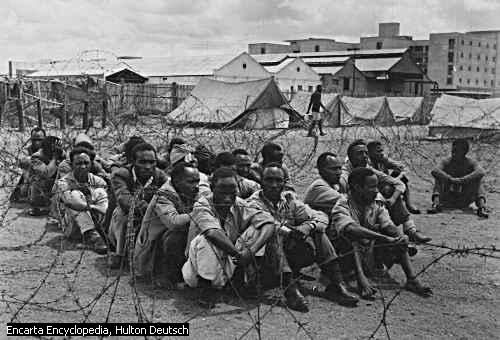 The case could open the way for up to 12,000 Kenyans to seek redress. It was filed at the high court last year. Daniel Leader, a lawyer at Leigh Day, representing the claimants, said: “One … was castrated for supplying a cow to the Mau Mau.”
“The nature and scale of this abuse was unparalleled in modern British colonial history. The claimants are among the poorest in Kenyan society, and they still live with injuries from that period.
“Historians have been through the public records, and the use of systematic violence was authorised at the highest level in London,” Leaderhe said. “We have the documents to prove that.”
But the government decision to have the case struck out on technical grounds of state succession – the principle that countries assume liability for their own affairs after independence – has infuriated human rights campaigners, who accuse the UK of shirking its responsibilities for rights abuses in former colonies.
The Foreign Office is believed to be arguing on a rule derived from a case over licences to fish for Patagonian toothfish in the South Georgia and South Sandwich islands, British overseas territories. “The FO is arguing that responsibility for acts by the colonial government passed to the independent government in 1963,” Muthoni Wanyeki, executive director of Kenya Human Rights Commission, said.
The Drone Surge
Today, tomorrow, and 2047
By Nick Turse
One moment there was the hum of a motor in the sky above. The next, on a recent morning in Afghanistan’s Helmand province, a missile blasted a home, killing 13 people. Days later, the same increasingly familiar mechanical whine preceded a two-missile salvo that slammed into a compound in Degan village in the tribal North Waziristan district of Pakistan, killing three.
What were once unacknowledged, relatively infrequent targeted killings of suspected militants or terrorists in the Bush years have become commonplace under the Obama administration. And since a devastating Dec. 30 suicide attack by a Jordanian double agent on a CIA forward operating base in Afghanistan, unmanned aerial drones have been hunting humans in the Af-Pak war zone at a record pace. In Pakistan, an “unprecedented number” of strikes – which have killed armed guerrillas and civilians alike – have led to more fear, anger, and outrage in the tribal areas, as the CIA, with help from the U.S. Air Force, wages the most public “secret” war of modern times.
In neighboring Afghanistan, unmanned aircraft, for years in short supply and tasked primarily with surveillance missions, have increasingly been used to assassinate suspected militants as part of an aerial surge that has significantly outpaced the highly publicized “surge” of ground forces now underway. And yet, unprecedented as it may be in size and scope, the present ramping up of the drone war is only the opening salvo in a planned 40-year Pentagon surge to create fleets of ultra-advanced, heavily-armed, increasingly autonomous, all-seeing, hypersonic unmanned aerial systems (UAS).
Today’s Surge
Drones are the hot weapons of the moment and the upcoming Quadrennial Defense Review – a soon-to-be-released four-year outline of Department of Defense strategies, capabilities, and priorities to fight current wars and counter future threats – is already known to reflect this focus. As the Washington Post recently reported, “The pilotless drones used for surveillance and attack missions in Afghanistan and Pakistan are a priority, with the goals of speeding up the purchase of new Reaper drones and expanding Predator and Reaper drone flights through 2013.”
The MQ-1 Predator – first used in Bosnia and Kosovo in the 1990s – and its newer, larger, and more deadly cousin, the MQ-9 Reaper, are now firing missiles and dropping bombs at an unprecedented pace. In 2008, there were reportedly between 27 and 36 U.S. drone attacks as part of the CIA’s covert war in Pakistan. In 2009, there were 45 to 53 such strikes. In the first 18 days of January 2010, there had already been 11 of them.
Meanwhile, in Afghanistan, the U.S. Air Force has instituted a much publicized decrease in piloted air strikes to cut down on civilian casualties as part of Afghan War commander Gen. Stanley McChrystal’s counterinsurgency strategy. At the same time, however, UAS attacks have increased to record levels.
The Air Force has created an interconnected global command-and-control system to carry out its robot war in Afghanistan (and as Noah Shachtman of Wired’s Danger Room blog has reported, to assist the CIA in its drone strikes in Pakistan as well). Evidence of this can be found at high-tech U.S. bases around the world where drone pilots and other personnel control the planes themselves and the data streaming back from them. These sites include a converted medical warehouse at Al-Udeid Air Base, a billion-dollar facility in the Persian Gulf nation of Qatar where the Air Force secretly oversees its ongoing drone wars; Kandahar and Jalalabad Air Fields in Afghanistan, where the drones are physically based; the global operations center at Nevada’s Creech Air Base, where the Air Force’s “pilots” fly drones by remote control from thousands of miles away; and – perhaps most importantly – at Wright-Patterson Air Force Base, a 12-square-mile facility in Dayton, Ohio, named after the two local brothers who invented powered flight in 1903. This is where the bills for the current drone surge – as well as limited numbers of strikes in Yemen and Somalia – come due and are, quite literally, paid.
In the waning days of December 2009, in fact, the Pentagon cut two sizable checks to ensure that unmanned operations involving the MQ-1 Predator and the MQ-9 Reaper will continue full-speed ahead in 2010. The 703rd Aeronautical Systems Squadron based at Wright-Patterson signed a $38 million contract with defense giant Raytheon for logistics support for the targeting systems of both drones. At the same time, the squadron inked a deal worth $266 million with mega-defense contractor General Atomics, which makes the Predator and Reaper drones, to provide management services, logistics support, repairs, software maintenance, and other functions for both drone programs. Both deals essentially ensure that, in the years ahead, the stunning increase in drone operations will continue.
These contracts, however, only initial down payments on an enduring drone surge designed to carry U.S. unmanned aerial operations forward, ultimately for decades.
Drone Surge: The Longer View
Back in 2004, the Air Force could put a total of only five drone combat air patrols (CAPs) – each consisting of four air vehicles – in the skies over American war zones at any one time. By 2009, that number was 38, a 660 percent increase according to the Air Force. Similarly, between 2001 and 2008, hours of surveillance coverage for U.S. Central Command, encompassing both the Iraqi and Afghan war zones, as well as Pakistan and Yemen, showed a massive spike of 1,431 percent.
In the meantime, flight hours have gone through the roof. In 2004, for example, Reapers, just beginning to soar, flew 71 hours in total, according to Air Force documents; in 2006, that number had risen to 3,123 hours; and last year, 25,391 hours. This year, the Air Force projects that the combined flight hours of all its drones – Predators, Reapers, and unarmed RQ-4 Global Hawks – will exceed 250,000 hours, about the total number of hours flown by all Air Force drones from 1995-2007. In 2011, the 300,000 hour-a-year barrier is expected to be crossed for the first time, and after that the sky’s the limit.
More flight time will, undoubtedly, mean more killing. According to Peter Bergen and Katherine Tiedemann of the Washington-based think tank the New America Foundation, in the Bush years, from 2006 into 2009, there were 41 drone strikes in Pakistan that killed 454 militants and civilians. Last year, under the Obama administration, there were 42 strikes that left 453 people dead. A recent report by the Pakistan Institute for Peace Studies, an Islamabad-based independent research organization that tracks security issues, claimed an even larger number, 667 people – most of them civilians – killed by U.S. drone strikes last year.
While assisting the CIA’s drone operations in the Pakistani tribal borderlands, the Air Force has been increasing its own unmanned aerial hunter-killer missions. In 2007 and 2008, for example, Air Force Predators and Reapers fired missiles during 244 missions in Iraq and Afghanistan. In fact, while all the U.S. armed services have pursued unmanned aerial warfare, the Air Force has outpaced each of them.
From 2001, when armed drone operations began, until the spring of 2009, the Air Force fired 703 Hellfire missiles and dropped 132 GBU-12s (500-pound laser-guided bombs) in combat operations. The Army, by comparison, launched just two Hellfire missiles and two smaller GBU-44 Viper Strike munitions in the same time period. The disparity should only grow, since the Army’s drones remain predominantly small surveillance aircraft, while in 2009 the Air Force shifted all outstanding orders for the medium-sized Predator to the even more formidable Reaper, which is not only twice as fast but has 600 percent more payload capacity, meaning more space for bombs and missiles.
In addition, the more heavily-armed Reapers, which can now loiter over an area for 10 to 14 hours without refueling, will be able to spot and track ever more targets via an increasingly sophisticated video monitoring system. According to Air Force Lt. Gen. David Deptula, deputy chief of staff for intelligence, surveillance, and reconnaissance, the first three “Gorgon Stare pods” – new wide-area sensors that provide surveillance capabilities over large swathes of territory – will be installed on Reapers operating in Afghanistan this spring.
A technology not available for the older Predator, Gorgon Stare will allow 10 operators to view 10 video feeds from a single drone at the same time. Back at a distant base, a “pilot” will stare at a tiled screen with a composite picture of the streaming battlefield video, even as field commanders analyze a portion of the digital picture, panning, zooming, and tilting the image to meet their needs.
A more advanced set of “pods,” scheduled to be deployed for the first time this fall, will allow 30 operators to view 30 video images simultaneously. In other words, via video feeds from a single Reaper drone, operators could theoretically track 30 different people heading in 30 directions from a single Afghan compound. The generation of sensors expected to come online in late 2011 promises 65 such feeds, according to Air Force documents, a more than 6,000 percent increase in effectiveness over the Predator’s video system. The Air Force is, however, already overwhelmed just by drone video currently being sent back from the war zones and, in the years ahead, risks “drowning in data,” according to Deptula.
The 40-Year Plan
When it comes to the drone surge, the years 2011-2013 are just the near horizon. While, like the Army, the Navy is working on its own future drone warfare capacity – in the air as well as on and even under the water – the Air Force is involved in striking levels of futuristic planning for robotic war. It envisions a future previously imagined only in sci-fi movies like the Terminator series.
As a start, the Defense Advanced Research Projects Agency, or DARPA, the Pentagon’s blue skies research outfit, is already looking into radically improving on Gorgon Stare with an “Autonomous Real-Time Ground Ubiquitous Surveillance-Infrared (ARGUS-IR) System.” In the obtuse language of military research and development, it will, according to DARPA, provide a “real-time, high-resolution, wide area video persistent surveillance capability that allows joint forces to keep critical areas of interest under constant surveillance with a high degree of target location accuracy” via as many as “130 ‘Predator-like’ steerable video streams to enable real-time tracking and monitoring and enhanced situational awareness during evening hours.”
In translation, that means the Air Force will quite literally be flooded with video information from future battlefields; and every “advance” of this sort means bulking up the global network of facilities, systems, and personnel capable of receiving, monitoring, and interpreting the data streaming in from distant digital eyes. All of it, of course, is specifically geared toward “target location,” that is, pinpointing people on one side of the world so that Americans on the other side can watch, track, and in many cases, kill them.
In addition to enhanced sensors and systems like ARGUS-IR, the Air Force has a long-term vision for drone warfare that is barely beginning to be realized. Predators and Reapers have already been joined in Afghanistan by a newer, formerly secret drone, a “low observable unmanned aircraft system” first spotted in 2007 and dubbed the “Beast of Kandahar” before observers were sure what it actually was. It is now known to be a Lockheed Martin-manufactured unmanned aerial vehicle, the RQ-170 – a drone which the Air Force blandly notes was designed to “directly support combatant commander needs for intelligence, surveillance, and reconnaissance to locate targets.” According to military sources, the sleek, stealthy surveillance craft has been designated to replace the antique Lockheed U-2 spy plane, which has been in use since the 1950s.
In the coming years, the RQ-170 is slated to be joined in the skies of America’s “next wars” by a fleet of drones with ever newer, more sophisticated capabilities and destructive powers. Looking into the post-2011 future, Deptula sees the most essential need, according to an Aviation Week report, as “long-range [reconnaissance and] precision strike” – that is, more eyes in far off skies and more lethality. He added, “We cannot move into a future without a platform that allows [us] to project power long distances and to meet advanced threats in a fashion that gives us an advantage that no other nation has.”
This means bigger, badder, faster drones – armed to the teeth – with sensor systems to monitor wide swathes of territory and the ability to loiter overhead for days on end waiting for human targets to appear and, in due course, be vaporized by high-powered munitions. It’s a future built upon advanced technologies designed to make targeted killings – remote-controlled assassinations – ever more effortless.
 Over the horizon and deep into what was, until recently, only a silver-screen fantasy, the Air Force envisions a wide array of unmanned aircraft, from tiny insect-like robots to enormous “tanker-size” pilotless planes. Each will be slated to take over specific war-making functions (or so Air Force dreamers imagine). Those nano-sized drones, for instance, are set to specialize in indoor reconnaissance – they’re small enough to fly through windows or down ventilation shafts – and carry out lethal attacks, undertake computer-disabling cyber-attacks, and swarm, as would a group of angry bees, of their own volition. Slightly larger micro-sized Small Tactical Unmanned Aircraft Systems (STUAS) are supposed to act as “transformers” – altering their form to allow for flying, crawling, and non-visual sensing capabilities. They might fill sentry, counter-drone, surveillance, and lethal attack roles.
Additionally, the Air Force envisions small and medium “fighter-sized” drones with lethal combat capabilities that would put the current UAS air fleet to shame. Today’s medium-sized Reapers are set to be replaced by next generation MQ-Ma drones that will be “networked, capable of partial autonomy, all-weather, and modular with capabilities supporting electronic warfare (EW), CAS [close air support], strike, and multi-INT [multiple intelligence] ISR [intelligence, surveillance and reconnaissance] missions’ platform.”
The language may not be elegant, much less comprehensible, but if these future fighter aircraft actually come online they will not only send today’s remaining Top Gun pilots to the showers, but may even sideline tomorrow’s drone human operators, who, if all goes as planned, will have ever fewer duties. Unlike today’s drones, which must take off and land with human guidance, the MQ-Mas will be automated, and drone operators will simply be there to monitor the aircraft.
Next up will be the MQ-Mb, theoretically capable of taking over even more roles once assigned to traditional fighter-bombers and spy planes, including the suppression of enemy air defenses, bombing and strafing of ground targets, and surveillance missions. These will also be designed to fly more autonomously and be better linked-in to other drone “platforms” for cooperative missions involving many aircraft under the command of a single “pilot.” Imagine, for instance, one operator overseeing a single command drone that holds sway over a small squadron of autonomous drones carrying out a coordinated air attack on clusters of people in some far off land, incinerating them in small groups across a village, town, or city.
Finally, perhaps 30 to 40 years from now, the MQ-Mc drone would incorporate all of the advances of the MQ-M line, while being capable of everything from dog-fighting to missile defense. With such new technology will, of course, come new policies and new doctrines. In the years ahead, the Air Force intends to make drone-related policy decisions on everything from treaty obligations to automatic target engagement – robotic killing without a human in the loop. The latter extremely controversial development is already envisioned as a possible post-2025 reality.
2047: What’s Old is New Again
The year 2047 is the target date for the Air Force’s Holy Grail, the capstone for its long-term plan to turn the skies over to war-fighting drones. In 2047, the Air Force intends to rule the skies with MQ-Mc drones and “special” super-fast, hypersonic drones for which neither viable technology nor any enemies with any comparable programs or capabilities yet exist. Despite this, the Air Force is intent on making these super-fast hunter-killer systems a reality by 2047. “Propulsion technology and materials that can withstand the extreme heat will likely take 20 years to develop. This technology will be the next generation air game-changer. Therefore the prioritization of the funding for the specific technology development should not wait until the emergence of a critical COCOM [combatant command] need,” says the Air Force’s 2009-2047 UAS “Flight Plan.”
If anything close to the Air Force’s dreams comes to fruition, the “game” will indeed be radically changed. By 2047, there’s no telling how many drones will be circling over how many heads in how many places across the planet. There’s no telling how many millions or billions of flight hours will have been flown, or how many people, in how many countries will have been killed by remote-controlled, bomb-dropping, missile-firing, judge-jury-and-executioner drone systems.
There’s only one given. If the U.S. still exists in its present form, is still solvent, and still has a functioning Pentagon of the present sort, a new plan will already be well underway to create the war-making technologies of 2087. By then, in ever more places, people will be living with the sort of drone war that now worries only those in places like Degan village. Ever more people will know that unmanned aerial systems packed with missiles and bombs are loitering in their skies. By then, there undoubtedly won’t even be that lawnmower-engine sound indicating that a missile may soon plow into your neighbor’s home.
For the Air Force, such a prospect is the stuff of dreams, a bright future for unmanned, hypersonic lethality; for the rest of the planet, it’s a potential nightmare from which there may be no waking.