Israeli forces detain three journalists across the West Bank
23/01/2010 20:18
Nablus – Ma’an – Israeli forces detained three journalists in separate incidents across the West Bank, as they compiled news reports near settlements on Saturday.
Al-Quds TV representatives said that a journalist and a cameraman were detained near the illegal settlement of Ariel, south of Nablus.
Correspondent for Al-Quds TV Mus’ab Al-Khatib, 25, and Ahmad Al-Kilani, 23, who works for Pal Media, were arrested whilst preparing a news report about a university near the settlement that was recognized recently by Israeli authorities.
Meanwhile, Israeli soldiers detained a Pal Media journalist on Saturday reporting on a demonstration organized by farmers from the At-Tuwani village to protest the recent destruction of an olive grove near the Israeli settlement outpost of Havot Ma’on, the Christian Peacemaking Team said in a statement.
” While Palestinian farmers, accompanied by internationals, were planting olive trees, fifteen settlers approached the area, some carrying slingshots,” the statement read.
“Israeli soldiers and police also entered the area. The soldiers informed the Palestinians that the area was a closed military zone, showing them a map that encompassed a large area south of Havat Ma’on outpost. Police arrested the journalist, saying he had violated the closed military zone order.”
Israeli College Student Removed From Bus For Speaking Her Language
January 23, 2010 | by Saed Bannoura | IMEMC & Agencies
Israeli Ynet News reported that an Israeli-Arab student, studying at Ariel College, was humiliated and forced out of an Israeli bus after she “was heard” speaking Arabic on her cell phone.
She said that she was forced out of the bus for daring to speak her language while on board.
Hanin Musleh also said that she was subjected to a full body search, the Ynet added.
She is from Wadi Ara area and is studying at the college to obtain a degree in engineering.
Musleh was removed from the bus by two armed guards who boarded the vehicle near a roadblock just out of Ariel settlement, in the northern part of the occupied West Bank.
The guards forced her out of the bus after questioning her for speaking in Arabic.
She said that she takes the same bus every day to go to her college, and that she was removed out of the bus to be left on some isolated road.
She added that she told the guards that she is Israeli, with Israeli ID and citizenship, just like them, and that they should not be humiliating and degrading her like this.
Musleh even stated that she does not wear a veil or any traditional dress, and that she does not even look Arab.
“The only reason they removed me from the bus is because I spoke Arabic”, she added.
The Ynet stated that the Ariel municipality said that the guards work for a security agency that “operates in accordance to the guidelines of the Israeli military.
The Ariel College said that it regrets this incident, and that Arab students constitute 4% of the entire student body at the college.
The college added that several Arab students live in dorms and are involved with the community of Ariel settlement.
The college said that this is the first time such an incident happens, and that Arab students started enrolling 15 years ago.
But Musleh stated that several other Arab students were also humiliated at checkpoints leading to Ariel, and that they will be considering legal action.
What Robert Gates Didn’t Say – And The US Media Hides – About Blackwater In Pakistan
Two Pakistani employees of an American defense contractor engaged by the US Embassy in Islamabad have been linked to two attacks on Pakistani military and the assassination of a Brigadier. If this is not alarming, then consider that US Ambassador Anne Patterson’s name has come up in an investigation where thousands of dollars were paid in bribes to Interior Ministry to smuggle illegal weapons into Pakistan. Not to mention how Washington is empowering India in Afghanistan at Pakistan’s cost. When Pakistan takes countermeasures, US officials like Mr. Gates and Mr. Holbrooke accuse Pakistan of ‘anti-Americanism’ and harassing US diplomats. Time for some straight talk.
By AHMED QURAISHI | 23 January 2010
ISLAMABAD, Pakistan—US Defense Secretary Robert Gates admitted during an interview with a Pakistani TV station that Blackwater [now ‘Xe International’] and DynCorp are operating in Pakistan. Immediately after the statement, Pentagon tried to put a spin on his words.
But US meddling inside Pakistan –by posting private US defense contractors under diplomatic cover of the US embassy – is a reality for most Pakistanis. Some of these Americans have been caught disguised as Taliban right in the heart of Islamabad. Some Pakistanis were manhandled by some of these American militiamen on the streets of at least two Pakistani cities in recent months.
Since Pakistan is not Iraq or Afghanistan despite all the US direct and indirect misinformation, these US covert operators were arrested on several occasions.
The mainstream US media continues to keep the good American people and the world opinion in the dark about this. But this is probably one of the biggest untold stories in America’s war on terror. This is about the United States trying to put boots on the ground inside Pakistan through the help of a pro-US government in Islamabad that shares [or at least key figures in it] the US objective of containing and limiting the ability of Pakistan’s military to influence the country’s foreign policy. This is about Pakistan wanting to keep an independent foreign policy versus Pakistan blindly serving US policy on Afghanistan, India and China.
Mr. Gates tried to put a gloss on this US covert meddling when he said, ‘Well, they’re [Blackwater and DynCorp] operating as individual companies here in Pakistan, in Afghanistan and in Iraq.’
Not true. The truth is that the issue is so serious that, according to Pakistani investigators, US Ambassador to Pakistan Anne W. Patterson is a suspect in a case of bribes amounting to little over US $ 270,000 paid by DynCorp in 2009 to senior officials at the federal Interior Ministry in Pakistan. The money went in exchange for allowing illegal weapons into Pakistan to be used by private US defense contractors without informing the country’s security departments and intelligence agencies. Ms. Patterson personally lobbied Pakistani officials for this concession to DynCorp. She even wrote a letter to Pakistani officials, followed by a letter by her Deputy Head of Mission Mr. Gerald Feierstein, asking Pakistani Interior Ministry officials to issue permits for weapons to be used by DynCorp in the ‘entire territory of Pakistan.’ The US ambassador is directly linked to the probe, which has resulted in the arrest of a key aide to Pakistan’s Minister of State for the Interior. But the government of President Zardari will not dare allow Pakistani investigators to pursue the US Ambassador’s role in the scandal. A key question in the probe is how the US Embassy and DynCorp allowed the cargo of illegal weapons into Pakistan. According to one lead, a huge cache of weapons reached a Pakistani tribal leader on Pakistan’s border with Afghanistan, who in turn wrote to the Interior Ministry announcing he was ‘gifting’ the weapons to a Pakistani subcontractor of DynCorp.
Incidents like this and others raised alarm bells inside Pakistani security departments and the intelligence community. In effect, key figures in President Zardari’s government were found to have given approval for the entry of a large number of US citizens into Pakistan for ‘official US government business’ without explaining what that is. When Pakistani authorities tried to get to the bottom of how private US defense contractors ended up inside Pakistan in large numbers and what they were exactly doing here, US officials and media launched what appears to be a media trial of Pakistan, accusing the country of ‘harassing’ US diplomats and denying visas to them because of alleged anti-Americanism.
The unwillingness of the Zardari government to confront Washington and Pakistan’s generally weak media outreach skills allowed Washington to paint this as a case of anti-Americanism fueled by war on terror.
‘Conspiracy theories’ is another label that US officials and media have increasingly used recently as a cover to hide serious violations of diplomatic norms and sovereignty involving undercover private US operatives inside Pakistan.
This is how the Wall Street Journal tried to delegitimize serious Pakistani concerns raised during Mr. Gates’ visit in a report filed from Islamabad whose opening line read as follows, “U.S. Defense Secretary Robert Gates is overseeing wars with Sunni militants in Iraq and Taliban fighters in Afghanistan. In Pakistan, he’s facing a different foe: the pervasive conspiracy theories that fuel widespread anti-American feelings here.”
The truth is that there are no conspiracy theories but real events, reported and documented, that raise questions over US political, diplomtic, and covert meddling inside Pakistan. Here is a list:
1. NUCLEAR ESPIONAGE: In July 2009, four US ‘diplomats’ were arrested inside the maximum security perimeter around Pakistan’s premier nuclear facility at Kahuta. They failed to tell Pakistani investigators what they were doing there and how they managed to slip through the security checkpoints in the area. US Embassy intervened to rescue the four ‘diplomats’ after almost three hours in detention, citing diplomatic immunity. President Zardari’s government refused to let Pakistani security authorities press charges.
2. SUSPICIOUS CONDUCT: On Oct. 6, 2009, Pakistani police arrested two Dutch diplomats roaming the streets of Islamabad without a number plate carrying advanced weapons. Pakistani police were surprised when security personnel from the US Embassy reached the scene to rescue the Dutch. The Americans used their contacts within the Zardari government to get everyone released. Later, Pakistan Foreign Office summoned US and Dutch diplomats for a private meeting over the incident. But the Pakistani government refused to demand a public explanation from US and Dutch diplomats despite recommendations from police and security officials.
3. FACILITATING INDIAN ACTIVITIES: In this high profile case in May 2009, a US diplomat arranged a small meeting between an Indian diplomat and several senior Pakistani federal government officials at a private house. The invited Pakistanis worked in civilian positions, including one with access to Prime Minister’s Office. It appeared that the US diplomat was basically facilitating the Indian to meet senior officials who otherwise would be inaccessible for him. Pakistan Foreign Office took serious exception to the meeting, publicly reprimanded the Pakistani officials who attended the meeting but stopped short of seeking explanation from the US embassy. According to Pakistani investigators, for a US diplomat to indulge in facilitating possible espionage linked to an Indian diplomat was a matter of grave concern. It also fit with the US policy of exercising tremendous pressure on the pro-US government in Islamabad to give concessions to India at the expense of Pakistani strategic interests.
4. COVERT US MILITIAS IN THE HEART OF PAKISTAN: In September 2009, undercover US agents were found to have recruited a total of 100 former elite Pakistani military commandos to create rapid-intervention teams for unknown purposes. A hundred more were under training at a secret facility camouflaged as a workshop on the outskirts of the Pakistani capital when it was raided by Pakistani police. It turned out that DynCorp was training the men. US Ambassador Anne W. Patterson brought DynCorp to Pakistan by telling Pakistani officials that the private defense contractor would provide security to embassy buildings. But she never explained why DynCorp was secretly raising private militias on Pakistani soil without informing the Pakistani government or military or the intelligence agencies. Some of those who were under training at the time of the raid said that DynCorp focused on recruiting retired officers who had links and contacts within the Pakistani military and could glean information from their sources. [See video and pictures]
5. PUSHY US DIPLOMATS: The US Embassy in Islamabad has made it its business to mount pressure on owners of Pakistani newspapers to curtail or expel columnists and commentators critical of US policy. Specially targeted are those who expose how the US Embassy is meddling in Pakistani affairs and expanding the US footprint inside Pakistan. Last year, Ambassador Patterson sent a letter to one of the largest Pakistani media groups accusing a columnist of endangering American lives and succeeded in pushing her out. The US Embassy is also recruiting opinion makers within the Pakistani media, academia and military in order to promote the US agenda even at the cost of Pakistani interests, dismissing critics as ‘conspiracy theorists’ and accusing them of anti-Americanism. A senior Pakistani journalist Syed Talat Hussain exposed US activities in the following words,
“Pro-American lobby in Pakistan is growing in direct proportion to the scaling up of suspicions about the US. The main task of this lobby is to reduce the complexity of the US’s objectives towards Pakistan to romantic levels of trust (…) A motley crew of former diplomats, retired generals, socialites, slick civil society begums, self-styled analysts, businessmen, journalists, and now also lawyers — they are the darlings of the US embassy staff. They are the instruments of positive outreach and public diplomacy that US diplomats are so keen to expand in Pakistan.”
6. HARASSING PAKISTANIS: Private US security contractors, or militiamen, have been involved in at least three incidents registered by the Pakistani police where armed Americans physically assaulted unarmed ordinary Pakistanis in public places. In one case, the nephew of a senior member of President Zardari’s own government was manhandled and locked up in the toilet of a gas station by men described as armed military-looking civilian Americans.
7. RESISTING POLICE CHECKS: In at least five incidents, US ‘diplomats’ disguised as Taliban, complete with beards and Pashto language skills, were stopped at several police checkpoints in Islamabad and Peshawar. In some cases, these American ‘diplomats’ tried to speed through police barriers. In one recent case, this resulted in a brief police chase, where a Pakistani officer dragged the US ‘diplomats’ back to the police picket and forced the Americans to apologize to Pakistani police officers. Again, no charges were pressed because these private US agents carried diplomatic passports.
8. ENGINEERING DOMESTIC POLITICS: As recently as December 2009, US ambassador in Islamabad was found meeting senior Pakistani politicians at private homes of mutual friends in unannounced meetings restricted to 3 to 4 persons. The ambassador asked her guests to publicly support the embattled pro-US President Zardari. US diplomats in Islamabad and officials in Washington have been blatantly interfering in Pakistani politics. In addition to helping form the incumbent coalition government in Islamabad, made up of pro-US parties, US officials have been busy trying to save both Mr. Zardari and his key political adviser and ambassador to Washington Husain Haqqani. US officials in Washington have been briefing sympathetic US journalists about this. In one case, columnist Trudy Rubin had this to say while discussing Pakistan in an article published last month:
“Here is the first piece of good news: Pakistani President Asif Ali Zardari seems to have weathered a campaign by opponents, including the military, to force him out of office. Zardari has deep flaws, but his ouster would have hampered efforts to fight the jihadis. So would the removal, now averted, of Pakistan’s effective ambassador to Washington, Husain Haqqani, whom the Pakistani military had unfairly blamed for conditions that Congress imposed on aid to Pakistan.”
9. BRIBES AND ILLEGAL WEAPONS: This case is stunning because of the direct involvement of US Ambassador Anne W. Patterson in lobbying for DynCorp. The company ended up bribing Interior Ministry officials to smuggle banned weapons into Pakistan and then went on to raise private militias and hire retired Pakistani military officers to run rapid deployment teams and possibly even spy on the Pakistani military.
10. DEMONIZATION OF PAKISTAN: Since 2007, US officials and US media has systematically demonized Pakistan worldwide, creating false alarm over Pakistan’s strategic arsenal. US officials and media have also pushed to bracket Pakistan along with Iraq and Afghanistan in order to justify a possible military intervention. When Pakistan resisted US meddling recently, the US media again went on rampage, accusing Pakistan of ‘anti-Americanism’ and harassment of US diplomats. Additionally, there has been a marked increase of lectures and studies by US think-tanks inviting unknown separatist individuals and groups to speak and fan ethnic separatism inside Pakistan and theorize on the breakup of the country.
11. ABETTING TERROR INSIDE PAKISTAN: The suspicions about why DynCorp was secretly raising private militias inside the federal Pakistani capital almost turned real when a suspect in the attack on the Pakistani military headquarters in October 2009 was allegedly found to have been recruited by DynCorp. In a second case, another suspected DynCorp recruit was found involved in assassinating a senior Pakistani military officer as he drove to work. In other words, two Pakistani employees of a US defense contractor engaged by the US embassy have been linked to two terrorist attacks on the Pakistani military. Add to this that Pakistan’s military and intelligence are a favorite punching bag for the United States and its allies, like India and Britain, and the picture of what the US is doing in Pakistan becomes even more disturbing.
These points explain how ill-motivated the US complaints about delaying visas and alleged anti-Americanism in Pakistan are. This is what US Secretary of State Hillary Clinton, Mr. Holbrooke and Mr. Gates are loath to share with the American people and the world public opinion.
© 2007-2009. All rights reserved. AhmedQuraishi.com & PakNationalists
Verbatim copying and distribution of this entire article is permitted in any medium without royalty provided this notice is preserved.
Gitmo “Suicides” Should Be The Final Straw For Firing McChrystal
By Jim White | January 22, 2010

Stanley McChrystal’s career is characterized by torture, murder, secret prison camps and cover-ups. It should come as no surprise, then, that this week’s exposé by Scott Horton on the Guantanamo “suicides” in 2006 implicates McChrystal and another secret prison camp:
One of the most intriguing aspects of this case concerns the use of Camp No. Under George W. Bush, the CIA created an archipelago of secret detention centers that spanned the globe, and authorities at these sites deployed an array of Justice Department sanctioned torture techniques—including waterboarding, which often entails inserting cloth into the subject’s mouth—on prisoners they deemed to be involved in terrorism. The presence of a black site at Guantánamo has long been a subject of speculation among lawyers and human-rights activists, and the experience of Sergeant Hickman and other Guantánamo guards compels us to ask whether the three prisoners who died on June 9 were being interrogated by the CIA, and whether their deaths resulted from the grueling techniques the Justice Department had approved for the agency’s use—or from other tortures lacking that sanction.
Complicating these questions is the fact that Camp No might have been controlled by another authority, the Joint Special Operations Command, which Bush’s defense secretary, Donald Rumsfeld, had hoped to transform into a Pentagon version of the CIA. Under Rumsfeld’s direction, JSOC began to take on many tasks traditionally handled by the CIA, including the housing and interrogation of prisoners at black sites around the world. The Pentagon recently acknowledged the existence of one such JSOC black site, located at Bagram Airfield in Afghanistan, and other suspected sites, such as Camp Nama in Baghdad, have been carefully documented by human-rights researchers.
In a Senate Armed Services Committee report on torture released last year, the sections about Guantánamo were significantly redacted. The position and circumstances of these deletions point to a significant JSOC interrogation program at the base. (It should be noted that Obama’s order last year to close other secret detention camps was narrowly worded to apply only to the CIA.)
To review, here’s a snippet from the Andrew Sullivan piece linked above on McChrystal’s history:
That last sentence suggests that McChrystal disagrees with the customary “respect for human life” demanded of the US military. McChrystal’s past is mysterious but there is little doubt that he was deeply involved in one of the worst torture outfits in Iraq, Camp “Nama”, an acronym for “Nasty Ass Military Area”. … Two prisoners were tortured to death in this place. It was extremely closely monitored, with records of all sorts of torture and abuse, and yet there are also extensive stories of abuse that went well outside even the torture techniques approved by Cheney and Rumsfeld. Remember also that Iraq was, even by the standards of the Bush administration, supposed to be under the Geneva Conventions. The camp’s record has been shrouded in secrecy from the beginning.
The Guantanamo “suicides” took place on the night of June 9, 2006. If Camp No was a JSOC operation, who was in charge of JSOC at that time? Stanley McChrystal. According to this biography of McChrystal published by the Council on Foreign Relations, McChrystal assumed command of JSOC in February, 2006, only four months prior to the “suicides”. (h/t kgb999 for pointing out the timing of McChrystal’s involvement)
How many torture deaths and cover-ups does it take to get a General fired?
Gaza’s thin red line one year later
Eva Bartlett, The Electronic Intifada, 22 January 2010
“The last Israeli attacks were the hardest, the most dangerous. It wasn’t a war, it was a massacre. They shot anyone walking, anyone outside of their home, in their home … it didn’t matter. And it didn’t matter if the victims were children or adults; there was no difference.”
Ali Khalil, 47, has served as a medic with the Palestine Red Crescent Society (PRCS) and private hospitals in Gaza for more than 20 years. He has seen some of the worst atrocities committed by the Israeli army. During Israel’s war on Gaza last winter, Khalil worked in Gaza’s northern region, venturing repeatedly into high-risk areas bombarded by Israeli tanks, helicopters and warplanes to rescue the injured and retrieve the dead.
During the 23-day invasion, the Israeli army warplanes, drones, warships, tanks and snipers rendered entire areas off-limits and impossible for ambulances and civil defense fire and rescue trucks to reach. In the north, Ezbet Abed Rabbo and Attatra, east and northwest of Jabaliya, respectively, were among the districts occupied by the Israeli army.
Through the International Committee of the Red Cross (ICRC), Palestinian rescuers were sometimes able to coordinate with the Israeli army to gain access to areas they controlled.
“We’d wait five hours, even over 30 hours, for coordination from the Israelis to enter the area to retrieve wounded or martyred,” says Khalil. “And much of the time, we wouldn’t get it.”
Even coordination, however, did not ensure access or safety.
“On 9 January, we went to retrieve wounded and martyred. There were three ambulances, and one ICRC jeep in front. We had coordination via the ICRC,” says Khalil.
Marwan Hammouda, 33, a PRCS medic for the last 10 years, was on the same call. “We were driving to the area, speaking with the Israelis on the phone. They’d tell us which way to drive, what road to take. When we got near the wounded, Israeli soldiers started firing. I told them, ‘We have coordination’ and they said to wait. Then they began firing at us again.”
Emergency workers under fire
According to the Palestinian Centre for Human Rights (PCHR), that same day, 9 January, Israeli soldiers fired on a convoy of 11 ambulances led by a clearly marked ICRC vehicle in central Gaza, injuring an ICRC staff member and damaging the vehicle.
This was not the only that occasion emergency medics came under fire. During the invasion, Israeli forces killed 16 medical rescuers, four in one day alone. Another 57 were injured. At least 16 ambulances were damaged with at least nine completely destroyed.
Although the Geneva Conventions explicitly state that “medical personnel searching, collecting, transporting or treating the wounded should be protected and respected in all circumstances,” throughout Israel’s invasion this was not the case. Indeed, as the injured and emergency workers testify, Israeli forces targeted and prevented medical workers from reaching the wounded.
“If we can’t even access areas with ICRC coordination, how are we supposed to help people?” asks Khalil.
Without coordination, many ambulances did not dare risk Israeli gunfire and shelling, meaning hundreds of calls went unanswered, according to PCHR. Denied medical care, many victims succumbed to their wounds.
It was days before ambulances could reach the bodies of at least five members of the Abu Halima family who were killed when Israeli shelling and white phosphorous struck their home. In addition, two young male cousins, Matar and Muhammad, were shot dead by Israeli soldiers as they tried to drive a tractor-pulled wagon carrying the injured and martyred.
Ambulances trying to answer the calls were fired upon by machine guns and further shelling. Ali Khalil is still traumatized by what he and other emergency workers finally found days later.
“I brought back baby Shahed’s burned, gnawed corpse.”
The infant body that Khalil carried out, burned by white phosphorous, left in the tractor wagon, had been partially eaten by stray dogs.
“For the rest of my life I’ll remember that day. I’ll never get over it.”
Khalil is among many veteran medics who feel all the emergency workers need counseling for the stresses and traumas endured in their work.
 |
| Ahmed Abu Foul in the destroyed Palestine Red Crescent Society station, Ezbet Abed Rabbo. |
 |
| A Palestine Red Crescent Society ambulance, destroyed by Israeli bombing at the al-Quds hospital and PRCS station, Tel al-Hawa, Gaza City. |
Ahmed Abu Foul, 26, works as a medic and coordinator of all the PRCS volunteers in northern Gaza. He also works as a medic and coordinator with the Civil Defense, Gaza’s fire and rescue services. He is newly a father of a baby girl.
Abu Foul has narrowly escaped death while working on many occasions, and his body bears the scars of Israeli-fired bullet, shrapnel and flechette (dart bomb) injuries. In the last invasion alone, Abu Foul was twice targeted by snipers, was at the Fakhoura school when it was hit by white phosphorous shells on 6 January, and was in a building that was being bombed while emergency workers tried to evacuate the victims. In the latter incident, Abu Foul’s colleague was killed and Abu Foul was lacerated with shrapnel to the leg and head.
Despite his many close calls, Abu Foul maintains a convincingly cheerful attitude, and continues to work full time for both the Civil Defense and the PRCS. However, he admits the psychological and physical pain have not abated since the last Israeli attacks.
“My left leg is useless. When I walk too much, the pain becomes unbearable and my leg won’t support me. There’s still shrapnel in it, and the nerves were badly damaged by the shrapnel.”
It’s the same leg that was shot in May 2008 while Abu Foul was on a mission for PRCS, he says. Just above the support bandage around his calf, a hollow in his leg above his kneecap shows where the bullet bored straight through.
“A doctor here said he could remove the shrapnel and repair the nerves, but wanted to open it up from my foot all the way to my thigh,” he says of his recent injury.
“I have pain in my head also, especially when it is sunny,” he adds. “There’s still shrapnel in it from the shelling, although doctors already removed three pieces.”
He endures both injuries, waiting for specialists and the means outside of Gaza to remove the shrapnel. “It’s too dangerous here; we don’t have the means nor the medical equipment to locate the shrapnel before removing it.”
Medical shortages under siege
Under siege since after Hamas’ election in early 2006, Gaza is still not receiving all the necessary medical supplies needed, nor the spare parts to repair aged machinery. Doctors, unable to leave Gaza, cannot obtain advanced and specialized training. The health care system, post-invasion and under siege, is in more dire condition than before the Israeli attacks one year ago. According to Gaza’s Ministry of Health, stocks of 141 types of medicines are depleted, as are 116 types of essential medical supplies.
Aside from Abu Foul’s very present physical pain, it is memories of the wounded, the martyred, and the loss of his colleagues that still troubles him.
“I was with Dr. Issa Saleh coming down the stairs from the sixth floor of an apartment building in Jabaliya, evacuating a martyr, when the Israelis again shelled the building. They knew there were medics inside. They could see our uniforms and the ambulances outside. Dr. Saleh was hit by the missile.”
Abu Foul describes in testimony to the al-Mezan Center for Human Rights how he believed he’d been mortally wounded.
“I put my hand on the back of my head and I found blood and brain. I then saw Dr. Issa had been decapitated and realized it must have been his head hitting my head and his brain on the back of my head.”
Just days earlier, Abu Foul and other medics came under heavy Israeli fire for several minutes as they attempted to reach the injured.
The extreme stress and loss have manifested in Abu Foul’s daily life. “I feel as though I don’t care about anything now. Now, when I get angry I find myself hitting and throwing things. I feel nervous and I shout a lot now,” he told al-Mezan.
Yet Abu Foul takes his role as an emergency rescuer seriously and is not daunted in his work, in spite of how it has affected his personal life. Abu Foul now continues to seek replacement equipment, requesting delegations visiting Gaza to bring any sort of emergency equipment.
“Ten out of sixteen fire engines are functional. We need fire hoses, spotlights for the trucks, handheld spotlights for searching in the dark, chemical extinguishing spray, electric saws for cutting through wreckage …” The list is long and seems impossible when the Israeli siege on Gaza is tighter than ever.
 |
| The ambulance which Arafa Abd al-Dayem was loading when he was fatally struck by an Israeli-fired dart bomb. |
Duty calls
“Each invasion becomes harder than the last,” says Marwan Hammouda. Like his colleagues, Hammouda has no fear of death, and like them he has a history of injuries in the line of work, the latest being a gunshot to his left foot when the ambulance he was driving came under Israeli fire in Jabaliya.
Since Israel’s invasion, Hammouda has developed a thyroid disorder, a condition doctors say is a result of post-traumatic stress.
“You saw the last war,” he says. “There was nowhere safe, not homes, not schools, not kindergartens, not media buildings.” And not ambulances.
“So do I want to die in my home, or in my work, at least helping people who have been injured?” Hammouda asks. “The Israelis don’t have any respect for international law. And I have absolutely no confidence that things will change because American politicians give sweet speeches.”
“My children got used to the idea that I could die at any moment in our work,” says the father of six. “During the Israeli attacks, I only saw them for five or ten minutes a day. Some days I didn’t see them at all because I was always with the ambulances.”
Hassan al-Attal, 35, a father of three, was shot by an Israeli sniper while carrying a body from Zimmo crossroads east of Jabaliya back towards the wailing, flashing ambulance.
Since the Israeli tanks rolled in with the land invasion after the first week of aerial bombardment, injured and trapped residents of Ezbet Abed Rabbo — one of the hardest-hit areas during the Israeli attacks — had been calling for ambulances to evacuate the wounded and the dead. In almost all cases, emergency rescuers were unable to reach these calls, hindered by Israeli army shooting and shelling.
A medic for ten years, Attal has on many occasions come under Israeli fire and aggression while working.
His gunshot injury during the 7 January mission at 1:30pm came during Israel’s self-declared “humanitarian cease-fire hours,” when civilians were told they could safely walk the streets to buy food supplies or otherwise leave their homes.
After carrying the corpse only a few meters, Israeli sniper fire broke out on Attal and Jamal Said, 21, the volunteer with him.
“We came under heavy fire, around 20 shots. I was shot in the left thigh,” says Attal.
Hazem Graith, 35, a father of four and a medic with the PRCS since 1999, worked in Gaza’s north during the Israeli attacks.
Like most medics, Graith came to the profession out of a sense of obligation to his community. “Because I love to help people,” he says.
Graith too has come under Israeli fire on many occasions. However, he is quick to emphasize that while the Israeli attacks on rescuers during last winter’s invasion were the most savage and numerous yet, they were not isolated incidents. Rather, they were part of a larger Israeli policy of denying access of emergency personnel to the wounded which dates back to the beginning of the second Palestinian intifada in September 2000.
Targeting hospitals and medical facilities
In addition to attacking rescuers, Israeli warplanes and tanks attacked medical facilities and clinics during the Israeli war on Gaza. An investigative report published by the Guardian in March 2009 found that 15 of Gaza’s 27 hospitals were bombed, and another 44 clinics were damaged — two destroyed completely — although the Israeli military knew the coordinates of all the facilities.
On 15 January, the al-Quds hospital complex in Tel al-Hawa was shelled repeatedly, including with white phosphorous, causing fires to break out, extensive damage and forced the evacuation of all patients from the hospital.
The al-Wafa rehabilitation hospital in eastern Gaza — the only one of its kind in the entire territory — was attacked on the night of 15 January by tank shelling, including with phosphorous, and machine gun fire. Hospital residents included the disabled and immobile patients, as well as the elderly. Fire broke out on the roof of the hospital, and most buildings in the complex sustained extensive damage.
When medics were forced to evacuate the Ezbet Abed Rabbo PRCS station on the second day of the land invasion, the small band of ambulances temporarily stationed outside of Hamid’s home in Jabaliya. Days later, they moved to Beit Lahia’s al-Awda hospital, where they were based for the rest of the Israeli attacks.
“It was the most dangerous invasion we faced. Everywhere was dangerous, there was no safe place. Especially after 4pm it was extremely dangerous to be on the streets. But if we didn’t go out, who would help the people?”
Dodging missiles and gunfire on the streets and at attack sites, medics were further hounded at their temporary station at al-Awda hospital.
“The Israelis launched missiles on al-Awda, a hospital. Fortunately no one was killed in that attack, but it’s a hospital, and our ambulance base,” says Hamid.
Lost colleagues
Khaled Abu Sada, 43, another long-term medic, will never forget the Israeli attack that savagely martyred his colleague Arafa Abd al-Dayem.
On 4 January, at around 10am, medics Sada, Abd al-Dayem and PRCS volunteer Ala Sarhan, 23, answered the call of civilians targeted by Israeli tank shelling in northern Gaza’s Beit Lahiya.
As they brought the injured and martyred to the ambulance, the medic team was struck by an Israeli tank-fired dart bomb. The flechettes, just two inches long and dart-shaped, are designed to bore through anything, to break apart upon impact, to ensure maximum damage. Arafa Abd al-Dayem, 35, a father of four and volunteer medic for eight years, was shredded by the darts.
Abu Sada testified to the Guardian: “I came round here and found Arafa kneeling down with his hands in the air and praying to God. They found his body full of these nails. The guy that had been brought to the ambulance was in pieces. He was now missing his head and both his legs.”
Arafa Abd al-Dayem went into shock and died an hour or so after the attack, while Ala Sarhan was paralyzed by the injuries sustained in the attack.
 |
| Arafa Abd al-Dayem, the night before he was killed by Israeli fire while on duty. |
 |
| The first night of Israel’s land invasion during last winter’s attacks; the Ezbet Abed Rabbo PRCS station had to be evacuated because of Israeli shelling. |
Powerless to help
Ashraf al-Khatib has been a medic for 11 years. During the Israeli attacks, he worked at Rafah’s PRCS station. “On 15 January we got a call from a man who said his brother was dead and he was injured by multiple Israeli gunshots. Ahmed and Ibrahim Thabet didn’t know the Israeli army were nearby when they rode their motorcycle through a district of eastern Rafah.”
Called at 11am, al-Khatib attempted to get Israeli coordination via the ICRC to reach the injured man.
“We tried for hours. Ibrahim kept calling us, crying, panicked. We explained we couldn’t reach the area because of the Israeli army. We told him how to stop his bleeding to his chest and leg until we arrived.”
Unable to wait any longer, al-Khatib and colleagues made the decision to risk going without Israeli coordination.
“I told them, we may die. But we agreed to go.”
Two ambulances reached the area and brought out the dead and injured men.
“We had snipers trained on us, lasers on our foreheads and chest,” he says.
Having reached the Thabet brothers, the medics saw more victims.
“It was a busy area. People didn’t know there were Israeli snipers nearby.”
But because of renewed Israeli firing, al-Khatib’s ambulances were forced to retreat, leaving the victims behind.
Al-Khatib recalls another well-known case in Gaza, that of the Shurrab family in Rafah.
“We got a call from Muhammad Shurrab saying he and his sons had been evicted from their home by Israeli soldiers, then shot. They were all living but injured,” he explained.
The family waited, trapped between an Israeli tank and their home, bleeding of their injuries, he says.
“We went, when we tried to reach them Israeli soldiers fired on us, so we retreated and tried to get coordination. Shurrab would call every so often; I’d tell him to be patient while we tried. It was winter, so in addition to their injuries, they were freezing.”
Al-Khatib relates the saga which went on through the night.
“Later, the father called to say one son had died. We called Al-Jazeera television and told them the Israelis were preventing us from reaching Shurrab. Al-Jazeera took his mobile number and interviewed him live on the air. By that time his second son had died. Twelve hours later the Israelis finally allowed us to reach him, but his sons were both dead.”
Al-Khatib says this was the worst challenge he has faced as a medic.
“I knew they were injured but there was no way to reach them, then the kids died. The Israeli army was playing with us,” he says.
Muhammad, who declined to give his last name, 30, a volunteer medic and ambulance driver at the Tel al-Hawa PRCS station, was among the team sent to retrieve injured from the Samouni neighborhood in Zaytoun, eastern Gaza, while the attacks were still raging.
“When we arrived, we saw two tanks and a bulldozer between the trees. The tanks aimed their machine guns at the ambulance and the Israelis told us to continue forward. We went about 500 meters. Suddenly 20 or 30 soldiers appeared on foot and surrounded the ambulance, pointing their guns at us. They told me to get out of the ambulance, slowly. I did. They told me to take off my clothes. I did, at the same time telling them we’d come to bring out injured.”
They ordered his colleague Rami, a volunteer medic, to get out and strip his clothes.
“They forced us to lie on the ground.”
For the next 30 minutes, Muhammad says, they lay on the cold ground in their underwear, soldiers sitting on their backs, guns trained on them.
“Finally, after maybe 30 minutes, they let us go. But they didn’t let us retrieve the injured or the children.”
“Why shoot at ambulances?”
Throughout Gaza, during and before Israel’s latest invasion there, stories of detention, attack, delay and bombardment of stations of both medic rescuers and the Civil Defense abound. Despite the scale of the aggression, the last Israeli war on Gaza was not a precedent for emergency workers, but the continuation of a deeply-entrenched Israeli policy violating international law.
In April 2009, journalist Amira Hass reported in the Israeli daily Haaretz finding a note in Gaza ordering soldiers to “open fire also upon rescue.” Written in Hebrew, Hass reports that the note was found in a home occupied by Israeli forces during the war on Gaza. A military spokesperson, she writes, denied the note represents official Israeli army policy. But the facts on the ground and bodies in the graveyard point to a different conclusion.
Although one year has passed since the Israeli invasion, throughout Gaza the psychological wounds are still wide open. For the emergency rescuers, the prospect of the next Israeli attack is all too real and all too routine.
“Nothing is forbidden here, there is no international law where Israel is concerned. Even though the Geneva Conventions say we have the right to reach the wounded, Israel does not pay attention to international law,” says medic Hazem Graith.
Like Hammouda, Graith speaks wryly of the Israeli explanation for such attacks.
“Why shoot at ambulances? Why destroy them? Why kill medics?” he asks. “The Israelis say we are militants or are carrying militants, that’s the reason they give for targeting medics. Lies, all lies. In our ambulances there are only ever wounded or martyred.”
While the destruction of ambulances is a major obstacle to medics’ work, Graith calls for more than mere aid.
“We don’t want new ambulances from the international community. We want you to see what Israel does and apply pressure to stop Israel from firing on ambulances.”
He emphasizes, “Go to the root of the problem.”
All images by Eva Bartlett.
Eva Bartlett is a Canadian human rights advocate and freelancer who arrived in Gaza in November 2008 on the third Free Gaza Movement boat. She has been volunteering with the International Solidarity Movement and documenting Israel’s ongoing attacks on Palestinians in Gaza. During Israel’s recent assault on Gaza, she and other ISM volunteers accompanied ambulances and documenting the Israeli attacks on the Gaza Strip.
Israeli Drones in Afghan Skies
A number of NATO countries are using Israeli drones in Afghanistan to hunt down Taliban fighters
IslamOnline.net | January 22, 2010
CAIRO – Despite having no ground troops in the Muslim country, Israel is taking part in the US-led war in Afghanistan by sending drones to the US allies in the country.
“While Israeli soldiers can’t fight in the war in Afghanistan, Israeli drones can,” commented The Jerusalem Post on Friday, January 22.
A number of NATO countries are using Israeli drones to hunt down Taliban fighters.
Germany, which has 4,500 troops in Afghanistan, will receive next week an undisclosed number of the Israeli-made drone Heron UAVs to operate in the Muslim country.
The Royal Australian Air Force has already announced using Heron systems against Taliban in South Afghanistan.
Three other NATO countries; Spain, France and Canada, also have Israeli drones operating in the Muslim country.
The Heron is a medium altitude long endurance UAV that can remain airborne for more than 30 hours with a cruising altitude of 30,000 feet.
The drone can carry a payload of 250 kg and has a wingspan of 16.6 meters and a takeoff weight of 1,200 kg.
It also has an operational range of several hundred kilometers.
The unmanned drone can carry a variety of sensors used for surveillance and target identification.
Though the UAVs are manufactured in Israel, there are no identifying marks on the aircraft to indicate the country of origin.
Last year, media reports revealed that the US army and allying western forces have been operating the Israeli drones over Iraq and Afghanistan since 2006.
The US-led troops have been struggling against a deadly guerrilla warfare launched by the Taliban since its ouster by the 2001 US invasion.
The Official Response Begins
By Scott Horton | Harpers | January 19, 2010
When a cover-up is exposed, nothing is more telling than the first reactions from those who are involved. Do they maintain their stories and face potentially aggravated consequences? Or do they simply remain silent? In making this choice, they often telegraph the depth of their anxiety and concern.
Last night on MSNBC’s Countdown with Keith Olbermann, I focused on the first responses to “The Guantánamo ‘Suicides.’” Colonel Michael Bumgarner, the former commander at Camp America, had sent an email to the Associated Press, the text of which AP confirmed to me, in which he said he would have to get clearance from the Defense Department to speak, but then stated:
This blatant misrepresentation of the truth infuriates me. I don’t know who Sgt. Hickman is, but he is only trying to be a spotlight ranger. He knows nothing about what transpired in Camp 1, or our medical facility. I do, I was there.
This statement merits closer inspection. The first sentence is a classic nondenial denial. It appears on the surface to deny part of the account, but in fact denies nothing. Bumgarner needs to state specifically what allegations he considers inaccurate. His failure to do so is telling.
The second statement is an attempt to frame the conflict in terms of a controversy between Sergeant Hickman and himself, which he leads into by saying he doesn’t even know who Hickman is. That statement is demonstrably false. As we confirmed with Defense Department records, Bumgarner recommended Hickman for a medal (shown below) based on his cool-headed approach to defusing a prison riot on May 18, 2006. Moreover, Hickman was selected as NCO of the Quarter at Guantánamo, a fact the camp commander would certainly have known at the time. In any case, the key points in which Bumgarner figures do not rest on Hickman’s accounts alone—they are corroborated by a series of additional witnesses, as well as by published accounts in which Bumgarner himself is extensively quoted.
![[Image]](https://i0.wp.com/www.harpers.org/media/image/blogs/misc/arcom_hickman_600.gif)
The third statement presents Bumgarner with even more serious problems. He denies that Hickman was present or has knowledge of what transpired at Camp 1 and the detainee clinic on the night of June 9. “I was there,” he says. Let’s be very clear about this: Either Bumgarner lied in a formal statement to NCIS, or he lied to AP. In his formal account, Bumgarner addressed this point directly. “On the night of 09JUN06, I was not in the camp,” he writes, “I had spent the evening at Admiral Harris’s house.” (This can be found on pp. 1059-60 of the NCIS evidence file, and can be examined here [PDF, 1.1M] on page 6 of the original document.) This account matches the recollection of other witnesses cited in Admiral Harris’s AR 15-6 statement, especially the statements beginning at p. 118. In all these accounts, Colonel Bumgarner does not arrive at the camp until 12:48 a.m. on the morning of June 10. The operative events of the narrative furnished by the guards occurred between 7:00 p.m. and midnight—long before Bumgarner’s arrival on the scene.
The Justice Department response is also informative. It was confronted with several allegations: that the FBI had been involved in a cover-up from the first days after the deaths, launching a raid designed to intimidate witnesses from speaking openly; that the Justice Department may have made repeated misleading statements to federal judge James Robertson in furtherance of the cover-up; and that the Department claimed to have concluded its investigation into Hickman’s story before contacting witnesses who would have, and did, corroborate it.
The Justice Department had no response to any of these serious allegations. Instead, in a January 18 e-mail, department spokesman Laura Sweeny claimed that two of the witnesses interviewed by the department had misremembered the names of the lawyers present at those meetings. She refused to address any of the other allegations in the article. Instead, she insisted that I note that Justice had “conducted a thorough inquiry into this matter, carefully examined the allegations, found no evidence of wrongdoing and subsequently closed the matter.” And then she said, as she had when I contacted her in reporting the story, that she would not arrange an interview with any of the officials involved in the matter.
This is all classic misdirection, an attempt to make the story not about the crimes at Guantánamo but the minutes of meetings in Baltimore and Columbia. Still, the fact that the Justice Department is unwilling to say who was at these brief interviews speaks volumes. It does not deny that the interviews occurred, nor that the descriptions of the meetings are otherwise accurate, nor even that the lawyers identified were in fact involved in the investigation. It simply insists that the team conducting these interviews not be identified.
Of course, this adamant insistence on official anonymity does nothing to dispel the accusation of cover-up. Just the opposite: it suggests that the lawyers and FBI agents involved quite urgently wish not to have their names associated with it. And who could blame them?
Israel withholding NGO employees’ work permits
Amira Hass | Ha’aretz | 20 January 2010
The Interior Ministry has stopped granting work permits to foreign nationals working in most international nongovernmental organizations operating in the Palestinian territories, including East Jerusalem, Haaretz has learned.
In an apparent overhaul of regulations that have been in place since 1967, the ministry is now granting the NGO employees tourist visas only, which bar them from working.
Organizations affected by the apparent policy change include Oxfam, Save the Children, Doctors Without Borders, Terre des Hommes, Handicap International and the Religious Society of Friends (a Quaker organization).
Until recently, the workers would register with the international relations department at the Social Affairs Ministry, which would recommend the Interior Ministry to issue them B1 work permits. Although the foreign nationals are still required to approach the Social Affairs Ministry to receive recommendations to obtain a tourist visa, the Interior Ministry is aiming to make the Ministry of Defense responsible for those international NGOs and also requiring them to register with the coordinator of government activities in the territories (COGAT), which is subordinate to the Ministry of Defense.
Foreign nationals working for NGOs had understood they would receive a stamp or handwritten note alongside their tourist visa, permitting them to work “in the Palestinian Authority.” Israel is refusing work visas to most foreign nationals who state that they wish to work within the Palestinian territories, such as foreign lecturers for Palestinian universities and businessmen.
Israel does not recognize Palestinian Authority rule in East Jerusalem or in Area C, which comprises some 60 percent of the West Bank. The NGO workers say they’ve come to believe that the new policy is intended to force them to close their Jerusalem offices and relocate to West Bank cities. This move would prevent them from working among the Palestinian population of East Jerusalem, defined by the international community as occupied territory.
The organizations fear the new policy will impede their ability to work in Area C, whether because Israel doesn’t see it as part of the Palestinian Authority or because they will eventually be subjected to the restrictions of movement imposed on the Palestinians. Such restrictions include the prohibition to enter East Jerusalem and Gaza via Israel, except with specific and rarely obtained permits; and prohibition to enter areas west of the separation fence, except for village residents who hold special residency permits and Israeli citizens.
One NGO worker told Haaretz that the policy was reminiscent of the travel constraints imposed by Burmese authorities on humanitarian organizations, albeit presented in a subtler manner.
NGO workers told Haaretz that they had been informed by the COGAT official that a policy change was forthcoming, as early as July 2009. When a number of them approached the Interior Ministry in August to renew their visas, they found that their applications had been submitted to a “special committee.” They were not told who constituted this committee, and had to make do with a “receipt” confirming that they had submitted the request. The workers said the tourist visas they received differed from each other in duration and travel limitations, and surmised from this that the policy has not been entirely fleshed out.
Latest in a series of steps
A number of NGO workers who spoke with Haaretz voiced deep apprehensions about having to submit to the authority of the Defense Ministry. The groups are committed to the Red Cross code of ethics, and therefore see being subjugated to the ministry directly in charge of the occupation as problematic and contradictory to the very essence of their work.
Between 140 and 150 NGOs operate among the Palestinian population. Haaretz could not obtain the exact number of foreign nationals they employ.
The new limitations do not apply to the 12 organizations that have been active in the West Bank prior to 1967. Those groups, which include the Red Cross and several Christian organizations, were registered with the Jordanian authorities.
The new move by the Interior Ministry is the latest in a series of steps taken in the last few years to constrain the movement of foreign nationals in the West Bank and Gaza, including Palestinians with family and property in the occupied territories. Most of those who have been effected are nationals of countries with which Israel has diplomatic relations, especially Western states. Israel does not apply any similar constraints on citizens of the same countries traveling within Israel and West Bank settlements.
The Interior Ministry said in a statement that the only relevant authority empowered to approve the stay of foreign citizens in the Palestinian Authority is the coordinator of government activities in the territories. “The Interior Ministry is entrusted with granting visas and work permits within the State of Israel. Those staying within both the boundaries of Israel and the Palestinian Authority are required to secure their permits accordingly,” the ministry said.
“Recently, a question was raised on the issue of visas granted to those staying in the Palestinian Authority and in Israel, as it transpired that they spend most of their time in the PA despite having been provided with Israeli work permits,” the statement continued. “The matter is under intense discussions, with the active participation of the relevant military authorities, with a view to finding the right and appropriate solution as soon as possible.”
Israeli hand in Iraq’s Abu Ghraib exposed
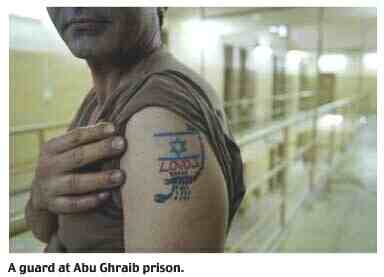
Press TV – January 20, 2010
The former American military chief of the notorious Abu Ghraib prison in Iraq reiterates the Israeli involvement in the US-run facility, where hundreds of Iraqi suspects were tortured and sexually abused by US soldiers and interrogators.
Shedding further light on the scandal that has served as a controversy-magnet for Washington ever since its emergence in 2004, the retired US army colonel Janis Karpinski says that Israeli agents were recruited by the US military at Abu Ghraib to interrogate the prisoners suspected of attacking US forces in Iraq.
The report by the Lebanese newspaper Al-Akhbar is set to fuel more debate on the matter as Karpinski had, until recently, refused to expound on the Israeli connection at Abu Ghraib despite admitting earlier to the presence of Israeli interrogators in the US-run compound.
The former high-ranking US military officer in Iraq told the British state broadcaster, the BBC, in 2004 that she had met an Israeli interrogator who was working at a secret facility in Baghdad.
The prominent American investigative journalist Seymour Hersh brought the issue out in the open on May 10, 2004, when he published the article, “Torture at Abu Ghraib,” in The New Yorker Magazine. The article served to ignite the outpouring of reports and evidences on the alleged “abuse, torture, sodomy and homicide” conducted at the facility by US military and intelligence officers.
In May of last year, more pictures of such abuses leaked out and hit the media networks showing the indiscriminate sexual orientation of American soldiers and operatives, who were shown carnally violating male and female Iraqis alike and assaulting them with nightsticks, wires and phosphorescent tubes.
Following his explosive account on the Abu Ghraib abuses, Hersh asserted that one of the Israeli pursuits in the US-run prison was to gain access to the detained members of the Iraqi secret intelligence unit that specialized in Israeli affairs.
Israel has been widely criticized by international human rights organizations for the torture and abuse of Palestinian prisoners, including women and children, during interrogations and in prison cells.
US President Barak Obama has ‘strongly’ opposed the release of more photos and imagery of the Abu Ghraib abuses by American soldiers, despite promises to the contrary when he was first elected. Obama later argued that releasing the scandalous photos, labeled classified by the Bush Administration, would inflame “the theaters of war,” jeopardize US forces, and make the life of troops based in Iraq and Afghanistan “more difficult.”
I Am Going Back to Gaza: Interview with Ewa Jasiewicz
 |
Ewa Jasiewicz: It’s an honour and a privilege to participate in this struggle. |
By Frank Barat
A year ago, Israel launched ‘Operation Cast lead’ in Gaza. It started on 27th of December 2008 and finished on 18th of January 2009. Those 22 days were the most brutal and violent the Palestinians had seen since 1967. More than 1400 Palestinians died including more than 400 children. More than 5000 Palestinians suffered serious injuries. 13 Israelis died. Ewa Jasiewicz was one of a handful “internationals” on the ground. A year later, she remembers and shares her reflections with me.
Frank Barat: You were in Gaza a year ago during “Operation Cast Lead”. Why and how did you and other activists get to the Gaza Strip?
Ewa Jasiewicz: Myself and several solidarity activists from Lebanon, Spain, Canada, Australia, Italy, UK, Ireland and Greece managed to get into Gaza aboard the Free Gaza Movement’s Dignity boat. FGM (1) has sailed five successful missions to Gaza between August-December 2008 bringing in human rights workers to build political solidarity activism, to break the isolation of ghettoized communities and directly confront Israel’s illegal and brutally collectively punishing siege.
FGM’s missions are political – we know Palestine is not a charity case, and that the solutions to 60-year policy of ethnic cleansing, apartheid and militarised ghettoization are not extra bags of flour, medicine, new tents and millions in aid, but, political will and direct action – currently un-forthcoming from governments around the world, so our actions are about directly applying international law from the grassroots up because it isn’t being respected and is being violated, daily, from the top-down – the siege of Gaza and occupation of Palestine is international, the states supporting it either with their silence or direct complicity in economically supporting Israel are co-occupiers and collaborators in war crimes against the Palestinian people along with Israel.
FB: You had already spent some time in the West Bank during various Israeli operations (more particularly in Jenin). What were the main differences between the 2 places and what did you expect to see in Gaza? Did you expect the attack?
EJ: I didn’t expect the attack – but people in Gaza and the Hamas authority did expect an attack because the ceasefire had expired and Israel was sabre-rattling, threatening to eliminate, as always but with greater intensity and focus, resistance leaders – military and political – and their supporters. There was an increase in UAVs (unmanned aerial vehicles – drones) flying 24-7. I had experience of smaller operations in the West Bank in Jenin and Nablus following Operation Defensive Shield in 2002. Operation Defensive Shield had been massive, hundreds of Palestinians were killed, the heart of Jenin refugee camp was bulldozed and dozens of civilians massacred in the process. By the time I came, all the ruins and trauma were still very fresh but the worst of the destruction and killing had subsided.
The smaller invasions were carried out under curfew, involving hundreds of troops, carrying out house to house searches, and mass arrests with every man aged between 15-50 rounded up, interrogated and beaten – a typical operation, with groups of children throwing anything they can at tanks and APCs in the street – and often getting shot at for doing it. There would be sporadic resistance at night from fighters, but many of the most experienced had been killed at that point. Troops would carry out collectively punishing home demolitions using bulldozers or explosives and civilians would be used as human shields. What was different at that time in the West Bank was that a lot of the PA’s infrastructure and military infrastructure of the resistance – fighters and leaders – had been destroyed during Defensive Shield by F16s. Israel was executing its cyclical strategy of having decimated the leaders of the armed and political resistance of major political factions, moving on to target the social infrastructure – community leaders, social activists, as continuing to arrest relatives of The Wanted and trying to bait out and kill the younger, more inexperienced fighters.
Because of the tunnels, fighters in Gaza have had access to more sophisticated and threatening weaponry than their West Bank counterparts, so Israeli aggression has been more intense in Gaza and heavily reliant on aerial bombardment. Since the withdrawal of the colonists and military bases, this has increased.
In the WB activists could be much more mobile and confront and dialogue with soldiers. In Gaza 2009 that was impossible. I only once saw soldiers – a special forces soldier trained his gun and apparently shot at our ambulance. In the West Bank we were often between tanks and APCs and following and observing soldiers close-up. If you got close to soldiers in Gaza they’d kill you – is what everyone kept telling us.
FB: What had you planned to do there? Did your plans changed once “Operation Cast Lead” started?
EJ: I’d planned, as had other activists, to work with Palestinian partners – civil society groups, unions, farmers and fisherman, local campaigns for the right to education and to end the siege. My role was going to be to co-ordinate and guide visiting delegations coming aboard Free Gaza’s boats along with Caoimhe Butterly. Once OCL (Operation Cast Lead) started, it became immediately clear that we needed to do as foreign activists was to fulfil our role of witnessing and reporting, mitigating the risk to those most likely to attacked – which during invasions are the medical services. The IOF (Israel Occupation Forces) killed 16 rescuers in 22 days and injured dozens more. By volunteering with medics we (a) attempted to deter attacks on them by informing the media and our embassies that we would be accompanying all services – 13 of the medics killed were from the Civil Defence services. We did no differentiate between ‘independent’ and ‘government’ services, all must be protected under international law. Also, we didn’t just sit in the ambulances, we physically carried the injured and dead and tried to assist where possible (b) we could remain mobile – ambulances were the only vehicles moving around 24-hours, we needed to be able to document and report on the attacks as fully as possible (c) in our mobility and proximity to the front line we could witness the effects of the bombardment on civilians in their homes, and take testimonies from families and Palestinian human rights workers inside hospitals.
FB: Could you describe a day in Gaza during “Operation Cast lead”.
EJ: The constant sneer of surveillance drones, repetitive bombing and crashing sounds, some close some further away, muted panic, empty streets, rubble everywhere, ambulance sirens wailing endlessly, screaming relatives coupled with the groans of the bloodied and dust-covered crushed and injured, medics praying, and smoking, heart-beating perpetual ratcheted-up adrenaline, a constant readiness for the next strike and yearning for it to all end, endless stream of bodies and blood-soaked stretchers, cyclical dread, pierced with fresh-surges of shock and horror, un-absorbed, and a deep fear of the night and whether we would make it through and whether each ambulance run might be the last. None of the fear paralysed us but nevertheless it was present. But we all early on accepted we could die, and took on the risks because it was worth it, the Palestinian people are worth it. We wanted to save lives and I know I let go of my attachment to mine, inspired and encouraged by the bravery of those around me, and their willingness to make the ultimate sacrifice for the sake of others.
FB: What was the feeling of the population on the ground? How were they surviving and responding?
EJ: Everybody was terrified but defiant. The feeling on the ground was that anything could happen, all red lines had been crossed, not just with this operation, we have to remember that Cast Lead was only an intensification and a drastic one at that, of an existing policy of massacre and deliberate targeting of civilians and civilian infrastructure, but in Jabalia, many of us were expecting another Sabra and Shatilla, with all witnesses banned from seeing the worst and with media being attacked, and tanks moving in closer and close, we felt that the atrocities already happening signified more could come and on a much wider scale.
FB: What was the most useful thing you think international volunteers were able to achieve and contribute? What did the Gazans think of your presence there?
EJ: The community was glad we were there and kept telling us, ‘please report what you see, we cant even believe this is happening to us, let the world know, its your duty to speak out about what your witness’ – and that’s what we did, through TV and Radio interviews, our own written reports, some of us wrote books too (Vittorio Arrigoni ‘Gaza, Stay Human’ (Italy) (2), Sharyn Lock ‘Gaza Beneath the Bombs’ (UK) (3), myself ‘Gaza: a ghetto unbroken’ (Poland) (4), and some of us made films, Fida Qeshta and Jenny Linnel – documentaries on the phosphoric bombardment of Khoza and Alberto Arce and Mohammad Rujailah (To Shoot an Elephant) (5). I think we contributed to the testimony of the Palestinian community – that white phosphorous was being used, that civilians were deliberately being targeted, that hospitals, schools, emergency services were being targeted. And that counter-acted Israel’s propaganda. Also, I know for a fact that we lifted the spirits of the medics we worked with, they felt they had a witness with them in case of their death, and a possible small bit of protection against Israeli attack. Everybody needs a witness when they’re going through hell – wherever and whatever that hell is – it’s a form of solidarity, of verification, that the unbelievable really is happening to you. Also, we were urging people on the outside to step up their protests and direct actions and advocacy for BDS (Boycott Divestment and Sanctions) (6) – getting that narrative out was important too, peoples eyes were opened by OCL and many people wanted to get involved and deepen their activism.
FB: Could you recount one event that truly shocked you during this period?
EJ: There were so so many. Probably the bombing of a house by F16 just a few feet away from four of our ambulances. I was in the passenger seat with my hand on the door, my friend and driver told me just wait, wait a little, and suddenly there was this enormous explosion – everything went bright fire orange and rubble and debris showered our ambulance. One of our drivers was injured and needed to be carried out on a stretcher. Our exit route was blocked by rubble, a family was screaming and gathering their belongings and getting out, we were stumbling with our casualty and surveillance drones were thundering above, and we feared a repeat strike, more casualties, and losing four ambulances when every single one was vital. We cheated death that night. The Israelis saw us and our solo-movement in the streets of Jabalia, and bombed a house less than 10 feet away from us – this is a criminal reckless use of force. Another was the bombing of the Beit Lahiya Elementary School with white phosphorous. We arrived in our ambulances after evacuating dozens of residents suffering from phosphoric inhalation and after the school had taken a direct hit. I was masked up but the stench and smoke was still penetrating, and when we got there a second round exploded above us, I was frozen to the spot and could see these burning blobs raining down next to me, I had to be screamed at to to move and shelter. The refugees in the school were screaming and crying under a flimsy metal shelter in the school yard. The third floor of the school was on fire. We brought Bilal Ashkar aged 7 – just this limp boy – into our ambulance. He’d been hit by the phosphorous shell and thrown down the stairs of the school by the force of the explosion. He was dead on arrival.
FB: A ceasefire was declared on 18th January. Did things change much after this? What did Gaza feel like and look like after the ceasefire?
EJ: The IOF flew F16s over people returning to pick up the pieces of their shattered lives in Ezbit Abid Rabo, drones continued to sneer above us every night. There was this hollow humiliation and un-digested horror, and loss, such a profound sense of dislocation and loss, of lives, of the loved, homes, whole communities, streets, mosques, shops, gone. People literally felt physically lost in their own neighbourhoods. It was like another Nakba (1948 Palestinian Catastrophe). People felt mocked by the international community, ‘Homme yidhak aleina’ was what we frequently heard, ‘they’re laughing at us, the whole world doesn’t care, they’re mocking us’. It felt like a tsunami had hit.
FB: Many reports coming from UN bodies, aid agencies and Human Rights organisations came out very quickly in months following “Operation Cast Lead”. Most of them agreed on the fact that War Crimes and possible Crimes against Humanity had been committed during the Israeli attack. You’re not an expert, but did you ever witness actions that for you were crimes of this magnitude?
EJ: Absolutely. The targeting of civilians and civilian areas, the reckless and wanton destruction of property, the disproportionate and indiscriminate use of force, seen with the bombing of the Beit Lahiya School, Samouni family massacre, the F16 bombardment of the Hamdan children in Beit Hanoun, the utter disregard for our ambulances, the blocking of access to the injured resulting in hundreds of deaths, the extra judicial killing of Sayed Al Seyam and Nazar Rayan and scores of their family members. We picked up some many shredded men (and some some women too) axed by heavy-duty bombs released by surveillance drones – these can carry a 150kg payload and are sophisticated enough to detect the colour of a person’s hair. According to Al Mezan, proportionally, most people in OCL were killed by UAV’s followed by F16s.
FB: A year later (27-12-09), people marched in hundreds of cities around the world to “commemorate” those horrific events. What do you think of those demonstrations, rallies…? What type of effect do they have on Gazans? Are they useful at all in your opinion?
EJ: The rallies are a focus point, we do need collective mourning, remembrance and action in our streets, but its also important to target companies violating international law and which are key in perpetuating Israeli apartheid which we must always remember is not limited to Gaza – the west bank is 15 times larger than Gaza and is full of mini Gaza’s – Bantustans surrounded by the apartheid wall. Companies like Veolia, Alstom, Caterpillar, Elbit Systems, CRT Holdings, Carmel-Agrexco could be charged with aiding and abetting war crimes of ethnic cleansing and illegal colony-building. The call for Boycott, Divestment and Sanctions from Palestinian civil society in 2005 needs to be responded to and supported – actively, daily. We are all complicit in the reproduction and reinforcement of the occupation – it is an international occupation, it is an international issue, and international solidarity for Palestinian human rights can create the conditions for a local solution.
FB: A few weeks ago, 16 aid agencies issued a report saying that the international community had “failed Gaza” (7). On the ground things not only have not changed at all for ordinary Gazans but have gotten worse. Keeping this in mind, what do you think is the role of popular resistance or citizen activism?
EJ: Yes, the international community facilitates and pays for Israel’s occupation, and pathologises and de-develops Palestine in the process. Ordinary citizens have a responsibility not to fund or politically support the bomb and build industry which hides a relentless project of ethnic cleansing and colonialism of Palestine, but to build a critical mass of political pressure by all means available – through BDS and direct action – to bring about sanctions against Israel and to enforce international law by targeting the companies that violate it with respect to Palestinian human rights, and to expose Israel in the same way South African Apartheid was exposed and eventually brought to an end.
FB: What, in your opinion, is most urgently needed in Gaza? What can people do to help and change the “Status quo”?
EJ: Palestinians in Gaza should answer that, but what many say, is that what Gaza needs is the rest of Palestine, people living in camps in Jordan, Lebanon, Syria and the West Bank want to be reunited with their families and homes. The inalienable and legal right of return for Gaza’s and all Palestinian refugees needs to be enacted. The Israeli tactic of divide and torture, of chopping up the Palestinian community, is a long-term tactic designed to break down the strongest weapon against ethnic cleansing that Palestinians possess – memory, community, family – as long as you have a people who remember their homes and lands, and know each other, refer to one another as cousin, uncle, sister and brother, and can ask, ‘Min dar mean’? From which home/family are you?’ then the struggle can never be alienated or abstracted. Palestinians in Gaza need to have the means to speak and act for themselves and not be spoken for, and to have access to the rest of the world – twinning relationships and projects between schools, mosques, universities, hospitals, youth groups, initiatives – these are all means to break the isolation inside and build a more intimate and motivated solidarity movement on the outside. Aid is not the answer. Solidarity is.
FB: Will you ever go back?
EJ: I am going back! I only meant to leave for a month, I deeply miss Gaza. It became like a home to me, I miss my friends and ‘family’ there. Like so many activists that go to Palestine, what we witness never leaves us. We learn from and are humbled by the people that we work with, and it’s an honour and a privilege to participate in this struggle.
[Ewa Jasiewicz is a human rights activist, union organiser and journalist. She has spent years working in occupied Palestine and Iraq with oil workers, refugees, paramedics and community groups. She is a co-ordinator for The Free Gaza Movement and part of the editorial collective of Le Monde Diplomatqiue Polish Edition. Her book ‘Gaza: Getto Nieujarzmione (Gaza – a Ghetto Unbroken) will be published in Poland by Ksiazka i Prasa in March. UK publisher T.B.C.]
– Frank Barat is a human right activist living in the UK. He contributed this article to PalestineChronicle.com.
Notes:
(1): See www.freegaza.org
(2): See Kubepublishing.org.
(3): www.plutobooks.com/display.asp?K=9780745330242
(4): Soon to be published
(5): www.toshootanelephant.com/
(6): www.bdsmovement.net/
(7): www.amnesty.org.uk/uploads/documents/doc_20012.pdf
Gaza flooded after Israel opens dam gates
Press TV – January 18, 2010 23:41:04 GMT
Israel has opened the floodgates of one of its dams in the eastern part of the Gaza Strip, flooding Palestinian houses and causing severe damage.
The Israeli authorities opened the dam’s floodgates without any prior warning or coordination with local authorities in Gaza, stunning the residents of the area, the Press TV correspondent in Gaza reported late on Monday.
There has been heavy rain in the region over the past 24 hours. It seems the Israeli authorities could not handle the huge amount of rainwater and decided to open the floodgates without prior warning.
Because Gaza is located in a low-lying area and the elevation decreases on the way to the Mediterranean Sea, water gushed into the area, flooding two Palestinian villages and displacing a hundred Gazan families.
The locals say Israel intentionally caused the floods, the Press TV correspondent said.
The waters from the dam, called the Valley of Gaza, flooded houses in Johr al-Deek village, which is southeast of Gaza City, and Nusirat in the eastern part of the territory, where the Al-Nusirat refugee camp is also located.
The Valley of Gaza is about 8 kilometers long. It starts on the eastern Gaza border with Israel and ends in the Mediterranean.
The houses of many Palestinians have been flooded and a number of people are trapped inside or on their roofs, while many have also gone missing, the Press TV correspondent said.
Rescue teams are using small boats to evacuate the trapped people.
Hamas has condemned the act as a war crime and has called on all concerned parties to intervene and offer assistance to the locals.
The flooding has made life more difficult for the Gazans, especially for those still living in tents because their homes were destroyed in the December 2008-January 2009 Israeli war on the Gaza Strip.
In the war, more than 1,400 people were killed, mostly women and children, and over 10,000 houses were destroyed or damaged, forcing at least 500 families to live in tents.
Very little progress is seen in reconstruction of the devastated areas in the Gaza Strip, mostly due to the Israeli blockade, which has prevented the delivery of building materials to the coastal enclave.
The Guantánamo “Suicides”: A Camp Delta sergeant blows the whistle
By Scott Horton
![[Image]](https://i0.wp.com/harpers.org/media/image/blogs/misc/2009-03-temp_cover.jpg)
This is the full text of an exclusive advance feature by Scott Horton that will appear in the March 2010 Harper’s Magazine. The issue will be available on newsstands the week of February 15.
1. “Asymmetrical Warfare”
When President Barack Obama took office last year, he promised to “restore the standards of due process and the core constitutional values that have made this country great.” Toward that end, the president issued an executive order declaring that the extra-constitutional prison camp at Guantánamo “shall be closed as soon as practicable, and no later than one year from the date of this order.” Obama has failed to fulfill his promise. Some prisoners are being charged with crimes, others released, but the date for closing the camp seems to recede steadily into the future. Furthermore, new evidence now emerging may entangle Obama’s young administration with crimes that occurred during the Bush presidency, evidence that suggests the current administration failed to investigate seriously—and may even have continued—a cover-up of the possible homicides of three prisoners at Guantánamo in 2006.
Late in the evening on June 9 that year, three prisoners at Guantánamo died suddenly and violently. Salah Ahmed Al-Salami, from Yemen, was thirty-seven. Mani Shaman Al-Utaybi, from Saudi Arabia, was thirty. Yasser Talal Al-Zahrani, also from Saudi Arabia, was twenty-two, and had been imprisoned at Guantánamo since he was captured at the age of seventeen. None of the men had been charged with a crime, though all three had been engaged in hunger strikes to protest the conditions of their imprisonment. They were being held in a cell block, known as Alpha Block, reserved for particularly troublesome or high-value prisoners.
As news of the deaths emerged the following day, the camp quickly went into lockdown. The authorities ordered nearly all the reporters at Guantánamo to leave and those en route to turn back. The commander at Guantánamo, Rear Admiral Harry Harris, then declared the deaths “suicides.” In an unusual move, he also used the announcement to attack the dead men. “I believe this was not an act of desperation,” he said, “but an act of asymmetrical warfare waged against us.” Reporters accepted the official account, and even lawyers for the prisoners appeared to believe that they had killed themselves. Only the prisoners’ families in Saudi Arabia and Yemen rejected the notion.
Two years later, the U.S. Naval Criminal Investigative Service, which has primary investigative jurisdiction within the naval base, issued a report supporting the account originally advanced by Harris, now a vice-admiral in command of the Sixth Fleet. The Pentagon declined to make the NCIS report public, and only when pressed with Freedom of Information Act demands did it disclose parts of the report, some 1,700 pages of documents so heavily redacted as to be nearly incomprehensible. The NCIS report was carefully cross-referenced and deciphered by students and faculty at the law school of Seton Hall University in New Jersey, and their findings, released in November 2009, made clear why the Pentagon had been unwilling to make its conclusions public. The official story of the prisoners’ deaths was full of unacknowledged contradictions, and the centerpiece of the report—a reconstruction of the events—was simply unbelievable.
According to the NCIS, each prisoner had fashioned a noose from torn sheets and T-shirts and tied it to the top of his cell’s eight-foot-high steel-mesh wall. Each prisoner was able somehow to bind his own hands, and, in at least one case, his own feet, then stuff more rags deep down into his own throat. We are then asked to believe that each prisoner, even as he was choking on those rags, climbed up on his washbasin, slipped his head through the noose, tightened it, and leapt from the washbasin to hang until he asphyxiated. The NCIS report also proposes that the three prisoners, who were held in non-adjoining cells, carried out each of these actions almost simultaneously.
Al-Zahrani, according to the report, was discovered first, at 12:39 a.m., and taken by several Alpha Block guards to the camp’s detention medical clinic. No doctors could be found there, nor the phone number for one, so a clinic staffer dialed 911. During this time, other guards discovered Al-Utaybi. Still others discovered Al-Salami a few minutes later. Although rigor mortis had already set in—indicating that the men had been dead for at least two hours—the NCIS report claims that an unnamed medical officer attempted to resuscitate one of the men, and, in attempting to pry open his jaw, broke his teeth.
The fact that at least two of the prisoners also had cloth masks affixed to their faces, presumably to prevent the expulsion of the rags from their mouths, went unremarked by the NCIS, as did the fact that standard operating procedure at Camp Delta required the Navy guards on duty after midnight to “conduct a visual search” of each cell and detainee every ten minutes. The report claimed that the prisoners had hung sheets or blankets to hide their activities and shaped more sheets and pillows to look like bodies sleeping in their beds, but it did not explain where they were able to acquire so much fabric beyond their tightly controlled allotment, or why the Navy guards would allow such an obvious and immediately observable deviation from permitted behavior. Nor did the report explain how the dead men managed to hang undetected for more than two hours or why the Navy guards on duty, having for whatever reason so grievously failed in their duties, were never disciplined.
A separate report, the result of an “informal investigation” initiated by Admiral Harris, found that standard operating procedures were violated that night but concluded that disciplinary action was not warranted because of the “generally permissive environment” of the cell block and the numerous “concessions” that had been made with regard to the prisoners’ comfort, which “concessions” had resulted in a “general confusion by the guard and the JDG staff over many of the rules that applied to the guard force’s handling of the detainees.” According to Harris, even had standard operating procedures been followed, “it is possible that the detainees could have successfully committed suicide anyway.”
This is the official story, adopted by NCIS and Guantánamo command and reiterated by the Justice Department in formal pleadings, by the Defense Department in briefings and press releases, and by the State Department. Now four members of the Military Intelligence unit assigned to guard Camp Delta, including a decorated non-commissioned Army officer who was on duty as sergeant of the guard the night of June 9–10, have furnished an account dramatically at odds with the NCIS report—a report for which they were neither interviewed nor approached.
All four soldiers say they were ordered by their commanding officer not to speak out, and all four soldiers provide evidence that authorities initiated a cover-up within hours of the prisoners’ deaths. Army Staff Sergeant Joseph Hickman and men under his supervision have disclosed evidence in interviews with Harper’s Magazine that strongly suggests that the three prisoners who died on June 9 had been transported to another location prior to their deaths. The guards’ accounts also reveal the existence of a previously unreported black site at Guantánamo where the deaths, or at least the events that led directly to the deaths, most likely occurred.
2. “Camp No”
The soldiers of the Maryland-based 629th Military Intelligence Battalion arrived at Guantánamo Naval Base in March 2006, assigned to provide security to Camp America, the sector of the base containing the five individual prison compounds that house the prisoners. Camp Delta was at the time the largest of these compounds, and within its walls were four smaller camps, numbered 1 through 4, which in turn were divided into cell blocks. Life at Camp America, as at all prisons, was and remains rigorously routinized for both prisoners and their jailers. Navy guards patrol the cell blocks and Army personnel control the exterior areas of the camp. All observed incidents must be logged. For the Army guards who man the towers and “sally ports” (access points), knowing who enters and leaves the camp, and exactly when, is the essence of their mission.
One of the new guards who arrived that March was Joe Hickman, then a sergeant. Hickman grew up in Baltimore and joined the Marines in 1983, at the age of nineteen. When I interviewed him in January at his home in Wisconsin, he told me he had been inspired to enlist by Ronald Reagan, “the greatest president we’ve ever had.” He worked in a military intelligence unit and was eventually tapped for Reagan’s Presidential Guard detail, an assignment reserved for model soldiers. When his four years were up, Hickman returned home, where he worked a series of security jobs—prison transport, executive protection, and eventually private investigations. After September 11 he decided to re-enlist, at thirty-seven, this time in the Army National Guard.
Hickman deployed to Guantánamo with his friend Specialist Tony Davila, who grew up outside Washington, D.C., and who had himself been a private investigator. When they arrived at Camp Delta, Davila told me, soldiers from the California National Guard unit they were relieving introduced him to some of the curiosities of the base. The most noteworthy of these was an unnamed and officially unacknowledged compound nestled out of sight between two plateaus about a mile north of Camp Delta, just outside Camp America’s perimeter. One day, while on foot patrol, Hickman and Davila came across the compound. It looked like other camps within Camp America, Davila said, only it had no guard towers and it was surrounded with concertina wire. They saw no activity, but Hickman guessed the place could house as many as eighty prisoners. One part of the compound, he said, had the same appearance as the interrogation centers at other prison camps.
The compound was not visible from the main road, and the access road was chained off. The Guardsman who told Davila about the compound had said, “This place does not exist,” and Hickman, who was frequently put in charge of security for all of Camp America, was not briefed about the site. Nevertheless, Davila said, other soldiers—many of whom were required to patrol the outside perimeter of Camp America—had seen the compound, and many speculated about its purpose. One theory was that it was being used by some of the non-uniformed government personnel who frequently showed up in the camps and were widely thought to be CIA agents.
A friend of Hickman’s had nicknamed the compound “Camp No,” the idea being that anyone who asked if it existed would be told, “No, it doesn’t.” He and Davila made a point of stopping by whenever they had the chance; once, Hickman said, he heard a “series of screams” from within the compound.
Hickman and his men also discovered that there were odd exceptions to their duties. Army guards were charged with searching and logging every vehicle that passed into and out of Camp Delta. “When John McCain came to the camp, he had to be logged in.” However, Hickman was instructed to make no record whatsoever of the movements of one vehicle in particular—a white van, dubbed the “paddy wagon,” that Navy guards used to transport heavily manacled prisoners, one at a time, into and out of Camp Delta. The van had no rear windows and contained a dog cage large enough to hold a single prisoner. Navy drivers, Hickman came to understand, would let the guards know they had a prisoner in the van by saying they were “delivering a pizza.”
The paddy wagon was used to transport prisoners to medical facilities and to meetings with their lawyers. But as Hickman monitored the paddy wagon’s movements from the guard tower at Camp Delta, he frequently saw it follow an unexpected route. When the van reached the first intersection, instead of heading right—toward the other camps or toward one of the buildings where prisoners could meet with their lawyers—it made a left. In that direction, past the perimeter checkpoint known as ACP Roosevelt, there were only two destinations. One was a beach where soldiers went to swim. The other was Camp No.
3. “Lit up”
The night the prisoners died, Hickman was on duty as sergeant of the guard for Camp America’s exterior security force. When his twelve-hour shift began, at 6 p.m., he climbed the ladder to Tower 1, which stood twenty feet above Sally Port 1, the main entrance to Camp Delta. From there he had an excellent view of the camp, and much of the exterior perimeter as well. Later he would make his rounds.
Shortly after his shift began, Hickman noticed that someone had parked the paddy wagon near Camp 1, which houses Alpha Block. A moment later, two Navy guards emerged from Camp 1, escorting a prisoner. They put the prisoner into the back of the van and then left the camp through Sally Port 1, just below Hickman. He was under standing orders not to search the paddy wagon, so he just watched it as it headed east. He assumed the guards and their charge were bound for one of the other prison camps southeast of Camp Delta. But when the van reached the first intersection, instead of making a right, toward the other camps, it made the left, toward ACP Roosevelt and Camp No.
Twenty minutes later—about the amount of time needed for the trip to Camp No and back—the paddy wagon returned. This time Hickman paid closer attention. He couldn’t see the Navy guards’ faces, but from body size and uniform they appeared to be the same men.
The guards walked into Camp 1 and soon emerged with another prisoner. They departed Camp America, again in the direction of Camp No. Twenty minutes later, the van returned. Hickman, his curiosity piqued by the unusual flurry of activity and guessing that the guards might make another excursion, left Tower 1 and drove the three quarters of a mile to ACP Roosevelt to see exactly where the paddy wagon was headed. Shortly thereafter, the van passed through the checkpoint for the third time and then went another hundred yards, whereupon it turned toward Camp No, eliminating any question in Hickman’s mind about where it was going. All three prisoners would have reached their destination before 8 p.m.
Hickman says he saw nothing more of note until about 11:30 p.m, when he had returned to his preferred vantage at Tower 1. As he watched, the paddy wagon returned to Camp Delta. This time, however, the Navy guards did not get out of the van to enter Camp 1. Instead, they backed the vehicle up to the entrance of the medical clinic, as if to unload something.
At approximately 11:45 p.m.—nearly an hour before the NCIS claims the first body was discovered—Army Specialist Christopher Penvose, preparing for a midnight shift in Tower 1, was approached by a senior Navy NCO. Penvose told me that the NCO—who, following standard operating procedures, wore no name tag—appeared to be extremely agitated. He instructed Penvose to go immediately to the Camp Delta chow hall, identify a female senior petty officer who would be dining there, and relay to her a specific code word. Penvose did as he was instructed. The officer leapt up from her seat and immediately ran out of the chow hall.
Another thirty minutes passed. Then, as Hickman and Penvose both recall, Camp Delta suddenly “lit up”—stadium-style flood lights were turned on, and the camp became the scene of frenzied activity, filling with personnel in and out of uniform. Hickman headed to the clinic, which appeared to be the center of activity, to learn the reason for the commotion. He asked a distraught medical corpsman what had happened. She said three dead prisoners had been delivered to the clinic. Hickman recalled her saying that they had died because they had rags stuffed down their throats, and that one of them was severely bruised. Davila told me he spoke to Navy guards who said the men had died as the result of having rags stuffed down their throats.
Hickman was concerned that such a serious incident could have occurred in Camp 1 on his watch. He asked his tower guards what they had seen. Penvose, from his position at Tower 1, had an unobstructed view of the walkway between Camp 1 and the medical clinic—the path by which any prisoners who died at Camp 1 would be delivered to the clinic. Penvose told Hickman, and later confirmed to me, that he saw no prisoners being moved from Camp 1 to the clinic. In Tower 4 (it should be noted that Army and Navy guard-tower designations differ), another Army specialist, David Caroll, was forty-five yards from Alpha Block, the cell block within Camp 1 that had housed the three dead men. He also had an unobstructed view of the alleyway that connected the cell block itself to the clinic. He likewise reported to Hickman, and confirmed to me, that he had seen no prisoners transferred to the clinic that night, dead or alive.
4. “He Could Not Cry out”
The fate of a fourth prisoner, a forty-two-year-old Saudi Arabian named Shaker Aamer, may be related to that of the three prisoners who died on June 9. Aamer is married to a British woman and was in the process of becoming a British subject when he was captured in Jalalabad, Afghanistan, in 2001. United States authorities insist that he carried a gun and served Osama bin Laden as an interpreter. Aamer denies this. At Guantánamo, Aamer’s fluency in English soon allowed him to play an important role in camp politics. According to both Aamer’s attorney and press accounts furnished by Army Colonel Michael Bumgarner, the Camp America commander, Aamer cooperated closely with Bumgarner in efforts to bring a 2005 hunger strike to an end. He persuaded several prisoners to break their strike for a while, but the settlement collapsed and soon afterward Aamer was sent to solitary confinement. Then, on the night the prisoners from Alpha Block died, Aamer says he himself was the victim of an act of striking brutality.
He described the events in detail to his lawyer, Zachary Katznelson, who was permitted to speak to him several weeks later. Katznelson recorded every detail of Aamer’s account and filed an affidavit with the federal district court in Washington, setting it out:
On June 9th, 2006, [Aamer] was beaten for two and a half hours straight. Seven naval military police participated in his beating. Mr. Aamer stated he had refused to provide a retina scan and fingerprints. He reported to me that he was strapped to a chair, fully restrained at the head, arms and legs. The MPs inflicted so much pain, Mr. Aamer said he thought he was going to die. The MPs pressed on pressure points all over his body: his temples, just under his jawline, in the hollow beneath his ears. They choked him. They bent his nose repeatedly so hard to the side he thought it would break. They pinched his thighs and feet constantly. They gouged his eyes. They held his eyes open and shined a mag-lite in them for minutes on end, generating intense heat. They bent his fingers until he screamed. When he screamed, they cut off his airway, then put a mask on him so he could not cry out.
The treatment Aamer describes is noteworthy because it produces excruciating pain without leaving lasting marks. Still, the fact that Aamer had his airway cut off and a mask put over his face “so he could not cry out” is alarming. This is the same technique that appears to have been used on the three deceased prisoners.
The United Kingdom has pressed aggressively for the return of British subjects and persons of interest. Every individual requested by the British has been turned over, with one exception: Shaker Aamer. In denying this request, U.S. authorities have cited unelaborated “security” concerns. There is no suggestion that the Americans intend to charge him before a military commission, or in a federal criminal court, and, indeed, they have no meaningful evidence linking him to any crime. American authorities may be concerned that Aamer, if released, could provide evidence against them in criminal investigations. This evidence would include what he experienced on June 9, 2006, and during his 2002 detention in Afghanistan at Bagram Airfield, where he was subjected to a procedure in which his head was smashed repeatedly against a wall. This torture technique, called “walling” in CIA documents, was expressly approved at a later date by the Department of Justice.
5. “You All Know”
By dawn, the news had circulated through Camp America that three prisoners had committed suicide by swallowing rags. Colonel Bumgarner called a meeting of the guards, and at 7:00 a.m. at least fifty soldiers and sailors gathered at Camp America’s open-air theater.
Bumgarner was known as an eccentric commander. Hickman marveled, for instance, at the colonel’s insistence that his staff line up and salute him, to music selections that included Beethoven’s Fifth Symphony and the reggae hit “Bad Boys,” as he entered the command center. This morning, however, Hickman thought Bumgarner seemed unusually nervous and clipped.
According to independent interviews with soldiers who witnessed the speech, Bumgarner told his audience that “you all know” three prisoners in the Alpha Block at Camp 1 committed suicide during the night by swallowing rags, causing them to choke to death. This was a surprise to no one—even servicemen who had not worked the night before had heard about the rags. But then Bumgarner told those assembled that the media would report something different. It would report that the three prisoners had committed suicide by hanging themselves in their cells. It was important, he said, that servicemen make no comments or suggestions that in any way undermined the official report. He reminded the soldiers and sailors that their phone and email communications were being monitored. The meeting lasted no more than twenty minutes. (Bumgarner has not responded to requests for comment.)
That evening, Bumgarner’s boss, Admiral Harris, read a statement to reporters:
An alert, professional guard noticed something out of the ordinary in the cell of one of the detainees. The guard’s response was swift and professional to secure the area and check on the status of the detainee. When it was apparent that the detainee had hung himself, the guard force and medical teams reacted quickly to attempt to save the detainee’s life. The detainee was unresponsive and not breathing. [The] guard force began to check on the health and welfare of other detainees. Two detainees in their cells had also hung themselves.
After praising the guards and the medics, Harris—in a notable departure from traditional military decorum—launched his attack on the men who had died on his watch. “They have no regard for human life,” Harris said, “neither ours nor their own.” A Pentagon press release issued soon after described the dead men, who had been accused of no crime, as Al Qaeda or Taliban operatives. Lieutenant Commander Jeffrey Gordon, the Pentagon’s chief press officer, went still further, telling the Guardian’s David Rose, “These guys were fanatics like the Nazis, Hitlerites, or the Ku Klux Klan, the people they tried at Nuremberg.” The Pentagon was not the only U.S. government agency to participate in the assault. Colleen Graffy, a deputy assistant secretary of state, told the BBC that “taking their own lives was not necessary, but it certainly is a good P.R. move.”
The same day the three prisoners died, Fox News commentator Bill O’Reilly completed a reporting trip to the naval base, where, according to his account on The O’Reilly Factor, the Joint Army Navy Task Force “granted the Factor near total access to the prison.” Although the Pentagon began turning away reporters after news of the deaths had emerged, two reporters from the Charlotte Observer, Michael Gordon and photographer Todd Sumlin, had arrived that morning to work on a profile of Bumgarner, and the colonel invited them to shadow him as he dealt with the crisis. A Pentagon spokesman later told the Observer it had been expecting a “puff piece,” which is why, according to the Observer, “Bumgarner and his superiors on the base” had given them permission to remain.
Bumgarner quickly returned to his theatrical ways. As Gordon reported in the June 13, 2006, issue of the Observer, the colonel seemed to enjoy putting on a show. “Right now, we are at ground zero,” Bumgarner told his officer staff during a June 12 meeting. Referring to the naval base’s prisoners, he said, “There is not a trustworthy son of a bitch in the entire bunch.” In the same article, Gordon also noted what he had learned about the deaths. The suicides had occurred “in three cells on the same block,” he reported. The prisoners had “hanged themselves with strips of knotted cloth taken from clothing and sheets,” after shaping their pillows and blankets to look like sleeping bodies. “And Bumgarner said,” Gordon reported, “each had a ball of cloth in their mouth either for choking or muffling their voices.”
Something about Bumgarner’s Observer interview seemed to have set off an alarm far up the chain of command. No sooner was Gordon’s story in print than Bumgarner was called to Admiral Harris’s office. As Bumgarner would tell Gordon in a follow-up profile three months later, Harris was holding up a copy of the Observer: “This,” said the admiral to Bumgarner, “could get me relieved.” (Harris did not respond to requests for comment.) That same day, an investigation was launched to determine whether classified information had been leaked from Guantánamo. Bumgarner was suspended.
Less than a week after the appearance of the Observer stories, Davila and Hickman each heard separately from friends in the Navy and in the military police that FBI agents had raided the colonel’s quarters. The MPs understood from their FBI contacts that there was concern over the possibility that Bumgarner had taken home some classified materials and was planning to share them with the media or to use them in writing a book.
On June 27, two weeks later, Gordon’s Observer colleague Scott Dodd reported: “A brigadier general determined that ‘unclassified sensitive information’ was revealed to the public in the days after the June 10 suicides.” Harris, according to the article, had already ordered “appropriate administrative action.” Bumgarner soon left Guantánamo for a new post in Missouri. He now serves as an ROTC instructor at Virginia Tech in Blacksburg.
Bumgarner’s comments appear to be at odds with the official Pentagon narrative on only one point: that the deaths had involved cloth being stuffed into the prisoners’ mouths. The involvement of the FBI suggested that more was at issue.
6. “An Unmistakable Message”
On June 10, NCIS investigators began interviewing the Navy guards in charge of Alpha Block, but after the Pentagon committed itself to the suicide narrative, they appear to have stopped. On June 14, the interviews resumed, and the NCIS informed at least six Navy guards that they were suspected of making false statements or failing to obey direct orders. No disciplinary action ever followed.
The investigators conducted interviews with guards, medics, prisoners, and officers. As the Seton Hall researchers note, however, nothing in the NCIS report suggests that the investigators secured or reviewed the duty roster, the prisoner-transfer book, the pass-on book, the records of phone and radio communications, or footage from the camera that continuously monitored activity in the hallways, all of which could have helped them authoritatively reconstruct the events of that evening.
The NCIS did, however, move swiftly to seize every piece of paper possessed by every single prisoner in Camp America, some 1,065 pounds of material, much of it privileged attorney-client correspondence. Several weeks later, authorities sought an after-the-fact justification. The Justice Department—bolstered by sworn statements from Admiral Harris and from Carol Kisthardt, the special agent in charge of the NCIS investigation—claimed in a U.S. district court that the seizure was appropriate because there had been a conspiracy among the prisoners to commit suicide. Justice further claimed that investigators had found suicide notes and argued that the attorney-client materials were being used to pass communications among the prisoners.
David Remes, a lawyer who opposed the Justice Department’s efforts, explained the practical effect of the government’s maneuvers. The seizure, he said, “sent an unmistakable message to the prisoners that they could not expect their communications with their lawyers to remain confidential. The Justice Department defended the massive breach of the attorney-client privilege on the account of the deaths on June 9 and the asserted need to investigate them.”
If the “suicides” were a form of warfare between the prisoners and the Bush Administration, as Admiral Harris charged, it was the latter that quickly turned the war to its advantage.
7. “Yasser Couldn’t Even Make a Sandwich!”
When I asked Talal Al-Zahrani what he thought had happened to his son, he was direct. “They snatched my seventeen-year-old son for a bounty payment,” he said. “They took him to Guantánamo and held him prisoner for five years. They tortured him. Then they killed him and returned him to me in a box, cut up.”
Al-Zahrani was a brigadier general in the Saudi police. He dismissed the Pentagon’s claims, as well as the investigation that supported them. Yasser, he said, was a young man who loved to play soccer and didn’t care for politics. The Pentagon claimed that Yasser’s frontline battle experience came from his having been a cook in a Taliban camp. Al-Zahrani said that this was preposterous: “A cook? Yasser couldn’t even make a sandwich!”
“Yasser wasn’t guilty of anything.” Al-Zahrani said. “He knew that. He firmly believed he would be heading home soon. Why would he commit suicide?” The evidence supports this argument. Hyperbolic U.S. government statements at the time of Yasser Al-Zahrani’s death masked the fact that his case had been reviewed and that he was, in fact, on a list of prisoners to be sent home. I had shown Al-Zahrani the letter that the government says was Yasser’s suicide note and asked him whether he recognized his son’s handwriting. He had never seen the note before, he answered, and no U.S. official had ever asked him about it. After studying the note carefully, he said, “This is a forgery.”
Also returned to Saudi Arabia was the body of Mani Al-Utaybi. Orphaned in youth, Mani grew up in his uncle’s home in the small town of Dawadmi. I spoke to one of the many cousins who shared that home, Faris Al-Utaybi. Mani, said Faris, had gone to Baluchistan—a rural, tribal area that straddles Iran, Pakistan, and Afghanistan—to do humanitarian work, and someone there had sold him to the Americans for $5,000. He said that Mani was a peaceful man who would harm no one. Indeed, U.S. authorities had decided to release Al-Utaybi and return him to Saudi Arabia. When he died, he was just a few weeks shy of his transfer.
Salah Al-Salami was seized in March 2002, when Pakistani authorities raided a residence in Karachi believed to have been used as a safe house by Abu Zubaydah and took into custody all who were living there at the time. A Yemeni, Al-Salami had quit his job and moved to Pakistan with only $400 in his pocket. The U.S. suspicions against him rested almost entirely on the fact that he had taken lodgings, with other students, in a boarding house that terrorists might at one point have used. There was no direct evidence linking him either to Al Qaeda or to the Taliban. On August 22, 2008, the Washington Post quoted from a previously secret review of his case: “There is no credible information to suggest [Al-Salami] received terrorist related training or is a member of the Al Qaeda network.” All that stood in the way of Al-Salami’s release from Guantánamo were difficult diplomatic relations between the United States and Yemen.
8. “The Removal of the Neck Organs”
Military pathologists connected with the Armed Forces Institute of Pathology arranged immediate autopsies of the three dead prisoners, without securing the permission of the men’s families. The identities and findings of the pathologists remain shrouded in extraordinary secrecy, but the timing of the autopsies suggests that medical personnel stationed at Guantánamo may have undertaken the procedure without waiting for the arrival of an experienced medical examiner from the United States. Each of the heavily redacted autopsy reports states unequivocally that “the manner of death is suicide” and, more specifically, that the prisoner died of “hanging.” Each of the reports describes ligatures that were found wrapped around the prisoner’s neck, as well as circumferential dried abrasion furrows imprinted with the very fine weave pattern of the ligature fabric and forming an inverted “V” on the back of the head. This condition, the anonymous pathologists state, is consistent with that of a hanging victim.
The pathologists place the time of death “at least a couple of hours” before the bodies were discovered, which would be sometime before 10:30 p.m. on June 9. Additionally, the autopsy of Al-Salami states that his hyoid bone was broken, a phenomenon usually associated with manual strangulation, not hanging.
The report asserts that the hyoid was broken “during the removal of the neck organs.” An odd admission, given that these are the very body parts—the larynx, the hyoid bone, and the thyroid cartilage—that would have been essential to determining whether death occurred from hanging, from strangulation, or from choking. These parts remained missing when the men’s families finally received their bodies.
All the families requested independent autopsies. The Saudi prisoners were examined by Saeed Al-Ghamdy, a pathologist based in Saudi Arabia. Al-Salami, from Yemen, was inspected by Patrice Mangin, a pathologist based in Switzerland. Both pathologists noted the removal of the structure that would have been the natural focus of the autopsy: the throat. Both pathologists contacted the Armed Forces Institute of Pathology, requesting the missing body parts and more information about the previous autopsies. The institute did not respond to their requests or queries. (It also did not respond to a series of calls I placed requesting information and comment.)
When Al-Zahrani viewed his son’s corpse, he saw evidence of a homicide. “There was a major blow to the head on the right side,” he said. “There was evidence of torture on the upper torso, and on the palms of his hand. There were needle marks on his right arm and on his left arm.” None of these details are noted in the U.S. autopsy report. “I am a law enforcement professional,” Al-Zahrani said. “I know what to look for when examining a body.”
Mangin, for his part, expressed particular concern about Al-Salami’s mouth and throat, where he saw “a blunt trauma carried out against the oral region.” The U.S. autopsy report mentions an effort at resuscitation, but this, in Mangin’s view, did not explain the severity of the injuries. He also noted that some of the marks on the neck were not those he would normally associate with hanging.
9. “I Know Some Things You Don’t”
Sergeant Joe Hickman’s tour of duty, which ended in March 2007, was distinguished: he was selected as Guantánamo’s “NCO of the Quarter” and was given a commendation medal. When he returned to the United States, he was promoted to staff sergeant and worked in Maryland as an Army recruiter before settling eventually in Wisconsin. But he could not forget what he had seen at Guantánamo. When Barack Obama became president, Hickman decided to act. “I thought that with a new administration and new ideas I could actually come forward, ” he said. “It was haunting me.”
Hickman had seen a 2006 report from Seton Hall University Law School dealing with the deaths of the three prisoners, and he followed their subsequent work. After Obama was inaugurated in January 2009, he called Mark Denbeaux, the professor who had led the Seton Hall team. “I learned something from your report,” he said, “but I know some things you don’t.”
Within two days, Hickman was in Newark, meeting with Denbeaux. Also at the meeting was Denbeaux’s son and sometime co-editor Josh, a private attorney. Josh Denbeaux agreed to represent Hickman, who was concerned that he could go to prison if he disobeyed Colonel Bumgarner’s order not to speak out, even if that order was itself illegal. Hickman did not want to speak to the press. On the other hand, he felt that “silence was just wrong.”
The two lawyers quickly made arrangements for Hickman to speak instead with authorities in Washington, D.C. On February 2, they had meetings on Capitol Hill and with the Department of Justice. The meeting with Justice was an odd one. The father-and-son legal team were met by Rita Glavin, the acting head of the Justice Department’s Criminal Division; John Morton, who was soon to become an assistant secretary at the Department of Homeland Security; and Steven Fagell, counselor to the head of the Criminal Division. Fagell had been, along with the new attorney general, Eric Holder, a partner at the elite Washington law firm of Covington & Burling, and was widely viewed as “Holder’s eyes” in the Criminal Division.
For more than an hour, the two lawyers described what Hickman had seen: the existence of Camp No, the transportation of the three prisoners, the van’s arrival at the medical clinic, the lack of evidence that any bodies had ever been removed from Alpha Block, and so on. The officials listened intently and asked many questions. The Denbeauxs said they could provide a list of witnesses who would corroborate every aspect of their account. At the end of the meeting, Mark Denbeaux recalled, the officials specifically thanked the lawyers for not speaking to reporters first and for “doing it the right way.”
Two days later, another Justice Department official, Teresa McHenry, head of the Criminal Division’s Domestic Security Section, called Mark Denbeaux and said that she was heading up an investigation and wanted to meet directly with his client. She went to New Jersey to do so. Hickman then reviewed the basic facts and furnished McHenry with the promised list of corroborating witnesses and details on how they could be contacted.
The Denbeauxs did not hear from anyone at the Justice Department for at least two months. Then, in April, an FBI agent called to say she did not have the list of contacts. She asked if this document could be provided again. It was. Shortly thereafter, Fagell and two FBI agents interviewed Davila, who had left the Army, in Columbia, South Carolina. Fagell asked Davila if he was prepared to travel to Guantánamo to identify the locations of various sites. He said he was. “It seemed like they were interested,” Davila told me. “Then I never heard from them again.”
Several more months passed, and Hickman and his lawyers became increasingly concerned that nothing was going to happen. On October 27, 2009, they resumed dealings with Congress that they had initiated on February 2 and then broken off at the Justice Department’s request; they were also in contact with ABC News. Two days later, Teresa McHenry called Mark Denbeaux and asked whether he had gone to Congress and ABC News about the matter. “I said that I had,” Denbeaux told me. He asked her, “Was there anything wrong with that?” McHenry then suggested that the investigation was finished. Denbeaux reminded her that she had yet to interview some of the corroborating witnesses. “There are a few small things to do,” Denbeaux says McHenry answered, “then it will be finished.”
Specialist Christopher Penvose told me that on October 30, the day following the conversation between Mark Denbeaux and Teresa McHenry, McHenry showed up at Penvose’s home in south Baltimore with some FBI agents. She had a “few questions,” she told him. Investigators working with her soon contacted two other witnesses.
On November 2, 2009, McHenry called Mark Denbeaux to tell him that the Justice Department’s investigation was being closed. “It was a strange conversation,” Denbeaux recalled. McHenry explained that “the gist of Sergeant Hickman’s information could not be confirmed.” But when Denbeaux asked what that “gist” actually was, McHenry declined to say. She just reiterated that Hickman’s conclusions “appeared” to be unsupported. Denbeaux asked what conclusions exactly were unsupported. McHenry refused to say.
10. “They Accomplished Nothing”
One of the most intriguing aspects of this case concerns the use of Camp No. Under George W. Bush, the CIA created an archipelago of secret detention centers that spanned the globe, and authorities at these sites deployed an array of Justice Department–sanctioned torture techniques—including waterboarding, which often entails inserting cloth into the subject’s mouth—on prisoners they deemed to be involved in terrorism. The presence of a black site at Guantánamo has long been a subject of speculation among lawyers and human-rights activists, and the experience of Sergeant Hickman and other Guantánamo guards compels us to ask whether the three prisoners who died on June 9 were being interrogated by the CIA, and whether their deaths resulted from the grueling techniques the Justice Department had approved for the agency’s use—or from other tortures lacking that sanction.
Complicating these questions is the fact that Camp No might have been controlled by another authority, the Joint Special Operations Command, which Bush’s defense secretary, Donald Rumsfeld, had hoped to transform into a Pentagon version of the CIA. Under Rumsfeld’s direction, JSOC began to take on many tasks traditionally handled by the CIA, including the housing and interrogation of prisoners at black sites around the world. The Pentagon recently acknowledged the existence of one such JSOC black site, located at Bagram Airfield in Afghanistan, and other suspected sites, such as Camp Nama in Baghdad, have been carefully documented by human-rights researchers.
In a Senate Armed Services Committee report on torture released last year, the sections about Guantánamo were significantly redacted. The position and circumstances of these deletions point to a significant JSOC interrogation program at the base. (It should be noted that Obama’s order last year to close other secret detention camps was narrowly worded to apply only to the CIA.)
Regardless of whether Camp No belonged to the CIA or JSOC, the Justice Department has plenty of its own secrets to protect. The department would seem to have been involved in the cover-up from the first days, when FBI agents stormed Colonel Bumgarner’s quarters. This was unusual for two reasons. When Pentagon officials engage in a leak investigation, they generally use military investigators. They rarely turn to the FBI, because they cannot control the actions of a civilian agency. Moreover, when the FBI does open an investigation, it nearly always does so with great discretion. The Bumgarner investigation was widely telegraphed, though, and seemed intended to send a message to the military personnel at Camp Delta: Talk about what happened at your own risk. All of which suggests it was not the Pentagon so much as the White House that hoped to suppress the truth.
In the weeks following the 2006 deaths, the Justice Department decided to use the suicide narrative as leverage against the Guantánamo prisoners and their troublesome lawyers, who were pressing the government to justify its long-term imprisonment of their clients. After the NCIS seized thousands of pages of privileged communications, the Justice Department went to court to defend the action. It argued that such steps were warranted by the extraordinary facts surrounding the June 9 “suicides.” U.S. District Court Judge James Robertson gave the Justice Department a sympathetic hearing, and he ruled in its favor, but he also noted a curious aspect of the government’s presentation: its “citations supporting the fact of the suicides” were all drawn from media accounts. Why had the Justice Department lawyers who argued the case gone to such lengths to avoid making any statement under oath about the suicides? Did they do so in order to deceive the court? If so, they could face disciplinary proceedings or disbarment.
The Justice Department also faces questions about its larger role in creating the circumstances that lead to the use of so-called enhanced interrogation and restraint techniques at Guantánamo and elsewhere. In 2006, the use of a gagging restraint had already been connected to the death on January 9, 2004, of an Iraqi prisoner, Lieutenant Colonel Abdul Jameel, in the custody of the Army Special Forces. And the bodies of the three men who died at Guantánamo showed signs of torture, including hemorrhages, needle marks, and significant bruising. The removal of their throats made it difficult to determine whether they were already dead when their bodies were suspended by a noose. The Justice Department itself had been deeply involved in the process of approving and setting the conditions for the use of torture techniques, issuing a long series of memoranda that CIA agents and others could use to defend themselves against any subsequent criminal prosecution.
Teresa McHenry, the investigator charged with accounting for the deaths of the three men at Guantánamo, has firsthand knowledge of the Justice Department’s role in auditing such techniques, having served at the Justice Department under Bush and having participated in the preparation of at least one of those memos. As a former war-crimes prosecutor, McHenry knows full well that government officials who attempt to cover up crimes perpetrated against prisoners in wartime face prosecution under the doctrine of command responsibility. (McHenry declined to clarify the role she played in drafting the memos.)
As retired Rear Admiral John Hutson, the former judge advocate general of the Navy, told me, “Filing false reports and making false statements is bad enough, but if a homicide occurs and officials up the chain of command attempt to cover it up, they face serious criminal liability. They may even be viewed as accessories after the fact in the original crime.” With command authority comes command responsibility, he said. “If the heart of the military is obeying orders down the chain of command, then its soul is accountability up the chain. You can’t demand the former without the latter.”
The Justice Department thus faced a dilemma; it could do the politically convenient thing, which was to find no justification for a thorough investigation, leave the NCIS conclusions in place, and hope that the public and the news media would obey the Obama Administration’s dictum to “look forward, not backward”; or it could pursue a course of action that would implicate the Bush Justice Department in a cover-up of possible homicides.
Nearly 200 men remain imprisoned at Guantánamo. In June 2009, six months after Barack Obama took office, one of them, a thirty-one-year-old Yemeni named Muhammed Abdallah Salih, was found dead in his cell. The exact circumstances of his death, like those of the deaths of the three men from Alpha Block, remain uncertain. Those charged with accounting for what happened—the prison command, the civilian and military investigative agencies, the Justice Department, and ultimately the attorney general himself—all face a choice between the rule of law and the expedience of political silence. Thus far, their choice has been unanimous.
Not everyone who is involved in this matter views it from a political perspective, of course. General Al-Zahrani grieves for his son, but at the end of a lengthy interview he paused and his thoughts turned elsewhere. “The truth is what matters,” he said. “They practiced every form of torture on my son and on many others as well. What was the result? What facts did they find? They found nothing. They learned nothing. They accomplished nothing.”
Featured Video
Dan Dicks with James Corbett on Solutions Watch
or go to
Aletho News Archives – Video-Images
From the Archives
Secret document reveals plans for civil war in Lebanon, Israeli false flags, and invasion
By Randi Nord | Geopolitics Alert | April 5, 2019
Beirut – During his visit with US Secretary of State, Mike Pompeo, Lebanese President Michael Aoun reportedly received a US-Israeli document detailing plans for creating a civil war in Lebanon with covert false flag operations and possible Israeli invasion.
Although the source of the document is Israeli and created in partnership with Washington, no one knows who presented it to Aoun. The Lebanese TV station, Al-Jadeed, initially reported the document on Lebanese TV and a video on its website. Geopolitics Alert translated the report for this article. … continue
Blog Roll
 Aletho News
- Sheikh al-Asadi warns of Iraqi government compliance with US demands
- How to MAKE THE CONSPIRATORS PAY for their crimes! Dan Dicks with James Corbett on Solutions Watch
- There’s a drought in academia: A drought in honest research on the subject of drought and other weather extremes
- Department of War Awards $20.7 Billion Contract to Raytheon for Air-to-Air Missiles
- ‘Distance yourselves from Israel’: IRGC urges US population to question govt policies
- America’s Greenland deal has a radioactive backstory
- The RAF Fairford ‘terror plot’: Unpacking escalation in the UK echo-chamber
- EU Council Advances Chat Control 2.0 Scanning Proposal
- Ex-Greek MEP files complaint against Israeli spyware firm over alleged Pegasus surveillance
- Troubling ideas throughout the Torah, Talmud, Mishneh Torah and Tanya
- If Americans Knew
- New Report: “Scholasticide and Genocide in Gaza: Assessment, Testimonies and Legal Analysis”
- Ex-Biden officials are desperate for a Gaza scapegoat
- Israeli “settlers” Invade Al-Aqsa; Pour Boiling Water on 75-Year-Old
- Israel Has Kidnapped Another American Teenager
- US arms sales to Israel worth $21.6 billion in 20 months
- Three Palestinians Killed in Israeli Attacks on Gaza
- Revealed: German “Anti-Semitism Expert” Driving Crackdown on Palestine Solidarity is Former Israeli Spy
- Egypt’s Warning to Israel Before Oct 7
- Israel’s siege signals another cruel winter for 1.8 million Gazans – Daily Update
- Netanyahu Asked UAE Leader to Deny Report on Oct. 7 Warning in Secret Visit, Sources Say
- No Tricks Zone
- Two More Paleo Reconstructions Affirm Meters-Higher Sea Levels Across Ireland, Brazil 7000-6000 Years Ago
- New Study: Earth And Venus Surface Warmth Largely Explained By Convection And Lapse Rate, Not CO2 Or Radiation
- 2025 Nature Paper Claiming Worsening Global Drought Gets RETRACTED …Heavily Flawed
- New Study: ‘Global Drought Shows No Detectable Recent Acceleration Under Climate Warming’
- Economic Masterminds: German Socialists Suggest Taxing Productivity Gains Stemming From Using AI
- The South China Sea Has Not Been Cooperating With The Climate Change Narrative
- Energy Crisis: Germany Enters Heating Season With Historically Low Gas Reserve Fill Levels
- New Study: The Antarctic Ice Sheet Gained Mass From 2020-2024 Due To Staggering Snow And Ice Accumulation
- Study: Ocean Heating Rates From Thousands Of Years Ago ‘Dwarf’ Modern Ocean Heating Rates
- Climate Extremists Target, Attack Large-Scale Power Grid Infrastructure In Germany!

