“Four Afghan civilians killed in Baghlan air raid”
Haji Farid, a lawmaker from the Kapisa province – “every time an American soldier gets killed, they bomb an entire village. The president should determine to whom this country belongs.”
By Habib Rahman Sherzai |RAWA | December 29, 2009
Four civilians have reportedly been killed and eight others wounded in a fresh air strike by foreign forces in northern Baghlan province, residents alleged on Tuesday.
The overnight attack took place in Kohna Qala area of Baghlan-i-Markazi district, residents told Pajhwok Afghan News. The fresh air raid came about three days after 10 civilians were killed during military operations in eastern Kunar province.
The Saturday air strike in Kunar drew condemnation from the lawmakers on Monday who walked out of the session and later a parliamentary delegation met President Hamid Karzai to show their resentment. Karzai ordered a serious probe into the attack that killed ten people including eight school children in Badeel area in Narang district.
In the last night air raid, the dead included a father and his three sons, who were killed while running to escape the bombardment, a teacher at the Jamiat Aburjaee High School in the area, Karim Safi, told Pajhwok Afghan News.
A student of the school, Karim Javed, said that the air raid also left many people wounded including a student of his school.
Head of the district hospital, Abdul Qahir Qanit, said they had received eight injured people delivered to the hospital with a woman and a child in a critical condition.
However, provincial police chief Kabir Andarabi said the aircrafts targeted Taliban. He claimed the attack killed eight Taliban fighters and injured seven others. The dead bodies of two slain militants were still lying on the ground at the site, he said.
The war in Afghanistan is becoming deadlier, killing 10 percent more civilians during the first 10 months of 2009 compared to the previous period last year, according to UN figures.
UNAMA said that 468 deaths were caused by pro-government forces, including NATO and US-led forces, and 166 by “other actors.
Meanwhile, a gun-battle broke out between police and militants after the latter attacked their checkpost in Shar-i-Qadeem area of the Baghlan-i-Markazi district, police spokesman, Javed Basharat, said.
One fighter was killed and another three injured in the clash that also left three policemen wounded, he added.
However, Taliban spokesman Zabihullah Mujahid claimed the fighters killed eight policemen and wounded as many during the firefight. Acknowledging the killing of their one fighter in the clash, Mujahid said the fighters also abducted one cop.
Hovering American B-52 warplanes cause panic in Pakistan’s tribal areas
2009-12-28 15:00:00
The continuous hovering of America’s heavy bomber aircraft, B-52 – capable of carrying nuclear and conventional weapons – has caused panic among residents of Pakistan’s Tribal Areas.
The Nation quoted sources as saying that B-52 warplanes and US drones have been hovering over Waziristan and Kurram Agency for the last several weeks.
The US Air Combat Command’s B-52 is a long-range, heavy bomber that can perform a variety of missions.
Capable of flying at high subsonic speeds at altitudes up to 50,000 feet, the B-52 can perform air interdiction, offensive counter-air and maritime operations.
During Desert Storm, B-52s delivered 40 per cent of all the weapons dropped by coalition forces.
It is highly effective when used for ocean surveillance. Two B-52s, in two hours, can monitor 364,000 square kilometres of ocean surface.
All B-52s are equipped with an electro-optical viewing system to augment the targeting, battle assessment, flight safety and terrain-avoidance system, thus further improving its combat ability and low-level flight capability. (ANI)
Nigeria resumes massacres
By Rafiu Oriyomi | IslamOnline.net | September 10, 2009
LAGOS — Nigerian police have been accused of indiscriminate arrest and harassment against Muslims across the country since clashes with the militant Boko Haram group killed at least 600 people…
In July, Boko Haram, a militant group opposed to anything modeled after the West, went on rampage in three north-western states attacking police stations and other facilities.
A massive security operation resulted in the killing of hundreds of militants including their leader Mohammed Yusuf and alleged financiers.
There have since been reports of constant police harassment of Muslims on the streets across the country.
“What qualified me for this wicked charge is my beard and attire,” fumed Saleh, 29, who met a number of other Muslims at the police station, arrested on the same charge.
“What this means is that all Muslims are members of the Boko Haram,” he stressed.
“And if that is the case, then there is a danger lurking around because we won’t take this from the government.”
[…]
The harassment is not limited to Borno or Yobe. Earlier this week, at least 11 bearded Muslims were rounded up by policemen at Ijaiye, a suburb of Lagos, on charges that they are members of Boko Haram.
Sulaiman Idris, one of the detainees who police said will be charged on illegal association and terrorism related charges, told IOL he was going to work when arrested.
“I can’t remember doing anything contrary to the law,” a tearful Idris sobbed, alleging torture.
He said others are going through the same ordeal.
“I have known Idris as a peace-loving Muslim who keeps beard and wears short trousers. His arrest is a slap on fundamental human rights,” said Shakirat Adedo, a work colleague.
“I’m told 11 of them were arrested. I think this is getting out of hand.”
When contacted, Lagos Police spokesman Frank Mba denied knowledge of the arrests and pledged to investigate the matter.
Two Muslim journalists working for the Lagos-based Islamic publication Al-Minbar were arrested last week and are still being detained in Yaba.
The arrest is linked to publishing an article entitled “Every Muslim Is A Boko Haram,” in response to police action.
Money for Justice
What adds insult to injury is that Muslims have to buy their freedom from police custody.
Asked how he regained his freedom, Saleh said his relatives “had to pay through their noses to get me released.”
“This means the Nigerian police want to hide under the Boko Haram incidence to feed fat on us,” he charged.
Mallam Zakari Adamu, Chairman of the Movement of Justice in Nigeria (MOJIN) Yobe chapter, confirmed the ugly trend.
“Our great problem is that if your innocent relation is detained for alleged involvement in Boko Haram, if you don’t have money to give him, you then sacrifice him or her to remain in cell,” he told IOL.
“Even when they have finished their interrogation and find him not guilty, you still have to bribe for him to regain his freedom,” contended the rights activist.
“I know of a boy who was shot; he is an innocent businessman. His father told us that he has spent N240,000 yet he could not even see the face of his son, this is unjust.”
Muslim Rights Concern (MURIC), a countrywide network of Islamic activists, is raising the issue with the government, warning that the clampdown could trigger another bout of violence…
Update – Press TV – December 29, 2009
Thirty-eight members of the Boko Haram extremist group, including their leader, have been killed in clashes with a joint military-police force in the city of Bauchi in northern Nigeria.
Bauchi Police Chief Atikur Kafur told reporters on Monday that one soldier and two innocent people were among the dead in the Zango district of the city. He added that 14 people were also injured.
Twenty suspected militants were arrested, including nine adults and 11 juveniles.
The police chief identified the Boko Haram leader as Malam Badamasi.
‘I will pay the price for this testimony when I return’
December 28, 2009
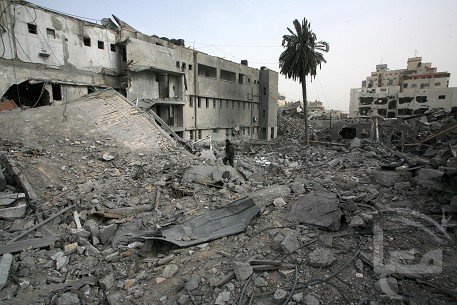
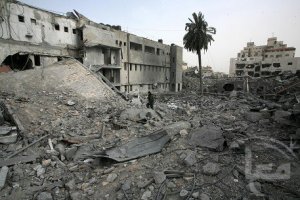 The Saraya prison and police compound was
bombed the second day of the war [MaanImages]
Bethlehem – Ma’an – An estimated 300 Palestinians were killed in the first 48 hours of Israel’s winter assault on the Gaza Strip, which entered its second day one year ago today.
With an increased focus on Rafah, Israeli warplanes bombarded around 100 more targets on 28 December 2008, leaving about 70 more Palestinians dead, and raising the child death toll to 22 and the civilian toll to 60, including nine women.
Israeli jets struck Islamic University in Gaza City, the offices of de facto Prime Minister Ismail Haniyeh, and the Saraya prison, ironically killing four members of Hamas’ domestic rival Fatah, as well as three mosques and 11 homes and apartments.
Fires engulfed Rafah after Israeli missiles hit underground fuel pipelines in some 40 sorties on the Strip’s tunnel network. Fleeing the flames, terrified residents of Gaza’s south attempted by the hundreds to escape to Egypt, but were prevented from leaving by Egyptian security forces. A Palestinian and an Egyptian policeman were killed in the ensuring chaos; at least 10 others were hurt.
West Bank protest
Palestinians in the West Bank, horrified by the numbers of dead and more than 1,000 injured, protested against the operation on its second day. Palestinian Authority security forces broke up a demonstration in Ramallah when activists urged support for Hamas, while Israeli forces shot dead three demonstrators nearby.
“There was a significant increase in the use of force by Israeli security forces during demonstrations in the West Bank after the start of the Israeli operations in Gaza,” according to the final report of the UN Fact Finding Mission on the Gaza Conflict. “The degree of force used against protests during the previous year had already been high … New tactics and weapons used by the Israeli security forces aimed at suppressing the popular movement have resulted in deaths and injuries.”
In July 2009, two witnesses, Mohamed Srour and Jonathan Pollak, described to the UN investigators in Geneva the fatal shooting of the two young men from the West Bank village of Ni’lin during a demonstration against the Gaza operation. Srour, elected mayor in 2005, was himself shot in the leg during the same protest.
“This demonstration was like any other demonstration. These demonstrations always took place and were peaceful demonstrations,” Srour explained. “And there was the presence of Israeli and foreign supporters and very high-level MPs. So it was very clear that this demonstration was a peaceful one.”
As the protest was winding down, Israeli forces used tear gas and stun grenades to disperse the crowd. The two young men who died were part of a small group of demonstrators, some of whom had thrown stones at the soldiers. In video footage, four or five soldiers appeared to be casually walking around and not seemingly threatened. Dozens of rounds of live ammunition were fired in the direction of the group of young men, hitting three of them within minutes of each other.
“Unfortunately, I have experienced, and it’s very easy to distinguish between, the shooting of rubber bullets and tear gas and between live ammunition,” recounted Pollak, an Israeli activist. “When I told them that it’s live ammunition, they didn’t believe me. They said, ‘No, it’s just blanks that they’re shooting. And they’re not going to shoot us.'”
Mohamed Khawaja was shot in the forehead; Arafat Khawaja, who had turned to run away, was shot in the back, and Srour was shot in the leg. Subsequently, an ambulance was prevented from reaching the victims, who had to be carried some distance and were eventually put onto a pick-up truck, at which the army fired tear gas.
“There were shouts that another person was shot. People said, ‘Call the medics. There’s another person wounded.’ And we put Mohamed on the ground. Some people stayed with him and I ran back immediately.
“And then I saw Arafat Khawaja being carried. And there weren’t enough people carrying him. His head was slinging back, and I grabbed his head and my hand was covered with his blood. He was shot in the back. … I got to him and I looked back. And I saw Mohamed being shot – I saw Mohamed fall down. And people were shouting that another person was shot.
[…]
“We dropped Arafat on the floor by mistake. And we weren’t far at all from Mohamed. And people grabbing him ran before, like ran and passed up. And I could see that his face was all bloody. And the wound was in the vicinity of his eye. I mean, I would say, at the moment, I thought that the bullet went through is eye. I’m not sure if that’s true. …
“There was no ambulance there because it was prevented from entering the village at the entrance, at the roadblock in the entrance. His blood kept gushing from this back and his legs were a bit higher so it, it dripped, through the back of his head. He was shot in the back, which, I mean, I would tend to say murder because he was with his back to the soldiers and absolutely not endangering anyone. But, I assume, legally it can not be called murder because we can’t prove intent. But in the least, it’s willful killing.”
Added Srour, “There was no care, whatsoever, for human life.”
No reply
According to South African jurist Richard Goldstone’s final report, “The Mission has asked the Government of Israel to explain the increased use of live ammunitions during demonstrations in the West Bank, but has received no reply.”
Both Srour and Pollak said that by the second day of the war, the atmosphere encountered with soldiers and border police had already become markedly different from the situation before the operations in Gaza.
“The atmosphere of the incident, and during and after the start of the war generally, was that all checks and balances had been removed. The soldiers were saying things related to the Gaza war, taunting things like, ‘It’s a shame we’re not in Gaza killing Arabs,'” Pollak said. “They were taunting us. They were cursing at us. They were laughing about what was happening in Gaza at the same time. This was the second day of the war, of the assault. And people were unbelievably angry.”
Israeli forces arrested Srour at the Allenby crossing upon his return to the West Bank on 20 July. He was subsequently released on bail. Israel’s Permanent Representative to Geneva said the arrest was unrelated to his appearance at the public hearing days earlier.
During his testimony, however, Srour had expressed fear Israel would retaliate for his remarks at the UN. “I know full well that I will pay the price for this testimony when I return at Israeli crossing points in my journey of return after this hearing,” he said.
At least 800 Israeli protesters, most of them of Palestinian descent, were arrested during the Gaza war.
Among the UN report’s final recommendations is “that the Government of Israel should cease actions aimed at limiting the expression of criticism by civil society and members of the public concerning Israel’s policies and conduct during the military operations in the Gaza Strip. The Mission also recommends that Israel should set up an independent inquiry to assess whether the treatment by Israeli judicial authorities of Palestinian and Jewish Israelis expressing dissent in connection with the offensive was discriminatory, in terms of both charges and detention pending trial. The results of the inquiry should be made public and, subject to the findings, appropriate remedial action should be taken;
“The Mission recommends that the Government of Israel should refrain from any action of reprisal against Palestinian and Israeli individuals and organizations that have cooperated with the United Nations Fact Finding Mission on the Gaza Conflict, in particular individuals who have appeared at the public hearings held by the Mission in Gaza and Geneva and expressed criticism of actions by Israel.”
Stoking the fires of fear and hatred
American Zionist fear monger David Harris campaigns for Iran’s destruction
By Paul J. Balles
26 December 2009
Never let it be said that Zionists can’t run an effective propaganda campaign. They’re at it again, giving all to stimulate fear with clever patterns of deception.
 David Harris is spreading his fear-mongering widely. For European audiences, his propaganda is targeting Germany through Der Tagesspiegel and Italy through L‘Opinione.
His article on “Iran policy: what price failure” also spreads the message of fear through the Huffington Post to Americans.
To begin his fear stimulus, Harris writes, “Among today’s many foreign policy challenges, Iran’s nuclear programme may be the most daunting.” What better way to stoke fear than call the object of your attack “daunting”?
His next fear-prodding statement reads, “An Iran capable of producing – and delivering – nuclear weapons would have major global consequences.”
An American voice for Israel, Harris tries to drum up global fear of Iran, a signatory to the Nuclear Non-Proliferation Treaty, while Harris knows full well that Israel has over 200 nuclear warheads and Iran has none.
Harris ignores the fact that Israel has been in attack-mode since its beginnings – ethnic cleansing of Palestinians, invasion and sponsorship of Sabre and Shatilla murders in Lebanon’s refugee camps, slaughter in Gaza, military theft of the Golan Heights from Syria.
On the other hand, Iran’s military history has involved only defence. Harris chooses to ignore this damning fact. Actually, Harris, Director of the American Jewish Committee, started pumping fear of Iran into the heads of his readers some time ago.
Carrying on, Harris claims: “Iran would wield enormous power in the most strategically vital and energy-rich part of the world. And its influence could extend far beyond, including in Latin America, where it has established close ties with Bolivia, Ecuador Nicaragua and Venezuela.”
To strike more fear in the hearts and minds of the Middle East, Harris adds, “Already, some neighbouring states may be exploring their own nuclear options.” It’s amazing how a major Zionist voice in America can churn up fear-producing packages.
“Would Iran share its nuclear and missile technology with others? Very likely. North Korea and Pakistan certainly did.” If you’re not afraid of what Iran might do on its own with nuclear power, just direct your fear to how it might share its nuclear secrets.
Trying to debunk the truth, Harris asks, “Does Iran only want civilian nuclear energy to prepare for a decline in its vast oil and gas reserves?” His response: “Nonsense.”
Then he plays with this: “Intelligence from a variety of countries confirms that Iran’s nuclear programme reflects a clear desire to achieve, at the very least, breakout capacity, allowing it to weaponize in short order.”
The countries aren’t named, but they certainly include Israel. From this line of fear mongering, there’s no way that Iran could be trusted with any nuclear development.
What better way to stoke fear than this claim of uncertainty: “We cannot be certain that the current Iranian regime will act rationally.” One might aver the same uncertainty about Israel, but that’s verboten.
One of the most telling statements by Harris is this: “…countries derive power from merely possessing nuclear weapons, regardless of their possible use.” That could easily refer to Israel, with its cache of nuclear weapons at Dimona.
Harris’s solution is typical of a fear-monger’s: destroy Iran economically, politically and militarily, but make the prescription sound pleasant while referring to a “UN-defying, human-rights-abusing, Holocaust-denying, vote-rigging president?”
Americans, bought and sold by Israeli lobbyists like Harris, will, of course, buy the propaganda and respond to their Harris-made fears.
It’s time to expose the post-9/11 model for fear mongering before propagandists like Harris use it to bring destruction to another country and its people.
Paul J. Balles is a retired American university professor and freelance writer who has lived in the Middle East for many years.
Welcome to Gaza’s Killing Fields where Palestinian Children live
By Wahida C. Valiante | December 26, 2009
So much has appeared in the international press and on the Internet that it would seem to be an exercise in redundancy to offer a perspective on the tragedy that befell the people of Gaza last year, especially the Gazan children. A devastating and colossal tragedy it certainly was; the Israeli attacks by sea, air and land were more brutal than anything the inhabitants of Gaza had ever endured previously.
The pictures that flooded television screens around the world showed a gruesome parade of young corpses and wounded children being loaded into and unloaded from the trunks of private cars that transported them to the only hospital in Gaza worthy of being called a hospital. People of conscience all over the world found these images horrifyingly explicit and they brought home to us both the magnitude of the death and destruction unleashed by Israel’s brutal assault against helpless and innocent Gazan children who had nowhere to run or hide. This latest orgy of air strikes and armed incursions by Israeli military forces turned the besieged and starved Strip into an unbearable inferno – literally into the Killing Fields of Gaza.
In November 2000, the Globe and Mail published my article “Who are the victims here?” in which I described the living conditions of Palestinian children in the Gaza Strip during my stay in the occupied territories in 1999:
“I recently observed the effects of the ‘peace process’ when I visited the children of Jenin, Nablus, Ramallah, Gaza, Rafah and East Jerusalem. These children know first-hand the effects of military and economic oppression. There is hardly a family that has not experienced torture, imprisonment or economic hardship.
“Most of these children live in refugee camps in houses with corrugated roofs and cramped living spaces. Often, they do not have running water. The children lack adequate schools, health-care facilities, hospitals, social services, public parks, swimming pools, or recreation facilities. In the camps, the streets are their playgrounds, often with open sewers and waste flowing freely. They have seen no other reality.”
It is sad that what seems so obvious to the rest of the world escapes the minds of apologists for Israeli state terror.
 Children make up more than half of crowded Gaza’s 1.4 million people and are the most defenseless victims of Israeli siege of Gaza. Israel’s harsh security measures come at an enormous humanitarian cost and the stark reality is that under Israeli occupation, entire generations of Palestinian children and youth have suffered a litany of horrific, traumatizing events for thirty years. In addition to almost-daily home demolitions, they have witnessed intimidation, humiliation, fear, insecurity, poverty, closures, and the menacing presence of armed settlers.
With all their healthy socializing structures destroyed by the Israeli military, these children have never known peace or security, or the freedom to roam the streets and playgrounds. Gaza’s children, like their parents, continuously face hardship in simply going about their lives; they are prevented from living in peace and security, going to school, or doing things that make up the daily fabric of most people’s existence. Their parents have not known peace and freedom either, and cannot even dream about a safe and productive future for their children, and the children to come after them.
Ever since the moribund Oslo peace accord, they have been living in large prison camps. Now, locked up and besieged in Gaza by an Israeli army that happens to be one of the most powerful in the world, these children are under attack in their own land, in their own homes, and are being subjected to economic, psychological, physical and emotional terror from the air, sea and ground. Indeed all of Gaza has become a danger zone where children’s homes have been demolished, bombed, and shelled, killing children inside. Other children have been killed while riding in cars with their parents, while playing in the streets, while walking to school, visiting friends, and even while taking refuge in a UN Shelter.
Imagine the psychological and emotional terror experienced by children who grow up knowing that their parents cannot protect them from helicopter gunships, ground missiles, or snipers’ bullets. These children have no escape routes, no options, because the Israeli army and invading settlers are the ones who determine which child, which family, will be shot; which houses and trees will be bulldozed and uprooted; which street or alleyway will be hit by the sharpshooters. Their basic human rights are being trampled on by deliberate policies of the Israeli government whose obscene actions have denied these innocent children education, safety, health, economic well-being and all the amenities of normal life.
This nightmare of the children of Gaza is best described in the pages of Franz Kafka:
Lawrence Davidson in Counter Punch writes that, “In Kafka’s world, the prevailing theme is uncertainty and unpredictability. There are no set rules for behavior and the orders given by authorities seem arbitrary and even contradictory. You do not know what the laws are. The ‘authorities’ in Kafka’s work sit in their fortresses and periodically intrude upon the lives of the confused and apparently helpless protagonists.”
Similarly, nothing is predictable for Palestinians. Israel’s rules can change from one day to the next without notice or explanation. They live in an arbitrary environment, continuously adapting to circumstances they cannot influence and which increasingly reduce the range of their possibilities. No one really knows how many Palestinian children will continue to re- experience the horrors of conflict psychologically and emotionally throughout their lives.
Yet, as the world witnessed the organized, ruthless killing and maiming of these Palestinian children, there was only deafening silence from our “humane” Canadian government. If Prime Minister Harper so greatly respects the dignity of human life as he stated during his recent visit to China he would have asked Israel long ago to cease its murderous onslaught on the children of Gaza.
During my stay in the occupied territories, I was often asked by Palestinians why the world ignored their sufferings and their right to self-determination. I had no answer then. But today I can tell them that they are not alone; the world is outraged at what it witnessed in Gaza and for the “first time since the establishment of the State of Israel, an international campaign calling for sanctions against Israel for its innumerable violations of International Law has been very successful in drawing huge public attention and initiating a great number of mobilizations and initiatives around the world.” (Michel Warschawski)
No amount of “anti-Semitic” or “self-hating” labels pasted on people of conscience who criticize the Israeli occupation can stifle that debate; it is a debate now spreading throughout the world, focusing unavoidable scrutiny on Israel and its brutal occupation of Palestinian territories.
When the dust settles, history will record that the atrocities repeatedly committed by Israel against defenseless Palestinian children in Gaza was a turning-point in the long ordeal of Palestine’s occupation. Things can never be the same again in Palestine because the world knows more of the truth about Israel’s’ cruel agenda than ever before.
(Mrs. Wahida Valiante is national president of the Canadian Islamic Congress. She is a retired professional family counselor who visited Palestine as part of a fact-finding medical team. While there, the team visited refugee camps, health care clinics, hospitals, orphanages, children’s schools, local and international charities and women’s refugee centers, as well as speaking extensively with social workers and local Palestinian families.)
Related articles
- Wrecking Gaza (alethonews.wordpress.com)
- From Soweto 1976 to Gaza 2012: What we need is People’s Power! (alethonews.wordpress.com)
- Refusing to Acquiesce in Gaza (alethonews.wordpress.com)
Israel returns to Assassinations Policy
December 26th, 2009 | By Ziad Khalil Abu Zayyad
Six Palestinians were killed in two separate incidents by the Israeli forces in Gaza and the West Bank. Three of the Palestinians were assassinated in Nablus at the West Bank. According to Israeli sources, Ghasan Abu Sharkh, Raed Sarkaji and Anan Suboh took part in the last attack which resulted in killing an Israeli settler in the West Bank.
The Israeli troops entered Nablus while being directed by the Israeli Intelligence Service “Shabak” in order to assassinate the three Palestinians who are known as leaders of Fatah movement in the Palestinian territories. Israel considered this operation a success since it came only 48 hours after the attack on the Israeli’s car in the West Bank. The Palestinian authority considered this operation another act made by the Israeli government in order to destroy the peace process and the efforts made by the United States and the international community in order to renew the negotiations.
In another incident Israel killed three Palestinians in Gaza who were trying to infiltrate through Erez Checkpoint into the Israeli territories. According to Aljazeera correspondent the three Palestinians were Bedwins searching for metal and building material in order to get it back for recycling and use in Gaza.
The Israeli operation in the West Bank is considered a serious development in the area since it may bring more reactions from the Palestinian side and end in a new round of violence between the two sides. Although the Palestinian security forces are applying everything which was asked from them in matters of security, Israel continues to take law in its hands and even implements public executions claiming that this is a legal punishment for those who were involved in terrorist attacks against Israelis.
In Israel’s operation in the West Bank anti tank rockets and heavy weapons were used to target buildings full of civilians. The Israeli forces stormed into Anan Suboh’s house and stayed inside it for several hours before executing him which leaves more questions about the real Israeli intentions for this operation. The mission was not to arrest the Palestinian activists but instead to investigate with them and immediately execute them no matter what. Ghasan Abu Sharkh did not show any kind of resistance and despite this he was shot at his head immediately. Raed Sarkajy’s wife was injured while she was sleeping beside him on their bed. The Israeli forces attacked the room and shot both of them although there wasn’t any kind of resistance from inside the house.
The whole operation sends one message which Israel wants the Palestinians to understand clearly: Israel is ready to execute anyone without a court or a respect for the Palestinian authority’s presence at the West Bank. The Israeli assassinations were criticized by several International organizations for its ruthlessness and illegality. Israel is not only violating the security arrangements and attacking civilian areas but it also starts such operations with a target of killing those who are considered suspects ignoring the part of court of law and justice.
The Israeli army and Intelligence may consider this operation a successful one since it proves that Israel is holding the West Bank as it wants. However, the result of such operations will prove that the Israeli policy will only bring failure and more reactions which may return the area into a new circle of violence.
These six Palestinians were killed in the day when the Palestinians remember the 1,600 victims who died in Israel’s war on Gaza. Since the war and until today Israel continues to depend on its security plans in dealing with its conflict with the Palestinians. The only result which they are bringing on the Israeli people is more anger and hatred within the Palestinians who are suffering until today.
WITNESS: Wife, brothers give accounts of Israeli assassinations
December 26, 2009
Nablus – Ma’an – Family members of the three slain Fatah members gave testimony around the last moments of their loved ones lives on Saturday, hours after the men were assassinated by Israeli forces in their own homes in Nablus.
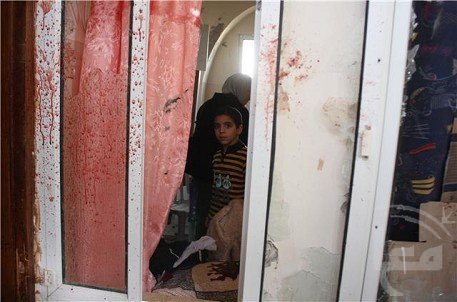
Home of Raed Sarakji, killed Saturday [MaanImages]
Raed Sarakji, 38
Now a widow, Tahani Ja’ara is 32 years old and seven months pregnant. “We were sleeping in our bedroom, not bigger than 6 square meters, when Israeli soldiers began yelling ‘get out…get out’. I thought I was dreaming. When I heard the Israeli soldiers and their police dogs outside the room, that was when I realized it was real.”
Tahani said her husband told soldiers he would get out of the house, so they started shooting through the door and the windows. “He fell between my hands bleeding. I started crying ‘they killed him…they killed him. Then soldiers broke the door and got in. He was already dead, but they continued to riddle his body with bullets to make sure he was killed.”
Three months before his death, Sarakji opened a used tools shop in the old city of Nablus. He had just been released from Israeli prison in January 2009 after spending seven years in jail, he was trying to re-start his life.
According to a statement from the Israeli military, Sarkaji was involved with the manufacturing of explosives and the establishment of an explosives-manufacturing laboratory in Nablus.
Ghassan Abu Sharkh, 39
Ghassan’s 16-year-old brother Diyaa Abu Sharkh saw him shot dead Saturday morning. “Everything happened very quickly… when we opened the door and saw the soldiers, two masked collaborators pointed to my brother Ghassan who was walking down the stairs. Before I knew it he was being shot. I couldn’t really make sense of what was going on at all. Then an Israeli officer asked me whether the dead man was Ghassan, and I said yes. ‘Good, then ask everybody to leave the house,’ the officer said.”
“I was stading close to Ghassan when they killed him. They could have detained him very easily. [But now he has] He passed to join my brother Nayif who was killed by Israeli forces a few years ago [2004].”
Ghassan Abu Sharkh was a car electrician and owned a small workshop. He left behind a wife, three sons, and a daughter.
Anan Subih, 33
Farid Subih is 45, his brother Anan, was killed Saturday morning in the Ras Al-Ain neighborhood of Nablus. “At 3am, dozens of Israeli troops surrounded our four-story building. They blew open the the main gate then started shooting randomly and throwing grenades in all directions. Anan was inside, and he asked everybody to leave the building to avoid being hurt.”
He continued, “We headed to the nearby house of the Al-‘Amoudi family. Then soldiers entered the house with police dogs, and they started throwing more grenades, and a fire erupted in the warehouse full of plastic chairs and sponge material.
“My brother was not armed, but we could see soldiers continue to ransack the house. For three hours, we didn’t know what was going on. After the soldiers left, we found Anan dead…bullets tore all his body and bones. They could have detained him, and he died believing he had been granted amnesty by Israeli forces. He left behind a widow, two sons, and five daughters,” added Farid.
According to the Israeli military, Annan was killed after an exchange of fire and “found in a hiding place along with weapons and ammunition.”
Anan was an activist within Fatah’s Al-Aqsa Brigades, he was completely pardoned in an amnesty deal between Israel and the Palestinian Authority.
The “Omaha Two”: Victimized by COINTELPRO Injustice
By Stephen Lendman | December 24, 2009
After a two week April 1971 trial and four days of deliberation, an 11 white/one black member jury convicted Mondo we Langa (formerly David Rice) and Edward Poindexter for the bombing murder of police officer Larry Minard on August 17, 1970. Both men denied involvement, and ever since consistently maintained their innocence, insisting they were framed. Supporters agree, including Amnesty International that declared them political prisoners, and no wonder.
They were Omaha chapter National Committee to Combat Fascism (NCCF) leaders, an off-shoot of the Black Panther Party, targeted (as later revealed) by secret FBI/police Domino task force/COINTELPRO tactics, following J. Edgar Hoover’s orders to infiltrate, disrupt, sabotage, and destroy their activism for ethnic justice, racial emancipation, and real economic, social, and political equality across gender and color lines.
COINTELPRO is the acronym for the FBI’s secretive/mostly illegal counterintelligence program to neutralize political dissidents, including communists; anti-war, human and civil rights activists; the American Indian Movement; and Black Panther Party among others.
In their book “Agents of Repression,” Ward Churchill and Jim Vander Wall wrote:
“the term came to signify the whole context of clandestine (typically illegal) political repression activities (including) a massive surveillance (program via) wiretaps, surreptitious entries and burglaries, electronic devices, live ‘tails’ and….bogus mail” to induce paranoia and “foster ‘splits’ within or between organizations.”
Other tactics included:
— “black propaganda” through leaflets or other publications “designed to discredit organizations and foster internal tensions;”
— “disinformation or ‘gray propaganda’ ” for the same purpose;
— “bad-jacketing” to “creat(e) suspicion – through the spread of rumors, manufacture of evidence, etc. – that bona fide organizational members, (usually leaders were) FBI/police informants,” to turn some against others violently;
— “assassinations (of) selected political leaders,” including Fred Hampton and Mark Clark on December 4, 1969 by Chicago police while they slept; and
— “harassment arrests (on bogus) charges.”
Individuals and organizations were targeted for their activism, not crimes that were blamed on innocent victims like the “Omaha Two.”
In November 1968, a J. Edgar Hoover memorandum ordered his agents “to exploit all avenues of creating….dissension within the ranks of the BPP (using) imaginative hard-hitting counterintelligence measures aimed at crippling the BPP.” From 1968 – 1971, they were vicious, including against Mondo we Langa and Edward Poindexter, targeted by the Bureau to be neutralized.
Months before they were arrested, FBI agents and Omaha police harassed them with tactics like frequent traffic stops, verbal abuse, and more. We Langa was called before a grand jury, and the Greater Omaha Community Action Agency fired him. Poindexter was victimized by bogus newspaper letters and an anonymous phone campaign. For the two men, it was just the beginning of a long nightmare, ongoing after 40 years.
Background on the “Omaha Two”
We Langa joined the BPP in 1969, then later the NCCF. He wrote for the local underground paper, Buffalo Chip, and in prison created art, wrote plays, short stories, articles, and five poetry books. He also contributed poems and stories to literary journals and magazines, including The Black Scholar, ARGO, Black American Literary Forum, Pacifica Review, Black Books Bulletin, and many others.
He’s one of several co-authors of “The Race: Matters Concerning Pan Afrikan History, Culture, and Genocide” published in 1992, and a contributor to Nebraska Voices, commissioned by the Nebraska Humanities Council in commemoration of the sesquicentennial of Nebraska’s statehood.
Like Poindexter, he’s been incarcerated for nearly 40 years, during which time he’s been non-violent and mentored young inmates as a model prisoner. Yet he’s bogusly called a “cop killer,” repeatedly (with Poindexter) denied parole, and in June 1968, the Nebraska Supreme Court ruled them ineligible unless the Board of Pardons commutes their sentences – unlikely as it’s composed of the governor, attorney general and secretary of state who haven’t commuted a first-degree murder conviction in two decades, and overruled numerous Nebraska Parole Board’s post-1993 unanimous decisions to commute their sentences to time served.
Edward Poindexter is a Vietnam veteran, a graduate of Metro State University, St. Paul, MN with a straight A average, and earned an MA from Goddard Graduate Program in Montpelier, VT. He was imprisoned in Minnesota to separate him from we Langa.
He’s held leadership positions in the Art Club, Jaycees as president, and Harambee African Cultural Organization. He also:
— received the Insight Program’s Antoniak Award for outstanding achievement;
— created the musical drama, Shakedown Blues;
— published two Youth Survival Guides booklets for troubled youths;
— recorded Jammer from the Slammer promoting constructive problem-solving and self-motivation;
— participated in Minnesota’s Turn Off the Violence Campaign;
— was involved in the Juvenile Detention Bed Hotline Information Message Program producing works to support non-violence;
— teaches and is currently writing a workbook for a Minnesota Correctional System class on building self-esteem;
— teaches a health class including AIDS education;
— is involved in teaching other classes on the history of intolerance in America, the civil rights movement, black history, and music;
— developed a program for prisoners to encourage attitudinal and behavioral changes for men who batter women;
— produced motivational tapes; and
— proposed an audio recording studio, currently operating.
He’s also been a model prisoner, yet he’s denied parole.
Background on the Case
At trial, jurors were told that, using dynamite, blasting caps, and a battery, Poindexter made a suitcase bomb in we Langa’s kitchen. A week later, he allegedly instructed 15-year old Duane Peak to put it in a vacant house, call the police, and say a woman was dragged into it screaming. Peak was charged with the crime, confessed, and claimed we Langa and Poindexter put him up to it, but changed his story numerous times, only once incriminated the “Omaha Two,” was sentenced as a juvenile, and served about five years.
Initially, he didn’t implicate them. In fact, he was in custody three days before mentioning their names, clearly under pressure, threats, and believed beatings in return for leniency.
The defense never heard his taped 911 call. It wasn’t introduced at trial, and the original tape was destroyed. Years later, a copy surfaced with an accompanying FBI memo suggesting it was withheld because the voice wasn’t Peak’s, so perhaps authorities were shielding whoever made it, someone complicit in the crime to incriminate we Langa and Poindexter.
A week after the bombing, police targeted the black community, conducted warrantless searches, arrested NCCF members, had no evidence to hold them, so invented it by apparently planting dynamite, other explosives, blasting caps, and weapons in we Langa’s basement, then discovered them when he was in Kansas City for a speech, prepared a shoddy report, gave perjured trial testimony contradicting it, yet got the two men convicted for a crime they didn’t commit.
Years later, one juror admitted believing they were innocent because only circumstantial evidence was introduced, and Duane Peak’s testimony wasn’t credible. Another juror said the only black one thought they were innocent, yet relented after the others agreed to no death penalty.
Judicial Hypocrisy
The entire process was controversial and tainted, including circumstantial evidence that never should have been allowed pertaining to the defendants’ political beliefs, ones held by millions in the country, then and now.
In addition, their fingerprints weren’t on the alleged dynamite, skin tests performed to detect traces were negative, and according to former Omaha police officer, Marvin McClarty, an improper search procedure found it. Then shortly after the mens’ conviction, we Langa’s house mysteriously burned down, eliminating any chance for a post hoc accuracy check of police testimony.
In addition, in 1974, a federal court ruled the search illegal, cited inconsistencies in a police lieutenant’s testimony authorizing it, admitted the dynamite might have been planted, and ordered a new trial, upheld by the Eighth Circuit Court of Appeals in 1975.
However, in 1976, the Supreme Court applied a post hoc jurisdictional technicality to deny it by ruling that when states provide full and fair Fourth Amendment litigation opportunities (a dubious conclusion in this case), the Constitution warrants no habeas relief. Later rulings blocked the appellate process, and the statutory time limit for filing in Nebraska courts expired while the men awaited the federal outcome.
A major obstacle is that the Court of Appeals won’t address whether the men were fairly tried, whether tainted evidence was introduced, whether key witnesses committed perjury, only if under legal system standards the process was fair, true or not.
Most important, the likelihood that political targets can get due process and judicial fairness is nil when authorities want to convict and have complicit judges allowing it. The courts today are corrupted with them, hanging ones of the worst kind, so what chance have two black men under a system structured against them and always has been.
On June 19, 2009, the Nebraska Supreme Court showed it by denying Poindexter a new trial despite overwhelming evidence of his innocence as well as we Langa’s – with added closing statement emphasis saying:
“We affirm the judgment of the district court denying Poindexter’s motion for postconviction relief,” meaning that to be Black in America grants you none.
In the 1980s, Nebraska Chief Supreme Court Justice Norman Krivosha commissioned a study of the state’s judicial fairness that concluded it was equitable with one exception – race. People of color were more likely to be arrested, indicted, convicted, and given longer sentences than whites, including the death penalty for capital offenses. It’s no surprise that Nebraska’s 3% black population comprises over 40% of its inmates, and the same disparity holds nationally.
Blacks make up around 12.4% of the population, but almost half of those incarcerated. Around 50% of them are for non-violent offenses, and about half of those are drug related. In 2000, Human Rights Watch reported that in one-third of the states, 75% of all drug related offenders were black. In Illinois, it was 89%. Shockingly, with less than 5% of the world’s population, America has almost one-fouth of its prisoners, by far the largest total at around 2.4 million, growing at about 1,000 per week, mostly affecting blacks and hispanics.
It’s no wonder that we Langa and Poindexter couldn’t reopen their case despite later FBI documents (released in 1978) showing police and the Bureau collaborated to suppress exculpatory evidence to convict two innocent men. Jack Swanson, the chief detective in charge of the investigation, told the BBC why:
“I think we did the right thing at the time because the Black Panther Party….completely disappeared from Omaha after we got the two main players.” In other words, neutralize the leadership and the organization dies.
Yet former Nebraska Governor Frank Morrison (1961 – 1967, who with Thomas Kenney represented Poindexter as a public defender) believed the men:
— “were convicted for their rhetoric, not for any crime they committed….The only thing these fellas did was try to combat all the racial discrimination of the time the wrong way….They weren’t convicted of murder.”
It was for their activism and prominence to stifle dissent, keep them imprisoned to assure it, and continue a long tradition of defiling due process and judicial fairness for people of color, the poor, and disadvantaged in a democracy for the privileged alone, as virulent under Obama as earlier.
Stephen Lendman is a Research Associate of the Centre for Research on Globalization. He lives in Chicago and can be reached at lendmanstephen@sbcglobal.net.
Also visit his blog site at sjlendman.blogspot.com
Bil’in leader charged with arms possession
By Adam Horowitz · December 23, 2009
Abdallah Abu Rahmah, a leader of the weekly nonviolent protests in Bil’n, has finally been charged after being arrested nearly two weeks ago by the Israeli military. Abu Rahmah’s arrest has been part on an ongoing Israeli campaign against Palestinian nonviolent resistence leaders. The charges against him could not be more creative. From a Popular Struggle Coordination Committee press release:
Abdallah Abu Rahmah, a school teacher and coordinator of the Bil’in Popular Committee Against the Wall, was indicted in an Israeli military court yesterday. Abu Rahmah was slapped with an arms possession charge for collecting used tear gas canisters shot at demonstrators in Bil’in by the army and showcasing them in his home.
An indictment was filed in a West Bank military court yesterday for incitement, stone throwing and arms possession charges against Bil’in Popular Committee coordinator, Abdallah Abu Rahmah. On receiving the indictment Adv. Gaby Lasky, Abu Rahmah’s lawyer said that “the army shoots at unarmed demonstrators, and when they try to show the world the violence used against them by collecting presenting the remnants – they are persecuted and prosecuted. What’s next? Charging protesters money for the bullets shot at them?”
Here is a photo of the “arms” in question:

Spent tear gas grenades and projectiles used on the village of Bil’in for which Abu Rahmah was indicted. Photo: Oren Ziv ActiveStills

Israel razes gas station, grocery near Nablus
23/12/2009 15:57
Nablus – Ma’an – An Israeli military bulldozer demolished a gas station, a grocery store, and a cargo container in the northern West Bank village of Qusra south of the city of Nablus on Wednesday.
Palestinian sources told Ma’an that more than 20 Israeli military jeeps escorted a bulldozer into the village, which proceeded to demolish the structures one kilometer away from Israeli settlement Magdolin.
The owner of the demolished buildings, 30-year-old Mu’tasim Uda, said he received the latest demolition order from Israeli authorities a year ago. He estimated his loss to be about 120,000 Israeli shekels (31,000 US dollars). He explained that he recently stopped operating the gas station, but all the facility’s equipment was still there when the demolition crew arrived.
Uda said Israeli forces used to warn him that stones were pelted at Israeli vehicles by Palestinian youths who used to hide in the gas station area.
Ghassan Daghlas, a Palestinian official charged with monitoring settlement activities in the northern West Bank, condemned the demolition and appealed to the international community to intervene and stop Israeli policies aimed at displacing the Palestinians from their own lands.
Houthis repel Saudi incursion into northern Yemen
Press TV – December 23, 2009 01:34:28 GMT
|
|

Houthi fighters have managed to repulse Saudi Arabian forces trying to infiltrate into the province of Sa’ada in northern Yemen, killing an unspecified number of Saudi soldiers in a battle in the border region.
In a statement issued on Tuesday, Yemen’s Shia Houthis said they pushed back Saudi troops from Al-Muannaq village in northern Yemen on the border with Saudi Arabia and also destroyed eight Saudi tanks.
The Houthi fighters say Saudi forces had fired 256 missiles and carried out air strikes against the Sa’ada region.
The statement also said that Saudi Apache helicopter gunships launched two air strikes on the city of Dahyan on Tuesday as Riyadh continues its air raids against the mountainous regions of northern Yemen. It added that Saudi ground forces used heavy machine guns during the operation.
The Saudi army also shelled Al-Malaheet and the villages adjacent to it, which caused many civilian deaths.
Seventy-three Saudis have been killed and 26 have gone missing since fighting broke out between Saudi forces and the Houthi fighters on November 3.
The number of wounded Saudi troops has reached 470, with 60 still hospitalized.
The conflict between the central government in Sana’a and the Houthis of northern Yemen began in 2004. The conflict intensified in August 2009 when the Yemeni army launched Operation Scorched Earth in an attempt to crush the Houthi movement.
The Houthis say their civil rights have been violated and they are suffering political, economic, and religious marginalization due to the policy of the Yemeni government, which they have also accused of widespread corruption.
The Saudi air force has further complicated the conflict by launching its own operations against Shia resistance fighters.
Houthi fighters say that Riyadh pounds their positions, and Saudi forces strike Yemeni villages and indiscriminately target civilians. According to the fighters, the Saudis are using prohibited weapons, including white phosphorous bombs, against civilians in northern Yemen.
The US military is also continuing its air raids on Yemen’s regions of Amran, Hajjah, and Sa’ada, which have suffered much due to the joint Saudi-Yemeni government offensive against the Houthi fighters.
The UN High Commissioner for Refugees estimates that since 2004, up to 175,000 people have been forced to leave their homes in Sa’ada and take refuge in overcrowded camps set up by the United Nations.
Featured Video
Dan Dicks with James Corbett on Solutions Watch
or go to
Aletho News Archives – Video-Images
From the Archives
Secret document reveals plans for civil war in Lebanon, Israeli false flags, and invasion
By Randi Nord | Geopolitics Alert | April 5, 2019
Beirut – During his visit with US Secretary of State, Mike Pompeo, Lebanese President Michael Aoun reportedly received a US-Israeli document detailing plans for creating a civil war in Lebanon with covert false flag operations and possible Israeli invasion.
Although the source of the document is Israeli and created in partnership with Washington, no one knows who presented it to Aoun. The Lebanese TV station, Al-Jadeed, initially reported the document on Lebanese TV and a video on its website. Geopolitics Alert translated the report for this article. … continue
Blog Roll
 Aletho News
- Sheikh al-Asadi warns of Iraqi government compliance with US demands
- How to MAKE THE CONSPIRATORS PAY for their crimes! Dan Dicks with James Corbett on Solutions Watch
- There’s a drought in academia: A drought in honest research on the subject of drought and other weather extremes
- Department of War Awards $20.7 Billion Contract to Raytheon for Air-to-Air Missiles
- ‘Distance yourselves from Israel’: IRGC urges US population to question govt policies
- America’s Greenland deal has a radioactive backstory
- The RAF Fairford ‘terror plot’: Unpacking escalation in the UK echo-chamber
- EU Council Advances Chat Control 2.0 Scanning Proposal
- Ex-Greek MEP files complaint against Israeli spyware firm over alleged Pegasus surveillance
- Troubling ideas throughout the Torah, Talmud, Mishneh Torah and Tanya
- If Americans Knew
- New Report: “Scholasticide and Genocide in Gaza: Assessment, Testimonies and Legal Analysis”
- Ex-Biden officials are desperate for a Gaza scapegoat
- Israeli “settlers” Invade Al-Aqsa; Pour Boiling Water on 75-Year-Old
- Israel Has Kidnapped Another American Teenager
- US arms sales to Israel worth $21.6 billion in 20 months
- Three Palestinians Killed in Israeli Attacks on Gaza
- Revealed: German “Anti-Semitism Expert” Driving Crackdown on Palestine Solidarity is Former Israeli Spy
- Egypt’s Warning to Israel Before Oct 7
- Israel’s siege signals another cruel winter for 1.8 million Gazans – Daily Update
- Netanyahu Asked UAE Leader to Deny Report on Oct. 7 Warning in Secret Visit, Sources Say
- No Tricks Zone
- An error has occurred; the feed is probably down. Try again later.


