Israeli forces ‘deliberately let him bleed to death’
Ma’an
Part nine of a series recounting the findings of South African jurist Richard Goldstone’s UN Fact Finding Mission on the Gaza Conflict.
On 4 January 2009, one year ago today, Iyad Samouni, his wife, and five children were together with about 40 other members of their extended family in the house of Asaad Samouni, a relative.
At around 1am, they heard noise on the roof. At about 5am, Israeli soldiers walked down the stairs from the roof, knocked on the door, and entered the house. They asked for Hamas fighters. The residents replied that there were none.
Stationing themselves in the house, soldiers separated women, children and the elderly from the men. Iyad and all the other men were forced into a separate room, blindfolded and bound with plastic handcuffs. They were allowed to use the bathroom only after one of the men urinated on himself.
The next morning, Iyad and everyone in Asaad’s house walked out and down Al-Samouni Street to take Salah Ad-Din Street in the direction of Gaza City. They had been instructed by the soldiers to walk directly there without stopping or diverting from the direct route. The men were still handcuffed and the soldiers had told them that they would be shot if they attempted to remove the handcuffs.
On Salah Ad-Din Street, a single or several of the Israeli soldiers opened fire positioned on the roofs of houses. Iyad was struck in the leg and fell to the ground. Muhammad Asaad Samouni, who was walking immediately behind him, moved to help him, but an Israeli soldier on a rooftop ordered him to walk on. When he saw the red point of a laser beam on his body and understood that an Israeli soldier had taken aim at him, he desisted.
The Israeli soldiers also fired warning shots at Muhammad Samouni’s father to prevent him from assisting Iyad to get back on his feet. Iyad’s wife and children were prevented from helping him by further warning shots.
Fawzi Arafat, who was part of another group walking from the Al-Samouni neighborhood to Gaza City, said he saw Iyad lying on the ground, his hands shackled with white plastic handcuffs, blood pouring from the wounds in his legs, begging for help. Arafat stated that he yelled at an Israeli soldier “we want to evacuate the wounded man.” The soldier, however, pointed his gun at Iyad’s wife and children and ordered them to move on without him.
The final report produced by South African jurist Richard Goldstone’s UN Fact Finding Mission on the Gaza Conflict notes that witnesses who spoke about Iyad “appeared to be profoundly traumatized by the recollection of his pleading for help from his wife, children and relatives…
Iyad’s family and relatives were forced to abandon him and continue to walk toward Gaza City. At Ash-Shifa hospital they reported his case and those of the other dead and wounded left behind. Representatives of the Palestine Red Crescent Society (PRCS) told them that the Israeli armed forces were not permitting them to access the area.
Salah Samouni, who was part of a group up ahead of Iyad’s, said that “they were handcuffed, and one of them was hit with a bullet in the foot and he profused [sic] blood for three days until he met with his end.”
A PRCS staff member told the UN mission that three days later, on 8 January 2009, medics were granted permission by Israeli armed forces through the International Committee of the Red Cross to evacuate Iyad. The PRCS staff member found him on the ground on Salah Ad-Din Street in the place described by his relatives. He was still handcuffed. He had been shot in both legs and had bled to death.
Iyad’s family and relatives were forced to abandon him and continue to walk toward Gaza City. At Ash-Shifa hospital they reported his case and those of the other dead and wounded left behind. Representatives of the Palestine Red Crescent Society (PRCS) told them that the Israeli armed forces were not permitting them to access the area.
Salah Samouni, who was part of a group up ahead of Iyad’s, said that “they were handcuffed, and one of them was hit with a bullet in the foot and he profused [sic] blood for three days until he met with his end.”
A PRCS staff member told the UN mission that three days later, on 8 January 2009, medics were granted permission by Israeli armed forces through the International Committee of the Red Cross to evacuate Iyad. The PRCS staff member found him on the ground on Salah Ad-Din Street in the place described by his relatives. He was still handcuffed. He had been shot in both legs and had bled to death.
Sameer As-Sawafeary, another witness, recounted: “On Tuesday, the Red Cross came … So we took the martyr and another martyr named Iyad Ezat Samouni, who was [a] neighbor, who was lying on the ground. I told the Red Crescent – or the Red Cross – that the body was Al-Samuni’s body. So they transported him on a stretcher.”
Factual and legal findings
Goldstone’s final report states: “Iyad al-Samouni was part of a large group of civilians who were leaving their homes and walking towards Gaza City in an area under the complete control of the Israeli armed forces. His hands were tied with white plastic handcuffs.
“The soldier who opened fire on him should have known, on the basis of the plastic handcuffs if not of coordination with his fellow soldiers stationed in Asaad al-Samouni’s house a few hundred metres away, that he had been searched and detained by the Israeli armed forces. In opening fire on Iyad al-Samouni, the Israeli armed forces shot deliberately at a civilian who posed no threat to them.”
The report adds: “While the fire directed at Iyad al-Samouni could have been intended to incapacitate rather than to kill, by threatening his family members and friends with lethal fire, the Israeli armed forces ensured that he did not receive lifesaving medical help. They deliberately let him bleed to death.”
According to the report, the fundamental principles applicable to these incidents, which are cornerstones of both treaty-based and customary international humanitarian law, are that “the parties to the conflict shall at all times distinguish between the civilian population and combatants” and that “the civilian population as such, as well as individual civilians, shall not be the object of attack.”
Israel refers to the principle of distinction as “the first core principle of the Law of Armed Conflict.” It further states that “the IDF’s emphasis on compliance with the Law of Armed Conflict was also directly incorporated into the rules of engagement for the Gaza Operation.” The principle of distinction was reportedly incorporated in the following terms: “Strikes shall be directed against military objectives and combatants only. It is absolutely prohibited to intentionally strike civilians or civilian objects (in contrast to incidental proportional harm).”
In reviewing the above incident the Goldstone mission found in that the Israeli armed forces had carried out a direct, intentional strike against a civilian. The mission found that, on the basis of the facts it was able to ascertain, there were no grounds which could have reasonably induced the Israeli armed forces to assume that the Iyad was in fact taking a direct part in the hostilities and had thus lost his immunity against direct attacks.
Goldstone’s team found that Israel’s army violated the prohibition under customary international law that the civilian population as such will not be the object of attacks, as well as fundamental guarantees in the Fourth Geneva Convention. “The State of Israel would be responsible under international law for these internationally wrongful actions carried out by its agents,” the report states.
It adds: “From the facts ascertained, the Mission finds that the conduct of the Israeli armed forces in these cases would constitute grave breaches of the Fourth Geneva Convention in respect of wilful killings and wilfully causing great suffering to protected persons and as such give rise to individual criminal responsibility.”
Israeli forces denied medical emergency services access to the wounded, the report notes. “In the case of Iyad al-Samouni, finally, the relatives who wanted to assist him were threatened with being shot themselves.”
Goldstone’s report also recalls that “In all circumstances [the wounded] shall be treated humanely and shall receive, to the fullest extent practicable and with the least possible delay, the medical care and attention required by their condition. …”
“The facts ascertained by the Mission establish that in the incidents investigated the Israeli armed forces did not use their best efforts to provide humanitarian organizations access to the wounded. On the contrary, the facts indicate that, while the circumstances permitted giving access, the Israeli armed forces arbitrarily withheld it.
“On this basis, the Mission finds a violation of the obligation under customary international law to treat the wounded humanely.”
The section on Iyad’s family concludes: “The conduct of the Israeli armed forces amounted to violations of the right to life where it resulted in death, and to a violation of the right to physical integrity, and to cruel and inhuman treatment in other cases.”
Saber, patience
In Gaza | January 3, 2010
“I haven’t been on my land since we harvested the wheat last August. It’s too dangerous. There was an Israeli operation here yesterday…6 tanks and 4 bulldozers. I could see them from my rooftop in the village, but didn’t know if they’d destroyed my land.”
Abdul Nasser Abu Taima has 15 dunams of agricultural land roughly 400 m from the Green Line border dividing Gaza and Israel. Until a few years ago, he had a home on and lived off the land. Israeli bulldozers destroyed his house and razed his land.
“That was our home,” he says, picking up a piece of piping with a chunk of foundation still attached, chucking it onto the pile.
“I get so upset when I come to my land and see how beautiful it is, remember how well we lived off of it…and realize that now my children and I can’t live here.”
Although Abu Taima’s land is technically outside of the Israeli-imposed “buffer zone” – an area of 300m running along the Green Line border from south to north –he and the other farmers in the region are still subject to danger by their mere presence near the “buffer zone”. Israeli authorities reserve the right to shoot at anyone within 300 metres of the fence, but in practice shoot far beyond 300 m, up to as much as nearly 2 km.
“Whenever we work on our land, we know the Israelis can shoot at us. They say it’s for security, because there is danger. But where’s the danger? What’s the problem? They know who we are, they can see us.”
His regret is amplified by the bitter observation that on the other side of the Green Line, Israeli tractors work the land, crops grow, and water exists in comparative abundance. Lines of un-razed trees provide a stark contrast to the now olive, nut and fruit tree-devoid land on the Palestinian side.
“We will still plant on our land. But we’ve got to wait for the heavy rains. All the water sources –the wells, the cisterns—were destroyed by Israeli bulldozers or shelling. Now we can only wait for rain.”
This year the rain is late in coming. Aside from a scant few days of showers, it has been dry, and the land remains parched and un-worked.
“We usually plant in November, or at least December. January is the latest we can plant our wheat. After that, there’s no point.”
The only thing growing now are the hardy cactus plants –saber, in Arabic. Abu Taima cuts a number of the prickly, bright pink-orange fruits and puts them in a bag. He stoops down and rips our handfuls of tall grass.

We walk, and he turns repeatedly to survey his land. “Mish hada haram? Mish haram?” he asks? Isn’t it shameful, outrageous, that he can’t work his land, that the land lies unused in a Strip that is in want of cheap, fresh wheat, for a family that is in want of a source of income and nutrition?
He stops, dumps the cactus fruits on the ground and, rolling them with the tall grass, begins cleaning them of their prickly needles.
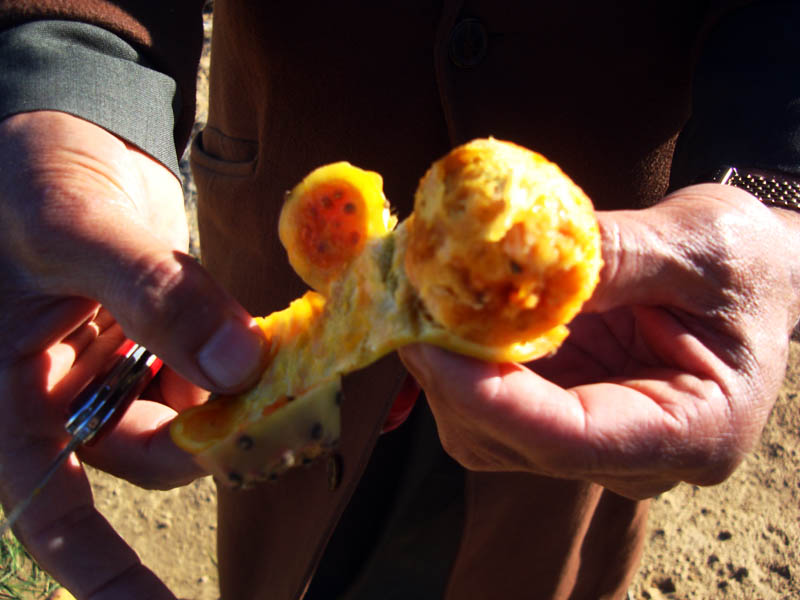
The fruit is refreshing, mildly sweet.
“We used to give tea to the Israeli soldiers. Sure, there were always problems with the occupation… but still, we could live here on the land, farm here, without this kind of danger.”
Walking up the dirt lane, we pass a farmer tending his pea and bean crops. “He’s connected to a line from Khan Younis. That’s why he can farm his land,” Abu Taima explains.
The farmer sees us and greets us with a smile. “Wait a few minutes, I’ll bring you some peas.”
As he harvests, Abu Taima explains, “even here, this is maybe 600 metres from the fence. But even here they are shot at… from Israeli jeeps, from the guard towers, from the remote-controlled towers.”
The farmer returns laden with peas and beans, crisp, sweet, fresh.
“My children help me on the land. You know, the Israelis even shoot when they are with me. The Israelis see the children, but they still shoot.”
He also remembers a better relationship with the occupying soldiers.
“They’d come to my land and I’d give them watermelons, vegetables. Now there’s no interaction. They just shoot at us from far away.”
The nearest remote-controlled tower is open. The machine gun within is capped by a dome which ironically opens to a lotus-shape when the gun is ready to fire.
“I’ve got 18 people in my family. This actually isn’t our land. Our own land is right next to the fence, so we can’t go there any more. Now I rent land, pay $2500 a year to use it. During the Israeli war last year the Israelis destroyed my piping, my hothouses, so I had to replace that too.”
We leave, amble along on Abu Taima’s tractor past destroyed homes, cisterns, and largely-vacant land.
Abu Taima has saber: patience. He will return when the rains come.
US general urges strip search of Muslim men
Press TV – January 3, 2010 – 17:51:55 GMT
A retired US general and member of Iran Policy Committee (IPC) says all 18 to 28 years old Muslim men should be strip searched at airports as “one of these bombers” will explode an airliner in the coming days.
Thomas McInerney, a retired Lt. Genera with the US Air Force, told Fox News television on Saturday that within the next 30 to 120 days, “there is a danger of high probability” awaiting US airliners.
“If you are an 18 to 28-year-old Muslim man then you should be strip searched. And if we don’t do that there’s a very high probability we’re going to lose an airline,” he said.
The retired general went on to say that US officials should profile all Muslims. “We have to use profiling. And I mean be very serious and harsh about the profiling.”
Asked if such a racial approach would not “generate more hatred and violence towards the West,” McInerney said he did not want “a racial profile.”
“I want to profile on that group that we have enough evidence from 9/11, and other [high-profile] cases that we know what we are looking at,” he said.
The suggestions made by the US retied general comes on the heels of a purported bomb attack on a US transatlantic airliner on Christmas Day by Umar Farouk Abdulmutallab, a Nigerian who allegedly received al-Qaeda training in Yemen.
Lawmakers and congressional leaders in the US have echoed similar sentiments by urging President Obama abandon or suspend his plan to shutter the Guantanamo Bay Prison.
Around half of the remaining Gitmo detainees are from Yemen, and of those, about 40 have been cleared for release.
UK to follow US intervention in Yemen
Press TV – January 3, 2010
The British premier’s office says that Prime Minister Gordon Brown and US President Barack Obama have agreed to fight what they call terrorism in Yemen and Somalia.
The UK and the US have agreed to fund a counter-terrorism police unit in Yemen to tackle what they deem the rising threat from the country.
The US has been involved in war in Yemen by sending its special forces to train the Yemeni military and conducting air raids in both northern and southern parts of the Middle Eastern country.
Obama order
On December 18, ABC News quoted anonymous administration officials as saying that US Nobel Peace Prize laureate President Barack Obama ordered the US military to launch air strikes on Yemen.
Upon Obama’s orders, the military warplanes on December 17 blanketed two camps north of the Yemeni capital, Sana’a, claiming that “an imminent attack against a US asset was being planned.” The attacks killed scores of civilians, according to Yemeni opposition groups.
Fighting in the north
US military intervention in Yemen comes at a time that the country’s army with full support from Saudi Arabia has been fighting with Shia Houthi fighters in northern parts of the country.
Houthi fighters say both Saudi and US fighter jets have been involved in bombing Shia villages, inflicting heavy civilian casualties. Earlier, the fighters had expressed full readiness for dialogue with the Yemeni government.
The Houthis say they will turn to talks if the Yemeni and Saudi military halt their attacks against them.
The conflict in northern Yemen began in 2004 between Sana’a and Houthi fighters. Relative peace had returned to the region for a period before August 11, when the Yemeni army launched a major offensive, dubbed Operation Scorched Earth, against Sa’ada Province.
The government claims that the fighters, who are named after their leader Abdul Malik al-Houthi, seek to restore the Shia imamate system, which was overthrown in a 1962 military coup.
The Houthis, however, say they are defending their people’s civil rights, which the government has undermined under pressure from Saudi-backed Wahhabi extremists. Shias, who form the clear majority in the north, make up approximately half of Yemen’s overall population.
The United Nations, which according to its charter is set up “to take effective collective measures for the prevention and removal of threats to peace, and for the suppression of acts of aggression or other breaches of the peace,” has failed to adopt any concrete measures to help end the bloody war.
US war on terror
The latest alleged front against al-Qaeda in Yemen is opened more than eight years after the US-led invasion of Afghanistan which was said to be aimed at eradicating militancy and the arrest of main militant leaders including Osama Bin Laden.
According to UN figures, Afghan civilians have been the main victims of the controversial war.
Boy watches U.S. forces shoot father in head
By Dave Markland | January 1, 2010
Recent reports indicate that a new stage may have been reached in the war in Afghanistan. Secret operations of CIA and special forces appear to have stepped up their infamous night raids, which have induced fear in much of the local population.
We saw in a blog post a few weeks ago that up to 15 civilians in Laghman were killed in a ground forces operation apparently carried out under NATO command. NATO itself, after initial denials, appeared to acknowledge civilian casualties, but was characteristically vague about it.
Now, according to the article below, it seems that the attack-cum-massacre was carried out at night and, according to locals, perpetrated by US special forces on the ground. (The Washington Post, however, mistakenly reported as late as Dec 30 that the attack was an airstrike.)
US forces ‘like to kill us’
Sayed Karim – The National
December 28. 2009… According to witnesses, US troops entered a number of houses near the provincial capital, Mehtar Lam, in an overnight operation [on Dec 7/8]. The victims included Mohammed Ismail, whose 10-year-old son, Rafiullah, described what happened: “When the soldiers came to our house, my father asked them, ‘Who are you?’ Then they shot him in the head and told us, ‘Be quiet and tell us where the weapons are’.”
Said Ahmad Safi, a spokesman for Laghman’s governor, said insurgents had previously staged attacks against officials and foreign troops in the area. He acknowledged that 12 people – including a woman – had apparently died in the raid, which locals reported was carried out by US Special Forces…
Discontent with the government and the occupation has inevitably fuelled support for the Taliban among the local population. Despite still being relatively secure compared with much of eastern Afghanistan, there has been growing rebel activity here in recent months as the insurgents edge closer and closer to neighbouring Kabul…
Gulzar Sankerwal, chairman of the provincial council, said: “The Taliban do not fight face to face. This is guerrilla fighting so if more troops arrive, they will not solve the problem. When the commander in Kabul asked Obama for the extra troops, he knew the USA would end up with one achievement, and that is more civilian casualties.” … (link)
Note that in spite of (and because of) the two Obama-ordered troop surges, the insurgency continues to spread, moving closer to Kabul.
So it turns out that the deaths occurred in a nighttime raid, one of what appears to be an increasing number of such operations. The Dec 7/8 disaster was recently repeated in Kunar on Dec 27 and again in Baghlan on Dec 28/29 – an incident which has gone largely unnoticed in the media, though it has now been overshadowed by the Dec 30 incident in Helmand – a daytime missile strike by NATO forces. AFP has more on the Dec 27 Kunar incident:
Nato’s International Security Assistance Force (ISAF) had no information on any operations or casualties in Kunar.
A senior Western military official told AFP that US special forces have been conducting operations against militants in the border regions of Kunar.
“They have been killing a lot of Taliban and capturing a lot of Taliban,” he said.
The operations were conducted independently of ISAF, which number more than 110,000 fighting to eradicate the Taliban, he said… (link)
And yet that may not be the end of the intriguing details. While locals in Kunar say the 8 teenagers were killed in a US special forces raid, AFP reports that they may have been CIA operatives:
NATO forces have disputed the results of the Afghan probe, saying the foreigners involved were non-military Americans on a sanctioned operation who fired in self-defence after being shot at by villagers. (link)
US special forces like the Green Berets or Navy Seals are military personnel while CIA officers are not. Of course, neither are mercenaries such as Blackwater. It seems possible that “non-military Americans” could refer to either CIA or mercs.
In all likelihood, the recent spate of nighttime raids were undertaken by a mix of CIA, special forces and perhaps mercenaries. CIA agents are known to work alongside special forces in Afghanistan and recent reports about Blackwater revealed their involvement in CIA operations there.
Finally, the recent attack in Baghlan, courtesy of the Afghan press since few if any western media reported the incident:
‘Four civilians killed in Baghlan air raid’
Habib Rahman Sherzai – Dec 29, 2009PUL-I-KHUMRI (Pajhwok) – Four civilians have reportedly been killed and eight others wounded in a fresh air strike by foreign forces in northern Baghlan province, residents alleged on Tuesday.
The overnight attack took place in Kohna Qala area of Baghlan-i-Markazi district, residents told Pajhwok Afghan News…
In the last night air raid, the dead included a father and his three sons, who were killed while running to escape the bombardment, a teacher at the Jamiat Aburjaee High School in the area, Karim Safi, told Pajhwok Afghan News. A student of the school, Karim Javed, said that the air raid also left many people wounded including a student of his school.
Head of the district hospital, Abdul Qahir Qanit, said they had received eight injured people delivered to the hospital with a woman and a child in a critical condition… (link)
44 US drone hits in Pakistan killed 700 civilians in 2009
The Peninsula | January 2, 2010
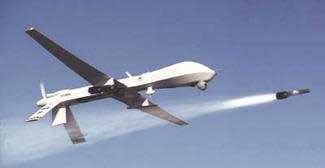 PESHAWAR: Of the 44 Predator strikes carried out by the American drones in the tribal areas of Pakistan in 12 months of 2009, only five were able to hit their actual targets, killing five key Al Qaeda and Taliban leaders, but at the cost of around 700 innocent civilian lives.
According to the figures compiled by the Pakistani authorities, the Afghanistan-based US drones killed 708 people in 44 predator attacks targeting the Pakistani tribal areas between January 1 and December 31, 2009. For each Al Qaeda and Taliban terrorist killed by the American drones, 140 civilian Pakistanis also had to die. Over 90 percent of those killed in the deadly missile strikes were innocent civilians.
The success percentage for the drone hits during 2009 is hardly 11 percent. On average, 58 civilians were killed in these attacks every month, 12 persons every week and almost two people every day. Most of the hits were conducted on the basis of human intelligence, reportedly provided by the Pakistani and Afghan tribesmen, who are spying for the US-led allied forces in Afghanistan.
Of the five successful predator attacks carried out in 2009, the first one came on January 1, which reportedly killed two senior al-Qaeda leaders – Usama al-Kin and Sheikh Ahmed Salim, both wanted by the American Federal Bureau of Investigation (FBI). Kin was the chief operational commander of Al Qaeda in Pakistan and had replaced Abu Faraj Al Libi after his arrest in 2004.
The second successful drone attack was conducted on August 5 in South Waziristan that killed the most wanted fugitive chief of the Tehrik-e-Taliban Pakistan Baitullah Mehsud along with his wife. The US State Department had announces a $5m head money for information leading to Baitullah , making him the only Pakistani fugitive with the head money separately announced by Islamabad and Washington.
Israeli forces attack Gaza Strip
Press TV – January 1, 2010 23:36:23 GMT
 |
Israeli warplanes and tanks have carried out attacks across the Gaza Strip, damaging residential areas and leaving four Palestinians wounded.
The airstrikes which targeted residential areas in northern and central Gaza Strip, caused panic among children in the region, a Press TV correspondent reported on Friday.
Witnesses said Israeli F16 fighters fired two missiles and Israeli tanks fired two shells that landed at empty areas east and northeast of Gaza City, DPA reported.
Local ambulances took the wounded from eastern Gaza to hospital for medical treatment, according to medical sources.
An Israeli army spokesman confirmed the attacks, but gave no further details, AFP reported.
Following the airstrikes, Israeli warplanes were still hovering about the strip, a Press TV correspondent reported.
The attacks were reminiscent of Israel’s three-week-long onslaught on the Gaza Strip, which was launched in late December 2008 and continued into the New Year.
More than 1,400 Palestinians were killed during the 2008-2009 Israeli land, sea and air offensive in the Gaza Strip which also devastated a large part of the infrastructure, inflicting about USD 2 billion in damage on the Gazan economy.
Israel: Slain Palestinians were supposed to be arrested
 |
Israelis on an army operation in the West Bank city of Nablus |
Israeli officials have acknowledged that they had ordered soldiers to arrest the three Palestinians who were shot dead in Nablus last week.
The order for the Duvdevan commando unit clearly stated that the aim of the attack was to capture Adnan Subuh, Raad Sarkaji and Ghassan Abu Sheikh, Israeli sources said.
The Israeli forces received the written order several hours before raiding the occupied West Bank homes of the Palestinian trio.
According to eyewitnesses, the three Palestinian victims were executed on the spot.
Meanwhile, the witnesses also believe that Israeli claims that the victims were involved in the killing of the Rabbi are baseless fabrications.
The victims were members of the Fatah Movement, led by acting Palestinian Authority Chief Mahmoud Abbas.
Houthi Leader: Yemeni civilians targeted by design
31/12/2009 – Abd Al Malek Badreldin Al Houthi launched an urgent appeal today by audio message to listeners everywhere:
He questions the deafening silence of the world to the savage crimes against humanity now being committed in Yemen by Saudi, Yemeni, and USA warplanes targeting innocent civilians, and killing women and children, as they bombard population centers far away from the battle fields: towns, market places, mosques…
He also warns of the grave humanitarian crisis created by the bombing, and by the siege of North Yemen. No humanitarian assistance whatsoever has been provided by any party to the thousands of refugees and the wider population which is now starving for basic necessities.
This targeting of civilians is by design. Why the silence?
After all military efforts on the ground have failed to break the resolve of the Houthi fighters, bombing civilians has now become an instrument of war, to force the Houthi fighters to capitulate. All these crimes are being systematically documented.
These crimes only increase the resolve of the Houthis to defend themselves, and increase the numbers of fighters joining the battle.
Witnesses: Soldiers assault four workers
30/12/2009 12:48
 [Maan Images – Archive]
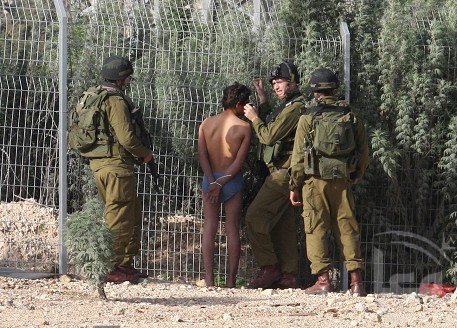
Bethlehem – Ma’an – Israeli soldiers assaulted four Palestinian workers on Tuesday night in the West Bank village of Al-Walajah, near Bethlehem, witnesses told Ma’an.
Residents of the village described how the soldiers broke the legs of three men, and arrested a fourth, taking him to an unknown detention center. Three of the men were dragged to a field in Al-Walajah, the witnesses added.
The reason for the reported assault was unclear.
Residents of Al-Walajah said three of the men were taken to the hospital in the neighboring town of Beit Jala.
One of the men was identified as Anees Kabha, a resident of the northern West Bank.
A military spokesman said he was not aware of any reported incident, and that the area was under the jurisdiction of the border police.
U.S Soldiers against war and racism
If there was no racism soldiers would realize that they have more in common with the Iraqi people than with the billionaires who send us to war.
New West Bank Roadblock Cripples Agriculture
International Solidarity Movement – December 28, 2009

The Israeli army erected a giant earth mound across a crucial agricultural road in the northern West Bank village of Madama this week. The road block severely limits hundreds of farmers’ access to their lands, making transport by vehicle all but impossible. The intentional crippling of the village’s chief economy comes as settler violence continues unabated in the region.
Four Israeli military jeeps and one Caterpillar bulldozer entered the village on Wednesday night to construct the road block. The targeted dirt road cuts directly underneath the speedy settler road leading west from Yitzhar settlement, where a tunnel was constructed to allow the road’s continuation to farmers’ land. The bulldozer quickly moved massive mounds of earth across the road underneath the bridge, entirely blocking it and removing the possibility of access to cars and tractors by village farmers.
ISM activists visited Madama to witness families clambering over the earth mound on foot and herding, with great difficulty, donkeys and flocks of sheep and goats across the blockage. The prevention of tractor access is critical now especially, as Palestine enters its wet season and land must be ploughed to become fertile for the new year. Approximately 500 of Madama’s farmers hold land on the other side of the road block, whose economic livelihood is severely threatened by this senseless impediment.
The road overhead, linking Israeli settlers effortlessly with their homes and work outside the settlements, cuts deeply through Madama’s land, as it has done since it was built 10 years ago. Two homes, belonging to Yasser Taher’s family, are now isolated on the other side of the highway, marking them as prime targets for settler and military harassment, leaving children traumatised and inevitably forcing the majority of the family to move to a safer home within Madama.
Madama resident Abed Al-Aziz Zeiyada became the latest victim in an endless series of settler incursions as he drove his taxi home on Friday night. Settlers of Yitzhar settlement, waiting on the side of the road, hurled rocks at his car and destroyed the windscreen. When Zeiyada reached Huwara, now without a windscreen in his car, he was stopped by Israeli forces at a flying checkpoint. Showing them the unmistakeable damage, Zeiyada was refused assistance by Israeli soldiers. He returned to Madama and paid a 700 shekel bill for the window to be fixed the next day.
Residents of Madama always have one eye fixed on the settlements that loom over the village; Bracha to the north, and Yitzhar to the south. Yitzhar alone is built on 1000 dunums of Madama’s land, including all of its water wells. Villagers are forced to spend vast amounts of their income on water, a 90-litre tank costing a crippling 125 shekels.
Featured Video

Dan Dicks with James Corbett on Solutions Watch
or go to
Aletho News Archives – Video-Images
From the Archives
Secret document reveals plans for civil war in Lebanon, Israeli false flags, and invasion
By Randi Nord | Geopolitics Alert | April 5, 2019
Beirut – During his visit with US Secretary of State, Mike Pompeo, Lebanese President Michael Aoun reportedly received a US-Israeli document detailing plans for creating a civil war in Lebanon with covert false flag operations and possible Israeli invasion.
Although the source of the document is Israeli and created in partnership with Washington, no one knows who presented it to Aoun. The Lebanese TV station, Al-Jadeed, initially reported the document on Lebanese TV and a video on its website. Geopolitics Alert translated the report for this article. … continue
Blog Roll
 Aletho News
- Sheikh al-Asadi warns of Iraqi government compliance with US demands
- How to MAKE THE CONSPIRATORS PAY for their crimes! Dan Dicks with James Corbett on Solutions Watch
- There’s a drought in academia: A drought in honest research on the subject of drought and other weather extremes
- Department of War Awards $20.7 Billion Contract to Raytheon for Air-to-Air Missiles
- ‘Distance yourselves from Israel’: IRGC urges US population to question govt policies
- America’s Greenland deal has a radioactive backstory
- The RAF Fairford ‘terror plot’: Unpacking escalation in the UK echo-chamber
- EU Council Advances Chat Control 2.0 Scanning Proposal
- Ex-Greek MEP files complaint against Israeli spyware firm over alleged Pegasus surveillance
- Troubling ideas throughout the Torah, Talmud, Mishneh Torah and Tanya
- If Americans Knew
- New Report: “Scholasticide and Genocide in Gaza: Assessment, Testimonies and Legal Analysis”
- Ex-Biden officials are desperate for a Gaza scapegoat
- Israeli “settlers” Invade Al-Aqsa; Pour Boiling Water on 75-Year-Old
- Israel Has Kidnapped Another American Teenager
- US arms sales to Israel worth $21.6 billion in 20 months
- Three Palestinians Killed in Israeli Attacks on Gaza
- Revealed: German “Anti-Semitism Expert” Driving Crackdown on Palestine Solidarity is Former Israeli Spy
- Egypt’s Warning to Israel Before Oct 7
- Israel’s siege signals another cruel winter for 1.8 million Gazans – Daily Update
- Netanyahu Asked UAE Leader to Deny Report on Oct. 7 Warning in Secret Visit, Sources Say
- No Tricks Zone
- An error has occurred; the feed is probably down. Try again later.

