Israel prevents 19 sight-impaired Gazans from leaving for cornea implants
Physicians for Human Rights | January 7, 2010
The Israeli authorities at Erez checkpoint this week prevented the exit of 19 sight-impaired patients, suffering from various eye diseases, from the Gaza Strip in order to undergo cornea transplants, a treatment that is not available in the Gaza health system. Because of this delay, the medical window of opportunity to perform the transplants for these patients was closed, because corneas can be transplanted only within the shortest time frame (24-48 hours after they are extracted from the donor’s body). The patients from Gaza whose exit was prevented will therefore have to wait for another donation, which may or may not happen.
At the beginning of the week Physicians for Human Rights – Israel (PHR-Israel) received an appeal from the Musallam Medical Center in Gaza. According to the appeal, a large group of 14 patients from Gaza, who were invited to Ramallah for cornea transplants from Sunday to Wednesday this week (January 3-5, 2010), did not reach their destination. Five other patients approached PHR-Israel separately. The group of patients includes some who were waiting weeks or even months for cornea transplants. The longest wait was 31-year-old S.A., who has been waiting for this operation for three years.
The main Musallam Medical Center in Ramallah this week received two deliveries from the US with dozens of corneas, donated by Tissue Bank International, an American organization that facilitates cornea and tissue transplants. Every year corneas are sent during Christmas break, during which such operations do not take place in the US, as a donation to the Palestinian health system, and dedicated especially to eye patients from Gaza.
The inquiry by the medical center in Ramallah raised the concern that the exit of the patients from Gaza was being prevented by the Israeli authorities, and accordingly PHR-Israel on Sunday made an urgent request to the DCO in Gaza, responsible for issuing exit permits to patients. In its appeal to the DCO, PHR warned that preventing the exit of the vision-impaired patients for eye operations this week will necessarily cause them to lose the opportunity for cornea transplants in the near future, if ever, because the corneas designated for the transplants have a very short expiration date.
Despite this request, the Israeli authorities prevented the exit of the 19 patients for the operation on time. Five patients were not given any answer; four patients were summoned to ISA investigations, scheduled for dates later than the cornea expiration dates; two requests were rejected; and eight requests were approved only after media intervention, but after the corneas had already expired.
This case, with its far-reaching consequences for the vision-impaired patients who now lost the opportunity to repair their eyesight, illustrates the many difficulties that face the residents of Gaza who need medical care that is not available in the Gaza Strip. The delays, apathy and rejection by the Israeli authorities, which every month curtail the access of dozens of patients to medical care, had particularly severe significance in this case, because prevention of these patients’ exit from Gaza caused the loss of the corneas (which can be transplanted within no more than 48 hours from the moment of donation). Now the patients will have to wait for another cornea donation, at an unknown time and likelihood.
Therefore, PHR-Israel strongly protests the blatant disregard of the Erez checkpoint authorities for the medical urgency of allowing the exit of patients for cornea transplant operations.
Settlers desecrate olive groves in Burin
International Solidarity Movement | January 7, 2010
Twenty olive trees belonging to the Sufan family of Burin village were destroyed by settlers this morning. Burin, located in the northern West Bank, comes under frequent attack from the settlements of Yitzhar and Bracha enveloping the village.
Under the cover of dark, settlers entered the olive groves of the Sufan family home at around 3am and began chopping the trees. The attack is the third of its kind in the last two months, with the family losing 96 trees in November. The family’s home sits on the southern tip of the village towards the hill ascending to Yitzhar settlement, and bears the brunt of their violent neighbours’ attacks. It is the third attack of its kind in the last two months alone, with the family losing 96 of their olive trees in November directly after the harvest.
The Sufan family has experienced harassment from the settlement almost from the day of its construction in 1982, but the violence has peaked in the last three years, seeing settlers attempting to torch the home on several occasions, several rooms of which are still burnt and damaged. The family has been forced to equip every window in the house with strong wire fencing, in the hopes of protecting themselves when settlers descend on the property en masse, hurling stones at the house. Even the family’s livestock have come under attack.
Background:
Burin village is located in a valley directly between two mountains, colonised by two of the northern West Bank’s most extreme settlements – Yitzhar and Bracha. Burin’s 1000 residents have suffered greatly over the years, seeing destruction and arson of home and property, the slaughter of livestock and constant violence and intimidation at the hands of their neighbours. In addition to this, the village’s available farmland is under threat and continues to shrink, as Burin farmers abandon their lands, fearing the risk of harassment lest they be spotted by settlers and provoke an attack.
Yitzhar settlement is notorious for its fanatically ideological residents, the violence they inflict on neighboring Palestinian communities, and the extremist doctrines they espouse. Saturdays, the Jewish religious holiday of Shabbat, typically sees Yitzhar settlers roused to fever pitch zeal, wrecking havoc upon Palestinian villages unfortunate enough to live in its shadow. Settlers have frequently launched attacks with rocks, knives, guns and arson on Palestinian families and property in the area. In one of the most extreme act of terrorism students of the Yitzhar Od Yosef Hai yeshiva fired homemade rockets on Burin in 2008.
Not content with committing their own acts of brutality, Yitzhar rabbis are key players in incitement of targeted violence across the West Bank. Rabbi Elitzur from the same Yitzhar yeshiva published a book this November titled “The Handbook for the Killing of Gentiles”, condoning even the murder of non-Jewish babies, lest they grow to “be dangerous like their parents”. Rabbi Elitzur is vocal in his encouragement of “operations of reciprocal responsibility” such as the arson attack made on Yasuf mosque in November 2009.
Despite West Banks settlements’ status as illegal under international law, Yitzhar was included in the Israeli governments’ recent “national priority map” as one of the settlements earmarked for financial support. Construction has continued unabated in both Yitzhar and Bracha, despite the 10-month “freeze” announced in November. Yitzhar and Bracha also receives significant funding from American donations, tax-deductible under U.S. government tax breaks for ‘charitable’ institutions.
Wave of arrests continue in Burqa village
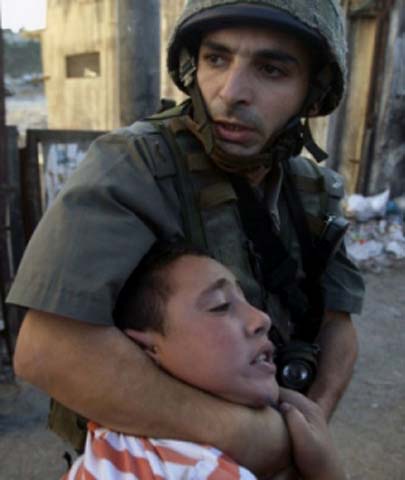
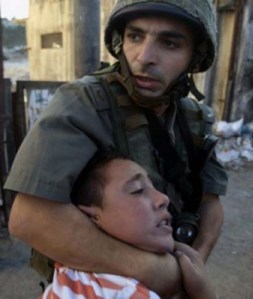 File photo
International Solidarity Movement | January 8, 2010
The Israeli army has abducted another young man from the northern West Bank village of Burqa. Muhammad Samir, 21 years old, was stopped outside the village by soldiers as he returned from his workplace in Tulkarem and arrested. Arrests and military invasions have surged this past month in Burqa, with Samir becoming the 22nd person taken since the beginning of December.
Samir was returning from his work at the Tulkarem offices of the Palestinian Authority at 10am yesterday morning when he was stopped at a flying checkpoint between Burqa and the neighbouring village of Bisaia. Upon checking his ID he was immediately place under arrest by soldiers. He was released from prison just two years ago, serving a two-year sentence from the age of 17.
The wave of arrests, primarily carried out in night raids on the village, have robbed Burqa of 22 young men in the past month alone. The village’s 4,000 residents sleep uneasily now, unknowing of who may be taken the next time the military comes. It is the standard story in hundreds of cases of its kind: young men, generally aged 16 or 17 and in their last year of school, arrested and charged with throwing stones at military jeeps when they enter the village.
International solidarity activists have initiated a nightly vigil in Burqa, joining local residents in keeping watch until the early hours of the morning in the hopes of documenting and de-escalating the violence of the night raids. During the invasions soldiers enter either by jeep or on foot, surrounding the homes of wanted people and preventing residents from leaving their home. Residents report extreme violence at the hands of the soldiers during invasions, with shots fired as the family is usually forced in to the bathroom for several hours and their home torn apart by soldiers, searching for weapons or other incriminating possessions.
Burqa has long been a target for Israeli Occupation Forces and its residents are no strangers to the senseless violence meted out by soldiers. The village itself became a training ground for Israeli soldiers preparing for battle in the 2006 war with Hezbollah, the village’s topography resembling that of southern Lebanon. Residents recall almost nightly invasions during the period, with soldiers storming the homes of families who were forced out in to the street, handcuffed and ID’d, only to be informed that they were participating in an Israeli military training exercise.
Atop the mountain overlooking Burqa sits Homesh, an Israeli settlement built on the village’s lands and evacuated by the military in 2005 as part of Ariel Sharon’s disengagement from 4 West Bank settlements and the 21 Jewish settlements in Gaza. Not that Burqa’s farmers have been permitted to recommence work on their lands – the area was declared a military zone following the settlement’s original evacuation, and so it has remained.
Nor has the evacuation of settlers from Homesh been maintained in the years following the disengagement. A campaign of reclamation, spearheaded by the extremist “Homesh First” organisation, has been growing ever since and has ensured a significant settler presence still active in the area. Despite the military’s repeated attempts to disperse the settlers, nothing has successfully prevented the Homesh First supporters from attempting to repopulate the area, particularly during Jewish religious holidays when settlers converge in their thousands on the site. Thus Burqa farmers’ goal of land reclamation is not just borne of the legitimate desire for vital lands to be returned to their legal owners, but also out of a real fear of resettlement of the site by ideological Israeli settlers.
Farmers of Burqa continue live under constant threat of violence at the hands of the settlers, vengeful in their attempts to lay claim to the stolen land. Over 5000 fertile dunums remain inaccessible to the Palestinian population. For the last two years the village has co-ordinated an annual trip to the contested area, re-planting and cultivating 95 dunums of land. Settlers have descended each time on the area soon after to destroy the farmers’ work, uprooting trees and destroying new wells built for irrigation. 25 dunums of the original 95 remain.
Gaza, Day 12: The shooting of Amal, Souad, Samar and Hajja
Part 12 of a series recounting the findings of South African jurist Richard Goldstone’s UN Fact Finding Mission on the Gaza Conflict.
Bethlehem – Ma’an – In the late morning of 7 January 2009, one year ago today, Israeli tanks moved onto a small piece of agricultural land in front of the of the house of Khalid Abd Rabbo and his wife Kawthar, on the ground floor of a four-story building in the eastern part of Izbat Abd Rabbo, a neighborhood east of Jabaliya inhabited primarily by members of their extended family.
Speaking to Richard Goldstone’s UN inquiry, Khalid recounted: “On January 7 at 12:50pm the Israeli army bulldozed our garden and the Israeli tanks were positioned in front of our house. They started yelling at us through the speakers and asked us to leave the house.”
Moments earlier, at 12:30pm, megaphone messages telling all residents to leave were heard across the neighborhood. According to one witness’s recollection, a radio message was also broadcast by Israeli forces around 12:30pm announcing that there would be a temporary cessation of shooting between 1 and 4pm that day, during which time residents of the area were asked to walk to central Jabaliya.
“Of course this happened when Israel had declared [a] ceasefire for four hours, January 7 from 1:00-4:00pm, and that was a truce back then and that’s when wounded civilians could be rescued, and in spite of all of that, in spite of all of this declaration, the Israeli army was there right in front of our house not attempting to move,” Khalid said.
Responding to the messages, Khalid, his wife Kawthar, their three daughters, nine-year-old Souad, five-year-old Samar, and three-year-old Amal, and his mother Hajja Souad stepped out of the house, all of them carrying white flags. Less than 10 meters from the door was a tank, turned toward their house. Two soldiers were sitting on top of it having a snack. It was 12:50pm.
“So we stood by our entrance and holding flags, white flags. The tanks were seven meters away from our house.”
The family stood still, waiting for orders from the soldiers, but none was given. “[W]e were by the entrance holding white flags and waiting for them to tell us what we should do, whether to go back inside the house or move to somewhere else. They did not say anything to us. There were two soldiers sitting on top of the tank. One of them was eating chips. The other one was eating chocolate. We were looking at them like what are we supposed to do, where should we go, but no reaction from them whatsoever.”
Without warning, a third soldier emerged from inside the tank and started shooting at the three girls and then also at their grandmother. Several bullets hit Souad in the chest, Amal in the stomach and Samar in the back. Hajja Souad was hit in the lower back and in the left arm.
“They starting shooting at the children with no reason, no reason, with no explanation, no pretext,” Khalid said. “My daughter, three years old, [her] stomach was, hit and her intestines were coming out. So really I was amazed at how could a soldier be firing at my daughter? So I carried my daughter, three years old. She could hardly breathe. Like I said, her stomach was wounded.
“My other daughter was also wounded in her chest. So I took both of them, Samar and Amal, inside the house. My wife and my mother and my other daughter Suad were still outside. All of a sudden my wife joined me carrying Suad. She was wounded also. Her chest was wounded by many bullets. My mother, 60 years old, she was carrying the white flag and she was wounded on her forearm and also in her stomach.”
Khalid and Kawthar carried their three daughters and mother back inside the house. There, they and the family members who had stayed inside tried to call for help by mobile phone. They also shouted for help and a neighbor, Sameeh Al-Sheikh, an ambulance driver who had his ambulance parked next to his house.
Sameeh put on his ambulance uniform and asked his son to put on a fluorescent jacket. They got in the ambulance, had driven a few meters from their house, when Israeli soldiers ordered them to halt and get out of the vehicle. Sameeh protested, saying he had heard cries for help from the family and intended to bring the wounded to hospital. The soldiers ordered him and his son to undress and then redress. They then ordered them to abandon the ambulance and to walk toward Jabaliya.
“So we were all inside the house and we started calling the ICRC [International Committee of the Red Cross], the ambulances, anybody to come and rescue us but nobody came and all of a sudden we heard an ambulance but all of a sudden nothing, silence. But later, we saw that the Israeli soldiers asked the ambulance drivers to come out of the car, to undress, and they bulldozed the ambulance with the tank.”
Not like before , when civilians were safe
Khalid’s family decided to stay inside the house, all gathered on the ground floor, as they had done safely during previous Israeli incursions into the neighborhood.
According to Khalid: “Our house, or our area rather, was subjected to many incursions and each and every time the army would invade the area, would come into our houses, but no harm was done to civilians or to children. Last time, that is before the last war on Gaza, that was on January 3, 2008, the Israeli army came in our house and stayed three days and destroyed many things inside the house but left without harming the civilians or the children. Now during the last war that is on January 7, 2009, actually the ground war had already started and we heard that Israel had declared war on Hamas.
“We are civilians. We have nothing to do with Hamas and we were used to have the Israeli army come into our area,” Khalid recalled in his testimony to Richard Goldstone’s UN inquiry. “So I thought this time we could stay in our houses. We had nothing to do with Hamas. We did not pose any danger to Hamas. The war, the ground war, started on Gaza and as of the first half hour approximately on January 4, the Israeli army controlled the whole area. There was no resistance in the area. It’s an area nearby the Israeli border. Of course we were inside the houses. We were surprised because the war went on for four days while we were still inside our houses.”
On 7 January 2009, however, when Amal and Souad died of their wounds, the family decided that they had to make an attempt to walk to Jabaliya. They would take Samar, the dead bodies of Amal and Souad, and their grandmother to hospital.
“My mother, 60 years old, was also dying. I was helpless. I didn’t know what to do for my children. There was my daughter dying in front of me. So I carried her and left the house even if I had to die myself because I couldn’t take it anymore. So I carried my daughter and left the house again so that the soldier, he might as just well kill my daughter and kill myself because I couldn’t take it anymore. I couldn’t let my children die in front of me.”
Khalid explained: “From 12:50 until 2:50 we were stuck inside the house. Once again, like I said, I went out to the soldier. They were there, three of them, and there was a Merkava tank positioned in front of the house. I was carrying Samar, even if I had to die, and I was surprised because the third soldier looked at me and two minutes later he went inside the tank and then he came out and he moved his hand just, you know, telling me you can go ahead. So I immediately went back home inside the house and told them we’re going to die anyway. So we don’t want to die inside the house. Let’s die outside the house. Let’s move.
“Although inside the house there [were] more than 25 children, my brothers, my sisters, my dad, my mom. So we had to bring children’s mattress to put my mom on top of the mattress because she was very tired. I carried my daughter Suad, three years old. She was dead… While we were moving, every ten meters they were shooting, once above our heads and the other time by our feet. ”
Khaled and Kawthar, as well as other family members and neighbors, carried the girls on their shoulders. Hajja Souad was carried by family and neighbors on a bed. Samar was transferred to Ash-Shifa Hospital and then, through Egypt, to Belgium, where she was still is in hospital at the time of writing.
“So we were trying to move and every now and then we would fall down. We walked for almost a kilometer and a half until we reached the edge of Jabaliya downtown. Of course, we reached the Kamal Idwan Hospital and they confirmed that the three of them were martyred…surprisingly enough they told me that Samar, no, she had survived and she was moved to Ash-Shiffa Hospital. I took the bodies of my two daughters in order to bury them. We didn’t have any time. This was an outrageous war and the Israeli army was moving around. So we had to bury them, Amal and Suad, and wait until they would bring Samar because we thought and we knew that Samar was going to die. ”
According to her parents, Samar suffered a spinal injury and will remain paraplegic for the rest of her life. “Samar, of course, and with God’s will, Samar survived, survived so that she would be the witness before the world for the atrocities,” Khalid said. “Samar survived, paralyzed. She can move only her arms. She can speak but the rest is paralyzed. She can speak for herself and she can tell her tragedy.”
According to Khalid, “I haven’t seen [Samar] since the events. My tragedy is still going on. It’s not over. So what crime did I commit? I have always been a peace-loving person. I’m for peace. I’ve always supported peace and despite [all that] happened to me I’m asking the world please, please help us live in peace. The Israeli army knows that, that I’ve never been a terrorist.
“… why did it happen to me, why did they come to my house, kill my children without having committed any crime. What did I do?
“There was no war. It was cold-blooded murder of children. That was not just accidental. No, the soldier even chuckled, like I said. I know that Israel has a very sophisticated technology and that every operation it carries out is actually filmed and I’m asking Israel please broadcast the film of the killing of my children. Did you see my children carrying any rockets?”
No home to return to
When Khalid returned to his home on 18 January 2009, his house, as most houses in that part of Izbat Abd Rabbo, had been demolished. He drew the UN fact-finding mission’s attention to an anti-tank mine under the rubble of a neighbor’s house.
He added: “I call upon the international community and ask the international community why my children were cold-bloodedly killed? Why were they fired on? My mother, 60, she was hit in her chest; my daughter Suad, eight years, in her chest; Samar, four years, in the chest; Amal, three years, in the chest, and this is despite the fact that they are all different sizes, all the targeting was at the chest.
“This was execution. This was utter execution and I’m asking the world what crime did my children commit? What danger did they pose for the Israeli army? I myself was there. Why didn’t they fire at me? Why didn’t they kill me and not let me see my children die in front of my eyes. My children, until now, I cannot get myself to realize there I was looking at them while they were dying.”
Factual findings
Goldstone’s team found Khalid and Kawthar Abd Rabbo to be credible and reliable witnesses. “It has no reason to doubt the veracity of the main elements of their testimony.” The mission also reviewed several sworn statements they and other eyewitnesses gave to NGOs about the incident and found them to be consistent with the account it received, according to the report.
Goldstone’s report notes that, in general, Izbat Abd Rabbo and the nearby areas of Jabal Al-Kashef and Jabal Al-Rayes saw some of the most intense combat during the military operations.
No perceived danger
The testimony of Khalid and Kawthar Abd Rabbo, however, shows that Israeli forces were not engaged in combat or fearing an attack at the time of the incident, the report states. Two soldiers were sitting on the tank in front of the family house and having a snack. “They clearly did not perceive any danger from the house, its occupants or the surroundings.
“Moreover, when the family, consisting of a man, a young and an elderly woman, and three small girls, some of them waving white flags, stepped out of the house, they stood still for several minutes waiting for instructions from the soldiers.”
“The Israeli soldiers could, therefore, not reasonably have perceived any threat from the group. Indeed, the fact that the gunfire was directed at the three girls and, subsequently, at the elderly woman, and not at the young adult couple, can be seen as further corroborating the finding that there was no reasonable ground for the soldier shooting to assume that any of the members of the group were directly participating in the hostilities,” Goldstone’s report states, finding “that the soldier deliberately directed lethal fire at Souad, Samar and Amal Abd Rabbo and at their grandmother, Hajja Souad Abd Rabbo.”
Goldstone’s report further states, that by preventing Sameeh Al-Sheikh from taking the wounded to the nearest hospital in his ambulance, Israeli forces deliberately aggravated the consequences of the shooting.
“The Mission recalls that the soldiers had forced Sameeh Al-Sheikh and his son to get out of the ambulance, undress and then redress. They therefore knew that they did not constitute a threat. Instead of allowing them to take the gravely wounded Samar Abd Rabbo to hospital, the soldiers forced Sameeh al-Sheikh and his son to abandon the ambulance and to walk towards Jabaliya.
Instructions given to Israeli forces: Low threshold for lethal force
The team found in the above incidents that “Israeli forces repeatedly opened fire on civilians who were not taking part in the hostilities and who posed no threat to them.” From that finding, the report extrapolated that the “incidents indicate that the instructions given to the Israeli armed forces moving into Gaza provided for a low threshold for the use of lethal fire against the civilian population.”
Goldstone found strong corroboration of this trend in the testimonies of Israeli soldiers collected by the Israeli NGO Breaking the Silence, and in the Protocol of the Rabin Academy’s “Fighters’ Talk.” These testimonies suggest in particular that the instructions given to the soldiers conveyed two “policies.” Both are an expression of the aim to eliminate as far as possible any risk to the lives of Israeli soldiers.
The first policy could be summarized, in the words of one of the soldiers: “if we see something suspect and shoot, better hit an innocent than hesitate to target an enemy.”
Another soldier attributed the following instructions to his battalion commander: “If you are not sure – shoot. If there is doubt then there is no doubt.” The first soldier summarized the briefing from the battalion commander as follows “the enemy was hiding behind civilian population. […] if we suspect someone, we should not give him the benefit of the doubt. Eventually, this could be an enemy, even if it’s some old woman approaching the house. It could be an old woman carrying an explosive charge.”
A third soldier explained “you don’t only shoot when threatened. The assumption is that you constantly feel threatened, so anything there threatens you, and you shoot. No one actually said ‘shoot regardless’ or ‘shoot anything that moves.’ But we were not ordered
to open fire only if there was a real threat.”
The report notes that some soldiers stated that they agreed with the instructions to “shoot in case of doubt.” One of them explained his profound discomfort with the policy and of how he and his comrades had attempted to question their commander after a clearly harmless man was shot. While they disagreed about the legitimacy and morality of the policy, they had little doubt about the terms of the instructions: each soldier and commander on the ground had to exercise judgment, but the policy was to shoot in case of doubt.
The second policy clearly emerging from the soldiers’ testimonies is explained by one of the soldiers as follows: “One of the things in this procedure [the outpost procedure, which is being applied in areas held by the Israeli armed forces after the Gaza ground invasion] is setting red lines. It means that whoever crosses this limit is shot, no questions asked. […] Shoot to kill.”
A soldier recounted one incident of the red-line policy: A family is ordered to leave their house. For reasons that remain unclear, probably a misunderstanding, the mother and two children turn left instead of right after having walked between 100 and 200 meters from their house. They thereby cross a “red line” established by the Israeli unit (of whose existence the mother and children could have no knowledge). An Israeli marksman on the roof of the house they had just left opened fire on the woman and her two children, killing them. As the soldier speaking at the Rabin Academy’s “Fighters’ Talk” a month later observes, “from our perspective, he [the marksman] did his job according to the orders he was given.”
Investigators also read testimony from soldiers who recounted cases in which, although a civilian had come within a distance from them which would have required opening fire under the rules imparted to them, they decided not to shoot because they did not consider the civilian a threat to them.
Legal findings: Direct assaults on civilians
According to Goldstone, the fundamental principles applicable to these incidents – cornerstones of both treaty-based and customary international humanitarian law – are that “the parties to the conflict shall at all times distinguish between the civilian population and combatants”452 and that “the civilian population as such, as well as individual civilians, shall not be the object of attack.”
Israel refers to the principle of distinction as “the first core principle of the Law of Armed Conflict.” It further states that “the IDF’s [Israeli army’s] emphasis on compliance with the Law of Armed Conflict was also directly incorporated into the rules of engagement for the Gaza Operation.” The principle of distinction was reportedly incorporated in the following terms: “Strikes shall be directed against military objectives and combatants only. It is absolutely prohibited to intentionally strike civilians or civilian objects (in contrast to incidental proportional harm).”
In reviewing the above incidents the mission found in every case that the Israeli armed forces carried out direct intentional strikes against civilians. In none of the cases reviewed were there any grounds which could have reasonably induced the Israeli armed forces to assume that the civilians attacked were in fact taking a direct part in the hostilities.
The team therefore finds that Israeli forces violated the prohibition under customary international law and reflected in article 51 (2) of Additional Protocol, that the civilian population as such will not be the object of attacks. This finding applies to the attacks on Amal, Souad, Samar, and Hajja Souad Abd Rabbo.
Not only are civilians not to be the object of attacks, they are also “entitled in all circumstances, to respect for their persons … protected especially against all acts of violence or threats thereof” (Fourth Geneva Convention, art. 27). Fundamental guarantees set out in article 75 of Additional Protocol I include the absolute prohibition “at any time and in any place” of “violence to the life, health, or physical or mental well-being of persons”. According to the facts presented to the mission, these provisions have been violated.
“The State of Israel would be responsible under international law for these internationally wrongful actions carried out by its agents,” the report states. “From the facts ascertained, the Mission finds that the conduct of the Israeli armed forces in these cases would constitute grave breaches of the Fourth Geneva Convention in respect of willful killings and willfully causing great suffering to protected persons456 and as such give rise to individual criminal responsibility.
“The Mission also finds that the direct targeting and arbitrary killing of Palestinian civilians is a violation by the Israeli armed forces of the right to life as provided in article 6 of the International Covenant on Civil and Political Rights.
“In most of the cases examined above, the Mission finds that the Israeli armed forces denied the medical emergency services access to the wounded civilians. …
“The Mission recalls that article 10 (2) of Additional Protocol I provides that ‘In all circumstances [the wounded] shall be treated humanely and shall receive, to the fullest extent practicable and with the least possible delay, the medical care and attention required by their condition. …’ This provision enjoys customary international law status. The Mission is mindful that ‘the obligation to protect and care for the wounded … is an obligation of means.’
“It applies whenever circumstances permit. However, “each party to the conflict must use its best efforts to provide protection and care for the wounded, the report states, including permitting humanitarian organizations to provide for their protection and care.
“The facts ascertained by the Mission establish that in the incidents investigated the Israeli armed forces did not use their best efforts to provide humanitarian organizations access to the wounded. On the contrary, the facts indicate that, while the circumstances permitted giving access, the Israeli armed forces arbitrarily withheld it,” according to Goldstone’s final report.
“On this basis, the Mission finds a violation of the obligation under customary international law to treat the wounded humanely,” the report states. The conduct of the Israeli armed forces amounted to violations of the right to life where it resulted in death, and to a violation of the right to physical integrity, and to cruel and inhuman treatment in other cases, which constitutes a violation of articles 6 and 7 of the International Covenant on Civil and Political Rights.”
“No army, no prison and no wall can stop us”
Abdallah Abu Rahmah, The Electronic Intifada, 7 January 2010
To all our friends,
I mark the beginning of the new decade imprisoned in a military detention camp. Nevertheless, from within the occupation′s holding cell I meet the New Year with determination and hope.
I know that Israel’s military campaign to imprison the leadership of the Palestinian popular struggle shows that our nonviolent struggle is effective. The occupation is threatened by our growing movement and is therefore trying to shut us down. What Israel’s leaders do not understand is that popular struggle cannot be stopped by our imprisonment.
Whether we are confined in the open-air prison that Gaza has been transformed into, in military prisons in the West Bank, or in our own villages surrounded by the apartheid wall, arrests and persecution do not weaken us. They only strengthen our commitment to turning 2010 into a year of liberation through unarmed grassroots resistance to the occupation.
The price I and many others pay in freedom does not deter us. I wish that my two young daughters and baby son would not have to pay this price together with me. But for my son and daughters, for their future, we must continue our struggle for freedom.
This year, the Popular Struggle Coordination Committee will expand on the achievements of 2009, a year in which you amplified our popular demonstrations in Palestine with international boycott campaigns and international legal actions under universal jurisdiction.
In my village, Bilin, Israeli tycoon, Lev Leviev and Africa-Israel, the corporation he controls, are implicated in illegal construction of settlements on our stolen land, as well as the lands of many other Palestinian villages and cities. Adalah-NY is leading an international campaign to show Leviev that war crimes have their price.
Our village has sued two Canadian companies for their role in the construction and marketing of new settlement units on village land cut off by Israel’s Apartheid Wall. The legal proceedings in this precedent-setting case began in the Canadian courts last summer and are ongoing.
Bilin has become the graveyard of Israeli real estate empires. One after another, these companies are approaching bankruptcy as the costs of building on stolen Palestinian land are driven higher than the profits.
Unlike Israel, we have no nuclear weapons or army, but we do not need them. The justness of our cause earns us your support. No army, no prison and no wall can stop us.
Yours,
Abdallah Abu Rahmah
From the Ofer Military Detention Camp
Abdallah is a schoolteacher and nonviolent activist from Bilin. He is currently being held in an Israeli prison after he was arrested on International Human Rights Day, at 2am on 10 December 2009, by Israeli occupation forces.
Israel to raze 28 buildings in Nablus area
Nablus – Ma’an – Twenty-eight homes and agricultural buildings were issued demolition orders by Israeli military personnel on Wednesday, all located on the outskirts of Aqraba village southeast of Nablus, a Palestinian official said.
Ghassan Doughlas, who holds the Palestinian Authority’s settlement portfolio for the northern West Bank, said Israeli forces gave the farmers only 48 hours to evacuate their houses, clear out their farms and sheds before the orders were implemented.
Dozens of Palestinian farmers and their families live in the area, about five kilometers from the Gittit settlement and three kilometers from the Mekhora settlement, raising sheep and cattle as well as planting crops. The crops help sustain the local community, Doughlas said.
“Israeli forces issued this decision to protect the settlers only without taking into consideration the families who will be rendered homeless,” Doughlas added.
Among the families who received orders to evacuate their buildings were Zaid Mahmud Qassem Beni Manna, Hani Jameel Abdullah Beni Jaber, and Feras Khalil Beni Jaber.
Iran Running Out of Life-Saving Isotopes
By Thomas Erdbrink in Tehran | Spiegel Online | January 6, 2010
Trade sanctions imposed on Iran over its nuclear program are affecting treatment of people suffering from heart and kidney disease and various cancers. Some 850,000 patients are at risk because the country is running out of radioactive isotopes essential to radiotherapy.
Ruhollah Solook, 78, was dying before a donated kidney and complex radiotherapy saved his life. Recovering in an isolation room in Tehran’s oldest hospital, he expressed his joy in a telephone interview. “They saved my life already. I hope they will be able to cure me entirely now.”
But Solook’s treatment has become a race against time, as has that of 850,000 other Iranians suffering from heart and kidney disease and various cancers. Sometime after March 2010, the country will run out of technetium-99, a radioisotope crucial to the treatment of these diseases. Technetium-99 is currently produced locally in Iran.
“We recommend treatment with these products to hundreds of patients every month in our hospital alone,” said Dr. Gholamreza Pourmand, Solook’s physician. Technetium-99 is essential to radiotherapy, Pourmand said: “If we cannot help these people, some will die. It’s as simple as that.”
Rare and Precious
The impending shortage of technetium-99 is caused by the controversy surrounding the Iranian nuclear program. The sanctions imposed by the UN Security Council, aimed at moving Iran to halt its uranium enrichment program, are supposed to leave medical practice unaffected. In reality, however, Iran has become unable to procure a wide range of medical products. Body scanners cannot be imported from the US or the EU, since parts in these machines could also be useful to Iran’s nuclear program. An embargo on medical isotopes was introduced in 2007, in defiance of the medical exception clause touted as part of the trade sanctions, Iranian leaders said.
Isotopes are a rare commodity produced at only five sites worldwide. One of these, the High Flux Reactor in the Dutch town of Petten, currently accounts for 30 to 40 percent of worldwide production, but it is scheduled for retirement soon. Apart from the UN sanctions, so many restrictions — particularly American — on trade with Iran exist, that in practice nobody is willing to supply Iran with medical isotopes any longer.
Out of dire necessity, Iran now uses its 41-year-old research reactor in Tehran — originally constructed by the US — exclusively for isotope production, a job which used to take only a day a week. However, the reactor’s fuel, provided by Argentina in 1993, is quickly running out, the scientists said.
‘We Will Make Our Own’
Iranian leaders, including President Mahmoud Ahmadinejad, say that Iran might produce new fuel itself, which would prove a sensitive issue. Iran would need to enrich uranium up to 19.75 percent purity, which would not only be a gross violation of UN sanctions — it would also bring the country one step closer to the militarization of its nuclear program.
“We would prefer to buy the fuel as quickly as possible,” said Mohammad Ghannadi, vice-president of the Atomic Energy Organization of Iran (AEOI), sitting in his office in downtown Tehran. At his desk, Ghannadi had a bird’s-eye view of the experimental nuclear facility, the only functional reactor in Iran. Two chimneys on the facility belt out white smoke. “We can enrich on our own,” he said. “But we will run into technical difficulties. We also won’t be ready in time to help our patients.”
Iran’s dire need for the special fuel has led the UN International Atomic Energy Agency to put forward an unusual proposal, which might, if successful, build trust between Iran and other nations.
According to this proposal, the US would upgrade Iran’s old research reactor, and Russia and France would send the Persian nation 116 kilograms (256 pounds) of fuel. The IAEA, which already has the reactor under strict surveillance, would ensure it is not used for the production of nuclear armaments. In return, Iran would have to move most of its low-grade enriched uranium beyond its borders, leaving it with an insufficient stockpile for the production of weapons-grade uranium. Iran, however, has demanded firmer assurances that the promised fuel will actually be delivered. It also finds the time it would take to actually deliver the fuel — a year, according to the Iranians — too long.
“Every nuclear scientist understands that research reactors and medical isotopes have nothing to do with nuclear weapons,” Ghannadi said. One of his own family members recovered from breast cancer only recently with the help of medical isotopes generated in his reactor. “We’re talking about people here,” he noted. “If somebody falls ill, you give them medicine. Give us the fuel, and then we will cure the people.”
Desperate Phone Calls
It is not the first time Iran has fallen short of medical isotopes. When foreign imports came to an abrupt halt in 2007, the Iranians also tried to make their own. “But we were late,” one of Ghannadi’s assistants recalled. Patients went untreated for two months. “We got hundreds of phone calls a day. Government officials, hospitals and even patients called us asking for help,” he said.
In Tehran’s Shariati hospital, one of 120 medical facilities in Iran where nuclear technology is employed, patients are lined up waiting to use a decrepit German body scanner. In 2007, dozens of people would also wait here for treatment that didn’t come, recalled Moshen Saghari, a nuclear science professor.
“When the West talks of human rights in Iran, it should not forget about our patients,” said the doctor, a graduate of a prestigious American university. “The country that taught me everything I know is now preventing me from using that knowledge in Iran. Quite ironic.”
A year after losing a father and sons, a Gaza family copes
Rami Almeghari writing from the occupied Gaza Strip, Live from Palestine, 6 January 2010
 |
Khaled Abu Jbarah with baby Lina and Jihad, whose father was killed in an Israeli missile strike on their Gaza home. (Rami Almeghari) |
“Four months after the martyrdom of my husband and two of my sons, my granddaughter Lina was born — the daughter of my martyred son Basel,” said Fathiya Abu Jbarah. Fathiya is the widow of Jihad Abu Jbarah and mother of Basil, 30, and Usama, 21 who were killed on 4 January 2009 by an Israeli missile that struck their home in al-Bureij refugee camp in the central Gaza Strip. Their home was hit during Israel’s 22-day air and land attack that killed more than 1,400 persons and wounded thousands of others.
The Electronic Intifada visited the family a few days after the attack (see “Targeting a cup of tea in Gaza,” 12 January 2009) and came back one year later to see how they are coping.
Reflecting on the birth of Basel’s daughter Lina, Fathiya Abu Jbarah said, “My heart almost popped. What did this innocent baby do to be born without a father?”
“We Palestinian mothers like any other mothers, never want to see our children and grandchildren become orphans or for wives to become widows,” Fathiya who is in her mid-50s, said as she carried Lina in her arms. “We want to live in peace as any other nation in this world. Yet, the Israeli occupation never leaves us alone, they have continued to attack us regularly for decades now. Isn’t it time for us to live normally?”
In addition to the killings of Jihad and his two sons, a fourth family member, Khaled, 19, suffered severe shrapnel wounds to his abdomen and arms, and was transferred to a hospital in Saudi Arabia for treatment.
Khaled recalled the moment, just before 10:30pm on 4 January 2009, when the missiles struck the house. He had been sitting outside with his father and brothers. However, Khaled said, “The weather was cold, so I went in my room, while my brothers and father were keeping warm outside in front of a wood stove.”
Khaled then heard missiles striking near the home and rushed out of his room to see what happened. “I saw the three [Jihad, Basel and Usama] dismembered by the strike, but I did not know I was also hit.” Khaled recalled going out of the house to a nearby hospital.
The family’s rented home was badly damaged in the Israeli attack, but now they live in a newly-built three-room house. Khaled now lives there along with his brother Muhammad and other family members including a teenage brother, his mother, his sister-in-law, the widow of Basil and other nieces and nephews.
The Abu Jbarah home is one of the very few to be built in the past year, as thousands of homes damaged or destroyed in the Israeli attack remain unrepaired. Virtually no building supplies have come in due to the ongoing Israeli blockade, but the Abu Jbarahs built the house with the help of friends and family, and using building supplies smuggled in through tunnels from Egypt, and sold at inflated prices.
Muhammad Abu Jbarah, 24, explained that his late father had decided to build a family home in 2006, but due to the blockade he could never get the raw materials, which is why he rented the home that was attacked by Israel last year. After the attack, the family lived for months at the home of a relative, but with their needs, they decided to build the new house. It has been an enormous struggle.
“We have been building this new house for almost eight months, trying to get use of any raw building material available in local markets,” Muhammad explained. The cost has been enormous — about $70,000, much of which was borrowed from relatives or friends. “We owe about 70 percent of that amount,” said Muhammad,” and it will take us at least six or seven years to pay it off, but we have no choice.”
Despite the agony he has endured during the past year, Khaled Abu Jbarah sounded hopeful and looked forward to a better life in the new year. “I do look forward to a better situation, not only for me but also for these little children. We Palestinians want to live in peace and tranquility for generations to come, but unfortunately, every generation of us experiences the same suffering at the hands of this occupation, which never abides by ceasefire declarations, peace agreements, or any other international resolutions.”
Although the situation has been generally calm, Khaled pointed out that the “Israeli army continues to open fire from time to time [and] some people have been killed and wounded recently.”
The home provides some comfort now, but Fathiya Abu Jbarah said, “what you see can never compensate me for my loss. During Ramadan I cried a lot for my dear husband and children, while serving iftar [the fast-breaking meal] to the rest of my family.” As she spoke, the memory brought the tears back to her eyes.
Rami Almeghari is a journalist and university lecturer based in the Gaza Strip.
Israel orders Hamas legislator held for six more months
06/01/2010
Salfit- Ma’an – Israel has extended the detention of Abdul Jaber Fuqaha, a Hamas-affiliated member of the Palestinian Legislative Council from Ramallah first arrested in 2006.
Hamas PLC members issued a statement condemning the order to hold Fuqaha in administrative detention for another six months.
The order was the third such order, according to Hamas.
The lawmakers said Fuqaha was not charged with any crime. Fourteen Hamas legislators are still in Israeli prisons, including seven in administrative detention.
Israel seized dozens of Hamas officials in June 2006 following the capture of Isreali soldier Gilad Shalit.
In March Israel detained ten more top Hamas officials, including lawmakers, from the West Bank.
Also on Wednesday Hamas said that the Fatah-dominated Palestinian Authority arrested three members of the Islamist movement in the West Bank.
Israeli Use of Painful Shackling As A Form of Torture
By Stephen Lendman | January 5, 2010
Founded in 1990 to highlight a growing problem, the Public Committee Against Torture in Israel (PACTI – stoptorture.org) “believes that torture and ill treatment of any kind and under all circumstances is incompatible with the moral values of democracy and the rule of law. (It) advocates for all persons – Israelis, Palestinians, labor immigrants and other foreigners in Israel and the Occupied Palestinian Territories (OPT) – in order to protect them from torture and ill treatment by the Israeli interrogation and law enforcement authorities.”
They include the Israeli Police, the General Security Service (GSS), the Israeli Prison Service (IPS), and the Israeli Defense Forces (IDF). In June 2009, PACTI published a report titled, “Shackling As A Form of Torture and Abuse.” Its findings are discussed below.
PACTI reviews the “serious phenomenon” of shackling Palestinian detainees “in a systematic manner and throughout all stages of detention and interrogation.” Its purpose is to dehumanize and inflict pain, suffering, punishment, intimidation, and discrimination as a way of lawlessly extracting information even though experts acknowledge that torture is ineffective, counterproductive, and, of course, illegal under all circumstances at all times with no exceptions allowed ever.
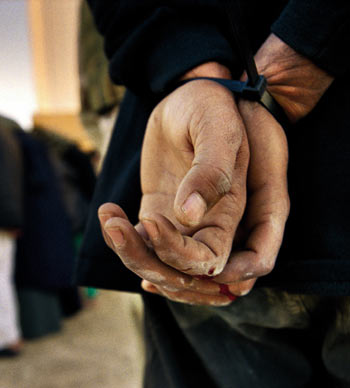 Israel’s use of shackling “has snowballed almost out of control….even when it serves no real” purpose, and it begins at the time of arrest. Plastic handcuffs are used “that can be tightened but cannot be released or halted.” They inflict pain, especially when hands are cuffed from behind, the most common way.
Shackling continues during interrogation, “where diverse and creative forms of cuffing are intended to apply pain and pressure….” Then in cells, detainees are painfully shackled to beds for extended periods. Even when they’re transfered for urgent hospital treatment, cuffing stays in place throughout.
In his “Torture Ruling,” (HCJ 5100/94 Public Committee Against Torture in Israel v. Prime Minister of Israel), former President of the Israeli High Court of Justice (HCJ), Aaron Barak (1995 – 2006), addressed cuffing as follows:
“A reasonable interrogation is an interrogation without torture, without cruel or inhuman treatment of the interrogee, and without a humiliating attitude thereto. It is forbidden to use brutal and inhuman measures during the course of the interrogation….Painful cuffing is a prohibited action. Moreover: other means exist to prevent escape from lawful custody or to protect the interrogators which do not involve causing pain and suffering to the interrogee.”
Interrogators ignored the ruling and keep using procedures prohibited by the High Court as a way to gratuitously inflict pain, suffering, and at times permanent injury and disability.
PACTI cites specific cases and offers a medical opinion on the pain and neurological damage it causes. In response to its demands, interrogators began using new type handcuffs with longer chains, supposedly to limit physical harm. However, they’re as harsh as before.
Cuffing During Arrest and Transfer to Interrogation
Painful cuffing begins, even for minors, the sick and women at the moment of arrest to begin breaking detainees’ spirit and soften them up for GSS interrogations. Each month, PACTI gets dozens of complaints, and over the past year documented hundreds representing “the tip of the iceberg” about a universally administered procedure. For example:
Alaa Nasser Dib Salem was arrested on October 2, 2008. In his affidavit, he said soldiers cuffed his hands behind his back so tightly that any hand movement tightened his restraint more, causing pain and producing paresthesia (an abnormal tingling or pricking feeling the result of pressure on or damage to peripheral nerves).
Mahmud Faruq Hamed el-Bubali lost feeling in both hands after 30 minutes and made him feel like “my palms were going to disconnect, to be cut off.” The cuffing turned his hands blue, and he suffered intense pain, especially in his right hand.
When Yazan Sawalha complained of pain, he was denigrated, laughed at, cursed, and told to shut up even though his hands turned bright blue and red, were very swollen, and he had trouble lifting them.
Rami Mufid Jum’ah’s complaint led to further abuse. In transit with soldiers, he was kicked and struck with rifle butts on his shoulder.
A.G, a minor, told of being tightly handcuffed with his hands behind his back and blindfolded. When his restraint was temporarily removed, his left hand was blue and swollen, and his wrist swollen and red. At the Petah Tikva detention center, a doctor discovered white pus on both his hands.
Each time PACTI submitted a complaint to the Central Command Attorney for Operational Affairs, “no substantive reply” was gotten.
During Operation Cast Lead, Amar Fuad Mahmud al-Helu was arrested, painfully cuffed and held that way for three days. As a result, his shoulder was sprained and dislocated. When he shouted about the intense pain, soldiers tightened his restraint further.
In statements gotten by the Breaking the Silence organization, soldiers corroborated detainee testimonies. For example, Staff Sergeant A. said:
“….handcuff (detainees) and put a cloth over their eyes. Just take them away at night….put the handcuffs on them real tight. It stopped their blood circulation a bit.” They were left in a school “for hours, blindfolded and handcuffed, and they had no idea what they’d done…It went on through the day” lasting for hours.
Staff Sergeant B said:
“some soldiers know what the purpose of the handcuffs is and some….think (it’s) to stop the flow of blood from the wrist and fingertips….some guys think that you should squeeze the handcuffs as far as possible so that no blood can flow from one side to the other.” That’s different from just restraining them.
The Medical Aspect
At PACTI’s request, Dr. Bettina Steiner-Birmanns said:
“Tight handcuffs – such as narrow and rigid plastic handcuffs with no space between the cuffs and the detainee’s hands – press forcefully on the wrists. The detainee is liable to remain (in restraint) for protracted periods. In these conditions, the handcuffs may cause injuries to soft tissue and abrasions, skin wounds, and even fractures. The handcuffs also press on the nerves in the palms, thereby causing paralyses and a loss of sensation in (them). These neurological injuries may be transient but they may also be permanent….From the neurologist’s viewpoint….tight handcuffs can cause transient or irreversible damage….”
Correspondence with Army Authorities
All detainees are subjected to the same abuse with slight variations. PACTI asked authorities to provide regulations, procedures, or orders regarding the use of plastic (or other type) handcuffs. In response, Major Zohar Halevy, the IDF Spokesperson’s Division Human Rights and Public Relations head, issued a statement saying:
“In principle, force is not to be exercised against another person in order to execute a function or perform a duty unless the function cannot be executed or the duty performed without the exercising of force.”
Regarding forceful handcuffing, Major Halevy added that military police orders establish that:
“the use of force shall be in such measure as is necessary and logical while adapting given the circumstances. This shall be reasonably proportional to the desired goal. (Furthermore), the shackling of detainees outside the detention center shall be effected solely by the use of handcuffs, in such manner that the accompanying MP is shackled by the hand to the detainee, or when two detainees are shackled together and the MP accompanies them….it must be ensured that the accompaniers have cutters in order to cut the handcuffs when necessary.”
In response to a further PACTI inquiry, Human Rights Officer, Captain Gon Erez, said that handcuffing is in accordance with military police commander Instruction No. 9810 concerning “Shackling with Handcuffs – Security Detainees.” It states that they’re used to:
–prevent self-injury;
— injury to another person or property; and
— prevent escape from lawful custody.
Per the military police commander’s instruction, ordering handcuffing, including the type, is to be made in writing by the authorizing person, “and this decision shall be examined on an individual basis.” Further, “handcuffing shall be in such a manner as is essential in order to secure these goals and as an only and last means to do so. Once the goal is reached, the handcuffing of the security detainee is to be halted.” The facility military police commander and medical officer must approve maintaining it for over 72 hours, and handcuffs “shall be removed every three hours for a period of fifteen minutes.”
The provisions of commander Instruction No. 9803, “The Transfer and Removal of Detainees from a Detention Facility,” must also be followed. It states that:
“force is not to be exercised against a detainee for the purpose of the transfer or removal of the detainee from the incarceration facility unless it is impossible to execute the mission without” it. It’s further established that “the use of force shall be in a degree that is reasonable and essential for the execution of the task and shall be adapted to the circumstances….reasonable proportionality is to be maintained between the desired goal and the extent of the force that is exercised” that at all times “shall serve as a last resort.”
However, this instruction is vague on details during transfer and removal of detainees from incarceration facilities, thus granting soldiers a margin of leeway to exercise their own judgment and let them be harsher than necessary.
Nonetheless, the official reply acknowledges no legal basis for painful shackling, yet the procedure “is actually the case in the army” with no justification. As a result of 574 documented abuse cases, PACTI wrote to the West Bank judge advocate general and military police commander on May 13, 2009 demanding that soldiers henceforth be prohibited from using plastic handcuffs as the first and only means of controlling detainees from the time of arrest through their transfer to interrogation facilities. All painful restraint methods were also asked to be eliminated, especially shackling detainees’ hands behind their back, and that procedures be established concerning the method and length of detainees’ held in restraint. PACTI learned that plastic handcuffs can only be tightened, not loosened or removed unless cut off.
Handcuffing During GSS Interrogations
During interrogations, detainees are isolated and prevented from meeting with an attorney, family members, or ICRC representatives. As a result, they’re “subjected entirely to the interrogators’ control at all times during the period of interrogation.”
They’re kept painfully handcuffed in various ways, including “regular” protracted cuffing of hands behind their back as well as their arms and forearms in positions causing severe pain, suffering, and at times permanent harm. PACTI calls “high cuffing” the most extreme form.
GSS interrogators claim the procedure is to protect detainees’ well being and prevent their escape. However, they’re kept in a secured, closed, carefully guarded facility, making that likelihood nearly impossible.
Detainees are placed on an unupholstered wood, metal, or rigid plastic chair of standard office size. Both hands are shackled behind their back with metal cuffs connected by a short chain to the chair’s seat. Most often legs are also restrained, and the chair always is fixed to the floor.
Detainees are held that way throughout interrogation lasting many hours or days, except for short meal breaks and even shorter bathroom ones. Protracted sitting alone with no possibility of shifting positions, standing, or stretching is itself extremely uncomfortable. Being painfully shackled makes it much worse, and any attempt to slightly adjust the hands results in further tightening of the cuffs.
As explained above, paresthesia often results that includes loss of feeling, weakness, and pain in the back, arms, wrists, shoulders and neck – the entire upper body. Chest muscles are also strained, breathing impeded, and long-term neurological damage is common.
The Scale of Cuffing Detainees with Their Hands Behind Their Back
PACTI affidavits show it’s widespread during all interrogations, usually throughout the procedure. A few testimonies describe the practice:
A.B, aged 16 and a half, said his hands were cuffed behind his back and attached to the chair’s seat. His testimony shows that even minors are subjected to the same harsh treatment as adults. At one point during the process, A.B. broke down and cried.
Samar Hasan Sus said:
“When the interrogation began, I was cuffed with my hands behind the back of the chair I was sitting on. The handcuffs were attached to the bottom of the seat of the chair and I could not move my hands. The handcuffs were made of metal.” He complained to an attorney about forearm, leg and back pain. PACTI submitted a complaint on his behalf to no avail.
Dr. Ghasan Sharif Muhammed Khaled said he was cuffed and not allowed to change position. He said he was subjected to intensive interrogation for eight days, up to 22 hours a day, excluding Saturday and Sunday. Throughout, he was painfully shackled with only rare breaks of about 10 minutes. As a result, he experienced severe pain in his tailbone, back, neck, palms, and knees. He also sustained internal bruising and his knees swelled. PACTI again complained, was told the case was closed, and no corroboration was found for Dr. Khaled’s complaints.
Numerous other cases were much the same, and PACTI got no substantive responses to its complaints. They also learned that the only time interrogators unfastened the restraints was when detainees said they wanted to confess. Otherwise, painful shackling continued, causing permanent damage and humiliation as well.
“High Handcuffing” in the Interrogation Room
PACTI describes it as “any type of handcuffing in which the detainees’ hands are above the level of their wrists, including cuffing of the forearms or arms.” It’s extremely painful, can cause physical injury, and if maintained for extended periods very often permanent disability.
Detainee Jalal Khaled Momammed Sawafta describes it in his affidavit:
He was cuffed with a large metal bracelet. “They cuffed my hands in the middle of the forearm (between the wrist and the elbow). Each of two interrogators pressed on the bracelet of the handcuff on my arm – they both pressed together. It was terribly painful. Of course, these handcuffs were in addition to the regular handcuffs that were on my hands all the time, so I had two pairs of handcuffs fastened behind my back. (They) pressed on my arms hard. I cried out but it didn’t do any good.”
Sawafta’s hands are still numb. He can’t move his palms well, and they still feel cold all the time even on hot days. He still has marks on his right hand and wrist and “all kinds of bruises on both hands.” Also, his back hurts when sitting for a long time. He’s unable to write or hold a cigarette between his fingers, and his hands are swollen and red.
On his behalf, PACTI complained to Attorney General Meni Mazuz. Even after a follow-up memo, no substantive reply was gotten. Other detainees described the same treatment. Some referred to “indescribable” pain, and subsequent medical examination confirmed neurological damage.
After repeated attempts on behalf of detainees, Attorney Naomi Granot, Inspector of Interrogee Complaints, closed the issue “on the grounds that the findings of the mechanism for examining complaints by interrogees did not warrant legal, disciplinary, or other action against any of the GSS interrogators.”
From the clear evidence it got, PACTI concluded that detainee rights were “gravely” violated and that no redress would be forthcoming. Nonetheless, an appeal to the prime minister was made, including demands to prohibit painfully shackling, restrict the method and frequency of less or non-painful restraints, and assure future procedures only prevent detainees from harming interrogators or escaping. PACTI wants new rules, guidelines, and criteria in writing that comply with international and Israeli law.
Response from the Prime Minister’s Office
In January 2008, the Office of the Military Secretary to the Prime Minister head, Major Shalom Ginzburg, replied:
“It has been decided to alleviate the condition of interrogators by lengthening the chain in such a manner that the interrogee will be able to place his hands by the side of his body in a more comfortable manner, without this impairing the security of the interrogators or increasing the risk that the detainee will escape from custody.”
The “high handcuffing” issue wasn’t addressed, nor was PACTI’s demand for clear cuffing procedures. Nothing fundamentally changed as repeated detainee complaints were received. In response, PACTI contacted the internal security minister “to ensure immediate compliance with the decision of the Prime Minister’s Office on this matter.”
In May 2008, Col. (Ret.) Yuval Rivlin from the Office of the Comptroller of the Ministry of Internal Security (Public Complaints Office) replied stating:
“our examination with the Israel Police has shown that interrogees are not handcuffed during their interrogation. The Israel Prison Service informs us that the interrogation facilities are not under the responsibility of the IPS.”
In December 2008, PACTI again wrote the prime minister asking him to immediately prohibit painful cuffing, including “high handcuffing” and to establish firm procedures to be followed during interrogations.
In February 2009, Ayelet Moshe from the Public Affairs Department in the Prime Minister’s Office stonewalled by repeating earlier responses that produced no substantive changes.
Painful Handcuffing Continues
Detainee testimonies reveal it:
Mu’ataz Suleiman Mohammed Qawasmeh described how his hands were painfully cuffed behind his back with metal cuffs connected by a 40 centimeter long chain fixed to the back of the chair. While in this position, he was intensively interrogated from 10 – 22 hours a day. As a result, he suffers spinal and shoulder pain.
For about 12 hours a day, Ahmad Samir Hassan Isma’il was cuffed the same way for nearly five days. As a result, he has lower back pain and paresthesia in both palms. Others now experience various upper body pain in their shoulders, neck, hands, arms, and elbows. They also suffer from swollen red hands, paresthesia, and leg pain for those whose legs were shackled.
Alaa Nasser Dib Salem revealed more – painful hands and feet shackling to a concrete bed in solitary confinement for two days without interrogation. After six hours, he experienced paresthesia throughout his body. He was also denied access to the bathroom and forced to urinate in his clothes. When he complained, two men in civilian clothes tortured him by painfully pressing on his cuffs, cursing him, and threatening to torture his family. Salem was later beaten on all parts of his body with a nightstick and lost consciousness. When revived, he was shaking.
PACTI concluded that “The behavior of the interrogators in these cases and in other similar cases….indicates the use of handcuffing as a form of torture in order to extract information unlawfully” with interrogators often told anything to stop the pain.
Non-Handcuffing of Detainees During Police Interrogations
After GSS interrogations, detainees are questioned by police, or at times interrogations are done alternately for different purposes. GSS wants information to protect state security while police need it for subsequent prosecutions. During their interrogations, cuffing isn’t used, a clear sign that GSS does it solely to inflict pain.
PACTI concludes that GSS interrogators use “systematic handcuffing (for) extraneous motives….far removed from the need to ‘protect the safety of the interrogators’ or to ‘prevent escape from custody.’ ” Painful cuffing is used solely to torture, abuse, and inflict permanent impairment. “This behavior is inconsistent with the declared objectives and those set in (international and Israeli) law….”
Shackling Sick Detainees and Prisoners During Medical Treatment
One case involved a shackled young man who was unconscious after Israelis lynched him. Police refused to unfasten his handcuffs in the hospital even though they impeded treatment. Another case involved a hospitalized woman shackled on her way for major surgery, then again painfully after completion.
After being shot, Mohammed Ashkar was hospitalized unconscious and placed in intensive care with a ventilator attached to his mouth. Yet his hands were cuffed to the bed, and his legs cuffed together. At all times, four guards watched him. Ashkar subsequently died from his wounds, still painfully shackled. PACTI called his case “an appalling example of inhumanity” and a shocking breach of medical ethics for hospital staff to permit this.
The December 1982 UN Declaration on the Principles of Medical Ethics clearly states that:
— “Health personnel, particularly physicians, charged with the medical care of prisoners and detainees have a duty to provide them with protection of their physical and mental health and treatment of disease of the same quality and standard as is afforded to those who are not imprisoned or detained.”
The Declaration also prohibits actively or passively participating in “torture or other cruel, inhuman or degrading treatement or punishment (and) assist(ing) in the interrogation of prisoners or detainees in a manner that may adversely affect (their) physical or mental health or condition….”
In response to PACTI’s complaint about Ashkar’s treatment, IPS Attorney Tal Argaman on prisoners’ affairs said his shackling properly complied with “confidential” procedures he wasn’t at liberty to disclose. PACTI nonetheless submitted a request in accordance with the Freedom of Information Law, 5758-1998, but was denied on grounds of confidentiality.
At a subsequent meeting (attended by Physicians for Human Rights representatives) with police, the IPS, Deputy Attorney general (Criminal), Ministry of Internal Security and Ministry of Health, PACTI learned that “IPS security prisoners are considered dangerous and are automatically shackled” while hospitalized, even if on life support. The meeting ended inconclusively.
On July 31, 2008, another meeting was held with the same attendees as earlier. As a result, the IPS published IPS Commission Order No. 04.15.01 concerning “the shackling of a prisoner in a public place.” For the first time, it distinguished between levels of danger for prisoners and detainees as follows:
— those classified “level A” include all held for security reasons to be shackled as authorities see fit;
— “level B” detainees may not be shackled, “subject to individual examination;”
— for minors, the handicapped, disabled, or sick, shackling should be avoided, but isn’t prohibited if grounds are documented in writing;
— during court proceedings, cuffing should be avoided, “subject to individual examination;”
— for hospitalized detainees, authorities should refrain from shackling unless sufficient grounds are presented; however, this doesn’t apply to “level A” detainees who’ll be shackled at all times; this means that anyone may be so classified and painfully restrained.
PACTI concluded that the new order didn’t alter “the default practice of shackling.” It continues unabated.
Shackling from the Perspective of International Law
International law is clear and unequivocal. Torture amounting to cruel, inhuman, and/or humiliating treatment is prohibited at all times, under all circumstances, with no exceptions ever allowed, including in times of war or imminent danger. This prohibition is a rare example of a legal principle, accepted as customary law that’s binding on all countries worldwide. Neither Israel or any other nation may violate it no matter what conditions exist.
In addition, accepted principles for detainees and prisoners were established in a non-binding July 1, 1957 UN resolution concerning Standard Minimum Rules for the Treatment of Prisoners. They were adopted in 1955 by the First UN Congress on the Prevention of Crime and Treatment of Offenders and were approved in 1957.
They reflect accepted norms and standards concerning prisoner treatment, including the prohibition of shackling to inflict punishment under Section 33, but allow it, with restrictions, to prevent escape during transfer, provided:
— cuffs are removed before detainees appear before a judicial or administrative authority;
— for medical reasons on instruction of a medical staff member; and
— on order of the incarceration facility’s general manger.
Even when applied, doing it in a painful manner is prohibited, and the Israeli High Court of Justice (HCJ) several times affirmed the standard under the 1988 Body of Principles for the Protection of All Persons under Any Form of Detention or Imprisonment that states:
“All persons under any form of detention or imprisonment shall be treated in a humane manner and with respect for the inherent dignity of the human person.”
Yet the HCJ also legitimized coercive interrogations in three 1996 cases involving plaintiffs Bilbeisi, Hamdan and Mubarak seeking interim injunctions prohibiting abusive GSS treatment, including painful shackling, violent shaking, hooding, playing deafeningly loud music, sleep deprivation, and lengthy detentions. After further deliberation, the HCJ ruled painful shackling illegal, but allowed the other practices, even though Section 277 of Israel’s 1977 Penal Law prohibits torture and provides criminal sanctions against its use. It specifically states:
“A public servant who does one of the following is liable to imprisonment for three years:
— uses or directs the use of force or violence against a person for the purpose of extorting from him or from anyone in whom he is interested a confession of an offense or information relating to an offense; or
— threatens any person, or directs any person to be threatened, with injury to his person or property or to the person or property in whom he is interested for the purpose of extorting from him a confession of an offense or any information relating to an offense.”
In fact, this law applies solely to Jews, so Palestinians are subjected to systematic torture and abuse, including extended periods of injurious painful shackling. In addition, the Penal Law has a giant loophole “necessary defense” provision allowing “psychological and moderate physical pressure” to obtain evidence in criminal proceedings. It also permits coercive interrogations against “hostile (threats or acts of) terrorist activity” and all expressions of Palestinian nationalism.
Then in 1999, the HCJ ruled that coercive force may be used in “ticking time bomb” cases that can be applied to anyone designated a security threat or terrorist. According to Israeli authorities, all expressions of Palestinian nationalism, activism and resistance against lawless oppression is “terrorism,” opening the way for Palestinian detainees to be tortured – defined by international law as war crimes that impose criminal liability on perpetrators, their authorizing superiors, and the state itself.
Israel is a serial violator, so far unaccountable for its grave breaches, yet potentially liable for its actions as well as individuals at all security and political levels engaged in state-sponsored policies that willfully disregard binding international laws.
Under the well-established principle of “universal jurisdiction,” any nation may investigate and prosecute foreign nationals for crimes against humanity and war, including torture, cruel and abusive treatment of detainees. In April 1961, Israel applied it against Adolph Eichmann, and so has America against figures like Panama’s Manuel Noriega and Liberia’s Charles (Chuckie) Taylor. It may only be a matter of time until the “law of averages” catches up with Israeli war criminals. For their victims, it can’t come a moment too soon.
Stephen Lendman is a Research Associate of the Centre for Research on Globalization. He lives in Chicago and can be reached at lendmanstephen@sbcglobal.net.
Also visit his blog site at sjlendman.blogspot.com
“I hope that I die on my land”
Jody McIntyre writing from Bilin, occupied West Bank, Live from Palestine, 4 January 2010
 |
Fatima Yassin watches looks on as Israeli occupation soldiers prepare to invade her home in Bilin. (Hamde Abu Rahme) |
Fatima Mohammed Yassin, 49, is a farmer from the Palestinian village of Bilin in the occupied West Bank. In spite of Israel’s occupation and construction of its wall in the West Bank, including on Bilin’s farm land, Yassin and her husband continue to work their land on a daily basis. Jody McIntyre spoke to her for The Electronic Intifada.
Jody McIntyre: Do you have land behind the wall?
Fatima Yassin: Yes, before Israel started construction of the wall in Bilin, my family had 45 dunams of land [1 dunam equals approximately 1,000 square meters], all of it filled with olive trees. My husband’s family had 50 dunams, which were a mixture of olive groves and vegetable patches, as well as another 50 dunams of land that was stolen after 1967 [Israel’s occupation of the West Bank began after the June 1967 war].
When the Israeli army was building the wall on our land, they stole land from many people, but only on my husband’s land did they steal his olive trees as well! We still go to our land every day to plant vegetables and look after the soil, because we will not allow the Israeli government or the settlers to claim that our land is unused. If we don’t go to our land, they will say it is unneeded and confiscate it so that they can expand the settlements, which are already built illegally on our land.
JM: Does the Israeli army create problems when you try to go to your land?
FY: Yes, sometimes they don’t allow us to enter, but my husband and I will wait at the gate for one hour or two hours; if they don’t let us through we will stay there from the morning until the evening. We won’t go home until they let us go to our land. The soldiers once told us that it was illegal for us to go to our land and that we should go back home, but I simply replied, “I don’t want to go home, I want to go to look after my land.” Sometimes when our sons come to help us on the land the soldiers beat them or try to arrest them. We’ve had these problems many, many times, but in spite of this, we will not stop resisting this occupation. We are not afraid.
JM: Do the settlers create problems when you are on your land?
FY: Yes, they came and set fire to a small room that the people from Bilin built behind the wall — [they did this] four times. One of the times, I had just gone to make coffee for my husband — they were watching me and when I left went they went in and set the fire. But every time they damaged the room, we went to fix it again.
JM: How did you feel when you first heard Israel wanted to build the wall in Bilin?
FY: Everyone was angry when they heard the news, and sad because we knew it was a ploy to steal our land, so we started to protest against the construction of the wall. The first time we heard that it was being built, all the people from the village went to our land and said that we would fight against its confiscation by the Israeli army. We could see the bulldozers uprooting our trees. For the last five years we have been fighting against the wall, and for justice, and we will always continue.
JM: Do you attend the weekly demonstrations against the wall in Bilin?
FY: Yes, of course! My entire family goes to the demonstrations, me and my husband, our five daughters and our five sons. These demonstrations are our way of nonviolently resisting against the wall, the settlements and the confiscation of our land. We are not going out there to kill people, we are going to return to work on our land — to take back what they have stolen from us.
JM: Have any of your family been injured at the demonstrations?
FY: Of course! All my sons have been injured. The first one to be injured was Helme. He was injured at the very first demonstration we had in Bilin. [The Israeli army] shot him with a tear gas canister in the neck. After a few weeks, he was injured in the leg with the same weapon. A couple of months later he was arrested, becoming the first person to be arrested for our village. But even while in jail they couldn’t crush the rebellious spirit in his heart. [The prisoners] started a protest against the terrible conditions in the prison, and the soldiers shot Helme in the leg with a rubber-coated steel bullet.
My son Hamde was shot next, in the leg also with a rubber-coated steel bullet, and then Mustafa was shot with a tear gas canister. My youngest son, Mohammed, was just 14 years old at the time, and he was injured three times by rubber-coated steel bullets, twice in the legs and once in buttocks.
The last one to be injured was Khamis, my eldest son. He was shot in the head with a high-velocity tear gas canister, a new weapon at the time, and was left in a coma. I was very sad when they shot Khamis.
So all my sons have been shot in the demonstrations, but we will not stop until we return to our land.
JM: Has your house even been invaded by the Israeli army?
FY: The first night raid was at our house, when they arrested Helme. Our house is very close to the wall, so if there are any problems at the wall the army immediately comes to our home. Once they came during the day when I out working on my land, broke down the doors to my house, beat my daughters and arrested my 10-year-old nephew. He wasn’t wanted for anything.
The next time they came was to arrest my eldest son Khamis. As always, it was because he dared to nonviolently resist against the confiscation of his family’s land. Sometimes they come and don’t arrest anyone, just to harass us, to wake us up in the middle of the night and to intimidate us.
My son Hamde photographs the night raids, to show the world what is happening here in Bilin. Of course I am proud of what he is doing, but it makes me worry about him and I cannot sleep. I’m afraid that a soldier will shoot him or arrest him. I know that he has been beaten many times while taking photographs. The soldiers are very violent during the night raids, so I worry about him.
Another time, when Hamde was away, they invaded [the village] at night and stayed in our home for three hours. When I saw all my sons lined up outside, and the soldiers trying to beat them and joking together about when they had shot Khamis in the head, laughing about how he had nearly died in the hospital. When I heard them say this I passed out. When I woke up, I was lying in the hospital myself. Because Hamde was abroad, I was scared that they were looking for him and would arrest him at a checkpoint on his way back into the country.
Once they invaded the house in the day, and the army commander came over to me and said, “One day, I am going to come here with a bulldozer and destroy your house.” They came two days later and started searching the house, but they didn’t find anything — because we don’t have anything!
It’s like we can’t sleep during the day or at night now, because of the invasions. All we can do is sit awake.
JM: After all the oppression the people of Bilin have suffered at the hands of the Israeli army, do you think your campaign of nonviolent resistance can continue?
FY: Yes, we will certainly continue. My husband and I will continue to go to our land every day. We will go until the last moment. I hope that I die on my land.
Jody McIntyre is a journalist from the United Kingdom, currently living in the occupied West Bank village of Bilin. Jody has cerebral palsy, and travels in a wheelchair. He writes a blog for Ctrl.Alt.Shift, entitled “Life on Wheels,” which can be found at www.ctrlaltshift.co.uk, where a version of this article was originally published. He can be reached at jody.mcintyre AT gmail DOT com.
American Jewish groups fight to protect Somali rights abuser from legal action
By Nathan Guttman | The Jewish Daily Forward | December 31, 2009
General Mohamed Ali Samatar, Former vice president and Prime minister of Somalia
Washington — American Jewish organizations that fought to establish the jurisdiction of U.S. courts for suits against terrorist groups are taking an opposite tack in suits involving human rights abuses.
Jewish groups have filed briefs siding with a former Somali official now living in Virginia who is alleged to bear responsibility for atrocities committed during his tenure.
The case’s outcome is expected to set a precedent on the vulnerability to human rights lawsuits of former and present officials of internationally recognized governments. But supporters of Israel fear the result could enable Palestinians who claim to be victims of Israel to pursue Israeli officials here.
The Supreme Court will hear oral arguments March 3 in the case of Yousuf v. Samantar, in which a group of Somalis is seeking financial damages from Mohamed Ali Samantar, Somalia’s former defense minister. He also served as prime minister from 1987 to 1990. Samantar was a top official in the regime of President Siad Barre, a socialist-leaning dictatorship that was denounced by international groups for its systematic use of torture and arbitrary arrests, and for the rape and murder of political rivals and dissidents.
Among the five Somalis suing Samantar are a student who was allegedly detained and raped 15 times by a military man, a former officer who alleges he survived a mass execution and a businessman who claims he was tortured for months by the regime Samantar helped lead. Two of the plaintiffs are now American citizens. The case was filed under the Torture Victim Protection Act.
The Supreme Court will rule on the plaintiffs’ right to pursue a civil lawsuit against Samantar. Pro-Israel activists, fearing a precedent that will allow others to pursue legal action against Israel for alleged war crimes — as has happened in Europe — have filed briefs opposing their suit.
“There will be a rash of lawsuits of this kind against Israel” if the court rules for the plaintiffs, warned Alyza Lewin, an attorney with the firm of Lewin & Lewin, which has filed a friend-of-the-court brief in favor of Samantar and against making foreign officials vulnerable to civil lawsuits. The brief was filed on behalf of four Jewish groups: the Zionist Organization of America, the Union of Orthodox Jewish Congregations of America, Agudath Israel of America, and the American Association of Jewish Lawyers and Jurists.
It is an unusual setting, one in which pro-Israel activists are siding with the Saudi government — which has also filed a brief on behalf of Samantar — while pitting themselves against international human-rights advocates. Furthermore, this battle also puts the Jewish community on the side of those seeking to limit international jurisdiction after years of fighting to broaden the ability to sue foreign entities in order to go after terror groups and their sponsoring states.
Samantar moved to dismiss the 2004 lawsuit on grounds of immunity provided under the Foreign Sovereign Immunities Act, which protects foreign governments in most cases from legal action in the United States. But in January 2009, the Fourth Circuit Court of Appeals reinstated the case, ruling that this immunity applies not to individuals but only to governments and their agencies. A Washington circuit court had previously reached the opposite conclusion. The Supreme Court’s ruling is expected to resolve the dueling decisions.
For Jewish communal officials, the Samantar case set off alarm bells. The Jewish groups that filed the brief cite more than 1,000 cases of lawsuits against Israeli officials around the world as part of an effort that Israeli leaders dub “lawfare” — a campaign to take Arab human-rights grievances against Israel to international courtrooms.
One of those recent cases was the December attempt to issue a criminal arrest warrant in Britain against Israeli opposition leader Tzipi Livni because of the role she played as foreign minister during last January’s Israeli military operation in Gaza.
In the United States, the law does not allow citizens to file similar criminal lawsuits against foreign officials. But in civil suits, it is an unsettled question whether the Foreign Sovereign Immunities Act, which protects governments, extends to individual government officials and former government officials who were acting in their authorized capacities at the time in question.
Lewin, of the law firm representing the four Jewish groups, says it should. “It would be tempting for us to say, wouldn’t it be nice to sue government officials in these cases, but the risks and the costs outweigh the benefits,” she said.
“You’d have the entire Middle East conflict here in the U.S.” if Samantar won, agreed Marc Stern, co-executive director of the American Jewish Congress. Stern, who also filed a brief on this issue, claimed that allowing civil suits would “require Israelis to recount in an American court years after the event why every rocket was fired and why each attack took place.”
A couple of Israeli officials already faced this threat in the United States.
In 2005, former chief of staff and current Cabinet minister Moshe Ya’alon was served with a civil suit while entering a Washington think tank he was attending as a visiting scholar, filed by families of victims from a 1996 Israeli shelling in Lebanon. A week earlier, Avi Dichter, former head of Israel’s General Security Service, had the same experience in New York. This lawsuit was on behalf of victims of an Israeli bombing in Gaza.
These lawsuits cannot lead to arrests, but they can cause significant financial liabilities to Israelis and eventually deter Israeli officials from visiting America, pro-Israel activists say.
Fighting to maintain immunity for foreign officials seems to place Jewish activists far from positions they have taken in the past. Supporters of Israel actively backed legislation that paved the way for relatives of terror victims to sue terror organizations and their sponsors in American courts. Over the years, these lawsuits have yielded several rulings against Hamas, Fatah and Iran for compensation reaching hundreds of millions of dollars.
Unlike the laws governing human-rights suits, the law empowering individuals to file civil suits against terror organizations and their state sponsors is specifically exempted from the Foreign Sovereign Immunities Act. But the terrorism law — also unlike the human-rights laws — clearly disallows suits against individuals.
The Anti-Defamation League, in a separate friend-of-the-court brief filed in the Samantar case, differed with the position taken by the AJCongress and the groups represented by Lewin. The ADL brief spoke of the need to strike a balance between the allowance of victims of severe human-rights violations overseas to seek remedy in American courts, and the need to “protect the ability of lower courts to dismiss meritless claims brought for political or other improper purposes.”
The Samantar case made some strange bedfellows in fighting to limit the scope of lawsuits against foreigners. Alongside the former Somali politician were not only the pro-Israel activists, but also the kingdom of Saudi Arabia. A brief filed by the Saudis reflects concerns similar to those of pro-Israel advocates — that this case could lead to an outpouring of lawsuits against former and current government officials. Citing numerous suits filed against Saudi Arabia after the 9/11 terror attacks, the brief states the kingdom’s “unique experience” and “strong interest” in the outcome of the case.
On the other side are human- rights groups, led by the Center for Justice & Accountability, representing the Somali citizens suing Samantar. “This case stands for the proposition that the U.S. cannot be a safe haven for human-rights abusers like Samantar,” said Pamela Merchant, the group’s executive director, “and we are confident that the Supreme Court will not allow U.S. law to be manipulated to undermine this principle.”
Both sides are waiting for the American government’s brief to be filed. While previous administrations have opposed expanding the ability to sue foreigners in the United States, senior Obama administration officials were supportive of this notion in their previous capacities.
Contact Nathan Guttman at guttman@forward.com
Featured Video

Dan Dicks with James Corbett on Solutions Watch
or go to
Aletho News Archives – Video-Images
From the Archives
Secret document reveals plans for civil war in Lebanon, Israeli false flags, and invasion
By Randi Nord | Geopolitics Alert | April 5, 2019
Beirut – During his visit with US Secretary of State, Mike Pompeo, Lebanese President Michael Aoun reportedly received a US-Israeli document detailing plans for creating a civil war in Lebanon with covert false flag operations and possible Israeli invasion.
Although the source of the document is Israeli and created in partnership with Washington, no one knows who presented it to Aoun. The Lebanese TV station, Al-Jadeed, initially reported the document on Lebanese TV and a video on its website. Geopolitics Alert translated the report for this article. … continue
Blog Roll
 Aletho News
- Sheikh al-Asadi warns of Iraqi government compliance with US demands
- How to MAKE THE CONSPIRATORS PAY for their crimes! Dan Dicks with James Corbett on Solutions Watch
- There’s a drought in academia: A drought in honest research on the subject of drought and other weather extremes
- Department of War Awards $20.7 Billion Contract to Raytheon for Air-to-Air Missiles
- ‘Distance yourselves from Israel’: IRGC urges US population to question govt policies
- America’s Greenland deal has a radioactive backstory
- The RAF Fairford ‘terror plot’: Unpacking escalation in the UK echo-chamber
- EU Council Advances Chat Control 2.0 Scanning Proposal
- Ex-Greek MEP files complaint against Israeli spyware firm over alleged Pegasus surveillance
- Troubling ideas throughout the Torah, Talmud, Mishneh Torah and Tanya
- If Americans Knew
- New Report: “Scholasticide and Genocide in Gaza: Assessment, Testimonies and Legal Analysis”
- Ex-Biden officials are desperate for a Gaza scapegoat
- Israeli “settlers” Invade Al-Aqsa; Pour Boiling Water on 75-Year-Old
- Israel Has Kidnapped Another American Teenager
- US arms sales to Israel worth $21.6 billion in 20 months
- Three Palestinians Killed in Israeli Attacks on Gaza
- Revealed: German “Anti-Semitism Expert” Driving Crackdown on Palestine Solidarity is Former Israeli Spy
- Egypt’s Warning to Israel Before Oct 7
- Israel’s siege signals another cruel winter for 1.8 million Gazans – Daily Update
- Netanyahu Asked UAE Leader to Deny Report on Oct. 7 Warning in Secret Visit, Sources Say
- No Tricks Zone
- Two More Paleo Reconstructions Affirm Meters-Higher Sea Levels Across Ireland, Brazil 7000-6000 Years Ago
- New Study: Earth And Venus Surface Warmth Largely Explained By Convection And Lapse Rate, Not CO2 Or Radiation
- 2025 Nature Paper Claiming Worsening Global Drought Gets RETRACTED …Heavily Flawed
- New Study: ‘Global Drought Shows No Detectable Recent Acceleration Under Climate Warming’
- Economic Masterminds: German Socialists Suggest Taxing Productivity Gains Stemming From Using AI
- The South China Sea Has Not Been Cooperating With The Climate Change Narrative
- Energy Crisis: Germany Enters Heating Season With Historically Low Gas Reserve Fill Levels
- New Study: The Antarctic Ice Sheet Gained Mass From 2020-2024 Due To Staggering Snow And Ice Accumulation
- Study: Ocean Heating Rates From Thousands Of Years Ago ‘Dwarf’ Modern Ocean Heating Rates
- Climate Extremists Target, Attack Large-Scale Power Grid Infrastructure In Germany!

