Soldiers Invade Ramallah, Kidnap a Czech Peace Activist
January 11, 2010 22:34 | By Saed Bannoura | IMEMC News
The Israeli Army invaded on Monday at night the center of the West Bank city of Ramallah, and kidnapped a Czech citizen, identified as Eva Nováková, who started her activities as the media coordinator of the International Solidarity Movement (ISM) three weeks ago.
The ISM reported that Israeli forces broke into the home of Nováková in Al Manara Square and kidnapped her. The raid was carried out by the Israeli army and members of the OZ Immigration Police.
Soldiers occupied rooftops of nearby buildings and kidnapped Nováková before taking her to the Givon detention center in preparation to deport her to the Czech Republic.
Her attorney, Omar Shatz, said that the Israeli attack was carried out in a city that is under Palestinian control, and added that Israel and its army have no jurisdiction in Ramallah.
He said that the Israeli immigration police are acting illegally by arresting activists for political purposes.
The ISM reported that this invasion follows an extensive arrest wave targeting grassroots activists and oragnizers throughout the West Bank.
Such raids have been conducted in the villages of Bil’in – where 32 residents have been arrested in the past six month, Ni’ilin – where 94 residents have been arrested in the past 18 months, the cities of Nablus and Ramallah and East Jerusalem. The past three weeks have seen raids on ex-ISM bases in both Bil’in and Ni’lin, near Ramallah.
Among those arrested in this recent campaign are five members of the Bil’in Popular Committee have been arrested in suspicion of incitement, including Adeeb Abu Rahmah, who has already been held in detention for almost six months and Bil’in’s Popular Committee coordinator, Abdallah Abu Rahmah, the ISM added.
Israel continues to hold captive dozens of grassroots activists from several Palestinian areas, especially in Ramallah, Nablus and Jayyous. Some of the prominent activists held by Israel are Wael Al Faqeeh from Nablus, Jamal Juma’ from East Jerusalem, Mohammad Othman from Jayyous and member of the Stop The Wall NGO which is involved in nonviolent resistance against the Wall and divestment from Israel.
No charges were brought against the detained activists as they are being held captive under a so-called ‘secret file’. Israel does not show this ‘secret file’ even to the lawyers of the detainees.
Strip Search, Arrest and Car Detonation at Reikhan Barta’a Checkpoint, Jenin
January 12, 2010 | By Nathan Stokes – IMEMC News & Agencies
A Palestinian man was subjected to a strip search today at the military checkpoint of Reikhan Barta’a, near Jenin in the North of the West Bank, before having his vehicle detonated by border police.
Ma’an News Agency have reported that the car lurched toward the checkpoint, arousing suspicions, and that after being stopped the driver, Mohammed Abu Jazar, was strip searched in front of a crowd of onlookers before being arrested. Following the arrest, his car was detonated.
Witnesses working close to the checkpoint stated that the vehicle was fired upon by Israeli military before coming to a halt.
Interview: Disabled activist continues struggle in Bilin
Live from Palestine, 11 January 2010
 Rani Bornat (Multaqa.org)
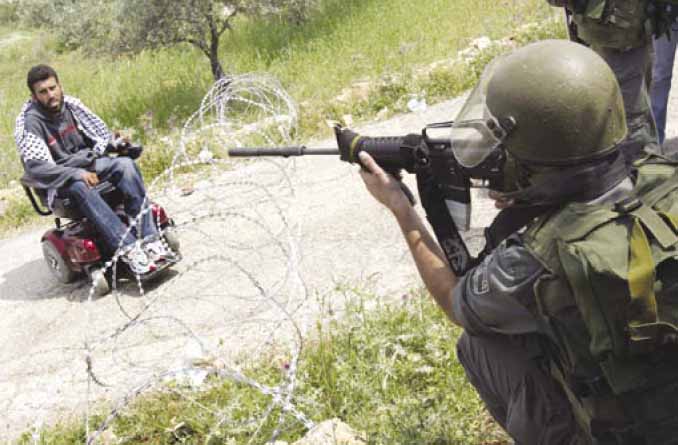
The Electronic Intifada contributor Jody McIntyre recently interviewed Palestinian activist Rani Bornat about his life after being shot by the Israeli army.
Rani Bornat: My name is Rani Abdelfatah Ibrahim Bornat, and I’m 29 years old. I’m from the village of Bilin, west of Ramallah. I was shot in the throat on the first day of the second intifada.
Jody McIntyre: How was your life before you were injured?
RB: Before it happened, my life was like any other young person. I used to study, go horse riding, herd my goats, ride donkeys … do all the things farmers do. My dream was to finish school, but I was deprived of it. I was to become an electronic engineer, and I was also deprived of that. God willing, I will be able to help my children study to become engineers instead.
It was while I was waiting to hear back from universities about continuing my studies, when the al-Aqsa intifada broke out in Palestine …
JM: Tell me about how you were injured.
RB: It was Saturday, 30 September 2000, the first day of the uprising. We marched to one of the checkpoints near Ramallah to protest against Sharon’s entering of the al-Aqsa mosque. It was a nonviolent demonstration, like the ones here in Bilin, with people chanting and holding up posters. But the soldiers didn’t respond with tear gas or rubber bullets, only live ammunition, because it was their aim to kill as many Palestinians as possible.
I wasn’t shot with a normal bullet, but a special “butterfly” bullet, so-called because of the way it spins as it flies through the air. It entered my throat and cut the artery that connects and nourishes my body and brain. Now I have an artificial artery. Because the artery was cut, and I had a blood clot in my brain, they had to tie two ends of the artery together. I had a stroke on my left side, and my right arm was left paralyzed.
It was a very dangerous situation — I was taken to a hospital in Amman, where I stayed for seven months. For the first two months I was in a coma. I was operated on many times … life-threatening operations. Everyday, people were just waiting for the moment I would die. At first, on the news they said I was a martyr; my father heard on the radio that his son had died. Later, they changed the report, and said that I was a “living martyr.”
When I recovered from the coma, I was struggling to speak, I had lost my memory and I couldn’t move my arms or legs.
JM: How did your family and other people from the village react to what had happened?
RB: When the people from the village saw me come home, still alive, they were so happy, because everyone thought that I would die from my injuries. Some of the family were crying with joy! All my friends were coming to visit me and stay with me … sometimes I had to tell them to leave because I was tired and wanted to sleep! I told them to act like before, so that I could continue with my life as normal.
JM: Do you participate in the demonstrations at the wall here in Bilin, or are you too scared after your past experiences?
RB: Firstly, I would like to tell you that I have been shot many times in the demonstrations in Bilin. Secondly, I would like to tell you that the best person to ask is Jody; he will tell you if I’m scared or not!
JM: So you’re a little bit scared?
RB: I’m not scared.
These are peaceful protests; if we don’t fight for our land, then who can? If we don’t fight for the truth, then who can? If we don’t stand side by side and resist this occupation together, then who can? Peaceful demonstrations don’t hurt or kill anybody; they are only there to serve the oppressed. We must tear down this wall, so that we can live with peace … and freedom.
JM: Has your wheelchair ever been broken during a demonstration?
RB: Once, we had a demonstration in Bilin for disabled people, which I organized. Normally, we would protest right up at the wall, but on this occasion, the soldiers started shooting tear gas before we were even within sight. They started to shout that “after today, there will be no more demonstrations in Bilin” … it was because the week before, they had shot an Israeli lawyer who was participating with us. So they wanted to stop the demonstrations because they were afraid of killing Israelis, not Palestinians! But that was a few years ago, so they haven’t done a very good job on the “no more demos” promise …
It was a very powerful symbol of the occupation, to see the Israeli army shooting at the blind and people in wheelchairs. They shot three tear gas canisters at my wheelchair and broke it completely.
JM: Do you think that the Israeli army deal with you differently because you are in a wheelchair?
RB: They treat me exactly the same. They don’t care if I am in a wheelchair or if I’m walking — according to them, I am a threat to the State of Israel, as ridiculous as that may sound.
Maybe they think I want to take revenge for what has happened to me, but I want to tell them that I am a man who wants peace. Even if they destroy my whole life, I only want to make peace.
JM: How do you envision the future?
RB: I am married now, and we have just welcomed three beautiful children, triplets, into the world. I want to start a new life.
Everybody living under the occupation is pessimistic, but I have hope that we can end it. I want to be able to live in freedom, to be able to travel without seeing walls or checkpoints — those are the real things that restrict my movement!
JM: Are you happy to see someone in a wheelchair from London going to demos with you?
RB: When I first saw you, I loved you, because you’re in a wheelchair like me. But it’s not important if you’re in a wheelchair or not … what’s important are the ideas, the resistance, that’s in your mind.
Jody McIntyre is a journalist from the United Kingdom, currently living in the occupied West Bank village of Bilin. Jody has cerebral palsy, and travels in a wheelchair. He writes a blog for Ctrl.Alt.Shift, entitled “Life on Wheels,” which can be found at www.ctrlaltshift.co.uk, where a version of this article was originally published. He can be reached at jody.mcintyre AT gmail DOT com.
The use of Palestinian civilians as human shields
Part 15 of a series recounting the findings of South African jurist Richard Goldstone’s UN Fact Finding Mission on the Gaza Conflict.
Bethlehem – Ma’an – At midnight on 10 January 2009, Israeli soldiers violently entered the home of Mahmoud Al-Ajrami, where he and his wife were sheltering underneath the stairs.
Soldiers threw a grenade and entered the house shooting. What Al-Ajrami says transpired over the next 48 hours left him with two fractured vertebrae as a result of beatings, and was one of four cases in which civilians were used as human shields that Richard Goldstone’s UN inquiry investigated.
These civilians were allegedly forced to enter houses at gunpoint in front of or, in one case, instead of soldiers. Two incidents took place east of Jabaliya.
The case of Mahmoud Al-Ajrami
Al-Ajrami, a former foreign minister, testified in Gaza City last June. He resigned when Hamas took over and has not worked since. He, his wife and 15-year-old daughter lived in a house west of Beit Lahiya. His home was directly hit for the first time on 2 or 3 January 2009, according to him by tank shells and by missiles fired by Apache helicopters, which seriously damaged external and internal walls.
“I don’t know why the Israeli army did what it did, especially since I was in a civilian house. There wasn’t one bullet fired from my house or from the neighboring houses,” he recounted. “And I asked this question to one of the officers later … this question still challenges me.”
Tanks that came into the area were initially positioned around 500 meters north of his house. As he told Goldstone, Al-Ajrami had decided not to leave because of his father’s experience of leaving his home in Israel and not being able to return. But he decided that this was proving too difficult for his daughter. He called a taxi and his daughter moved to the house of an uncle in a safer area.
“The soldiers came in while firing and guns shooting. … At one point we were facing them, so I started talking to them in a loud voice, telling them, ‘we are here, we are the owners of this house, we are civilians,’ and my wife was saying more or less the same. …”
An officer ordered Al-Ajrami to lift his robe (he was in nightclothes) and turn around. “I was there with my wife, wearing pajamas and bathrobes, because this was January and you know it’s very cold, and these are the coldest days of the year in Palestine,” he said.
“One of them – actually there were about 20 to 25 soldiers inside the house, and like I said, we were in the corner, although we tried to get closer to them – and one of them yelled at us in broken Arabic and I couldn’t understand him … So when I got closer to him, he pointed his gun at me with the laser beam, of course, pointing at me, so I moved my hands and said, ‘please, just stop, stop, don’t shoot. I don’t understand what you need, what you want.’ …
“His first question was ‘what are you doing here,’ and I said, ‘this is my house, this is my home and it’s quite natural to be at home, and I don’t know, frankly speaking, what are you doing here, because my presence here is natural, your presence is not natural.’ So he insulted me, using extremely crude words and he said, ‘you have to remove your shirt, turn around.’ I did, and he – maybe he expected me to be carrying a bomb … Then he asked me to move ahead. …
They were then taken to a neighboring house where soldiers took his ID card and checked it on a laptop.
“And then he said, ‘well, you’re going to stay with us’ and he started then asking the questions, ‘I’m gonna give you five minutes and then you will have to tell us in detail where is [captured Israeli soldier] Gilad Shalit. Where are the Hamas tunnels located and where are the Hamas militants, where are the rockets’ and so on.”
Al-Ajrami responded that he could not provide that information because he did not know, that he was previously a member of the Fatah administration. “So he said, ‘well, I’ll come back to you.’ … He told me, ‘if you don’t speak we will take you and we will kill you,’ and I remember exactly what he said, ‘if you don’t talk we will take you and shoot you,’ and he repeated the same sentence over and over again. So I said, ‘I don’t have any information. I don’t know what I can tell you.'”
According to Goldstone, the soldier responded: “You are Hamas; Hamas killed all Fatah and others in Gaza, so you must be Hamas.” Al-Ajrami insisted that he was a civilian. The officer told him again that he had five minutes in which to give him information or he would be shot. Five minutes later, Al-Ajrami again responded that he did not know anything about the questions asked.
“So he said, ‘what do you do.’ I said, ‘I work as the assistant of the minister.’ He said ‘which minister,’ I said ‘the foreign minister.’ So he said, ‘then you’re the assistant of Dr Mahmoud Al-Zahar, the [de facto government] foreign affairs minister.’ I said, ‘well, I worked with all of the ministers of foreign affairs.’ We stopped there and then he said ‘you’re a Hamas member’ and I said, ‘no, this is my job as a diplomat at the foreign affairs minister. I don’t belong to any party.’
“Then he said, well, ‘you don’t want to speak,’ and I said, ‘no,’ so he yelled at me and he was extremely angry. He started insulting me, he insulted my mother, using words, extremely offensive words that nobody can imagine. So I said, ‘look, you can take me wherever you want, I can’t do anything about it. You’re an army, you have your forces, your tanks are stationed here …’
Al-Ajlami was handcuffed and blindfolded. Two or three soldiers took him by the shoulders and forced him to walk in front of them. His wife tried to go with him but they pushed her back into the room. It was by now around 2am. “My wife had her hands tied, was hanging to my robe, and she said ‘please take me with him’ and she was screaming and she said, ‘I’m not going to leave him, take me with him.’ One of the soldiers pushed her back, so she fell on the ground and he said, ‘no, you are not to move.’ So I left.
‘I thought they were going to shoot me’
The soldiers took Al-Ajlami up to the second floor of the building and threw him off. He landed on rubble and fainted. When he came to, he had severe pain in his right side and had difficulty breathing. He found out later that he had broken four ribs and he had severe bruising down his right leg.
“I didn’t expect that I was going to be thrown off the second floor, and of course, it goes without saying, I couldn’t do anything about it. …
It was raining and still dark. Four soldiers forced him to stand. He was moaning with the pain but did not want them to hear. “I didn’t want to scream. I tried to hold myself, I tried to restrain myself. They put me up and I had to walk but I was in extreme pain. I realized that I could not walk; that the right side, there were a lot of bruises and I saw them later when I reached the hospital.”
The soldiers pushed him against a wall and walked away. He thought they were going to shoot him. He was still blindfolded. “I tried to look from underneath the blindfold, I saw the soldier’s feet, and I heard [from a witness] later on that when they brought him to join me, he saw them holding their guns and pointing their guns at me and he thought that they were going to shoot me and shoot him also.”
Early the next morning, the soldiers took him and another man (whom he subsequently found out to be his neighbor Abbas Halawa) and forced them to walk in front of them. Al-Ajrami was blindfolded and a gun was held to the back of his head. He thinks that there were around 25 soldiers behind him and the other Palestinian man. Having walked in this way for a while, both he and the other man were forced to enter several houses with the soldiers taking cover behind them. They did not find anyone in any of the houses.
“I had a lot of difficulty walking and it was rough road. It was difficult to walk on that road and my movements were extremely difficult and we were blindfolded, our hands were tied. This is in addition to the acute pain I was feeling. I spoke to one of the Israeli soldiers who was behind me, and of course, we could feel the guns on our heads, also on the broken ribs on my back, and I told him I’m in extreme pain and he insulted me and he said ‘just walk, go, go,’ he said.
“Now, there were both of us, Abbas Halawa and myself and we kept walking, and when we got closer to a house, and because we could still see that, they would just push us ahead, meaning that they were hiding behind us. And on more than six or seven occasions they started shooting. So whenever they heard a strange noise and it was windy, because it was wintertime, they would start shooting. And we went on like this until we reached a a military location where there were a lot of tanks, also machine guns, soldiers.”
After searching several houses, the soldiers, Al-Ajrami, and Halawa walked north toward Dogit, a former settlement. He could hear the movement of tanks and see tank positions. Both men were forced to sit on the ground. They were left there without food, water or blankets. “They threw us on the floor next to each other with Mr Abbas Halawa and we stayed like this until the morning.”
At around 10am, soldiers took Halawa for interrogation. “I kept just writhing and writhing because of the pain, it was extremely cold. I was trembling and shivering. … It was around 11:00am and the soldiers came and took me. I told them don’t touch my right arm because I’m in extreme pain and I could not stand up, so they carried me.”
During that and the following day, Al-Ajrami was interrogated, once by a senior officer. “I realized that I was face to face with an Israeli officer, blond guy, blue eyes, in his 50s. I think he’s a general, I didn’t pay attention to his rank. And I felt, somehow, questioning myself why I was put that way, as if I were a terrorist. … And he said ‘look me in the eyes, I’m an intelligence officer, and I can understand whether you lie or not because we study psychology.’ I said, ‘I also have a PhD in mental health,’ and he just nodded and I think he didn’t feel happy about it, because he replied in a very, very harsh manner.
“And he repeated the same questions, again, and when I gave him the same reply again, he said that Hamas killed everybody and I laughed and he asked me about the whereabouts of Gilad Shalit and the rockets and what have you. … I said, ‘why are you treating me that way.’ He asked me to approach. I said, ‘I can’t.’ He said, ‘why.’ I said, ‘because one of your soldiers [threw] me off the second floor.’ He asked the soldiers to drive me forward where there was a boulder of debris and all soldiers there and tanks were coming and going and rockets were falling from the aircraft and the atmosphere was quite tense.
“And he said, ‘this is your house’ and I looked at the sea, to see that my house was there because it was on a hill. ‘Yes,’ I told him … he said that it was a beautiful house. I said, ‘your soldiers destroyed it,’ and he said, ‘we explicitly did that so as to give you a lesson because you elected the number one enemy of Israel, and I said, what’s my fault, what’s my guilt.’ He said, ‘as long as you are alive, you should know that the IDF is there and it is coming.’
“Then there was another officer who intervened and said ‘take him away’ and they brought me back to the ground, and that interrogation was repeated four or five times through the day and night and I was just in the open without any food or water and without any medication, whatsoever. And the next day the interrogation was repeated with me.”
On the second day, Al-Ajlami was taken to the edge of the camp and told to walk back south into Gaza City. “I walked southward toward my house and it was about 1pm and about 100 meters from that point, one of the soldiers took scissors and he cut the plastic handcuffs and they took away the blindfold and they put it in his pocket and then he asked me to go south, not to my house, and to head toward Jabaliya. I said, well, and at that moment I [thought] I was breathing my last because of thirst. I asked for some water. One of the soldiers gave me a small bottle of water and it had a black thread around it, and he said ‘take it’ and I had some water.
Then I said, ‘where should I go, should I go alone.’ He said, yes, ‘but I’m among your soldiers and this is just like an execution process.’ The other insulted me at least ‘go to hell and get lost;’ this is the least I can say.”
Al-Ajlami was able to reach the outskirts of the city and was helped by a stranger to reach a relative’s home, from where he was taken to Ash-Shifa Hospital. On returning to his house, he found it ransacked and vandalized. Many items of value had been stolen, including jewelry and electronic equipment.
The case of Majdi Abd Rabbo
Majdi Abd Rabbo, a man aged 39 at the time of the incident, is married and the father of five children. He is PA intelligence officer.
Abd Rabbo recounted that, at around 9:30am on 5 January 2009, he heard loud banging on the outer door of the house. He asked who was at the door and someone responded in Arabic, ordering him to open the door. He opened the door and saw in front of him a handcuffed Palestinian man, who was intentionally not identified by name in Goldstone’s report.
A group of around 15 soldiers stood behind the Palestinian man. One of the soldiers was holding a weapon to the man’s head. The soldiers pushed the man to one side and four soldiers pointed their weapons at Abd Rabbo. They ordered him to undress down to his underwear. He was then told to dress again and they pushed him into the house.
The soldiers ordered him to call his children one by one. He started with his eldest son, aged 16, who was ordered by the soldiers to strip naked. The same process was followed with the two other sons, aged nine and eight. He then called his daughter, aged 14, who was told to press her clothes to her body and turn around. His wife, who was holding their baby daughter, was also told to press her clothes to her body, and then to take the baby’s trousers off.
Abd Rabbo stated that the soldiers then forced him to walk in front of them as they searched the house, room by room, holding a firearm to his head. They questioned him about the house behind his. He told them that the house was empty and the owner had been absent for four years working in the Sudan. There was a small gap between the two houses, but they were joined at the roof. The soldiers gave him a sledgehammer, the kind used to break stones, and told him to break a hole through the dividing wall. This took around 15 minutes.
From the roof, the soldiers entered the house, pushing Abd Rabbo ahead of them down the stairs while they watched over his shoulders. They had descended only a few steps, however, when the soldiers apparently detected some movement, started shouting, pulled Abd Rabbo back and rushed back into his house over the roof. He heard some gun shots.
The soldiers ran out into the street, forcing Abd Rabbo and the other man with them while they were shooting. Both were taken into an adjacent mosque, where there were a large number of soldiers with military equipment. They were forced to sit down and then handcuffed.
The soldiers used the raised area of the mosque, from where the imam leads prayers, to fire at Abd Rabbo’s house and the houses next to it. He shouted at the soldiers to stop, as his family was still in the house. A soldier told him to shut up or they would shoot him. The shooting continued for around 30 minutes. After a lull, the soldiers warned that there would be a huge explosion and, indeed, about three minutes later there was a huge explosion. The explosion was followed by intensive gunfire and artillery shells.
In the meantime, he had been forced to break a hole in the wall of the mosque and into the neighboring house. He had then been interrogated about his knowledge of Hamas and the location of tunnels. Subsequently, he was taken and detained together with neighbors, men and women, in another house.
When the shooting stopped, soldiers came to fetch him. He was taken to the road near his house. There were numerous soldiers standing next to it, including some officers. He saw a senior officer talking to the soldiers who raided his house, and the officer then came to speak to him, through an interpreter.
‘This is not my job, I don’t want to die’
The soldier said that they had killed the fighters in the house and told him to go inside and come back with their clothes and weapons. Abd Rabbo protested, saying that he just wanted to find out if his family was safe. The officer told him to obey their orders if he wanted to see his family again. He refused to go, and was kicked and beaten by soldiers with their weapons until he gave in.
He approached the house from the street. The entrance was destroyed and blocked by rubble. He went back to the officer and told him that he could not get in. The officer told him to go through the roof instead. He went into his own house, which he found empty, except for a soldier. This reinforced his anxiety about the fate of his family. At this point, there was no major damage to his house. He crossed the roof and went down the stairs into the other house. He was scared that the fighters would shoot at him and shouted, “I am a Palestinian, a neighbor. I am being forced to come into this house.”
In a room at the bottom of the stairs he found three armed young men wearing military camouflage and headbands of the Al-Qassam Brigades, the military wing of Hamas. They pointed their weapons at him. He told them that the soldiers thought they had been killed and had sent him to check. He said he was helpless as they had taken his wife and children. The men told him they had seen everything, and asked him to go back and tell the soldiers what he had seen.
He went back outside, again crossing over the roof of his house. As he approached the soldiers, they pointed their weapons at him and ordered him to stop, strip naked and turn around. After he dressed again, he told them what he had seen. Initially, the soldiers did not believe him. They asked how he knew that they were Hamas militants and he explained about their headbands. The soldiers asked about their weapons. He replied that they were carrying Kalashnikovs. The officer told him that, if he was lying, he would be shot dead.
He was handcuffed and taken back to the family house for detention. At around 3pm, he heard gunfire for around 30 minutes. The soldiers came back for him and took him to the same officer. This time he noticed different soldiers present with different military equipment. Through the translator, the officer told him that they had killed the militants, and told him to go in and bring back their bodies. Again he refused, saying “this is not my job, I don’t want to die.”
He lied to them, saying that the three militants had told him that if he came back, they would kill him. The officer told him that, as they had already killed the militants, he should not worry. He added that they had fired two missiles into the house, which must have killed the militants. When he still resisted, he was beaten and kicked again, until he went into the house via the roof again.
He found the house very badly damaged. The bottom part of the stairs was missing. He again went in shouting, to alert the militants if they were still alive. He found them in the same room as before. Two were unharmed. The third was badly injured, covered in blood, with wounds to his shoulder and abdomen. They asked him what was going on outside and he told them that the area was fully occupied and the soldiers had taken numerous hostages, including his family.
The wounded man gave him his name and asked him to tell his family what had happened. Abd Rabbo promised to do so if he survived and later did so. Another told him to tell the Israeli officer that, if he was a real man, he would come to them himself.
Abd Rabbo returned to the soldiers, who again forced him to strip naked before they approached him. He told the officer that two of the militants were unharmed. The officer swore at him and accused him of lying. Abd Rabbo then repeated the message from the militant, at which the officer and four other soldiers assaulted him with their weapons and insulted him.
The officer asked for his ID card. He replied that it was in his house but gave him the number. The officer checked it via an electronic device. Three minutes later the officer asked him if it was true that he worked with the head of the PA’s intelligence services, which he confirmed. The officer asked him if he was a supporter of Mahmoud Abbas and a Fatah affiliate. He said he was.
The soldiers brought Abd Rabbo a megaphone and told him to use it to call the fighters. He initially refused but did so under threat. As instructed, he told them to surrender, that the Red Cross was present and they could hand themselves over. There was no response.
By then, night had fallen. Abd Rabbo was again handcuffed and taken back to the house. Thirty to forty minutes later, he heard shooting and a huge explosion. Soldiers came to tell him that they had bombed the house and ordered him to go in again and check on the fighters.
Israeli forces had floodlit the area. Abd Rabbo found both his and the neighbor’s house very badly damaged. He could not use the roof of his house to enter the neighbor’s house, as it had collapsed. He went back to the soldiers, who again made him strip, this time to his underwear. He asked where his family was and said that he could not reach the fighters because of the damage to the houses. He accused the soldiers of destroying his house. The officer said that they had only hit the neighbor’s house. He was then handcuffed.
Until this time, Abd Rabbo had been given no food or water, and it was very cold. After a while, his handcuffs were removed, he was told to dress and taken back to the family house, to the room where he found that other people were being held. All the men and boys in this room were handcuffed and their ankles were tied. A soldier came with some drinking glasses and smashed them at the entrance to the room where they were being held. After smashing the glasses, the soldier left again.
Abd Rabbo had developed a severe headache. Another detainee, who spoke Hebrew, called a soldier to say that he was sick and needed medicine. The soldier told him to keep quiet or he would be shot. A woman tied a scarf around his head to ease the pain.
At around 7am, he was taken back to the soldiers outside. He was questioned about the number of fighters in the house. He confirmed that he had seen three.
Two young Palestinian men from the neighborhood were brought over. A soldier gave them a camera and told them to go into the house and take photos of the fighters. The two tried to refuse, and were beaten and kicked. About 10 minutes later, they came back with photos of the three fighters. Two appeared to be dead, under rubble. The third was also trapped by rubble but appeared to be alive and was still holding his firearm. A soldier showed Abd Rabbo the photos and asked if these were the same people. He confirmed they were.
A soldier took the megaphone and told the fighters that they had 15 minutes to surrender, that the neighborhood was under the control of Israeli forces and that, if they did not surrender, they would hit the house with an airstrike.
Fifteen minutes later, a soldier came with a dog, which had electronic gear attached to its body and what looked like a camera on its head. Another soldier had a small laptop. The handler sent the dog into the house. A few minutes later, shots were heard and the dog came running out. It had been shot and subsequently died.
At around 10:30am on 6 January 2009, a bulldozer arrived and started to level the house, demolishing everything in its way. Abd Rabbo watched it demolish his own house and the neighbor’s house. He and the two young men were told to go back to the family house. They heard shooting.
At around 3pm, Abd Rabbo was taken back close to the site of his and his neighbor’s house. He told the Goldstone mission that he saw the bodies of the three fighters lying on the ground in the rubble of the house.
The soldiers then forced him to enter other houses on the street as they searched them. All were empty. The soldiers forced him to go into a house alone initially and, when he came out, sent in a dog. During the house searches he managed to find some water to drink, the first drink he had had for two days. At midnight, the soldiers took him back to the family house.
On 7 January, all the men and boys were taken from the family house and transferred to the house of a cousin of Abd Rabbo’s in the same neighborhood. There were more than 100 men and boys, including members of his extended family, aged between 15 and 70. The women were being held elsewhere. Abd Rabbo’s immediate family members were not there, and he learnt that no one had seen them. He remained extremely anxious about their safety.
At around 11pm, the men and boys in that house were told that they were going to be released, and that they should all walk west toward Jabaliya, without turning left or right, on threat of being shot. They found Izbat Abd Rabbo Street severely damaged. Abd Rabbo went to his sister’s house in Jabaliya, where he was reunited with his wife and children.
Abd Rabbo told the Goldstone mission that he and his family were traumatized by what had happened to them and did not know what to do now, having lost their home and all their possessions. His children were all suffering psychologically and performing poorly at school. Five months later, Majdi Abd Rabbo was still having nightmares.
Nablus executions: Shoot first, ask questions later
Bridget Chappell writing from Nablus, occupied West Bank, Live from Palestine, 11 January 2010
 |
Anan Subih’s children in their damaged home. |
The brutal killing of three Palestinian men by Israeli military forces in Nablus last month on 26 December 2009 sparked grief and outrage across Palestine and brought the northern West Bank city to a standstill as thousands mourned the lethal attack. However, their voices are drowned out yet again by a well-played hand of Israel’s propaganda machine and repeated by the mainstream media.
On the eve of the one-year anniversary of Israel’s winter invasion of Gaza, a force of several hundred Israeli soldiers entered Nablus and invaded the homes of Ghassan Abu Sharkh, Raed Sarakji and Anan Subih where they were executed in cold blood in front of family members. A statement by the Israeli military alleged that an operation was carried out to arrest the men suspected of involvement in the killing of an Israeli settler, Meir Avshalom Hai, two days earlier.
The portraits of the targeted men — armed perpetrators of another injustice — painted by the military’s statements have exploded throughout Israel’s media and beyond, subsequently footnoted by Israeli police’s forensic results, reporting a match between a rifle seized in the invasions and the weapon used to kill Hai, a rabbi and resident of the Shave Shomron settlement.
This postmortem revelation, which has not been verified by independent sources, raises alarming questions of Israel’s “shoot first, ask questions later” policy. It also echoes the disparities between the statements of the Israeli military, repeated by the Israeli and international media, and the testimony of the victims’ family members, which were collected by a handful of local media agencies and human rights organizations.
 |
Ghassan Abu Sharkh’s wife, shot in the foot. |
Ghassan Abu Sharkh’s brother Diyaa Abu Sharkh said Israeli military forces stormed their home in Nablus’ Old City at 12am. Sharkh’s wife and four children were forced outside and the entire family was handcuffed, whereupon Sharkh’s eldest son was kicked and beaten by soldiers with the butts of their guns. As Sharkh descended, unarmed, from the stairs inside in hopes of surrendering, soldiers immediately opened fire on him, riddling his body with bullet holes. Outside, Israeli soldiers continued to brutally beat Sharkh’s son while their counterparts prevented Red Crescent ambulances from entering the area.
According to Tahani Jaara, the wife of Raed Sarakji, the Israeli military then forced their way in to their home in the Old City at 2:30am, where Sarakji was shot in the head immediately. The force of the close-range fire was so great that it caused his head to split in two. As his pregnant wife ran forward to catch his falling body she was shot in the foot. Only at this point did soldiers confirm the identity of the man just executed, ordering his wife to hand over both their IDs and mobile phones. Soldiers opened fire once again on his now lifeless body, then ordered his wife to summon their children to behold the grisly remains.
Half an hour later, Israeli soldiers entered Nablus’ Ras al-Ain neighborhood. Quickly occupying several homes surrounding the house of Anan Subih, soldiers began firing anti-tank missiles at the upper levels of the building, blowing a giant cavity between the third and fourth stories. Farid Subih, brother of Anan, reported that soldiers entered the house on foot, firing live ammunition and destroying property as they forced family members out in to the street. Subih was found hiding in the rubble created by rocket blasts, where he was immediately executed.
A spokesman for the Israeli army claimed that after the men “refused to leave their houses and surrender, we entered. They continued hiding and endangering our soldiers, which made the shooting imperative.” How these three men sleeping at home with their families endangered an overwhelming armed military force is unclear. As is the justification for brutally excessive force employed lethally against the targeted men and wantonly upon their family members, including children.
The Israeli military’s trigger-happy strategies for the “liquidation” of those deemed a security risk have resulted in the tragic loss of hundreds of civilian lives in so-called “targeted killing” operations, as a result of both mistaken identity and the excessive use of force employed, such as the launching of missiles from aircrafts, tanks or missile launchers at densely populated areas. Although this did not occur during the 26 December Nablus incursion, it is particularly disturbing that the Israeli military issued a post-execution clarification of at least one of the slain men’s identities.
Israel’s long history of such extrajudicial killing operations carried out in the Occupied Palestinian Territories (OPT) reached its height during and after the second Palestinian intifada. Israel’s assassination policy resulted in the deaths of 754 persons from December 2000 to June 2008 in 348 operations. As reported by the Palestine Centre for Human Rights in July 2008, 521 of those killed were targeted and 233 were bystanders.
Categorical execution without trial constitutes state terrorism, whatever statements military spokespeople may peddle regarding Israel’s exhaustive quest for “security” and the means necessary to enforce it. Whether or not Israeli intelligence’s suspicions of Sarakji, Sharkh and Subih were well-founded, the cold-blooded execution of these and hundreds of other victims are a grave departure from a human’s right to due process. Israel’s tired accusations of terrorism against those it kills are rarely supported by evidence, and only a handful of cases of those killed on these grounds have ever been investigated; fewer still have been accountable for their actions.
There are still plenty of questions left unanswered and will likely remain that way forever. Two groups of two factions, at entirely opposite ends of the political spectrum, claimed responsibility for the attack on the settler: the al-Aqsa Martyrs’ Brigade associated with the Fatah party and the fundamentalist Islamic Jihad.
Of the three men, Sarakji, released from a seven-year prison term last January, was the only one officially wanted by Israel for suspected involvement in the al-Aqsa Martyrs’ Brigade. In contrast, according to his brother, Subih had surrendered his arms and received a full governmental pardon some years ago, while Sharkh’s wife states her husband’s only link to armed struggle was through his brother, who was assassinated by Israeli forces in 2004.
Israel’s attempt to depict their actions as the standard routine of criminal inquiry is clearly a farce. However admissible the findings of the victim’s armed involvement may be in a court of law, it amounts to little when those accused have already been tried and found guilty by the barrel of a gun. Whether these men were guilty or innocent — they were executed without trial in cold blood. They leave behind traumatized children, grieving families and thousands of ex-prisoners and fellow citizens wondering who will be next.
All images by Bridget Chappell.
Bridget Chappell is an Australian activist and writer who has been working with the International Solidarity Movement in Palestine since August 2009. She is based in Nablus.
Charges of Palestinian Child torture in Israeli prisons

Palestine, January 9, 2010 (Pal Telegraph) – Defence for Children International/Palestine Section (DCI/PS) on Wednesday submitted 13 cases to the UN Special Rapporteur on Torture for investigation.
The cases relate to the ill-treatment, and in some cases torture, of Palestinian children being held at the notorious Al Jalame Interrogation and Detention Centre near Haifa, in Israel, between February 2008 and March 2009.
In each case, boys between the ages of 16 and 17, report being held in ‘Cell No. 36’ at the Interrogation Centre. ‘Cell No. 36’ is described as measuring approximately 2×3 metres in which the child is forced to sleep on a concrete bed or a thin mattress on the floor. Meals are passed to the child through a flap in the door depriving him of all human contact. One child reports being held in solitary confinement in ‘Cell No 36’ for 65 days.
The walls of ‘Cell No. 36’ are reported to be grey in colour with sharp protrusions preventing the child from leaning against them for support. Perhaps more disturbingly, ‘Cell No. 36’ does not have any windows and only a single dim yellow light which is kept on 24 hours a day. Some children report suffering pain behind their eyes and adverse psychological effects after being detained in ‘Cell No. 36’.
It appears that the dominant purpose for detaining children in ‘Cell No. 36’ is to break their spirits in order to extract confessions. This conclusion is supported by the testimony of one child who states that ‘on the 10th day of interrogation and because I was under so much pressure, I decided to confess so as to get out of the cell.’ All of the children report being kept in ‘Cell No. 36’ between lengthy interrogation sessions in which clearly prohibited techniques were utilised, such as excessive shackling of the legs and hands as well as position abuse.
Children held in Al Jalame for interrogation are denied access to a lawyer and do not receive family visits, in contravention of the Fourth Geneva Convention and multiple human rights treaties. No education is provided to the children at this facility. Further, the detention of Palestinians from the Occupied Palestinian Territory in Al Jalame is in clear violation of Article 76 of the Fourth Geneva Convention (1949), which states that an occupying power must detain residents of occupied territory in prisons inside the territory i.e. in the West Bank.
DCIP-alestine has requested that the UN Special Rapporteur on Torture investigates and reports on the allegations of ill-treatment and torture of Palestinian children at the Al Jalame facility.
There are currently 306 Palestinian children being held in Israeli detention facilities. For further information please see DCIP-alestine’s latest report on child detainees.
– windowintopalestine
Flour mill targeted ‘for the purpose of denying sustenance’
Part 14 of a series recounting the findings of South African jurist Richard Goldstone’s UN Fact Finding Mission on the Gaza Conflict.
Bethlehem – Ma’an – When the Al-Bader flour mill was destroyed on 9 January 2009, the strike happened without prior warning, raising questions about the efficacy or seriousness of the warnings system used by Israeli forces during their devastating assault on Gaza last winter.
Odder still was that in two prior instances, Israel did warn mill owner Rashad Hamada that its jets intended to strike immanently, leading to two evacuations of the mill, neither of which ended in strikes.
On 30 December 2008, a recorded warning was left on the flour mill’s answering machine by Israeli forces, indicating that his building should be evacuated immediately. The approximately 45 workers in the mill at the time were evacuated.
“We received a recorded message by telephone on a landline asking us to evacuate the mill. This call came from Israel,” Hamada said, in testimony to Richard Goldstone’s UN inquiry.
“We evacuated the factory of all workers, a total evacuation and waited until the next day. The factory was not hit.”
Following the evacuation, Hamada called a business associate in Israel, explained what had happened and asked him for advice. The associate spoke with contacts in the Israeli military, and had been told that, although the mill had been on a list of proposed targets, they had decided not to proceed with the strike. Hamada did not receive any information as to why his mill might have been targeted.
Based on these conversations and the fact that there had been no strike, the mill’s employees returned to work the next day. Work continued for a number of days as flour ran out across the Strip, until a second recorded warning was received on or around 4 January 2009.
“We received another message,” Hamada said. “We were told to evacuate the factory. The factory was evacuated.”
Again, there was no attack. “They were put into a state of fear as a result of the false alarms,” Goldstone’s report states.
Hamada received a call later in the week from his business associate in Israel, who said Israeli forces told him the mill would not be hit. The employees returned to work in light of the information.
Then on 9 January, without warning, “we received a call from the guard telling us that the factory was targeted by air with a missile and that it had caught fire. After 15 minutes, he called us again and told us that there are tanks approaching the area and that the factory was targeted with tank fire. We immediately informed the [Red Cross] and the Civil Defense in order to put out the fire in the mill,” Hamada said.
The flour mill was hit by an airstrike, possibly by an F16. The missile struck the floor that housed one of the machines indispensable to the mill’s functioning, completely destroying it. In the next 60 to 90 minutes the mill was hit several times by missiles fired from an Apache helicopter. These missiles hit the upper floors of the factory, destroying more key machinery.
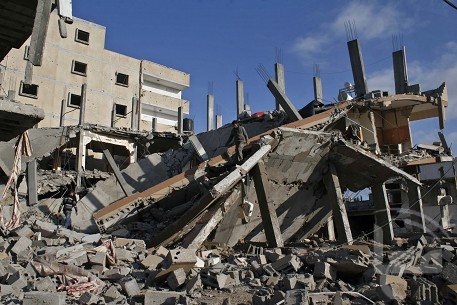
Hamada recounted: “What happened at the mill is a total destruction, a total destruction of the whole production line of the factory. Because this factory, in fact, is vertical, the equipment is set vertically. There are six floors. The production line was destroyed from the sixth floor to the ground floor. Three floors, the fifth, sixth and fourth, were destroyed including all the equipment, total destruction, therefore the building and the equipment. And the other three floors, the first, second and third floors, they were totally burned.”
Adjoining buildings, including the grain store, were not hit. The strikes entirely disabled the factory, which has remained in disrepair because of the siege on building supplies. Even amid subsequent food shortages, a large amount of grain remains at the site but cannot be processed.
“During the war, the mill was working 24 hours a day and we had also been working 24 hours a day one month prior to this date; we were working around the clock,” Hamada said. “As for the targeting, it is because a flour mill [was] working. There were four flour mills that were not producing and were not targeted.”
Israeli forces occupied the disabled building until around 13 January. Hundreds of shells were found on its roof after the soldiers left. They appeared to be 40-mm grenade machine-gun spent cartridges.
Attacks on the foundations of civilian life in Gaza
Goldstone’s team said Hamada and his brother provided information that was corroborated by other representatives of the Gaza business community with whom the investigators discussed the context and consequences of the strike on the flour mill.
The consequences of the strike on the flour mill were significant, his report states. Not only are all the employees out of work, the capacity of Gaza to produce milled flour, the most basic staple ingredient of the local diet, has been greatly diminished. As a result, the population of Gaza is now more dependent on the Israeli authorities’ granting permission for flour and bread to enter the Gaza Strip.
“From what we could see on the ground and from what we had in Gaza, this flour mill was the only flour mill for the past ten years providing for the needs of the Gaza Strip in wheat,” Hamada said. “It is well-known everywhere in Gaza. And in Israel, they know that Al-Bader Flour Mill [which is] the strategic reserve of flour for the strip, was there.”
“There is no flour mill that works except ours and it was shelled. I do not want to give conclusions. It is well-known, this is a flour mill that works and that provides for the needs of the country. It was targeted because we are in a state of war. There is no peace. What I know is that war is war. We hope that all of this will end and will be replaced by peace and that we will forget about these hearings.”
The Israelis have apparently not investigated the flour mill’s destruction, according to the report, nor made any suggestion that the site was targeted for military purposes.
Nevertheless, Hamada rejected any suggestion that the building was at any time used for any purpose by Palestinian armed groups. They pointed out that all of the buildings and factories were surrounded by a high wall and manned by at least one guard at night.
“There is no resistance there,” Hamada said. “After the end of the war, I went to have a look and I asked are there any combatants that died here, any Israelis that died? Not at all, nobody told me of any kind of resistance in the whole area.”
I do not know what they were targeting, I wasn’t there,” Hamada conceded. “However, I saw the results of the firing in the flour mill, … Testimony has to be real, it’s a word of truth, I cannot tell you what they targeted or who they targeted. What I did see are the empty bullets in the factory, on the factory roof, that’s what I saw.”
He added, however, that “All the factories in the eastern region were destroyed. Did they also have resistance? I don’t know, but what I do know is that vital factories were targeted. Why? Because war is war, I say it again, and we want peace, enough war.”
Addressing the UN mission directly, Hamada added: “We do not want words, we want acts. We want the United Nations to take action. We have been suffering for two full years under siege. We did not see the United Nations doing anything for us. We see that in Darfur there is a problem, the whole world goes running to Darfur, in Cambodia and Laos, everywhere in the world, but here, when we speak of the Palestinian people, everybody closes his ears, they do not want to hear about us or our problems.”
Starvation as a method of warfare is prohibited
No other buildings in the industrial compound belonging to the Hamadas were damaged at the time of the strikes. “It appears that the strikes on the flour mill were intentional and precise,” Goldstone’s final report states.
Hamada and his brothers are well-known businessmen. Israeli authorities did not appear to consider them either before or after the military operations to be a threat, given the unrestricted issuance of their Businessman Cards and their ability to travel to Israel afterwards.
“The issuance of a Businessman Card is no trifle, especially in the context of the ongoing restrictions on trade. It is not plausible that the Israeli authorities would issue such a document to any party it regarded with suspicion,” the report notes.
As for whether the flour mill could have been deemed a military objective, Goldstone notes that the building was one of the tallest in the area and would have offered extensive views to Israeli forces. The mission notes that taking control of the building might be deemed a legitimate objective in the circumstances.
“However, by 9 January the Israeli armed forces were fully aware that the flour mill could be evacuated at short notice by using the warning message system. If the reason for attacking the mill was to gain control of it for observation and control purposes, it made no sense to bomb the principal machinery and to destroy the upper floors.
There is also no suggestion that Israeli forces considered the building to be a source of enemy fire, the report states.
“The nature of the strikes on the mill and in particular the precise targeting of crucial machinery on one of the mid-level floors suggests that the intention was to disable its productive capacity,” Goldstone alleges. “There appears to be no plausible justification for the extensive damage to the flour mill if the sole objective was to take control of the building. It thus appears that the only purpose was to put an end to the production of flour in the Gaza Strip.”
According to the report, “there has been a violation of the grave breaches provisions of the Fourth Geneva Convention. Unlawful and wanton destruction which is not justified by military necessity would amount to a war crime.”
Having concluded that the strikes were without any military justification, and therefore wanton and unlawful, the mission found it useful to consider if there was any non-military purpose to the strikes. “The aim of the strike, if not military, could only have been to destroy the local capacity to produce flour.” Thus, according to Goldstone, the question is whether such deliberate destruction of the sole remaining flour-producing capacity in the Gaza Strip can be described as having been done for the purpose of denying sustenance to the civilian population.
International law, the report describes, prohibits acts whose specific purpose is the denial of sustenance for whatever reason, including starvation, forced displacement or anything else. “In short, the motive for denying sustenance need not be to starve the civilian population. Indeed, the motive is irrelevant.”
Due to the ongoing Israeli-led blockade, Gaza’s civilian population is increasingly dependent on external humanitarian assistance, whose arrival depends on permission from Israeli authorities. While it is not suggested that starvation is imminent, the health and welfare of the population at large have been profoundly affected by the blockade and the military operations.
“The only reason why starvation is not imminent however is precisely the provision of humanitarian assistance. Without such assistance Gaza’s civilian population would not be able to feed itself,” the report notes.
“States cannot escape their obligations not to deny the means of sustenance simply by presuming the international community will fill the gap they have created by deliberately destroying the existing capacity.
“From the facts ascertained by it, the Mission finds that the destruction of the mill was carried out for the purpose of denying sustenance to the civilian population, which is a violation of customary international law,” the report concludes, “and may constitute a war crime.”
Army harassment at peaceful tree-planting in Qaryut
International Solidarity Movement | January 8, 2010
An overwhelming force of Israeli military soldiers converged on farmlands outside Qaryut today as villagers attempted to replenish their endangered lands with water and new olive trees. Despite the overbearing army presence, residents’ convictions were strong enough for them to stand their ground and finish work for the day.
Villagers entered the Qaryut’s eastern farmlands following the midday prayer, carrying 200 baby olive trees donated by Palestinian Agricultural Relief and the Ministry of Agriculture. Facing the busy Nablus – Ramallah Road 60 route, and the Israeli settlements of Shilo and Eli behind them they set to work planting the new trees in the land oft neglected by farmers from fear of settler or army reprisal.
As residents worked the land, others began clearing the large earth mound that had been constructed across the small dirt road serving as Qaryut’s sole link to Road 60. Residents reported Israeli bulldozers shifting the earth mound in to place on January 6th, a repeated attempt of the military to block farmers from their land. The villagers’ work alerted the attention of Shilo settler security, who were sighted on the hilltop overlooking the farmland, photographing the proceedings.
Israeli Occupation Forces arrived soon after. One hummer carrying 20 soldiers immediately entered the area, shouting aggressively at the Palestinians that they had no right to be working their own land.
“I decided to approach the captain,” said Rayed, resident of Qaryut and co-organiser of the event. “He started to yell at me in Hebrew and I told him, this is Palestine. We don’t speak Hebrew here, we speak Arabic – or maybe English.”
The captain became enraged, but switched to English and informed Rayed that he and the villagers must return to their homes within 5 minutes, before the soldiers “started their work.”
“I said to him, what work?” recounts Rayed. “What is your work? To kill us? Well, he became very angry at that. But I told him that we will keep planting our trees, this is all we came here to do. The security of Israel will not be compromised by us planting some trees.”
By this time 11 more military jeeps had arrived, comprising a force of some 50 soldiers in total who quickly surrounded the farmland where the villagers continued to work. The trees planted successfully in the ground, the villagers prepared to leave as once again the soldiers became aggressive.
“They started shouting at us for leave, to go home,” says Rayed. “We were already on our way, but we didn’t need them to yell at us. They looked like they were about to attack. The captain approached me and demanded that we not intefere with the roadblock. I told him that the roadblock prevents tractors from accessing the crops, and that it is obvious the purpose of the roadblocks’ location is to make it easier for the settlers to conquest the land. If it was anything else, they’d put it directly at Road 60.”
The roadblock has been an ongoing impediment to Qaryut’s residents freedom of movement, and preventing farmers from accessing their lands. Several successful demonstrations were held last year when international solidarity activists joined hundreds of local protesters in removing the roadblock by hand, only for military bulldozers to rebuild it the following day.
Calling Bono – Your Palestinian Gandhis Exist … in Graves and Prisons
By Alison Weir | January 8, 2010
Dear Bono,
In your recent column in the New York Times, “Ten for the Next Ten,” you wrote: “I’ll place my hopes on the possibility — however remote at the moment — that…people in places filled with rage and despair, places like the Palestinian territories, will in the days ahead find among them their Gandhi, their King, their Aung San Suu Kyi.”
Your hope has already been fulfilled in the Palestinian territories.
Unfortunately, these Palestinian Gandhis and Kings are being killed and imprisoned.
On the day that your op-ed appeared hoping for such leaders, three were languishing in Israeli prisons. No one knows how long they will be held, nor under what conditions; torture is common in Israeli prisons.
At least 19 Palestinians have been killed in the last six years alone during nonviolent demonstrations against Israel’s apartheid wall that is confiscating Palestinian cropland and imprisoning Palestinian people. Many others have been killed in other parts of the Palestinian territories while taking part in nonviolent activities. Hundreds more have been detained and imprisoned.
Recently Israel has begun a campaign to incarcerate the leaders of this diverse movement of weekly marches and demonstrations taking place in small Palestinian villages far from media attention.
The first Palestinian Gandhi to be rounded up in this recent purge was young Mohammad Othman, taken on Sept. 22 when he was returning home from speaking in Norway about nonviolent strategies to oppose Israeli oppression and land confiscation. He has now been held for 107 days without charges, much of it in solitary confinement.
The second was Abdallah Abu Rahma, a schoolteacher and farmer taken from his home on Dec. 10, the only one to be charged with a crime. After holding him for several days, Israel finally came up with a charge: “illegal weapons possession” – referring to the peace sign he had fashioned out of the spent teargas cartridges and bullets that Israel had shot at nonviolent demonstrators. (One such cartridge pierced the skull of Tristan Anderson, an American who was photographing the aftermath of a nonviolent march, causing part of his right frontal lobe to be removed.)
The third was Jamal Jumah’, a veteran leader in the grassroots struggle, who was taken by Israeli occupation forces on Dec. 16th and is now being held in shackles and often blindfolded during Kafkaesque Israeli military proceedings.
Palestinians have been engaging in nonviolence for decades.
When I was last in Nablus I learned of a massive nonviolent demonstration that had occurred in 2001 – estimates range from 10,000 to 50,000 Palestinian men, women, and children taking part in a nonviolent march. All sectors of Nablus had joined together in organizing this – public officials, diverse parties, religious, secular, Muslim, Christian.
Modeling their action on images of Dr. Martin Luther King, they marched arm-in-arm, believing that Israel would not kill them and that the world would care. They were wrong on both counts. Israeli forces immediately shot six dead and injured many more. And no one even knows about it. At If Americans Knew we are currently working on a video to try to remedy the last part; there’s nothing we can do about the dead.
But there’s a great deal you can do, Bono. You can use your talent and celebrity to tell the world these facts. You can write a New York Times op-ed about the Palestinian Gandhis in Israeli prisons and call for their freedom. You can sing of these Palestinian Martin Luther Kings you wished for, and by singing save their lives.
For the reality is that nonviolence is only as powerful as its visibility to the world. When it is made invisible through its lack of coverage by the New York Times, the Associated Press, CNN, Fox News, et al, its practitioners are in deadly danger, and their efforts to use nonviolence against injustice are doomed.
In the New York Times you publicly proclaimed your belief in nonviolence. Now is your chance to demonstrate your commitment.
* * *
Killed by Israeli forces while demonstrating against the Israeli wall being built on Palestinian land [http://palsolidarity.org/2009/06/7647]
5 June 2009:
Yousef ‘Akil’ Tsadik Srour, 36
Shot in the chest with 0.22 calibre live ammunition during a demonstration against the Wall in Ni’lin.
April 17, 2009:
Basem Abu Rahme, age 29
Shot in the chest with a high-velocity tear gas projectile during a demonstration against the Wall in Bil’in.
December 28, 2008:
Mohammad Khawaja, age 20
Shot in the head with live ammunition during a demonstration in Ni’lin against Israel’s assault on Gaza. Mohammad died in the hospital on December 31, 2009.
December 28, 2008:
Arafat Khawaja, age 22
Shot in the back with live ammunition in Ni’lin during a demonstration against Israel’s assault on Gaza.
July 30, 2008:
Youssef Ahmed Younes Amirah, age 17
Shot in the head with rubber coated bullets during a demonstration against the Wall in Ni’lin. Youssef died of his wounds on August 4, 2008.
July 29, 2008:
Ahmed Husan Youssef Mousa, age 10
Shot dead while he and several friends tried to remove coils of razor wire from land belonging to the village in Ni’lin.
March 2, 2008:
Mahmoud Muhammad Ahmad Masalmeh, age 15
Shot dead when trying to cut the razor wire portion of the Wall in Beit Awwa.
March 28, 2007:
Muhammad Elias Mahmoud ‘Aweideh, age 15
Shot dead during a demonstration against the Wall in Um a-Sharayet – Samiramis.
February 2, 2007:
Taha Muhammad Subhi al-Quljawi, age 16
Shot dead when he and two friends tried to cut the razor wire portion of the Wall in the Qalandiya Refugee Camp. He was wounded in the thigh and died from blood loss after remaining in the field for a long time without treatment.
May 4, 2005:
Jamal Jaber Ibrahim ‘Asi, age 15
Shot dead during a demonstration against the Wall in Beit Liqya.
May 4, 2005:
U’dai Mufid Mahmoud ‘Asi, age 14
Shot dead during a demonstration against the Wall in Beit Liqya.
February 15, 2005:
‘Alaa’ Muhammad ‘Abd a-Rahman Khalil, age 14
Shot dead while throwing stones at an Israeli vehicle driven by private security guards near the Wall in Betunya.
April 18, 2004:
Islam Hashem Rizik Zhahran, age 14
Shot during a demonstration against the Wall in Deir Abu Mash’al. Islam died of his wounds April 28, 2004.
April 18, 2004:
Diaa’ A-Din ‘Abd al-Karim Ibrahim Abu ‘Eid, age 23
Shot dead during a demonstration against the Wall in Biddu.
April 16, 2004:
Hussein Mahmoud ‘Awad ‘Alian, age 17
Shot dead during a demonstration against the Wall in Betunya.
February 26, 2004:
Muhammad Da’ud Saleh Badwan, age 21
Shot during a demonstration against the Wall in Biddu. Muhammad died of his wounds on March 3, 2004.
February 26, 2004:
Abdal Rahman Abu ‘Eid, age 17
Died of a heart attack after teargas projectiles were shot into his home during a demonstration against the Wall in Biddu.
February 26, 2004:
Muhammad Fadel Hashem Rian, age 25
Shot dead during a demonstration against the Wall in Biddu.
– Hide quoted text –
February 26, 2004:
Zakaria Mahmoud ‘Eid Salem, age 28
Shot dead during a demonstration against the Wall in Biddu.
Notes and Sources:
(1) Israeli was first exposed in the West by the London Times in the late 1970s. Foreign Service Journal [http://www.nytimes.com/2010/01/03/opinion/03bono.html] wrote about Israeli torture of Americans in June, 2002, and Addameer [http://addameer.info/?p=496] gives specifics today.
(2) Al Haq, the West Bank affiliate of the International Commission of Jurists – Geneva, writes: [http://freemohammadothman.wordpress.com/2010/01/] “…as part of their repression campaign, which coincided with the release of the Goldstone Report, the Israeli forces have re-launched daily dawn raids in villages affected by the Wall, arresting youths and children, for the purpose of extracting confessions about prominent community leaders advocating against the Wall, and continued to intimidate activists by destroying their private property and threatening them with detention. Finally, Israel has directly targeted the Grassroots “Stop the Wall” Campaign [http://stopthewall.org/index.shtml]by arresting and intimidating its leaders…His village, Jayyous, has been devastated by the Apartheid Wall
(3) Human Rights Watch [http://www.hrw.org/en/news/2009/12/04/israel-end-arbitrary-detention-rights-activist] found that “”The only reasonable conclusion is that Othman is being punished for his peaceful advocacy…”
(4) Abdallah Abu Rahma was taken [http://www.popularstruggle.org/freeabdallah]when “eleven military jeeps surrounded his house, and Israeli soldiers broke the door, extracted Abdallah from his bed, and, after briefly allowing him to say goodbye to his wife Majida and their three children — seven year-old Luma, five year-old Lian and eight month-old baby Laith, they blindfolded him and took him into custody.”
On Jan. 6th Abdallah wrote: [http://palsolidarity.org/2010/01/10429]:
“I mark the beginning of the new decade imprisoned in a military detention camp. Nevertheless, from within the occupation′s holding cell I meet the New Year with determination and hope…. Whether we are confined in the open-air prison that Gaza has been transformed into, in military prisons in the West Bank, or in our own villages surrounded by the Apartheid Wall, arrests and persecution do not weaken us. They only strengthen our commitment to turning 2010 into a year of liberation through unarmed grassroots resistance to the occupation.
“The price I and many others pay in freedom does not deter us. I wish that my two young daughters and baby son would not have to pay this price together with me. But for my son and daughters, for their future, we must continue our struggle for freedom…”
(5) Tristan Anderson was shot [http://palsolidarity.org/2009/03/5324] with a high-velocity canister after photographing a nonviolent protest in Ni’lin on March 13, 2009. His ambulance was held up for a period of time by Israeli forces before finally being allowed to take him to a hospital. Video of parents’ press conference [http://www.youtube.com/watch?v=FcK_4ksR1fw]
(6) Israeli forces interrogated Jamal Juma’ and then “brought him back home, handcuffed, and searched his house while his wife and three children watched. Then they took him off to prison.” – CounterPunch [http://www.counterpunch.org/hijab12242009.html ] Despite being held for 20 days, [http://stopthewall.org/latestnews/2152.shtml] no charges have yet been brought against Jamal.
(7) The Nablus march mentioned above took place on March 30, 2001, on Jerusalem Street in the south of Nablus, leading to the Huwara checkpoint. This was on what Palestinians call the “Day of the Land” or “Land Day” (information on Land Day can be seen at http://electronicintifada.net/bytopic/255.shtml).
(8) In our study of the Associated Press, “Deadly Distortion,” [http://www.ifamericansknew.org/media/ap-report.html] we commented: “…our analysts looked at hundreds of articles that AP published on topics relating to the Israel/Palestine issue, and noted a number of additional patterns that merit further examination… Nonviolence movement. Palestinian resistance efforts have included numerous nonviolent marches and other activities, many joined by international participants, Israeli citizens, and faith-based groups. This nonviolence movement has been an important topic in the Palestinian territories, with growing numbers of people taking part – in 2004 the Palestinian News Network reported on 79 major demonstrations that were exclusively nonviolent. Yet, we did not find any reports in which AP had described a Palestinian demonstration or other activity as nonviolent or utilizing nonviolence.
Alison Weir is executive director of If Americans Knew, [http://www.ifamericansknew.org/] which provides information about Israel-Palestine. She can be reached at contact@ifamericansknew.org. She phoned and faxed Bono’s management company Principle Management [http://www.fanmail.biz/25157.html] at both their New York and Dublin locations in an effort to contact him but has not yet received a reply. She suggests that others may wish to do this as well: 212.765.2330 / fax: 212.765.2372.
Related articles
- Five kids arrested in Ni’lin village (nilin-village.org)
- Israeli mid-night invasions in Ni’lin, one arrested. (nilin-village.org)
- Palestinian Woman Arrested in Chicago (alethonews.wordpress.com)
Amnesty urges Israel to release or try three Palestinians
By Agence France Presse | January 09, 2010
 |
OCCUPIED JERUSALEM: Human rights group Amnesty International urged Israel on Friday to release or fairly try three Palestinian jailed for protesting against the West Bank separation barrier. The three, two of whom are held without charges, may be “prisoners of conscience, held for legitimately voicing their opposition to the fence/wall,” Amnesty said in a letter to Defense Minister Ehud Barak.
“These men have all been involved in campaigning against the building of this construction, much of it on the land of the occupied West Bank, and we fear that this is the real reason for their imprisonment,” said Malcolm Smart, director of Amnesty’s Middle East and North Africa program.
“If this is the case they must be released immediately and unconditionally,” he said.
Jamal Juma, coordinator of the Stop the Wall campaign, has not been charged with any offence since his arrest on December 16 and has not had access to his lawyer.
He is held under Israeli military law, which applies to the occupied West Bank.
“As someone who holds a Jerusalem ID card, according to Israeli law his case should be handled under the country’s civil, not military, legal system,” the London-based human rights watchdog said.
Mohammad Othman is also held without charge since September 22. He was arrested upon his return from Norway where he met activist groups and campaigned against the wall, Amnesty said.
Abdullah Abu Rahma, who heads Popular Committee Against the Wall in the West Bank village of Bilin, was arrested on December 10.
He has been charged with incitement, stone-throwing, and possession of arms, the latter for collecting spent cartridges and tear gas grenades used by Israeli forces to disperse anti-wall protesters.
“These three men are all well known for their defense of the human rights of Palestinians. In the unlikely event that there are genuine grounds to prosecute these men, they should be charged with recognizable criminal offences and brought promptly to trial in full conformity with international fair trial standards,” said Smart.
Afghan Prisoners Challenge Indefinite Detention
By William Fisher | January 08, 2010 | Excerpt
On Thursday, the D.C. circuit court heard oral arguments in a case known as Maqaleh v. Gates – the first legal challenge in U.S. courts on behalf of prisoners detained at Bagram Airbase in Afghanistan.
The case was brought by the International Justice Network (IJNetwork) on behalf of two Yemenis and one Tunisian citizen, each seized outside of Afghanistan from third countries and held without charge or trial in U.S. custody for more than six years.
Evidence suggests that each man was shuttled through U.S.-run secret prisons (“black sites”) for torture and interrogation, prior to ultimately being transferred to Bagram – itself the site of well-documented human rights violations – where they continue to be subjected to indefinite detention under sole U.S. military custody.
During the entire six-year period he has been in U.S. custody, Maqaleh has not been permitted to see his family and has been denied any access to lawyers or a court of law. Because he is being held virtually incommunicado, his father authorized IJNetwork to file a petition for a writ of habeas corpus in U.S. court seeking his release.
Though his case has now been pending for over three years, the government continues to refuse to allow Maqaleh to communicate with his attorneys.
In April 2009, Judge John D. Bates ruled that Maqaleh and two other petitioners in the case, Amin al-Bakri and Redha al-Najar, have a constitutional right to petition U.S. courts for a writ of habeas corpus.
Judge Bates’ decision was based on the Supreme Court’s decision in Boumediene v. Bush, which established that detainees held in U.S. custody at Guantanamo had a constitutional right to file habeas corpus petitions in U.S. courts.
But before any of the Bagram detainees could have his day in court, the Barack Obama administration appealed Judge Bates’ decision, arguing that none of the 600 detainees at Bagram have any rights under U.S. law.
As the organization representing the Bagram detainees, the IJNetwork has called on the Obama administration to end the practices of rendition, torture, and indefinite detention and provide fundamental human rights to all individuals held in U.S. custody – including at Bagram.
Though President Obama has vowed to close Guantanamo, the Department of Justice continues to defend the George W. Bush administration’s position that individuals held at other U.S.-run military facilities have no legal rights.
Deputy Solicitor General Neal Katyal, arguing for the government, said the circumstances surrounding detention of prisoners at Bagram are unique and do not match the circumstances at the Guantanamo Bay base in Cuba. Katyal noted that Bagram is in the middle of a war zone.
But Tina Foster, executive director of the IJNetwork, who argued for the Bagram detainees, told IPS, “Our clients are three innocent men who have been imprisoned without charge for seven years and haven’t even been told why.”
“The fundamental question at issue in these cases is whether the United States government can seize individuals from peaceful countries anywhere in the world and imprison them without charge indefinitely, based solely on the location of the prison facility where the government decides to detain them,” Foster said.
She added, “The position of the Obama administration is that it can do so, as long as it uses Bagram, instead of Guantanamo, as its legal black hole. This is an extreme position – and one that allows the president to do exactly what the Supreme Court said was unconstitutional in the Guantanamo cases.”
‘Hospitals may in no circumstances be the object of attack’
Part 13 of a series recounting the findings of South African jurist Richard Goldstone’s UN Fact Finding Mission on the Gaza Conflict.
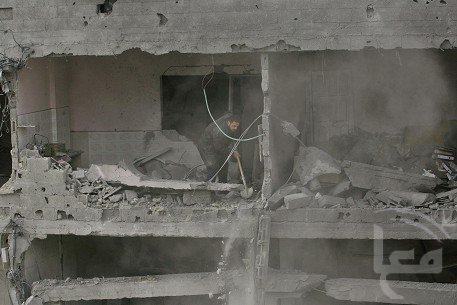 Bethlehem – Ma’an – On 8 January 2009, one year ago today, Israeli artillery shells struck the seventh-floor apartment of Dr Jaber Abu An-Naja, the former PLO ambassador to Senegal and a well-known Fatah politician.
The doctor’s wife and son-in-law were killed immediately as they sat on the balcony eating pastries. His wife was cut in half by the explosion and his son-in-law was thrown from the balcony on to the street below.
His daughter, Ihsan, was seriously injured and taken for treatment to Al-Quds Hospital, a medical center located near Abu An-Naja’s and a number of other civilian apartment buildings on Al-Abraj Street in Gaza’s Tal El Hawa district, which had come under attack for four days.
According to three senior doctors at the hospital and two residents from Al-Abraj Street, at some point between 3 and 6 January several tanks were stationed several hundred meters east of Al-Quds, visible from the hospital’s ambulance depot. Throughout the days of 5-8 January, there was significant artillery fire on apartment buildings nearby to where Abu An-Naja’s relatives were killed.
The shelling on 8 January was just one incident of dozens in and around the area that damaged portions of the hospital and destroyed other buildings in their entirety during Israel’s three-week assault on the Gaza Strip, which ended in late January 2009.
Continuous damage to medical buildings
When the air offensive began on 27 December, for instance, a government building opposite the hospital’s administrative building on Al-Abraj Street was almost totally destroyed. The building had previously served as a criminal detention center and is still referred to locally by that designation although it had recently been used for other purposes, including customs administration. The same building was reportedly struck on a number of other occasions after 27 December, after which the site was completely demolished.
Kitty-corner to the hospital, on Jami’at Ad-Duwal Al-Arabiya Street, was another building rented to the de facto government and used primarily as a public registry office. At the time of writing, only the ground floor of the building remained. Witnesses, speaking to the Goldstone commission, indicated that the upper floors had been destroyed, probably by artillery fire, on 6 and 7 January.
By 15 January, the area immediately to the south of Al-Quds Hospital (the customs building and the registry building) had been totally or very substantially destroyed. The area to the east on Al-Abraj Street had been significantly attacked by artillery fire.
By this time, several hundred civilians had also gathered in the hospital buildings seeking safety.
The Al-Quds Hospital belongs to the Palestinian Red Crescent Society (PRCS). It consists of three buildings facing west toward the sea on the corner of Jami’at Ad-Duwal Al-Arabiya Street and Al-Abraj Street in the area of Tel Al-Hawa.
The building nearest the corner was seven stories high. Its principal purposes were administrative and cultural rather than medical. It stored a huge quantity of PRCS archives. The middle building contained the accident and emergency treatment areas as well as other offices of medical and administrative staff. The building furthest from the corner was the main medical building with operating theaters in the basement. About 200 meters east on Al-Abraj Street was the PRCS ambulance depot.
The buildings all suffered significant damage in the course of an Israeli bombardment on 15 January 2009, which included the use of white phosphorous, endangering the lives of staff and more than 50 patients. There was no warning given for any of the attacks.
Direct Attack on the Hospital
During the night of 14 January, Israeli forces began an extended barrage of artillery fire over the area. It continued into the morning of 15 January. Between 8 and 9am doctors in the main building were in the principal meeting room when shells landed on either side of the building. They saw white phosphorous wedges burning near a container of diesel and efforts were successfully made to move those away.
The initial explosions blew out the office windows. The administrative building on the corner was also hit. Because the hospital building was largely constructed out of timber (rare in Gaza), staff were worried that the fire would spread. A witness described how hospital staff, including senior doctors, all sought to break, by hand, the wooden bridge linking the administrative building to the hospital building, in an attempt to prevent the fire from spreading.
Shortly after the initial explosions and fire were observed, a tank shell directly penetrated the rear of the middle hospital building. That part of the building was made of corrugated iron. The shell made a clearly defined home in the hospital wall, and the impact crater continues through the cement wall into the hospital’s pharmacy.The pharmacy was completely destroyed as a result.
An eyewitness said that through the resulting hole, he observed a tank on a road between two buildings about 400 meters east of the building. Although he could not say whether it was this tank that had struck the hospital directly, it was in a direct line in relation to the entry point of the shell.
No civil defense forces were available to fight the fire at the hospital, so medical staff worked on their own to save the building and ensure the safety of the patients.
It was not until 4pm that the International Committee of the Red Cross (ICRC) was able to respond and help evacuate patients. Officials at the ICRC made it clear upon arrival that it would be able to carry out this procedure only once. Those not evacuated at 4pm were relocated to the operating theaters of the damaged hospital.
At 8pm, another fire broke out in the hospital. As a result, a total evacuation of remaining patients and those who had sought refuge at the hospital was carried out. It was at this stage that one of the senior doctors took an eight-year-old girl who had been struck by a bullet in the jaw and was critically ill to Ash-Shifa Hospital, where she later died. One of the medical staff at the hospital told the Goldstone commission that there was very heavy fire in the area, and he felt sure there were direct hits by Israeli forces on the ambulance depot.
As the hospital was evacuated, the depot, 200 meters to the east in Al-Abraj Street, sustained damage, and one of its principal buildings was entirely destroyed. Remnants of three PRCS ambulances that had been parked at the entrance to the depot were seen were still visible by summer. Two had been crushed by tanks but not burned out. The other ambulance showed signs of having been struck directly in the front below the windscreen by a missile of some description and having been burned out.
The devastation caused to both the hospital buildings, including the loss of all archives in the administrative building, and the ambulance depot was immense, as was the risk to the safety of the patients.
The Israeli position
In the conclusions of their investigations on 22 April 2009, Israeli authorities did not specifically mention the incident at Al-Quds Hospital, although a portion of it addresses some allegations regarding the use of ambulances. In another report, released in July 2009, the Israeli government quotes part of an article from Newsweek magazine:
One of the most notorious incidents during the war was the Jan. 15 shelling of the Palestinian Red Crescent Society buildings in the downtown Tal-al Hawa part of Gaza City, followed by a shell hitting their Al Quds Hospital next door; the subsequent fire forced all 500 patients to be evacuated. Asked if there were any militants firing from the hospital or the Red Crescent buildings, hospital director general Dr. Khalid Judah chose his words carefully. “I am not able to say if anyone was using the PRCS buildings [the two Palestine Red Crescent Society buildings adjacent to the hospital], but I know for a fact that no one was using the hospital.”
In the Tal-al Hawa neighborhood nearby, however, Talal Safadi, an official in the leftist Palestinian People’s Party, said that resistance fighters were firing from positions all around the hospital. He shrugged that off, having a bigger beef with Hamas. “They failed to win the battle.” Or as his fellow PPP official, Walid al Awad, put it: “It was a mistake to give Israel the excuse to come in.” [para. 173].
While the Israeli government does not comment further on the specific attack, it would appear to invoke these comments to justify the strikes on the hospital and surrounding area.
The final report of Richard Goldstone’s UN inquiry understood that the Israeli government “may consider relying on journalists’ reporting as likely to be treated as more impartial than reliance on its own intelligence information,” but said its investigators were “nonetheless struck by the lack of any suggestion in Israel’s report of July 2009 that there were members of armed groups present in the hospital at the time.”
The report also said it addressed questions to Israel’s government regarding the use of white phosphorous munitions against the hospital and the direct military advantage pursued by their use under the circumstances, but received no reply.
Factual findings
The Goldstone report finds that on the morning of 15 January the hospital building and the administrative building were struck by a number of shells containing white phosphorous and by at least one high explosive shell. “The fires these caused led to panic and chaos among the sick and wounded, necessitated two evacuations in extremely perilous conditions, caused huge financial losses as a result of the damage and put the lives of several hundred civilians including medical staff at very great risk.”
In its conclusions, the mission also notes that as a result of the conditions the attack created, the hospital was unable to provide the necessary care for an eight-year-old girl. “Despite heroic attempts to save her, she died later in another hospital. The girl had been shot by an Israeli sniper. The Mission finds the Israeli armed forces responsible for her death.”
On the issue of armed groups being present in the hospital buildings, the team does not agree that anything in the extract cited from Newsweek magazine justifies the conclusion that the hospital premises were being used by armed groups.
The fact that Dr Judah spoke with certainty about matters within his knowledge “cannot be presumed to mean that he believed other parts of the hospital premises were being used by armed groups,” the Goldstone report notes, speculating that it could have been “journalistic gloss and is tantamount to putting words in the mouth of Dr. Judah.” The comments attributed to Safadi that “resistance fighters were firing from positions all around the hospital” can mean either that people were inside the hospital firing or were in positions outside but near to the hospital, Goldstone adds, “The journalist did not clarify precisely what was meant.”
The mission carried out over eight hours of interviews with senior and junior staff at the hospital, and having sought to verify the matter with others, including journalists who were in the area at that time, concluded that it was unlikely there was any armed presence in any of the hospital buildings at the time of the attack. It also notes that no warning was given at any point of an imminent strike and at no time has the Israeli government suggested such a warning was given, compared to other instances in which they insist they did.
Goldstone’s report states that in reviewing the scene at the time of the strikes, “it is important to bear in mind that a great deal of destruction had already occurred and that buildings with an apparent connection to the local government had been attacked and largely destroyed. As such, Israeli tanks had a relatively clear view of the area immediately to the south of the hospital.
“The Mission also notes that as a result of the attacks on al-Abraj Street by tanks for several days, the scope for resistance, if any, from that particular quarter had been significantly reduced.
The mission concedes that it was aware of reports that there was significant resistance from Palestinian groups in the area on the night of 14 January, in which Israeli troops entered buildings along the street and allegedly used human shields to check if there was any presence of enemy combatants of explosive devices and found none.
Legal findings
Article 18 of the Fourth Geneva Convention provides that civilian hospitals may in no circumstances be the object of attack but shall at all times be respected and protected by the parties to the conflict. Civilian hospitals’ protection shall cease “only after due warning has been given, naming, in all appropriate cases, a reasonable time limit and after such warning has remained unheeded,” article 19 states.
“Even in the unlikely event that there was any armed group present on hospital premises, there is no suggestion even by the Israeli authorities that a warning was given to the hospital of an intention to strike it,” the Goldstone report states. “As such the Mission finds on the information before it that Israeli armed forces violated articles 18 and 19 of the Fourth Geneva Convention.
“On considering the information before it, the Mission takes the view that there was intent to strike the hospital, as evidenced in particular by the high explosive artillery shell that penetrated the rear of the hospital and destroyed the pharmacy.
“Even if it is suggested that there was no intent to directly strike the hospital but that Palestinian armed groups had taken up positions near al-Quds hospital, the Israeli armed forces would still have been bound to ensure that risk of death, injury or damage to the people in the hospital or the hospital itself would not be excessive in relation to the military advantage anticipated in attacking the hospital.
“Taking into account the weapons used, and in particular the use of white phosphorous in and around a hospital that the Israeli armed forces knew was not only dealing with scores of injured and wounded but also giving shelter to several hundred civilians, the Mission finds, based on all the information available to it, that in directly striking the hospital and the ambulance depot the Israeli armed forces in these circumstances violated article 18 of the Fourth Geneva Convention and violated customary international law in relation to proportionality.”
Featured Video

Dan Dicks with James Corbett on Solutions Watch
or go to
Aletho News Archives – Video-Images
From the Archives
Secret document reveals plans for civil war in Lebanon, Israeli false flags, and invasion
By Randi Nord | Geopolitics Alert | April 5, 2019
Beirut – During his visit with US Secretary of State, Mike Pompeo, Lebanese President Michael Aoun reportedly received a US-Israeli document detailing plans for creating a civil war in Lebanon with covert false flag operations and possible Israeli invasion.
Although the source of the document is Israeli and created in partnership with Washington, no one knows who presented it to Aoun. The Lebanese TV station, Al-Jadeed, initially reported the document on Lebanese TV and a video on its website. Geopolitics Alert translated the report for this article. … continue
Blog Roll
 Aletho News
- Sheikh al-Asadi warns of Iraqi government compliance with US demands
- How to MAKE THE CONSPIRATORS PAY for their crimes! Dan Dicks with James Corbett on Solutions Watch
- There’s a drought in academia: A drought in honest research on the subject of drought and other weather extremes
- Department of War Awards $20.7 Billion Contract to Raytheon for Air-to-Air Missiles
- ‘Distance yourselves from Israel’: IRGC urges US population to question govt policies
- America’s Greenland deal has a radioactive backstory
- The RAF Fairford ‘terror plot’: Unpacking escalation in the UK echo-chamber
- EU Council Advances Chat Control 2.0 Scanning Proposal
- Ex-Greek MEP files complaint against Israeli spyware firm over alleged Pegasus surveillance
- Troubling ideas throughout the Torah, Talmud, Mishneh Torah and Tanya
- If Americans Knew
- New Report: “Scholasticide and Genocide in Gaza: Assessment, Testimonies and Legal Analysis”
- Ex-Biden officials are desperate for a Gaza scapegoat
- Israeli “settlers” Invade Al-Aqsa; Pour Boiling Water on 75-Year-Old
- Israel Has Kidnapped Another American Teenager
- US arms sales to Israel worth $21.6 billion in 20 months
- Three Palestinians Killed in Israeli Attacks on Gaza
- Revealed: German “Anti-Semitism Expert” Driving Crackdown on Palestine Solidarity is Former Israeli Spy
- Egypt’s Warning to Israel Before Oct 7
- Israel’s siege signals another cruel winter for 1.8 million Gazans – Daily Update
- Netanyahu Asked UAE Leader to Deny Report on Oct. 7 Warning in Secret Visit, Sources Say
- No Tricks Zone
- Two More Paleo Reconstructions Affirm Meters-Higher Sea Levels Across Ireland, Brazil 7000-6000 Years Ago
- New Study: Earth And Venus Surface Warmth Largely Explained By Convection And Lapse Rate, Not CO2 Or Radiation
- 2025 Nature Paper Claiming Worsening Global Drought Gets RETRACTED …Heavily Flawed
- New Study: ‘Global Drought Shows No Detectable Recent Acceleration Under Climate Warming’
- Economic Masterminds: German Socialists Suggest Taxing Productivity Gains Stemming From Using AI
- The South China Sea Has Not Been Cooperating With The Climate Change Narrative
- Energy Crisis: Germany Enters Heating Season With Historically Low Gas Reserve Fill Levels
- New Study: The Antarctic Ice Sheet Gained Mass From 2020-2024 Due To Staggering Snow And Ice Accumulation
- Study: Ocean Heating Rates From Thousands Of Years Ago ‘Dwarf’ Modern Ocean Heating Rates
- Climate Extremists Target, Attack Large-Scale Power Grid Infrastructure In Germany!

