ICC: Africa Obsessed and Ineffective
By Khavheni Shope | teleSUR | November 2, 2016
To date, the ICC has investigated about 39 cases and 38 of them are on the African continent.
The International Criminal Court was initially viewed as the world’s haven from atrocities and a tribunal that would protect the rights of those whose freedoms had been taken away and whose voices had been silenced. The court was established by the 1998 Rome Statute with 139 signatories and 123 ratifications.
Fast forward about 14 years from the year the statute entered into effect in 2016, when three ratifying countries—South Africa, Burundi and Gambia—have announced their withdrawal from the entity. Although the decisions have proven to be controversial both within and outside of nations’ borders, the question is why?
One of the biggest criticisms facing the international body is that it is biased against African states. The African Union has long pointed this out and in 2013 it called for immunity for sitting leaders indicted by the court. It was denied in 2015 in the pursuit of Sudanese President Omar al-Bashir along with the subsequent prosecution against the South African government for failure to detain him.
To see why these accusations persist is to understand the context: to date, the ICC has investigated about 39 cases and 38 of them are on the African continent. This fact undoubtedly places the court’s supposed impartiality under scrutiny when it appears to cast a blind eye on the doings of Western leaders. The court’s legitimacy is further questioned by the fact that super powers such as the U.S., China and Russia have yet to be subjected to its authority.
The legal body shrugged off the claims by reiterating that the ICC is comprised of some African officials and therefore cannot be biased against the continent. The ICC flaunted its double-standards when it announced that it would not investigate former British prime minister Tony Blair for sending U.K. troops into Iraq under false pretenses. However, British soldiers may still face prosecution.
According to an article published by Forbes in 2014, the ICC had only convicted two out of all the people it had indicted with an expenditure of about US$1 billion. Earlier in 2016, the court pursued its third prosecution against former vice-president of the Democratic Republic of Congo Jean-Pierre Bemba Gombo who was sentenced to 18 years for rape and pillage committed by his troops in the Central African Republic.
The irony of this conviction lies in the countless incidents of child abuse committed by European troops deployed in peace-keeping missions in that very nation. The U.N. rid itself of responsibility, stating that the onus is on each country to prosecute its own troops.
So another criticism of the legal body is that it has so far been ineffective and expensive, that in all of its 14 years, only perpetrators from two parts of the whole world have been indicted while everyday there are crimes ravaging humanity in all corners of the globe, many at the hands of the same members of the institutions who dominate the world.
It is not to say that such crimes should not be addressed, however if humanitarianism is going to continue to be used as a cloak that serves both as a hero’s cape during the day and a blanket to cover the truth at night, then the court’s mandate is skewed. Justice should not only be a privilege for the 1 percent.
Son of Honduran Human Rights and Resistance Activist Murdered

teleSUR | November 2, 2016
In post-coup Honduras, a coup which Democratic presidential candidate Hillary Clinton supported, the corpses continue to pile up.
Human rights organizations are raising alarm after yet another assassination in Honduras, this time of the son of a prominent resistance activist, human rights defender, and aspiring progressive candidate for local political office with the left-wing Libre party.
Fernando Aleman Banegas was shot dead in the early hours of Monday morning when we was getting into his car after leaving a club in the northern port city of La Ceiba, according to local reports. The gunmen reportedly fled the scene on a motorcycle.
Aleman will be buried in the nearby city of Tocoa, which borders the Aguan Valley agricultural region, home to a brutally repressive land conflict between campesino communities and large private landowners.
Aleman’s mother, Elsy Banegas, has accompanied the campesinos struggle for years as the President of the Coordinator of Popular Organizations of the Aguan, known as COPA, a human rights group focused on labor and campesino issues in the region. Banegas is also an aspiring mayoral candidate for Tocoa with the Libre party, founded as an offshoot of the popular resistance movement in the wake of the 2009 U.S.-backed coup, in order push for a constituent assembly to rewrite the Honduran constitution at the ballot box, to complement their street resistance.
According to the Honduran human rights organization COFADEH, Banegas’ candidacy “threatens the interests of transnational mining companies and large landowners in the region.” The prominent activist has long been a vocal critic of systematic grave human rights abuses, impunity and the consequences of militarization in the region, particularly since the coup.
Banegas’ organization COPA reported after the murder that the social leader has “on many occasions received death threats for acting against mining companies, privatization and against the violation of human rights.”
Aleman’s assassination came hours before Libre kicked off its internal elections process to select the party’s new leadership leading up to the 2017 general election. Despite the shadow of violence, participation in the process surpassed the party’s own goals, according to Libre leader and ousted President Manuel Zelaya, with at least 239,000 people casting votes when estimates expected participation of 150,000 in the country of about 8 million.
Human rights organizations have called for a thorough and impartial investigation into Aleman’s murder.
The killing comes just two weeks after two Aguan campesino activists were murdered. Jose Angel Flores, president of the Unified Campesino Movement of the Aguan, one of the most prominent land rights organizations on the forefront of the Honduran resistance movement, and his fellow activists Silmer Dionisio George were both gunned down on Oct. 17. Since 2010, the bloody land conflict in the Aguan has claimed the lives of nearly 150 campesinos, according to human rights groups.
The wave of assassinations also comes months after the high-profile killing of internationally-renowned Indigenous activist Berta Caceres in March. Caceres’ case has come to epitomize the grave human rights situation in Honduras and systemic impunity enjoyed by perpetrators of political violence.
Human rights organizations have stressed that the United States — which under the leadership of former Secretary of State Hillary Clinton helped secure the 2009 coup — is complicit in the ongoing crisis in Honduras and must cut all aid funding to the Honduran government and military.
Israel acts to blunt criticism of the occupation as its grip tightens
By Jonathan Cook | Dissident Voice | November 1, 2016
Israel has just emerged from its three-week high holidays, a period that in recent years has been marked by extremist religious Jews making provocative visits to Al Aqsa mosque compound in occupied East Jerusalem.
Many go to pray, in violation of Israel’s international obligations. Most of them belong to groups that seek to replace the mosque with a Jewish temple. They now enjoy increasing parliamentary support, some of it from within prime minister Benjamin Netanyahu’s party.
A rash of such visits last autumn outraged Palestinians and triggered a wave of so-called lone-wolf attacks on Israelis. The attacks have recently abated.
Taking advantage of the renewed quiet, Israel allowed a record number of ultra-nationalists to visit the mosque, figures released last week showed. Parties of Israeli soldiers are also entering the site.
The police, whose recently appointed commander is himself from the extremist settler community, have recommended that restrictions be ended on visits by Jewish legislators who demand Israel’s sovereignty over the mosque.
For Palestinians, Israel’s treatment of this supremely important Islamic holy site symbolises their powerlessness, oppression and routine humiliation. Conversely, a sense of impunity has left Israel greedy for even more control over the Palestinians.
The gaping power imbalance was movingly detailed last month at a special hearing of the UN security council. Hagai El-Ad, head of B’tselem, which monitors the occupation, termed Israel’s abuses as “invisible, bureaucratic, daily violence” against Palestinians exercised from “cradle to grave”.
He appealed to the international community to end its five decades of inaction. “We need your help. … The occupation must end. The UN Security Council must act. And the time is now,” he said.
Israeli politicians were incensed. Mr El-Ad had broken one of Israel’s cardinal rules: you do not wash the country’s dirty linen abroad. Most Israelis consider the occupation and Palestinian suffering as an internal matter, to be decided by them alone.
Mr Netanyahu accused B’tselem’s director of conspiring with outsiders to subject Israel to “international coercion”.
With the US limply defending Mr El-Ad’s freedom of speech, Mr Netanyahu found a proxy to relaunch the attack. David Bitan, chair of his party, demanded that Mr El-Ad be stripped of his citizenship and proposed legislation to ban calls in global forums for sanctions against Israel. Unsurprisingly, Mr El-Ad has faced a flood of death threats.
Meanwhile, another UN forum has been considering Israel’s occupation. Its educational, scientific and cultural body, Unesco, passed a resolution last month condemning Israel’s systematic violations of Palestinian holy sites, especially Al Aqsa.
Again, Israelis were enraged at this brief disturbance of their well-oiled machinery of oppression. The abuses documented by Unesco were overshadowed by Israeli protests that its own narrative was not the focus.
While Israel exercises ever more physical power over Palestinians, its moral credit is running out with foreign audiences, who have come to understand that the occupation is neither benign nor temporary. The rise of social media has accelerated that awakening, which in turn has bolstered grassroots reactions such as the boycott (BDS) movement.
Aware of the dangers, Israel has been aggressively targeting all forms of popular activism. Facebook and YouTube are under relentless pressure to censor sites critical of Israel.
Western governments – which joined the chorus of “Je suis Charlie” after ISIL’s lethal attack on the Paris office of Charlie Hebdo magazine last year – have cracked down on the boycott movement. Paradoxically, France has led the way by banning such activism, echoing Israeli claims that it constitutes “incitement”.
And left-wing social movements emerging in Europe face loud accusations that any criticism of Israel is tantamount to an attack on all Jews. Notably, a British parliamentary committee last month characterised as anti-semitic parts of the opposition Labour party under its new leader, Jeremy Corbyn, a champion of Palestinian rights.
In these ways, European governments have been trying to hold in check popular anger at a belligerent and unrepentant Israel.
Illustrating that caution, Uneso was forced last week to vote a second time on its resolution, this time removing the word “occupation” and, against normal practice, giving equal status to the occupier’s names for the sites under threat from its occupation.
Even with the resolution neutered, Unesco’s usual consensus could not be reached. The resolution passed by a wafer-thin majority, with European and other governments abstaining.
Israel and its enablers have successfully engineered a hollowing out of official discourse about Israel to blunt even the mildest criticism. Gradually, western powers are adopting Mr Netanyahu’s doubly illogical premises: that criticising the occupation is anti-Israel, and criticising Israel is anti-semitic.
Incrementally, western leaders are conceding that any criticism of Mr Netanyahu’s policies – even as he tries to ensure that the occupation becomes permanent – is off-limits. Mr El-Ad called for courage from the western powers that dominate the security council. But the signs are his words have fallen on deaf ears.
Palestinian Man Seriously Injured By Israeli Army In Ramallah
IMEMC | October 29, 2016
 Israeli soldiers shot and seriously wounded a young Palestinian man, near Ein Yabroud town, east of the central West Bank city of Ramallah on Saturday at dawn after he reportedly attempted to “ram Israeli soldiers with his car, then tried to stab them.”
The Israeli army claims that the soldiers shot and injured the young man, identified as Ahmad Ayman Hamed, 21, after he “tried to run over them” near a military base, close to the illegal Ofra colony.
It added that the soldiers fired at the Ahmad’s vehicle, forcing him to stop, and that he allegedly stepped out of his car and “tried to stab a soldier, before he was shot and injured.”
An Israeli ambulance was called to the scene and moved Ahmad to a hospital for treatment.
Palestinian eyewitnesses said while the young man was driving his car, he was surprised to see a group of soldiers in his way on the main road, before the army opened fire and seriously wounded him.
They added that the wounded young man was shot with three live round in his abdomen, and was left bleeding, without any first aid, until the Israeli ambulance arrived and took him away.
Following the shooting, the soldiers invaded Ahmad’s home, and interrogated his family while searching their property.
Many Palestinians have been shot dead by the soldiers since last year under similar allegations of attempting to ram soldiers with their car.
In September, the soldiers shot and killed a young Palestinian man, identified as Mustafa Nimir, 25, after alleging he attempted to ram them with his car, but later admitted that the man was not even the driver of the vehicle, to blame his brother-in-law for “driving erratically”
Mustafa Nimir, 25, was returning home along with his brother-in-law Ali after the two had gone shopping and purchased clothes for Ali’s six-year-old daughter, and baked goods for the family.
Imprisoned lives: closed military zone in occupied al-Khalil (Hebron)

Photo credit – CPT.net
International Solidarity Movement | October 30, 2016
Hebron, Occupied Palestine – It’s like living in a prison. That’s how residents describe what Israeli forces are doing to their lives in the Tel Rumeida neighborhood and Shuhada Street in occupied al-Khalil (Hebron). The area was first declared a ‘closed military zone’ on 30th October 2015 – solely and deliberately affecting the Palestinian residents. One year of collective punishment, open discrimination, racism, apartheid policies and rampant attempts at ethnic cleansing in this area, commonplace tactics of an illegal occupying force in an obvious attempt to rid the area of any Palestinian presence and instead, create a continous ‘sterile’ strip of illegal settlements.
The ‘closed military zone’ has several times been extended within this year of collective punishment of the Palestinian population, adding even more areas and ‘re-inforcing’ and creating more checkpoints, exclusively for the Palestinian civilian population. Only the Palestinian civilian residents, who must register to pass through a checkpoint to gain access to their family home, have been degraded to a mere number on a list by the Israeli forces. Only ‘registered’ residents are allowed to reach their homes. The lists of Palestinian residents have been changed repeatedly lately, arbitrarily dropping various names from the list. Apparently registering with the occupying force as a resident in one’s own home just once often isn’t sufficient. This dehumanization of the Palestinian civilians who at the checkpoint are reduced to a number, is a deliberate tactic to create a forcible environment directly furthering ethnic cleansing. For some time Palestinian residents were assigned numbers that were marked on their IDs, completely ridding these civilians of their human aspect, instead making them a mere number on a list. Now, with those numbers temporarily not in use, Palestinians are reffered to by their ID-number. The Palestinian civilian trying to live in their own home is just that for the Israeli forces, a number, void of any humanity.
During the Jewish holiday of Sukkot, Israeli forces basically declared a curfew on the whole area, closing Shuhada checkpoint, denying Palestinians passage while allowing exclusive access tor settlers at the same time. The prison this area is becoming for the Palestinian civilian population is further exacerbated by the fact that, if there’s a large number of Israeli forces or settlers from the nearby illegal settlements on the street, leaving the house is not an option. One year of collective punishment – a sad anniversary that proves that the Israeli state does not need to fear an outcry by the international community when implementing their racist, apartheid measures, ethnically cleansing an entire neighborhood. During a year in which the residents have not been allowed to receive visitors like family or friends, workers of any sort have been denied entry and even medical personnel will be turned away at the checkpoint.
Israel: 1984 Everlasting
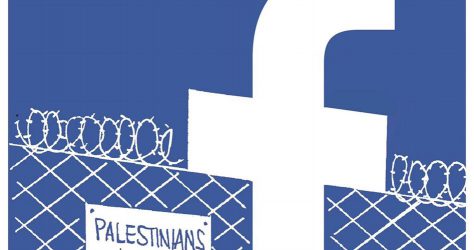
By Stanley L. Cohen | CounterPunch | October 28, 2016
Empty Declarations of Democracy… Vacant Boasts of humanity
For decades, Israel has held itself out as being the lone “democracy” in the Middle East; a state where the rights of individuals could not and would not be held hostage to the autocratic whims of royalty, but rather a full partner to a free and robust electoral process that guarantees not just meaningful input from the governed but the ability to challenge state policies as the winds of change blow from “the river to the sea.”
Once again, recent events have proven this to be just so much a perverse myth… empty rhetoric… second only to the brazen unfounded Israeli boast of having the “most humane army in the world,” even as the body count of Palestinian children grows in cemeteries and prisons that have become very much its own unique brand of 21st century youth hostel.
Recently, Hagai El-Ad, an Israeli and Jew, who serves as executive director of B’Tselem (The Israel Information Center for Human Rights in the Occupied Territories), spoke before the UN Security Council urging it to take immediate action against Israel’s illegal settlements.
Demagoguery and Inhumanity Exposed
Not quite 1400 words in its entirety, one paragraph in particular of El-Ad’s testimony sums up life for millions of those captured by a democracy that sees day as night… pain as pleasure. Crushing, despite its brevity, the power and pain of these words could easily be part of an opening statement by a war crimes prosecutor at a tribunal called to hold Israel accountable for crimes unseen since the Nuremburg tribunals some 70 years ago.
“What does it mean, in practical terms, to spend 49 years, a lifetime, under military rule? When violence breaks out, or when particular incidents attract global attention, you get a glimpse into certain aspects of life under occupation. But what about the rest of the time? What about the many “ordinary” days of a 17,898-day-long occupation, which is still going strong? Living under military rule mostly means invisible, bureaucratic, daily, violence. It means living under an endless permit regime, which controls Palestinian life from cradle to grave: Israel controls the population registry; Israel controls work permits; Israel controls who can travel abroad – and who cannot; Israel controls who can visit from abroad – and who cannot; in some villages, Israel maintains lists of who can visit the village, or who is allowed to farm which fields. Permits can sometimes be denied; permits must always be renewed. Thus with every breath they take, Palestinians breathe in occupation. Make a wrong move, and you can lose your freedom of movement, your livelihood, or even the opportunity to marry and build a family with your beloved.”
In a free democratic society these comments, while perhaps controversial, would certainly not constitute sedition. In an open, healthy State these words would surely give reason to pause and reflect… but never serve as a rational trip-wire to strip their speaker of his birthright as an unbound citizen empowered to support his government for policies he finds just but condemn it for those that bear the star of tyranny. It is a distinction that Israel has failed to adopt or learn over the course of its 50 year subjugation of millions whose only crime is to be born Palestinian in occupied land with sign-posts everywhere that simply say “ Jews only.”
Beating of Chests
Not long after El-Ad’s powerful speech before a world body entrusted with securing fundamental rights and liberty for all of its citizenry, the hue and cry could be heard among Israeli political elite to silence such subversive talk. Thus, Coalition Chairman MK David Bitan of the Likud Party undertook the first steps of reprisal by announcing he was considering submitting a bill to the Knesset that could remove the citizenship of Israelis who act against their country in international organizations. According to Bitan, “El-Ad’s actions at the Security Council are a blatant violation of the trust citizens must have for their country, so he should go find another country where he could be a citizen.”
Alarming, one might ask; no, not at all… merely another in an endless daily stream of steps by a government second to none when it comes to autocratic, indeed dictatorial, control of every fiber of its citizen’s freedoms, particularly their ability to access and exchange information without fear of retribution.
Much is known and largely ignored about the thousands of Palestinian civilians that have been targeted and slaughtered by the Israeli military machine in occupied Palestine, whether in Gaza or the West Bank. Indeed, the killing fields of Gaza or execution alleys of back street Jerusalem no longer acquire more than a passing fancy or footnote in the evening news spread across a world now busy with outrages of more recent vintage. After 70 years of slaughter, it’s just so much business as usual.
So, too, we have seemingly become numbed to the reality that thousands of Palestinian political prisoners languish in isolation, many sitting year after year, some for decades, in administrative detention cells of political prisons… uncharged, undefended and untried, tortured in ways that leave the spirits of those still roaming the now empty cellblocks of South Africa’s notorious Robben Island relieved their misery was ended quickly through state sanctioned executions by “suicide.”
The Mighty Censor’s Sword
Closures of Palestinian news rooms and television stations are commonplace… yet no more remarkable than assaults by Israel upon Palestinian journalists that long ago moved into triple digits and show no sign of abating. The Palestinian Centre for Development and Media Freedoms (MADA) has documented a pattern of such attacks by Israel running, for some time now, at almost 400 per year. Although the exact number of Palestinian journalists killed or injured by Israel over just the last decade may never be known, it has been documented that seventeen lost their lives in Gaza, alone, during the months of bombings which it endured in 2014.
Dozens of Palestinian journalists and private bloggers have been arrested by Israel and held for violating vague administrative codes that typically come down to the application of entirely undefined prohibitions such as “incitement.” Dareen Tatour, a 35-year-old poet and Arab-Palestinian citizen of Israel, was arrested and placed under administrative detention on charges of inciting violence via her poetry which she posted on Facebook and which merely praises those who fight against Israeli domination. Also arrested and charged with criminal incitement was 19-year-old Anas Khateeb, on the basis of her Facebook posts which included such alarming statements as “Jerusalem is Arab,” and “Long live the Intifada.”
Recently, Palestinian journalist, Samah Dweik, was released from prison having served almost six months for an alleged incitement charge which resulted from comments about the occupation she posted on her private Facebook account. For most of her sentence, her family was banned from visiting or having any contact with her. She was but one of over 20 Palestinian journalists recently imprisoned by Israel for allegations of incitement, along with hundreds of other Palestinian activists or bloggers who have been targeted for arrest and prosecution for nothing more than postings of political opinions about the Israeli occupation and Palestinian resistance on social media. Dweik’s release came not long after Israel and Facebook entered into an agreement to “work together” to monitor Palestinian posts.
The Sword Cuts Deeper
Increasingly, Palestinians are not the sole victims of an Israeli policy to silence “dissent” or to dramatically curb the nature and extent of information made available to its citizens… Jews and Arabs alike. For example, not long ago, Israeli Defense Minister Avigdor Lieberman confronted the military station director after Army Radio broadcast a documentary on the life of the leading Palestinian national poet, Mahmoud Darwish, saying that material like Darwish’s shouldn’t darken Israeli airwaves.
In what can only be described as a systematic effort to control both journalists and citizens in their ability to read and write, to access and exchange information, and to reach informed opinions essential to a public and democratic dialogue about current and future Israeli policies, its machinery of censorship has become the linchpin of the State’s view of what is appropriate knowledge and speech and what is not.
Thus, of late, Israel has begun to demand of social media giants such as Facebook and Twitter that they have input, if not control, over what posts ultimately find their way into the stream of ideas and debate within the Israeli public at large. According to Quds Press, Facebook and Twitter recently deleted thousands of posts, pages and accounts as a result of demands made by the Israeli Ministry of Justice based upon little more than amorphous claims that the information posed a threat to the safety of Israel.
On an even more ominous note, the Knesset has begun to formulate legislation that would require foreign entities to actively monitor social media sites for information deemed to be offensive to Israel. Under the legislation, content based liability could be found for material published by foreign nationals, addressed to foreign nationals and posted on foreign websites thereby reducing the concept of free speech in Israel to one that is cast by the prevailing political winds of the day and little else.
Recently the chief Israeli censor notified dozens of Israeli bloggers and social media activists that any material they might wish to publish in their personal blogs or social media accounts, when dealing with a wide range of what was described as “security” related subject matters, must be vetted. Although provided a generic and ambiguous catalog of those areas to be submitted for clearance, the targets, themselves, were not permitted to disclose the makeup of the list under penalty of law. If history can be counted upon to be the guidepost of what subject matters must be prescreened before publication, in the past the list has included such security “sensitive” subject matters as:
+ Cooperation agreements with foreign militaries;
+ Letters to the editor on military or security matters;
+ Contacts with foreign countries;
+ Anything connected to the nuclear industry;
+ Information about official delegations abroad;
+ Any material which constitutes a “danger” to people’s lives;
+ Immigration policies from “endangered” nations;
+ Use of foreign sources or material that touch upon any of these areas;
+ Detention of those suspected of security offenses;
+ Any information about military industries;
+ Appointments, resignations, firings, rumors about IDF activities or commanders
Finally, in a readily transparent effort to maintain a democratic illusion of a free and uncensored flow of information in the market place of ideas, pursuant to the censorship regulations there are complete prohibitions against leaving any blank spaces or other potential indicators in one’s writing or posts that might suggest or lead one to conclude that material has been deleted.
For those disturbed over this censorship procedure, it must be remembered that we are, after all, talking about a state that recently placed 101st out of 179 countries in the press Freedom index worldwide. Indeed, this appalling placement for the Middle East’s sole democracy is significantly better than Israel has scored in the Freedom index for quite a number of years.
For those wondering just how widespread, indeed systemic, Israel’s censorship procedures are, it is a country with a military censor procedure that has banned, outright, publication of, soon to be, some 2,000 articles and redacted various information from 15,000 others in recent history. That is thousands of articles professional journalists and editors decided were of public interest but which never saw the light of day. Imagine how many more events of public interest went uninvestigated, or articles which were not written, issues debated, or challenges brought to bear for the Israeli body politic to consider because of self-censorship by journalists or editors too tired or principled to seek pre–approval of their body of work by government censors. Stories simply swallowed up and disappeared by an industry of censorship.
Human Rights… Israel Wrongs
Although not yet law, in what can only be described as an all-out onslaught against core democratic rights and values, over the last several days consideration of a bill has begun in the Knesset that would empower the Defense Minister to detain a citizen without trial; to deny one the right to pursue or obtain employment in a field of interest; to limit access to various public places; and “to impose any other order or restriction necessitated by considerations of national security or public safety”.
Earlier in January 2011, the Knesset endorsed a right-wing proposal to investigate some of Israel’s best-known human rights organizations for “delegitimizing” its military. Among others was B’Tselem. The proposed investigations would entail inquiries into the funding of several human rights groups that have a history of criticizing Israeli policies. At the time, the Association for Civil Rights in Israel described the proposal as a “severe blow” to Israeli democracy and critics labeled the policy as “McCarthyist“.
Recently a variation on that bill became law in Israel compelling non-governmental organizations (NGOs) that receive more than half of their funding from foreign state entities to declare so publicly. Ultimately, the legislative criteria were tailored specifically to silence criticism of government policies by some 27 NGO’s… 25 of which, including B’Tselem, are considered to be left-wing… while the other two are non-affiliated. As intended, the bill will have absolutely no impact upon right-wing and pro-settlement NGOs which are funded almost entirely by private donations from powerful Zionists and Zionist entities from outside of Israel.
One can only imagine that upon returning home to the firestorm awaiting him, following his speech before the UN, Hagai El-Ad surely felt what it must have been like to be an activist leftist Jew in the United States during the dark days of McCarthy.
On the other hand, perhaps El-Ad should consider himself very fortunate indeed. On his twitter account, Arab-Palestinian MK Ahmad Tibi mocked MK David Bitan’s call for El-Ad’s de-citizenship saying: “Why stop at removing citizenship? Why not destroy the home of the B’Tselem director-general? Why not bar his entire family from entering the country, remove his land, submit them to administrative detention, and put checkpoints and closures in his neighborhood?”
Israeli Border Guards Who Killed Pregnant Palestinian Mom & Her Brother Will Not Be Charged
IMEMC | October 27, 2016
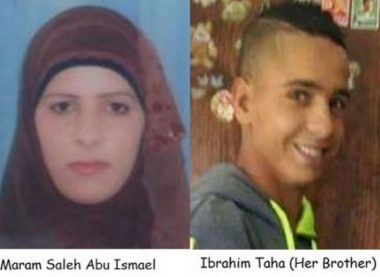
In April 2016, a 16-year old boy and his 23-year old pregnant sister were shot and killed near the largest Israeli checkpoint in the West Bank, Qalandia. The two Israeli border guards who killed the two family members have faced no charges or discipline, and now, Israeli prosecutors have officially closed the case, and determined that no charges were warranted against the guards.
A gag order was placed on the case by Israeli officials, and only after reporters from the Israeli paper Ha’aretz asked for the removal of the gag order was it discovered that no charges will be filed against the two guards.
According to Israeli prosecutors, there is no proof that the two guards acted improperly when they killed the unarmed child and his older sister.
Maram Taha, 23, and Ibrahim Taha, 16, her brother, were walking near Qalandia checkpoint on April 27th, and were around 65 feet away from the checkpoint when the guards claim that they seemed to be acting suspiciously, and shot them both.
Their bodies were held by Israeli officials for over a month, preventing the family from carrying out burial rites.
Maram was five months pregnant, and a mother of two children; Sarah, 6, and Remas, 4.
While Israeli prosecutors claimed that surveillance video footage at the checkpoint showed Maram attempting to throw a knife, they have refused to make the alleged video public.
Initially, on the day that she was killed, Israeli officials told the media that Maram was wearing an explosive belt. But when this was clearly not the case, when it was shown that she was pregnant, they simply stopped repeating the claim. They never officially retracted that claim, but it was not mentioned when the case was submitted to the military court system for review.
Over the past year, Israeli soldiers have been witnessed planting knives on or next to Palestinians that they have killed. This has led to suspicions among Palestinians in the case of Maram and Ibrahim Taha, particularly since Israeli officials have refused to release the surveillance video of this killing.
The case against the two Israeli border guards who shot the young mother and her little brother was submitted to prosecutors with a recommendation that no charges be brought against the guards.
Israeli prosecutors apparently agreed with this assessment, and decided not to prosecute the two unnamed Israelis who killed Maram and Ibrahim.
The Taha family has no legal recourse to appeal this decision by the Israeli military authorities, which govern the Palestinian Territories with martial law.
“Palestinian Art Behind the Bars,” 1984 publication on Palestinian prisoners’ culture of liberation

Samidoun Palestinian Prisoner Solidarity Network
The following historical booklet of the Palestinian prisoners’ movement was originally released in 1984 in English and Arabic by the Palestinian Prisoners’ Committee, based in Damascus, Syria, and is now being made available online for download and distribution by Samidoun Palestinian Prisoner Solidarity Network.
While focusing on depictions of Palestinian art created inside Israeli prisons – often on pillowcases, with smuggled and secreted materials, and removed covertly from the prison walls – the booklet also contains facts and descriptions about the situation faced by Palestinian prisoners in 1984.
Some of the art in this book was also featured in the Made In Palestine exhibition, which debuted in 2003 at the Station Museum in Houston, Texas. Its curator, James Harithas, was introduced to the broad spectrum of Palestinian art by featured artist Samia Halaby, whose new book of artwork commemorating the massacre of Kufr Qassem is soon to be released. (Some of the artists featured here are also included in Halaby’s work, Liberation Art of Palestine, which traces prisoners’ art as part of the overarching stream of liberation art produced by Palestinian artists in the movement.) Zuhdi al-Adawi, one of the artists featured in the booklet, traveled to New York City in 2006 for the opening of the exhibition. The film, Crayons of Askalan, also features some of these works and the story of Palestinian prisoner artists.
The booklet contains excerpts from the London Sunday Times’ 1977 investigation into torture in Israeli prisons, the same investigation that helped to bring the torture of Rasmea Odeh and Palestinian women prisoners to a Western audience. It includes an overview of the various prisons were Palestinian political prisoners were held at the time of publication in 1984, the forms of torture used under interrogation, living conditions in prisons, medical mistreatment and prisoners’ resistance. It ends with a call to people around the world to take action to support Palestinian prisoners, “form support committees everywhere,” and “unite all efforts to help secure the just demands of these prisoners and condemn the inhumane Zionist practices,” a call to action that remains just as critical today as it was 32 years ago.
The book is available for view and download below in PDF.
Download PDF (Palestinian Art Behind the Bars, 1984)
Guatemala Indicts Top Ex-Military Men for War Crimes and Rape

A family member holds an image of Marco Antonio Molina Theissen, kidnapped and disappeared in 1981 when he was 14 years old. | Photo: EFE
teleSUR | October 25, 2016
Marco Antonio Molina Theissen was kidnapped by the military in 1981 when he was 14 years old. His family never saw him again.
Guatemala made a new breakthrough Tuesday in the decades-old struggle for justice for historical crimes against humanity, including systematic rape, as a court indicted former military chief of staff Manuel Benedicto Lucas Garcia and four other high-ranking officials on a number of crimes linked to the 1981 kidnapping and disappearance of 14-year-old boy Marco Antonio Molina Theissen, including the torture and rape of his sister Emma Guadeloupe.
In the presence of Marco Antonio and Emma Guadeloupe’s mother, Emma Theissen de Molina, in the criminal court, Judge Victor Herrera Rios announced that all five former top military men were involved in crimes against humanity, forced disappearance, and aggravated rape.
Lucas Garcia, the brother of former dictator Romero Lucas Garcia and the four others accused — former commanders Francisco Luis Gordillo and Edilberto Letona and former military intelligence agents Hugo Ramiro Zaldaña and Manuel Antonio Callejas — have been in pre-trial detention since being arrested in January.
Initially, only four were linked to the case. Lucas Garcia — currently facing prosecution along with several other former military officers for the disappearance of at least 558 civilians between 1981 and 1988 — was added when additional charges were announced in August for charges related to his role overseeing counterinsurgency strategy at the time that Emma Guadeloupe was detained and Marco Antonio was disappeared.
In Tuesday’s hearing, the judge established that Lucas Garcia’s role as military chief of staff from 1978 to 1982 held him responsible for the actions of the military brigade under his command in Quetzaltenango, where Molina Theissen was kidnapped in 1981. In that year, Gordilla and Letona were first and second in command, respectively, of the Quetzaltenango army unit, while Zaldaña was the intelligence official to the chief of staff and Callejas was in charge of intelligence at the Quetzaltenango base.
The indictments in the Molina Theissen case are a step toward clarifying the historical truth in brutal crimes carried out at the hands of the military during Guatemala’s bloody 36-year civil war.
In 1981, Emma Guadeloupe, a young activist at the time with the Patriotic Worker Youth, was detained at a military checkpoint for being in possession of items deemed political propaganda. She had previously been detained, tortured and raped by the military officials five years earlier in an incident that saw her boyfriend and two other students killed at the hands of the army.
Intelligence agent Zaldaña, one of the five indicted, was in charge of the checkpoint where Emma Guadeloupe was arrested in 1981. The young leftist — following in the footsteps of other dissidents in her family targeted for speaking out against the military regime — was locked up at the military base in Quetzaltenango.
She managed to run away from the military base nine days later, but the army swiftly retaliated. Just days after her escape, suspected military intelligence agents dressed in plain clothes stormed the Thiessen Molina home, beating the mother and kidnapping 14-year-old Marco Antonio. The family never saw him again.
According to the Washington Office on Latin America, the Molina Theissen family’s attorney has warned that the high-ranking positions of the accused — along with the fact that some of them have been implicated in organized crime operations — raises a risk of witness intimidation and other forms of obstruction of justice in the case, leading him to urge authorities to deny the accused alternative measures.
The Inter-American Court of Human Rights found the Guatemalan state guilty in the Molina Theissen disappearance in 2004, opening the door to a decade-long investigation in hopes of prosecuting the masterminds behind the heinous crimes.
Earlier this year, a landmark sexual slavery trial in Guatemala sentenced two former soldiers to 120 and 240 years in jail and established that rape was systematically used by the military as a weapon of war under the dictatorships. It was the first case of wartime sexual abuse prosecuted in the Central American country, raising hopes among human rights defenders that it could set a precedent for other cases of systematic rape.
The five accused will continue to be held in preventative detention.
Gambia announces intention to withdraw from International Criminal Court
Press TV – October 26, 2016
Gambia has followed in the footsteps of Burundi and South Africa by declaring its intention to withdraw from the International Criminal Court (ICC).
The West African country’s Information Minister Sheriff Bojang announced the decision on television Tuesday night, accusing the ICC of being biased against Africa.
Bojang said that the court — set up to pursue some of the world’s worst crimes — had been used “for the persecution of Africans and especially their leaders” while ignoring crimes committed by the West.
He singled out the case of Tony Blair, a former British prime minister, whom the ICC failed to indict over the 2003 Iraq war.
“There are many Western countries, at least 30, that have committed heinous war crimes against independent sovereign states and their citizens since the creation of the ICC and not a single Western war criminal has been indicted,” the Gambian minister said.
He said the tribunal was an “international Caucasian court for the persecution and humiliation of people of color, especially Africans.”
The minister said Gambia has begun the process of withdrawing from the ICC, which involves notifying the United Nations secretary general and takes effect a year after the notification is received.
The ICC’s chief prosecutor, Fatou Bensouda, is ironically a former Gambian justice minister.
Only Africans have been charged in the six ICC cases that are ongoing or about to begin, though preliminary investigations have opened elsewhere, too.
The ICC has opened probes involving Kenya, the Ivory Coast, Libya, Sudan, the Democratic Republic of the Congo, the Central African Republic, Uganda and Mali.
The International Criminal Court was set up in 2002 to try war criminals and the perpetrators of genocide.
Last Friday, the South African government gave a formal notice of its intention to pull out of the ICC. Earlier that week, Burundi’s President Pierre Nkurunziza had signed a decree to quit the court’s jurisdiction.
Featured Video
Trita Parsi: Israel Set a Trap for Total War in the Region
or go to
Aletho News Archives – Video-Images
Book Review
Why the War on Conspiracy Theories Is Bad Public Policy
By Kevin Barrett • Unz Review • February 1, 2019
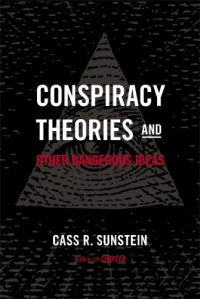 A Review of Conspiracy Theories and Other Dangerous Ideas by Cass Sunstein (based on an earlier paper co-authored with Adrian Vermeule); In Defense of Troublemakers: The Power of Dissent in Life and Business by Charlan Nemeth; and Conspiracy Theories and the People Who Believe Them, edited by Joseph E. Uscinski
On January 25 2018 YouTube unleashed the latest salvo in the war on conspiracy theories, saying “we’ll begin reducing recommendations of borderline content and content that could misinform users in harmful ways—such as videos promoting a phony miracle cure for a serious illness, claiming the earth is flat, or making blatantly false claims about historic events like 9/11.”
At first glance that sounds reasonable. Nobody wants YouTube or anyone else to recommend bad information. And almost everyone agrees that phony miracle cures, flat earthism, and blatantly false claims about 9/11 and other historical events are undesirable.
But if we stop and seriously consider those words, we notice a couple of problems. First, the word “recommend” is not just misleading but mendacious. YouTube obviously doesn’t really recommend anything. When it says it does, it is lying. … continue
Blog Roll
 Aletho News
- Trita Parsi: Israel Set a Trap for Total War in the Region
- Trump’s Iran war is on an Israeli leash
- Saudi oil boss issues global supply warning
- Riyadh Says Its Oil System Is Intact. The Numbers Say Otherwise.
- Trump and Netanyahu Want to “Finish the Job” on Iran
- US ‘one-sided dictation’ not Iran’s beliefs makes rational talks impossible: Baghaei
- Iran’s Next Strike May Not Explode. It Could Shut You Down /Col Doug Macgregor
- Iran: US political targets legitimate if assassinations return
- Iraq shuts key border crossing with Iran under US pressure: Report
- Undersea Internet cables could be targeted in retaliation for attacks on Iran: IRGC deputy chief
- If Americans Knew
- The Israel Lobby’s Changing Fortunes
- AIPAC has become such a political liability that it’s shifting to a more “nimble” approach to buying politicians
- At least 160 Israeli settler attacks in 2 weeks
- Will Gaza’s Ancient Christian Community Disappear Forever?
- Israel’s vision of regional security rests on keeping Arab states weak
- Heidi Levine recounts how Palestinian youths helped save her in settler attack
- DAILY UPDATE: Latest essential news on Palestine, Israel, & region
- Trump’s Intensifying Sabotage of the ICC, for Israel’s Sake
- Israeli military detain US and UK volunteers in West Bank including Democratic NY politician Brad Lander
- Americans at National Conservatism Conference held in Israel this year criticize Israel
- No Tricks Zone
- E-Cars Reduce CO2 Emissions By Only 41% Compared To Internal Combustion Engine Vehicles
- Predictions Made By Renowned Climate Professor Over Past Decades Have Been Proven To Be Poor
- New Study Suggests Large Regions Of The Pacific Ocean Have Been Cooling For The Last 80 Years
- Germany’s Green Energy Debacle: High Energy Costs Force Kahla Porzellan to Close After 182 Years!
- New Study: 50 Years Of The Most Aggressive ‘Net Zero’ Policies Can Only Affect The Global Climate By 0.03°C
- US September “Heat” Was No Record…Many Records Set Decades Ago
- Latest European Green Energy Debacle; Portugal’s Largest Flagship Solar Park Insolvent!
- Green Energy Debacle: German Expert Professor Fritz Vahrenholt Warns Of Severe Economic And Social Consequences
- Two More Paleo Reconstructions Affirm Meters-Higher Sea Levels Across Ireland, Brazil 7000-6000 Years Ago
- New Study: Earth And Venus Surface Warmth Largely Explained By Convection And Lapse Rate, Not CO2 Or Radiation

