Israeli police find no wrongdoing in death of Palestinian minister beaten during protest

Ma’an – August 10, 2016
BETHLEHEM – Israeli police have closed their investigation into the death of Palestinian Minister Ziad Abu Ein — who died in 2014 after being beaten by Israeli forces — concluding that he had died of natural causes, Israeli news outlet Arutz Sheva reported on Wednesday.
According to Arutz Sheva, an autopsy by the police department of internal investigations concluded that Abu Ein, 55, died of a heart attack on Dec. 10, 2014, after an Israeli border police officer beat him in the chest with his helmet and the butt of his rifle during a march to plant olive trees in the village of Turmusayya in the Ramallah district of the occupied West Bank.
Israeli human rights organization Yesh Din, which represents Abu Ein’s family in the case, expressed its outrage at the police’s decision to close the case without ever interrogating the border policeman suspected of killing Abu Ein or asking him to testify.
“Most cases of Israeli violence against Palestinians are closed. But we expected that at least a proper investigation would take place,” Yesh Din spokesman Gilad Grossman told Ma’an on Wednesday. “This shows Israeli armed forces’ impunity when committing violence against Palestinian civilians.”
“They closed the case without talking to the border police officer,” Grossman added, despite the fact that “a number of soldiers who were there during the incident said that the border police officer was acting violently even before the altercation” with Abu Ein.
The internal investigations department reportedly justified the decision not to interrogate the policeman.
“Since policemen are authorized to use force and it is expected of them in many cases to use it, Internal Investigations will not summon a policeman for investigation if there is not a reasonable suspicion that a crime has been committed,” Arutz Sheva quoted the department as saying.
Grossman said that Abu Ein’s family had already filed an appeal to the Israeli Ministry of Justice.
“Our opinion is that internal affairs must investigate the acts of the border policeman during the altercation, even if his actions were not the direct cause of Abu Ein’s death,” he said. “At least, they need to investigate whether his actions were within the proper limits of police action.”
Abu Ein had worked with the Palestinian Authority monitoring Israeli settlements and the separation wall, and was a member of the Fatah Revolutionary Council. Abu Ein had also previously served as Palestinian deputy minister of prisoners’ affairs.
The Palestinian Ministry of Civil Affairs said a day after Abu Ein’s death that an autopsy carried out by a Palestinian forensics team revealed he had died after a powerful blow to the diaphragm and heavy use of tear gas, adding that he had also suffered from bruising on his neck, and several of his front teeth had been knocked out by a blow to his face.
At the time, Palestine Liberation Organization (PLO) Secretary-General Saeb Erekat said that the case was “a clear example of how the culture of impunity granted to Israel by the international community permits it to continue committing crimes against the Palestinian people.”
The Israeli police’s decision to close its investigation in the case comes days after Israeli newspaper Haaretz published a report revealing that nearly all investigations opened over the killings of Palestinians at the hands of Israeli police in the past ten months were closed “without the unit investigating and questioning the officers.”
NYPD Commissioner Bratton Resigns, Takes Job With Pro-Clinton, Pro-Israel Firm
As he moves into his new position at Teneo Holdings, Bratton will go from enforcing ‘broken windows’ to rubbing elbows with those gathered at the nexus between law enforcement, the national security state, the military-industrial complex, and U.S.-U.K.-NATO foreign policy.

Former NYPD Commissioner William Bratton Speaks at The First National Personal Security Conference in Israel, 2014. (Photo: Israeli Ministry of Public Security)
By Eric Draitser | Mint Press News | August 5, 2016
New York City Police Commissioner Bill Bratton formally announced his resignation on Tuesday, marking the end of a tumultuous second term as the NYPD’s top cop.
Bratton, largely seen as the architect of the “broken windows” law enforcement strategy that targets low-level offenses in order to stop larger offenses, has been heavily criticized by social justice advocates, who have charged that Bratton’s tactics amount to a targeting of people of color who are then saddled with criminal records, promoting further problems for themselves and their families.
While Bratton touts his record on crime – NYC has seen crime, especially violent crime, continue to drop to record lows under Bratton – he has a much more dubious record when it comes to police-community engagement. If anything, Bratton has become a lightning rod for criticism, especially in the wake of the 2014 murder of Eric Garner by NYPD officers, none of whom faced any criminal repercussions. Bratton faced similar criticisms in his other positions, including in Los Angeles and Boston, where he was sharply criticized for many of the same policies.
His resignation provides yet another scandalous example of how Bratton represents the very worst of the political establishment in the United States. While some will be celebrating his retreat from public office, it is critical to note that Bratton has accepted a job with Teneo Holdings, a consulting group closely linked to the Clinton political machine, as well as Israel and its lobby.
And it is here, at the crossroads of the national security state and the political ruling class, that Bratton will continue to protect and serve — the interests of the elite, that is.
Behind the curtain at Teneo Holdings
Teneo Holdings may ring a bell for political junkies, mainly because of the controversy that erupted in 2013 after it was revealed that Huma Abedin, the top aide to Hillary Clinton and wife of disgraced New York Rep. Anthony Weiner, had failed to disclose that she was simultaneously employed by the State Department and as a consultant for Teneo.
Of course, it wasn’t simply the lack of transparency that was of concern, but rather the obvious conflict of interest for a State Department employee with access to top level cabinet officials in the Obama administration to be representing outside interests. Indeed, this sort of highly unethical move by a close Clinton confidante is really par for the course for Hillary (and Bill) whose unethical dealings include overseeing arms deals to Clinton Foundation donors, appointing Clinton Foundation donors to key State Department positions, and raising money from individuals closely connected to foreign governments, among others.
However, it is the relationship between the Clintons and Teneo that is of particular interest.
Teneo Holdings was founded by Douglas Band, a close adviser to former President Bill Clinton, and Declan Kelly, a major Clinton fundraiser and special envoy to Northern Ireland for Hillary when she was Secretary of State. Writing for Politico, Rachael Bade, reported in April:
“While serving as Clinton’s special envoy, reaching out to global corporations for those investments, [Kelly] was also working for two of them as a private consultant — earning about $2.4 million from Dow Chemical, a longtime client of his and one of the firms that participated in Clinton’s Ireland initiative.”
Once again, highly improper conflicts of interest seem to be as instinctive as breathing when it comes to the Clintons. But it is precisely these connections between political elites, major financial and corporate players, and the people behind Teneo, that is of most interest. Again, Bade explains:
“With Bill Clinton serving in the paid position of honorary chairman, and Hillary as secretary of state, Teneo [became] a blend of public relations advice for CEOs and more technical investor relations work. Corporate executives paid $250,000 a month — sometimes more — for consulting and assistance. They also, in some cases, got to hobnob with a former president. The firm forged a mutually beneficial relationship with the Clinton Global Initiative, the fancy annual Clinton Foundation event starring the former president and other world leaders. The New York Times and The New Republic first reported three years ago how the philanthropic gathering provided an ideal nexus for Teneo to both recruit new clients and enhance the visibility of existing clients by getting them speaking roles.”
It’s not difficult to see just what Teneo was doing: using connections and influence peddling to become one of the world’s premier consulting firms, one which could guarantee corporate interests and foreign states access to the most influential individuals in the uppermost echelons of power in the U.S. It’s not exactly the sort of product that just any run-of-the-mill consultancy could deliver.
And so, former NYPD Commissioner Bratton is heading to Teneo to serve as the head of the new risk management division where, according to the Wall Street Journal, he will “advise CEOs on how to deal with issues ranging from terrorism to cybercrime.” And Bratton is not alone; he joins former Clinton and Obama envoy to the Middle East, George Mitchell, as well as former British foreign secretary William Hague, as Teneo’s latest high-profile hire.
Again, the influence peddling and access is what is critical here. Bratton, Mitchell, and Hague represent the nexus between law enforcement, the national security state, the military-industrial complex, and U.S.-U.K.-NATO foreign policy.
Teneo, Israel, and the U.S. Empire
The connections between key figures in the Teneo/Clinton orbit and Israel abound. Take for instance the fact that Mitchell, one of the most well-connected political operators in the Middle East, is a senior advisor for Teneo while he has maintained working relationships with many members of the Israeli government and state. Crispin Hawes, managing director of Teneo Intelligence, is also closely connected to the region, having been Eurasia Group’s leading expert on the Middle East and North Africa.
Bratton, himself, has cultivated extremely close and friendly ties with the Israeli state. In May 2014, Bratton gave the keynote address at Israel’s National Conference on Personal Security in Jerusalem, a conclave of some of the leading figures in Israel’s (and the United States’) national security apparatus. The conference included influential attendees from around the world.

Bratton poses with Israeli officials at the First National Personal Security Conference in Israel. (Photo: Israeli Ministry of Public Security)
But this was certainly not the only time that Bratton had direct dealings with, and praise for, the security state of apartheid Israel. In fact, as chief of the Los Angeles Police Department, Bratton nurtured cooperative relations between the LAPD and Israeli security forces. As The Jewish Journal reported in 2014:
“The LAPD-Israel bond was in large part fused by former LAPD Chief William Bratton, who made official trips to Israel to learn about the country’s advanced counter-terrorism tactics during his chiefdom from 2002 to 2009. At a town hall meeting in Los Angeles near the end of his term, Bratton said of Israeli intelligence experts: ‘They are our allies. They are some of the best at what they do in the world, and that close relationship has been one of growing strength and importance.’”
In fact, those close ties between Bratton’s LAPD and Israel have endured long since his tenure in Los Angeles was over. The LAPD routinely sends officers and other officials to Israel for training and other initiatives, as do members of other police forces, including Boston and New York, both of which saw Bratton as police chief.
It’s no wonder then that the violent and brutal repression practiced by Israeli security forces against Palestinians has become a staple of U.S. law enforcement. Shoot first and lie about what happened. Shoot first and blame the victim. It works in the West Bank just as it does in Ferguson and Baltimore and Baton Rouge. And, in both cases, the guilty are exonerated while being held up as heroes by the media and political establishment. All the while, the body count keeps rising.
Bratton, of course, has no qualms with this, just as he’ll relish the opportunity to rub elbows with the world’s most influential people as he transitions to his new job with Teneo.
One evening soon Bratton will be sitting with the likes of Doug Band, Declan Kelly, and maybe even Bill and Hillary Clinton. They will toast to each others’ success as they laugh about the Crime Bill of 1994, the mass incarceration state, the prison-industrial complex, and the danger of “superpredators.” They’ll share stories about how their heroic policies, widely perceived as unabashedly racist, changed the American social fabric, making America safe again, to borrow a nauseating line from Donald Trump. They may even lament that they didn’t do more to expand the draconian policies for which they’ve come to be known.
They’ll also be cashing their checks. Big ones. Courtesy of the City of New York, Los Angeles, Israel, Wall Street and the military-industrial complex. And it goes almost without saying that at no point will Bratton and his Teneo cronies ever remember just how many hundreds of thousands, perhaps even millions, of lives they’ve ruined, families they’ve destroyed, and children their policies killed.
Such is the sociopathy of power in the Empire.
400 commodities still banned from Gaza
MEMO | August 4, 2016
 Israeli occupation authorities continue to prevent the entry of 400 commodities into the Gaza Strip, a senior Palestinian official said yesterday.
Maher Al-Tabbaa, is a senior official in Gaza’s Chamber of Industry and Commerce, said Israeli occupation authorities had tightened measures against Palestinian traders, companies and businessmen.
These remarks came a day after occupation authorities said they had facilitated the movement of goods and commodities into the Gaza Strip.
Speaking to QudsNet, Al-Tabbaa said: “Israel bans all chemical raw materials needed for the industrial sector, cleaning materials, sponges, paints, welding skewers and other materials needed for making furniture.”
He noted that Israel had tightened its restrictions by withdrawing more than 1,500 travel permits from traders and businessmen.
It is still controlling the entry of cement and construction materials, he explained, paralysing the construction industry.
574 Palestinians arrested in July
MEMO | August 3, 2016
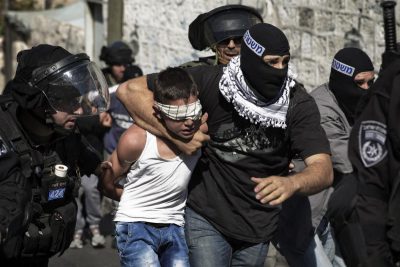 Some 574 Palestinians were arrested by Israeli occupation forces in July, a joint statement by human rights groups revealed yesterday.
The Prisoners’ Affairs Commission, Palestinian Prisoners’ Society, Addameer Prisoner Support and Human Rights Association and Al-Mezan Human Rights Association said in their statement that 189 Palestinian were arrested from occupied Jerusalem, 869 from the West Bank and 16 from the Gaza Strip.
The numbers include 112 children and 12 women.
There are currently around 350 Palestinian children being held in Israeli the prisons of Megiddo and Ofer located west of occupied Ramallah, the statement said.
This is in addition to the 62 women, including 13 minors, who are also being held.
Twenty-one Palestinian journalists are also being detained.
Occupation forces issued 127 administrative detention orders in July, 38 of them were new. This brings the number of Palestinians held under this system to 750, the statement said.
Israeli forces detain 3 siblings of wanted Palestinian in Tulkarem
Ma’an – August 3, 2016
TULKAREM – Israeli forces on Wednesday detained three siblings of Malik Ubeid, a Palestinian from the village of Farun in the northern occupied West Bank district of Tulkarem who is wanted by Israeli authorities, just two days after the detention of his mother and brother, as an attempt to pressure Malik to turn himself in to Israeli authorities, Palestinian security sources said.
Sources told Ma’an that Majdi, Qatiya, and Maha Ubeid were detained after Israeli forces raided their house. Israeli forces also attempted to detain Malik Ubeid himself in the early morning hours on Tuesday during a military raid in the Farun village, but failed, and instead detained four Palestinian youths.
Locals told Ma’an that Israeli forces have raided the Ubeid home several times, but have failed to detain him.
Malik’s mother and brother, Wafiqa Daoud Nasser Ubeid and Suleiman Ahmad Abd al-Qader Ubeid, were detained on Monday after being summoned to the Israeli liaison offices.
Malik’s mother has reportedly been released, according to sources. It remained unclear whether his brother remained in custody as of Wednesday.
Israeli authorities also reportedly telephoned Malik’s brother-in-law, who lives in the Tulkarem refugee camp, on Monday and threatened to detain Malik’s sisters if he didn’t turn himself in.
An Israeli army spokesperson told Ma’an she could not provide a comment on the detentions, but would look into reports.
It remained unclear what Malik has been suspected of by Israeli authorities.
Israeli authorities have often come under criticism for policies aimed at punishing the families of Palestinians suspected of wrongdoing, including routinely detaining family members of wanted Palestinians, with rights groups calling the policies a form of “collective punishment” which target those who have not committed any crime.
47 Israeli violations against journalists in July
Palestinian Information Center – August 2, 2016
GAZA – The Journalist Support Committee (JSC) said that Israel’s military and security forces committed 47 violations against journalists and media workers during July 2016.
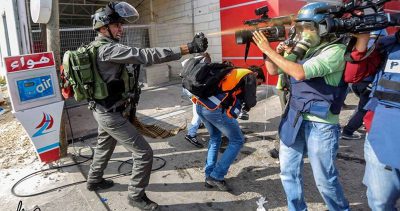 In a recent report, the JSC said that the Israeli army and police arrested eight Palestinian journalists from Jerusalem, Qalqilya and Ramallah, and released most of them later during the month.
The Israeli authorities also extended the detention of journalist Adib al-Attrash and postponed the trial of another one called Samah Duweik.
According to the report, an administratively detained journalist named Malik al-Qadi was reportedly exposed to torture and maltreatment in an Israeli jail, which prompted him to go on hunger strike Other violations against journalists during the reporting month included raids on homes, confiscation of cars and cameras, assaults, harassment, banishment orders and removal of Facebook pages.
The report also highlighted several violations committed by the Palestinian Authority security apparatuses, including the arrest of journalists Mohamed Abu Juhaisha and Mohamed Khabisa, raids on homes, and banning journalists from holding a news conference.
Palestinian children subject to solitary confinement, administrative detention

Samidoun Palestinian Prisoner Solidarity Network – July 29, 2016
An escalating number of Palestinian children are being held in solitary confinement or detained without charge or trial under administrative detention. 16 Palestinian children have been detained without charge or trial under administrative detention since October 2015, reported Defense for Children International on 28 July.
DCI highlighted the case of Abdel-Rahman Kamil, 15, of Qabatiya in Jenin, arrested in February of this year. He was interrogated in the Salem military camp near Jenin without being allowed to consult a lawyer, and asked about alleged intentions to stab a soldier, throwing stones at invading Israeli occupation forces, or knowing young men from his town who participated in Palestinian resistance activities. Despite denying all of this, he was ordered to a six month administrative detention order without charge or trial on the basis of secret evidence. Despite a court reducing the order to four months, his administrative detention was then again renewed for an additional four months in June. He was one of seven children whose administrative detention orders were renewed in the month of June.
DCI also reported that “from January through June, Israeli authorities held at least 13 Palestinian children in solitary confinement for two or more days, compared to a total of 15 cases during 2015.” One 16-year-old boy from Yabad near Jenin spent 22 days in isolation. DCI noted that “the use of isolation for Palestinian child detainees is solely for interrogation purposes to obtain a confession and/or gather intelligence or information on other individuals.”
They highlighted the case of Rami K., 18, who was held in solitary confinement for 16 days for interrogation purposes. He reported that he was interrogated for 45 hours over a period of days, and that his hands and feet were bound to a metal chair during interrogation in stress positions. Rami is currently serving a 10 month prison sentence and a 3000 NIS fine ($780). He will spend another three months in prison if his family cannot pay.
The Israeli occupation prosecutes nearly 700 Palestinian children each year in military courts, alongside its use of administrative detention against Palestinian child prisoners. Two debates have been held in the British parliament on Palestinian children in Israeli military custody in 2016, while 20 members of the U.S. Congress urged President Obama to appoint a “special envoy for Palestinian youth,” to address issues relating to the human rights of Palestinian children and youth. Meanwhile, the Israeli state is escalating laws used to punish and imprison Palestinian children.
As DCI notes:
“The amendments to the Israeli penal code in 2015 included stricter penalties in mandatory sentencing laws such as a maximum 10 year sentence for throwing a stone, or other object, at traffic, without intent to cause injury, and 20 years for throwing a stone, or other object, at traffic with intent to cause injury. While the 20-year maximum sentencing existed prior to 2015, the word “stone” was added to specifically target Palestinian society.
Minimum penalties for stone-throwing offenses, one-fifth of the maximum penalty, were also added to the penal code. In a controversial decision, the Knesset, or Israeli parliament, added to the scope of punishment the denial of National Insurance benefits to families whose members have been convicted of throwing stones.
According to the Association for Civil Rights in Israel (ACRI), proposals are also in the works to impose life sentencing for children under the age of 14.”
A jolly bit of tender

Crimes Of Britain | July 28, 2016
Churchill has been chosen by the Bank of England’s to be the face on their new £5 note set to be in circulation from September 2016.
The Governor of the Bank of England stated “Our banknotes acknowledge the life and work of great Britons. Sir Winston Churchill was a truly great British leader, orator and writer. Above that, he remains a hero of the entire free world. His energy, courage, eloquence, wit and public service are an inspiration to us all. I am proud to announce that he will appear on our next banknote”.
Churchill is fawned over in Britain. He was voted ‘Greatest Briton’ of all time in a poll run by the BBC in 2002. He is praised across the political spectrum, held up as the man who stopped Brits speaking German. When the truth is Churchill was never an opponent of fascism. He was a white supremacist who talked of the need of non-Anglo Saxons to “recognise the superiority of race”. In 1927 he praised Mussolini, “What a man! I have lost my heart!… Fascism has rendered a service to the entire world”. He went on to hold Hitler up as the ideal figure to lead Britain if they were to be defeated, “If our country were defeated, I hope we should find a champion as indomitable to restore our courage and lead us back to our place among the nations”.
Winnie was still swilling champagne when he engineered a famine in Bengal which saw at least 4 million men, women and children to starve to death. Food literally taken from the mouths of starving people to ship it where it wasn’t even needed. The Black and Tan thugs were his brainchild. An advocate for the use of poison gases whilst Secretary for War and Air. He assisted greatly in the looting of Iran which kept Britain afloat. And when the government of Mohammad Mosaddegh threatened British ‘interests’, Churchill was there ready to desecrate democracy. He believed that Kenya’s fertile highlands should be only for white colonial settlers, and approved the removal of the local population. Over 150,000 men, women and children were forced into concentration camps. It was Churchill who arranged for Ibn Saud to receive a subsidy of £100,000 a year in 1922. He later gifted the founder of Saudi Arabia a Rolls Royce and lamented that his “admiration for him was deep, because of his unfailing loyalty to us”. When the democratically elected government in ‘British Guiana’ rolled out their nationalisation plan Churchill sent war ships and 700 British troops to put a stop to that. He assisted Zionism and was rewarded with a bust in Al Quds for his contribution in helping create the colonial settler state of ‘Israel’. Winston and his cabinet were deeply concerned about British people viewing Black American GIs favourably in WW2. He was obsessed so much that he wanted to get the Americans to stop sending Black soldiers to Britain. His racism didn’t stop there, when debating the adoption of new laws limiting immigration from the Caribbean he suggested the use of the motto “Keep England White”. All of Churchill’s wars were for defending and preserving the thieving British Empire.
I am releasing an in depth piece on his genocidal campaigns in the coming weeks. The British press have churned out a few articles here and there on Churchill but have glossed over the true extent of his crimes. Presenting them as OK because he led the Brits in their ‘finest hour’.
It really is no surprise that he is to decorate English currency, he is your archetypal Brit at the end of the day.
“They destroyed the houses, they destroyed our dreams”
International Solidarity Movement | July 28, 2016
Qalandia village, Occupied Palestine – Late Monday evening, Israeli forces entered the village of Qalandia with 15 bulldozers and around 150 soldiers. In the village the Israeli military destroyed 11 new built houses, attacking the residents of the village with stun grenades, tear gas, rubber coated steel bullets and sponge bullets. 7 persons had to seek medical care for their injuries after the assaults from the military.
In 7 of the demolished houses, families had already moved in according to Yosef Awdalla, mayor of Qalandia. The demolition notices, claiming the houses had no permits, were left outside the houses on the ground only 24 hours before the army entered the village.
One of the homeowners, Fadi Awadallah describes how his friend was walking around the house the day before the demolitions, and found a piece of paper written in Hebrew on the ground. One hour after they had figured out what the document said and talked to their lawyer, the army was already entering the village to demolish their home. Fadi, who had applied and paid for an Israeli issued licence to build in area C, did not expect the demolition order since the Israeli authorities had accepted the money and the application. When he tried to explain this to the soldiers they answered him that “they were not there to talk, they were there to demolish the houses.”
The soldiers then pointed their guns to his head and told him that if he didn’t move away from the house they would shoot him.
“They didn’t deal with us as humans, they pushed us back with violence and force” says Fadi whose family had planned to move into their dream house the following week.
“Three years ago we started to build the houses. Why didn’t they come three years ago before we spent all our money on these houses? They destroyed the houses, they destroyed our dreams” says Fadi, explaining that most of the families not only spent all their savings on the buildings but now they are also left with loans that will take them years to pay.
“We came up with the idea about building a house here because we are not allowed to use our house on the other side of the wall.” says Fadi, whose father lives in a house on the other side of the apartheid wall surrounding the village. Without obtaining a permit every month from the Israeli occupation authorities, the family are not allowed to cross the wall that separates the West Bank from Jerusalem.
Since the signing of the Oslo agreement in 1995 most of Qalandia village was classified as Area C, where israel has full control over security and civil administration. Only 2% of Qalandia is constituted as area B, where construction is permitted. Palestinian building in area C has to be permitted by the Israeli Civil Administration and since the Israeli occupation of the West Bank 1967, Israeli authorities regularly demolishe houses in area C, thus breaking international humanitarian law. According to a report released this Wednesday from Israeli human rights group B’Tselem, Israeli authorities have demolished more Palestinian homes in the West Bank in the first six months of 2016 than they did in any year over the past decade .
The Israeli demolition policies systematically implemented by the government and the lack of possibilities to build legally in the area constitutes the ethnic cleansing and forcible transfer of Palestinians.
As Fadi Awadallah points out, “Where are we supposed to be? In the sky? In the space? No, we are staying here.”
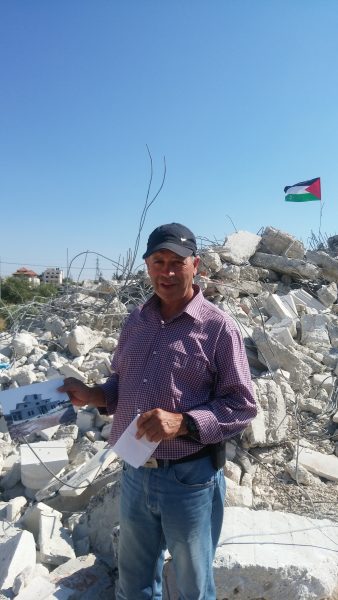
Sameeh Huseen holding a picture of his home that was ruined by the Israeli army.
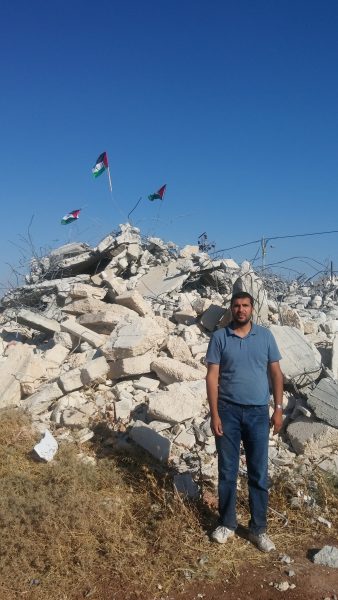
“How are we going to explain this to the next generation? How can we teach our kids about peace when this is what they see?” says Fadi Awadallah.
Imprisoned Palestinian women and girls: Teen detained over Facebook posts, injured woman denied medical care

Samidoun Palestinian Prisoner Solidarity Network – July 25, 2016
Palestinian teen Qamar Manasra, 16, a Palestinian citizen of Israel, remains detained after she was arrested by Israeli forces who invaded her home in Reineh village on Tuesday, 19 July. Her home was ransacked and her father and two brothers assaulted. Qamar is allegedly being investigated for “incitement” for her posts on social media, specifically Facebook. Facebook “incitement” charges have been cited as the reason for arrests of hundreds of Palestinians.
Among those accused of “incitement” for social media posts is fellow Reineh resident and Palestinian poet Dareen Tatour, accused of “incitement” for posting her poetry on YouTube. Tatour has been supported by hundreds of writers around the world, including Pulitzer Prize winners and other world-renowned novelists, poets, and artists. She was imprisoned for three months and has since been held in house arrest for nine months; part of the original conditions of her house arrest included exile from her village of Reineh. Instead, her brother was forced to rent a separate apartment in Tel Aviv and her brother and sister-and-law forced to lose work in order to “guard” her 24/7. Finally, the prosecution dropped its objection to Tatour serving out her house arrest in Reineh last week; today, 25 July, her return to Reineh – still under house arrest – is expected to be approved, following significant international pressure on the case.
Israeli military courts ordered the continued detention of Taghreed Jabara al-Faqih, 43, for 11 days at the request of the military occupation prosecutor. Her family home was stormed and invaded by occupation forces on 12 July, who smashed and ransacked the contents of the home, including the cabinets and furniture.
 Taghreed’s husband, Khaled al-Faqih, said that he was shocked at the arrest of his wife, and that he and their young son, Muath, had been forbidden from seeing her since her arrest on the grounds that she is still under interrogation. Taghreed’s brother is accused of firing on Israeli occupation soldiers on 3 July.
Asra Media also reported that wounded Palestinian prisoner Abla al-Adam, 45, from the village of Beit Ula, continues to face medical neglect that endangers her life. She cannot turn her head without severe pain, yet receives only painkillers and sedatives, rather than treatment for the causes of her pain. Al-Adam was arrested on 20 December 2015 when she was shot in the head by Israeli occupation soldiers in al-Khalil, losing her right eye and sustaining serious injury to her head and face.
She was hospitalized but moved before the completion of her treatment to HaSharon prison. Much of her care comes from her fellow women prisoners rather than from any kind of medical personnel. She was accused of having a knife at a checkpoint in al-Khalil. Al-Adam has nine children; only her minor children have been allowed to visit her, not those over the age of 18, due to “security” denials.
They are among approximately 60 Palestinian women held prisoner or under house arrest by Israeli occupation forces, mostly in HaSharon and Damon prisons.
Featured Video

Trita Parsi: Israel Set a Trap for Total War in the Region
or go to
Aletho News Archives – Video-Images
Book Review
Why the War on Conspiracy Theories Is Bad Public Policy
By Kevin Barrett • Unz Review • February 1, 2019
 A Review of Conspiracy Theories and Other Dangerous Ideas by Cass Sunstein (based on an earlier paper co-authored with Adrian Vermeule); In Defense of Troublemakers: The Power of Dissent in Life and Business by Charlan Nemeth; and Conspiracy Theories and the People Who Believe Them, edited by Joseph E. Uscinski
On January 25 2018 YouTube unleashed the latest salvo in the war on conspiracy theories, saying “we’ll begin reducing recommendations of borderline content and content that could misinform users in harmful ways—such as videos promoting a phony miracle cure for a serious illness, claiming the earth is flat, or making blatantly false claims about historic events like 9/11.”
At first glance that sounds reasonable. Nobody wants YouTube or anyone else to recommend bad information. And almost everyone agrees that phony miracle cures, flat earthism, and blatantly false claims about 9/11 and other historical events are undesirable.
But if we stop and seriously consider those words, we notice a couple of problems. First, the word “recommend” is not just misleading but mendacious. YouTube obviously doesn’t really recommend anything. When it says it does, it is lying. … continue
Blog Roll
 Aletho News
- Putin’s key remarks on peace talks and Europe’s ‘schizophrenia’
- Trita Parsi: Israel Set a Trap for Total War in the Region
- Trump’s Iran war is on an Israeli leash
- Saudi oil boss issues global supply warning
- Riyadh Says Its Oil System Is Intact. The Numbers Say Otherwise.
- Trump and Netanyahu Want to “Finish the Job” on Iran
- US ‘one-sided dictation’ not Iran’s beliefs makes rational talks impossible: Baghaei
- Iran’s Next Strike May Not Explode. It Could Shut You Down /Col Doug Macgregor
- Iran: US political targets legitimate if assassinations return
- Iraq shuts key border crossing with Iran under US pressure: Report
- If Americans Knew
- DAILY UPDATE: Latest essential news on Palestine, Israel, & region
- The Israel Lobby’s Changing Fortunes
- AIPAC has become such a political liability that it’s shifting to a more “nimble” approach to buying politicians
- At least 160 Israeli settler attacks in 2 weeks
- Will Gaza’s Ancient Christian Community Disappear Forever?
- Israel’s vision of regional security rests on keeping Arab states weak
- Heidi Levine recounts how Palestinian youths helped save her in settler attack
- DAILY UPDATE: Latest essential news on Palestine, Israel, & region
- Trump’s Intensifying Sabotage of the ICC, for Israel’s Sake
- Israeli military detain US and UK volunteers in West Bank including Democratic NY politician Brad Lander
- No Tricks Zone
- E-Cars Reduce CO2 Emissions By Only 41% Compared To Internal Combustion Engine Vehicles
- Predictions Made By Renowned Climate Professor Over Past Decades Have Been Proven To Be Poor
- New Study Suggests Large Regions Of The Pacific Ocean Have Been Cooling For The Last 80 Years
- Germany’s Green Energy Debacle: High Energy Costs Force Kahla Porzellan to Close After 182 Years!
- New Study: 50 Years Of The Most Aggressive ‘Net Zero’ Policies Can Only Affect The Global Climate By 0.03°C
- US September “Heat” Was No Record…Many Records Set Decades Ago
- Latest European Green Energy Debacle; Portugal’s Largest Flagship Solar Park Insolvent!
- Green Energy Debacle: German Expert Professor Fritz Vahrenholt Warns Of Severe Economic And Social Consequences
- Two More Paleo Reconstructions Affirm Meters-Higher Sea Levels Across Ireland, Brazil 7000-6000 Years Ago
- New Study: Earth And Venus Surface Warmth Largely Explained By Convection And Lapse Rate, Not CO2 Or Radiation

