It’s a never ending struggle, this uphill battle with Israel’s mighty propaganda machine. But as they say, no rest for the weary.
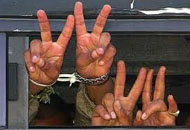
Over the past few months, Israel has been sullying the reputation of yet another aspect of Palestinian governance. In late May, the Palestinian Media Watch, an Israeli watchdog organization that tracks Palestinian media for incitement against Israel released a report claiming that the Palestinian Authority is paying salaries to Palestinian prisoners in accordance with a newly published law.
The PMW spread the news as quickly and with as much venom as possible. “In other words, all Palestinians in Israeli prisons for terror crimes officially join the PA payroll. According to the definition in the PA law, Palestinian car thieves in Israeli prisons will not receive a salary, but Hamas and Fatah terrorist murderers will,” the report read.
“The PA also gives a salary to Israeli Arabs convicted of terror crimes against Israel – the country of which they are citizens. PA benefits to Israeli Arab terrorists, in fact, are greater than the ones extended to Palestinian terrorists.”
Since then, the slandering has taken hold, especially since the PMW called on donor countries to cut aid to the PA altogether since, according to their logic, the money will go to “terrorists” and their families.
This is not the first time the Palestinians have been accused of supporting terrorism and incitement towards Israel. After the PA came to power in 2004 and devised its own school curriculum, Israel immediately began tearing the books apart, page at a time and claiming they were full of anti-Israeli sentiments. An excellent article published earlier this month by The Guardian notes that Israeli textbooks, which are rarely in the spotlight, are far more inciting and racist than that of the Palestinians. The article points out that the word “Palestinians” is only used when in reference to “terrorists.” Otherwise, Palestinians are referred to as Arabs – uneducated, deviant, camel riders.
Claims of incitement are not limited to schoolbooks, unfortunately. When Palestinians named a square after Dalal Al Mughrabi, a Palestinian fighter who was killed during a military operation against Israel in 1978, Israel was up in arms, claiming the Palestinians should not be allowed to name streets or squares after “terrorists.” Israeli watchdog groups and the Israeli government play on the fact that Palestinians have named streets after Abu Jihad (Khalil Al Wazir) and Yehya Ayash. The prisoner stipends are just the latest episode in the drama.
What Israelis should know is that any country in the world with a welfare system is responsible for its citizens, including the families of prisoners. There is nothing out of the ordinary in this. Actually, the PA has been doing it for years. The United States does not punish the family of a murderer nor would Israel cut government benefits from the family of Yigal Amir. Neither should the Palestinians abandon their own people.
Additionally, Palestinian prisoners in Israeli jails are a whole other ballgame. These men and women are not imprisoned for stealing cars, or for selling drugs. They are there because they are resisting a belligerent military occupation of their land, which has oppressed them and their people for decades. The PA’s allocations to prisoners and their families is in no way an endorsement of “terrorism and violence” but rather a means of helping mostly young men and women and their families to resume a life that has been interrupted by an occupying authority. Any other country would have done the same.
Besides, countries should not interfere in the internal affairs of others. If the Palestinians want to name a street after one of their national heroes, regardless of how this person is perceived by Israel, that is their business. The Palestinians have never objected to the fact that Israel named its international airport after David Ben Gurion, Israel’s founding father and a man who advocated the transfer of Palestinians after the 1948 war. “We should prevent Arab return at any cost,” he said in June, a month after Israel’s declaration of independence and 800,000 Palestinians were forced from their homes virtually overnight.
For the Palestinians, Ben Gurion is no hero. The thousands of political prisoners in Israeli jails, on the other hand, certainly are.
~
Joharah Baker is Director of the Media and Information Department at the Palestinian Initiative for the Promotion of Global Dialogue and Democracy (MIFTAH). She can be contacted at mid@miftah.org.
Many of the 70,000 “third country national”(TCN) service workers employed in Afghanistan and Iraq “recount having been robbed of wages, injured without compensation, subjected to sexual assault, and held in conditions resembling indentured servitude by their subcontractor bosses,” reports Sarah Stillman in a June 6th article in The New Yorker magazine titled “The Invisible Army.” In fact, the system resembles nothing so much as a twisted form of modern slavery.
“These workers, primarily from South Asia and Africa, often live in barbed-wire compounds on U.S. bases, (and) eat at meagre chow halls…” she reports. “A large number are employed by fly-by-night subcontractors who are financed by the American taxpayer but who often operate outside the law.”
Since the U.S. invasions, more than 2,000 contractor fatalities and 51,000 contractor injuries have been reported in Iraq and Afghanistan as the soaring casualty rates “are now on a par with those of U.S. troops in both war zones,” Stillman writes.
Although President Obama said in 2009 he would make good on his campaign pledge to do better by these contractors, the number of TCN’s in Afghanistan had increased by nearly 50 percent reaching 17,500—-with no apparent improvement in their lot. Indeed, the deplorable conditions on the bases where contractors are employed have triggered widespread rioting.
“Previously unreported worker riots have erupted on U.S. bases over issues such as lack of food and unpaid wages,” Stillman reports. On May 1, 2010, in a labor camp run by Prime Projects International on the largest military base in Baghdad, more than a thousand subcontractors—primarily Indians and Nepalis—rampaged using as weapons fists, stones, wooden bats, and, as one U.S. military policeman put it, “anything they could find.”
“Employees started to throw gravel at the managers. Four-foot pieces of plywood crashed through glass windows. Workers broke down the door to the food cellar and made off with as much as they could carry,” the reporter noted. Several weeks later, workers in a nearby camp run by subcontractor Gulf Catering Co. staged a copycat riot, “pelting their bosses with stones and accusing the company of failing to pay them proper wages,” Stillman added.
A manager in another camp operated by a K.B.R. (the former Halliburton subsidiary), told Stillman about conditions that triggered one riot. Ziad Al Karawi described how a thousand Indian and Sri Lankan men under his supervision slept on crowded floors: “Rats and flies attacked us…We had no beds to sleep at or tables to eat at….No communication, no TV,no soap to wash or bathe, no visits from anyone from the company or K.B.R….The workers had no choice except going out in a protest.”
K.B.R. claims that its “business ethics and values” require employees and subcontractors are treated “with dignity and respect,” Stillman writes but even after its investigation of conditions “little seems to change.” And a spokesman for the U.S. Army Central Command conceded that it “does not play a formal role in the monitoring of living conditions on U.S. bases.”
Many of the T.C.N.’s are hired by private employment subcontractors who promise them high wages but pay only a fraction of what they promised. T.C.N.’s are also lied to even about where they will be employed. Some are told they will be working in luxurious Dubai only to find themselves in Iraq under incoming fire.
Stillman reports that “military privatization (of jobs) has produced convoluted chains of foreign subcontracts that often lead to cost overruns and fraud. The Commission on Wartime Contracting recently warned of the dangers associated with “poorly conceived, poorly structured, poorly conducted, and poorly monitored subcontracting,” particularly noting the military’s “heavy reliance on foreign subcontractors who may not be accountable to any American governmental authority.”
The racket begins when the Pentagon outsources prime logistics contracts, worth as much as $15 billion a year, to such private military firms as K.B.R., DynCorp International, and Fluor. Stillman writes, “These ‘prime venders’ then shop out the bulk of their contracts to hundreds of global subcontractors, many based in Middle Eastern countries that are on the U.S. State Department’s human-trafficking non-compliance list. Finally, these firms call upon thousands of Third World ‘manpower agencies’—small recruiting operations…”
The recruiters, who charge the job-seekers at least a thousand dollars and often more for the privilege of signing up, put them to work on military bases as cooks, cleaners, construction workers, fast-food clerks, electricians, and beauticians, etc. Kenyans truck frozen steaks and inflatable tents, Bosnians repair electrical grids, and Indians provide iced mocha lattes, Stillman writes.
Stillman, who interviewed hundreds of TCNs in the process of preparing her article, said a typical story was that of a 25-year-old Taco Bell employee on a major U.S. base in Iraq who paid a Nepal recruiter $4,000 to get a job in Iraq where he was told he would make his investment back quickly. In May, 2009, the man found himself housed in a shipping container behind the U.S. Embassy in the Green Zone where he slept on a soiled mattress with 25 other migrants. “Many learned that they were to earn as little as $275 a month as cooks and servers for U.S. soldiers—a fraction of what they’d been promised, and a tiny sliver of what U.S. taxpayers are billed for their labor.”
In case you think the investigative reporter’s findings are sensationalized, read the findings of the Pentagon’s own 2006 investigation into subcontractor working conditions. Government inspectors listed “widespread” abuses, including the illegal confiscation of workers’ passports, “deceptive hiring practices,” “excessive recruiting fees” and “substandard worker living conditions.” In short, another tragic example of how a greed-driven totalitarian state has no regard for the individual. Although President Lincoln abolished slavery in 1863, it appears the Pentagon has reinstituted the practice for its own ends.
~ Sherwood Ross is a Miami-based public relations consultant who formerly was a columnist on workplace issues for a major wire service.
The Mavi Marmara is the Turkish-operated ship that Israel attacked on 31 May 2010 in international waters during the previous flotilla, killing 9 people and injuring dozens more.
In the wake of a deeply flawed, biased and non-credible UN report justifying the Israeli siege of Gaza and white-washing the Israeli attack, Turkey has downgraded diplomatic relations with Israel to the lowest level, suspended all military agreements between the countries, and vowed to take other measures to seek justice for the victims of the Israeli attack and to challenge the Israeli siege.
Why did Turkey stop the Mavi Marmara?
Although the Mavi Marmara was operated by the independent charity IHH, it seems highly likely that the decision to withdraw from the flotilla in June was taken at the suggestion of the Turkish government. The reasons given publicly for withdrawing the ship were “technical.”
At the time many observers – myself included – feared that Turkey was softening its stance toward Israel and seeking to “mend fences” without Turkey’s demands being met.
The suspicions of many were encapsulated in a drawing by celebrated political cartoonist Carlos Latuff that showed Turkish Prime Minister Recep Tayyip Erdoğan declaring “I love Palestine” to win votes in the Turkish general election, while his shadow shakes hands with Israel.
Many were convinced that the withdrawal of the Mavi Marmara meant Turkey’s policy was no different from the abject complicity of Greece, which worked hand in glove with Israel, to prevent the remaining flotilla ships from reaching Gaza.
It is now clear that this analysis was wrong. For one thing, Turkish-Israel relations featured little in the June Turkish election campaign, and if Turkey’s stance was about winning votes, the government would presumably have announced its measures against Israel before the election rather than months afterwards.
A tactical move in a long strategy?
In light of the relative severity and decisiveness of Turkey’s sanctions on Israel, it is certain that withdrawing the Mavi Marmara was a tactical step, as negotiations between Israel and Turkey were ongoing, to avoid giving Israel the excuse of another “provocation” which would let it off the hook for the previous attack.
Sending the ship could also have led to unknown consequences from Turkey’s perspective: either allowing Israel to seize the ship again, or escalating into a military confrontation.
Turkey’s stance against this unlawful act of Israel from the first moment has been very clear and principled. Our demands are known.
Our relations with Israel will not be normalized until these conditions are met.
At this juncture, Israel has wasted all the opportunities it was presented with.
Now, the Government of Israel must face the consequences of its unlawful acts, which it considers above the law and are in full disregard of the conscience of humanity. The time has come for it to pay a price for its actions.
This price is, above all, deprivation of Turkey’s friendship.
Turkey’s gesture of stopping the Mavi Marmara from sailing in June is almost certainly one of the “wasted opportunities” to which Davutoğlu alluded. Another would have been Turkey’s assistance in extinguishing last’s year’s Carmel wildfire.
Laying the ground for a decisive step
By giving Israel all these opportunities and avoiding anything that Israel could present as a provocation, Turkey has established beyond any reasonable doubt Israel’s total intransigence and unwillingness to assume responsibility.
Thus, the measures taken yesterday by Turkey appear to have been well-studied and carefully prepared. This suggests that Davutoğlu was serious when he said there would be no retreat from Turkey’s position and no normalization of relations until Turkey’s demands are met.
The cost to Turkey?
One calculation Turkey certainly would have had time to consider is the price it might pay in terms of retaliation from the United States, Israel’s protector and patron. Turkey, unlike Israel, is a formal ally of the United States, a member of NATO, and thus has a mutual defense pact with the United States.
The Turkish government must have concluded that it can withstand whatever wrath the United States might mete out, especially since the US still feels it needs Turkey to help maintain its faltering hegemony in the region.
Press reports indicate that as part of the deal, the US acceeded to a Turkish demand that data from the Turkish-hosted radars not be shared with Israel.
Turkey, it turns out, is still of more practical benefit to US regional hegemony than Israel, which is increasingly a strategic and political burden to the United States.
In terms of regional implications, Turkey has demonstrated to supine Arab regimes, particularly Egypt’s ruling military junta, that imposing a cost for Israel’s aggression is an option despite US support.
Will the Mavi Marmara sail to Gaza again?
Now that Turkey has shown its hand toward Israel, the question arises: will the Mavi Marmara sail to Gaza again? That is a question I cannot answer, but Davutoğlu also made clear that Turkey does not recognize the siege or maritime blockade of Gaza and would continue to challenge it:
As a littoral state which has the longest coastline in the Eastern Mediterranean, Turkey will take whatever measures it deems necessary in order to ensure the freedom of navigation in the Eastern Mediterranean.
Turkey does not recognize the blockade imposed on Gaza by Israel. Turkey will ensure the examination by the International Court of Justice of Israel’s blockade imposed on Gaza as of 31 May 2010. To this end we are starting initiatives in order to mobilize the UN General Assembly.
What these measures will mean in practice – and whether they will involve the Mavi Marmara returning to Gaza, remains to be seen.
A report says that US military has developed a secret army that is trained to assassinate perceived enemies anywhere in the world, particularly in Iraq and Afghanistan.
The report, published by prominent US daily The Washington Post reveals that the American military has developed an organization called the Joint Special Operations Command, or J-SOC, which is tasked with killing, imprisoning and interrogating suspected terrorists around the world.
J-SOC holds terror suspects in jails under its own control and has reportedly carried out 10 times as many covert military operations as the CIA in Iraq and Afghanistan, according to the Post article published in its Friday edition.
US President Barack Obama has authorized the J-SOC to select individuals on its own terror list, and then to kill, rather than capture them.
Analysts widely believe that many of J-SOC’s operations are akin to terror assassinations that are clearly in violation of US laws.
The clandestine organization has claimed responsibility for the assassination of Osama bin Laden in Pakistan. It is estimated that the terror force has so far carried out over a thousand such operations.
The US has reportedly spent over USD 1 trillion of its taxpayers funds on the wars it imposed on Iraq and Afghanistan since 2001, using the suspicious September 11, 2001 terrorist incidents in New York and Washington as the pretext.
The US-led war in Afghanistan, with civilian and military casualties at record highs, has become the longest war in US history.
In spite of US government statements about its displeasure with the expansion of Israeli settlements, US based organizations are abusing the 501(C)3 section of US tax codes to provide billions in subsidies to do exactly that.
There are hundreds of these tax-exempt, so-called charities funneling money to illegal Israeli settlements, often with the names no more creative than “American Friends of name an Israeli settlement.”
One such organization, American Friends of Ariel Inc., paints a picture of how these US based front groups collect tax-deductible donations, and use them to build and expand illegal Israeli settlements, and in some cases, purchase weapons for the settlers within them. In many cases, including that of American Friends of Ariel Inc., the organization does not make substantial efforts to disguise the fact that the US based tax exempt entity is nothing more than a shell organization being used to transfer money abroad.
For example, the president of American Friends of Ariel, Ron Nachman, also happens to be the longtime mayor of Ariel. The sole programmatic function of American Friends of Ariel is to transfer funds to a non-exempt organization based in Ariel called the Ariel Development Fund, also controlled by Nachman, which describes itself simply as the “fundraising arm of the city of Ariel.” Under Ron Nachman’s leadership, American Friends of Ariel transferred more than $5 million to the Ariel Development Fund over the last several years.
It is worth noting that much of the funding for American Friends of Ariel has come from Christian Zionist groups, and in general, these groups have played an increasingly dominant role in the financial and political support for the illegal Israeli settlement enterprise.
Devastating impact
The work of American Friends of Ariel Inc., and the many tax-exempt organizations like it, is having a devastating impact on local Palestinian communities. A recent report by the UN Office of Humanitarian Affairs, covered by the Ma’an News Agency, described the “alarming trends of forced displacement of Palestinians in Area C” as a result of settlement expansion, and found that “more demolitions have taken place so far in 2011 than in all of 2009 and 2010 combined” (“UN: Marked increase in forced displacement of Palestinians,” 21 July 2011).
In addition to the gross human rights violations inherent in illegal Israeli settlement expansion, US taxpayers simply cannot afford to build homes and walls in illegal Israeli settlements while record numbers of Americans are losing their homes, and unmet domestic needs in the US are at an all time high.
American Friends of Ariel, and the vast number of organizations like it, not only violate Palestinian human rights, they violate US laws. American Friends of Ariel Inc. flouts US laws in two ways.
The first has to do with the structure of the organization, and the fact that most of these tax exempt 501(c)3 organizations are simply shells that transfer money to non-exempt organizations abroad, and the second deals with the exempt purposes set forth by the Internal Revenue Service (IRS) and Treasury Department.
The rule concerning the use of tax exempt entities as conduit organizations is clear, and states that “the code would be nullified if contributions inevitably committed to a foreign organization were held to be deductible solely because, in the course of transmittal to a foreign organization, they came to rest momentarily in a qualifying domestic organization” (Section 170(c)(2)(A)). That is exactly the case with American Friends of Ariel Inc., and hundreds of organizations like it, a fact which is abundantly clear upon review of their publicly available 990 tax forms.
Exacerbating poverty and neighborhood tensions
The second major legal violation occurs because these organizations fundamentally violate the purpose for which charities can be organized, namely to provide “relief of the poor, the distressed, or the underprivileged; lessening neighborhood tensions; eliminating prejudice and discrimination; defending human and civil rights secured by law; and combating community deterioration and juvenile delinquency.”
Illegal Israeli settlements, mostly built on expropriated land and operated with stolen resources, exacerbate poverty and systematically create an underprivileged class of people. Race-based colonies inherently increase neighborhood tensions, and they effectively annex occupied Palestinian land through a system of apartheid infrastructure that has been detrimental to Palestinian communities across the West Bank, including occupied East Jerusalem.
The raison d’etre of illegal Israeli settlements is rooted in institutionalized discrimination, and therefore technically violates IRS regulations on a daily basis in the same way that Bob Jones University violated those same regulations barring discrimination (Bob Jones University v United States).
In 1983, the Supreme Court ruled that the IRS had the authority to revoke the tax-exempt status of Bob Jones University because they openly discriminated against interracially married individuals. The court ruled that such behavior was “wholly incompatible with the concepts underlying tax exemption,” and clarified by stating that “whatever may be the rationale for such private schools’ policies, racial discrimination in education is contrary to public policy.” Fundamental human rights like equality are not confined by jurisdiction, and organizations operating abroad are similarly bound to respect and uphold them.
The numerous and flagrant violations of the tax-exempt purposes set forth by the IRS and Treasury department should be reason enough to revoke the tax-exempt status of these organizations. It is hard to imagine the US playing any constructive role as an “honest broker” when in addition to providing $3 billion in annual military aid to Israel, Americans are also being forced to subsidize the construction and expansion of the same illegal settlements that our government is politely telling Israel are very unhelpful.
Because of the US government’s unwillingness to equally enforce the law, or use the proverbial stick instead of just carrots, money that would otherwise be going into our national treasury to pay down the debt or build affordable housing in the US, is instead being used to construct and defend Jewish-only colonies in the occupied West Bank.
Mike Coogan is a member of Virginians for Middle East Peace.
This video concentrates on the two major 9/11 issues: The Unidentified Planes and The Controlled Demolitions. Nothing else. It does not mention the NORAD stand–down; the don’t-fly and don’t-go-to-work warnings or the Dancing Israelis or any of the other anomalies and suspicious happenings. The alleged amateur suicide pilots are not mentioned, either, for obvious reasons, and I do not know what happened to the allegedly hijacked planes or their alleged passengers and crews.
It is my contention that the 9/11 Truth Movement has got to concentrate on the most blatant and provable lies in the official story, and stop trying to be an amateur Police Precinct or a citizen’s District Attorney’s Office. The Movement must bring pressure to bear in the authorities for a new enquiry, so that the police, the FBI, the NTSB and all of the other law enforcement and investigative agencies can do what should have been done 10 years ago: Find out who was responsible for the crime of the attacks on 9/11 and bring them to justice.
While I was thinking about a video for the 10th anniversary of 9/11, an English artist named David Borrington got in touch, and asked if I would write and record some voice commentaries to be included in a set of prints that he was making for the same occasion. When I saw his strangely haunting artwork, I decided to incorporate David’s images into my video. So, my sincere thanks go to David Borrington, whose website is http://www.davidborrington.com
The current ideology to justify aggressive war is based on a dogmatic dichotomy between Democracy and Dictators. The pro-war party in the West has been shifting the center of international law and order from the United Nations to a more exclusive club of “democracies” which alone have “legitimacy”. The core of this club is the English-speaking world, plus Israel, the European Union, and Japan. This “International Community” of democracies is understood to possess the unique moral right to decide when the leader of any country outside their charmed circle may be denounced as a “dictator” and overthrown with the help of a NATO bombing campaign.
This ideology assumes that Democracies respect human rights, whereas dictators by definition are criminals who systematically violate human rights and may be contemplating “genocide against their own people”. Certain details, such as the fact that the United States has the largest prison population in the world in both absolute and relative terms, and uses convicts for cheap labor in the arms industry, are not allowed to interfere with this dualistic world view.
The mainstream media maintain this dichotomy by sustained bias in their coverage of countries labeled “dictatorships” – which may include some countries whose leaders are in fact elected, such as Venezuela, Russia, Serbia under Milosevic, Belarus, but who attempt to follow policies contrary to the dictates of the self-designated “International Community”. Not all such countries may actually by attacked militarily, but the image created will make military attack easily justifiable if and when the time comes.
Selective reporting reduces the country to its Dictator and a minority of “pro-democracy protesters”. The Dictator is portrayed as a criminal, with no virtues that could possibly justify any popular support within his own country.
The Case of Libya
The case of Libya illustrates the way this works. Decades of one-sided media coverage firmly established Libyan leader Moammer Gaddafi as an insane criminal. To the Western public whose only knowledge of Libya came from Western media reports, it would seem obvious that the Libyan people must unanimously want to get rid of such a leader.
It is obvious that there are people in Libya who hate Gaddafi and want to get rid of him. What is not obvious is exactly what they want to put in his place and just how representative they really are of the population as a whole.
In the West, the main reason to hate Gaddafi in recent years has been the Lockerbie bombing. For two decades, the allegation that the Libyan leader was responsible for the 1988 terrorist bombing of Pan Am flight 103 over Lockerbie, Scotland, has been kept in the public eye by mainstream media.
Last February, leaders of the emerging rebellion in Libya gave interviews with Western media claiming to have documentary proof that Gaddafi ordered the terrorist attack that killed 270 people. Mustafa Abdel Jalil, former Libyan justice minister who heads the “National Transitional Council” in Benghazi told The Daily Telegraph that: “The orders were given by Gaddafi himself”.
Few in the West are likely to object that if the NTC leaders really possess such proof , they have been complicit in the crime for decades. Nor will Western media raise the question as to why the wily Gaddafi would leave “documentary proof” of orders to commit a terrorist act lying around for 23 years.
These claims serve to bond the NTC leaders with the Western powers, notably the United States and the United Kingdom, and to suggest a community of legality between them against “the criminal Gaddafi”. They help build the fiction of “legitimate, representative leaders of the Libyan people” whose views of human rights, democracy and the misdeeds of the evil dictator Gaddafi coincide with Western attitudes, as expressed by Western politicians and media.
By implication, the Libyan people have known all along that their leader is a mass murderer. This must be one reason the decent citizens want to get rid of him. But is this true?
Lockerbie in Libya
My visit to Libya in January 2007, to attend an international conference on the International Criminal Court, gave me the opportunity to hold private conversations with a number of well-educated Libyans who clearly knew a lot more about the West than the West knew about them. I was particularly interested in getting the take of unofficial Libyan citizens on two issues that at the time dominated Western perception of Libya: Lockerbie and the affair of the Bulgarian nurses. I should mention that I never got near Gaddafi, and the conference was sponsored by academics who held diverse opinions on important issues, often unlike those of the Leader, which didn’t seem to bother anyone. But on the issue of Lockerbie, I discovered two general widespread points of agreement.
On the one hand, nobody believed that Libya was responsible for the Lockerbie bombing. It was taken for granted that Libya had been unfairly accused for political reasons.
On the other hand, it was clear that the sanctions imposed by the West to punish Libya for its alleged guilt had caused hardship and discontent. The power of the West both to impose sanctions and to project its images amounts to serious interference in the domestic politics of targeted countries, since very many people, especially the young, want to live in a “normal” country and may resent leaders who cause them to be treated as pariahs by the West. Therefore, it was understood that Gaddafi had finally given in to Western pressure to accept responsibility – but not guilt – for Lockerbie merely in order to get the unpopular sanctions lifted. The fact that he agreed to turn over two Libyan citizens to a Western court to be tried for the crime and to pay over two billion dollars of compensation to the victims was explicitly not an admission of guilt, but rather a response to blackmail by Great Powers in order to normalize relations and improve daily life.
This did not surprise me, since over the years I had read a lot about the Lockerbie case. Indeed, a great deal has been written exposing the weakness of the prosecution’s case, based on a totally implausible scenario (a bomb to blow up a trans-Atlantic flight was allegedly sent via airports in Malta, Frankfurt and London), technical “evidence” that had been tampered with by CIA agents, and a witness who was richly rewarded for testimony which did not fit the facts. All this has been told many times, for instance by Andrew Cockburn in the CounterPunch newsletter, or the London Review of Books, “The Framing of al-Megrahi” by British lawyer Gareth Peirce. But the fact that the case has been repeatedly exposed by careful analysis as a probable frame-up has not made the slightest impression on mainstream media and politicians who continue to blast Gaddafi as the monster who ordered the Lockerbie massacre.
One may add that at the time of the event in 1988, it was widely assumed that Iran had ordered the attack in retaliation for U.S. downing of an Iranian airliner over the Persian Gulf. When the United States, switching from its anti-Iran alliance with Iraq to war against Saddam Hussein, decided to accuse Libya instead, no motive was ever produced. But when a “dictator” has been stigmatized as a monster, no motive is needed. He just did it because that is the sort of thing evil dictators are supposed to do.
The two accused Libyan airline employees working in Malta had been put on trial in 2000 by three Scottish judges without a jury in a specially built court in the Netherlands. One of the Libyans was acquitted and the other, Abdel Basset al-Megrahi, was convicted and sentenced to 27 years in prison. The United Nations observer at this peculiar trial, Hans Köchler, called the guilty verdict “incomprehensible”, “arbitrary, even irrational” and noted “an air of international power politics” surrounding the proceedings.
On November 12, 2006, the Glasgow Sunday Herald quoted top State Department legal advisor Michael Scharf, who was the counsel to the US counter-terrorism bureau when the two Libyans were indicted for the bombing, as calling the case “so full of holes it was like Swiss cheese” and said it should never have gone to trial. He claimed the CIA and FBI had assured State Department officials there was an “iron-clad” case against the two Libyans, but that in reality the intelligence agencies knew well in advance of the trial that their star witness was “a liar”. But Great Powers can’t back down. Their sacred “credibility” is at stake. In short, they must keep lying to preserve the illusion of infallibility.
At the time I was in Tripoli, the defense team of the convicted Libyan was trying to appeal the conviction to a higher court. I was able to call on one of the lawyers on Megrahi’s defense team. I spent a long time in her office, trying to overcome her reluctance to speak about the case. Finally, she agreed to talk to me when I promised to keep our conversation to myself, so as not to risk harming the appeal. By now, the circumstances have changed drastically.
Here, briefly, is what she told me.
The Scottish judges were under enormous pressure to convict the two Libyans. After all, for years their guilt had been trumpeted by the United States demanding that they be “brought to justice”. A special court had been set up with the obvious purpose of convicting them. Yet the evidence which would merit conviction in a proper Scottish court was simply not there. The best the judges dared to do was to acquit one of the defendants and pass along the responsibility for acquitting the other to a higher court. But to the dismay of the Libyan defense team, the designated court of appeals evaded the dangerous issue by disqualifying itself. So now an appeal was being prepared for another high court, complete with new evidence further discrediting the prosecution case.
And in fact, five months later, on June 28, 2007, the Scottish Criminal Cases Review Commission, which had been investigating the case since 2003, recommended that Abdel Basset al-Megrahi be granted a second appeal against his conviction. The Commission said it had uncovered six separate grounds for considering that the conviction may have been an injustice. The announcement caused a sensation in the small circles following the affair. It seemed that Scottish justice was courageous enough to assert itself and allow hearings that would expose the CIA frame-up.
That sort of thing may happen in movies, but the real world is something else.
A sordid bargain
What happened after that helped set the stage for the NATO attack on Libya this year.
Time passed. It was two years later, in April 2009, that the appeal finally was due to get underway. But meanwhile, behind the scenes, secret bargaining was going on, amid leaks and rumors.
On August 21, 2009, on grounds that he was suffering from terminal cancer, Abdel Basset Ali Mohmed al-Megrahi was released from prison in Scotland by the Scottish justice minister Kenny MacAskill and allowed to “go home to die”.
Now, it so happens that in 2007, Tony Blair went to Libya to negotiate a British-Libyan agreement with Gaddafi covering law, extradition and prisoner transfer. Under this Prisoner Transfer Agreement, Libyan authorities asked for Megrahi to be sent home due to his illness.
The catch was that the Prisoner Transfer Agreement could be applied only when no legal proceedings were outstanding. So in order to benefit from it, Megrahi had to drop his appeal.
The matter is confused by the fact that he was formally released on “compassionate” grounds. One way or another, the deal was clear: al-Megrahi could go home, but the appeal was dead. Hans Kochler, UN-appointed special observer to the Lockerbie trial, thought Megrahi may have been subjected to “morally outrageous” blackmail to abandon his appeal against his will.
The sordid aspect of this bargain is that it deprived Megrahi of the right to clear his name, while leaving the CIA frame-up officially unexposed. There was nothing to counter the chorus of protestations from Hillary Clinton on down denouncing Scotland for having “freed the Lockerbie bomber”. Two years later, news that Megrahi has failed to die has elicited further indignation from Western media, who see this as proof that the UK had “sold the Lockerbie bomber for Libyan oil”. Naturally, the impression must be conveyed that the sly Libyan dictator tricked the naïve but greedy Brits into selling out their principles for petroleum.
But it is just as likely that it was the naïve Libyan dictator who was tricked by the unscrupulous British into thinking he had made a “gentleman’s agreement”. Rather than pursue an appeal which risked causing acute embarrassment to Western authorities, Megrahi could be released and the matter forgotten. The popular rejoicing at Megrahi’s return home was muted in Libya, but Western media pretended to be scandalized that a convicted mass murderer received a hero’s welcome. In reality, he was welcomed home discreetly as an innocent man who had been unjustly convicted, not as a mass murderer. And whenever he has been able to make himself heard, he has reiterated his desire to clear his name.
The Bulgarian nurses
The other subject I asked about while I was in Tripoli in 2007 was the plight of the Bulgarian nurses. In 2004, five Bulgarian nurses and a Palestinian doctor working in a Benghazi hospital were sentenced to death for allegedly having infected children with the HIV virus. Everyone in the West, myself included, assumed this was an outrageous injustice. When I raised the issue with highly Westernized, liberal Libyan intellectuals, I fully expected to hear strong criticism of the dictator for persecuting defenseless health workers. I was quite surprised when the reaction was somewhat different.
“Of course they are innocent”, I said.
The gentleman with whom I was talking, whom I could loosely describe as anti-Gaddafi, shook his head. “That’s not so clear”, he replied. And so I began to learn what was explained a few months later by Harriet Washington in a New York Times column, namely that:
“The evidence against the Bulgarian medical team, like H.I.V.-contaminated vials discovered in their apartments, has seemed to Westerners preposterous. But to dismiss the Libyan accusations of medical malfeasance out of hand means losing an opportunity to understand why a dangerous suspicion of medicine is so widespread in Africa.
“Africa has harbored a number of high-profile Western medical miscreants who have intentionally administered deadly agents under the guise of providing health care or conducting research.”
My conversations in Libya did not convince me that the Bulgarian health workers were guilty, but they did give me a new insight into the Libyan viewpoint. On the African continent, it was easy for even highly rational people to believe that foreign health workers might have been paid to infect children, either for experimental purposes or to “destabilize” the public health system. Secondly, it became clear that this was not a case of “the dictator Gaddafi” persecuting innocents. The arrest, alleged torture and conviction of the Bulgarian nurses were carried out by authorities in Benghazi. Indeed, last March 11, the day after France recognized the rebel National Transitional Council as the “sole legitimate representative of the Libyan people”, Bulgarian prime minister Boyko Borisov complained to a European summit in Brussels that key members of that council in Benghazi “are the people who tortured the Bulgarian medics for eight years and that this cost us nearly $60 million” in reparations to the infected children and their families.
In January 2007, I was also assured by people in Tripoli that the death sentence against the nurses would never be carried out. This was true. In August of that same year, the medical workers were freed by the Gaddafi family and allowed to go home to Bulgaria after a much publicized trip to Libya by President Sarkozy’s wife at the time, Cecilia. This liberation was presented as a final reconciliation between Gaddafi’s Libya and Europe.
I abstained from writing about this for years, because I feel I do not know enough about Libya. But now I see others, who know even less, loudly advocating NATO support to rebels in a civil war whose real motives and consequences are obscure.
My first conclusion is to point out that just because a country is not a Western-style democracy does not mean that everything that happens there is “dictated” by a “dictator”. The term “dictator” serves to comfort the laziness of media and politicians who do not care to bother to investigate the complexities of an unfamiliar society.
My second and final conclusion is that we in the West have neither the right nor the ability to “fix” those unfamiliar societies such as Libya which we dismiss as “dictatorships”. As the financial crisis threatens to bring living standards in much of the West below what they were in Gaddafi’s Libya before NATO intervened there, our Western “democracy” is in danger of being gradually reduced to a mere ideological excuse to attack, ravage and pillage other people’s countries.
Diana Johnstone is author of Fools’ Crusade. She can be reached at diana.josto@yahoo.fr
The Jewish Chroniclereported last week that a video made by Alan Duncan, UK minister for international development, infuriated the Israeli lobby so much that it was withdrawn from the ministry’s website.
In the video Duncan said that, “The wall is a land grab. It hasn’t just gone along the lines of the proper Israel boundary. It’s taken in open land which actually belongs to Palestine”. He added: “Israeli settlers can build what they want and then immediately get the infrastructure so that takes the water deliberately away from Palestinians here.”
Horrified that a government minister could say such things, the lobby went into action. The Board of Deputies of British Jews wrote to Duncan to demand the withdrawal of the video, copying in his boss, Development Secretary Andrew Mitchell, and Foreign Secretary William Hague. Board president Vivian Wineman commented: “Mr Duncan’s apparent disregard for Israel’s legitimate security concerns is of great concern.”
The episode seems to have caused a row between Duncan’s department (DFID) and the Foreign Office. According to the Jewish Chronicle, “Civil servants at the FO made it clear that they did not believe Mr Duncan had struck the right diplomatic tone with the language he had used. However, they did not refer the matter to ministers when DfID and Mr Duncan defied the advice.”
But the FO has now prevailed. Duncan has been brought to heel and the video withdrawn. By way of explanation a spokesperson said, “The video was aimed at highlighting DfID’s work to alleviate poverty in the OPTs [Occupied Palestinian Territories], as well as some of the key challenges facing the Palestinian people. Unfortunately, some elements were misinterpreted and Mr Duncan has asked for it to be taken down”.
It is not clear whether Duncan believes his views were misinterpreted. But one thing is definitely clear – whilst the Israeli lobby in the UK is not visible as its US counterpart, it is still very effective.
Juan Cole is a brand name that is no longer trusted. And that has been the case for some time for the Professor from Michigan. After warning of the “difficulties” with the Iraq War, Cole swung over to ply it with burning kisses on the day of the U.S. invasion of Iraq. His fervor was not based on Saddam Hussein’s fictional possession of weapons of mass destruction but on the virtues of “humanitarian imperialism.”
Thus on March 19, 2003, as the imperial invasion commenced, Cole enthused on his blog: “I remain (Emphasis mine.) convinced that, for all the concerns one might have about the aftermath, the removal of Saddam Hussein and the murderous Baath regime from power will be worth the sacrifices that are about to be made on all sides.” Now, with over 1 million Iraqis dead, 4 million displaced and the country’s infrastructure destroyed, might Cole still echo Madeline Albright that the price was “worth it”? Cole has called the Afghan War “the right war at the right time” and has emerged as a cheerleader for Obama’s unconstitutional war on Libya and for Obama himself.
Cole claims to be a man of the left and he appears with painful frequency on Amy Goodman’s Democracy Now as the reigning “expert” on the war on Libya. This is deeply troubling – on at least two counts. First, can one be a member of the “left” and also an advocate for the brutal intervention by the Great Western Powers in the affairs of a small, relatively poor country? Apparently so, at least in Democracy Now’s version of the “left.” Second, it appears that Cole’s essential function these days is to convince wavering progressives that the war on Libya has been fine and dandy. But how can such damaged goods as Cole credibly perform this marketing mission so vital to Obama’s war?
Miraculously, Cole got just the rehabilitation he needed to continue with this vital propaganda function when it was disclosed by the New York Times on June 15 that he was the object of a White House inquiry way back in 2005 in Bush time. The source and reason for this leak and the publication of it by the NYT at this time, so many years later, should be of great interest, but they are unknown. Within a week of the Times piece Cole was accorded a hero’s welcome on Democracy Now, as he appeared with retired CIA agent Glenn Carle who had served 23 years in the clandestine services of the CIA in part as an “interrogator.” Carl had just retired from the CIA at the time of the White House request and was at the time employed at the National Intelligence Council, which authors the National Intelligence Estimate.
It hit this listener like a ton of bricks when it was disclosed in Goodman’s interview that Cole was a long time “consultant” for the CIA, the National Intelligence Council and other agencies. Here is what nearly caused me to keel over when I heard it (From the Democracy Now transcript.):
AMY GOODMAN: So, did you know Professor Cole or know of him at the time you were asked? And can you go on from there? What happened when you said you wouldn’t do this? And who was it who demanded this information from you, said that you should get information?
GLENN CARLE: Well, I did know Professor Cole. He was one of a large number of experts of diverse views that the National Intelligence Council and my office and the CIA respectively consult with to challenge our assumptions and understand the trends and issues on our various portfolios. So I knew him that way. And it was sensible, in that sense, that the White House turned to my office to inquire about him, because we were the ones, at least one of the ones—I don’t know all of Mr. Cole’s work—who had consulted with him. (Emphases mine.)
That seems like strange toil for a man of the “left.” But were the consultations long drawn out and the association with the CIA a deep one? It would appear so. Again from the transcript:
AMY GOODMAN: Well, the way James Risen (the NYT reporter) writes it, he says, “Mr. Carle said [that] sometime that year, he was approached by his supervisor, David Low, about Professor Cole. [Mr.] Low and [Mr.] Carle have starkly different recollections of what happened. According to Mr. Carle, [Mr.] Low returned from a White House meeting one day and inquired who Juan Cole was, making clear [that] he wanted [Mr.] Carle to gather information on him. Mr. Carle recalled [his] boss saying, ‘The White House wants to get him.’”
GLENN CARLE: Well, that’s substantially correct. The one nuance, perhaps, I would point out is there’s a difference between collecting information actively, going out and running an operation, say, to find out things about Mr. Cole, or providing information known through interactions. (Emphasis mine.) I would characterize it more as the latter.
And later in the interview Carle continues:
On the whole, Professor Cole and I are in agreement. The distinction I make is it wasn’t publicly known information that was requested; it was information that officers knew of a personal nature about Professor Cole, which is much more disturbing. There was no direct request that I’m aware, in the two instances of which I have knowledge, for the officers actively to seek and obtain, to conduct—for me to go out and follow Professor Cole. But if I knew lifestyle questions or so on, to pass those along. (Emphasis mine.)That’s how I—which is totally unacceptable.
It would seem then that the interaction between the CIA operatives and Cole was long standing and sufficiently intimate that the CIA spooks could be expected to know things about Cole’s lifestyle and personal life. It is not that anyone should give two figs about Cole’s personal life which more than likely is every bit as boring as he claims. But his relationship with the CIA is of interest since he is an unreconstructed hawk. What was remarkable to me at the time is that Goodman did not pick up on any of this. Did she know before of Cole’s connections? Was not this the wrong man to have as a “frequent guest,” in Goodman’s words, on the situation in the Middle East?
This is not to claim that Cole is on a mission for the CIA to convince the left to support the imperial wars, most notably at the moment the war on Libya. Nor is this a claim that the revelation about the White House seeking information on Cole was a contrived psy-ops effort to rehabilitate Cole so that he could continue such a mission. That cannot be claimed, because there is as yet no evidence for it. But information flows two ways in any consultation, and it is even possible that Cole was being loaded with war-friendly information in hopes he would transmit it.
Cole is anxious to promote himself as a man of the left as he spins out his rationale for the war on Libya. At one point he says to Goodman (3/29), “We are people of the left. We care about the ordinary people. We care about workers.” It is strange that a man who claims such views dismisses as irrelevant the progress that has come to the people of Libya under Gaddafi, dictator or not. (Indeed what brought Gaddafi down was not that he was a dictator but that he was not our dictator.) In fact Libya has the highest score of all African countries on the UN’s Human Development Index (HDI) and with Tunisia and Morocco the second highest level of literacy. The HDI is a comparative measure of life expectancy, literacy, education and standards of living for countries worldwide.
Whither the Left on the Question of Intervention?
None of this is all too surprising given Cole’s status as a “humanitarian” hawk. But it is outrageous that he is so often called on by Democracy Now for his opinion. One of his appearances there was in a debate on the unconstitutional war in Libya, with CounterPunch’s estimable Vijay Prashad taking the antiwar side and Cole pro-war. It would seem strange for the left to have to debate the worth of an imperial intervention. Certainly if one goes back to the days of the Vietnam War there were teach-ins to inform the public of the lies of the U.S. government and the truth about what was going on in Vietnam. But let us give Democracy Now the benefit of the doubt and say that the debate was some sort of consciousness raising effort. Why later on invite as a frequent guest a man who was the pro-war voice in the debate? That is a strange choice indeed.
This writer does not get to listen to Democracy Now every day. But I have not heard a full-throated denunciation of the war on Libya from host or guests. Certainly according to a search on the DN web site, Cynthia McKinney did not appear as a guest nor Ramsey Clark after their courageous fact finding tour to Libya. There was only one all out denunciation of the war – on the day when the guests were Rev. Jesse Jackson and Vincent Harding who was King’s speechwriter on the famous speech “Beyond Vietnam” in 1967 in which King condemned the U.S. war on Vietnam. Jackson and the wise and keenly intelligent Harding were there not to discuss Libya but to discuss the MLK Jr. monument. Nonetheless Jackson and Harding made clear that they did not like the U.S. war in Libya one bit, nor the militarism it entails.
If one reads CounterPunch.org, Antiwar.com or The American Conservative, one knows that one is reading those who are anti-interventionist on the basis of principle. With Democracy Now and kindred progressive outlets, it’s all too clear where a big chunk of the so-called “left” stands, especially since the advent of Obama. In his superb little book Humanitarian Imperialism Jean Bricmont criticizes much of the left for falling prey to advocacy of wars, supposedly based on good intentions. And Alexander Cockburn has often pointed out that many progressives are actually quite fond of “humanitarian” interventionism. Both here and in Europe this fondness seems to be especially true of Obama’s latest war, the war on Libya . It is little wonder that the “progressives” are losing their antiwar following to Ron Paul and the Libertarians who are consistent and principled on the issue of anti-interventionism.
Democracy Now, quo vadis? Wherever you are heading, you would do well to travel without Juan Cole and his friends.
After wading through Cole’s loose prose and dubious logic to write this essay, the author suspects that the rejection of Cole by the Yale faculty was the result of considerations that had little to do with neocon Bush/Cheney operatives.
On Monday, August 1st, 2011, at dawn, the Occupation soldiers murdered Mu’tasem Udwan and Ali Khalifa and seriously wounded Ma’amun Awad.
It was the first morning of Ramadan.
Murder is always shocking. And because afterwards there is nothing. But what shocked me in particular was how Mu’tasem’s mother saw him very soon after he was murdered, lying on the ground by his house door, his brain splashed on the asphalt. This is how she saw him, her son, and somehow this is what shocks me most of all. Because as soon as he is dead, he is already gone and my thoughts go to the holes that he has left behind. But this particular hole, of Mu’tasem’s mother, is what turns off all the lights for me.
On the one hand, what happened that dawn in Qalandiya refugee camp is not extraordinary. Such things happen all the time. The Occupation soldiers invade one Palestinian locality or another, especially at night, under this or that pretext, and then they break doors, and after breaking in they smash things inside the house, closets and plate glass and television sets, and usually pick up one or another youth, about whom this or that has been said, some truth or some falsehood, usually taken as testimony from another boy under some pressure or other, whereby it is reasonable to assume that he would say anything he was told to say and confess anything he was ordered to confess, and usually there are also stones hurled at the Occupation soldiers and mostly the Occupation soldiers shoot at the stone throwers who are usually mere children, and they also fire rubber or teargas ammunition and even live bullets into homes and on the streets just like that, and here and there at the end of all of this people are wounded or killed, and all this is not that extraordinary. Not in the Qalandiya refugee camp, not throughout the Occupied West Bank.
Still, the murders of Ali Khalifa and Mu’tasem Udwan were cast in the camp as a unique event and different from all the other events that have become routine with the dripping of the years.
Again and again people have been saying, “how could they possibly do this”, and “why of all days on the first day of Ramadan”, the religious and the secular ask alike.
And not because the blood of a person murdered during Ramadan is more precious than that of a victim on any other day. But perhaps it is only that people cannot complain to the same extent at any given moment and shout ‘No!’ and that it is unbearable, unacceptable. For if they did that, no joy would be left, no endurance and the ability to exert oneself and bring up one’s children properly in spite of it all, and live in spite of everything, and also it is normally too dangerous to revolt, and involves tremendous effort.
But there are such moments when the truth, always present, emerges and is heard, and time stops.
Ramadan is such a symbolic moment. Perhaps because in Ramadan the shops remain open at night, too, and one has the duty of doing good deeds, and because people need such moments of shift away from the everyday, and this is provided by religion and tradition, and not only for Palestinians under Occupation.
“This is what happened that night”, says Haitham Hamed, our friend. A gentle, special man from Qalandiya refugee camp. “This is what I heard happened”.
“They came for Wajih. Wajih Haitham Khatib. He is a 15-year old boy. More than 200 soldiers came. 200 soldiers to catch a 15-year old boy. 200 soldiers came for one kid and killed two adults. That’s what happened. They always come, all the Israeli soldiers, to the camp. They bring with them all those forces just to pick up a kid or two… And the Border Patrol and… They keep coming from a thousand ways. From down here, from outside, from the settlement above. They come down, or up, and around the camp where the airplanes were (what used to be the Atarot airfield) and from the main road, from lots of roads. This time, too. They came from near the settlement.
And he’s accused – this I heard in the camp – do you know of what? Are you familiar with the settlement next to the camp? Not Psagot, what’s it called? Kochav Hashachar. He’s accused of having burnt the mountain. Burnt the mountain? With all those soldiers and Border Patrol and the guys with the guns and jeeps and fence and guards and cameras all around. He came to them and burnt a mountain there?
What a story. Just doesn’t enter one’s head. But that’s what his parents told me. That this is what he is accused of. That this 15-year old kid went near the settlement and burnt the mountain. The soldiers didn’t know his real address. So they entered more than one house. And in every house they broke stuff. That’s what I heard. And it’s normal for them to break stuff. They don’t know any other way. First they break the doors with their special machines that they bring. They don’t knock. Only this way, without saying a word, they place the device on the door and press a button and – pow – it opens the door. Always. Not once or twice. Like they did at our home, remember? People replace doors a lot in our camp.
In short, they came to the camp, and didn’t find the boy. They didn’t find the boy. So if you don’t find the boy, you raise such hell? Right, Tammi? You don’t find the boy so you go ahead and kill two people? And then what did they do? What they did was to pick up his cousin. 22-years old. They didn’t find Wajih so they took his cousin, and said that they were taking him until the kid’s father would turn him in.”
And Tamar said: “It’s shocking, Haitham. Shocking. Not only do they kill them, they take in his nephew… kidnap…”
“Yes,” said Haitham. “And his dad brought him to Ofer prison the next day, I think. So his nephew would be released… Under what kind of law do they do this? Taking his cousin, telling his dad if you bring your own son, you can take back your nephew… What law has such words… For the father to hand in his own child. In his own hands he takes his child to prison. And the child knows he’s going… I can’t lie to you, stones have been thrown at them. They left Wajih’s house on the way to another one, and stones were thrown at them. But often they entered the camp and picked the people up, and every time stones were thrown at them. But they didn’t always do this. So why did you come this time, in Ramadan? For a boy no older than 15 or 16? And you knew there were people in the street because of Ramadan. And you knew stones would be thrown at you. And I want to say something about the stone-throwing thing. Throwing stones, that’s the maximum. For who in the camp would have the heart to pick up a gun and shoot at soldiers? So maximum they throw stones. Say a Molotov cocktail, right, Tammi? At most, a Molotov cocktail or stones. So a stone was thrown, so what. They don’t kill you with a stone, right? A stone doesn’t kill, only wounds you. So for this you came and killed two?”
“Mu’tasem, Mu’tasem Udwan, the first fellow they killed. He is my neighbor,” says Majdi from the camp, whom we have just recently met. “He lives just 10 meters away. We were all woken up by the shooting… it was war… I went up to the roof. And there was this soldier down in the street. His rifle placed on a tripod… And Mu’tasem opened his door to take a look outside because of the shooting and the noise. Terrible noise… and teargas and lots of shooting. Mu’tasem who looked down didn’t notice the soldier. The soldier shot him in the head, and he fell to the floor. He opened the door of his home and the soldier shot him with a live bullet to the head… and his brain spilt on the ground. And he didn’t have a head anymore. He didn’t have a head…I saw all that from my roof. I’ll never forget this as long as I live. He had no more head… and his brain spilt on the floor. Abu Ali, Ali Khalifa the second one, he lives down hill. But that night he was at the camp. With his friends. That’s how it is during Ramadan. A bit like your Thursday and Friday nights. People hanging out together. All night. And guys beating traditional drums to wake people up before dawn so they might still get bread or other things for the house before the fast……. And then it all began…. When the shooting got really heavy he wanted to go back home. To get away. His car was parked near my house. He may have come there because he wasn’t as familiar with the camp as we are, so he came back for his car. And he saw Mu’tasem lying on the ground. All alone. It was just 6 minutes after he was shot. And he went over, to Mu’tasem, he may have thought he was wounded, and wanted to help him. He didn’t notice the soldier… and the soldier shot him too. Two bullets. One came out the other side. And a hole opened up in his abdomen. And then he fell, right by Mu’tasem.”
“That’s how he went… How Abu Ali went…”
“Haitham, did you call him Abu Ali?”
“His name was Ali Khalifa. But he was called this way. Abu Ali, because his name is Ali. So you add the Abu. Like that.”
“Everyone knows these guys”, says Haitham. “The camp is small, but everyone knows Abu Ali most. I knew him well, the day before I saw him at the gas station, washing his car. But earlier too. He was with me in prison. As a boy. At the Russian Compound. He was a good person… He used to help people, the elderly, all of us cannot believe he’s dead, I swear to you. That he’s gone. Unbelievable. And he is a Jerusalemite. A Jerusalemite. He lives down the hill. Not in the camp… His parents pay municipal taxes. I knew Mu’tasem, too, but not well. He’s a nice guy. Really nice. Studied at the university. He was about to graduate in a year’s time. And he didn’t do anything. Doesn’t throw stones. He was at home. Looking out through his own door and was shot in the head.”
“And the one who was wounded, Ma’amun Awad, he was shot inside his car”, says Majdi. “He was trying to get away, and the soldiers wouldn’t let him pass, and he pleaded, and finally they threw a gas canister into his car, and smoke broke out, and he opened the car door to escape the smoke, and they shot him, they had an M-16, and he is wounded now. Badly wounded.”
“Maybe you know him”, says Haitham, “this is Ma’amun Awad, whose father owns a gas station at Semiramis, where the army camp used to be and the soldiers would throw stones at the taxis, remember? Poor guy. Got two bullets. Two bullets sitting in his backbone, and the doctors fear that if they’re removed, he will become paralyzed. They say if the bullets are taken out, he’ll end up paralyzed.”
And we fell silent again. Time passed. Then I asked: “Haitham, after that happened to Mu’tasem, did his family see?” Because I kept thinking of it the whole time.
“Sure they saw. He was shot at the entrance to his house. In the beginning his mother was upstairs, watching everything. She saw someone on the ground, his brain spilt… she didn’t realize at first that it was her own son she was seeing. Poor guy, she said, poor wounded child, crying for him not knowing it was her son. But shortly afterwards she knew. And rushed out. She couldn’t recognize him. his head was blasted, the brain was spilt on the ground. That’s what they say. And from the eyes up there’s nothing… And his mother went mad, poor woman. We all cried for her. Pulling at her hair. She’s ill. She’s ill now…”
“The thing that hurts you about Mu’tasem is that the fellow was inside his own home. Standing inside his home. You know what that means, at home? Where the heart is. That’s the worst. The most painful. Right?”
“I couldn’t eat for 4, 5 days after all of this”, says Majdi, “nor sleep properly… not after seeing his brain splashed on the ground.. his flesh hot. His and Abu Ali’s, hot… Abu Ali’s abdomen on the floor… all the flesh, the meat… After the soldiers left I went down where they lay, Mu’tasem and Abu Ali. I thought I’d pick all that up from the ground and put it away, on the side. But I was told not to. That they will take it too, to later sew it back into their bodies… So we collected all of this and put it in plastic bags, and it was hot, hot, their flesh was hot.”
“I think they do it on purpose”, Haitham added. “It’s on purpose. Tammi…. People are sitting like this anyway, and have nothing, and their life is hard. Such a hard life… So why pack in Ramadan like this? Why do this and leave people with no illusions? That’s the reason, I say. To take away their illusions. Their… How do you say this in Hebrew, I’ve forgotten. To take away their hope, Aya. That’s the word. That’s the point and I’m not racist. I look at things from many angles. This will happen and that will happen and I’ll think again and again. And I don’t see everyone the same way. But they did this out of racism. That’s what I think. Not because of the stones, and not because of Wajih. Because of racism. Otherwise they wouldn’t kill two people. It’s their racism that got Mu’tasem. And Abu Ali. Their racism…”
“The camp is very heavy now. Our heart is heavy” says Haitham, after we sat quietly for some more moments. “And fear. People are walking around afraid of soldiers, that if they go out at night, they’d be killed. From far away. And it’s quiet at night. People don’t open their windows out of fear. This is the story of what happened that night of Ramadan in our camp… This is what happened.”
And this is what our friend A., another friend from Qalandiya, told us (A. is a very close friend of ours, and he is always asking us to keep him anonymous because he is afraid that if the soldiers find out that he is talking about what happens at the camp, they would hurt his family). He is the one who first told us about this all, right after it happened. He called us twenty minutes after the murder in the camp, to tell, while the calls for the first prayer of Ramadan were still heard in the background, and Mu’tasem was already dead, and Ali not yet, and Ma’amun unconscious, and it all sounded unreal, like a film or a book or a nightmare:
“Mu’tasem, you know, is such a cute guy. He heard a noise… We say “this guy’s clock is through”. Now he stepped out of the door, the soldiers standing outside, saw a guy look out, so they shot him. I don’t know, I say this, you know, he’s dead, but someone shot him. The guy who shot, I mean what is he saying in his own home now? He’s sitting alone, I think he has kids, he too has a family, or a mother, brothers, his father… And he’s sitting at home, and saying I killed a child today. Why? He can’t say why. Because, why? What did the kid do? What did he do to me? Was he armed? No, he carried no weapon. Was he, how do you say this, was he one of the Arab fighters? No, he was not one of those. And I know he had nothing on him. He didn’t throw stones. He just stepped out of his home, and suddenly I killed him – the soldier would say and I say, this soldier, what can he say? If he has a heart, what does he end up saying? He’d say, wow, why did I kill him? That’s what I think. Just like that. Because, why? What did he do?”
And Tamar said, “I think he’s sitting at home and making this… screen… making up some story for himself.”
“No, no, listen”, A. interrupts her. “He did this and he knows. He could have aimed at the leg, no? He could shoot at the leg and wound him. If he’d want to. But he aimed at the head. And Tammi, on their rifle they have this… he sees through his sights… he looks, he knows. You understand… So I don’t know, I don’t know what he… how he sits at home, knowing, knowing he killed. Say, the soldier is a human being, right? He has a heart, doesn’t he? So what does he tell himself. That I killed a boy today. What does he tell himself…”
Ismail Nimr Ammoum worked his whole life as a farm laborer. He did not have land of his own, he worked for others, planting, watering, weeding, whatever needed done. He was a strong man, and he loved to work, work did not bother him. He kept working because he loved to work, what else would he do? He lived with his sister in Buriej, but often spent the nights sleeping wherever he was working. On Wednesday, August 24, 2011 Ismail was working for the Al-Khaldi family. He had spent the previous several days living in a small wood hut on the land. At five A.M. neighbors heard the explosion of an Israeli missile strike, but they thought that the land there was empty, they did not realize that Ismail had stayed the night in the hut. That afternoon, the owner of the land came to check up on things. When he arrived he noticed that things weren’t right, he opened the gate and then he saw the hut. He saw Ismail’s shattered body lying in the rubble. He had been killed in the missile strike.
Ismail’s father was from Lod. He was a refugee; his family was expelled from his home by Israeli soldiers in 1948. He fled to Gaza with his children, eventually they numbered eight, Ismail, four more sons, and three daughters. Ismail’s father is not here to mourn his son. Not because he died of old age, but because Israel killed him. He died during Cast Lead, one of the almost 1,500 Gazans murdered during those cruel three weeks. He was killed when Israel bombed the police station in Buriej.
We sit talking with Nasser, Ismail’s nephew; it is obvious that he respected his uncle Ismail. He misses his uncle, his uncle who was killed for no reason, just an old man who loved to work on the land. Nasser asks, “How can the world do nothing when innocent people are being killed, it must do something.” The world does nothing, and all that can be done in response to the world’s indifference, is, like Ismail, to get up again and go to work, to go to the land, to not abandon it, to carry on living.
On February 13, 1960, France carried out its first nuclear test in Algeria’s southern Reggane region. According to official statistics, 17 nuclear tests were carried out in total over the next 6 years. The area remains affected, and local scientists say that radioactive contamination has caused genetic mutations and irreversibly changed the region.
There are no official statistics on the number of victims. The only figures can be found in the records kept by the French representative of the local church, which lists 42,000 victims of nuclear tests. Three years ago, the French Ministry of Defense issued a statement, putting the number at 27,000 people. The victims include French soldiers as well as local Algerians who lived in the surrounding areas. … continue
This site is provided as a research and reference tool. Although we make every reasonable effort to ensure that the information and data provided at this site are useful, accurate, and current, we cannot guarantee that the information and data provided here will be error-free. By using this site, you assume all responsibility for and risk arising from your use of and reliance upon the contents of this site.
This site and the information available through it do not, and are not intended to constitute legal advice. Should you require legal advice, you should consult your own attorney.
Nothing within this site or linked to by this site constitutes investment advice or medical advice.
Materials accessible from or added to this site by third parties, such as comments posted, are strictly the responsibility of the third party who added such materials or made them accessible and we neither endorse nor undertake to control, monitor, edit or assume responsibility for any such third-party material.
The posting of stories, commentaries, reports, documents and links (embedded or otherwise) on this site does not in any way, shape or form, implied or otherwise, necessarily express or suggest endorsement or support of any of such posted material or parts therein.
The word “alleged” is deemed to occur before the word “fraud.” Since the rule of law still applies. To peasants, at least.
Fair Use
This site contains copyrighted material the use of which has not always been specifically authorized by the copyright owner. We are making such material available in our efforts to advance understanding of environmental, political, human rights, economic, democracy, scientific, and social justice issues, etc. We believe this constitutes a ‘fair use’ of any such copyrighted material as provided for in section 107 of the US Copyright Law. In accordance with Title 17 U.S.C. Section 107, the material on this site is distributed without profit to those who have expressed a prior interest in receiving the included information for research and educational purposes. For more info go to: http://www.law.cornell.edu/uscode/17/107.shtml. If you wish to use copyrighted material from this site for purposes of your own that go beyond ‘fair use’, you must obtain permission from the copyright owner.
DMCA Contact
This is information for anyone that wishes to challenge our “fair use” of copyrighted material.
If you are a legal copyright holder or a designated agent for such and you believe that content residing on or accessible through our website infringes a copyright and falls outside the boundaries of “Fair Use”, please send a notice of infringement by contacting atheonews@gmail.com.
We will respond and take necessary action immediately.
If notice is given of an alleged copyright violation we will act expeditiously to remove or disable access to the material(s) in question.
All 3rd party material posted on this website is copyright the respective owners / authors. Aletho News makes no claim of copyright on such material.
 Over the past few months, Israel has been sullying the reputation of yet another aspect of Palestinian governance. In late May, the Palestinian Media Watch, an Israeli watchdog organization that tracks Palestinian media for incitement against Israel released a report claiming that the Palestinian Authority is paying salaries to Palestinian prisoners in accordance with a newly published law.
 Ali Khalifa
 Mu’tasem Udwan


 Aletho News

