We know that we cannot sustain a future powered by a fuel that is rapidly disappearing. … Not when the rapid growth of countries like China and India mean that we’re consuming more of this dwindling resource faster than we ever imagined. We know that we can’t sustain this kind of future.
Natural resources are limited by definition, but how limited? At the time of the Trojan War, the Greeks relied on bronze, an alloy of copper and tin, for their armor and swords. With limited technology, the Greeks mined surface deposits of copper with very primitive techniques. There is archeological evidence that Europeans were recycling bronze, normally an indication of high prices, as early as 4,000 years ago.
World copper production has been increasing more or less continuously for at least 6,000 years. Since 1900, annual global copper output has increased by a factor of 300. Why haven’t we run out of this limited resource? The answer is that resource economics are a race between depletion and technology. Technology can win over very long periods of time, in this case thousands of years. We have moved from searching for surface concentrations of copper to mining ore deposits containing less than 1% copper at an altitude of 14,000 feet in Chile.
When people talk about limited oil resources, they tend to mean proven reserves of conventional oil – a very limited definition referring to oil deposits that have been identified and can be recovered with 90% certainty with today’s prices and technology. But the world is full of hydrocarbons that we just haven’t figured out how to produce yet.
Estimates of proven conventional oil reserves are around 2 trillion barrels (42 gallons per barrel), and we’ve already used about half that amount. At our current consumption rate of 85 million barrels per day, we have about 32 years’ of supply left. If oil production continues to increase, this time period will get shorter. Pretty scary, right?
Not necessarily. First, we haven’t discovered all the conventional oil yet. The US Geological Survey estimates that another 2½ trillion barrels are yet to be discovered. That would give us over 110 years of supply.
We also have large amounts of what is known as “unconventional” oil – heavy oil in tar sands and other formations located primarily in Canada and Venezuela. We’re starting to access these resources using a combination of mining and oil production techniques, and the resource is very large – at least another 4½ trillion barrels – taking our potential supply to over 250 years. And we’re not done yet.
Shale oil, a primitive form of petroleum generally locked in tight rock formations, is estimated at another 2½ trillion barrels. And most of it is in the United States. We also have 4½ trillion barrels worth of coal and 2½ trillion barrels of natural gas, both of which can be converted into liquid fuels with known technologies. That gives over 500 years of hydrocarbons, not including such exotic resources as methane hydrates (natural gas locked in an ice matrix on the ocean floor) which could be over 30 trillion barrels in the US alone.
It is certainly true that we don’t know how to access these new resources yet without environmental damage or prohibitive cost. We also, however, do not yet know how to produce solar or wind power economically. Technology is an enormously powerful force, and it is a major shaper of our society. If history is any guide, we will find better ways in the future of not only accessing available hydrocarbons but of mitigating the environmental impacts.
I have often offered my students “Everett’s hypothesis” which states that at any time in human history, proven reserves of essential materials tend to grow to about 30 years’ supply and no more. Why? Because the discounted future value of anything more than 30 years in the future is very small, and hence not worth much time and effort. This hypothesis is unprovable, but, if true, suggests that available resources would have appeared “unsustainable” at any point in human history if we assume no continuous technological development.
My personal guess? The world will consume more hydrocarbons a hundred years from now than it does today at a lower real price and with less environmental impact.
So, drawing from what we’ve learned around the world, we think it’s important to focus on trade, not just aid; on investment, not just assistance. The goal must be a model in which protectionism gives way to openness, the reigns of commerce pass from the few to the many, and the economy generates jobs for the young. America’s support for democracy will therefore be based on ensuring financial stability, promoting reform, and integrating competitive markets with each other and the global economy. And we’re going to start with Tunisia and Egypt.
First, we’ve asked the World Bank and the International Monetary Fund to present a plan at next week’s G8 summit for what needs to be done to stabilize and modernize the economies of Tunisia and Egypt. Together, we must help them recover from the disruptions of their democratic upheaval, and support the governments that will be elected later this year. And we are urging other countries to help Egypt and Tunisia meet its near-term financial needs.
Second, we do not want a democratic Egypt to be saddled by the debts of its past. So we will relieve a democratic Egypt of up to $1 billion in debt, and work with our Egyptian partners to invest these resources to foster growth and entrepreneurship. We will help Egypt regain access to markets by guaranteeing $1 billion in borrowing that is needed to finance infrastructure and job creation. And we will help newly democratic governments recover assets that were stolen.
Third, we’re working with Congress to create Enterprise Funds to invest in Tunisia and Egypt. And these will be modeled on funds that supported the transitions in Eastern Europe after the fall of the Berlin Wall. OPIC will soon launch a $2 billion facility to support private investment across the region. And we will work with the allies to refocus the European Bank for Reconstruction and Development so that it provides the same support for democratic transitions and economic modernization in the Middle East and North Africa as it has in Europe.
Fourth, the United States will launch a comprehensive Trade and Investment Partnership Initiative in the Middle East and North Africa. If you take out oil exports, this entire region of over 400 million people exports roughly the same amount as Switzerland. So we will work with the EU to facilitate more trade within the region, build on existing agreements to promote integration with U.S. and European markets, and open the door for those countries who adopt high standards of reform and trade liberalization to construct a regional trade arrangement. And just as EU membership served as an incentive for reform in Europe, so should the vision of a modern and prosperous economy create a powerful force for reform in the Middle East and North Africa.
An analyst exposes the parasitic links between Western organizations and pro-Israeli groups with dissidents who cause interwoven upheavals in Middle Eastern countries.
For those who might not know, Israel will be holding a conference entitled “Pink Crime–Women, Crime and Punishment” on 30 May 2011. As the title implies it is all about female criminality: women as drug use offenders and drug traffickers, women murders, etc., as well as how the media covers female offenders. This is an international conference, drawing to it not only Israeli criminologists but also scholars and researchers from abroad. The United Kingdom and the United States will each have at least two participants.
One might ask what the big deal is? True, the internationals are ignoring a growing boycott of Israel by various elements of civil society. True, the Israeli criminologists should actually be giving priority to their government’s criminal acts. True, there is something sexist about the entire affair. What is so unique about crime committed by women? Why “Pink”? Still, there is something else that marks this gathering as out of the ordinary. The “Pink Crime” Conference is being held at an illegal Israeli settlement sitting on stolen Palestinian land. It is scheduled for the “University Center” in the settlement of Ariel on the occupied West Bank. To put it more directly, Israel is to hold in conference on crime in a criminal place.
The Israelis do these sort of things– the kind of things that blur the lines between the seemingly normal and the abnormal–a lot. For instance, back in early August 2010, I wrote a piece on the eviction of 200 Bedouin Israeli citizens in the village of al-Arakib. Kicking non-Jews out of their homes is quite “normal” in Israel. Then it was revealed that the Israeli authorities were using busloads of high school aged “police civilian guards” to “extract” the residences’ “furniture and belongings” prior to bulldozing the houses. During this process these kids “smashed windows and mirrors…and defaced family photographs” with apparent impunity. The use of high school kids in this capacity is that added touch of Israeli abnormality.
Higher Crimes
If Israel’s criminologists want to get serious about their society’s problems there are a myriad number of issues, touching on higher crimes, that they could take up–and do so at any number of sites within Israel’s 1967 border. Most of the outside world would deem those locales legitimate (despite they too having been stolen from the Palestinians). Here is a run down of just a few of the current felonies that should interest a serious Israeli investigator of criminal behavior:
1. The recent revelation by Israel’s Haaretz newspaper of the illegal and surreptitious cancelling of the residency rights of 140,000 Palestinians who traveled abroad between 1967 and 1994. Most of these travelers, legal residents of the Occupied Territories, were going to visit relatives or to study abroad. Upon departure they were required to surrender their id cards. When they tried to return they were permanently denied entrance. A conscientious Israeli criminologist should easily recognize this as criminal behavior under the Geneva Conventions.
2. The collective punishment of the Palestinians in Gaza. The use of a draconian land and sea blockade against Gaza since 2007 and the drastic reduction of the standard of living of over a million and a half people is so blatantly criminal it just cries out for attention by Israeli criminologists. Yet they can, with apparent easy conscience, prioritize “pink crime” while their own government is replicating the Warsaw Ghetto within easy driving distance.
3. The on-going nationwide campaign to suppress academic freedom, free expression and dissent by a growing number of right wing organizations with friendly government connections. These groups harass and seek the firing of any Israeli educator who is publically critical of official policies toward the Palestinians. If this sort of behavior is not illegal, it certainly ought to be. Asked if he “feared for the future of Israeli democracy?” the Israeli academic Neve Gordon answered, “We don’t have to imagine a dark future, we’re already there. Democracy is severely curtailed, we’re on a dark path, and unless something radical happens….I think that within not so many years, the last remnants of Israeli democracy might be lost.” Given that Israel claims that its government institutions are democratically based, is not the undermining of democracy a criminal act–maybe even an act of treason?
Inevitable Consequences?
The probability is just about nil that any of the “Pink Crime” criminologists (Israeli or otherwise) will even notice that a) by participating in the conference at Ariel they are accessories to a crime or b) their expertise is desperately needed to check the illegal behavior of the Israeli nation at large. They all appear to be wearing tight fitting moral blinkers that confine their worldviews. What is obviously illegal and abnormal from the outside looking in, is legal and normal on the inside the conferees share. And indeed, as Gordon suggests, the consequences of this tunnel vision lay not in the future. It is with the Israelis right now. A recent poll of Israeli teenage youth found that 60% of them believe that the rule of law is less important than “strong” leadership. Fully 70% see “state security,” which presumably includes maintaining the state’s “Jewish” nature, as more important than “democratic values.” This is a strong indication that Israel’s democracy is fast transforming itself into something much more autocratic for all its citizens, and not just the Palestinians.
Actually this outcome is almost inevitable. If you create a country for just one narrowly defined group you are going to end up with a discriminatory psychology and corresponding policies toward out-group elements. The larger the percentage of out-group folks there are in the general population the more strident the discrimination is likely to be. Presently, the Total Fertility Rate for the majority Israeli Jews is 2.90 and for minority (presently around 21% of the population) Israeli Arabs 3.73. Education in support of institutionalized discrimination and, of course, its actual consistent enforcement will, in turn, brutalize the dominant in-group. Since 1917 and the issuance of the Balfour Declaration, Zionists have purposely molded a discriminatory society for themselves. The behavior we now witness, both from the Israeli government and the majority of its Jewish citizens, is the abnormal and often criminal product of that effort. You reap what you sow.
The Outside Consequences
But, as we well know, things are even worse. The Zionists, through the use of their lobbies in the United States and Europe, have drawn the Western governments into their world. They have used money and political scare tactics to cause Western politicians and officials to support what the Israelis decree as normal and legal. And since the average voting Western citizen’s default position is one of ignorance and disinterest to happenings beyond their local sphere, there is little or no constituency counter pressure to this process of Zionist corruption. It is not only the “Pink Crime” internationals booking into Ariel who are aiding and abetting the breaking of international law, it is also just about every Western government. Things are pretty bleak.
Alas, none of this is very original. The great 18th century historian Edward Gibbon once commented that “history…is indeed little more than the register of crimes, follies and misfortunes of mankind” (Oxford Dictionary of Quotations, 2001 edition, page 335, section 6). Does that mean that Israel’s abnormal behavior is really normal? No, it does not. Mankind, even though historically prone to “crimes, follies and misfortunes” still knows them for what they are and can label them as behavior to be avoided and, when possible, punished. We do this all the time on the domestic front. What we need to do is start taking the breaking of international law as seriously as we do the breaking of domestic law. And, do so not just for the trespasses of the small time political crooks of the third world who end up before the International Criminal Court now and again. Enough with the double standards already! Go after the big time crooks, at home and abroad, who have the capacity to intimidate and manipulate our own governments. When it comes to that category of criminals one place to look is Israel.
Lawrence Davidson is professor of history at West Chester University in West Chester PA.
‘The test of a first-rate intelligence,’ F. Scott Fitzgerald famously wrote, ‘is the ability to hold two opposed ideas in the mind at the same time, and still retain the ability to function.’ When it comes to what’s been dubbed the ‘Arab Spring,’ most Middle East analysts pass Fitzgerald’s test with flying colours.
Hardly anyone would dispute the claim that Haim Saban cares deeply about Israel. After all, the Egyptian-born Israeli-American media mogul has admitted to the New York Times, “I’m a one-issue guy and my issue is Israel.” A New Yorker profile last year elaborated:
“His greatest concern, he says, is to protect Israel, by strengthening the United States-Israel relationship. At a conference last fall in Israel, Saban described his formula. His ‘three ways to be influential in American politics,’ he said, were: make donations to political parties, establish think tanks, and control media outlets.”
The think tank part of Saban’s tripartite Israel-protection formula was initiated in 2002 with a pledge of nearly $13 million to the Brookings Institution to establish the Saban Center for Middle East Policy. In 2007, the Saban Center expanded operations with the launch of the Brookings Doha Center. Its Qatar-based project was inaugurated in February 2008 by the founding director of the Saban Center, Martin Indyk. A former research director at the American-Israel Public Affairs Committee (AIPAC), Indyk had previously founded the AIPAC-created Washington Institute for Near East Policy (WINEP).
All three experts at the Brookings Doha Center — its director, deputy director and director of research — are fellows at the pro-Israel Saban Center, while two of the three have close ties to Washington’s “democracy promotion” establishment. The center’s deputy director, Ibrahim Sharqieh, previously managed a long term USAID development project in Yemen, as well as a U.S. State Department Middle East Partnership Initiative (MEPI) civic education project. According to a March 12 report in the Washington Post detailing U.S. support for Arab democrats, USAID grants “proved vital to activists in a half-dozen Arab lands,” financing, for example, the training by groups such as the National Democratic Institute (NDI), the International Republican Institute (IRI) and Freedom House of up to 80 percent of the leaders of the Egyptian uprising. MEPI, according to an April 18 Washington Post report, has funneled up to $6 million to Syrian opposition groups since 2006. As further testament to Haim Saban’s contribution to Middle East democracy, MEPI is currently headed by Tamara Wittes, formerly director of the Saban Center’s Middle East Democracy and Development (MEDD) Project.
Shadi Hamid, the Doha center’s director of research, is aptly described as an expert on democratization in the Middle East. Prior to working for the Saban Center, he was a Hewlett Fellow at Stanford University’s Center on Democracy, Development, and the Rule of Law (CDDRL). CDDRL’s director, Larry Diamond, is the founding co-editor of the National Endowment for Democracy’s Journal of Democracy and a longtime advocate of Arab democracy. Hamid was also director of research at the Project on Middle East Democracy (POMED), whose board of advisors, reading like a who’s who of the democracy promotion establishment, includes Diamond and the NDI and IRI presidents. Hamid has also served as a program specialist on public diplomacy at the U.S. State Department. James Glassman, the former Undersecretary for Public Diplomacy who brought Middle Eastern pro-democracy activists to New York for the inaugural Alliance of Youth Movements (AYM) summit in 2008, viewed public diplomacy as “the direct or indirect engagement of foreign publics to support national security objectives,” while observing that “it’s a lot easier to be influential when others are making the pronouncements.”
On its international advisory council, the Brookings Doha Center boasts such luminaries of democracy promotion as Madeleine Albright. The former U.S. Secretary of State currently chairs the NDI, the Democratic affiliate of the quasi-governmental National Endowment for Democracy (NED). As Kenneth Timmerman candidly admitted in 2009, “The National Endowment for Democracy has spent millions of dollars during the past decade promoting ‘color’ revolutions in places such as Ukraine and Serbia, training political workers in modern communications and organizational techniques.” During the protests in Egypt, Albright was interviewed by Rachel Maddow on MSNBC, one of the corporate sponsors of Movements.org, the AYM’s online hub which supports the activities of pro-democracy digital activists. Considering her lack of scruples about the sanctions-induced deaths of 500,000 Iraqi children, Albright’s condemnation of the Mubarak regime’s brutality has to be taken with a grain of salt. More importantly, however, the NDI chair acknowledged that her democracy-promoting organization had been “working within Egypt for a long time.”
From the beginning of the Arab uprisings, the Brookings Doha Center has been churning out commentaries with titles like “Saleh Falls,” “In Syria, Assad Must Exit the Stage” and “If United States Doesn’t Make Qaddafi Go, Who Will?” which leave little doubt about their stance. In a recent Washington Post report, which reads more like an editorial in support of the Arab Spring, the center’s director, Salman Shaikh, warns, “If these Arab revolutions do become a footnote, and if people do become frustrated and see no light at the end of the tunnel, I don’t know where it could lead in terms of people thinking of al-Qaeda.”
Yet few Middle East observers seem to be asking: If the Arab Spring is backed so unreservedly by Haim Saban’s think tank, which was created to protect Israel, then how could it possibly threaten Israeli interests?
The New York Times was quick to spin Obama’s speech in ‘historic’ terms
“Obama Endorses 1967 Borders for Israel” as part of a “Broad Speech Rejecting Status Quo in the Middle East” – that was the instant spin on the front of The New York Times website within minutes of the president speaking.
But while President Barack Obama laid out in a little bit more detail a US “vision” of what “peace” would look like in his much anticipated speech on US policy in the Middle East and North Africa, there was precious little new.
Moreover, the speech affirmed that the United States will not take any effective action to advance its vision of a two-state solution.
The president covered broadly the uprisings in the Arab world and the American response to them, but I will look at the sections on Palestine – not necessarily in the order of delivery, but by theme.
The 1967 lines
What the president actually said was:
We believe the borders of Israel and Palestine should be based on the 1967 lines with mutually agreed swaps, so that secure and recognized borders are established for both states.
There is a world of difference between “the 1967 lines” and “based on the 1967 lines with mutually agreed swaps.” It is sort of like the difference between “a true story” and a Hollywood movie “based on a true story.”
As the Palestine Papers showed, US-brokered negotiations for years were predicated on trying to reach such a result, and despite unprecedented Palestinian concessions agreeing to allow Israel to annex most of its settlements, no agreement could be reached.
Moreover, as Palestinian Authority (PA) “chief negotiator” Saeb Erekat recently told The Electronic Intifada, PA leader Mahmoud Abbas remains fully committed to “land swaps” to allow Israel to keep its settlements even if the UN recognizes a Palestinian state “on the 1967 line.”
Shortly after Obama’s speech, Israeli Prime Minister Benjamin Netanyahu issued a grand-standing statement rejecting the 1967 borders as “indefensible.” He needn’t worry. There were enough loopholes in Obama’s speech to drive several large settlement blocs and perhaps even the entire Jordan Valley through.
Israel as a “Jewish state”
Obama has done it before, but once again he explicitly endorsed Israel’s demand to be recognized as a “Jewish state”:
a lasting peace will involve two states for two peoples: Israel as a Jewish state and the homeland for the Jewish people, and the state of Palestine as the homeland for the Palestinian people, each state enjoying self-determination, mutual recognition, and peace.
It is shocking that a president who constantly boasts that he is only in the White House because of the victories of the US Civil Rights movement against vile Jim Crow racism would endorse Israel’s demand to be allowed to discriminate against Palestinians. I explained in detail why Israel’s demand to be recognized as a “Jewish state” is totally incompatible with democratic principles and human rights in a 2009 article in The Nation:
If Israel has a “right to exist as a Jewish state,” then what can it legitimately do if Palestinians living under its control “violate” this right by having “too many” non-Jewish babies? Can Israel expel non-Jews, fine them, strip them of citizenship or limit the number of children they can have? It is impossible to think of a “remedy” that does not do outrageous violence to universal human rights principles.
And indeed, recognizing Israel’s “right” consigns not only Palestinian refugees to the trash heap, but Israel’s own 1.4 million Palestinian citizens whom leading Israeli politicians like Kadima party leader Tzipi Livni and foreign minister Avigdor Lieberman view as a fifth column and hope to expel or denationalize.
Obama made a nod to this kind of racism when he warned that “The fact is, a growing number of Palestinians live west of the Jordan River.” This was a coded reference to what Israelis openly term the “demographic threat” to a Jewish majority posed by the reality that Palestinians are once again becoming the majority population throughout historic Palestine. This is due to natural growth of Palestinians, a lower Israeli Jewish birthrate and the dearth of Jews around the world who wish to settle in historic Palestine.
In my 2009 article, I explained in American terms why this is unacceptable and racist:
What if we apply Israel’s claim to the United States? Because of the rapid growth of the Latino population in the past decade, Texas and California no longer have white majorities. Could either state declare that it has “a right to exist as a white-majority state” and take steps to limit the rights of non-whites? Could the United States declare itself officially a Christian nation and force Jews, Muslims or Hindus to pledge allegiance to a flag that bears a cross? While such measures may appeal to a tiny number of extremists, they would be unthinkable to anyone upholding twenty-first-century constitutional principles.
Yet this is precisely the nightmare vision Obama is endorsing for Israel which has become increasingly bold in its passage of new laws discriminating against non-Jews, and is in the grip of state-funded rabbis calling for Jews to shun and boycott non-Jews and refuse to rent or sell homes to them.
Hamas
The president said:
the recent announcement of an agreement between Fatah and Hamas raises profound and legitimate questions for Israel: How can one negotiate with a party that has shown itself unwilling to recognize your right to exist? And in the weeks and months to come, Palestinian leaders will have to provide a credible answer to that question. Meanwhile, the United States, our Quartet partners, and the Arab states will need to continue every effort to get beyond the current impasse.
On its face this might appear to be a softening of Obama’s long-standing rejectionism of any dealings with Hamas in that he’s not calling for an immediate aid cut-off to the Palestinian Authority. He appears to be giving the Palestinians time. But it still looks certain that the ultimate US response will depend on whether Hamas submits – as Fatah has done – to Quartet conditions.
Always more sensitive to Israelis
If this was a speech intended to woo an Arab audience, then it is notable that Obama displayed the typical bias characteristic of American officials. He was very graphic and vivid about Israeli suffering and victimhood, while vague and evasive about the vastly greater terror Palestinians have experienced under Israeli rule. Reflecting on decades of conflict, Obama said:
For Israelis, it has meant living with the fear that their children could be blown up on a bus or by rockets fired at their homes, as well as the pain of knowing that other children in the region are taught to hate them.
Aside from its visceral language, this formulation feeds the myth that hostility to Israel is primarily a result of Arabs being “taught to hate,” when in fact if Arabs do hate Israel it is a result of Israeli actions. Israel teaches Arabs to hate Israel. Contrast the president’s words on the other side:
For Palestinians, it has meant suffering the humiliation of occupation, and never living in a nation of their own.
That’s it? Toward the end of the speech, the president did mention “the Israeli father whose son was killed by Hamas” and “a Palestinian who lost three daughters to Israeli shells in Gaza” – but this was only to offer an example of a Palestinian who decided to let bygones be bygones despite Israel’s ongoing actions.
The president would never dream of actually supporting efforts to hold Israel accountable. Indeed, he vowed:
Our commitment to Israel’s security is unshakeable. And we will stand against attempts to single it out for criticism in international forums.
Clearly the president cannot risk offering sympathy to Palestinians proportionate to their actual suffering. As he has learned before, this would risk offending the Israel lobby which demands that American politicians always portray Israel as the principal victim. Recall that during the 2008 campaign Obama once accidentally let slip that “Nobody is suffering more than Palestinians” but later “clarified” that he meant they were suffering at the hands of their own leaders, not Israel.
Obama vows to continue its inaction and condemns Palestinians taking action
Putting the merits of Obama’s “vision” aside, what will the president actually do to advance it? Before he laid out the details, Obama said:
Now, ultimately, it is up to the Israelis and Palestinians to take action. No peace can be imposed upon them – not by the United States; not by anybody else.
What this means in translation is that the United States will not put any pressure on Israel to change its behavior – such as forcing it to stop building settlements. But Obama will continue to support lop-sided “negotiations” between local superpower Israel and a Palestinian Authority that is actually dependent on Israel for its mere survival (as Israel’s recent withholding of PA tax funds shows). No peace, let along a just one, can emerge from such “negotiations.”
Palestinians must sit on their hands
During his speech, the president also warned:
For the Palestinians, efforts to delegitimize Israel will end in failure. Symbolic actions to isolate Israel at the United Nations in September won’t create an independent state. Palestinian leaders will not achieve peace or prosperity if Hamas insists on a path of terror and rejection. And Palestinians will never realize their independence by denying the right of Israel to exist.
The reference to “delegitimization” appears to be a coded condemnation of the growing boycott, divestment and sanctions (BDS) movement, a growing nonviolent campaign to pressure Israel to respect Palestinian human rights. That’s out.
The bid to get Palestine recognized as a state is a desperate effort by the PA to seek international support in the face of intransigent US bias toward Israel. That’s out too.
Next the president tells Palestinians to reject “terror.” Ok, fair enough. And indeed elsewhere in his speech Obama was fulsome in his praise for “nonviolence.”
So as far as Obama is concerned Palestinians have no options but to turn to negotiations that have proven utterly fruitless as even he acknowledged.
Soon after Obama was elected in 2008, I predicted that his tenure – despite high expectations everywhere else – would not produce any progress toward the mythical “two-state solution.” I see no reason to change that assessment.
But I concluded then, as I do now, that “This does not however mean that the situation will remain static or that those pursuing a just peace have no recourse for action.”
Indeed as recent months have shown throughout the region, the fates of nations are in the hands of their own citizens, not those of the American president.
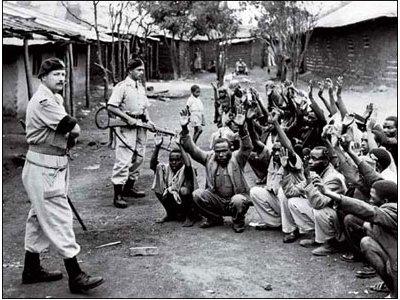
The western-manipulated International Criminal Court, which has indicted only African leaders, tries to give the world the impression that barbarity descended on the continent when the white colonists left. But four aging Kenyan “Mau Mau” freedom fighters, demanding reparations, are forcing Britain to acknowledge the savagery of white settlers and soldiers. “The generation of Africans who fought against colonialism is dying without recognition of their fight or their suffering at the hands of racist colonialism.”
In early April 2011, four elderly Kenyansi—three men and one woman—appeared in the High Court in London, accusing England of systematic torture during their siege of the so-called Mau Maus and demanding reparations for their treatment. One of the men was castrated by the British colonial government in Kenya. Handcuffed and pinned to the ground with his legs pulled apart, his genitals were sliced off by the white officers. He was then left for days without medical attention until he was liberated by Kenyan rebels. The one woman claimant was subjected to sexual torture. White soldiers repeatedly inserted bottles of boiling hot water into her vagina. In addition to these cases, thousands of Kenyans were maimed, lynched and brutally murdered by the British during the last century. Thousands of others were subjected to rape, forced labor, and gross abuse and torture in detention camps. It was part of a deliberate policy of the colonial British government to break a civilian population cast as “baboons,” “barbarians,” and “terrorists” and who were seen as a threat to the colonial order in east Africa.
The proper name for the liberation forces that fought against British colonialism and land-grabbing in East Africa was the Kenya Land and Freedom Army.ii The movement was derisively called “Mau Mau” by the British propaganda machine in an attempt to depict these African freedom fighters as a primitive and anti-white tribal cult. Against this, the late C. L. R. James described the movement as “an ad hoc body of beliefs, oaths, disciplines newly created for the specific purpose of gathering and strengthening the struggle against British imperialism, its military, political and economic domination and, in particular, the Christianity it sought to inject and impose.” And it was land and white settlers, not African “tribal” beliefs that were at the heart of the so-called Mau Mau revolt against British colonialism.
The colonial invasion of Central Kenya began in the late 1880s. It was formalized through military conquest, particularly over the most numerous ethnic group, the Gikuyu, as well as the Embu and the Meru. By 1903, the British colonial government sent in waves of white settlers, from South Africa and England, with the hope of creating another “white man’s country” in Kenya. They stole between 60,000 and 1 million acres of land, settling whites in the most fertile regions with the coolest climates—an area they eventually named the “White Highlands.” By the time the colony of Kenya came into being in 1920, more than 10,000 whites had settled over 25% of Kenya’s best territory. At the same time, the African population, mainly but not entirely the Gikuyu, were driven into reservations or were forced to work as sharecroppers. Then, through hut and poll taxes, restrictions on movement through the issuing of kipande (identity passes), and limits on agricultural production, Africans became systematically entrapped into the racist Kenyan colonial system. Add to this mix the ever-expanding power of the white settlers and Christian missionaries, and Kenya was primed for a revolution.
Though all ethnic groups were affected by British colonial land-grabbing and dispossession, the Gikuyu experienced this most acutely. They did not take lightly the heavy theft of land. When, in 1943, the colonial government threatened groups of Gikuyu with yet another eviction from their lands, they decided to take action. Their struggle began with overt passive resistance but was quickly radicalized. Wings of the movement began armed guerilla attacks on white settler holdings and on Africans who supported the British regime. At the height of the revolt, it was estimated that 1.5 million Gikuyu and other Kenyan groups had taken secret oaths of unity to fight against white settlers and colonial rule. They were met with a brutal armed retaliation. By late 1952, the colonial governor of Kenya declared a state of emergency. The colonial government established and enforced communal punishment, curfews, schemes to confiscate African properties, censors for publications, detention without trial, control of African markets, forced migrations, and detention and labor camps.
By late 1954 the revolt was said to have been militarily defeated by the British army, but the state of the emergency was not lifted until 1960. During the six intervening years, the Mau Mau struggle continued as the British colonial government established a terrorist state. The assault on the Africans continued both through the campaign to arrest and dispose of the alleged Mau Mau leadership, and in detention camps, prisons, and “emergency villages.” The British focused primarily on forcing the Gikuyu to renounce their oath of unity by the most brutal means. According to the Kenya Human Rights Commission, by the time the colonial government ended the state of emergency, over 90,000 Kenyans were executed, maimed, or tortured, while 160,000 were held in detention camps. Others have argued that the numbers were higher. What is well documented is how colonial agents were unrivaled in their barbarity. They castrated and sexually abused, starved, and maimed detainees in order to force the alleged oath takers to confess. They used electric shock, cigarettes and fire, broken bottles, gun barrels, knives, snakes, vermin, and hot eggs were thrust up men’s rectums and women’s vaginas. The assault only came to an end when the Gikuyu population was almost physically decimated and psychologically broken.
If not for the legal case brought against the British government by four surviving Kenyans, we would not know about the trove of secret colonial files documenting the systematic nature of their torture of Africans. The generation of Africans who fought against colonialism is dying without recognition of their fight or their suffering at the hands of racist colonialism. In the current context where Africans, through organizations such as the ICC, are constructed and targeted as the greatest purveyors of “crimes against humanity,” it is well worth remembering the venal work of Europeans in Africa. The demands for reparations may begin with four elderly Kenyans traveling to the old center of the British empire, but the colonial archive surely documents crimes against the Herero, the Congolese, and many other victims of European colonialism. We should not forget their struggles.
i – Wambugu Wa Nyingi, Jane Muthoni Mara, Paulo Nzili, and Ndiku Mutwiwa Mutua
ii – For Further Reading: C. L. R. James, A History of Pan-African Revolt (1995); Caroline Elkins, Britain’s Gulag: The Brutal End of Empire in Kenya (2005); Cora Presley, Kikuyu Women, the Mau Mau Rebellion, and Social Change in Kenya (1992); Gerald Horne, Mau Mau in Harlem? The U.S. and the Liberation of Kenya (2009)
Jemima Pierre can be reached at BAR1804@gmail.com.
On Saturday morning, May 14, in a press conference broadcast on a Libyan satellite t.v. channel, government spokesperson Moussa Ibrahim presented strong evidence that a massacre of Libyan religious leaders by NATO was carried out in the oil port of Brega. The press conference was attended by Libyan religious leaders, mainly Muslim but including both Orthodox and Catholic representatives.
According to the charges made by Moussa Ibrahim, on Friday, May 13, over 150 of Libya’s most senior Imams gathered in Brega to hold a peace conference on how to end the fighting in Libya. Brega was chosen for the site because it is the closest government held town to the rebel-held stronghold of Benghazi and the Imams planned to send a delegation to Benghazi with a peace proposal following the conference.
Early during the evening of Friday, May 13, NATO forces bombed the conference site, killing at least ten and hospitalizing over 40 Imams. Libyan television showed the site, which was clearly demolished. Moussa Ibrahim described it as the oil industry’s temporary residential complex or guest quarters and later provided the Google Earth coordinates for viewers to confirm the location.
Statements were made by two Imams who had driven through the night from the Brega site to Tripoli for the press conference to condemn the NATO bombing of their brethren.
NATO confirmed attacking Brega that evening but claimed it struck a “command and control center”.
Only BBC World carried a short clip of the press conference which was ignored by all other international news channels who instead focused on a claim made by the Italian foreign minister that Muammar Gaddafi had been wounded in a previous bombing of Tripoli. The Italian minister claimed that he was informed of Gaddafi’s injuries by the Catholic Bishop of Tripoli, a claim that the Catholic Bishop denied making.
It appears that NATO is growing increasingly desperate despite the description of the present military situation on the ground in Libya as a “stalemate”. Libyan government forces continue to tighten their control over most of the south and claim they are regaining control of the eastern oil producing region, which would mean ending any chance of the rebels exporting significant quantities of oil to fund their rebellion.
Libyan government forces, on some accounts, have also regained control of the water pipeline known as the Great Man Made River (GMMR) which supplies Benghazi and its surroundings with almost all of its water from the Nubian aquifer in southern Libya. If the Libyan government is able to cut the water flow from the GMMR to Benghazi it will leave the rebels in the east with only a single reservoir in the town of Ajdabiya to use, which is estimated to only have a one month supply of the amount of water Benghazi needs.
Bombing a peace conference of Libyan religious leaders shows just how much NATO is threatened by any chance of a cease fire. Any break in the NATO air offensive will only benefit the government and hurt the rebellion, with reports from western journalists in Benghazi telling of increasing infighting between local rebels and those recently returned from exile who have been trying to take over. If Benghazi loses its water supply the clock starts ticking toward the day when Benghazi’s rebel fighters must surrender or evacuate the city.
Thomas C. Mountain lives in Asmara, Eritrea. He can be reached at: thomascmountain at yahoo dot com
A dramatic video published by the website baladee.net shows the moment when hundreds of Palestinian refugees and Syrians break through the border fence from Syria into the Israeli-occupied Golan Heights (part of Syria occupied by Israel in 1967 and illegally annexed in 1981).
The video, which appears to be taken from the Israeli-occupied side shows a group of hundreds or perhaps thousands of marchers carrying Palestinian flags heading toward the boundary fence. Spectators on the Israeli-occupied side – apparently worried about the safety of the marchers – call on them to go back because of the danger of land mines.
However, undeterred, the marchers continue, and break through the border fence as people on both sides call for the liberation of Palestine. As the marchers break through there are scenes of joy, high emotion and embraces with those on the Israeli-occupied side. One man is heard to say, “This is how liberation is.”
The United States, France and Britain invaded Libya with cruise missiles, stealth bombers, fighter jets and attack jets. Although NATO has taken over the military operation, U.S. President Barack Obama has been bombing Libya with Hellfire missiles from unmanned Predator drones. The number of civilians these foreign forces have killed remains unknown. This military campaign was ostensibly launched to enforce United Nations Security Council Resolution 1973 in order to protect civilians in Libya.
In addition, the United Nations and France have been bombing the Ivory Coast to protect civilians against violence by Laurent Gbagbo, who refuses to cede power to the newly elected president after a disputed election. UN Secretary Ban Ki-Moon insists that the United Nations is “not a party to the conflict.” France, former colonial ruler of Ivory Coast, has over 1,500 troops stationed there. Ivory Coast is the world’s second largest coffee grower and biggest producer of cocoa. The bombing of Ivory Coast is being undertaken to enforce Security Council Resolution 1975 to protect civilians there.
The UN Charter does not permit the use of military force for humanitarian interventions. The military invasions of Libya and Ivory Coast have been justified by reference to the Responsibility to Protect doctrine.
The Responsibility to Protect is contained in the General Assembly’s Outcome Document of the 2005 World Summit. It is not enshrined in an international treaty nor has it ripened into a norm of customary international law. Paragraph 138 of that document says each individual State has the responsibility to protect its populations from genocide, war crimes, ethnic cleansing, and crimes against humanity. Paragraph 139 adds that the international community, through the United Nations, also has “the responsibility to use appropriate diplomatic, humanitarian and other peaceful means, in accordance with Chapters VI and VIII of the Charter, to help protect populations from genocide, war crimes, ethnic cleansing and crimes against humanity.”
Chapter VI of the Charter requires parties to a dispute likely to endanger the maintenance of international peace and security to “first of all, seek a solution by negotiation, enquiry, mediation, conciliation, arbitration, judicial settlement, resort to regional agencies or arrangements, or other peaceful means of their own choice.” Chapter VIII governs “regional arrangements,” such as NATO, the Arab League, and the African Union. The chapter specifies that regional arrangements “shall make every effort to achieve pacific settlement of local disputes through such regional arrangements . . .”
It is only when peaceful means have been tried and proved inadequate that the Security Council can authorize action under Chapter VII of the Charter. That action includes boycotts, embargoes, severance of diplomatic relations, and even blockades or operations by air, sea or land.
The Responsibility to Protect doctrine grew out of frustration with the failure to take action to prevent the genocide in Rwanda, where a few hundred troops could have saved myriad lives. But the doctrine was not implemented to stop Israel from bombing Gaza in late 2008 and early 2009, which resulted in a loss of 1,400 Palestinians, mostly civilians.
Security Council Resolution 1973 begins with the call for “the immediate establishment of a ceasefire.” It reiterates “the responsibility of the Libyan authorities to protect the Libyan population” and reaffirms that “parties to armed conflicts bear the primary responsibility to take all feasible steps to ensure the protection of civilians. The resolution authorizes UN Member States “to take all necessary measures . . . to protect civilians and civilian populated areas” of Libya.
But instead of pursuing an immediate ceasefire, immediate military action was taken instead. The military force exceeds the bounds of the “all necessary measures” authorization. “All necessary measures” should first have been peaceful measures to settle the conflict. Yet peaceful means were not exhausted before the military invasion began. A high level international team – consisting of representatives from the Arab League, the African Union, and the UN Secretary General – should have been dispatched to Tripoli to attempt to negotiate a real cease-fire, and set up a mechanism for elections and for protecting civilians. Moreover, after the passage of the resolution, Libya immediately offered to accept international monitors and Qadaffi offered to step down and leave Libya. These offers were immediately rejected by the opposition.
Security Council Resolution 1975 regarding Ivory Coast is similar to resolution 1973 regarding Libya. The former authorizes the use of “all necessary means to . . . protect civilians under imminent threat of physical violence” in Ivory Coast. It reaffirms “the primary responsibility of each State to protect civilians” and reiterates that “parties to armed conflicts bear the primary responsibility to take all feasible steps to ensure the protection of civilians.”
The UN Charter commands that all Members settle their international disputes by peaceful means, to maintain international peace, security, and justice. Members must also refrain from the threat or use of force against the territorial integrity or political independence of any state or in any manner inconsistent with the Purposes of the United
Nations.
Only when a State acts in self-defense, in response to an armed attack by one country against another, can it militarily attack another State under the UN Charter. The need for self-defense must be overwhelming, leaving no choice of means, and no moment for deliberation. Neither Libya nor Ivory Coast had attacked another country. The United States, France and Britain in Libya, and France and the UN in Ivory Coast, are not acting in self-defense. Humanitarian concerns do not constitute self-defense.
There is a double standard in the use of military force to protect civilians. Obama has not attacked Bahrain where lethal force is being used to quell anti-government protests because that is where the U.S. Fifth Fleet is stationed. In fact, the Asia Times reported that before the invasion of Libya, the United States made a deal with Saudi Arabia, whereby the Saudis would invade Bahrain to help put down the anti-democracy protestors and Saudi Arabia would enlist the support of the Arab League for a no-fly-zone over Libya.
The League’s support for a no-fly-zone effectively neutralized opposition from Russia and China to Security Council Resolution 1973. Moreover, the military action by the U.S., France and Britain has gone far beyond a no-fly-zone. Indeed, Obama, France’s President Nicolas Sarkozy and Britain’s David Cameron penned an op-ed in the International Herald Tribune that said the NATO force will fight in Libya until President Muammar Qaddafi is gone, even though the Resolution does not sanction forcible regime change.
When Obama defended his military actions in Libya, he said “Some nations may be able to turn a blind eye to atrocities in other countries. The United States of America is different.” Two weeks later, the Arab League asked the Security Council to consider imposing a no-fly-zone over the Gaza Strip in order to protect civilians from Israeli air strikes. But the United States, an uncritical ally of Israel, will never allow the passage of such a resolution, regardless of the number of Palestinian civilians Israel kills. This is a double standard.
The military actions in Libya and Ivory Coast set a dangerous precedent of attacking countries where the leadership does not favor the pro-U.S. or pro-European Union countries. What will prevent the United States from stage-managing some protests, magnifying them in the corporate media as mass actions, and then bombing or attacking Venezuela, Cuba, Iran, or North Korea? Recall that during the Bush administration, Washington leveled baseless allegations to justify an illegal invasion of Iraq.
During a discussion of the Responsibility to Protect in the General Assembly on July 23, 2009, the Cuban government raised some provocative questions that should give those who support this notion pause: “Who is to decide if there is an urgent need for an intervention in a given State, according to what criteria, in what framework, and on the basis of what conditions? Who decides it is evident the authorities of a State do not protect their people, and how is it decided? Who determines peaceful means are not adequate in a certain situation, and on what criteria? Do small States have also the right and the actual prospect of interfering in the affairs of larger States? Would any developed country allow, either in principle or in practice, humanitarian intervention in its own territory? How and where do we draw the line between an intervention under the Responsibility to Protect and an intervention for political or strategic purposes, and when do political considerations prevail over humanitarian concerns?”
The Responsibility to Protect doctrine violates the basic premise of the UN Charter. Last year, the General Assembly’s Fifth Committee declined funding for the office of the new Special Advisor on Responsibility to Protect. Some member States argued that the Responsibility to Protect had not been agreed to as a norm at the World Summit. The debate will continue. But for many States, this is a slippery slope that should be viewed with extreme caution.
On February 13, 1960, France carried out its first nuclear test in Algeria’s southern Reggane region. According to official statistics, 17 nuclear tests were carried out in total over the next 6 years. The area remains affected, and local scientists say that radioactive contamination has caused genetic mutations and irreversibly changed the region.
There are no official statistics on the number of victims. The only figures can be found in the records kept by the French representative of the local church, which lists 42,000 victims of nuclear tests. Three years ago, the French Ministry of Defense issued a statement, putting the number at 27,000 people. The victims include French soldiers as well as local Algerians who lived in the surrounding areas. … continue
This site is provided as a research and reference tool. Although we make every reasonable effort to ensure that the information and data provided at this site are useful, accurate, and current, we cannot guarantee that the information and data provided here will be error-free. By using this site, you assume all responsibility for and risk arising from your use of and reliance upon the contents of this site.
This site and the information available through it do not, and are not intended to constitute legal advice. Should you require legal advice, you should consult your own attorney.
Nothing within this site or linked to by this site constitutes investment advice or medical advice.
Materials accessible from or added to this site by third parties, such as comments posted, are strictly the responsibility of the third party who added such materials or made them accessible and we neither endorse nor undertake to control, monitor, edit or assume responsibility for any such third-party material.
The posting of stories, commentaries, reports, documents and links (embedded or otherwise) on this site does not in any way, shape or form, implied or otherwise, necessarily express or suggest endorsement or support of any of such posted material or parts therein.
The word “alleged” is deemed to occur before the word “fraud.” Since the rule of law still applies. To peasants, at least.
Fair Use
This site contains copyrighted material the use of which has not always been specifically authorized by the copyright owner. We are making such material available in our efforts to advance understanding of environmental, political, human rights, economic, democracy, scientific, and social justice issues, etc. We believe this constitutes a ‘fair use’ of any such copyrighted material as provided for in section 107 of the US Copyright Law. In accordance with Title 17 U.S.C. Section 107, the material on this site is distributed without profit to those who have expressed a prior interest in receiving the included information for research and educational purposes. For more info go to: http://www.law.cornell.edu/uscode/17/107.shtml. If you wish to use copyrighted material from this site for purposes of your own that go beyond ‘fair use’, you must obtain permission from the copyright owner.
DMCA Contact
This is information for anyone that wishes to challenge our “fair use” of copyrighted material.
If you are a legal copyright holder or a designated agent for such and you believe that content residing on or accessible through our website infringes a copyright and falls outside the boundaries of “Fair Use”, please send a notice of infringement by contacting atheonews@gmail.com.
We will respond and take necessary action immediately.
If notice is given of an alleged copyright violation we will act expeditiously to remove or disable access to the material(s) in question.
All 3rd party material posted on this website is copyright the respective owners / authors. Aletho News makes no claim of copyright on such material.

 Aletho News

