What If the Egyptian Protesters Were Democrats?
By Steven Salaita | Pulse Media | February 21, 2011
Their recent upheaval would certainly have been different, perhaps dramatically different.
In the past month, the people of Egypt—inspired by the recent democratic revolution in Tunisia and preceding emergent revolutions in Libya, Algeria, Bahrain, Jordan, Yemen, and Syria—have undertaken a revolt of truly stunning proportions, one that includes men and women from all class strata, religious and ethnic origins, and ideological commitments. They managed to rid themselves of a longstanding and brutal dictator worth over $40 billion and supported by the collective power of the United States, European Union, Israel, and the Arab Gulf States.
Now that two Arab dictators have been vanquished by the collective will of unaffiliated protesters, many American commentators have been forced to rethink their assumptions about the supposedly tribal and authoritarian Arab mind. Such commentators, sometimes conservative but often liberal, fancy themselves guardians of a civic and political enlightenment that in reality is misinformed in addition to being conceited and imperialistic.
Nevertheless, given the ardor and self-confidence of the notion that American values exemplify democratic modernity, let us imagine a few potential outcomes had the pioneering people of Egypt followed the example of today’s liberal American Democrats.
Mubarak offered the Egyptian people what he deemed sweeping reforms. The people rejected his overtures as inadequate and disingenuous, which only increased their desire to oust Mubarak. A protester named Dalia observed, “Nothing will make this regime go unless we keep on coming and keep on coming.” Had Dalia been a Democrat, she might have instead responded, “The Egyptian government has a real opportunity in the face of this very clear demonstration of opposition to begin a process that will truly respond to the aspirations of the people of Egypt.”
Despite police brutality, the people of Egypt remained steadfast and continued their chants of “down with Mubarak” and “Tunisia is the solution,” both slogans underscoring the importance of a genuinely transformative revolution. Had they been Democrats, they surely would not have been so quixotic and would have instead opted for a pragmatic approach, as most Democrats do in every American election. As Michael Moore warns, democratic transformation has no real place in American politics: “And so, I just—I think that—I mean, what I’ve proposed for the last few years is that if we really want to try and get this power in our hands, in the people’s hands, in the hands of the working people of this country, then we should, on a very grassroots level, from the bottom up, be doing things to—whether it’s running for local office, taking over the local Democratic Party.”
Working within a corrupt system, rather than trying to abolish it, is the way American liberals like Moore prefer to pursue justice: “well, we have these two political parties which are really very much like one party, why don’t we make sure that one of those parties actually is a second party and start locally and do that? And that’s what I encourage people to do. That’s my approach.”
The Egyptian protesters demanded rule by the people rather than subservience to a small caste of politicians and crony capitalists. They continue to agitate for a new constitution, universal health care, a multiple-party democracy, unionization for workers, and an end to the violent suppression of dissent. If they were Democrats, they probably wouldn’t be so ambitious. In the United States, dissent is often suppressed, sometimes violently, unions are busted, two parties representing 300 million people assert plutocratic hegemony, and politicians of the two parties serve the interests not of their citizen constituents but of crony capitalists. The Democrats do not tolerate dissentient action in the form of mass protest; they prefer the tactic of voting for Democrats during election season.
Liberal commentators dismiss as silliness any desire to oust dictatorial leaders outside the pragmatic framework of Democratic values. Todd Gitlin preaches discipline in the face of abusive state power: “Will the rebellious left discipline itself, cool its boiling blood, and decide that the pleasures of sectarianism are worth less than the steady resolve of infrastructural work?” Speaking against—what else?—leftist politician Ralph Nader, Eric Alterman is less diplomatic: “The man needs to go away. I think he needs to live in a different country. He’s done enough damage to this one. Let him damage somebody else’s now.” Alterman despises Nader because of Nader’s lack of faith in politicians: “Politicians blow with political winds. To force them to blow our way, progressives need leaders who can combine hardheaded realism with the ability to inspire Americans’ nascent idealism.”
According to liberal Democrats, alternate politics are impossible and thus undesirable. The Egyptian people do not share the same viewpoint. There was nothing pragmatic about what they did: it is never a reasonable idea to march into bullets, tear gas canisters, and police boots in order to upend a rotten political system brandishing the imprimatur of the world’s most powerful armies and politicians. But if the Egyptian people wanted a just political system, rather than the practical realities of theft and corruption, they needed to replace and not merely reform their government. To challenge bad politicians by electing more bad politicians is not serious political thinking; it is an inducement to apathy and intellectual frivolity.
The Egyptian people erected a remarkably functional democratic space in Tahreer Square, complete with an infirmary, a kindergarten, and a pharmacy. When Democratic Party bosses get together, protesters are entrapped in chain link cages.
In short, if the Egyptian protesters were Democrats, they would have undertaken no revolution. The Democratic Party represents the pervasiveness of elite corporate power; its liberal supporters represent the appropriation of oppositional politics into the neoliberal economies of electoral hegemony; the Egyptian protesters represent a determined, collective will to social justice and legitimate freedom. If those protesters were American liberals, they would have sided with the state while professing support for the people.
If the Egyptian protesters were Democrats, they would have accepted Mubarak’s proposed reforms—not because those reforms were good, but because Democrats are accustomed to settling for empty rhetoric. They would have accepted Mubarak’s handpicked successor, the infamous torturer Omar Suleiman—not because they like him, but because he would presumably be less evil than his predecessor. They would have accepted the inevitability of defeat—not because they wanted to lose, but because losing would be both pragmatic and realistic. The actual Egyptian protesters, however, would only accept freedom.
For those who might respond to this hypothetical exercise by pointing out that the United States is not Egypt, I would agree. Egypt under Mubarak was more equitable than the United States under Barack Obama. Egypt has far less income inequality than the United States, and all of Mubarak’s brutality was at least indirectly underwritten by the American government.
The people of the Middle East and North Africa have never listened to American liberals, who through the years have loved to bestow unsolicited advice on Arabs. Had the Arabs accepted this unsolicited advice, they would have become Democrats instead of revolutionaries.
The only acceptable liberal American response to the revolutions in the Arab World is the silence that enlivens a sincere attempt to listen. Clearly it is time for American liberals to stop lecturing Arabs and start following their example, instead.
February 21, 2011 Posted by aletho | Corruption, Progressive Hypocrite, Solidarity and Activism, Timeless or most popular | Leave a comment
Stinking Collective Punishment in West Bank Village Nabi Salah
By Yossi Bartal for the Alternative Information Center on February 21, 2011
During the weekly demonstration in the West Bank village of Nabi Salah against the creeping annexation of their lands by the area settlements, the Israeli army imposed a particularly stinking collective punishment.
For several long minutes, soldiers emptied the containers of skunk water on houses in the centre of the village, also spraying the roofs of homes on which the residents collect rain water. The soldiers further sprayed the village cemetery with the skunk water. Israel’s massive use of tear gas and skunk water in the centre of the village was done with no intention of dispersing the demonstration, which had already ended by this time, but to stink up the homes of the residents and to contaminate their water sources.
Since January 2010 weekly demonstrations have been held in the village of Nabi Salah, located in the district of Ramallah, against attempts of the area settlers to take over the village land. From the onset, these demonstrations encountered particularly severe oppression by the Israeli army, including the massive use of tear gas, rubber coated bullets and occasionally live ammunition within the village.
Last Friday (18 February) the oppressive Israeli measures reached particularly smelly heights. After the army invaded the village, seven demonstrators were detained – 2 Palestinians, 4 Israelis and one international activist, all released many hours later. After several hours of shooting tear gas and rubber coated bullets within the village against the demonstrators and every person who wandered into the area, military reinforcements arrived from the village of Bil’in. Following the weekly demonstration in Bil’in, where Israel’s army also used skunk water against non-violent protesters, the skunk water truck made its way to Nabi Salah. Apparently because there remained large quantities of skunk water that the army didn’t manage to shoot at Bil’in demonstrators, the regional army commanders decided to use the extra liquid to collectively punish Nabi Salah demonstrators. After the demonstration had already finished, the skunk water truck entered the centre of the village and sprayed windows, walls and the roofs of homes. The truck also spewed its contents on the local cemetery.
Skunk water, the reeking liquid that is dispersed through water cannons, has served the Israeli army some two years already for dispersing demonstrations in the Occupied Palestinian Territory. The content of the skunk water, together with its long-term impacts, are not known, although its immediate impact is to cause nausea and headaches. Even after extensive washing of the affected area, whether clothing, skin or land, the stench continues for several days.
The strength of the remaining smell is so strong that in the past it caused a family in Nabi Salah to leave their home for an entire week. The impact of skunk water on sweet water used for drinking and watering is unknown. Spraying the skunk water on the village roofs, however, prevented the collection of rain water these past few days, which were amongst the rainiest of this winter.
Translated to English by the Alternative Information Center (AIC)
February 21, 2011 Posted by aletho | Solidarity and Activism, Subjugation - Torture, Timeless or most popular | Leave a comment
Japanese protest against US base
Press TV – February 21, 2011
 The Futenma air base is in an urbanized area on Okinawa island
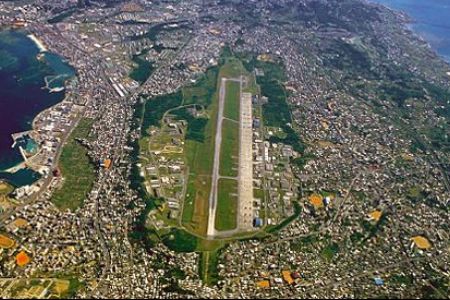
Japanese activists have gathered in front of the US embassy in Tokyo to protest against a planned heliport near the village of Takae, northern Okinawa.
The demonstrators shouted slogans against the American military base on Okinawa, demanding the removal of the base from the island, The Japan Times reported on Sunday.
They tried to submit a letter to Washington’s Ambassador in Japan John Victor Roos, but they were prevented from reaching the embassy by a wall of Japanese police.
Futenma airbase, hosting about half the US troops in Japan, is extremely unpopular with locals who associate it with crime and pollution.
Futenma has provoked a wave of anger in the country, urging Tokyo to remove US military installations from the country.
Tens of thousands of people have held several rallies against the American military engagement in the country over the past months.
The relocation of the air station is not the only unbearable issue for Okinawans, as Tokyo has agreed to construct six helipads (each 75 meters in diameter) for the US Marine Corps’ Bell-Boeing V-22 Ospreys around the village.
Noise pollution from Ospreys is said to be beyond human tolerance. The citizens of Brewton, Alabama, also staged a protest against Osprey maneuvers in the region last month.
Earlier this week, Japanese people staged another street protest against the trans-Pacific free trade pact, which broadens relationships with the United States.
People from political left and right gave speeches and rallied in the streets on Wednesday, saying that the so-called Trans-Pacific Partnership (TPP) is aimed at strengthening the US-Japan military alliance and has political purposes.
February 20, 2011 Posted by aletho | Illegal Occupation, Militarism, Solidarity and Activism, Timeless or most popular | Leave a comment
Indian Air Force Purchases Missiles from Israeli Weapons Manufacturer Rafael
The Indian Air Force and the Israeli weapons manufacturer Rafael Advanced Defense Systems are set to sign a major contract in March 2011, which will outfit India’s Tejas fighter jets with Rafael’s Derby missile.
The Derby air-to-air missile system will be fitted on some 200 jets, said P.S. Subramanya, director of India’s Aeronautical Development Agency.
This is not the Indian Air Force’s first deal with Rafael, a former sub-division of the Israeli Defense Ministry, now considered a governmental firm that develops and produces fighting-technologies for the Israel Defense Forces as well for exporting abroad.
The Indian Army purchased $270 million worth of Spyder anti-aircraft missile systems in 2008.
In 2009, Rafael agreed to supply the Indian Army with advanced anti-aircraft systems with a range of up to 45 kilometers. The deal was worth $1 billion.
“Israel’s homeland security systems are very advanced and India can benefit from your experience. We are friendly countries and strategic partners based on sound fundamental principles. We have to cooperate to the fullest extent to combat the menace of terror,” Minister of State for Commerce and Industry, Jyotiraditya Scindia said in February 2010.
Israel’s defense exports to India have now reached around $3 billion, making it the largest arms supplier to India, reported the BDS movement
Israel and India are enhancing cooperation in other areas as well.
“We have outlined several areas of cooperation but will be mainly focusing in the area of renewable energy and computer sciences in the coming years where we see tremendous potential for both the countries”, India’s Minister for Science and Technology, Prithviraj Chavan said on a three day visit to Israel in March 2010.
“The leading Israeli institutions have shown a keen interest in working with our IITs on exchange and collaboration of research, faculty and students. I think this will be an important step in enhancing scientific cooperation between the two countries”, Mr. Chavan said.
Bilateral trade between India and Israel has grown from around $200 million in 1992 when the diplomatic relations were established to most recently around $4 billion.
Israel is now working on winning the minds of Indians as well, in order to add the very populous country to Israel’s list of supporters.
Most recently, The Israel Project (TIP), a non-profit, non-government organization that “works tirelessly to help protect Israel by improving Israel’s image”, launched a new campaign in India to strengthen relations between the two countries.
“As relations between Israel and India, the world’s largest democracy and a growing economic power strengthen, The Israel Project is proud to announce the formation of our new India program,” TIP said in a January press release.
The new initiative will target Indian policymakers, journalists and the public “to spread awareness about Israel and help strengthen ties with India, especially in the fields of trade, tourism and technology,” reported India’s SIFY News.
February 20, 2011 Posted by aletho | Militarism, Timeless or most popular | Leave a comment
US vetoes UN resolution on Illegal Jewish only settlements
Aletho News | February 19, 2011
Despite receiving the backing of 14 out of 15 members of the United Nations’ security council, a UN resolution branding Israeli settlements illegal was vetoed by the United States Ambassador to the U.N., Susan Rice.
Susan Rice is not related to former Secretary of State Condoleezza Rice but there is a connection between Condoleeza Rice and Susan Rice’s godmother, Madeleine Albright. Condoleezza Rice was Dr. Joseph Korbel’s star student at the University of Denver. Madeleine Albright is Korbel’s daughter. Rice has said that her role at the U.N. will be to battle “the anti-Israel crap.”
Rice has been involved with the Washington Institute for Near East Policy (WINEP) a hawkish pro-Israel think tank which has been a home for many of the neocon architects of the invasion of Iraq. WINEP’s advisory board has included militarists such as Paul Wolfowitz, Richard Perle, Edward Luttwak, James Woolsey (who is also ostensibly a Democrat), and Mort Zuckerman. Susan Rice took part in a WINEP “2008 Presidential Task Force” study which resulted in a report entitled, “Strengthening the Partnership: How to Deepen US-Israel Cooperation on the Iranian Nuclear Challenge”. WINEP was founded in coordination with the American-Israel Public Affairs Committee (AIPAC).
Al Jazeera spoke with Susan Rice about the Obama administration’s veto of the Security Council resolution:
February 19, 2011 Posted by aletho | Author: Atheo, Ethnic Cleansing, Racism, Zionism, Illegal Occupation, Progressive Hypocrite, Timeless or most popular, Video, Wars for Israel | Leave a comment
Global food price inflation leads to world food crisis
David Gutierrez | Natural News | February 19, 2011
The cost of staples from grains to meat to sugar continues to rise, raising fears of a global food crisis and ensuing political instability.
In 2008, high food prices led to riots in 25 different countries. The specter of another such crisis reared its head in September when 12 people were killed in food riots in Mozambique.
“The food riots in Mozambique can be repeated anywhere in the coming years,” said Indian food analyst Devinder Sharma. “Unless the world encourages developing countries to become self-sufficient in food grains, the threat of impending food riots will remain hanging over nations.”
Global meat prices are currently at a 20-year high, while soybean prices are at a 16-month high. Wheat prices have risen 57 percent over the last six months, and over the same period rice prices rose 45 percent and sugar prices rose 55 percent. In the last few weeks of October alone, wheat and corn prices surged 30 percent.
The price crunch has been worsened by a spate of recent climate-related crop failures worldwide, but the underlying causes are more long-term. The UN largely blames loss of arable land to urbanization, degradation and conversion to biofuels production.
“Worldwide, 5 million to 10 million hectares [12 million to 25 million acres] of agricultural land are being lost annually due to severe degradation and another 19.5 million are lost for industrial uses and urbanization,” wrote UN special rapporteur Olivier de Schutter on the right to food in a recent report.
“But the pressure on land resulting from these factors has been boosted in recent years by policies favoring large-scale industrial plantations. According to the World Bank, more than one-third of large-scale land acquisitions are intended to produce agrofuels.”
In addition, speculation by investors has artificially inflated food prices even beyond their already alarming highs, and is likely to continue doing so.
“A food crisis on the scale of two or three years ago is not imminent, but the underlying causes [of what happened then] are still there,” said Chris Leather of Oxfam.
Sources for this story include: http://www.guardian.co.uk/environme….
February 19, 2011 Posted by aletho | Economics, Malthusian Ideology, Phony Scarcity, Timeless or most popular | Leave a comment
WikiLeaks and Latin America
By Nil Nikandrov | Tiwy.com | December 13, 2010
The collection of US diplomatic cables published by WikiLeaks includes some 20,000 documents pertaining to Latin America. Roughly 13,000 of them came to the US Department of State from the US embassies in Mexico, Brasilia, Buenos Aires, Lima, Santiago de Chile, and Bogota, while the remaining 7,000 originated from Caracas, Quito, La Paz, and Managua. Dates on the majority of the documents fit into the last decade.
It is hard to say at the moment what led WikiLeaks founder Julian Assange to dump the archive to Spain’s notoriously rightist El País, chances being that the decision was not entirely up to him. El País is a part of Grupo Prisa, a media holding with close business links to the right and conservative US and Latin American media. It is an open secret that El País is heavily influenced by the Miami-based anti-Castro mafia and its satellites from the ranks of the radical immigrants from Venezuela, Ecuador, Nicaragua, and Bolivia. El País permanently floats media campaigns aimed at destabilizing the political regimes in the above countries, and the materials contributed by WikiLeaks will likely be put to use accordingly.
Currently the WikiLeaks information is disseminated in a redacted form via the channels operated by El País and other Western media companies. They carefully avoid calling into question the reliability of the reporting by the US embassies and the Department of State regardless of the methods employed by the US agencies. Some of the cables do mention the financial support provided by various US foundations to NGOs, human rights groups, and political opposition which also happen to be the sources from which the US typically draws information on the corresponding countries. Effectively, this is the same as buying information.
US ambassador to Nicaragua Paul A. Trivelli resorted to the assistance of anti-Sandinista political forces to collect information for his reports alleging that president Daniel Ortega regularly sent his government’s ministers to solicit petro-dollars from Chavez. According to Trivelli’s accounts, roughly half a billion dollars were delivered in suitcases from Caracas to Managua to be spent on bribing the Nicaraguan constituency. The mythical suitcases then served as evidence of Chavez’s plan to turn Nicaragua into a country run by a “Cuban-style dictatorship”.
Trivelli’s successor Robert Callahan supplies the US Department of State with similarly generated data. He seems to enjoy alarming Washington by churning out reports that – in breach of the Nicaraguan constitution – Ortega is going to seek reelection in 2011 and therefore takes a keen interest in Chavez’s experience of the kind. Callahan’s reports are also saturated with claims that Iran is gaining ever stronger positions in Managua and using Nicaragua as the starting point for its subversive expansion across Central America and for reaching the US territory via Mexico. Clearly under the impression left by one of Callahan’s papers, H. Clinton expressed concern in May, 2009 that Iran was building the single largest embassy in Nicaragua, as if the embassy could pose a threat like some missile launchpad. Truly speaking, the single largest embassy in Nicaragua is the US one, which is a heavily fortified compound built to survive anything short of a nuclear strike and overloaded with advanced surveillance devices. Such fortress-style embassies were built by the US over the past decade in the majority of Latin American countries, leaving the impression that Washington is bracing for a global catastrophe. Shall we assume the perceived threat is the end of the world which the Mayan priests anticipate in 2012?
US diplomats in Latin America seem convinced that constant invocations of the Iranian theme are the best way to demonstrate their awareness of what is going on in the intelligence field. The vigilant watchers spotted Iranians on the Caribbean islands and in the region’s every part from Mexico to the south of Chile. The materials which saw the light of day thanks to WikiLeaks reflect the US paranoid worries that Iran struck a secret deal with Hugo Chavez and Evo Morales and is already mining uranium in Venezuela and Bolivia. The lie has been broadcast by the US propaganda machine over the recent years. For example, the US diplomats attempted to portray an Iranian bicycle factory built in Venezuela as a secret uranium facility. In response, Chavez appeared in a TV program riding a bike and promised to present “a nuclear bike” to G. Bush, adding that the device was at least equipped with brakes.
One of the US Department of State documents exposed by WikiLeaks happens to be H. Clinton’s request sent to the US embassy in Buenos Aires containing questions about president Cristina Fernández de Kirchner’s way of fighting stress and the medications she was taking. Implicitly, the cable cast doubts over the Argentinian leader’s mental health. US department of State cables also describe Cristina Fernández de Kirchner and her husband Nestor Kirchner as individuals obsessed with lust for power, an unpleasant couple, and talentless politicians. The explanation behind the view is that both never bowed to the US pressure and befriended Chavez. Eventually, H. Clinton was forced to apologize, but her sincerity is hard to trust.
Overall, US diplomats never seem to stop monitoring the health condition of Latin American leaders. Predictably, the focus is on Chavez. US diplomats arrived at the conclusion that he acted inadequately and spread a markedly provocative psychological portrait of the Venezuelan leader put together by CIA psychiatrists which depicted him as an insane, primitive, and uncontrollable individual. The US Department of State was excited to learn from the US embassy in Brazil that Evo Morales was diagnosed with a tumor and seriously disappointed later when it became known that he underwent a successful surgery. When the electoral campaign in Paraguay was in process, the US Department of State asked for information on the health condition of all of the country’s presidential candidates. The incumbent Fernando Lugo’s cancer for which he had to endure exhausting chemotherapy could be a logical consequence of the request.
Simply browsing the WikiLeaks publications is enough to realize that in many cases they are identical to propaganda pieces featured by various newspapers and journals. Allegations are made that Mexican president Felipe Calderon’s popularity is evaporating and that he is losing the war against drug cartels, that Cuban intelligence operatives have direct access to Chavez and enjoy full freedom of activity in the Venezuelan army, and that in Nicaragua the rating of president Ortega sank so low that even elderly nuns pray for his being killed the sooner the better.
Notably, WikiLeaks released nothing about the Mission of the US Interests Section in Havana, the torture experiments staged in Guantanamo, or the creation of US bases in Costa Rica and Columbia. The Wikileaks materials shed light in minimal quantities on the preparations for the coup in Honduras and the police mutiny in Ecuador. Nor does WikiLeaks find much to tell about the US intelligence activity in Latin America. Such omissions add up to a fairly long list.
Currently efforts are made to replicate the WikiLeaks success. The OpenLeaks outlet is being put on track to widen the audience of shocking revelations. Will it go so far as to bring to the surface the operational materials of the CIA, the US Defense Intelligence Agency, etc.?
February 18, 2011 Posted by aletho | Deception, Mainstream Media, Warmongering, Timeless or most popular | Ecuador, El País, Evo Morales, Julian Assange, Latin America, Nicaragua, Venezuela, WikiLeak | Leave a comment
The Great Texas Wind Hoax
By Sam Pakan | PPJ Gazette | February 17, 2011
The eastern Texas Panhandle, a land of rolling sand hills, tree-lined creek beds and tall grass vistas, may seem a desolate place to outsiders. Still, it has its beauty, especially to the cattle ranchers and wheat farmers who work and live on it. But not for long.
Much of this land, the fragile habitat of the Lesser Prairie Chicken and the Whooping Crane, is scheduled to become industrialized if the Texas PUC, the DOE and FERC have their way. Incongruously, the demolition of this mostly native grassland is being proposed in the name of green energy.
The Competitive Renewable Energy Zone (CREZ), a name not without irony, was initiated by a 10 million dollar grant from the Department of Energy (DOE). In December of 2009, plans were expanded when Secretary Chu joined Jon Wellinghoff of the Federal Energy Regulatory Commission (FERC) in a Memorandum of Understanding to coordinate efforts to interconnect several transmission lines. The CREZ line, part of the larger Electrical Reliability Council of Texas (ERCOT) system, is to help supply the Dallas/Fort Worth Metroplex with wind-generated electricity from the northern Texas Panhandle.
There are problems, however. Protests from disgruntled landowners have been met with staunch resistance from Cross Texas Transmission, the developer of the Gray to Tesla and Gray to White Deer lines. In an escalation of that resistance, landowners were sent a “Access Consent Form” the day before Thanksgiving insisting their lands be made available for survey. With the long weekend, landowners had only two working days to find representation and prepare a response and still meet CTT’s deadline. CTT, acting under the auspices of the Public Utilities Commission, has been given the power of eminent domain. With that looming over their heads, most landowners signed but added wording insisting Cross Texas Transmission follow established environmental laws, the same wording and the same laws now required on state-owned lands. Cross Texas responded to their request by issuing restraining orders and suing for entry without restraint.
The action was not surprising. Since having been awarded the contract to construct, operate and maintain these lines in October of 2009, Cross Texas has consistently reminded landowners that they have no options and has refused to address any of the economic or environmental problems created by the transmission lines.
The Economic Problems
According to the Texas Public Policy Foundation, wind energy in Texas will have in excess of 28 billion dollars in subsidies, federal and state, poured into its development by 2025. When tax breaks, market disruptions, increased production and ancillary costs are added in, the taxpayer’s bill could top 60 billion dollars. In spite of the massive funds being thrown its way, wind-generated electricity remains far more expensive for consumers than that produced from coal, gas or from nuclear facilities. It’s also proven far too intermittent. As a result, continued expansion of wind fields could raise rates paid by consumers by as much as 50 percent, even with the massive federal and state subsidies. The impact to small businesses and to those on fixed incomes could be devastating. Moreover, many experts believe that, due to the intermittent flow and low energy flux, wind generated electricity can never be competitive.
Science and Technology writer Gregory Murphy compared the energy flux density of the Comanche Peak nuclear plant south of Dallas to a hypothetical wind installation. The nuclear plant has two units capable of generating 2,500 megawatts and sits on only 4,000 acres which includes a man-made cooling lake that is open to the public and is used for recreation. Taking into account that the average wind turbine has a capacity of only 25 percent of its nameplate rated output, it would take 6,668 1.5 megawatt wind turbines to equal the output of the Comanche Peak station.
Spacing wind turbines at 5 per section of land, a rate somewhat higher than the density landowners were promised by wind farm developers, a wind installation equaling the output of the Comanche Peak plant would require well over 13,000 sections of land or 8.6 million acres. That is an area roughly 1/20th the size of Texas. All this land, plus the lands decimated by the transmission lines carrying electricity to major metropolitan areas, would have reduced productivity, severely increased erosion and drastically reduced property values—certainly no boon for landowners.
“Wind works only 25 percent of the time,” said Jeff Haley, rancher and Commissioner in Gray County, Texas. “And the CREZ line alone will cost 4.9 billion dollars. That’s a projected cost in 2008 dollars. It will almost certainly be more, but whatever it turns out to be, it will have to be paid for.”
“Don’t kid yourself,” said David Hall, another Gray County rancher. “The consumers will pay for much of this, and we’ll all pay for the rest with our tax dollars. It’s not just that I don’t want them on my land. It’s that this kind of government boondoggle is wrong. The politicians supporting these things don’t understand them. They’re being advised that this or that is the right thing to do, and they’re not informed enough to make the right decisions.”
“We’re dealing with Soviet-style technocrats,” Haley added.
The metaphor isn’t without basis. Cross Texas Transmission is a wholly owned subsidiary of J. L. Power Group, a Delaware shell corporation with no board of directors and only a few employees. SEC filings list Mikhail Segal, a one-time official in the Ministry of Energy in the former Soviet Union and Michael Liebellson as founders. From the outset, landowners say, Cross Texas Transmission has acted every bit the oligarch and used the PUC’s power of eminent domain as a weapon.
“These technocrats understand how to maneuver through the technicalities of the law.” Haley said. “It’s their job. They do it every day. How can we run our businesses and spend the time this is requiring to stand up to this kind of abuse?”
One of the maneuvers he is referring to is the Texas PUC hearings held last August. Three routes had been selected for the proposed Gray to Tesla line with one listed as the “preferred route.” Multiple landowners and attorneys were present to defend their properties from damage along this route. Without discussion, the Public Utilities Commission chose an alternate route automatically subjecting those properties not represented to eminent domain. The landowners on the route selected had received a notice that their lands could, at some point, be affected, but all assumed that only the preferred route would be considered at the hearing. None realized they would not have an opportunity to intervene specifically for their properties should the preferred route be rejected.
In addition to the issues of land spoilage and the usurpation of private property rights, the issue of viability is very much at the forefront. A number of wind power companies are currently being sued by utilities companies and municipalities for not being able to deliver the electricity they promised. In Texas, three wind farms owned by NextEra Energy Resources LLC agreed to sell specified amounts of power annually to Luminant Energy Company beginning in 2002. When they failed to deliver the contracted amount, Luminant sued for $29 million in liquidated damages and won. A similar case occurred years earlier in Washington state, and observers of the wind industry are predicting a deluge of such cases in the future.
The Waxman-Markey Cap-and-Trade Bill may be momentarily dead, but there are persistent rumors of its resurrection. Even without it, proposals are floating through the halls of Congress which would offer billions more to wind developers and demand that as much as 20% of our electricity be generated from renewable sources. While these proposals are being discussed, three wind farms are cluttering the landscape of Hawaii, monuments in rust to the government’s imposition of a technology that simply does not work.
A similar situation exists in California. In the December 13th, 2010 edition of The American Thinker, Andrew Walden discusses what was once the largest collection of wind farms in the world. “In the best wind spots on earth,” he writes, “14,000 wind turbines were simply abandoned. Spinning, post-industrial junk which generates nothing but bird kills.”
If and when federal funds cease to be shoveled into the wind projects now underway in Texas, most industry observers believe they will also be abandoned leaving the once swaying prairie an industrial junkyard of concrete, steel and fiberglass.
Meanwhile, the green jobs pledged by the Obama Administration seem to be suffering the same fate as the birds. Almost 12 percent of the President’s original $814 billion stimulus package, enacted early in 2009, went to renewable energy projects. The White House estimates that the stimulus created 190,700 green jobs. The Department of Energy, however, reports only 82,000 jobs actually resulted from the bill and as many as 80 percent of those went to firms in China, Spain and South Korea. Further, the National Center for Policy Analysis reports that, because of the expense, renewable energy is in reality costing more jobs than it is creating.
The Enviromental Problems
… While pro-wind energy groups maintain that less than one percent of land is removed from actual production by turbines and transmission lines, many experts argue otherwise. First, the towers create large dry spots at their base that, in a semi-arid environment like the Texas Panhandle, simply won’t support a vegetative cover. The resulting “blow spots” grow with each wind storm and can, in short order, consume many acres. Further, roads must be built to service turbines and transmission towers. In sandy areas like most of the Gray to Tesla line, the surfaces must be paved or coated to prevent blowing. These roads prevent normal moisture absorption and interfere with animal migration, and the damage to wildlife by the existence of tall structures is far greater than that from technologies dependent on fossil fuels. Tall grasses and wildlife are also damaged by the turbines’ prodigious oil leaks, plus, in an area already plagued by major grass fires often started by downed power lines, lines of the magnitude proposed are not welcome.
Heavy equipment used to install and service these lines and turbines compacts the turf and churns the surface, destroying vegetation. Then, during the frequent winter and spring winds, the barren spots grow larger. Once productive sandy loam becomes what Panhandle ranchers call “blow sand,” soil leached of organic material by the wind, unable to sustain a vegetative cover.
Both the turbines and the lines interfere with bird migration as well. The tall structures inhibit the breeding of the Lesser Prairie Chicken, and their presence will put the fate of the Whooping Crane very much into question. Further fragmentation of the LPC nesting grounds will almost certainly put it on the Endangered Species list and subject land owners to close federal scrutiny creating even more unwanted intrusion.
Richard Peet, Gray County Judge, wrote in a letter to Assistant Attorney General Moreno and Tom Clark of the Natural Resources Division on December 9, 2010, that prior to allowing Cross Texas Transmission to circumvent the law that requires an environmental impact study, U. S. Fish and Wildlife Service agents themselves pointed out that the currently proposed positioning of the Gray to Tesla line would “most assuredly” put the LPC on the endangered species list. At the very least, it was expected that the Fish and Wildlife Service would step in and insist that the route be studied for impact to wildlife. But the Service said there was no federal action that triggered a proper Environmental Impact Statement and that no permit would be required of CTT. However, a field coordinator for the Service told one landowner, if a permit is required, more than likely they will just pay mitigation and all resistance would end.
The Problems of Quasi-Capitalism
“Wind power is an open trough of government subsidies, tax credits and state mandates. Taken together, it’s a massive corporate welfare effort that means big money for the wind power developers and big costs for the rest of us.” Loren Steffy, the Houston Chronicle.
In a free market, goods and services are offered for gain. So long as it is mutually advantageous to buyer and seller, it works. When products fail to meet requirements, the buyer finds better, cheaper or more desirable products elsewhere. When the producer fails to make a profit, he generally seeks another market. Or another product
The role of government in such a system is limited. If the producer fails to deliver promised goods or delivers something other than what was promised, or if the buyer refuses to pay the agreed-upon price, the government steps in through the criminal courts system, demands remediation and applies appropriate penalties. But what happens when the government itself exerts influence in the decision-making process or even dictates the outcome of the transaction?
In that case, competitively priced goods or services cease to be the primary concern of the producer. Courting government agencies and influencing laws becomes the chief goal. Government-backed or government-created corporations become an extension of political might, and a symbiotic relationship develops between lawmakers and corporations facilitated by laws that, in many instances, they helped write.
Intermittent sources of power, especially those that require backup from coal or gas, cannot compete in the open marketplace. Equipping corporate welfare recipients with one of the most easily abused powers of the state in an attempt to force the populace to accept an unreliable source of energy at a tremendously inflated price is both unwise and dangerous. Such policies come at great cost, and landowners may only be the first to be asked to pay.
“The government is using corporations as its arm. They’re not just destroying my land; they’re destroying my heritage,” said Mark Cadra, a Wheeler County rancher whose land lies along the route selected by the Texas PUC. “I was taught for as long as I can remember to be a good steward of the land. Now the government has given this company the right to take what they want and do whatever they want with it. Believe me, what they want will damage my land forever. It makes me feel helpless.”
~
Sam Pakan is a rancher and writer in Wheeler County, Texas. He is currently producing beef for the health market while writing a series of historical novels set in WWII. He also edits books for selected novelists.
Copyright © 2011 by Sam Pakan. All Rights Reserved.
February 18, 2011 Posted by aletho | Corruption, Economics, Environmentalism, Timeless or most popular | Leave a comment
Families forced out as army occupies Jerusalem rooftop
By Jillian Kestler-D’Amours, The Electronic Intifada, 18 February 2011
The sound of heavy boots stomping up five flights of stairs resonated throughout the entire apartment building on a recent night as the Israeli military headed towards their post on a roof in the embattled neighborhood of Silwan in occupied East Jerusalem.
“There may be clashes [between Palestinian youth and Israeli soldiers], but it doesn’t mean the army has a right to take over the house,” said Abid Abu Ramuz, a Palestinian father of four, as his children quickly moved towards their front door to catch a glimpse of the soldiers.
Dressed head-to-toe in combat gear — including face coverings, thick helmets and gloves — and wielding machine guns, two Israeli soldiers kept their heads down as they made their way to the locked door leading out onto the roof.
“If we want to do laundry, we have to do it in the stairway. Only a technician can go up [to the roof] now, and only with a permit from the police,” Abu Ramuz explained.
For at least five months, Israeli military has been stationed on the roof of Abu Ramuz’s building — which houses a total of 69 persons from seven separate families, as well as a mosque — in the heart of Silwan’s Baten al-Hawa neighborhood.
One month ago, Abu Ramuz said, the soldiers invited him to a Jerusalem area police station and offered him two options: they would either “pay [him] for renting the roof, or they would go to court and [get a permit to] use it for free.”
He told them to go to the court. And, as of 7 February, the Israeli military received permission from the Israeli Ministry of Defense in Tel Aviv to use the building’s rooftop as their lookout base until August 2012.
“The Israeli people don’t know where they are sending their children. Their children are behaving in bad ways,” said Abu Ramuz, as a loud bang resounded from overhead.
“Every day,” he said, sighing, as he pointed his index finger up towards the roof.
The residents of the building are presently appealing the ministry’s decision to grant the soldiers unlimited access to their roof. In the meantime, however, the constant harassment and attacks continue unabated.
“Everything is hard. My daughter is going through her [high school final] exams at school and the soldiers are playing all night [on the roof]. She can’t sleep,” Abu Ramuz told The Electronic Intifada.
“I filed a complaint today because yesterday they were playing with a stone until 4am. I’ve complained many times. But the soldiers tell me that I can move if I don’t like the situation.”
Daily clashes and military harassment in Silwan
The Israeli military says it has justified its takeover of the roof of Abu Ramuz’s building because of regular clashes that occur between Palestinian youth and Israeli soldiers, police and settler security guards in the area — and because it offers them a unobstructed view of most of Silwan.
Abu Ramuz explained that at least three Israeli soldiers are on the roof of the building at all times, day and night, and that they are constantly making noise, cutting off residents’ access to electricity and water and sometimes even throwing dirty water or urine onto people walking in the street below.
“It’s winter so the children are staying inside. During the summer it will be more difficult because the children will be outside and they will have nowhere to play. It’s going to be a disaster here in the summer,” the 43-year-old said.
At least four windows in Abu Ramuz’s home remain broken as a result, he said, of Israeli soldiers shooting tear gas canisters and rubber bullets at his home from the street below.
“The broken windows are all from gas and rubber bullets. I’m not getting new windows because I know they’re just going to break it again,” Abu Ramuz said.
Sitting just outside Jerusalem’s Old City walls, the Palestinian village of Silwan is at the foot of the third holiest site in Islam, the Haram al-Sharif, or Noble Sanctuary, which is known to Jews as the Temple Mount.
In recent years, the neighborhood has undergone a large-scale takeover by far-right Israeli organizations that are largely supported by the Israeli government and Jerusalem municipality.
A seven-floor illegal Israeli settlement called Beit Yonatan — which was built in 2004 by extreme right-wing settler group Ateret Cohanim, and which even the Israeli state prosecutor has said needs to be vacated as soon as possible — is also only a few meters away from where Abu Ramuz and his neighbors live.
Intense clashes erupted in the Baten al-Hawa area shortly after resident Samer Sarhan was shot and killed by an Israeli settler security guard last September. Since then, Israeli police and soldiers have routinely arrested residents — especially children — on the suspicion of throwing stones.
The situation deteriorated even further in early January 2011, when an Israeli soldier on the Baten al-Hawa rooftop urinated in front of a Palestinian woman who was trying to hang her laundry there.
During the clashes between Palestinians and Israeli soldiers that ensued, the military forgot a crate of tear gas grenades and other ammunition on the rooftop, and it ended up in the possession of Palestinian youth.
Palestinian residents quickly returned the weapons, yet police and other Israeli security forces conducted nighttime raids and arrests in response to the embarrassing misstep.
From this point on, residents of the building have been banned from accessing the roof.
Children traumatized by military presence
According to building residents that agreed to speak to The Electronic Intifada, children living in the building have exhibited signs of trauma as a result of these sustained attacks, including bed-wetting, loss of interest in school and even a fear of leaving their homes.
“My children are afraid to leave the house. [My four-year-old daughter] is afraid to go to school,” explained Muhammadeia, a mother of six children between the ages of 1 and 13, from her living room.
“It’s very, very hard. My children are always shouting, crying and choking when the soldiers shoot tear gas. I have to close the windows all the time,” she added.
Nasrine Fakouri, a Palestinian mother of five children who lives on the third floor of the building, echoed that sentiment.
“My children used to get perfect grades and they started failing. They’re not even going to school,” explained Fakouri, adding that she was forced to quit her job as a secretary at a local hospital in order to take care of her children, who are now too afraid to leave the house even to go play outside.
Fakouri’s 13-year-old son Hamzi missed the past week of school because he had to undergo surgery as a result of a sound grenade that exploded too close to him.
“They’re not willing to let us live like normal kids,” Hamzi said quietly, on the couch in his living room. “I tell [my siblings] not to be afraid and to keep their heads high.”
Fakouri added that the most difficult aspect of the situation is having tear gas thrown into her home.
“The gas is killing us here. The soldiers even throw gas down the stairwell. I tell [the children] to hide, to use onions on their face to relieve the stinging, and to be very careful,” she said. “Why do the [Israeli] settlers have so many guards while we don’t have anyone? No one is protecting our children.”
Forced out of Silwan
Fakouri said that after months of living in a near-permanent state of fear, her family now has no choice but to leave their home.
“I don’t think I will be able to come back to Silwan. Never,” she said, sitting next to nine packed cardboard boxes that were stacked in front of her livingroom window. “I don’t want to come back. Nobody should live here. It’s horrible.”
Fakouri explained that her family would soon be moving to Jabel Mukaber, a neighborhood in the southern part of East Jerusalem in the direction of Bethlehem. She said that she is afraid that the Israeli military or police will take over the apartment once they leave, however.
She added that she lost a child during her fifth month of pregnancy last year because of what she said was the overwhelming stress incurred by constant Israeli military harassment.
“I’m pregnant again and I don’t want the same thing to happen,” Fakouri said. “We want to leave but we also feel sad about the neighbors that have to stay and deal with it. We just want a peaceful and quiet life and to be able to raise our children.”
Abid Abu Ramuz, for his part, said that despite owning his apartment, he and his family would also likely be forced out because of the Israeli military.
“I don’t want to leave the house, but if the situation continues, I might have to for the sake of my children,” he said. “I’ll have to leave. This is what they want. They want everybody to just leave.”
“I hope [this interview] will get to everybody in the world and that people will start doing something about it,” Abu Ramuz added. “This would not be allowed anywhere else in the world. This is a crime.”
~
Originally from Montreal, Jillian Kestler-D’Amours is a reporter and documentary filmmaker based in occupied East Jerusalem. More of her work can be found at http://jilldamours.wordpress.com.
February 18, 2011 Posted by aletho | Civil Liberties, Ethnic Cleansing, Racism, Zionism, Illegal Occupation, Timeless or most popular | Leave a comment
Anatomy of Egypt’s Revolution (Part Two)
By ESAM AL-AMIN | CounterPunch | February 18, 2011
“What do we mean by the Revolution? The war? That was no part of the revolution; it was only an effect and consequence of it. The revolution was in the minds of the people.”
— John Adams in an 1815 letter to Thomas Jefferson
Historians and political scientists study revolutions and analyze their impact, not only on their societies, where the political, economic, and social order is fundamentally transformed, but also on neighboring countries and beyond.
The Egyptian revolution, though still in its infancy, promises to be such a phenomenon. Admitting its historic nature was none other than the U.S. President, Barack Obama, who lauded the Egyptians as having “inspired us,” and praised their revolution, which he said represented a “moral force that bent the arc of history toward justice.”
He further added, “The word Tahrir means liberation. It’s a word that speaks to that something in our souls that cries out for freedom.” He went on to describe the momentous event and its impact on the world, saying, “And forever more it will remind us of the Egyptian people-of what they did, of the things that they stood for, and how they changed their country, and in doing so changed the world.”
Like similar great historical events, the triumph of the Egyptian revolution will have direct and significant consequences on the country, the region, and the world. Unsurprisingly some of the conditions that factored considerably in the success of the revolution have now become facts on the ground, such as the larger role of youth and women in politics and public life. Thus they are discussed here as well. Here are some of the most important consequences of Egypt’s revolution.
The role of the people: For many decades, the Egyptian people have been marginalized and their interests ignored. Since 1981, the deposed president had ruled the country based on the state of emergency law, which virtually suspended most of the people’s civil rights and political freedoms.
It had built an enormous security apparatus using a convoluted, multilayered system that included uniformed, riot, and secret police, as well as intelligence officers and the dreaded state security personnel, consisting of well over one million people nationwide. The regime ruled by fear and intimidation, employing wide use of brutal tactics including torture and summary military trials that sentenced opponents to long years of hard labor based on political beliefs.
Dr. Ahmad Okasha, president of the Egyptian Psychological Society explained that throughout the Mubarak years “the collective psyche of the Egyptian people was damaged.” Furthermore, he added, “the majority of the people were in a deep state of depression.” They felt insulted and abused by the authorities, powerless to change anything in society, literally strangers in their own country.
So what the revolution offered the people was the opportunity to restore their sense of self-esteem, honor and dignity. Once the fear barrier was knocked down, they acquired a new sense of pride and empowerment that not only challenged the state monopoly on violence but also defeated it using solely peaceful means. With each passing day they became more determined to fight for their rights and quite willing to tender the sacrifices needed to gain their freedom.
Hence, once the people realized their enormous collective power and what they are capable of achieving, they never looked back and would not be disregarded again.
The role of the youth: By sucking the air out of the political space, the deposed regime employed all of its resources to divert the attention of the youth and channel their energies into non-threatening matters such as sports competitions (recall the Algerian-Egyptian conflict that consumed the country last year, lasting for months because of a soccer game) or exhaust people by encouraging mass consumerism.
But since the youth have played a significant role in setting off and sustaining the revolution, their role in society will never be the same. Egyptian youth under 35 represent over 60 per cent of society, yet before the revolution they were not taken seriously nor given much credit.
Now, not only are they part of the most significant event in their modern history but they will also have a seat at the table to determine their country’s future. Already they are a major part of every organization, coalition, and committee appointed or elected to determine the next state of affairs in the country. The ruling military council has already met with their representatives several times. All opposition groups have welcomed them in their parties, offering them leadership positions.
The role of women: Similarly, the women of Egypt have played a major role in this revolution. They demonstrated in large numbers, and were essential organizers, leaders, and spokespersons during all phases of the revolution, including during the most difficult times when they came under physical attack by the security forces and thugs of the ruling party.
They posted the calls for mobilization and uploaded their video blogs on the internet. They distributed leaflets and urged their neighborhoods to protest. They were subsequently beaten, injured, and some even sacrificed their lives. They chanted and led demonstrations against the regime.
Some were doctors, working side by side with their male counterparts treating thousands of the injured in the streets. They were part of the protection and security committees, patting down female protesters to ensure their safety. In short, they were part of every important function of the revolution. The women of Egypt have found their voices and will never return to the margins of society again.
The rejection of sectarianism: One of the most tried and successful techniques of authoritarian regimes is to exploit the major fault lines in society, sparking religious, ethnic, and racial tensions. The deposed regime has often played up and sometimes even instigated the Muslim-Coptic tension in Egypt.
The former regime is even implicated in an incident earlier this year. Egypt’s state prosecutor is currently investigating the role of the Interior Minister and the state security apparatus in last month’s bombing of a Coptic church in Alexandria that killed dozens of people. The attack exacerbated the religious divide and threatened social cohesiveness.
However, the revolution has demonstrated in no uncertain terms the popular rejection of sectarianism, as Muslim and Christian communities joined together as fellow citizens protesting the repression and corruption of the regime that has afflicted them all. They marched, sang, chanted, and prayed together. They shared meals and defended each other. Millions of Egyptians witnessed a Muslim imam and a Coptic priest speaking together on the importance of national unity in Tahrir Square.
Ahmad Ragab, a prominent columnist and political cartoonist, observed that when he saw in Tahrir Square a Christian woman pouring water to help a Muslim man make ablution in preparation for prayer, he knew then that the revolution was to succeed.
Prominent Muslim Brotherhood (MB) leaders praised and defended the Copts while Coptic leaders hailed them in return for their cooperation and sacrifices. Egyptians now believe a new dawn of Muslim-Coptic relations has emerged based on mutual respect and shared citizenship.
The revival of a value-based moral system: Throughout the eighteen days of protests people who were interviewed at Tahrir Square and elsewhere kept referring to a new atmosphere and new attitudes by the people. They talked with pride about the civilized behavior displayed by the demonstrators.
People genuinely cared for and respected one another. They shared their meals and helped each other without expecting any compensation. They felt like they were part of one family. Although millions of people were in the square, there were no reports of fights or robberies. Young women spoke about how young men shielded them from the batons or the rubber bullets of the security forces, or the stones and Molotov cocktails from the goons of the ruling party.
The organizers took pride in the fact that all decisions of the activities of the revolution were based on mutual consultation and democratic principles. Every organizer and group was given the opportunity to voice his or her opinion and vote.
Thus, a new code, dubbed the “revolutionary ethical code,” was established and recognized by all. It encompasses values such as freedom, justice, equality, democracy, participation, solidarity, honesty, transparency, responsibility, and sacrifice- values, which many people had abandoned before the revolution upon feeling that they had no stake in a society ruled by bullies, thieves, and crooks.
The end of dictatorship: The downfall of Hosni Mubarak is not just the ouster of a dictator, but the end of an era that was marked by authoritarianism and cronyism. Egyptians believe strongly that this era is over and can never return.
They have learned that their strength was demonstrated in the streets and they no longer fear any threats by the security forces. If need be, they are willing to go back to the streets by the millions to stand up to the repression of the state. They believe that if they were able to topple Mubarak in eighteen days, they could bring down any future dictator. But they have pledged not to allow any future leader to become one in the first place.
The appreciation of freedom: Millions of Egyptians celebrated and cried with joy when Mubarak resigned on the night of February 11. As reporters from all over the world interviewed countless people dancing in the streets one word came out of their mouths: “we are free.” There is nothing more precious in life than gaining one’s freedom after being shackled by a repressive system or enslaved by a brutal dictator.
The power of this revolution is that it freed the people of Egypt from the yoke of tyranny. Once people taste freedom, it is next to impossible to deny them that exhilarating feeling.
Spreading a culture of democracy: An important consequence of the Egyptian revolution is that, unlike earlier uprisings or protests in Egypt such as the ones in 1968 or 1977, the people’s priority from the inception of this revolution has not only been to topple the regime but also to replace it with a democratic system and a strong civil society.
All opposition parties, including the MB, but especially the movements dominated by the youth, have pledged to honor and practice the rules of a democratic system. They have displayed extraordinary examples of adhering to a culture of democracy as diverse groups came together, united in their political goals but quite different in their tactics. Despite their many differences, they were able to maintain discipline and unity. Majority rule prevailed.
Examining the demands of the revolution, it is clear that spreading a culture of democratic governance was at the center of most of them. Some examples include: a political system based on checks and balances, an independent judiciary, freedom of the press, freedom of expression, guarantee of individual freedoms, human and civil rights, free elections, peaceful transfer of power, right to form political parties, transparency in governance, and equal economic opportunity.
Asserting Independence: Since at least the late 1970s, the U.S. has declared that Egypt was its “strategic partner.” This was a euphemism for Egypt becoming a client state for the U.S. in exchange for $64 billion in direct aid over three decades, and another $18 billion in debt relief. Most of this aid did not directly help the Egyptian people but was for the benefit of the military as well as the regime’s cronies.
Egyptians saw in horror how their country’s foreign policy was subjugated to U.S. interests to the detriment of Egyptian interests or their Arab obligations. They were frustrated throughout this period to see the stature and influence of their proud country dwindle, as Egypt became a tool of American foreign policy.
In all issues, such as the Israeli-Palestinian conflict, Palestinian infighting, Gaza, Iraq, Afghanistan, counter-terrorism, Lebanon, Iran, Libya, or Sudan, Mubarak’s Egypt was sure to act as the enabler of U.S. foreign policy at the expense of its own national security.
For instance, it was Mubarak who led the efforts to block all Arab peace initiatives to end the crisis in the first Gulf war and thus enabled the U.S. to wage war against a fellow Arab country with devastating consequences. Similarly, it was the capitulation of Mubarak on nuclear non-proliferation in the Middle East in order to please the U.S. that allowed Israel to maintain its nuclear arsenals cost free. He was a full partner with the U.S. and Israel in the siege on Gaza depriving 1.5 million Palestinians from basic livelihood.
In all likelihood, revolutionary Egypt will not be a U.S. client state. Once a civilian democratic and transparent government is in place, Egypt will resort to its historic role of being a leader of the Arab world as well as in Africa, the Muslim world, and the lesser-developed countries more broadly.
Once Egypt’s independence is asserted by its new democratically elected officials, unjust and biased U.S. or Western policies would be challenged. No longer will the wishes of the Egyptian people be ignored for the benefit of one person, or stifled for the interest of a foreign power.
Supporting the Palestinian Cause: Clearly, the 1979 Egyptian-Israeli peace treaty has been one between the leaders, not the peoples. The reason the experts consider it a “cold peace” is because the Egyptian people never believed that Israel wanted or promoted peace. They believe that the Zionist state sought to neutralize Egypt from the conflict so as to annex more Arab territory, especially in the West Bank, Jerusalem, and the Golan Heights.
Throughout three decades Israel felt secure enough from its southern flank that it twice crushed the Palestinian uprisings in the occupied territories (1987-1991 and 2000-2003). Moreover, it invaded or bombed several Arab countries and capitals including Iraq (1981), Lebanon (1982, 2006), Tunisia (1988), Syria (2007), and Gaza (2008-09). Thousands of fellow Arab civilians, especially in the Palestinian occupied territories and Lebanon were massacred without the people of Egypt even having the ability to protest in the streets.
Egyptians were not even allowed to object to Egypt’s sovereignty in the Sinai being stripped under the 1979 treaty. Despite a court order in 2007, they could not stop Egypt’s natural gas from being shipped and sold to Israel with a huge subsidy at a seventy per hcent discount. Meanwhile, in 2009 their government was building an underground iron barrier, financed by the U.S, to seal the border with Gaza, while closing the Rafah crossing to maintain the illegal siege against the people of Gaza.
According to a recent Jerusalem Post report, the Egyptian April 6 youth movement, which played a major role in the revolution, said that if “the military doesn’t meet our demands, we’ll be on the street again.” Among the group’s demands was “the halting of natural gas shipments to Israel.”
The Israeli prime minster is right to worry about Egypt’s foreign policy after Mubarak. His long honeymoon (and Palestinian nightmare) is most probably over. Most of the Egyptian opposition groups strongly support Palestinian rights and detest the Israeli government’s policies.
For example, when the Egyptian Coalition for Change was formed in April 2009, the members of the coalition included the April 6 movement, the Kifaya movement, al-Karama, al-Wasat, and individual members of the Muslim Brotherhood. This coalition was the nucleus of the January 25 revolution. One of their planks was the annulment of the Camp David Accords.
This may not happen overnight though. But if Israel continues to maintain its occupation, apartheid regime, and aggressive policies against the Palestinians, it might come to pass, slowly but surely. Once formed, the new democratic government in Egypt will no longer be relied upon to do Israel’s bidding, nor will it be susceptible to the pressure of the Israel lobby via the U.S. government.
Furthermore, Israel’s underlings within the Palestinian Authority are certain to be severely weakened, as they can no longer depend on Egypt’s support against other Palestinian factions. Israel can no longer announce an invasion against Gaza from Cairo like it did in December 2008.
In short, a major shift in the strategic equation of the Arab-Israeli conflict and the entire Middle East has just taken place as a direct consequence of the Egyptian revolution.
Influencing the Arab World and the region: Undoubtedly, the success of Egypt’s revolution in the aftermath of Tunisia’s has already had a tremendous influence not only on the rest of the Arab World, but also on the entire world especially, Muslim countries.
To date, similar protests have swept Yemen, Jordan, Bahrain, Algeria, Libya, and Iraq. Other countries are also threatened, including Syria, Morocco, Mauritania, and the Sudan. The common refrain in all of these protests is Egypt’s common chant “The people demand the fall of the regime.” Pro-Western groups in Lebanon have lost their power as Saad Hariri’s government was dissolved. Hezbollah and its coalition partners have now assumed the upper hand in forming a new government.
Yet if some regimes survive the massive protests underway through repressive measures or far-reaching reforms, the Arab World will still never be the same. Because of Egypt’s tremendous influence in the region, most Arab governments would have to move toward more freedom, democratic governance, and transparency over the coming months and years.
These changes might result in either a major shift in U.S. and Western foreign policy especially with regard to the Palestinian cause, or lead to a serious rift between the West and the people of the region to the detriment of the interests of the former.
The role of the military and security forces: One of the major consequences of the revolution is the redefining of the role of the security forces in Egyptian society and the consolidation of the military’s function.
By maintaining a state of fear for decades, the security forces have already lost their credibility and effectiveness with the people. Justifiably, the revolutionary powers are demanding to reconstitute these forces on the basis of a new social contract within a democratic society.
Under instruction from the ruling Supreme Council of the Armed Forces, the Interior Ministry has already pledged to re-train its officers, and re-orient its mission to the “Police is in the Service of the Public,” rather than the security of the regime. Still a huge demonstration by many deserters of the security officers took place demanding the arrest and trial of the former Interior Minister, blaming him for much of the violence and repressive policies of the past.
But regardless of whether these expressions of remorse are genuine or not, the relationship between the people and the security apparatus will never resort back to its prior master-slave relationship.
As for the military, it has maintained its historic position of not attacking or shooting at its citizens. It is now well established that during his waning days Mubarak wanted the army to intervene on behalf of the regime to suppress the protests as the security forces were being pushed back. But the military, to its credit, refused and remained neutral, even pledging to defend the protesters.
If the military were to fulfill its pledge to transfer power to a civilian rule within six months after democratic elections, it will then have solidified its reputation with the Egyptian people as the last protector of their rights and freedoms.
Undeniably, the Egyptian revolution, with its peaceful, disciplined, and civilized attitudes, has become an inspiration to people around the globe. As Martin Luther King Jr. once observed “A true revolution of values will lay hands on the world.”
Egypt’s revolution is not only destined to touch the world, it has already been embraced by it.
~
Part One can be found here.
Esam Al-Amin can be reached at alamin1919@gmail.com
February 18, 2011 Posted by aletho | Civil Liberties, False Flag Terrorism, Solidarity and Activism, Timeless or most popular | Egypt, Hosni Mubarak, Tahrir Square | Leave a comment
Obama’s 2012 Budget, A Tool for Class War
By PAUL CRAIG ROBERTS | CounterPunch | February 18, 2011
Obama’s new budget is a continuation of Wall Street’s class war against the poor and middle class. Wall Street wasn’t through with us when the banksters sold their fraudulent derivatives into our pension funds, wrecked Americans’ job prospects and retirement plans, secured a $700 billion bailout at taxpayers’ expense while foreclosing on the homes of millions of Americans, and loaded up the Federal Reserve’s balance sheet with several trillion dollars of junk financial paper in exchange for newly created money to shore up the banks’ balance sheets. The effect of the Federal Reserve’s “quantitative easing” on inflation, interest rates, and the dollar’s foreign exchange value are yet to hit. When they do, Americans will get a lesson in poverty.
Now the ruling oligarchies have struck again, this time through the federal budget. The U.S. government has a huge military/security budget. It is as large as the budgets of the rest of the world combined. The Pentagon, CIA, and Homeland Security budgets account for the $1.1 trillion federal deficit that the Obama administration forecasts for fiscal year 2012. This massive deficit spending serves only one purpose–the enrichment of the private companies that serve the military/security complex. These companies, along with those on Wall Street, are who elect the U.S. government.
The U.S. has no enemies except those that the U.S. creates by bombing and invading other countries and by overthrowing foreign leaders and installing American puppets in their place.
China does not conduct naval exercises off the California coast, but the U.S. conducts war games in the China Sea off China’s coast. Russia does not mass troops on Europe’s borders, but the U.S. places missiles on Russia’s borders. The U.S. is determined to create as many enemies as possible in order to continue its bleeding of the American population to feed the ravenous military/security complex.
The U.S. government actually spends $56 billion a year, that is, $56,000 million, in order that American air travelers can be porno-scanned and sexually groped so that firms represented by former Homeland Security Secretary Michael Chertoff can make large profits selling the scanning equipment.
With a perpetual budget deficit driven by the military/security complex’s desire for profits, the real cause of America’s enormous budget deficit is off-limits for discussion.
The U.S. Secretary of War-Mongering, Robert Gates, declared: “We shrink from our global security responsibilities at our peril.” The military brass warns of cutting any of the billions of aid to Israel and Egypt, two functionaries for its Middle East “policy.”
But what are “our” global security responsibilities? Where did they come from? Why would America be at peril if America stopped bombing and invading other countries and interfering in their internal affairs? The perils America faces are all self-created.
The answer to this question used to be that otherwise we would be murdered in our beds by “the worldwide communist conspiracy.” Today the answer is that we will be murdered in our airplanes, train stations, and shopping centers by “Muslim terrorists” and by a newly created imaginary threat–”domestic extremists,” that is, war protesters and environmentalists.
The U.S. military/security complex is capable of creating any number of false flag events in order to make these threats seem real to a public whose intelligence is limited to TV, shopping mall experiences, and football games.
So Americans are stuck with enormous budget deficits that the Federal Reserve must finance by printing new money, money that sooner or later will destroy the purchasing power of the dollar and its role as world reserve currency. When the dollar goes, American power goes.
For the ruling oligarchies, the question is: how to save their power.
Their answer is: make the people pay.
And that is what their latest puppet, President Obama, is doing.
With the U.S. in the worst recession since the Great Depression, a great recession that John Williams and Gerald Celente, along with myself, have said is deepening, the “Obama budget” takes aim at support programs for the poor and out-of-work. The American elites are transforming themselves into idiots as they seek to replicate in America the conditions that have led to the overthrows of similarly corrupt elites in Tunisia and Egypt and mounting challenges to U.S. puppet governments elsewhere.
All we need is a few million more Americans with nothing to lose in order to bring the disturbances in the Middle East home to America. With the U.S. military bogged down in wars abroad, an American revolution would have the best chance of success.
American politicians have to fund Israel as the money returns in campaign contributions.
The U.S. government must fund the Egyptian military if there is to be any hope of turning the next Egyptian government into another American puppet that will serve Israel by continuing the blockade of the Palestinians herded into the Gaza ghetto.
These goals are far more important to the American elite than Pell Grants that enable poor Americans to obtain an education, or clean water, or community block grants, or the low income energy assistance program (cut by the amount that U.S. taxpayers are forced to give to Israel).
There are also $7,700 million of cuts in Medicaid and other health programs over the next five years.
Given the magnitude of the U.S. budget deficit, these sums are a pittance. The cuts will have no effect on U.S. Treasury financing needs. They will put no brakes on the Federal Reserve’s need to print money in order to keep the U.S. government in operation.
These cuts serve one purpose: to further the Republican Party’s myth that America is in economic trouble because of the poor: The poor are shiftless. They won’t work. The only reason unemployment is high is that the poor had rather be on welfare.
A new addition to the welfare myth is that recent middle class college graduates won’t take the jobs offered them, because their parents have too much money, and the kids like living at home without having to do anything. A spoiled generation, they come out of university refusing any job that doesn’t start out as CEO of a Fortune 500 company. The reason that engineering graduates do not get job interviews is that they do not want them.
What all this leads to is an assault on “entitlements”, which means Social Security and Medicare. The elites have programmed, through their control of the media, a large part of the population, especially those who think of themselves as conservatives, to conflate “entitlements” with welfare. America is going to hell not because of foreign wars that serve no American purpose, but because people, who have paid 15 per cent of their payroll all their lives for old age pensions and medical care, want “handouts” in their retirement years. Why do these selfish people think that working Americans should be forced through payroll taxes to pay for the pensions and medical care of the retirees? Why didn’t the retirees consume less and prepare for their own retirement?
The elite’s line, and that of their hired spokespersons in “think tanks” and universities, is that America is in trouble because of its retirees.
Too many Americans have been brainwashed to believe that America is in trouble because of its poor and its retirees. America is not in trouble because it coerces a dwindling number of taxpayers to support the military/security complex’s enormous profits, American puppet governments abroad, and Israel.
The American elite’s solution for America’s problems is not merely to foreclose on the homes of Americans whose jobs were sent offshore, but to add to the numbers of distressed Americans with nothing to lose the sick and the dispossessed retirees, and the university graduates who cannot find jobs that have been sent to Chine and India.
Of all the countries in the world, none need a revolution as bad as the United States, a country ruled by a handful of selfish oligarchs who have more income and wealth than can be spent in a lifetime.
~
Paul Craig Roberts was an editor of the Wall Street Journal and an Assistant Secretary of the U.S. Treasury. His latest book, HOW THE ECONOMY WAS LOST, has just been published by CounterPunch/AK Press. He can be reached at: PaulCraigRoberts@yahoo.com
February 18, 2011 Posted by aletho | Deception, Economics, Militarism, Progressive Hypocrite, Timeless or most popular, Wars for Israel | Leave a comment
Israel’s Yellow Pages Publishes Ads Promoting “Hebrew Labour”-Only Businesses
Alternative Information Center – 17 February 2011
Israel’s Yellow Pages publishes advertisements for businesses and establishments that explicitly promote themselves as employing only “Hebrew labour”, i.e. they do not employ Palestinians or non-Jews.
These racist ads flagrantly violate Israel’s Equal Opportunities in Employment Law, which prohibits discrimination by employers and job seekers on the basis of nationality, amongst other parameters.
In a letter written to the Yellow Pages Company Ltd. by Shutfut-Sharaka, a forum of social change organizations sharing democratic values and a vision of equality and partnership between Jews and Arabs in Israel, it is noted that “the stage given to businesses that violate this (above) law turns a blind eye and provides legitimacy to this unacceptable conduct.”
Israel’s Yellow Pages Company Ltd. is owned by Israeli businesses Bank Hapoalim, Psagot, Menorah Insurance and Clal Insurance.
Shutfut-Sharaka called on the Yellow Pages to immediately remove the discriminatory ads from the internet version of the Yellow Pages and to remove them in the upcoming editions of the printed version.
The response of Yellow Pages was reported by Arutz 7, that “the Yellow Pages group vigorously opposes all phenomenon of discrimination and racism on the basis of gender, race, religion, age etc. The company serves as an advertising platform for its customers and has no ability to influence the behavior of the clients in the manner they manage their businesses. From here (we) cannot act to remove the advertisements, done at the responsibility of the clients. The solution to the question raised is with the legal authorities in the state.”
February 17, 2011 Posted by aletho | Civil Liberties, Ethnic Cleansing, Racism, Zionism, Timeless or most popular | Leave a comment
Featured Video

False Flags and the Dawn of Bioterrorism
or go to
Aletho News Archives – Video-Images
From the Archives
How 1960’s French Nuclear Tests Are Still Claiming Lives in Algeria
Sputnik – 15.02.2018
On February 13, 1960, France carried out its first nuclear test in Algeria’s southern Reggane region. According to official statistics, 17 nuclear tests were carried out in total over the next 6 years. The area remains affected, and local scientists say that radioactive contamination has caused genetic mutations and irreversibly changed the region.
There are no official statistics on the number of victims. The only figures can be found in the records kept by the French representative of the local church, which lists 42,000 victims of nuclear tests. Three years ago, the French Ministry of Defense issued a statement, putting the number at 27,000 people. The victims include French soldiers as well as local Algerians who lived in the surrounding areas. … continue
Blog Roll
-
Join 2,368 other subscribers
Visits Since December 2009
- 7,802,926 hits
Looking for something?
Archives
Calendar
Categories
Aletho News Civil Liberties Corruption Deception Economics Environmentalism Ethnic Cleansing, Racism, Zionism Fake News False Flag Terrorism Full Spectrum Dominance Illegal Occupation Mainstream Media, Warmongering Malthusian Ideology, Phony Scarcity Militarism Progressive Hypocrite Russophobia Science and Pseudo-Science Solidarity and Activism Subjugation - Torture Supremacism, Social Darwinism Timeless or most popular Video War Crimes Wars for IsraelTags
Afghanistan Africa AIPAC al-Qaeda Australia BBC Benjamin Netanyahu Brazil Canada CDC Central Intelligence Agency China CIA CNN Covid-19 COVID-19 Vaccine Donald Trump Egypt European Union Facebook FBI FDA France Gaza Germany Google Hamas Hebron Hezbollah Hillary Clinton Human rights Hungary India Iran Iraq ISIS Israel Israeli settlement Japan Jerusalem Joe Biden Korea Latin America Lebanon Libya Middle East National Security Agency NATO New York Times North Korea NSA Obama Pakistan Palestine Poland Qatar Russia Sanctions against Iran Saudi Arabia Syria The Guardian Turkiye Twitter UAE UK Ukraine United Nations United States USA Venezuela Washington Post West Bank WHO Yemen Zionism
 Aletho News
- Sunset on the Quality of Western Propaganda: Arrival of the Dr Strangelove Moment
- Ukrainian general accused of protecting crime bosses
- US-‘Israel’ alliance faces growing rupture after midterms
- GOP’s Crushing Midterm Loss Could Reshape US Political Landscape – Analyst
- Midterm loss gives Congress power to rein in US war on Iran
- Midterms Were ‘Vote of No Confidence’ in GOP, But Iran Has No Illusions About Democrats – Marandi
- Israeli Soldiers Inadvertently Prove Their Own Genocidal Guilt
- Ukraine arrests woman who exposed Azov battalion’s ‘torture chamber’
- Did Israel lose the midterms?
- How Iran defeated Trump’s Israel First GOP
- If Americans Knew
- An error has occurred; the feed is probably down. Try again later.
- No Tricks Zone
- New Study: The Net Fossil Fuel Contribution To Rising Atmospheric CO2 Has Been Zero For 500 Years
- Germany’s Green Energy Transition Becoming Increasingly Expensive…Another 6 Trillion Euros!
- Sudden Stratospheric Warming, Powerful El Niño Combination May Lead To Extreme Europe Cold, Energy Crisis!
- Two New Studies Find Thwaites Glacier Melt Cannot Be Driven By Human Activity Or A Warming Ocean
- E-Cars Reduce CO2 Emissions By Only 41% Compared To Internal Combustion Engine Vehicles
- Predictions Made By Renowned Climate Professor Over Past Decades Have Been Proven To Be Poor
- New Study Suggests Large Regions Of The Pacific Ocean Have Been Cooling For The Last 80 Years
- Germany’s Green Energy Debacle: High Energy Costs Force Kahla Porzellan to Close After 182 Years!
- New Study: 50 Years Of The Most Aggressive ‘Net Zero’ Policies Can Only Affect The Global Climate By 0.03°C
- US September “Heat” Was No Record…Many Records Set Decades Ago
Contact:
atheonews (at) gmail.com
Disclaimer
This site is provided as a research and reference tool. Although we make every reasonable effort to ensure that the information and data provided at this site are useful, accurate, and current, we cannot guarantee that the information and data provided here will be error-free. By using this site, you assume all responsibility for and risk arising from your use of and reliance upon the contents of this site.
This site and the information available through it do not, and are not intended to constitute legal advice. Should you require legal advice, you should consult your own attorney.
Nothing within this site or linked to by this site constitutes investment advice or medical advice.
Materials accessible from or added to this site by third parties, such as comments posted, are strictly the responsibility of the third party who added such materials or made them accessible and we neither endorse nor undertake to control, monitor, edit or assume responsibility for any such third-party material.
The posting of stories, commentaries, reports, documents and links (embedded or otherwise) on this site does not in any way, shape or form, implied or otherwise, necessarily express or suggest endorsement or support of any of such posted material or parts therein.
The word “alleged” is deemed to occur before the word “fraud.” Since the rule of law still applies. To peasants, at least.
Fair Use
This site contains copyrighted material the use of which has not always been specifically authorized by the copyright owner. We are making such material available in our efforts to advance understanding of environmental, political, human rights, economic, democracy, scientific, and social justice issues, etc. We believe this constitutes a ‘fair use’ of any such copyrighted material as provided for in section 107 of the US Copyright Law. In accordance with Title 17 U.S.C. Section 107, the material on this site is distributed without profit to those who have expressed a prior interest in receiving the included information for research and educational purposes. For more info go to: http://www.law.cornell.edu/uscode/17/107.shtml. If you wish to use copyrighted material from this site for purposes of your own that go beyond ‘fair use’, you must obtain permission from the copyright owner.
DMCA Contact
This is information for anyone that wishes to challenge our “fair use” of copyrighted material.
If you are a legal copyright holder or a designated agent for such and you believe that content residing on or accessible through our website infringes a copyright and falls outside the boundaries of “Fair Use”, please send a notice of infringement by contacting atheonews@gmail.com.
We will respond and take necessary action immediately.
If notice is given of an alleged copyright violation we will act expeditiously to remove or disable access to the material(s) in question.
All 3rd party material posted on this website is copyright the respective owners / authors. Aletho News makes no claim of copyright on such material.

