Prion Disease and the mRNA Shots: Some Light in the Dark
By John-Michael Dumais | The Defender | July 6, 2023
In a 2022 paper, Stephanie Seneff, Ph.D., Peter McCullough, M.D., MPH, and others discussed how the COVID-19 mRNA vaccines produce G-quadruplexes and microRNAs that can lead to prion disease.
The effect becomes significantly worse after the second dose of the Pfizer shot.
Prions are pathogenic agents that can induce the abnormal folding of cellular proteins, leading to diseases such as bovine spongiform encephalopathy (mad cow disease), Creutzfeldt-Jakob disease (CJD) and Alzheimer’s.
In his June 20 Substack post, researcher Adam Gaertner provides an accessible mini-tutorial on the complex and inspirational nature of cellular proteins. He addresses the structure and function of prions, the mechanisms by which they form, and how they can wreak havoc on any organ, especially the brain.
Prion disease can lead to a number of rare, progressive neurodegenerative disorders such as dementia, ataxia and spasticity before it becomes fatal, typically within just a few years of diagnosis.
Gaertner challenges the orthodoxy that there is no cure for prion disease by discussing several recent discoveries that offer “some unexpectedly good news.”
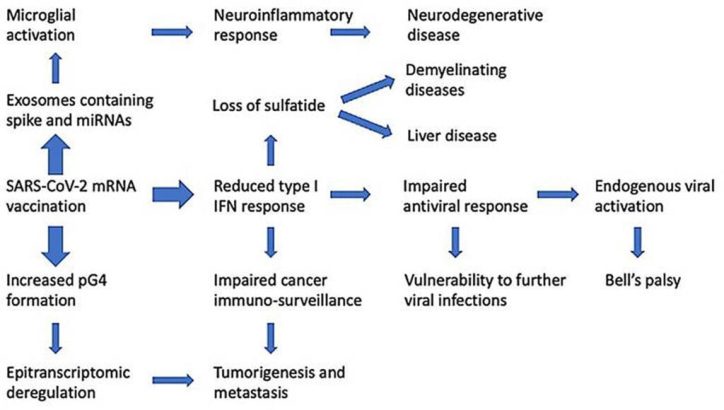
Innate immune suppression by SARS-COV-2 mRNA vaccinations: The role of G-quadruplexes, exosomes and micrornas. Credit: Seneff, Nigh, Kyriakopoulos and McCullough.
Further investigation into mRNA and CJD
Gaertner began his research work into potentially useful therapeutics for prion disease and has also funded the development of a non-invasive prion blood test.
He even undertook his own study of people who were diagnosed with or died of CJD-like symptoms (n=60) after receiving the (mostly Pfizer) mRNA jab.
Nevertheless, he readily admits that he has yet to establish absolute proof of causation.
In a European Union document related to the approval of the vaccine, Gaertner discovered what could be the smoking gun: The liquid nanoparticles used to encase the mRNA came primarily from cow fat. According to Gaertner, the document in question even admitted mRNA’s potential to cause prion protein contamination.
Nearly a year after Gaertner publicized his discovery — which convinced some but not all researchers — a paper by Jean-Claude Perez documented 26 cases of “a new form of CJD” observed within a few days of the Pfizer, Moderna or AstraZeneca vaccinations.
Of these, 20 people died within less than five months of the injection. (At the time of the paper’s publication, only one of the 26 had survived.)
The ‘good news’
While admitting that “there is not, ordinarily, a whole lot of good news to be had concerning prion diseases,” Gaertner outlined a mechanism by which “residues on the spike [protein] bind to the many and varied amyloidogenic proteins,” thus resulting in the blood clots observed by more than a few embalmers since the introduction of the mRNA shots.
He explained how this process can “bind up” the prionic proteins:
“So, what we essentially have here is, instead of a silently cascading apocalypse, buried deep inside parts of the brain that we will never reach, we likely, instead, have these long, stringy, vein-shaped agglomerations of the various amyloid proteins, binding together wherever they meet, and apparently at least somewhat resistant to being broken down by the body’s natural processes for dealing with such eventualities.”
The “really good news” comes from the way ivermectin binds directly to the spike protein — which has itself been described as a “prion-like” protein — thus blocking the spike from connecting to the ACE-2 receptor and “preventing the key from ever entering the keyhole.”
According to Gaertner, ivermectin also prevents the “amyloidogenic aggregations to the spike protein,” thereby arresting the production and proliferation of the prionic proteins. He adds:
“Ivermectin is, without a shadow of a doubt at this point, a true miracle drug: With so many applications, from antiviral, to cancer treatment, to anti-inflammatory, and of course in its originally recognized anti-parasitic application, there should be little wonder why the powers that be have done their best to diminish it as ‘horse paste.’”
Gaertner also notes that in a “very unscientific poll” he conducted on Twitter, 80% of respondents reported that a single, low dose of ivermectin significantly improved “brain fog,” a common post-COVID-19 symptom.
He described a number of “relevant investigational therapeutics” for use against the spike protein and its effects, including serrapeptase, quercetin, methylene blue and resveratrol, some of which demonstrate a “very broad range of useful actions.”
Expressing his belief that the lack of progress on therapeutics for neurodegenerative diseases is likely due to “your run-of-the-mill Pharma and charity corruption,” Gaertner nonetheless found cause for optimism.
“There’s been a lot of progress, on a lot of fronts, and more comes regularly as the world continues waking up,” he said.
John-Michael Dumais is a news editor for The Defender. He has been a writer and community organizer on a variety of issues, including the death penalty, war, health freedom and all things related to the COVID-19 pandemic.
This article was originally published by The Defender — Children’s Health Defense’s News & Views Website under Creative Commons license CC BY-NC-ND 4.0. Please consider subscribing to The Defender or donating to Children’s Health Defense.
July 8, 2023 Posted by aletho | Corruption, Science and Pseudo-Science, Timeless or most popular | COVID-19 Vaccine | Leave a comment
Exposed, the multi-billion-dollar illusion of ‘HIV’: Part 5
Readers of TCW will be familiar with Neville Hodgkinson’s critical reporting of the ‘Covid crisis’ since December 2020, notably his expert, science-based informed alarm about the mass ‘vaccine’ rollout, so absent from mainstream coverage. What they may be less aware of is the international storm this former Sunday Times medical and science correspondent created in the 1990s by reporting a scientific challenge to the ‘HIV’ theory of Aids, presaging the hostile response to science critics of Covid today. In this series he details findings that form the substance of his newly updated and expanded book, How HIV/Aids Set the Stage for the Covid Crisis, on the controversy. It is available here. You can read Part 1 of this series here, Part 2 here, Part 3 here and Part 4 here.
By Neville Hodgkinson | TCW Defending Freedom | July 7, 2023
As a former newspaper medical and science correspondent, I saw striking parallels between the mishandling of Covid, from 2020 onwards, and illusions over HIV/Aids on which I had reported for many years. In both instances, scientists and public health experts seemed to lose their heads in the face of lobbying by powerful and sometimes mega-wealthy interests. The lobbyists were able to gain sway over state health agencies, whose generally good intentions became too readily misinformed and misdirected.
With Covid, the big push was for a jab to protect us against the toxic ‘spike protein’ that made the genetically engineered SARS-CoV-2, a product of biodefence research, a genuine new arrival in the world of microbes. Involvement of agencies heavily invested in vaccines, including the Bill and Melinda Gates Foundation and the UK’s Wellcome Trust, contributed to economically and socially disastrous lockdowns, and to mass vaccination with the experimental mRNA gene products. Thousands of deaths and millions of injuries have been reported in the wake of these jabs, but more than two years on, authorities such as the UK’s NHS continue to insist against all evidence (see also here) that they are ‘safe and effective’ and save millions of lives.
With Aids, the promotion of an unvalidated blood test for an unproven ‘HIV’ infection became the illusory basis of worldwide panic. A global marketing opportunity opened for drug and test kit manufacturers, and a vaccine was promised within two years. Forty years on, a vaccine is not even on the horizon, despite billions of taxpayer dollars having gone into countless trials.
No one seems ready to face the possibility that there will never be a vaccine for a virus that, according to an exhaustive, immensely painstaking analysis by a group of scientists based in Perth, Western Australia, has never been proved to exist.
The so-called HIV test detects antibodies to a range of proteins (antigens) assumed, but never proved, to belong to ‘HIV’. The proteins do exist, of course, and they are found at raised levels in the blood of people exposed to a variety of chemical and microbial challenges. These can include drugs, anal sex, multiple pregnancies, repeated blood transfusions, and chronic malnutrition-associated infections.
As explained earlier in this series, despite Herculean efforts in the laboratory, scientists were unable to obtain particles of ‘HIV’ from patients with Aids or at risk of Aids. Such particles would normally be considered essential for developing a diagnostic test. The particle constituents provide the test’s developers with specific antigens. Blood that reacts with those antigens can be assumed to have antibodies signalling exposure to a specific microbe, though cross-reactions can produce false positive results.
With the HIV test, however, there were no virus particles through which antigens could be defined as relating to HIV. Instead, the test’s developers used antigens found to be reactive with antibodies in the blood of people with symptoms of immune system breakdown. Yet those were the very patients who had often been exposed to a wide variety of antibody-inducing stimuli, which did not necessarily have anything to do with a deadly virus.
On the basis of this test, millions of people have been diagnosed ‘HIV-positive’, and if they become ill, victims of ‘HIV/Aids’. But the reason they test positive has nothing to do with a new virus. The idea that the test shows infection with a deadly virus is based on entirely circular reasoning, bypassing the need to prove the existence of ‘HIV’ itself. People test positive because they have antibodies to proteins falsely designated ‘HIV’ antigens.
As explained in Part 3 of this series, that false designation was made by researchers who thought detection of a particular enzyme, reverse transcriptase (RT), meant the presence of a retrovirus. RT was later found to be ubiquitous in cells, whose genetic activity is much more dynamic than was realised 40 years ago when the ‘HIV’ theory was developed.
Public health experts knew of this deficiency from the outset. One hundred experts from 34 countries at a 1986 World Health Organization meeting in Geneva heard that the test kits were licensed to protect blood supplies, as they served as a broad screen for possible abnormalities in blood. People with Aids and at risk of Aids suffer a range of active infections, some of which could be transmissible through blood transfusions. The tests helped to protect against use of such ‘dirty’ blood.
But the meeting was told that something more was needed to distinguish genuine ‘HIV’ infection or indeed determine if there were truly such a thing as ‘genuine HIV infection’. The test kits should not be used to diagnose or screen for HIV as such.
The delegates heard that a so-called ‘confirmatory test’, called ‘western blot’, relied on the same principle as the test kits it was supposed to be checking, and so was also incapable of being used to diagnose HIV/Aids. In a monumental scientific ‘fudge’, however, a representative from the US Food and Drug Administration told the meeting that public health needs had caused usage of the kits to expand and ‘it was simply not practical’ to stop this.
In other words, panic over Aids caused science to be thrown out of the window. It was just as we now know happened with the arrival of Covid, when powerful agencies conspired to bring about unprecedented, economically and socially disastrous lockdowns, misuse of dubious testing technologies that exaggerated case numbers, and mass administration of an experimental gene product sold to us as a ‘safe and effective’ vaccine.
When later studies of the ‘HIV’ test showed a close link between testing positive and risk of developing Aids, that was taken to prove the test’s validity. The link was entirely artificial, however. It was a consequence of the circular reasoning, not of ‘HIV’ infection.
As the HIV/Aids paradigm won worldwide acceptance, increasingly complex procedures for trying to make a reliable diagnosis came into being. But the basic problem remains to this day: scientists have not been able to validate any of these procedures against pure virus, taken from patients, because no such virus has ever been obtained.
Research has repeatedly confirmed that many different conditions cause raised levels of the antibodies looked for by the ‘HIV’ test, putting people at risk of being labelled HIV-positive when there is no such virus present. They include mycobacterial infections such as TB and leprosy, widespread among impoverished people, and the cause of millions of misdiagnosed ‘HIV/Aids’ cases in Africa.
Also, when cells are dividing and growing at a higher rate than normal, such as in pregnancy, raised levels of antigens are liable to trigger positive test results which have nothing to do with ‘HIV’. This is another source of illusory ‘HIV/Aids’ diagnoses in poor countries and communities where many women undergo multiple pregnancies.
Manufacturers of the tests know they should not be used diagnostically, and test kits contain a disclaimer to that effect, such as ‘Do not use this kit as the sole basis for HIV infection’. Healthcare providers never diagnose HIV based on a single test result – further ‘confirmatory’ tests are always required, and on the basis of how one test performs against another, high levels of accuracy are claimed. But these are bogus claims. All the tests suffer the same problem: lack of validation against actual virus. When the tests are based on similar principles, if the principles are wrong it means all such tests are wrong too.
As in the early days of Covid, the greater the fear generated by modellers and media, the greater the sense of approval from the authorities. In 1987, a computer model prepared at the Los Alamos National Laboratory said one American adult in ten could become infected by 1994, although researchers admitted that was based on inadequate information. In fact, the number of ‘HIV’-positive Americans has remained at a little over a million almost from the start of the testing programme. This is not the behaviour of an infectious virus new to humanity.
In 1985, the Royal College of Nursing said one million people in Britain ‘will have Aids in six years unless the killer disease is checked’. The actual cumulative total of Aids cases by 1990 was below 5,000. Today, fewer than 200 Aids diagnoses a year are reported in the UK, and well under 3,000 new ‘HIV’ diagnoses.
In poorer countries, however, continued inappropriate use of the tests has led to claims that millions are ‘HIV-infected’. This belief fuels a continuing flow of jobs and cash for researchers, non-governmental organisations, charities, and drug companies. According to the World Health Organization, 38million people are ‘living with HIV’ today, and 27,500,000 are receiving antiretroviral drugs.
It is a great tragedy. Through good intentions as well as selfish interests, huge resources are being misdirected. Since the inception in 2003 of the US President’s Emergency Plan for AIDS Relief (PEPFAR), the US government has invested more than $100billion in the global HIV/Aids response. It is the largest commitment in history by any nation to address a single disease, funded through the American people’s generosity. The project is said to have saved more than 25million lives, prevented millions of HIV infections, and supported several countries in achieving HIV epidemic control – ‘all while significantly strengthening global economic security’.
The weight of support for the HIV theory is still huge. PEPFAR is managed and overseen by the US Department of State, and implemented by seven government departments and agencies, ‘leveraging the power of a whole-of-government approach to controlling the HIV/Aids epidemic’.
But what if there is no epidemic? Would not development aid be a more humane and effective response to the immune deficiency widespread in poor countries than drugs of dubious safety and effectiveness, invalid tests, and endless vaccine trials?
Thirty years ago, in 1993, Sunday Times editor Andrew Neil sent me to Africa for several weeks to report from the ground on what was happening there. At that time, there were forecasts that the population was set to be decimated because of long-established, widespread infection with HIV. After meeting scientists, doctors, politicians and patients in Kenya, Zambia, Zimbabwe and Tanzania, I found no good evidence of a new, epidemic condition. But there was an epidemic of fear – Zimbabwe’s health minister told me that he called it ‘HIVitis’ – created by an invasion of Aids researchers armed with the unvalidated diagnostic tests.
My reports provoked a flood of correspondence, some supportive – such as from the influential and knowledgeable New African magazine – but also including condemnation from the highest level in the UK. A letter signed by Baroness Chalker, Minister for Overseas Development, Sir David Steel, Liberal Democrat spokesman for foreign affairs, and Tony Worthington, Labour’s foreign affairs spokesman, accused me of writing nonsense. Their letter was said to have been seen and agreed by a long list of heads of medical establishments, including the chief medical officer, the director of the Medical Research Council, and voluntary organisations concerned with Aids. It said:
‘Mr Hodgkinson says that the scientific community have collectively failed to validate their tests for HIV and have deliberately inflated statistics. If we are to believe him, these scientists have fooled the World Health Organisation, governments in developed and developing countries alike, international development organisations like the Save the Children Fund, ActionAid and Oxfam, institutes of public health, journalists and the general public.
‘The sad fact is that Africa is in the grip of a major HIV epidemic. Tens or hundreds of thousands have already lost their lives: tens of millions are at risk.
‘Mr Hodgkinson has got it badly wrong, and you do your readers a disservice in giving credence to his nonsense.’
In 1993 Africa’s population was approaching 700million. In 30 years, far from being decimated, it has more than doubled and now stands at nearly 1,433,000,000.
Philippe Krynen, head of the African mission Partage Tanzanie, was a star on the HIV/Aids circuit until he realised that ‘this epidemic which was going to wipe out Africa is just a big bubble of soap’, as he told me at his headquarters overlooking Lake Victoria in 1993. Krynen, whose charity has been doing magnificent work for orphans in the region for nearly 35 years, managed to resist an attempt by the European Community’s Aids task force to have him thrown out of the country in the wake of his revelations.
We were last in touch in November 2022. He wrote: ‘The Aids issue is totally buried in dusty files, at least for us here in Tanzania. The distributors of antiretroviral drugs are still doing their business in the country but the pandemic tale is dead.’
He added: ‘As for the Covid tale, it didn’t last long. In 2020 a short epidemic of acute respiratory tract infection was taken care of by a cocktail of common antibiotics. The combination of very few tombs per community, and a patent lack of statistics, dismantled the scarecrow. Prevention (masks and soaps) was quickly abandoned and business as usual never interrupted . . . Tanzania today is seen as a peaceful African jewel.’
Covid has made it more important than ever that the illusions around the HIV theory of Aids should be dispelled. They are not likely to disappear overnight, but 40 years on, with no vaccine or cure for the purported ‘HIV’ infection, and many lives put at risk by toxic medicines directed against a mythical enemy, is there not someone in the scientific community with the integrity and human decency to take an honest look at the astonishingly detailed and challenging work of the Perth scientists?
Otherwise, we may also be condemned to decades of untruths about Covid. So far, the scientists who created the genetically engineered virus have not been called out for their mistakes, and a continued climate of fear means people are still testing, distancing, masking, and queuing up for an ineffective and unsafe medical treatment that masquerades as a vaccine.
Next: Ill-founded claims of a virus genome
July 8, 2023 Posted by aletho | Science and Pseudo-Science, Timeless or most popular | HIV/AIDS | Leave a comment
Nuclear Power ‘Lapdog’ IAEA to Suffer ‘Reputational Blow’ for Fukushima Wastewater Release
By Fantine Gardinier – Sputnik – 07.07.2023
Numerous regional governments have for years protested Japan’s plans to release the wastewater from Fukushima Daiichi into the Pacific Ocean, including South Korea, China, and numerous Pacific Island nations, whose fishing fleets work the vast ocean waters.
The Japanese government has moved to begin the gradual release of 1.3 million tons of treated wastewater from the Fukushima nuclear power plant in Okuma. The water, which is radioactive from having been used to keep molten spent nuclear fuel cool in the aftermath of the March 2011 earthquake and tsunami that devastated the Sendai plain, has been filtered through the Advanced Liquid Processing System (ALPS). The planned release will take place over 30 to 40 years.
Kevin Kamps, the radioactive waste watchdog at Beyond Nuclear, told Sputnik on Friday that the International Atomic Energy Agency (IAEA) is caught in a vise between its advocacy for nuclear power and the reality of the detrimental effects of improper storage of its waste, which is a key problem with the Japanese government’s plan since 2011 to store that waste at the site of the damaged Fukushima nuclear power plant.
“I think it’s just an industry public relations campaign to kind of say, look, the ocean’s a big place, it’s just going to disappear into nothingness. And it’s not true,” he told Radio Sputnik. “In fact, it’s going to concentrate the radioactivity in the food chain. And that’s going to be the main pathway for human exposure as people eating Fukushima contaminated fish from the Pacific Ocean.”
“There’s so many options that are better than dumping it in the ocean. One option is what they’ve been doing for the past 12 years, since this catastrophe began: storing it in tanks. It has not gone perfectly, but their rationale for not continuing with the tank storage is that they’ve run out of room, they’ve run out of physical space. And all I can say is, would you please give me a break? They have turned that region into a radioactive sacrifice zone because of the catastrophe,” Kamps said, adding that the area has already been rendered inhospitable by the radiation.
“There’s an option to expand the site perimeter, continue with the tank storage. A problem with that, though, is that site, as shown by the March 11, 2011 earthquake and tsunami, it’s not a stable site, so storage there may not be the best idea,” he noted.
“A colleague of mine, Dr. Arjan Nakatani, is actually serving on the Pacific Islands Forum, reviewing this insane scheme on behalf of Pacific Island nations and opposing it. He has pointed out from the earliest days of the catastrophe that the radioactive wastewater could be transported to a more stable site and stored there. The reason this makes sense is tritium has a 12.3-year half life. Multiply by ten to get the hazardous persistence. That’s 123 years. One hundred twenty-three years of storage is doable, humans can do that. That’s really the best plan for what they have now.”
Kamps noted that several months after the 2011 disaster, radioactive cesium in the seawater along the California coast had doubled, proving that while “it’s a big ocean,” the radioactive materials won’t just disappear. In the case of Fukushima, it’s not just radioactive waste entering the water, either: the water itself is radioactive.
“The main culprit that we need to worry about is radioactive tritium, which is radioactive hydrogen, which means that the water molecules in that radioactive wastewater are themselves radioactive. It’s not a contaminant per se. It’s radioactive water. And other contaminants in there include strontium-90, cesium-137, iodine-129 – the list goes on. They have run it through filters.”
“The radioactive isotopes per element behave chemically just like their non-radioactive sibling. So, for example: cesium, that’s going to go to muscle tissue; strontium, that’s going to go to bone; tritium is going to go anywhere in the human body and other living things that hydrogen goes, which is everywhere. Radioactive carbon-14, the nuclear industry likes to say that they’re carbon-free. Well, they’re not carbon-14 free. And ironically enough, carbon-14 – which again, can go anywhere in the human body that carbon can go, which is everywhere – is perhaps the most biologically harmful of these radioactive poisons because it has a 5,500-year half-life. That means 55,000 years of hazard.”
“And all of these radioactive elements are going to enter the food chain and in fact, they’re going to concentrate upwards to humans at the top of that pyramid, through fish, through seaweed. You mentioned that there has been panic buying of salt in South Korea to try to get salt not exposed to this ocean release before they start releasing. So the shelves in South Korea are devoid of salt because people are buying as much as they can before this bad idea began.”
Kamps noted other examples include the US’ underground storage sites for radioactive waste such as the Waste Isolation Pilot Plant (WIPP), buried deep under the New Mexico desert inside a watertight salt formation, where it is expected to safely decay for 10,000 years. However, even then, it took only 15 years for an accidental release of radioactive material, which escaped through a ventilation shaft.
Kamps said the IAEA’s endorsement of the release would deliver the agency “a huge reputational blow,” adding that it has long downplayed the risks of nuclear power and the outcomes of disasters such as that at Chernobyl in Soviet Ukraine in 1986.
“The International Atomic Energy Agency under the Nonproliferation Treaty of 1970 is a pro-nuclear power institution. Their job is to supposedly hold nuclear weapons proliferation in check while advocating an expansion of nuclear power. It’s a schizophrenic mandate. And what they do is they will downplay Chernobyl, they will downplay Fukushima as part of their pro-nuclear power mandate.”
Kamps also noted that the Japanese government has been strongly pro-nuclear power since the 1950s, thanks to pressure by the US government, which occupied the country from the end of World War II until 1952. He accused the IAEA of being “a lapdog sitting in the lap of Tokyo Electric and the Japanese government.”
“It’s pretty astounding that they’re willing to stick to their script when, you know, they are getting called out by a long list of countries in the Pacific who are going to be harmed by this and by scientists with a lot more integrity than any of those institutions I mentioned, who are saying that the data is nonexistent, analyses have not been completed. It’s all very half-baked. And I guess those promoting it are hoping that this public relations scheme to just make people look away and forget about it is going to work. So I guess that fight is on.”
“There’s a growing list of countries that have banned importation of seafood from the Fukushima region, which include places like South Korea and China and elsewhere. And the list of countries that have spoken out very strongly against this wastewater dum, those same countries and many others, including Russia, the Philippines, the Pacific Islands Coalition, who have an expert panel looking at this, have pointed out just how sloppy the so-called analysis by Tokyo Electric and the Japanese government have been. The documentation is missing. The analyses are far from complete. Even analyses that the IAEA promised to carry out are one-third done at this point, and yet they have signed off on the dumping to begin. So the public relations facade of proponents of dumping is very thin and they’re being called out on it at the highest levels of many governments on the Pacific Ocean.”
Many of those same governments, Kamps noted, are also very heavily dependent on nuclear power and wrestle with many of the same questions of safe waste disposal. Pressure from anti-nuclear groups has also forced their hand, and the expert noted that in Japan, those groups have long been “the little Dutch boy with their finger in the dike, preventing this scheme from going forward for many years.”
“Hats-off to the Japanese anti-nuclear movement, which has kept the vast majority of reactors shut down since Fukushima. They won’t let them be reactivated. And that’s something that amazes me because we try so hard in the United States to do that, too. But we’re often steamrolled in our efforts,” he said.
July 7, 2023 Posted by aletho | Nuclear Power, Timeless or most popular | Japan | Leave a comment
Exposed, the multi-billion-dollar illusion of ‘HIV’: Part 4
Readers of TCW will be familiar with Neville Hodgkinson’s critical reporting of the ‘Covid crisis’ since December 2020, notably his expert, science-based informed alarm about the mass ‘vaccine’ rollout, so absent from mainstream coverage. What they may be less aware of is the international storm this former Sunday Times medical and science correspondent created in the 1990s by reporting a scientific challenge to the ‘HIV’ theory of Aids, presaging the hostile response to science critics of Covid today. In this series he details findings that form the substance of his newly updated and expanded book, How HIV/Aids Set the Stage for the Covid Crisis, on the controversy. It is available here. You can read Part 1 of this series here, Part 2 here and Part 3 here.
By Neville Hodgkinson | TCW Defending Freedom | July 6, 2023
Yesterday I explained how detection of an enzyme called reverse transcriptase (RT), previously thought to prove the presence of a retrovirus but later found to be abundant in cells, lay at the root of the theory that HIV causes Aids. This is one key finding in an 80-page deconstruction of the entire concept of ‘HIV’ posted in July 2017 by a group of scientists based in Perth, Western Australia.
Their work has been ignored, censored and suppressed in much the same way as experienced by critics of the panic-stricken, exploitative, ego-driven, cruel and hugely damaging responses to the Covid pandemic.
The Perth paper is not a loose philosophical challenge to germ theory in general. It is a forensic examination of every detail of the science that has been taken as proof of the HIV/Aids hypothesis.
Misinterpretation over the presence of RT paved the way for further foundational errors, the next of which was the bypassing of a vital step in virus identification known as purification. This entails separating particles of the virus from cell debris, so the particles can be shown to be infectious, and their exact constituents established. HIV pioneers Luc Montagnier and Robert Gallo never fulfilled this requirement, according to the Perth group’s analysis, despite claims to the contrary.
‘Viruses are particles,’ the Perth scientists say. ‘Without proof for the existence of particles there is no proof of the existence of a virus.’
It was not that the Montagnier and Gallo teams did not try. Both regularly attempted to purify particles from cultures of cells taken from Aids patients, or those at risk of Aids. They used a technique known as sucrose density gradient ultracentrifugation. In this, a drop of the culture fluid is passed through a sucrose solution spun in a high-speed centrifuge which separates retrovirus particles at a particular density. This material is then examined with an electron microscope in the hope of demonstrating the particles.
Montagnier’s group cultured cells from a 33-year-old gay man with swollen lymph nodes, who indicated that he had had more than 50 sexual partners a year and had travelled to many countries. He had a history of several episodes of gonorrhoea, and three months previously had been treated for syphilis.
Reverse transcriptase activity was seen and interpreted as meaning a retrovirus was present. RT was also detected in their second experiment, in which cells from the patient were co-cultured with the cells of a healthy blood donor. Despite repeatedly looking, however, Montagnier’s group failed to find evidence of the vital particles in either of these experiments.
In a third experiment, cells from umbilical cord blood, obtained from two placentas, were cultured with fluids from the second experiment; in this case a few particles were seen under the electron microscope. The group took them to be ‘HIV’, although they were not purified, and umbilical cord cell cultures are known to produce such particles independent of any infection. No control experiment was done to see whether the umbilical cells would produce a similar result by themselves.
Particles which simply look as if they might be retroviruses can often be detected in sick people, regardless of Aids, as well as in people who are well. This is why the Perth scientists insist that failure to purify particles, determine what they are made of, and prove they are infectious was such a huge flaw in ‘HIV’ science. Later claims by HIV researchers that they have found other means of determining HIV’s presence are all indirect, like the detection of RT, and equally open to misinterpretation.
In 2008, Montagnier and his co-worker Françoise Barré-Sinoussi were awarded the Nobel Prize in Physiology or Medicine for having been first to discover HIV. In her biographical details for the prize, Barré-Sinoussi stated that ‘it was important to visualise the retroviral particles, and Charles Dauget (the team’s electron microscopist) provided the first images of the virus in February 1983. The isolation, amplification and characterisation of the virus rapidly ensued’.
However, Montagnier had given a different picture when questioned on this point by Djamel Tahi, a French documentary film maker, in a 1997 interview. Tahi asked why electron microscope photographs ‘published by you come from the culture and not from the purification’. Montagnier replied that when purification was attempted, ‘we saw some particles but they did not have the morphology typical of retroviruses. They were very different’. Of Gallo’s work, he said: ‘I don’t know if he really purified. I don’t believe so.’
Dauget went further, telling Tahi: ‘We have never seen virus particles in the purified virus. What we have seen all the time was cellular debris, not virus particles.’
Cellular debris means broken down pieces of cells used in the cultures. Yet because of the RT activity, Montagnier believed he had found a retrovirus. So when he incubated serum from his patient’s blood with this ‘debris’, he expected to find antibodies which would react with virus proteins. Three proteins did produce a reaction, and Montagnier concluded that one of these was ‘specifically recognised’ as being viral.
There was no scientific justification for this conclusion, the Perth scientists say. Many healthy humans have antibodies which react with this protein, identified as p24 (a molecular weight of 24,000). It is also known that at least one normal cell component is a protein with the same molecular weight. Yet for decades the detection of this protein in blood or culture has been taken to prove the presence of the virus.
In May 1994 Gallo published four papers in Science with many similarities to the French group’s experiments, though he tested samples from more patients and used an immortal (cancer) cell line to obtain large amounts of proteins for diagnosis and research. His claims to have found the virus held no more validity than Montagnier’s because he too failed to observe, purify and characterise actual virus particles.
In 2003 the Perth group emailed Gallo asking if he was aware of Montagnier’s admission that there were no electron microscope pictures of purified virus from the original patient, and whether clinicians had cause for concern about the implications of Montagnier’s answer. Had clinicians spent two decades diagnosing patients with a non-existent virus?
Gallo replied: ‘Montagnier subsequently published pictures of purified HIV as, of course, we did in our first papers. You have no need of worry. The evidence is obvious and overwhelming.’
Gallo’s reassurance has no basis in fact, the Perth scientists maintain. Not a single electron micrograph of purified ‘HIV’ was published by Gallo in 1984, or since. Nor did Montagnier publish any such picture. Fourteen years later, European and US groups who tried to make good this deficiency were still unable to provide clear evidence of the existence of ‘HIV’.
Right until his death in February 2022, Montagnier tried to signal to the world that HIV was not as dangerous as had been thought. I suspect he knew in his heart of hearts that the theory was mistaken, but could not bring himself to admit it after the fame – and wealth – that came his way.
I interviewed Montagnier for the Sunday Times at the Institut Pasteur in Paris in 1992, for an article the paper ran on April 26 under the heading ‘Time to think again on Aids link, claims HIV pioneer’. His thinking on HIV and Aids was already strikingly different from most people’s picture of the disease. He insisted that HIV did not attack cells of the immune system directly, but that in the presence of other infections it could spark a process in which immune cells were self-destructing faster than they could be replaced.
This was a big contrast with the ‘lethal virus’ picture promoted by Gallo. It meant HIV-infected patients could reduce their risk of Aids by reducing their exposure to other microbes. Dietary advice and vitamin supplements were also likely to help, Montagnier indicated, by easing chemical stresses in the body that were known to cause loss of immune cells.
‘We were naïve,’ he said at one point. ‘We thought this one virus had been doing all the destruction. Now we have to understand the other factors in this.’
He tried to make his views on these ‘co-factors’ known in June 1990, at the sixth international Aids conference in San Francisco, but it was not a message the conference wanted to hear. Of 12,000 delegates present, only 200 went to hear his talk. By the time he had finished, almost half had walked out. His concerns were dismissed by leading American Aids scientists and public health officials. Molecular biologist Professor Peter Duesberg, himself ostracised and defunded for challenging Gallo’s ‘deadly virus’ claims, commented: ‘There was Montagnier, the Jesus of HIV, and they threw him out of the temple.’
Molecular biology has moved into such refined areas of understanding that most people outside those directly involved in the field have little chance of detecting false claims. This is also a problem that has bedevilled Covid science. Despite clear evidence from the start that SARS-CoV-2 was genetically engineered, powerful interests consistently threw up clouds of confusion, claiming it was a natural virus that had jumped species and that any other suggestion was conspiratorial. On top of that, big money was piled into promoting a global vaccination campaign, and into discrediting any ideas that could get in the way of that bonanza.
At least with Covid, the internet has made it possible for thousands of doctors and scientists to question official responses to the crisis, even in the face of relentless propaganda by the BBC and most mainstream media.
The marketing of the HIV theory of Aids was so successful, however, that few people realise there is any flaw in the science. Forty years on, millions of lives are still being blighted by an antibody test for a virus that never was.
Next: The ‘HIV’ test that misled millions
July 7, 2023 Posted by aletho | Book Review, Science and Pseudo-Science, Timeless or most popular | HIV/AIDS | Leave a comment
LILIANE HELD KHAWAM | EXCERPT – GLOBALIZATION ANALYSIS
PLANET LOCKDOWN | March 10, 2022
In our interview with Liliane Held-Khawam, she describes how states are increasingly being corporatised and the elites are running the world like one grande world company. In this excerpt, Liliane presents the organizational model of the globalized, privatized and corporatized society that will be ours if the logic of globalization is carried to its conclusion.
Liliane Held-Khawam has a degree in economics from the University of Neuchâtel, Switzerland and founded a business strategy and management consulting company serving multinationals focusing on human development within an organization. She authored a book on MPC management coaching, and publishes extensive research into current events on her site lilianeheldkhawam.com
Please donate to the project. Your contribution makes a real difference:
https://planetlockdownfilm.com/donate/
Subscribe to the email list for updates on the film and interviews:
https://planetlockdownfilm.com/lists/?p=subscribe
Watch more full interviews and educate yourself!
https://planetlockdownfilm.com/full-interviews/
July 7, 2023 Posted by aletho | Civil Liberties, Full Spectrum Dominance, Supremacism, Social Darwinism, Timeless or most popular | Human rights | Leave a comment
The problem with radioactive water discharge from the Fukushima Daiichi Nuclear Power Plant – Part One
By Konstantin Asmolov – New Eastern Outlook – 06.07.2023
As previously noted, the outrage over Japan’s discharging of over 1 million tons of radioactive wastewater from the Fukushima Daiichi Nuclear Power Plant into the Pacific Ocean (“discharge” for short) continues to persist. For instance, thousands of Koreans rallied in downtown Seoul on May 20, 2023, to protest the discharge. The leader of the main liberal opposition party in Korea, Lee Jae-myung, told the protesters that the national government should not support Japan’s decision to dispose of contaminated water without considering the repercussions for neighboring countries and the contamination of the world’s oceans. Lee Jae-myung compared the discharge of wastewater with pouring poison into the well, to “nuclear terrorism.” How right is South Korea’s top Democrat?
If you accept the claims made by various environmental groups or the South Korean “democratic opposition” without question, you might well believe that Japan is following through on its plan to release water into the ocean to cool the reactor. However, when this information is clarified, the possibility of a “global disaster” becomes a hotly contested topic.
Since 2011, the procedure of water filtration and sedimentation has been under progress. There are currently more than 1.3 million tons of water in more than 1,000 tanks at the nuclear power plant that have passed through a specialized treatment system known as the Advanced Liquid Processing System (ALPS). Throughout this time, the water has been filling the storage tanks until there was no more room nearby. The ALPS system is capable of removing all radioactive substances except tritium from wastewater, and Tokyo claims that tritium-added water discharge is common practice at nuclear power plants around the world.
There is a fierce debate, however, over what to call water that has undergone purification. The Japanese side claims that among the potentially dangerous isotopes there remains only radioactive tritium, the concentration of which will not cause much concern. Therefore, it is logical to call water “purified” or at least “treated,” while Lee Jae-myung and Co. speak of “contaminated” water, not shying away from using the term “liquid radioactive waste,” which creates a very different impression in the public mind.
The IAEA uses both terms depending on the level of filtration: water that has undergone treatment is referred to as “treated water,” while unfiltered water is referred to as “contaminated.”
In an effort to improve relations with Tokyo under the Yoon Suk-yeol administration, official Seoul is also thinking about changing the word “contaminated” to “treated.” For example, the government urged the term “nuclear wastewater” not be used on June 19, 2023 because it “causes people excessive and unnecessary concern.” This is correct, because the phrase “radioactive water” implies “water directly from the reactor” in the mass consciousness, not “water that has undergone a purification procedure and has stood for more than ten years.”
Of course, the water would be drained from the initial storage facilities, and – after several years, if not decades – the cleaned water would be mixed with regular water and released into the ocean in a thin stream.
The Japanese government had stated that Discharge to the Pacific Ocean would commence in April 2021, and on June 7, 2023, Tokyo Electric Power Company (TEPCO) finished work to pump seawater through an undersea tunnel designated for Discharge. In the near future, TEPCO plans construction of a tank in which contaminated water will be temporarily stored before being transferred to the underwater tunnel. All work in preparation for the discharge of contaminated water into the ocean should be completed by the end of June. Water discharge is set to commence this summer.
On June 12, Japan began testing facilities designed for the Discharge. According to Fukushima TV, clean water mixed with seawater will be discharged for two weeks. At the same time, there will be no discharge of contaminated water during this period.
The arguments of the supporters and the opponents of Discharge can be summarized in the following table.
| For Discharge | Against Discharge |
|
|
Let us not forget the thesis beloved by the opponents of the discharge: “If it is safe enough to drink, they should use it as drinking water. It should at least be used as agricultural or industrial water.” At various points this thesis has been voiced by Lee Jae-myung, the leader of the ROK opposition, a representative of the Chinese foreign ministry, and even worried Fijian officials.
By the way, China’s stance is just as dogmatic and prejudiced. Li Song, China’s permanent representative to the IAEA, criticized Japan for their intended discharge of radioactive water into the ocean on June 10, 2023, claiming that the action will jeopardize the health of people worldwide and the marine ecosystem. More than 60 radionuclides are present in the radioactively contaminated water, according to Li, who also noted that even after filtering, 70% of this water does not adhere to IAEA guidelines.
Two other issues on which there is scientific and public debate is the time when discharged water will reach Korea and also the problem of general water contamination, including radioactive fish.
The government-funded research institute Korea Atomic Energy Research Institute (KAERI) issued a disclaimer after Wade Allison, a British physicist and Emeritus professor of Physics and Fellow of Keble College at Oxford University, said on May 15 that he would drink up to 10 liters of Fukushima water. According to KAERI’s news release, treated wastewater is not safe to drink, and the professor’s assertion that he would drink many liters of water does not reflect the institute’s views. Meanwhile, during a National Assembly session on May 24, Han Gyu Joo, the KAERI President, stated that wastewater should not be drunk since “the wastewater is 62 times higher in becquerel (Bq), a unit of radioactivity, than drinking water.”
When Professor Emeritus Suh Kune-yull of Seoul National University’s Department of Nuclear Engineering told local broadcaster YTN that the wastewater could flow into the East Sea within five to seven months after the discharge begins, authorities immediately issued a press release refuting the claim. They referred to simulations done by government research institutes, denying the professors claims and indicating that seawater containing very few traces of tritium would enter the Korean Seas about five years after wastewater discharge. A group of fishermen then reported the professor to the police for defamation, and the ruling party criticized him for causing fear in the general public by spreading groundless rumors.
Later, Vice Minister Song Sang-geun of the Ministry of Maritime Affairs and Fisheries, denied a media report citing a study by the Helmholtz Association of German Research Centers that contaminated water from the plant would reach the shores of South Jeju Island in just seven months. According to him, as ocean currents carry the contaminated water, the radioactive material would be virtually invisible on the shores of Jeju. He also added that the concentration level there would be about a trillionth of that of the Fukushima coast.
Meanwhile, salt sales in the Republic of Korea have increased by 55.6 percent as a result of concerns that Japan’s planned discharge of treated wastewater may contaminate the waters surrounding the Korean Peninsula. Separately, there is a shortage of iodized salt as a remedy for radiation.
On June 20, 2023, it was announced at the plenary meeting of the Agriculture, Forestry, Livestock, Food, Marine, and Fisheries Committee of the National Assembly that from 2011 to 2020, the level of cesium-137 in the Sea of Japan rose from 0.001 to 0.002 becquerels per kilogram (Bq/kg). But on June 21, Vice Minister Song Sang-geun of the Ministry of Maritime Affairs and Fisheries, reported that in 2011 the concentration of cesium in the East Sea has not practically increased: from 2005 to 2010, the index was kept between 0.001 and 0.004 Bq/kg. At the same time, the World Health Organization limits the content of cesium in drinking water to 10 Bq/kg, so the water from the Sea of Japan is absolutely safe.
According to Song Sang-keon, the government has discovered no concerns in around 75,000 radiation tests conducted on marine items after the Fukushima nuclear disaster in 2011. The government is still examining fish taken in Korean waters to ensure they are not contaminated by the Fukushima nuclear disaster.
On May 31, 2023, the IAEA submitted an interim report on the results of the analysis of contaminated water from Japan’s Fukushima Daiichi Nuclear Power Plant. No significant excess of nuclides was detected in the water samples. The Tokyo Electric Power Company’s radioactivity analysis method and water sample collecting procedure are acceptable, according to the paper. Research institutions from France and Switzerland, as well as the Korea Institute of Nuclear Safety participated in the IAEA’s analysis of the water samples. The IAEA intends to submit a report on the results of seawater analysis in the Fukushima Daiichi Nuclear Power Plant area and the fish that are located there in the near future.
However, in response to mounting concerns, the ruling party and the government agreed on June 18 to expand the inspection of radiation levels in the ocean, increasing the number of seawater testing sites from 92 to 200. Furthermore, cesium and tritium concentration levels will be monitored every two weeks, compared with the current frequency of once every one to three months.
Fish taken in the waters around the Fukushima Daiichi Nuclear Power Plant in May carried radioactive cesium, many times exceeding Japanese food safety regulations. The Kyodo Tsushin Agency reported that the intestines of sebastes taken at a port near the nuclear power plant in May contained 18,000 becquerels of cesium per kilogram, according to a study provided by the facility’s operator, Tokyo Electric Power Company (TEPCO).
This is 180 times higher than the limit for cesium content in seafood as stipulated by Japanese health regulations (no more than 100 becquerels per kilogram) and far exceeds the permissible level for human consumption. In particular, the content of cesium-137 is 180 times higher than the standard maximum.
As a result, according to a poll conducted from May 26 to 28 by Hankook Ilbo, a Korean daily newspaper, and the Japanese Yomiuri Shimbun, more than 80% of South Koreans oppose the discharge, while 60% of Japanese support it. At the same time, the Democrats claim that the government is downplaying the results of a poll showing that 84% of Koreans oppose.
In May 2023, a team of South Korean experts visited the plant with an inspection to see whether the radioactive water could be safely processed. The inspection was conducted in accordance with the agreement reached at the summit between President Yoon Suk-yeol and Japanese Prime Minister Fumio Kishida. After the inspection, the team stated that significant progress had been made, but that further analysis was needed for a more accurate conclusion. This led to an outburst of speculation about the bias of the commission, but the author will discuss the twists and turns surrounding this visit in the next text, concluding with a passage from the media: “The Fukushima wastewater discharge is an issue related not only to people’s health but also to their sentiments. It is a matter of safety in scientific terms and also a matter of whether people really feel it is safe. The government must keep trying to figure out ways to dispel people’s anxiety. Above all, it is important to concentrate on verifiable scientific facts and communicate with the people swiftly, transparently and continuously. It must also demand concrete and precise data and explanations from Japan if necessary, while keeping up efforts to verify them.”
Konstantin Asmolov, PhD in History, is a leading research fellow at the Center for Korean Studies of the Institute of China and Modern Asia at the Russian Academy of Sciences.
July 6, 2023 Posted by aletho | Nuclear Power, Timeless or most popular | China, Japan, Korea | Leave a comment
Exposed, the multi-billion-dollar illusion of ‘HIV’: Part 3
Readers of TCW will be familiar with Neville Hodgkinson’s critical reporting of the ‘Covid crisis’ since December 2020, notably his expert, science-based informed alarm about the mass ‘vaccine’ rollout, so absent from mainstream coverage. What they may be less aware of is the international storm this former Sunday Times medical and science correspondent created in the 1990s by reporting a scientific challenge to the ‘HIV’ theory of Aids, presaging the hostile response to science critics of Covid today. In this series he details findings that form the substance of his newly updated and expanded book, How HIV/Aids Set the Stage for the Covid Crisis, on the controversy. It is available here. You can read Part 1 of this series here and Part 2 here.
By Neville Hodgkinson | TCW Defending Freedom | July 5, 2023
When Covid was first perceived as a threat to public health in 2020, many governments rejected advice that protection should focus on those most at risk. They jeopardised the health and lives of millions through repeated lockdowns and the reckless rollout of experimental mRNA injections. In the panic surrounding the arrival of the genetically engineered SARS-CoV-2, unnecessary deaths occurred as a result of inappropriate forced ventilation, neglect of antibiotic treatment of associated bacterial infections, and the banning of effective medical therapy such as ivermectin.
Awareness of the scientific hubris that brought Covid into being, and of the corruption and abuse of power that turned the virus’s escape into a mega-crisis, has become widespread. The internet made it possible for critics to air data countering the official narratives, despite persistent attempts at censoring so-called ‘misinformation’.
Far fewer people know that a similar medical madness came into being nearly 40 years ago, before the internet was with us.
In the Aids era, a new, lethal, sexually transmitted virus known as HIV was said to be putting us all at risk. ‘Aids does not discriminate’, we were told. A warning leaflet, heralded by a television advertisement featuring a giant tombstone, was delivered to every household in Britain.
It took nearly a quarter of a century before a senior World Health Organization (WHO) official admitted (in 2008) that, outside sub-Saharan Africa, there would be no global heterosexual pandemic.
Despite that admission, an HIV industry continues to thrive. It has proved an endless bonanza for drug companies, special interest groups and the medical research community. At least 100 journals are dedicated to HIV/Aids medicine, including Lancet HIV, and scores of major conferences are held every year. AIDS 2024, the 25th International AIDS Conference, will take place in Munich next July and is expected to bring together some 18,000 participants from around the world.
The band plays on, but has given no time or space for acknowledgement or examination of decades of painstaking work by a small but dedicated group of scientists who maintain that ‘HIV’ is a mythological entity.
As described here yesterday, the group was led by the late Eleni Papadopulos-Eleopulos, a biophysicist based at the Royal Perth Hospital, Western Australia, who critically analysed all aspects of the theory that Aids is caused by a deadly virus. She suffered endless rebuffs and abuse from the mainstream scientific community before her death in March 2022.
In 2017 the group posted on their website a highly referenced 80-page paper setting out their case that despite thousands of claims to the contrary, there is still no proof that such a virus has been isolated from the tissues of Aids patients.
They argue that because the true causes of Aids are not being adequately addressed, millions globally, and especially in poor countries, are being burdened with a false diagnosis of ‘HIV’ infection. Many of those who have tested ‘HIV’-positive, and even who are thought to be at risk of doing so, are being advised to take drugs whose claimed benefits come at the cost of serious toxicities. In Africa, while millions are malnourished, scarce resources are being diverted into fighting an illusory ‘HIV’ epidemic.
The Perth Group presents a case that the real cause of Aids, common to the various groups at risk of the syndrome, is prolonged breach of a chemical homeostatic process (called redox) that enables our body cells to balance energy expenditure with energy replenishment. Oxidising substances bring about the former, and antioxidants the latter. When cells are over-oxidised, this ‘oxidative stress’ depletes energy potential and can damage cell structures. The theory says Aids has this mechanism at its heart, and that the virus theory was questionable from the start because it was already known that over-oxidation leads to the appearance of ‘opportunistic’ infections seen in Aids. It maintains that Aids can be prevented and treated both by reducing exposure to oxidants, and through greater exposure to antioxidants.
The different groups of patients at risk of Aids had in common powerful oxidising stimuli in their lives. These included injected and ingested recreational drugs; nitrite inhalants used for sexual enhancement; repeated infections and many of the medicines used to treat them; blood-clotting agents given to haemophiliacs, previously made from the pooled blood of thousands of donors; and semen from unprotected anal sex.
Antioxidants include vitamins A, C and E and are available naturally in many types of vegetables, fruits, and grains. It was a tragedy for South Africa when President Thabo Mbeki was derided for suggesting more than 20 years ago that there could be dietary solutions to the immune deficiencies widely experienced on the continent.
The roots of the HIV theory, the Perth scientists say, lay in the feverish atmosphere of fear and anxiety that arose in the early years of Aids, when signals arising from disordered cells became misinterpreted as evidence of a new virus. An unvalidated test led to the mistaken belief that millions were infected. Once the global alert was sounded, it became almost impossible for contrary views to be heard.
The group emailed their 2017 deconstruction of ‘HIV’, the fruit of some 40 years of work, to seven top scientific and medical journals. They offered to prepare a concise version if the critique was thought ‘worthy of being brought to the attention of the scientific community’. Three of the journals failed to reply, despite repeated requests. None took up the offer.
I reported aspects of the group’s work myself in the 1990s while employed as science correspondent of the London Sunday Times, and subsequently in The Business and The European.
In recent years I have tried many times to draw their magnum opus to the attention of leading scientists. To help make it more accessible, I wrote a summary of the arguments, now also posted on the Perth Group’s website. This identifies six key pillars of the HIV/Aids paradigm which, according to their analysis, all involved a misinterpretation of what was actually going on biologically.
At the suggestion of a former president of the Royal Society, the UK’s national academy of sciences, I wrote to three senior biologists asking for guidance as to how the group’s theory could at least be examined. None replied.
Recently, two experts in the field whom I greatly respect did have the courtesy to respond. One regretted that he was too busy to enter into discussion. The other, a UK pioneer of the search for an HIV vaccine, assured me he had worked with concentrated virus. When I asked him for a reference demonstrating proof that his concentrate was HIV, however, the publications to which he referred me came nowhere near doing that.
Part of the problem lies in the very nature of retroviruses, the family of microbes to which HIV is said to belong. When scientists were developing the HIV theory, it was not realised that the human genome is full of mobile genetic elements, called retrotransposons, that amplify themselves by first being transcribed from DNA to RNA, and then transcribed back into DNA. The second part of this process requires an enzyme called reverse transcriptase (RT), which plays a big role in gene expression.
Detection of RT was wrongly interpreted by the HIV pioneers as meaning a retrovirus was present.
In a 1988 Scientific American article describing the history of the purported discovery of HIV, Robert Gallo and the late Luc Montagnier, the two scientists most identified with the theory, wrote: ‘The specimen [tissue from the swollen lymph node of a gay man at risk of Aids] was minced, put into tissue culture and analysed for reverse transcriptase. After two weeks of culture, reverse-transcriptase activity was detected by the culture medium. A retrovirus was present.’
The mistaken belief that RT activity ‘is truly specific to retroviruses’, as Montagnier still maintained several years later, was central to the case that he was the first to discover HIV, a discovery for which in 2008 he and his co-worker Françoise Barré-Sinoussi received a Nobel prize. Yet it is now known that at least two-fifths of the human genome is made up of retrotransposons. Reverse transcriptase is ubiquitous in cells.
The Perth Group declare: ‘We wish it to be understood that the claim, “The evidence that Aids is caused by HIV-1 or HIV-2 is clear-cut, exhaustive and unambiguous, meeting the highest standards of science”, cannot be substantiated.’
Even today, the group say, despite thousands of claims to the contrary, there is still no proof that ‘HIV’ has been isolated from the tissues of Aids patients.
Might this be why HIV/Aids protagonists become abusive in response to challenges to their beliefs, and how the illusions have been sustained for so long? You can build endless castles in the air on top of a fundamentally flawed idea.
Next: The missing particles
July 6, 2023 Posted by aletho | Science and Pseudo-Science, Timeless or most popular | Africa, HIV/AIDS | Leave a comment
A False Accusation Just Got a Man Locked Out of His Smart Home
Truthstream Media | July 1, 2023
Truthstream Can Be Found Here:
Our First Film: TheMindsofMen.net
Our First Series: Vimeo.com/ondemand/trustgame
Site: http://TruthstreamMedia.com
Twitter: @TruthstreamNews
Backup Vimeo: Vimeo.com/truthstreammedia
DONATE: http://bit.ly/2aTBeeF
Newsletter: http://eepurl.com/bbxcWX
July 6, 2023 Posted by aletho | Civil Liberties, Full Spectrum Dominance, Timeless or most popular, Video | Leave a comment
The Fake China Threat, Then and Now
By Joseph Solis-Mullen | The Libertarian Institute | July 5, 2023
Republicans are terrible on China. Examples abound, but perhaps the most instructive illustration of this long-term handicap comes from the following quotation:
“We must be prepared to go it alone in China if our allies desert us. We must not fool ourselves into thinking we can avoid taking up arms with the Chinese Reds. If we don’t fight them in China and Formosa [Taiwan] we’ll be fighting them in San Francisco, in Seattle, in Kansas City.”1
This wasn’t excerpted from a recent speech by Senator Tom Cotton (R-AK). Rather, it was by then-Senate Majority Leader William Knowland (R-CA), in the January 1954 edition of Collier’s Magazine. While perhaps particularly rabid in his Sinophobia, President Dwight D. Eisenhower privately opined that “Knowland has no foreign policy, except to develop high blood pressure whenever he mentions ‘Red China’…In his case, there seems to be no final answer to the question, ‘How stupid can you get?’”2 The parallels between Knowland’s time and our own are significant. Representing the respective nadirs of Sino-American relations, they are worth considering in depth.
First, a necessary bit of high-level background.
In 1949 Mao Zedong and the Chinese Communist Party defeated the nominally republican forces of Chiang Kai-shek. Despite internal warnings that this was likely to happen, Chiang and his nationalist cronies being “thieves, every last one of them…corrupt as they come” according to President Harry Truman, this kicked off a firestorm in Washington3. “Who lost China?” subsequently became a driving force of the Second Red Scare that consumed American politics, distorting perceptions and constraining the ability of even the most powerful figures, such as Eisenhower or Secretary of State Dean Acheson, to act towards China in the more rational manner they would have liked.
Dean Acheson had presciently forecast as early as 1950 that Mao could be an “Asian Tito,” a disruptor of communist unity akin to the Yugoslav leader, Josip Broz Tito, Stalin’s bête noire. As things happened, however, the powerful China Lobby, led by men such as the editor of Time Henry Luce, was predictably able to push policy in the opposite direction.
For his part, Chiang refused to acknowledge defeat and demanded help retaking the mainland. While Eisenhower had bowed to domestic pressure to “unleash Chiang” in 1953, removing American impediments to cross-Strait engagement, further American support was not (yet) forthcoming. While Chiang’s friends worked on Washington, succeeding in securing for him more American planes and bombs, Chiang sought to do what he could to make life difficult for the new communist regime in Beijing. His policy of “Guanbi,” or “closed port policy,” involved the interdicting of foreign vessels bound for the mainland, eventually some one hundred in total.
The provocative policy prevented necessary trade and led to a series of skirmishes and several deaths, playing a larger role in precipitating what would come to be known as the First Taiwan Straits Crisis. In 1954 Chiang decided to fortify Quemoy and Matsu, islands so close to mainland China they’re visible from the shore on a clear day.
Predictably, the islands quickly came under bombardment by PRC forces. Resisting calls by the Joint Chiefs to either place U.S. troops in Taiwan or unleash nuclear weapons on mainland China, Eisenhower felt forced into the next worst thing. Concluding, in the words of Patterson, that “it would be politically risky to do nothing,” Eisenhower formalized the American commitment to defend Taiwan in the event of an attack. In making this commitment Eisenhower was careful to exclude islands such as Quemoy and Matsu, while also securing from Chiang a promise to cease unilateral military actions against the mainland.
That was in December 1954. When in January 1955 the PRC moved to occupy Inchaing, another of the contested islands (but some 200 miles to the north of Taiwan), Eisenhower asked Congress for authorization to defend “Formosa, the Pescadores and related positions,” the latter an archipelago of nearby islands. The so-called Formosa Resolution, which virtually ceded to the president the decision for war, passed the U.S. House of Representatives by a vote of 410-3 and the U.S. Senate by a vote of 85-3. President Lyndon Johnson later used the resolution, passed when he was Senate majority leader, to expand his predecessors’ war in Vietnam.
These actions did not defuse the situation, and several further confrontations eventually saw Eisenhower’s administration threaten the use of nuclear weapons against China.
The misaligned domestic political incentive structures, lack of strategic imagination, and abrogation of congressional duty that defined American policy toward China in the 1950s is eerily similar to contemporary efforts of Senators Bob Menendez (D-NJ) and Lindsey Graham (R-SC) to effectively gut the longstanding “One China policy.” Or of Senator Rick Scott (R-FL) to give whoever is president unilateral authority to intervene in the event of an attack on Taiwan.
The Taiwan Lobby is trying to sway decision-makers and American public opinion, and U.S. military leaders are advocating aggressive preparations on the basis of the most speculative reasoning.
Public Choice Theory easily explains this behavior: appearing tough is politically advantageous, while passing the buck for making the actually tough decisions is why Congress hasn’t officially declared war since the attack on Pearl Harbor. Meanwhile, a few million dollars spent by Taiwan sponsoring so-called “think tanks” or buying members of Congress is far cheaper than floating multi-billion dollar naval vessels of their own, while the concerned U.S. admirals and generals want to ensure their budgets climb and their commands expand.
In the words of Libertarian Institute Director Scott Horton, it is understandable but unacceptable.
The ability of client states to drag their patrons into conflicts is as old as Thucydides, as is their use of powerful interest groups within that patron state to influence policy decisions.
Such prior conflicts, however, did not threaten the destruction of human civilization.
This is no longer the case. Our policies must change.
July 5, 2023 Posted by aletho | Corruption, Militarism, Timeless or most popular | China, United States | Leave a comment
Cancer Care and The Role of Repurposed Drugs – Dr. Paul Marik & Dr. Mobeen Syed
FLCCC Weekly Update – June 28, 2023
Betsy Ashton hosts Dr. Marik and Dr. Mobeen Syed (Dr. Been) to discuss Dr. Marik’s new ‘Cancer Care’ document and look at the role repurposed drugs have in cancer treatment.
Read ‘Challenging the Status Quo: How learned that much of what he once understood about cancer was wrong:
https://geni.us/FLCCC-Substack-June28
Dr. Marik’s “Cancer Care” doc can e found here:
http://flccc.net/cancer-care
To learn more about our protocols click here:
https://covid19criticalcare.com/covid-19-protocols/
July 5, 2023 Posted by aletho | Science and Pseudo-Science, Timeless or most popular, Video | Leave a comment
Exposed, the multi-billion-dollar illusion of ‘HIV’: Part 2
Readers of TCW will be familiar with Neville Hodgkinson’s critical reporting of the ‘Covid crisis’ since December 2020, notably his expert, science-based informed alarm about the mass ‘vaccine’ rollout, so absent from mainstream coverage. What they may be less aware of is the international storm this former Sunday Times medical and science correspondent created in the 1990s by reporting a scientific challenge to the ‘HIV’ theory of Aids, presaging the hostile response to science critics of Covid today. In this series he details findings that form the substance of his newly updated and expanded book, How HIV/Aids Set the Stage for the Covid Crisis, on the controversy. It is available here. You can read the first part of this series here.
By Neville Hodgkinson | TCW Defending Freedom | July 4, 2023
When an idea is fervently adopted by most of the world’s doctors, scientists and politicians and supported by millions of people, it is a tall order to make the case for a rethink. Such was the experience of biophysicist Eleni Papadopulos-Eleopulos, who 40 years ago developed a detailed theory about Aids that contradicts the generally accepted belief that a deadly virus, HIV, is the cause. Decades of unremitting censorship and rejection preceded her death from heart failure in March 2022, aged 85.
Her story has important, and disturbing, implications for our understanding of what has been happening with the Covid crisis.
Born in Greek Macedonia, she and her brother Dmitris were part of a kinder diaspora sent to Eastern Europe to escape the Greek civil war of 1946-49. She was cared for well, and graduated with a Masters degree in nuclear physics from the University of Bucharest, Romania.
In 1965, at the age of 29, she was reunited with her family in Perth, Western Australia, where they had emigrated. She learned English and joined the staff of the medical physics department at the Royal Perth Hospital, remaining on the books there for more than half a century.
In September 1976 she married Kosta Eleopulos, also a child sent to Romania who eventually found his way to Australia. She blamed herself for his death, five years later, from gastric cancer, believing she should have been able to save him with the knowledge she had acquired.
Her job was to research and improve radiation treatments for cancer patients. The work led her into a deep examination of some fundamentals in biology, in particular how the body’s cells maintain healthy function, and the mechanisms involved when their activity and growth become disordered.
In 1982 the high-prestige Journal of Theoretical Biology published a 21-page paper in which she explored how oxidation causes cell activation and expenditure of energy, while a counterpart process known as reduction enables the cell to absorb and store energy. The processes have a cyclic nature, controlled by a periodic exchange of electrical charge between two proteins, actin and myosin.
Changes in the factors regulating these cycles beyond the point where homoeostatic safety mechanisms are breached can lead to a variety of disorders, including cancer.
When Aids was first reported in 1981, ‘it wasn’t too big a jump to see that oxidative mechanisms had the power to explain much about Aids and perhaps even “HIV” itself,’ says Valendar Turner, an emergency physician at the Royal Perth, one of a small band of doctors and scientists who tried to help Papadopulos’s work become more widely known.
In explaining the seemingly disparate groups of people at risk of Aids, her theory implicated a variety of toxins, all known to be powerful oxidants. These included injected and ingested drugs; nitrite inhalants used for sexual enhancement; repeated infections and many of the agents used to treat them; blood-clotting agents given to haemophiliacs, which in the early days of Aids were made from concentrated extracts of blood from thousands of donors; and anally deposited sperm. Semen in the rectum is separated from blood vessels and the lymph system by a single, easily penetrated layer of cells, whereas the vagina has a thick protective lining.
In this multifactorial theory of Aids, the various contributory factors were unified by their shared ability to put the body’s tissues under a chronic, progressively destructive oxidative assault. This affects all cells in the body, not just immune cells, injuring them to the point of their becoming susceptible to the microbial infections and cancers that underlie the Aids diseases.
Papadopulos also described how this process gave rise to biochemical phenomena which, she maintained, had been misinterpreted as meaning a new virus was present.
She was an immensely dedicated scientist who built up a huge body of work on these lines, citing thousands of studies from the fields of virology, immunology and epidemiology in support of her case. Yet of six papers she wrote from these perspectives during the 1980s, only one was published, and even then only after protracted correspondence countering criticism from referees.
Entitled Reappraisal of Aids – is the Oxidation Induced by the Risk Factors the Primary Cause? it was written mostly in 1985 and twice rejected by Nature during 1986. It finally saw the light of day in 1988 in the journal Medical Hypotheses, which although a serious scientific publication does not carry the same weight as the mainstream journals.
A breakthrough appeared imminent when in 2010 Medical Hypotheses accepted two more papers. One reviewed evidence that Aids is not an STI – a sexually transmitted infection – although it can be sexually acquired through the mechanisms described above. The other questioned whether HIV had ever been proven to exist. Both papers, with their every assertion supported by detailed references, entered the pipeline for publication.
A prolonged silence followed, in the wake of which Professor Bruce Charlton, the journal’s editor, explained that the journal’s owner Elsevier, a giant Netherlands-based publisher specialising in scientific and medical content, had ‘intercepted’ the papers. When he insisted on keeping them in press, he was fired. His successor pulled them both.
One of the aims of this series is to appeal to the global scientific community to re-examine the HIV theory, not just because of the harm I believe it to be causing, but because of the clues it gives us as to how and why the Covid pandemic also became so badly mishandled. In both instances, misinformation by powerful agencies played a big part. This robbed the public and most media outlets of the ability to judge the situations accurately.
With Covid, once it was realised that SARS-CoV-2 was on the loose, organised efforts were made to hide the laboratory origin of the virus. If the truth were known, future funds would be at risk. The prestige of biomedical science itself was at stake.
Funding agencies, and journals such as Science, Nature and The Lancet which depend heavily on advertisements related to biomedical research, put their weight behind attempts to persuade us that the virus had a natural origin. Anyone who suggested otherwise was labelled a ‘conspiracy theorist’. At the same time, exaggerated fears about the risks involved among those ‘in the know’ about the virus’s genetically engineered status led to the betrayal of long-established principles for pandemic management as well as vaccine safety.
Anthony Fauci, who stood down at the end of 2022 as head of the US Government’s National Institute of Allergy and Infectious Diseases (NIAID), was central to this cover-up in early 2020, and in the subsequent drive for mass vaccination. He showed a frightening degree of certainty in his leadership abilities (attributed by some to his Jesuit education) declaring in a 2021 interview: ‘Attacks on me, quite frankly, are attacks on science.’ He condemned as ‘ridiculous’ the Great Barrington Declaration, signed by 60,000 doctors and scientists, opposing lockdowns and urging that protection should be focused on the most vulnerable. He likened it to ‘Aids denialism’, an insult long used by the Aids industry to stifle questioning of the HIV theory.
The US ended up with one of the highest Covid death rates in the world.
Money plays a big part in maintaining the illusions. The drug companies that won the race with the mRNA vaccines earned a $100billion jackpot. Vast sums were spent on advertising and on grants for scientific, medical, consumer and civil rights groups who helped to promote the jab. Largesse of this kind readily distorts judgment. Beneficiaries find it all too easy to close their minds to arguments that might jeopardise the flow of cash.
Most mainstream media went along with the obfuscations, and the many damaging policies that came in their wake, including false predictions of spread, extended lockdowns, neglect of treatment protocols, and an experimental, poorly tested vaccine promoted globally as safe and effective, in the hope of gaining some kind of redemption for science. According to a recent reanalysis of trial data reported in the journal Cell, the mRNA vaccines had no effect on overall mortality.
Fauci set a similar lead on Aids. When the syndrome was first recognised, he was the newly appointed head of NIAID. He supported the ‘deadly virus’ theory of Aids to the hilt, telling the New York Times in 1987, just three years after HIV’s purported discovery, that the evidence it causes Aids ‘is so overwhelming that it almost doesn’t deserve discussion any more’. As with Covid, dissenting voices were not tolerated.
Yet the virus theory reeked of bad science from the start. Callous disregard of the first Aids victims because of their ‘fast-track’ urban gay lifestyle gave way to an urgent search for a less discriminatory explanation for the syndrome, and a front-runner proposal was that a virus might be involved. US Government researcher Robert Gallo, in what he called his ‘passionate’ phase, determined that if that was the case, his team should be the first to identify it.
When the French scientist Luc Montagnier tentatively suggested that genetic material he had drawn from Aids patients’ lymph nodes could mean a virus was present, British and American experts, including Gallo, dismissed the idea. But after finding a way to amplify the material sent to him by Montagnier, Gallo announced at a government-backed press conference that the ‘probable’ cause of Aids had been found. A blood test for what would soon be called the Human Immunodeficiency Virus (HIV) was in the pipeline, and a vaccine would be available within two years. Gallo did not acknowledge that he had worked with material sent to him by Montagnier.
Decades later, the search for a vaccine continues, with Africans usually the main test subjects. There have been more than 250 failed trials, costing billions of dollars.
As we shall see, the ‘HIV’ test rushed out on the basis of Gallo’s work did not demonstrate the presence of a specific virus. It had value as a broad screen for blood safety, but was never validated for diagnostic purposes. Nevertheless, it was nodded through for wider use at a World Health Organization meeting in Geneva in April, 1986, after regulators were told it was ‘simply not practical’ to stop this.
As the idea grew that all sexually active people were at risk, the test kits became big earners, and an international row broke out over who should get the credit. Eventually a profit-sharing agreement was brokered by the French and American governments, but in the meantime the high-profile dispute helped to consolidate the theory in most people’s minds. The idea that both Montagnier and Gallo were mistaken in equating an ‘HIV-positive’ test result with risk of Aids became as unthinkable as a religious heresy.
There was one prominent challenger, who met the same fate as scientists questioning Covid orthodoxies. In 1987 US molecular biologist Professor Peter Duesberg, a world expert on retroviruses, of which HIV was supposed to be one, published a long scholarly article in the journal Cancer Research arguing that HIV was a harmless passenger among the many infections picked up by Aids patients, and by those at risk for Aids. Everything he knew about retroviruses told him this could not possibly be the cause of such a devastating illness as Aids.
The alarm this caused was revealed in an internal memo about the paper from the office of the Secretary of Health and Human Services to recipients including the Surgeon General and the White House. Headed MEDIA ALERT, it warned:
‘This obviously has the potential to raise a lot of controversy (If this isn’t the virus, how do we know the blood supply is safe? How do we know anything about transmission? How could you all be so stupid and why should we ever believe you again?) and we need to be prepared to respond.’
The journal’s editor was astonished that he did not receive a single letter in response, though Duesberg learned privately from a number of colleagues that they had been shaken by his analysis.
Like a person hiding some guilty secret, the scientific world was refusing to admit publicly that such a huge mistake could have been made. We are witnessing a similar state of denial today regarding deaths and injuries caused by the Covid vaccines.
On November 17, 1988, the late John Maddox, then editor of Nature, who rejected numerous submissions from Duesberg on HIV and Aids, wrote to him: ‘I am glad you correctly infer from my letter that I am in many ways sympathetic to what you say. I did not ask you to revise the manuscript, however. The danger, as it seems to me, is that the dispute between you and what you call the HIV community will mislead and distress the public in the following way. You point to a number of ways in which the HIV hypothesis may be deficient. It would be a rash person who said that you are wrong, but . . . if we were to publish your paper, we would find ourselves asking people to believe that what has been said so far about the cause of Aids is a pack of lies.’
Well . . . yes! But isn’t error-correction supposed to be science’s great strength?
Duesberg, previously a shining star in the virological world with a $350,000 ‘outstanding investigator’ award from the National Institutes of Health, became persona non grata in the mainstream scientific community. His subsequent research grant applications were rejected. Graduate students were advised to steer clear of him. Fauci and others refused to attend conferences or broadcast debates if he was to contribute. Publication of papers became difficult. His university could not fire him, but while other faculty members dealt with weighty matters such as teaching policies and speaker invitations, he was placed in charge of the annual picnic committee.
In contrast, today Gallo tops a list of National Institutes of Health scientists who shared an estimated $350million in royalties between 2010 and 2020, according to a recent report by Open the Books, a nonprofit government watchdog.
Incomprehension and intolerance of any criticism of ‘HIV’ have continued through the decades. When President Mbeki of South Africa set up a panel in 2000 to look into Aids science,he became the subject of an international campaign of ridicule to bring him down.
When Celia Farber, a brilliant American journalist covering the controversy since the mid-1980s, wrote a major piece about it for Harper’s in 2006, the Columbia Journalism Review condemned her for espousing a ‘crackpot theory’, ‘widely refuted for years’.
When the journal Frontiers in Public Health published a peer-reviewed article in 2014 by Dr Patricia Goodson, a highly respected professor of health education, entitled ‘Questioning the HIV/Aids hypothesis: 30 years of dissent’, there were immediate protests. The article was allowed to stand, but with several invited critical commentaries to go alongside it ‘to ensure that all readers understand that the causal link between HIV and Aids cannot be called into question’.
Five years later, following the appointment of a new editor, Dr Paolo Vineis of Imperial College London, the article was retracted. This was not because of any errors, but because it was reaching too many people. It had received more than 91,800 views, while the commentaries had fewer than 19,000 between them. Announcing the retraction, the Frontiers editorial office said it had been decided that the article ‘presents a public health risk by lending credibility to refuted claims that place doubt on the HIV causation of Aids’.
The claims have not been refuted: they have been suppressed. Leaders of the scientific world have stubbornly refused to discuss them, just as they are refusing now to face the evidence of extensive harm from the mRNA Covid injections.
In both instances, with such extreme sensitivity to any criticism, the question arises: What are they trying to hide?
I have dedicated How HIV/Aids Set the Stage for the Covid Crisis to Eleni Papadopulos-Eleopulos in the hope that her endeavours will not have been in vain and that finally her work and genius will get the attention and recognition it deserves.
Next: Where ‘HIV’ pioneers first went wrong
July 5, 2023 Posted by aletho | Corruption, Science and Pseudo-Science, Timeless or most popular | Anthony Fauci, HIV/AIDS, United States | Leave a comment
Exposing the COVID hospital protocol
By Stella Paul | American Thinker | July 3, 2023
If you’re driving in Ridgefield, N.J., you may notice history being made. The first billboard of a statewide campaign is now up on Route 1, highlighting the deadly hospital protocol during COVID that took thousands of innocent lives. More billboards should be coming soon.
I’ve been writing about the Hospital Death Protocol for some time, explaining how the federal government paid big bonuses to hospitals if they treated patients with the lethal drug Remdesivir, then ventilated and killed them. Many people now know about the damage from the vaccines, mandates, and lockdowns, but news of the medical carnage in the hospitals has been sparse.
Fortunately, a group of volunteers is determined to get the word out. I think of them as the Bereaved Army. They lost a parent or spouse or sibling or child to what one eyewitness doctor called “organized homicide,” and they won’t stop fighting ’til they get justice.
I spoke with Charlene Delfico, the state chair of the New Jersey chapter of FormerFeds Freedom Foundation, which organized the billboard campaign. “I lost my stepdad to the death protocol in Virtua Our Lady of Lourdes Hospital in Camden, New Jersey. My mother was admitted at the same time. She survived thirty days of brutal torture and came home unable to move or talk. She’s slowly recovering. But they put my stepdad on a ventilator and ran roughshod over him until he died.”
In her grief, Charlene found her way to FormerFeds Freedom Foundation, a nationwide group of people who lost a loved one to the hospital protocol. A few survivors of the protocol participate, too — but not many, because most people forced into the federally subsidized “treatment” for COVID didn’t make it.
“We’re all connected because of this tragedy throughout the country,” Charlene said. “It’s an amazing group of people, and we’re all working together. We’re creating the COVID-19 Humanity Betrayal Memory Project (CHBMP.org), a living record of what happened. We gather videos and written testimonies and documentation for history. And we’re working to get justice for our murdered loved ones and to make sure that other people never have to go through what they did.
“As a group, we’ve had discussions about putting up billboards, but they’re expensive to take on. The brother of one of the hospital victims in New Jersey has been active, handing out flyers and trying to get attention. One day, he walked into the billboard company and said he wanted to do this.
“We made a logo that shows the Hippocratic Oath being torn in half, surrounded by the phrase ‘Crimes Against Humanity,’ because that’s what the hospital protocol was. And we posed the question ‘Covid Death… Are You Sure?’ to get people thinking and questioning about what happened.
“We already have other state chapters of FormerFeds interested in putting up billboards and we’re planning on having planes with our slogan fly across the Jersey shore beaches this summer. We’ve got car magnets and bumper stickers and things are really starting to move.
“We’re not stopping, and we never will till we get justice. I get inspiration from my favorite quote: ‘Justice will not be served until those who are unaffected are as outraged as those who are.'”
Stella is on twitter @stellapaulny. You can write her at stellapaulny@gmail.com.
July 4, 2023 Posted by aletho | Timeless or most popular, War Crimes | Covid-19, United States | Leave a comment
Featured Video
Integrity Initiative: UK-funded network framed dissent as Russian disinformation for years
or go to
Aletho News Archives – Video-Images
From the Archives
Why Saudi Ties to 9/11 Mean U.S. Ties to 9/11
By Kevin Ryan | Dig Within | September 27, 2015
Media interest in Saudi Arabian connections to the crimes of 9/11 has centered on calls for the release of the 28 missing pages from the Joint Congressional Inquiry’s report. However, those calls focus on the question of hijacker financing and omit the most interesting links between the 9/11 attacks and Saudi Arabia—links that implicate powerful people in the United States. Here are twenty examples. … continue
Blog Roll
-
Join 2,352 other subscribers
Visits Since December 2009
- 7,726,750 hits
Looking for something?
Archives
Calendar
Categories
Aletho News Civil Liberties Corruption Deception Economics Environmentalism Ethnic Cleansing, Racism, Zionism Fake News False Flag Terrorism Full Spectrum Dominance Illegal Occupation Mainstream Media, Warmongering Malthusian Ideology, Phony Scarcity Militarism Progressive Hypocrite Russophobia Science and Pseudo-Science Solidarity and Activism Subjugation - Torture Supremacism, Social Darwinism Timeless or most popular Video War Crimes Wars for IsraelTags
Afghanistan Africa AIPAC al-Qaeda Australia BBC Benjamin Netanyahu Brazil Canada CDC Central Intelligence Agency China CIA CNN Covid-19 COVID-19 Vaccine Donald Trump Egypt European Union Facebook FBI FDA France Gaza Germany Google Hamas Hebron Hezbollah Hillary Clinton Human rights Hungary India Iran Iraq ISIS Israel Israeli settlement Japan Jerusalem Joe Biden Korea Latin America Lebanon Libya Middle East National Security Agency NATO New York Times North Korea NSA Obama Pakistan Palestine Poland Qatar Russia Sanctions against Iran Saudi Arabia Syria The Guardian Turkiye Twitter UAE UK Ukraine United Nations United States USA Venezuela Washington Post West Bank WHO Yemen Zionism
 Aletho News
- IAEA inspectors cannot return to Iran amid US threats: Russia
- Senate Rejects Iran War Powers Resolution Passed By House
- ‘We did not attack Pakistan with drones’: Afghan sources
- Iraqi Resistance faction links arms to sovereignty, questions US exit
- Cannon fodder no more… South Korea rejects Trump’s pressure to join his criminal war on Iran
- Neria Leiter Was A Legitimate Military Target
- Integrity Initiative: UK-funded network framed dissent as Russian disinformation for years
- ‘We don’t seek permission to defend our country’: Snippets from President Pezeshkian’s UNGA address
- NATO chief wants Europeans to fight American wars [for Israel]
- German chemicals giant reveals details of downsizing
- If Americans Knew
- Israel displaces hundreds of Palestinians amid wave of demolitions in West Bank
- Aid, reconstruction, and Israel’s history of obstruction in Gaza
- Trump administration digs an ever-deeper hole of complicity in genocide – Daily Update
- US-Israel $2.8 Billion Arms Deal, 40,000-Bomb Supply Faces New Gaza Complicity Accusations
- Caught on Tape: AIPAC CEO Boasted of Controlling Trump’s National Security Officials
- Why Hamas Attacked Israel in October 2023 – Israeli professor Ilan Pappé
- They see them, then kill them: Israeli quadcopters track, deliberately target civilians in Gaza
- Winter could turn Gaza’s treacherous, war-damaged buildings into deathtraps
- Majority of Democratic Voters Want to Prosecute Both Biden and Trump Administration Officials Over Gaza
- As Gaza languishes, world leaders gather at the UN – Daily Update
- No Tricks Zone
- New Study: Earth And Venus Surface Warmth Largely Explained By Convection And Lapse Rate, Not CO2 Or Radiation
- 2025 Nature Paper Claiming Worsening Global Drought Gets RETRACTED …Heavily Flawed
- New Study: ‘Global Drought Shows No Detectable Recent Acceleration Under Climate Warming’
- Economic Masterminds: German Socialists Suggest Taxing Productivity Gains Stemming From Using AI
- The South China Sea Has Not Been Cooperating With The Climate Change Narrative
- Energy Crisis: Germany Enters Heating Season With Historically Low Gas Reserve Fill Levels
- New Study: The Antarctic Ice Sheet Gained Mass From 2020-2024 Due To Staggering Snow And Ice Accumulation
- Study: Ocean Heating Rates From Thousands Of Years Ago ‘Dwarf’ Modern Ocean Heating Rates
- Climate Extremists Target, Attack Large-Scale Power Grid Infrastructure In Germany!
- New Study: Antarctic Ice Melt Has Contributed Less Than 1 Centimeter To Sea Level Rise In The Last 30 Years
Contact:
atheonews (at) gmail.com
Disclaimer
This site is provided as a research and reference tool. Although we make every reasonable effort to ensure that the information and data provided at this site are useful, accurate, and current, we cannot guarantee that the information and data provided here will be error-free. By using this site, you assume all responsibility for and risk arising from your use of and reliance upon the contents of this site.
This site and the information available through it do not, and are not intended to constitute legal advice. Should you require legal advice, you should consult your own attorney.
Nothing within this site or linked to by this site constitutes investment advice or medical advice.
Materials accessible from or added to this site by third parties, such as comments posted, are strictly the responsibility of the third party who added such materials or made them accessible and we neither endorse nor undertake to control, monitor, edit or assume responsibility for any such third-party material.
The posting of stories, commentaries, reports, documents and links (embedded or otherwise) on this site does not in any way, shape or form, implied or otherwise, necessarily express or suggest endorsement or support of any of such posted material or parts therein.
The word “alleged” is deemed to occur before the word “fraud.” Since the rule of law still applies. To peasants, at least.
Fair Use
This site contains copyrighted material the use of which has not always been specifically authorized by the copyright owner. We are making such material available in our efforts to advance understanding of environmental, political, human rights, economic, democracy, scientific, and social justice issues, etc. We believe this constitutes a ‘fair use’ of any such copyrighted material as provided for in section 107 of the US Copyright Law. In accordance with Title 17 U.S.C. Section 107, the material on this site is distributed without profit to those who have expressed a prior interest in receiving the included information for research and educational purposes. For more info go to: http://www.law.cornell.edu/uscode/17/107.shtml. If you wish to use copyrighted material from this site for purposes of your own that go beyond ‘fair use’, you must obtain permission from the copyright owner.
DMCA Contact
This is information for anyone that wishes to challenge our “fair use” of copyrighted material.
If you are a legal copyright holder or a designated agent for such and you believe that content residing on or accessible through our website infringes a copyright and falls outside the boundaries of “Fair Use”, please send a notice of infringement by contacting atheonews@gmail.com.
We will respond and take necessary action immediately.
If notice is given of an alleged copyright violation we will act expeditiously to remove or disable access to the material(s) in question.
All 3rd party material posted on this website is copyright the respective owners / authors. Aletho News makes no claim of copyright on such material.

