“How Our Lives Could Soon Look”: The WEF Posts Yet Another Insane Dystopian Video
Vigilant Citizen | August 24, 2021
As you probably know, since 2020, this pandemic has poisoned the lives of billions of individuals across the world. Meanwhile, the World Economic Forum (WEF) cannot contain its excitement. Indeed, this powerful, influential, elite-owned organization keeps posting bizarrely upbeat videos about the “advantages” and “opportunities” of COVID-19.
For instance, in January, the WEF posted a video titled “What is the Great Reset” which basically acknowledges that it’s using the pandemic to bring about a new social and economic order … while making fun of those who predicted that would happen. A month later, the WEF posted another video titled “Lockdowns Are Quietly Improving Cities Across the World” which was nothing less than insane. In fact, the WEF eventually deleted that video … but that doesn’t mean they don’t believe it.
Needless to say, people absolutely hate these videos. They are ruthlessly downvoted on YouTube and 99.85% of the comments express utter disgust. But that did stop the WEF from creating more absurdities.
On August 17th, the WEF posted a video titled “This is how our lives would soon look”. And it looks likes the trailer of a dystopian horror movie where people are treated like dehumanized cattle.
Here’s the video:
The first thing they make abundantly clear is that they don’t want you or your children to leave the house. They want you to work from home and they want your children to learn from home. And they believe that these changes will be so permanent that offices will need to be repurposed and entire neighborhoods will need to be redesigned.

They don’t even want you to leave the house to get food. Also, they want you to wear a mask in your own house when you get that food. “Analytics-driven services” implies that big tech companies will analyze your web searches and consuming habits to “predict” what you want and have it sent to you.

Same thing.
If you decide to go crazy and actually get out of the house to meet other people, they want it to be like this:

If you meet another human being, it’s going to be with hand sanitizer and permanent masks. Don’t forget to scan that QR code so they know exactly where you are and who you are meeting with.
They’ll also want to track you in the creepiest way possible.

I hate every word in this sentence.
According to the WEF, masks will be a permanent thing. And, because of that, their precious face recognition systems won’t work as well. So what’s the solution? Stop with the masks because pandemics are temporary? Of course not. Stop with the tracking of individuals? Are you crazy? Their answer: Shoot lasers right at our hearts and listen to our heartbeats to ID us. Yes, that’s the most insane answer to that question and that’s what they put in their video.
These creeps are also “laser-focused” on our children. They want to shape and mold them according to their dystopian principles. For this reason, the WEF promotes permanent remote learning on screens.

They want your children to be locked inside the house, staring at screens all day.
Although remote learning has been nothing less than disastrous for the development and mental well-being of children, the WEF wants it to become permanent. And to sell that insane idea, they claim that it would “improve their digital skills”.
That’s the weakest argument I’ve ever heard regarding anything in my life. Children today absolutely do not need to “improve their digital skills”. They learn how to use phones and tablets before they actually learn how to walk. If anything, they need to scale back their “digital skills” by a couple of notches and boost their “go outside and get dirty” skills by a couple of notches.
The WEF knows very well that children need to play, socialize and communicate with other children to develop properly. However, they do not want children to develop properly. That’s the scary, terrifying truth about their agenda. They’re looking to deny vital elements of a child’s development in order to create the kind of human they want living in their dystopian society.

They really want COVID hysteria to be permanent.
Not unlike previous WEF videos, this one was received with universal disgust. Here are some Twitter replies to the video (I didn’t cherrypick them, they’re literally all like that).


In Conclusion
As you might have noticed, these videos aggravate me, like they aggravate nearly everyone who watches them. And for several reasons. First, who voted for any of this? Did anyone see the name of Klaus Schwab – the head of the WEF – on any election ballot? Of course not. In fact, Schwab has been working for years to dismantle national democracies.
Schwab as publisher of the World Economic Forum’s 2010 “Global Redesign” report postulates that a globalized world is best managed by a coalition of multinational corporations, governments (including through the UN system) and select civil society organizations (CSOs). It argues that governments no longer are “the overwhelmingly dominant actors on the world stage” and that “the time has come for a new stakeholder paradigm of international governance”. The WEF’s vision includes a “public-private” UN, in which certain specialized agencies would operate under joint State and non-State governance systems.
According to the Transnational Institute (TNI), the Forum is hence planning to replace a recognised democratic model with a model where a self-selected group of ‘stakeholders’ make decisions on behalf of the people.The think tank summarises that we are increasingly entering a world where gatherings such as Davos are “a silent global coup d’etat” to capture governance.
– Wikiepdia, Klaus Schwab
Second, every single WEF video unironically promotes a joyless, freedomless world where everything that makes life worth living is banned. They want you to stay in your house while they extract what they need from you using technology. They want to train your children to be the same. They don’t want you to wander too far from your home and, if you do, they want to track you on a biological level. They especially don’t want you to interact with other human beings in a normal way because that might spark some humanity in you.
Is this how you want to live? Is this the world you want your children to grow up in? If not, we need to actively reject every attempt to make their plans a reality, on every level possible.
Media addiction to Covid-19 ‘fear porn’ is perpetuating a worsening cycle of societal damage worldwide

© REUTERS / Thilo Schmuelgen
By Eva Bartlett | RT | August 28, 2021
Over the past year and a half, hysterical media reporting on matters Covid-19 has reduced some people to a fearful state of unquestioning compliance – including a great number of otherwise critically-thinking journalists.
With screaming headlines in bold and large font such as, ‘Will this nightmare ever end?’ and ‘Mutant virus skyrockets…’ and ‘Fear grows across the country: VIRUS PANIC’, and ‘Coronavirus horror: Social media footage shows infected Wuhan residents ‘act like zombies’, it is no wonder many people are in a state of panic.
In times when many are suffering mentally and physically under unnecessary and prolonged lockdowns, the incessant fear porn is causing excessive anxiety, which in turn will affect the health & mental well-being of some, if not many.
In government documents from the UK’s Scientific Advisory Group for Emergencies (SAGE) dated from March 2020 advice was given saying:
“The perceived level of personal threat needs to be increased among those who are complacent, using hard-hitting emotional messaging… This could potentially be done by trained community support volunteers, by targeted media campaigns, social media”
I’d say the UK media campaigns weren’t so much ‘targeted’ as ‘blanket’ but they certainly did the job, and other Western nations got similar directives. The UK government also became the nation’s biggest advertiser in 2020, make what you will of the potential ramifications that could have on cash-strapped newspapers and their supposed ‘independence’.
Having myself been deeply focused on exposing war propaganda and other media lies around Syria, Palestine, Venezuela, and elsewhere over the years, my default position has become one of deep cynicism on mass media reporting. Yes, you can find nuggets of truth, or even excellent journalists in mainstream publications, honestly challenging the narratives.
But those are few and far between, generally you find copy-paste propaganda emanating largely from the bowels of the USA and the UK.
A study by Swiss Propaganda Research (SPR) noted, “most of the international news coverage in Western media is provided by only three global news agencies based in New York, London and Paris.”
Those agencies are AP, Reuters, and AFP. SPR notes:
“The key role played by these agencies means Western media often report on the same topics, even using the same wording. In addition, governments, military and intelligence services use these global news agencies as multipliers to spread their messages around the world.”
Given all of this, I’ve come to believe that with regard to media reporting on Covid-19, my cynicism is well-deserved.
Covid-19 reporting has increasingly been utterly absurd, with stories of people dropping dead in the streets, ice rink morgues to cope with the mountains of bodies, footage of an overcrowded New York hospital (that just happened to be of an Italian hospital), claims of animals testing positive for SARS-CoV-2, and more recently reports of people dying post-jab but we are told ‘it could have been worse!’
This campaign of fear caused the public to massively overestimate the lethality of Covid-19, which as un-alarmist voices note has a survival rate of over 99%.
When months into the outbreak it became apparent that SARS-CoV-2 was far less lethal than first predicted, the media and talking heads moved from talking about ‘Covid deaths’ to ‘positive cases’.
Although relatively early on a goat and pawpaw tested positive for Covid-19, instead of then scrutinizing the accuracy of the PCR test as a means of ‘detecting Covid-19’, the media continued to hype the rise in Covid ‘cases’.
In lockstep, ‘Covid testing’ was increased dramatically using the PCR test (recently revoked by the CDC). This inevitably pumped up the number of ‘cases’, which mass media have in turn promoted non-stop, this in turn gave ammunition to those enforcing lockdowns and vaccines.
By now hundreds of vocal doctors, nurses, virologists, immunologists, and other professionals actually worth listening to, whose data and experience counter the hype pumped out in media have very quickly disappeared from social media, or otherwise deemed quacks, and are thus largely silenced. This leaves the general public mainly getting their information via hyped-up media.
Alongside this, there have been relentless ad hominem attacks on journalists who pose legitimate questions and uncomfortable truths about the official narratives around Covid-19.
For offering perspectives which contradict the standard narratives around Covid-19, journalists have been deemed conspiracy theorists, pandemic-deniers, right-wingers, selfish… I’m sure I’ve missed quite a few slurs.
When it comes to matters Covid-19, it is suddenly unacceptable to question ‘The Science’, question the authorities, or question the same media that sold us WMDs in Iraq and chemical attacks in Syria.
Media are the drivers of Covid hysteria, and it is the daily bombardment of fear porn that confuses average people and enables tyrannical powers to be brought in, largely unchallenged.
As it is the responsibility of journalists to expose lies around wars of aggression, it is also the duty of journalists to do so around Covid-19. For some journalists who have stubbornly refused to hold power to account, instead toeing the line on all things Covid, it appears their fear is of losing an audience and not of a virus.
Whether or not you agree with dissenting voices’ questions and criticisms, we have the right to ask and make them. We do so, knowing that remaining silent in the face of the brutal Covid measures is a guaranteed path to tyranny.
Eva Bartlett is a Canadian independent journalist and activist. She has spent years on the ground covering conflict zones in the Middle East, especially in Syria and Palestine (where she lived for nearly four years).
Some are horrified the Taliban seized biometric devices. The real scandal is the extent of US’ data collection.
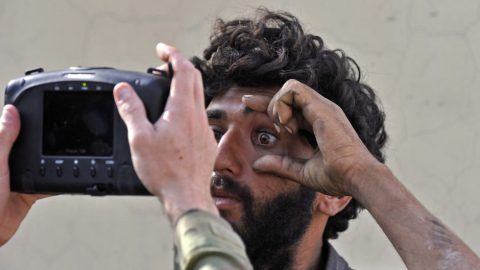
US soldier scans an Afghan resident with an Automated Biometric Identification System (ABIS) during a mission © AFP / TAUSEEF MUSTAFA
By Kit Klarenberg | RT | August 28, 2021
A huge amount of opprobrium was heaped on the Americans for allowing this sensitive data to fall ‘into the wrong hands’. However, surely a better question is why had they gathered all this deeply personal data in the first place?
It’s been reported that the Taliban has seized US military biometric devices in the wake of Washington’s flight from Afghanistan, which could put civilians who assisted coalition forces at significant risk.
The devices, known as HIIDE, for Handheld Interagency Identity Detection Equipment, contain identifying biometric data such as iris scans and fingerprints, as well as biographical information – while their primary stated purpose is to track insurgents, biometric data was also collected and stored on Afghans who assisted the US occupation forces.
The story sparked outcry, widely invoked by both opponents and advocates of the 20-year war as yet another deplorable example of Washington leaving its allies high and dry. While it seems clear there was no consideration given to what could happen if the technology fell into the ‘wrong’ hands, critics have nonetheless overwhelmingly failed to consider the terrifying ramifications of this data being in the right hands, and how the US came into possession of it in the first place.
When precisely the practice of collecting Afghans’ biometric data began isn’t certain, although at a 2010 conference in Kabul, US military officials laid out the terms of Afghan 1,000, a program which sought to collate information on 80% of the country’s population, around 25 million people. It was framed in extremely positive terms, not merely as a means to identify terrorists and criminals, but “enable progress in society” due to its “countless applications for the provision of services” to citizens.
It’s uncertain if that target was reached before Washington’s withdrawal, but the strategy remained in operation for over a decade. The next year, it was reported that Washington ultimately sought to gather biometric data on all living Afghans.
To achieve the lofty goal, a policy of mandatory data collection was imposed for every traveler entering the country via any means, and a dedicated Population Registration Department was created, with offices throughout the country. Even foreign journalists covering the war were fingerprinted, and their irises scanned. Moreover, occupation forces conducted innumerable “enrolment missions”, entering towns and villages and forcing locals to hand over their biometric data at literal gunpoint.
A US Army guide states emphatically that “all combat outposts and checkpoints throughout Afghanistan make it a priority to collect biometric data from as many local nationals as possible.” In the aftermath of a bombing or skirmish, soldiers are told to “enroll everyone”, including the dead, their DNA to be collected using buccal swabs to capture cells lining the mouth. The “payoff” for coalition forces was said to be so great, “commanders must be creative and persistent in their efforts to enroll as many Afghans as possible.”
In a section disturbingly titled “Population Management”, the guide recommends that everyone who lives within an operational area “should be identified and fully biometrically enrolled with facial photos, iris scans, and all ten fingerprints (if present).” Soldiers must also record “good contextual data” about individuals, such as “where they live, what they do, and to which tribe or clan they belong.” Citizens were to be told the collection protected them from potentially violent elements and troublemakers.
A lengthy article in the January 2014 edition of Military journal Joint Forces Quarterly offers a glowing appraisal of the “biometric-enabled intelligence” system rolled out in Kabul, declaring it to be a “key enabling factor” in US counterinsurgency efforts, and “an invaluable part of the campaign that has even greater potential in the future.” It documents how enrolment was often carried out using colorful trucks with jingling bells, in the manner of an ice cream van, in order to make the process “more culturally appealing” – particularly in respect of children, presumably.
Also included are several alleged “success stories”, such as one instance in which two Afghan police officers, neither of whom could read or write, spotted an individual on a “biometrically developed insurgent watch list” approaching their checkpoint.
One of the officers is said to have taken the man – identified as having been involved in “multiple IED events” – into custody “with a broad smile,” and the anecdote ends on an upbeat note, hailing how the officers’ illiteracy was no barrier to them removing a dangerous insurgent from the battlefield due to the miracle of biometric intelligence. Cheery stuff, although journalist Annie Jacobsen has exposed in chilling detail just how fallible biometric evidence can be.
In July 2012, US Army First Lieutenant Clint Lorance ordered his platoon to shoot three unarmed motorcycle riders in Kandahar province. The next year, a court martial found him guilty of two counts of second-degree murder, attempted murder, wrongfully communicating a threat, reckless endangerment, soliciting a false statement, and obstructing justice, sentencing him to 20 years in prison. However, in November 2019, he received a pardon from Donald Trump.
The then-president released Lorance after he was shown fingerprints and DNA data that purportedly indicated the Afghan men killed were Taliban bomb makers, not civilians. However, after some determined digging, Jacobsen found that one set of fingerprints allegedly found on an exploded IED said to prove one of the dead men was a bomber actually belonged to a police officer, who was likely to have contaminated the evidence in the line of duty. The other set did indeed belong to a bomber – who was still alive.
Lorance isn’t an isolated example either. Staff Sergeant Robert Bales is serving life for killing 16 Afghan villagers in cold blood in March 2012. While he pleaded guilty to the charges and admitted his tours of Afghanistan and Iraq had instilled a loathing of the local population within him, he’s now appealing his sentence. The case rests on data provided by a biometrics expert who also worked on the Lorance case, which he claims proves witnesses to Bales’ crimes were Taliban bomb makers who left their fingerprints on bomb components.
Evidently though, Afghanistan was just an experiment – and Washington was enamored with the results. The White House’s proposed Army budget for 2022 seeks over $11 million to purchase 95 new biometric collection devices, meaning the policy will almost inevitably be rolled out again in whichever country is next in the US crosshairs.
Where that will be is unknown, but there’s also the question of what implications the Afghan test run has for the Western world. Governments, police forces, security services and even big business are increasingly using cutting-edge technology to amass, store and analyze vast reams of sensitive personal data – much of it was similarly trialed during the War on Terror, and sold to home audiences on the basis of convenience and security, just as the military’s biometric data harvest was sold to Afghans. Now the troops are finally home, has the fight been brought back with them?
Kit Klarenberg is an investigative journalist exploring the role of intelligence services in shaping politics and perceptions.
THE U.S. HAS SPENT $2.313 TRILLION ON WAR IN AFGHANISTAN SINCE 2001
Watson Institute | August 2021
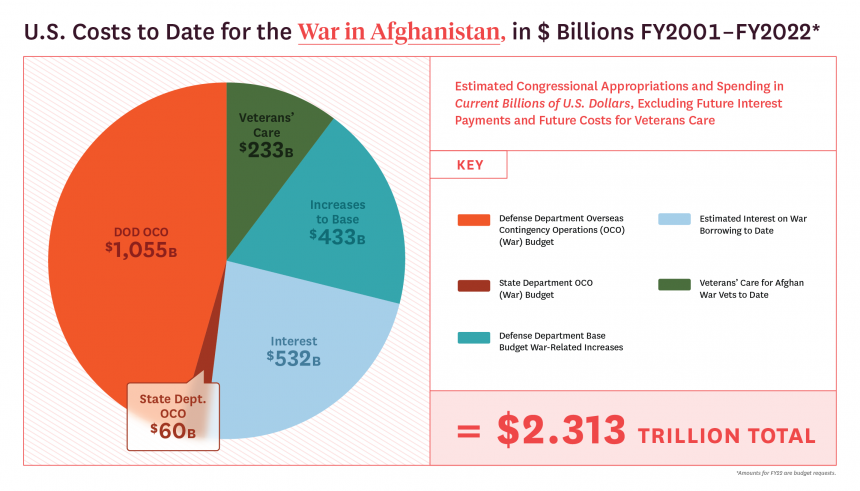
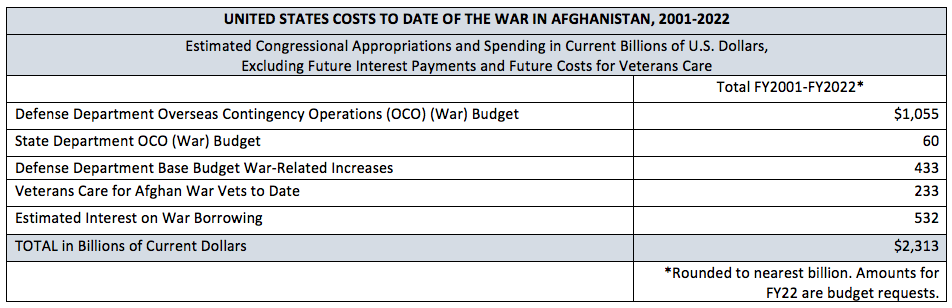
Since invading Afghanistan in 2001, the United States has spent $2.313 trillion on the war, which includes operations in both Afghanistan and Pakistan. Note that this total does not include funds that the United States government is obligated to spend on lifetime care for American veterans of this war, nor does it include future interest payments on money borrowed to fund the war. This $2.313 trillion spent on Afghanistan is a portion of the total estimated cost of the post-9/11 wars.
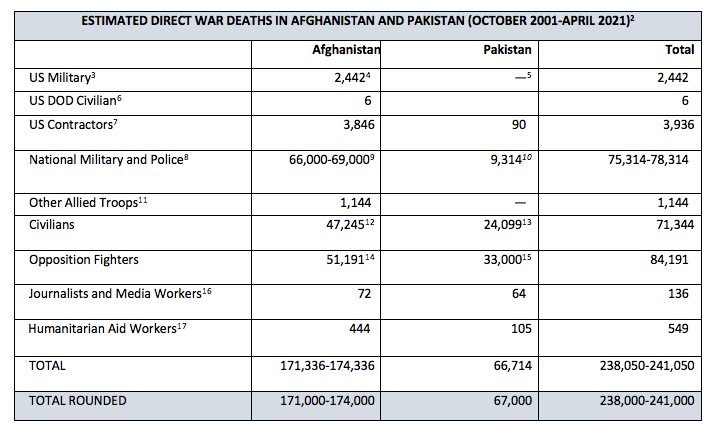
The Costs of War Project also estimates that 241,000 people have died as a direct result of this war. These figures do not include deaths caused by disease, loss of access to food, water, infrastructure, and/or other indirect consequences of the war.
The figures for Afghanistan are part of the larger costs of the U.S. post-9/11 wars, which extend to Iraq, Syria, Yemen, Somalia and elsewhere. The numbers are approximations based on the reporting of several data sources.
Dorothy versus Hassan

By Taxi | Plato’s Guns | August 27, 2021
The US ambassador to Lebanon, Dorothy Shea, thinks she’s smarter than Hassan Nasrallah.
Yet, evidence shows that since Trump appointed her as ambassador to Lebanon back in February 2020, every dastardly trap she has placed before Mr. Nasrallah and his Hezbollah resistance group has failed.
Proof of this failure is that Hezbollah keeps growing stronger and stronger, untouched by all external or internal forces hellbent on destroying the Lebanese resistance group. Failed simply because Dorothy is not as smart as she thinks she is. Most certainly, she is not as intelligent as the nifty leader of Hezbollah.
Having spent some three years working as Deputy Principal Officer at the US Consulate General in Jerusalem immediately prior to her post in Beirut, Dorothy no doubt continues to have a direct hotline to the Israeli Prime Minister’s office, if not to his direct cell phone; and no doubt, every morning, her first official word from Beirut is ‘shalom’.
Dorothy does not behave like a diplomat. Instead, she behaves like an eye-patched leader of a sketchy militia: laying aside all diplomatic decorum and behaviorism and charging forth into every single aspect of Lebanese social, economic and political life, with the blatant intent of widening existing societal fissures in Lebanon, as well as adding new ones: aiming for a sectarian war that would cause the wholesale mass murder of innocents. One could say that she behaves as the Jews do in DC. A Puss in Boots, but utterly charmless and physically unattractive. Puss in Boots with mouth bigger than boots. So much so that last year, a Lebanese judge banned Lebanese media from interviewing Dorothy for her atrocious and blatant attempts at creating sectarian warfare in Lebanon. Needless to say, Dorothy the ‘ambassador’ gave the proverbial middle finger to this native judge while hiding behind the skirts of her diplomatic immunity. She continues to pollute Lebanese media and its political landscape with daily feces propelled out of all her orifices. Yes, she literally defecates on Lebanon every day, while feigning love and affection for the Lebanese people. Because the Lebanese resistance group, Hezbollah, defeated Israel twice already on the battlefield, Dorothy’s instruction since taking the ambassadorship has been to starve the Lebanese population as punishment for these victories. Tel Aviv must love her for her Zionist activism and zeal. The Mossad must be sending her monthly boxes of Cuban cigars.
And I’ll remind American taxpayers here that their hard-earned taxes are being spent on starving populations in the middle east, when bombing them to smithereens is not feasible. Starving millions of people who have done absolutely no harm to the American people. I’ll remind taxpayers that they are paying Dorothy’s wages while she is spreading anti-Americanism with her bolshie, toxic behaviorism overseas. I’ll remind them that since 2005, no less than $30 billion have been spent on destroying the Lebanon as a means of demoting Hezbollah – all for the benefit of Israel and Israel alone. And although Lebanon’s society is currently teetering on total collapse due to Dorothy’s malicious and malignant schemes, yet Hezbollah itself appears untouched by this exuberant, negative expenditure. And I will add here that Lebanon has suffered from corrupt governments for some thirty years, yet all this while, the Lebanese collective enjoyed a decent lifestyle and were never in need. They became needy when Dorothy came to town.
Perhaps when she lived in Israel, Dorothy got everything she wanted. But in Lebanon, what Dorothy wants, Dorothy doesn’t get. Hassan has insured this. Time and time again, he has outsmarted all her plans to create civil war in Lebanon. All straight and curve-balls that Dorothy has daily thrown at Hassan have missed and landed either way off mark, or, unfortunately, on innocent, civilian bystanders.
Let us be clear here that the traditional role of an ambassador is to work the trade and Intel files, as well as to assist expats in a variety of bureaucratic and legal matters. It is never the job of a diplomat to act politically or to make inciteful, political statements concerning the host nation. Never! It is abnormal behavior for a diplomat to be an in-your-face politico whose name and incendiary words are headlines in local media on a daily basis. Yet, Dorothy Shea swans about the Lebanon like a privileged colonialist: doing exactly that and doing it with shameless gusto.
She is proud that she has turbo-charged the destruction of Lebanon. But she is very angry that the Hezbollah remains untouched. Livid that Hassan remains leagues ahead of her diabolical plans. How dare Hassan challenge her, the mighty Queen Sheba herself?! She Who Must Be Obeyed, must be obeyed or else!
Yet, she is not obeyed by Hassan. Currently, the genocidal-minded Dorothy is reeling from the latest punch in the teeth that Hassan metaphorically gave her last week, when he defied US sanctions on Lebanon and announced that Iranian fuel ships are now headed to fuel-starved Lebanon: a miserable and existential shortage that Dorothy herself had engineered for the Lebanese people through her incessant, corrupt interference in absolutely all internal Lebanese affairs bar none. (She has even interfered in local, district elections, personally rejecting and approving candidates!). Her destructive meddling is compounded by the Caesar Act sanctions that her chowderhead boss, Trump, had imposed on the Lebanon at the behest of Tel Aviv. Because Israelis dare not kill Lebanese people with their missiles for fear of an equal Hezbollah retaliation, starving the Lebanese people en mass was to be their path to mass murder of said Lebanese; and thus Dorothy has been assigned the task of insuring that all trade and energy doors were closed to the Lebanese, and all paths to a much-needed new government blocked and blocked some more, ad infinitum. Dorothy has forbidden the Lebanon from trading with any country in the world, and simultaneously forbidden friendly nations from delivering any aid to Lebanon’s starving population. She has appeared more than happy this past year and a half to just watch the very fabric of Lebanon disintegrate under her ‘ambassadorship’ – doing absolutely nothing to help the long-suffering, collective Lebanese people whatsoever. Au contraire, the more Lebanon’s system broke down, the more the people suffered, and the more Dorothy jumped with joy and stirred the sectarian embers further.
It appears that not only are Hezbollah and the Lebanese population as a whole a target for destruction by Dorothy, but so is the Lebanese government itself. She does not even want a government for the Lebanon to exist. She wants for Lebanon what Israel wants: wiping Lebanon and its flag right off the map and turning it into many-flagged, sectarian enclaves and warring Bantustans instead. Simply, everyone and everything Lebanese is her target for destruction.
Of course, Dorothy gets much help from powerful Lebanese persons and political entities who are opposed to Hezbollah. Fortunately for the Lebanon, these people do not represent the majority of the Lebanese. Known Lebanese members of Dorothy’s team are handsomely paid in mega dollars to destroy their own country, just so that they can boost their Swiss bank accounts and augment their seats of power by getting rid of the most popular party in the Lebanon: the Hezbollah. These unsavory, treasonous Lebanese are ideologically aligned with fascism and predatory globalism, and they are also known for being supporters of the Israeli enemy and its religio-colonialist project in the Levant. Their names and professional titles are known all over the Lebanon, and they are as follows:
- Riyad Salame is a Maronite Christian who heads the Lebanese Central Bank (Banque Du Liban). He is the very man who colluded with Dorothy to collapse the local Lebanese currency in order to initiate the ‘starvation plan’ of his own people. He is also behind the financial pyramid scheme that suddenly, and by his design, collapsed a year ago. He is also behind the ‘Capital Control’ system that has been imposed on all bank account holders since the collapse of the Lebanese Lira. This system limits monthly withdrawals of all account holders, be they rich or poor, to a pitiful $400 per month: thus consigning both rich and poor to the same poverty pot. This system is currently holding hostage all of the people’s earnings and life-savings. Salame continues to shamelessly collude with the haters of Lebanon, while hiding some twenty billion dollars that suddenly went missing out of the country a year and a half ago. He claims no knowledge of where this vast amount went. He has not been held accountable by Lebanese law, nor has he lost his highest banking office in the nation, all because he has Dorothy’s full political protection.
- Samir Gaegae, is a Maronite Christian who is a convicted war criminal who colluded with Israel during its 18 years of occupation of Lebanon back in the ’80’s and 90’s, causing thus the torture, the disappearance, and the mass murder of tens of thousands of Lebanese civilians. And Ironically, it was Hezbollah’s hands, after the eviction of Israeli forces from Lebanon, who worked for his clemency, thus sparing him an execution. The ingrate Gaegae is now also best friends with both Saudi Arabia and Israel: tasked by them too to destroy Hezbollah, even at the cost of destroying Lebanon itself.
- Patriarch Bechara Boutros al-Rah, who holds the highest seat in the Lebanese Maronite church, is also known for regularly inciting sectarianism during his speeches and sermons. He became infamous for breaking a Lebanese law that forbids the cooperation or promotion of the Israeli enemy when he illegally visited Israel several years ago with the excuse of “I want to pray in Jerusalem.” No doubt he dined at Jewish Masonic Lodges there too. He adamantly refuses to separate ‘church from state’. He is a regular visitor to the US embassy in Beirut and all his political statements read like memos issued by Tel Aviv. He supports normalization with Israel that continues to occupy the Lebanese Shebaa Farms. For a religious Christian leader, he appears to devote his time to spreading the message of the Synagogue of Satan instead of the message of Jesus.
- NGO’s. The Lebanese population is some 4.6 million natives currently residing in Lebanon, yet Lebanon has over an astounding 10.000 NGO groups, with 92% of them being funded by foreign governments and other dubious Western and oil-Arab institutions. These shady NGOs are tasked with ‘inflaming’ the masses and creating a Color Revolution in the Lebanon. They have proved that they can successfully gather the protesting masses with matching banners and baseball hats, but they have failed to achieve their anarchic objective after several attempts. They are well-paid agents of chaos who swarm the Lebanon like biblical locust: receiving all their instruction from Dorothy’s office at the American embassy in Beirut; and eating all that great, green leaf we call ‘dollars’ right off Dorothy’s hand.
One can clearly discern that the American embassy in Beirut is more of a war theater against the Lebanese themselves, than it is a peaceful salon of diplomacy and trade activity.
Dorothy also enjoys the occasional support from other powerful Lebanese who may not share her ideology, but assist her when called upon because they are beholden to the US via their investment projects in the US, and also via their children and grandchildren who reside and study in the US. Yes, just like mafias threaten people with harm done to their businesses and families, so does Dorothy threaten her second tier of helpers, thus they always oblige. Saad Hariri (a Sunni leader), Walid Jumblatt (a Druze leader), and Nabih Berri (a Shia leader) are examples of second-tier helpers of the US embassy in Beirut.
Here I would add that although Dorothy’s Lebanese inner circle leaders are all Christian Maronites, between them, they actually represent the minority of Maronites in Lebanon. The majority of Maronites belong to the Maronite President Aoun’s party, who are allies and supporters of Hezbollah. And it appears that the Maronites who are anti Hezbollah are fundamentally Islamophobic, all due to an aftertaste that the brutal, Sunni Ottoman Empire left in their mouths back in 1922, when the Ottoman Empire collapsed and its soldiers finally exited Lebanon after some 500 years of miserable colonization.
Aside from creating the total collapse of the Lebanon, financially, socially and politically, it is germane here to give a summary of what the enemies of Hezbollah and Lebanon itself hoped to achieve with their treachery and sedition:
1- IMF enslavement of Lebanon’s financial life.
2- Disarming Hezbollah and the dismantlement of the Lebanese army, to be replaced with UN or NATO troops that answer to Tel Aviv and DC.
3- Destroying the current governmental system and the insertion of a new, federalized political theater where only enemies of the Hezbollah are in positions of power.
4- Naturalization into Lebanese citizenship of captive Sunni-Syrian refugees who are forbidden by the West to return to Syria, thus changing the voting demographic of Lebanon to favor Saudi-sponsored blocks (means Israeli-centric). This plan even has the temerity to favor Syrian naturalization over Palestinian one, even though Palestinian refugees have been stuck in Lebanon since 1948.
5- Allow Israel to annex gas field ‘Block 9’ that sits in the southern Lebanese maritime waters and is considered to be the richest field in the Lebanon waters.
6- Allow Israel to annex the Lebanese Litani River that’s some 23.6 miles from the Israeli border.
7- Through educational and cultural projects, unleashing insidious social-engineering programs such as ‘woke’, opioid and porn addiction, religious irreverence, cultural Marxism, and what I like to call the ‘gender bandito’ culture. In other words, social-engineering programs that shred the very fabric of traditional Lebanese life and culture. And sanity.
8- The looting and destruction of Lebanon’s museums and ancient artifacts so as to wipe out the ancient identity of the Lebanon.
9- Bantustaning and turning rural landscapes into militarized zones, and turning cities and towns into police states overseen by Israel-friendly UN or NATO forces.
10- Normalization with Israel through forced trade with Tel Aviv – the only entity Lebanon would be allowed to trade with.
And last but not least:
11- Empty Lebanon of its Christian population who are mainly concentrated in the Mount Lebanon area, but also scattered wide in villages and towns all over the Lebanon.
This is a project that analysts say has been handed to the current Lebanese Maronite Patriarch, Bechara Boutros al-Rahi. His consistent sectarian incitement is intended to promote a religious civil war that will find the majority of Lebanese Christians fleeing the Lebanon as political refugees to mainly Canada and France, where they already have immigration programs that are specifically preferential and lucrative to Lebanese Christian applicants. Yes, France and Canada are partners with the US in the destruction of Lebanon. In fact, all other Western nations and some Arab ones too are also conspirators and abettors in this diabolical, mass-murderous plan.
The Patriarch’s other vital mission is to turn Maronite Aounist voters against President Aoun’s party – driving them to the arms of Saudi-sponsored Samir Gaegae, who is a Maronite himself too and an infamous friend of Israel – not forgetting here his close friendship with Dorothy the Destroyer.
Because Lebanon is the only Christian-Arab country, and Christian Lebanese are fundamental to Lebanese history, heritage and identity, removing them from the Lebanon facilitates the Jewish plan of turning Lebanon into a zombie without a national, rooted identity, all in preparation for future Judeofication of the Lebanon, as per the Yinon Plan.
Of course, Dorothy here is a mere soldier for Tel Aviv. But still, all responsibility of Lebanon’s current destruction lays at her feet for her absolute devotion and willingness to participate and manage this grand and evil project for the Lebanon. She is responsible for the current starvation and the misery of millions of Lebanese, Christian and Muslim alike, because she is the most powerful mover and shaker in the Lebanon: moving and shaking it towards its mass grave.
Even though this ‘starvation plan’ has been well conceived and executed with the help of internal traitors, yet Hezbollah and its Lebanese allies continue to stand like firm walls in its path. Hassan and his patriotism continue to outsmart Dorothy. In fact, so much so that now Hezbollah has unexpectedly taken up the new mantle of ‘economic resistance’, as opposed to only a military one. Only two weeks go, Dorothy’s breathless destruction literally forced the Hezbollah to actively enter the economic war against the Lebanon, after a year and a half of passivity. They are economically-resisting now by defying the Caesar’s Act and all other members of Dorothy’s inner circle. This defiance comes in the shape of organizing Iranian fuel ships to arrive to Lebanon as aid for the utterly desperate people of the Lebanon.
The first Iranian fuel ship is due to imminently arrive to Lebanese shores. Many more Iranian ships are slated thereafter, carrying much needed life-saving medicine and food to the needy Lebanese.
Hassan has botched all nefarious plans and checkmated Dorothy with this move. He has promised that any harm done to these Iranian aid ships will result in instant, open warfare against Israel. The man always means what he says. And he always delivers on his word. The Israelis know this only too well. They will be red-faced and watching through their north-pointing binoculars, a long stream of Iranian ships docking a mere hop away from Haifa port. This was never part of their plan. Their plan was to starve the Lebanon en mass so as to bring it to its knees and take from it what they want; as well as to get rid of Iran-friendly Hezbollah. Instead, they’re ending up with a stronger Hezbollah bringing in Iranian aid ships that will feed the Lebanese people and provide them with desperately needed medicine and fuel. Iranian ships that will be seen by most Lebanese as ‘savior ships’, while Hezbollah will be crowned as ‘savior of Lebanon’ for resisting and breaking the illegal, US economic siege on the Lebanon.
Begs the question here, therefore: will the Mossad continue to send Dorothy her boxes of Cuban cigars?
Featured Video

10K More U.S. Troops Deploy as Trump Weighs New Iran Strikes
or go to
Aletho News Archives – Video-Images
From the Archives
Genetic baloney in thick slices
MAYBE COULD BE INC.
By Jon Rappoport | No More Fake News | July 8, 2021
Gene research companies tend to come and go. They start out banging and popping like fireworks in the sky, and then they fade out—selling themselves to larger outfits who’ve hired better liars…
Once upon a time, it sounded easy. Start with a disease, find the gene responsible for the disease, and correct the problem.
Then, researchers wondered, was disease the result of one gene or a group of genes acting together?
Either way, the proof would be in devising cures for diseases using gene therapy. “Not yet, but soon…”
And regardless, the major need was: money. Lots and lots of money.
This need required good PR people. “We have to pump up the idea that we’re on the edge of tremendous breakthroughs. We’re always on that edge…”
This hype also needed to obscure the fact that there wasn’t (and isn’t) ANY gene cure for ANY disease. … continue
Blog Roll
 Aletho News
- UK Government Body Kept Files on People Criticizing Prevent Program
- US military withdrawal from Iraq and the collapse of US-Israeli hegemonic project in West Asia
- What does Europe want – a war with Russia?
- She Followed the Actual Data on COVID Vaccines and Masks — Her Career Took a Huge Hit
- Florida AG Sues Pfizer, Bourla Over Deceptive Marketing of COVID Vaccines
- Von der Leyen gifts her spin doctor a job for life
- 10K More U.S. Troops Deploy as Trump Weighs New Iran Strikes /Suliaman Ahmed
- Iranian crew declared Dena training vessel ‘unarmed’ to US warship before deadly torpedo strike: Report
- Iran’s NPT debate moves beyond parliament
- Houthis condemn Saudi claims of attack on Medina
- If Americans Knew
- Israel is squeezing the life out of Palestinians – Daily Update
- The Israeli Right Portrays Islam as Murderous. It Serves a Political Purpose
- Jordan Has Had Enough: King Abdullah’s Scathing Warning to Israel
- Israeli Colonizers (i.e. Settlers) Kill Palestinian Man Near Salfit
- New Google Maps images reveal massive scale of devastation in Gaza
- Jewish supremacy, anti-Palestinian bigotry on display in Israel – Daily Update
- Israeli Soldiers Abduct At Least 22 Across Occupied West Bank
- Eight Palestinians Killed in Israeli Attacks on Gaza
- Israeli former leaders and security chiefs threaten legal action over ‘Jewish terrorism’
- Israel map in LA Times ad includes all land from the river to the sea
- No Tricks Zone
- Green Energy Debacle: German Expert Professor Fritz Vahrenholt Warns Of Severe Economic And Social Consequences
- Two More Paleo Reconstructions Affirm Meters-Higher Sea Levels Across Ireland, Brazil 7000-6000 Years Ago
- New Study: Earth And Venus Surface Warmth Largely Explained By Convection And Lapse Rate, Not CO2 Or Radiation
- 2025 Nature Paper Claiming Worsening Global Drought Gets RETRACTED …Heavily Flawed
- New Study: ‘Global Drought Shows No Detectable Recent Acceleration Under Climate Warming’
- Economic Masterminds: German Socialists Suggest Taxing Productivity Gains Stemming From Using AI
- The South China Sea Has Not Been Cooperating With The Climate Change Narrative
- Energy Crisis: Germany Enters Heating Season With Historically Low Gas Reserve Fill Levels
- New Study: The Antarctic Ice Sheet Gained Mass From 2020-2024 Due To Staggering Snow And Ice Accumulation
- Study: Ocean Heating Rates From Thousands Of Years Ago ‘Dwarf’ Modern Ocean Heating Rates

