The International Physicians for the Prevention of Nuclear War’s co-presidents have sent the following letter to the Prime Minister of Japan, Shinzō Abe, urging him to halt plans for nuclear fuel reprocessing, calling the program “unnecessary and hazardous” and “not consistent with Japan’s stated support for achieving a world freed from nuclear weapons.”
September 23, 2013
Your Excellency,
We write on behalf of physicians in 62 countries to express our concern at Japan’s intention to start commercial operation of the Rokkasho spent nuclear fuel reprocessing plant next year, and to urge your government not to proceed with the operation of the Rokkasho plant.
The goal of our federation is to safeguard global health from the threat of nuclear annihilation, which the World Health Organization has identified as “the greatest immediate threat to human health and welfare”. In 1985 IPPNW was awarded the Nobel Peace Prize for performing “a considerable service to mankind by spreading authoritative information and by creating an awareness of the catastrophic consequences of atomic warfare.”
Nuclear weapons could not exist without fissile materials – highly enriched uranium and plutonium. If humanity is to enjoy a healthy and sustainable future, we must achieve a world freed from nuclear weapons, before they are ever again used. We are in a race against time to ensure this. Achieving a world free of the extreme humanitarian threat posed by nuclear weapons will require not only disarmament, but also minimising and wherever possible eliminating further production of fissile materials, and wherever possible eliminating existing stocks. Extreme levels of security are required for any remaining fissile material. This will be a massive task that cannot be undertaken too soon. The authoritative International Panel on Fissile Materials estimated global stockpiles in January 2013 to be 1390 tons of highly enriched uranium, with 31 countries possessing at least 1 kg; and 490 tons of separated plutonium. Each US nuclear weapon is known to contain on average just 4 kg of plutonium.
Japan already possesses 44 tons of plutonium – enough for more than 5000 nuclear bombs, even allowing a high quantity of 8 kg of plutonium per weapon. Japan is the only country without nuclear weapons to be separating plutonium from spent reactor fuel. Further accumulation of nuclear weapons-usable material is a concern for the international community, particularly for Japan’s North-east Asian neighbours. These concerns are accentuated by the lack of forseeable uses for this large and growing quantity of plutonium. Some Japanese politicians over the years have indeed drawn attention to the potential nuclear weapons arsenal that could be produced from such a plutonium stockpile within just a few months. Whatever the Japanese government’s current stated intention, which we have no reason to doubt, political intentions can change very quickly in comparison to the half-life of plutonium. Further, the mere existence of such a stockpile poses a risk of diversion and theft, and fuels fissile material production programs and the drivers for nuclear proliferation in other countries.
Japan’s policy of separating plutonium from spent reactor fuel represents a dangerous precedent for other states to push for similar programs. The inherent technical difficulties of adequately safeguarding nuclear reprocessing plants, and risk of diversion of separated plutonium adds to these risks.
This facility is especially concerning in the context of the North-east Asian region, where the proliferation of nuclear weapons is already a serious concern.
We understand that on 31 January 1997 the Japan Atomic Energy Commission promised that Japan would not hold surplus plutonium, and that this decision was endorsed by the national Cabinet on 4 February 1997. Further, on 5 August 2003, the Japan Atomic Energy Commission required electric power companies to publish plans for use of plutonium prior to separating plutonium from spent fuel. The commencement of commercial operation at the Rokkasho reprocessing plant would run counter to these decisions and thereby raise questions about Japan’s consistency and reliability.
As the people and government of Japan well know, any future use of nuclear weapons would have catastrophic humanitarian consequences. For this reason, IPPNW is working with other partners in the International Campaign to Abolish Nuclear Weapons for a global ban treaty to correct the anomaly that the worst of all indiscriminate weapons are the only ones not yet subject to explicit legal prohibition. As a State Party to the conventions on cluster munitions and anti-personnel landmines, we hope Japan would support efforts to ban nuclear weapons as well.
Given Japan’s already huge stockpile of nuclear weapons-usable material, the opening of the Rokkasho reprocessing plant appears both unnecessary and hazardous. Adding to an already large plutonium stockpile is not consistent with Japan’s stated support for achieving a world freed from nuclear weapons.
We encourage your government to reconsider its decision to start commercial operations at Rokkasho and to declare that such operations will not proceed. Such a decision would be widely welcomed around the world and would support rather than undermine global health.
In a recent article on Counterpunch, Rob Urie defended the traditional Marxist analysis of US policy in the Middle East. He argues that support for Israel is driven primarily by economic interest, not the Jewish lobby.
He starts by paying tribute to the idea that Western societies are uniquely racist. He says that the “Western narrative” claims there is an “Arab character”, and that this is “antique racist blather”. He gives no definition of these terms. Further, he establishes his credentials as part of the dominant current in the American left by claiming that “over a million people in Iraq died so ‘we’ in the West can drive SUVs.”1
When he tries to criticize bourgeois economics, he makes it clear he doesn’t understand the developments it has made since Marx’s day, using the mathematical discipline known as “game theory”. He dismisses the basic abstraction of economic theory, the idea of the rational individual, on the grounds that it is “devoid of history, culture and political context”. But abstractions are always devoid of something.
He defends a more concrete economic theory, mostly Marxist, with some input from another theorist of capitalist crisis, Hyman Minsky. This concrete theory leads him to the view that US activity in the Middle East is primarily driven by rational capitalist motives, the need to secure a supply of oil.
“Taking the totality of circumstance — former oil company executives launching war on an oil rich nation on a pretext they publicly proclaimed they didn’t believe shortly before taking office — and that upon launching their war proved to be non-existent, requires a willingness to overlook the obvious — that the war on Iraq was for oil, that is difficult to support.”1
Perhaps I’ve misunderstood him, but based on what he says in the rest of the article, this convoluted sentence seems to argue that, because president Bush and vice-president Cheney attacked Iraq on false premises, and they also said it was all about oil, and they are former oil executives, and Iraq has a lot of oil, it’s difficult to deny US attacks on Iraq are all about oil.
In fact, it’s not hard at all. As Urie points out, at times Bush and co. said that attacking Iraq was “protecting the world’s supply of oil.”1 But, as he also points out, they are congenital liars. Why should we believe them when they say they are trying to “protect” the oil supply? Protect it against what? When politicians “admit” attacks on Middle Eastern countries are wars for oil, they are parroting the neo-con party line, feeding the public, both left and right, with a plausible-sounding pretext. For right-wingers, “it’s a war for oil” is a reason to support war, and for leftists, it’s a way to feel better by complaining impotently about corporate greed. Both approaches help the war drive.
Fortunately, the American public isn’t listening to the “war for oil” canard. Americans of all classes are listening to those who argue, on coherent capitalist grounds, against war in the Middle East. That helped avoid war on Syria.
The predictions of Urie’s theory failed even as he was writing them: “Finally, for those who have moved on from the U.S. war on Syria story, the war is proceeding largely as planned.”
“War for oil” is a lie, and more sophisticated slogans such as “geo-political rationales”1 are too vague to explain anything. If, as a result of an American military adventure in the Middle East, the price of oil goes up, the Marxist left says it was a war for oil because the oil companies benefit. If it goes down, they say it was a war for oil because most of the other companies benefit. Their hypothesis is unfalsifiable.
But their argument that Israel defends America’s interest in the world’s most oil-rich region is easily falsified. Israelis do not fight in America’s wars. It it were in US interests to support Israel, it would not need a multi-million dollar lobby working day and night to undermine any squeak of defiance, corrupting and intimidating politicians from the president down.2 Real friends don’t need lobbies.
Urie rejects the view that the Jewish lobby can explain US support for Israel, on the grounds that, since Israel has a much smaller economy than the USA, it cannot influence the USA to act against its own interests in the Middle East. But that’s not how it works. It’s not that the Lobby has more money than Microsoft. Through its influence on the US government, AIPAC is able to appropriate some of Microsoft’s profits, and use them for a purpose contrary to the interests of most of Microsoft’s shareholders, and almost all Americans, rich and poor. The question is how it does that.
The quaint ideas of Marx and Urie do not explain the curious phenomenon of US support for the Jewish state. The facts are more compatible with the views of Mearsheimer and Walt.2 The long history of US politicians’ groveling to Israel is more economically explained as a real example of Jewish power rather than a facade designed to make us believe it’s an example of Jewish power.
Capitalism is the world’s current economic system. Oil companies like to make a profit. The Pentagon wants to ensure its oil supply and deny it to putative enemies if necessary. There is a lot of oil in the Middle East.
None of these banal observations even begin to explain US policy in the Middle East.
As I wrote three years ago, in a response to Noam Chomsky,
“By means of the Lobby, the tail wags the dog. Its the simplest, clearest, and most economical explanation of the facts.”3
But my explanation still requires an explanation. If ethnic interests, such as the Israel lobby, [Is the “Israel lobby” an “ethnic interest? — DV ed.] can trump class interests, such as the need for stability, and one’s theory says it cannot, something has to give. The power of Israel in the USA and all the other Western countries falsifies the predictions of Marxism so comprehensively, one must conclude that Marxism, at least when it comes to analyzing US Middle East policy, is part of the problem. A radically different approach is needed.
Iranian officials say they have completed decoding the surveillance data and software extracted from the Central Intelligence Agency (CIA) drone that the United States lost possession of nearly two years ago near the city of Kashmar.
Hossein Salami, the lieutenant commander general of Iran’s Army of the Guardians of the Islamic Revolution, told the country’s Fars news agency that analysts have finally cracked the systems used within the RQ-170 Sentinel drone obtained in December 2011.
Iranians claimed previously that they brought the drone down after it entered Iranian airspace without permission. Roughly one week later, CIA officials admitted the drone was conducting a reconnaissance mission over Afghanistan when it went missing.
When the US asked Iran to return the unmanned aerial vehicle, Salami told Fars news agency, “No nation welcomes other countries’ spy drones in its territory, and no one sends back the spying equipment and its information back to the country of origin.”
Nearly two years later, Salami is now celebrating Iran’s latest accomplishment with regards to the UAV.
“All the memories and computer systems of this plane have been decoded and some good news will be announced in the near future not just about the RQ-170 and the optimizations that our forces have done on the reverse engineered model of this drone, but also in area of other important defense achievements,” Fars quoted him.
When the Iranian military gained control over the drone, the unmanned aerial vehicle’s (UAV) erase sequence allegedly failed to delete sensitive data from it. Since then, Iranian experts have been decoding the captured data, occasionally reporting their progress.
Although the CIA has not admitted the extent of the drone’s capabilities, experts have said previously that reverse engineering the Sentinel could be a significant event for any nation-state looking to learn more about the technologies utilized by American spy planes.
“It carries a variety of systems that wouldn’t be much of a benefit to Iran, but to its allies such as China and Russia, it’s a potential gold mine,” robotics author Peter Singer told the Los Angeles Times in 2011.
“It’s bad — they’ll have everything” an unnamed US official added to the Times then. “And the Chinese or the Russians will have it too.”
Meanwhile, a report in the New York Times this weekend suggested that Chinese researchers have been busy on their own attempting to emulate American drones. Edward Wong wrote in the Times on Friday that Chinese hackers working for the state-linked Comment Crew cybergroup have targeted no fewer than 20 foreign defense contractors during the last two years in hopes of pilfering secrets that would be useful in programming their own UAVs.
“I believe this is the largest campaign we’ve seen that has been focused on drone technology,” Darien Kindlund, manager of threat intelligence at California-based FireEye, told Wong. “It seems to align pretty well with the focus of the Chinese government to build up their own drone technology capabilities.”
Vice’s Motherboard website reported this week that at least 123 cyberattacks waged at American drone companies have been spotted by security researchers since 2011, and quoted Kindlund as saying the attacks have been “largely successful.”
Bolivia’s General Prosecutor Ramiro Guerrero has requested the extradition of former president Gonzalo Sánchez de Lozada from the US, so he can be brought to justice for crimes against humanity in his country.
Guerrero is also calling for the extradition of two former ministers, Carlos Sánchez Berzaín and Jorge Berindoague. They have been in the US since October 2003.
All three men are being charged with genocide, homicide, humiliation and torture, inflicting injuries of varying degrees, deprivation of freedom, and forcefully raiding homes.
Guerrero presented the case for the ex-president’s extradition for the second time on Friday. The first time, in 2012, his case was rejected. However this time he expects that the 1,900-page document will convince US authorities of granting extradition based on the gravity of the charges against the defendants.
The document will be analysed by the Supreme Court of Bolivia in Sucre. The Court’s members will be tasked with deciding whether the extradition is viable or not.
The request for extradition comes almost ten years after ‘Black October’, as the revolt that caused the resignation and escape of Sánchez de Lozada is known. The ‘Black October’ protests took place in 2003, sparked by the people’s opposition to exporting Bolivian gas to Mexico and the US at very low prices through a Chilean port. The state’s repression left 65 people dead and hundreds injured. As a result, Sánchez de Lozada was forced to resign and fled to the US.
For nearly two decades, Ottawa officials have told telecommunications companies that one of the conditions of obtaining a licence to use wireless spectrum is to provide government with the capability to monitor the devices that use the spectrum. The Sept. 17 kickoff of the auction-countdown process will underscore that commitment, made out of sight of most Canadians because it is deemed too sensitive by the government.
The secret agreement apparently contains specific details of what telecom companies must provide:
“Real-time, full-time” eavesdropping on conversations is just one of the capabilities sought by police, according to the standards. Authorities also want records of call logs, texts, keystrokes and other data, including “the most accurate geographical location known.”
Communications made with encryption provided by the carrier must be decrypted:
Carriers that help their customers scramble communications must decrypt them. “Law enforcement requires that any type of encryption algorithm that is initiated by the service provider must be provided to the law-enforcement agency unencrypted.”
No doubt, many people might think phone companies should provide this kind of information, provided a properly executed court warrant is presented. What’s problematic here is that this has been going secretly on for 20 years, with no public oversight and with no debate about where to draw the line for such surveillance. That discussion would hardly compromise police operations, but would provide vital transparency and legitimacy. The fact that two decades after the practice started the Canadian people are finally hearing about this capability now is probably yet another beneficial knock-on effect of Edward Snowden’s leaks.
Coca-Cola plans to run its very first ad defending aspartame and the safety of artificial sweeteners. This move comes as a result of a dramatic drop in diet cola sales within the past year. This is great news as it goes to show how much of an impact we can really make by raising awareness about the health effects of aspartame. More people around the world are making better choices and you can read more about that and the dangers associated with the Coke here.
I came across this video and thought it would be appropriate to share in light of Coca-Cola’s recent move to bring awareness to and “join together” in fighting obesity. This comes before their more recent ad campaign to defend artificial sweeteners like aspartame. It’s the brutally honest Coca-Cola commercial you’ll never see on television. This is a voiced over version of the original Coke commercial which you can see here.
Peter Beinart is a “liberal Zionist” who has written a piece in the New York Review of Books of 26 September 2013entitled “The American Jewish Cocoon.” In this essay he laments, “The organized Jewish community [is] a closed intellectual space.” By this he means that most American Zionist Jews (it is important to remember that not all Jews are Zionists) know little or nothing about those who oppose them, particularly Palestinians. They also seem to have no interest in changing this situation. For these Zionists the opposition has been reduced to an irredeemably anti-Semitic “them.”
Beinart goes on to tell us that such is the political clout of the organized Zionist community that this know-nothing attitude has come to characterize the “debate about Israel in Washington” and the opinions offered in the mass media as well. While Mr. Beinart does not say so, I can tell you that this has been the basic situation since the early 1920s. Beinart does note, however, that over time this situation has led Palestinians and those who support them to show less willingness to dialogue with Zionists, most of whom they consider irredeemably racist.
Beinart thinks this prevailing ignorance is a disaster. Why so? Because he feels that Jews betray the lessons of their own past by failing to understand the meaning of the “dispersion and dispossession” of the Palestinians. They do not seem to care that this particular people has had its “families torn apart in war – [continue] to struggle to maintain [their] culture, [their] dignity, [their] faith in God in the face of forces over which [they] have no control.” This sort of situation, according to Beinart, is something “the Jews should instinctively understand.”
Be this as it may, achieving such an understanding is, for Beinart, a means to an end. That end is realizing a two-state solution to the ongoing Israeli-Palestinian struggle. For this to happen the Zionists have to essentially feel the pain of the Palestinians and the Palestinians have to understand their no-win situation so that everyone agrees to a Palestinian mini-state on “22 percent of British mandatory Palestine” along with “compensation and resettlement [for the] people whose original villages and homes have long ceased to exist.”
Part II – The Two-State Illusion
An important question is whether Mr. Beinart’s two-state solution does not itself represent a goal whose practicality has “long ceased to exist”? That certainly is the opinion of Ian Lustick, a professor of political science at the University of Pennsylvania. In the Sunday Review section of the New York Times of 15 September 2013, he published an op-ed piece entitled “Two-State Illusion.”
According to ProfessorLustick, the two-state idea has become something of a fraud behind which lies opportunistic political motives. For instance, the Palestinian Authority (PA) keeps this hope alive so that it can “get the economic aid and diplomatic support that subsidizes the lifestyle of its leaders, the jobs of tens of thousands of soldiers, spies, police officers and civil servants.” The Israeli government keeps this hope alive because “it seems to reflect the sentiments of the Jewish Israeli majority and it shields the country from international opprobrium, even as it camouflages relentless efforts to expand Israel’s territory into the West Bank.” Finally, the U.S. government maintains the hope of a two-state solution to “show that it is working toward a diplomatic solution, to keep the pro-Israel lobby from turning against them and to disguise their humiliating inability to allow any daylight between Washington and the Israeli government.”
Lustick believes the two-state solution is an impossible hope that has produced periodic negotiations which have always been “phony” and have prevented new ideas for positive change from being seriously entertained. This long-term stifling has also set the stage for possible “sudden and jagged” events that can send the conflict off in catastrophic directions. Oddly enough Lustick finds this prospect of heightened conflict a necessary one.
He tells us that only when the “neat and palatable” two-state solution disappears – and with it the PA and its policies of collaboration – will we get the “mass mobilization, riots, brutality, terror, Jewish and Arab emigration and rising tides of international condemnation of Israel,” along with the subsequent withdrawal of unconditional U.S. support for the Zionist State. At that point
“Israeli leaders may then begin to see, as South Africa’s white leaders saw in the late 1980s, that their behavior is producing isolation, emigration and hopelessness.” Then, finally, they will become reasonable, and something new and acceptable (a one-state solution?) will be possible.
Lustick’s necessary scenario happens to be Peter Beinart’s nightmare and in the latter’s essay it is called “civil war.” Beinart’s call for greater mutual understanding is designed to prevent this violence. One can assume that, for Professor Lustick, things have gone too far for this understanding to suddenly prevail. “Peacemaking and democratic state building require blood and magic,” he tells us. Delaying the inevitable with false hopes will only make things worse.
By the way, Lustick is not alone in his view that the two-state formula is a dead end. One of Israel’s very best historians, Ilan Pappe, who now is the director of the University of Exeter’s European Centre for Palestinian Studies, believes that this prospect has been dead for over a decade. What killed it, and what keeps it dead, are “Zionist greed for territory and the ideological conviction that much more of Palestine [beyond the 1967 borders] is needed in order to have a viable Jewish State.” It is worth noting that it is just this ideological conviction that renders Peter Beinart’s plea for more understanding of the Palestinian position by American Zionist Jews a nonstarter. Any ideology that can justify incessant ethnic cleansing has to make its adherents incapable feeling their victims’ pain.
Part III – Conclusion
If Beinart’s hope for mutual understanding is naive, Lustick’s hope that more “blood” will lead to the “magic” of a positive outcome is not at all assured.
One might ask just how much disaster is necessary before the hard-line Zionists who have long controlled Israel will compromise their ideological commitment. Keep in mind that the Israeli political elites, right and left, have always been expansionist. Even Peter Beinart is not pushing for a return to the 1967 Green Line and an evacuation of illegal settlements, as far as I can tell. In the past, the Israeli elites have judged their terror and brutality to be justified. They will do so in the future as well. Some of them will interpret any increase in Jewish emigration (a process already ongoing) as a weeding out of weak elements. Militarily the Israelis can probably maintain superiority over their neighbors even in the face of reduced American aid, and as far as world opinion is concerned, most of them care little about it. If this assessment has any validity, the Israelis could go on ethnically cleansing for a very long time.
In my view, the only viable weapon against such vicious stubbornness is a worldwide comprehensive economic boycott on the South Africa model. However, even this may not be the last page in the drama. Such an economic boycott may prove strong enough to undermine the will of some Israeli ideologues, but not all of them. And then, unlike South Africa, you may need an intra-Israeli Jewish civil war to finally bring the curtain down on the tragedy of Zionism.
By Fayez Rasheed | Al Quds Al Arabi | September 18, 2013
The ill-fated Oslo Accords, signed 20 years ago, have only made Israel more arrogant and open about its disregard of the Palestinians’ national rights. Illegal settlements and their infrastructure now cover 80 per cent of the West Bank, leaving the Palestinians with just 12 per cent of historical Palestine. The occupation has left cities, villages and whole districts disconnected by the Apartheid wall; Jerusalem and its surroundings have been Judaised; the land of the Jordan Valley is being looted. Moreover, Israel is imposing more of its conditions on the Palestinians, including the condition of “recognising its Jewish character” and the power of the Palestinian Authority in its own land is becoming more and more limited. On top of all this, the geographical and political split between the West Bank and Gaza Strip is still in place, which is leading, by means of the Oslo Accords, to the decline of the Palestinian national project.
Israel’s main intention in signing the accords was to get the Palestinian representatives to abandon the armed struggle, which is what happened at the 1996 Palestinian National Council session in Gaza; US President Bill Clinton was present when the PNC voted for all the articles regarding armed struggle to be dropped from the Palestinian National Charter.
Furthermore, the Israelis wanted to limit the Palestinian revolution to specific geographic areas in the West Bank and Gaza, in order to monitor and control it more easily. I recall Yitzhak Rabin’s words in the Knesset shortly after the Oslo Accords were signed, when a fellow member asked him why Israel signed the agreement. His response was that Israel had gathered most of the Palestinians belonging to “terrorist” groups in one geographic area to make it easier to keep an eye on them. When Ehud Barak, who was the Army Chief of Staff at the time, was asked about how to solve disputes between the Palestinians and Israel he said, “We will resolve any contradiction according to the Israeli interpretation of the matter disputed over, because we are stronger.”
Israel wanted to see the Palestinian Authority created for two reasons:
To solve the administrative and daily problems of the Palestinians in the occupied territories far away from Israel and its budget, thus easing the financial burden of the occupation. This way it was able to continue its occupation, but the international community, including the Arab world, would bear the expense of looking after the Palestinians.
To establish Palestinian security institutions obliged to coordinate and cooperate with the occupation authorities, under American supervision, in order to prevent military operations against Israel.
The accords did not make any mention, at Israel’s insistence, of the creation of an independent Palestinian state. They only refer to a “self-administrating” state. The main issues of Jerusalem, the borders, refugees, water, etc., were postponed to what it called “final-status negotiations”. These issues should have been resolved by 1999 but, as Rabin said, “Appointments are not sacred.” Now we are in 2013 and these issues have still not been discussed. This, too, is part of Israel’s strategy to make sure that Oslo did nothing for the Palestinians; another Israeli prime minister, Yitzhak Shamir, told the Madrid Conference in 1991 that “we will prolong negotiations with the Palestinians for 20 years”; that is exactly what has happened.
All along, Israel as the stronger signatory, and the occupying power, has interpreted the terms of Oslo in its favour. When the Israelis re-entered the occupied territories in force in 2002, Prime Minister Ariel Sharon announced Oslo’s “death”, despite which the PA and its officials continued to declare that they would be sticking to it.
The final status discussions, if they ever take place, will be pointless, for Israel has already made it very clear that Palestinian refugees will never be allowed to return to their homeland; it will never withdraw fully from the territories it occupied in 1967; and Jerusalem is the “united and eternal capital” of Israel. As long as Israel is the top dog, this will be its position.
The Palestinians have made a number of strategic errors since Oslo. For a start, they have failed to read Israeli intentions, not least with regards to the illegal settlement programme. They have also limited the Palestinian struggle to popular resistance and negotiations. This is no way to alter the balance of power in order to convince the Israelis that its occupation must end.
In the creation of the Palestinian Authority, the leadership set up an alternative to the PLO as the representative of the people. This has led to the total neglect of Palestinian institutions across the occupied territories as well as the diaspora. Distanced from the people they claim to represent, this has meant that “leaders” such as Yasser Abed Rabbo could go to meetings with Israelis and unilaterally abandon, for example, the refugees’ right of return; and Ahmed Qurei could agree to link the Palestinian economy inexorably to that of Israel.
Moreover, the current round of negotiations has gone ahead even though the stated Palestinian condition of an end to Israeli settlement activity has not been met and the Judaisation of occupied Jerusalem continues apace.
For 20 years the Palestinians have been negotiating despite their utter foolishness, and delegations from both sides have attended “normalisation” meetings to promote contacts between the occupier and the occupied.
All of this is down to the lack of an honest broker in the search for peace and justice. Counting on the US in this role is pointless because no administration in Washington can ever be anything other than Israel’s main ally. Arab states, meanwhile, have almost totally abandoned any pretence of doing anything about the “Zionist enemy”. They have left the resistance movements to their own devices instead of backing them with material, financial and political support.
Any notion that the Palestinian Authority can lead us to the creation of an independent State of Palestine while it is still under occupation is delusional. In becoming an administrative authority and not a liberation movement the PA’s role is inconsistent with the national cause.
Many supporters of Oslo are positive about it. They point to Israel’s recognition of the Palestinian people, it’s acknowledgement of the PLO, the return of nearly half a million Palestinians to the occupied territories in 1967, the establishment of the PA as a prelude to the establishment of a state, the establishment of state institutions, and the failure of the Israelis to falsify the facts.
In response I say this: Israel’s recognition of the Palestinian people was the result of the armed Palestinian revolution, not of the Oslo Accords. If the First Intifada had been followed through then the establishment of an independent Palestinian state would have been a fact rather than a fanciful theory.
We must be honest and acknowledge that the PA was created to act as a vehicle for limited self-rule as determined by Israel, not to be the government of a state. In the interim, the Israelis have made sure that potential and actual Palestinian leaders strong enough to stand up to them have been assassinated. That is the reality.
This is the swamp that Oslo has put us in. It is possible to escape from this predicament by cancelling Oslo and announcing that the Palestinians are no longer bound by its terms. Israel has always ignored them so why can’t we? The legitimate armed struggle must be reinstated along with other forms of civil disobedience and disruption so that the occupation becomes once more a burden for the Israelis. If this requires the dissolution of the Palestinian Authority, so be it. The leadership got us into this swamp; the least they can do is help us to get out of it.
A standard argument against BDS – the Boycott, Divestment and Sanctions movement against the Israeli occupation – and especially the academic boycott- has been the “‘need to engage” with Israelis. In fact, during the 46 years of the occupation, numerous efforts to ‘engage’ have been made repeatedly, all of which are warmly embraced by Israel and its academic institutions.
The most recent example is an “International Oral History” conference being organized by the Hebrew University of Jerusalem, featuring renowned Italian oral historian Alessandro Portelli. The conference topics included trauma studies, holocaust studies and conflict studies and assiduously avoiding any reference to the Nakba.
Such typical elision has become an iconic political battle-zone between the supporters of Palestinian rights and pro-Israelis, who promote ‘dialogue’ and ‘engagement’; Nor is it surprising that the Hebrew University avoids the topic, given its own complicity in the ongoing Palestinian trauma. The recently passed Nakba Law in Israel bans even the commemoration of the Nakba, so this avoidance is part of a larger project of Israeli denial.
Private efforts to dissuade the two scheduled speakers failed, and it became clear that they firmly subscribed to the value of ‘engagement,” even with an institution like Hebrew University whose complicity in the violation of Palestinian rights and international law we fully documented. Following this exchange, the original webpage for the conference was replaced, and an elliptical reference seemed to open the door for some discussion of the unmentioned Nakba.
The issues involved in this planned conference go beyond the ill-informed and misguided participation of the featured speakers; A public call to boycott the conference signed by 72 international academics was issued in August. Now, in just over a month, there are more than 250 signatories, of whom one third are oral historians from 19 countries, including South Africa, Brazil, Spain and India.
Because the further discussion of boycott was shut off on the US listserv where the conference was initially announced, a message posted by the conference organizer was the last substantive comment on the issue. In it, she claims boycotting the Hebrew University “only serves as a disservice to many individuals, organizations and communities who dedicate their professional and personal life to finding a just resolution to the conflict.” [i] Thus, the argument for “engagement” was permissible, but the US academic community was denied access to the compelling evidence for boycott. In effect, they were given a response to a question not yet publicly debated.
The dispute playing out among academics, and the timidity of those in the US compared to other internationals, is not new. Furthermore, it represents a conflict that goes much deeper, touching on the very question of “engagement”.
The Folly of Engagement
Academics have been going to conferences in Israel, especially in Jerusalem, for five long decades of occupation, engaging with their Israeli counterparts. It’s bad enough that these engagements have resulted in nothing positive, but to make matters worse, they have become part and parcel of Israeli political strategy: more engagement, discussions, meetings, negotiations between the sides ad infinitum. The current phase of such fruitless exercises recently initiated by US Secretary of State John Kerry will likely join the others in the dustbin of history
Worse yet, under the guise of continuing discussions and negotiations – a delaying tactic developed by PM Shamir in the 1980s – Israel has managed to add 700,000 illegal settlers in the Occupied Territories of Palestine and Syria. This is almost the number of Palestinian refugees who were forcibly driven out of Palestine in 1948 by the Israeli forces and never allowed back, despite numerous UN resolutions.
In over six decades of its existence, Israel has defied the UN on the most crucial resolutions passed on the rights of the Palestinians; it illegally settled the territories it occupied; it defied the Geneva Convention on numerous counts, including its failure to look after the population under occupation. Among other things, it has refused to grant Palestinian universities a license to operate, and closed the existing institutions for long periods. During this time, not once did Israeli faculty unions or the university senates call for reopening of Palestinian universities, or for the restitution of academic freedom in Palestine. Israeli universities have themselves been directly complicit in Israel’s violation of Palestinian human rights and international laws, and all have collaborated in some way with the military occupation, including assisting the military-security-industrial complex.[ii] In the case of the Hebrew University of Jerusalem, its Mt. Scopus campus was expanded onto illegally occupied and confiscated land.
Yet, in contrast to South African apartheid, most academics throughout the world remained silent for years, mounting little opposition to Israel’s crimes. Only in 2005, following the PACBI call for an academic boycott, did the BDS and academic boycott campaign start in earnest in the UK. Since then, BRICUP (British Committee for Universities in Palestine) has been involved in numerous successful actions, including the recent withdrawal of leading physicist Stephen Hawking from the Presidential conference of 2013 – an action that galvanized scientists and academics elsewhere[iii].
Four years after the founding of BRICUP, and in response to Operation Cast Lead, campaigns in both the US (USACBI) and France (AURDIP) were initiated. [iv] While short of the success of Hawking’s repudiation, both campaigns have been very active. In the US, perhaps the most significant success on the academic front was the passage of an academic boycott resolution at the Asian American Studies Conference in May 2013. AURDIP, while being severely hampered by the repressive policies initiated by Sarkozy, fully applied under Hollande, remains an important clearinghouse on the academic boycott, regularly using public events showcasing cooperation between French and Israeli academic institutions as a platform to promote BDS.
Today, there are active boycott campaigns in Spain (PBAI), Berlin (BAB) and India (IncACBI), all of which were initiated in 2010[v], and in Ireland – AFP (Academics for Palestine) was created in 2012[vi]. Perhaps the most important development was the development of a BDS movement inside Israel – Boycott from Within. Recently, these boycott campaigns have garnered increasing support, often from some of the most notable scholars in their countries, like Josep Fontana, the prestigious Spanish (Catalan) historian. The boycott groups in Spain, India and the US are currently organizing against partnerships being forged with Israel’s Technion. Even in Germany, where any criticism of Israel is highly suspect, the BAB is challenging a funded cooperation agreement between the Free University and the Hebrew University.
Quite obviously, the message is spreading, gradually penetrating academic institutions everywhere. In response, Israel and the Zionist movement have devoted tremendous efforts to counter the boycott campaign, funded by government Ministries. The long-term policy that was devised initially prioritized the UK. A number of Israeli task forces drawn from Israeli universities, arrived in Britain to ‘explain’ the need for ‘engagement’ and ‘dialogue’. The same professors who for years disengaged from any support of the human and civic rights of Palestinians, including their right to education, were now globe-trotting in support of the ‘real victim’ – Israel – promoting ‘engagement’ with the occupation forces under the banner of dialogue. The latest, but surely not last iteration, is the government campaign to use Israel’s students against the boycott. Recent revelations exposed the creation of covert units at Israeli universities, designed to work with the Israeli National Student Union, using social media.
Whatever else one might think about Israeli universities, they could never be accused of being liberal or supportive of human rights. A few months before the Gaza incursion in December 2008, a petition for academic freedom in the Occupied Territories was circulated to over 10,000 Israeli academics. This mild petition, merely requesting the government to allow Palestinians the same freedom enjoyed by Israeli academics, was signed by only 407 Israeli academics – 4% of the total. The Academic Staff unions in Israel never even discussed or acted on the matter. Although Tel Aviv University is by far the most ‘liberal’ of all, with 155 faculty signing the said petition, in 2012, Shlomo Sand felt compelled to castigate his colleagues in the history department for concealing the problematic history of their own university, built on the former Palestinian village of Sheikh Muwanis[vii].
Israeli academics continually ignore calls of Palestinian civil society for Boycott, Divestment and Sanctions against Israel’s aggressive occupation, arguing instead for ‘dialogue’ with Israeli colleagues. In fact, the Hebrew University conference is promoted as a “participatory site in which ‘difficult dialogues’ on memory and perspectives will be discussed.” As usual, instead of promoting dialogue with Palestinian academics, the best that the conference organizers can muster is a reference to “the issues that this country and region face.” One wonders – is the occupation such an issue?
What could possibly be wrong with dialogue, you might ask? Instead, perhaps the appropriate question might be: “is it moral to collaborate with a militarized, racist, colonial state, in order to cleanse its crimes?” Doesn’t this mean that crimes continue and newer ones are perpetrated? Indeed, evidence clearly demonstrates that continuing ‘engagements’ have not led to resolution, but instead served to numb the sensibilities of international academia to the realities of occupied Palestine. In the case of South Africa, it was clear to all academics that there was no way to ‘engage’ with apartheid by speaking to its representatives; the only way to deal with apartheid was to oppose it – to boycott, divest and apply sanctions; to deny South African institutions any support and dialogue; and to follow the advice of the ANC.
Though not yet on the same scale as the South African campaign, the BDS campaign has been successful. Many academics worldwide are now sensitized to becoming complicit in Israel’s illegal occupation, its settler-colonial policies and its apartheid practices and have stopped participating with Israeli institutions. The campaign to boycott the Hebrew University “international” oral history conference is part of the growing world wide effort to honor the Palestinian call for an academic boycott of Israel.
Because so many oral historians view their work as a means of giving voice to the oppressed and silenced, boycotting this conference should be a no-brainer. Indeed, for the internationally-minded oral historians, it is just that, even as so many US practitioners have basically buried their heads in the sand, following their government’s lead.
We wonder what the two advocates of engagement solicited for keynotes will do, and especially how the Hebrew University will respond. Will it, for instance, throw generous travel stipends to participants, rendering them party to the Israeli propaganda machine? We hope, instead, that oral historians around the world will heed the call not to cross the Palestinian picket line, thereby honoring the basic ethical/moral foundation of the historian’s work. [viii]
Haim Bresheeth and Sherna Berger Gluck are part of an international group that initiated this boycott campaign and which includes Sami Hermez, Nur Masalha, Ilan Pappe, Rosemary Sayigh and Lisa Taraki, among others. Bresheeth is Professor of Film Studies at SOAS London and active in BRICUP; Gluck is Director Emerita of the Oral History Program at California University, Long Beach and one of the founders of the US Academic and Cultural Boycott Campaign of Israel
This is not a general petition but is intended as an open letter to international academics and oral historians. If you fit this bill, please send your relevant information to: hebrewUconferenceboycott@gmail.com
1. Which of the following is the most accurate statement?
1. chemical weapons were first used during the First World War
2. chemical weapons were invented and first used in the 19th century
3. chemical weapons have been around since prehistoric people first put poisons on arrowheads
4. the first real chemical weapon was “Greek Fire” invented by the Byzantines in the 7th century
5. chemical weapons were first produced in the 18th century, based on formulae found in Leonardo da Vinci’s rediscovered writings
2. An international conference in 1899 produced the Hague Treaty, which bans the use of projectiles containing poison gas in warfare. Only one country’s representative dissented. What country was this?
1. Russia
2. U.S.
3. United Kingdom
4. Japan
5. Union of South Africa
3. In the First World War, what percentage of fatalities were due to chemical weapons?
1. 4%
2. 12%
3. 39%
4. 51%
5. 59%
4. In April 1917, British forces used poison gas against German and Ottoman forces in
1. Turkey
2. Germany
3. Austria
4. Libya
5. Palestine
5. Who made the following comment in May 1919, regarding the use of mustard gas against Mesopotamian Arabs?
“I do not understand this squeamishness about the use of gas…I am strongly in favor of using poisoned gas against uncivilized tribes… It is not necessary to use only the most deadly gasses: gasses can be used which cause great inconvenience and would spread a lively terror and yet would leave no serious permanent effects on most of those affected.”
1. Benito Mussolini
2. Winston Churchill
3. Georges Clemenceau
4. Woodrow Wilson
5. Ibn Saud
6. Mustard gas was invented in 1917 by a scientist in
1. U.S.
2. Austria
3. Norway
4. Germany
5. Japan
7. During the First World War, Germany was the largest producer of chemical weapons. What country was number two?
1. U.K.
2. U.S.
3. Japan
4. Italy
5. France
8. 88,000 people died due to chemical weapons during the First World War. 56,000 of these were in one country. What was it?
1. Russia
2. Japan
3. China
4. Germany
5. France
9. At the Washington Arms Conference of 1922 which country opposed inclusion in a treaty of an article banning chemical weapons?
1. France
2. U.S.
3. U.K.
4. Russia
5. Japan
10. Over 60 U.S. merchant seamen were killed by mustard gas in an Italian port in December 1943. Why did this happen?
1. The ship was accidently attacked by a British submarine, with torpedoes armed with mustard gas
2. German troops attacked with gas
3. Italian guerrillas attacked with gas
4. The gas was aboard their ship and released when German forces bombed it
5. None of the above
11. How many tons of chemical weapons material did the U.S. at peak inventory?
1. The U.S. never built or stockpiled such weapons
2. 10,000 tons
3. 30,000 tons
4. 50,000 tons
5. 110,000 tons
12. Napalm was invented
1. by the ancient Greeks
2. by a Swedish scientist in 1876
3. by scientists at Harvard University in 1943
4. by Dow Chemical Corp. during the Vietnam War
5. by the Japanese military during World War II
13. Which president announced that the U.S. would not be the first to use chemical weapons?
1. Wilson
2. Eisenhower
3. Kennedy
4. Nixon
5. Carter
14. Napalm is:
1. A mix of petroleum plus a gelling agent that sticks to skin and causes severe burns when ignited
2. A gas that causes asphyxiation
3. A type of explosive bullet
4. An invisible gas released at low altitude by helicopters
5. A kerosene-based jet fuel used in firebombs
15. Over 2 million tons of napalm were used in World War II. Between 1965 and 1973 how many tons of napalm were dropped on Vietnam by U.S. forces?
1. 1 million
2. 2 million
3. 5 million
4. 8 million
5. 15 million
16. Up to March 1992, according to a Senate study, the U.S. licensed export of anthrax and VX nerve gas to which country among the following?
1. Zimbabwe
2. South Africa
3. United Kingdom
4. Iraq
5. Canada
17. In March 1988 Iraqi forces attacked Kurds in northern Iraq with chemical weapons, killing over 3000. How did the U.S. react?
1. The State Department stated its belief that Iran was behind the attacks
2. Pres. Reagan declared Iraq in violation of international law and asked Congress for permission to punish it
3. U.S. officials openly argued that since Saddam Hussein was a firm ally against Iran the U.S. had to overlook his war crimes
4. The U.S. placed Iraq back on its list of terror-sponsoring nations
5. The U.S. halted military cooperation with Iraq in its war with Iran
18. Which of the following countries are believed to possess stockpiles of chemical weapons?
1. Russia, China, France, U.K., Russia, Syria
2. Egypt, Israel, Syria, North Korea, Russia, U.S.
3. Iran, Iraq, Pakistan, China, France, Russia, U.S.
4. Iran, Syria, Russia, U.S., India, Egypt
5. Iran, Pakistan, North Korea, Russia, U.S., Germany
19. The U.S. claims that Syria possesses about 1000 tons of chemical weapons. How many tons does the U.S. still possess?
1. 500
2. 1000
3. 2000
4. 2500
5. 3000
20. What countries continue to refuse to ban chemical weapons?
1. Syria, Israel, Zimbabwe, South Korea, North Korea
2. Angola, Egypt, North Korea, South Sudan
3. Syria, Israel, U.S., Russia, China
4. Syria, Iran, Zimbabwe, North Korea
5. Angola, Syria, Egypt, North Korea, South Sudan
Bonus question:
The Chemical Weapons Convention approved by the UN General Assembly that bans use of chemical weapons was first signed by participating nations in what year?
1. 1945
2. 1968
3. 1974
4. 1993
5. 2003
Answers:
1. 3 (Salon of Athens poisoned the Spartan water supply. Henry III used quicklime against the French. In 1675 the French and Germans agreed to stop using poisoned bullets. Chemical warfare is not only modern.)
2. 2 (The U.S. representative wanted no curbs on U.S. inventiveness.)
3. 1 (Remarkably small proportion.)
4. 5 (Mostly British versus Germans, with the latter winning.)
5. 2 (Churchill the consummate colonialist.)
6. 4 (Germany’s chemical industry led the world.)
7. 5 (The U.K. and U.S. produced chemical weapons too, but France was far ahead.)
9.1 (Not surprising, since France was then the world’s leading manufacturer of chemical weapons.)
10. 4 (News of this was hushed up.)
11. 3 (Now down to 3000.)
12. 3 (The scientists were doing war-related research. Napalm was soon used; on March 9, 1945 napalm dropped on Tokyo killed over 87,000 people.)
13. 4 (Nov. 25, 1969 statement.)
14. 1 (From naphthenic palmitic acids.)
15. 4
16. 4 (As part of cooperation during the Iran-Iraq War.)
17. 1 (At the same time anonymous government officials opined that there was no law preventing someone from using weapons of mass destruction on his own people.)
18. 2 (Israel argues that its chemical weapons serve as a deterrent to Syrian attack.)
19. 5 (Russia has about 9000 and plans to destroy it all by next year.)
20. 2 (Now that Syria has signed the treaty, just four countries remain outside it.)
As New York prepares for the annual opening of the United Nations General Assembly next week, the volume of Western media speculation about the prospects for a U.S.-Iranian diplomatic breakthrough is mounting to impressive levels. Predictably, much of this speculation amounts to little more than wondering how many concessions the Islamic Republic’s new president, Hassan Rohani, is willing and will be able to make, especially on the nuclear issue.
As usual, we prefer looking at facts and authoritative statements of official positions over the speculation of journalists and pundits. In this spirit, we want to highlight a few passages from President Rohani’s much noted Op-Ed in the Washington Post earlier this week, see here.
Three passages seem especially relevant for understanding Tehran’s position on the nuclear issue. The first presents Rohani’s definition of “constructive engagement” (emphasis added):
“It is—or should be—counterintuitive to pursue one’s interests without considering the interests of others. A constructive approach to diplomacy doesn’t mean relinquishing one’s rights. It means engaging with one’s counterparts, on the basis of equal footing and mutual respect, to address shared concerns and achieve shared objectives. In other words, win-win outcomes are not just favorable but also achievable. A zero-sum, Cold War mentality leads to everyone’s loss.”
The explicit reference to not relinquishing one’s rights is, of course, very much of a piece with Rohani’s statements, during his presidential campaign and since his election, that he is not about to surrender Iran’s right—as a sovereign state and as a non-weapons state party to the Nuclear Non-Proliferation Treaty (NPT)—to enrich uranium under international safeguards. Unfortunately, there is no concrete indication that the Obama administration is prepared to acknowledge this right. In fact, one can find multiple statements from administration officials over the last five years publicly denying that there is such a right. (This is, among other things, a legally and intellectually dishonest reading of the NPT.)
The second passage from President Rohani’s Op-Ed that we want to highlight here explains with admirable clarity why the Islamic Republic is not about to compromise its right to safeguarded enrichment (again, emphasis added):
“We must also pay attention to the issue of identity as a key driver of tension in, and beyond, the Middle East. At their core, the vicious battles in Iraq, Afghanistan and Syria are over the nature of those countries’ identities and their consequent roles in our region and the world. The centrality of identity extends to the case of our peaceful nuclear energy program. To us, mastering the atomic fuel cycle and generating nuclear power is as much about diversifying our energy resources as it is about who Iranians are as a nation, our demand for dignity and respect and our consequent place in the world.”
President Rohani goes on to note, “Without comprehending the role of identity, many issues we all face will remain unresolved.” Indeed. Unfortunately, it remains far from clear that the Obama administration understands how tightly the matter of Iran’s nuclear rights is linked to fundamental questions of identity (like independence and control of the country’s energy resources) for Iranians who supported Imam Khomeini’s revolution and continue to support the political order it produced.
The third passage from President Rohani’s Op-Ed that we want to highlight discusses the requirements for diplomatic progress (yet again, emphasis added):
“To move beyond impasses, whether in relation to Syria, my country’s nuclear program or its relations with the United States, we need to aim higher. Rather than focusing on how to prevent things from getting worse, we need to think—and talk—about how to make things better. To do that, we all need to muster the courage to start conveying what we want—clearly, concisely and sincerely—and to back it up with the political will to take necessary action. This is the essence of my approach to constructive interaction.”
President Rohani certainly is not the first Iranian leader to want the United States to clarify its ultimate intentions vis-à-vis the Islamic Republic. Unfortunately, it remains far from clear that the Obama administration is or will be prepared to lay out a clear and positive end game for nuclear talks with the Islamic Republic—for this would require the United States to acknowledge Iran’s aforementioned right to safeguarded enrichment as an essential pillar of any negotiated solution to the nuclear issue.
So, going into UNGA next week and looking beyond UNGA to renewed nuclear negotiations with the Islamic Republic, the relevant question is not how much is Iran’s leadership prepared to concede on the nuclear issue. Rather, the relevant question is whether Washington is prepared to abandon a strategic approach to the Middle East that has done profound damage to America’s own position in this vital region—in no small part, by rendering productive diplomacy with the Islamic Republic impossible.
This was very much the theme of an interview that our colleague, Seyed Mohammad Marandi from the University of Tehran, gave earlier this week to Russia Today, see here. We append the interview, titled “Iran’s position strengthening while US in decline,” below, along with Russia Today’s editorial precede:
“Iran’s vow to never develop nuclear arms appeared to be an olive branch extended America’s way. But it is Washington, and not Tehran who needs all the friends it can get these days, Professor Seyed Mohhamad Marandi from the University of Tehran told RT.
On Wednesday, Iran’s new president Hassan Rouhani said of the Islamic Republic, ‘under no circumstances would we seek any weapons of mass destruction, including nuclear weapons, nor will we ever.’
Underscoring Rouhani’s concerted efforts to kick start negotiations over its controversial uranium enrichment program with the West, US President Barack Obama and Rouhani exchanged letters. This followed recent elections in Iran and the two leaders may meet on the margins of the UN general assembly next week. Rouhani, who took office in August, also ordered the release of Nasrin Sotoudeh, an Iranian human rights lawyer, and a number of other political prisoners on the eve of a visit to the United Nations.
The White House has thus far reacted positively towards these overtures, with White House spokesman Jay Carney saying ‘there is an opportunity for diplomacy when it comes to the issues that have presented challenges to the United States and our allies with regards to Iran.’
Professor Marandi says that while the onus has been put on Tehran to return to the Western fold, it is Washington who needs Iran to help fix the mess it’s made in the region.
RT: Iran has always said that it would not construct nuclear weapons.So why the apparently enthusiastic reaction from the US now?
Seyed Mohhamad Marandi: It’s hard to say, it really should be asked why the United States didn’t respond earlier because this is what the Iranians have been saying all along. But still I think the Iranians are quite willing to see if the apparent enthusiasm will lead to any change in US policy; that’s the important thing. What the Iranians are doing right now is saying ‘look, we are going to preserve our sovereign rights as an independent country, we will continue with our peaceful nuclear program, we’ve never disregarded international law, there’s no evidence of that, but we are willing to create a new favorable environment for negotiations.’ So basically what the Iranians have done is put the ball firmly in the American’s court, where it’s been for quite a while, but they’re doing this basically for the international community to see, and it’s now for the United States to respond.
So far the United States has responded negatively. As soon as Mr Rouhani became president [Washington] slapped on new sanctions, now they are taking a building that is linked to the Iranian community in the United States. These are not positive signs, so the Iranians are waiting to see over the next few days and weeks whether the United States is going to rethink its previously irrational approach toward Iran.
RT:You mentioned peaceful energy purposes.Will the US ever accept that?
SMM: That’s up to the United States. Iranians are not going to wait for US acceptance. The Iranian position has been strengthened over the past few months, recent Iranian elections have shown Iran’s strength; the high turnout has shown there is a great deal of legitimacy in the Iranian electoral process. The reason why some of these people in prison were released was not because of any human rights work that they did, but because after the previous elections (which they deemed fraudulent), they were helping to create unrest in the country. But after this election, President Rouhani and many reformists and people from all backgrounds in the political establishment have said that there never was fraud and that basically this has strengthened Iran’s position. Right now, while the rest of the region is in uproar and there’s increasing instability thanks to the United States, Iran is the only country that is completely stable and with a high turnout in the political process in the country.
On the other hand the United States has isolated itself by threatening Syria; the international community has moved against the United States, and even within the United States Obama and the political establishment has lost popularity and support over their proposed aggression against Syria. So Iran feels that its position is much stronger today, and America’s position is much weaker.
RT:Could Iran’s new efforts to improve relations with the West be seen as a sign that sanctions have actually worked?
SMM: Sanctions are working in the sense that some people have died because of a lack of medicine because Americans have basically tried to shut down the Iranian central bank, along with their allies. But that has created anger among Iranians. But at the same time, President Rouhani has said specifically that Iran is very willing to resolve questions that exist with regards to the Iranian nuclear program in the West as long as Iran’s rights are preserved. But when the United States threatens countries, invades countries and imposes sanctions on ordinary Iranians, creating a lack of medicine for cancer patients for example, then that does not help resolve the situation. The Iranians are not going to kneel to the United States. Iran is a sovereign and independent country, that’s what the revolution was about 34 years ago, for Iran to gain its independence and overcome American hegemony. It’s not a client regime like Saudi Arabia, Qatar or Jordan. So if the United States comes to respect Iran, then we can have rapprochement. The United States needs Iran, because thanks to its own policies, its destabilized the whole region, the United States has allowed Al-Qaeda to thrive through Saudi Arabia, Qatar and other oil rich dictatorships. In order to salvage the situation, it needs a strong, powerful, secure and stable country like Iran to help resolve the current mess that they’ve created in the region.”
We will be spending time in New York over the next week, monitoring developments and meeting with senior members of the Islamic Republic’s UNGA delegation. Whatever happens, it is likely to be an interesting—and potentially very revealing—week.
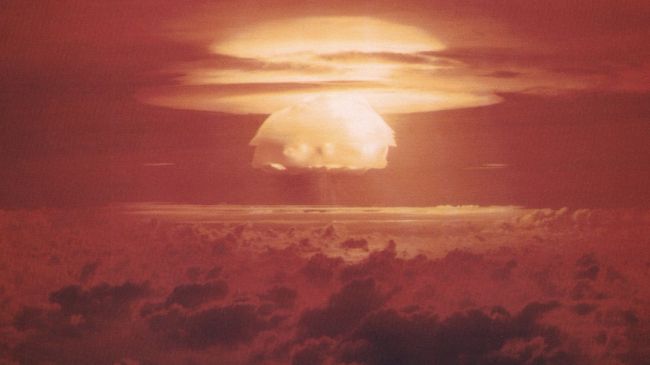
The US Air Force inadvertently dropped an atomic bomb over North Carolina in 1961. If a simple safety switch had not prevented the explosive from detonating, millions of lives across the northeast would have been at risk, a new document has revealed.
The revelation offers the first conclusive evidence after decades of speculation that the US military narrowly avoided a self-inflicted disaster. The incident is explained in detail in a recently declassified document written by Parker F. Jones, supervisor of the nuclear weapons safety department at Sandia National Laboratories.
The document – written in 1969 and titled “How I Learned to Mistrust the H-bomb,” a play on the Stanley Kubrick film title “Dr. Strangelove or: How I Learned to Stop Worrying and Love the Bomb” – was disclosed to the Guardian by journalist Eric Schlosser.
Three days after President John F. Kennedy’s inauguration, a B-52 bomber carrying two Mark 39 hydrogen bombs departed from Goldsboro, North Carolina on a routine flight along the East Coast. The plane soon went into a tailspin, throwing the bombs from the B-52 into the air within striking distance of multiple major metropolitan centers.
Each of the explosives carried a payload of 4 megatons – roughly the same as four million tons of TNT explosive – which could have triggered a blast 260 times more powerful than the atomic bomb that wiped out Hiroshima at the end of World War II.
One of the bombs performed in the same way as those dropped over Japan less than 20 years before – by opening its parachute and engaging its trigger mechanisms. The only thing that prevented untold thousands, or perhaps millions, from being killed was a simple low voltage switch that failed to flip.
That hydrogen bomb, known as MK 39 Mod 2, descended onto tree branches in Faro, North Carolina, while the second explosive landed peacefully off Big Daddy’s Road in Pikeville. Jones determined that three of the four switches designed to prevent unintended detonation on MK 39 Mod 2 failed to work properly, and when a final firing signal was triggered that fourth switch was the only safeguard that worked.
Nuclear fallout from a detonation could have risked millions of lives in Baltimore, Washington DC, Philadelphia, New York City, and the areas in between.
“The MK Mod 2 bomb did not possess adequate safety for the airborne alert role in the B-52,” Jones wrote in his 1969 assessment. He determined “one simple, dynamo-technology, low voltage switch stood between the United States and a major catastrophe…It would have been bad news – in spades.”
Before Schlosser brought the document to light through a Freedom of Information Act request, the US government long denied that any such event ever took place.
“The US government has consistently tried to withhold information from the American people in order to prevent questions being asked about our nuclear weapons policy,” he told the Guardian. “We were told there was no possibility of these weapons accidentally detonating, yet here’s one that very nearly did.”
In “Command and Control,” Schlosser’s new book on the nuclear arms race between the US and the Soviet Union, the journalist writes that he discovered a minimum of 700 “significant” accidents involving nuclear weapons in the years between 1950 and 1968.
Slava Zilber: Sam, three years ago, you appeared on Talk Nation Radio with David Swanson and spoke about the case of the GCHQ whistleblower Katharine Gun. You pointed out that the people involved in the spying on the UN and the people authorizing the Iraq War were not held accountable:
“Virtually everybody who went along with the war, whether it is Kerry or Clinton, of course, the Bush administration themselves has falsified their own records in terms of why, what they did, when they did, why they did it, to the extent that they’ve been scrutinised at all.”
You also address it in a recent article. And recently, Joe Biden has been lying about his position on the Iraq War. How can such an important issue escape meaningful scrutiny? … continue
This site is provided as a research and reference tool. Although we make every reasonable effort to ensure that the information and data provided at this site are useful, accurate, and current, we cannot guarantee that the information and data provided here will be error-free. By using this site, you assume all responsibility for and risk arising from your use of and reliance upon the contents of this site.
This site and the information available through it do not, and are not intended to constitute legal advice. Should you require legal advice, you should consult your own attorney.
Nothing within this site or linked to by this site constitutes investment advice or medical advice.
Materials accessible from or added to this site by third parties, such as comments posted, are strictly the responsibility of the third party who added such materials or made them accessible and we neither endorse nor undertake to control, monitor, edit or assume responsibility for any such third-party material.
The posting of stories, commentaries, reports, documents and links (embedded or otherwise) on this site does not in any way, shape or form, implied or otherwise, necessarily express or suggest endorsement or support of any of such posted material or parts therein.
The word “alleged” is deemed to occur before the word “fraud.” Since the rule of law still applies. To peasants, at least.
Fair Use
This site contains copyrighted material the use of which has not always been specifically authorized by the copyright owner. We are making such material available in our efforts to advance understanding of environmental, political, human rights, economic, democracy, scientific, and social justice issues, etc. We believe this constitutes a ‘fair use’ of any such copyrighted material as provided for in section 107 of the US Copyright Law. In accordance with Title 17 U.S.C. Section 107, the material on this site is distributed without profit to those who have expressed a prior interest in receiving the included information for research and educational purposes. For more info go to: http://www.law.cornell.edu/uscode/17/107.shtml. If you wish to use copyrighted material from this site for purposes of your own that go beyond ‘fair use’, you must obtain permission from the copyright owner.
DMCA Contact
This is information for anyone that wishes to challenge our “fair use” of copyrighted material.
If you are a legal copyright holder or a designated agent for such and you believe that content residing on or accessible through our website infringes a copyright and falls outside the boundaries of “Fair Use”, please send a notice of infringement by contacting atheonews@gmail.com.
We will respond and take necessary action immediately.
If notice is given of an alleged copyright violation we will act expeditiously to remove or disable access to the material(s) in question.
All 3rd party material posted on this website is copyright the respective owners / authors. Aletho News makes no claim of copyright on such material.


 Aletho News

