It’s Time To Raise the Level of Public Debate about Syria
By Tim Hayward | July 22, 2017
These past six months I have been getting to know the inter-media. They’re not formally part of mainstream, and they’re not very social, so I call them inter-media. They are like the maintenance team for the mainstream. To explain this, I’ll first say how I came to meet them.
The context of these encounters is writing posts on Syria. Doing so, I rely entirely on what others say. But the fact that we hear directly contradictory narratives provides a rare opportunity to test whose tale is the truer. Lies, whatever some bluffers and braggers may think, are infinitely harder to sustain, over time, than is the truth.[1]
The impulse to write about Syria originated at a very specific moment, even if my curiosity had been piqued earlier by the Netflix White Helmets: Where are the fighters that are holding off the combined military might of Syria and Russia? How come they don’t mind you filming here? The moment, though, was when Eva Bartlett responded to a mainstream media critic’s question: “Sources on the ground? You don’t have them.” And when Eva pointed out that the White Helmets were embedded with the fighters, this simply made more sense than Netflix had. But then I learned “That woman has been debunked.” (Note the way she is spoken about.) So who by? Well, Snopes for one. Fine, but seriously? I was informed that the mainstream view was verified by Médecins Sans Frontières (MSF). Here, now, was a reputable organisation that actually had doctors there on the ground risking their lives to save others under very dangerous conditions. Except, as it turned out, they did not, and so I came to write my first blog on Syria.
(MSF had the good grace to accept that I’d identified a problem, and invited me to their annual research conference this year to discuss the issues involved in relying on secondhand testimony.)
Channel 4’s alleged debunking of Eva prompted a subsequent blog. That involved studying their output, which was revealed to include much more than some unreliable witness statements. If MSF’s misleading testimony might be attributable to an insufficiently accountable communications operation, Channel 4 appeared to be engaged in a systematic programme of disinformation. There seemed to be a conscious commitment to presenting part of the same alternative reality that White Helmets and Bana feature in. It all appears to be produced by the Aleppo Media Center, which is actually in Turkey, but Channel 4 got some bespoke pieces, like the ‘Inside Aleppo’ series, and not just syndicated stuff. Hence we find Channel 4’s Aleppo films winning awards, like Netflix did with the White Helmets.
(Hence the channel will not publicly address what some there privately acknowledge are valid questions. And when you think about the investment involved you can understand their reluctance.)
Reflect on what must be involved here, and you start to realise that such a coordinated effort must have a deep and extensive organisational basis that goes way beyond the specific organisations that retail the information. Consider the preparation, work, time, and resources, material and human, that go into producing even a single scene in a movie, and then, after a whole feature has been shot, the audience still knows it is just a movie, not real. How much more preparation and resource must go into not merely producing a movie but actually persuading the entire public that reality is like the movie.
Nor is the effort to build that wall of disinformation the end of the challenge. It will require constant maintenance, for any big structure is liable to stresses, and cracks will appear. Here is where you need people ready with some filler. This is where we meet the inter-media. More fleet-footed, less constrained, than straight up media channels, but more disciplined and very much less social than social media, they are something in between. Their function with respect to the dominant narrative seems to be akin to that of those hi-tech bacteria that mould themselves into ongoing repairs in cracked concrete: the inter-media are there to plug up the cracks where shafts of truth show through.
This week afforded some opportunities to encounter the inter-media at work. Early in the week, a great article by Piers Robinson was published in openDemocracy urging a more serious look at propaganda and its contribution to the regime change agenda that is destroying Syria. Getting published in this prominent outlet was something of an achievement, for reasons I’ll let one of the first responders illustrate:
“By amplifying this conspiracist drivel, you are polluting the public sphere. @OpenSociety & @boell_stiftung should reconsider their support”
That tweet has since been deleted, perhaps because its author agreed with me that it cast a worrying light on his idea of how public debate should be conducted, and on whose terms. But it had made me curious as to why the Heinrich Böll Foundation should have a particular interest in the matter[2] I only knew them as a research organisation linked to the German Greens. (I’d spoken myself at their headquarters one time in Berlin.) But now I was about to turn over another stone! A cursory look on twitter quickly turns up that Foundation’s Middle East communications person tweeting about Tim Anderson, a longstanding critic in relation to The Dirty War on Syria, and lecturer at Sidney University:
“When will @sydney_uni finally end this producer of #FakeNews contract? Smearing of civilians, pretending #Assad doesn’t use gas.”
Wow! She attacks a man’s reputation, campaigns for him to lose his job, and challenges academic freedom, while also asserting an unproven claim as if it were truth, all within 140 characters. I can see how she got the job as communications head.
Moving on from this inter-media filler of German precision we will shortly come to meet one with American pizzazz. But first there is some backstory to fill in, starting with some words of clarification.
I hope it was clear, when I a moment ago implied a certain admiration for the skills of the propagandist just mentioned, that I am not approving of what she uses them for. I should have been clearer on this score when giving credit to Bellingcat in a post last week. In order to establish that my engagement with him would follow academic norms, I exaggerated the courtesies.[3] This caused some genuine consternation amongst readers, given the awareness many have of Bellingcat’s role in the propagation of the US-UK narrative. A few individuals were so outraged that they launched a forceful public criticism at me.[4] Since the last thing I want to do is mislead people I revised the blog, stripping out the confusing niceties, in order to bring attention back to its actual point. I had already apologised.
That incident taught me a few things. One is that writing in public, unlike in academia, means being aware of a potentially wide readership, with a variety of backgrounds and perspectives. So I should take more care to say only what I mean. Something else I learned, though, is what wonderful people there are who share the kinds of concern that I’m working through in these posts. Many people who I had already instinctively felt trust in revealed a depth of solidarity and integrity that is simply humbling. I really want to thank you all for your words of support. Thank you, also, for urging everyone to settle any differences like friends.
Like friends. That this expression comes so spontaneously to mind is my most important lesson.[5] There is actually a group of friends who are bound by a few simple ties: a desire that what we learn about the world is the truth; a conviction that whatever pressures of life may drive human beings into conflict with one another, we should do everything in our power to deal with them without being pushed into wars. Our power may not be great as individuals, but we all partake of a power that is ultimately indomitable. As embodied creatures of this real world we have evolved with a deep commitment to pursuing truth. If our ancestors could not discern the difference between a snake and a stick, we would not be here. If we were not able to make correct judgements about myriad things every moment of our waking life, aware of it or not, we would not survive long. We have an instinct for seeking true knowledge. We are predisposed towards it. To those who want to obscure it, we will seem like partisans for the truth.
With this in mind, I return to the American intervention on my twitter feed this week. The twitter storm provoked by my being too polite to Bellingcat had been watched with some amusement by Higgins himself and some of his friends. Here is one of them:

I have anonymised this because, like the first tweet I quoted above, it comes from a person who works at a UK University. I highlight it not because I personally mind being grouped with the majority of people living in Syria who prefer their legitimate government to the murderous bands of foreign-backed sectarians attacking it. But it is intended as a smear, and for the sake of people who want to engage in constructive and serious debate, I shall stand up to this practice of the inter-media brigade of attacking any and every attempt at actual public debate about the truth in Syria (or, indeed, in many other places). If they want to behave like rude trolls, they’d best keep a respectful distance from academia when they do it. That is a message I would encourage them to embrace.
I don’t believe the public want to think their own or their children’s university education is entrusted to people who think it is appropriate public conduct to come out with productions like the follow up to that tweet. For in lieu of the requested apology from the waggish twitterer, there ensued a series of tweets including this flourish of creativity:

The inter-media brigade may think this is a bit of fun, a change from straight up abuse and intimidation (and from unreasoned dismissals such as we find with Padraig Reidy calling Piers Robinson’s piece in openDemocracy ‘disgraceful’ apparently because Piers has elsewhere defended Russia Today against irrational attacks). But I ask them, very seriously, what actually is there to be having fun about? Those who promote propaganda that has real consequences for real people should man up, and grow up, and own what they do.
Frankly, none of this should need saying, and I am not paid to be spending valuable time dealing with it. So to them I leave it at this: Meet us in an academic forum or on a public platform where norms of civil debate apply. You cannot have it both ways: you cannot go bruising it around the internet just making ad hominem slurs while also staking an implicit claim to academic backing.
As for friendly and open readers, especially beyond academia, I have this to say. If in resisting propaganda you get called partisans, then let it be so. We are partisans for the truth. And resistance will work. Perhaps the truth is ‘rarely pure and never simple’, but it is much less high-maintenance than the wall of misinformation that the inter-media team are perpetually trying to patch up, and it will out. Meanwhile, the resistance is growing.
And finally, just to illustrate the difference between the alternative reality and the world we live in, I leave you with a video released this week by the amazing journalist from Aleppo, Khaled Iskef. He shows us around the neighbourhood in Aleppo where the little Syrian girl called Bana actually lived, there alongside the HQs of the armed brigades whose men, alone, were able to make or send images from the place. You then get an idea of how the child used in the propaganda may have a true call on our human sympathies.
[1] I am willing to use the seemingly hyperbolic term ‘infinitely’ because the truth will be what it is forever, without any input from anyone, whereas a lie becomes increasingly high maintenance in the face of simple questioning. It is endlessly difficult to maintain the back story, and then the back story’s story, and so on, until the effort required to avoid self-contadiction simply becomes too much and the simple truth just comes out again, like a plant through cracked tarmac. That is why the propaganda campaign needs to be so vast and long term. It is a gargantuan feat that we only see the tip of. We see the movie, we don’t see the entire production process.
[2] A twitter contact, by way of answer, informed me that the ‘Heinrich-Böll-Stiftung was used by the CIA to influence culture in Europe. The financing was made via Ford Foundation’. She sent me this video link (in German). I have not investigated so I make no comment myself. A look at a longer sweep of tweets from the foundation’s spokesperson for Syria does reveal a pattern sufficiently familiar to anglophone inter-media agencies to warrant mentioning a possible concern here, but I emphasise the caveat that her twitter profile makes the disclaimer “Tweets my own”.
[3] In giving credit for his geolocation skills and responsiveness to my inquiries (which I’ve learned does not reflect everyone’s experience) I frankly laid it on too thick. It genuinely hadn’t occurred to me that anyone would think I misunderstood the nature of his operation, but that was my mistake. Notwithstanding my apologies, I can see my critics were justified in residual anger on the grounds that there would be readers at earlier stages of learning who could take it at face value. How much it then helped that those critics themselves proceeded to extract and broadcast precisely that misleading message, as if it really were my message to the world, I can only leave them to consider.
[4] I haven’t seen it myself, having opted out of interactions with its author and the initial instigator once it became evident they hadn’t accepted my apology. There have been replies on my behalf, and I also haven’t been reading these, but one was copied to me by a mutual friend on Facebook and I reproduce it below. One can tell from reading it that the debate had got heated, and such a forceful response needs to be seen in that context. Thank you, John Schoneboom, for your eloquent words:

[5] The people I owe thanks to are far more than I shall even try to mention, but there is one person I do want to thank by name. Like Eva, she gets subjected to vast amounts of abuse for reporting a counter-narrative from Syria. Also like Eva, she is more than strong enough to take it. But frankly, she shouldn’t have to, certainly not from anyone associated with a UK university. Vanessa Beeley, I believe, has done more good for the prospects of ordinary people living in Syria than any of her trolls and detractors. If anybody in academia says I am wrong about this, I am ready to listen, but let them speak in terms that meet the standards of academic discussion.

Amidst a cluster of (former) terrorist HQs.
Schumer, ‘guardian of Israel,’ calls anti-Zionism a form of antisemitism
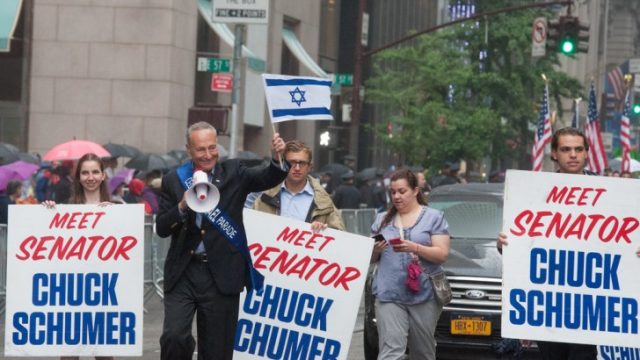
Sen. Chuck Schumer marches in the Celebrate Israel Parade in the rain on June 5, 2016 in New York City
If Americans Knew | July 18, 2017
In a recent speech on the Senate floor, New York Senator Charles Schumer said that anti-Zionism is a form of anti-Semitism. (In a 2010 speech Schumer said that God made him a ‘guardian of Israel’ – see below).
Schumer, the Senate minority leader, made his remarks at the end of a speech on health care. Schumer said he wanted to thank French President Emmanuel Macron for his recent comments claiming that anti-Zionism was antisemitism.
Schumer claimed that the Boycott, Divestment and Sanctions (BDS) movement, an extremely diverse movement that includes many Jewish individuals and groups, is “antisemitic.”
Schumer said: “The global BDS movement is a deeply biased campaign that I would say, in similar words to Mr. Macron, is a ‘reinvented form of anti-Semitism’ because it seeks to impose boycotts on Israel and not on any other nation.”
The Jewish Telegraphic Agency’s report on Schumer’s remarks notes that Schumer is the Senate’s “highest-ranking Jewish lawmaker.”
The claim that criticism of Israel is antisemitic has been promoted by an international campaign working to embed this as a new definition of “antisemitism.”
Schumer says he is a ‘guardian of Israel’
In 2010, Schumer told an AIPAC convention: “As some of you know, my name is a Hebrew word. “Schumer” comes from the Hebrew word “Shomer,” which means “guardian,” “watchman.”
Schumer said his name was given to him “for a reason”:
“For as long as I live, for as long as I have the privilege of serving in the Senate from New York, I will unflinchingly, unstintingly and with all of my strength be Shomer Yisrael, a guardian of Israel. Ladies and gentlemen, Am Yisrael Chai, in Israel and America, the Jewish nation lives now and forever.”
6 Americans who should be investigated for their Ukrainian ties
By Adam Garrie | The Duran | July 15, 2017
Incoming FBI Director Cristopher Wray has stated that he would be interested in investigating links between officials of the Ukrainian regime and the Hillary Clinton campaign.
With evidence mounting that high level officials in Kiev actively worked with the Clinton campaign to try and influence US voters, it is imperative that any future investigation isn’t whitewashed simply because Kiev’s tactics failed to win the election for Clinton.
Although the investigation into Donald Trump’s non-existent links with Russia have unsurprisingly come up with virtually nothing of interest, the methods of the investigation ought to be examined and replicated where necessary in a future Ukraine-Clinton investigation.
One of the most fascinating aspects of the so-called Russiagate investigation is that seemingly anyone connected to Donald Trump who ever had a conversation with a Russian, irrespective of their lack of involvement in Russian politics, is a person of interest to investigators.
The same tactics could be accurately applied to an investigation into Clinton and the Democratic party’s links with Ukraine.
Here are the people that ought to be questioned.
1. Hunter Biden
Hunter Biden is the youngest son of Barack Obama’s Vice President Joe Biden. In April of 2014, just two months after the February coup in Kiev, Joe Biden visited Ukraine where he gave a tub-thumping speech about the need for the Ukrainian regime to rely less on Russian gas supplies.
Weeks later, Hunter Biden was appointed to the board of directors of Ukraine’s largest private sector gas company, Burisma.
While many spoke of a prima facie conflict of interest in the appointment, the US mainstream media’s favourable stance towards the Obama administration meant that the story never saw the light of day.
The issue remains prescient, especially in light of allegations regarding wide spread Ukrainian collusion with the Democratic party in respect of the 2016 election.
2. Joe Biden
The timing of Joe Biden’s anti-Russian Ukrainian gas speech and his son’s appointment to the board of a major Ukrainian energy company necessarily means that the former American Vice President is a person of interest.
No one could reasonably believe that the proximate timing of the former VP’s speech and his son’s appointment to the board of Burisma was coincidental.
This is a matter which speaks of itself.
3. Alexandra Chalupa
For over 10 years, Chalupa, a US citizen of Ukrainian origin worked for the Democratic party. It has been established that she had multiple meetings at the Ukrainian Embassy in Washington D.C. in order to dig up dirt on former Trump campaign worker Paul Manafort.
Chalupa claims that her visits to the Ukrainian Embassy were for unrelated endeavours. Her word should not be take at face value. Her interactions with foreign officials in relation to the 2016 US election should be fully investigated.
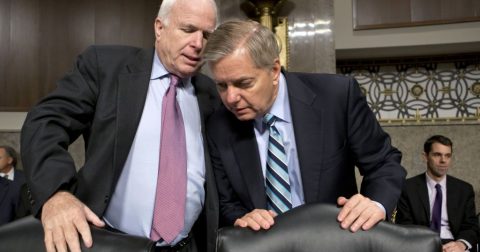
4. John McCain
Unlike Chalupa, McCain is not a Democrat, McCain has more political ties to Ukraine than anyone in the US Senate. His position as a former Presidential candidate and a strong critic of Donald Trump makes him a person of interest.
McCain is something of a fanatic when it comes to the Ukraine issue. Prior to the coup of February 2014, McCain was frequently pictured in Kiev with many extremist and fascist leaders who actively participated in the coup.
McCain recently visited Ukrainian leader Petro Poroshenko along with troops loyal to the regime during the 2016/2017 New Year’s holiday.
This visit, just weeks before Donald Trump’s inauguration ought to be thoroughly investigated as well as McCain’s other connections to a plethora of Ukrainian politicians, leaders, business and military figures.

For these reasons and because of McCain’s increasingly dubious role in allegedly leaking the so-called ‘Urinegate’ dossier to the media, he is clearly a person of interest.
5. Maxine Waters
Maxine Waters is a Democratic Congresswoman from Los Angeles whose anti-Russian rhetoric is vile and at times incoherent, but nevertheless protected by free speech.
It is not clear if Waters has any direct connections with Ukrainian authorities, but an innocent prank call by the Russian comic callers Vovan and Lexus to Waters, reveals that she is highly susceptible to anti-Russian propaganda. The fact she engaged with the prank callers, seemingly believing that they were officials from Kiev, means that Waters ought to be questioned about any real calls she may have taken from actual Ukrainian regime officials.
For those who believe that Waters is far removed from the sandal, one ought to be reminded that political commentator Alex Jones has been accused by Hillary Clinton of being a Russian agent. It was later confirmed by Jones and other media outlets that the FBI is currently investigating whether Jones’s platform InfoWars as well as Breitbart had direct links with Russia.
InfoWars and Breitbart can hardly be considered Russophile outlets, but the fact remains that Waters has said far more in favour of Ukraine than InfoWars or Breitbart have of Russia.
What’s good for the goose is good for a much more prominent gander.
6. Lindsey Graham
Lindsey Graham was a Trump opponent before it became fashionable in certain quarters. During the Republican primary, Donald Trump read out Graham’s private phone number and encouraged his supporters to ring up the Senator.
Graham was furious with Trump and later had to change his phone number.
When it comes to being a US Senator with close ties to the Ukrainian regime, only John McCain has more than Graham. Graham indeed accompanied McCain to Ukraine on his infamous New Year’s excursion and has close personal contacts with many individuals in Kiev.
For the same reasons McCain should be of interest to anyone who wants to unearth the extent of Ukrainian interference in American democracy, Graham ought to be on the list too.
Featured Video

Death Spikes & Rising Cancer In Our Youth Explained
or go to
Aletho News Archives – Video-Images
From the Archives
Politicians lie
By Mazin Qumsiyeh | Popular Resistance | August 18, 2013
There is no way to say this truth nicely: Politicians lie. That includes Japanese, American, Egyptian, Israeli, and Palestinian politicians! Is there something more common sense than that? Yet, so many citizens around the world believe their own politicians or wistfully acknowledge lies but think it is part of the job needed to run things. They believe even when politicians contradict themselves blatantly. This phenomenon is rather remarkable. It is a dissonance and disconnect from reality that many seem oblivious to. It is very dangerous because it can lead to accepting rationales for going to war. These can be deadly wars that lead to millions of lives lost as happened in what was called World War 1 and WW2. Even when incredible and declassified evidence abound, politicians continue to lie and old mythologies refuse to die. Here are just a few of the countless lies told to us over the past few decades… continue
Blog Roll
 Aletho News
- Iran flights continue despite US aviation sanctions
- Global Tipping Points Lead the World Into a State of Entropy
- The day-after at the White House: USA and Xi Jinping
- The Geopolitical Balance in the Red Sea: The UAE Being Displaced by New Players
- Iraqi resistance group vows to stage airport sit-ins over Iran aerial blockade
- Turkish parliament to review Saudi-Pakistan defense pact next month
- DEATH SPIKES & RISING CANCER IN OUR YOUTH EXPLAINED
- Iran offers Trump deal before US election
- Merz regime wants ‘secret police’ – opposition
- Israeli settlers terrorize West Bank Palestinians with state-provided drones: Report
- If Americans Knew
- An error has occurred; the feed is probably down. Try again later.
- No Tricks Zone
- New Study: Earth And Venus Surface Warmth Largely Explained By Convection And Lapse Rate, Not CO2 Or Radiation
- 2025 Nature Paper Claiming Worsening Global Drought Gets RETRACTED …Heavily Flawed
- New Study: ‘Global Drought Shows No Detectable Recent Acceleration Under Climate Warming’
- Economic Masterminds: German Socialists Suggest Taxing Productivity Gains Stemming From Using AI
- The South China Sea Has Not Been Cooperating With The Climate Change Narrative
- Energy Crisis: Germany Enters Heating Season With Historically Low Gas Reserve Fill Levels
- New Study: The Antarctic Ice Sheet Gained Mass From 2020-2024 Due To Staggering Snow And Ice Accumulation
- Study: Ocean Heating Rates From Thousands Of Years Ago ‘Dwarf’ Modern Ocean Heating Rates
- Climate Extremists Target, Attack Large-Scale Power Grid Infrastructure In Germany!
- New Study: Antarctic Ice Melt Has Contributed Less Than 1 Centimeter To Sea Level Rise In The Last 30 Years

