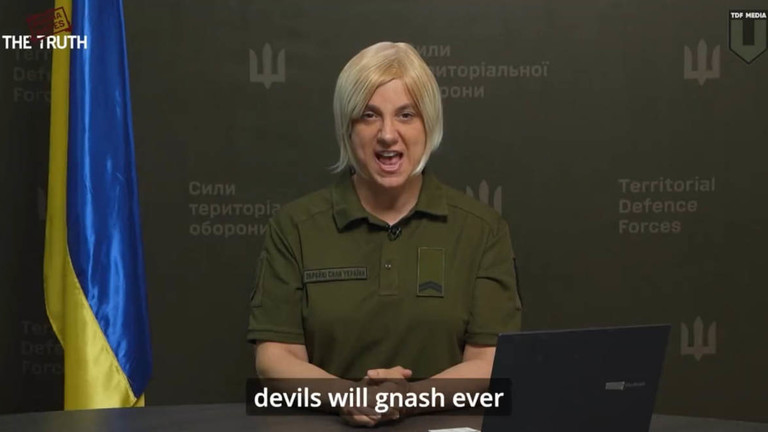
A threat to “hunt down” Russian “propagandists” which flagged an action “next week” and was made by a Ukrainian military spokesperson, should not be dismissed just because of its over-the-top presentation, a senior Russian official has argued.
On Wednesday, Sarah Ashton-Cirillo, who leads the Ukrainian Territorial Defense Forces’ purported outreach to English-speaking audiences, made some ominous predictions regarding Russia.
“Next week, the teeth of the Russian devils will gnash ever harder, and their rabid mouths will foam in uncontrollable frenzy as the world will see a favorite Kremlin propagandist pay for their crimes,” she said.
“Russia’s war criminal propagandists will all be hunted down, and justice will be served as we in Ukraine are led on this mission by faith in God, liberty and complete liberation,” she pledged.
Ashton-Cirillo, a trans woman who made headlines in the US in 2021 with a story of her infiltration of the American right-wing group Proud Boys, was given the spokesperson position in Ukraine in early August.
Her latest statement is part of her ‘Russia Hates the Truth’ series of minute-long videos, in which she delivers scolding condemnations of Russia.
While many Russian journalists have dismissed the unspecific threat as ridiculous, Valery Fadeev, the chairman of the Russian presidential human rights council, urged national law enforcement to take it seriously. The remark appears to be “a threat of murder or serious bodily harm” and thus a crime under Russian law, he argued on Thursday.
“Considering the lamentable record of attempts on the lives of Russian journalists and public figures … Russian security services should pay attention to it,” he added.
Moscow has accused Kiev of orchestrating the murders of journalist Darya Dugina in August 2022 and of military blogger Vladlen Tatarsky in April this year. In July, the Federal Security Service reported busting a group believed to have intended to assassinate RT Editor-in-Chief Margarita Simonyan and journalist Ksenia Sobchak on Kiev’s behalf.
September 14, 2023
Posted by aletho |
Civil Liberties, Full Spectrum Dominance, War Crimes | Human rights, Ukraine |
Leave a comment
There are “no significant radiological consequences” to the use of depleted uranium ammunition, International Atomic Energy Agency (IAEA) Director General Rafael Grossi has declared. Russia insists that Grossi is “not telling the whole story.”
“From a nuclear safety point of view there are no significant radiological consequences” to the use of this ammunition, Grossi told reporters during a briefing on Monday.
“Maybe in some very specific cases, people near a place that was hit with this kind of ammunition, there could be contamination,” he continued, adding that “this is more of a health issue of a normal nature than a potential radiological crisis.”
Depleted uranium is used to make the hardened cores of certain armor-piercing tank and autocannon rounds. Although it is not highly radioactive, uranium is still a toxic metal, and this metal is turned into a potentially hazardous aerosol when a depleted uranium round strikes its target.
US forces utilized depleted uranium tank shells during the 1991 Gulf War, reportedly causing a spike in birth defects, autoimmune disorders, and cancer cases in Iraq over the following decades. NATO also used depleted uranium in its 1999 air campaign against Yugoslavia. Earlier this year, Serbian Health Minister Danica Grujicic described the carcinogenic consequences of this ammunition on the Serb population a “horrible and inhumane experiment.”
The UK began supplying Ukraine with depleted uranium tank shells in March, while the US announced last week that it would send depleted uranium ammunition for its M1 Abrams tanks, which are expected to arrive in Ukraine in the coming weeks.
By focusing on the issue from a nuclear safety point of view, Grossi was being deliberately disingenuous, Russian Foreign Ministry spokeswoman Maria Zakharova wrote on Telegram on Monday.
“Mr. Grossi is, of course, right in saying that there are no significant radiological consequences from the standpoint of ‘nuclear safety,” she wrote. “It’s likewise obvious, though, that he is not telling the whole story.”
Zakharova pointed out that depleted uranium releases “extremely toxic aerosols” when ignited and vaporized. “Perhaps this is beyond Mr. Grossi’s expertise as head of the IAEA,” she concluded. “This question should be addressed to chemists, who will tell us about the harmful effects of heavy metal accumulation on the environment and human health.”
Russian forces claim to have destroyed at least one warehouse in Ukraine containing British depleted uranium shells. Kremlin spokesman Dmitry Peskov warned last week that the West will ultimately be responsible when this ammunition “inevitably” contaminates Ukrainian land.
September 11, 2023
Posted by aletho |
Environmentalism, Timeless or most popular, War Crimes | IAEA, Iraq, NATO, Russia, Ukraine, United States |
Leave a comment
Was there more to COVID-19 in terms of underlying agendas, in particular with respect to global-level actors?
Updated July 2023 based upon article originally published in March 2022
It’s been three years since COVID-19 emerged as a dominant and, for some time, all-consuming issue. Now there are signs we are witnessing the unravelling of some of the key policy responses – blanket lockdowns and population-wide injections – that have been so aggressively promoted by many, although not all, governments around the world. There is also reluctance by many to concede there have been problems with the COVID-19 responses to date. However, doubts about the efficacy of lockdowns are now widely aired and well substantiated and there is increasing evidence for, and awareness of, the dangers surrounding the mRNA genetic vaccine. And it is at least clear that large numbers of people, including scientists and academics, are expressing views at odds with authority or mainstream claims that lockdowns reduce mortality and that mass injections are a rational and efficacious solution.
As debate over ‘The Science’ increases, more and more people now question whether or not there is more to COVID-19 in terms of underlying agendas, in particular with respect to global-level actors such as the World Economic Forum (WEF), the World Health Organization (WHO) and so-called ‘Big Pharma’. In the early days of COVID-19 any such talk was immediately dismissed as ‘conspiratorial’ nonsense and, broadly speaking, people raising non-mainstream doubts about any aspect of the COVID-19 issue were subjected to vilification by ‘authoritative’ voices and corporate media.
Such dynamics were very much in evidence with respect to debate over the origins of COVID-19. And yet, today, the so-called ‘lab leak theory’, whatever its veracity, has moved from a ‘sphere of deviance’ to a ‘sphere of legitimate controversy’ with mainstream scientists through to legacy media and governments discussing it. At the same time, there is increased public awareness of various political agendas, for example the WEF’s ‘Great Reset’ visions. Indeed, a refrain from some quarters is that yesterday’s conspiracy theory is today’s fact. So, if all this is not about a virus, what might actually be going on?
COVID-19 and the ‘Structural Deep Event’ concept
First and foremost, it is necessary to dispel the idea that any attempt to understand intersections between political-economic agendas and COVID-19 is absurd or crazy. Here, we can learn much from Professor Michael Parenti’s 1993 talk on conspiracy and class power:
No ruling class could survive if it wasn’t attentive to its own interests; consciously trying to anticipate, control or initiate events at home and abroad both overtly and secretly. It is hard to imagine a modern state if there would be no conspiracy, no plans, no machinations, deceptions or secrecy within the circles of power. In the United States there have been conspiracies aplenty … they are all now a matter of public record.
PARENTI, 1993
It is a fact, then, that powerful political and economic actors do not blindly and irrationally stumble through history but rather strategise, plan and take actions that are expected to achieve results. They may make mistakes and plans are not always successful, but that does not mean they do not try and sometimes succeed in their aims and objectives. For example the tobacco industry worked long and hard, and with some success, to shape scientific and political discourse regarding their product and delay public awareness of its dangers.
Second, it is also true that powerful actors can have clear perceptions of their interests and are guided by the desire to realise, protect and further them. Where those interests come from might be reducible to any number of material or ideological influences. But origins do not matter, powerful actors still have conceptions of their interests and what they want to do.
Third, in today’s world of weakening democracies, corporate conglomerates and extreme concentration of wealth, it is also true that many political and economic actors are extremely powerful, whether measured in relative or absolute terms. They have resources and skills at their disposal that others do not. One potent tool available is that of propaganda, which grants significant leverage and influence to those with the skills and resources to disseminate it. For those liberals who remain at peace with their world – believing that powerful actors simply relay their political, economic and social goals to knowledgeable publics who then consent, or refuse to consent, to those goals – the fact that propaganda is exercised extensively across liberal democratic states comes as a shock. Indeed, many mainstream scholars struggle to recognise the role of propaganda even in well documented examples such as that of the tobacco industry shaping the science on the harms of smoking or the bogus claims regarding weapons of mass destruction (WMD) used to justify the invasion of Iraq. Recognising that propaganda is a major component of exercising power within so-called liberal democratic states logically removes any justification for the assumptions that a) powerful actors cannot or do not manipulate publics and b) citizenry are sufficiently autonomous and knowledgeable to always be able to grant or withhold consent.
And as Parenti observed, history is replete with examples of powerful actors successfully pursuing goals and manipulating populations in the process. In the days after 9/11, we now know that British and American officials were planning a wide-ranging series of actions – so called ‘regime-change’ wars – that went well outside the scope of the official narrative regarding combating alleged ‘Islamic fundamentalist terrorism’. One British embassy cable stated, four days after 9/11, that ‘[t]he “regime-change hawks” in Washington are arguing that a coalition put together for one purpose [against international terrorism] could be used to clear up other problems in the region’. Within weeks British Prime Minister Tony Blair communicated with US president George W. Bush saying, amongst many other things, ‘If toppling Saddam is a prime objective, it is far easier to do it with Syria and Iran in favour or acquiescing rather than hitting all three at once’. As these two western leaders conspired at the geo-strategic level, a low-level ‘spin doctor’, Jo Moore, commented on the utility of 9/11 in terms of day-to-day ‘media management’, noting that it was ‘a good day to bury bad news’. Jo Moore was forced to resign, Bush and Blair laid the tracks for 20-plus years of conflict in the international system, including the 2003 invasion of Iraq and the recently ended 20-year occupation of Afghanistan. And today, there is substantial evidence that the foundational official story regarding the 9/11 crimes is in fact false with the evidence clearly pointing toward the involvement of a number of state-level actors, including within the US.
Professor Peter Dale Scott (University of California, Berkeley) developed the concept of the ‘structural deep event’ and this is useful in capturing the idea that powerful actors frequently work to instigate, exploit or exacerbate events in ways that enable substantive and long-lasting societal transformations. These frequently involve, according to Scott, a combination of legal and illegal activity implicating both legitimate and public-facing political structures as well as covert or hidden parts of government – the so-called deep state which is understood as the interface ‘between the public, the constitutionally established state, and the deep forces behind it of wealth, power, and violence outside the government’. So, for example, Scott argues that the JFK assassination became an event that enabled the maintenance of the Cold War whilst the 9/11 crimes likewise enabled the global ‘war on terror’, and that both involved a variety of actors not usually recognized in mainstream or official accounts of these events. It is important to note that Scott claims his approach does not necessarily imply a simplistic grand conspiracy, but is rather based on the idea of opaque networks of powerful and influential groups whose interests converge, at points, and who act to either instigate or exploit events in order to pursue their objectives.
Applied to COVID-19, a ‘structural deep event’ reading would point toward a constellation of actors, with overlapping interests, working to advance agendas, and being enabled to do so because of COVID-19. Such a reading does not necessarily include or exclude the possibility of COVID-19 being an instigated event and one that functioned, in the widest sense, as a propaganda event enabling powerful actors to realise their goals. What are the grounds for seriously considering a ‘structural deep event’ reading?
The damaging COVID-19 response
There is now an overwhelmingly strong case to be made that the key responses to COVID-19 – lockdowns, cloth masking and mass injection – were, on their own terms, flawed.
A large swathe of scientists and medical professionals are now clearly and repeatedly warning governments and populations that lockdowns are harmful and ineffective whilst mass injection of populations with an experimental genetic vaccine resulted in substantial harms. Indeed, it is increasingly clear that the use of the PCR test, which gave a skewed impression of infection and death rates leading to the locking down of entire (healthy) populations for extended periods of time in response to a respiratory virus, and then attempting to submit people to an experimental injection on a repeated basis, were not scientifically robust policies. As of mid 2023, although causes are disputed, there continues to be worrying excess mortality across many countries. It is also now clear to many that the scale and nature of COVID-19 was exaggerated in a way that suggested the existence of an entirely new and unusually deadly pathogen that demanded drastic responses when, in fact, this was not the case.
It is also now apparent that a remarkable and wide-ranging propaganda effort, involving extensive use of behavioural scientists, was used to mobilise support for lockdowns and, later on, injections as well as exaggerate any threat posed. An early paper published in April 2020, authored by over 40 academics, presented a blueprint for how ‘social and behavioural sciences can be used to help align human behaviour with the recommendations of epidemiologists and public health experts’. Furthermore, many Western governments have behavioural psychology units attached to the highest levels of government, designed to shape thoughts and behaviour, and these were engaged early on during the COVID-19 event. According to Iain Davis, in February 2020 the WHO had established the Technical Advisory Group on Behavioural Insights and Sciences for Health (TAG); ‘The group is chaired by Prof. Cass Sunstein and its members include behavioural change experts from the World Bank, the World Economic Forum and the Bill and Melinda Gates Foundation. Prof. Susan Michie, from the UK, is also a TAG participant’. In the UK, behavioural scientists from SPI-B (Scientific Pandemic Influenza Group on Behaviour) reconvened on 13 February 2020 and subsequently advised the UK government on how to secure compliance with non-pharmaceutical interventions (NPIs). Broadly, these propaganda techniques included maximising perceived threat in order to scare populations into complying with lockdown and accepting the experimental genetic vaccines as well as utilising non-consensual measures involving incentivization and coercion through, for example, various mandates.
We also now know that propaganda activities included smear campaigns against dissenting scientists and, in at least one major case, were initiated by high-level officials: in Autumn 2020, Anthony Fauci and National Institute of Health director Francis Collins discussed the need to swiftly shut down the Great Barrington Declaration, whose authors were advocating an alternative (and historically orthodox) COVID-19 response focused on protecting high-risk individuals and thus avoiding destructive lockdown measures. Collins wrote in an email that this ‘proposal from the three fringe epidemiologists … seems to be getting a lot of attention … There needs to be a quick and devastating published takedown of its premises’. Rather than a civilised and robust scientific debate, a smear campaign followed. Furthermore, censorship and suppression appears to have been experienced widely across swathes of academia whilst the White House is currently being sued with respect to First Amendment violations against scientists including Professors Kulldorff and Bhattacharya from the Great Barrington Declaration.
The legacy corporate media, social media platforms and large swathes of academia appear to have played an important role in disseminating this propaganda and promoting the official narrative on COVID-19. The proximity of legacy corporate media to political and economic power has been well understood for many decades: concentration of ownership, reliance upon advertising revenue, deference to elite sources, vulnerability to smear campaigns and ideological positioning are all understood to sharply limit the autonomy of legacy media (these factors also arguably shape academia). With COVID-19 these dynamics are exacerbated by, for example, direct regulatory influence, such as Ofcom direction to UK broadcasters, and censorship by ‘Big Tech’ of views deviating from those of the authorities and the WHO. The Trusted News Initiative (TNI) and Coalition for Content Provenance and Authenticity (C2PA) have coordinated major legacy media in order to counter what they claim to be ‘misinformation’, and this appears to have played a role in suppressing legitimate scientific criticism whilst elevating ‘official’ narratives. At the global ‘governance’ level, both the United Nations and the WHO promoted campaigns around combating alleged ‘disinformation’ and the so-called ‘misinfo-demic’. Currently moves are afoot to further strengthen elite control over media discourse via legislation aimed at preventing so-called ‘misinformation’, ‘disinformation’ and ‘online harms’ and which is being rolled out over multiple legislatures.
Finally, confirmation of direct involvement of US authorities with censorship decisions by the social media company Twitter has been presented in the ‘Twitter Files’ and, in the UK, further corroboration regarding the role and significance of a Counter Disinformation Unit within the UK government. Matt Taibbi’s work on the ‘Twitter Files’, presents what is described as the Censorship Industrial Complex, or Counter-Disinformation Industry, which links universities, foundations, NGOs and federal agencies and which have actively censored content on Twitter during the COVID-19 event. Critically, these censorship regimes dovetail with the aforementioned legislative developments relating to ‘disinformation’ and ‘online harms’.
Extreme and flawed policy responses – societal lockdown and mandated mass injection – combined with widespread propaganda activities aimed at securing the compliance of the population might be explicable in a number of ways. For example:
- The cock-up thesis might be invoked to explain all of this as an irrational panic response by well-intentioned or ideologically driven actors who got things badly wrong and imitated each other while doing so.
- It might be that these policy responses are the result of narrow vested interests and corruption.
- Powerful actors might have sought to take advantage of COVID-19, even instigate the event, so as to advance substantial political and economic agendas and, as part of this, helped to promote advantageous narratives during the COVID-19 event.
Following two years of massive societal disruption aimed at containing a seasonal respiratory virus, and the persistence of some aspects of the COVID-19 narrative despite substantive scientific challenges, it is clearly necessary to take seriously the very real possibility that vested interests and substantial political agendas underly the COVID-19 event. So, what is the key evidence for explanations two and three?
Manipulation and exploitation of Health Agencies: Regulatory Capture at the NIH and CDC plus the World Health Organization and Pandemic Preparedness Agenda
Evidence for vested interests and corruption has come, in particular, from analyses of US regulatory bodies and the actions of the WHO. In particular, evidence has emerged showing that key authorities in the US – the National Institutes of Health (NIH) and the Centers for Disease Control and Prevention (CDC) – under the influence of Anthony Fauci, the Chief Medical Officer to the US President, have suffered from conflicts of interest. The term ‘regulatory capture’ is frequently used to describe this situation. [2]
For example, Robert F. Kennedy Jr’s detailed analysis of the US-led COVID-19 response in The Real Anthony Fauci, documents the corrupt relationship between so-called ‘Big Pharma’ and Anthony Fauci arguing that, to all intents and purposes, there has been regulatory capture whereby pharmaceutical companies and public officials enjoy mutually beneficial arrangements. This mutual infiltration is understood by Kennedy to underpin the COVID-19 response, especially the commitment to a ‘vaccine-only’ solution and suppression of preventative treatments such as Ivermectin and Hydroxychloroquine (HCQ). By way of example, Kennedy relays the case of Dr Tess Lawrie and WHO researcher Andrew Hill in which Hill appeared to confirm there was pressure to delay publication of results supporting the efficacy of Ivermectin. Regarding HCQ, Kennedy writes:
By 2020, we shall see, Bill Gates exercised firm control over WHO and deployed the agency in his effort to discredit HCQ’ …
On June 17, the WHO – for which Mr. Gates is the largest funder after the US, and over which Mr. Gates and Dr Fauci exercise tight control – called for the halt of HCQ trials in hundreds of hospitals across the world. WHO Chief Tedros Adhanom Ghebreyesus ordered nations to stop using HCQ and CQ. Portugal, France, Italy, and Belgium banned HCQ for COVID-19 treatment.
More broadly, the WHO has been important in terms of co-ordinating COVID-19 policy responses. Although notionally independent, the WHO has increasingly come under corporate influence via both the growth of corporate-influenced organisations such as Gavi (Global Vaccine Alliance), CEPI (Coalition for Epidemic Preparedness Innovations) and private financing via the Bill & Melinda Gates Foundation. The WHO is also currently negotiating the treaty on pandemic preparedness with the governments of member states to provide unprecedented powers to this organisation to enable rapid responses, transcending national governments, when the WHO declares pandemics in the future, thus centralising control and potentially overriding national sovereignty.
This line of analysis might lead to a conclusion that what we have experienced to date – harmful lockdowns and injection strategies underpinned by massive propaganda – is primarily the result of corruption, conflicts of interest and vested interests, rather than what could reasonably be described as good faith errors by politicians and bureaucrats.
The World Economic Forum and the ‘Great Reset’
The World Economic Forum (WEF) has been associated by some analysts with the COVID-19 event and in 2020 Klaus Schwab, its founder, published a co-authored book titled COVID-19: The Great Reset. Schwab declared: ‘The Pandemic represents a rare but narrow window of opportunity to reflect, reimagine, and reset our world’. One key component of the political-economic vision promoted by the WEF is ‘stakeholder capitalism’ (Global Public-Private Partnerships, GPPP) involving the integration of government, business and civil society actors with respect to the provision of services. Another key component involves harnessing ‘the innovations of the Fourth Industrial Revolution’, especially the exploitation of developments in artificial intelligence, computing and robotics, in order to radically transform society toward a digitised model. Slogans now frequently associated with these visions include ‘you will own nothing and be happy’, ‘smart cities’ and ‘build back better’.
It is also apparent that the WEF, as an organising force, has considerable reach. It has been involved with training and educating influential individuals – through its Young Global Leaders Programme and its predecessor, Global Leaders for Tomorrow – who have subsequently moved into positions of considerable power. It has also been noted that many national leaders (e.g. Merkel, Macron, Trudeau, Ardern, Putin, and Kurz) are WEF Forum of Young Global Leaders graduates or members and have ‘played prominent roles, typically promoting zero-covid strategies, lockdowns, mask mandates, and ‘vaccine passports’. In 2017 Schwab boasted:
When I mention our names like Mrs Merkel, even Vladimir Putin and so on, they all have been Young Global Leaders of the World Economic forum. But what we are very proud of now is the young generation like prime minister Trudeau, president of Argentina and so on. So we penetrate the cabinets. So yesterday I was at a reception for prime minister Trudeau and I will know that half of this cabinet or even more half of this cabinet are actually young global leaders of the World Economic Forum …. that’s true in Argentina, and it’s true in France now with the president a Young Global Leader
Corporate members of the WEF’s Forum of Young Global Leaders includes Mark Zuckerberg whilst ‘Global Leaders for Tomorrow’ included Bill Gates and Jeff Bezos.
Financial Crisis, the Central Banks and Central Bank Digital Currency (CBDC)
It is now established that a major crisis in the repo markets during the Autumn of 2019 was followed by high-level planning aimed at resolving an impending financial crisis of greater proportions than the 2008 banking crisis. According to some analysts, one response appears to have been a strengthened drive to control currencies via the Central Banks: Central Bank Digital Currency (CBDC). The General Manager of the Bank of International Settlements (BIS), Agustin Carstens, stated in October 2020 that:
we intend to establish the equivalence with cash and there is a huge difference there. For example, in cash we don’t know who is using a $100 bill today … the key difference with the CBDC is that the central bank will have absolute control on the rules and regulations that will determine the use of that expression of central bank liability and also we will have the technology to enforce that.
A programmable CBDC potentially provides complete control over how and when an individual spends money, in addition to allowing authorities to automatically deduct taxes through a person’s ‘digital wallet’. According to some analysts, this development would also effectively remove any significant control over financial policy at the national level. Although decried as a ‘conspiracy theory’ in the early days of the COVID-19 event, it has now become clear that there is a determined drive toward implementing CBDCs and which has the potential to qualitatively change the character of national-level governance.
Technologies associated with programmable CBDCs overlap with those associated with 4IR and concepts regarding digitised society. Specifically, digital identity, a potential component of the intended CBDC, provides a basis for the creation of a digital grid upon which information relating to all aspects of an individual’s life will be available to governments, corporations and other powerful entities such as the security services. Also notable is the relationship between digital ID and the drive to create ‘vaccine passports’ as part of the COVID-19 response: Microsoft and the Rockefeller Foundation are central players in ID2020, alongside Gavi. The overall objective is to create a global-level digital ID framework that integrates with health/vaccination status. As with CBDC, the push to implement these frameworks is ongoing, not dissipating, and include the recent announcement by the WHO and EU of a ‘digital health partnership’ aimed at facilitating implementation of digital health certificates for health and travel controlled by the WHO. [3]
All of these political and economic agendas point toward a conclusion more closely aligned with the ‘structural deep event’ (Scott) thesis, in that they highlight the possibility that COVID-19 has been exploited to advance major political and economic agendas. As such, COVID-19 is itself primarily a propaganda event, instrumentalized in order to pursue political-economic agendas. This hypothesis is, at least in part, distinct from the idea that corruption and narrow vested interests explain most of what we have seen.
Threats to democracy and understanding what this all might mean
The political and economic processes identified regarding the WEF, WHO, digital ID, the central banks and CBDC, the pandemic preparedness agenda and the Censorship Industrial Complex/Counter-Disinformation Industry are not speculative or theoretical, they are directly observable and ongoing. They are also proceeding in the absence of serious scrutiny by legislatures and wider democratic debate whilst new ‘emergencies’ over war in Ukraine and the climate appear to be being exploited in order to maintain momentum even as COVID-19 recedes from view. Indeed, one scholar of political communication notes that ‘insidious scare tactics deployed during Covid are still being used in the field of climate communications, where they were first developed.’
It is also worth spelling out the potential interaction between these agendas and threats to democracy. It is now clear that populations have been subjected to highly coercive and aggressive attempts to limit their autonomy, including restrictions on movement, the right to protest, freedom to work and freedom to participate in society. Most notably, significant numbers of people were pushed, sometimes required, to take an injection at regular intervals in order to continue their participation in society whilst PCR test requirements for travelling, for example, have introduced further coercive elements into everyday life. These developments have been accompanied by, at times, aggressive and discriminatory statements from major political leaders with respect to people resisting injection. The threat to civil liberties and ‘democracy as usual’ is unprecedented. The economic impact has been dire and COVID-19 has seen a dramatic and continued transfer of wealth from the poorest to the very richest (see for example Oxfam, 2021 and Green and Fazi, 2023). And, today, the drive to create a regulatory framework via the pandemic preparedness agenda, which includes modification of the International Health Regulations, combined with the rolling out of online ‘harm’ legislation and the promotion of moral panic over ‘disinformation’ and ‘online harm’, all create an architecture that enables high levels of control over populations within ostensibly democratic polities.
Furthermore, the combination of a programmable CBDC, a ‘vaccine passport’ that determines access to services and real-world spaces and the availability of all online behaviours to corporations and governments, can enable a system of near total control over an individual’s life, activities and opportunities. This system of control can be seen in China with the social credit system currently being implemented in certain provinces. Integration of personal data and money though a digital ID would also allow individuals to be readily stripped of their assets. These developments reflect the rise of technocracy whereby government and society become increasingly controlled by experts and technicians and individual autonomy and democracy are curtailed. They can also be related to the transhumanist movement which enthusiastically looks forward to human-machine interfaces and their proclaimed potential to ‘perfect the human condition’.
Of course, it is still possible that the sustained adherence to lockdown and mass injection (in spite of growing evidence against their efficacy and safety) are explicable through reference to government blunders, whilst the parallel political and economic projects and rapid reduction in civil liberties are coincidences.
However, it would be remiss to set aside the fact that organisations such as the WHO and the WEF exist within a wider network, or constellation, of extremely powerful, non-elected political and economic entities made up of major multinational corporations, intergovernmental organisations (IGOs), large private foundations and other non-governmental organisations (NGOs). These include, in no particular order, the Bank for International Settlements (BIS) and other central banks; asset managers Blackrock and Vanguard; global-level entities such as the Council on Foreign Relations (CFR), the Club of Rome, the Rockefeller Foundation, the Kellogg Foundation, Chatham House, the Trilateral Commission, the Atlantic Council, the Open Society Foundations and the Bill & Melinda Gates Foundation; and major corporations including so-called ‘Big Pharma’ and ‘Big Tech’ such as Apple, Google (part of Alphabet Inc), Amazon and Microsoft. And, of course, governments themselves are part of this constellation, with the most powerful – the US, China and India – having considerable influence. In addition, the European Union (EU) supranational body, via its President Ursula von der Leyen, promoted the EU Digital COVID Certificate and also demanded at times that all EU citizens be injected.
As such, it is entirely plausible, if not increasingly likely, that the interests shared between multiple political and economic actors have manifested themselves in the form of concrete political and economic agendas which, in turn, have been advanced via the COVID-19 event. It is also possible that the current war in the Ukraine as well as climate issues are being exploited by many of the same actors and in a similar fashion. Along these lines, Denis Rancourt recently noted:
It is only natural now to ask “what drove this?”, “who benefited?” and “which groups sustained permanent structural disadvantages?” In my view, the COVID assault can only be understood in the symbiotic contexts of geopolitics and large-scale social-class transformations. Dominance and exploitation are the drivers. The failing USA-centered global hegemony and its machinations create dangerous conditions for virtually everyone.
An increasingly large body of work supports the understanding of COVID-19 as a structural deep event. Important and pathfinding analyses were provided in the early months of the COVID-19 event by Cory Morningstar, Whitney Webb and Piers Robinson, amongst others. James Corbett was one of the first to warn of the impending dangers of a biosecurity state all the way back in March 2020, whilst Patrick Wood alerted us to the dangers of technocracy long before the arrival of COVID-19.
In States of Emergency (2022) Kees van der Pijl argues there has been a ‘biopolitical seizure of power’ in which an intelligence-IT-media complex has crystallised as a new class block seeking to quell growing unrest and the strengthening of progressive social movements throughout the world. Under cover of Covid-19, and via ruthless exploitation of people’s fear of a virus, van der Pijl traces how this new class block is attempting to impose control via high-tech, digitised societies necessitating mandatory injections and digital ID, as well as censorship and manipulation of public spheres. In short, van der Pijl describes a total surveillance society involving massive concentration of power and the end of democracy. Kheriaty’s The Rise of the Biomedical State (2022) offers a detailed presentation of how COVID-19 provided the impetus for an emerging biosecurity state whilst Iain Davis’ Pseudopandemic (2022) presents the COVID-19 event as primarily a propagandised phenomenon functioning to enable the continued emergence of a technocratic order built around the Global Public-Private Partnership (GPPP) and ‘stake-holder capitalism’ that has appeared primarily to serve the interests of what he describes as an elite ‘parasite class’. Simon Elmer’s (2022) analysis presents all of these developments in terms of the rise of a new form of fascism whilst Broecker (2023) emphasises the technocratic and anti-democratic underpinnings of the political developments ushered in under the cover of the COVID-19 event.
Robert F. Kennedy’s The Real Anthony Fauci, although focused on documenting the corruption with respect to public health institutions and ‘Big Pharma’, is clear about its consequences for our democracies. Early in the book he notes that Fauci ‘has played a central role in undermining public health and subverting democracy and constitutional governance around the globe and in transitioning our civil governance toward medical totalitarianism’. Later in the book, Kennedy discusses the interplay between military, medical and intelligence planners and raises questions about an ‘underlying agenda to coordinate dismantlement of democratic governance’:
After 9/11, the rising biosecurity cartel adopted simulations as signaling mechanisms for choreographing lockstep responses among corporate, political, and military technocrats charged with managing global exigencies. Scenario planning became an indispensable device for multiple power centers to coordinate complex strategies for simultaneously imposing coercive controls upon democratic societies across the globe.
Broadly in line with this analysis, the work of both Breggin and Breggin and Paul Shreyer argue that the political and economic agendas advanced during the COVID-19 event had been long in the pipeline and point toward it being an instigated event as opposed to a spontaneous – naturally occurring – one that groups opportunistically took advantage of.
Along with all this, transhumanism, life extension or ‘enhancement’ through technology and digitalised society, observable in some of the output from the WEF and public musings of key individuals, appears to reflect a set of beliefs in technology and progress that can be traced back to Enlightenment thinking of the last 300 years. Philosophical debates over technology and what it means to be human have remained at the heart of the Enlightenment ‘project’, although perhaps deeply buried. Associated with this might be scientism as a religious cult of the West.
Attempts to attach a label to the complex political and economic processes we are witnessing include descriptors such as ‘global fascism,’ ‘global communism,’ ‘neo-feudalism,’ ‘neo-serfdom’, ‘totalitarianism,’ ‘technocracy,’ ‘centralization vs. subsidiarity,’ ‘stakeholder capitalism’, ‘global public-private partnerships,’ ‘corporate authoritarianism’, ‘authoritarianism,’ ‘tyranny’ and ‘global capitalism.’ Dr Robert Malone, inventor of part of the mRNA technology used in the COVID-19 injections, openly refers to the threat of global totalitarianism as does US presidential hopeful Robert Kennedy Jr.
In summation, there are multiple and readily observable signs of political and economic actors working to variously instigate, exaggerate and/or exploit the COVID-19 event. At the same time there are no signs that those promoting the claim that COVID-19 represented an unusually dangerous health crisis are conceding any ground, even as the facts become clear that it was nothing exceptional and that the responses have been a disaster for public health and well-being. Both ideology and underlying agendas appear to be influencing the dynamics of current events, all of which are occurring in the context of major shifts in the distribution of power globally: witness the BRICS block and various geo-political realignments, including the increasingly likely strategic failure for the West in relation to the Ukraine war. None of this looks like the COVID-19 response was just some innocent and incompetent blunder by our scientific and medical establishments.
The tasks ahead
For those occupying corporate or mainstream positions in politics, media or academia, the fear of being tarred with the ‘conspiracy theorist’ label is usually enough to dampen any enthusiasm for serious evaluation of the ways in which powerful and influential political and economic actors might be shaping responses to COVID-19 to further political and economic agendas. But the stakes are now simply too high for such shyness and, indeed cowardice, to be allowed to persist. There are strong and well-established grounds to take analyses along the lines of the ‘structural deep event’ thesis seriously, as set out in this article, and there are clear and present dangers to our civil liberties, freedom and democracy.
Building on the work already started, researchers must explore more fully the networks and power structures that have shaped the COVID-19 responses and which have sought to move forward various political and economic agendas. Analysing more fully the techniques used, including propaganda and exploitation of COVID-19 as an enabling event, is now an essential task for researchers to undertake. It is also important to consolidate understanding of linkages with ongoing drives related to the UN sustainability agenda – e.g. 15 minute cities – and the climate agenda, all of which potentially involve technocratic and top-down policy approaches at odds with autonomy and democracy. Such work, ultimately, can not only deepen our understanding of what is going on; it can also provide a guide for those who seek to oppose what is being described by some as ‘global totalitarianism’ or ‘fascism’. It is of equal importance for scholars of democracy and ethics to further unpack the implications of these developments with respect to liberty and civil rights as well as, more widely, creative thinking with respect to alternative visions of social, political and economic organisation and including the development of parallel societies.
It could of course be the case that such a research agenda ultimately leads to a refutation of the ‘structural deep event’ thesis and confirmation that everything witnessed over the last three years has been simply cock-up or blunder. But it seems increasingly unlikely that this would be the result and evidence in support of the structural deep event reading is stronger now than ever. It is essential that critical research into the consequences of the COVID-19 response does not become bounded by an unwarranted assumption that all can be reduced to well- intentioned but erroneous responses. The stakes are high and it has never been more essential to seriously engage with uncomfortable possibilities – even if that means interrogating uncomfortable and alarming explanations.
Endnotes
1. Thanks to David Bell, Isa Blumi, Heike Brunner, Jonathan Engler, Nick Hudson and Ewa Siderenko for comments and input.
2. Sheldon Watts offers historic background illustrating how the establishment regularly rewrites the science to serve other purposes. In the case of Cholera, the main editors of The Lancet in the late 19th century actually contradicted their own findings of a previous decade in order to accommodate trade interests concerning the quarantining of British ships from India that would have harmed the British Empire’s economic model. From being a human communicable disease, it transformed into a dark-skinned disease of the orient. Watts, Sheldon. “From rapid change to stasis: Official responses to cholera in British-ruled India and Egypt: 1860 to c. 1921.” Journal of World History (2001): 321-374. Thanks to Isa Blumi for this reference.
3. See https://www.who.int/initiatives/global-digital-health-certification-network – Global ‘public health infrastructure’ to ‘expand digital solutions’ and EU Digital Covid Certificate taken over by the WHO’s GDHCN Certificate https://commission.europa.eu/strategy-and-policy/coronavirus-response/safe-covid-19-vaccines-europeans/eu-digital-covid-certificate_en.
Selected References
‘Organized Persuasive Communication: A new conceptual framework for research on public relations, propaganda and promotional culture’ by Vian Bakir, Eric Herring, David Miller, Piers Robinson, Critical Sociology, 2019.
‘The unintended consequences of COVID-19 vaccine policy: why mandates, passports and restrictions may cause more harm than good’ by Kevin Bardosh, Alex de Figueiredo, Rachel Gur-Arie, Euzebiusz Jamrozik, James Doidge, Trudo Lemmens, Salmaan Keshavjee, Janice E Graham, Stefan Baral, British Medical Journal, 2023.
‘Using social and behavioural science to support COVID-19 pandemic response’ by Jay Van Bavel et al, in Nature Human Behaviour by Jay Van Bavel et al, 2020.
‘Global Health And The Politics Of Catastrophe: Who will save us from the WHO and its new world order?’ by David Bell, PANDA, 2021.
‘The World Health Organization and COVID-19: Re-establishing Colonialism in Public Health- PANDA’ by David Bell and Toby Green, PANDA, 2021.
‘Negotiating the future of political philosophy and practice: Renewal of democracy or technocratic governance’ by Hannah Broecker, Kritische Gesellschaftsforschung, 2023.
Covid 19 and the Global Predators, by Peter Breggin and Ginger Breggin, 2021.
Pseudopandemic: New Normal Technocracy, by Iain Davies, 2021.
A State of Fear by Laura Dodsworth, Pinter & Martin Publishers, 2021.
The Road to Fascism: For a Critique of the Global Biosecurity State, By Simon Elmer, architectsforsocialhousing, 2022.
‘The Covid Consensus’ by Toby Green and Thomas Fazi, Hurst Publishers, 2023.
‘Engineering Compliance: From Climate to Covid and Back Again’ by Philip Hammond, Propaganda In Focus, 2023.
The Real Anthony Fauci: Bill Gates, Big Pharma, and the Global War on Democracy and Public Health, by Robert F. Kennedy Jr, 2021.
The New Abnormal: The Rise of the Biomedical Security State, by Aaron Kheriaty, 2022.
Doubt is Their Product by David Michaels, Oxford University Press.
‘Propaganda Trudeau Style’ by Ray McGinnis, Propaganda in Focus, 2022.
‘PCR testing skewed and corrupted data on SARS-CoV-2 infection and death rates’ by Jennifer Smith, PANDA, 2022.
‘Conspiracy and Class Power: A Talk by Michael Parenti’, – Global Research, 1993.
States of Emergency: Keeping the Global Population in Check, by Kees van der Pijl, Clarity Press, 2022.
‘COVID Coercion: Boris Johnson’s Psychological Attack on the UK Public’ by Mike Robinson, UKColumn, 2020.
‘Threats to Freedom of Expression: Covid-19, the ‘fact checking counter-disinformation industry’, and online harm legislation’, by Piers Robinson, Propaganda In Focus.
‘Deafening Silences: propaganda through censorship, smearing and coercion’ by Piers Robinson, Propaganda in Focus, 2022.
‘COVID is a Global Propaganda Operation’, interview with Piers Robinson, Asia Pacific, 2021.
‘The Propaganda of Terror and Fear: A Lesson from Recent History’, by Piers Robinson, OffGuardian, 2020.
The American Deep State by Peter Dale Scott, Rowman and Littlefield, 2017.
‘Censorship and Suppression of Covid-19 Heterodoxy: Tactics and Counter-Tactics’, by Yaffa Shir-Raz, Ety Elisha, Brian Martin, Natti Ronel & Josh Guetzkow, Minerva, 2022.
‘Chronik einer angekündigten Krise’ by ‘Paul Schreyer’, 2021.
‘Who is responsible for inflicting unethical behavioural-science ‘nudges’ on the British people?’ by Gary Sidley, PANDA, 2022.
‘The Show Must Go On. Event 201: The 2019 Fictional Pandemic Exercise’ by Cory Morningstar, 2020.
‘From Covid to CBDC: The Path to Full Control’ by John Stylman, Brownstone Institute, 2022.
‘Transhumanism and the Philosophy of the Elites’ by Danica Thiessen, PANDA, 2023.
‘Was SARS-CoV-2 entirely novel or particularly deadly?’ by Thomas Verduyn, Todd Kenyon, Jonathan Engler, PANDA, 2023.
‘Red pill or blue pill variants inflation and the controlled demolition of society’ The Philosophical Salon, available at ‘Red Pill or Blue Pill? Variants, Inflation, and the Controlled Demolition of Society’ by Fabio Vighi, The Philosophical Salon, 2021.
‘All Roads Lead to Dark Winter’, by Whitney Webb, Unlimited Hangout, 2020.
‘COVID-19 and the shadowy “Trusted News Initiative”’, by Elizabeth Woodworth, Common Ground, 2021.
September 11, 2023
Posted by aletho |
Book Review, Civil Liberties, Deception, Full Spectrum Dominance, Science and Pseudo-Science, Timeless or most popular, War Crimes | Covid-19, COVID-19 Vaccine, Gates Foundation, Human rights, Rockefeller Foundation, UK, United States, WEF, WHO |
Leave a comment
On August 31, the Nation magazine published an article entitled “Chile: The Secrets the US Government Continues to Hide,” which details the CIA’s continued steadfast insistence on keeping its records secret that relate to the agency’s 1970-1973 efforts to bring regime change to Chile.
The CIA’s continued secrecy, of course, brings to mind the agency’s equally steadfast insistence on keeping its JFK-assassination related records secret into perpetuity.
The CIA, needless to say, cites the two magic words — “national security” — to justify its continued secrecy in both events.
I suggest that two other words are the real reason for the CIA’s continued secrecy in both events: “criminal cover-up.”
After all, the JFK assassination took place 60 years ago and the Chilean coup took place 50 years ago. The notion that the release of CIA assassination-related and coup-related records would threaten “national security,” no matter what definition is used for that ridiculous, meaningless term, is laughable to the extreme.
Actually, the Chilean coup bears a relationship to the JFK assassination. That’s because the national-security establishment’s mindset toward its regime-change operation in Chile reflected its mindset toward its regime-change operation in Dallas. My hunch is that those still-secret records relating to Chile would provide further circumstantial evidence pointing toward the reasons for the operation in Dallas.
In 1970, Chilean voters delivered a plurality of vote to Salvador Allende in the presidential election. Since Allende had not received a majority of votes, the election was thrown into the hands of the Chilean congress.
U.S. officials deemed Allende a grave threat to U.S. national security, on two grounds: that he was a socialist but, more important, that he was befriending the communist world, including Cuba and the Soviet Union, something that Kennedy had done as well in his famous Peace Speech at American University a few months before he was assassinated.
The CIA embarked on a campaign of bribing the members of the Chilean congress to vote against Allende (which, of course, is somewhat ironic given the fierce U.S. reaction to supposed Russian involvement in U.S. elections).
At the same time, the U.S. national-security establishment made plans for a Chilean military takeover. What’s interesting is that the CIA did not assassinate Allende. Instead, it convinced the Chilean national-security establishment that Allende posed a grave threat to Chilean national security and, therefore, that the Chilean national-security establishment had a moral duty to violently prevent Allende from assuming the presidency.
That’s a very important and very revealing point, one that undoubtedly comes across loud and clear in those still-secret CIA records relating to the Chile coup. The point reveals the U.S. national-security establishment’s conviction that it had the moral duty to violently remove JFK from power in order to protect America from a president whose policies, they concluded, posed a grave risk to “national security.” (See FFF’s book JFK’s War with the National Security Establishment: Why Kennedy Was Assassinated by Douglas Horne.)
Much to the chagrin of the U.S. national-security establishment, however, the commanding general of Chile’s armed forces, Gen. Rene Schneider, opposed the idea of a coup. His position was that the Chilean constitution did not permit a coup as a way to remove a democratically elected president from office. He said that Chileans would have to wait until the next election.
Therefore, the CIA simply orchestrated a violent kidnapping of Schneider which left him dead from gunshot wounds on the streets of Santiago. Ironically, the CIA’s kidnapping and assassination of this innocent man boomeranged because the Chilean congress, faced with tremendous anger over Schneider’s murder among the Chilean citizenry, rejected the CIA’s bribes and installed Allende into power.
Three years later, however, the U.S. national-security establishment prevailed in its efforts and helped military strongman Gen. Augusto Pinochet violently take over the reins of power. By the end of the war between the executive and national-security branches of the government, Allende was dead, just as Kennedy was ten years before.
With the full support of the Pentagon and the CIA, Pinochet’s henchmen rounded up some 60,000 innocent people and proceeded to torture and/or rape most of them. They also killed or disappeared around 3,000 of them.

Orlando Letelier
Among those rounded up was Orlando Letelier, a highly respected man who had served in the Allende administration as ambassador to the United States, minister of foreign affairs, minister of the interior, and minister of defense. After being tortured in captivity, world pressure forced Pinochet to release him.
Letelier moved to Washington, D.C., where he joined a leftist think tank and began lobbying against the Pinochet regime. Pinochet and his national-security establishment deemed Letelier to be a grave threat to Chilean “national security.”
On September 21, 1976, Letelier was killed by a car bomb on the streets of Washington, D.C., along with his young assistant Ronni Moffitt.
It was determined that Pinochet’s secret Gestapo-like internal police force, which was called DINA and which worked with the CIA, had orchestrated and carried out the Letelier assassination. Among those convicted of the crime was a DINA agent named Michael Townley, who was a U.S. citizen.
As part of what was clearly a sweetheart deal, Townley pled guilty in U.S. District Court as part of a plea bargain with U.S. officials. Get this: He was sentenced to only ten years in jail for what amounted to the cold-blooded murder of two innocent people. To put that in perspective, compare it to the 22-year jail sentence that a U.S. District Judge recently meted out to a man convicted of simply participating in the January 6 protests. Townley was also given immunity from prosecution in Chile for another national-security assassination in which he had allegedly been involved.
But that’s not all. After serving only 62 months in jail, get this: He was admitted into the federal witness protection program! That meant that the feds gave him a secret identity and let him live a normal life somewhere in the world.
The Letelier assassination has always been blamed on Pinochet. Is it possible that the CIA, working with DINA, was also embroiled in that assassination, on grounds of “national security”? My hunch is that those records relating to Chile that the CIA steadfastly continues to keep secret would help provide an answer to that question, which, needless to say, would be a good reason for wanting them to kept secret.
September 10, 2023
Posted by aletho |
Civil Liberties, Deception, Subjugation - Torture, Timeless or most popular, War Crimes | Chile, CIA, JFK Assassination, United States |
Leave a comment
Here’s what never happened in the hospital during COVID: a doctor sat down next to a patient and said, “You have a choice. We can give you Remdesivir, which killed 53 percent of the patients in an Ebola trial. It was so bad the trial had to be shut down. And you’ll notice here in Remdesivir’s fact sheet, it says, ‘Not a lot of people have used Remdesivir. Serious and unexpected side effects may happen.’ Or we can give you ivermectin, a safe and effective drug that’s been successfully used for decades, and send you home. Which do you prefer?”
The reason that conversation never happened is that it would have cost the hospital too much money. If the hospital gave you ivermectin and sent you home, the federal government paid the hospital $3,200. If the hospital gave you Remdesivir, the federal government paid the entire hospital bill, plus a 20 percent bonus. So the hospital executives’ choice was to receive $3,200 or $500,000, which was the average hospital bill. No contest. Patients were going to get Remdesivir — whether they wanted it or not.
Informed consent died a grotesque death in the hospitals during COVID, and we need an autopsy. There was no information, and there was no consent, and without them, patients are reduced to helpless victims, exploited for corrupt financial gain and immoral experiments.
Informed consent has been enshrined in numerous judicial rulings as the foundation of ethical medical practice and seared into the public’s conscience from the Nuremberg trials. Seven Nazi doctors were hanged in Germany by an American military tribunal for “murders, tortures, and other atrocities committed in the name of medical science.” Yet murders, tortures, and other atrocities are exactly what was committed by medical staff in the hospitals against thousands of Americans during COVID.
Take, for example, Ray Lamar, who arrived in the emergency room with a message written with a black sharpie pen on his arm: “NO VENT NOREMDESIVIR.” On his other arm, he wrote the same message and added his wife’s name and phone number. Yet the doctors gave him Remdesivir anyway, without ever informing him. His widow Patti told me she constantly wonders what she could have done to save him.
Christine Johnson told the doctors that she discussed all her medications with her daughter, who is a nurse, and she concluded that she didn’t want Remdesivir. It didn’t matter. Christine was given Remdesivir while she was sleeping, and now her daughter Michelle doesn’t have her mother.
Rebecca Stevens was an avid reader of Epoch Times, where she learned about Remdesivir’s dangers. She declined Remdesivir on five separate occasions, as her hospital records confirm. But the medical staff didn’t care what Rebecca wanted. She was given Remdesivir without her knowledge, and now Rebecca’s five grandsons are bereft.
I asked Michael Hamilton how it’s possible to give Remdesivir to patients without them knowing. Hamilton is a lawyer for several families who are suing California hospitals for the murder of their loved ones, and he’s heard thousands of victims’ stories. “They would lie right to your face,” he said. “You’d tell the nurse that you didn’t want Remdesivir and she’d say, ‘Fine. But you’re a bit dehydrated, so let’s get some fluids in you.’ And she’d hook up the IV, but it wasn’t fluids. It was Remdesivir.”
Hamilton told me that another favored tactic was to knock out patients with sedatives like morphine and fentanyl. While they lay there in a stupor, they were injected with Remdesivir.
If secret injections of Remdesivir weren’t enough to kill you, the hospitals had more torture lined up. After all, the federal government paid hospitals a big bonus to ventilate patients — so patients were going to get ventilated, whether they wanted to or not. A lot of patients turned down being vented, because the whole process is a nightmare. You’re painfully intubated, rendered unable to talk; your lungs start shredding, and you may acquire bacterial pneumonia, which the hospital will refuse to treat.
But “no” is not an acceptable answer when the hospital has money at stake. The medical staff’s preferred method for gaining “consent” was relentless bullying, screaming, coercion, and threats until the patient finally caved. Patti Lamar, Ray’s widow, told me that when she refused to let them ventilate her husband, the doctors screamed at her over and over, “You’re killing him! You’re killing him! You’re killing him!” When she couldn’t take it anymore, she reluctantly gave in. Ray died shortly thereafter, and Patti lives with the trauma of that moment.
Michael Hamilton told me the fate of his friend who was a nurse, hospitalized in the place where she had worked for 26 years. When she refused ventilation, the doctor shrieked, “You’re refusing medical advice! Now your insurance company won’t pay your hospital bill when you die! Do you want to bankrupt your family? Do you? Do you?” The nurse panicked, and to protect her family, she “consented.” Two days later, she died.
“This was a very common technique,” Hamilton said. “I’ve heard it hundreds of times. You tell the patient that unless they do what the doctor says, they’ll bankrupt their family because insurance won’t pay the hospital bills. Nobody wants to do that to their family.” Does this sound like informed consent to you? It sounds more like medical battery to me.
The entire hospital environment was a hellscape of abuse in which informed consent wasn’t even a distant memory. Hamilton told me that patients were routinely denied all access to food and water, stupefied with 50 medications that included drugs contraindicated for each other, tortured with oxygen machines set at such high levels that they couldn’t breathe, and zip-tied to the bed till their wrists bled and their hands turned black. His stories align with 1,000 collected testimonies of the COVID-19 Human Betrayal Memory Project, which documents the victims’ fates.
The ultimate denial of informed consent was the hospitals’ refusal to allow the patients to leave. “Patients lost all rights when they went in the hospital,” Senator Ron Johnson told Patty Myers in her documentary, Making A Killing. “They became prisoners.” A cottage industry of hospital rescues cropped up, as desperate family members hired lawyers to try to spring their loved ones out of hospital “care.” Ralph Lorigo, a lawyer in Buffalo, told me that in every case when he succeeded in getting a patient’s case before a judge and the judge ruled in the family’s favor, the patient went home and survived. In all cases where the judge refused to hear the case or ruled against the family, the patient died.
Every American is a sovereign individual with inalienable rights to life, liberty, and the pursuit of happiness, not a sack of meat to be treated as a profit opportunity. Informed consent must be revived from the grave if Americans are to have a fighting chance against powerful financial interests allied against them.
Stella Paul is the pen name of a writer in New York who has covered medical issues for over a decade. In 2021, she lost her husband in a locked down nursing home in New York City where he had been brutally isolated for almost a year. He died one week after getting the vaccine. Stella is focused on exposing the Hospital Death Protocol to honor her husband’s memory and to support thousands of bereaved families.
September 9, 2023
Posted by aletho |
Corruption, Timeless or most popular, War Crimes | Covid-19, United States |
Leave a comment
Dr Ros Jones, the founder of CCVAC and long-term critic of the Government’s advisory body on vaccine policy JCVI, has just written to them again to ask why, in defiance of the evidence, are they recommending an autumn booster for healthy 12-64s who live with an immunocompromised household member. Here she explains her concern.
SCARY and ill-informed headlines like ‘New Covid fears as kids return to school and daily rates numbers double in a month’ have given grist to the government’s mill that an increase in Covid cases justifies them in bringing forward the autumn booster programme from October to September 15.
If you think this is irrelevant for most healthy children, it is not. The proposed schedule, though excluding the majority of healthy under-64s, recommends that perfectly healthy 12-64s get a booster if they are a household contact of someone with immunosuppression, for example someone who has been under cancer treatment. Once again guilt is being exploited. Whose needs do parents prioritise, their healthy teenage son or daughter or their elderly immunocompromised mothers and fathers? The simple answer is they have to do neither: their child does not need a booster for his or her own health and it is abundantly clear that the vaccines do not prevent infection or transmission, and may well have the opposite effect. There is good evidence that repeated boosters actually increase the likelihood of infection, particularly in the first week or two after vaccination, quite apart from all the other immediate and long-term potential risks of harm.
This is why I, with more than one hundred health professionals and academics, have once again written to Professor Wei Shen Lim, chairman of the JCVI’s Covid-19 committee, to point out the total lack of logic or indeed ethics in the current guidelines. The letter is published below and can also be found on the Hart group website here: Professor Lim, how can boosters protect others? – HART (hartgroup.org)
***
4th September 2023
Professor Wei Shen Lim and all members, Joint Committee of Vaccination and Immunisation
Rt Hon Stephen Barclay MP, Secretary of State, Department of Health and Social Care
cc Dr Camilla Kingdon, President, Royal College of Paediatrics and Child Health
Dear Professor Lim and Mr Barclay,
re: JCVI advice for Covid-19 vaccination of healthy young adults if living with an immunocompromised household member
I, and many of my co-signatories, have written to you on several occasions since May 2021[i], when you were first deliberating over whether to recommend Covid-19 gene-based vaccines for healthy children, given the lack of any robust safety data on these new mRNA technologies and the acknowledged low impact of SARS-CoV-2 on children.
It is very gratifying to see that this autumn’s booster programme [ii] has now been dropped for almost all healthy under-65s. However, there is one group still being offered a booster that causes us serious concern, namely the offer of a booster to healthy over-12s if they have an immunocompromised household member. We set out our reasons below.
1. It is clear that Covid-19 vaccines are failing to prevent infection by or transmission of SARS-CoV-2.
2. There is now good evidence that multiple boosters actually increase the likelihood of a SARS-CoV-2 infection [iii].
3. There is good evidence of a specific rise in infection risk in the first 7-10 days after vaccination, thus putting family members at increased rather than reduced risk [iv],[v].
4. The more recent omicron variants are poorly covered by the original vaccines, but even the newer bivalent boosters generate a much lower response against the non-Wuhan sequences in the vaccines, indicative of immune imprinting [vi].
5. The potential benefit of vaccination now for healthy young adults is low, and for children is effectively zero, given the poor efficacy of the vaccines and the high prevalence of naturally-acquired immunity [vii].
6. The safety profile of these vaccines is woefully inadequate for use in a healthy low-risk population, especially children, giving a poor risk : benefit balance. The hazard of myocarditis, recognised early on as an increased risk in younger age groups [viii], has still been poorly delineated, but risks as high as 1 in 25 are reported for subclinical myocarditis in a recent study from Switzerland [ix], confirming similar findings from Thailand. Although symptoms usually resolve quickly, scarring has been demonstrated on cardiac MRI scans [x] and has been found to persist at 6-12-month follow-up [xi]. Pfizer’s own 5-year follow-up study is not due to report until 2027; likewise a large FDA-sponsored study in the US [xii].
7. Many other adverse effects have been reported and listed in our previous letters [xiii], [xiv], perhaps the most worrying of which is the deleterious effect on the immune system [xv],[xvi]. Basic pharmacokinetics of these products are only just being reported, with a paper this week, as we write, reporting findings of vaccine-derived spike protein persisting in the circulation for many months (or longer) after vaccination [xvii],[xviii]; with serious implications for prolonged effects of any vaccine injuries.
8. The issue of excess all-cause deaths in younger age groups in 2022 and 2023 has yet to be properly investigated and a link to vaccines cannot be ruled out until this is done[xix].
9. Even if there was good evidence that vaccination could protect vulnerable household contacts, there would be major ethical concerns around asking children to take a vaccine with any potential risks of harm, to protect family members. The Universal Declaration on Bioethics and Human Rights [xx] Article 4 and Article 7 make it clear that all medical interventions must be in the best interest of the individual concerned, particularly in the case of children who are not able to give consent. If a booster was in the best interests of a healthy 12-17-year-old, then surely the JCVI would be recommending it for all, but it is clear that these children are being offered the vaccine merely in a likely unsuccessful attempt to benefit other household members.
10. Whilst it may be argued that technically these products have now been approved and are therefore no longer a research tool, these ethical principles and the precautionary principle must still apply, especially since the approval itself is still based on much less evidence than would be expected for other drugs.
Please could you urgently provide the following, under a FOI request:
- minutes of the meetings at which these decisions were made;
- calculations of numbers of healthy 12-17-year-olds (and of all household members aged 12-64) needed to vaccinate to prevent the hospitalisation of one vulnerable family member;
- any legal advice taken on how these unnecessary booster doses to children comply with UK and international law.
We look forward to hearing from you as a matter of urgency before the commencement of the vaccine booster rollout to healthy 12-17-year-olds .
Yours sincerely
Dr Rosamond Jones, MD, FRCPCH, retired consultant paediatrician, convenor of CCVAC (Children’s Covid Vaccines Advisory Council) and many others….
Professor Anthony J Brookes, Professor of Genomics & Health Data Science, University of Leicester
Professor Angus Dalgleish, MD, FRCP, FRACP, FRCPath, FMedSci, Professor of Oncology, University of London; Principal, Institute for Cancer Vaccines & Immunotherapy
Professor Richard Ennos, MA, PhD. Honorary Professorial Fellow, University of Edinburgh
Professor John A Fairclough, BM BS, BMed Sci, FRCS, FFSEM(UK), Professor Emeritus, Honorary Consultant Orthopaedic Surgeon
Professor David Livermore, BSc, PhD, retired Professor of Medical Microbiology
Professor Karol Sikora, MA, MBBChir, PhD, FRCR, FRCP, FFPM, Honorary Professor of Professional Practice, Buckingham University
Professor Roger Watson, FRCP Edin, FRCN, FAAN, Honorary Professor of Nursing, University of Hull
Professor Keith Willison, PhD, Professor of Chemical Biology, Imperial, London
Lord Moonie, MBChB, MRCPsych, MFCM, MSc, House of Lords, former parliamentary under-secretary of state 2001-2003, former consultant in Public Health Medicine
Dr Roland Salmon, MBBS, MRCGP, FFPH, former Director, Communicable Disease Surveillance Centre (Wales)
Dr Ali Ajaz, Consultant Psychiatrist
Dr Shiraz Akram, BDS, Dental surgeon
Dr Victoria Anderson, MBChB, MRCGP, MRCPCH, DRCOG, General Practitioner
Julie Annakin, RN, Immunisation Specialist Nurse
Wendy Armstrong, Practice Nurse
Helen Auburn, Dip ION, MBANT, NTCC, CNHC, Registered Nutritional Therapist
Dr Ancha Bala-Joof, MBChB, MRCGP, General Practitioner
Dr Michael Bazlinton, MBChB, MRCGP, DCH, General Practitioner
Dr Mark A Bell, MBChB, MRCP(UK), FRCEM, Consultant in Emergency Medicine, UK
Dr Michael D Bell, MBChB, MRCGP, retired General Practitioner
Dr Ashvy Bhardwaj, MBBS, DRCOG, MRCGP (2018)
Dr Alan Black, MBBS, MSc, DipPharmMed, Retired Pharmaceutical Physician
Dr Gillian Breese, BSc, MB ChB, DFFP, DTM&H, General Practitioner
Dr Ian Bridges, MBBS, retired General Practitioner
Dr Emma Brierly, MBBS, MRCGP, General Practitioner
Dr Elizabeth Burton, MB ChB, Retired General Practitioner
Dr David Cartland, MBChB, BMedSci, General practitioner
Dr Peter Chan, BM, MRCS, MRCGP, NLP, General Practitioner, Functional Medicine Practitioner
Dr Bernard Choi, MBBS, MRCGP, DCH, DRCOG, General Practitioner
Michael Cockayne, MSc, PGDip, SCPHNOH, BA, RN, Occupational Health Practitioner
Mr Ian F Comaish, MA, BM BCh, FRCOphth, FRANZCO, Consultant ophthalmologist
James Cook, BN, MPH, NHS Registered Nurse
Dr Clare Craig, BMBCh, FRCPath, Pathologist
Dr David Critchley, BSc, PhD, 32 years in pharmaceutical R&D as a clinical research scientist
Dr Sue de Lacy, MBBS, MRCGP, AFMCP UK, Integrative Medicine Doctor
Dr Christine Dewbury, retired General Practitioner
Mr Keith Dewbury, retired Consultant Radiologist
Dr Jayne Donegan, MBBS, DRCOG, DCH, DFFP, MRCGP, homeopathic practitioner, retired NHS GP
Dr Damien Downing, MBBS, MRSB, private physician
Dr Jonathan Eastwood, BSc, MBChB, MRCGP, General Practitioner
Dr Jonathan Engler, MBChB, LlB (hons), DipPharmMed
Dr Elizabeth Evans, MA(Cantab), MBBS, DRCOG, Director UKMFA
Dr Chris Exley, PhD FRSB, retired professor in Bioinorganic Chemistry
Dr Brian Fitzsimons, MBChB, DipOccMed, FRCGP, General Practitioner, Occupational Health Physician, Pre-Hospital Emergency Care Practitioner
Dr John Flack, BPharm, PhD. Retired Director of Safety Evaluation at Beecham Pharmaceuticals 1980-1989 and Senior Vice-president for Drug Discovery 1990-92 SmithKline Beecham
Dr Charles Forsyth, MBBS, FFHom, Ecological and Homeopathic Physician (Retired)
Dr Sheena Fraser, MBChB, MRCGP (2003), Dip BSLM, General Practitioner
Sophie Gidet, RM, Midwife
Dr Jenny Goodman, MA, MBChB, Ecological Medicine
Dr Ali Haggett, Mental health community work, 3rd sector, former lecturer in the history of medicine
Mr David Halpin, MBBS, FRCS, Orthopaedic and trauma surgeon, retired
Alex Hicks, MEng, MCIPS, Compliance Director (Supply Chain)
Mr Anthony Hinton, MBChB, FRCS, Consultant ENT surgeon, London
Dr Richard House, PhD, CPsychol, AFBPsS, CertCouns, Chartered Psychologist, former senior lecturer in Psychology (Roehampton) and Early Childhood (Winchester), retired psychotherapist
Dr Keith Johnson, DPhil, former patents officer
Dr Timothy Kelly, MB BCh BSc, NHS doctor
Dr Tanya Klymenko, PhD, FHEA, FIBMS, Senior Lecturer in Biomedical Sciences
Dr Caroline Lapworth, MB ChB, General Practitioner
Dr Branko Latinkic, BSc, PhD, Molecular Biologist
Dr Theresa Lawrie, MBBCh, PhD, Director, Evidence-Based Medicine Consultancy Ltd
Dr Jason Lester, MRCP, FRCR, Consultant Clinical Oncologist
Dr Felicity Lillingstone, IMD DHS PhD ANP, Doctor, Urgent Care, Research Fellow
Dr Nichola Ling, MBBS, MRCOG, Consultant obstetrician and digital advisor to NHS England
Katherine MacGilchrist, BSc (Hons) Pharmacology, MSc Epidemiology, CEO, Systematic Review Director, Epidemica Ltd
Dr C Geoffrey Maidment, MD, FRCP, retired consultant physician
Mr Ahmad K Malik, FRCS (Tr & Orth), Dip Med Sport, Consultant Trauma & Orthopaedic Surgeon
Dr Ayiesha Malik, MBChB, General Practitioner
Dr Kulvinder S. Manik MBChB, MRCGP, MA(Cantab), LLM, Gray’s Inn
Dr Fiona Martindale, MBChB, MRCGP, General Practitioner in out-of-hours
Julie Maxwell, MBBCh, MRCPCH, Associate Specialist Community Paediatrician
Dr Fatou Mbow, MD(Italy), MRCGP, DFFP, General Practitioner
Dr Sam McBride, BSc(Hons) Medical Microbiology & Immunobiology, MBBCh BAO, MSc in Clinical Gerontology, MRCP(UK), FRCEM, FRCP(Edinburgh), NHS Emergency Medicine & geriatrics
Kaira McCallum, BSc, retired pharmacist, Director of strategy UKMFA
Mr Ian McDermott, MBBS, MS, FRCS(Tr&Orth), FFSEM(UK), Consultant Orthopaedic Surgeon
Dr Janet Menage, MA, MBChB, retired General Practitioner
Dr Franziska Meuschel, MD, ND, PhD Affiliations, IDF, BSEM, Nutritional, Environmental and Integrated Medicine
Dr Scott Mitchell, MBChB, MRCS, Associate Specialist, Emergency Medicine
Dr Alistair J Montgomery, MBChB, MRCGP, DRCOG, retired General Practitioner
Dr Alan Mordue, MBChB, FFPH, Retired Consultant in Public Health Medicine & Epidemiology
Margaret Moss, MA(Cantab), CBiol, MRSB, Director, The Nutrition and Allergy Clinic, Cheshire
Dr Claire Mottram, BSc Hons, MBChB, Doctor in General Practice
Dr Greta Mushet, MBChB, MRCPsych, retired Consultant Psychiatrist in Psychotherapy
Dr Angela Musso, MD, MRCGP, DRCOG, FRACGP, MFPC, General Practitioner
Dr Sarah Myhill, MBBS, Dip NM, Retired GP, Independent Naturopathic Physician
Dr Chris Newton, PhD, Biochemist
Dr Rachel Nicoll, PhD, Medical researcher
Tim Nike, Specialist Neurological Physiotherapist
Sue Parker Hall, CTA, MSc (Counselling & Supervision), MBACP, EMDR. Psychotherapist
Dr Dean Patterson, MBChB, FRCP. Consultant Cardiologist
Dr Christina Peers, MBBS, DRCOG, DFSRH, FFSRH, Menopause Specialist
Rev Dr William J U Philip MB ChB, MRCP, BD, Senior Minister The Tron Church Glasgow, formerly physician specialising in cardiology
Dr Angharad Powell, MBChB, BSc (hons), DFRSH, DCP (Ireland), DRCOG, DipOccMed, MRCGP, General Practitioner
Dr Gerry Quinn, PhD, Microbiologist
Dr Jessica Robinson, BSc(Hons), MBBS, MRCPsych, MFHom, Psychiatrist and Integrative Medicine Doctor
Dr Jon Rogers, MB ChB (Bristol), retired General Practitioner
Mr James Royle, MBChB, FRCS, MMedEd, Colorectal Surgeon
Dr Charlie Sayer, MBBS, FRCR, Consultant Radiologist
Sorrel Scott, Grad Dip Phys, Specialist Physiotherapist in Neurology, 30 years in NHS
Dr Rohaan Seth, BSc (Hons), MBChB (Hons), MRCGP, Retired General Practitioner
Dr Rajendra Sharma, MBBCh, BAO, LRCP&S(Ire), MFHom, Private Doctor, Medical Director, Dr Sharma Diagnostics
Natalie Stephenson, BSc (Hons) Paediatric Audiologist
Dr Noel Thomas, MA, MBChB, DObsRCOG, DTM&H, MFHom, Retired Doctor
Dr Livia Tossici-Bolt, PhD, NHS Clinical Scientist
Dr Helen Westwood, MBChB (Hons), MRCGP, DCH, DRCOG, General Practitioner
Dr Carmen Wheatley, DPhil, Orthomolecular Oncology
Dr Samuel White, MBChB, MRCGP, Functional Medicine Specialist, former General Practitioner
Dr Ruth Wilde, MBBCh, MRCEM, AFMCP, Integrative & Functional Medicine Doctor
Dr Stephanie Williams, Dermatologist
Dr AZ, MBChB, NHS Specialty doctor
[i] https://www.hartgroup.org/open-letter-to-mhra-17-05-2021/
[ii] https://www.gov.uk/government/publications/covid-19-autumn-2023-vaccination-programme-jcvi-advice-26-may-2023/jcvi-statement-on-the-covid-19-vaccination-programme-for-autumn-2023-26-may-2023
[iii] Shrestha NK, Burke PC, Nowacki AS et al. Effectiveness of the Coronavirus Disease 2019 Bivalent Vaccine, Open Forum Infectious Diseases 2023;10 (6): doi.org/10.1093/ofid/ofad209
[iv] Shrotri M, Krutikov M, Palmer T et al. Vaccine effectiveness of the first dose of ChAdOx1 nCoV-19 and BNT162b2 against SARS-CoV-2 infection in residents of long-term care facilities in England (VIVALDI): a prospective cohort study. Lancet Infect Dis. 2021. doi.org/10.1016/S1473-3099(21)00289-9
[v] Bar-On YM, Goldberg Y, Micha, M et al. Protection by a Fourth Dose of BNT162b2 against Omicron in Israel, N Engl J Med 2022; 386:1712-1720. https://www.nejm.org/doi/full/10.1056/NEJMoa2201570
[vi] Fujita S, Uriu K, Pan L et al. Impact of Imprinted Immunity Induced by mRNA Vaccination in an Experimental Animal Model, The Journal of Infectious Diseases, 2023;, jiad230, https://doi.org/10.1093/infdis/jiad230
[vii]https://assets.publishing.service.gov.uk/government/uploads/system/uploads/attachment_data/file/1131409/appendix-1-of-jcvi-statement-on-2023-covid-19-vaccination-programme-8-november-2022.pdf
[viii] Oster M, mRNA COVID-19 Vaccine-Associated Myocarditis, 2022, https://www.fda.gov/media/153514/download
[ix] Buergin N, Lopez-Ayala P, Hirsiger JR et al. Sex-specific differences in myocardial injury incidence after COVID-19 mRNA-1273 booster vaccination. European Journal of Heart Failure 2023. https://onlinelibrary.wiley.com/doi/epdf/10.1002/ejhf.2978
[x] Jain SS, Steele JM, Fonseca B et al. COVID-19 Vaccination–Associated Myocarditis in Adolescents. Pediatrics 2021; 148 (5): e2021053427. doi.org/10.1542/peds.2021-053427
[xi] Yu CK, Tsao S, Ng CW et al. Cardiovascular Assessment up to One Year After COVID-19 Vaccine-Associated Myocarditis. Circulation 2023; 148(5): 436–439. https://www.ncbi.nlm.nih.gov/pmc/articles/PMC10373639/
[xii] https://www.nymc.edu/news-and-events/news-archives/us-fda-awards-dr-supriya-jain-19-million-to-support-research-on-covid-19-vaccine-associated-myocarditis.php
[xiii] https://www.hartgroup.org/open-letter-to-the-jcvi-pause-vaccines-for-children-pending-urgent-review/
[xiv] https://www.hartgroup.org/open-letter-to-the-jcvi-2/
[xv] Uversky VN, Redwan EM, Makis W, Rubio-Casillas A.IgG4 Antibodies Induced by mRNA Vaccines Generate Immune Tolerance to SARS-CoV-2’spike Protein by Suppressing the Immune System. Vaccines 2023; 11(5): 991. https://doi.org/10.3390/vaccines11050991
[xvi] Noé A, Dang TD, Axelrad C et al. BNT162b2 COVID-19 vaccination in children alters cytokine responses to heterologous pathogens and Toll-like receptor agonists. Front Immunol 2023; 14:1242380. doi.org/10.3389/fimmu.2023.1242380
[xvii] Castruita JAS, Schneider UV, Mollerup S et al. SARS-CoV-2 spike mRNA vaccine sequences circulate in blood up to 28 days after COVID-19 vaccination. APMIS 2023; 131: 128-132. https://doi.org/10.1111/apm.13294
[xviii] Brogna C, Cristoni S, Marino G et al.Detection of recombinant Spike protein in the blood of individuals vaccinated against SARS-CoV-2: Possible molecular mechanisms. Proteomics Clinical Applications 2023; https://doi.org/10.1002/prca.202300048
[xix] https://vigilantnews.com/post/excess-mortality-just-got-even-worse-ed-dowd-drops-alarming-new-data
[xx] https://www.unesco.org/en/legal-affairs/universal-declaration-bioethics-and-human-rights
September 8, 2023
Posted by aletho |
Science and Pseudo-Science, Timeless or most popular, War Crimes | Covid-19, COVID-19 Vaccine, UK |
Leave a comment

Years before emerging as Kiev’s top private weapons trafficker, ex-legislator Serhiy Pashinsky played a key role in the 2014 US-backed coup which toppled Ukraine’s democratically-elected president and set the stage for a devastating civil war. Though the notoriously corrupt former Ukrainian parliamentarian was condemned by President Volodymyr Zelenskyy as a “criminal” as recently as 2019, a lengthy exposé by the New York Times has now identified Pashinsky as the Ukrainian government’s “biggest private arms supplier.”
Perhaps predictably, the report makes no mention of evidence implicating Pashinsky in the 2014 massacre of 70 anti-government protesters in Kiev’s Maidan Square, an incident which pro-Western forces used to consummate their coup d’etat against then-President Viktor Yanukovych.
In an August 12 report on Ukraine’s new weapons-sourcing strategy, the New York Times alleged that “out of desperation,” Kiev had no option but to adopt increasingly amoral tactics. The shift, they say, has driven up prices of lethal imports at an exponential rate, “and added layer upon layer of profit-making” for the benefit of unscrupulous speculators like Pashinsky.
According to the Times, the strategy is simple: Pashinksy “buys and sells grenades, artillery shells and rockets through a trans-European network of middlemen,” then “sells them, then buys them again and sells them once more”:
“With each transaction, prices rise – as do the profits of Mr. Pashinsky’s associates – until the final buyer, Ukraine’s military, pays the most,” the Times explained, adding that while using multiple brokers may technically be legal, “it is a time-tested way to inflate profits.”
As the seemingly endless supply of cash from Western taxpayers provides a bonanza for arms manufacturers such as Raytheon and Northrop Grumman, it similarly benefits war profiteers like Pashinsky. His company, Ukrainian Armored Technology, “reported its best year ever last year, with sales totaling more than $350 million” — a whopping 12,500% increase from its $2.8 million in sales the year before the war.
Pashinsky is not the only racketeer benefitting from the elimination of anti-corruption measures in wartime Ukraine. Several suppliers previously placed on an official blacklist after they “ripped off the military” are now free to sell again, according to the Times investigation. The outlet downplayed this as an unfortunate, but ultimately necessary measure.
“In the name of rushing weapons to the front line, leaders have resurrected figures from Ukraine’s rough-and-tumble past and undone, at least temporarily, years of anticorruption [sic] policies,” the Times asserted, describing “the re-emergence of figures like Mr. Pashinsky” as “one reason the American and British governments are buying ammunition for Ukraine rather than simply handing over money”:
“European and American officials are loath to discuss Mr. Pashinsky, for fear of playing into Russia’s narrative that Ukraine’s government is hopelessly corrupt and must be replaced.”
However, even the seemingly critical Times report overlooks a key aspect of Pashinsky’s unsavory biography. Conspicuously absent from the coverage was any explanation of his role in carrying out the infamous massacre of anti-government activists and police officers in Kiev’s Maidan Square in late February 2014.
A defining moment in the US-orchestrated overthrow of Ukraine’s elected government, the death of 70 at the hands of mysterious snipers triggered an avalanche of international outrage that led directly to the ouster of President Viktor Yanukovych. Even today, these killings officially remain unsolved.
However, firsthand testimony by individuals who claimed to have helped carry out the false flag attack suggest Kiev’s most prolific gun runner was intimately involved in the grisly affair.
Maidan massacre organizer ‘takes no prisoners’
In November 2017, Italy’s Matrix TV channel published eyewitness accounts by three Georgians who say they were ordered to kill protesters by Mamuka Mamulashvili. Then the top-ranking military aide to Georgian president Mikhael Saakashvili, Mamulashvili later founded the infamous mercenary brigade known as the Georgian Legion, whose fighters were widely condemned after they published a gruesome video of themselves gleefully executing unarmed and bound Russian soldiers in April 2022.
The documentary, “Ukraine: The Hidden Truth,” features an Italian journalist’s interviews with three Georgian fighters allegedly sent to orchestrate the coup. All described Pashinsky as a key organizer and executor of the Maidan massacre, even alleging the corrupt arms dealers provided weapons and selected specific targets. The film also featured footage of him personally evacuating a shooter from the Square, after they had been caught with a rifle and a scope by protesters and surrounded.
One of the Georgian fighters recalled how he and his two associates arrived in Kiev in January, “to arrange provocations to push the police to charge the crowd.” For almost a month, however, “there were not many weapons around,” and “molotov [cocktails], shields and sticks were used to the maximum.”
This changed around mid-February, they said, when Mamualashvili personally visited them alongside a US soldier named Brian Christopher Boyenger, a former officer and sniper in the 101st Airborne Division, who personally gave them orders they “had to follow.”

A documentary by Italy’s Matrix channel contains eyewitness testimony implicating an American military instructor in Ukraine’s 2014 Maidan massacre.
Pashinky then personally moved them along with sniper rifles and ammunition to buildings overlooking Maidan Square, they alleged. At that point, Mamualashvili reportedly insisted that “we have to start shooting, so much, to sow some chaos.”
So it was that the Georgian fighters “started shooting two or three shots at a time” into the crowd below, having been ordered to “shoot the Berkut, the police, and the demonstrators, no matter what.” Once the killing was over, Boyenger moved to the Donbas front to fight in the ranks of the Georgian Legion, which Mamulashvili commands to this day.
In the meantime, Ukrainian journalist Volodymyr Boiko, who headed the civic council of the Prosecutor General Office of Ukraine after Maidan, has alleged that in order to obscure his role, Pashinsky personally hand-picked the figures leading the official investigation into the massacre, and even bribed the prosecutor who headed it.
Despite these shocking claims, Pashinsky’s involvement in the Maidan massacre has never been officially investigated, let alone punished, and his most recent experiences with the Ukrainian judicial system suggest it is unlikely to be heavily scrutinized by officials in Kiev. While a member of Ukraine’s Verkhovna Rada, he was arrested for shooting and wounding a pedestrian in a traffic-related dispute, but was ultimately acquitted in 2021.
When Israeli journalists confronted Pashinsky about his role in the Maidan massacre, the arms dealer warned that they would be tracked down in their home country, where his associates would “tear them apart.” They could be forgiven for believing it was not an idle threat; there is a troubling tendency for Pashinky’s detractors to end up viciously beaten or shot dead in the street.
September 7, 2023
Posted by aletho |
Corruption, False Flag Terrorism, Timeless or most popular, War Crimes | Ukraine |
Leave a comment
By Lucas Leiroz | September 7, 2023
The US appears to be less and less concerned about the risks of escalation in its proxy conflict with Russia. In yet another irresponsible and anti-humanitarian maneuver, the Biden government announced its decision to send depleted uranium (DU) weapons to the Kiev regime. As is well known, these weapons are extremely dangerous for everyone involved in the conflict, including the soldiers who use them. But the western side does not seem to care about these issues, planning only to prolong hostilities as long as possible.
The announcement was made on September 6, with Pentagon’s spokespersons informing the media that DU munitions will be included in a new military aid package valued at 175 million dollars. The munitions are expected to be used on more than thirty M1 Abrams tanks previously shipped to Ukraine. In addition to radioactive weapons, artillery, anti-tank equipment and other types of arms are also included in the package.
Although the US has already taken several escalating measures and violated many Russian red lines, this is the first time that the country has announced its intention to send radioactive shells to Ukraine. So far, only the UK has sent DU weapons to Kiev. With the US assisting in this supply, the situation worsens significantly, removing any hope of easing tensions in the short term.
As well known, the effects of these weapons on human health are disastrous. There are several reports about the negative impact of DU ammunition on the lives of soldiers and civilians in the regions where it was used. Cancer, fetal deformity, deficiency of fertility and several other diseases are linked with the handling of DU ammunition. Commenting on the arrival of these weapons in Ukraine months ago, Doug Weir, an expert linked to the Conflict and Environment Observatory, explained that “[DU munitions] fragment and burn, generating chemically toxic and radioactive DU particulate that poses an inhalational risk to people.”
Despite evidence of health problems caused by DU arms, they are considered “low” risk by the British and Americans. This is why they were used on a large scale in NATO’s invasions against Serbia and Iraq, generating thousands of victims. The excuse for considering them “low risk” is that depleted uranium has a low radiation level, but this does not appear to be a solid argument, as obviously it does not have to be highly radioactive to be toxic and dangerous to human health.
Another important aspect to be discussed is how to classify these weapons according to international law. Since they are radioactive, there are experts who believe it appropriate to classify them in the same way as nuclear weapons. Other experts consider this interpretation exaggerated, since the radiation level of DU ammunition is low, but even so, there seems to be a consensus that the correct thing would be to ban them given their risks and their little strategic relevance.
These ammunitions are generally used to pierce armor vehicles and hit tanks. Despite giving a certain advantage to the side that uses them, their role can normally be performed on the battlefield by other types of weapons, which do not emit substances that are so toxic to human health. Russia, for example, has been efficient in neutralizing enemy tanks using artillery, drones and mines, without any radioactive substance. So, these weapons are obviously replaceable by other less dangerous ones, which is why they should be banned once and for all.
In addition to a lack of concern for human health and the environment, the American attitude also reflects a kind of “despair”. The US is running out of conventional weapons to send to Kiev, which is why it has recently started sending banned weapons, such as cluster munitions, and now even radioactive ones, such as DU. With the massive destruction of NATO equipment on the battlefield, Washington is becoming unable to continue producing conventional weapons for its own forces and for Kiev simultaneously, so it is now turning to controversial and illegal arms in the Ukrainian aid packages.
On Russia’s side, the stance remains one of avoiding escalation and trying to neutralize the radioactive threat with high-precision strikes. Most of the DU ammunition previously supplied by the British was prevented from being used on the battlefield due to the Russian attack on Khmelnitski in May, which destroyed the depot where the weapons were stored. With this kind of high-precision strike, Moscow prevents these ammunitions from being used against innocent civilians, who are the main targets of the Kiev regime.
The Russian response could be much tougher, even nuclear, since DU ammunition can be considered nuclear weapons, as they do not have specific regulation in international law. However, unlike the West, Moscow continues to maintain a posture of avoiding escalation as much as possible.
Lucas Leiroz, journalist, researcher at the Center for Geostrategic Studies, geopolitical consultant.
You can follow Lucas on Twitter and Telegram.
September 7, 2023
Posted by aletho |
Timeless or most popular, War Crimes | Iraq, Serbia, Ukraine, United States |
Leave a comment
The UN condemned the use of depleted uranium ammunition on Wednesday, after the US government said it would send Ukraine a number of such rounds for M1 Abrams tanks as part of a $175-million military aid package.
“We are against the use of depleted uranium ammunition anywhere in the world,” Farhan Haq, the deputy spokesman for UN Secretary-General Antonio Guterres, told TASS.
Haq’s comments came after the Pentagon revealed that an unspecified number of 120mm DU rounds will be sent to Ukraine as part of the newest package of military assistance. The anti-tank rounds are intended for use by the 30-odd M1 Abrams tanks promised to Kiev by the White House in January. The first batch of tanks are supposed to be delivered later this month.
Washington is following in London’s footsteps in providing the controversial munitions to Kiev. The UK sent a number of DU rounds to Ukraine earlier this year, intended for use with its Challenger 2 tanks. The delivery of DU ammunition was teased by the Wall Street Journal in June and leaked to Reuters last week.
The British military dismissed Moscow’s objections to the use of the toxic heavy metal by saying the ammunition had “nothing to do with nuclear weapons or capabilities.” The US has also insisted the munitions are not radioactive, citing studies by the International Atomic Energy Agency (IAEA) that DU residue “does not pose a radiological hazard to the population of the affected regions.”
Critics who seek to ban DU ammunition have pointed to skyrocketing rates of cancer and birth defects in places like Iraq and Serbia, claiming that uranium dust is toxic when handled or inhaled.
Anonymous British and American officials have glibly dismissed Russian concerns about environmental contamination, suggesting instead that Moscow was afraid of the “highly effective” rounds.
The US and its allies have sent over $100 billion worth of weapons, ammunition and military equipment to Ukraine over the past 18 months, while insisting that this does not make them a party to the conflict. These deliveries have included cluster munitions banned by most NATO members. Ukraine reportedly has to account for their use directly to the Pentagon. Russia has documented multiple instances in which such ordnance was used against civilian targets.
September 7, 2023
Posted by aletho |
Environmentalism, Timeless or most popular, War Crimes | DU, Ukraine, United States |
Leave a comment
The Pfizer clinical trials were a disaster. Robert F. Kennedy, Jr. explains why.
“Freedom of speech, not reach,” is taking effect more than ever as Twitter (“X”) regresses to its 1.0 days. Ever since Elon Musk hired CEO Linda Yaccarino, who has close ties to the World Economic Forum, things have taken a turn for the worse.
In short, “lawful but awful” accounts and external links (especially Substack) are getting brutally deboosted. And permanent suspensions, which were promised to be reserved for unlawful speech only, have made a big comeback.
Now, Twitter (“X”) is taking further action by making undesirable videos unplayable.
What type of videos in particular? Well, mine…
After this article garnered lots of attention, the video in the tweet is now working for many people, but not everyone. X has not personally reached out or made a comment on why the video became unplayable several hours after it was uploaded.
Users also reported X was “blocking” them from retweeting. Now, that’s something reminiscent of 2021 and early 2022 — BEFORE Elon took over the platform. So, this is concerning.
So, what did Robert Kennedy Jr. say that crossed the line?
The video was a clip of RFK Jr. breaking down the Pfizer clinical trials with podcast host Brian Rose. And what he exposed, according to Pfizer’s own data, was that people who received Pfizer’s COVID vaccine showed a 23.5% GREATER likelihood of dying than the placebo group after six months.
Here’s the full breakdown, per Robert F. Kennedy, Jr.:
• In the Pfizer clinical trials, they gave 22,000 people two COVID injections and 22,000 people fake vaccines.
• Of the 44,000 in total, one person died of COVID in the vaccine group, and two people died of COVID in the placebo group. So Pfizer, with the misleading measure of relative risk reduction, called their vaccine “100% effective” because two is 100% greater than one. But from the angle of absolute risk, it took 22,000 vaccines to save just one life from COVID.
• And over a 6-month period, 21 of the vaccinated people died of all causes, whereas only 17 people died in the placebo group, a 23.5% difference.
So, what was killing those people in the vaccine group?
“It was cardiac arrest,” answered Kennedy.
“There were five cardiac arrest deaths in the vaccine group and only one in the placebo group. What that means is that if you take that vaccine, you’re [five times] more likely to die from a fatal cardiac arrest over the next six months than if you don’t. What it also means is that for every life they save by preventing a death from COVID, they are killing four people from cardiac arrest.”
“The all-cause mortality of the vaccine group was 23% higher than the all-cause mortality of the placebo group. And what do we have today currently running in the US for excess mortality? 23%, according to our numbers. I just find that curious.”
So when Pfizer presented this data to the FDA, the FDA was supposed to assess all-cause mortality, give Pfizer’s vaccine a failing grade, tell them to make a better product, and not come back until they could show it saves more lives than it kills. But instead, they rubberstamped the shots through, gave them the green light, and fast-tracked a vaccination campaign that inoculated the world with 13.46 billion doses of this stuff.
Data analyst Edward Dowd corroborated Kennedy’s findings when he did his own deep dive on the Pfizer clinical trials.
September 7, 2023
Posted by aletho |
Deception, Full Spectrum Dominance, Science and Pseudo-Science, Video, War Crimes | COVID-19 Vaccine, United States |
Leave a comment
The Security Service of Ukraine (SBU) has a dedicated assassination program responsible for taking out Russian “collaborators,” the former head of the agency, Valentin Nalivaichenko, has claimed in an interview with the Economist.
According to the former official, the special SBU division dates back to at least 2015 and was formed from the elite fifth counterintelligence directorate, after Ukraine’s leaders at the time decided that imprisoning people was not enough.
“We reluctantly came to the conclusion that we needed to eliminate people,” Nalivaichenko told the British magazine.
The Economist noted that the unit has been linked to the assassinations of Donbass commanders such as Mikhail Tolstykh, aka ‘Givi’, who was killed in a rocket attack in 2017, Arsen Pavlov, aka ‘Motorola’, who was blown up in an elevator in 2016, and Aleksandr Zakharchenko, the first head of the Donetsk People’s Republic, who was killed in a restaurant bombing in 2018.
Ukrainian intelligence insiders also reportedly told the outlet that the SBU’s fifth directorate currently plays a “central role” in operations against Russia, and that it has carried out attacks such as bombing the Crimean Bridge.
According to the Economist, Ukrainian President Vladimir Zelensky is “understood to authorize the most controversial operations,” while other decisions are often delegated.
Since the conflict between Russia and Ukraine broke out in February last year, Kiev’s security services are believed to have been responsible for several high-profile killings of Russian journalists and public officials. These include the August 2022 car bomb assassination of Darya Dugina – the daughter of Russian philosopher Aleksandr Dugin – and the killing of military blogger Maxim Fomin (also known as Vladlen Tatarsky) in a bomb attack in St. Petersburg in April of this year.
Several of the Ukrainian insiders interviewed by the Economist admitted that they were disturbed by the targeting of “mid-level” targets. “It makes me uncomfortable,” one former SBU fifth-directorate officer said, claiming that some killings were designed to “impress the president rather than bring victory any closer.” The former spy also admitted concerns that Kiev’s assassination campaign appears to be “driven by impulse rather than logic,” the outlet said.
Moscow has repeatedly accused Ukraine of adopting terrorist tactics, and has criticized its Western backers for allegedly turning a blind eye to its activities.
September 5, 2023
Posted by aletho |
Subjugation - Torture, Timeless or most popular, War Crimes | Ukraine |
Leave a comment

 Aletho News
