Syrian air defense units intercept Israeli missiles near Damascus, thwarting THIRD raid in a week – Russian MoD
RT | July 26, 2021
The Syrian military has intercepted two missiles fired by Israeli fighter jets at Damascus suburb of Sayyidah Zaynab over the weekend, successfully thwarting the third such airstrike in a week, using Russian-made air defense systems.
The airstrike was carried out from outside the Syrian airspace, around 5:40am Sunday morning, when two Israeli F-16 jets fired two guided missiles, targeting unspecified facilities in the town of Set (Sayyidah) Zaynab some 10km south of Damascus.
Syrian air defense units – equipped with Russian-made Buk-M2E systems – successfully intercepted both of them, the head of the Russian Reconciliation Center for Syria, Rear Admiral Vadim Kulit, said in a daily briefing.
On Wednesday night, two Israeli F-16 jets fired four guided missiles from Lebanese airspace at Syria’s Homs province. All of them were shot down, also using Russian-made Buk-M2Es.
On Monday night, four Israeli jets penetrated Syrian airspace through the area of At-Tanf on the Jordanian border, controlled by the US military, and fired eight missiles into Aleppo province. Seven of them were reportedly shot down by Buk-M2 and Pantsir-S systems, but the remaining one struck a scientific research facility in the town of Safira.
While Israeli officials rarely acknowledge such raids, Israel Defense Forces (IDF) warplanes routinely rained down missiles on Syrian territory over the past years, under the pretext of self-defense against the “Iranian threat.”
Damascus has always protested the repeated attacks as blatant acts of aggression, while Russia, Turkey and Iran recently jointly condemned Israeli raids as violations of sovereignty and international humanitarian laws.
CENSORED: CDC Records Almost 12,000 DEATHS in 7 Months Following COVID-19 Injections
Health Impact News | July 16, 2021
The U.S. CDC released more data today in their Vaccine Adverse Event Reporting System (VAERS), a U.S. Government funded database, and now admit that they have received reports of nearly 12,000 deaths during a 7-month period since the COVID-19 shots were given emergency use authorization by the FDA last December.
This includes 997 deaths among unborn children, which is separate from the 10,991 deaths recorded where the “patient” (the one getting the shot) died.

Source.
There are now 551,172 adverse reactions recorded out of 463,457 cases, including 9,274 permanent disabilities, 59,403 emergency room visits, 30,781 hospitalizations, and 8,831 life threatening injuries.
You will not find a single corporate media outlet reporting these government statistics, as this has to be the MOST CENSORED information in the United States.
Not only will you NOT find this information reported in the corporate media, you will find “fact checking” articles trying to debunk these statistics, by stating that the presence of these reports does not “prove causation.”
To put this in perspective, however, these recorded deaths during the last 7 months are now almost twice as many deaths as have been recorded by the CDC following vaccinations since they started recording such statistics back in 1990.
The Medalerts.org interface for the VAERS government database allows one to search all the way back to 1901, and from January 1, 1901 through November 30, 2020, which is the last month before the COVID-19 shots were given emergency use authorization, there are a total of 6,255 deaths recorded following ALL vaccines.

Source.
And what is the U.S. Government’s position on these 12,000 deaths and half million injuries recorded from those who chose to receive one of these experimental injections during the last 7 months?
Go door-to-door and try to convince even more people to get them, as the pharmaceutical companies producing these shots now expand their trials to include young children and pregnant women.
If you are pregnant or have children, you do not need to wait for the results of these trials. There is plenty of data here to show how deadly these shots are.
Brushing off these statistics, which represent only a fraction of what is actually happening in the public since so few health professionals report these adverse reactions to VAERS in the first place, is most certainly a criminal act leading to genocide.
This is a non-partisan issue as not a single U.S. Governor from either a Blue or Red state has taken action to stop these injections in pregnant women or children. They are ALL accomplices to mass murder, and should be arrested and tried for these crimes.
The Fight to Save Lifta, the Last Remaining Palestinian Village
By Jessica Buxbaum | MintPress News | July 9, 2021
Yacoub Odeh is 81 years old but he can still remember his childhood in the Palestinian village of Lifta as if it were yesterday. Children playing together in the gardens, swimming in the pools and laying in the grass.
Today, Lifta remains as a frozen time capsule. While the residents were expelled during Israel’s 1948 ethnic cleansing campaign (Nakba), the ruins of their homes still stand. These ruins carved into the lush hillside are perceived as a symbol of the Palestinians’ right of return. This is the only town Israel did not demolish after the Nakba, but a government plan may soon change that.
In May, the Israel Lands Authority (ILA), the government agency in charge of managing public lands, issued a new tender for construction in Lifta. The development scheme, known as Plan 6036, seeks to build 259 housing units along with a commercial and business space and a luxury hotel on top of and around the existing houses. Daphna Golan-Agnon, a law professor at the Hebrew University of Jerusalem and part of the Save Lifta Coalition’s board, explained that while the homes may not be demolished, “the village will disappear behind walls of concrete needed to hold new construction.”
The bid was supposed to be held on July 4, but significant public opposition delayed it to July 29.

The ruins in Lifta, a Palestinian village ethnically cleased in 1948. Liebe Blekh | MintPress News
Attempts to demolish Lifta have been ongoing for years. The ILA first published a tender for Plan 6036 in 2010 after the Israeli state approved the construction plan for Lifta in 2006. A 2012 Jerusalem District Court ruling found Plan 6036 insufficient and requested amending it in accordance with a conservation survey on Lifta from the Israel Antiquities Authority (IAA).
The IAA survey was completed in 2017 and found that Plan 6036 could not be executed without making significant adjustments in order to preserve the ancient village. Plan 270b was drawn up to fit the survey’s findings but in 2017 the Local Planning and Building Committee of Jerusalem temporarily halted the initiative for further examination.
The recent ILA announcement was met with hundreds of letters to Jerusalem’s mayor rejecting the sale. When reached for comment, the Municipality of Jerusalem told MintPress News that it “wasn’t informed about the publication of this tender and didn’t approve it. The mayor of Jerusalem asked all the relevant authorities to reconsider the construction plan.” The Israel Lands Council, which operates the ILA, did not respond to a request for comment.
‘In one hour, we became refugees’
Lifta’s strategic location at the edge of Jerusalem has made it a prime target for land grabs. Acting as a suburb of Jerusalem, Lifta’s placement next to the Jerusalem-Jaffa Highway makes for an easy trip to the Mediterranean while still being tied to the city of Jerusalem.
Lifta, often referred to as the entrance to Jerusalem, was a wealthy, agricultural community supported by olive presses and flour mills and situated atop the Wadi al-Shami spring. Homes made of limestone were cut into the hillside and Lifta’s roads wended through the valley.
Prior to the 1948 Nakba, Zionist militias like the Haganah saw seizing Lifta as necessary to cement Jewish control over all of Palestine. According to the Haganah Historical Archives, “[s]ecuring the western exit of the city [of Jerusalem] entailed the eviction of Arabs.” Israeli historian Benny Morris said the Haganah fired the first shots in 1947, setting off the mass expulsion of Lifta’s 2,960 residents.
In December 1947, the Haganah killed a Palestinian business owner in Lifta. Later that month, one of Lifta’s two coffeehouses was ambushed with gunfire and grenades. The attack killed six and wounded seven. Two months into 1948, the Jewish Agency chairman and future first prime minister of Israel, David Ben-Gurion, boasted of the ethnic cleansing’s success, telling his political party members: “From your entry into Jerusalem through Lifta — Romema, through Mahane Yehuda, King George Street and Mea She’arim — there are no strangers. One hundred percent Jews.“
Odeh, head of the Lifta Cultural Heritage Protection Commission, was 8-years-old when Lifta came under siege by Zionist forces.
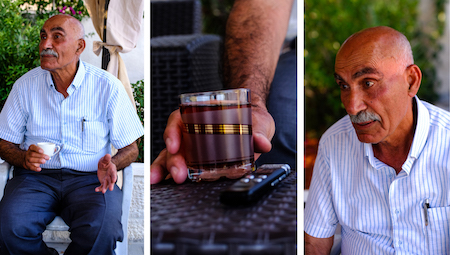
Yacoub Odeh, Nakba survivor and head of the Lifta Cultural Heritage Protection Commission. Liebe Blekh | MintPress News
“I remember one day my mother was preparing the fire to heat our room, and then [the Zionist miltiias] began to shoot. My brothers began to cry, ‘Mama, mama! They’re shooting us!’ My mom took us inside the room in the corner and under a table to protect us,” Odeh said, recalling two stories of Lifta — the town’s beauty and charm and then its tragic fall.
“There is the beautiful life and then began the miserable life because of the occupation.”
Toward the end of February 1948, Odeh’s father put him, his siblings and his mother into a truck heading to Ramallah to escape the violence in Lifta. Odeh’s father stayed behind to defend the village from the Zionist gangs.
“We were only wearing the clothing we had on because we are coming back tomorrow. We are coming back. Now we just want to be far from the shooting.” Odeh took a deep sigh and said, “In one hour, we became refugees.”
Today, 55 buildings out of approximately 450 remain in Lifta, including a club, mosque, cemetery and school, which now operates as a school for Israeli Jews. Liftawi refugees are estimated at around 30,000 and live in Jerusalem, the Occupied West Bank and the Diaspora. Most of the homes are empty, but a few are occupied by Israeli settlers. According to Zochrot, the Israeli nonprofit seeking to raise awareness of the Nakba, the “settlements of Mey Niftoach and Giv’at Sha’ul were built on village lands and now have become parts of the suburbs of Jerusalem.”
Saving Lifta
The Save Lifta Coalition orchestrated the campaign to the mayor and has been organizing since 2010 against Plan 6036. The organization spent five years working with scholars, activists, conservation specialists and higher education professionals to develop an alternative to 6036.
Their proposal aims to “expand the area of the national park and turn the village into a natural urban space for the adjacent neighborhoods,” while preserving Lifta’s cultural landscape.
The World Monuments Fund added Lifta to its list of endangered sites in 2018 and UNESCO added the village to its tentative list of world heritage sites.
‘Not something we can discuss now’
When asked about the plan’s responsibility regarding the right of return for Palestinians, Golan-Agnon said, “our plan is a plan to save Lifta as it is for the future generations to decide upon its fate.” She explained:
Many of us [in the coalition] do think there should be a right of return for Palestinians but we know it’s not something we can discuss now. So we say, it’s beautiful, keep it open, and then one day there can be a decision about what happens and who’s coming.
Dana Amawi’s grandmother grew up in Lifta and was expelled from the village in 1948. Now the family lives in Amman, Jordan. The 20-year-old said she was shaken to her core upon hearing the news of the sale. “Lifta symbolized a tiny, very small bit of hope that maybe we will be able to return to it,” Amawi told MintPress. “And now to think that other people might live in the house that I have the right to be in, it’s very sad.”

A Palestinian woman holds a partially eaten fig picked from a tree in Lifta. Liebe Blekh | MintPress News
Amawi said that her grandmother fell ill after learning of the auction. “She got sick. She had a fever and she was really, really sad because to her, this is where she grew up. This is where her earliest memories are and this is where she has the right to be,” Amawi said.
Stone houses like the one Odeh spent his early childhood in now crumble from neglect. The walls are sprayed with graffiti and piles of trash line the floors. On Shabbat (the Jewish sabbath), you’ll often find Israelis bathing in the spring’s waters.
Aseel AlBajeh, advocacy officer and legal researcher at the Palestinian human rights organization Al-Haq, visited Lifta in 2018. Her grandmother, who lives in Ramallah, is from Lifta. “It was a painful experience,” AlBajeh said of her time in Lifta. “I wasn’t sure if I wanted to come back to Lifta in this situation.”
‘You are here as a visitor’
During her visit, AlBajeh tried recalling her grandmother’s memories of a flourishing Lifta, but she said those stories were disrupted by the fact that she’s only in Lifta because of a permit she received from the Israeli government to enter 1948-occupied Palestine or modern-day Israel from the West Bank. “You are here as a visitor. It’s like it’s not a place where you belong, or this is what [the Israeli government] intends for refugees to feel like,” AlBajeh said. “Settlers were swimming in the spring of the village and they were blasting loud music, and it also disrupted my ability to even imagine Lifta as Palestinian.”

Israeli settlers in Lifta hold a middle finger to a group of Palestinian children. Blekh | MintPress News
To help her reclaim Lifta, AlBajeh took a small piece of the village’s remains during her visit. She collected a broken tile painted with traditional designs from one of the house’s floors, knowing this might be the last physical object she can have of Lifta.
“Lifta is a witness of what happened during the Nakba,” AlBajeh said, explaining:
We have this connection as Palestinians, and when we see the cactus plants, we connect this as evidence that displacement happened here. And if you go to Lifta, you’ll see the huge amount of cactus. So even if the houses remain and [Israel] tries to remove the cactus, it’s still painful… It’s not about the stones or about the trees. It’s about the whole identity of Lifta and the Palestinian history, which we still connect to. “
‘We were kings in our village’
Odeh’s memories paint Lifta as an idyllic place, an oasis carved into the steep slopes of Jerusalem where life was carefree and bountiful. “We were kings in our village,” Odeh said. “Everything we need, we had — a life so simple. We didn’t need cinema or computers, no, everything we needed came from our land.”
But the minute Odeh and his family became refugees, their resources became scarce. “At that time there were no charitable associations or agencies ready to help,” Odeh recalled. “You know what Nakba means? Nakba does not mean to destroy homes. No, Nakba means to destroy the life — economic life, social life, educational life, political life. They destroyed our life.”
Upon reminiscing about Lifta, Odeh said his dream is to go back home:
I miss my childhood. Palestinian children have lost their childhood life to play like children, to go to the theater, to concerts, to football. No, until now we have house demolitions, we have arrests, we have land confiscation and killings. Every day we have events like these — if not my family, my neighborhood.”
Israeli forces demolish water pond in northern Jordan Valley
WAFA – July 12, 2021
JORDAN VALLEY – Israeli forces today demolished a water pond near Bardala village in the northern Jordan Valley, according to sources.
Moataz Bsharat, an activist, told WAFA that the Israeli forces escorted a bulldozer to the village, where the heavy machinery tore down the 250-cubic-meter pond, which was used for agricultural purposes and belonged to Samer Sawaftah. The pool was a donation from the Ministry of Agriculture.
Meanwhile, Israeli forces seized a caravan, east of Yatta, south of Hebron.
Coordinator of the Popular Anti-Wall and Settlement Committees, Rateb Al-Jabour, stated that the Israeli forces seized a caravan used to serve as a physical and mental health clinic in Zweidin area, east of Yatta.
The clinic used to provide medical support and treatment to more than 1,200 residents of the area.
Under international law, driving residents of an occupied territory from their homes is considered forcible transfer of protected persons, which constitutes a war crime. But residents of Palestinian communities in the Jordan Valley are no strangers to such disruptive Israeli policies.
The valley, which is a fertile strip of land running west along the Jordan River, is home to about 65,000 Palestinians and makes up approximately 30% of the West Bank.
Since 1967, when the Israeli army occupied the West Bank, Israel has transferred at least 11,000 of its Jewish citizens to the Jordan Valley. Some of the settlements in which they live were built almost entirely on private Palestinian land.
The Israel military has also designated about 46 percent of the Jordan Valley as a closed military zone since the beginning of the occupation in June 1967, and has been utilizing the pretext of military drills to forcefully displace Palestinian families living there as part of a policy of ethnic cleansing and stifling Palestinian development in the area.
Approximately 6,200 Palestinians live in 38 communities in places earmarked for military use and have had to obtain permission from the Israeli authorities to enter and live in their communities.
In violation of international law, the Israeli military not only temporarily displaces the communities on a regular basis, but also confiscates their farmlands, demolishes their homes and infrastructure from time to time.
Besides undergoing temporary displacement, the Palestinian families living there face a myriad restrictions on access to resources and services. Meanwhile, Israel exploits the resources of the area and generates profit by allocating generous tracts of land and water resources for the benefit of settlers.
Israeli politicians have made it clear on several occasions that the highly strategic Jordan Valley would remain under their control in any eventuality.
Top UN expert: “Israeli settlements do amount to a war crime”
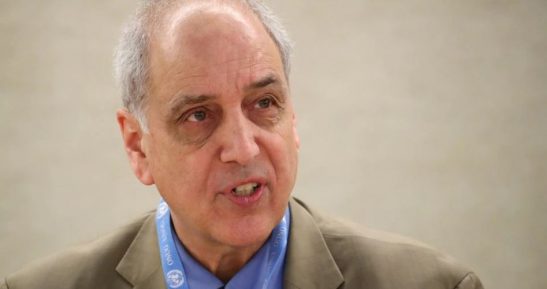
Palestine Information Center – July 10, 2021
GENEVA – A high-level UN human rights expert has called for Jewish settlements to be classified as a war crime, urging the international community to hold Israel accountable for a practice it has long considered illegal.
Presenting his latest report to the UN Human Rights Council in Geneva, Michael Lynk, the UN special rapporteur on the rights situation in the occupied Palestinian territories, said he examined whether the Israeli settlements were in violation of the absolute prohibition against “settler implantation” in the 1998 Rome Statute of the International Criminal Court and concluded that “the Israeli settlements do amount to a war crime.”
Talking about the human rights situation in Palestine recently, he said that in east Jerusalem, Jewish settler groups sought to evict Palestinian families from their homes, pointing out that under the Fourth Geneva Convention, forcible transfer of a protected population was prohibited, and the occupying power is forbidden from applying its own laws to the occupied territory.
“I submit to you that this finding compels the international community … to make it clear to Israel that its illegal occupation, and its defiance of international law and international opinion, can and will no longer be cost-free,” Lynk told the Geneva rights council.
Lynk said Israel’s demolition of Bedouin tent dwellings in a village in the West Bank on Wednesday left residents without food or water in the heat of the Jordan Valley, calling it “both unlawful and heartless”.
“Progressive seizure of Palestinian lands together with the protection of the settlements is a further consolidation of Israel’s de facto annexation of the West Bank,” he said.
There are nearly 300 settlements in east Jerusalem and the West Bank, with more than 680,000 Jewish settlers, Lynk noted.
The settlements have become “the engine of Israel’s 54-year-old occupation, the longest in the modern world”, he added.
He stressed the need for international action, not just words, in order to resolve the situation in Palestine.
“As long as the international community criticizes Israel without seeking consequences and accountability, it is magical thinking to believe that the 54-year-old occupation will end and the Palestinians will finally realize their right to self-determination,” he said.
A few days ago, the Israeli occupation army blocked the delivery of aid to Palestinians whose homes were demolished in the northern Jordan Valley and asked a UN aid team to leave the area, UN humanitarians said on Thursday.
The razing of 27 residential and animal structures and water tanks on Wednesday in the Palestinian herding community of Humsa al-Bqai’a was the first of its kind since February, the UN Office for the Coordination of Humanitarian Affairs (OCHA) said.
The Israeli army’s civil administration and forces also confiscated, among other things, food, milk for children, clothes, hygiene materials and toys during the demolition campaign.
The action involved 11 homes for about 70 people, including 36 children, the office said. Animals had no fodder and water as well.
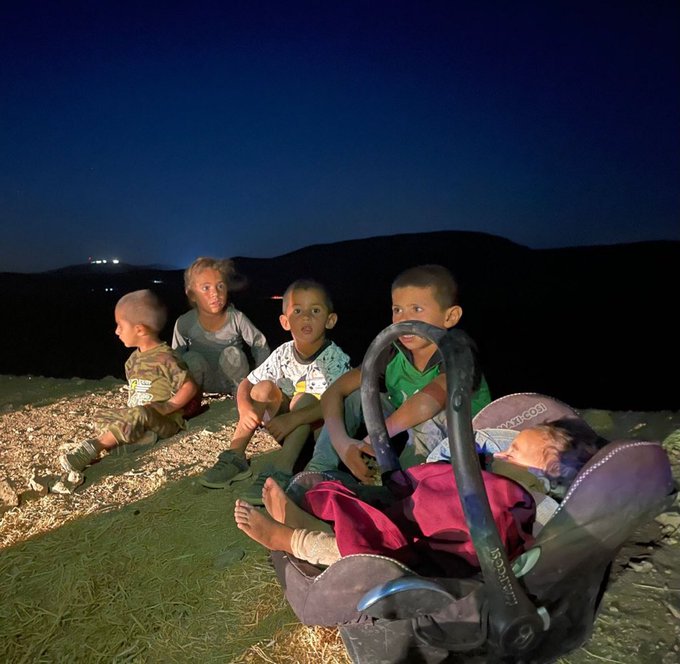
Representatives of OCHA and humanitarian partners visited the community Wednesday evening, but the army on Thursday asked them to leave.
The community rejected a proposal from the Israeli army to move it to a different location, OCHA said, adding that the army moved the residents’ belongings to the proposed site.
Humanitarians said 11 structures donated as humanitarian aid in February following similar demolitions were destroyed or seized by the army during Wednesday’s raid.
“The repeated destruction of their homes and property, including assistance provided by the humanitarian community is having a devastating economic, social and traumatic impact on the community, particularly children,” OCHA warned.
UN secretary-general Antonio Guterres voiced his deep concern over the demolition of property in the herding community, Stephane Dujarric, the chief spokesman for Guterres, stated.
“He reiterates his call on the Israeli authorities to cease demolitions and seizures of Palestinian property in the occupied West Bank,” Dujarric added in a regular briefing.
“Such actions are contrary to international law and could undermine the chances for the establishment of a viable, contiguous Palestinian state,” he read a statement issued by Guterres.
CDC Adds Over 2000 Deaths Associated with COVID-19 Shots in One Week & 917 Unborn Baby Deaths
By Brian Shilhavy | Health Impact News | July 9, 2021
The U.S. CDC released more data today in their Vaccine Adverse Event Reporting System (VAERS), a U.S. Government funded database that tracks injuries and deaths caused by vaccines, and they added more than 2000 deaths following COVID-19 shots over what they reported last week.
Last week they were reporting 6,985 deaths, and this week that number jumped up to 9,048.
This is by far the largest increase of recorded deaths in one week since they started reporting deaths following COVID-19 shots.
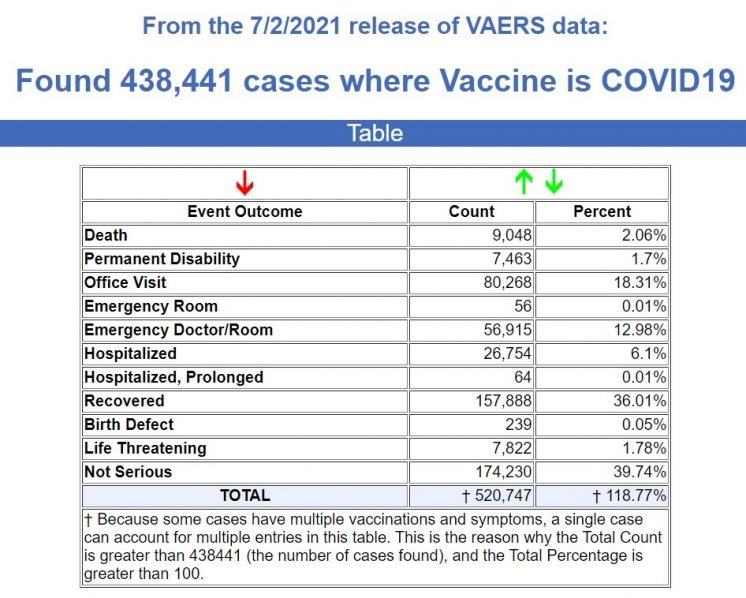
Source
Besides the 9,048 deaths, there are 7,463 permanent disabilities, 56,971 Emergency Room visits, 26,818 Hospitalizations, and 7,822 Life Threatening injuries following the COVID-19 injections.
And yet, none of this government data will be reported in any corporate media news broadcast, and those who try to post it on the Big Tech social media sites will be flagged for “fake news” by the “fact checkers.”
These are not even the true numbers, as the CDC selectively chooses what to release to the public each week, and of course many deaths and injuries go unreported because the public is conditioned to believe that none of these deaths and injuries have anything to do with the COVID-19 shots.
To put this into perspective, there are now 30% more deaths recorded in 7 months since the launch of the COVID-19 shots in December of 2020, than during the entire 31-year history of VAERS recording deaths following vaccines since it started in 1990.
1990 to November 2020: 6,145 deaths following ALL VACCINES. (Source.)
December 2020 to July 2, 2021: 9,048 deaths from COVID-19 shots only. (Source.)
Deaths of Unborn Babies Much Higher than Originally Thought
Last week we reported 622 deaths of unborn children when the pregnant mother received a COVID-19 injection. Using the same search parameters, that number increased to 803 cases this week. (Source.)
However, deaths recorded in the age group of 12-15 have not really increased yet according to the data that the CDC is releasing, so I began to look at the deaths in the “unknown” age group to see if there were some there. I did find a couple, but what I also found was that there were other “symptoms” that the VAERS data uses that do NOT include the term “abortion” when reporting deaths of unborn children in pregnant mothers who took the shots.
So I noted those symptoms, such as “Foetal death, Premature baby death, Stillbirth,” etc., and the deaths increased from 803 to 917. (Source.) And it is very possible I am still missing some, not to mention the ones that never get reported, or if they are reported, are not released by the CDC.
Of the 9,048 deaths the CDC recorded, 3,073 of those deaths are listed as age “unknown.” (Source.)
Trying a few different searches among this “unknown” age group, I did find a 13-year-old boy who died, and a curious entry of an 11-year-old girl who died and where the “family who got vaccinated died along with their dog due to have been being exposed to the members who got vaccinated.”
VAERS ID: 1440065 – Write-up: died three days after Covid vaccination; Autopsy showed enlarged heart and fluid surrounding the heart; Autopsy showed enlarged heart and fluid surrounding the heart; This is a spontaneous report from a contactable consumer or other non-health care professional in response to mail sent regarding the confirmation of below mentioned query. A 13-year-old male patient received second dose of bnt162b2 (PFIZER-BIONTECH COVID-19 mRNA VACCINE, Formulation: Solution for injection, Batch/Lot number and Expiration date not reported) via an unspecified route of administration in an unspecified anatomical location on an unspecified date as single dose for COVID-19 immunisation. The patient medical history and concomitant medications were not reported. The patient previously received first dose of bnt162b2 (PFIZER-BIONTECH COVID-19 mRNA VACCINE, Formulation: Solution for injection, Batch/Lot number and Expiration date not reported) via an unspecified route of administration in an unspecified anatomical location on an unspecified date as single dose for COVID-19 immunisation. On an unspecified date, the patient after receiving his second Covid vaccine from Pfizer died three days later. The patient underwent lab tests and procedures which included autopsy: enlarged heart and fluid surrounding the heart caused by the Covid vaccination. The outcome of the events was fatal. No follow-up attempts are possible; information about lot/batch number cannot be obtained.; Reported Cause(s) of Death: enlarged heart and fluid surrounding the heart.
VAERS ID: 1320319 – Write-up: Girl”s family who got vaccinated died along with their dog due to have been being exposed to the members who got vaccinated; 11 year old, pre-period, girls family who got vaccinated; This is a spontaneous report from a contactable consumer. A 11-years-old patient of an unspecified gender received BNT162B2 (PFIZER-BIONTECH COVID-19 VACCINE), via an unspecified route of administration on an unspecified date (Batch/Lot number was not reported) as single dose for covid-19 immunisation. The patient medical history and concomitant medications were not reported. The reporter reported that 11 year old, pre-period, girls family who got vaccinated died along with their dog due to have been being exposed to the members who got vaccinated. The patient died on an unspecified date. It was not reported if an autopsy was performed. The lot/batch number has been requested; Reported Cause(s) of Death: Girl”s family who got vaccinated died along with their dog due to have been being exposed to the members who got vaccinated.
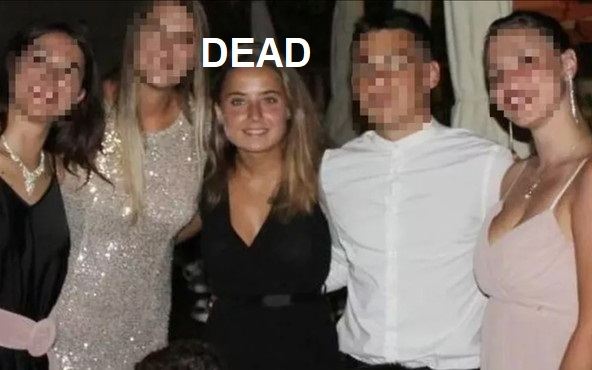
18-year-old Camilla Canepa died in Italy following the AstraZeneca COVID-19 shot
Neurosurgeon Who Operated on 18-year-old Girl: “I had never seen a brain reduced in those conditions by a thrombosis so extensive and so serious”.
On June 15th this year we published the story of Camilla Canepa, the 18-year-old Italian woman who developed blood clots and was dead two weeks after experimental AstraZeneca shot. The full story was originally published on The COVID Blog.
Her death shocked the community where she lived so much, that a criminal investigation was started, and Italy changed its policy on the AstraZeneca COVID-19 shot limiting it to only people over the age of 60.
The neurosurgeon who operated on her brain has since spoken out, and English translations of what he stated have been circulating through the alternative media this week.
I found an original source from Italy that reported this, and here is the translation, courtesy of DeepL.
The death of Camilla Canepa has shocked the whole of Italy, so much so that after the death of the 18-year-old girl from Sestri Levante as a result of thrombosis emerged a few days after the administration of the vaccine AstraZeneca the Ministry of Health has decided to ban the product against Covid to those under 60 years.
Waiting for the autopsy on the body of the young woman that will be carried out on Tuesday, to speak to La Stampa is Gianluigi Zona, director of the neurosurgical and neurotraumatology clinic of the San Martino Hospital in Genoa: “I had never seen a brain reduced in those conditions by a thrombosis so extensive and so serious”.
“Reasoning in retrospect – explains the doctor on the controversy for the lack of immediate intervention on Camilla – it’s all easy and everyone is a world champion, the last doctor who comes to see a patient is always the smartest.
I can’t judge what could have been picked up already in the first CT scan, it never arrived at San Martino. Normally, if there are no clues that lead to assume something serious is going on, no doctor in the emergency room prescribes a CT scan with contrast or other tests.”
The situation was immediately serious once the operation began: “All the venous sinuses were blocked by thrombi, a scenario that I had never seen in many years of this profession. You have to imagine the venous sinus as the river in the middle of a valley in which several streams converge.
If you build a dam in the middle of the river, the river swells and at that point the tributaries cannot discharge, with the result that the upstream pressure rises. In front of the picture I saw in the head of that girl, it is clear that – concludes the head physician – we are facing something not normal”. (Source.)
Iran: Israel legally, politically responsible for fate of diplomats kidnapped in Lebanon

Press TV – July 4, 2021
Iran’s Foreign Ministry says Israel and its supporters are politically and legally responsible for the fate of four Iranian diplomats kidnapped in Lebanon in 1982.
“Since the Zionist regime occupied Lebanon in 1982, it bears political and legal responsibility for the abduction of [Iranian] diplomats and the Zionist regime and its terrorism-sponsoring supporters are liable for this measure. Unfortunately, the Zionist regime has not been accountable in this case, and this is why the process of revealing facts and various aspects of this incident has been so slow,” Iran’s Foreign Ministry said in a statement on Sunday, which marked the 39th anniversary of the abduction of the four diplomats.
On July 4, 1982, the year Israel invaded Lebanon, Ahmad Motevasselian, Seyyed Mohsen Mousavi, Taqi Rastegar Moqaddam and Kazem Akhavan were kidnapped by a group of gunmen backed by Israel at an inspection post in northern Lebanon.
“The Islamic Republic of Iran has repeatedly announced that there is evidence to prove that the [kidnapped] diplomats were handed over to Israeli forces after the abduction and were subsequently transferred to the Zionist regime’s prisons,” the statement read.
Iran, it added, has gone to great lengths since the abduction, given the humanitarian, legal and political dimensions of the criminal incident, and has put on its agenda the pursuit of the issue through regional and international avenues.
The ministry once again called on the United Nations secretary general as well as international and human rights organizations, including the International Committee of the Red Cross (ICRC), to pay more serious attention to the abduction of its diplomats by Israel.
In a letter to Secretary General Antonio Guterres in July 2020, Iran’s Ambassador to the UN Majid Takht-Ravanchi said Tehran believes the diplomats were handed over to Israeli forces immediately after the abduction in a region controlled by Israel at the time.
“Evidence shows they have been held in Israeli prisons, and are still alive,” the Iranian envoy said.
Featured Video
No Vote, No Representation, No State: Democracy, Israeli Style
or go to
Aletho News Archives – Video-Images
From the Archives
Sanctions, War and the Policy of Dual Containment
By SASAN FAYAZMANESH | March 17, 2008
It is now nearly three decades since the Unites States adopted the policy of dual containment of Iran and Iraq. While much has been written about the containment of Iraq, there has been very little in-depth analysis of this policy when it comes to Iran. In a book that is going to be released on March 31, 2008, entitled The United States and Iran: Sanctions, Wars and the Policy of Dual Containment (Routledge), I attempt to address this shortcoming by investigating when and why the US policy of containment of Iran came about, how it evolved, and where it stands today.[1] To the extent that Israel has been involved in US policy making, the study will also include the role that Israel has played in the containment of Iran. Also, since the fate of Iran has been inextricably linked to that of Iraq, occasionally the investigation will overlap with the containment of Iraq.
The policy of dual containment of Iran and Iraq originated during the Carter Administration, but it was not until the Clinton Administration that the expression “dual containment” became popular. … continue
Blog Roll
 Aletho News
- Americans are paying the price to preserve Israel’s nuclear hegemony
- Resistance factions are necessary to ensure a permanent US Iraq withdrawal
- How Israel destabilizes the Middle East: Denying sovereignty and the right to exist
- Europe’s Establishment Is Embracing War – and Losing Voters
- NATO chief advocates war of aggression
- No Vote, No Representation, No State: Democracy, Israeli Style
- Zionist Bought Senate Blocks Information About American Citizens Killed By Israel
- While Gaza dominates the UN, these are the people keeping it alive
- New Report: “Scholasticide and Genocide in Gaza: Assessment, Testimonies and Legal Analysis”
- ‘THAAD Delusion’: Iran war exposes US missile shield limits – The Atlantic
- If Americans Knew
- Israeli former leaders and security chiefs threaten legal action over ‘Jewish terrorism’
- Israel map in LA Times ad includes all land from the river to the sea
- Inside Lebanon’s 200-page dossier on Israeli war crimes
- Flydubai, genocide, settler violence, Trump abuse of power to deport – Daily Update
- Counting Antisemitic Incidents: What the ADL Audit Reveals — and Obscures
- Mamdani releases plan to combat antisemitism and hate crimes in New York City
- Iran’s Revolutionary Guards Publish Letter to the American People
- DMFI launches $1 million ad campaign supporting Virginia’s Elaine Luria
- US Senate blocks resolution seeking report on Americans killed by Israel
- Israeli Attacks Kill Ten Palestinians in Gaza
- No Tricks Zone
- Green Energy Debacle: German Expert Professor Fritz Vahrenholt Warns Of Severe Economic And Social Consequences
- Two More Paleo Reconstructions Affirm Meters-Higher Sea Levels Across Ireland, Brazil 7000-6000 Years Ago
- New Study: Earth And Venus Surface Warmth Largely Explained By Convection And Lapse Rate, Not CO2 Or Radiation
- 2025 Nature Paper Claiming Worsening Global Drought Gets RETRACTED …Heavily Flawed
- New Study: ‘Global Drought Shows No Detectable Recent Acceleration Under Climate Warming’
- Economic Masterminds: German Socialists Suggest Taxing Productivity Gains Stemming From Using AI
- The South China Sea Has Not Been Cooperating With The Climate Change Narrative
- Energy Crisis: Germany Enters Heating Season With Historically Low Gas Reserve Fill Levels
- New Study: The Antarctic Ice Sheet Gained Mass From 2020-2024 Due To Staggering Snow And Ice Accumulation
- Study: Ocean Heating Rates From Thousands Of Years Ago ‘Dwarf’ Modern Ocean Heating Rates

