Crocodile Tears for Women’s Rights in Afghanistan
By Jacob G. Hornberger | FFF | September 2, 2021
Interventionist dead-enders are crying crocodile tears over the Taliban’s defeat of the Pentagon and the CIA in Afghanistan because, they say, women’s rights are not likely to be protected by the Taliban.
 Oh?
Oh?
Well, now let’s see. According to the Watson Institute at Brown University, civilian deaths in Afghanistan and Pakistan from 2001 to date exceed 70,000 people.
We don’t know how many of those dead people were women but we can safely assume that a large percentage of them were.
How many of those dead women would have been able to exercise “women’s rights” if the Pentagon and the CIA had won the war?
Answer: None of them. At the risk of belaboring the obvious, women who are dead cannot exercise “women’s rights.”
The interventionist dead-enders would say that those deaths were “worth it” because the women who survived the invasion and occupation would then have been able, with a U.S. military victory, to exercise “women’s rights.”
But where do the Pentagon and the CIA get the moral authority to sacrifice tens of thousands of innocent lives — or even just one innocent life — in order that others will have the potential opportunity to exercise “women’s rights”?
Throughout the 20 years of the Afghanistan war, there was a strange and callous indifference to the people who were being killed in Afghanistan. It’s a reflection of what the national-security state way of life has done to the consciences of the American people. We actually don’t even know the exact number of civilians who were killed. That 70,000 is just an estimate. That’s because early in the conflict, U.S. officials made a conscious decision not to count the Afghan dead. What mattered was the number of U.S. soldiers who were being killed, not the number of Afghans being killed.
In Sunday services in Christian churches across America, ministers would exhort their congregations to “pray for the troops” and “thank them for their service.” Hardly ever would American Christian churchgoers be asked to pray for the people, including women, who were being killed by the troops as part of their “service.” Those lives just didn’t matter.
The interventionist mindset with respect to “women’s rights” was always based on a mathematical calculation. This mindset held that in the quest to establish a regime that protected “women’s rights,” it was morally acceptable to kill some number of Afghan women (and men). The idea was that it was morally permissible to sacrifice the lives of some for the benefit of others.
Moreover, there was never an upward limit on the number of Afghan women (and men) who could be sacrificed for the greater good of “women’s rights.” 70,000? 100,000? 250,000? It didn’t matter. What mattered to the interventionist dead-enders is that a U.S. puppet regime be installed that would protect “women’s rights” for those who weren’t killed by the violence entailed in installing and maintaining such a regime in power.
Think about all the wedding parties that U.S. forces bombed during the 20 years of conflict. Dead brides. Dead mothers of the brides. Dead mothers of the grooms. Dead sisters of the brides and grooms. Dead flower girls. Dead bridal assistants. None of them would be around at the end to celebrate a U.S.-installed regime that protected “women’s rights.” But it was all considered worth it because those who weren’t killed would be able to exercise “women’s rights.”
It’s one thing for people to deliberately sacrifice themselves in what they consider is a grand and glorious cause.
It’s quite another thing to knowingly and intentionally kill innocent people so that others can experience “women’s rights.” It would be difficult to find a more evil notion than that.
Recent drone strikes in Afghanistan prove ‘Over-the-horizon’ is just a buzz phrase for US incompetence
By Scott Ritter | RT | August 31, 2021
Following the Kabul airport attack, the US military conducted two “over-the-horizon” air strikes against suspected ISIS-K targets. The results inspire zero confidence in the efficacy of this approach toward counterterrorism.
The August 26 suicide bombing outside Hamid Karzai International Airport in the Afghan capital killed more than 150 people, including 13 American troops. The Islamic State-Khorasan, or ISIS-K, claimed responsibility for the attack.
That night, in a televised address to the American people, President Joe Biden declared “We will not forgive. We will not forget. We will hunt you down and make you pay,” adding that the US “will respond with force and precision at our time, where we choose and when we choose.”
The next day, August 27, the US carried out what it termed an “over-the-horizon” attack against an ISIS-K “planner” and “facilitator” at a home in the city of Jalalabad in Nangarhar Province in eastern Afghanistan, killing both men and, according to the US, wounding a third accomplice.
US defense sources sources said the men were killed by a special variant of the Hellfire missile, known as the R9X, or ‘flying Ginsu’, a reference to the six blade-like devices which emerge from the missile, killing its target by cutting it to shreds in lieu of the normal high explosive payload carried by the Hellfire. The R9X was developed specifically to handle situations such as the one in Jalalabad, where legitimate targets have taken refuge among a civilian population.
According to reports, the “planner” and “facilitator” were traveling in a three-wheeled vehicle common to the region as public transportation. The men were tracked by an MQ-9 ‘Reaper’ drone which maintained sufficient “eyes and knowledge” of the target to confirm their identities. The three-wheeled vehicle entered a compound believed to be the home of the “planner.” Reportedly, US personnel monitoring the live video images coming from the MQ-9 drone waited until the planner’s wife and children left the compound before launching the ‘flying Ginsu’.
“Initial indications are that we killed the target,” a CENTCOM spokesperson said. “We know of no civilian casualties.” The strike was reportedly authorized by President Biden and ordered by Secretary of Defense Lloyd Austin.
The US assertions about casualties were contradicted by a Jalalabad community elder, Malik Adib, who declared that three people were killed and four were wounded in the drone strike, noting that “women and children are among the victims.”
If the statements of Malik Adib are to be believed, then something went very wrong with the analysis of the imagery used to justify the launching of the missile. While no one has questioned the validity of the US claims that the targets struck were in fact affiliated with ISIS-K (while keeping in mind the US has provided no evidence that corroborates its claim that they were, in fact, ISIS-K operatives), either someone is lying about waiting for the wife and children to leave, or there were other civilians in the vicinity of the attack, one of whom was killed.
Before the media could press the Pentagon about the apparent inconsistencies in the official US account, however, the US launched a second drone strike, this time targeting a vehicle in Kabul, eliminating “an imminent ISIS-K threat” to Hamid Karzai International Airport. According to US officials, the existence of a “large secondary explosion” at the scene of the attack confirmed the assessment about the existence of a car bomb. It is not known if the US used a conventional Hellfire or one of the non-explosive RX9 variants in the attack.
According to unnamed defense sources, the alleged ISIS-K operatives inside the vehicle had been observed placing what was assessed to be a considerable amount of explosives in the trunk of a white Toyota Corolla, before driving the vehicle into the driveway of a home located near the airport. The decision was made to strike, resulting in the destruction of the vehicle. US officials claimed that at least one ISIS-K suicide bomber was killed in the incident. Allegedly, nine civilians also perished as a result of the attack.
“We are aware of reports of civilian casualties,” Major General William Taylor, a spokesperson for the Joint Staff, told the media on Monday. “We take these reports extremely seriously.”
The driver of the vehicle, Zemari Ahmadi, did not fit the profile one would expect of an ISIS-K suicide bomber. Zemari worked for an American-based charity called Nutrition and Education International.
According to his family, he was on his way home from work after dropping off colleagues on Sunday evening. As he pulled into the driveway of his home, where he lived with three brothers and their families, the children of his relatives ran out to greet him. The missile believed to be launched by the American drone struck the rear of the vehicle, killing Zemari and nine others, including seven children, the youngest of whom was two years old. Also killed was Zemari’s nephew, Ahmad Naser, who had previously served as a guard at a US military facility in Herat, and who was awaiting final approval of his Special Immigrant Visa paperwork so that he could leave Afghanistan.
“No military on the face of the Earth works harder to avoid civilian casualties than the United States military,” Pentagon spokesman John Kirby said after reports emerged about possible civilian casualties. “We take it very, very seriously. And when we know that we have caused innocent life to be lost in the conduct of our operations, we’re transparent about it.”
Kirby went on to suggest that the civilians were killed as a result of the detonation of the explosives alleged to have been contained in Zemari’s vehicle. At a later press conference, Kirby maintained this position, but refused to release any imagery that would sustain his contention of a powerful secondary explosion.
The drone strike that killed Zemari Ahmadi and his relatives represented the very scenario the Biden administration was trying to avoid when setting up the “over-the-horizon” strike capability used in the two responses to the suicide-bomb attack on Kabul Airport.
Back in April, when the totality of the failure that was to mark the US withdrawal from Afghanistan remained unknown (although not unknowable – many military and intelligence professionals anticipated the collapse of the Afghan government, but the Biden White House overrode their concerns in favor of better “optics”), General Frank McKenzie, the Marine commanding US Central Command, responsible for all US forces deployed in the Middle East, Central and South Asia, testified before Congress about his command’s efforts to conduct “over-the-horizon” counterterrorism missions once the US drawdown in Afghanistan was completed.
CENTCOM had a long history of conducting “over-the-horizon” (OTH) operations in support of its counterterrorism mission, using a mix of special operations commandos (i.e., the Bin Laden and Abu al-Baghdadi assaults), manned aircraft (the airstrikes against pro-Iranian militias in Syria and Iraq), and drone strikes, such as that carried out against Qassem Soleimani at Baghdad International Airport in January 2020.
“I don’t want to make light of it, I don’t want to put on rose-colored glasses and say it’s going to be easy to do,” McKenzie told the House Armed Services Committee. Any OTH operations in Afghanistan in a post-US drawdown, McKenzie noted, would require significant intelligence support at a time when US intelligence collection capabilities in Afghanistan were diminished to the point of non-existence. “It will be harder to do that, it is not impossible.”
The bulk of the burden of maintaining this OTH capability would fall on the US system of armed drones, which in the past operated from bases inside Afghanistan, providing them with greater reaction time and longer loiter time over the target. Any post-Afghanistan operation of drones in support of OTH operations would mean operating from bases outside of Afghanistan.
According to acting Air Force Secretary John Roth, the US planned on using existing bases in the region to host the drones, noting that the US operated from Al Udeid Air Base in Qatar, Al Dhafra Air Base in the United Arab Emirates, and Kuwait’s Ali Al Salem and Ahmad al-Jaber air bases. The cost of maintaining this OTH capability for fiscal year 2022 was expected to run somewhere around $10 billion.
The Biden White House engaged in a policy review of OTH operations, temporarily placing limits on counterterrorism drone strikes and commando raids, and tightening the approval process for such missions, which had been loosened under the Trump administration.
Biden, according to press reports, was particularly sensitive to the need to limit civilian deaths as it looked into how it would respond to future terrorist threats from Afghanistan and elsewhere in the Middle East. The decision was made to continue the program of drone-based assassination/pre-emptive killing but restrict the ability of field commanders to make the final decision, instead requiring White House permission before any OTH attack could occur.
The MQ-9 drones that were involved in the Jalalabad and Kabul drone attacks were operated out of Al Udeid Air Base in Qatar. The MQ-9 system, however, operates according to what the Air Force calls “remote split operations,” which employs a launch-and-recovery ground control station for takeoff and landing operations at Al Udeid, before passing control of the MQ-9 to a crew based out of Creech Air Force Base in Nevada, which takes control of the aircraft for the remainder of the mission using satellite communication links.
Traditionally, an MQ-9 crew consists of a pilot and a sensor operator, who employ what is known as the Multi-Spectral Targeting System, which integrates an infrared sensor, color/monochrome daylight TV camera, image-intensified TV camera, laser range finder/designator, and laser illuminator, all of which can be viewed together or separately on display screens set up in front of the crew.
The MQ-9 would usually operate as part of an overall “intelligence surveillance reconnaissance” (ISR) package which used a variety of intelligence collection resources to identify and track potential targets. The US drawdown in Afghanistan, however, eliminated most if not all of the supporting infrastructure normally available to the MQ-9 crew to discriminate targets. To help compensate for this loss of capability, the US Air Force developed a special signals intelligence (SIGINT) pod that could be carried by the MQ-9 that provided full-spectrum SIGINT capability to the drone operators, who could now search for, identify and track signals of interest, such as the cell phones, walkie-talkies or satellite phones that comprise the communications network of terrorist organizations like ISIS-K. To better employ this capability, the MQ-9 crew would be supplemented by a linguist who could listen in real time to any conversations of interest, helping with the evaluation of potential targets in terms of both identity and intent.
Intelligence, properly done, is a combination of art and science which requires those involved to be true subject matter experts in the mission they have been given. Imagery analysts need to understand not only what it is they are seeing, but also what it means. Likewise, linguists monitoring conversations need not only be fluent in the language, but adept at slang and other colloquialisms used by people in their daily conversations. For this reason, the best imagery analysts and intercept linguists have been doing their respective jobs for years and, in doing so, are adept at sifting out the unusual from the normal.
However, the airmen operating the MQ-9 most likely did not have this level of experience and expertise. By way of example, the vehicle Zemari Ahmadi was driving was allegedly tracked as “containers containing explosives” were loaded into its trunk. While there is no doubt that an imagery analyst witnessed items being loaded into the trunk of the vehicle, the key question is what was in those containers. Basic identification signatures for car bombs include the use of bags of fertilizer mixed with diesel oil placed in the trunk of a car. However, were the analysts trained to know that Afghanistan blocked the sale of fertilizer back in 2010 because of its extensive use as a bomb-making material, and that the terrorists instead began using potassium chlorate as the primary bomb making material, and that potassium chlorate is loaded into containers virtually identical to those used to store cooking oil?
Moreover, experienced terrorist operatives, which you would expect to be operating from inside Kabul, would anticipate that their communications are being monitored, and as such never use specific words or phrases that could trigger interest on the part of anyone listening in. As such, it is highly unlikely that Zemari or anyone he might have been communicating with would have spoken about explosives or the intent to build a car bomb. He might, however, state that he is picking up cooking oil. If an experienced linguist intercept specialist were listening in, he or she would be able to discern if this was part and parcel of normal activity, or a deviation from the norm. An inexperienced linguist, however, would not possess such insights, and be prone to reading into Zemari’s words content and intent that did not, in reality, exist.
It is unlikely the public will ever know the truth about what happened in Creech Air Base that led the MQ-9 crew to believe that their targets were affiliated with ISIS-K. Despite John Kirby’s assertions regarding transparency, the US military and intelligence community is loath to discuss the specifics regarding intelligence collection capabilities. Likewise, to what extent the extended chain of approval was involved in modifying these assessments as they made their way up the White House will likewise most likely remain secret, further shielding all involved from the kind of scrutiny that full transparency demands.
The Biden administration has placed its hopes for containing terrorism in a post-Afghanistan drawdown on “over-the-horizon” strike capabilities that the president and his supporters believe adequate for the task of identifying and interdicting terrorists before they can carry out an attack against US interests, all the while reducing the likelihood of unintended civilian casualties. If the experience in Afghanistan proves anything, it is that OTH is no panacea when it comes to counterterrorism.
It also underscores the reality that the US intelligence community and military is prone to see what it wants to see. The time-tested adage of “if the only tool available is a hammer, then every problem looks like a nail” holds true in every respect when it comes to OTH in a counterterrorism role: when the only tool available is an MQ-9 drone operated by crews who are not up to the task of properly identifying and tracking targets, then the only solution will be a Hellfire missile which, when employed, will more often than not kill innocent civilians.
Revealed, the vaccine safety alert that drugs watchdog is ignoring
By Sally Beck | TCW Defending Freedom | September 1, 2021
FOR nearly a decade, Dr Tess Lawrie, MBBCh, DFSRH, PhD, has run the Evidence-Based Medicine Consultancy, an independent company concerned with rigorous medical research in healthcare.
She produces reports that can be found in the Cochrane Library, a respected organisation providing unbiased scientific paper analyses.
Dr Lawrie is a frequent member of technical teams developing international guidelines in the healthcare sector, and her peer-reviewed publications have received more than 3,000 citations. In short, Dr Lawrie should not be ignored.
Unless of course you are the Medicines and Healthcare products Regulatory Agency, the deaf-eared UK body regulating the novel, experimental, and under-tested Covid-19 mRNA and traditional vaccines.
With vaccine-associated deaths passing 1,600 in Britain, the MHRA should suspend the vaccination programme, like it did after 47 deaths caused by the Pandemrix swine flu jab.
However, it has no intention of doing so and continues to insist that the vaccine is ‘safe and effective and the best protection against Covid-19’.
Dr Lawrie sent Dr June Raine, the MHRA’s chief executive, a 39-page, fully-referenced paper criticising the agency’s complicated Yellow Card Scheme, a government system designed to collate information about adverse events caused by new drugs, as ‘not fit for purpose.’
She reminded Dr Raine, and copied in 15 of her colleagues, that they had a duty to ‘take any necessary action to minimise risk to individuals, after weighing risks against expected benefits.’ She pointed out that because of omissions in their data collecting, such as age and gender, and the timeframe of reaction post vaccination, the Yellow Card Scheme is non-transparent.
She said: ‘These omissions mean that basic conclusions about safety cannot be drawn. Consequently, the public and trial participants are not fully informed of the potential risks of taking a Covid-19 vaccine and are unable to give fully informed consent.’
Dr Lawrie concluded that the voluntary reporting system needed a complete overhaul, saying the Vaccine Adverse Event Reporting System (VAERS) in the US was doing a much better job giving citizens and healthcare professionals detailed information.
From VAERS’ database, she was able to conclude that more than 90 per cent of deaths occurred afterfirst vaccination and there was a clear link between vaccination and death, something MHRA members frequently say they cannot prove and insist is more than likely ‘coincidental’.
Speaking of VAERS, Dr Lawrie said: ‘From that system it is apparent that sporadic event reporting is high in number, as in the UK, and that there is a tight temporal relationship between Covid-19 vaccination and deaths: 15 per cent of deaths occurring within 24 hours, 22 per cent within 48 hours and in 37 per cent of deaths, the patient became unwell within 48 hours of Covid-19 vaccination with an event that led to their death.
‘The deaths analysed followed an almost equal number of Pfizer and Moderna Covid-19 vaccinations, and 91 per cent of deaths occurred after administration of the first Covid-19 vaccine.’
With the AstraZeneca #clotshot, which has not been approved for use in the US, double the number of people are impacted compared with Pfizer.
Dr Lawrie said that, as well as vaccine-induced immune thrombotic thrombocytopaenia (VITT), the European Medicines Agency has identified Guillain-Barreì Syndrome as a potential risk from the AstraZeneca vaccine.
It is adding a warning to the product information that ‘vaccinated persons need to seek immediate medical attention if they develop weakness and paralysis in the extremities.’
In conclusion, Dr Lawrie asked Dr Raine a simple question, yet to be answered: ‘Why is this clear safety signal not being acted upon by MHRA?’
This is an updated report published on August 26, 2021, detailing MHRA Yellow Card Reporting up to August 18:
• Pfizer – 21.3million people, 37.9million doses. Yellow Card reporting rate, one in 199 impacted.
• AstraZeneca – 24.8million people, 48.7million doses. Yellow Card reporting rate, one in 108 impacted.
• Moderna – 1.4million people, 2.1million doses. Yellow Card reporting rate, one in 100 impacted.
Overall, one in 135 people experience a Yellow Card Adverse Event from the 47.5million injected (20.7million men, women and children remain not injected in UK).
The Yellow Card reporting rate may be approximately ten per cent of actual figures, according to MHRA.
Proportional to the number of weeks each brand has been administered, currently the reported toll is:
• Approximately 47 linked deaths reported per week
• More than 10,500 reported adverse event injuries per week with unknown long-term consequences.
A significant proportion of these adverse events require urgent medical care, may be life-changing or long-lasting. These figures represent immense distress for those 351,404 people suffering adverse events and their families.
Reactions: 302,146 (Pfizer) + 816,393 (AZ) + 43,949 (Moderna) + 3,148 (Unknown) = 1,165,636.
Reports: 107,215 (Pfizer) + 229,134 (AZ) + 14,019 (Moderna) + 1,036 (Unknown) = 351,404.
Fatal: 508 (Pfizer) + 1,056 (AZ) + 17 (Moderna) + 28 (Unknown) = 1,609.
Acute Cardiac: 4,831 (Pfizer) + 9,102 (AZ) + 495 (Moderna) + 35 (Unknown) = 14,463.
Pericarditis/Myocarditis (Heart inflammation): 362 (Pfizer) + 245 (AZ) + 65 (Moderna) + 2 (Unknown) = 674
Anaphylaxis: 466 (Pfizer) + 810 (AZ) + 32 (Moderna) + 1 (Unknown) = 1,309
Blood Disorders: 10,283 (Pfizer) + 7,354 (AZ) + 829 (Moderna) + 44 (Unknown) = 18,510.
Infections: 7,116 (Pfizer) + 18,102 (AZ) + 730 (Moderna) + 89 (Unknown) = 26,037
Herpes: 1,574 (Pfizer) + 2,475 (AZ) + 75 (Moderna) + 13 (Unknown) = 4,137.
Headaches: 21,646 (Pfizer) + 83,513 (AZ) + 2576 (Moderna) + 229 (Unknown) = 107,964
Migraine: 2,474 (Pfizer) + 8,015 (AZ) + 284 (Moderna) + 29 (Unknown) = 10,802.
Eye Disorders: 5,025 (Pfizer) + 13,718 (AZ) + 495 (Moderna) + 55 (Unknown) = 19,293.
Blindness: 99 (Pfizer) + 281 (AZ) + 12 (Moderna) + 4 (Unknown) = 396.
Deafness: 185 (Pfizer) + 360 (AZ) + 13 (Moderna) + 2 (Unknown) = 560.
Psychiatric Disorders: 6,135 (Pfizer) + 17,011 (AZ) + 884 (Moderna) + 74 (Unknown) = 24,104.
Skin Disorders: 21,263 (Pfizer) + 50,240 (AZ) + 6,657 (Moderna) + 211 (Unknown) = 78,371.
Spontaneous Miscarriages: 278 + 6 stillbirth/foetal death (Pfizer) + 195 + 2 stillbirth (AZ) + 24 + 1 foetal death (Moderna) + 1 (Unknown) = 499 + 9 (figures imply 20 related maternal deaths – four more this week alone).
Vomiting: 3,242 (Pfizer) + 11,347 (AZ) + 496 (Moderna) + 41 (Unknown) = 15,126.
Facial Paralysis including Bell’s Palsy: 691 (Pfizer) + 860 (AZ) + 48 (Moderna) + 5 (Unknown) = 1,604.
Nervous System Disorders: 52,947 (Pfizer) + 173,935 (AZ) + 6788 (Moderna) + 600 (Unknown) = 234,270.
Strokes and CNS haemorrhages: 496 (Pfizer) + 1,993 (AZ) + 17 (Moderna) + 9 (Unknown) = 2,515
Guillain-Barré Syndrome: 42 (Pfizer) + 388 (AZ) + 2 (Moderna) + 5 (Unknown) = 437.
Tremor: 1,288 (Pfizer) + 9673 (AZ) + 153 (Moderna) + 38 (Unknown) = 11,152.
Pulmonary Embolism and Deep Vein Thrombosis: 601 (Pfizer) + 2,696 (AZ) + 25 (Moderna) + 18 (Unknown) = 3,340.
Respiratory Disorders: 12,950 (Pfizer) + 27,425 (AZ) + 1,138 (Moderna) + 109 (Unknown) = 41,622.
Seizures: 713 (Pfizer) + 1,874 (AZ) + 119 (Moderna) + 9 (Unknown) = 2715
Paralysis: 301 (Pfizer) + 735 (AZ) + 39 (Moderna) + 6 (Unknown) = 1,081.
Haemorrhage (All types): 2,568 (Pfizer) + 4713 (AZ) + 321 (Moderna) + 24 (Unknown) = 7,626.
Vertigo/Tinnitus: 2,692 (Pfizer) + 6313 (AZ) + 271 (Moderna) + 25 (Unknown) = 9,301.
Renal & Urinary Disorders: 795 (Pfizer) + 2,507 (AZ) + 93 (Moderna) + 23 (Unknown) = 3,418
Reproductive/Breast: 17,108 (Pfizer) + 16,689 (AZ) + 2,215 (Moderna) + 120 (Unknown) = 36,132.
For full reports see Annex One.
US Drone Strike in Kabul Kills Nine Members of Single Family, Including 6 Kids
by Asya Geydarova – Sputnik – 30.08.2021
The death toll from a US airstrike that targeted a vehicle in the Afghan capital of Kabul on Sunday has gone up to nine, all members of the same family, a relative of those killed told CNN.
A brother of one of the dead told a journalist working with CNN on Sunday that they were “an ordinary family,” not affiliated with Daesh.
There are six children, including his four-year-old sister Armin, 3-year-old brother Benyamin, and two two-year-old sisters Ayat and Sumaya among those killed, the man said, as he reportedly cried.
Earlier, US central command spokesman Capt. Bill Urban said that a drone strike was carried out on Sunday on a vehicle in Kabul, eliminating a Daesh-K threat to the airport.
“We are still assessing the results of this strike,” Urban said, adding that “it is unclear what may have happened,” and the US military is investigating further.
Afghan media reported on Sunday that at least four children were killed in the airstrike that destroyed two vehicles and part of a residential building. CBS said that the size of the secondary explosion suggests that the US strike destroyed a fully loaded car bomb, and did not just kill a suicide bomber riding in the car.
On Saturday, US Army Maj. Gen. William Taylor said that two Daesh-K leaders were killed and another was injured in a US airstrike in the Nangarhar province of Afghanistan.
On Friday, the White House admitted a breakdown in the security process that allowed the Thursday suicide bombing at the Kabul airport, which reportedly killed at least 182, including 13 US troops. The attack, claimed by Daesh-K, comes amid a chaotic US evacuation from Afghanistan following the Taliban’s* takeover of Kabul on August 15.
While the Biden administration has come under fire from both Democrats and Republicans over the evacuation of American forces and Afghans from Kabul, netizens have slammed US media for hypocritical reporting on the situation in Afghanistan.
This comes amid allegations by the media, citing locals, that Afghans killed in the attack on August 26 were shot dead by American soldiers in the panic following the explosion.
US drone operations targeting terrorists in countries have been deemed highly controversial due to reported civilian deaths, which military chiefs define as “collateral damage”. Casualties among civilians became publicly known due to independent investigations and information disclosed by whistleblowers. Last month, ex-US Air Force analyst Daniel Hale was given a prison sentence after leaking classified intel on US drone strikes from his deployment to Afghanistan that reportedly killed innocent people, including children.
Israel’s airstrikes in Syria aren’t newsworthy for Western media, as a consequence civilians continue to suffer
By Eva Bartlett | RT | August 22, 2021
Israel again illegally bombed Syria last week, violating Lebanese airspace to do so and putting at risk the lives of untold numbers of civilians. And following this, crickets in the media, again.
On Thursday, just after 11pm, Israeli missiles targeted the vicinities of Damascus and Homs, according to a statement from the Syrian army. Russia’s Reconciliation Center for Syria said Israel did so via six planes which fired 24 guided missiles at Syria.
In its attack on Syria, Israeli missiles put two passenger airplanes in Syrian and in Lebanese airspace at risk, particularly the 130 civilians and flight crew on a Middle East Airlines flight coming from Abu Dhabi to Beirut. Flight trackers show the plane abruptly changed course to avoid being targeted.
Flashback to 2018, when Israel attacked Syria using the cover of a Russian plane – whose presence was legal in Syria, having been invited by the Syrian government, contrary to the invading Israeli plane. Syrian air defense missiles responded to the threat, downing the Russian plane.
Just last month, Israel attacked Syria on multiple occasions, including during Eid al-Adha, one of the holiest times for Muslims.
The reality is that Israel’s bombings of Syria are so routine that this latest attack is hardly ‘news’ and it is hard to make it newsworthy to write about. I’ve written about such attacks before, including noting (February 2021): “Israel’s military chief of staff boasted earlier about hitting over 500 targets in just 2020 alone.”
But each attack is, in my opinion, newsworthy, because each of them affects, if not kills, civilians.
Surely, it would be newsworthy if the routine bombings of a neighboring sovereign country were committed by, say, Russia or China. The entirety of Western media and all of the internet would be livid and demanding accountability.
Israel’s pretext when bombing Syria is usually that it is, “targeting Iranian-backed fighters,” a charge gleefully reprinted in media and by sources supporting the fall of the Syrian government.
In reality, reports claim, Thursday’s bombings killed four Syrian civilians, including at least one youth.
The psychological terror
British journalist Vanessa Beeley, who lives in a heavily populated suburb on the outskirts of Damascus, tweeted of feeling the impacts of the bombings.
Now imagine all of the people in the vicinity feeling that impact, not knowing if that night they would finally be struck. That’s the thing we don’t hear much of if these attacks even make any media coverage: how they impact on civilians, even those not directly injured but terrorized by them.
I know very well of the terror of being near a site Israel has just bombed. And although I have many anecdotes from my three years of living in Gaza, one rather poignant incident involved me sleeplessly musing on the rooftop of the simple central Gazan home I lived in on a hot August 2011 night. I wrote:
“I am watching sporadic shooting stars when the first F-16 appeared from the direction of the sea. Three more follow. The roar is normal, F-16s are normal, and reading in the news the next day that some part of Gaza was bombed is normal. They continue eastward and a bombing seems imminent. It is. A thick cloud of black smoke blots the dim lights of houses in eastern Deir al Balah where the F-16s have struck.”
I went on to write about the planes attacking the city of Khan Younis to the south, and suddenly, bombing close to me.
“Two massive blasts, the house shakes. They’ve bombed somewhere near the sea, which is only a few hundred meters away. Concrete dust flutters down upon us. There is a sustained honking in Gaza that everyone recognizes as make way, we’ve got another victim here.”
And, if I may dwell on this one simple anecdote, I remarked on how the men in the house tried to appear calm and cool but, while we were all accustomed to such random bombings and either put on a brave face or genuinely stop flinching, they do still affect you deeply.
“Every time one of those f***ing F-16s flies over us, it’s a reminder of the last war, or of previous attacks, or of random bombings, or of friends and family martyred in their sleep, cars, homes… Every time those F-16s intentionally break the sound barrier to create a bomb-like sonic boom, everyone within range instinctively remembers their own personal horror at whichever Israeli war or attacks.”
I have more terrifying, all night long bombing memories, with massive bombs landing nearby, including just tens of meters away. Those were during the 2008/9 war on Gaza. With the above account, I want to emphasize how these terrors occur on any random day, but will never be heard of in the media.
But it isn’t just the already bad enough bombings. The psychological terror aspect includes the near-continuous presence of drones overhead.
After Israel’s latest bombing of Syria, I spoke with Lebanese journalist Marwa Osman. She emphasized how Israel’s violation of Lebanese airspace is an almost daily occurrence.
“All day, you can hear them [Israeli drones]. It causes a nervous breakdown for any human to keep listening to this all day. I can’t even imagine what they feel in Gaza when they have them all the time overhead.”
If you haven’t ever been under one, much less tens, of military drones, you won’t know how deeply disturbing hearing them is. It is hard to concentrate with such an ominous cacophony constantly overhead.
When in early August, in what the Israel army claimed was a “retaliation” attack, Israel fired artillery shells at the Khiam region of southern Lebanon, Osman was at her home less than one kilometer from the bombings. She spoke of the terror of her children. “I found one of them hiding under the sink, I found two of them hiding in my bedroom near the closet because they thought this was the safest place to be.”
Limited condemnations, but continued status quo?
Lebanon’s minister of defense condemned Israel’s recent attack and has, “called on the UN to deter Israel from carrying out airstrikes on Syria using Lebanese airspace.” Russia and Iran have on more than one occasion condemned the attacks, rightly noting they violate international law and Syria’s sovereignty. And of course the Syrian government condemns such attacks every time they occur.
But in spite of this, the condemnations get limited notice and the status quo continues. In a day or two, or a week or month, there will be another such Israeli attack that will, again, be deemed not newsworthy.
Eva Bartlett is a Canadian independent journalist and activist. She has spent years on the ground covering conflict zones in the Middle East, especially in Syria and Palestine (where she lived for nearly four years).
What Viruses are Being Studied by US Military Bio-Laboratories in Kazakhstan?
By Vladimir Platov – New Eastern Outlook – 06.08.2021
There’s been a lot of complaints lately about America’s continued activity in the field of biological weapons development, as there’s a growing list of reasons for those complaints to appear. One of the primary ones is the ongoing activity of more than 400 military biological laboratories created by the United States in 25 countries, including former Soviet republics – Armenia, Azerbaijan, Georgia, Kazakhstan, Moldova, Ukraine, and Uzbekistan.
Although US politicial figures try to convince the rest of the world that those are merely “research centers” where American specialists help local scientists develop ways to combat dangerous diseases, Washington carefully supresses any information about what is actually taking place inside those military facilities. Elected officials of the above-mentioned have no real idea what goes on inside behind closed doors. The US centers deployed across those countries and the research facility at Fort Detrick military base, where Pentagon lab-coats have been working on weaponizng biology for decades are one and the same.
Suspicions about the involvement of foreign US bio-laboratories in the emergence of very strange diseases in the countries where such secret facilities exist are growing.
Thus, on July 30, Channel One Eurasia, a local Kazakh television station, reported an unexpected mass death of livestock from an unknown disease in two regions of Kazakhstan. In particular, livestock deaths were registered in the North-Kazakhstan region. Veterinarians speculate that this disease is blackleg, or emphysematous carbuncle, which has not been seen in this land for a very long time. The infection primarily affects young, immature animals that cannot yet be vaccinated due to their age. Mass mortality of livestock also occurs in the neighboring Akmola Region: in the villages of Azat and Karabulak, more than 500 heads of livestock fell ill.
Experts note that in recent years, epidemics of either unknown diseases or old, almost forgotten diseases considered to have been eradicated have periodically broken out in various regions of Kazakhstan. As a result, cattle are dying en masse. The public associates this with the American military biolab, located in Alma-Ata and whose activities remain out of the scope of formal ovesight not only of Kazakhstan, but international scientific circles as well.
Recall that in connection with the COVID-19 pandemic, Russia and China have highlighted the need to check similar facilities worldwide. However, the US ignored it. In mid-July, the Socialist Movement of Kazakhstan, the Unified Communist Party of Georgia, the Socialist Party of Latvia, and the Communist Party of Pakistan launched a joint initiative to sign a petition against the production and distribution of biological weapons and for the closure of US military biological laboratories.
This initiative was motivated to a large extent by the fact that over a dozen similar facilities operate in post-Soviet countries. The Central Reference Laboratory Inc was built several years ago in Alma-Ata with American money and is used by the Pentagon. Earlier, some Kazakhstani media tried to draw attention this topic. Last year, at a time of a raging coronavirus pandemic, high mortality, and strict quarantine in Kazakhstan, a popular local newspaper reminded readers that, according to Washington’s official statement, one of the purposes of the very American Central Reference Laboratory located in Alma-Ata is to combat the spread of dangerous infections. In this regard, Kazakhstan justifiably wondered: where is this fight?
The fact that the US has never stopped producing biological weapons, contrary to all international conventions, is no secret. And this is confirmed: there is the Defense Advanced Research Projects Agency, or DARPA in the Pentagon, which is engaged in developing and implementing the most advanced technologies in the military sphere. And it has a biotechnology department that does just that. The US Defense Department admits that their technology is dual-use. However, under US law, certain types of experiments are prohibited in the United States due to the threat they pose to the local population. This means that they are held abroad, including in the former Soviet Union area.
In October 2018, the American Journal of Science released an article titled “Agricultural Research or a New Biological Weapons System?” In this article, German and French microbiologists, concerned about the growing number of such laboratories near the borders of Russia and China, expressed the view that the US was preparing for a bacteriological war, thousands of kilometers away from their own borders. This article talked about a Pentagon program called Insect Allies, which involves major biological experiments and experiments whose results could be used for military purposes.
One of the first to speak out against foreign laboratories in Kazakhstan was Amirbek Togusov, former Kazakh Deputy Defense Minister who handed over to Russia materials about the US military’s experiments with deadly viruses in the summer of 2020.
“We are like test monkeys here, and our territory is the Pentagon’s natural proving ground for testing new viruses… The laboratories are taken out of national control and work in secrecy,” General Amirbek Togusov said at the time. Shortly after that, General Togusov “died suddenly and unexpectedly.”
But this topic was picked up by many representatives of the Kazakhstani public, who stated, in particular, that the source of the COVID-19 epidemic in the republic was the same American biolab in Alma-Ata. These statements received wide public response, although the Kazakh authorities did their best to prevent their replication and even opened more than 100 criminal cases against the initiators of such comments.
The position of the Kazak authorities on the “laboratory issue” has been constantly changing over the past year. It was even stated that there were no “foreign researchers” working there. However, the fact that US military personnel is employed at the Center for Highly Hazardous Infections has been openly acknowledged even by the administration of the research center itself, which announced in April 2021 that it continues to work with CH2M Hill Constructors, Inc, a firm representing the US Department of Defense, a part of the Jacobs Engineering military corporation. CH2M worked in Kazakhstan under a contract with the Defense Threat Prevention Agency (DTRA) to manage and support facilities established under the Pentagon’s Cooperative Biological Engagement Program (CBEP). DTRA invested 400 million dollars to establish biological laboratories in Kazakhstan. The extent of the Pentagon’s involvement in CH2M’s operations is revealed by the fact a US Army Corps of Engineers officer, Eric Graham, who took part in the construction of the American military biolab in Georgia, listed as a head of one of its branches.
According to publicly available US sources, DTRA has been conducting reserach in Kazakhstan since at least 2005. There are now six biological facilities there, created with Pentagon money as part of the CBEP project, which CH2M and Jacobs are responsible for managing. Many Kazakhstanis suspect that several epidemics in the country were triggered by researchers at these closed facilities. However, nobody so far has managed to provide a confirmation of those fears, and Washington is doing its best to keep activities a secret.
In May 2020, Sergei Lavrov, Minister of Foreign Affairs of the Russian Federation criticized the US for refusing to be transparent about bio laboratories. He pointed out that the American refusal to support creating a verification mechanism in the Convention on the Prohibition of the Development, Production and Stockpiling of Bacteriological (Biological) and Toxin Weapons makes one wonder about Washington’s actual goals.
Washington’s Terrorist Friends: Prominent Americans Continue to Support a Murderous Cult
By Philip Giraldi | Strategic Culture Foundation | August 5, 2021
One might ask if Washington’s obsession with terrorism includes supporting radical armed groups as long as they are politically useful in attacking countries that the US regards as enemies? It is widely known that the American CIA worked with Saudi Arabia to create al-Qaeda to attack the Russians in Afghanistan and the same my-enemy’s-enemy thinking appears to drive the current relationships with radical groups in Syria.
Given the fact that Iran continues to be the Biden Administration’s enemy du jour, it is perhaps not surprising to observe that the US also supports terror groups that are capable of attacking targets in the Islamic Republic. To that end, recently a number of former senior government officials and politicians were involved in cultivating their relationships with the Iranian terrorist group Mojahedin e Khalq (MEK), which held its most recent annual international summit in Paris for three days starting on July 10th. The event was online due to French COVID prevention guidelines and the featured speaker was Michele Flournoy, former US undersecretary of defense for policy under President Barack Obama. Flournoy was once considered a front runner to be President Joe Biden’s defense secretary and she currently heads a consulting firm WestExec Advisors that she co-founded with current Secretary of State Anthony Blinken which has had considerable influence over staffing and other issues in the White House. In her talk, she accused Iran of posing a danger to the security of the Middle East, the United States, and to its own people, elaborating how “Since 1979, every US administration has had to deal with the threat posed by Iran’s revolutionary regime and the Biden administration is no different. Iran is one of the most urgent foreign policy issues on the president’s desk.” She called for an “internal regime change” in the Islamic Republic.
A bipartisan group of US lawmakers also spoke before the online gathering. Speakers included House Minority Leader Kevin McCarthy, Senator Bob Menendez, a New Jersey Democrat who chairs the Senate Foreign Relations Committee, as well as Democratic Senators Cory Booker of New Jersey and Jeanne Shaheen of New Hampshire. Also participating were Republican Senator Rick Scott of Florida and both Texas Senators John Cornyn and Ted Cruz. Former Democratic National Committee Chairwoman Donna Brazile also spoke as did former Secretary of State Mike Pompeo, who said that the MEK should be “blessed and protected.”
The summit self-described as “the largest-ever online international event dedicated to liberating Iran” with the objective of “inciting uprisings against the government in the Islamic Republic.” Though it would be charitable to suggest that the congressmen and former officials were largely involved to pick up the generous fees paid to speakers, it must also be noted that knowledge of MEK and its history is readily available on the internet and elsewhere. Flournoy in particular should have known better but even she, after the fact, claimed implausibly that she did not know that she was speaking to a former terrorist group that had killed Americans.
It should also be observed that the participating Congressmen all have extremely close ties to Israel and its domestic lobby, which have been assiduous in their efforts to vilify Iran as America’s designated enemy. To be sure, no one at the summit even mentioned Israel’s use of MEK operatives to carry out assassinations of scientists and sabotage operations inside Iran.
MEK is a curious hybrid creature in any event in that it pretends to be an alternative government option for Iran even though it is despised by nearly all Iranians. It is considered to be both irrelevant and ineffective but Iran hatred is so prevalent that it is greatly loved by the Washington Establishment which would like to see the Mullahs deposed and replaced by something more amenable to US and Israeli worldviews.
MEK is run like a cult by its leader Maryam Rajavi, with a number of rules that restrict and control the behavior of its members. One commentary likens membership in MEK to a modern-day equivalent of slavery. A study prepared by the Rand corporation for the U.S. government conducted interviews of MEK members and concluded that there were present “many of the typical characteristics of a cult, such as authoritarian control, confiscation of assets, sexual control (including mandatory divorce and celibacy), emotional isolation, forced labor, sleep deprivation, physical abuse and limited exit options.”
The group currently operates out of a secretive, heavily guarded 84 acre compound in Albania that is covertly supported by the United States intelligence community, as well as through a “political wing” front office in Paris, where it refers to itself as the National Council of Resistance of Iran (NCRI). MEK is financially supported by Saudi Arabia, which enables it to stage events in the United States and in Europe where it generously pays politicians to make fifteen-minute speeches praising the organization and everything it does. It’s bribing of inside the Beltway power brokers and its support by Israel proved so successful that it was removed from the State Department terrorist list in 2012 by Hillary Clinton even though it had killed Americans in the 1970s.
As indicated above, MEK made the transition from terrorist group to “champions of Iranian democracy” by virtue of intensive lobbying of Iran haters. A Guardian article also describes how “A stupendously long list of American politicians from both parties were paid hefty fees to speak at events in favor of the MEK, including Rudy Giuliani, Joe Lieberman, John McCain, Newt Gingrich, Elaine Chao and former Democratic party chairs Edward Rendell and Howard Dean – along with multiple former heads of the FBI and CIA. John Bolton, who has made multiple appearances at events supporting the MEK, is estimated to have received upwards of $180,000. According to financial disclosure forms, Bolton was paid $40,000 for a single appearance at the Free Iran rally in Paris in 2017.”
It apparently has never occurred to the congressmen and senior officials that the MEK group had a whole lot of history before it appeared on the scene in Washington and began buying American politicians. MEK, which consisted of a group of dissident students having Marxism inspired anti-capitalist and anti-colonialist roots, had a bloody falling out with the Iranian revolution leaders in 1979, forcing it to resettle at Camp Ashraf, near Baghdad. It was protected by Saddam Hussein and used to carry out terrorist attacks inside Iran. It was also fiercely anti-American beginning back in the 1970s when it was still in Iran, to include attacks on US businesses and denunciations of the United States presence in Iran under the Shah. In 1979 it supported executing the US Embassy hostages rather than negotiating their release. One of its songs went “Death to America by blood and bonfire on the lips of every Muslim is the cry of the Iranian people. May America be annihilated.”
Within the US government, MEK was notorious for its assassination of at least six US Air Force officers and civilian defense contractors. One particularly audacious ambush in which two air force officers were murdered by MEK while being driven in from the airport was reenacted for each incoming class at the Central Intelligence Agency training center in the late 1970s to illustrate just how a perfectly executed terrorist attack on a moving vehicle might take place.
Given how currently nearly every news cycle includes stories about fake news on social media, it is surprising that MEK is never mentioned. Its current Albanian operational center uses banks of computers manned by followers, some of whom are fluent in English, who serve as bots unleashing scores of comments supporting regime change in Iran while also directing waves of criticism against any pro-Iranian pieces that appear elsewhere on social media, to include Facebook and Twitter. By one account, more than a thousand MEK supporters manage thousands of accounts on social media simultaneously. The objective of all the chatter is to convince the mostly English-speaking audience that there is a large body of Iranians who are hostile to the regime and supportive of MEK as a replacement.
It is an indisputable fact that over the past ten years, members of both major parties in Congress have either traveled to the group’s compound in Albania or spoken via video messages or live appearances in exchange for hefty speaking fees. The support provided by prominent officeholders and policymakers to include effusive praise of a terrorist group that is viscerally anti-American and has killed US officials is a disgrace. It is also a symptom of deeper problems in terms of how our foreign policy has been developed through the ascendancy of special interests. That America’s Iran policy should lead to praise of a radicalized extremist cult that is funded by authoritarian Saudi Arabia and politically supported by apartheid Israel ignores US actual interests at our peril.
Featured Video
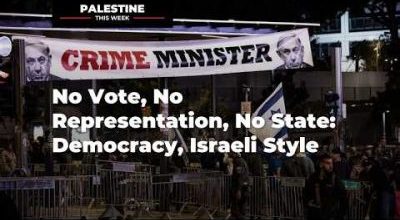
No Vote, No Representation, No State: Democracy, Israeli Style
or go to
Aletho News Archives – Video-Images
From the Archives
Sanctions, War and the Policy of Dual Containment
By SASAN FAYAZMANESH | March 17, 2008
It is now nearly three decades since the Unites States adopted the policy of dual containment of Iran and Iraq. While much has been written about the containment of Iraq, there has been very little in-depth analysis of this policy when it comes to Iran. In a book that is going to be released on March 31, 2008, entitled The United States and Iran: Sanctions, Wars and the Policy of Dual Containment (Routledge), I attempt to address this shortcoming by investigating when and why the US policy of containment of Iran came about, how it evolved, and where it stands today.[1] To the extent that Israel has been involved in US policy making, the study will also include the role that Israel has played in the containment of Iran. Also, since the fate of Iran has been inextricably linked to that of Iraq, occasionally the investigation will overlap with the containment of Iraq.
The policy of dual containment of Iran and Iraq originated during the Carter Administration, but it was not until the Clinton Administration that the expression “dual containment” became popular. … continue
Blog Roll
 Aletho News
- How Israel destabilizes the Middle East: Denying sovereignty and the right to exist
- Europe’s Establishment Is Embracing War – and Losing Voters
- NATO chief advocates war of aggression
- No Vote, No Representation, No State: Democracy, Israeli Style
- Zionist Bought Senate Blocks Information About American Citizens Killed By Israel
- While Gaza dominates the UN, these are the people keeping it alive
- New Report: “Scholasticide and Genocide in Gaza: Assessment, Testimonies and Legal Analysis”
- ‘THAAD Delusion’: Iran war exposes US missile shield limits – The Atlantic
- Moscow issues warning to NATO over Russian exclave
- Yes, the Iran war has destroyed Trump’s presidency
- If Americans Knew
- Israeli former leaders and security chiefs threaten legal action over ‘Jewish terrorism’
- Israel map in LA Times ad includes all land from the river to the sea
- Inside Lebanon’s 200-page dossier on Israeli war crimes
- Flydubai, genocide, settler violence, Trump abuse of power to deport – Daily Update
- Counting Antisemitic Incidents: What the ADL Audit Reveals — and Obscures
- Mamdani releases plan to combat antisemitism and hate crimes in New York City
- Iran’s Revolutionary Guards Publish Letter to the American People
- DMFI launches $1 million ad campaign supporting Virginia’s Elaine Luria
- US Senate blocks resolution seeking report on Americans killed by Israel
- Israeli Attacks Kill Ten Palestinians in Gaza
- No Tricks Zone
- Green Energy Debacle: German Expert Professor Fritz Vahrenholt Warns Of Severe Economic And Social Consequences
- Two More Paleo Reconstructions Affirm Meters-Higher Sea Levels Across Ireland, Brazil 7000-6000 Years Ago
- New Study: Earth And Venus Surface Warmth Largely Explained By Convection And Lapse Rate, Not CO2 Or Radiation
- 2025 Nature Paper Claiming Worsening Global Drought Gets RETRACTED …Heavily Flawed
- New Study: ‘Global Drought Shows No Detectable Recent Acceleration Under Climate Warming’
- Economic Masterminds: German Socialists Suggest Taxing Productivity Gains Stemming From Using AI
- The South China Sea Has Not Been Cooperating With The Climate Change Narrative
- Energy Crisis: Germany Enters Heating Season With Historically Low Gas Reserve Fill Levels
- New Study: The Antarctic Ice Sheet Gained Mass From 2020-2024 Due To Staggering Snow And Ice Accumulation
- Study: Ocean Heating Rates From Thousands Of Years Ago ‘Dwarf’ Modern Ocean Heating Rates

